The day of the devils
p. 15 · Read in the full issue
Tonga
THE Kingdom of Tonga scored an international publicity coup last month, but one which its leaders probably could have done without. The breathless saga first hit Pacific Island air waves on March 28. A female member of Tonga’s 3000-member Tokaikolo Christian Fellowship claimed to have
been kidnapped, interrogated and drug
ged by two men in dark glasses and a modern-day witch with computers on her chest. The woman prayed in her drugged delirium and, she later claimed, an angel dressed in shining white re leased her from her captors’ van.
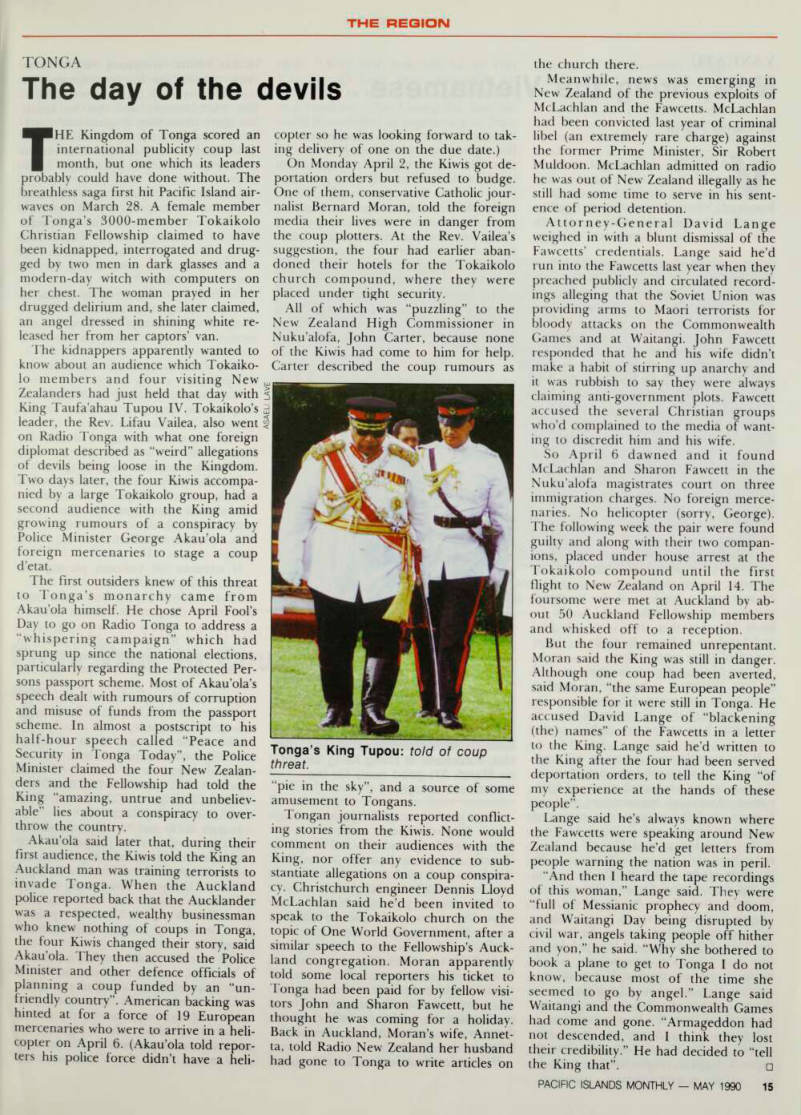
The kidnappers apparently wanted to know about an audience which Tokaiko lo members and four visiting New Zealanders had just held that day with King Taufa’ahau Tupou IV. Tokaikolo’s leader, the Rev. Lifau Vailea, also went on Radio Tonga with what one foreign diplomat described as “weird” allegations of devils being loose in the Kingdom.
Two days later, the four Kiwis accompa nied by a large Tokaikolo group, had a second audience with the King amid
growing rumours of a conspiracy by
Police Minister George Akau’ola and foreign mercenaries to stage a coup d’etat.
The first outsiders knew of this threat to Tonga’s monarchy came from Akau’ola himself. He chose April Fool’s Day to go on Radio Tonga to address a
“whispering campaign” which had
sprung up since the national elections, particularly regarding the Protected Per sons passport scheme. Most of Akau’ola’s speech dealt with rumours of corruption and misuse of funds from the passport scheme. In almost a postscript to his half-hour speech called “Peace and Security in Tonga Today”, the Police Minister claimed the four New Zealan ders and the Fellowship had told the King “amazing, untrue and unbeliev able” lies about a conspiracy to over throw the country.
Akau’ola said later that, during their first audience, the Kiwis told the King an Auckland man was training terrorists to invade Tonga. When the Auckland police reported back that the Aucklander was a respected, wealthy businessman who knew nothing of coups in Tonga, the four Kiwis changed their story, said Akau’ola. They then accused the Police Minister and other defence officials of planning a coup funded by an “un friendly country”. American backing was hinted at for a force of 19 European mercenaries who were to arrive in a heli copter on April 6. (Akau’ola told repor ters his police force didn’t have a heli
copter so he was looking forward to tak ing delivery of one on the due date.) On Monday April 2, the Kiwis got de portation orders but refused to budge.
One of them, conservative Catholic jour nalist Bernard Moran, told the foreign media their lives were in danger from the coup plotters. At the Rev. Vailea’s suggestion, the four had earlier aban doned their hotels for the Tokaikolo church compound, where they were placed under tight security.
All of which was “puzzling” to the New Zealand High Commissioner in Nuku’alofa, John Carter, because none of the Kiwis had come to him for help.
Carter described the coup rumours as
“pie in the sky”, and a source of some amusement to Tongans.
Tongan journalists reported conflict
ing stories from the Kiwis. None would comment on their audiences with the King, nor offer any evidence to sub stantiate allegations on a coup conspira cy. Christchurch engineer Dennis Lloyd McLachlan said he’d been invited to speak to the Tokaikolo church on the topic of One World Government, after a similar speech to the Fellowship’s Auck land congregation. Moran apparently told some local reporters his ticket to Tonga had been paid for by fellow visi tors John and Sharon Fawcett, but he thought he was coming for a holiday.
Back in Auckland, Moran’s wife, Annet ta, told Radio New Zealand her husband had gone to Tonga to write articles on
the church there.
Meanwhile, news was emerging in New Zealand of the previous exploits of McLachlan and the Fawcetts. McLachlan had been convicted last year of criminal
libel (an extremely rare charge) against
the former Prime Minister, Sir Robert Muldoon. McLachlan admitted on radio he was out of New Zealand illegally as he still had some time to serve in his sent ence of period detention.
Attorney-General David Lange
weighed in with a blunt dismissal of the Fawcetts’ credentials. Lange said he’d run into the Fawcetts last year when they preached publicly and circulated record ings alleging that the Soviet Union was providing arms to Maori terrorists for bloody attacks on the Commonwealth Games and at Waitangi. John Fawcett responded that he and his wife didn’t make a habit of stirring up anarchy and it was rubbish to say they were always
claiming anti-government plots. Fawcett
accused the several Christian groups who’d complained to the media of want ing to discredit him and his wife.
So April 6 dawned and it found McLachlan and Sharon Fawcett in the Nuku’alofa magistrates court on three
immigration charges. No foreign merce
naries. No helicopter (sorry, George).
The following week the pair were found guilty and along with their two compan ions, placed under house arrest at the Tokaikolo compound until the first flight to New Zealand on April 14. The foursome were met at Auckland by ab out 50 Auckland Fellowship members and whisked off to a reception.
But the four remained unrepentant.
Moran said the King was still in danger.
Although one coup had been averted, said Moran, “the same European people” responsible for it were still in Tonga. He accused David Lange of “blackening (the) names” of the Fawcetts in a letter to the King. Lange said he’d written to the King after the four had been served deportation orders, to tell the King “of my experience at the hands of these people”.
Lange said he’s always known where the Fawcetts were speaking around New Zealand because he’d get letters from people warning the nation was in peril.
“And then I heard the tape recordings of this woman,” Lange said. They were “full of Messianic prophecy and doom,
and Waitangi Day being disrupted by
civil war, angels taking people off hither and yon,” he said. “Why she bothered to book a plane to get to Tonga I do not know, because most of the time she seemed to go by angel.” Lange said Waitangi and the Commonwealth Games had come and gone. “Armageddon had not descended, and I think they lost their credibility.” He had decided to “tell the King that”. □
Tonga’s King Tupou: told of coup threat.