The best and the worst of Ofa
p. 14 · Read in the full issue
Samoa
NATURAL disasters bring out
the best and the worst in peo ple, and Ofa was no exception.
For example, the Mainland US Gov ernment agency handling disaster relief,
the Federal Emergency Management
Administration (FEMA) counted up the applications for household disaster assist ance in American Samoa. They found 6900 of them.
The only problem is that other, pre- Ofa statistics showed that there were not that many households in the territory.
Further, the Red Cross, running a diffe rent assistance programme, had a total of only 5200 claims. Since not all families were hurt by the storm this meant that many hundreds of families had sought to defraud the governnment. “The num bers of applications are outrageous,” an anonymous FEMA official told the Samoa Journal. “We will be verifying ev
erything.”
FEMA faced a minor version of this same problem on the Mainland, after the San Francisco earthquake, but the feds had a basic identification tool to mini mise the extent of the scam and potential con men know about it. On the Mainland, 99 per cent of the houses have well-fixed addresses, usually a num ber and a street name. There are no such addresses for most houses in Amer ican Samoa, and island names are con fusing to the Statesiders flown in for handling the claims.
The extent of the fraudulent claims was well publicised and caused at least one of the newspapers in Pago Pago to write a pained editorial on the subject, saying, in effect, “do not try to get more than your share”.
While the fraud problem slowed the application-screening process and while there were some criticisms, as there al ways are in such situations, that the re lief agency did not act quickly enough, FEMA did approve enough applications rapidly enough to cause another
problem.
The Bank of Hawaii, despite regular infusions of currency arriving on every plane from Honolulu, ran out of cash.
So many people had so many large Ofa checks so quickly that the bank could not keep up with the demand for dollars.
Bankers tried to convince the grantees to put at least some of the money in savings or checking accounts, but most families wanted cash on the barrelhead.
“We can’t cash $4OOO checks all in one go. We got nearly the whole island con verging on us,” complained one bank official. Another island bank, Amerika Samoa Bank, did not have this problem. (Despite the very real damage to the is
lands, one wonders what happens to personal spending patterns, and to prices, with so much extra cash sloshing around in the island’s economy).
It is not that all FEMA assistance flows quickly through a single pipeline. There are at least two principal programmes for storm-hurt families (as well as others for businessmen and for the government itself). The programme paying the most rapidly is the individual and family grant programme. There is also the housing programme, which in some cases will provide entirely new houses for eligible families, and in more cases will provide help to rebuild damaged houses. Given the size of the challenge and the relatively small number of building contractors in the territory, FEMA decided that it
would, under some circumstances, allow families to repair their own houses or hire handymen to do it for them; this decision was an indications of FEMA’s flexibility; it would not make such a deci sion on the Mainland, and had not done so during the last big storm to hit Amer ican Samoa.
Some 500 families, whose houses were totally obliterated during the storm, and who are now living in FEMA-supplied tents, will get 360-, 480-, 600-, or 720square foot houses, built of wood on concrete foundations, at no cost. (The size of the house varied depending on the size of the destroyed house). FEMA contends that these houses, in most inst ances, will be both more comfortable and more valuable than the earlier house.
Typically storms are more likely to flat ten the less durable houses in a com munity than the sturdier ones. So, if all goes as planned, the basic housing stock of American Samoa will, ultimately, be improved by the combination of Ofa and
Fema.
While the storm-relief programme in American Samoa are considerably better funded than those in Western Samoa they are also more complicated, and more likely to involve written applica tions.
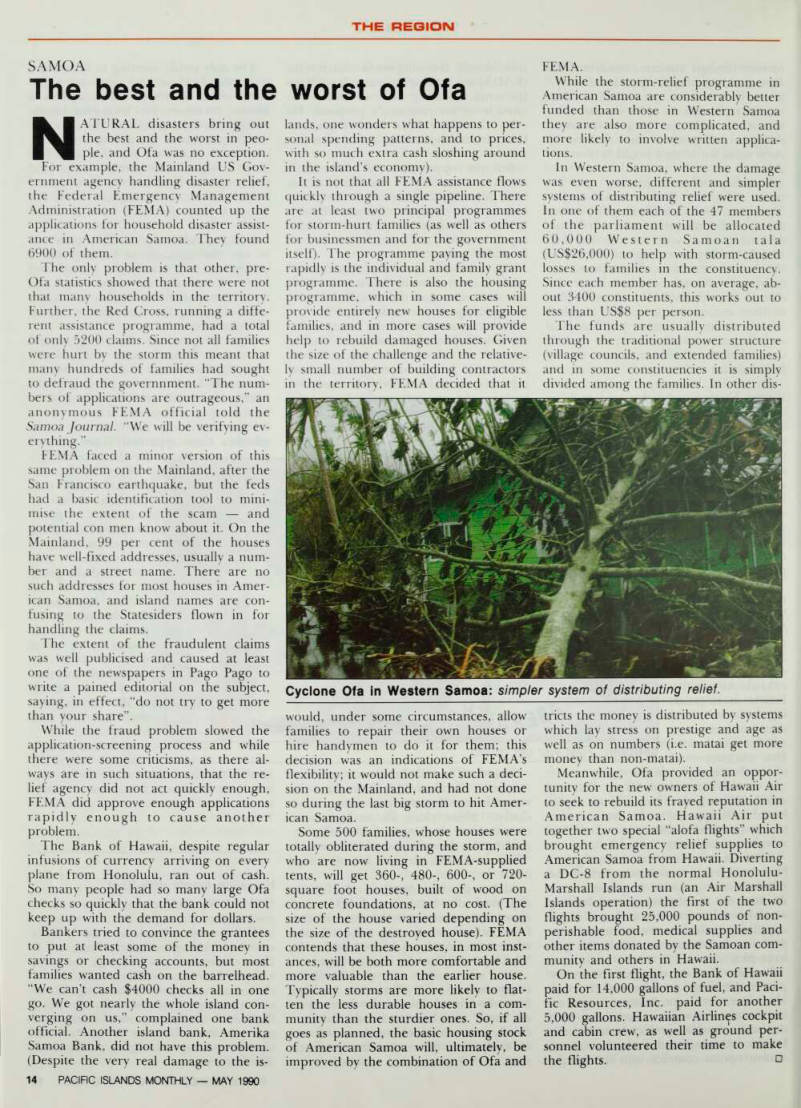
In Western Samoa, where the damage was even worse, different and simpler systems of distributing relief were used.
In one of them each of the 47 members of the parliament will be allocated 60,000 Western Samoan tala (U 5526,000) to help with storm-caused losses to families in the constituency.
Since each member has, on average, ab out 3400 constituents, this works out to less than US$B per person.
The funds are usually distributed through the traditional power structure (village councils, and extended families) and in some constituencies it is simply divided among the families. In other dis
tricts the money is distributed by systems which lay stress on prestige and age as well as on numbers (i.e. matai get more money than non-matai).
Meanwhile, Ofa provided an oppor tunity for the new owners of Hawaii Air to seek to rebuild its frayed reputation in American Samoa. Hawaii Air put
together two special “alofa flights” which
brought emergency relief supplies to American Samoa from Hawaii. Diverting a DC-8 from the normal Honolulu- Marshall Islands run (an Air Marshall Islands operation) the first of the two
flights brought 25,000 pounds of non
perishable food, medical supplies and other items donated by the Samoan com munity and others in Hawaii.
On the first flight, the Bank of Hawaii paid for 14,000 gallons of fuel, and Paci fic Resources, Inc. paid for another 5,000 gallons. Hawaiian Airlines cockpit and cabin crew, as well as ground per sonnel volunteered their time to make the flights. □
Cyclone Ofa in Western Samoa: simpler system of distributing relief.