Playground
pp. 10-13 · Read in the full issue
The Region
Dangerous Playground
A new trade could turn the Pacific into a dump for dangerous rubbish.
By David Robie
A SHADOWY new trade feeding on the poverty of the developing world and the growing waste cri sis in industrialised nations is having an unwelcome impact on the South Pacific.
Frequently the brokers involved are car petbaggers with limited experience in handling garbage and little regard for the delicate ecosystems of fragile island nations.
Usually the trade operates on the fringe of legality or cashes in on legal loopholes and the absence of environ mental safeguards in independent Third World nations countries that desper
ately need fresh sources of income yet lack the infrastructure to police waste
dumpers.
Environmental campaigners describe an “explosion of schemes” to ship waste from the North to the South. Waste brokers are sending flotillas of ships around the world, exploring for new potential dump sites. In the past two years alone more than 3.1 million tonnes of wastes have been exported from in dustrialised countries to the Third World.
The “toxic colonialism”, as it is dubbed by some environmentalists, knows no national boundaries. More than 80 de veloping countries have been asked to
accept massive quantities of industrial waste. In painful choice between poverty and poison, nations are often asked to choose between short-term economic gain and the long-term health of genera tions of their people.”
In 1988 a scheme was exposed under which the impoverished West African nation of Guinea-Bissau would have accepted 15 million tonnes of toxic waste from a consortium of American and European companies. In exchange it would have been paid US$l2O million a year for five years roughly about the same as its gross national product. When the agreement was publicly condemned by the European Parliament and the Organisation of African Unity, Guinea- Bissau pulled out.
In Nigeria, thousands of barrels of toxic waste from Italy were discovered in the tiny port of Koko and the military regime threatened to execute by firing squad anybody trying to profit from the illicit trade. On the island of Guinea, af ter trees began to die researchers disco vered 15,000 tonnes of incinerator ash had been dumped by a Norwegian ship ping company.
With resistance towards the trade growing in Africa and elsewhere, waste brokers have been turning to the South Pacific for what they hoped would be
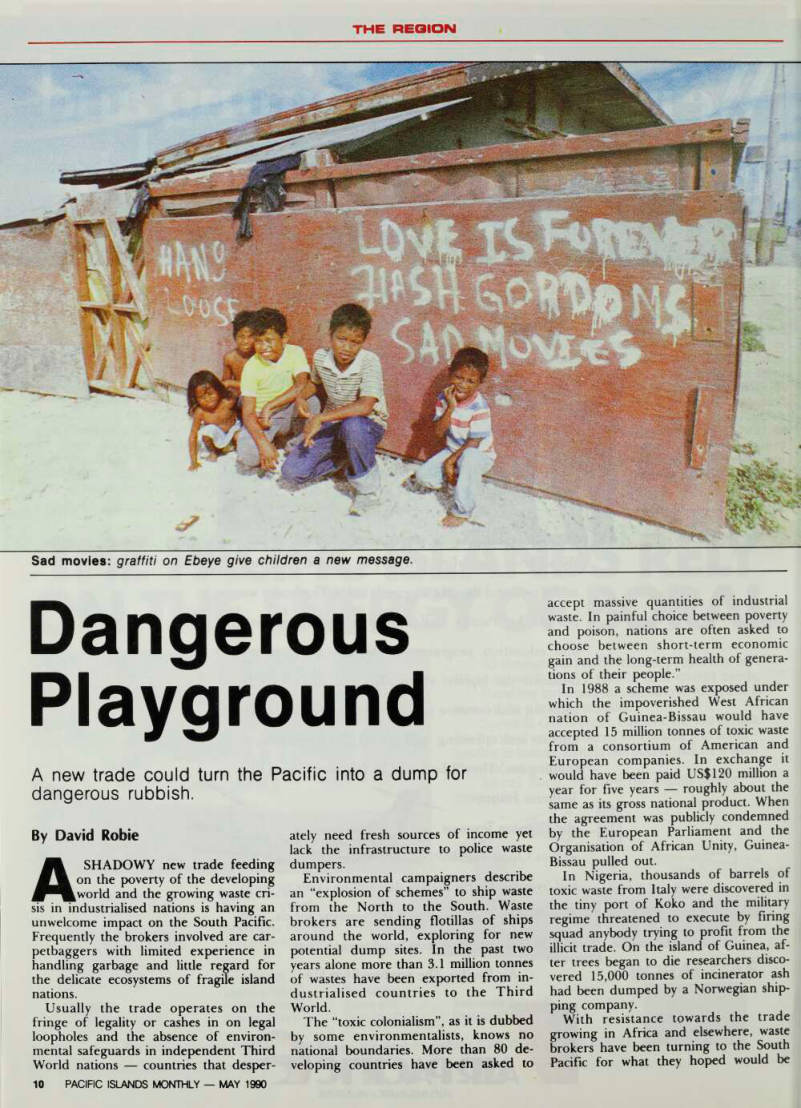
Sad movies: graffiti on Ebeye give children a new message.
easier pickings. Apart from one country, however, their proposals have all col
lapsed.
In Tonga, a plan promoted by King Taufa’ahau Tupou IV’s daughter, Prin cess Pilolevu, to build an incinerator
plant for burning imported toxic wastes
was abandoned in 1988. A scheme in Papua New Guinea was also scrapped the same year. The national government in Port Moresby intervened to block a USS3B million chemical detoxification plant planned by an American company in association with the Northern provin cial government.
Kiribati, the Solomon Islands, Vanuatu and Western Samoa have also turned
down waste dumping proposals.
The one exception so far has been the Marshall Islands where a Californian company’s grandiose scheme for reclaim ing land with garbage fill on low-lying atolls an attempt to counter the so called “greenhouse effect” has won powerful supporters, including President Amata Kabua. In spite of the flaws in the plan which have been exposed since it was first mooted by the company in October 1988, a row last September over an alleged secret plan for the dumping of nuclear waste, and the eroding credi bility of the proposal’s architects, it is still favoured by the country’s political and
business elite.
Now the company, Admiralty Pacific Inc, faces a struggle against a Califor nian rival, Micronesian Marine Develop ment Inc formed after the dispute which split Admirality. And Micro Mar is prepared to spend USsl million on a six-month engineering and environmen tal survey.
Admiralty Pacific’s proposal is to dump 17 million tonnes of “non-toxic” waste over five years in the atoll chain and to add topsoil from New Zealand, or possibly Australia. The company would pay the Marshall Islands government a fee of US$l4O million with an option to continue dumping for a further 10 years.
“If the Marshall Islands accepts the Admiralty proposal it would set a dangerous precedent in the Pacific,” says Lesley Stone, Auckland-based Green peace toxic wastes campaigner for the international Greenpeace environmental organisation. “It could encourage dump ing companies from throughout the world to descend on the region, ped dling their wastes.”
Stone regards the European Economic Community’s agreement last October to ban exports of nuclear and toxic wastes to their African, Pacific and Caribbean (ACP) trading partners as a major break
through.
New Zealand became involved in the Marshall Islands proposal as an environ mental consultant when President Kabua visited there last June: Environment Minister Geoffrey Palmer discussed the proposal with Kabua at the time and ex pressed the concern of other South Paci fic nations.
“I said to President Kabua that accept ance of this proposal would contravene the spirit of the South Pacific Regional Environmental Programme [SPREP] agreement which the Marshall Islands has signed and ratified,” Palmer says.
“While they have been told by Admiralty Pacific that the garbage could provide landfill to cope with a rising sea level from climate change, this could have massive implications for the environ ment.”
President Kabua then asked for New
Zealand’s help in providing an indepen
dent environmental assessment and in the following month the Secretary of the Environment, Dr Roger Blakeley, was sent to Majuro to provide advice.
Although Dr Blakeley won’t be drawn on the nature of that sensitive feedback, he says New Zealand has “established its credentials as a leading independent country with sound environmental
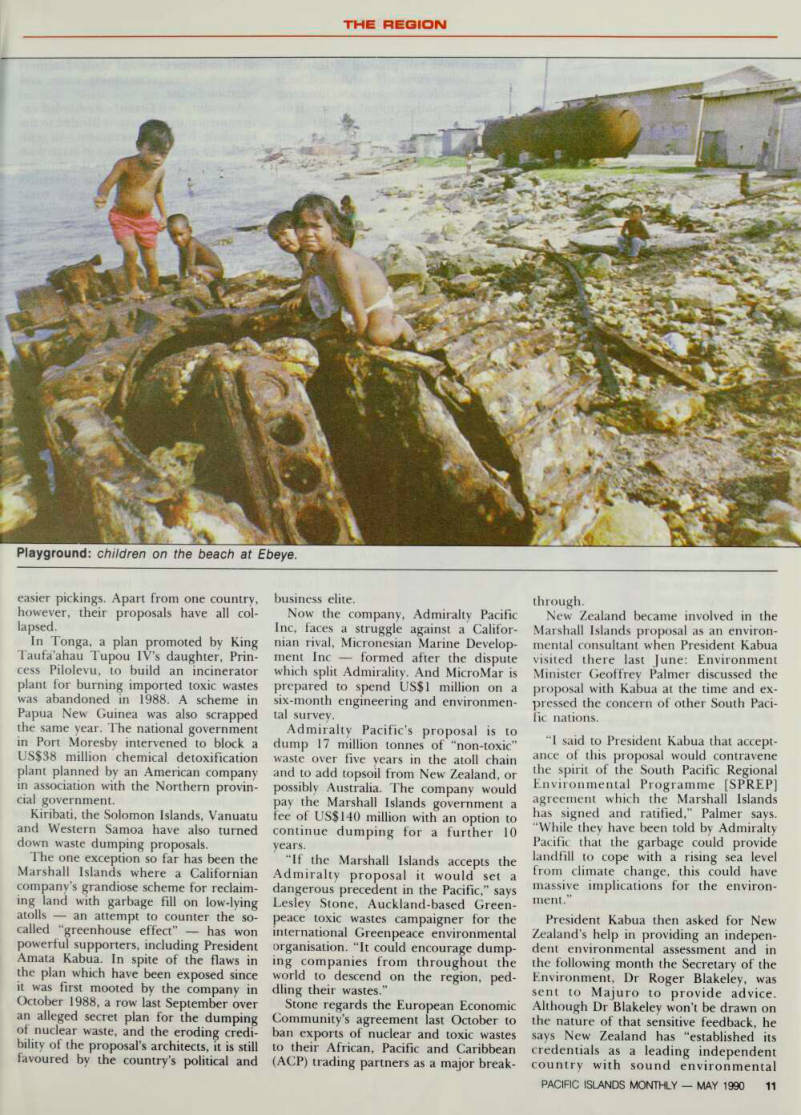
Playground: children on the beach at Ebeye.
priorities.”
For decades the mid-Pacific republic of the Marshall Islands has been a test ing ground for United States nuclear weapons and a target range of ballistic missiles. Arguably the most exploited is land nation in the Pacific, it was forced to “host” nuclear tests by the United States for 12 years after the territory was seized from Japan during the Second World War.
Bikini and Enewetak atolls, in the northern Marshalls, remain too con taminated for people to inhabit; many islands were vapourised by the nuclear blasts. Thousands of islanders are seek ing compensation for illnesses blamed on radiation, and for the loss of their ances tral lands. They are being paid out of a fund provided by the Compact of Free Association an unprecedented treaty in which the United States accepted re sponsibility for nuclear test damages.
A thermonuclear test triggered at Biki ni on 1 March 1954, with a force 1000 times stronger than the atomic bomb dropped on Hiroshima, swept a deadly cloud of fallout to the east, contaminat
ing islanders on Rongelap and Utir ik atolls. In May 1 985 just a month before it was bombed the peace ship Rainbow Warrior evacuated the descendants of the islanders and moved them to a
tiny isle on Kwaja
lein Atoll.
Kwajalein is still a United States milit ary base three years after the Mar shall Islands gained
independence
under the compact and joined the South Pacific Forum. The atoll lagoon is a test ing range for ICBMs launched from Vandenberg Air Force Base in southern California.
The atoll republic is also destined for a key role in testing for the so-called Star Wars missile defence system.
The Marshall Islands government was one of the first to sign and ratify the United Nations-sponsored SPREP con vention for the protection of the natural resources and environment of the South Pacific. The republic has also ratified a forum protocol about cooperation in
dealing with pollution emergencies in
the Pacific and another seeking to pre
vent pollution from dumping.
Although the government is keen on Admiralty Pacific’s proposal, President Kabua stressed at the South Pacific Forum heads of government meeting in Tarawa, Kiribati, last June that his
cabinet would not proceed if feasibility studies being currently conducted were not favourable. Kabua is also counting on further independent advice from New Zealand.
Kabua signed a letter of intent with the developers early last year and the Nitijela (Parliament) passed a resolution
giving Admiralty Pacific exclusive rights
to dispose of the US garbage in the Mar shall Islands if the company’s proposal is found to be “feasible and of benefit to the Marshall Islands people”.
In an earlier interview with Pacific Is lands Monthly, Kabua said: “We’ll prob ably bring some of the experts in New Zealand to look this things up. If it’s not toxic and safe then we’ll accept it be cause it can be a good thing to build land with.” When Admiralty Pacific re portedly tried to persuade the Marshall Islands government to pay US$3 million for the environmental impact study, President Kabua turned them down: “This company hasn’t done its home
work yet.”
Admiralty Pacific also needs to seek clearance from the US Enviromental
Protection Agency
and the republic’s own fledgling agen cy which is follow ing US guidelines.
The proposal
claims that waste dumped in the Marshall Islands would be “non toxic waste and sludge”. Dan Flem ing, then company
vice-president, told
the Marshall Is lands Journal the waste was “non toxic” and non hazardous ... It is
household garbage, with the metals re moved.”
However, since then Fleming has admitted “there is no such thing as non toxic, non-hazardous garbage. But we can make it as safe as is possibly can be.”
Greenpeace campaigner Lesley Stone
stresses that the problems associated with landfills are well-known and well documented: “Leachate produced when water filters through garbage can con tain a highly toxic cocktail which will contaminate drinking water, rivers or coastal marine life. A ‘landfill’ in a la goon would make it possible to contain the leachate and its effects would be
magnified.”
About two-thirds of the municipal waste is expected to be actual household waste. Other wastes typically found in municipal waste include commercial waste, construction debris, industrial process waste, hazardous waste from
small industries, sewage sludge, inciner ator ash, asbestos-containing waste, and infectious waste.
According to a Greenpeace-funded en vironmental impact report handed to the Marshall Islands government, an esti mated 58 million kilograms of hazardous waste would be included in the dumped garbage. Some of hazardous substances probably including highly toxic
cyanide, dry cleaning filtration residues,
ignitable wastes, photographic wastes and strong acids or alkalis would leach into the lagoons or water supplies, or otherwise pollute the environment.
Coupled with the fact that receiving landfills in the Marshall Islands do not
comply with the regulations required for
US landfills, the proposal poses signifi cant short and long-term threats to groundwater, near-shore marine areas, air quality, and agriculture activity, says Greenpeace.
“There is good theoretical and empir ical evidence that the hazardous consti tuents that are placed in land disposal facilities very likely will migrate from the facility into the broader environment,” says the US Environment Protection Agency. “This may occur several years, even many decades, after placement of the waste in the facility, but data and scientific prediction indicate that, in most cases, even with the application of the best available land disposal technology, it will occur eventually.”
The Greenpeace report stresses that for the Marshall Islands, a “whole range of different problems would be added to those of conventional landfills because of their unique location. Forces which will increase the difficulty of containing con taminants include wind and rain erosion during tropical downpours, potential in undation during several tropical storms, exposure and dispersal via wave and tid al action”.
Greenpeace plans a Pacific-wide education drive on waste-dumping and the campaign ship Rainbow Warrior II is expected to visit the Marshall Islands ab out June. “There is no question of us telling people what they should do,” says Stone. “It is a matter of creating an awareness of what garbage is and the price they’ll have to pay for having it.”
Knowledge gained from the Greenpeace education drive would be made available to other Pacific countries in the form of useful literature and information kits.
A suggestion two years ago by Presi dent Kabua that several atolls be studied as possible sites for the dumping of nuc lear waste from plants in the US and elsewhere was revived late last year. At the time the notion was first raised Con gress instructed the Reagan administra tion to consider the islands as a nuclear dump in return for “big money”.
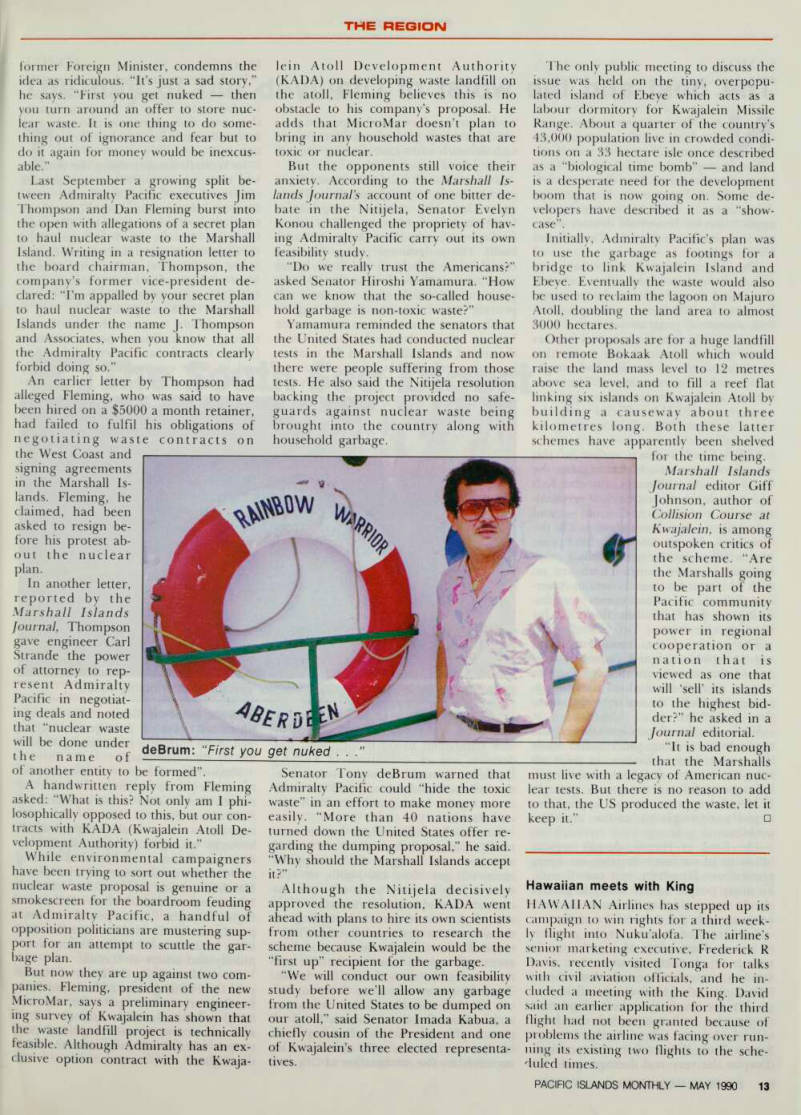
Senator Tony deßrum, an outspoken
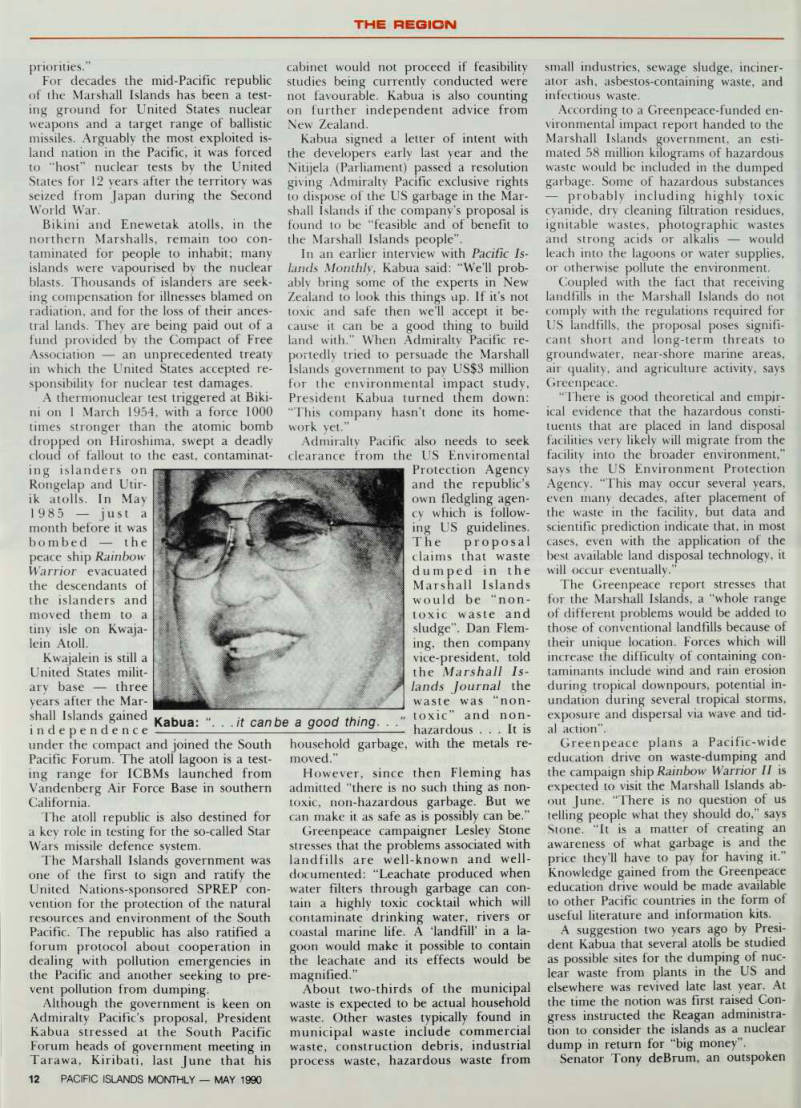
Kabua: ". . .it can be a good thing. . .”
former Foreign Minister, condemns the idea as ridiculous. “It’s just a sad story,” he says. “First you get nuked then you turn around an offer to store nuc lear waste. It is one thing to do some thing out of ignorance and fear but to do it again for money would be inexcus able.”
Last September a growing split be
tween Admiralty Pacific executives Jim Thompson and Dan Fleming burst into the open with allegations of a secret plan to haul nuclear waste to the Marshall Island. Writing in a resignation letter to the board chairman, Thompson, the company’s former vice-president de clared: “I’m appalled by your secret plan to haul nuclear waste to the Marshall Islands under the name J. Thompson and Associates, when you know that all the Admiralty Pacific contracts clearly forbid doing so.”
An earlier letter by Thompson had alleged Fleming, who was said to have been hired on a $5OOO a month retainer, had failed to fulfil his obligations of negotiating waste contracts on
the West Coast and
signing agreements
in the Marshall Is lands. Fleming, he claimed, had been asked to resign be fore his protest ab out the nuclear
plan.
In another letter, reported by the Marshall Islands Journal , Thompson gave engineer Carl Strande the power of attorney to rep
resent Admiralty
Pacific in negotiat ing deals and noted that “nuclear waste will be done under the name of
of another entity to be formed”.
A handwritten reply from Fleming asked: “What is this? Not only am I phi losophically opposed to this, but our con tracts with KADA (Kwajalein Atoll De velopment Authority) forbid it.”
While environmental campaigners have been trying to sort out whether the nuclear waste proposal is genuine or a smokescreen for the boardroom feuding at Admiralty Pacific, a handful of opposition politicians are mustering sup port for an attempt to scuttle the gar
bage plan.
But now they are up against two com panies. Fleming, president of the new Micro Mar, says a preliminary engineer ing survey of Kwajalein has shown that the waste landfill project is technically feasible. Although Admiralty has an ex clusive option contract with the Kwaja
lein Atoll Development Authority
(KADA) on developing waste landfill on the atoll, Fleming believes this is no obstacle to his company’s proposal. He adds that Micro Mar doesn’t plan to bring in any household wastes that are toxic or nuclear.
But the opponents still voice their anxiety. According to the Marshall Islands Journal’s account of one bitter debate in the Nitijela, Senator Evelyn Konou challenged the propriety of having Admiralty Pacific carry out its own
feasibility study.
“Do we really trust the Americans?” asked Senator Hiroshi Yamamura. “How can we know that the so-called household garbage is non-toxic waste?”
Yamamura reminded the senators that the United States had conducted nuclear tests in the Marshall Islands and now there were people suffering from those tests. He also said the Nitijela resolution
backing the project provided no safe-
guards against nuclear waste being
brought into the country along with
household garbage.
Senator Tony deßrum warned that Admiralty Pacific could “hide the toxic waste” in an effort to make money more easily. “More than 40 nations have turned down the United States offer re
garding the dumping proposal,” he said.
“Why should the Marshall Islands accept it?”
Although the Nitijela decisively
approved the resolution, KADA went ahead with plans to hire its own scientists from other countries to research the scheme because Kwajalein would be the “first up” recipient for the garbage.
“We will conduct our own feasibility study before we’ll allow any garbage from the United States to be dumped on our atoll,” said Senator Imada Kabua, a chiefly cousin of the President and one of Kwajalein’s three elected representa tives.
The only public meeting to discuss the issue was held on the tiny, overpcpu lated island of Ebeye which acts as a labour dormitory for Kwajalein Missile Range. About a quarter of the country’s 43,000 population live in crowded condi tions on a 33 hectare isle once described as a “biological time bomb” and land is a desperate need for the development boom that is now going on. Some de velopers have described it as a “show case”.
Initially, Admiralty Pacific’s plan was
to use the garbage as footings for a bridge to link Kwajalein Island and Ebeye. Eventually the waste would also be used to reclaim the lagoon on Majuro Atoll, doubling the land area to almost 3000 hectares.
Other proposals are for a huge landfill on remote Bokaak Atoll which would raise the land mass level to 12 metres above sea level, and to fill a reef flat linking six islands on Kwajalein Atoll by building a causeway about three kilometres long. Both these latter schemes have apparently been shelved
for the time being.
Marshall Islands Journal editor Giff Johnson, author of Collision Course at Kwajalein, is among outspoken critics of the scheme. “Are the Marshalls going to be part of the
Pacific community
that has shown its power in regional cooperation or a nation that is viewed as one that will ‘sell’ its islands to the highest bid der?” he asked in a Journal editorial.
“It is bad enough that the Marshalls
must live with a legacy of American nuc lear tests. But there is no reason to add to that, the US produced the waste, let it keep it.” □
Hawaiian meets with King HAWAIIAN Airlines has stepped up its campaign to win rights for a third week ly flight into Nukualofa. The airline’s senior marketing executive, Frederick R Davis, recently visited Tonga for talks with civil aviation officials, and he in cluded a meeting with the King. David said an earlier application for the third flight had not been granted because of problems the airline was facing over run ning its existing two flights to the sche duled times.
deBrum: ‘‘First you get nuked . . ."