Now, bring the Vietnamese
pp. 16-17 · Read in the full issue
Vanuatu
By David North
VfANUATU, following a series of conflicting statements, has apparently decided to accept a hundred Vietnamese refugee families, providing a series of conditions are met.
The road to that decision was a rough one.
First a self-identified ambassador of the President of Vanuatu, Selwyn A.
Leodoro, told Vietnamese in California that his country would welcome refugees from Hong Kong.
Then the office of Prime Minister Walter Lini and the Vanuatu Foreign Office vehemently denied these reports, and said that Leodoro had been fired as Secretary of the President prior to the
California trip.
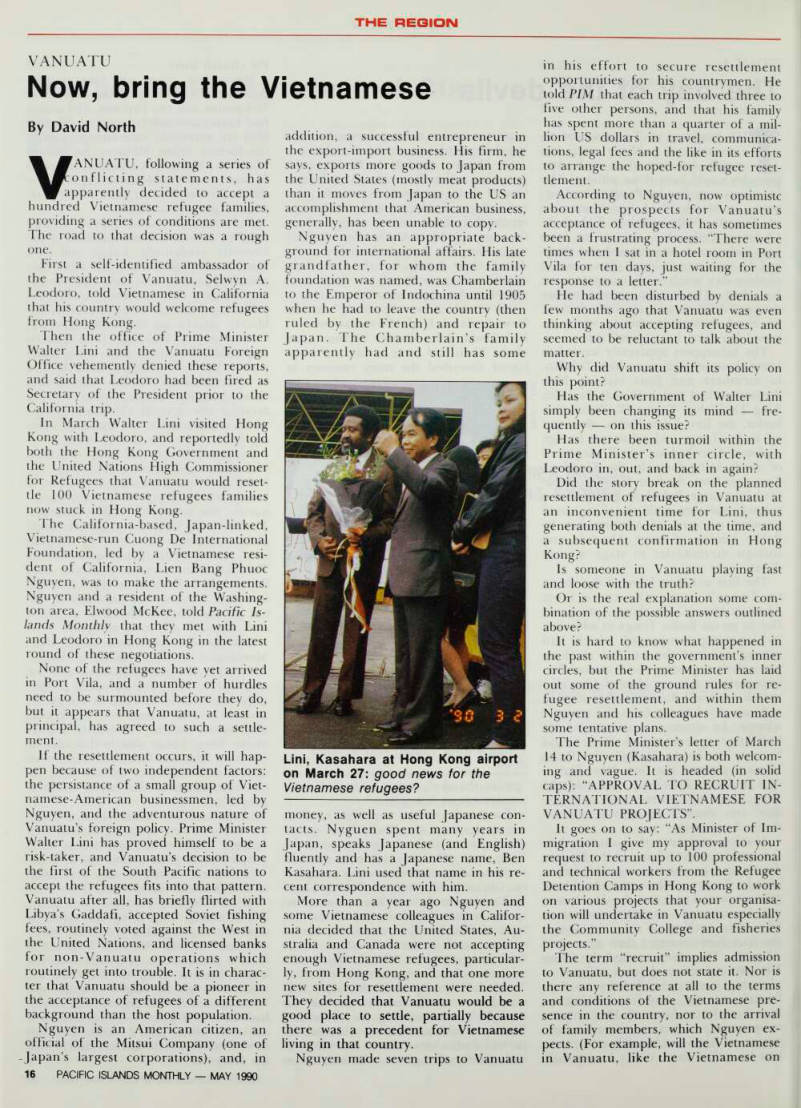
In March Walter Lini visited Hong Kong with Leodoro, and reportedly told both the Hong Kong Government and the United Nations High Commissioner for Refugees that Vanuatu would reset tle 100 Vietnamese refugees families now stuck in Hong Kong.
The California-based, Japan-linked, Vietnamese-run Cuong De International Foundation, led by a Vietnamese resi dent of California, Lien Bang Phuoc Nguyen, was to make the arrangements.
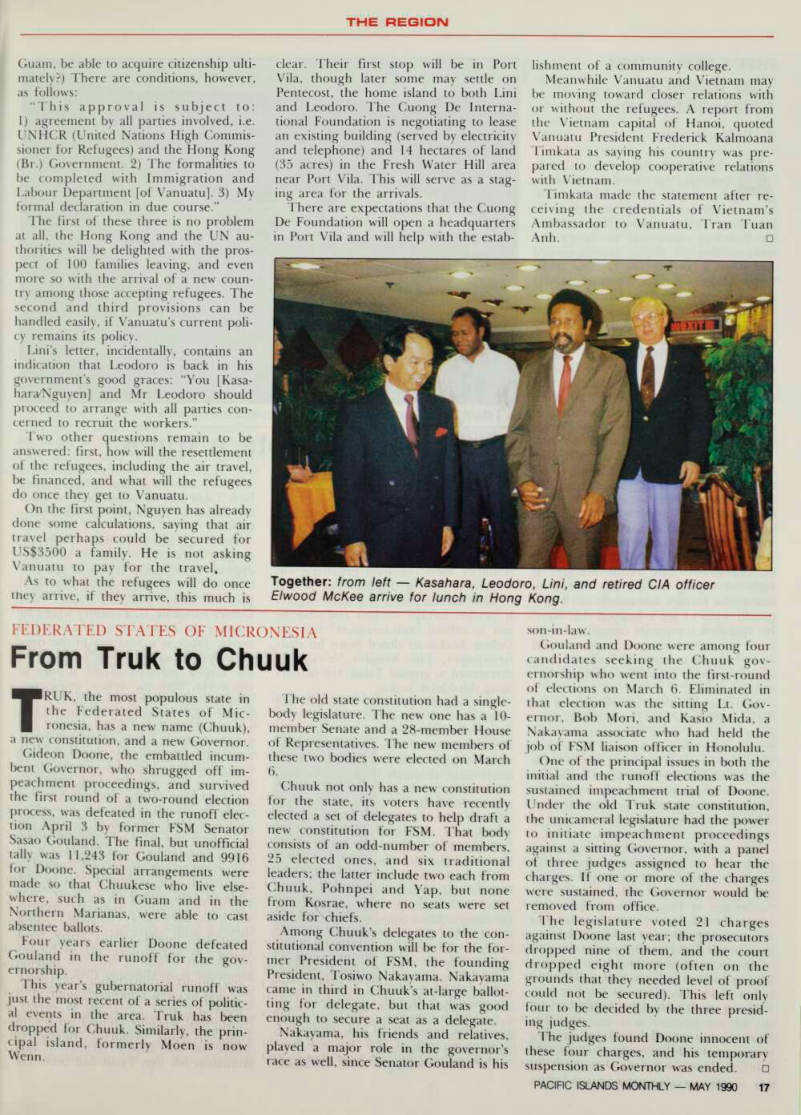
Nguyen and a resident of the Washing ton area, Elwood McKee, told Pacific Is lands Monthly that they met with Lini and Leodoro in Hong Kong in the latest round of these negotiations.
None of the refugees have yet arrived in Port Vila, and a number of hurdles need to be surmounted before they do, but it appears that Vanuatu, at least in principal, has agreed to such a settle ment.
If the resettlement occurs, it will hap pen because of two independent factors: the persistance of a small group of Viet namese-American businessmen, led by Nguyen, and the adventurous nature of Vanuatu’s foreign policy. Prime Minister Walter Lini has proved himself to be a risk-taker, and Vanuatu’s decision to be the first of the South Pacific nations to accept the refugees fits into that pattern.
Vanuatu after all, has briefly flirted with Libya’s Gaddafi, accepted Soviet fishing fees, routinely voted against the West in the United Nations, and licensed banks for non-Vanuatu operations which routinely get into trouble. It is in charac ter that Vanuatu should be a pioneer in the acceptance of refugees of a different background than the host population.
Nguyen is an American citizen, an official of the Mitsui Company (one of Japan’s largest corporations), and, in
addition, a successful entrepreneur in the export-import business. His firm, he says, exports more goods to Japan from the United States (mostly meat products) than it moves from Japan to the US an accomplishment that American business, generally, has been unable to copy.
Nguyen has an appropriate back ground for international affairs. His late grandfather, for whom the family foundation was named, was Chamberlain to the Emperor of Indochina until 1905 when he had to leave the country (then ruled by the French) and repair to
Japan. The Chamberlain’s family
apparently had and still has some
money, as well as useful Japanese con tacts. Nyguen spent many years in Japan, speaks Japanese (and English) fluently and has a Japanese name, Ben Kasahara. Lini used that name in his re cent correspondence with him.
More than a year ago Nguyen and some Vietnamese colleagues in Califor nia decided that the United States, Au stralia and Canada were not accepting
enough Vietnamese refugees, particular
ly, from Hong Kong, and that one more new sites for resettlement were needed.
They decided that Vanuatu would be a good place to settle, partially because there was a precedent for Vietnamese living in that country.
Nguyen made seven trips to Vanuatu
in his effort to secure resettlement opportunities for his countrymen. He told PIM that each trip involved three to five other persons, and that his family has spent more than a quarter of a mil lion US dollars in travel, communica tions, legal fees and the like in its efforts to arrange the hoped-for refugee reset tlement.
According to Nguyen, now optimistc about the prospects for Vanuatu’s acceptance of refugees, it has sometimes been a frustrating process. “There were times when I sat in a hotel room in Port Vila for ten days, just waiting for the response to a letter.”
He had been disturbed by denials a few months ago that Vanuatu was even
thinking about accepting refugees, and
seemed to be reluctant to talk about the matter.
Why did Vanuatu shift its policy on
this point?
Has the Government of Walter Lini simply been changing its mind fre quently on this issue?
Has there been turmoil within the Prime Minister’s inner circle, with Leodoro in, out, and back in again?
Did the story break on the planned resettlement of refugees in Vanuatu at an inconvenient time for Lini, thus generating both denials at the time, and a subsequent confirmation in Hong
Kong?
Is someone in Vanuatu playing fast and loose with the truth?
Or is the real explanation some com bination of the possible answers outlined above?
It is hard to know what happened in the past within the government’s inner circles, but the Prime Minister has laid out some of the ground rules for re fugee resettlement, and within them Nguyen and his colleagues have made some tentative plans.
The Prime Minister’s letter of March 14 to Nguyen (Kasahara) is both welcom ing and vague. It is headed (in solid
Caps): “Approval To Recruit In
Ternational Vietnamese For
Vanuatu Projects”.
It goes on to say: “As Minister of Im migration I give my approval to your request to recruit up to 100 professional and technical workers from the Refugee Detention Camps in Hong Kong to work on various projects that your organisa tion will undertake in Vanuatu especially the Community College and fisheries
projects.”
The term “recruit” implies admission to Vanuatu, but does not state it. Nor is there any reference at all to the terms and conditions of the Vietnamese pre sence in the country, nor to the arrival of family members, which Nguyen ex pects. (For example, will the Vietnamese in Vanuatu, like the Vietnamese on
Lini, Kasahara at Hong Kong airport on March 27: good news for the Vietnamese refugees?
Guam, be able to acquire citizenship ulti mately?) There are conditions, however, as follows: “This approval is subject to: 1) agreement by all parties involved, i.e.
UNHCR (United Nations High Commis sioner for Refugees) and the Hong Kong (Br.) Government. 2) The formalities to be completed with Immigration and Labour Department [of Vanuatu]. 3) My formal declaration in due course.”
The first of these three is no problem at all, the Hong Kong and the UN au thorities will be delighted with the pros pect of 100 families leaving, and even more so with the arrival of a new coun try among those accepting refugees. The second and third provisions can be handled easily, if Vanuatu’s current poli cy remains its policy.
Lini’s letter, incidentally, contains an indication that Leodoro is back in his government’s good graces: “You [Kasa hara/Nguyen] and Mr Leodoro should proceed to arrange with all parties con cerned to recruit the workers.”
Two other questions remain to be answered: first, how will the resettlement of the refugees, including the air travel, be financed, and what will the refugees do once they get to Vanuatu.
On the first point, Nguyen has already done some calculations, saying that air travel perhaps could be secured for US$35OO a family. He is not asking Vanuatu to pay for the travel.
As to what the refugees will do once they arrive, if they arrive, this much is
clear. Their first stop will be in Port Vila, though later some may settle on Pentecost, the home island to both Lini and Leodoro. The Cuong De Interna tional Foundation is negotiating to lease
an existing building (served by electricity
and telephone) and 14 hectares of land (35 acres) in the Fresh Water Hill area near Port Vila. This will serve as a stag ing area for the arrivals.
There are expectations that the Cuong De Foundation will open a headquarters in Port Vila and will help with the estab
lishment of a community college.
Meanwhile Vanuatu and Vietnam may be moving toward closer relations with or without the refugees. A report from the Vietnam capital of Hanoi, quoted Vanuatu President Frederick Kalmoana Timkata as saying his country was pre
pared to develop cooperative relations
with Vietnam.
Timkata made the statement after re ceiving the credentials of Vietnam’s Ambassador to Vanuatu, Tran Tuan Anh. □
Together: from left - Kasahara, Leodoro, Lini, and retired CIA officer Elwood McKee arrive for lunch in Hong Kong.