The glow of midnight
pp. 38-39 · Read in the full issue

Midnight, off the island of Ovalau. Ika 8 lies at anchor, ris ing and falling with the gentle
swell on the island’s leeward side.
Around and behind the vessel, underwa ter bulbs cast an eerie green glow. In the distance, lights show faintly on the Viti Levu horizon.
Aboard the pole-and-liner, Captain
and Fishmaster Peni Latianara casts an eye over the dark waters. He scans the schools of baitfish swarming around the lights and, satisfied, nods to his chief mate.
The catching of bait the most critic al element in pole-and-line fishing be
gins.
The underwater bulbs were lowered at dusk and since darkness fell have been attracting the daniva or sardines that will be used to bring the skipjack tuna to the vessel’s lures the next morning.
Now the moon has set, and Ika B’s lights are the only illumination, the mo ment has come to begin the complex task of catching the bait. Every light on the boat is extinguished, leaving only the underwater lamps showing one astern and one on the port side.
From the almost totally-dark starboard side, the huge boom net is slowly ex tended. Once it is in place, the light ast ern is taken, still underwater, to the back of the vessel. Using a dinghy, the fisher men draw the light around the boat and under the net. The thousands of bait fish, drawn by the light, are thus lured into net.
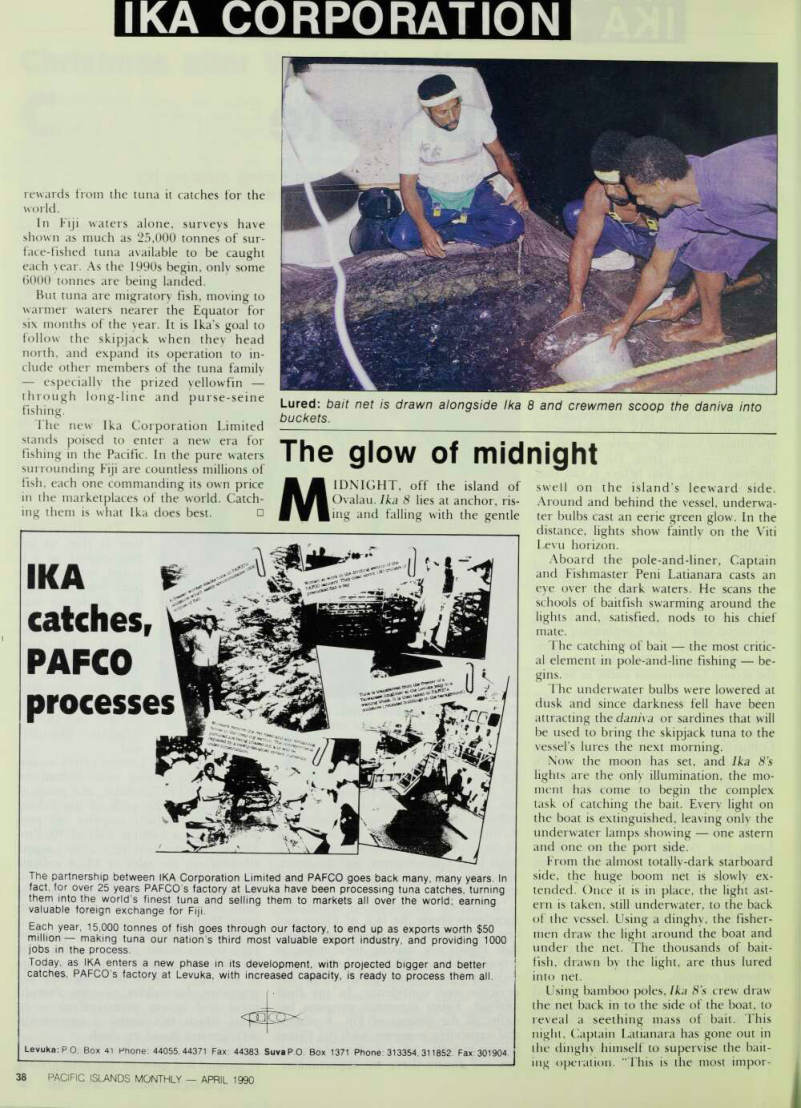
Using bamboo poles, Ika B’s crew draw the net back in to the side of the boat, to reveal a seething mass of bait. This night, Captain Latianara has gone out in the dinghy himself to supervise the bail ing operation. “This is the most impor
Lured: bait net is drawn alongside Ika 8 and crewmen scoop the daniva into buckets.
tant part of the what we do,” he says. “If we get good bait, I know we’ll get fish tomorrow.”
Out in the dinghy, he watches eagle eyed as his crewmen scoop the bait into buckets and transfer it carefully into the ship’s bait tanks. Here the fish will swim until Ika 8 reaches the fishing grounds.
Back on board, the skipper checks each tank of bait. Finally, he allows him self a smile: “Not bad”. Then he’s off to the bridge, the engine room bells sound, the anchor comes up, Ika B’s propellers bite into the dark water, and she comes about headed for the island of Makogai three hours away and another dawn at the fishing grounds.
Night after night during the fishing
season, this is life aboard Ika Corpora tion Limited’s vessels. In all weathers the men of Ika catch tuna for the world.
The work is hard, skilled, and deman ding. The ocean does not yield its riches
easily.
Through the small hours of the morn ing, Ika 8 churns through the darkness.
On the bridge, the captain and his mate pore over the charts. The helmsman, illuminated only by the glow from the gyro-compass, stares steadily ahead. Be low, the fisherman grab an hour or two
of sleep.
In the galley, the cook bakes the day’s
buns, or bread, and boils water for tea.
In the tanks, the bait swim in endless circles. And, in the deep water of the
fishing grounds, the skipjack tuna
tens upon tens of thousands of them
await the dawn.
As the first light of day brightens the east, the men of Ika 8 are ready. Break fast eaten, poles readied, they scan the surface of the Pacific for signs of fish.n
Caught: a crewman transfers live bait to a tank aboard the fishing vessel for use the next morning.