The frenzy
pp. 40-41 · Read in the full issue

of dawn
DAWN, off Makogai. Under a leaden sky, Ika 8 rolls on the deepwater swells of the Pacific.
On the island of Makogai a green backdrop off the starboard bow only the earliest of risers are up and about.
In the vessel’s wake, a handful of gulls wheel and cry.
On the bridge, on the bow and on every corner of the boat, eyes strain
through the early-morning light to catch
a glimpse of skipjack. The prized tuna feed on the surface only at dawn. If they are to catch any today, the men of Ika 8 must find a school and soon. Tension runs high.
Captain Latianara, binoculars glued to his eyes, his feet braced against the heav ing of his vessel, calls directions to his helmsman. He is looking for two things.
The first sign that the skipjack are there is often a flock of gulls circling and plunging into the water in pursuit of baitfish stirred to the surface by the tuna. The fishmaster is also scanning the wave-tops, looking for the tell-tale splash of a leaping fish. In his mouth, he holds a whistle the sound of which will sig nal the baitman to begin casting bait into the water to draw Ika B’s quarry nearer the lures.
Around the bow and the stern sit the fishermen, their long poles ready, dangling pink and white lures. The mi nutes tick away. The sun makes its first appearance over the horizon. No-one speaks. Everyone aboard knows that ev ery moment that passes increases the
The hunt: Fishmaster, Captain Peni Latianara scans the ocean at dawn for signs of feeding skipjack.
danger that the skipjack will return to the depths and Ika 8 will return to its anchorage with nothing to show for the
day.
Then; a grunt of satisfaction from the skipper, the high-pitched scream of his whistle, and the boat erupts into activity.
Firing directions at the helmsman, Captain Latianara signals the baitmen at the bow and stern to direct their bait towards the school. The fishermen plunge their lures into the water. Crew men run bait from the main tanks to smaller containers alongside each baitman.
At the bow and stern, spray pumps
send a sheet of water onto the surface of the sea partly to disguise the boat and partly to excite the skipjack. For a mo ment, again, nothing. Then, all around the vessel splashes erupt from the water.
The poles begin to arc backward over the fishermen’s shoulders.
And, suddenly, the air is filled with fish.
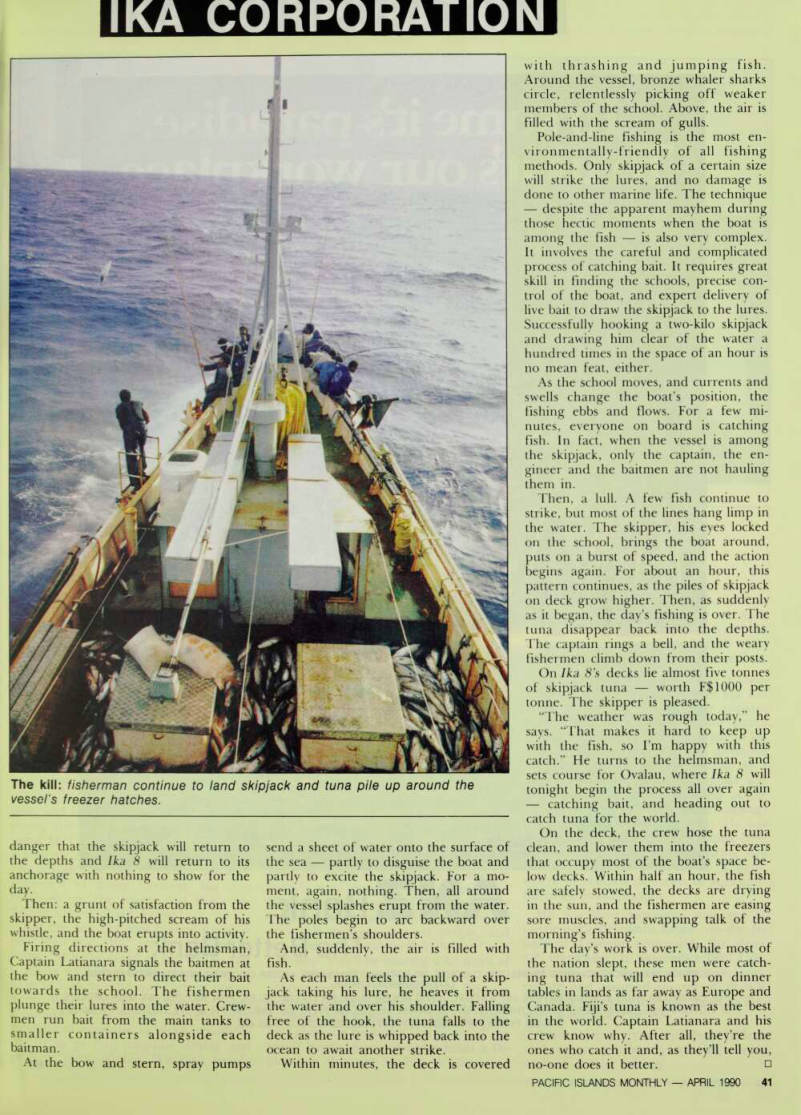
As each man feels the pull of a skip jack taking his lure, he heaves it from the water and over his shoulder. Falling free of the hook, the tuna falls to the deck as the lure is whipped back into the ocean to await another strike.
Within minutes, the deck is covered
with thrashing and jumping fish.
Around the vessel, bronze whaler sharks circle, relentlessly picking off weaker members of the school. Above, the air is filled with the scream of gulls.
Pole-and-line fishing is the most en vironmentally-friendly of all fishing methods. Only skipjack of a certain size will strike the lures, and no damage is done to other marine life. The technique despite the apparent mayhem during those hectic moments when the boat is among the fish is also very complex.
It involves the careful and complicated process of catching bait. It requires great skill in finding the schools, precise con trol of the boat, and expert delivery of live bait to draw the skipjack to the lures.
Successfully hooking a two-kilo skipjack and drawing him clear of the water a hundred times in the space of an hour is no mean feat, either.
As the school moves, and currents and swells change the boat’s position, the fishing ebbs and flows. For a few mi nutes, everyone on board is catching fish. In fact, when the vessel is among the skipjack, only the captain, the en gineer and the baitmen are not hauling them in.
Then, a lull. A few fish continue to strike, but most of the lines hang limp in the water. The skipper, his eyes locked on the school, brings the boat around, puts on a burst of speed, and the action begins again. For about an hour, this pattern continues, as the piles of skipjack on deck grow higher. Then, as suddenly as it began, the day’s fishing is over. The tuna disappear back into the depths.
The captain rings a bell, and the weary fishermen climb down from their posts.
On Ika B’s decks lie almost five tonnes of skipjack tuna worth Fslooo per tonne. The skipper is pleased.
“The weather was rough today,” he says. “That makes it hard to keep up with the fish, so I’m happy with this catch.” He turns to the helmsman, and sets course for Ovalau, where Ika 8 will tonight begin the process all over again catching bait, and heading out to catch tuna for the world.
On the deck, the crew hose the tuna clean, and lower them into the freezers that occupy most of the boat’s space be low decks. Within half an hour, the fish are safely stowed, the decks are drying in the sun, and the fishermen are easing sore muscles, and swapping talk of the
morning’s fishing.
The day’s work is over. While most of the nation slept, these men were catch ing tuna that will end up on dinner tables in lands as far away as Europe and Canada. Fiji’s tuna is known as the best in the world. Captain Latianara and his crew know why. After all, they’re the ones who catch it and, as they’ll tell you, no-one does it better. □
The kill; fisherman continue to land skipjack and tuna pile up around the vessel’s freezer hatches.