Ika goes private
pp. 37-38 · Read in the full issue
Ika Corporation
Fiji continues to corporatise. In late February, the state-owned fishing division, Ika Corporation, turned into a limited liability company. Mark Garrett reports
AT Fiji’s Ika Corporation Limited, fishing is what they do best. In fact, that’s all they do. Among the myriad species of fish that inhabit Fiji waters are the migratory skipjack tuna. These valuable visitors form the backbone of Fiji’s tuna industry now third on the nation’s list of top income earners. In Fiji, they are called ika.
Fiji’s tuna is widely considered to be the finest in the world, and is sold inter nationally under more than 30 different brand names. And, because pole-and line-caught fish are in great demand both for the method’s environmental friendliness and the superior quality of the fish tuna from Fiji commands premium prices. But, before it can find its way onto dinner tables in lands as far away as Europe and Canada, it must first be found, hooked, and landed no easy task in the vast expanses of the Pacific.
That’s where Ika comes in.
The company that bears the name of its quarry was established in 1975, and charged with enhancing the utilisation of marine resources in and around Fiji’s territorial waters. Ika Corporation oper ated successfully as a Government agen cy until January 1, 1990, when it became the second Government entity to be cor poratised.
Freed from the confines of the ordi nance that created it, Ika Corporation, a limited liability company under Fiji’s Companies Act, now intends to build on its reputation for catching the world’s finest tuna, and also harvest a greater share of the vast potential inherent in Pacific fisheries.
On February 26 the new Ika made its public debut at a special function in Lami, just outside Fiji’s capital, Suva.
Fiji’s Minister of Finance and Economic Planning, Josevata Kamikamica, laun ched the new company.
The occasion, Kamikamica told guests at the function, “represents another adv ance in our drive to emancipate Fiji’s economy, thus releasing all the energy and initiative previously curbed by Gov ernment controls.”
Ika, he said, “will be expected to stand on its own, without benefit of grants, and build on its reputation for catching the world’s finest tuna.”
The Minister went on to note that the company provides further proof that in-
digenous Fijians are increasingly becom ing more involved in strategic sectors of the economy. “Ika Corporation’s board has four Fijian members; the general manager is a young Fijian, well-schooled
through the Carpenter Group in all
facets of commerce; four of the five Ika boats have Fijian masters, and the crews, including fishermen, are almost exclu
sively Fijian.
“So when we hear so much de spondency about the lack of Fijian suc cess in business, we should remember that Fijians are making their mark in crucial industries. That trend will streng then as Fijians gain qualifications, ex perience and confidence. In the final analysis, Fijian economic progress be nefits all the citizens of Fiji. A vibrant and expanding economy, with the Fijians joining in fully with our other communi ties, will ensure there are opportunities
and prosperity to be shared by all.”
Ika’s chairman, Colonel Paul Manu eli, a former Com mander of the Royal Fiji Military Forces and later the Suva based general mana ger of British Pet roleum South West Pacific Limited, said Ika’s board had al ways endeavoured to manage the corpora tion as a commercial operation, and said the company had, in fact, been making money, “The difference now is that we are restructured as a li mited liability com pany with the free dom to pursue mar ket opportunities like any other business concern. This repre sents an exciting and
challenging phase for
Ika, and we will strive to significantly improve our per formance,” Manueli said.
Ika Corporation Limited enters its new era on a firm footing, with accumulated profits over Fsl.s million, and assets of $7 million. At the peak of the fishing season, the company employs 145 peo ple, and has a fulltime staff of 50. Pro jections for the first year after corpor atisation are for sales of F 52.4 million.
The new Ika owns five polc-and-line ves sels, two of them commissioned in early 1990 after construction at Fiji’s Govern
ment Shipyard.
Vessels from other countries also fish Fiji’s waters under charter to Ika. The corporation provides a complete range of services from licensing and im migration formalities to crew recruit ment and spares procurement to boats which fish under a commission arrangement based on catch.
But the new Ika plans to go further, to expand and grow to reap even greater
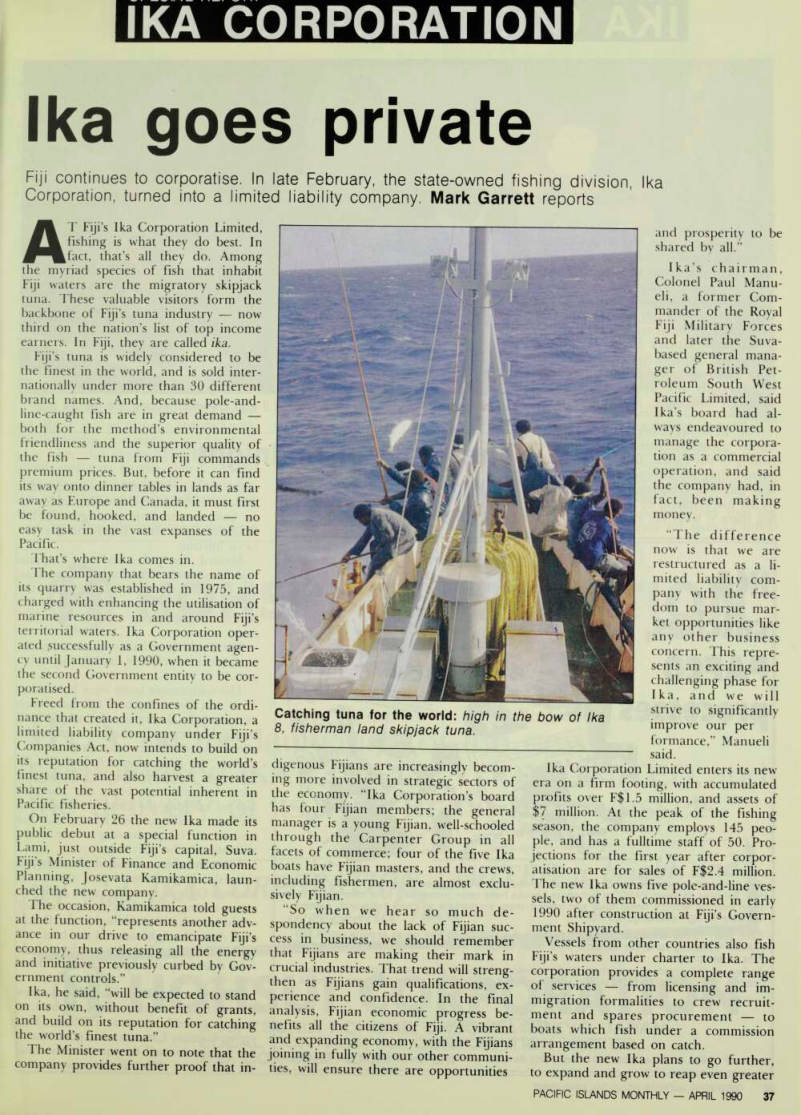
Catching tuna for the world: high in the bow of Ika 8, fisherman land skipjack tuna.
rewards from the tuna it catches for the world.
In Fiji waters alone, surveys have shown as much as 25,000 tonnes of sur face-fished tuna available to be caught each vear. As the 1990 s begin, only some 6000 tonnes are being landed.
But tuna are migratory fish, moving to warmer waters nearer the Equator for six months of the year. It is Ika’s goal to follow the skipjack when they head north, and expand its operation to in clude other members of the tuna family
especially the prized yellowfin
through long-line and purse-seine
fishing.
The new Ika Corporation Limited stands poised to enter a new era for fishing in the Pacific. In the pure waters surrounding Fiji are countless millions of fish, each one commanding its own price in the marketplaces of the world. Catch ing them is what Ika does best. □