boom industry
pp. 34-36 · Read in the full issue
Tourism
Cashing in on a boom industry
The number of hotel rooms in Fiji will more than double in the next five years, generating a lot of income and employment. But will Fiji be able to attract the visitors to fill the rooms?
By Penny Gibson
TOURISM is the biggest growth in
dustry in the world and Fiji is cashing in on the boom. The num ber of rooms will double to 7000 by 1995 and given some of the grandiose plans already on the drawing board, will triple or even quadruple by the year 2000.
The boom is being felt right across the industry, in all size and price-bracket hotels and tourist services. A number of small, exclusive island resorts will open this year and several small and middle range hotels are opening, reopening, re novating and/or expanding on the mainland. There are many new shops, day tours and adventures to cater for all tourists.
The big growth, however, is in the large multi-hotel, condominium and marina complexes planned for Denarau Island, Vulani Island, Nasoso Island, Natadola and Saweni over the next de cade. If the plans come to fruition and there is some scepticism about seeing actual bricks and mortar (and golf
courses) instead of dreams tourism will easily outstrip the rest of the eco nomy as the country’s major income ear ner. There was a 30 percent increase in tourist numbers last year, and although this was still below record levels, they stayed longer (up from 8.5 days to 9.2), creating a record number of “tourist
days”.
The Central Planning Unit and Bureau of Statistics estimate each tourist spent F$ 122.20 each day of their holiday last year, up Fsl9 from 1988. It gener ated a massive Fs2Bl million, as much as the sugar and gold industries put together. This year, projections are for over F|3oo million based on 270,000 tourists. Unfortunately, 58c of every dol lar is leaving the country to pay for im ports of hotel requirements, from machinery and building materials to food, and for profit repatriation to over seas parent companies.
Despite this financial drain, the econo mic benefits are being felt throughout the community. The hotels directly em ploy 7000 skilled, semi-skilled and un skilled people, or about 6.6 percent of
the official workforce. Growth in the labour intensive hotel industry will directly generate 1.8 jobs for every room built.
The indirect benefits for employment in the service sector shop owners, taxi drivers, tour operators, farmers, sup pliers and contractors is almost im possible to calculate.
Landowners and the government are benefitting from large rents. The Native Lands Trust Board (NLTB), a govern ment statutory organisation that admi nisters native land for the benefit of the indigenous owners, earned F 5887,022 last year, with increases forecast for this year of F 5964,869. The Department of Lands bases rents for hotels on Crown Land on the hotels’ gross receipts 3.5 percent of accommodation, food and be verage receipts plus 15 percent on shop and service concessions. Compensation for loss of fishing rights has led to some very large payouts to villages.
Given the anticipated growth, will Fiji be able to fill the hotels? Despite the political situation being far from re solved, the hotels are obviously confident of being profitable or they wouldn’t be investing their hundreds of millions of dollars.
They say Fiji is an exotic destination for Australians and New Zealanders and particularly exotic for Japanese and North Americans, where Fiji has hardly scratched the market, and for Europe where marketing has only just begun.
Fiji appeals because it has a fascinating culture, friendly population and lovely tropical climate. It is clean, with decent medical care and safe drinking water; it has the degree of westernisation most tourists like, even when adventuring into a developing country.
Hoteliers like it because the tourism
Penny Gibson
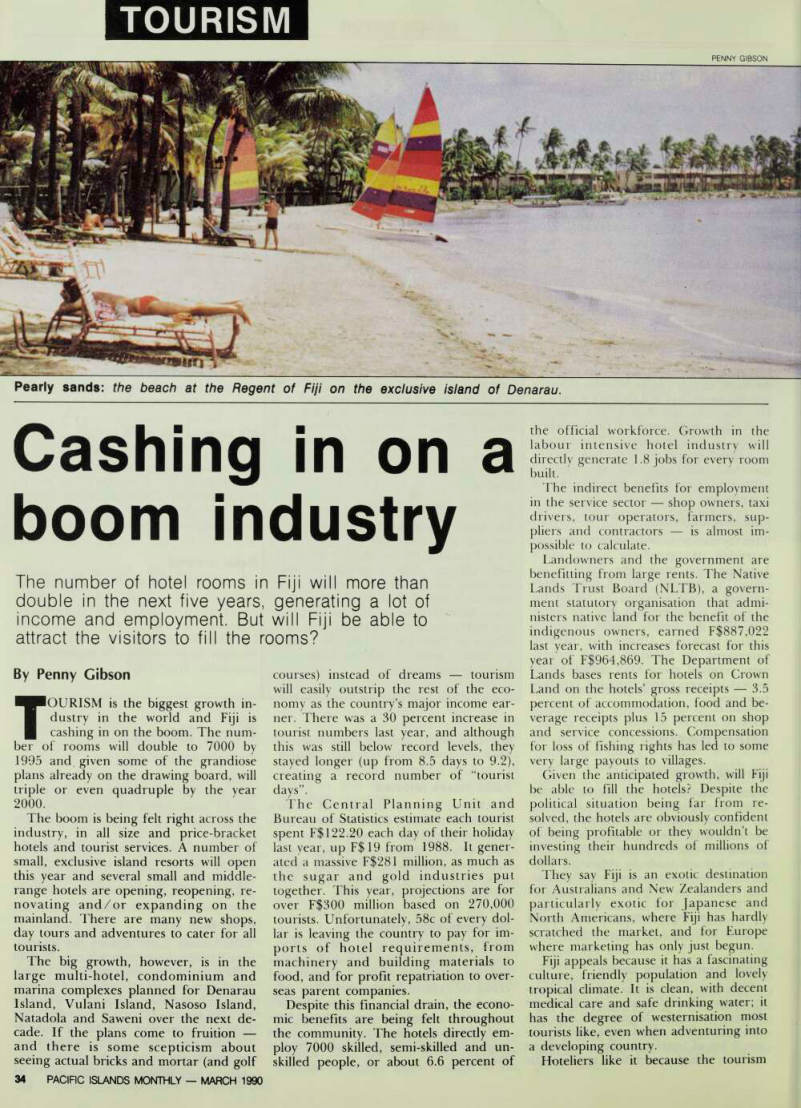
Pearly sands: the beach at the Regent of Fiji on the exclusive island of Denarau.
industry is relativeliy small but has enor mous potential to expand. The facilities are good, there is an excellent road, wa ter and power infrastructure, land and property are relatively cheap and the Government gives a lot of incentives.
The Fiji Hotel Association’s chief ex ecutive, Kevin Mutton, said the tourist industry had been latent for a long time largely because the Government did not give it nearly the same degree of import ance as it does now.
“Growth in the tourism industry will be sustainable given the (current) level of Government commitment and the way the economy is developing. Given the
proper marketing and planning going
into it, it will certainly grow and be a dynamic force in the economy,” he said.
Once new hotel projects using off shore capital have been approved by the Fiji Trades and Investment Board (FTIB) and the Government’s Tourism Advisory Committee, the Government smoothes the way with a steering com mittee of all relevant ministries and in frastructure bodies. Roads, water and power are made available for sites with minimal fuss and sometimes with some financial assistance, particularly where the local population will also benefit.
The Government gives several incen tives to hoteliers to invest under the Hotels Aid Act, which allows developers of any new project or existing project undergoing expansion to set off 55 per cent of approved capital expenditure on buildings against tax, written out over six years. The great outflow of tourist money to overseas hotel chains is also an incentive, and hotels have duty conces sions on imported goods for use in hotels, including food.
The Government has also agreed to fund another hotel school, based in the
Western Division, to train the skilled and semi-skilled staff the hotels will need.
The hotels and Fiji Visitors Bureau (FVB) are confident of maintaining and expanding their traditional sources of tourists and breaking into new territory to fill all these new’ rooms as long as Air Pacific comes to the party with air line seats.
FVB’s marketing director, Fasiu Jione, said FVB was developing new, aggressive policies to diversify from the family mar ket, where Fiji hotels are saturated dur ing school holidays and have much lower occupancy the rest of the year. This year FVB will target the Australian diver, honeymooner and incentive convention markets to stimulate growth in these areas.
Australians comprise over 40 percent of visitors and from July, Air Pacific will increase its capacity from Sydney by 22 per cent to 1830 seats. With the purchase of its new’ 767 aircraft and extra flights, it will almost double its present seat
capacity out of Melbourne (330 to 624) and seats from Brisbane will increase from 270 to 624. From New Zealand, there wil be a 10 per cent increase from 756 seats to 832.
The big growth area will be Japan, currently only 4 per cent of the market; Air Pacific will double its flights from Tokyo from October, taking seal num bers from 420 to 840 a week.
Fiji Visitors Bureau has just begun to tap the European market through the Tourism Council of the South Pacific, which is funded by the EEC and has just opened an office in London and two on the continent. It also wants a Canadian office to take advantage of seats into Fiji on Canadian Airlines, but has no money in this year’s marketing budget. Jione hopes to get alternative funding to set up office by end of year.
Although FVB has a busy office in Los Angeles, the United States market is li mited by the lack of airline seals into Fiji. The Government is trying to negoti ate a North American carrier as Air Pacific says it hasn’t the resources to fly an American route. The USA would be a major source of well-heeled tourists,
back-packers and divers. Fiji is rapidly
gaining an excellent reputation in the USA as a dive destination.
With a severely limited Fs2 million marketing budget, FVB’s main market ing strategy is to influence the in fluencers of travel the media. This year, in co-operation with Air Pacific and tourist operators, FVB will bring 120 travel writers from Australia, New Zea land and the United States to see Fiji for themselves. Fasiu says this has been very effective in the past.
Jione, Mutton and many others in the industry say the fate of Fiji’s tourist in dustry lies with Air Pacific: “A lot of
Jale Moala
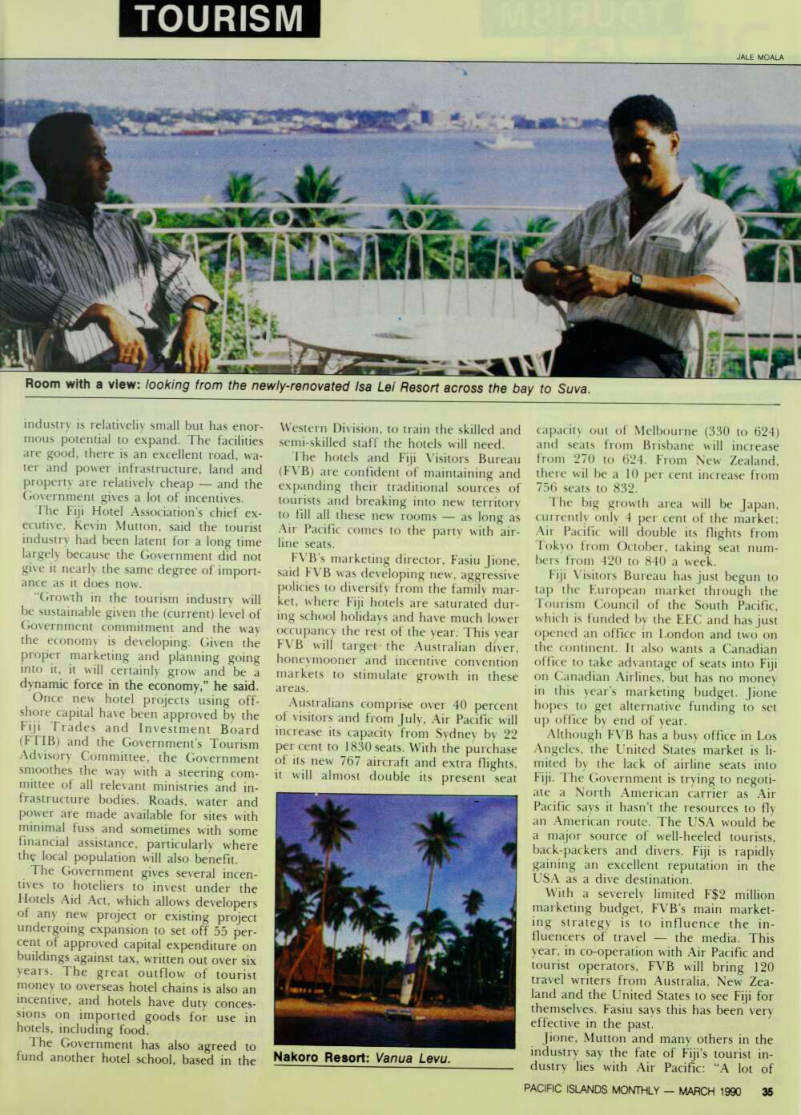
Room with a view: looking from the newly-renovated Isa Lei Resort across the bay to Suva.
Nakoro Resort: Vanua Levu.
North American airlines have come and gone, but at the end of the day, Fiji’s destiny depends on Air Pacific,” accord ing to Mutton. Jione adds: “Growth de pends entirely on having a national car rier. Without (it), Fiji is too dependent on overseas forces.”
Air Pacific’s marketing manager, Ernie Dutta, said US carriers wouldn’t come to Fiji because it was not economically worth their while, and because tourist numbers to the South Pacific have been declining over the last year (though this may be a factor of not enough seats).
FVB has hired a consultant to look at issue of flight seats and predict future requirements. All involved agree it is a chicken and egg situation whether to build the hotel rooms first or provide the airline seats. Air Pacific came in for a lot of criticism last year over the alleged lack of seats, although hotels were also reporting full occupancy. Dutta said Air pacific increased seat numbers to cater for present demands and would make further plans when it was required.
Although pleased with last year’s un precedented boom, he said it was unlike ly to continue this year, particularly as Australian carriers and resorts will be offering rock bottom packages to recoup losses from the airline pilots’ strike.
Regardless of the argument over air line seats, construction is moving apace, with many resorts on the brink of open ing and others being constructed. Plans are on the drawing board for many others, big and small. Some of the new developments include several exclusive, small island resorts Tokoriki Island, Sonaisali Island, Vatulele, Liku Holdings and Yasawa Paradise.
The Fijian on the Coral Coast is build ing a new 74-room wing, the Grand Pacific Hotel in Suva is undergoing a
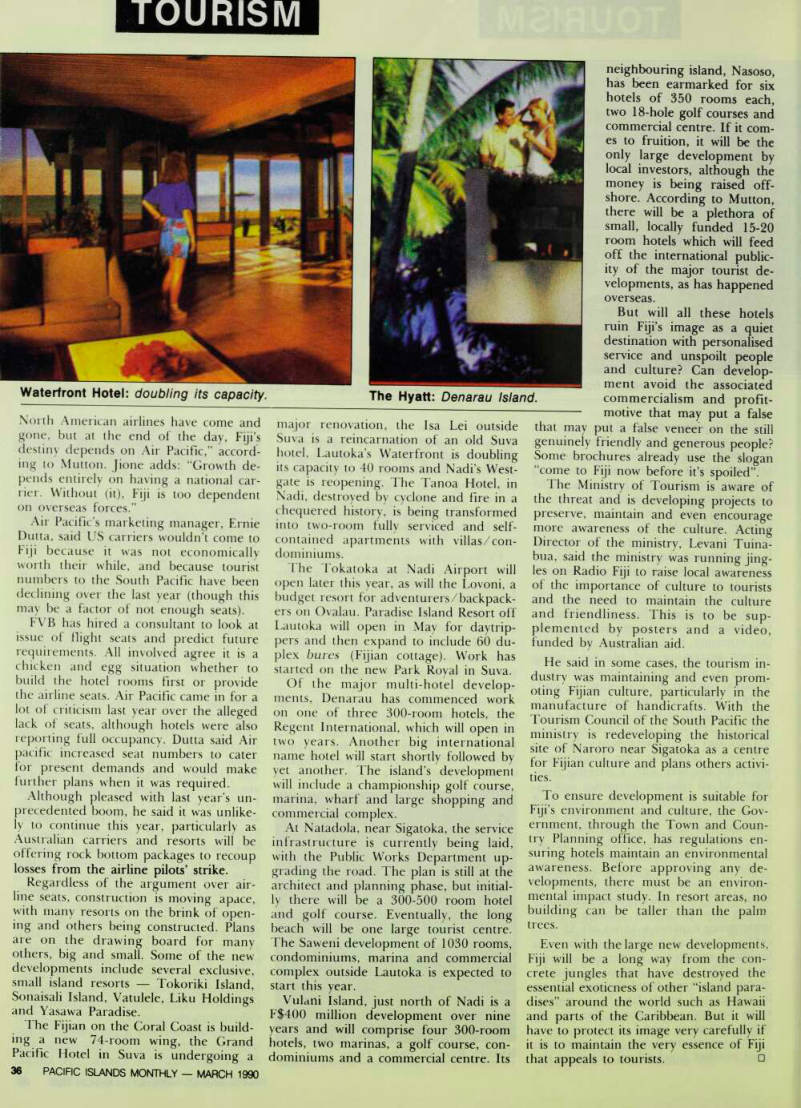
major renovation, the Isa Lei outside Suva is a reincarnation of an old Suva hotel, Lautoka’s Waterfront is doubling its capacity to 40 rooms and Nadi’s West gate is reopening. The Tanoa Hotel, in Nadi, destroyed by cyclone and fire in a
chequered history, is being transformed
into two-room fully serviced and self contained apartments with villas/con dominiums.
The Tokatoka at Nadi Airport will open later this year, as will the Lovoni, a budget resort for adventurers/backpack ers on Ovalau. Paradise Island Resort off Lautoka will open in May for daytrip pers and then expand to include 60 du plex burcs (Fijian cottage). Work has started on the new Park Royal in Suva.
Of the major multi-hotel develop ments, Denarau has commenced work on one of three 300-room hotels, the Regent International, which will open in two years. Another big international name hotel will start shortly followed by yet another. The island’s development will include a championship golf course, marina, wharf and large shopping and
commercial complex.
At Natadola, near Sigatoka, the service infrastructure is currently being laid, with the Public Works Department up grading the road. The plan is still at the architect and planning phase, but initial ly there will be a 300-500 room hotel
and golf course. Eventually, the long
beach will be one large tourist centre.
The Saweni development of 1030 rooms, condominiums, marina and commercial complex outside Lautoka is expected to start this year.
Vulani Island, just north of Nadi is a Fs4oo million development over nine years and will comprise four 300-room hotels, two marinas, a golf course, con dominiums and a commercial centre. Its
neighbouring island, Nasoso, has been earmarked for six hotels of 350 rooms each, two 18-hole golf courses and commercial centre. If it com es to fruition, it will be the
only large development by
local investors, although the money is being raised off shore. According to Mutton, there will be a plethora of small, locally funded 15-20 room hotels which will feed off the international public ity of the major tourist de
velopments, as has happened
overseas.
But will all these hotels
ruin Fiji’s image as a quiet
destination with personalised
service and unspoilt people
and culture? Can develop ment avoid the associated commercialism and profit motive that may put a false
that may put a false veneer on the still
genuinely friendly and generous people?
Some brochures already use the slogan “come to Fiji now before it’s spoiled”.
The Ministry of Tourism is aware of the threat and is developing projects to preserve, maintain and even encourage more awareness of the culture. Acting Director of the ministry, Levani Tuina bua, said the ministry was running jing les on Radio Fiji to raise local awareness of the importance of culture to tourists and the need to maintain the culture and friendliness. This is to be sup plemented by posters and a video, funded by Australian aid.
He said in some cases, the tourism in dustry was maintaining and even prom oting Fijian culture, particularly in the manufacture of handicrafts. With the Tourism Council of the South Pacific the ministry is redeveloping the historical site of Naroro near Sigatoka as a centre for Fijian culture and plans others activi ties.
To ensure development is suitable for Fiji’s environment and culture, the Gov ernment, through the Town and Coun try Planning office, has regulations en suring hotels maintain an environmental awareness. Before approving any de velopments, there must be an environ mental impact study. In resort areas, no building can be taller than the palm trees.
Even with the large new developments, Fiji will be a long way from the con crete jungles that have destroyed the essential exoticness of other “island para dises” around the world such as Hawaii and parts of the Caribbean. But it will have to protect its image very carefully if it is to maintain the very essence of Fiji that appeals to tourists. □
Waterfront Hotel: doubling its capacity.
The Hyatt: Denarau Island.