Solomon Star
pp. 32-33 · Read in the full issue
Trade Winds
Solomons runs out of space
FORTY-FOUR foreign investment
proposals including a German
financed brewery were approved by the Solomon Islands gov ernment during 1989, but the Industry Minister Edmund Andresen is now wor ried about the shortage of space at Hon iara’s Ranadi industrial site.
The foundation of the brewery will be laid in March, and 30 per cent of the shares in the company to be known as Solomon Island Brewery will be made available to local interests. There has been considerable opposition to the pro ject for some years, but the present gov ernment has allowed the German inves tors to go ahead although the capital cost has recently been increased from Sls 15 million to $2l million.
The Foreign Investment Board (FIB) last year approved 44 investment ap plications valued at total 515209.3 mil lion. But the minister said the major problem for the government was the lack of space around Honiara. Shortage of land on the Ranadi estate could slow down the advancement of investment in
Solomon Islands, Andresen said. One manufacturing company whose ap plication had been approved could not find a piece of land suitable for its
proposed clothing factory. Cathay
Clothes had been trying for two years to find property.
Andresen said the government would consider developing an industrial site near the Henderson airfield. “This would be made a priority as, with the
increasing number of approved foreign
investments in hand, we can no longer rely on the present Ranadi area,” he was reported as saying. The area at Hender son airfield would accommodate both
offices and manufacturing plants.
Of the 44 foreign investment plans approved, 21 are now operational, five have been cancelled while 18 are ex pected to get under way during 1990.
Those given the green light by the Solo mon Islands government are in the areas of forestry (logging for export, forestry plantation), tourism (hotel and resort de velopment, diving and boat cruises),
manufacturing (timber processing, fish
and food processing, cans and shell but
tons), agriculture (livestock, cropping,
crocodile farming, marine products), mineral prospecting and service indus tries (restaurants, insurance, media and
engineering and repair services).
The cancelled projects were worth Sls4s million, and were to have involved tourism, manufacturing and agriculture.
Papua New Guinea
Mango plan cleared PAPUA New Guinea is to get a mango industry. The government has approved a scheme which will lead to the country
growing, processing and exporting the
crop.
The plan will be undertaken in con junction with a Townsville company, Barrington Pty Ltd. The cost of estab lishing the industry has been estimated at K 22 million, to be spent over five years.
Barrington will be the project mana ger, providing up to 100,000 seedlings.
The initial project will be set up in Cen tral Province, with plans to expand into other provinces which lack cash crop opportunities. The government sees the
mango project leading to the develop
ment of a fruit juice canning industry.
Chinese loggers rejected LANDOWNERS at Vailala, in the Gulf Province of Papua New Guinea, have re jected a Chinese-owned logging com pany, Shisei Pty Ltd, as the developer of their rich timber resource. They have cajled on the government to cancel the agreement between the state and Shisei, complaining they were not party to the agreement. The landowners fear they have been left out of any partnership, training and other spin-offs.
Bunnings sells timber company THE Perth-based Bunnings Ltd has sold its Papua New Guinea subsidiary, Vani mo Forest Products Ltd, to a local com pany. WTK Realty Pty Ltd has paid ab out A|l7 million for the acquisition.
Bunnings said it decided on the divest ment because it was in line with dispos ing of underperforming assets and di versifying the company’s income base.
Bunnings’ latest annual report said it had been an extremely difficult year for Vanimo. Exceptional rainfall in Papua New Guinea had hampered logging and transport, and also meant an increase of operating expenses.
Landowners want pipeline royalty LANDOWNERS on the site of the Hides gas reservoir in Papua New Guinea’s Enga province want guidelines set down for local participation in the proposed pipeline which, it is proposed, will haul 9.1 million cubic feet a day of gas from Hides to the Porgera gold mine project 70km away. The landowners want the developer, British Petroleum, to clarify its attitude toward local equity participa tion, spin-off businesses and royalty sharing.
Highlands seek tourists
WESTERN Highlands province of
Papua New Guinea is to make an attempt to attract more tourists in the
face of increasing local law and order
problems. The provincial government
has appointed a tourist board and will set up a visitors’ bureau at Kagamuga airport.
Samoa
Business licences shape-up BUSINESS applications in American Samoa which include foreign interests are going to find the territory’s planning commission taking a tougher line. Com mission acting chairman Bill Satele said there was concern that some applications included Samoans whose only involve ment was the use of their names for the licence. The commission recently re jected a restaurant licence renewal where the applicant was a 17-year-old Samoan girl, but the Asian businessman also in volved did not appear before the com mission.
Pacific Commercial profit up PACIFIC Commercial Bank of Western Samoa has recorded a 27 per cent in crease in after-tax profit with earnings of W 55350,965, for the year to December 31, 1988. The directors’ report said this was very satisfactory at a time when the Western Samoan economy showed no real growth and heavy regulation of the banking system was maintained by the government.
Solomon Star
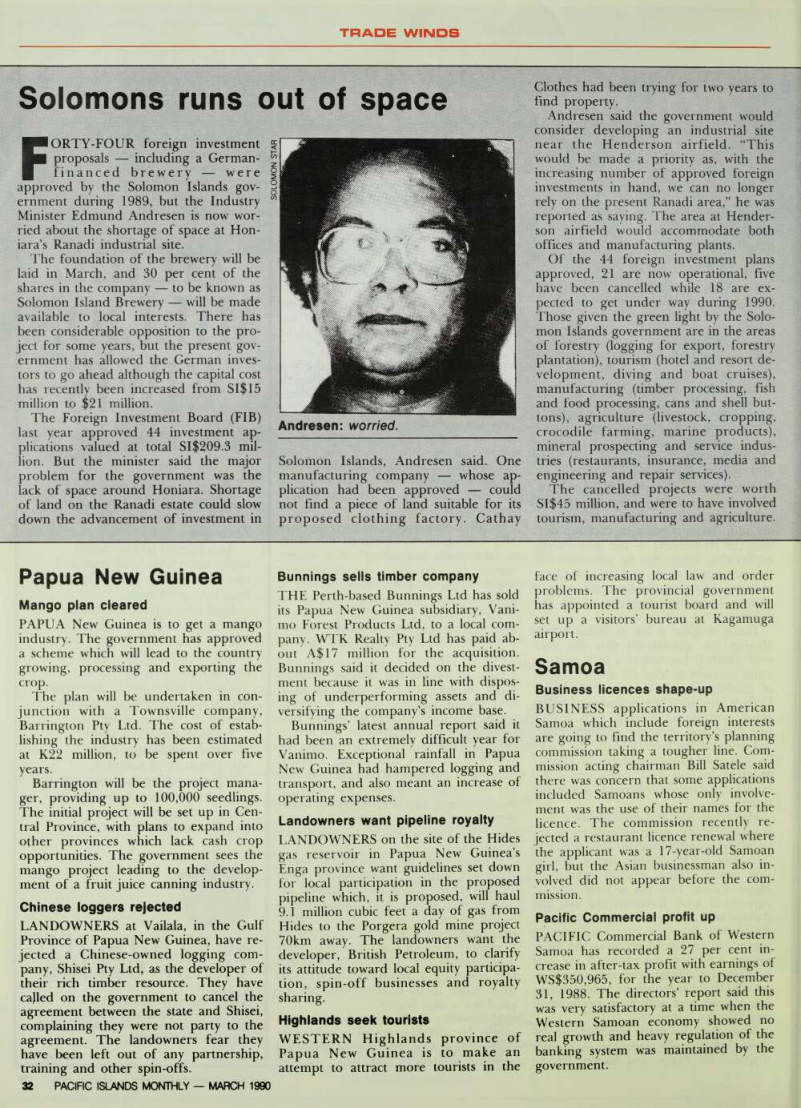
Andresen: worried.
Solomon Islands
Casino gets green light A CASINO resort costing Sls2l million has got the green light from the Solo mon Islands government. It will be built at Mamara, west of Honiara, by an Au stralian company, Swain (SI) Ltd which is a subsidiary of Industrial Performance Group Ltd. The casino had previously been opposed by the Guadalcanal Pro vincial government.
Airline to lease 737 SOLOMON Airlines is to lease a Boeing 737 airliner from a California finance company, and will introduce the aircraft on its routes from June 1. The 100-seat aircraft will be replaced in 1992 by a later version of the 737 which can carry 140 passengers. The 737 will be used on the three weekly flights between Honiara and Brisbane, and will fly once a week to Fiji, Vanuatu and Papua New Guinea.
With the introduction of the stretched version in 1992, Solomon Airlines hopes to expand its routes to include South east Asia and Japan. Air New Zealand will be responsible for maintenance of the new jet.
Fish deal extended THE Solomon Islands government has extended its agreement under which Japanese tuna boats have access to the country’s economic zone. A government
spokesman was reported as saying the
12-month extension will give the admi nistration the time it needs to review fishing policies. Under the present agreement, the Solomon Island govern ment received about Sls3 million a year by way of licence fees from the Japanese tuna fleet.
Micronesia
Garbage bid on again Marshall Islands is again the target of a waste management company, following an earlier unsuccessful attempt to use the islands for the disposal of household garbage from the United States. The earlier bid was made by Admiralty Paci fic Inc. Now another company, Microne sian Marine Development Inc, wants to use Kwajalein Atoll as a dump by means of landfill. The company will spend USSSOO,OOO on a feasibility study.
Tinian starts visitor centre ALTHOUGH tourism is still in its infan cy on the island, Tinian in the Northern Mariana group has begun work on a visi tor centre. The island, separated by ab out 5 km of water from Saipan, is about to have a high-speed boat service from
Tonga
Friendly nears profitability TONGA’S government-owned Friendly Island Airways is getting closer to pro fitability after widening its revenue base to 63 inter-island flights a week. The airline has also installed a computer sys tem which allows it to make bookings for any airline in the world, and accept bookings from abroad for its own flights.
General manager Dennis Hoskin said its current operations were in the black, but Friendly Islands Airways was carrying losses from the past years.
New terminal started CONSTRUCTION of the T$6 million terminal at Tonga’s Fua’motu interna tional airport was to have begun in February. The project is being funded by Japanese aid. The new terminal will be used by both domestic and interna tional passengers, with the existing build ing being turned into offices for the De partment of Civil Aviation. It is expected the new terminal will be in use by March next year.
Pumpkin sales promise JAPANESE agents have confirmed they will buy 5000 tonnes of pumpkins from
Tonga during 1990 despite some prob
lems with the initial shipment last year, including weak crates, bad packing and some evidence of fruit fly. Tonga earned a net T$600,000 in foreign exchange for the 3000 tonnes of pumpkins shipped to Japan in late 1989. The 76 million pumpkins were grown on allotments covering 800 hectares.
the main island and the locals hope Air Micronesia will begin a regular shuttle.
Palau raises rejected PLANS to pay the majority of Palau’s government workers more money have been blocked by the United States De partment of the Interior, saying the is land state lacks the U 55489,500 neces sary. Government workers in the trust territory number about 1200.
Marshalls airline expands IN a service similar to that of Air Raro tonga, Airline of the Marshall Islands has used Hawaii Airlines aircraft and crews to expand its network. The Ma juro-based carrier now operates the DC -8 jet twice a week between its home base and Honolulu. The aircraft is a combi type, which has a large cargo section at the rear.
Fiji
Beef shortage BUTCHERS in Fiji have reported a con tinuing shortage of beef. The Ministry of Primary Industries is predicting these shortages will occur for a few years as a result of many cattle having been sold or dying during the 1987 drought.
Trade deficit up SOARING imports pushed Fiji’s trade deficit to a record F 5366 million for calendar 1989. This was a 160 per cent increase in the 1988 figure, and has been attributed to a surge in imports.
Exports rose marginally over the year from Fsslß million to F 5672 million, but imports shot up from F 5659 million to a new high of Fs93B million. Much of the import rise resulted from a huge inflow of materials and capital goods under Fiji’s tax-free zone scheme.
Bid to wipe out moth A TEAM of Australian scientists visited Fiji, Western Samoa and Tonga to study the destructive Fruit Piercing Moth, which threatens the region’s fruit indus try. The scientists are evaluating biolo gical controls by use of a parasite.
Metal ordered STANDARD Concrete, a Suva-based company, has an order for 7500 tonnes of crushed metal to be shipped to Vanuatu for use on a wharf at Santo Island. The order, worth USSI2O,OOO is thought to be the largest aggregate ex port order from Fiji.
Cook Islands
Cooks moves to solar COOK Islands technicians have been sent to French Polynesia to train in the use of solar power to prepare for the introduction of a system in the Northern islands.
France is lending the Cooks NZsl3.s million for the project and the upgrad ing of Rarotonga’s power and water sup plies. Pukapuka will be the first island to have solar-generated electricity.
Pearl farm grows THE United States Agency for Interna tional Development is putting up NZ$25 million to aid the development of a black pearl industry on the island of Suwar row, with possible extension to Penrhyn and Pukapuka. The Cook Islands Public Works Department will be responsible for building a jetty, septic tank and wa ter system for pearl farm workers.