Untouched Paradise
pp. 37-39 · Read in the full issue
Vanuatu’s revival as Untouched Paradise
//I THINK we’ve come out of the bad time. Tourists are ■ . coming back and things are
definitely improving.” So spoke Gabriel
ani, acting manager of Vanuatu’s National Tourism Office. Times are certamly good for Bani. A graduate in Economics from the University of Papua New Guinea the genial young man from Aoba Island learned recently that he has been awarded a prestigious scholarship to study in New Zealand.
Bam s good fortune may be symptomatic ot the change in the fortunes of tourism generally. After a few bleak years when this part of the country s economy went into a tailspin and tounsm related enterprises came close to crashing completely, a levelling out although a fairly low one in terms of visitor numbers and revenues (and even ?noo 11 j Crease ) became apparent in late 1988 ami early 1989.
In 1987, 14,624 visitors came to Vanuatu, the lowest figure for more than a decade. But that number doesn’t give an accurate perspective on tourism, because only 9201 of these were tourist arrivals, that is those whose purpose was
pleasure.
Two years earlier the comparable fi gures had been 24,521 and 18,889.
Tourist numbers therefore declined by more than 50 per cent in two years. The fall in the number of cruise ship arrivals was only slightly less distressing. In 1985, 75,742 cruise ship passengers visited Vanuatu; in 1987, their numbers were down to 49,381. What happened to tour ism in that time?
In retrospect it almost seems as though there had been a conspiracy be tween man and nature at their most malevolent to frustrate, even destroy, tourism’s chances of success in the infant republic, whose economic base is preca rious at the best of times. Lack of a national airline to provide direct services from major tourist markets, cyclones, political unrest, an ongoing confusion in the minds of many tourists between New Caledonia and Vanuatu, so misleadingly packaged together by many tour wholesalers and, on top of all this, an unreasonably hostile and often misin formed overseas (mainly Australian) media.
Australian and New Zealand political
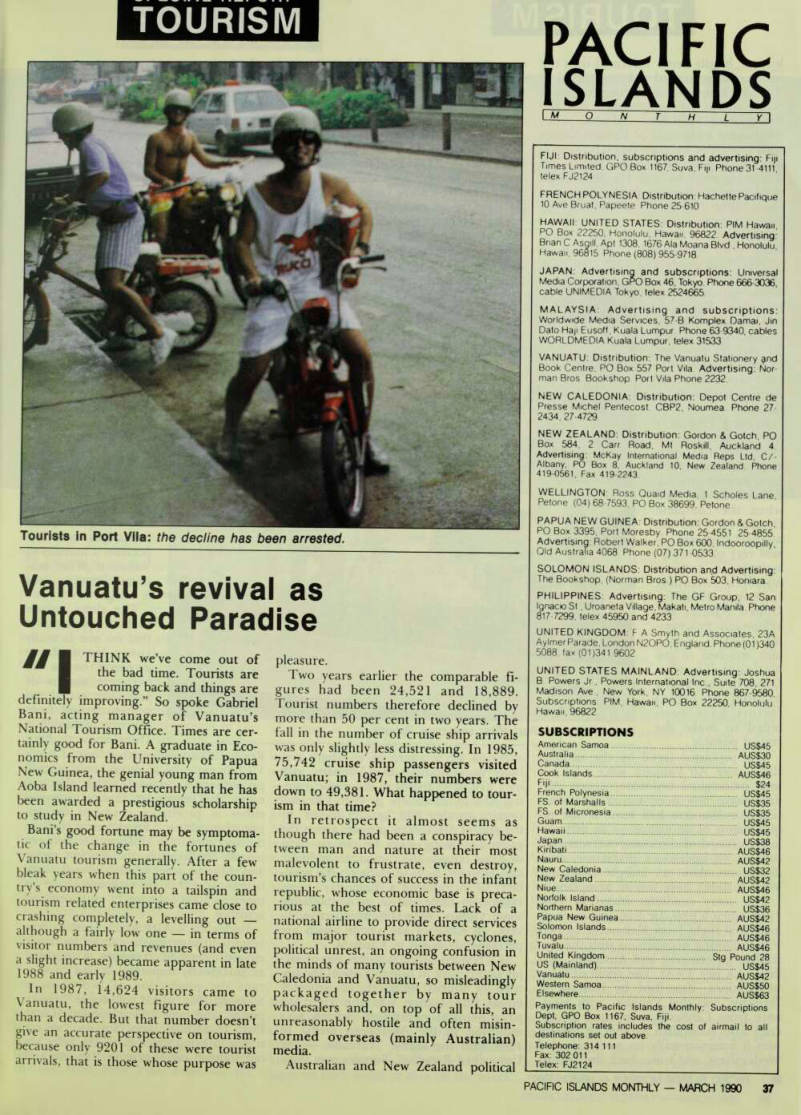
Tourists in Port Vila: the decline has been arrested.
leaders, hardly better informed than the media, were reported as being critical of
Vanuatu’s independent foreign policy
stance and its fishing agreement with the Soviet Union. The Press and some politi cians made a big issue of Vanuatu’s links with Liyba and its leder Gaddafi. Austra lia’s Department of Foreign Affairs and Trade, headed by Bill Hayden in his pre-Governor General mode, suggested for a while that travel to Vanuatu was unsafe for Australians.
The result of all this was that Austra lians, who numbered 12,969 out of 18,889 “real” tourists in 1985, fell away
to 4974 in 1987.
Since Australia has long been Vanuatu’s major tourist market,
providing between
50 and 60 per cent of the republic’s in take annually, the decline bordered on disaster.
In early 1990, it is safe to say, the de cline has not only been arrested, it has been turned around.
Indications are that when the complete figures for 1989 are assessed they will re veal very obvious up swings in tourist
numbers. According
to Roger Hoskins, United Nations De
velopment Program
me (UNDP) consul tant attached to the National Tourism Office in Port Vila, a number of recent factors have com bined to make the revival possible.
The problems faced by the national flag carrier, Air Vanuatu, since it fell out with its original bed-mate, Ansett Air lines, have now been solved. For some time Air Vanuatu had most of the re quirements of an airline an office, a logo, a board of directors, overseas con sultants on operations procedure, even discussions about an inflight magazine.
What it didn’t have was an aeroplane.
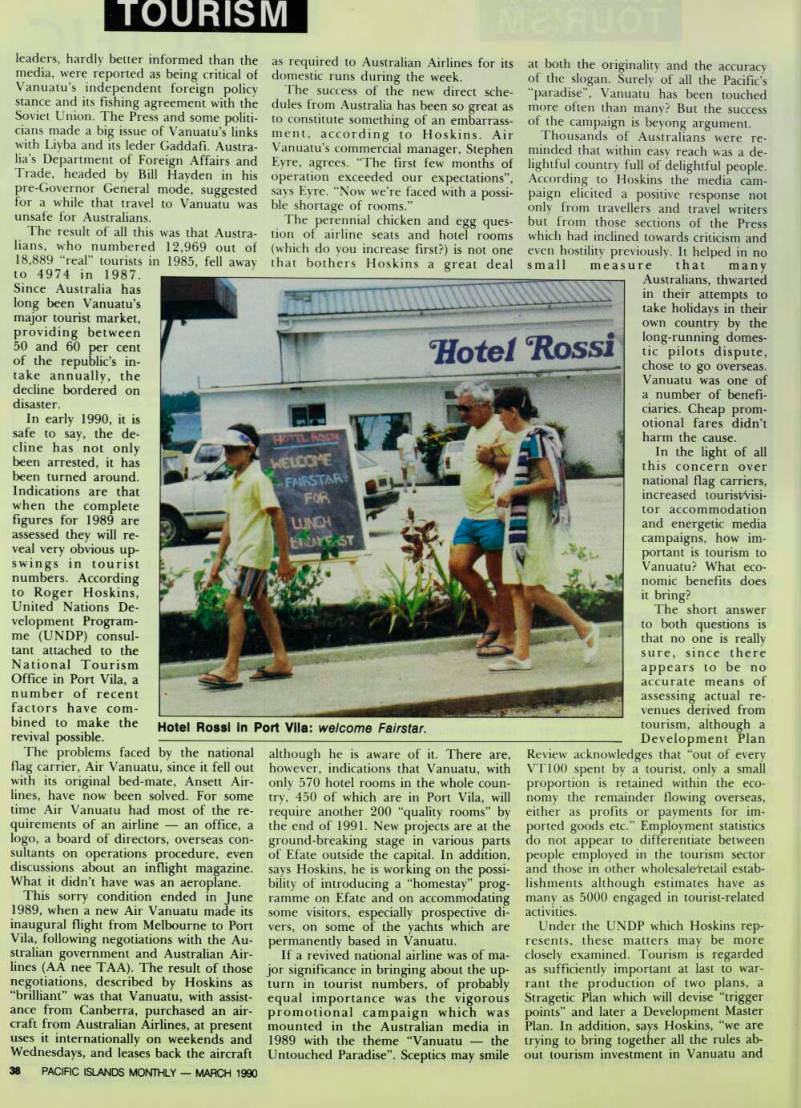
This sorry condition ended in June 1989, when a new Air Vanuatu made its inaugural flight from Melbourne to Port Vila, following negotiations with the Au stralian government and Australian Air lines (AA nee TAA). The result of those negotiations, described by Hoskins as “brilliant” was that Vanuatu, with assist ance from Canberra, purchased an air craft from Australian Airlines, at present uses it internationally on weekends and Wednesdays, and leases back the aircraft
as required to Australian Airlines for its domestic runs during the week.
The success of the new direct sche dules from Australia has been so great as to constitute something of an embarrass ment, according to Hoskins. Air Vanuatu’s commercial manager, Stephen Eyre, agrees. “The first few months of operation exceeded our expectations”, says Eyre. “Now we’re faced with a possi ble shortage of rooms.”
The perennial chicken and egg ques tion of airline seats and hotel rooms (which do you increase first?) is not one that bothers Hoskins a great deal
although he is aware of it. There are, however, indications that Vanuatu, with only 570 hotel rooms in the whole coun try, 450 of which are in Port Vila, will require another 200 “quality rooms” by the end of 1991. New projects are at the ground-breaking stage in various parts of Efate outside the capital. In addition, says Hoskins, he is working on the possi
bility of introducing a “homestay” prog
ramme on Efate and on accommodating some visitors, especially prospective di vers, on some of the yachts which are permanently based in Vanuatu.
If a revived national airline was of ma jor significance in bringing about the up turn in tourist numbers, of probably equal importance was the vigorous promotional campaign which was mounted in the Australian media in 1989 with the theme “Vanuatu the Untouched Paradise”. Sceptics may smile
at both the originality and the accuracy of the slogan. Surely of all the Pacific’s “paradise”, Vanuatu has been touched more often than many? But the success of the campaign is beyong argument.
Thousands of Australians were re minded that within easy reach was a de lightful country full of delightful people.
According to Hoskins the media cam paign elicited a positive response not only from travellers and travel writers but from those sections of the Press which had inclined towards criticism and even hostility previously. It helped in no small measure that many
Australians, thwarted in their attempts to take holidays in their own country by the
long-running domes
tic pilots dispute,
chose to go overseas.
Vanuatu was one of a number of benefi ciaries. Cheap prom otional fares didn’t harm the cause.
In the light of all this concern over national flag carriers, increased tourisfrVisi tor accommodation and energetic media campaigns, how im portant is tourism to Vanuatu? What eco nomic benefits does
it bring?
The short answer to both questions is that no one is really sure, since there appears to be no accurate means of assessing actual re venues derived from tourism, although a Development Plan
Review acknowledges that “out of every VTIOO spent by a tourist, only a small proportion is retained within the eco nomy the remainder flowing overseas, either as profits or payments for im ported goods etc.” Employment statistics do not appear to differentiate between people employed in the tourism sector and those in other wholesalotetail estab lishments although estimates have as many as 5000 engaged in tourist-related activities.
Under the UNDP which Hoskins rep resents, these matters may be more closely examined. Tourism is regarded as sufficiently important at last to war rant the production of two plans, a Stragetic Plan which will devise “trigger points” and later a Development Master Plan. In addition, says Hoskins, “we are trying to bring together all the rules ab out tourism investment in Vanuatu and
Hotel Rossi in Port Vila: welcome Fairstar.
aiXoachXeXaXr .! nVeSt ° rS might
P ht the liffht of fh P • , . ■ Vanuatu b„,i. bu, tm n ent h N ot n A eC f eSSari ![’ »° sklns ’ ut probably. After all, Ni-Vanuatu from a few^low-key^nterpriser” 8 ’ s\ i, r P ‘ One prominent Ni-Vanuatu, however, uousy sees ealthy prospects for tour- So pe 3 bn g l t im (T sec r ete r y n e r al presiding Vanuaaku Partv and former cabinet minister has converted a Port Vila apartment block to low • a apartment block to low cost tourist accommodation and has plans for a small resort on Tanna aimed at budget travellers. this might introduce a new element into anuatu tourism; the backpacker, eagerly welcomed by some small island countne B almost dreaded by others, wnne backpackers have so far not been encouraged, says Hoskins, these developquotes "pete r Ta u ra kola*”f ’p npra I u‘ ge, of the National T ’ • Mana ‘
rnLn
to XTourag'e
backpackers ” 8 Whether backnacker or cruise passenger package tourisf h s difficult to find someone who hasn’t en joyed time pen Vanuatu although the great majority of tourL get no further than Port Via Even so the vna. tven so, the
“pual, Ol £ of thc . most charming in the Pac,flc ’ offers J v,suors enou g h to keep
Ljhiy'Xrf zz:zt:z\ 3s
In Vila ° ne Can sta >' at island res °rts hke Erakor or Iririki that are only momentS f a^ ay fr ° m town . a " d . et ex P eri ‘ ence feelings of virtual isolation; eat at a different restaurant every night of the week and not be disappointed or overg ° duty f « !• in conditions that are competi- Ch CSS l » ymg f* 1311 many ot^er bargain centres in the region; enjoy some of the finest traditional and some of the most interesting modern art in the South Seas, at the Cultural Centre , the Gallerie L’Atelier or the Michoutouchkine-Pilioko Foundation; scuba and snorkel to the heart’s content or the limit of one’s oxygen tank, and be in the company of some of the nicest people in the Pacific Islands.
All of these are verifiable, and the last haS S “. ally P r °™ b ? a Tourlsm Council of the South Pacific survey, f ° Und tha ‘ V “' S C ° UMrs * m ° St r .i” , u f ... ,u r i’ 1 ' ghtl >' mO J e imre P ,d vlsltor X'l feature ?, of Ta " na A constantl >! actl^ e ’ ac^ essib l e volcano A ,1 brCathmg Carg ° Cult ” t prospects of Espiritu °TI Can , VlSlt re ™ ote vil ,* lages on bush walks or dive on the wreck
of the Coolidge, one of World War U s more fascinating disasters.
tTking’ aTvanmgf ButTs
Vanuatu enters its second decade as an independent nation, there are signs that the economy in general and tourism in particular enter a new period of growth This will be well-earned- the y has the past, mostly undeserved, but some times stron g enough to shake the confi dence of the staunchest optimist, H But ri g bt now the general mood is one of enthusiasm. Under new Minister for Tourism Edward Natapei, whose port folio also includes Transport and Civil Aviation, Vanuatu’s National Tourism ° fflde s have been re-established in Syd ney> Auckland and San Francisco. And Vanuatu is to hold its first ever tourism conv ention in May 1990.
For the last word let’s hear from Mar ry Patterson, veteran of the hotel estab '“hment Vanuatu and a man who has ? which Cyclone Uma resulted in the total obliteration of his popular hotel the -7 S ° laise ’ Harry has since «buik and ex panded. If he can be optimistic about the P ros P ects everyone should be.
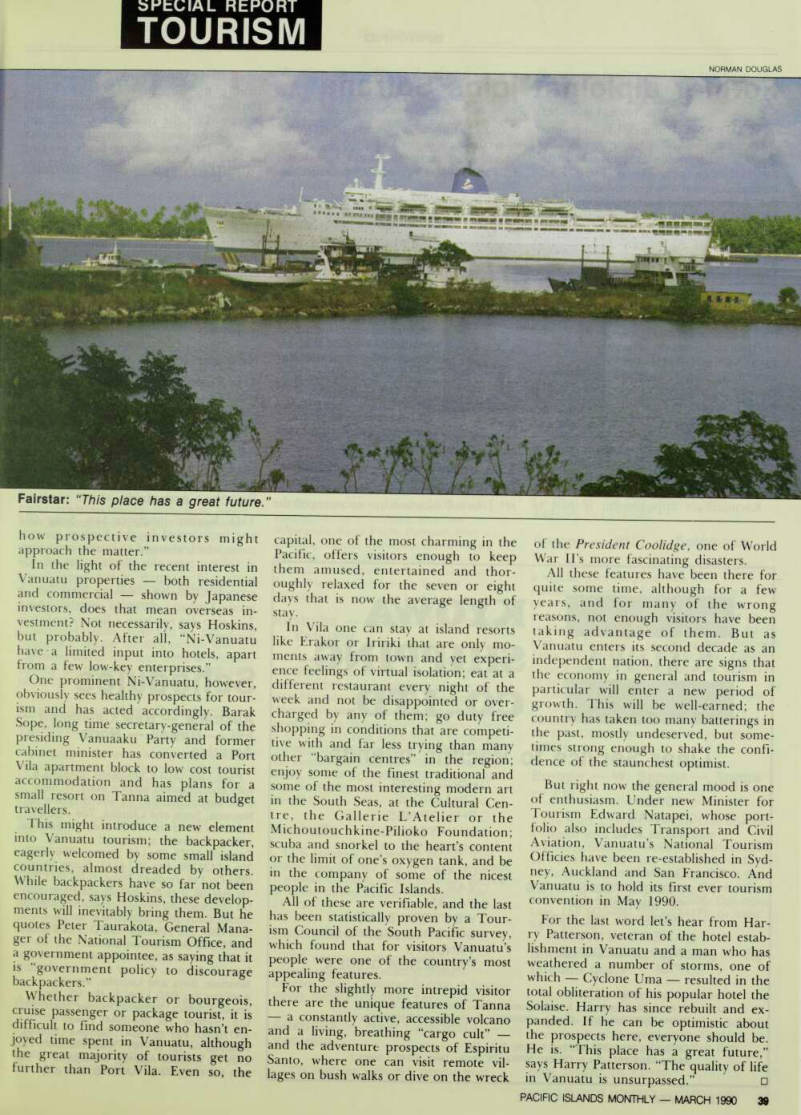
He is. “This place has a great future,” says Ha rry Paterson. “Thequality of life in Vanuatu is unsurpassed.” □
Norman Douglas
Fairstar: “This place has a great future."