Chasing a place
p. 47 · Read in the full issue
Sport
Chasing a place in the Olympics
POLYNESIAN outrigger canoeing
has successfully crested another wave on its voyage to the Olym pics.
More than 1000 paddlers from around the Pacific took part in the International Polynesian Canoe Federation’s fourth world sprint championships in Auckland last month. Teams came from outrigger strongholds of Tahiti and Hawaii, as well as from American and Western Samoa, Australia, California, Canada, the Cook Islands, New Caledonia, New Zealand
and Fiji.
Federation president Georges Estall believes the boost in participation and spread of membership since the outrig ger champs began in 1984, shows the sport has what it takes to gain recogni tion as an Olympic event.
“My wish and hope is to see it at the 27th Olympic Games in the year 2000.”
The first step is to gain recognition from the International Canoe Federation. It’s president was at the Auckland champs and Estall believes his counterpart’s re port will give outriggers wider exposure in European canoeing circles. “After all, the ICE has already recognised Indian canoes, kayaks, for the Olympics,” says Estall, “and the federation has acknow ledged that outrigger canoeing is a real sport and deserves worldwide promo tion.”
Estall hopes outriggers will be part of the competition for the next South Paci fic Games in Papua New Guinea, show ing the Polynesian sport as an equal with the usual European events. The poten tial for outrigger canoeing to spread further through the region is shown by the sport’s blossoming in New Zealand.
Since its inception in 1987, Tatou Hoe O Aotearoa has championed the huge re vival of waka (canoe) culture amongst Maori tribes, and now boasts 14 clubs
nationally.
Chairman of the host Ngati Whatua organising committee Alec Hawke, be lieves the Auckland champs will prove a
catalyst for Maori outrigger canoeing
over the next two years, when the fifth world championships wil be held on Lake Natoma in Sacramento, California.
The Auckland champs were also not able for what Estall calls the “leap for ward” in competitiveness by the newer members. Tahiti, with its pool of more than 6000 paddlers in what is virtually the country’s national sport, again swept the medals. The 250-strong Tahitian contingent won 19 of the 22 gold med als, including all of the single-person outrigger titles, nd the men’s and women’s glamour sprints in the 12person double hulls.
But the Baloa women’s team from Au stralia took two team golds, as did a combined Hawaiian women’s team in the masters event. California, New Caledonia and New Zealand also took their share of the dozen lesser medals which eluded the Tahitians.
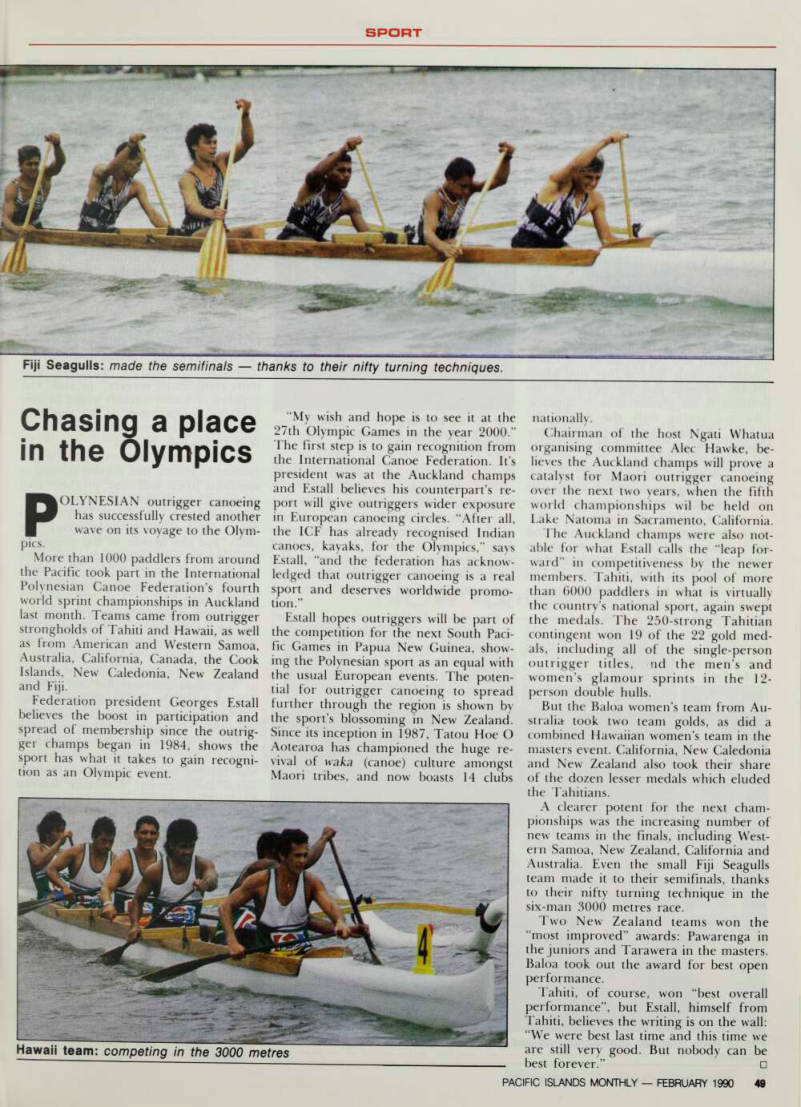
A clearer potent for the next cham pionships was the increasing number of new teams in the finals, including West ern Samoa, New Zealand, California and Australia. Even the small Fiji Seagulls team made it to their semifinals, thanks to their nifty turning technique in the six-man 3000 metres race.
Two New Zealand teams won the “most improved” awards: Pawarenga in the juniors and Tarawera in the masters.
Baloa took out the award for best open performance.
Tahiti, of course, won “best overall performance”, but Estall, himself from Tahiti, believes the writing is on the wall; “We were best last time and this time we are still very good. But nobody can be best forever.” □
Fiji Seagulls: made the semifinals - thanks to their nifty turning techniques.
Hawaii team: competing in the 3000 metres