of Captain Cook
pp. 45-46 · Read in the full issue

The unknown wife of Captain Cook
By Graeme Orr
SO much has been written and re corded about Captain James Cook it seems remarkable that there has been nothing more than an occasional minute reference to there having been a Mrs Cook. It is even more remarkable that no one appears to have had the curiosity to inquire about her.
Was she a strong influence on her husband, a woman of authority, or was she simply that “good little wife” so typical of her time when women were largely locked into the sole role of wife and mother? More importantly, with her husband gone to sea for much of the 17 years of their married life, what kind of woman was she to have coped with life and raised a family almost singlehanded ly, always under the strain of fear that her husband may never return?
Cook ended his bachelorhood at the age of 34 on December 21, 1762 when he married 21-year-old Elizabeth Batts, the daughter of a small London shop keeper. They were married in the Parish church of St Margaret in Barking Essex by special licence of the Archbishop of Canterbury, which meant that once Cook had made up his mind to marry he wasn’t going to wait for any such impedi ments as the usual posting of the bans!
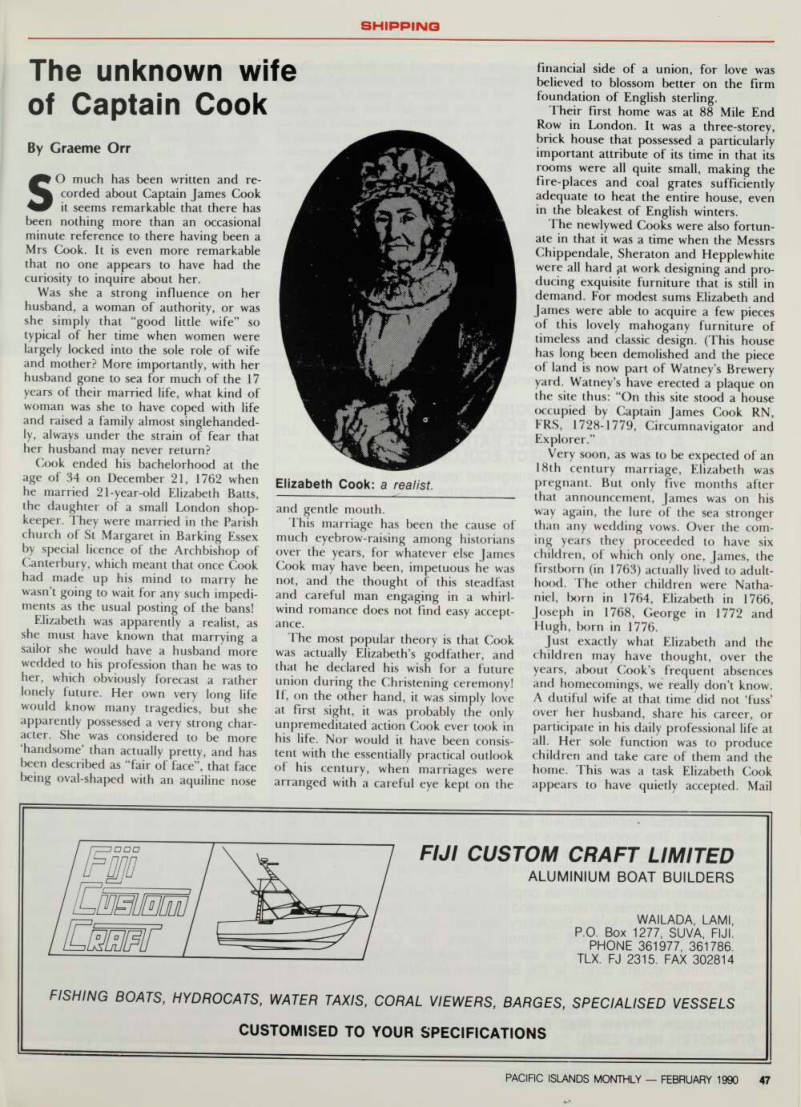
Elizabeth was apparently a realist, as she must have known that marrying a sailor she would have a husband more wedded to his profession than he was to her, which obviously forecast a rather lonely future. Her own very long life would know many tragedies, but she apparently possessed a very strong char acter. She was considered to be more ‘handsome’ than actually pretty, and has been described as “fair of face”, that face being oval-shaped with an aquiline nose
and gentle mouth.
This marriage has been the cause of much eyebrow-raising among historians over the years, for whatever else James Cook may have been, impetuous he was not, and the thought of this steadfast and careful man engaging in a whirl wind romance does not find easy accept ance.
The most popular theory is that Cook was actually Elizabeth’s godfather, and that he declared his wish for a future union during the Christening ceremony!
If, on the other hand, it was simply love at first sight, it was probably the only unpremeditated action Cook ever took in his life. Nor would it have been consis tent with the essentially practical outlook of his century, when marriages were arranged with a careful eye kept on the
financial side of a union, for love was believed to blossom better on the firm
foundation of English sterling.
Their first home was at 88 Mile End Row in London. It was a three-storey, brick house that possessed a particularly important attribute of its time in that its rooms were all quite small, making the fire-places and coal grates sufficiently adequate to heat the entire house, even in the bleakest of English winters.
The newlywed Cooks were also fortun ate in that it was a time when the Messrs
Chippendale, Sheraton and Hepplewhite
were all hard work designing and pro ducing exquisite furniture that is still in demand. For modest sums Elizabeth and James were able to acquire a few pieces of this lovely mahogany furniture of timeless and classic design. (This house has long been demolished and the piece of land is now part of Watney’s Brewery yard. Watney’s have erected a plaque on the site thus: “On this site stood a house occupied by Captain James Cook RN, fRS, 1728-1779, Circumnavigator and
Explorer.”
Very soon, as was to be expected of an 18th century marriage, Elizabeth was pregnant. But only five months after that announcement, James was on his way again, the lure of the sea stronger than any wedding vows. Over the com ing years they proceeded to have six children, of which only one, James, the firstborn (in 1763) actually lived to adult hood. The other children were Natha niel, born in 1764, Elizabeth in 1766, Joseph in 1768, George in 1772 and Hugh, born in 1776.
Just exactly what Elizabeth and the children may have thought, over the years, about Cook’s frequent absences and homecomings, we really don’t know.
A dutiful wife at that time did not ‘fuss’ over her husband, share his career, or participate in his daily professional life at all. Her sole function was to produce children and take care of them and the home. This was a task Elizabeth Cook appears to have quietly accepted. Mail
Elizabeth Cook: a realist.
End Row was not in a fashionable area, nor were the Cook’s fashionable people.
When at home together they were simp ly an everyday family, a man and his wife and their children.
Cook’s outside companions were generally men of the sea while Eli zabeth’s friends were other homebound, family oriented women. Elizabeth apparently did not relate much to the sea, and matters such as mathematics and astronomy, both so very important to Cook in his surveying and mapping,
were not part of her daily life. She is alleged not to have understood the first and felt the latter to smack of paganism.
In what little has been written about her a line here, a comment there Elizabeth Cook has had the reputation of being a reserved and distant, sometimes even cold, woman. But perhaps that is not so surprising when one considers the consistent tragedies in her life. Their only daughter, also named Elizabeth, died at the age of four years in 1770 (not long after James encounter with
Australian coastline). Joseph, the third son, died in 1768 at the age of one month. George, the fourth son, died in 1772 at the age of four months. (These three infants died while Elizabeth was home alone, with James at sea).
Nathaniel, the second son, died in 1779 at the age of 16. He was lost at sea while on board the Thunderer, a man of-war, about six months after his father’s death. Hugh, the youngest, died in 1793 of scarlet fever at the age of 17, while attending Christ’s College at Cam bridge. James, the firstborn and only child to survive into adulthood died in 1794 at the age of 31. He had been master and commander of the Spitfire , a sloop-of-war, and while the sloop lay off Poole, England, waiting for hands to come aboard, she was driven out to sea in a heavy gale and all on board were drowned. James’ body was found, however, and he was buried in Cam bridge by the side of his brother, Hugh, whose funeral he had attended only six weeks earlier.
Thus the James and Elizabeth Cook line died without having had much of a chance to get started.
It is well known that Captain Cook was killed by natives in the Hawaiian Islands in February 1779 at the age of 51.
However, few are aware that the news of his death, relayed by hand from the Siberian coast, (for his ship went north from the Sandwich Isles before it made for home) did not reach Elizabeth in En gland until January 1780 eleven months later.
But the indomitable Elizabeth lived on alone until 1835 to the age of 93 totally bereft of her once large family. She was 56 years a widow.
Following Cook’s death Elizabeth was given a lifetime pension of 200 pounds a year from King George HI (who was reported to have wept upon hearing of Cook’s death), which was a substantial income at that time. She also apparently received considerable sums for her share of the profits from the sale of books about her husband’s voyages. Upon her death in 1835, she is recorded as having left the large sum of 60,000 pounds, most of which was left to various char ities.
Elizabeth, claiming to have been over whelmed by so many deaths, retired to Clapham, Surrey in 1778 where she lived for 47 years with her sad memor ies. She was said to be a handsome and dignified woman, possessed of her facul ties to the end. She constantly dressed in black satin and wore a ring containing strands of her husband’s hair. This claim has occasionally been disputed, but re ferences to it are frequent. She kept the anniversaries of her personal tragedies as fast days, partaking in quiet medita tion and reading her family Bible. □