Robert Simms
p. 48 · Read in the full issue
Health
Looking into a real problem
By Robert Simms
WHILE health standards in the Pacific islands have improved generally, eye diseases continue to be neglected. Bilateral cataracts are common. Most island nations depend on visiting specialists to treat these and other major complaints because very few have resident ophthalmologists. A back log of cases has led to acceptance by the people that blindness is part of growing old.
Dr Richard LeMesurier, an ophthalmic surgeon based in Honiara in the Solo mon Islands and supported by the Royal Commonwealth Society for the Blind (RCSB), believes that the extent of the problem is far greater than it appears.
“We are seeing only the tip of the iceberg,” he said. “For people in remote villages, it is not practical or possible to have their eyes treated”.
Dr LeMesurier often moves between provincial hospitals in the Solomons to teach new skills to the local health work ers and to operate when necessary. “Be cause the population is so scattered and has a subsistence lifestyle, we can’t always rely on them to come to the hospital,” he said.
Even though he makes the effort to get out into the villages to see the peo ple, Dr LeMesurier said that he is bat tling ignorance. “There has been no eye care for so long that the people don’t know they can be helped.”
He feels that teaching primary eye care to nurses and health care workers
in the field is the most effective way to address the continuing problems. “It is important to let the villagers know that eye care is available,” he said. Once some of the people have been treated success fully, he said others will be encouraged to come forward. “Regular visits by health workers with eye care training will encourage them to have their eyes tre ated.”
One such health worker is Casper Tiga, a Papua New Guinean health ex tension officer with the Department of Health at Goroka. He travels throughout the Eastern Highlands Province of PNG,
teaching primary eye care and treating
minor eye disease. “I give the people advice on cleanliness and the importance of eating a diet containing high levels of vitamin A,” he said.
Casper has worked for the Health De partment for 10 years. He assisted in the Eye Clinic at Goroka Hospital for one year where he performed minor eye op erations. Dr LeMesurier said that this type of training is essential if eye disease faced by the islanders is to be dealt with
effectively.
“Secondary eye care workers are the key to the whole problem,” he said.
“Given sufficient training, they are very competent at minor lid surgery and pter
igium operations.”
He added that they are able to handle a lot of the cases that would take up much of the time of visiting specialists.
“In this way, the ophthalmologist can concetrate on cataract extractions and more complicated surgery,” he said. The network of health workers would be able to refer serious cases to the specialist, while doing eyecare education in the field themselves, he said.
Dr LeMesurier believes that it is im portant to ensure that doctors trained in specialist areas will stay in their own country and not seek alternative employ ment overseas. “It takes a long time to train a doctor in ophthalomology,” he said. “For the benefit of the people of that country, they should stay within the public health system so that their skills can be used in the areas where they are needed most.”
Co-ordination of the agencies involved in eyecare assistance and training in the Pacific is seen as essential if it is to have maximum impact. Keith Holdsworth, a member of Foresight, otherwise known as Australian Overseas Aid and Preven tion of Blindness Ltd, completed a sur vey recently that was designed to deter mine how blindness can be prevented and how services can be provided to people with eye problems. The survey was funded by the Australian Interna tional Development Assistance Bureau
(Aidab).
He said that the scarcity of eyecare services is a common problem through out the Pacific. “Apart from Fiji, which has a reasonably good programme, eye care is generally given a low priority,” he said.
Ideally, he thinks there should be three levels of health workers. “Primary eyecare in the villages is very important,” he said. “Health workers, who are already working in the field, should be taught eyecare skills in diagnosis and prevention of eye disease.” The secon dary level would include people trained in the health system who could be given additional specialised skills to perform minor surgery and treat common eye complaints. □
Robert Simms
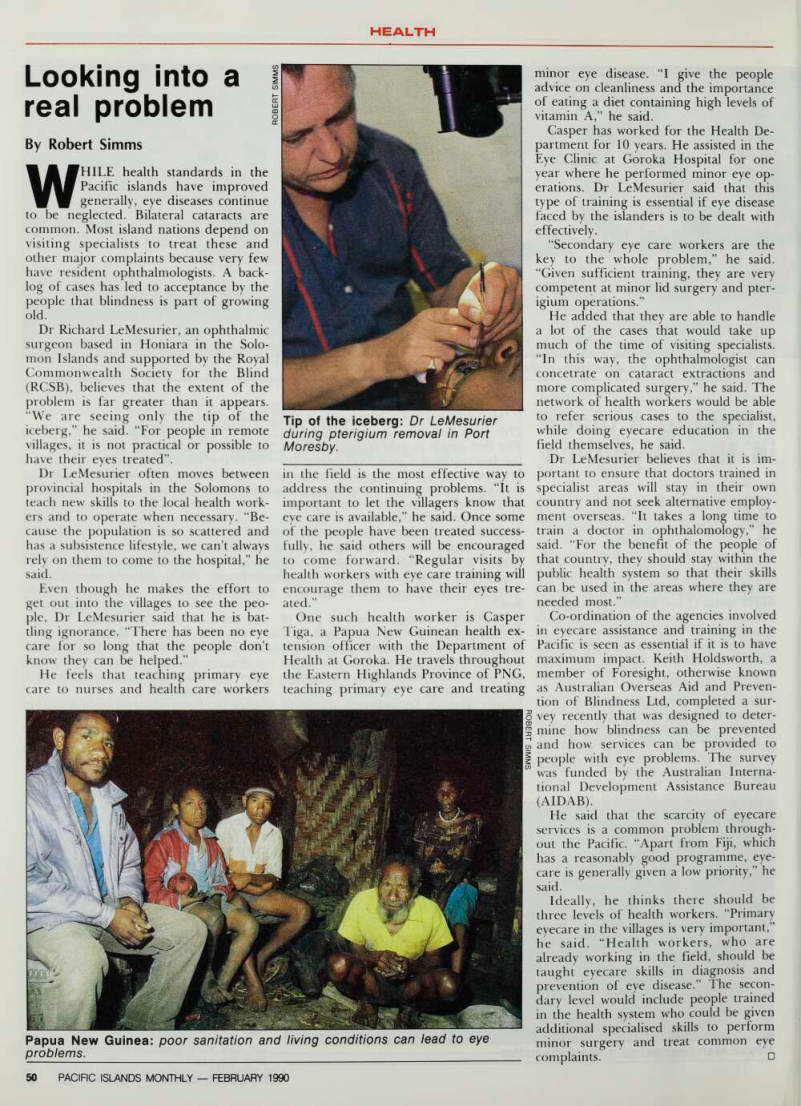
Papua New Guinea: poor sanitation and living conditions can lead to eye problems.
Tip of the iceberg: Dr LeMesurier during pterigium removal in Port Moresby.