Man of
pp. 9-12 · Read in the full issue
Cover Story
Man of the Decade
‘We are from here and nowhere else. You are from here but also from somewhere else’
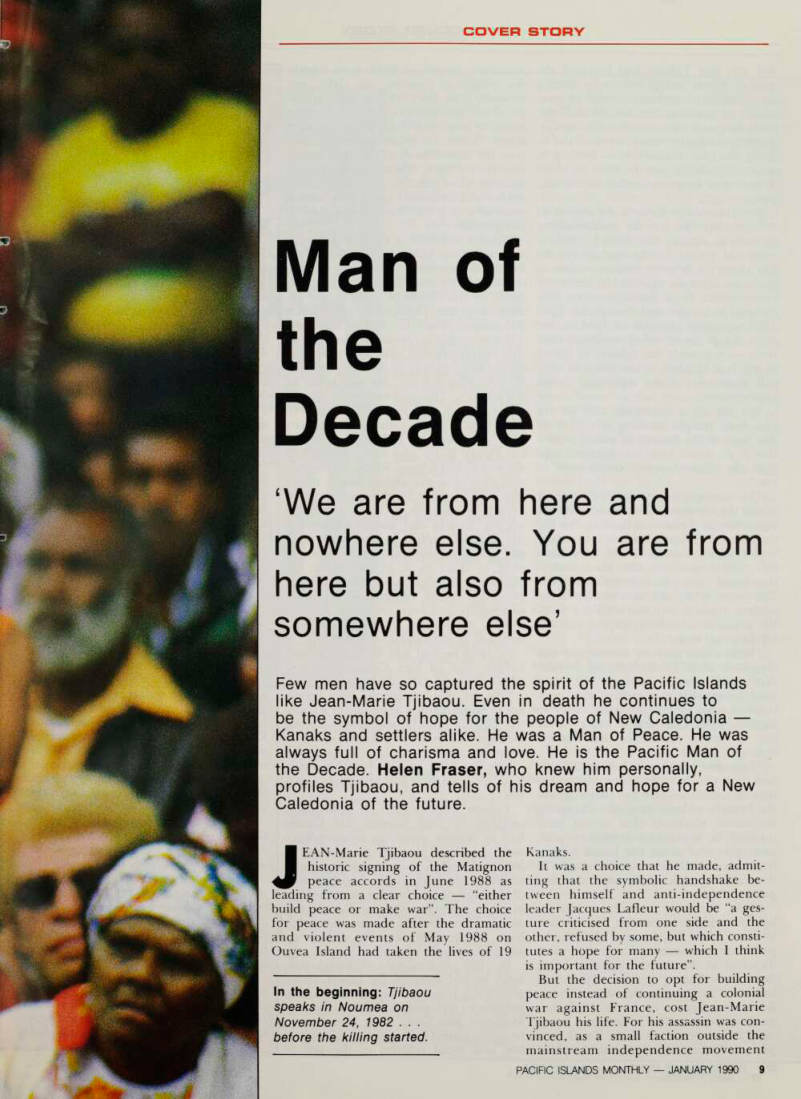
Few men have so captured the spirit of the Pacific Islands like Jean-Marie Tjibaou. Even in death he continues to be the symbol of hope for the people of New Caledonia Kanaks and settlers alike. He was a Man of Peace. He was always full of charisma and love. He is the Pacific Man of the Decade. Helen Fraser, who knew him personally, profiles Tjibaou, and tells of his dream and hope for a New Caledonia of the future.
JEAN-Marie Tjibaou described the
historic signing of the Matignon peace accords in June 1988 as leading from a clear choice “either build peace or make war”. The choice for peace was made after the dramatic and violent events of May 1988 on Ouvea Island had taken the lives of 19
Kanaks.
It was a choice that he made, admit ting that the symbolic handshake be tween himself and anti-independence leader Jacques Lafleur would be “a ges ture criticised from one side and the other, refused by some, but which consti tutes a hope for many which I think is important for the future”.
But the decision to opt for building peace instead of continuing a colonial war against France, cost Jean-Marie Tjibaou his life. For his assassin was con vinced, as a small faction outside the mainstream independence movement
still are, that Tjibaou had betrayed the
goal of Kanak independence by settling
on a plan that involved 10 years of tran sition, of training for Kanaks and de velopment of the economically under privileged largely Kanak areas of the is lands and the countryside leading to an independence vote in 1998 in which Kanaks and longterm settlers would take part.
For Jean-Marie Tjibaou the option of militant strategy for the independence movement against the French Govern ments of recent history was always the last choice, a decision that was made in each case after the rejection by France of compromises from Kanak leaders. The decision to boycott and disrupt the April 1988 territorial elections held on the same day as the French Presidential elec tions was made by Tjibaou as leader in the face of what he described as colo nial repression of the rightwing Chirac Government.
“We are on a battlefield and we are just dead people awaiting our turn to die, because the balance of power is such that if we didn’t have international sup port the colonial power could wipe us out.”
The statute planned for the territory which the elections were to usher in was described by Tjibaou as leading “to the death of the Kanak people”, a statute under which Kanaks would have been left with control of the most under developed, resource-less areas of New Caledonia while the anti-independence settlers would have controlled the weal thy urban area of Noumea and the bet ter farming areas.
The decision to turn to violence was also made after Tjibaou’s Kanak Socialist National Liberation Front (FLNKS) had tried again what they termed the “insti tutional road to independence” only to find by April 1988 that it was a cul de sac. It was an experience that was not new.
Three and a half years before, Tjibaou had led the independence movement into an earlier militant campaign against the French, of boycotting and disrupting territorial elections that would have ushered in a previous autonomy plan, and again one which the Kanak leaders had seen as leading to the domination of the Kanak people in demographic and political terms.
Again, the move to militancy was not lightly made but came after the rejection by the French Government of the inde pendence movement’s suggested mod ifications to the autonomy statute. Two factors particularly licensed Tjibaou as leader of the then Independence Front; firstly that France could, in 1983, for mally recognise “the innate and active right to independence of the Kanak peo ple” and then through the Lemoine
autonomy statute in 1984 deny Kanaks the chance to exercise this right; and secondly that Roch Pidjot, the “grand pere” of the independence movement and the man who had decades earlier asked France to grant autonomy, had seen his amendments to the 1984 auton omy statute flatly rejected by the French Socialist Government. And as in 1988 the move to militancy came after several years of trying the “institutional road to
independence . .
Tjibaou as leader of the independence movement was not only focussed on the French Government of the day, but also on the other communities in New Cale donia the ‘Caldoche’ settlers, the In donesians, the Vietnamese, the French Polynesians and the Wallis Islanders.
Tjibaou sought to persuade those not in the independence camp of the non threatening, indeed of the very necessity of independence for the well-being of the country. This was evident in the de cision to form a coalition Government in June 1982 not only with the Centre Par ty, FNSC, but also with his brother-in law Henry Wetta who was a member of the anti-independence RPCR, in his deci sion to reverse the annual Kanak depic tion of September 24, the anniversary of French colonisation, as a day of mourn ing for Kanaks and instead celebrate a day of Kanak culture in Noumea’s “place des Cocotiers” with all communities in vited to share in it, in his patient ex planations through the 1980 s that inde pendence meant recognition of Kanak sovereignty and once sovereign the wel coming by Kanaks of the other com munities as inhabitants of Kanaky.
In 1983 he told RPCR leader Jacques Lafleur and all New Caledonians in a televised round table discussion: “We say that we are the only people not to be recognised as people of a coun try. You are French nationalist it’s this message that you don’t absorb, that you refuse to absorb, “We are from here and nowhere else.
You are from here but also from some where else.”
Tjibaou from as early on as his party congress of 1982 insisted that Kanaks had to achieve economic independence and take their place in the circuits of New Caledonia’s economy before inde pendence was truly viable. And his vision of the kind of socialism he wanted to see in an independent state of Kanaky was one he described as where you didn’t have people who are very rich living alongside people who are very poor.
In 1985 after months of Kanak mili tancy he had accepted the Fabius/Pisani plan for a transition period to an inde pendence referendum, which, like the Matignon plan three years later, was to
be accompanied by major judicial, econo
mic and social reforms in the aim of
lessening the gaps between Kanaks and non-Kanaks.
With enormous enthusiasm Tjibaou, after electoral successes at the start of the transition period, led the Kanak in dependence movement into what he termed “the green revolution”. He was confident that if Kanaks had the chance to show what they could achieve and how their regional governments could succeed, then that along with the experi ence of Kanaks and non-Kanaks working
together, would win over enough people
for independence to be a reality.
But a change of government in Paris in 1986 brought obstructions to the re forms and the functioning of the Kanak regions, and in any case New Caledonia did not appear ready to welcome non- Kanaks and Kanaks working together on economic development for many set tlers who did embark on projects with Kanaks found themselves the targets of extreme rightwing violence.
Three years later Tjibaou was again offered the chance of choosing this peaceful road to independence, and now, under the Matignon Accord the re forms were to be deeper and more wide spread. It was the same bet, or gamble, he had accepted in 1985 although this time the finishing post was to be 10 years away.
“The first time I was asked at Matig non about the 10-year duration I wept for the people who are in prison, the people who have lost family members.
But to leave through the front door with an anthem and a flag only to come back begging through the back door No!”
The weeks before his death were filled with a whirlwind timetable of consulta tions with French officials, architects, agricultural experts, engineers and de velopment planners as the territory moved towards the start of provincial government. Tjibaou was as excited by his visions of what could be done in the two provinces that would come under Kanak control as he was by the Caldoche small-businessmen who were eager to come and set up their factories and businesses in the Kanak areas.
It was a vision tempered by reality, however: “There are development pro jects moving ahead, but there is always a timelag between our goals which are static and the setting up of the pro cess to achieve results, and this timelag is hard to accept for those who take part in determining the goals but who don’t have any power over the process to achieve them.” Lack of confidence in the French administration was also a hand icap, Tjibaou said. “But whafs terrific is that we’re now underway and it will be up to us to get the results.”
Tjibaou had a personality more suited to “building the peace than making war” for he was a seductive figure even to
those opposed to his ideas: the first qual ity that all use to try and paint his por trait was his wonderful, deliciously wick ed at times, sense of humour. Although this quality was in evidence even during some of the blackest periods of recent Kanak history, it was a humour at its best when the mood was one of
optimism.
His style as leader of the independ ence movement was not confrontational on several occasions when consensus decisions did not go his way, he prefer red to let the matter go for a few days while he quietly worked at reversing the decision. On one very important occa sion, when some sections of the inde pendence movement criticised him after the 1985 death of Eloi Machoro, he withdrew to his home at Hienghene for over a month and left the FLNKS to discover life without Tjibaou as leader. It was a point that was well made, and when he emerged from his “retreat” his control was reinforced.
And when asked what he would do if his support of the Matignon Accords was not accepted by the grassroots of his par ty, he replied that “I will go home to Hienghene to plant yams and (French Prime Minister and fellow peace architect) Rocard he’ll go and plant
cabbages.”
Tjibaou’s leadership was not a sole leadership; with Machoro he shared a partnership that saw the latter develop as the tactical strategist of the independ ence movement while Tjibaou concen trated on diplomacy and negotiations.
And as leader of the FLNKS Tjibaou was particularly close with his deputy, Yeiwene Yeiwene, who offered both sup port and objective criticism at times of major decision making, but above all who gave to the partnership with Tjibaou a buoyant optimism and his own brand of warm friendliness.
Throughout the South Pacific, France and internationally Tjibaou made warm friendships, particularly with the leaders of Vanuatu, Papua New Guinea and the Solomon Islands as well as in French Polynesia. As he put it once, he was very attracted to people whose language was the language of dreaming . . .
His vision for the future of “Kanaky” did not stop at the frontiers of the coun try but was for a neutral, nuclear free South Pacific: “It is very important that the day can come when we can perhaps negotiate a sort of neutrality pact with the super powers.
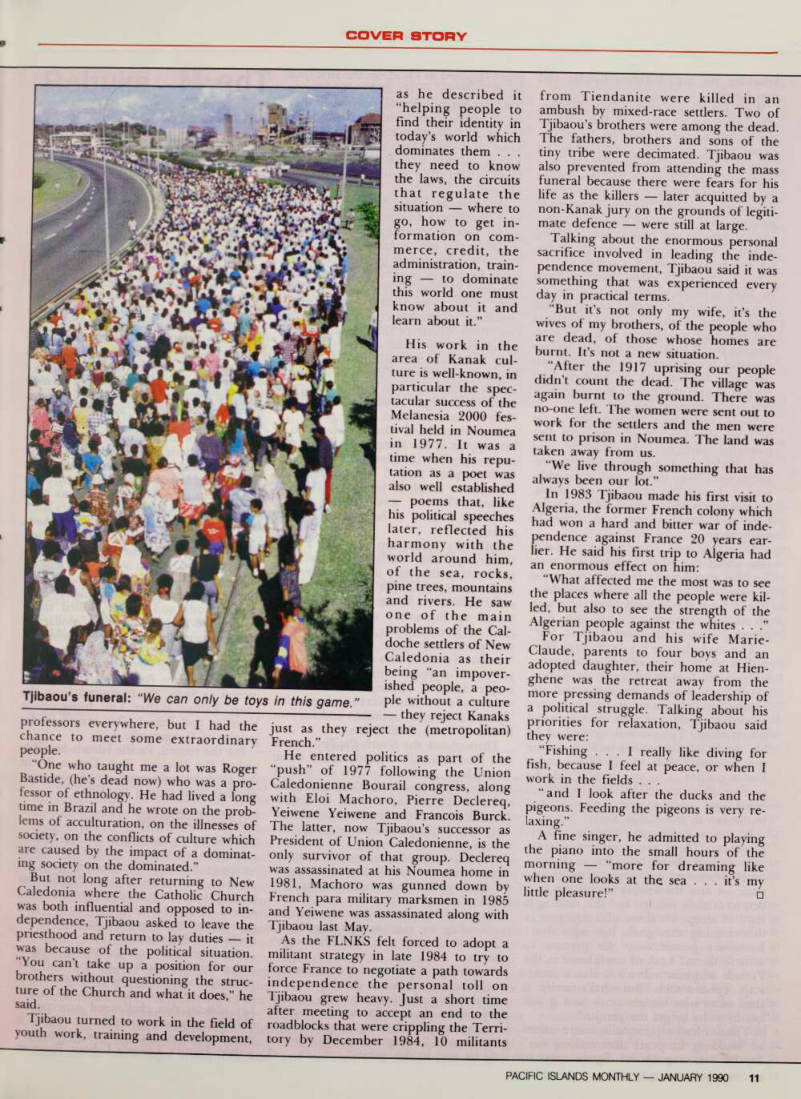
“It is more important for our develop ment and for regional development to negotiate a neutrality pact with the su perpowers than to amuse ourselves learning to play like big countries in a game made for big countries. We can only be toys in this game.” I=l