tribes had
pp. 10-11 · Read in the full issue
‘And so the tribes had nothing to do but die...'
By Helen Fraser
FOR Jean-Marie Tjibaou, the for mer Catholic priest who was edu cated in French universities during the late 19605, it was not the ideas and influences of that time which led to his political commitment against colonialism, but rather the harsh conditions into which he was born.
“One is always influenced by the situa tion, it’s more the historical situation than studies that made my engagement, it’s necessary to fight to change the con ditions of the lives of my people,” he told me two years ago in a long interview about his life.
Tjibaou’s tribal village of Tiendanite near Hienghene is small, with only about 120 people. His grandmother was shot dead by the French during the 1917 Kanak uprising against the colonial pre sence, but Tjibaou said he was not influ enced by this so much as “by the stories of people being taken for work, of work ing in road gangs it was a bit like forced labour for the people”.
“The gendarmes regularly took a cer tain number of men each month from the tribe to go and work for the settlers, and there was a guard with a truncheon and a gun to make the people work.”
For Tjibaou these conditions gave him a picture of colonialism at a very early age: "... for my parents and grandpa rents it was the ‘native code’ that banned Kanaks from moving around, required a head tax to be paid by the chief even if there was no money it was organised so that people would be obliged to work for the settlers and then the money went to the administration.
“And so the tribes had nothing to do but die because there was nothing left to eat because there were no people left to work at growing things to eat.
“Anyone who so much as raised their heads was forced to work two, three or four months instead of one. Weeds were coming up through the yam fields, so people organised themselves to do the turns of the other of the pregnant women, of the sick.”
Tjibaou studied sociology at university in Lyons and then Paris where he ex perienced the openness of the university world. “There were narrow minded pro fessors just as there are narrow-minded
professors everywhere, but I had the chance to meet some extraordinary
people.
“One who taught me a lot was Roger Bastide, (he’s dead now) who was a pro fessor of ethnology. He had lived a long time in Brazil and he wrote on the prob lems of acculturation, on the illnesses of society, on the conflicts of culture which are caused by the impact of a dominat ing society on the dominated.”
But not long after returning to New Caledonia where the Catholic Church was both influential and opposed to in dependence, Tjibaou asked to leave the priesthood and return to lay duties it was because of the political situation.
You can’t take up a position for our brothers without questioning the struc ture of the Church and what it does,” he said.
Tjibaou turned to work in the field of youth work, training and development,
as he described it “helping people to find their identity in today’s world which dominates them . . . they need to know the laws, the circuits that regulate the situation where to go, how to get in formation on com merce, credit, the administration, train ing to dominate this world one must know about it and learn about it.”
His work in the area of Kanak cul ture is well-known, in particular the spec tacular success of the Melanesia 2000 fes tival held in Noumea in 1977. It was a time when his repu tation as a poet was also well established poems that, like his political speeches later, reflected his harmony with the world around him, of the sea, rocks, pine trees, mountains and rivers. He saw one of the main problems of the Cal doche settlers of New Caledonia as their
being “an impover
ished people, a peo ple without a culture they reject Kanaks
just as they reject the (metropolitan) French.”
He entered politics as part of the “push” of 1977 following the Union Caledonienne Bourail congress, along with Eloi Machoro, Pierre Declereq, Yeiwene Yeiwene and Francois Burck.
The latter, now Tjibaou’s successor as President of Union Caledonienne, is the only survivor of that group. Declereq was assassinated at his Noumea home in 1981, Machoro was gunned down by French para military marksmen in 1985 and Yeiwene was assassinated along with Tjibaou last May.
As the FUNKS felt forced to adopt a militant strategy in late 1984 to try to force France to negotiate a path towards independence the personal toll on Tjibaou grew heavy. Just a short time after meeting to accept an end to the roadblocks that were crippling the Terri tory by December 1984, 10 militants
from Tiendanite were killed in an ambush by mixed-race settlers. Two of Tjibaou’s brothers were among the dead.
The fathers, brothers and sons of the tiny tribe were decimated. Tjibaou was also prevented from attending the mass funeral because there were fears for his life as the killers later acquitted by a non-Kanak jury on the grounds of legiti mate defence were still at large.
Talking about the enormous personal sacrifice involved in leading the inde pendence movement, Tjibaou said it was something that was experienced every day in practical terms.
But it’s not only my wife, it’s the wives of my brothers, of the people who are dead, of those whose homes are burnt. It’s not a new situation.
“After the 1917 uprising our people didn’t count the dead. The village was again burnt to the ground. There was no-one left. The women were sent out to work for the settlers and the men were sent to prison in Noumea. The land was taken away from us.
“We live through something that has always been our lot.”
In 1983 Tjibaou made his first visit to Algeria, the former French colony which had won a hard and bitter war of inde pendence against France 20 years ear lier. He said his first trip to Algeria had an enormous effect on him: What affected me the most was to see the places where all the people were kil led, but also to see the strength of the Algerian people against the whites . . .”
For Tjibaou and his wife Marie- Claude, parents to four boys and an adopted daughter, their home at Hien ghene was the retreat away from the more pressing demands of leadership of a political struggle. Talking about his priorities for relaxation, Tjibaou said
they were;
“Fishing ... I really like diving for fish, because 1 feel at peace, or when I work in the fields . . .
“and I look after the ducks and the pigeons. Feeding the pigeons is very re
laxing.”
A fine singer, he admitted to playing the piano into the small hours of the morning “more for dreaming like when one looks at the sea . . . it’s my little pleasure!” □
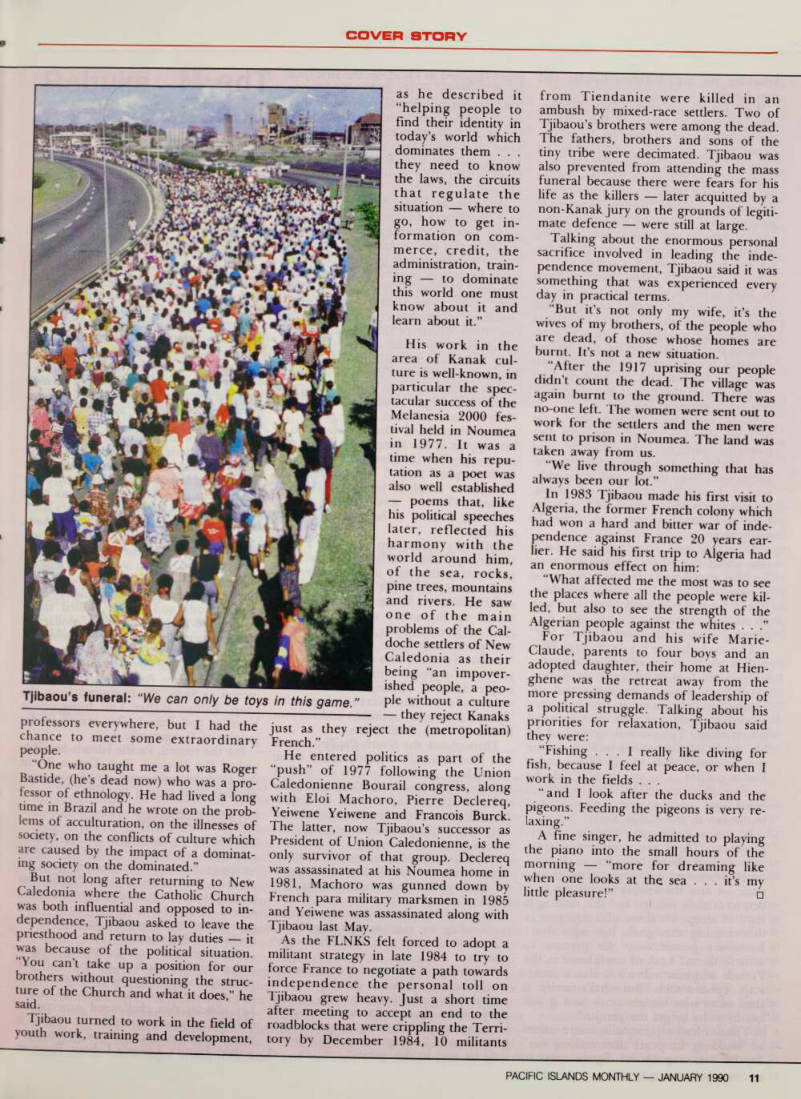
Tjibaou’s funeral: "We can only be toys in this game."