Sing Sing in Dreamtime
pp. 46-47 · Read in the full issue
By Brian Johnstone
A THOUSAND warriors and their women are packed onto the main showground arena at Mt Hagen, high in the Western Highlands.
The thin winter mountain air is electric
with expectation, fuelled by a cacophony
of sound. Hundreds of clansmen and their leaders stand in formation, short but powerfully built dark-skinned men,
their pig-oiled bodies glistening in the sun. The men and women are bedecked in thousands of parrot and eagle feath ers, ass-grass, baler shell breastplates, tree kangaroo tails, and the red, blue and black plumes of Birds of Paradise.
Many fiddle with stone axes, spears,
bows and needle-sharp, poison tipped
arrows. Last minute preparations are made to hundreds of instruments fashioned from wood, bamboo, gourds, nuts, seeds, leaves, conch shells and clay.
This is the home of the talking lizard skin drums and high pitched message flutes which traditionally announce tribal ceremonies, such as pig killings and in itiations, to anyone from miles around familiar with the pounding, hooting vibrations. This is Sing Sing at the annual Mount Hagen Show. 50,000 peo ple have travelled from all over PNG to participate or simply to watch the seeth ing human rainbow.
The Sing Sing ground is the tradition al music forum in Papua New Guinean life, usually a large clearing near the men’s house. Singing and dancing on the
Sing Sing ground usually coincides with
a pig feast, which, in the Highlands, thousands may attend. The participants
sing their mantras and dance themselves into another state of consciousness but something odd is happening here . . .
Hundreds of the gaily decorated locals
have stopped chanting and dancing.
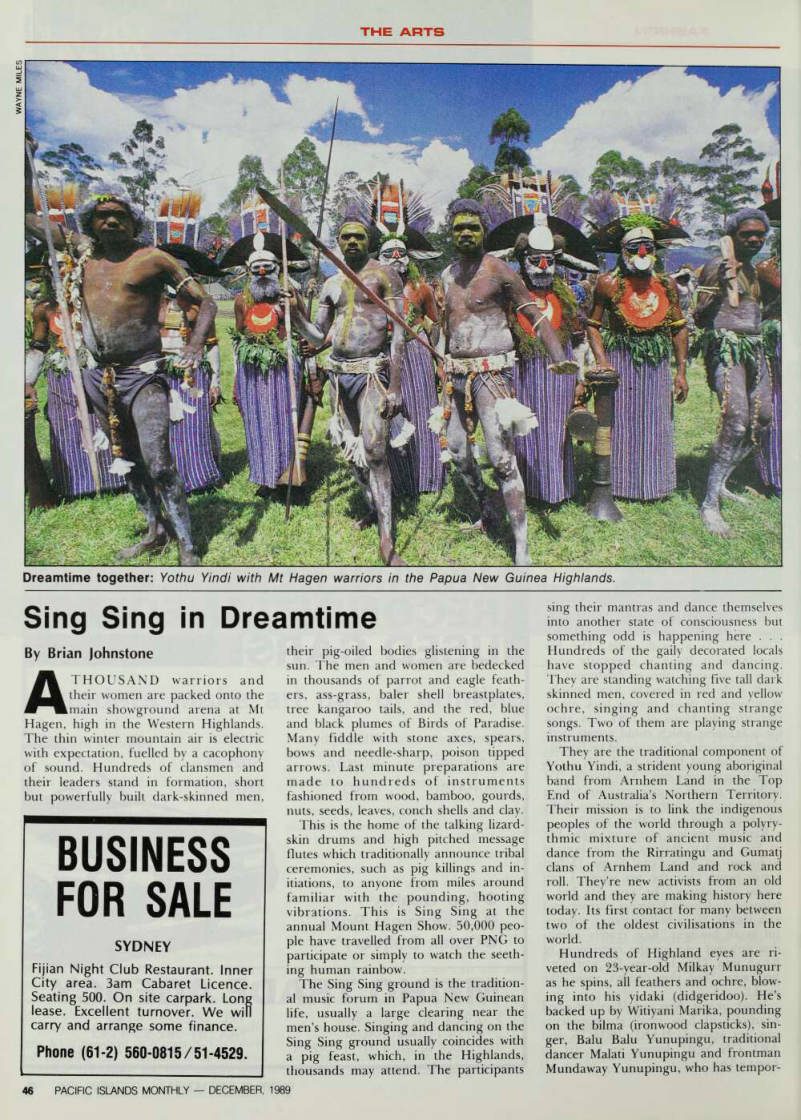
They are standing watching five tall dark skinned men, covered in red and yellow ochre, singing and chanting strange songs. Two of them are playing strange instruments.
They are the traditional component of Yothu Yindi, a strident young aboriginal band from Arnhem Land in the Top End of Australia’s Northern Territory.
Their mission is to link the indigenous peoples of the world through a polyry thmic mixture of ancient music and dance from the Rirratingu and Gumatj clans of Arnhem Land and rock and roll. They’re new activists from an old world and they are making history here today. Its first contact for many between two of the oldest civilisations in the world.
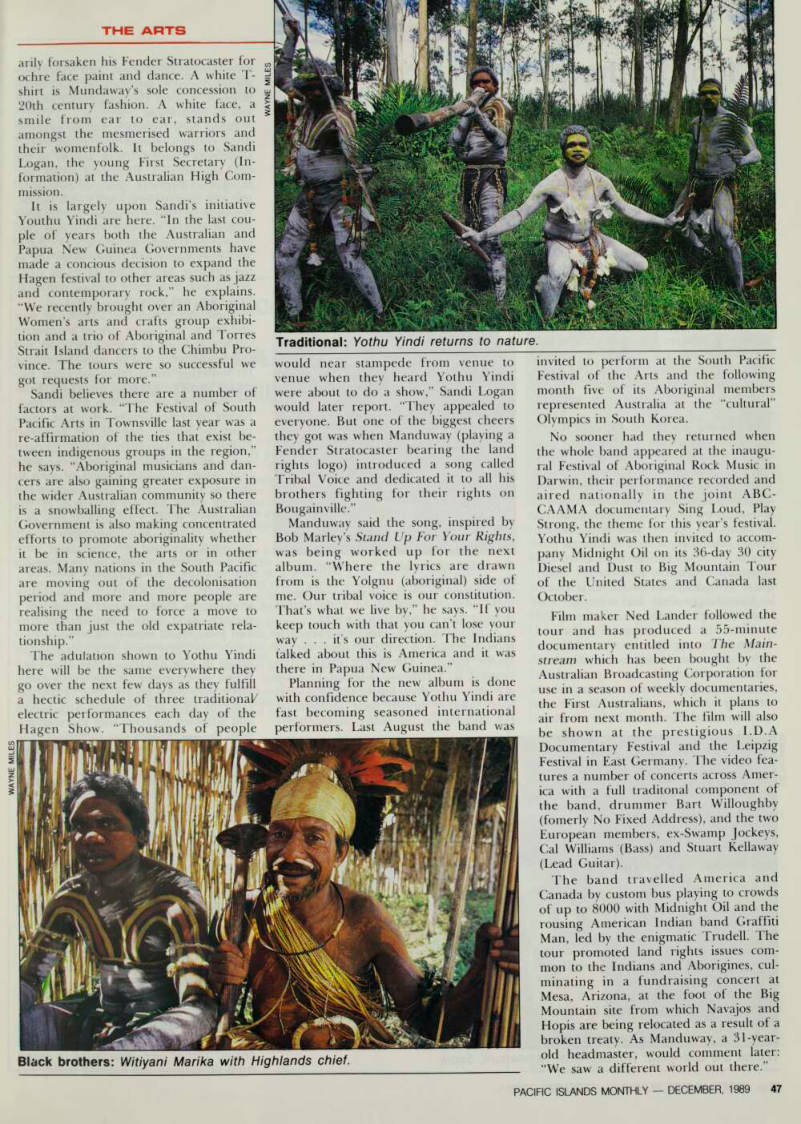
Hundreds of Highland eyes are ri veted on 23-year-old Milkay Munugurr as he spins, all feathers and ochre, blow ing into his yidaki (didgeridoo). He’s
backed up by Witiyani Marika, pounding
on the bilma (ironwood clapsticks), sin ger, Balu Balu Yunupingu, traditional dancer Malati Yunupingu and frontman Mundaway Yunupingu, who has tempor
Dreamtime together: Yothu Yindi with Mt Hagen warriors in the Papua New Guinea Highlands.
arily forsaken his Fender Stratocaster for ochre face paint and dance. A white T shirt is Mundaway’s sole concession to 20th century fashion. A white face, a smile from ear to ear, stands out amongst the mesmerised warriors and their womenfolk. It belongs to Sandi Logan, the young First Secretary (In formation) at the Australian High Com mission.
It is largely upon Sandi’s initiative Youthu Yindi are here. “In the last cou ple of years both the Australian and Papua New Guinea Governments have made a concious decision to expand the Hagen festival to other areas such as jazz and contemporary rock,” he explains.
“We recently brought over an Aboriginal
Women’s arts and crafts group exhibi tion and a trio of Aboriginal and Torres Strait Island dancers to the Chimbu Pro vince. The tours were so successful we got requests for more.”
Sandi believes there are a number of factors at work. “The Festival of South Pacific Arts in Townsville last year was a re-affirmation of the ties that exist be tween indigenous groups in the region,” he says. “Aboriginal musicians and dan cers are also gaining greater exposure in the wider Australian community so there is a snowballing effect. The Australian Government is also making concentrated efforts to promote aboriginality whether it be in science, the arts or in other areas. Many nations in the South Pacific are moving out of the decolonisation period and more and more people are realising the need to force a move to more than just the old expatriate rela tionship.”
The adulation shown to Yothu Yindi here will be the same everywhere they go over the next few days as they fulfill a hectic schedule of three traditional/ electric performances each day of the Hagen Show. “Thousands of people
would near stampede from venue to venue when they heard Yothu Yindi were about to do a show,” Sandi Logan would later report. “They appealed to everyone. But one of the biggest cheers they got was when Manduway (playing a Fender Stratocaster bearing the land rights logo) introduced a song called Tribal Voice and dedicated it to all his brothers fighting for their rights on
Bougainville.”
Manduway said the song, inspired by Bob Marley’s Stand Up For Your Rights, was being worked up for the next album. “Where the lyrics are drawn from is the Yolgnu (aboriginal) side of me. Our tribal voice is our constitution.
That’s what we live by,” he says. “If you keep touch with that you can’t lose your way . . . it's our direction. The Indians talked about this is America and it was there in Papua New Guinea.”
Planning for the new album is done with confidence because Yothu Yindi are fast becoming seasoned international performers. Last August the band was
invited to perform at the South Pacific Festival of the Arts and the following month five of its Aboriginal members represented Australia at the “cultural”
Olympics in South Korea.
No sooner had they returned when the whole band appeared at the inaugu ral Festival of Aboriginal Rock Music in Darwin, their performance recorded and aired nationally in the joint ABC CAAMA documentary Sing Loud, Play Strong, the theme for this year’s festival.
Yothu Yindi was then invited to accom pany Midnight Oil on its 36-day 30 city Diesel and Dust to Big Mountain Tour of the United States and Canada last October.
Film maker Ned Lander followed the tour and has produced a 55-minute documentary entitled into The Main stream which has been bought by the Australian Broadcasting Corporation for use in a season of weekly documentaries, the First Australians, which it plans to air from next month. The film will also be shown at the prestigious I.D.A Documentary Festival and the Leipzig Festival in East Germany. The video fea tures a number of concerts across Amer ica with a full traditonal component of the band, drummer Bart Willoughby (fomerly No Fixed Address), and the two European members, ex-Swamp Jockeys, Cal Williams (Bass) and Stuart Kellaway (Lead Guitar).
The band travelled America and Canada by custom bus playing to crowds of up to 8000 with Midnight Oil and the rousing American Indian band Graffiti Man, led by the enigmatic Trudell. The tour promoted land rights issues com mon to the Indians and Aborigines, cul minating in a fundraising concert at Mesa, Arizona, at the foot of the Big Mountain site from which Navajos and Hopis are being relocated as a result of a broken treaty. As Manduway, a 31-year old headmaster, would comment later: “We saw a different world out there.”
Black brothers: Witiyani Marika with Highlands chief.
Wayne Miles
Traditional: Yothu Yindi returns to nature.