Liz Thomson
pp. 48-49 · Read in the full issue
A foot in the past, a foot in the future
By Liz Thompson
SOMEONE once said that culture is such an important part of national development that it “helps to strengthen the independence, sovereign ty and identity of nations”. The speaker was Soroi Marape, secretary of the Divi sion of National Heritage and Monu ments in Papua New Guinea. Marape said developing countries often put too much emphasis on quantity and in the process lose quality in national growth.
Because cultures are often seen as los ing their means of “traditional” artistic expression in the face of modernisation, there is often little encouragement of its retention, or transition into another world.
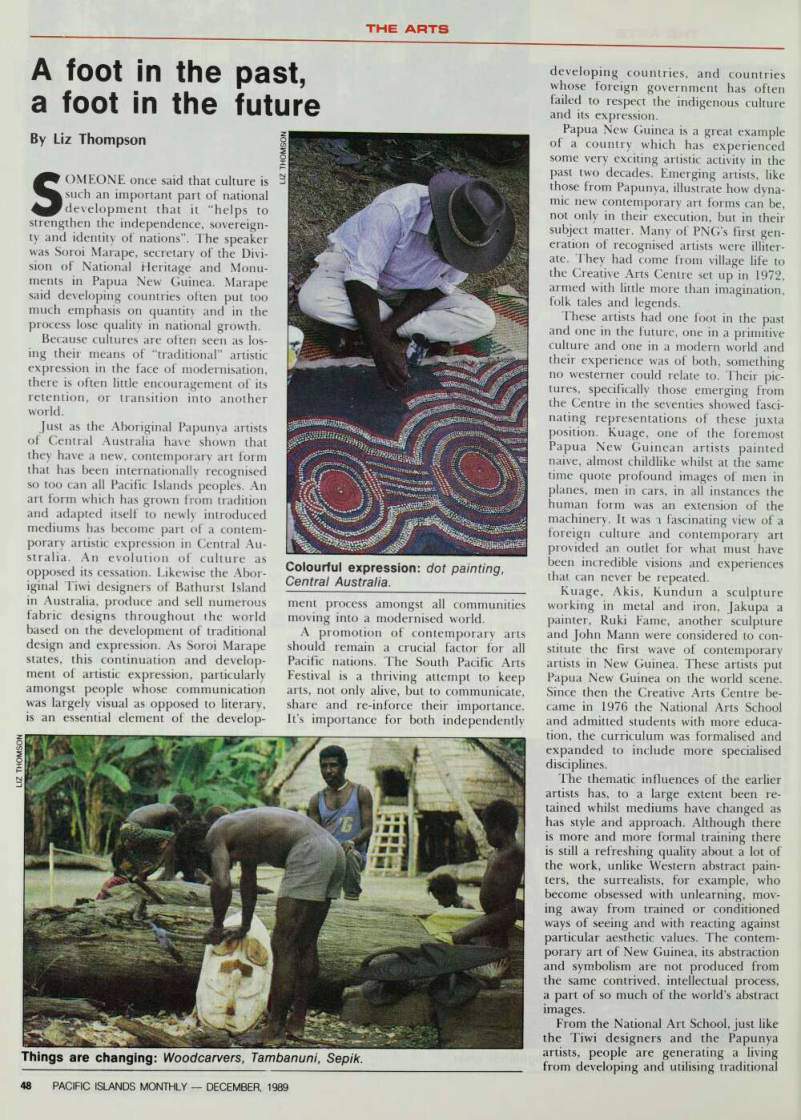
Just as the Aboriginal Papunya artists of Central Australia have shown that they have a new, contemporary art form that has been internationally recognised so too can all Pacific Islands peoples. An art form which has grown from tradition and adapted itself to newly introduced mediums has become part of a contem porary artistic expression in Central Au stralia. An evolution of culture as opposed its cessation. Likewise the Abor iginal Tiwi designers of Bathurst Island in Australia, produce and sell numerous fabric designs throughout the world based on the development of traditional design and expression. As Soroi Marape states, this continuation and develop ment of artistic expression, particularly amongst people whose communication was largely visual as opposed to literary, is an essential element of the develop-
ment process amongst all communities moving into a modernised world, A promotion of contemporary arts should remain a crucial factor for all Pacific nations. The South Pacific Arts Festival is a thriving attempt to keep arts, not only alive, but to communicate, share and re-inforce their importance, It’s importance for both independently
developing countries, and countries whose foreign government has often failed to respect the indigenous culture and its expression.
Papua New Guinea is a great example of a country which has experienced some very exciting artistic activity in the past two decades. Emerging artists, like those from Papunya, illustrate how dyna mic new contemporary art forms can be, not only in their execution, but in their subject matter. Many of PNG’s first gen eration of recognised artists were illiter ate. They had come from village life to the Creative Arts Centre set up in 1972, armed with little more than imagination, folk tales and legends.
These artists had one foot in the past and one in the future, one in a primitive culture and one in a modern world and their experience was of both, something no westerner could relate to. Their pic tures, specifically those emerging from the Centre in the seventies showed fasci nating representations of these juxta position. Kuage, one of the foremost Papua New Guinean artists painted naive, almost childlike whilst at the same time quote profound images of men in planes, men in cars, in all instances the human form was an extension of the machinery. It was a fascinating view of a foreign culture and contemporary art provided an outlet for what must have been incredible visions and experiences that can never be repeated.
Kuage, Akis, Kundun a sculpture working in metal and iron, Jakupa a painter, Ruki Fame, another sculpture and John Mann were considered to con stitute the first wave of contemporary artists in New Guinea. These artists put Papua New Guinea on the world scene.
Since then the Creative Arts Centre be came in 1976 the National Arts School and admitted students with more educa tion, the curriculum was formalised and expanded to include more specialised
disciplines.
The thematic influences of the earlier artists has, to a large extent been re tained whilst mediums have changed as has style and approach. Although there is more and more formal training there is still a refreshing quality about a lot of the work, unlike Western abstract pain ters, the surrealists, for example, who become obsessed with unlearning, mov ing away from trained or conditioned ways of seeing and with reacting against particular aesthetic values. The contem porary art of New Guinea, its abstraction and symbolism are not produced from the same contrived, intellectual process, a part of so much of the world’s abstract
images.
From the National Art School, just like the Tiwi designers and the Papunya
artists, people are generating a living
from developing and utilising traditional
Liz Thomson
Things are changing: Woodcarvers, Tambanuni, Sepik.
Colourful expression: dot painting, Central Australia.
artistic skills. In New Guinea, Philip Brimper and Wendy Chou Lai are laying the foundations for the emerging textile industry. The textile department at the school displays beautiful silk screens whose designs have been drawn from those which previously adorned shields.
Fabrics of this nature are used to pro duce clothes, cover furniture, hang on walls. It’s a way of transferring and de veloping elements of tradition to suite a new situation, a process which establishes and builds on links with the past.
Carvers from the National Art School
were commissioned to design and manu facture all decorative aspects of Parlia ment House. Using modern materials, permanent surfaces with weatherproof and colourfast properties they enhanced the architecture with something distinctly New Guinean. A mosaic mural at the Grand Hall’s main entrance, which de veloped from drawings by two of PNG’s leading artists, Jakupa and Kuage, is bordered by a carved lintel of kwila wood depicting 19 ancestral masks rep resenting the nation’s provinces. Below them the kwila door handles are carved
in the shape of traditional kundu drums.
There are various ways of translating tradition, of developing an evolutionary culture as opposed to adopting the no tion that a culture has died. The impor tant thing is that these developments gain support, not only in terms of vocal enthusiasm and encouragement but also financial support and encouragement.
Artistic expression is a vital part of any
communities development, and, particu
larly amongst people undergoing great change. A cultural continuation in what ever form is an important anchor, a part
of national heritage and pride.
The Papunya artists have enjoyed great acclaim, their work hangs in New York galleries and fetches increasingly high prices, the first wave of Papua New Guinean artists also enjoyed extensive media coverage and an appreciative au dience. Besides the obvious talent of both parties, they also had the added advantage of the novelty of their posi tion. People were fascinated by this re latively new occurrence, a modern art,
emerging from a primitive society. Now,
new artists are emerging, equally talented, with new experiences to depict and it is important that they, who don’t benefit from the novelty factor are also
recognised and supported.
Contemporary is synonymous with continuation, and a contemporary artistic evolution is an ongoing process. The New Guinea annual Arts and Crafts Ex hibition is an attempt to provide young artists with a place to show their work, to move into the public arena and com municate ideas. Likewise the South Paci fic Arts Festival. It’s interesting that most
foreign galleries have primitive art sec
tions, lined with ancient carvings, very few house collections or even samples of those same countries contemporary artists. Such is the fascination with the primitive that frequently that is all that’s recognised so re-inforcing the notion that when those practices die out, so too does the culture. □
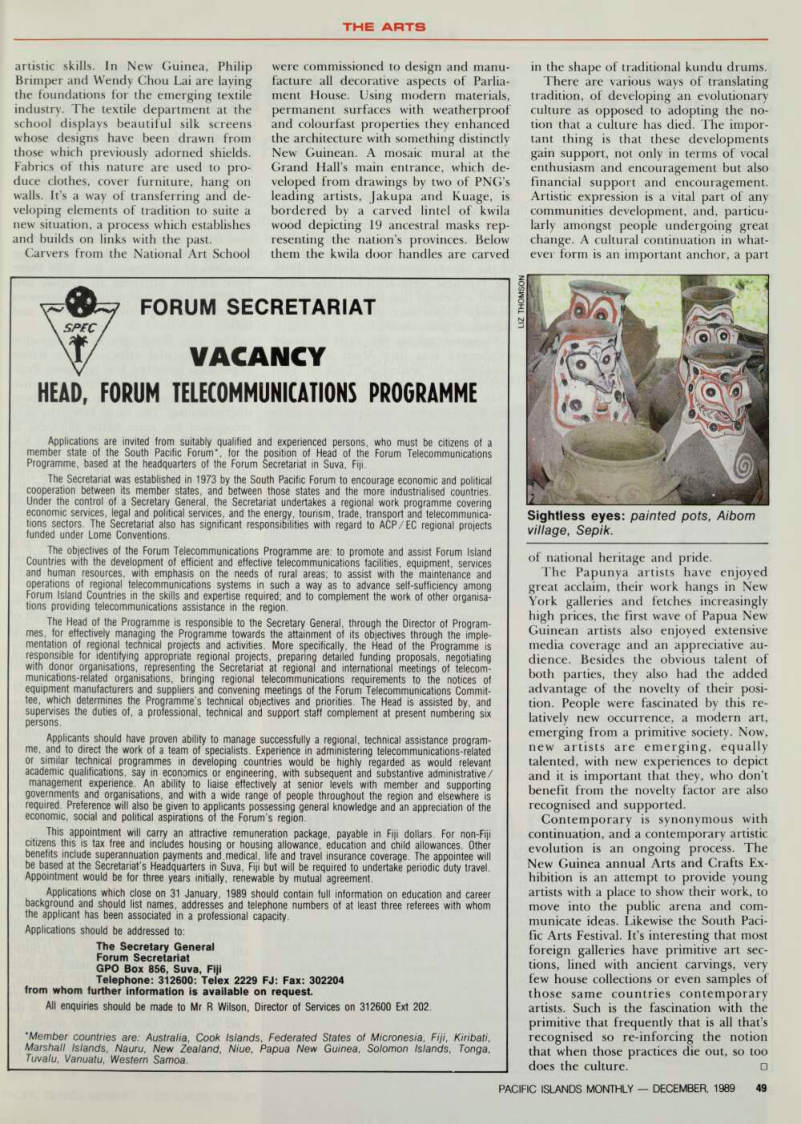
Sightless eyes: painted pots, Aibom village, Sepik.