Islanders make art out of printing
pp. 44-45 · Read in the full issue
Fashion
By Ngaire Douglas
No two pieces of the many thousands he has painted are alike, giving a whole new dimension to fashion design. The Michoutouchkine signature is always in corporated in each unique “canvas”, the hallmark of an original which intending purchasers should look for. Several peo pie have attempted to cash in on
Michoutouchkine’s success by producing
cheap imitations.
Sune Egan, of Tonga, uses a screen
printing technique to produce shirts and
scarves etc. Sune has adapted her art style to suit the materials available in Tonga. She arrived in Tonga in 1974 with a supply of the materials she was familiar with but they soon ran out and after finding it tremendously difficult and expensive to locate further sup
plies, she experimented with plain white
tapa as the fabric and local brown dyes, Her distinctive style continues in these two tones and is screen printed onto materials. “I have work hanging in Buck
ingham Palace,” she says proudly of shirts which have been presented to Princess Diana and Prince Edward.
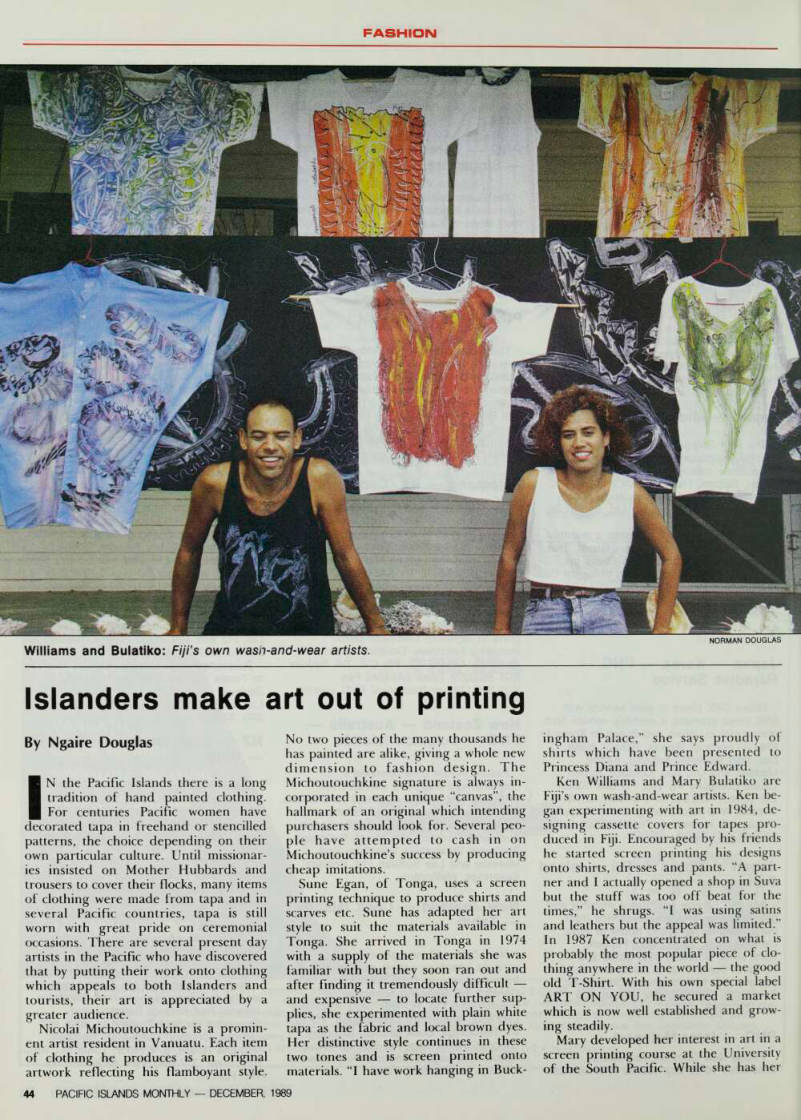
Ken Williams and Mary Bulatiko are Fiji’s own wash-and-wear artists. Ken be gan experimenting with art in 1984, de signing cassette covers for tapes pro duced in Fiji. Encouraged by his friends he started screen printing his designs onto shirts, dresses and pants. “A part ner and I actually opened a shop in Suva but the stuff was too off beat for the times,” he shrugs. I was using satins and leathers but the appeal was limited, In 1987 Ken concentrated on what is probably the most popular piece of clo thing anywhere in the world the good old T-Shirt. With his own special label ART ON YOU, he secured a market which is now well established and grow
ing steadily,
Mary developed her interest in art in a screen printing course at the University of the South Pacific. While she has her
IN the Pacific Islands there is a long tradition of hand painted clothing.
For centuries Pacific women have decorated tapa in freehand or stencilled patterns, the choice depending on their own particular culture. Until missionar ies insisted on Mother Hubbards and trousers to cover their flocks, many items of clothing were made from tapa and in several Pacific countries, tapa is still worn with great pride on ceremonial occasions. There are several present day artists in the Pacific who have discovered that by putting their work onto clothing which appeals to both Islanders and tourists, their art is appreciated by a greater audience.
Nicolai Michoutouchkine is a promin ent artist resident in Vanuatu. Each item of clothing he produces is an original artwork reflecting his flamboyant style.
Norman Douglas
Williams and Bulatiko: Fiji’s own wash-and-wear artists.
own label, HAND PRINTS, together she and Ken are producing a lively, colour ful range of clothing in easy care, easy wear 100 per cent cotton. They combine screen printing techniques with a “squeeze and draw” style and reverse printing to get a variety of effects. Their paintings now decorate shirts, shorts, sulus, trousers, dresses, hats and T-Shirts,
all realistically priced. Designs incorpo
rate abstract and representational styles as well as a number of traditional tapa motifs.
A young friend George Evans helps them keep up with the steady stream of orders from shops, hotels and resorts.
They each produce work in different styles and colours. Ken prefers the col ours of the sea and beach. Mary likes sunny colours. George uses earthy tones.
“He really should have his own label now,” says Ken. “He’d make a lot more money working for himself but he just likes to work for someone else when he needs some money. All care and no re
sponsibility!”
Ken believes that there is a lot of un tapped natural talent in Fiji. “Lots of people just need encouragement to get started in the right direction,” he said.
“Fijians have good ideas but they just don’t know how to market them. We really need some trained people who would be readily available to offer marketing skills to people who want to get started on a new project.”
In partnership with his mother, Marge Williams, Ken has opened The Beach Shop in the Dominion Arcade in down town Suva as a retail outlet. The Fiji Development Bank is currently very keen to assist in the establishment of small scale businesses by local people.
With tourism slowly getting back on its feet after the blows of 1987, any ideas for a business which could attract both local and tourist dollars would be favour ably considered by the Bank. “If I can get a loan, anyone can,” Ken laughs. “I’d be happy myself to give someone advice on how to get started. Sometimes that’s all people need to get them going.”
Ken Williams is a man who enjoys life in Fiji. He has reasons to. He lives at Korotogo on Fiji’s Coral Coast. “I feel better being near the sea where I can follow its colours,” he says. He has a talented and lively business partner and companion. He is building up a success ful small business. Ken readily admits that he’s not one for the restrictions of 9-to-5 jobs. “I’m not one for working,” he grins, “but this doesn’t seem like work!”
Work or not, Ken and Mary are good examples of how small entrepreneurs can get started. HAND PRINTS and ART ON YOU deserve to be art on everyone. □
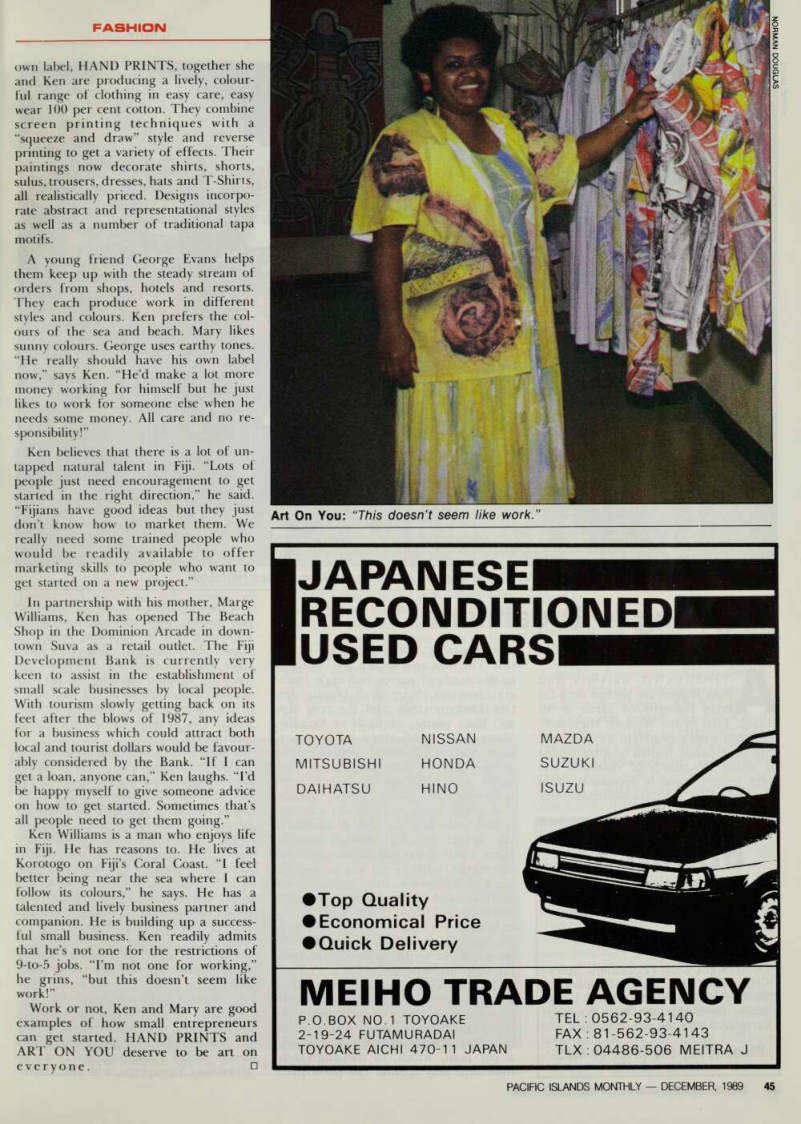
Art On You: “This doesn’t seem like work."