Yasur, that’s
p. 50 · Read in the full issue
Books
Yasur, that’s my coffee
Agriculture In Vanuatu: A
Historical review By Barry Weightman. 320 pp, published by the British Friends of Vanuatu, cA 67 Beresford Rd, Cheam, Surrey, UK.
Price in Pacific region outside Vanuatu; UK20.25 pounds, order from British Friends of Vanuatu.
Reviewed by Nicholas Rothwell
Encyclopaedic in scope, engag ing in tone, this first survey of
agriculture in Vanuatu, formerly
the Franco-British condominium of the New Hebrides, is inevitably a social his tory of the islands during the colonial era and the post independence period of the past decade.
Interspersed among its detailed assess ments of crops and livestock, and the catalogues of the dismaying range of dis eases to which they fall prey, are bizarre episodes of Vanuatu history. In this is land country, the development of agri culture is equivalent to the development of the entire economy.
Poignant tales abound as Weightman weaves together history and commerce.
One delightful example is the story of the first bananas to arrive in the New Hebrides. These fruits were the descen dants of a plant observed growing in the British stately home, Chatsworth, by an observant priest, the Rev John Williams, who obtained several sample suckers from the Duke of Devonshire before set ting out on a voyage to Samoa in 1838.
The banana boxes remained unopened in Samoa until Williams’ death on Erron mango. When they were finally in spected, only one sucker was found to have survived; but it produced a 50 kilo bunch of fruit, and was in due course spread throughout the islands of Vanuatu. Virtually every page of Weightman’s compendium is salted with such vignettes, which leaven the passages of technical information, lending the text as a whole a certain compulsive quality.
The book itself is the most significant ventures yet undertaken by a small orga nisation of great energy, the British Friends of Vanuatu, now in its third year of activity. The BFV obtained the sup port of the Overseas Development Administration of the British Govern ment, which supported the publication of Agriculture in Vanuatu.
The author was employed in agricultu ral and advisory posts in Vanuatu be tween 1968 and 1986, and has written a
work that will be an essential aid for students and agricultural managers throughout the country indeed, a supply of copies has been sent to Vila for distribution by various government agencies, and a further 100 copies will be on sale to the general public in the
capital.
But Agriculture in Vanuatu reaches far beyond its immediate aim, and the author’s quick eye illustrates the quirks of plantation era and condominium his tory. Weightman casts his net wide, in cluding extensively discussions of the political and economic context of the na tion upon independence, and delving into the narratives of the missionary period in order to establish the social
importance of agriculture.
On topics such as the best means of ensuring the full growth of pig s double tusks, or the precise place of ceremonial feasting in the grade system, he is con
stantly illuminating, drawing together a
wealth of source material into a succinct
synthesis. Weightman provides a turbu
lent overview of the rogues of the first plantation days, such as Ross Lewin, “a violent man and notorious kidnapper”, or James Proctor, “a wild and colourful character who had lost a leg fighting for the confederates in the Civil War”.
The development of the two giant companies that shed their influence over the colonial era Societe Francaise des Nouvelles Hebrides and Burns Philp is followed up to the coming of inde pendence. Today, all alienated land has reverted to customary owners, but in almost all cases, plantations that are being worked by foreign operators are
now leased from the ni-Vanuatu owners.
Coffee was a crop of choice for many of the early plantation figures, such as Lewin, who obtained a 100 acre plot on Tanna for some 25 pounds, during the 1860 s, on the fairly reasonable condition that he leave the villages and kava houses intact and assist “his” tribe in any quarrels. (This amble area was clearly not enough for Lewin, who soon after wards was shot while encroaching on land.) Late 19th century coffee planters could benefit from the extensive report presented to the Australian Royal Geog raphic Society by one J.W. Lindt, who thoughtfully included sections on such basic tropics as “How to get to the New Hebrides” and “How to choose land”.
Filtered through the fortunes of the cof fee planting endeavour, which was, pre
dictably, ravaged by cross-diseases, the
history of a strand of New Hebridean life emerges into an intriguing new light.
Weightman is not above marking the
old helpful suggestion for the marketing
of Vanuatu crops; for Tanna coffee, which he hope will soon “satisfy the most discriminating drinkers in the cafes and homes of Vila, and we hope, win a name for quality in the world outside,” he proposes this catchy slogan: “Yasur, that’s my coffee.”
He also includes a section on “non traditional” export crops, in which pride of place goes to kava, Vanuatu’s most unusual plant.” As a drink, kava is valued for the sense it brings of quiet contemplation, relaxation and mild
euphoria, though with over-indulgence
the effects of sleep inducement and im
paired locomotion predominate.”
Although suppressed as a “heathen”
practice by the early missionaries, kava
drinking has now emerged as one of the integral social pastimes of Vila, and is
growing in popularity through the
archipelago. Weightman concludes that
it is the one crop “which Vanuatu has an immediate prospect of developing and holding a controlling interest in the world market it therefore deserves to be given high priority for research, de velopment and promotion in the fields of production and marketing over the
coming years”.
Weightman modestly announces in his introduction that his work is not defini tive, yet for the present, it serves as a magisterial guide to the history and the potential of agriculture in Vanuatu: lent additional charm by its revelatory illus trations of the life of the islands.
Both a labour of love and a store house of memories. Agriculture in Vanuatu is certain to play an important role in setting the priorities for the fu ture development of the nation. □
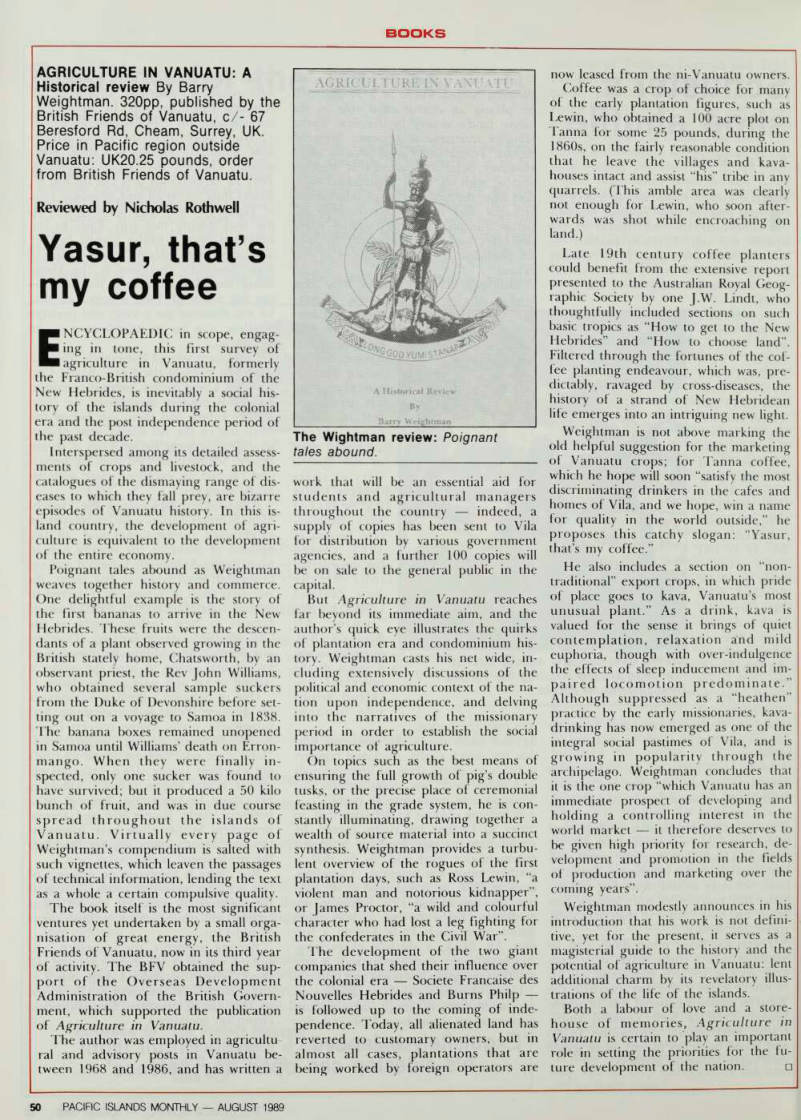
The Wightman review: Poignant tales abound.