Schuster’s
p. 49 · Read in the full issue
shoe shuffle
By Paul Moon
THE French rygby union team’s re cent tour of New Zealand not only confirmed the All Blacks as the world’s top side, but also enabled the Kiwis’ second five-eighth John Schuster to consolidate his status as one of the most exciting personalities in the game
today.
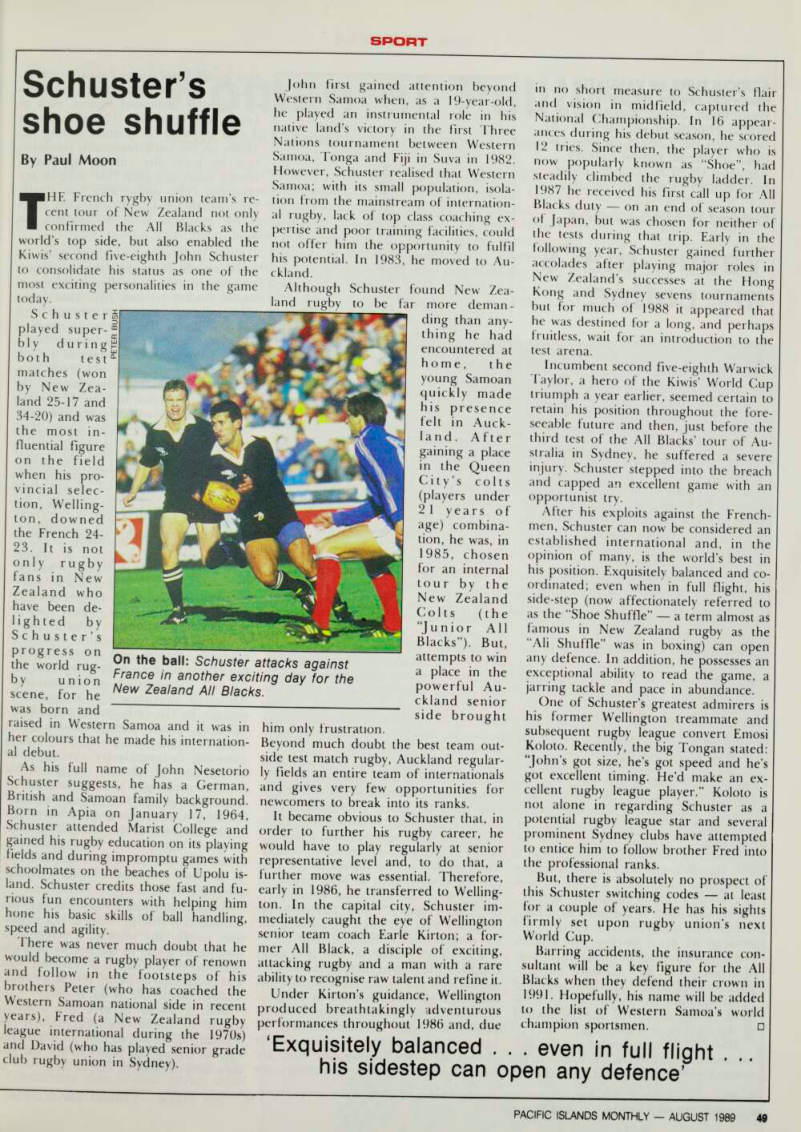
Schuster played super
bly during
both test matches (won by New Zea land 25-17 and 34-20) and was the most in
fluential figure
on the field when his pro vincial selec
tion, Welling
ton, downed the French 24- 23. It is not
only rugby
fans in New Zealand who have been de
lighted by
Schuster’s progress on the world rug
by union
scene, for he was born and
raised in Western Samoa and it was in her colours that he made his internation al debut.
As his full name of John Nesetorio Schuster suggests, he has a German, British and Samoan family background.
Born in Apia on January 17, 1964, Schuster attended Marist College and gained his rugby education on its playing fields and during impromptu games with schoolmates on the beaches of Upolu is land. Schuster credits those fast and fu rious fun encounters with helping him hone his basic skills of ball handling, speed and agility.
I here was never much doubt that he would become a rugby player of renown and follow in the footsteps of his brothers Peter (who has coached the Western Samoan national side in recent years), fred (a New Zealand rugby league international during the 19705) and David (who has played senior grade club rugby union in Sydney).
John first gained attention beyond Western Samoa when, as a 19-year-old, he played an instrumental role in his native land’s victory in the first Three Nations tournament between Western Samoa, Tonga and Fiji in Suva in 1982.
However, Schuster realised that Western Samoa; with its small population, isola tion from the mainstream of internation al rugby, lack of top class coaching ex pertise and poor training facilities, could not offer him the opportunity to fulfil his potential. In 1983, he moved to Au ckland.
Although Schuster found New Zea land rugby to be far more deman -
ding than any thing he had encountered at home, the young Samoan quickly made his presence felt in Auck land. A fter gaining a place in the Queen City’s colts (players under 21 years of age) combina tion, he was, in 1985, chosen for an internal tour by the New Zealand Colts (the “Junior All Blacks”). But, attempts to win a place in the powerful Au ckland senior side brought
him only frustration.
Beyond much doubt the best team out side test match rugby, Auckland regular ly fields an entire team of internationals and gives very few opportunities for newcomers to break into its ranks.
It became obvious to Schuster that, in order to further his rugby career, he would have to play regularly at senior representative level and, to do that, a further move was essential. Therefore, early in 1986, he transferred to Welling ton. In the capital city, Schuster im
mediately caught the eye of Wellington
senior team coach Earle Kirton; a for mer All Black, a disciple of exciting, attacking rugby and a man with a rare ability to recognise raw talent and refine it.
Under Kirton’s guidance, Wellington produced brealhtakingly adventurous performances throughout 1986 and, due
in no short measure to Schuster’s flair and vision in midfield, captured the National Championship. In 16 appear ances during his debut season, he scored 12 tries. Since then, the player who is now popularly known as “Shoe”, had steadily climbed the rugby ladder. In 1987 he received his first call up for All Blacks duty on an end of season tour of Japan, but was chosen for neither of the tests during that trip. Early in the following year, Schuster gained further accolades after playing major roles in New Zealand’s successes at the Hong Kong and Sydney sevens tournaments but for much of 1988 it appeared that he was destined for a long, and perhaps fruitless, wait for an introduction to the test arena.
Incumbent second five-eighth Warwick Taylor, a hero of the Kiwis’ World Cup triumph a year earlier, seemed certain to retain his position throughout the fore seeable future and then, just before the third test of the All Blacks’ tour of Au stralia in Sydney, he suffered a severe injury. Schuster stepped into the breach and capped an excellent game with an opportunist try.
After his exploits against the French men, Schuster can now be considered an established international and, in the opinion of many, is the world’s best in his position. Exquisitely balanced and co ordinated; even when in full flight, his side-step (now affectionately referred to as the “Shoe Shuffle” a term almost as famous in New Zealand rugby as the “Ali Shuffle” was in boxing) can open any defence. In addition, he possesses an exceptional ability to read the game, a jarring tackle and pace in abundance.
One of Schuster’s greatest admirers is his former Wellington treammate and
subsequent rugby league convert Emosi
Koloto. Recently, the big Tongan stated:
“John’s got size, he’s got speed and he’s got excellent liming. He’d make an ex
cellent rugby league player.” Koloto is
not alone in regarding Schuster as a potential rugby league star and several prominent Sydney clubs have attempted to entice him to follow brother Fred into the professional ranks.
But, there is absolutely no prospect of this Schuster switching codes at least for a couple of years. He has his sights firmly set upon rugby union’s next
World Cup,
Barring accidents, the insurance con sultant will be a key figure for the All Blacks when they defend their crown in 1991. Hopefully, his name will be added to the list of Western Samoa’s world champion sportsmen, □
‘Exquisitely balanced . . . even in full flight . his sidestep can open any defence’
On the ball: Schuster attacks against France in another exciting day for the New Zealand All Blacks.