Pacific



Islands
Month Y
American Samoa US$2.5O Australia A 52.50 Cook Islands NZ$3.OO Fiji F 51.75 FS. of Micronesia US$3.OO Guam US$3.OO Hawaii US$3.OO Kiribati As 2 50 Nauru A 52.50 New Caledonia CFP2SO New Zealand (incl GST) $NZ3.45 Niue NZ$3.OO Norfolk Island A 53.00 Nth Marianas..! US$3.OO Papua New Guinea K 53.00 Rep. of Marshall US$3.OO Solomon Islands A 53.00 Tahiti CFPS3OO Tonga P 3.00
Usa Us$3.Oo
Vanuatu VT2OO - Samoa T 2.75 •Recommended retail price only
August 198 S
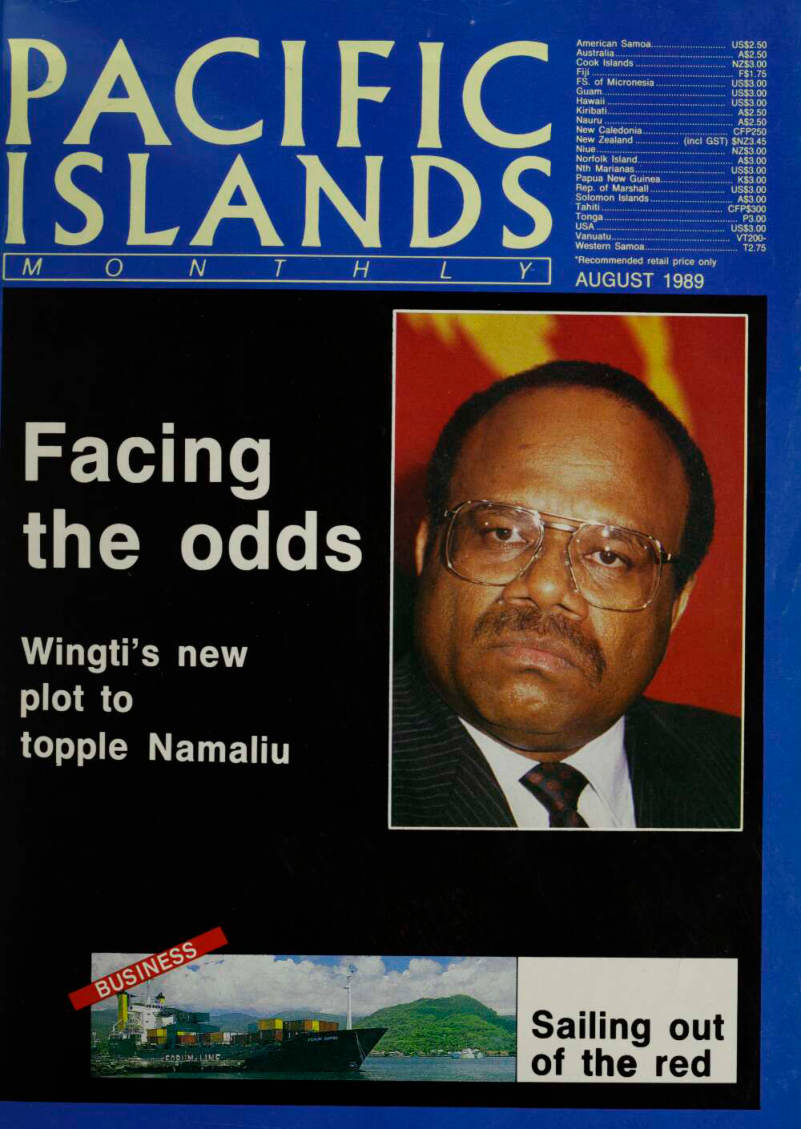
Facing the odds If
Wingti’s new plot to topple Namaliu
Sailing out of the red
Cover photo: Namaliu by Matthew McKee
Advertisements & other items, pp. 2-4 (1 item)
Progress with Distinction.
M
■ V SdP n
Our bold approach
to steering is giving you
room to move.
Honda’s unique four-wheel steering system smoothes
your turning response, at any manoeuvring speed.
Ever since we introduced our revolutionary four-wheel steering (4WS) system on the sleek Honda Prelude, we have been turning a lot of heads.
Not only because the idea is so fascinating, but also as the advantages are so wonderfully apparent on the road.
Drivers invariably marvel at how easily the opposite-direction steer of the rear wheels lets them slip into a tight parking space, or execute a sharp low-speed turn. Many are equally astonished at how smoothly high-speed lane changes occur, as the 4WS system changes over to same-direction rear-wheel steering.
Perhaps equally amazing is that we’ve refined all these manoeuvres with a single, simple, and reliable mechanism.
Naturally, we worked quite hard to achieve that result. Yet for Honda, such dedication to original technology that benefits the driver goes without saying. Were bent on improvement, not imitation.
And we would never want to steer you wrong.
W HONDA
n the 1988 Formula One Constructors' Championship, Honda engines towered the HONDA Marlboro McLaren to victory, as they did be Williams HONDA team in 1986 and 1987. k Q3 ST pon Mo rp h shv/TA Hm r h 9s , R °f d n Tullamarine ' Victoria 3043/NEW ZEALAND: Honda New Zealand Ltd. P.O, Box 97-340, South Auckland/PAPUA NEW GUINEA; Toba Pty„ Ltd. P.O. Box y TAHITI. Honda Distribution S.A. R.L B P 1665, Papeete/KIRIBATI: Atoll Motor & Marino Services P.O Box 49, Balriki Tarawa, Republic of Kiribati/U.S. TRUST TERRITORY; United Micronesia 2052 Suva F AMFRIPAN campa ui m . o ISLANDS: Lee Kwok Kuen & Co., Ltd. P.O. Box 537, Homara/NAURU: Nauru Cooperation Republic of Nauru/FIJI: Coral Island Motors Ltd. P.O. Box E . R . CA . N M ° A : HOll day Moto rs ’ Parts and Service P.O. Box 968, Pago Pago, American Samoa 96799: Heleck’s Service Center Ltd. P.O. Box 1138 Pago Pago, American Samoa 96799/TONGA: onga Industrial Traders P O Rrwinnß Nukualofa mci Akin. i
Looking for a Hard Time.
;■ O * - ■ v -• - ». r • ' Wm m Mm ■ m •tm - The Mitsubishi Galant, Ist Group N, 4th Overall in the 1989 Acropolis Rally, Round 6 of the WRC Finding the ideal conditions in which to put your theories to the test can sometimes take you a little out of your way. As in the case of testing the advanced technology incorporated in the Mitsubishi Galant.
They entered the Galant in some of the most grueling rounds of the World Rally Championship looking for those conditions.
So, from the rocky trails of the Acropolis Rally to the high-speed tracks of the Finnish 1000 Lakes Rally, the Mitsubishi Galant’s organic performance is being put to the test.
Mitsubishi Motors regards all motor sports events as the ultimate proving ground for their automotive technology. And where better to test the embodiment of organic performance, Dynamic-4? Four comprehensive drive systems: 4-wheel drive, 4-wheel steering, 4-wheel independent suspension and 4-wheel anti-lock braking are melded into a single, thinking performance.
An organic performance.
This approach testing the worth of their technology under the rigors of competition maintains Mitsubishi’s finely honed competitive and innovative edge.
And the test results become another part in Mitsubishi’s ever evolving production philosophy —the organic performance.
MITSUBISHI QHLHNT
A
MITSUBISHI
MOTORS
AMERICAN SAMOA: MORRIS SCANLAN SERVICE INC. PO Box 367. Pago Pago. Tel 633 5520/ AUSTRALIA; MITSUBISHI MOTORS AUSTRALIA LTD Box 1284 South Road CJovelly 275-7223/FIJI: NIVIS MOTOR & MACHINERY CO. LTD G P O Box 150. Suva. Tel 383411 /FRENCH POLYNESIA (TAHITI); ETS-BREDIN FRERES ET FILS P O Box 21. Papeete, Tahiti. Tel 4-202-58/ NEW CALEDONIA: SOCIETE D IMPORTATION D AUTO DU PACIFIQUE SUD S A B P 438 Rond Point du Pacifique, Noumea, Tel 274144/NEW ZEALAND: MITSUBISHI MOTORS NEW ZEALAND LTD T ®'„ 3^'° 9 / NORFOLK ISLAND: BORRYS LTD PO Box 169. Norfolk Island, Tel 2114/PAPUA NEW GUINEA: TOBA PTY LTD PO Box 503. Port Moresby. Tel 21 7874/SOLOMON LTD G P°Box 8a Honiara nunrutrv iolapiu. ownn ioliu r- kj dvja iuc? mui iwirv lotat iu. ici c ■■■»/» «» 1 ■ ' ... ... a i r\ urn nikinc itd Guadalcanal Tel 30128/TONGA: SITANI MAFI CO . LTD PO Box 83. Nuku ALOFA. Tel 21 044/VANUATU: SOCOMETRA B P 06 Route de Lagon, Port-Vila. Tel 2314/WESTERN SAMOA A M MACDONALD HOLDINGS LTD
Pacific
Islands
Monthly
Vol. 59 NO. 19
Voice Of The Pacific
August ’B9
Cover
The Bougainville rebellion has en veloped Papua New Guinea in a state of political and economic crisis. Worse is coming for Prime Minister Rabbie Namaliu: former Premier Paias Wingti announced in Port Moresby his inten tion to overthrow Namaliu through a vote of no confidence most likely in
September. And as the region’s biggest
nation slips deeper into turmoil, other countries united in Tarawa to tackle some of the Pacific’s most pressing problems. Starts page 10.
The Region
Palau The United States House of Repre sentatives approved the principles of the Compact of Free Association oy a voice vote. Page 16.
Vanuatu Businessman Cheung Siu Wah jailed for the shipment of heroin to Australia via Port Vila. The judge warns the re gion. Page 17.
New Caledonia The spirit of Jean-Marie Tjibaou lives among the Kanaks as they begin the long trek to independence. Page 19.
Solomon Islands Walter Haganu was an illiterate village man when he signed a 20-year logging contract he now regrets. Page 20.
New Zealand David Lange’s government is under fire as New Zealand goes through a period of racial tension. Page 22.
Northern Marianas It is certain that Tenorio will win the election for Governor. But the question is: which Tenorio. Page 25.
Sport
Schuster makes his mark as one of the most ecxiting New Zealand All Blacks of recent times. Page 49.
Business
Finance Fiji’s Air Pacific announces another firofit and plans or expansion into Asia. Page 36.
Shipping Forum Shipping Line is making money and be coming a successful example of region al cooperation.
Page 40.
Editor Jale Moala Editorial Adviser John Carter Contributors Al Prince Carrie Loranger David North David Robie Dykes Angiki Ed Rampell Frank Senge John Zubrzycki Jope Balawanilotu Nicholas Rothwell Paul Moon Robin Bromby
Publisher Geoffrey Hussey
Business Manager Charlotte Thomas (subscriptions/enquiries) Advertising Sales Sydney & Melbourne Fergus Maclagan (02) 412 3918; Brisbane Robert Walker (07) 371 0533 Adelaide Hastwell Williamson Representations (08) 79 9522
Our editorial office is now located at 20 Gordon Street, Suva. All editorial material and correspondence should be sent there and not to our old Syd ney address.
Cover prices are recommended retail only Registered by Australia Post, publication No NBP 1210 Copyright Fiji Times Limited, Suva, Fiji
Advertisements & other items, pp. 5-6 (3 items)
Departments
LETTERS 7
STAMPS 8
OPINION 9
HEALTH 46
BOOKS 50
PACIFIC PEOPLE 51
ISLAND PRESS 53
OUT OF THE PAST 54
5
PACIFIC ISLANDS MONTHLY AUGUST 1989
A Fiji Times Limited Production.
Founded 1930 (USPS 952480) 20 Gordon Street, Suva, Fiji; Telex; FJ2124; Telephone: (679) 314111; Fax: (679) 302011.
Pacific Islands Monthly (APPS No. NBP 1210) is published month ly by Fiji Times Limited, a division of Nationwide News, 2 Holt St, Sur ry Hills, NSW 2010. Second class postage paid at Honolulu, Hawaii, POSTMASTER. Send address changes to PACIFIC ISLANDS MONTHLY, PO Box 22250, Honolu lu, Hawaii 96822. Typeset and printed by Fiji Times Limited, 20 Gordon Street, Suva, Fiji.
efinitior
o &KI
high speed CD dubbins
The new high speed dubbing feature on the AIWA X-D9OO system allows you to dub CDs in about half the playing time.
And, it’s the world’s first midi component system with new high definition BBE sound originally developed for audio professionals. BBE brings out more sonic detail, particularly in vocals and solos.
In combination with AlWA’s original DSL and a full 1000 W (PMPO) high power output, you’ll enjoy authentic soundstage presence.
The X-D9OO also offers audio/video compatibility, with 3 AN inputs and 2 AA outputs, along with a built-in AN surround sound system. It’s everything you could want in a genuine high quality separate component system.
1000 PMPO
r- * I R : ■llliß liliill N Pure Hi-Fi Component System
X-D9DC
The word “BBE” and the "BBE symbol" are trademarks of BBE Sound,
Digital Audios. Video
Mobex Pty., Ltd. Unit 1,70 Gibbes Street Chatswood N.S.W. 2067 AUSTRALIA PHONE: 001-61-2-4066277/Oceania Indent Agency (P.N.G.) Pty., Ltd. Ago St., Gordon Box 5518, Boroko, Port Moresby, Papua New Guinea PHONE; 256411/The Sound Centre Ltd. P.O. Box 434 Port Vila, Vanuatu PHONE: 2035/P. Hargovind Bros. 190 Renwick Road P.O. Box 409 Suva Fiji PHONE: 24350/Octavium Group Ltd. 33 Constellation Drive Mairangi Bay, Auckland 10 NEW ZEALAND PHONE: 001-64-9-479-1272/Hifivox 19 av. Foch B.P. 1458 NOUMEA Nouvelle-Caledonie PHONE; 001-687-27.24.66/Harvest Pacific Limited P.O. Box 517, Honiara, Solomon Islands PHONE: 131/Fare-Hi-Fi Stereo Ruede Marechal Foch P.O. Box 269, Papeete Tahiti R.C. 6604 A TAHITI PHONE: 2.48.14/Micropac Audio, Inc.
P.O. BOX 3478 Anana Guam 96010 PHONF- 479-8091 479.8997/Rarntnnna Hutu Proa Shnn Private Ran PO Roy 99 Ramtnnna Gnnk IslanH/Nauru Go-Onerative Society Republic of Nauru
Too much
Tropicalities
Letters
Too much on Wea?
THE June 1989 article, ‘Did Wea gun down the Accord’, by Mr David Robie, concerning the murder of Jean-Marie Tjibaou and Yeiwene Yeiwene, and the death of one of their assassins, Djoubelly Wea, unfortunately lacks balance and contains errors. Accordingly it could mis lead an uninformed reader. To begin with, the attention given to Wea is almost equal to that given to the two leaders whose death he plotted. An un informed reader could be given the im pression that Wea’s stature and import ance was broadly equivalent to that of his victims. This seems odd, since although Wea was well known as a long time militant campaigner for independ ence, his influence scarcely extended beyond the small village of Gossanah in the north of the outer island of Ouvea.
In contrast, Tjibaou and Yeiwene were the leading figures in the Kanak nationalist movement, and senior and
widely-respected participants in New
Caledonian politics. Both also had a high reputation in the region. Had he been spared, Tjibaou’s qualities as a statesman probably would have ensured that in the longer term he played an important part in South Pacific affairs.
Moreover, the comments made on Wea are all highly positive, which seems an odd way to mark the memory of a man who apparently cooly planned and executed the murder of the leaders of his people. Thus we are told that he was “• • • a maverick but respected leader”, • . . typical of the new generation of leaders”, the . . undisputed leader of the Ouvea militants”, and . . an unlike ly assassin: a respected and long-time advocate of non-violent action”. In addi tion, we are told that he . . was a man of humility, preferring to live simply and to conduct his activist life by example”, who, unlike . . some other elected Kanak leaders [none specified] . . . shun ned the use of his salary for personal benefit.”
The presentation of Wea in these heroic terms could be read as an en dorsement of his crime. Moreover, the “non-violent” label seems especially in congruous. After all, Wea strongly sup ported the violent “active boycotts” of the elections in November 1984 and May/June 1989, and supported the armed hostage-taking of the gendarmes on Ouvea, which although no doubt intended as a symbolic exercise which would end through negotiation neces sarily carried the risk of casualties. After
the tragic outcome of the hostage-taking.
Wea isolated Gossanah village from the outside world, with armed teenagers guarding the barricades, patrolling the
village, and intimidating opponents.
Moreover, Wea indulged himself in wild and violent rhetoric which had little to do with the hard realities and limited options in New Caledonian politics. The emphasis on Wea’s simplicity and dedica tion also, at least by implication, could be read to reflect badly on Tjibaou and Yeiwene. Such aspersions would be com pletely unwarranted; they also lived simply, putting the cause to which they were dedicated above all else.
Yet despite the dedication, integrity and high calibre of the dead leaders, the article’s comments on them have a carp
ing quality, especially compared with the
eulogistic treatment of Wea. The article contends, quite incorrectly, that the two men were . . struggling for their sur vival against younger hardline leaders.”
In fact, as Tjibaou’s success in bringing the great majority of FLNKS supporters around to support of the Matignon Accord demonstrated; and as the vacuum left after their deaths con firmed; their leadership was under no serious challenge, despite criticism from the extremist fringe of the nationalist movement. We are told, correctly, that Tjibaou . . was a spiritual man, a visionary”, but no mention is made of his human warmth, of his great skills as a speaker, leader and political tactician, and of his deep commitment to econo mic development. Neither is any men tion made of his achievements as Mayor of the northern municipality of Hien ghene, as head of the territorial govern ment from 1982 to 1984, and as Presi dent of the Northern region from 1985 to 1988. We are also told, in a mislead
ing oversimplification, that Tjibaou’s rise
to prominence in the nationalist move ment dated from the Melanesia 2000 Cultural Festival in 1975, which he orga nised and inspired. Then a slur is put on this noteworthy achievement by the dis torted and unsubstantiated claim that he was “backed” in mounting the Festival by Noumea’s right-wing mayor, Roger Laroque and the “ultra-conservative business establishment”.
Meanwhile Yeiwene Yeiwene, despite his much greater stature than Wea, is given only scant attention. We are told that he was “representative of an entrep reneurial group of Kanaks”, an assertion which no doubt would have left him mystified, as it would anyone who knew him. He is described, correctly, as Tjibaou’s loyal deputy, and his arrest at Christmas 1987 is recorded, but no men tion is made of his dynamism and charm, or of his skills as a tactician and
orator. The article also tails to mention Ins role as a leader of demonstrations, and as a master of symbolic protest, in
cluding, tor example, his Septemer 1984
“takeover” of Mare airport. This incident involved the temporary “confiscation” and daubing of slogans on the helicop ters and plane of visiting DOM-TOM Minister Georges Lemoine and his en tourae, to the great embarrassment of the French administration. Yet while fail ing to record Yeiwene’s true merit, on the other hand the article comments dis paringly and misleadingly that .. he faced increasing criticism from some FLNKS members [none specified] who regarded him as being full of platitudes and reluctant to take action.” 1 he article also contains factual errors.
The names “Machoro” and “Cortot” are rendered incorrectly as “Machuro” and “Courtot”. The French newspaper refer red to is “ Le Monde", not “De Monde".
Since its formation, the FLNKS has in cluded five, not four, political parties, namely the UC, the PALIKA, the UPM, and PSK and the FULK. (However it is true, although this is not mentioned in the article, that the FULK which is a small party with very limited support has, in practical terms, excluded itself from the movement, and may be formal ly ejected at the next congress in August or September). Rather than halting de velopment programmes and Kanak training, as the sixth paragraph on page 13 seems to suggest, the Matignon peace plan in fact embodies these measures.
Meanwhile, the report from Paris accom panying the article states incorrectly that the French government had announced the postponement of the June regional elections, following the deaths of Tjibaou and Yeiwene. The French government did suggest a postponement. However the FLNKS leadership insisted that the elections go ahead as planned.
In addition, the article’s attempt to draw a parallel between the death of High Chief Atai in 1878 and that of Jean-Marie Tjibaou in 1989 is strained and absurd. Atai was slain after a period of warfare, by members of a rival tribe, in an era when an overall sense of Kanak nationalism was non-existent. In contrast the unarmed Tjibaou, the ack nowledged leader of the Kanak national ist movement, had travelled to Ouvea, with his stalwart deputy and other senior colleagues, to heal wounds and make peace. But he was betrayed and slain, his arm stretched out in a gesture of open ness and friendship.
Stephen Henningham
Research Fellow, Department of Political and Social Change , Re search School of Pacific Studies , Australian National University.
The Michel
Stamps
The Michel Rundschau list
By John Hunter
EACH year I have given you selec tions from the Michel Rund schau’s list of stamp issues for the year. The Michel Rundschau magazine has again listed stamp issuing details, this time for the year 1987. It is always in teresting to see whether the issues for the year have indicated a fall or rise.
The good news for the year 1987 is that the number of issues is down on those of 1986. The number of stamps produced in 1987 shows a small reduction from 9509 to 9107. Perhaps the reality of the philatelic market as begun to sink in. Let us hope that the trend of fewer stamps being produced will continue. I have written before on numerous occasions about the stupidity of some postal au thorities over producing in the hope of attracting that elusive dollar.
The country to head the list of stamp
producers is Guyana (certainly not an honour) which issued a staggering 356 stamps for the year 1987.
In a list of those countries that issued 100 or more stamps for the year there were 16 offenders. Unfortunately there were two offending Pacific nations.
These two nations have, sad to say, been in the top list for a number of years.
Tuvalu was the fifth largest producer in the world with 181 stamps and the Cook Islands was the eleventh top producer
with 112 issues. It was good however to see that both these countries had issued fewer stamps than the year before.
A close examination of the above table will show which countries have not been tempted to over produce. It is good to see that a large percentage have kept their numbers in the low twenties or even lower. I have also indicated in the table the value of the new issues in Deutchmark. In the listing of the top 10 countries with the highest value of stamps issued, it is unfortunate to see one Pacific country and that is the Cook Islands.
The Cook Islands holds second place in the world. With such a high value on the stamps issued one can imagine how difficult it would be to maintain loyalty and continue to collect stamps from such countries. Again it is a case of the au thorities chasing the elusive dollar.
When we look at the figures tor 1988 I am afraid that we will see the number of stamps issued by Australia take a dramatic leap as this was the year that the bicentenary stamps appeared in large numbers and caused collectors to aban don Australia in large numbers.
Country
Total
Stamps
Miniature
Value
Units
Sheets
(DM) Australia 61 61 73.40 Cook Is 112 103 9 825.00
Fiji
19 17 2 45.00 French
Polynesia
28 27 1 113.40 Kiribati 16 15 1 31.70 Nauru 12 11 1 19.70 New Caledonia 22 22 77.70 New Zealand 33 31 2 56.35 Niuafo’ou 13 12 1 47.25 Niue 19 15 4 189.50 Norfolk Island 31 31 — 81.20
Papua New
Cuinea 22 22 — 37.75
Penrhyn
12 8 4 156.75 Pitcairn 16 16 — 37.00 Samoa 24 21 3 59.00 Solomon Is 38 37 1 75.25 Tokelau Is 12 12 — 9.50
Tonga
23 21 2 99.60 Tuvalu 181 169 12 512.00
Remembering
a disaster
On March 16, Western Samoa issued a very interesting set of four setenant stamps to commemorate a disaster, the Apia Hurricane of 1889.
Of the seven warships in the Bay of Apia only one managed to escape, the
Calliope.
The captain of Calliope, H.C.
Kane, gave this account of the event: “As the afternoon of the 15th wore on, the wind came up from the N.E., and gradually freshened. By mid night it was blowing a gale, and it increased all through the middle and morning watch. By daylight, when it was blowing a hurricane, we found we had dragged quite close to the reef. By that time the “Eber” had gone down with all hands but five.
I managed to keep clear, but our port cable parted and we came against the Vandalia’s stern, and carried away the jibboom, and all the fastenings of the bowsprit. Then the Olga came up on
our star b° arc l side and very nearly rammed us. 1 just managed to steer clear, but she caught our foreyard
and damaged it severely.
“Seeing that everytime we tautened our cable we were getting nearer the reef (in fact it had become a question of feet), I made up my mind to slip and try to go out, reserving as a last resort the hope of beaching the ship on a sandy patch, which the Olga afterwards succeeded in reaching.
Luckily I had confidence in the strength of the ship and the power of the engines, and determined to go out. At about 9.30, I sent down to the Staff Engineer for every pound of steam he could give me, sheered well out to starboard of the Vandalia, put her head to the wind and slipped the remaining cable. It was an anxious moment: for some time, how long I know not, she remained perfectly still, moving neither way, and then
gradually drew ahead, pitching
tremendously, bow and stern in turn right under water. We gave the Vandalia a wide berth, and stood out to-
wards the Trenton, which was still holding on right in the entrance pas sage between the reefs, I sheered close past the Trenton's stern, our
foreyard actually passing over her
quarter as we rolled. The engines were going very fast by then, and the ship answered her helm admirably.
We came up to the wind in splendid style, clearing the reef by 50 yards, and then stood right out to sea.
“As we passed the Trenton all the officers and crew who were on deck gave us a ringing cheer, which was heartily returned by us. We were much affected by that proof of good will from another ship at a time when they might well have been thinking about themselves alone.
In five minutes after passing the Trenton there was nothing to see but the driving mist. We still had the reef on either hand, but trusted to our compass to take us clear. We made about one knot as near as I could estimate it, driving the ship at the utmost power of the engines. But we were safe.”
Pacific
Islands
Monthly
Opinion
Good news, bad news
WHAT did July bring? Good news and bad. First the good news.
In New Caledonia, the country witnessed a peaceful transfer of administrative power from Paris to the new Territorial Assembly.
With Kanaks controlling two provincial administrations and the white settlers one, the country has launched itself strongly in the direction of the Matignon Accord and towards the referendum on independ ence in nine years. For the Kanaks, often militant in their struggle for independence, the spirit of Jean-Marie Tjibaou was alive, and orators eulogised him as they tried to set the pace for the future. For the white settlers, hoping for New Caledonia to remain under the French flag, the future is made easier by the fact they control the nickel-rich Southern Province, and its developments and financial centre. The Accord seems to have won the unity of the majority. The future for New Caledonia seems peaceful.
Fiji made some headlines. Pundits living far away predicted a third coup this year, and warned of impending doom, much to the asto nishment of the local residents. Methodist Church fundamentalists erected roadblocks, again, in their continuing battle with the law to preserve the sanctity of the Sunday. They were put in jail. The economy continued to bloom with the Asian Development Bank pre dicting a growth rate of between two and three percent for this year and next year. Quite contrary to what the critics say about Fiji, the Bank report said the political situation has stabilised, the tourism industry recovered and earnings from sugar, gold and garments have risen.
Vanuatu was swift in acting against the use of Port Vila as a trans-shipment port for heroin from Asia headed for the Australian market. The country remained politically stable. The brightest spot was news of the successful health care programme being run by the Save the Children Fund Australia and the Australian International Development Assistance Bureau (AIDAB). In a country that had poor health and one child in every 10 dying in their first year, Vanuatu has been able to arrest the problem and working for a health for all.
In French Polynesia, a hunger strike achieved some form of success when the territory’s President promised a special sitting of the Ter ritorial Assembly to discuss nuclear testing. The mellowing of official attitude in the territory was a good sign for anti-nuclear activists although it would not nave mucn of an impact on French nuclear
testing in the region.
One of the best examples of successful regional cooperation is the Pacific Forum Line which will announce another profit this month.
From very jittery beginnings many years ago Forum Line has man aged to sail away from financial trouble ana is becoming a profitable enterprise for Pacific Island countries.
Like all good things come to an end, so, too, good news. The bad news of July was the unsolved crisis in Papua New Guinea where the government was still having a shootout m the jungle with Francis Ona’s rebels. The crisis, followed by an impending motion of no confidence in the government, has created havoc m the country’s economy. In Tarawa the rest of the Pacific gathered for the 20th Forum, a meeting that was acknowledged a happy one until Japan again refused to agree to a ban on driftnet fishing in the region. □
Advertisements & other items, p. 9 (1 item)
FIJI: Distribution, subscriptions and advertising: Fiji
Times Limited, GPO Box 1167, Suva, Fiji Phone 31 -4111. telex FJ2124 FRENCFI POLYNESIA: Distribution: Hachette Pacifique 10 Ave Bruat, Papeete Phone 25-610 HAWAII: UNITED STATES: Distribution: PIM Hawaii, PO Box 22250, Honolulu, Hawaii, 96822 Advertising: Brian C Asgill, Apt 1308, 1676 Ala Moana Blvd Honolulu Hawaii, 96815. Phone (808) 955-9718 JAPAN: Advertising and subscriptions: Universal Media Corporation, GPO Box 46, Tokyo Phone 666-3036 cable UNIMEDIA Tokyo, telex 2524665 MALAYSIA Advertising and subscriptions: Worldwide Media Services, 57-B Komplex Damai, Jin Dato Haji Eusoff, Kuala Lumpur Phone 63-9340, cables WORLDMEDIA Kuala Lumpur, telex 31533 VANUATU: Distribution: The Vanuatu Stationery and Book Centre, PO Box 557 Port Vila Advertising: Norman Bros Bookshop Port Vila Phone 2232 NEW CALEDONIA: Distribution: Depot Centre de Presse Michel Pentecost CBP2, Noumea Phone 27- 2434, 27-4729 NEW ZEALAND; Distribution: Gordon & Gotch, PO Box 584, 2 Carr Road, Mt Roskill, Auckland 4 Advertising: McKay International Media Reps Ltd, C/- Albany PO, Auckland 10, New Zealand Phone 413-9119 Telex NZ22701, FAX 413-9110 WELLINGTON: Ross Quaid Media, 1 Scholes Lane Petone (04) 68-7593, PO Box 38699, Petone PAPUA NEW GUINEA: Distribution: Gordon & Gotch, PO Box 3395, Port Moresby Phone 25-4551 25-4855 Advertising: Robert Walker, PO Box 600, Indooroopilly Old Australia 4068 Phone (07) 371-0533 SOLOMON ISLANDS: Distribution and Advertising: The Bookshop (Norman Bros ) PO Box 503, Honiara PHILIPPINES; Advertising: The GF Group, 12 San Ignacio St Uroaneta Village, Makati, Metro Manila Phone 817-7299, telex 45950 and 4233 UNITED KINGDOM F A Smyth and Associates, 23A Aylmer Parade, London N2OPO, England. Phone (01 )340 5088, fax (01)341 9602 UNITED STATES MAINLAND: Advertising: Joshua B Powers Jr , Powers International Inc , Suite 708 271 Madison Ave , New York, NY 10016 Phone 867-9580, Subscriptions PIM, Hawaii, PO Box 22250 Honolulu Hawaii, 96822
SUBSCRIPTIONS
American Samoa US$45 Australia AUSS3O Canada US$45 Cook Islands AUSS46 Fiji Fs24 French Polynesia US$45 Guam US$45 Hawaii US$45 Japan US$3B Kiribati AUSS46 Micronesia US$35 Naum AUSS42 New Caledonia US$32 New Zealand AUSS42 Solomon Islands AUSS46 Tonga AUSS46 Tuvalu AUSS46 United Kingdom Stg £2B US (Mainland) US$45 Vanuatu UASS42 Western Samoa AUSS6O Elsewhere US$63 Payments to Pacific Islands Monthly: Subscriptions Dept, GPO Box 1167, Suva, Fiji.
Subscriptions rates includes the cost of airspeeding to all destinations set out above. Direct airmail rates on application.
Back to square one
Cover
Paias Wingti wants to return to power. He has lost faith in the government of Rabbie Namaliu and has announced his intention to move a motion of no confidence in the government. The motion, withdrawn in July , is now likely to be tabled in September. It will catch Namaliu in an awkward position: the rebellion on Bougainville continues, the economy is diving, and parliamentary unity now seems lost. Frank Senge looks at the crisis:
PAIAS Wingti threw a sumptuous feast on July 21, and immediate ly declared to some 300 guests that it would be the last party he threw as Papua New Guinea’s Leader of Opposition. The message implied that the next party he hosted would be in his capacity as Prime Minister of the country.
Wingti’s declaration was made on the last day of the July sitting of Parliament.
Two weeks previously, on the first day of Parliament, the Opposition (with Wingti’s full blessing) had withdrawn a motion of no confidence in the 12month-old government of Prime Minis ter Rabbie Namaliu. The motion had named Wingti as alternate Prime Minister.
As the party went on, Wingti told his guests the motion of no confidence was the work of his “lieutenants”. He was
reluctant to en tertain it and said many times he wanted to give the Namaliu Government time and room
to perform
or self destruct. (Wingti’s own second term in office had been short circuited by a Namaliu mo tion of no con
fidence eight
months into office). Namaliu’s 12 months in office have not been enough to allow the work of his government to bear fruit, particularly with the turmoil in Bougainville and recent unrest a big hinderance. But because of those violent problems, Wingti has had a change of mind and concluded Namaliu’s govern ment is not only self-destructing but also taking the Country down with it.
Wingti has had enough. He is now committing his party and the Opposition
to “working 24 hours-a-day” to change
the government. This announcement has jolted his audience back to the reality of Papua New Guinea politics. Nothing has
changed, even though things looked
different in the first two weeks of July.
For a short while then political observers in Papua New Guinea thought the coun
try was achieving political majurity and
acquiring some parliamentary stability.
It is said that crisis mould nations.
There was an indication of this during the July sitting of Parliament when MPs faced with the threat of a national crisis of frightening proportion tried to shake themselves loose of their small party, factional and regional shells to make one giant effort to work together to save the country. From this effort emerged Parliament’s best and most con structive debate on the State of Emergency at Bougainville. For once Members of Parliament put aside the ugly below-the-belt politics which had been the feature of independent Papua New Guinea and collectively sought to solve the violent problems of Bougain-
ville.
The Austra lian colonial administration was blamed for the crisis now
gripping
Bougainville. It is said Papua New Guinea’s colonial mas ters had ignored the landowners, failed to in clude them in roundtable dis cussions and had relocated
them under police supervision. There was no recognition of Bougainville’s strongly matrilineal society where the woman is the landowner. Instead the col onial administration and the House of Assembly representatives drew up a “gentleman’s” agreement. The Bougain ville Copper Agreement contains provi sions for reviews every seven years.
There has been no review since 1974 despite requests by individual parlia mentarians, landowners, provincial au thorities, and the company itself.
Bougainville is a long story. There have been drawbacks in attempts to bring peace since violence erupted with the sabotage of Bougainville Copper Li
mited and government installations after the theft of a large quantity of explosives from BCL last November. In the commit tees formed to deal with the crisis, gov ernment had overlooked the need to
appoint a Bougainville leader to negoti
ate with the landowners. The National Intelligence Organisation has also been accused of not being good enough to warn government of Bougainville before it erupted. One Member of Parliament even blamed the organisation for the deaths of civilians, members of the security forces and militants.
Namaliu told Parliament that the mili tants, led by former BCL worker Francis Ona, were preparing for their military campaign as early as 1987, codifying dis trict names and regional commands. As the security forces battle inch-by-inch into the jungles of Panguna they find expertly dug trenches and tunnels.
Namaliu pointed out the militants have changed their demands from seeking compensation for land to secession for Bougainville. Ona and his guerillas have made secession an unconditional de mand, saying they will fight on until in dependence is achieved, or die trying.
The general population of Bougainvil
le has turned against Ona, now fighting a desperate battle in Panguna’s forested mountains with his lines of supply cut by security forces. But Government forces’ appeals for surrender only attracted de fiance from the rebels. In such a situa tion government has been able to win Opposition support for a two-month ex tension of the State of Emergency on Bougainville. The extension expires on September 5. Parliament is due to meet again in Port Moresby to discuss the Emergency. It is in this meeting that pundits believe Wingti will move his mo tion of no confidence in the government (if he is really serious about it). Bougain ville had occupied Parliament so much that it adjourned without discussing con stitutional reforms that is so crucial to Namaliu’s survival until the next general elections.
The proposed reforms included new constitutional provisions that will restrict motions of no confidence, and provisions
governing the timing of the convening
of Parliament after general elections.
Without having had these constitutional matters cleared in July, Namaliu has ex-
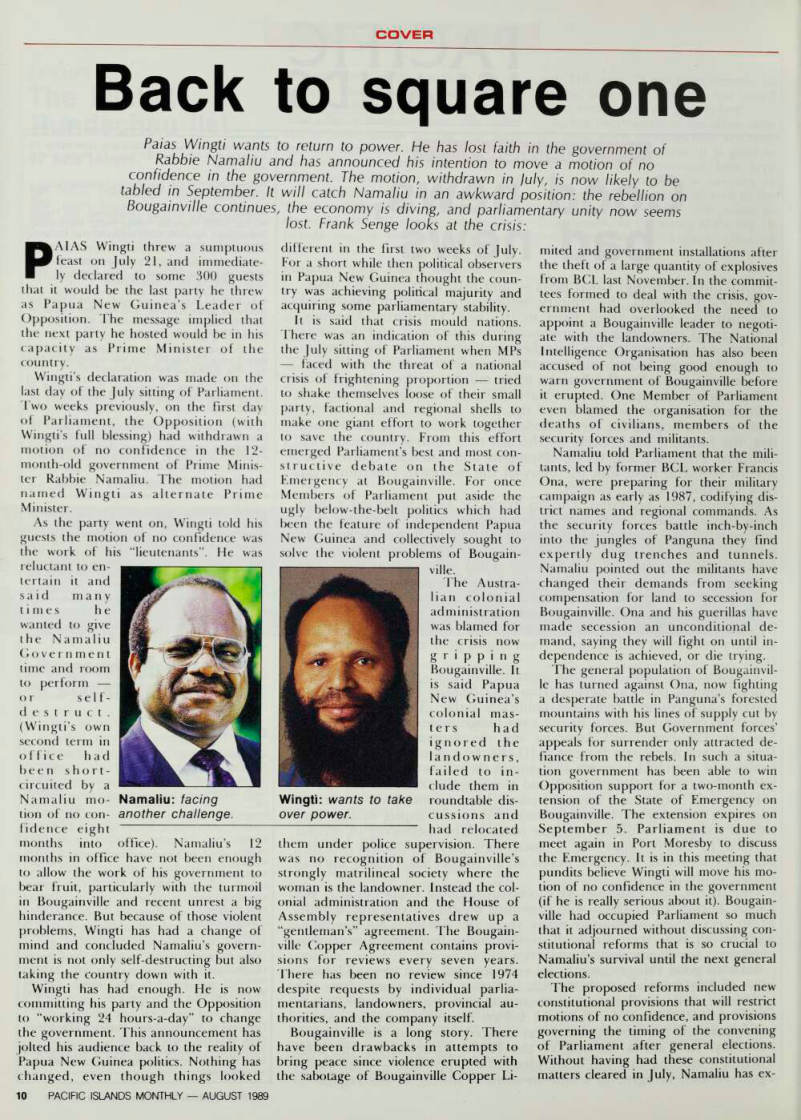
Namaliu: facing another challenge.
Wingti: wants to take over power.
posed his government to renewed attack in the next session which is likely to pro duce a more uncooperative Opposition entertaining a new motion of no confi dence. Should Wingti return to power through such a motion he is likely to also face an uncooperative Namaliu probably
unwilling to help pass any legislation,
particularly the constitutional reforms which Wingti drew up in his previous term of office.
Despite its willing participation in the
constructive debate on Bougainville, the Opposition’s withdrawal in July of its motion of no confidence in the govern ment was not totally a sign of coopera tion. Fate had intervened in the form of the assassination of Communications Minister Malipu Balakau at his home in Mt Hagen. Four members of the Opposition come from Enga Province up in the Highlands where Balakau had strong support. This support, spearheaded by Balakau’s relatives and catalysed by the threat of a vendetta war, pressured the Opposition to withdraw the motion of no confidence at the time of mourning. Even if the Opposition had gone ahead with the motion, it would have certainly lost because it would not have had the Highlands support it needed to provide the 55-vote majority
to win. A count at the time showed the motion would have attracted only 47 votes.
For Wingti, it was wise to withdraw the motion in the face of so much opposition at the time. Had he moved it at the time and lost, it would have encouraged the Opposition to look beyond him the next time for an alternate prime minister.
Now with this latest announcement, Wingti has two months before the next sitting in September to prepare for the new motion. Whether he can drag the Members of Parliament back with him to the instability that marked Parliament in the past is not known. However, many hope that the good signs that emerged in Parliament during the Emergency would remain, encouraging greater unity during the yet unsolved Bougainville crisis.
The Bougainville copper mine was still closed in the last week of July with little indication of when it would reopen. Ona and his rebels were still fighting and well entrenched in the jungles of Panguna.
For the government of Rabbie Namaliu, a new headache emerged, one not re lated to Wingti’s threat to unseat him in September. The highly toxic wastes of Ok Tedi mine on the mainland was dis
charging into the Fly River, threatening
to destroy life as it flowed to the ocean.
The government was being required to act; temporarily close the mine and lose more essential revenue or keep it open and watch the Fly River turn its deltas into a toxic desert.
What was needed was a tailings dam to contain the dangerous waste. A tempor ary one would cost K3OO million. A permanent one would cost K 1.2 billion.
Ok Tedi contributes KlOO million to Papua New Guinea’s foreign reserves, it
directly or indirectly employs 4500 peo
ple, and it supports a range of local com panies with a combined annual turnover of K 22 million. On the other hand, Fly River and its delta support a huge barra mundi population, with annual catches fetching K 2.5 million. Fly River’s prawn and lobster fisheries earn K 10.5 million a year. These figures mean more to Namaliu now because of the closure of Bougainville copper mine which contri butes 20 percent of the annual budget.
It seemed that as he contemplated what to do, Namaliu slipped deeper into a situation where it was difficult to win. □
Lindsay Swanson
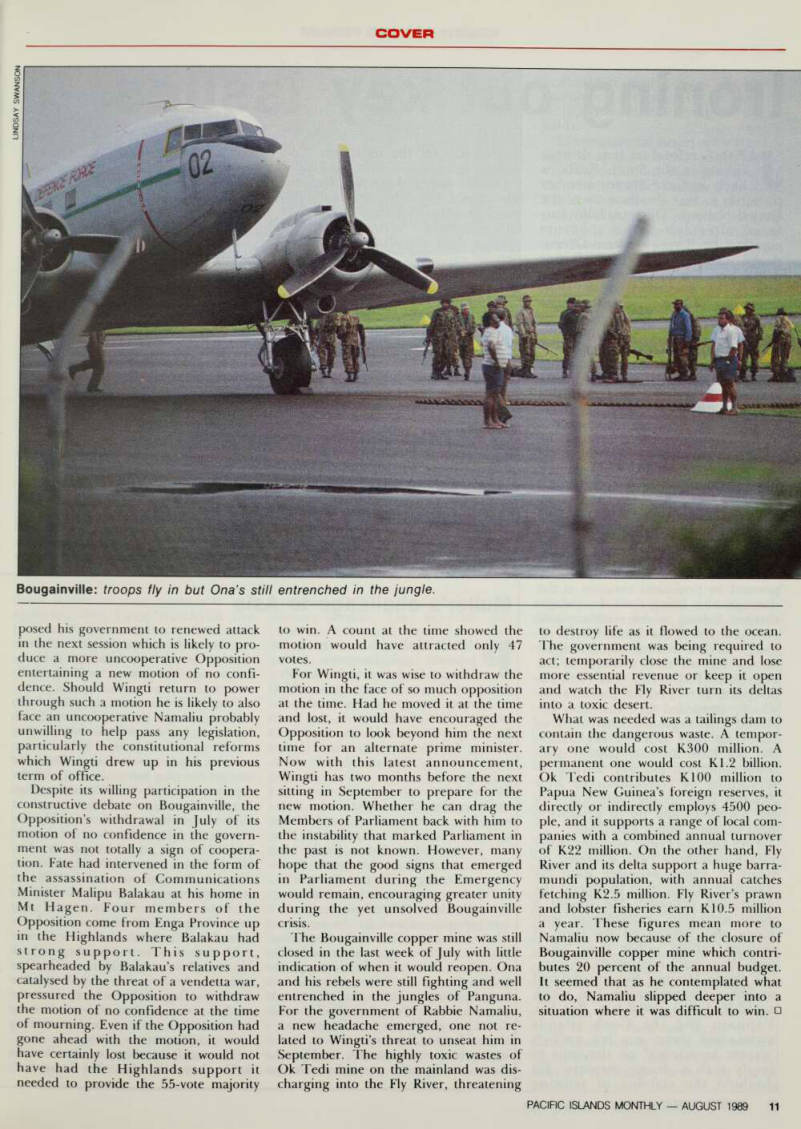
Bougainville: troops fly in but Ona’s still entrenched in the jungle.
Ironing out key issues
South Pacific Forum
JAPAN’S refusal to stop driftnet fishing in the South Pacific is likely to force Forum member countries to take the issue up at the United Nations. This possibility sur faced after last month’s Forum meeting in Tarawa when Green
peace campaigner Mike Hagler
urged New Zealand to introduce the subject for discussion at the UN.
Japan continue to refuse to stop the use of the devastating driftnets in the South Pacific, offering in Tara wa to instead reduce the catch if it could be scientifically proven that the highly-priced albacore tuna stocks were being wiped out. But like they did to a similar approach by Japan in the past, the countries of the region refused to except the compromise, saying it was the same delaying tactic Japan used when it faced strong opposition in the North Pacific.
The use of driftnets, also known as gillnets and now dubbed the ‘wall of death’, was a major issue at the 20th Forum meeting on the tiny atoll of Tarawa. “The Forum ex pressed its profound concern at the
damage now being done by pelagic
driftnet fishing to the economy and environment of the South Pacific re gion,” said a Forum communique.
In the face of such a threat to the regional fisheries, the Forum adopted the Tarawa Declaration which, proposed by Australia, de clared the region a driftnet-free zone (see box). But the declaration did not have an easy passage with some countries, like Fiji, having re servations. A convention in New Zealand later in the year will iron out loopholes and try to produce a final detailed policy statement.
Fiji’s Deputy Prime Minister, Jose
vata KamiKamica (who attended in stead of Prime Minister Ratu Sir Kamisese Mara), tried to amend the Australian proposal. He sought a more workable arrangement with Japan and Taiwan on the issue of driftnet fishing rather than “shut ting them our completely. Austra lian Prime Minister Bob Hawke had sought a comprehensive ban which could lead to a global ban. But Fiji, Vanuatu and the Cook Islands maintained there was not enough “expert knowledge” on the issue to justify such a drastic measure. Fiji doubted the viability of policing
such a ban on the high seas. “We simply need more information, in particular expert knowledge on the issue,” said Fiji delegate Ratu Finau Mara, a lawyer at the Crown Law Office in Suva. “Australia wanted to present the convention and declaralion as a package but some leaders thought this was too fast. One thing at a time.’
It was evident that Japan had a strong influence in the Pacific Is-
lands, prompting suggestions that
“cheque book diplomacy” was being
used to gain political clout in the region. “One consequence of this is that the island countries are certain to get more Japanese aid,” an Australian official was reported from Tarawa as saying. “But this is not much good if their future fish resource base is being severely eroded.” Japanese aid to the Pacific Islands is estimated to be SUS7O million a year.
Japan is doing its homework, While the leaders of the Pacific Islands were in Tarawa discussing a
ban on Japanese drifnetters,
Japanese diplomats were making
deals in the capitals of the region.
In Tarawa itself, on July 13, during the Forum, Suva-based Japanese Ambassador Toshio Isogai gave the government of Kiribati |US6.7 mil lion for the construction of a new hospital in Tarawa. At the same time a Japanese company gave SUS 10,000 to Vanuatu to help send a team to the Games of Disabled People in Japan next month. Also on the same day Radio Tonga re ported that a Japanese company, Teisei Maru Marine Products, had
approached the Tongan government
for an agremeent to fish in the king dom’s exclusive 200-mile economic zone. On July 20 Japan gave Tuvalu SUSI million as part of a multi million dollar grant to pay for Tuva
lu’s community fishing project de
velopment. On July 2o Japan gave
Vanuatu SUSB million to pay for the construction of a new terminal building at Bauerfield Airport out side Port Vila. Japan is also funding
a similar project at Tonga’s Fua’amotu Airport. The list goes on as Japan builds friendship in the is lands.
Environmental issues were the key agenda at the Forum which “noted with appreciation” the ratification of the South Pacific Nuclear Free Zone Treaty by the Solomon Islands, making it the 10th party to the trea ty. China has also ratified the trea ty’s Protocols 2 and 3. The Forum called on major powers, particularly the United Mates, France and Bri tain, to ratify the protocols and accept the treaty. The Forum Secre tariat in Suva was also authorised to exchange information and coopera tion with the Organisation for the Prohibition of Nuclear Arms in Latin America (OPANAL). France again came under attack for its con tinued testing of nuclear weapons in French Polynesia, and was urged to stop the tests “immediately”.
In Port Moresby a week later, the government of Rabbie Namaliu, which was represented at the Forum by Deputy PM Akoka Doi, told Par liament it would monitor all de velopments in nuclear-related mat ters in the region. Foreign Affairs Minister Michael Somare said gov
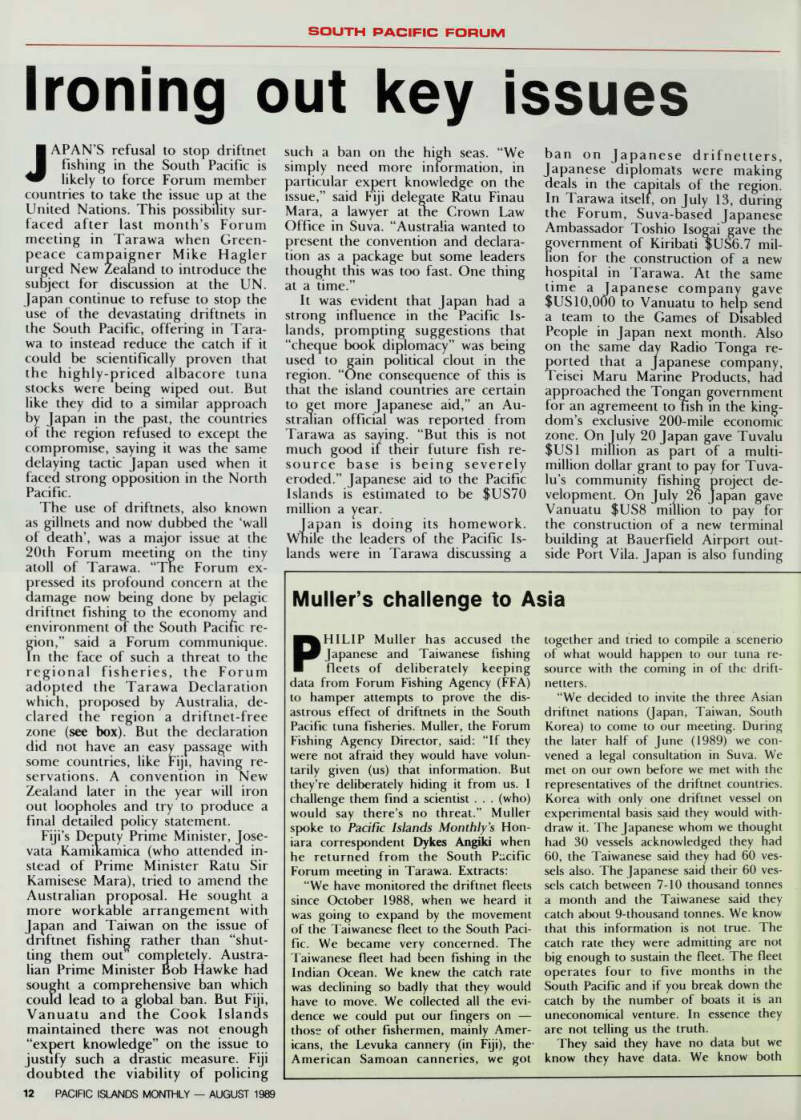
Geoffrey Henry speaks to the press: Australian patrol boats too expensive to run.
ernment would recommend reviews of the treaty to improve existing provisions with a view of covering aspects not adequately covered. Of the superpowers, only China and the Soviet Union have supported the treaty.
H awke confirmed his govern ment’s commitment to a net work of monitoring stations in the region to study the Greenhouse Effect which some scientists are saying will cause sea levels to rise and swamp some of the Pacific’s cor al atolls. The cost of such a project,
including the design phase, will be
$A6.25 million. Work will begin ear ly next year. Talking about the Greenhouse Effect, Hawke told Fiji Times journalist Mesake Koroi that the issue was “a matter of life and death” for some countries in the Pacific. “This is why we as a nation would like to help out and ensure that we are well aware of what the region is in for. The Australian tunding was in response to a request made by the Forum at their meeting in Tonga last year. While the focus of discussions concentrated on how to prevent the Greenhouse Effect, Australia and New Zealand did com mit themselves to the relocation of people in cases of islands being
swamped.
Dr Timoci Bavadra, whose Indi an-dominated Coalition government was overthrown by a military coup in Fiji two years ago, tried to get the Forum to discuss the Fiji situation.
Vanatu strongly denied speculation
that Bavadra had won its support to lobby for the inclusion of Fiji in the Forum agenda. Kamikamica met Vanuatu Prime Minister Walter Lini at a dinner hosted by Kiribati.
Speaking to The Fiji Times later, Lmi’s secretary, Jo Natuman, said: “We will have nothing to do with such a proposal.” He confirmed Bavadra sought a meeting with Lini when both were in New Zealand as Lini travelled to Tarawa. “We could not meet him,” Natuman said. “Dr Bavadra however was told that Vanuatu would be prepared to lis ten to his views, but tnere was no way Vanuatu would bring the issue up at the Forum.”
The Forum, however, did discuss the developments in New Caledonia
and officially “expressed its deep
sadness” at the assassination on May 4 of Kanak leaders Jean-Marie Tjibaou and his second in command Yeiwene Yeiwene. Representing the Kanak Socialist National Liberation Front (FLNKS) in Tarawa was Rock
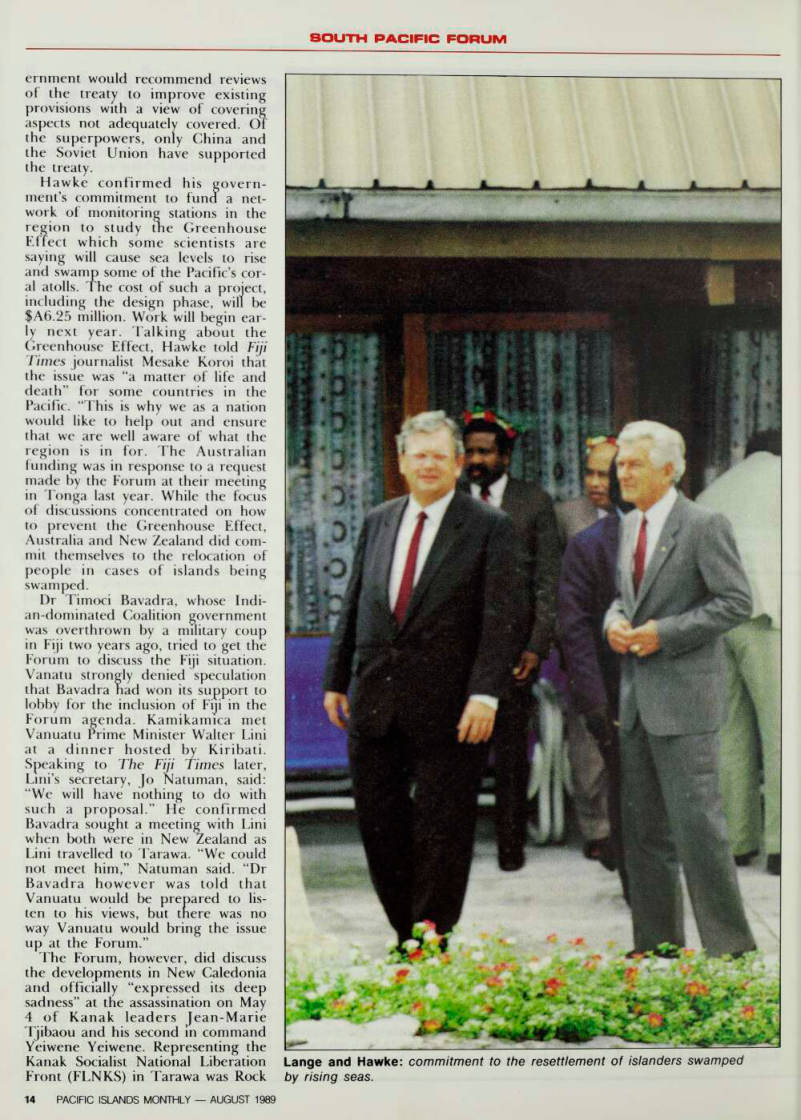
Lange and Hawke: commitment to the resettlement of islanders swamped by rising seas.
Wamytan, a member of New Galedonia’s newly-elected Southern Provincial Assembly. He urged the Forum to continue to monitor the progress of the Matignon Accord, through which the French Government lias assured a referendum on independence in 1998. He met with Hawke and discussions were understood to have centred on Kanak training and development. He also had meetings with Lini and New Zealand Prime Minister David Lange. Also in Tarawa was Yann
Celene Uregei whose Kanak faction, FULK, has Teen threatening violent opposition to the Matignon Accord.
Endorsing Australia’s offer to train Kanaks to occupy key positions associated with government, the Forum reiterated its willingness to contribute to the process of recon ciliation and training, On security, Cook Islands Prime Minister, Geoffrey Henry said that although countries have been en
couraged to participate in a joint
programme of surveillance of ter
ritorial waters, the cost of running an Australian-built patrol boat was around |A350,000 a year and still too expensive for the small nations that rely almost entirely on overseas aid grants to keep their economies afloat.
The media came under the target of some rather sharp criticism, mainly Doi. The target of his com ments were Australia and New Zea land. Doi accused Australia of
biased and misinterpreted reporting,
especially on recent events in Bougainville and Port Moresby. He accused the Australian media of not
understanding enough the culture
and traditions of Papua New Guinea to be able to present a better view of events in the country. Because of biased reports, Doi said, PNG lost revenue as potential investors were discouraged. Tourism also suffered.
When asked if he thought Austra lian journalists were anti-Papua New Guinea, Doi replied: “No, it is a case of not understanding the situation, or bothering to make sure the re ports are accurate.” He said Austra lian journalists “beat” up stories and create sensationalism. He said Fiji, Vanuatu and Nauru shared his views. Hawke on the other hand, said the Australian media was com mitted to the freedom of the press.
While he acknowledged that some countries had expressed dissatisfac tion over Australia’s media report ing, he said Australian media re porting was of a high standard.
Even he himself often received un fair treatment from the press at home, he said.
China missed the pre-Forum dia logue. The Chinese delegation was to have travelled from New Zealand with Lange. But Lange said: “There was no room on the plane for them”. Asked if he had given them “the cold shoulder” treatment be cause of the recent trouble in Beij
ing, Lange replied; “I suppose you
could say that, anyway China has a lot more planes than New Zealand has so they still could have got here”.
Next year’s Forum meeting will be in Vanuatu. □
Muller’s challenge to Asia
PHILIP Muller has accused the Japanese and Taiwanese fishing fleets of deliberately keeping data from Forum Fishing Agency (FFA) to hamper attempts to prove the dis astrous effect of driftnets in the South Pacific tuna fisheries. Muller, the Forum Fishing Agency Director, said: “If they were not afraid they would have volun tarily given (us) that information. But they’re deliberately hiding it from us. I challenge them find a scientist . . . (who) would say there’s no threat.” Muller spoke to Pacific Islands Monthly’s Hon iara correspondent Dykes Angiki when he returned from the South Pacific Forum meeting in Tarawa. Extracts: “We have monitored the driftnet fleets since October 1988, when we heard it was going to expand by the movement of the Taiwanese fleet to the South Paci fic. We became very concerned. The Taiwanese fleet had been fishing in the Indian Ocean. We knew the catch rate was declining so badly that they would have to move. We collected all the evi dence we could put our fingers on those of other fishermen, mainly Amer icans, the Levuka cannery (in Fiji), the- American Samoan canneries, we got
together and tried to compile a scenerio of what would happen to our tuna re source with the coming in of the drift netters.
“We decided to invite the three Asian driftnet nations (Japan, Taiwan, South Korea) to come to our meeting. During the later half of June (1989) we con vened a legal consultation in Suva. We met on our own before we met with the representatives of the driftnet countries.
Korea with only one driftnet vessel on experimental basis said they would with draw it. The Japanese whom we thought had 30 vessels acknowledged they had 60, the Taiwanese said they had 60 ves sels also. The Japanese said their 60 ves sels catch between 7-10 thousand tonnes a month and the Taiwanese said they catch about 9-thousand tonnes. We know that this information is not true. The catch rate they were admitting are not big enough to sustain the fleet. The fleet operates four to five months in the South Pacific and if you break down the catch by the number of boats it is an uneconomical venture. In essence they are not telling us the truth.
They said they have no data but we know they have data. We know both
fleets report to their companies and agencies. We know firsthand the Japanese Fisheries Agency and industry are conspiring to deprave their own scientists and our own scientists of the precise data. Their attempt is to gain a few more years of fishing but we cannot let this happen because it would just wipe out fishery stock. If we take their advice we 11 see in five years time what has happened in the Indian Ocean and in the North Pacific. ‘The first thing to go is the adult fishery. Where we are involved will suffer most. Currently we have fleets that pay access fees and we have lots of Pacifie islanders fishing for albacore tuna.
In the north Pacific, the catch went down from 120-thousand tonnes to 40thousand tonnes. It went from longline catching 420,000 tonnes to two-thirds being caught by driftnets and only one-
third by longline. The longline went
from about 120-thousand down to about 15-thousand, almost to one-tenth. Our involvement in this exercise is to be able to bring to the attention of FFA member countries what is really happening in this issue. To provide the best information possible and to draw to their attention the danger posed by such a fishing technique. We’ve met with the Japanese, the Taiwanese and the Koreans. The
Japanese and the Taiwanese came with out any position. They were not pre
pared to negotiate. They came with
accusation that we have no data and that we were being emotional, “The fact is they have the data and they’re not giving it to scientists. If they were not afraid, they would have volun tarily given that information to prove their claim that driftnet fishing is safe,
But they’re deliberately hiding it from
us. I challenge them to give it. I chal lenge them to find a scientist to use that data and say there’s no threat to the tuna stock . . . get a reputable scientist who would put his personal reputation and the reputation of his institution, use their data and prove that it’s safe, “Many Pacific Islands have no re sources. We only have fish. We have never deprived the Japanese and the Taiwanese access to our resources. On this occasion what we’re saying is ‘help us conserve it that their children and our children can reap benefit in future’. Let’s ensure the sustainability of the resource, “What we need now is a new political direction. In Tarawa, at the request of some governments, we tried to advise the officials from various Forum govern ments on what we considered a serious conservation issue. We have a long rela tionship with the Japanese and the
Taiwanese in the industry, and we have aid and trade relations. It’s not a ques tion of whether we should give away our resources for the price of aid.
“The Japanese and the Taiwanese admit they have a combined fleet of 120 vessels. The previous year they had a combined fleet of 27 vessels, 7 Taiwanese and 20 Japanese. The 20 Japanese were mostly working in the Tasman Sea. They concentrate on the South Pacific convergence zone where the young tuna gathered during the summer months. In previous years we only catch the big tuna using long lines.
Now they are taking both the adult fish and the young. Once it gets to a certain level, the decline will become irrev ersible.
“The Tarawa Declaration means we call on them to cease their use of this method of fishing. It means we’re calling on the international community to help us because this issue means the survival of the indigenous people in an island environment. We are immediately put ting a ban on port visits, trans-shipment, refuelling and supplies, and other provi sions such as food and water. We are trying to deny them easy access to our ports. These actions may be slow in hav ing an impact but they certainly will eat into their profitability in the long run.D
Shuttle strip nears completion
WORK is nearing completion at Ander son air force base on Guam for the SUSSOO,OOO emergency landing strip for American space shuttle missions. The final touches to the site should be added within two months. □
Advertisements & other items, p. 15 (1 item)
Appointment Of Director
TOURISM COUNCIL OF THE SOUTH PACIFIC
Applications are invited for the position of Director of the Tourism Council of the South Pacific, an inter-governmental organisation of twelve island countries of the South Pacific.
The main objectives of the Council are to promote, coordinate, plan and implement projects and activities designed to strengthen regional cooperation in tourism development and to optimise the contribution of tourism to socio-economic development of the member countries. Most funding is currently provided by the Pacific Regional Tourism Development Programme financed by the European Economic Community.
The Director will be the chief executive officer of the Council, responsible to the Management Board for the administration of the TCSP affairs and for the management and operation of the Secretariat located in Suva, Fiji.
The post is restricted to nationals of the member countries* of the TCSP. Applicants should have qualifications and experience appropriate to the post and a record of achievement in tourism in the region at senior level.
Those interested in the appointment are advised to obtain a copy of further particulars of the post available from the Secretariat (Phone: (679) 315277; Fax: (679) 301995) before applying. Applications including a detailed curriculum vitae and names and addresses of three referees with whom the applicant has been associated in a professional capacity, must be submitted by 30 September 1989 to the Chairman, Tourism Council of the South Pacific, P.O. Box 13119, Suva, Fiji. Envelopes should be marked “Director Application”. The successful candidate is expected to take up the position as soon as possible and at the latest, by the end of 1989. * Member countries of TCSP are American Samoa, Cook Islands, Fiji, Kiribati, Niue, Papua New Guinea, Solomon Islands, Tahiti. Tonga, Tuvalu, Vanuatu and Western Samoa.
Voicing
The Region
Palau
Voicing approval for the Compact
By Ed Rampell
THE United States House of Repre sentatives approved the proposed Compact of Free Association be tween the Republic of Palau and the Un ited States by a voice vote in the Con gress on June 27, taking a major step forward toward implementing a prop osed Compact of Free Association be tween the two nations. The legislative package includes the Subsidiary Agree ments signed by Palau Vice-President Kuniwo Nakamura and the U.S. State Department’s James Berg at Guam on May 26.
This enhanced accord provides Palau with additional funding of at least US$9.3 million for a hospital, prison,
and an anti-drug programme. A special prosecutor and public auditor will also be appointed to investigate the violence and corruption plaguing the Micronesian nation. In addition, the House bill makes up to US$36 million available to Palau to pay off the onerous debt incurred by the IPSECO power project.
But anti-nuclear and other treaty opponents hold the trump card in Compact electoral politics, since the accord requires a 75 percent vote in order to override a constitutional nuclear ban,
which it has repeatedly failed to garner since 1983. The Compact of Free Asso ciation remains, in essence, the same document, which Congressman Ron De Lugo, told the House from the Virgin Islands, on June 27 “would provide Palau with self-governing authority in all matters other than those affecting secur ity. The United States would retain full military rights in Palau . . . (including) the authority to deny military access to any other country in perpetuity. They also include the requirement that Palau
make land designated by the U.S. avail able for military bases for 50 years. In combination with bases in Guam and base rights in the Northern Mariana Is lands, these base rights figure into almost any scenario for alternatives to our important bases in the Philippines . . . 500 miles from Palau.”
The proposed Compact would phase out a 42-year-old American administered United Nations Strategic Trust in the strategically located Western Pacific archipelago. As representative Stephen Solarz pointed out on June 27, the Com pact “is of considerable importance . . . to larger American interests in the South Pacific”. But as Solarz, the Chairman of the Subcommittee on Asian and Pacific Affairs, pointed out, the Constitution’s nuclear free provision and 75 percent requirement will stand in the way of the overall United States strategic game plan regarding military and nuclear policies for Micronesia and the rest of Oceania.
House Joint Resolution 175 makes concessions regarding two essential stick ing points: land rights provisions and the IPSECO power debt. As lawyer and for mer Palau Senator Johnson Toribiong once said, the Compact, along with its
Subsidiary Agreements, are legalese
“masterpieces in cross-references”, hence making them difficult to comprehend.
Originally, the Compact stipulated that
the Palau government would provide land within 60 days for sites selected by the military; the Republic would also compensate the landownwers. The U.S. would provide only US$5.5 million for land it had option on. Compact critics such as activist attorney Roman Bedor maintain that under the treaty, the Pen tagon has rights to up to one third of Palau’s land.
But Subsidiary Agreements amend this. De Lugo told Congress: “The U.S. would be committed to enter into agree ments for financial assistance if re quested by Palau to acquire land, other than at the airfield and harbour, that the U.S. requires Palau to provide . . . Palau would not be obligated to make such land available until such agreement are reached. The U.S. would be committed to extend the 60-day period ... if Palau justifies such an extension.”
Regarding the disastrous IPSECO power project, which has plunged Palau into a US$4B million debt upon its birth, the Subsidiary Agreements allow Palau to provide funds set aside for energy and capital improvements over the 15year term of Compact funding. The multi-national consortium of bankers, which has successfully sued Palau in a United States federal court, agreed to a deadline whereby the financiers will accept the millions made available to the Republic for IPSECO by the House leg islation.
Zeder sails in
AMBASSADOR Fred Zeder, President Bush’s nominee to head a United States development agency, was confirmed unanimously by the U.S. Senate for the job in question. Zeder was criticised by some for his alleged role in connection with Palau’s purchase of an expensive generating plant. But he sailed through both Senate Committee and full Senate consideration without a voice being raised against his appointment.
This was the case despite Zeder’s staunch Republican ties, and despite the fact that the Democrat-dominated Senate
has been adamantly opposed to other Republican nominees, such as John Tow er, the former Texas Senator first chosen by Bush to be the US Secretary of Defence.
Zeder served as the Reagan Adminis tration’s envoy in the status negotiations with the Federated States of Micronesia, the Republic of the Marshall Islands and the Republic of Palau. An old friend of the President, his new post is President and Chief Executive Officer of the Over seas Private Investment Council (OPIC).
OPIC is a US Government agency which encourages and guarantees private in vestments in the Pacific and elsewhere.^
Advertisements & other items, p. 16 (1 item)
Suddenly, New Zealand is a whole lot closer.
And so too is a potential market of 3.2 million .cosmopolitan New Zealanders.
As a Forum Island nation, exploration and development of new markets can be a difficult and frustrating exercise.
Now, through the establishment in New Zealand of the South Pacific Trade Office, you have direct access to a variety of services that are specifically geared to assist you in the export and promotion of South Pacific products into New Zealand.
Services include market research, marketing plans, identification of potential customers, office facilities, product displays, participation in trade fairs, and secondments.
For further details contact...
SOUTH PACIFIC
TRADE OFFICE
Jetset Centre, 44 Emily Place, P.O. Box 774, Auckland 1, New Zealand.
Phone (09) 302-0465, Fax (09) 776-642, Telex SPTO NZ63328 Madison 3589
Stopping the
Vanuatu
Stopping the drug barons
By Macel Manua
VANUATU’S Chief Justice, Frederick Cooke, has warned Pacific Island countries to be on their guard against drug barons using the region as market or trans-shipment point. Justice Cooke made the warning on July 10 when sentencing Chinese businessman Cheung Siu Wah to five years imprisonment and a fine of 200,000 vatu for importing and posses
sing heroin.
Wah pleaded guilty to importing into
Vanuatu 50 kilograms of heroin between last February 12 and March 17, and being in possession of 677 grammes of heroin between last March 17 and 18.
Justice Cooke said the consignment of
heroin was brought from Hong Kong
and destined for Australia. “It was clear from investigations that not only the ac cused but a large number of Chinese both in Hong Kong and Australia played a part in the operation. The organisation dealing with the drugs was linked with the Triad Society in Hong Kong, and that the accused had connections with the Triad Society in setting up the enter prise of the importation of the heroin,” said Justice Cooke.
The court was told that Vanuatu was chosen as a staging post for shipment on the consignment because the accused had legitimate business interests in Port Vila which he could use as a cover for the first leg of the consignment of he roin from Hong Kong to Australia. The organisation in Hong Kong realised a shipment of heroin from Vanuatu could easily enter Australia undetected.
Wah first arrived in Vanuatu in May 1988 to explore business possibilities. He was associated with a Hong Kong com pany connected to the Port Vila firm of Olympic Investments Limited. Wah wanted to set up a garment factory. An application to operate such a company was lodged and processed early this year.
The company provided a front for the importation into Vanuatu of a consign ment of sewing machines and a mini bus.
Said Justice Cooke: “In that mini bus was concealed 50 kilos of heroin. The mini bus and garment equipment were
shipped from Hong Kong to Vanuatu
aboard the ship South Island 45. The vessel arrived in Vila last March 12.
Said Justice Cooke: “The Bill of Lad ing was made out with the accused as consignee, and Customs clearance was carried out by agents. The heroin was
removed from the mini bus by either the accused or two others engaged by him and concealed in the vacuum between the inner and outer lining of a large refrigerator. Some was put in kitchen equipment.” The refrigerator was ac quired from Mandarin Restaurant, a Vila restaurant which closed last De cember.
Wah’s name appeared on the Bill of Lading as shipper to Australia. The name of the person to be notified on its arrival in Australia was also listed on the Bill of Lading.
The consignment left on April 21 on the vessel Nimos for Australia. Said Jus tice Cooke: “Two of the packets of he roin were not sent to Australia and were later removed from the mini bus in Vila by the authorities in May 1989.” Howev-
er, on April 21 Wah flew to Australia and told Australian authorities of the consignment of heroin.
His information resulted in Australian
police intercepting the shipment. People
were arrested in Hong Kong and Au stralia. Wah then returned to Vanuatu last May and he was arrested in Vila on the 18th of that month. He told police he was expecting to be paid |HK2O,OOO per unit of freight from Hong Kong, making a total of SHKI.S million. The court also heard that Wah knew the drugs were in the mini bus before it left Hong Kong for Vanuatu and was ex pected to be paid another $A630,000 if the consignment arrived intact in Au stralia.
Said Justice Cooke: “In this case, Vanuatu was used as a stepping stone for the drugs to Australia. It was thought that the Australian authorities would never expect a consignment of drugs would come from Vanuatu. It nearly succeeded.” □
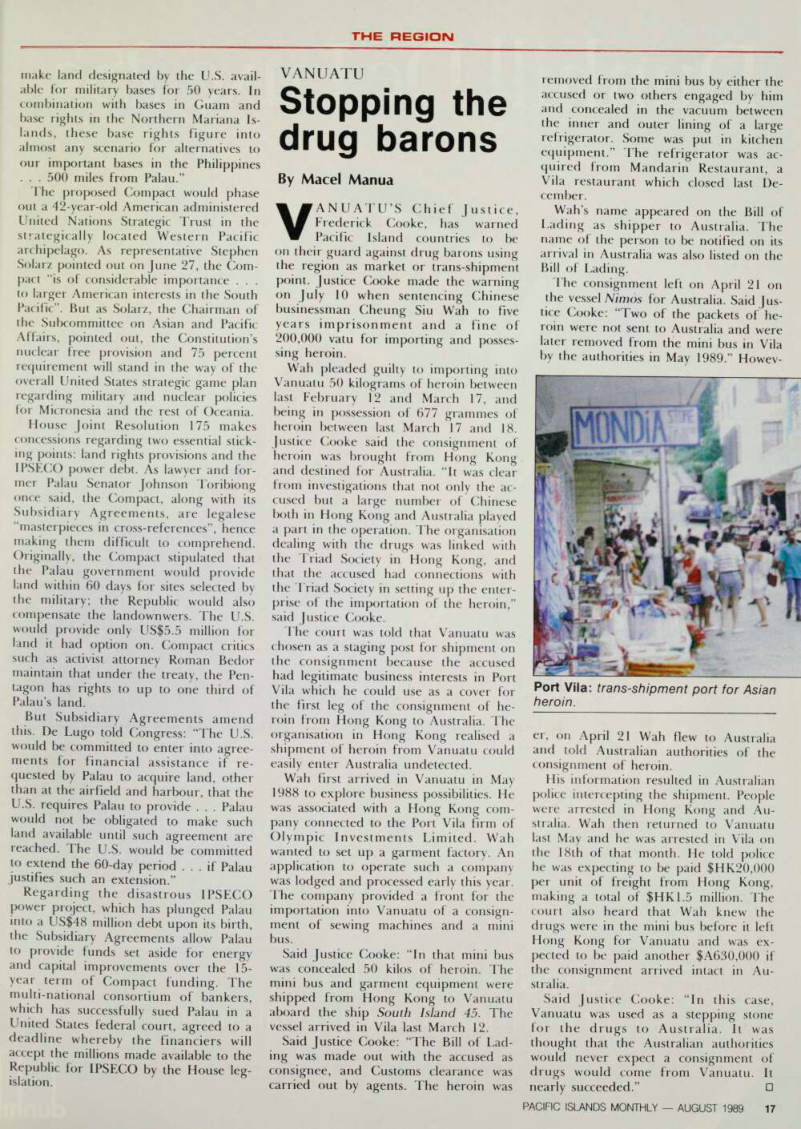
Port Vila: trans-shipment port for Asian heroin.
Advertisements & other items, p. 18 (1 item)
Warn
a HdH to -V V.
JSto £ vV S %3*y \Jto ' *. K V* % %W=-" %>*- - W % ' %£ '%#• v %i v %£ \ '®-" % * ? w %£. wwL K* !#„ '' ? I § ¥ W. W %ft K W. V w \, \ V s& : Jr ’ ty s * y *'j! ty
J ‘V V V :y
* t > t t . <..■ - ~&0< -• s*s* s - fr 7 11 yf<jr £//< «||tk * *•>.. **■ ; !' tok '*■ * - m 4.t /. %£ :j. y ’ ■■■' M Siy , siau 'v- V"M v y€ M w :4 M Us
ff; vl
rfM./T.^, v *«
Warn
is; ImJ
m
liM
U »a ■-< Mm
« few
ffcO* fIA $3
% ■ • ■ >■ , ■ yn % y.iyyyi||i y'y. * ' V ~;• ■%, *a ■SjA f - it, '**"• ' •*■
The way
New Caledonia
The way ahead
IF July 14 was a day to look back for all French citizens who commemo rated the two hundredth anniversary of their revolution, it had a special sig nificance for Kanaks and Europeans liv ing in New Caledonia; July 14 marked the end of the one-year direct adminis tration by the state and the beginning of the new statute dividing the Territory into three largely autonomous provinces.
On July 17 the Assemblies of the northern province and the islands held their first meetings in Kone, on the west coast, and Lifou, in the Loyalty Islands.
Two days later it was the turn of the southern province after the first official session of the new 54-member Territo rial Congress composed of the three assemblies.
A few days before July 14 French Prime Minister Michel Rocard had writ
written to the three
newly
elected Presidents of the pro vinces and to the Presi dent of the
Congress
and said: “It is now the New Caledonians who have to carry out the econo mical, social and cultural
development” in their country. Referring to National Kanak Socialist Liberation Front (FLNKS) leader Jean-Marie Tjibaou and Rally for Caledonia in the Republic (RPCR) leader Jacques Lafleur, he added that in Paris in June 1988, the two men “had agreed that the state should govern the Territory under direct administration for one year in order to restore civil peace, to prepare new institutions accepted by a large majority of New Caledonians and to lay the foundation of a more balanced de
velopment”.
“The baton has been passed,” said the High Commissioner of the republic, Ber nard Grasset, who attended the three meetings in Kone, Lifou and Noumea.
He will remain the exeuctive chief of the Territory and the head of the Territorial Administration. But the three assemblies
(2 pro-independence, 1 pro-French) will now govern the provinces with extended powers and important financial means.
“We have nine years ahead of us be fore the Territory freely chooses its des tiny. We have nine years to forge the tools necessary to that free choice. Peace has been restored but the germs of divi sion, the germs of clashes still exist. The country is convalescent,” Grasset said. In the north and the islands, where inde
pendentists have a huge majority, the
memory of Jean-Marie Tjibaou and the lieutenant Yeiwene Yeiwene, both assas sinated at Ouvea on May 4, was very present on July 17. The two men were favourites in the two FLNKS lists for the elections and should have therefore be come the Presidents of the two pro vinces.
“Somebody is here among us,” said Grasset in Kone. “It’s Jean-Marie Tjibaou. Without him, the task wouldn’t have been achieved. He would have been here, at this table today. I believe he will be here, invisible but vigilant, attending the meetings during which the future of the Territory and all its inhabitants will be discussed.”
To train Kanaks how to run an office, a business, a city, a pro vince or a country, to teach them how to ba lance a
budget, to
turn politic
al militants into effi cient far mers, accountants or teachers
was Tjibaou’s obsession. He knew that the Kanak community lacked skilled pro fessionals ready to hold key positions in the future independent state of Kanaky.
“I don’t want immediate independence for my country if that means being listed among the 20 poorest countries of the United Nations,” he used to say.
“There’s no point in waving your flag at the front of the door if you have to crawl through the back door and beg for
money.” This explains why he accepted
in 1988 in Paris (and imposed it to a rather reluctant FLNKS) the 10-year transition period and the provinces lead ing to a referendum on self determina tion in 1998. “Contracts for Develop ment” will be signed between the state and the provinces in order to “favour the counter balancing between Noumea and the rest of the Territory” explains
Article 85 of the Bill about New Caledo nia passed in Paris on November 6, 1988.
Indeed the south is bigger and richer.
It has more skilled people and potential.
Noumea generates (or attracts) and keeps all the wealth. There is a risk Europeans will create a golden circle in the capital, surrounded by a Kanak underdeveloped desert in which people will be left with the crusts of the cake. 82.8 per cent of the small businesses are in the Greater Noumea area; 205 gar ages out of 276, 166 electricians out of 191, 1051 contractors in the building in dustry out of 1233. Tjibaou used to ask: “Who will want to open an ice-cream parlour in Ouayagette?” up in the re mote mountains. Money is generated in Noumea, jobs are created in Noumea and Kanaks who do not live there are generally still living in the rural self subsidence system.
For many rural Kanaks, money comes only from family allowances and scarce old-age pensions. The average income of a Kanak family in the bush is half the income of a Kanak couple in Noumea and only a quarter of what an average
European couple make in the capital.
“The new administration of the northern and island provinces will need computers and furniture. Where will they get them?
In Noumea. The new system will make us earn more money,” says a Noumea based businessman.
There’s another danger hampering
the fragile construction of the Matignon Accord: 3000 of the 4000 territorial civil servants will be placed under the author ity of the provinces. Most of them live and work in Noumea and their new administrative roles won’t mean much change: Noumea, capital of the southern province, will employ most of them. A few hundred (primary school teachers, officers of the department of agricul ture, for instance) will be assigned to the Loyalty Islands. For those who are Euro pean, and opposed to independence, it will mean leaving the comforts of city for rural settlements that lacked basic ameni ties, few shops, doctors, cinemas and
provides neighbours strongly opposed to
their political views. An incentive bonus of 1,000,000 Pacific francs (about AU$ll,5OO) doesn’t seem to attract many volunteers.
The French government is aware of these dangers. It hopes the creation of a deep sea harbour in Nepoui, near Kone, and the opening of the Kone-Tiwaka road linking the west coast with the east will create jobs. But reluctant civil ser vants and reluctant investors will make the challenge difficult and risky. □
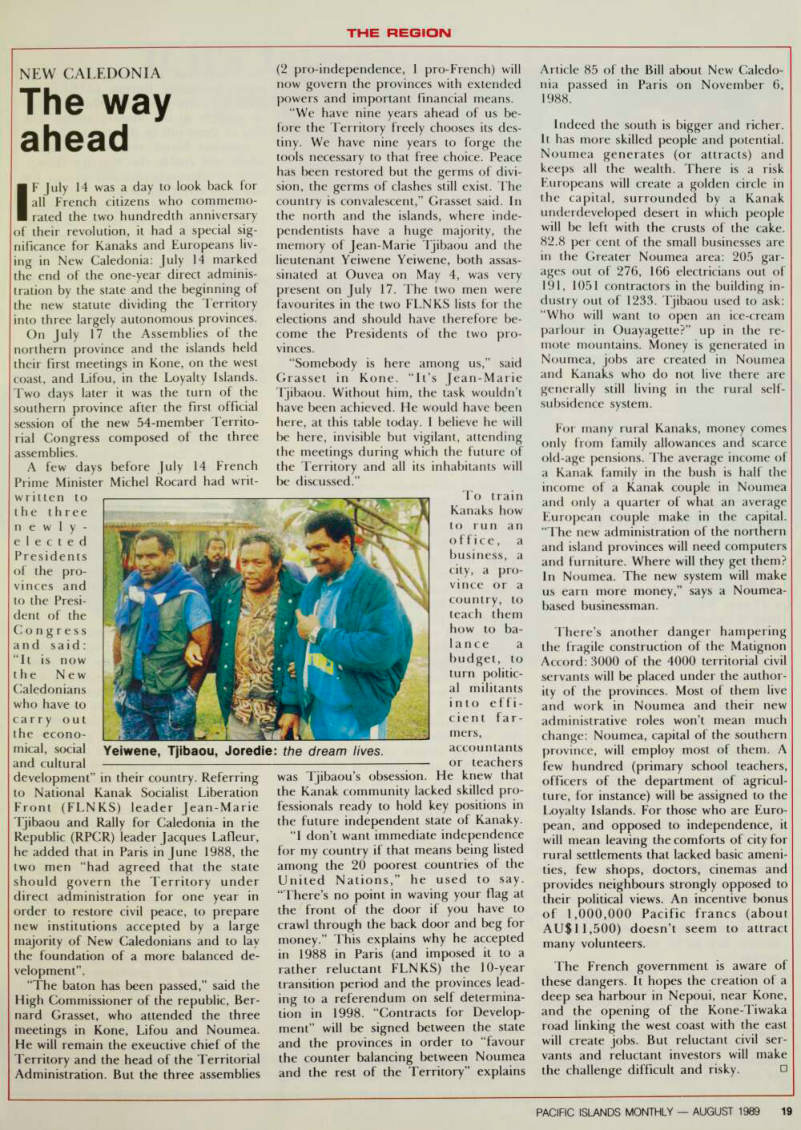
Yeiwene, Tjibaou, Joredie: the dream lives.
Bob Peisley/Aois
Solomon Islands
Regrets over logging deal
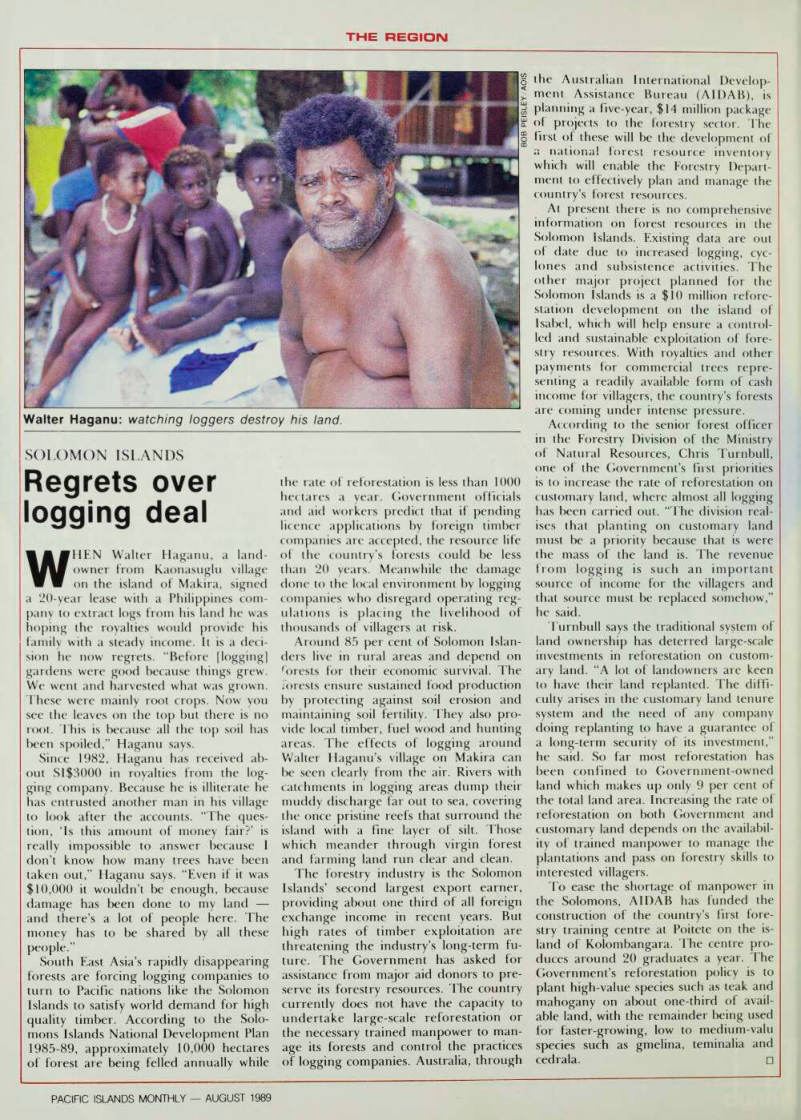
WHEN Walter Haganu, a land
owner from Kaonasuglu village
on the island of Makira, signed a 20-year lease with a Philippines com pany to extract logs from his land he was
hoping the royalties would provide his
family with a steady income. It is a deci sion he now regrets. “Before [logging]
gardens were good because things grew.
We went and harvested what was grown.
These were mainly root crops. Now you see the leaves on the top but there is no root. This is because all the top soil has
been spoiled,” Haganu says.
Since 1982, Haganu has received ab out Sls3ooo in royalties from the log ging company. Because he is illiterate he has entrusted another man in his village to look after the accounts. “The ques tion, Is this amount of money fair?’ is really impossible to answer because I don’t know how many trees have been taken out,” Haganu says. “Even if it was $lO,OOO it wouldn’t be enough, because damage has been done to my land and there’s a lot of people here. The money has to be shared by all these
people.”
South East Asia’s rapidly disappearing
forests are forcing logging companies to
turn to Pacific nations like the Solomon Islands to satisfy world demand for high quality timber. According to the Solo mons Islands National Development Plan 1985-89, approximately 10,000 hectares of forest are being felled annually while
the rate of reforestation is less than 1000 hectares a year. Government officials and aid workers predict that if pending
licence applications by foreign timber
companies are accepted, the resource life of the country’s forests could be less than 20 years. Meanwhile the damage done to the local environment by logging
companies who disregard operating reg
ulations is placing the livelihood of thousands of villagers at risk.
Around 85 per cent of Solomon Islan ders live in rural areas and depend on r orests for their economic survival. The forests ensure sustained food production
by protecting against soil erosion and
maintaining soil fertility. They also pro
vide local timber, fuel wood and hunting areas. The effects of logging around Walter Haganu’s village on Makira can be seen clearly from the air. Rivers with catchments in logging areas dump their muddy discharge far out to sea, covering the once pristine reefs that surround the island with a fine layer of silt. Those which meander through virgin forest and farming land run clear and clean.
The forestry industry is the Solomon Islands’ second largest export earner, providing about one third of all foreign exchange income in recent years. But high rates of timber exploitation are
threatening the industry’s long-term fu
ture. The Government has asked for assistance from major aid donors to pre serve its forestry resources. The country currently does not have the capacity to undertake large-scale reforestation or the necessary trained manpower to man age its forests and control the practices of logging companies. Australia, through
the Australian International Develop ment Assistance Bureau (AIDAB), is
planning a five-year, $l4 million package
of projects to the forestry sector. The first of these will be the development of a national forest resource inventory which will enable the Forestry Depart ment to effectively plan and manage the country’s forest resources.
At present there is no comprehensive information on forest resources in the Solomon Islands. Existing data are out of date due to increased logging, cyc lones and subsistence activities. The other major project planned for the Solomon Islands is a $lO million refore station development on the island of Isabel, which will help ensure a control led and sustainable exploitation of fore stry resources. With royalties and other payments for commercial trees repre senting a readily available form of cash income for villagers, the country’s forests are coming under intense pressure.
According to the senior forest officer in the Forestry Division of the Ministry of Natural Resources, Chris Turnbull, one of the Government’s first priorities is to increase the rate of reforestation on customary land, where almost all logging has been carried out. “The division real ises that planting on customary land must be a priority because that is were the mass of the land is. The revenue from logging is such an important source of income for the villagers and that source must be replaced somehow,” he said.
Turnbull says the traditional system of land ownership has deterred large-scale investments in reforestation on custom ary land. “A lot of landowners are keen to have their land replanted. The diffi culty arises in the customary land tenure system and the need of any company doing replanting to have a guarantee of a long-term security of its investment,” he said. So far most reforestation has been confined to Government-owned land which makes up only 9 per cent of the total land area. Increasing the rate of reforestation on both Government and customary land depends on the availabil ity of trained manpower to manage the plantations and pass on forestry skills to
interested villagers.
To ease the shortage of manpower in the Solomons, AIDAB has funded the construction of the country’s first fore stry training centre at Poitete on the is land of Kolombangara. The centre pro duces around 20 graduates a year. The Government’s reforestation policy is to plant high-value species such as teak and mahogany on about one-third of avail able land, with the remainder being used for faster-growing, low to medium-valu species such as gmelina, teminalia and cedrala. □
Walter Haganu: watching loggers destroy his land.
Bob Peisley/Aois
Advertisements & other items, p. 21 (1 item)
If it’s International Services
you can bank on us. ¥ ¥ c#' x ?
SP e« O’- As Fiji’s own bank, the NBF understands business in Fiji.
And that means a full understanding of what Fiji businessmen require internationally as well as overseas investors require in Fiji.
If it involves export, import, or investment, the NBF has the expertise to provide all the service you require.
The NBF, covering Fiji and the World for you.
NBF
NATIONAL BANK OF FIJI
Cnr. Victoria Parade & Gordon Street, Suva, Fiji Islands. Telephone 311-999. Telex 2135 FJ.
Nz Embassy
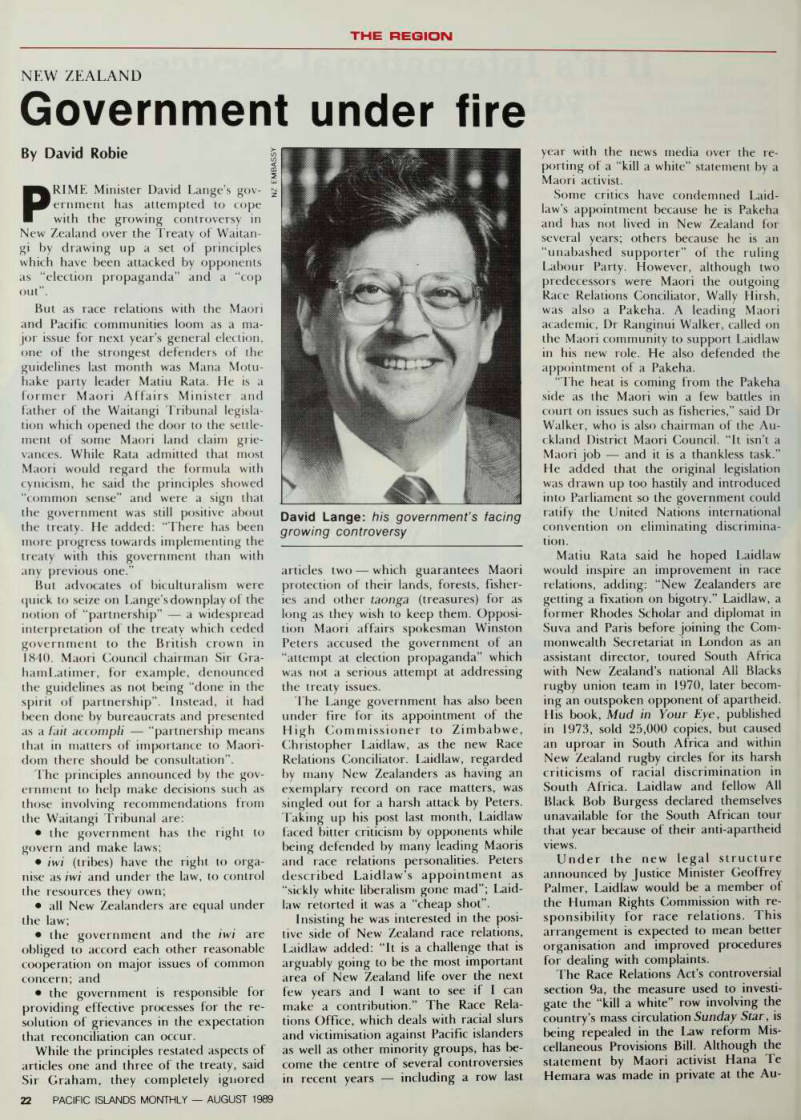

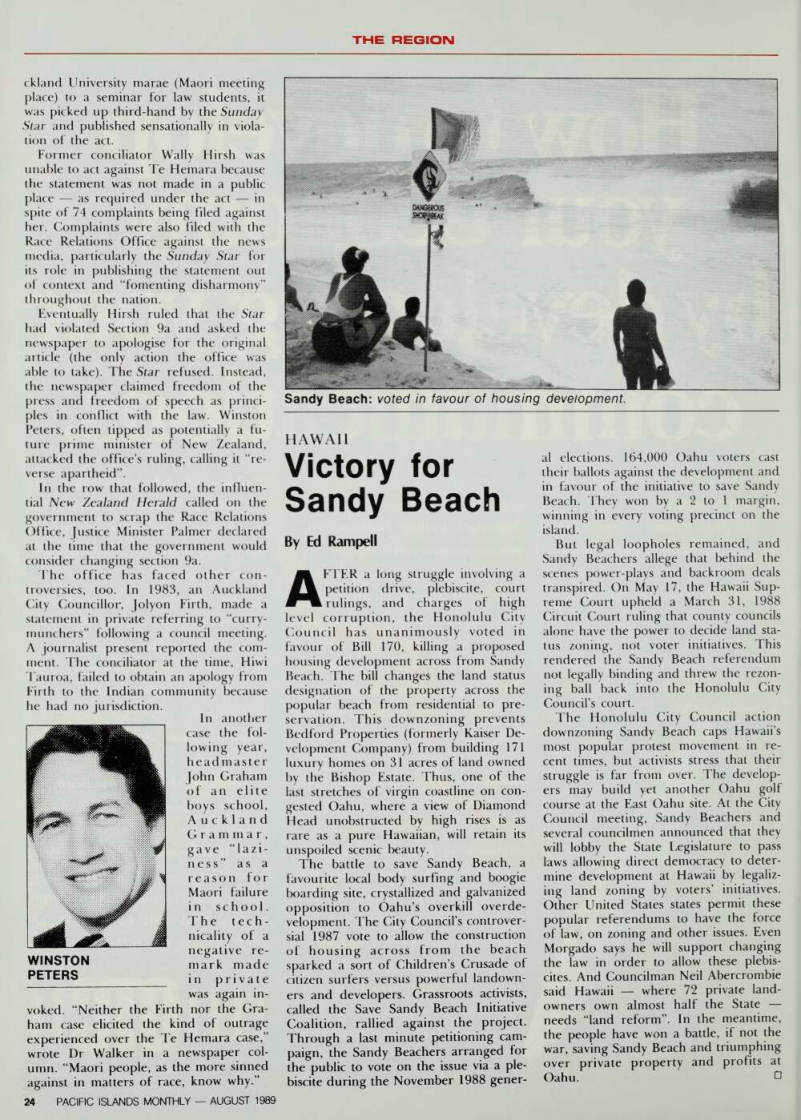
New Zealand
Government under fire
By David Robie
PRIME Minister David Lange’s gov ernment has attempted to cope with the growing controversy in New Zealand over the Treaty of Waitan gi by drawing up a set of principles which have been attacked by opponents as “election propaganda” and a “cop out”.
But as race relations with the Maori and Pacific communities loom as a ma jor issue for next year’s general election, one of the strongest defenders of the guidelines last month was Mana Motu hake party leader Matiu Rata. He is a former Maori Affairs Minister and father of the Waitangi Tribunal legisla tion which opened the door to the settle ment of some Maori land claim grie vances. While Rata admitted that most Maori would regard the formula with cynicism, he said the principles showed “common sense” and were a sign that the government was still positive about the treaty. He added: “There has been more progress towards implementing the treaty with this government than with any previous one.”
But advocates of biculturalism were quick to seize on Lange’s downplay of the notion of “partnership” a widespread interpretation of the treaty which ceded government to the British crown in 1840. Maori Council chairman Sir Gra hamLatimer, for example, denounced the guidelines as not being “done in the spirit of partnership”. Instead, it had been done by bureaucrats and presented as a fait accompli “partnership means that in matters of importance to Maori dom there should be consultation”.
The principles announced by the gov ernment to help make decisions such as those involving recommendations from the Waitangi Tribunal are: • the government has the right to govern and make laws; • iwi (tribes) have the right to orga nise as iwi and under the law, to control the resources they own; • all New Zealanders are equal under the law; • the government and the iwi are obliged to accord each other reasonable cooperation on major issues of common concern; and • the government is responsible for providing effective processes for the re solution of grievances in the expectation that reconciliation can occur.
While the principles restated aspects of articles one and three of the treaty, said
Sir Graham, they completely ignored
articles two which guarantees Maori protection of their lands, forests, fisher ies and other taonga (treasures) for as long as they wish to keep them. Opposi tion Maori affairs spokesman Winston Peters accused the government of an “attempt at election propaganda” which was not a serious attempt at addressing the treaty issues.
The Lange government has also been under fire for its appointment of the High Commissioner to Zimbabwe, Christopher Laidlaw, as the new Race Relations Conciliator. Laidlaw, regarded by many New Zealanders as having an exemplary record on race matters, was singled out for a harsh attack by Peters.
Taking up his post last month, Laidlaw faced bitter criticism by opponents while
being defended by many leading Maoris
and race relations personalities. Peters described Laidlaw’s appointment as “sickly white liberalism gone mad”; Laid law retorted it was a “cheap shot”.
Insisting he was interested in the posi tive side of New Zealand race relations, Laidlaw added: “It is a challenge that is arguably going to be the most important area of New Zealand life over the next few years and I want to see if I can make a contribution.” The Race Rela tions Office, which deals with racial slurs and victimisation against Pacific islanders as well as other minority groups, has be come the centre of several controversies in recent years including a row last
year with the news media over the re porting of a “kill a white” statement by a Maori activist.
Some critics have condemned Laid law’s appointment because he is Pakeha and has not lived in New Zealand for several years; others because he is an “unabashed supporter” of the ruling Labour Party. However, although two predecessors were Maori the outgoing Race Relations Conciliator, Wally Hirsh, was also a Pakeha. A leading Maori academic, Dr Ranginui Walker, called on the Maori community to support Laidlaw in his new role. He also defended the appointment of a Pakeha.
“The heat is coming from the Pakeha side as the Maori win a few battles in court on issues such as fisheries,” said Dr Walker, who is also chairman of the Au ckland District Maori Council. “It isn’t a Maori job and it is a thankless task.”
He added that the original legislation was drawn up too hastily and introduced into Parliament so the government could ratify the United Nations international convention on eliminating discrimina tion.
Matiu Rata said he hoped Laidlaw would inspire an improvement in race relations, adding: “New Zealanders are getting a fixation on bigotry.” Laidlaw, a former Rhodes Scholar and diplomat in Suva and Paris before joining the Com monwealth Secretariat in London as an assistant director, toured South Africa with New Zealand’s national All Blacks rugby union team in 1970, later becom
ing an outspoken opponent of apartheid.
His book, Mud in Your Eye, published in 1973, sold 25,000 copies, but caused an uproar in South Africa and within New Zealand rugby circles for its harsh criticisms of racial discrimination in South Africa. Laidlaw and fellow All Black Bob Burgess declared themselves unavailable for the South African tour that year because of their anti-apartheid views.
Under the new legal structure
announced by Justice Minister Geoffrey
Palmer, Laidlaw would be a member of the Human Rights Commission with re sponsibility for race relations. This arrangement is expected to mean better
organisation and improved procedures
for dealing with complaints.
The Race Relations Act’s controversial section 9a, the measure used to investi gate the “kill a white” row involving the country’s mass circulation Sunday Star, is being repealed in the Law reform Mis cellaneous Provisions Bill. Although the statement by Maori activist Hana Te Hemara was made in private at the Au
Nz Embassy
David Lange: his government’s facing growing controversy
ckland University marae (Maori meeting place) to a seminar for law students, it was picked up third-hand by the Sunday Star and published sensationally in viola tion of the act.
Former conciliator Wally Hirsh was unable to act against Te Hemara because the statement was not made in a public place as required under the act in spite of 74 complaints being filed against her. Complaints were also filed with the Race Relations Office against the news media, particularly the Sunday Star for its role in publishing the statement out of context and “fomenting disharmony” throughout the nation.
Eventually Hirsh ruled that the Star had violated Section 9a and asked the newspaper to apologise for the original article (the only action the office was able to take). The Star refused. Instead, the newspaper claimed freedom of the press and freedom of speech as princi ples in conflict with the law. Winston Peters, often tipped as potentially a fu ture prime minister of New Zealand, attacked the office’s ruling, calling it “re
verse apartheid”.
In the row that followed, the influen tial New Zealand Herald called on the government to scrap the Race Relations Office, Justice Minister Palmer declared at the time that the government would consider changing section 9a.
The office has faced other con troversies, too. In 1983, an Auckland City Councillor, Jolyon Firth, made a statement in private referring to “curry munchers” following a council meeting.
A Journalist present reported the com ment. The conciliator at the time, Hiwi Tauroa, failed to obtain an apology from Firth to the Indian community because he had no jurisdiction.
In another case the fol lowing year, headmaster John Graham of an elite boys school, Auckland Grammar, gave “lazi ness” as a reason for Maori failure in school.
The tec h nicality of a
negative re
mark made
in private
was again in
voked. “Neither the Firth nor the Gra ham case elicited the kind of outrage experienced over the Te Hemara case,” wrote Dr Walker in a newspaper col umn. “Maori people, as the more sinned against in matters of race, know why.”
Winston
Peters
Advertisements & other items, p. 23 (1 item)
by developing your
How to develop
your economy
communications.
In today’s world, no country can develop in isolation.
To grow it must compete in fast-moving world markets, and to gain access to these a modern telecommunications network is essential.
When you invest in OTC telecommunications you get more than the best telecommunications system available.
You also get the financial expertise that has made OTC Australia’s leading international telecommunications company.
By providing training to your staff in all aspects of financial planning and cost accounting, your system will operate on a sound financial basis. And pay for itself.
Bringing world markets to you.
Australia, like many nations, is a long way from the world’s business capitals. However, through OTC’s advanced communications network, the world is now on our doorstep.
OTC is the world’s leading exponent of thin route satellite systems for isolated areas. OTC was one of the founders of Intelsat. And, in the development of optical fibre cable systems, OTC is a pioneer.
This technology which put Australia at the forefront of communications is now available to you through OTC International.
Tailor-made telecommunications.
OTC gives you the choice of the world’s best communications systems which can be specifically designed to meet your needs.
Because we design and operate our own systems, we can offer you experience in integrating the best software and hardware available.
Our experience in the international arena has taught us valuable lessons about the reliability of equipment and supply.
Making the right decision.
For an objective appraisal of your communication needs contact OTC now. Telephone or write to: Mr. Peter Shore, Executive Director, OTC International Limited, GPO Box 7000, Sydney, NSW 2001 Australia. Phone: (612) 2875410. Fax: (612) 2875617.
imiOlGii
i
OTIO4OO/PI
Victory for
Hawaii
Victory for Sandy Beach
By Ed Rampell
AFTER a long struggle involving a
petition drive, plebiscite, court
rulings, and charges of high level corruption, the Honolulu City Council has unanimously voted in favour of Bill 170, killing a proposed housing development across from Sandy Beach. The bill changes the land status designation of the property across the popular beach from residential to pre servation. This downzoning prevents Bedford Properties (formerly Kaiser De velopment Company) from building 171 luxury homes on 31 acres of land owned by the Bishop Estate. Thus, one of the last stretches of virgin coastline on con gested Oahu, where a view of Diamond Head unobstructed by high rises is as rare as a pure Hawaiian, will retain its unspoiled scenic beauty.
The battle to save Sandy Beach, a
favourite local body surfing and boogie
boarding site, crystallized and galvanized
opposition to Oahu’s overkill overde velopment. The City Council’s controver sial 1987 vote to allow the construction of housing across from the beach sparked a sort of Children’s Crusade of citizen surfers versus powerful landown ers and developers. Grassroots activists, called the Save Sandy Beach Initiative Coalition, rallied against the project, Through a last minute petitioning cam paign, the Sandy Beachers arranged for the public to vote on the issue via a pie biscite during the November 1988 gener
al elections. 164,000 Oahu voters cast their ballots against the development and in favour of the initiative to save Sandy Beach. They won by a 2 to 1 margin, winning in every voting precinct on the island.
But legal loopholes remained, and Sandy Beachers allege that behind the scenes power-plays and backroom deals transpired. On May 17, the Hawaii Sup reme Court upheld a March 31, 1988 Circuit Court ruling that county councils alone have the power to decide land sta tus zoning, not voter initiatives. This rendered the Sandy Beach referendum not legally binding and threw the rezon ing ball back into the Honolulu City Council’s court.
The Honolulu City Council action downzoning Sandy Beach caps Hawaii’s most popular protest movement in re cent times, but activists stress that their struggle is far from over. The develop ers may build yet another Oahu golf course at the East Oahu site. At the City Council meeting, Sandy Beachers and several councilmen announced that they will lobby the State Legislature to pass laws allowing direct democracy to deter mine development at Hawaii by legaliz ing land zoning by voters’ initiatives.
Other United States states permit these popular referendums to have the force of law, on zoning and other issues. Even Morgado says he will support changing the law in order to allow these plebis cites. And Councilman Neil Abercrombie said Hawaii where 72 private land owners own almost half the State needs “land reform”. In the meantime, the people have won a battle, if not the war, saving Sandy Beach and triumphing over private property and profits at Oahu. D
Sandy Beach: voted in favour of housing development.
Tenorio
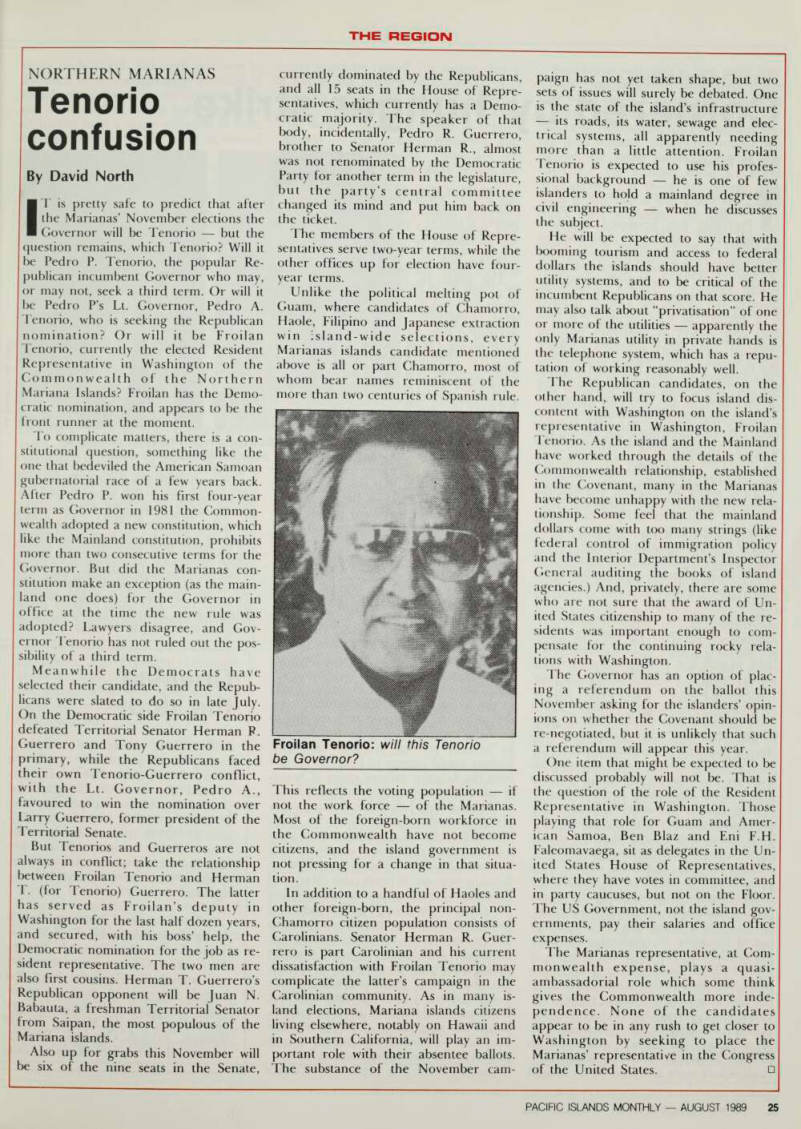
Northern Marianas
Tenorio confusion
By David North
IT is pretty safe to predict that after the Marianas’ November elections the Governor will be Tenorio but the question remains, which Tenorio? Will it be Pedro P. Tenorio, the popular Re publican incumbent Governor who may, or may not, seek a third term. Or will it be Pedro P’s Lt. Governor, Pedro A.
Tenorio, who is seeking the Republican nomination? Or will it be Froilan Tenorio, currently the elected Resident Representative in Washington of the Commonwealth of the Northern Mariana Islands? Froilan has the Demo cratic nomination, and appears to be the front runner at the moment.
To complicate matters, there is a con stitutional question, something like the one that bedeviled the American Samoan gubernatorial race of a few years back.
After Pedro P. won his first four-year term as Governor in 1981 the Common wealth adopted a new constitution, which like the Mainland constitution, prohibits more than two consecutive terms for the Governor. But did the Marianas con stitution make an exception (as the main land one does) for the Governor in office at the time the new rule was
adopted? Lawyers disagree, and Gov
ernor Tenorio has not ruled out the pos sibility of a third term.
Meanwhile the Democrats have selected their candidate, and the Repub licans were slated to do so in late July.
On the Democratic side Froilan Tenorio defeated Territorial Senator Herman P.
Guerrero and Tony Guerrero in the primary, while the Republicans faced their own Tenorio-Guerrero conflict, with the Lt. Governor, Pedro A., favoured to win the nomination over Larry Guerrero, former president of the Territorial Senate.
But Tenorios and Guerreros are not always in conflict; take the relationship between Froilan Tenorio and Herman T. (for Tenorio) Guerrero. The latter has served as Froilan’s deputy in Washington for the last half dozen years, and secured, with his boss’ help, the Democratic nomination for the job as re sident representative. The two men are also first cousins. Herman T. Guerrero’s Republican opponent will be Juan N.
Babauta, a freshman Territorial Senator from Saipan, the most populous of the Mariana islands.
Also up for grabs this November will be six of the nine seats in the Senate,
currently dominated by the Republicans, and all 15 seats in the House of Repre sentatives, which currently has a Demo cratic majority. The speaker of that body, incidentally, Pedro R. Guerrero, brother to Senator Herman R., almost was not renominated by the Democratic Party for another term in the legislature, but the party’s central committee changed its mind and put him back on the ticket.
The members of the House of Repre sentatives serve two-year terms, while the other offices up for election have four year terms.
Unlike the political melting pot of Guam, where candidates of Chamorro, Haole, Filipino and Japanese extraction win island-wide selections, every Marianas islands candidate mentioned above is all or part Chamorro, most of whom bear names reminiscent of the more than two centuries of Spanish rule.
This reflects the voting population if not the work force of the Marianas.
Most of the foreign-born workforce in the Commonwealth have not become citizens, and the island government is not pressing for a change in that situa tion.
In addition to a handful of Haoles and other foreign-born, the principal non- Chamorro citizen population consists of Carolinians. Senator Herman R. Guer rero is part Carolinian and his current dissatisfaction with Froilan Tenorio may complicate the latter’s campaign in the Carolinian community. As in many is land elections, Mariana islands citizens living elsewhere, notably on Hawaii and in Southern California, will play an im portant role with their absentee ballots.
The substance of the November cam
paign has not yet taken shape, but two sets of issues will surely be debated. One is the state of the island’s infrastructure its roads, its water, sewage and elec trical systems, all apparently needing more than a little attention. Froilan Tenorio is expected to use his profes sional background he is one of few islanders to hold a mainland degree in civil engineering when he discusses
the subject.
He will be expected to say that with booming tourism and access to federal dollars the islands should have better utility systems, and to be critical of the incumbent Republicans on that score. He may also talk about “privatisation” of one or more of the utilities apparently the only Marianas utility in private hands is the telephone system, which has a repu tation of working reasonably well.
The Republican candidates, on the other hand, will try to focus island dis content with Washington on the island’s representative in Washington, Froilan Tenorio. As the island and the Mainland have worked through the details of the Commonwealth relationship, established in the Covenant, many in the Marianas have become unhappy with the new rela tionship. Some feel that the mainland dollars come with too many strings (like federal control of immigration policy and the Interior Department’s Inspector General auditing the books of island agencies.) And, privately, there are some who are not sure that the award of Un ited States citizenship to many of the re sidents was important enough to com pensate for the continuing rocky rela tions with Washington.
The Governor has an option of plac ing a referendum on the ballot this November asking for the islanders’ opin ions on whether the Covenant should be re-negotiated, but it is unlikely that such a referendum will appear this year.
One item that might be expected to be discussed probably will not be. That is the question of the role of the Resident
Representative in Washington. Those
playing that role for Guam and Amer ican Samoa, Ben Blaz and Eni F.H.
Faleomavaega, sit as delegates in the Un ited States House of Representatives, where they have votes in committee, and in party caucuses, but not on the Floor.
The US Government, not the island gov ernments, pay their salaries and office expenses.
The Marianas representative, at Com monwealth expense, plays a quasi ambassadorial role which some think gives the Commonwealth more inde pendence. None of the candidates appear to be in any rush to get closer to
Washington by seeking to place the
Marianas’ representative in the Congress of the United States. □
Froilan Tenorio: will this Tenorio be Governor?
Cornered by hunger strike
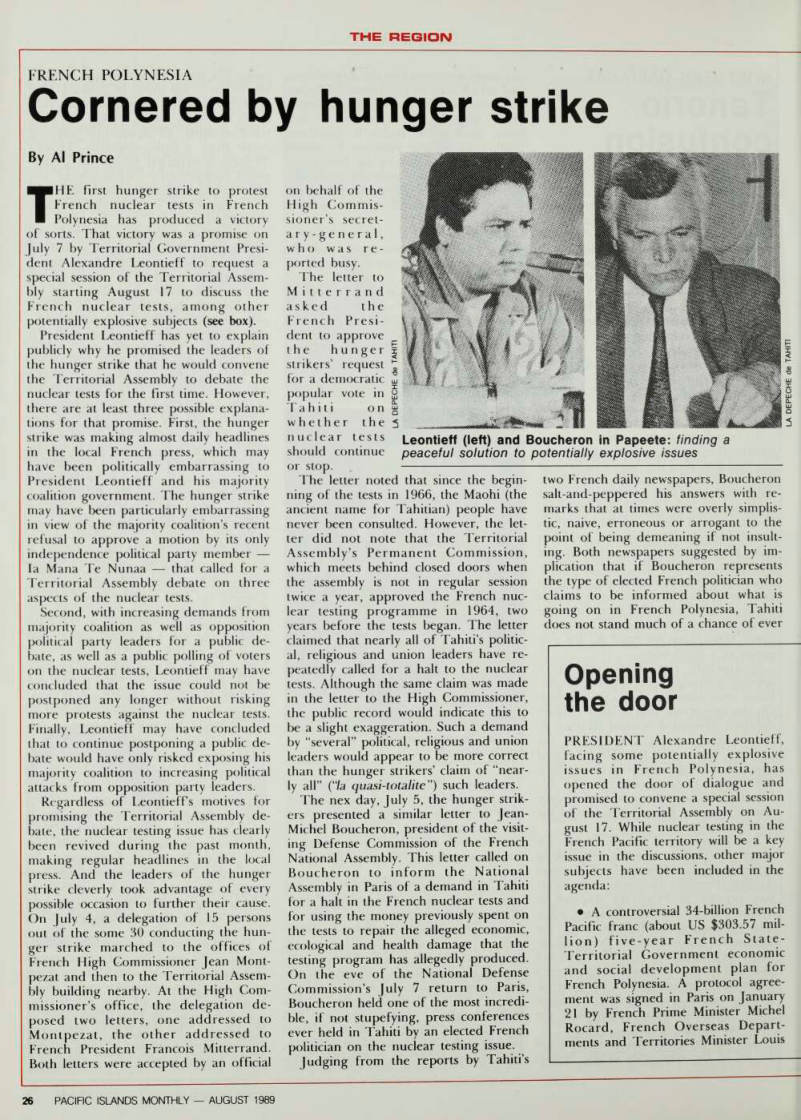
French Polynesia
By Al Prince
THE first hunger strike to protest French nuclear tests in French Polynesia has produced a victory of sorts. That victory was a promise on July 7 by Territorial Government Presi dent Alexandre Leontieff to request a special session of the Territorial Assem bly starting August 17 to discuss the French nuclear tests, among other potentially explosive subjects (see box).
President Leontieff has yet to explain publicly why he promised the leaders of the hunger strike that he would convene the Territorial Assembly to debate the nuclear tests for the first time. However, there are at least three possible explana tions for that promise. First, the hunger strike was making almost daily headlines in the local French press, which may have been politically embarrassing to President Leontieff and his majority coalition government. The hunger strike may have been particularly embarrassing in view of the majority coalition’s recent refusal to approve a motion by its only
independence political party member
la Mana Te Nunaa that called for a Territorial Assembly debate on three aspects of the nuclear tests.
Second, with increasing demands from majority coalition as well as opposition political party leaders for a public de bate, as well as a public polling of voters on the nuclear tests, Leontieff may have concluded that the issue could not be postponed any longer without risking more protests against the nuclear tests.
Finally, Leontieff may have concluded that to continue postponing a public de bate would have only risked exposing his majority coalition to increasing political attacks from opposition party leaders.
Regardless of Leontieffs motives for promising the Territorial Assembly de bate, the nuclear testing issue has clearly been revived during the past month, making regular headlines in the local press. And the leaders of the hunger strike cleverly took advantage of every possible occasion to further their cause.
On July 4, a delegation of 15 persons out of the some 30 conducting the hun ger strike marched to the offices of French High Commissioner Jean Mont pezat and then to the Territorial Assem bly building nearby. At the High Com missioner’s office, the delegation de posed two letters, one addressed to Montpezat, the other addressed to French President Francois Mitterrand.
Both letters were accepted by an official
on behalf of the
High Commis
sioner’s secret ary-general, who was re ported busy.
The letter to Mitterrand asked the French Presi dent to approve the hunger strikers’ request for a democratic popular vote in Tahiti on whether the nuclear tests should continue or stop.
The letter noted that since the begin ning of the tests in 1966, the Maohi (the ancient name for Tahitian) people have never been consulted. However, the let ter did not note that the Territorial Assembly’s Permanent Commission, which meets behind closed doors when the assembly is not in regular session twice a year, approved the French nuc lear testing programme in 1964, two years before the tests began. The letter claimed that nearly all of Tahiti’s politic al, religious and union leaders have re peatedly called for a halt to the nuclear tests. Although the same claim was made in the letter to the High Commissioner, the public record would indicate this to be a slight exaggeration. Such a demand by “several” political, religious and union leaders would appear to be more correct than the hunger strikers’ claim of “near ly all” (“/a quasi-totalite”) such leaders.
The nex day, July 5, the hunger strik ers presented a similar letter to Jean- Michel Boucheron, president of the visit ing Defense Commission of the French National Assembly. This letter called on Boucheron to inform the National Assembly in Paris of a demand in Tahiti for a halt in the French nuclear tests and for using the money previously spent on the tests to repair the alleged economic, ecological and health damage that the testing program has allegedly produced.
On the eve of the National Defense Commission’s July 7 return to Paris, Boucheron held one of the most incredi ble, if not stupefying, press conferences ever held in Tahiti by an elected French politician on the nuclear testing issue.
Judging from the reports by Tahiti’s
two French daily newspapers, Boucheron salt-and-peppered his answers with re marks that at times were overly simplis tic, naive, erroneous or arrogant to the point of being demeaning if not insult
ing. Both newspapers suggested by im
plication that if Boucheron represents the type of elected French politician who claims to be informed about what is going on in French Polynesia, Tahiti does not stand much of a chance of ever
La Depeche De Tahiti
La Depeche De Tahiti
Leontieff (left) and Boucheron in Papeete: finding a peaceful solution to potentially explosive issues
being understood. Although that may be as much of an exaggeration as some of Boucheron’s comments he certainly can not be accused of having been evasive or of having used a vague dialogue of dou ble talk that is often the habit of elected
officials anywhere.
Boucheron claimed that while the French Pacific Testing Centre (CEP) played a role in the beginning of Tahiti’s new era of economic progress, it now plays more and more of a weaker role in the Territory’s gross interior product.
When asked about a potential polling of voters in the future about independ ence, Boucheron said that the purpose of his visit was for military matters.
However, he noted the progress the Ter ritorial Government has made with grea ter self-government during the four years since his last visit.
“Now there’s a choice. Does France bring in nothing and is it of no use?
Look at the figures: the C.E.P., but also the direct aid from France . . he said.
Looking at all of France’s overseas terri tories, Boucheron claimed that French Polynesia’s situation “is the most intelli gent of all”. And he added: “What I don’t want to see are people killing each
other, people starving to death, people
losing their cultural identity. We are advancing, but there’s a long way to go before all Polynesians have access to the
profit of development. There are misery
and poor people in Polynesia, but also in France. Then, when we will have adv anced further along this road, it is evi dent that the question (about independ
ence) could be raised. I’m saying that it is not in the interest of Polynesia. It is certainly not in the interest of Polyne sians. I’m absolutely convinced of that.
The debate should be aimed at serious subjects the budget, economic aid, technical assistance, etc. Those are the things that have direct, daily results for
the Polynesians.”
Boucheron then launched in to a dis course about the economic progress made by the Leontieff Government with the fundamental idea of respecting the Polynesian identity and the cultural identity. But that does not mean there is not a lot of progress left to be made, he said. “If we go too far in the area of all types of investments,” Boucheron said, “we are going to end up with a situation like Hawaii. If we don’t go quickly enough, the development will be harmed, there will be poverty. The poverty problem doesn’t suit Polynesia.”
In attesting to the solid progress made in French Polynesia, he said, “I saw a telephone booth in each island (he vi sited). I won’t hide from you that I was surprised. I was staggered to see a col our television on a lost island hundreds of kilometres from Papeete,” an obvious reference to his visit to the Marquesas Islands. “I’m going to share a secret with you,” Boucheron told journalists at the press conference.
“I called Paris. I reached my secretary in Paris more quickly in telephoning from Huahine than when I call from Rennes. I had her on the line in a few seconds.”
Boucheron was told at one point that Tahiti’s independence supporters claim that while the C.E.P. has participated in Tahiti’s economic development it has also been responsible for Polynesians los ing their identity. Boucheron totally dis agreed. He asked for examples of how the C.E.P. has brought about a cultural degradation. “If there are people who want to live like it was 2,000 years ago, that’s their problem,” he said, Asked for his feelings about the de mand for a public polling of voters on whether French nuclear tests should con tinue or stop in French Polynesia, Boucheron replied: “I would like a popular polling on peace.” He claimed that if Polynesia lives in serenity it is because Polynesia is France and that Tahiti’s internal autonomy, or self government, statute confers security. Im plying that peace relies on France’s nuc lear disuasive force, Boucheron claimed: “Assuring peace is the most important.
This is what France does in Polynesia.”
He denied the French nuclear tests pose any ecological problems for French Polynesia. To underscore his point, he proposed that a hotel be built on the nuclear test site atoll of Moruroa to re ceive all those who are afraid of such tests.
As president of the French National Assembly’s Defense Commission, Boucheron confirmed that starting next year the number of nuclear tests con ducted in French Polynesia will drop from eight to six a year.
The number might drop further to one a year in 1992. By reducing the number of yearly tests and grouping all of the tests into one period, the French Gov ernment hopes to save 20 billion French Pacific francs (about U 55223.2 million).
Boucheron’s comments prompted a re sponse the next day (July 7) from Enri que “Quito” Braun-Ortega, president of a center group in the Territorial Assem bly. In a published letter to Boucheron, Braun-Ortega noted that the 1964 deci sion by Tahiti’s Permanent Commission calls for the C.E.P., in the event that nuclear testing stops in French Polynesia, to return the Tuamotu test site atolls of Moruroa and Fangataufa to the Terri tory in the same condition they originally were, without any compensation or repa ration of any sort by the French State.
Braun-Ortega called for the Territory to be given sufficient advance notice of an eventual halt in the C.E.P.’s nuclear test ing. He also claimed that the C.E.P.’s evolving needs over the years, which were unforeseen in 1964, have created an uncontestable degradation of the two atolls and their lagoons. As a result of this alleged damage, Braun-Ortega cal led for an indemnity for public works damages from the French State. □
Opening
the door
PRESIDENT Alexandre Leontieff,
facing some potentially explosive
issues in French Polynesia, has opened the door of dialogue and promised to convene a special session of the Territorial Assembly on Au gust 17. While nuclear testing in the French Pacific territory will be a key issue in the discussions, other major subjects have been included in the
agenda:
• A controversial 34-billion French Pacific franc (about US $303.57 mil lion) five-year French State- Territorial Government economic and social development plan for French Polynesia. A protocol agree ment was signed in Paris on January 21 by French Prime Minister Michel Rocard, French Overseas Depart ments and Territories Minister Louis
Le Pensec and President Leontieff.
However, the Territorial Assembly has yet to debate the plan, which is supposed to start this year and run
through 1993.
• Bringing up to date the Terri tory’s provisional 1989 budget of 70.355 billion francs (about US$62B million) in view of expenditures already made or committed and re
venues already collected. Although
normally a routine procedure, this, too, could prove controversial in view of the current debate among majority coalition and opposition political lead ers over whether President Leontieffs economic recovery plan announced last August has really taken effect.
On the nuclear testing issue, two items are reportedly scheduled for debate during the Territorial Assem bly’s special session. They are: • A three-item motion submitted
on May 26 by independence political
party leader Oscar Temaru calling for a debate of Tahiti’s relationship
with Europe starting in 1993; the role of the French Pacific Testing Center, known locally as the C.E.P. (Centre
d’Experimentation du Pacifique); and
a public polling of voters on whether they are for or against Tahiti’s inde pendence from France. • A three-item motion submitted and then withdrawn by the independ ence political party la Mana Te Nunaa. That motion was initially opposed by fellow majority coalition leaders of the Leontieff Government and supported by opposition leaders.
The motion called for the creation of a special Territorial Government Commission to study the economic and social impact of the C.E.P.’s pre sence; the creation of a special com mission to evaluate the health and ecological consequences of nuclear testing in French Polynesia; and the organisation of a public polling of vo ters on whether they are for or against continued nuclear testing in this French overseas territory of nearly 200,000 people. □
Advertisements & other items, pp. 28-29 (1 item)
Leave the humdrum behind.
Own a Mazda 626, and
you own the road.
Boredom’s a strong emotion.
And at Mazda, we think there’s no good reason why any driver should have to suffer it.
That’s why we created the Mazda 626. A car offering equal measures of uncommon good looks. Unrestrained performance. And a remarkable degree of precision handling.
This last, especially, has earned the 626 much praise throughout Europe. Enthusiasts speak of the 626’s grip on all kinds of surfaces. Its assured cornering and straight-line stability. Its regard for everything, in fact, that pays off in enhanced driver feel.
Driver feel has long been a
priority at Mazda. We’ve gone so far as to construct a Global Road Circuit in which every conceivable road condition, from ice to Belgian cobblestone to city pothole, is duplicated. Sensors gauge our cars’ performance over these surfaces, as well as through the many twists and turns we’ve designed to simulate European roadways.
The results include innovative and acclaimed suspension systems.
As well as the world’s first speedsensing, 4-wheel steering system.
Regrettably, some people will remain unaware of their options and, by choosing an ordinary car, suffer the consequences.
You needn’t be one of them.
Instead you can choose a Mazda.
Model and features shown may not be available in your area. Please consult your local Mazda dealer.
'll^^ © Mazda Motor Corporati
point on security
Conferences
Washington
Driving home the point on security
By Chris Ashton
THE notion that the South Pacific is a tranquil backwater to global con flict dies hard. In terms of United States security it was long seen as an
American lake, meaning overwhelming
US naval superiority underpinned by the ANZUS Pact, with Australia and New Zealand ensuring the security of the Pacific Islands. Not any more. And to drive the point home to the Bush Admi nistration this was signalled through a two-day conference in Washington in May.
Called Strategic Co-operation and Competition in the Pacific Islands, it
brought together diplomats, politicians,
defence force personnel, academics and civil servants from Australia, New Zea land, the Pacific Islands, France and Japan for the presentation of papers and round-table discussions with their Amer ican counterparts for policy in the Paci fic, including Micronesia. Dr Fedor Mediansky, Associate Professor of Poli tical Science at the University of NSW, Sydney, and Conference co-ordinator, told Pacific Islands Monthly that the US interest in the South Pacific was militari ly driven, meaning that it was perceived for its bearing on US security interests.
Unless US policy managers for the Paci
fie could understand it and adapt its policies accordingly in terms of Pacific island interests, its own security interests would ultimately be imperilled, he said.
The conference was meant quite ex pressly to correct US misconceptions ab out the Pacific.
Such conferences, often with the same figures giving the key papers, have been presented elsewhere, notably in Hawaii and Canberra. And what they had to say this time was familiar with a specialist interest in Pacific affairs. The difference was that for the first time the vanue was Washington. The South Pacific ranks low in America’s list of global priorities.
Many of the speakers accepted this, and added that it should remain so. Their plea was rather for greater sensitivity and willingness to listen to Pacific Island states, and the urgent need to develop a core of career specialists in Pacific policy management in the Defence and State Departments, in place of generalists whose limited expertise was lost when they were posted elsewhere.
Will the Washington Conference make any difference? Don’t look for a blinding revelation comparable with Saul on the road to Damascus. To the extent that it changes anything, those changes will be piecemeal, incremental, slow and largely invisible.
But nor should it be discounted as merely another academic talkfest. A six page summary of the main points emerging from the Conference was dis tributed the following week to the under secretary for policy in the Office of De
fence; to the chairman of the joint chiefs of staff and to desk officers in the East Asia Pacific division in Defence.
One of the highlights of the confer ence was the bafflement of the eminent Japanese professor advising his Govern ment on its Pacific aid programme, Dr Akio Watanabe, as to the attitude of its Western partners in the Pacific to Japan playing a more active role in its security.
Another was the universal derision with which American, but also Australian
participants greeted the claims by New
Zealand’s spokesman, American-born Dr Stephen Hoadley, of Auckland Universi ty, that despite the rupture to the ANZUS Pact, New Zealand’s capacity to safeguard Western security interests in the Pacific was not impaired.
A third, oft-repeated point was that the Pacific Islands were becoming in creasingly open to so-called new “play ers” from outside the region. They varied from Libya with a special interest in New Caledonia, and India with a spe cial interest in Fiji, to the growing intelli gence gathering activities of the USSR
through its fishing fleets.
The feeling of most participants was that the dangers posed by some of the newcomers was at least equal to the be nefits others would confer. Drug run ning, terrorism, arms smuggling, orga nised crime and scope for exploiting ethnic and racial tensions were cited. For the Western nations already involved the moral of this was that its security in terests would need more careful man agement than in the past. □
Hurdles in the islands
Wellington
By David Robie
IN his recent book Lo Bilong Yumi Yet, Papua New Guinea Justice Minis ter Bernard Narakobi tells an anec dote about a group of villagers who want to take their young people to court. The youth had taken off to the city and re fused to send any money back to the village to assist the old folk.
According to custom it is right that the old people insist that the youth send them payments. After all, if the young people were still in the village the fruits of their labour from the gardens, forests on the sea would automatically be shared.
However faced with the problems of living in an urban environment, the youth found it difficult to accept that their pay packets should be handed over to their parents, grandparents, siblings and even cousins.
In Western Samoa, a distraught young man searching for his runaway wife turned to a local church social worker for help. When the worker offered to put a discreet message on a radio prog ramme, however, the young man re fused. He believed the message would bring shame to his village and he would risk being ostracised for having being in capable of “keeping” his wife.
In Fiji, a high chief beat up a com moner as was his customary right with a walking stick for a minor offence against himself. The commoner, claim ing his right under the law, took the chief to court.
These are some examples of the grow ing conflict between traditional commun al rights and the rights of individuals in the South Pacific cited by Suliana Siwati bau at May’s Aotearoa and Asia- Pacific Human Rights conference in Wellington. In a keynote speech on Paci fic human rights at the New Zealand
government-sponsored conference, she outlined serious problems facing the re
gion.
Mrs Siwatibau, a Fijian United Nations consultant now living in Port Vila, advo cates the establishment of a Human Rights Commission and Human Rights Charter for the Pacific, an idea already proposed by a Lawasia research group.
She also appealed for better rights for
women, youth, handicapped people, the
elderly and other disadvantaged groups “only then will Pacific societies be tru ly free”.
During recent years Pacific islanders have become increasingly concerned over the growing erosion of their cultu
ral integrity.
“This has been manifest, for example, in discussions on the formal incorpora tion of indigenous custom-based laws into the laws of the land in various Paci fic states, and in the surge of interest in native languages,” Mrs Siwatibau says.
“It was one of the main justifications of the military coup that overthrew the democratically elected government of Fiji in 1987.” °
Advertisements & other items, p. 31 (1 item)
Business
PACIFIC
ISLANDS
M O N I H L Y
PACIFIC
BUSINESS
REPORT
EIGHT PAGES OF BUSINESS AND
FINANCIAL NEWS FROM
THROUGHOUT THE PACIFIC
EDITED BY ROBIN BROMBY
sees growing
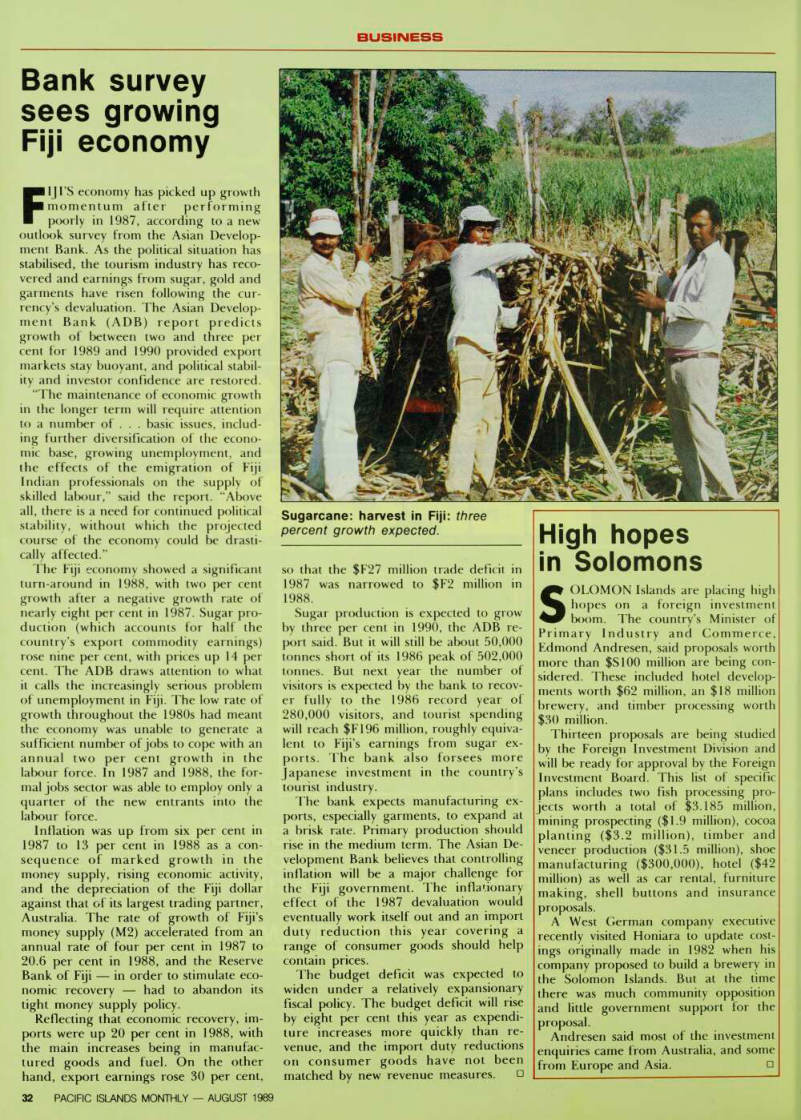
Business
Bank survey sees growing Fiji economy
FIJI’S economy has picked up growth
momentum after performing poorly in 1987, according to a new outlook survey from the Asian Develop ment Bank. As the political situation has stabilised, the tourism industry has reco vered and earnings from sugar, gold and garments have risen following the cur rency’s devaluation. The Asian Develop ment Bank (ADB) report predicts growth of between two and three per cent for 1989 and 1990 provided export markets stay buoyant, and political stabil ity and investor confidence are restored.
“The maintenance of economic growth in the longer term will require attention to a number of . . . basic issues, includ ing further diversification of the econo mic base, growing unemployment, and the effects of the emigration of Fiji Indian professionals on the supply of skilled labour,” said the report. “Above all, there is a need for continued political stability, without which the projected course of the economy could be drasti
cally affected.”
The Fiji economy showed a significant turn-around in 1988, with two per cent growth after a negative growth rate of nearly eight per cent in 1987. Sugar pro duction (which accounts for half the
country’s export commodity earnings)
rose nine per cent, with prices up 14 per cent. The ADB draws attention to what it calls the increasingly serious problem of unemployment in Fiji. The low rate of growth throughout the 1980 s had meant the economy was unable to generate a sufficient number of jobs to cope with an annual two per cent growth in the labour force. In 1987 and 1988, the for mal jobs sector was able to employ only a quarter of the new entrants into the labour force.
Inflation was up from six per cent in 1987 to 13 per cent in 1988 as a con sequence of marked growth in the
money supply, rising economic activity,
and the depreciation of the Fiji dollar against that of its largest trading partner, Australia. The rate of growth of Fiji’s money supply (M 2) accelerated from an annual rate of four per cent in 1987 to 20.6 per cent in 1988, and the Reserve Bank of Fiji in order to stimulate eco nomic recovery had to abandon its
tight money supply policy.
Reflecting that economic recovery, im ports were up 20 per cent in 1988, with the main increases being in manufac tured goods and fuel. On the other hand, export earnings rose 30 per cent,
so that the SF27 million trade deficit in 1987 was narrowed to SF2 million in 1988.
Sugar production is expected to grow
by three per cent in 1990, the ADB re port said. But it will still be about 50,000 tonnes short of its 1986 peak of 502,000 tonnes. But next year the number of visitors is expected by the bank to recov er fully to the 1986 record year of 280,000 visitors, and tourist spending will reach SFI96 million, roughly equiva lent to Fiji’s earnings from sugar ex ports. The bank also forsees more Japanese investment in the country’s
tourist industry.
The bank expects manufacturing ex ports, especially garments, to expand at a brisk rate. Primary production should rise in the medium term. The Asian De velopment Bank believes that controlling inflation will be a major challenge for the Fiji government. The inflationary effect of the 1987 devaluation would eventually work itself out and an import duty reduction this year covering a range of consumer goods should help
contain prices.
The budget deficit was expected to widen under a relatively expansionary fiscal policy. The budget deficit will rise by eight per cent this year as expendi ture increases more quickly than re venue, and the import duty reductions on consumer goods have not been matched by new revenue measures. □
Sugarcane: harvest in Fiji: three percent growth expected.
High hopes
in Solomons
SOLOMON Islands are placing high
hopes on a foreign investment boom. The country’s Minister of
Primary Industry and Commerce,
Edmond Andresen, said proposals worth more than $BlOO million are being con sidered. These included hotel develop ments worth $62 million, an $lB million brewery, and timber processing worth $3O million.
Thirteen proposals are being studied by the Foreign Investment Division and will be ready for approval by the Foreign Investment Board. This list of specific plans includes two fish processing pro jects worth a total of $3,185 million, mining prospecting ($1.9 million), cocoa planting ($3.2 million), timber and veneer production ($31.5 million), shoe manufacturing ($300,000), hotel ($42 million) as well as car rental, furniture making, shell buttons and insurance
proposals.
A West German company executive recently visited Honiara to update cost ings originally made in 1982 when his company proposed to build a brewery in the Solomon Islands. But at the time there was much community opposition and little government support for the
proposal.
Andresen said most of the investment enquiries came from Australia, and some from Europe and Asia. □
Cocoa
in crisis
COGOA is becoming a real quan dary for the Papua New Guinea government. The world price con tinues to drop, the stabilisation fund is out of money, but the government must keep the industry going at a time when the Bougainville crisis is eating deeply into its revenues.
Papua New Guinea has made a sub stantial investment in the cocoa industry in recent years, with both the quality and yield improved by the introduction of new hybrid varieties. About 13 per cent of the population depends on the crop for its livelihood, so cocoa is a major political consideration. The fact that one of the two major produces is the North Solomons Province which has been eco
nomically devastated by the Bougainville
copper mine closure (East New Britain is the other prime cocoa area) just makes the task of the national government in deciding on a future policy all that more difficult. It does not want to get dragged into permanent price support, but at the same time, the industry’s collapse would pose even greater problems.
The growers have done their bit.
Papua New Guinea exported 31,000 ton nes in 1985, rising to 37,400 tonnes in 1988.
The problem is that prices have fallen.
In 1985 the country received K 2021 per tonne of cocoa exported. In 1988 it was down to K 1221 and this year the price is unlikely to average more than KlOOO.
Back in the late 19705, prices hit K5OOO and above, and the government and in dustry then had the foresight to plough much of that money into a stabilisation fund. That fund ran out of cash in May, which is why cocoa has become an issue; a committee set up to recommend future policy will report to the national govern ment at the end of August.
Papua New Guinea cannot turn to the International Cocoa Organisation (ICO) for help, because that body is paralysed by the crisis in world prices. Meanwhile, most of the major producers have in vested in expanding production. In 1981 1.7 million tonnes was placed on the world market. Now the major growing nations (including Ghana, Cote d’lvoire, Brazil, Malaysia and Indonesia) push 2.33 million tonnes on to the World market. Demand has risen from 1.569 million tonnes to 2.08 million tonnes, but the lag in the latter’s growth has brought about a very high level of cocoa stocks about 54.6 per cent of a year’s require ments is now held in warehouses.
On the positive side, the world de mand for cocoa is continuing to grow
(compared with coffee, where health concerns have seen as easing of de mand). There are signs of the Eastern European and Japanese markets opening up for substantial volumes. But the fact that the size of the stocks overhanging the world market has never been higher does rather overshadow the good news.
There is no sign that countries are winding back on the cocoa production, although the World Bank has been knocking back projections to try and dis courage more planting. The latest West pac tropical product bulletin says prices are unlikely to recover much unless weather conditions deteriorate drastically in West Africa.
The unpredictable element is the stocks held by the ICO all 250,000 tonnes, which it bought in to try and maintain the price. There are certain pa rallels with tin a falling world price, vast over-production and an internation al body falling apart at the height of the crisis. The ICO cannot control its mem bership, and many of those members have refused to pay their annual fee to the organisation the fear now is that the ICO will start liquidating the cocoa stocks it holds, pushing them on to the world market just to earn some money to keep itself going. There is also con siderable unsold stock held by Cote d’l voire (held back to try and get the price moving upward) and by Ghana (about five months’ consumption). The Westpac report says these stocks dwarf any prob able changes in the demand-supply ba lance.
“It appears more likely that these stocks will be liquidated in the next year, resulting in a price collapse,” said West pac. More importantly, any such price collapse is unlikely to have an effect on production; cocoa, once established, re quires little additional cost to harvest.
Just across the border, Papua New Guinea faces greater competition from Indonesian cocoa growers. They are planning not only to step up production, but quality as well. That has immense implications, because one edge which Papua New Guinea has is that its cocoa is of high quality and better than most pro duced in West Africa. Recently, the chairman of the Indonesian Cocoa Asso ciation, Ibrahim Hassan, was reported as saying his country would concentrate on cocoa quality to make inroads in the world market. He said Indonesia would cope with world demand by improving quality and aiming at the same top end users who buy PNG cocoa. Most Indone sian coffee goes to the Netherlands.
The March 1989 trade figures from Port Moresby show that cocoa export volumes increased by 76 per cent to 8600 tonnes over the March 1988 quar ter. The increase was due to higher pro duction from rehabilitated cocoa planta
tions. Output is expected to increase further as more of the newly planted cocoa matures.
The government’s loan of Kl 5 million to the Cocoa Stabilisation Fund in May has enabled farmers to receive a K 528 per tonne bounty (on top of the K 750 per tonne they earn from the processors) but that money will run out by the end of October. And here is the govern ment’s quandry: it does not want to get itself into a situation of permanent price support, both for reasons of not setting a precedent for other crops and because it cannot afford the money with no re venue from Bougainville. The short term outlook for cocoa is poor, with several years of rock-bottom prices, and therefore the need for Papua New Guinea growers to be supported.
On top of that, about 45 per cent of the country’s cocoa comes from the same North Solomons province which is now in turmoil over the mine dispute and violence. The government is anxious to keep the lid on the province, but in a wider sense its whole policy has been to foster agriculture to keep people on the land and not drifting into Rabaul, Lae, Port Moresby and other towns to become urban poor. About 13 per cent of Papua New Guineans depend on cocoa for their livelihood. (Prime Minister Rabbie Namaliu himself having been a cocoa
producer).
The importance of cocoa transcends its role as an export commodity it is part of the cornerstone of government economic and social policy.
There is one other complication, too.
Cocoa and copra are complementary crops; about 90 per cent of cocoa pro ducers are also involved with copra, and the price of that commodity has also suf fered a major downturn in price over the last three years. The March quarter also showed a 17 per cent decline in copra exports.
The Bougainville Copper Ltd mine provides 40 per cent of Papua New Guinea’s export income, and 17 per cent of the national government’s revenue when the mine is in full production. The closure of the mine has made a catas trophic hole in state income. Namaliu can neither afford to prop up the cocoa growers, nor afford not to. □
Crab export ban
THE Solomon Islands government has banned exporting of coconut crabs, a popular delicacy in island and Asian na tions. No official reason was given, but it seems the government was alarmed by the rate of harvest overtaking breeding rate. □
fast growth
Banks on fast growth
RECENT bank reports from the region indicate that sector continues to grow at a faster rate than general economic development, and that lending and deposits show a steady upward trend.
The Bank of Kiribati, which is 51 per cent owned by Westpac and 49 per cent by the Kiribati government, reported another good year. The bank lost a SA6 million trustee investment which was transferred to a specialist superannuation manager in Australia, but general deposits increased by $3.3 million. The bank, in line with its charter to increase credit within Kiribati, expanded its loans portfolio by 71 per cent to $4.02 million.
The bank’s 1988 report commented that much of the increased lending had been for personal, rather than essential housing, purposes and in the following year lending policies might need to be analysed in an attempt to direct money into developments more in line with the gov-
ernment’s economic policy.
The bank had opened a branch on Kiritimati Island and at the end of the year deposits there totalled $531,000 which was more than 50 per cent higher than the bank had predicted in its plan ning. Most of the business at the branch was new to the bank and had not been just transferred from the head office on Tarawa. Its opening meant that only Au stralian dollars were now being used on the island which, the report said, was a major contribution to the economic de velopment of the country.
The Bank of Kiribati made a profit after tax of $553,620 and had total assets of $32 million.
The Bank of South Pacific reported another good year in Papua New Guinea, with after-tax profits of K 2.12 million (compared with K 1.34 million the year before) to September 30, 1988.
Income was up 25.4 per cent, while de posits and loans grew by 12 per cent and 18 per cent respectively. Deposits grew with a large increase in mineral activity more than counterbalancing the fall-off in the agricultural sector.
In its comment on the general econo mic outlook, the bank’s report said it
continued to support the government’s desire to promote a competitive financial sector as one of the most effective ways to achieve the goal of sustained long term growth for Papua New Guinea.
The bank believed the financial sector would remain strong. But the report warned that, while Papua New Guinea had a wealth of resources which should ensure long-term prosperity, the country must control the temptation to generate short-term benefits.
The latest available report for the Bank of Western Samoa, to December 31 1987, shows a 23 per cent increase in deposits for the year. After-tax profit almost doubled to SWSI.B7 million.
There was a large increase in interna tional business, most of it in the form of remittances, but the bank commented on Western Samoa’s widening trade gap, caused mainly through a decline in ex ports, and voiced concern about the trend. In 1987 the trade gap reached $lO6 million, compared with $Bl.BB mil lion the previous year. This gap widened
despite a slight improvement in export
prices, especially for coconut oil, and the growing number of tourist visiting the country. □
Hawaii construction’s going up
CONSTRUCTION in the state of Hawaii is having a banner year, reports the First Hawaiian Bank in its latest economic indicators report. And the industry was still headed for growth after a 16 per cent increase in activity in the last year. Private permits authorised, a measure of future construction activity, increased in most countries through March. Oahu’s residential and nonresidential permits rose by 66 per cent and 26 per cent respectively.
Public sector construction is also on the rise, contracts being up 56 per cent in value to SUSIB3 million. Meanwhile, the real estate industry showed signs of slowing down, according to First
Hawaiian, home prices being down three per cent.
In a special on construction in the state, the Bank of Hawaii put a value of SUS2.S billion on new buildings in 1988, bringing the industry back to the peaks achieved in 1969 and 1973-75. When these high levels of construction activity are reached, all the sector’s resources be come heavily committed. The bank says the resultant backlogs should keep activ ity up for another year at least before any major decline occurs.
The Bank of Hawaii does draw atten tion to the housing shortage through the islands. It says research indicates that the
slowdown in issuing of housing permits
began at the same time as population and urban growth management became major policy concerns of the state gov ernment in the early 19705, reflected in law changes covering the use of land.
Government measures included placing a high priority on agriculture and the preservation of farm land. “Interestingly
enough, agriculture received constitu
tional attention during a period when it was dropping in relative importance in the state’s economy and while non
agricultural industries, especially tour
ism, were providing most of the state’s economic growth,” said the Bank of Hawaii report.
The state’s Land Use Commission con tinues to exercise pre-emptive control over the use of land. □
Advertisements & other items, p. 34 (1 item)
Fiji Custom Craft Limited
ALUMINIUM BOAT BUILDERS
WAILADA, LAMI.
P.O. Box 1277, SUVA, FIJI.
PHONE 361977, 361786.
TLX. FJ 2315. FAX 302814
FISHING BOATS, HYDROCATS, WATER TAXIS, CORAL VIEWERS, BARGES, SPECIALISED VESSELS
CUSTOMISED TO YOUR SPECIFICATIONS
Emm
Hawaiian Air’s
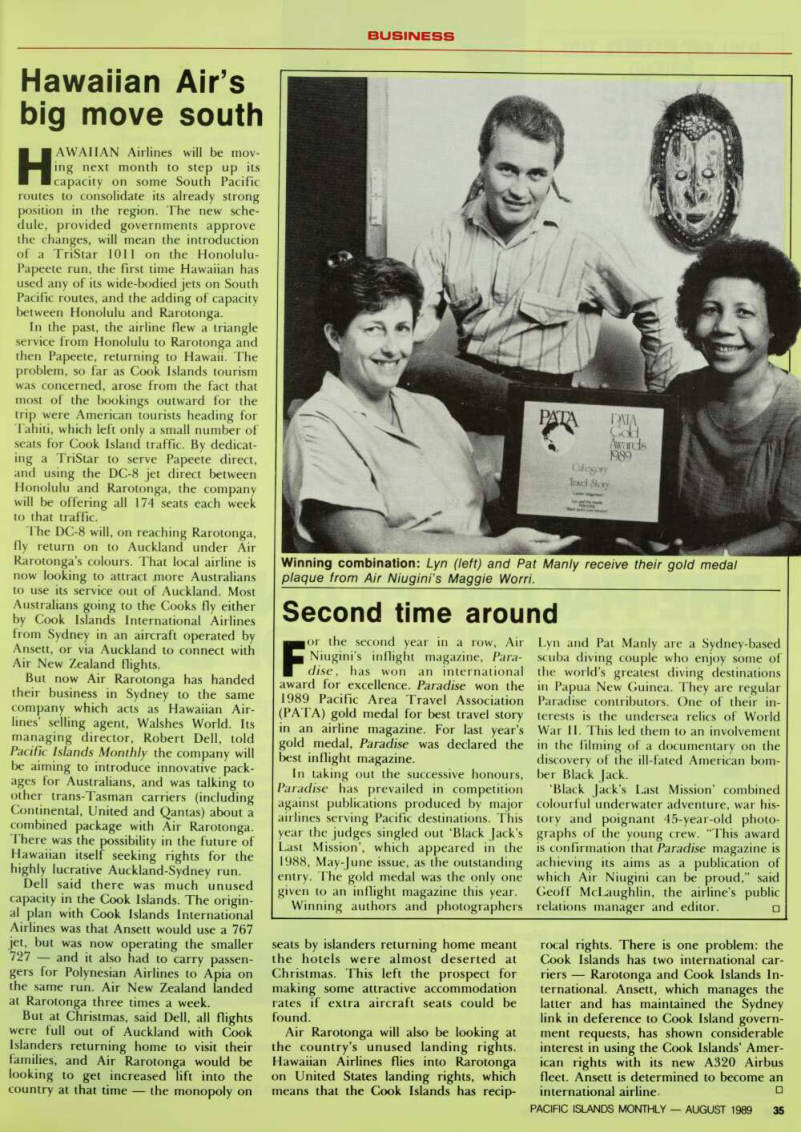
big move south
HAWAIIAN Airlines will be mov ing next month to step up its capacity on some South Pacific routes to consolidate its already strong position in the region. The new sche dule, provided governments approve the changes, will mean the introduction of a TriStar 1011 on the Honolulu- Papeete run, the first time Hawaiian has used any of its wide-bodied jets on South Pacific routes, and the adding of capacity between Honolulu and Rarotonga.
In the past, the airline flew a triangle service from Honolulu to Rarotonga and then Papeete, returning to Hawaii. The problem, so far as Cook Islands tourism was concerned, arose from the fact that most of the bookings outward for the trip were American tourists heading for Tahiti, which left only a small number of seats for Cook Island traffic. By dedicat ing a TriStar to serve Papeete direct, and using the DC-8 jet direct between Honolulu and Rarotonga, the company will be offering all 174 seats each week to that traffic.
The DC-8 will, on reaching Rarotonga, fly return on to Auckland under Air Rarotonga’s colours. That local airline is now looking to attract more Australians to use its service out of Auckland. Most Australians going to the Cooks fly either by Cook Islands International Airlines from Sydney in an aircraft operated by Ansett, or via Auckland to connect with Air New Zealand flights.
But now Air Rarotonga has handed their business in Sydney to the same company which acts as Hawaiian Air lines’ selling agent, Walshes World. Its managing director, Robert Dell, told Pacific Islands Monthly the company will be aiming to introduce innovative pack ages for Australians, and was talking to other trans-Tasman carriers (including Continental, United and Qantas) about a combined package with Air Rarotonga.
There was the possibility in the future of Hawaiian itself seeking rights for the
highly lucrative Auckland-Sydney run.
Dell said there was much unused capacity in the Cook Islands. The origin al plan with Cook Islands International Airlines was that Ansett would use a 767 jet, but was now operating the smaller 727 and it also had to carry passen gers for Polynesian Airlines to Apia on the same run. Air New Zealand landed at Rarotonga three times a week.
But at Christmas, said Dell, all flights were full out of Auckland with Cook Islanders returning home to visit their families, and Air Rarotonga would be looking to get increased lift into the country at that time the monopoly on
seats by islanders returning home meant the hotels were almost deserted at Christmas. This left the prospect for making some attractive accommodation rates if extra aircraft seats could be found.
Air Rarotonga will also be looking at the country’s unused landing rights.
Hawaiian Airlines flies into Rarotonga on United States landing rights, which means that the Cook Islands has recip-
rocal rights. There is one problem: the Cook Islands has two international car riers Rarotonga and Cook Islands In ternational. Ansett, which manages the latter and has maintained the Sydney link in deference to Cook Island govern ment requests, has shown considerable interest in using the Cook Islands’ Amer ican rights with its new A 320 Airbus fleet. Ansett is determined to become an international airline. D
Second time around
For the second year in a row, Air
Niugini’s inflight magazine, Para
dise, has won an international award for excellence. Paradise won the 1989 Pacific Area Travel Association (PATA) gold medal for best travel story in an airline magazine. For last year’s gold medal, Paradise was declared the best inflight magazine.
In taking out the successive honours, Paradise has prevailed in competition against publications produced by major airlines serving Pacific destinations. This year the judges singled out ‘Black Jack’s Last Mission’, which appeared in the 1988, May-June issue, as the outstanding entry. The gold medal was the only one given to an inflight magazine this year.
Winning authors and photographers
Lyn and Pat Manly are a Sydney-based scuba diving couple who enjoy some of the world’s greatest diving destinations in Papua New Guinea. They are regular Paradise contributors. One of their in terests is the undersea relics of World War 11. This led them to an involvement in the filming of a documentary on the discovery of the ill-fated American bom ber Black Jack. ‘Black Jack’s Last Mission’ combined colourful underwater adventure, war his
tory and poignant 45-year-old photo
graphs of the young crew. “This award is confirmation that Paradise magazine is achieving its aims as a publication of which Air Niugini can be proud,” said Geoff McLaughlin, the airline’s public relations manager and editor. □
Winning combination: Lyn (left) and Pat Manly receive their gold medal plaque from Air Niugini’s Maggie Worri.
considers
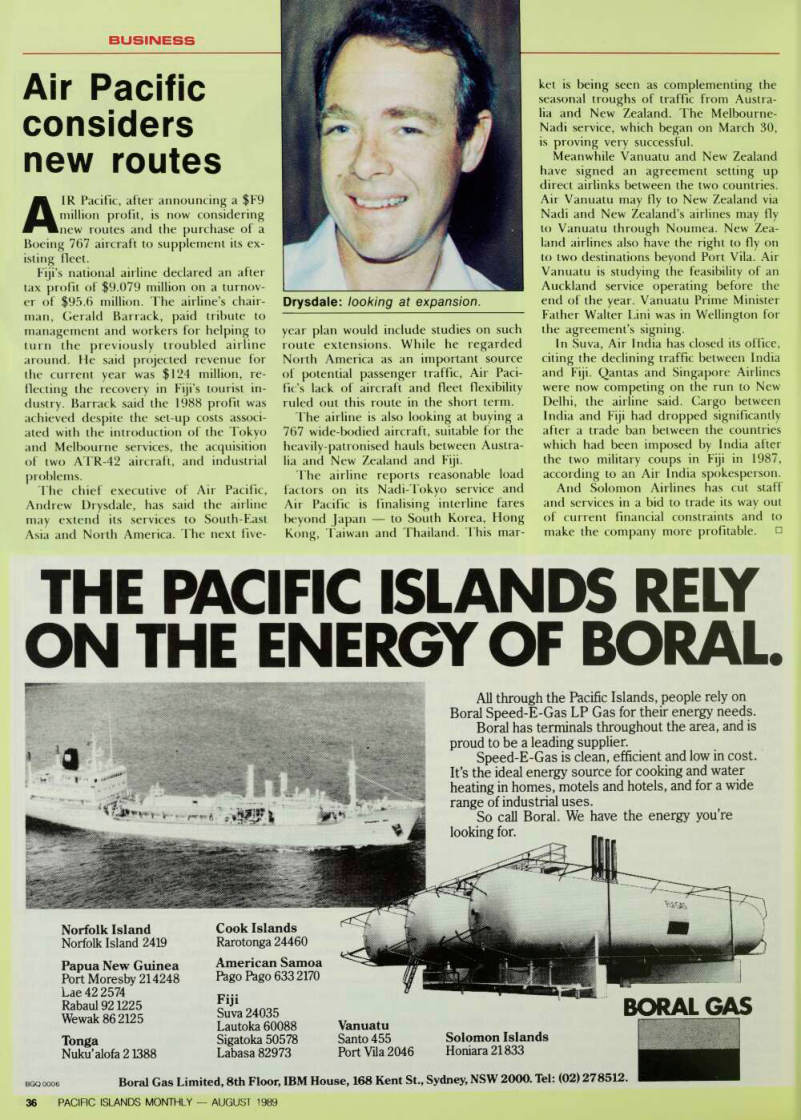
Air Pacific considers new routes
AIR Pacific, after announcing a SF9 million profit, is now considering new routes and the purchase of a Boeing 767 aircraft to supplement its ex isting fleet.
Fiji’s national airline declared an after tax profit of $9,079 million on a turnov er of $95.6 million. The airline’s chair man, Gerald Barrack, paid tribute to management and workers for helping to turn the previously troubled airline around. He said projected revenue for the current year was $124 million, re flecting the recovery in Fiji’s tourist in dustry. Barrack said the 1988 profit was achieved despite the set-up costs associ ated with the introduction of the Tokyo and Melbourne services, the acquisition of two ATR-42 aircraft, and industrial problems.
The chief executive of Air Pacific, Andrew Drysdale, has said the airline may extend its services to South-East Asia and North America. The next five-
year plan would include studies on such route extensions. While he regarded North America as an important source of potential passenger traffic, Air Paci fic’s lack of aircraft and fleet flexibility ruled out this route in the short term.
The airline is also looking at buying a 767 wide-bodied aircraft, suitable for the heavily-patronised hauls between Austra lia and New Zealand and Fiji.
The airline reports reasonable load factors on its Nadi-Tokyo service and Air Pacific is finalising interline fares beyond Japan to South Korea, Hong Kong, Taiwan and Thailand. This mar
ket is being seen as complementing the seasonal troughs of traffic from Austra lia and New Zealand. The Melbourne- Nadi service, which began on March 30, is proving very successful.
Meanwhile Vanuatu and New Zealand have signed an agreement setting up direct airlinks between the two countries.
Air Vanuatu may fly to New Zealand via Nadi and New Zealand’s airlines may fly to Vanuatu through Noumea. New Zea land airlines also have the right to fly on to two destinations beyond Port Vila. Air Vanuatu is studying the feasibility of an Auckland service operating before the end of the year. Vanuatu Prime Minister Father Walter Lini was in Wellington for
the agreement’s signing.
In Suva, Air India has closed its office, citing the declining traffic between India and Fiji. Qantas and Singapore Airlines were now competing on the run to New Delhi, the airline said. Cargo between
India and Fiji had dropped significantly
after a trade ban between the countries which had been imposed by India after the two military coups in Fiji in 1987, according to an Air India spokesperson.
And Solomon Airlines has cut staff and services in a bid to trade its way out of current financial constraints and to make the company more profitable. □
Drysdale: looking at expansion.
Advertisements & other items, p. 36 (2 items)
Business
The Pacific Islands Rely
ON THE ENERGY OF BORAL
f» ... .
Zk % r - ' ' *<fi All through the Pacific Islands, people rely on Boral Speed-E-Gas LP Gas for their energy needs.
Boral has terminals throughout the area, and is
proud to be a leading supplier.
Speed-E-Gas is clean, efficient and low in cost.
It’s the ideal energy source for cooking and water heating in homes, motels and hotels, and for a wide range of industrial uses.
So call Boral. We have the energy you're
looking for.
4 " ! - f** 1 Cook Islands Rarotonga 24460 Norfolk Island Norfolk Island 2419 Papua New Guinea Port Moresby 214248 Lae 42 2574 Rabaul 921225 Wewak 862125 Tonga Nukualofa 21388 American Samoa Pago Pago 633 2170 Fiji Suva 24035 Lautoka 60088 Sigatoka 50578 Labasa 82973
BORAL GAS
Vanuatu Santo 455 Port Vila 2046 Solomon Islands Honiara 21833 Boral Gas Limited, Bth Floor, IBM House, 168 Kent St., Sydney, NSW 2000. Tel: (02) 278512.
from oilfields
Good news from oilfields
THE continuing gloom surrounding the Bougainville copper mine in Papua New Guinea some sources say it could be six months before full production is resumed has been at least partly offset by good news from the lagifu and Hedinia oilfields. Chev ron Niugini, the subsidiary of the giant American-owned Chevron Corporation, has been undertaking land surveys for a 330-kilometre pipeline to carry the oil to the Gulf Province port of Kerema.
By November the company is expected to know whether the project is viable, and the country will be pinning its hopes on the likely event that the pipeline will go ahead. Chevron’s public relations manager, Brad LeDu, says the drilling results are “very positive”.
The one major problem, apart from the terrain between the oilfields and the sea, will be negotiations with landowners.
One local member and the Minister for Fisheries and Marine Resources, Allan Ebu, has said no pipeline would be built unless landowners were satisfied. Ebu has demanded that Chervon Niugini set aside a contingency financial package for local people in case of a serious oil spil lage, and that the company be ready to move in and clean up any spill.
LeDu said the company had con ducted meetings with local people and they had been assured the pipeline would not harm the environment. He said Chervon would build it to the best safety standards, and that it was the only cost-effective way in which to transport huge quantities of oil overland.
Drilling has indicated encouraging re sults, with one well producing 1110 bar rels a day.
Meanwhile, the North Solomons pro vincial government has cut its budget spending proposals by almost a half be cause of the Bougainville crisis. Travel, overtime and transport hire by govern ment employees has been banned unless
absolutely essential.
The production totals from the giant Panguna mine up to the end of the June quarter illustrate just how the company has been hit since the mine closed on May 15: copper output was 28,080 ton nes and gold 1465 kg compared with 42,712 tonnes and 3909 kg respectively for the previous corresponding period.
The national government in Port Mores by is losing about K 3 million a week in revenue since the mine closed.
The full impact on Bougainville Cop per Ltd’s earnings may not be felt until the quarter now under way because the company was still making shipments af ter the mine closed.
Even if peace is restored, the mining company will have trouble getting an early re-start on operations. Skilled workers have left the North Solomons province for jobs elsewhere, while many expatriates who have fled Papua New Guinea are not expected to want to re turn. The company also has some mechanical problems to remedy when the mine re-opens. □
Concern in Norfolk
Norfolk
IN a budget which sought to increase revenue by a general increase in gov ernment fees, the Norfolk Island Minister of Finance, Neville Christian, voiced concern at the overheating of the island’s economy caused by consumer over-confidence. The impact of higher interest rates and inflation on the Au stralian mainland was also being felt on Norfolk: tourists were being more care ful with their money while on holiday.
The island’s traders had been specifi cally hit by Australia’s introduction of a SA4OO duty free limit. The Norfolk Is land administration was to urge the Au stralian government to either exempt the island from the limit, or raise the duty free threshold.
To cover its budget estimates of $4.9 million, the Norfolk Island government increased duty and fees: • Duty on cigarettes, cigars and tobac co went from 15 per cent to 60 per cent; • General rate of duty from eight to nine per cent; • Immigration fees up; • Property conveyance fee doubled; • Vehicle registration charge in creased by 50 pier cent; • Duty on beer up 10c per can, with larger increases for bottles larger than 375 ml and for kegs. • Quarantine and health fees up, and an increase on the financial institutions transactions levy of 400 per cent, from 0.05 per cent to 0.25 per cent.
The increase on government charges were expected to raise an additional $560,000, said Christian. A thorough re view of the postal service had been undertaken and the government plan ned to revitalise philatelic sales and the
post generally.
Christian said the government needed to keep its expenditure under tight rein in view of the delicate nature of the is land’s economic base. Section heads would be meeting to find ways of keep ing costs under control, as the island’s economy must not be eroded by careless
spending. □
Advertisements & other items, p. 37 (1 item)
Dhl It!
BOAT AVAILABLE FOR LOCAL
(HARTERS
Multi-purpose sixteen meter tramp motor-sailer, two and one half metre draft. Twenty cubic meter blast freeze hold. Full electronics, unlicensed, interisland light general cargo. Carry four passengers, limited commercial and sport diving. Troll and bottom fishing research, support vessel, VIP tourist charters. Shipshape. Nice appearance with boat operator PDA LANI, P.O. Box 1210, Kapaa, Kawai, Hawaii, 96746.
FOR SALE
REFRIGERATED CONTAINERS
20x8x8-6 aluminium clad exterior, ribbed fibreglass interior. Fitted Email refrigeration machinery. Equipment in excellent working order. Suitable for either freezer or chiller applications.
Ideal for use in transport, static storage, portable cool rooms.
CONTAINER SYSTEMS AUSTRALIA
P.O. BOX 467, WERRIBEE,
VICTORIA. 3030.
TEL 03 6892411 FAX 03 6891264.
FOR SALE
EX-AUSTRALIAN GOVERNMENT
Ex Australian Government Bulldozers Cranes Tractors Post Hole Borers Forklifts Loaders Loaders backhoes Elevating Platforms Trenchers Road Graders Road Rollers Garbage Compactors Street Sweepers Excavators 4x4 x 6x6 Heavy Duty Trucks Generators Compressors Prime Movers etc.
'Low Kim Low Hr Units
COUSINS TRUCK & MACHINERY SALES
P.O. BOX 191 ARCHERFIELD
BRISBANE OLD 4108
PHONE (07) 277 1822
FAX (07) 274 1389
HOW ON EARTH AM I GOING TO TAKE
ALL THIS HOME 7
DHL IT!
DHL has years ol ejpenote cneWly ' jng and shipping Fiji's afcdnhrg worts ol art diredty lo your home doorslep Of reputation has been bull on arng (or your wludles Don't kit chances, phone us «*’re here ta help Just call DHL we ll do the rest 1 worldwide express ■
Burns Philp quits Niue
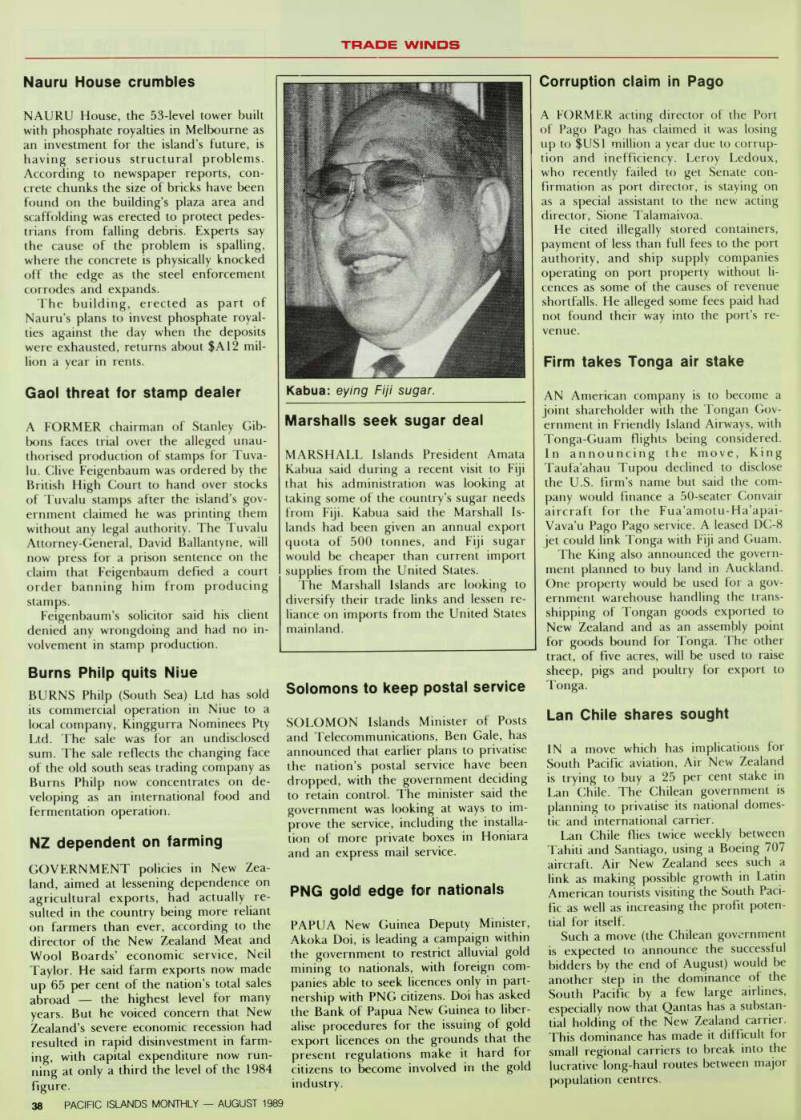
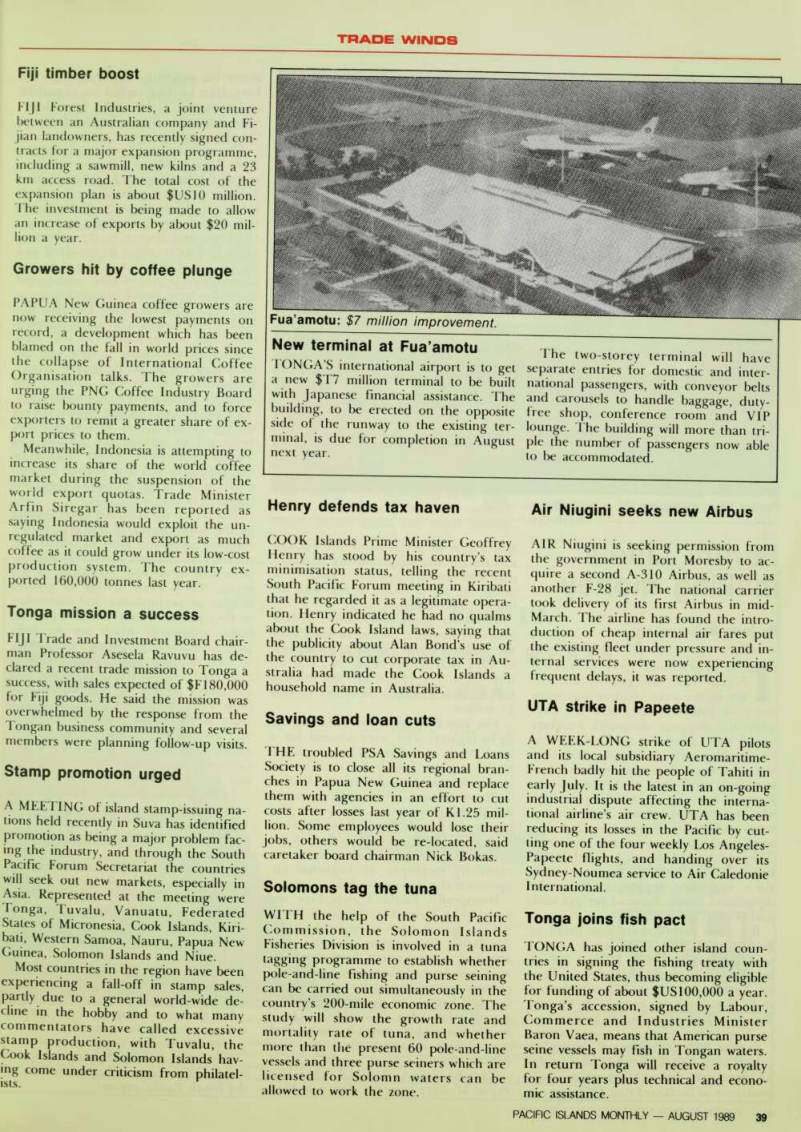
Trade Winds
Nauru House crumbles NAURU House, the 53-level tower built with phosphate royalties in Melbourne as an investment for the island’s future, is
having serious structural problems.
According to newspaper reports, con crete chunks the size of bricks have been found on the building’s plaza area and scaffolding was erected to protect pedes trians from falling debris. Experts say the cause of the problem is spalling, where the concrete is physically knocked off the edge as the steel enforcement corrodes and expands.
The building, erected as part of
Nauru’s plans to invest phosphate royal
ties against the day when the deposits were exhausted, returns about SAI2 mil lion a year in rents.
Gaol threat for stamp dealer A FORMER chairman of Stanley Gib bons faces trial over the alleged unau thorised production of stamps for Tuva lu. Clive Feigenbaum was ordered by the British High Court to hand over stocks of Tuvalu stamps after the island’s gov ernment claimed he was printing them without any legal authority. The Tuvalu Attorney-General, David Ballantyne, will now press for a prison sentence on the claim that Feigenbaum defied a court order banning him from producing stamps.
Feigenbaum’s solicitor said his client denied any wrongdoing and had no in volvement in stamp production.
Burns Philp quits Niue
BURNS Philp (South Sea) Ltd has sold its commercial operation in Niue to a local company, Kinggurra Nominees Pty Ltd. The sale was for an undisclosed sum. The sale reflects the changing face of the old south seas trading company as Burns Philp now concentrates on de veloping as an international food and
fermentation operation.
NZ dependent on farming
GOVERNMENT policies in New Zea land, aimed at lessening dependence on agricultural exports, had actually re sulted in the country being more reliant on farmers than ever, according to the director of the New Zealand Meat and Wool Boards’ economic service, Neil Taylor. He said farm exports now made up 65 per cent of the nation’s total sales abroad the highest level for many years. But he voiced concern that New Zealand’s severe economic recession had resulted in rapid disinvestment in farm ing, with capital expenditure now run ning at only a third the level of the 1984 figure.
Solomons to keep postal service SOLOMON Islands Minister of Posts and Telecommunications, Ben Gale, has announced that earlier plans to privatise the nation’s postal service have been dropped, with the government deciding to retain control. The minister said the government was looking at ways to im prove the service, including the installa tion of more private boxes in Honiara and an express mail service.
PNG gold edge for nationals PAPUA New Guinea Deputy Minister, Akoka Doi, is leading a campaign within the government to restrict alluvial gold mining to nationals, with foreign com panies able to seek licences only in part nership with PNG citizens. Doi has asked the Bank of Papua New Guinea to liber alise procedures for the issuing of gold export licences on the grounds that the present regulations make it hard for citizens to become involved in the gold industry.
Corruption claim in Pago
A FORMER acting director of the Port of Pago Pago has claimed it was losing up to SUSI million a year due to corrup tion and inefficiency. Leroy Ledoux, who recently failed to get Senate con firmation as port director, is staying on as a special assistant to the new acting director, Sione Talamaivoa.
He cited illegally stored containers, payment of less than full fees to the port
authority, and ship supply companies
operating on port property without li cences as some of the causes of revenue shortfalls. He alleged some fees paid had not found their way into the port’s re venue.
Firm takes Tonga air stake AN American company is to become a joint shareholder with the Tongan Gov ernment in Friendly Island Airways, with
Tonga-Guam flights being considered.
In announcing the move, King Taufa’ahau Tupou declined to disclose the U.S. firm’s name but said the com pany would finance a 50-seater Convair aircraft for the Fua’amotu-Ha’apai- Vava’u Pago Pago service. A leased DC-8 jet could link Tonga with Fiji and Guam.
The King also announced the govern ment planned to buy land in Auckland.
One property would be used for a gov ernment warehouse handling the trans
shipping of Tongan goods exported to
New Zealand and as an assembly point for goods bound for Tonga. The other tract, of five acres, will be used to raise sheep, pigs and poultry for export to
Tonga.
Lan Chile shares sought IN a move which has implications for South Pacific aviation, Air New Zealand is trying to buy a 25 per cent stake in Lan Chile. The Chilean government is planning to privatise its national domes tic and international carrier.
Lan Chile flies twice weekly between Tahiti and Santiago, using a Boeing 707 aircraft. Air New Zealand sees such a link as making possible growth in Latin American tourists visiting the South Paci fic as well as increasing the profit poten tial for itself.
Such a move (the Chilean government is expected to announce the successful bidders by the end of August) would be another step in the dominance of the South Pacific by a few large airlines, especially now that Qantas has a substan tial holding of the New Zealand carrier.
This dominance has made it difficult for small regional carriers to break into the lucrative long-haul routes between major
population centres.
Fiji timber boost FIJI Forest Industries, a joint venture between an Australian company and Fi jian landowners, has recently signed con tracts for a major expansion programme, including a sawmill, new kilns and a 23 km access road. The total cost of the expansion plan is about SUSIO million.
The investment is being made to allow an increase of exports by about $2O mil lion a year.
Growers hit by coffee plunge PAPUA New Guinea coffee growers are now receiving the lowest payments on record, a development which has been blamed on the fall in world prices since the collapse of International Coffee Organisation talks. The growers are urging the PNG Coffee Industry Board to raise bounty payments, and to force exporters to remit a greater share of ex port prices to them.
Meanwhile, Indonesia is attempting to increase its share of the world coffee market during the suspension of the world export quotas. Trade Minister Arfin Siregar has been reported as saying Indonesia would exploit the un regulated market and export as much coffee as it could grow under its low-cost production system. The country ex ported 160,000 tonnes last year.
Tonga mission a success FIJI Trade and Investment Board chair man Professor Asesela Ravuvu has de clared a recent trade mission to Tonga a success, with sales expected of $F 180,000 for Fiji goods. He said the mission was overwhelmed by the response from the Tongan business community and several members were planning follow-up visits.
Stamp promotion urged
A MEETING of island stamp-issuing na tions held recently in Suva has identified promotion as being a major problem fac ing the industry, and through the South Pacific Forum Secretariat the countries will seek out new markets, especially in Asia. Represented at the meeting were Tonga, Tuvalu, Vanuatu, Federated States of Micronesia, Cook Islands, Kiri bati, Western Samoa, Nauru, Papua New Guinea, Solomon Islands and Niue.
Most countries in the region have been experiencing a fall-off in stamp sales, partly due to a general world-wide de cline in the hobby and to what many commentators have called excessive stamp production, with Tuvalu, the Cook Islands and Solomon Islands hav ing come under criticism from philatel ists.
Henry defends tax haven COOK Islands Prime Minister Geoffrey Henry has stood by his country’s tax minimisation status, telling the recent South Pacific Forum meeting in Kiribati that he regarded it as a legitimate opera tion. Henry indicated he had no qualms about the Cook Island laws, saying that the publicity about Alan Bond’s use of the country to cut corporate tax in Au stralia had made the Cook Islands a household name in Australia.
Savings and loan cuts THE troubled PSA Savings and Loans Society is to close all its regional bran ches in Papua New Guinea and replace them with agencies in an effort to cut costs after losses last year of K 1.25 mil lion. Some employees would lose their jobs, others would be re-located, said caretaker board chairman Nick Bokas.
Solomons tag the tuna WITH the help of the South Pacific Commission, the Solomon Islands Fisheries Division is involved in a tuna ta gg' n g programme to establish whether pole-and-line fishing and purse seining can be carried out simultaneously in the country’s 200-mile economic zone. The study will show the growth rate and mortality rate of tuna, and whether more than the present 60 pole-and-line vessels and three purse seiners which are licensed for Solomn waters can be allowed to work the zone.
Air Niugini seeks new Airbus AIR Niugini is seeking permission from the government in Port Moresby to ac quire a second A-310 Airbus, as well as another F-28 jet. The national carrier took delivery of its first Airbus in mid- March. The airline has found the intro duction of cheap internal air fares put the existing fleet under pressure and in ternal services were now experiencing frequent delays, it was reported.
UTA strike in Papeete A WEEK-LONG strike of UTA pilots and its local subsidiary Aeromaritime- French badly hit the people of Tahiti in early July. It is the latest in an on-going industrial dispute affecting the interna tional airline’s air crew. UTA has been reducing its losses in the Pacific by cut ting one of the four weekly Los Angeles-
Papeete flights, and handing over its
Sydney-Noumea service to Air Caledonie International.
Tonga joins fish pact
TONGA has joined other island coun tries in signing the fishing treaty with the United States, thus becoming eligible for funding of about SUS 100,000 a year.
Tonga’s accession, signed by Labour, Commerce and Industries Minister Baron Vaea, means that American purse seine vessels may fish in Tongan waters.
In return Tonga will receive a royalty for four years plus technical and econo mic assistance.
Marshalls seek sugar deal
MARSHALL Islands President Amata Kabua said during a recent visit to Fiji that his administration was looking at taking some of the country’s sugar needs from Fiji. Kabua said the Marshall Is lands had been given an annual export quota of 500 tonnes, and Fiji sugar would be cheaper than current import supplies from the United States.
The Marshall Islands are looking to diversify their trade links and lessen re liance on imports from the United States mainland.
Kabua: eying Fiji sugar.
New terminal at Fua’amotu
Tnx . r A , c . , IONGAS mternational airport is to get a new ST7 million terminal to be built with Japanese financial assistance. The Hiildmg to be erected on the opposite side of the runway to the existing ter mmal, is due for completion in August next Vear
t lhe two-storey terminal will have separate entries for domestic and inter national passengers, with conveyor belts and carousels to handle baggage dutv free shop, conference room and VIP lounge. The building will more than tri pie the number of passengers now able to be accommodated.
Fua’amotu: $7 million improvement.
making money
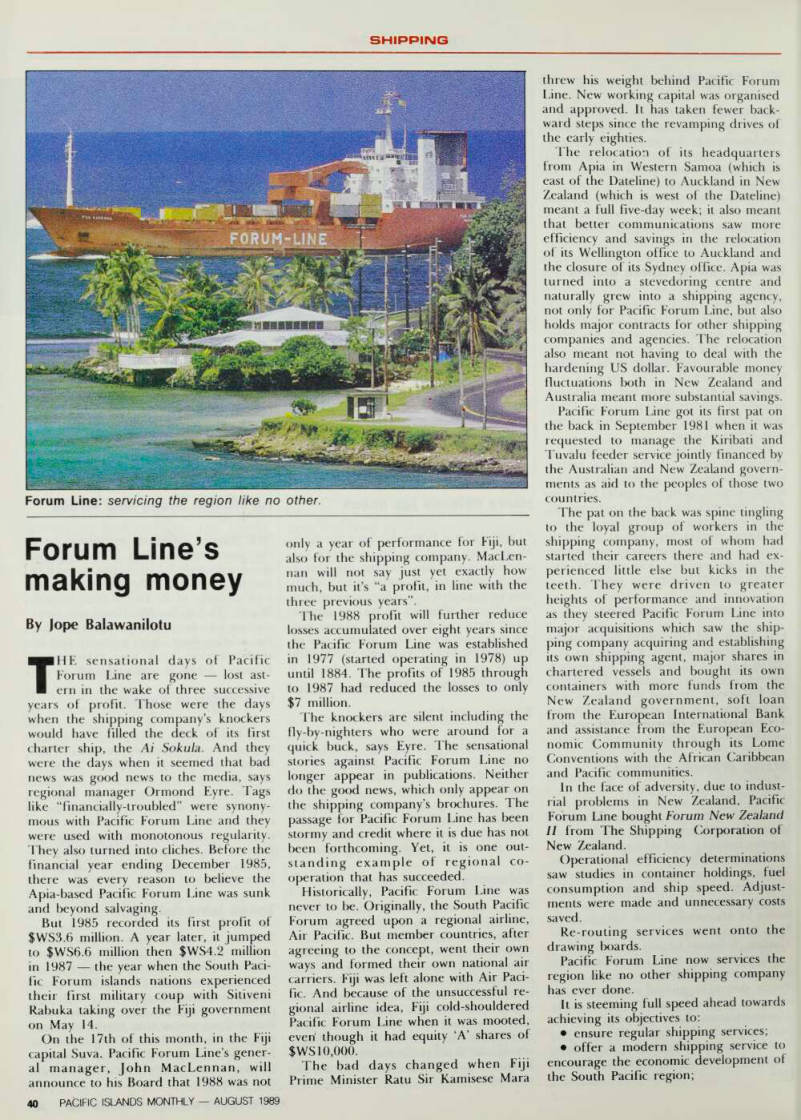
Shipping
Forum Line’s making money
By Jope Balawanilotu
The sensational days of Pacific Forum Line are gone lost ast ern in the wake of three successive years of profit. Those were the days when the shipping company’s knockers would have filled the deck of its first charter ship, the Ai Sokula. And they were the days when it seemed that bad news was good news to the media, says
regional manager Ormond Eyre. Tags
like “financially-troubled” were synony mous with Pacific Forum Line and they were used with monotonous regularity.
They also turned into cliches. Before the financial year ending December 1985, there was every reason to believe the Apia-based Pacific Forum Line was sunk
and beyond salvaging.
But 1985 recorded its first profit of SWS3.6 million. A year later, it jumped to SWS6.6 million then SWS4.2 million in 1987 the year when the South Paci fic Forum islands nations experienced their first military coup with Sitiveni Rabuka taking over the Fiji government on May 14.
On the 17th of this month, in the Fiji capital Suva. Pacific Forum Line’s gener al manager, John MacLennan, will announce to his Board that 1988 was not
only a year of performance for Fiji, but also for the shipping company. MacLen nan will not say just yet exactly how much, but it’s “a profit, in line with the
three previous years”.
The 1988 profit will further reduce losses accumulated over eight years since the Pacific Forum Line was established in 1977 (started operating in 1978) up until 1884. The profits of 1985 through to 1987 had reduced the losses to only $7 million.
The knockers are silent including the fly-by-nighters who were around for a quick buck, says Eyre. The sensational stories against Pacific Forum Line no longer appear in publications. Neither do the good news, which only appear on the shipping company’s brochures. The passage for Pacific Forum Line has been stormy and credit where it is due has not been forthcoming. Yet, it is one out
standing example of regional co
operation that has succeeded.
Historically, Pacific Forum Line was never to be. Originally, the South Pacific Forum agreed upon a regional airline, Air Pacific. But member countries, after agreeing to the concept, went their own ways and formed their own national air carriers. Fiji was left alone with Air Paci fic. And because of the unsuccessful re gional airline idea, Fiji cold-shouldered Pacific Forum Line when it was mooted, even though it had equity ‘A’ shares of
Sws 10,000.
The bad days changed when Fiji Prime Minister Ratu Sir Kamisese Mara
threw his weight behind Pacific Forum
Line. New working capital was organised
and approved. It has taken fewer back ward steps since the revamping drives of
the early eighties.
The relocation of its headquarters from Apia in Western Samoa (which is east of the Dateline) to Auckland in New Zealand (which is west of the Dateline) meant a full five-day week; it also meant that better communications saw more efficiency and savings in the relocation of its Wellington office to Auckland and the closure of its Sydney office. Apia was turned into a stevedoring centre and naturally grew into a shipping agency, not only for Pacific Forum Line, but also holds major contracts for other shipping companies and agencies. The relocation also meant not having to deal with the hardening US dollar. Favourable money fluctuations both in New Zealand and Australia meant more substantial savings.
Pacific Forum Line got its first pat on the back in September 1981 when it was requested to manage the Kiribati and Tuvalu feeder service jointly financed by the Australian and New Zealand govern ments as aid to the peoples of those two countries.
The pat on the back was spine tingling to the loyal group of workers in the shipping company, most of whom had started their careers there and had ex perienced little else but kicks in the teeth. They were driven to greater heights of performance and innovation as they steered Pacific Forum Line into
major acquisitions which saw the ship
ping company acquiring and establishing
its own shipping agent, major shares in chartered vessels and bought its own containers with more funds from the New Zealand government, soft loan from the European International Bank and assistance from the European Eco nomic Community through its Lome Conventions with the African Caribbean and Pacific communities.
In the face of adversity, due to indust rial problems in New Zealand, Pacific Forum Line bought Forum New Zealand II from The Shipping Corporation of New Zealand.
Operational efficiency determinations
saw studies in container holdings, fuel
consumption and ship speed. Adjust
ments were made and unnecessary costs saved.
Re-routing services went onto the
drawing boards.
Pacific Forum Line now services the region like no other shipping company has ever done.
It is steeming full speed ahead towards
achieving its objectives to:
• ensure regular shipping services; • offer a modern shipping service to encourage the economic development of the South Pacific region;
Forum Line: servicing the region like no other.
• contain freight rates; and • operate a viable shipping service.
With four ships Forum Micronesia, Forum Samoa, Fua Kavenga and Forum New Zealand II Pacific Forum Line is
getting closer to achieving those objec
tives.
The purchase of its own office premis es in Suva, the acquisition of Union Maritime’s agency services both in Suva and Lautoka in Fiji, the growth of its Fiji staff from three to 27 and the acquisi tion of Akarana Freights in New Zealand indicate that momentum has not peaked.
The demise of the Daiwa Lines saw Pacific Forum Line moving in to fill the gap, also servicing New Caledonia and the Melanesian Spearhead Group na tions.
Pacific Forum Line now links Mic ronesia, Polynesia, Melanesia, New Zea land and Australia.
Marshall Islands President Amata Kabua is talking about more trade with and amongst the Pacific Forum islands
nations, continuing a swelling growth
potential.
Pacific Forum Line is having its share
of shipping Fiji’s booming garments ex
ports and booming timber and pine
chips exports.
Jacques Sellam, a Frenchman of Tahiti
who has garments factories in Chicago, Chile and France, is talking joint venture with a Fiji concern for the European and American markets. It will give added volume as Pacific Forum Line eyes Asia, Europe and the Pacific-West-Coast of the American continent where it already has
trans-shipment arrangements.
And there is more good news. The Pacific Way works. Those South Pacific countries which had sat back during the bad days are welcome to join and buy shares. General manager MacLennan confirms that talks are going on with the Marshall Islands to join.
Pacific Forum Line is indeed a pleasant irony. It is taking off from a regional airline idea which failed to reach the sky. □
Help sought for shipping
I HE Fiji Inter-Island Ship Owners Asso ciation has warned the government its policies would lead to the collapse of the industry. Association president Leo Smith said private operators faced com petition from government and military vessels. Better jetties and roads leading to ports were needed, he said. □
Schedules
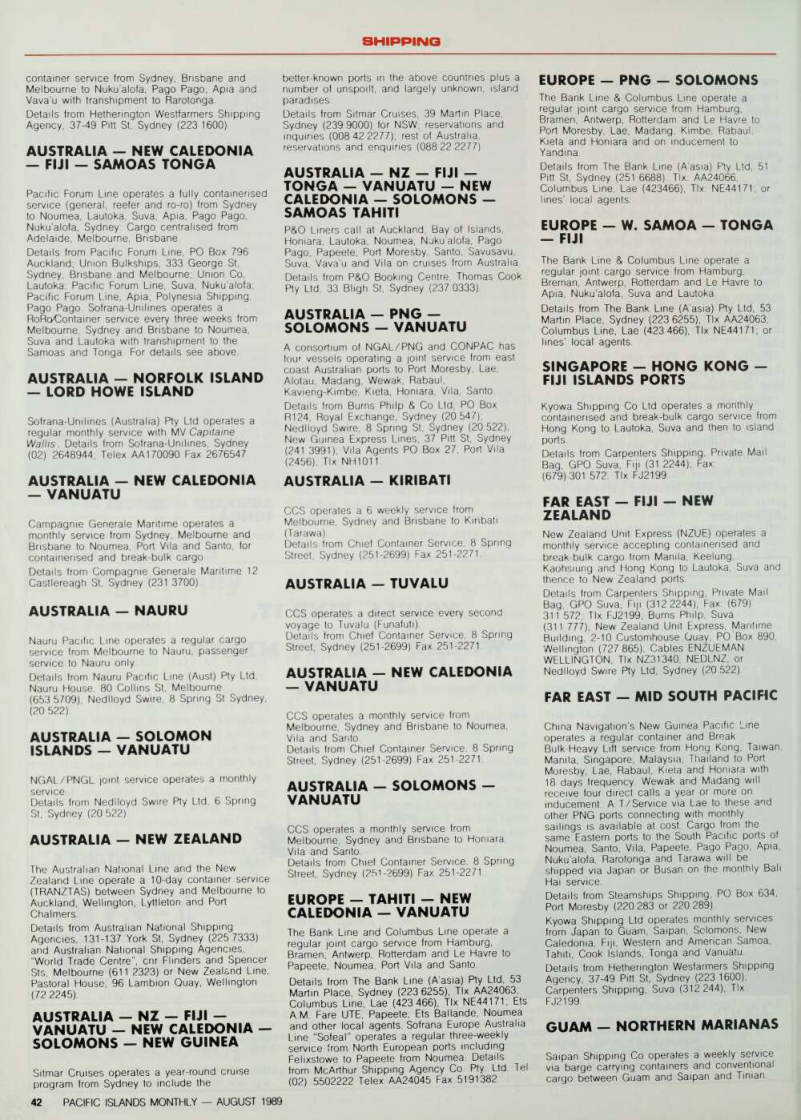

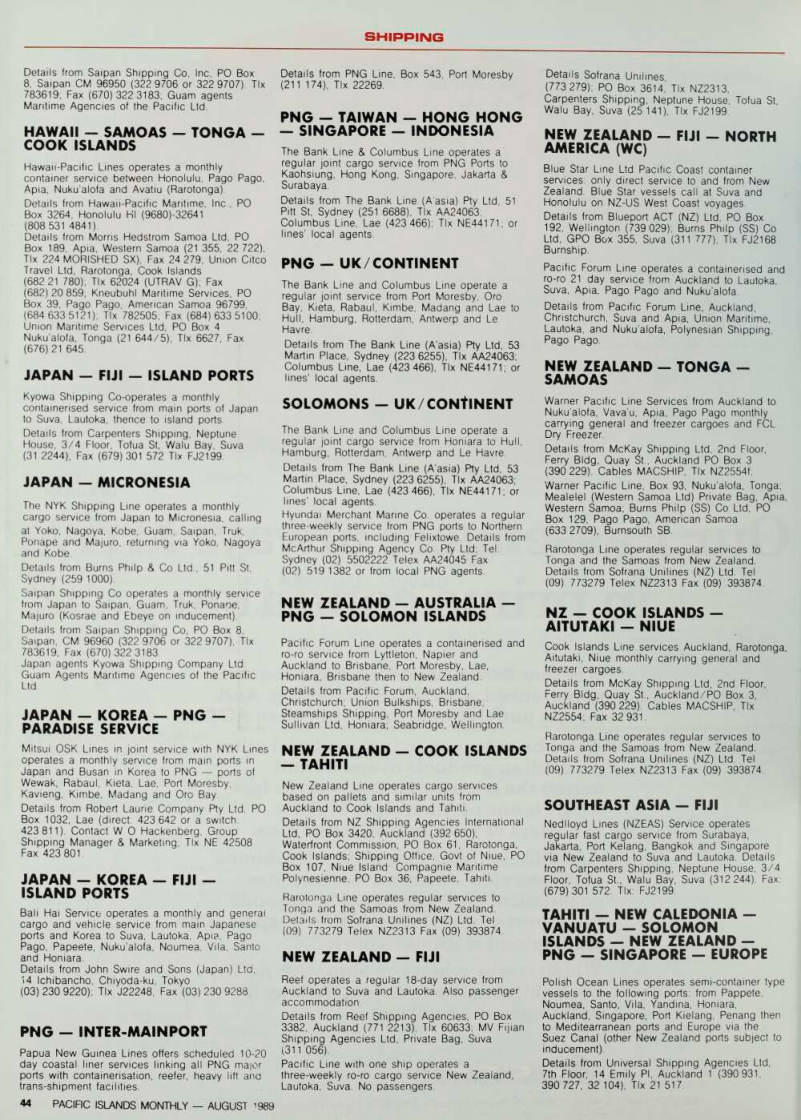
Australia - New Caledonia
-Fiji - Hawaii - North
America
PACE Line (ACTA Shipping) operates a fully containerised service every 17 days from Melbourne, Sydney and Brisbane to Noumea, Suva and Lautoka. The vessels continue on to the North coast of America, calling at Hawaii at frequent intervals.
Details from ACTA Pty Ltd, Sydney (266 0633); Tlx AA121369, Fax 267 1148. Burns Philp (SS) Co Ltd, Rodwell Road, Suva (311 777) Tlx FJ2168; Fax 301 127; Burns Philp (SS)’Co Ltd, Lautoka (60 777), Sato SA, Avenue James Cook BPC 2. Noumea, Cedex (281 122), Tlx 3163 NM GATO Fax 276 532. Sofrana Unilmes operates a Roßo/container service every three weeks from Melbourne, Sydney and Brisbane to Noumea, Suva and Lautoka Vessels continue (as PAD Line) to the US West coast.
Details from Sofrana-Umlines (Aust) Pty Ltd Sydney. Tel 264 8944; Telex AA170090, Fax 267 6547 Sofrana Unilines. Noumea Tel 275191; Telex NM3048, Fax 272611 Wiltrans Agency, Melbourne Tel (03) 6144788 Telex AA30163; Fax (03) 6145909 Wiltrans Agency Melbourne Tel (03) 6144788 Telex AA30163 Fax (03) 6145909 Wiltrans Agency, Brisbane Tel (07) 8541855 Telex AA40712 Fax (07) 2524953. Carpenters Shipping, Suva Tel 25141 Telex FJ2IBB Fax 301572.
Australia Samoas -
Tonga
Warner Pacific Lines operates a regular
container service from Sydney, Brisbane and Melbourne to Nuku'alofa, Pago Pago, Apia and Vava’u with transhipment to Rarotonga Details from Hetherington Westfarmers Shipping Agency, 37-49 Pitt St, Sydney (223 1600).
Australia - New Caledonia
Fiji Samoas Tonga
Pacific Forum Line operates a fully containerised service (general, reefer and ro-ro) from Sydney to Noumea, Lautoka, Suva, Apia, Pago Pago, Nuku’alofa, Sydney. Cargo centralised from Adelaide, Melbourne, Brisbane Details from Pacific Forum Line, PO Box 796 Auckland; Union Bulkships, 333 George St, Sydney, Brisbane and Melbourne; Union Co, Lautoka; Pacific Forum Line, Suva, Nuku’alofa, Pacific Forum Line, Apia; Polynesia Shipping, Pago Pago Sofrana-Unilines operates a RoßcyContainer service every three weeks from Melbourne, Sydney and Brisbane to Noumea, Suva and Lautoka with transhipment to the Samoas and Tonga. For details see above.
Australia - Norfolk Island
Lord Howe Island
Sofrana-Unilines (Australia) Pty Ltd operates a regular monthly service with MV Capitaine Wallis. Details from Sofrana-Unilines, Sydney (02) 2648944, Telex AA170090 Fax 2676547
Australia New Caledonia
Vanuatu
Campagnie Generate Maritime operates a monthly service from Sydney, Melbourne and Brisbane to Noumea, Port Vila and Santo, for containerised and break-bulk cargo.
Details from Compagme Generate Maritime 12 Castlereagh St, Sydney (231 3700)
Australia Nauru
Nauru Pacific Line operates a regular cargo service from Melbourne to Nauru, passenger service to Nauru only Details from Nauru Pacific Line (Aust) Pty Ltd, Nauru House, 80 Collins St, Melbourne (653 5709), Nedlloyd Swire, 8 Spring St Sydney, (20 522).
Australia Solomon
Islands Vanuatu
NGAL/PNGL joint service operates a monthly service Details from Nedlloyd Swire Pty Ltd, 6 Spring St, Sydney (20 522)
Australia New Zealand
The Australian National Line and the New Zealand Line operate a 10-day container service (TRANZTAS) between Sydney and Melbourne to Auckland, Wellington, Lyttleton and Port Chalmers.
Details from Australian National Shipping Agencies. 131-137 York St, Sydney (225 7333) and Australian National Shipping Agencies, "World Trade Centre”, cnr Flinders and Spencer Sts, Melbourne (611 2323) or New Zealand Line.
Pastoral House, 96 Lambion Quay, Wellington (72 2245)
Australia Nz Fiji
Vanuatu New Caledonia
Solomons New Guinea
Sitmar Cruises operates a year-round cruise program trom Sydney to include the
better-known ports in the above countries plus a number of unspoilt, and largely unknown, island paradises.
Details from Sitmar Cruises, 39 Martin Place, Sydney (239 9000) for NSW; reservations and inquiries (008 42 2277); rest of Australia, reservations and enquiries (088 22 2277).
Australia - Nz - Fiji -
Tonga - Vanuatu - New
Caledonia - Solomons -
Samoas Tahiti
P&O Liners call at Auckland, Bay of Islands, Honiara. Lautoka, Noumea, Nuku'alofa, Pago Pago, Papeete, Port Moresby, Santo, Savusavu, Suva. Vava’u and Vila on cruises from Australia Details from P&O Booking Centre, Thomas Cook Pty Ltd, 33 Bligh St, Sydney (237 0333)
Australia Png
Solomons Vanuatu
A consortium of NGAL/PNG and CONPAC has four vessels operating a joint service from east coast Australian ports to Port Moresby, Lae, Alotau, Madang, Wewak, Rabaul, Kavieng-Kimbe, Kieta, Honiara, Vila, Santo.
Details from Burns Philp & Co Ltd, PO Box R 124, Royal Exchange, Sydney (20 547), Nedlloyd Swire, 8 Spring St, Sydney (20 522); New Guinea Express Lines, 37 Pitt St, Sydney (241 3991); Vila Agents PO Box 27, Port Vila
(2456), Tlx Nhioii
Australia Kiribati
CCS operates a 6 weekly service from Melbourne, Sydney and Brisbane to Kiribati (Tarawa).
Details from Chief Container Service, 8 Spring Street, Sydney (251-2699) Fax 251-2271
Australia Tuvalu
CCS operates a direct service every second voyage to Tuvalu (Funafuti).
Details from Chief Container Service, 8 Spring Street, Sydney (251-2699) Fax 251-2271
Australia New Caledonia
Vanuatu
CCS operates a monthly service from Melbourne, Sydney and Brisbane to Noumea, Vila and Santo Details from Chief Container Service, 8 Spring Street, Sydney (251-2699) Fax 251-2271
Australia Solomons -
Vanuatu
CCS operates a monthly service from Melbourne, Sydney and Brisbane to Honiara, Vila and Santo Details from Chief Container Service, 8 Spring Street, Sydney (251-2699) Fax 251-2271,
Europe - Tahiti - New
Caledonia Vanuatu
The Bank Line and Columbus Line operate a regular joint cargo service from Hamburg, Bramen, Antwerp, Rotterdam and Le Havre to Papeete, Noumea, Port Vila and Santo Details from The Bank Line (A’asia) Pty Ltd, 53 Martin Place. Sydney (223 6255), Tlx AA24063; Columbus Line, Lae (423 466), Tlx NE44171; Ets A M. Fare UTE, Papeete; Ets Ballande, Noumea and other local agents. Sofrana Europe Australia Line “Sofeal" operates a regular three-weekly service from North European ports including Felixstowe to Papeete from Noumea. Details from McArthur Shipping Agency Co Pty. Ltd Tel (02) 5502222 Telex AA24045 Fax 5191382.
Europe Png - Solomons
The Bank Line & Columbus Line operate a regular joint cargo service from Hamburg, Bramen, Antwerp, Rotterdam and Le Havre to Port Moresby, Lae, Madang, Kimbe, Rabaul, Kieta and Honiara and on inducement to Yandina.
Details from The Bank Line (A’asia) Pty Ltd, 51 Pitt St, Sydney (251 6688). Tlx; AA24066, Columbus Line, Lae (423466), Tlx: NE44171; or lines’ local agents.
Europe W. Samoa - Tonga
Fiji
The Bank Line & Columbus Line operate a regular joint cargo service from Hamburg, Breman, Antwerp, Rotterdam and Le Havre to Apia, Nuku'alofa, Suva and Lautoka.
Details from The Bank Line (A'asia) Pty Ltd, 53 Martin Place, Sydney (223 6255), Tlx AA24063; Columbus Line, Lae (423 466), Tlx NE44171; or lines’ local agents.
Singapore - Hong Kong -
Fiji Islands Ports
Kyowa Shipping Co Ltd operates a monthly containerised and break-bulk cargo service from Hong Kong to Lautoka, Suva and then to island ports.
Details from Carpenters Shipping, Private Mail Bag, GPO Suva. Fiji (31 2244); Fax: (679)301 572. Tlx FJ2199
Far East - Fiji - New
Zealand
New Zealand Unit Express (NZUE) operates a monthly service accepting containerised and break-bulk cargo from Manila, Keelung, Kaohsiung and Hong Kong to Lautoka, Suva and thence to New Zealand ports.
Details from Carpenters Shipping, Private Mail Bag, GPO Suva, Fiji (312 2244), Fax: (679) 311 572, Tlx FJ2199; Burns Philp, Suva (311 777); New Zealand Unit Express. Maritime Building, 2-10 Customhouse Quay, PC Box 890, Wellington (727 865), Cables ENZUEMAN
Wellington, Tlx Nz31340, Nedlnz, Or
Nedlloyd Swire Pty Ltd, Sydney (20 522).
Far East - Mid South Pacific
China Navigation's New Guinea Pacific Line operates a regular container and Break Bulk-Heavy Lift service from Hong Kong, Taiwan, Manila, Singapore, Malaysia, Thailand to Port Moresby. Lae, Rabaul. Kieta and Honiara with 18 days frequency. Wewak and Madang will receive four direct calls a year or more on inducement A T/Service via Lae to these and other PNG ports connecting with monthly sailings is available at cost. Cargo from the same Eastern ports to the South Pacific ports of Noumea, Santo, Vila, Papeete, Pago Pago, Apia, Nukualofa, Rarotonga and Tarawa will be shipped via Japan or Busan on the monthly Bali Hai service.
Details from Steamships Shipping, PC Box 634, Port Moresby (220 283 or 220 289) Kyowa Shipping Ltd operates monthly services from Japan to Guam, Saipan, Solomons, New Caledonia, Fiji, Western and American Samoa.
Tahiti, Cook Islands, Tonga and Vanuatu.
Details from Hetherington Wesfarmers Shipping Agency, 37-49 Pitt St, Sydney (223 1600); Carpenters Shipping, Suva (312 244). Tlx FJ2199
Guam Northern Marianas
Saipan Shipping Co operates a weekly service via barge carrying containers and conventional cargo between Guam and Saipan and Tinian
Details from Saipan Shipping Co, Inc, PO Box 8, Saipan CM 96950 (322 9706 or 322 9707). Tlx 783619; Fax (670)322 3183; Guam agents Maritime Agencies of the Pacific Ltd.
Hawaii - Samoas - Tonga -
Cook Islands
Hawaii-Pacific Lines operates a monthly container service between Honolulu, Pago Pago, Apia, Nukualofa and Avatiu (Rarotonga) Details from Hawaii-Pacific Maritime, Inc., PO Box 3264, Honolulu HI (9680)-32641 (808 531 4841) Details from Morris Hedstrom Samoa Ltd, PO Box 189, Apia, Western Samoa (21 355, 22 722), Tlx 224 MORISHED SX), Fax 24 279; Union Citco Travel Ltd, Rarotonga, Cook Islands (682 21 780); Tlx 62024 (UTRAV G); Fax (682) 20 859; Kneubuhl Maritime Services, PO Box 39, Pago Pago, American Samoa 96799, (684 633 5121); Tlx 782505; Fax (684)633 5100, Union Maritime Services Ltd, PO Box 4 Nukualofa, Tonga (21 644/5); Tlx 6627, Fax (676) 21 645.
Japan - Fiji - Island Ports
Kyowa Shipping Co-operates a monthly containerised service from main ports of Japan to Suva, Lautoka, thence to island ports.
Details from Carpenters Shipping, Neptune House, 3/4 Floor, Tofua St, Walu Bay, Suva (31 2244), Fax (679)301 572 Tlx FJ2199
Japan - Micronesia
The NYK Shipping Line operates a monthly cargo service from Japan to Micronesia, calling at Yoko, Nagoya, Kobe, Guam. Saipan, Truk, Ponape and Majuro, returning via Yoko, Nagoya and Kobe.
Details from Burns Philp & Co Ltd., 51 Pitt St, Sydney (259 1000).
Saipan Shipping Co operates a monthly service from Japan to Saipan, Guam, Truk, Ponape, Majuro (Kosrae and Ebeye on inducement).
Details from Saipan Shipping Co. PO Box 8, Saipan, CM 96960 (322 9706 or 322 9707), Tlx 783619, Fax (670)322 3183 Japan agents Kyowa Shipping Company Ltd Guam Agents Maritime Agencies of the Pacific Ltd
Japan - Korea - Png -
Paradise Service
Mitsui OSK Lines in joint service with NYK Lines operates a monthly service from mam ports in Japan and Busan in Korea to PNG ports of Wewak, Rabaul, Kieta. Lae, Port Moresby, Kavieng, Kimbe, Madang and Oro Bay Details from Robert Laurie Company Pty Ltd, PO Box 1032, Lae (direct: 423 642 or a switch: 423 811). Contact W O Hackenberg, Group Shipping Manager & Marketing, Tlx NE 42508 Fax 423 801.
Japan Korea Fiji -
Island Ports
Bali Hai Service operates a monthly and general cargo and vehicle service from main Japanese ports and Korea to Suva, Lautoka, Apia, Pago Pago, Papeete, Nukualofa, Noumea, Vila, Santo and Honiara.
Details from John Swire and Sons (Japan) Ltd, 14 Ichibancho, Chiyoda-ku, Tokyo (03)230 9220); Tlx J 22248, Fax (03)230 9288
Png Inter-Mainport
Papua New Guinea Lines offers scheduled 10-20 day coastal liner services linking all PNG major ports with containerisation, reefer, heavy lift ana trans-shipment facilities.
Details from PNG Line, Box 543, Port Moresby (211 174), Tlx 22269.
Png Taiwan - Hong Hong
Singapore - Indonesia
The Bank Line & Columbus Line operates a regular joint cargo service from PNG Ports to Kaohsiung, Hong Kong, Singapore, Jakarta & Surabaya.
Details from The Bank Line (A'asia) Pty Ltd, 51 Pitt St, Sydney (251 6688), Tlx AA24063; Columbus Line, Lae (423 466); Tlx NE44171; or lines’ local agents.
Png - Uk/Continent
The Bank Line and Columbus Line operate a regular joint service from Port Moresby, Oro Bay, Kieta, Rabaul, Kimbe, Madang and Lae to Hull, Hamburg, Rotterdam, Antwerp and Le Havre.
Details from The Bank Line (A'asia) Pty Ltd, 53 Martin Place, Sydney (223 6255), Tlx AA24063; Columbus Line. Lae (423 466), Tlx NE44171; or lines’ local agents.
Solomons Uk/Continent
The Bank Line and Columbus Line operate a regular joint cargo service from Honiara to Hull, Hamburg, Rotterdam, Antwerp and Le Havre.
Details from The Bank Line (A'asia) Pty Ltd, 53 Martin Place, Sydney (223 6255), Tlx AA24063; Columbus Line, Lae (423 466), Tlx NE44171; or lines’ local agents.
Hyundai Merchant Marine Co. operates a regular three-weekly service from PNG ports to Northern European ports, including Felixtowe. Details from McArthur Shipping Agency Co, Pty Ltd; Tel.
Sydney (02) 5502222 Telex AA24045 Fax (02) 519 1382 or from local PNG agents.
New Zealand - Australia -
Png Solomon Islands
Pacific Forum Line operates a containerised and ro-ro service from Lyttleton, Napier and Auckland to Brisbane, Port Moresby, Lae, Honiara, Brisbane then to New Zealand.
Details from Pacific Forum, Auckland, Christchurch; Union Bulkships, Brisbane; Steamships Shipping, Port Moresby and Lae Sullivan Ltd, Honiara; Seabridge, Wellington
New Zealand - Cook Islands
Tahiti
New Zealand Line operates cargo services based on pallets and similar units from Auckland to Cook Islands and Tahiti.
Details from NZ Shipping Agencies International Ltd, PO Box 3420. Auckland (392 650), Waterfront Commission, PO Box 61, Rarotonga, Cook Islands; Shipping Office, Govt of Niue, PO Box 107, Niue Island Compagnie Maritime Polynesienne, PO Box 36, Papeete, Tahiti.
Rarotonga Line operates regular services to Tonga and the Samoas from New Zealand.
Details from Sofrana Unilines (NZ) Ltd. Tel (09) 773279 Telex NZ2313 Fax (09) 393874.
New Zealand Fiji
Reef operates a regular 18-day service from Auckland to Suva and Lautoka, Also passenger accommodation.
Details from Reef Shipping Agencies, PO Box 3382, Auckland (771 2213), Tlx 60633; MV Fijian Shipping Agencies Ltd, Private Bag, Suva (311 056).
Pacific Line with one ship operates a three-weekly ro-ro cargo service New Zealand, Lautoka. Suva. No passengers
Details Sofrana Unilines, (773 279); PO Box 3614,' Tlx NZ2313, Carpenters Shipping, Neptune House, Tofua St, Walu Bay, Suva (25 141), Tlx FJ2199
New Zealand Fiji North
America (Wc)
Blue Star Line Ltd Pacific Coast container services: only direct service to and from New Zealand. Blue Star vessels call at Suva and Honolulu on NZ-US West Coast voyages.
Details from Blueport ACT (NZ) Ltd, PO Box 192, Wellington (739 029); Burns Philp (SS) Co Ltd, GPO Box 355. Suva (311 777), Tlx FJ2168 Burnship.
Pacific Forum Line operates a containerised and ro-ro 21 day service from Auckland to Lautoka, Suva, Apia, Pago Pago and Nukualofa.
Details from Pacific Forum Line, Auckland, Christchurch, Suva and Apia, Union Maritime, Lautoka, and Nukualofa, Polynesian Shipping, Pago Pago
New Zealand Tonga
Samoas
Warner Pacific Line Services from Auckland to Nukualofa, Vava’u, Apia, Pago Pago monthly carrying general and freezer cargoes and FCL Dry Freezer, Details from McKay Shipping Ltd, 2nd Floor, Ferry Bldg, Quay St., Auckland PO Box 3 (390 229). Cables MACSHIP, Tlx NZ2554L Warner Pacific Line, Box 93, Nukualofa, Tonga; Mealelel (Western Samoa Ltd) Private Bag, Apia Western Samoa; Burns Philp (SS) Co Ltd, PO Box 129, Pago Pago, American Samoa (633 2709), Burnsouth SB.
Rarotonga Line operates regular services to Tonga and the Samoas from New Zealand.
Details from Sofrana Unilines (NZ) Ltd. Tel (09) 773279 Telex NZ2313 Fax (09) 393874.
Nz - Cook Islands -
Aitutaki - Niue
Cook Islands Line services Auckland, Rarotonga, Aitutaki, Niue monthly carrying general and freezer cargoes.
Details from McKay Shipping Ltd, 2nd Floor, Ferry Bldg, Quay St.. Auckland/PO Box 3, Auckland (390 229). Cables MACSHIP, Tlx NZ2554; Fax 32 931.
Rarotonga Line operates regular services to Tonga and the Samoas from New Zealand.
Details from Sofrana Unilines (NZ) Ltd. Tel (09) 773279 Telex NZ2313 Fax (09) 393874.
Southeast Asia - Fiji
Nedlloyd Lines (NZEAS) Service operates regular fast cargo service from Surabaya, Jakarta, Port Kelang, Bangkok and Singapore via New Zealand to Suva and Lautoka. Details from Carpenters Shipping, Neptune House, 3/4 Floor, Tofua St.. Walu Bay, Suva (312 244). Fax: (679) 301 572, Tlx: FJ2199.
Tahiti - New Caledonia
Vanuatu - Solomon
Islands - New Zealand -
Png Singapore Europe
Polish Ocean Lines operates semi-container type vessels to the following ports: from Pappete, Noumea, Santo, Vila, Yandina, Honiara.
Auckland, Singapore, Port Kielang, Penang then to Meditearranean ports and Europe via the Suez Canal (other New Zealand ports subject to inducement).
Details from Universal Shipping Agencies Ltd, 7th Floor, 14 Emily PI, Auckland 1 (390 931, 390 727, 32 104), Tlx 21 517
Advertisements & other items, pp. 41-45 (2 items)
Bali
FIJI
TONGA
KIRIBATI
VANUATU
COOK ISLAND
SOLOMON ISLANDS
NEW CALEDONIA
U.S. SAMOA
WESTERN SAMOA
FRENCH POLYNESIA
JAPAN . KOREA
YOU’LL FIND IT,
WHERE THE SKY MEETS
THE SEA
BP
RORO. CONTAINER &
B.BULK SHIPPING
BALI
HAI SERVICE
AGENTS
and
PHONE
SUVA:Burns Philp(B P) 311 777 Carpenter Shipping (C S) 31 2244 LAUTOKArB P 60777 C S 63988 APIA;B P 22611 PAGOPAGO Polynesia o' n r?o SerViCeS Lld 633 1211 pAp EETE:Compagnie Maritime Polynesienne 42.84.02 NOUMEA:Efablissements Ballande 687-283384 n P23 ° HONlARA:Su,livans (Solomon Islands) Ltd 21645 TARAWA:Shipping Corporation of Kiribati 26195 NUKUALOFArBP 21500 BUSANrfor general cargo Young Chang Shipping Co., Ltd 753-0451 for vehicle Pan Continental Shipping Co , Ltd 778-7680 Soyang Shipping Co., Ltd 752-7755 JAPANrfor general cargo Swire 03-230-9245 for vehicle NYK Lines 03-284-5506 Mitsui O S K 03-587-7123
Our Passengers always arrive
-v 1 I w
in prime condition.
Whether frozen or chilled, meat requires experienced, specialised handling. And no one understands this better than ACTA.
We’ve been transporting meat and other Australian products overseas and across the country for 20 years. In fact, ACTA is one of Australia’s biggest exporters of meat to North America.
At ACTA, we offer complete, continuous cargo service from advice on more economical methods of packing goods for export to assistance with transportation from inland stations to ports.
Which is why when you ship with ACTA, your shipment arrives just the way it left. In prime condition.
ACTA PTY. LIMITED ACTA HOUSE 447 Kent St Sydney N.S.W. 2000 Phone (02)2660633 Fax (02)2671148 Telex 121369
YOUR DIRECT EUROPEAN CONNECTION
m
EUROPE-SOUTH PACIFIC JOINT SERVICE
The South Pacific Specialists offer facilities for shipment of: Containers (FCL/LCL) and Breakbulk Cargo plus reefer space and deeptanks for carriage of vegetable oils and other liquid bulk cargo.
Carriers also accept heavy lifts, overlength and cumbersome parcels.
Ports of Service: Loading: Papeete, Apia, Suva, Lautoka, Noumea, Port Vila, Santo, Honiara, Port Moresby, Lae,Madang, Kimbe, Rabaul, Kieta, Darwin.
For: Rotterdam, Antwerp, Hamburg, Hull, Dunkirk, Le Havre.
Please contact our regional offices for further information: The Bank Line (Australasia) Pty Ltd Ground Floor Telex AA24063 53 Martin Place Telephone (02) 223 6255 Sydney NSW 2000 Facsimile (02) 223 6549 S
-ROUND THE WORLD SERVICE
Additional ports on enquiry.
Columbus Line Reederei GmbH P.O. Box 1667 Lae/Papua New Guinea Phone: 42 3466/42 3287 A.H. 42 2481 Telex: Colline NE 44 171
THE BANK LINE LTD LONDON
COLUMBUS LINE REEDEREI GMBH HAMBURG
C0L0024
Tackling a problem in Vanuatu
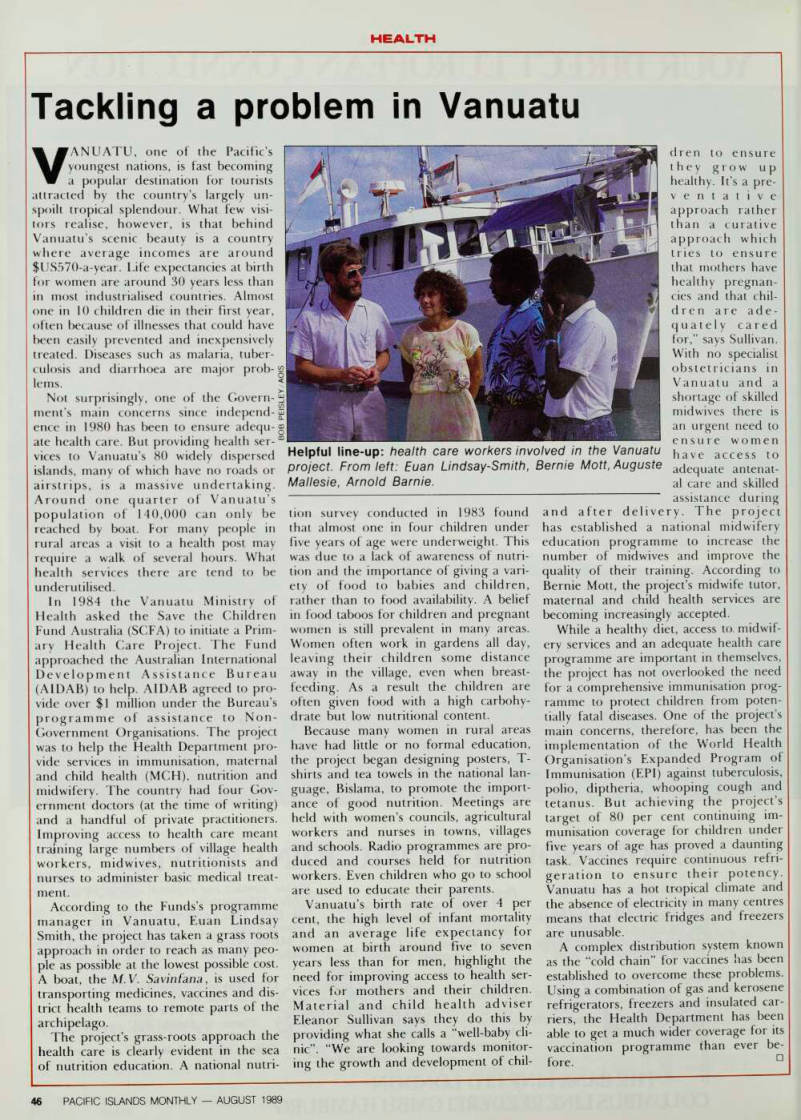
Health
VANUATU, one of the Pacific’s youngest nations, is fast becoming a popular destination for tourists attracted by the country’s largely un
spoilt tropical splendour. What few visi
tors realise, however, is that behind Vanuatu’s scenic beauty is a country where average incomes are around SUSS7O-a-year. Life expectancies at birth for women are around 30 years less than in most industrialised countries. Almost one in 10 children die in their first year, often because of illnesses that could have
been easily prevented and inexpensively
treated. Diseases such as malaria, tuber culosis and diarrhoea are major prob lems.
Not surprisingly, one of the Govern ment’s main concerns since independ ence in 1980 has been to ensure adequ ate health care. But providing health ser vices to Vanuatu’s 80 widely dispersed islands, many of which have no roads or airstrips, is a massive undertaking.
Around one quarter of Vanuatu’s population of 140,000 can only be reached by boat. For many people in rural areas a visit to a health post may require a walk of several hours. What health services there are tend to be underutilised.
In 1984 the Vanuatu Ministry of Health asked the Save the Children Fund Australia (SCFA) to initiate a Prim ary Health Care Project. The Fund approached the Australian International Development Assistance Bureau (AIDAB) to help. AIDAB agreed to pro vide over $1 million under the Bureau’s programme of assistance to Non-
Government Organisations. The project
was to help the Health Department pro vide services in immunisation, maternal and child health (MCH), nutrition and midwifery. The country had four Gov ernment doctors (at the time of writing) and a handful of private practitioners.
Improving access to health care meant
training large numbers of village health
workers, midwives, nutritionists and nurses to administer basic medical treat ment.
According to the Funds’s programme manager in Vanuatu, Euan Lindsay Smith, the project has taken a grass roots approach in order to reach as many peo ple as possible at the lowest possible cost.
A boat, the M.V. Savinfana, is used for transporting medicines, vaccines and dis trict health teams to remote parts of the
archipelago.
The project’s grass-roots approach the health care is clearly evident in the sea of nutrition education. A national nutri-
tion survey conducted in 1983 found that almost one in four children under five years of age were underweight. This was due to a lack of awareness of nutri tion and the importance of giving a vari ety of food to babies and children, rather than to food availability. A belief in food taboos for children and pregnant women is still prevalent in many areas.
Women often work in gardens all day, leaving their children some distance away in the village, even when breast feeding. As a result the children are often given food with a high carbohy drate but low nutritional content.
Because many women in rural areas have had little or no formal education,
the project began designing posters, T
shirts and tea towels in the national lan guage, Bislama, to promote the import ance of good nutrition. Meetings are held with women’s councils, agricultural workers and nurses in towns, villages and schools. Radio programmes are pro duced and courses held for nutrition workers. Even children who go to school are used to educate their parents.
Vanuatu’s birth rate of over 4 per cent, the high level of infant mortality and an average life expectancy for women at birth around five to seven years less than for men, highlight the need for improving access to health ser vices for mothers and their children.
Material and child health adviser Eleanor Sullivan says they do this by providing what she calls a “well-baby cli nic”. “We are looking towards monitor ing the growth and development of chil
dren to ensure they grow up healthy. It’s a pre venta t i v e approach rather than a curative
approach which
tries to ensure that mothers have
healthy pregnan
cies and that chil dren are ade
quately cared
for,” says Sullivan.
With no specialist obstetricians in Vanuatu and a shortage of skilled midwives there is an urgent need to ensure women have access to
adequate antenat
al care and skilled assistance during
and after delivery. The project has established a national midwifery education programme to increase the number of midwives and improve the quality of their training. According to Bernie Mott, the project’s midwife tutor, maternal and child health services are
becoming increasingly accepted.
While a healthy diet, access to. midwif ery services and an adequate health care programme are important in themselves, the project has not overlooked the need for a comprehensive immunisation prog ramme to protect children from poten tially fatal diseases. One of the project’s main concerns, therefore, has been the implementation of the World Health
Organisation’s Expanded Program of
Immunisation (EPI) against tuberculosis,
polio, diptheria, whooping cough and
tetanus. But achieving the project’s target of 80 per cent continuing im munisation coverage for children under five years of age has proved a daunting task. Vaccines require continuous refri geration to ensure their potency.
Vanuatu has a hot tropical climate and the absence of electricity in many centres means that electric fridges and freezers are unusable.
A complex distribution system known as the “cold chain” for vaccines has been established to overcome these problems.
Using a combination of gas and kerosene refrigerators, freezers and insulated car riers, the Health Department has been able to get a much wider coverage for its vaccination programme than ever be fore. D
Bob Peisley/ Aois
Helpful line-up: health care workers involved In the Vanuatu project. From left: Euan Lindsay-Smith, Bernie Mott, Auguste Mallesie, Arnold Barnie.
Diana Mcmanus
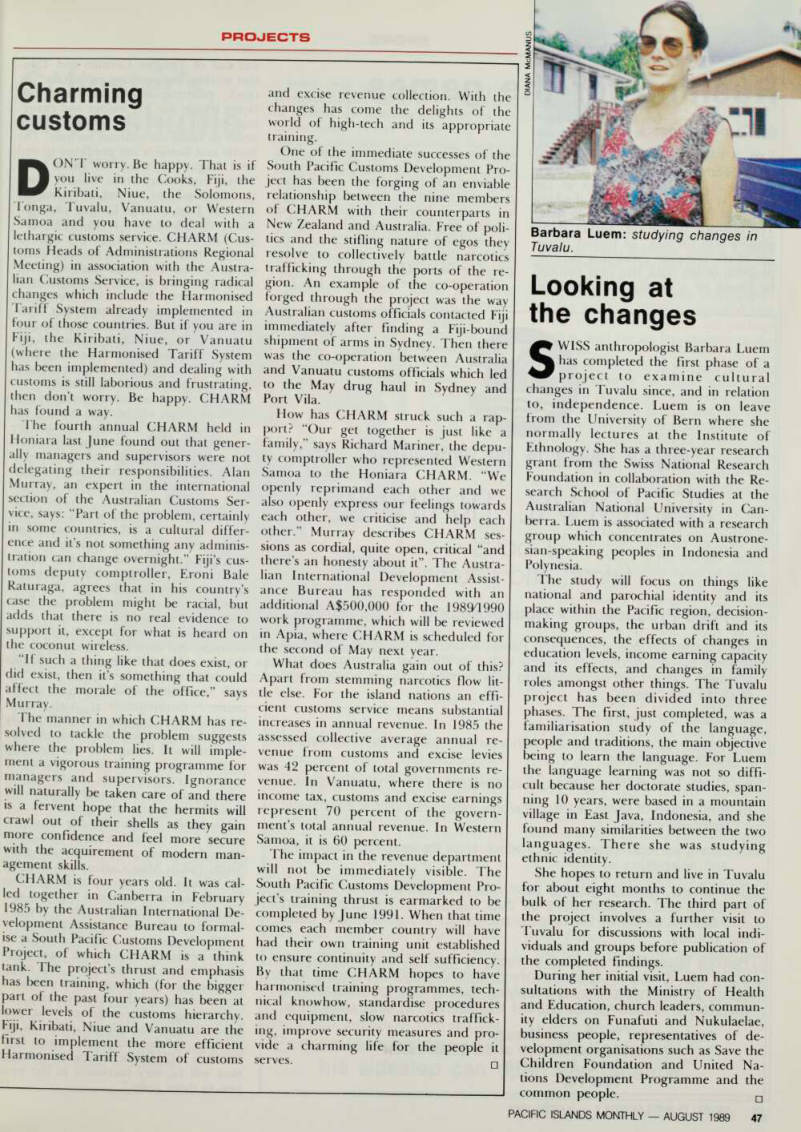
Projects
Charming customs
DON’T worry. Be happy. That is if you live in the Cooks, Fiji, the Kiribati, Niue, the Solomons, Tonga, Tuvalu, Vanuatu, or Western Samoa and you have to deal with a lethargic customs service. CHARM (Cus toms Heads of Administrations Regional Meeting) in association with the Austra lian Customs Service, is bringing radical changes which include the Harmonised Tariff System already implemented in four of those countries. But if you are in Fiji, the Kiribati, Niue, or Vanuatu (where the Harmonised Tariff System has been implemented) and dealing with customs is still laborious and frustrating, then don’t worry. Be happy. CHARM has found a way.
The fourth annual CHARM held in Honiara last June found out that gener ally managers and supervisors were not delegating their responsibilities. Alan Murray, an expert in the international section of the Australian Customs Ser vice, says: “Part of the problem, certainly in some countries, is a cultural differ ence and it’s not something any adminis tration can change overnight.” Fiji’s cus toms deputy comptroller, Eroni Bale Raturaga, agrees that in his country’s case the problem might be racial, but adds that there is no real evidence to support it, except for what is heard on the coconut wireless.
If such a thing like that does exist, or did exist, then it’s something that could affect the morale of the office,” says Murray.
The manner in which CHARM has re solved to tackle the problem suggests where the problem lies. It will imple ment a vigorous training programme for managers and supervisors. Ignorance will naturally be taken care of and there is a fervent hope that the hermits will crawl out of their shells as they gain more confidence and feel more secure with the acquirement of modern man agement skills.
CHARM is four years old. It was cal led together in Canberra in February 1985 by the Australian International De velopment Assistance Bureau to formal ise a South Pacific Customs Development Project, of which CHARM is a think tank. The project’s thrust and emphasis has been training, which (for the bigger part of the past four years) has been at lower levels of the customs hierarchy.
Fiji, Kiribati, Niue and Vanuatu are the first to implement the more efficient Harmonised Tariff System of customs
and excise revenue collection. With the changes has come the delights of the world of high-tech and its appropriate
training.
One of the immediate successes of the South Pacific Customs Development Pro ject has been the forging of an enviable relationship between the nine members of CHARM with their counterparts in New Zealand and Australia. Free of poli tics and the stifling nature of egos they resolve to collectively battle narcotics trafficking through the ports of the re gion. An example of the co-operation forged through the project was the way Australian customs officials contacted Fiji immediately after finding a Fiji-bound shipment of arms in Sydney. Then there was the co-operation between Australia and Vanuatu customs officials which led to the May drug haul in Sydney and Port Vila.
How has CHARM struck such a rap port? “Our get together is just like a family,” says Richard Mariner, the depu ty comptroller who represented Western Samoa to the Honiara CHARM. “We openly reprimand each other and we also openly express our feelings towards each other, we criticise and help each other.” Murray describes CHARM ses sions as cordial, quite open, critical “and there s an honesty about it”. The Austra lian International Development Assist ance Bureau has responded with an additional A 5500,000 for the 1989 a 990 work programme, which will be reviewed in Apia, where CHARM is scheduled for the second of May next year.
What does Australia gain out of this?
Apart from stemming narcotics flow lit tle else. For the island nations an effi cient customs service means substantial increases in annual revenue. In 1985 the assessed collective average annual re venue from customs and excise levies was 42 percent of total governments re venue. In Vanuatu, where there is no income tax, customs and excise earnings represent 70 percent of the govern ment’s total annual revenue. In Western Samoa, it is 60 percent. 1 he impact in the revenue department will not be immediately visible. The South Pacific Customs Development Pro ject’s training thrust is earmarked to be completed by June 1991. When that time comes each member country will have had their own training unit established to ensure continuity and self sufficiency.
By that time CHARM hopes to have harmonised training programmes, tech nical knowhow, standardise procedures and equipment, slow narcotics traffick
ing, improve security measures and pro
vide a charming life for the people it serves. Q
Diana Mcmanus
Barbara Luem: studying changes in Tuvalu.
Looking at
the changes
SWISS anthropologist Barbara Luem
has completed the first phase of a project to examine cultural changes in Tuvalu since, and in relation to, independence. Luem is on leave Irom the University of Bern where she normally lectures at the Institute of Ethnology. She has a three-year research grant from the Swiss National Research Foundation in collaboration with the Re search School of Pacific Studies at the Australian National University in Can berra. Luem is associated with a research group which concentrates on Austrone sian-speaking peoples in Indonesia and
Polynesia.
The study will focus on things like national and parochial identity and its place within the Pacific region, decision making groups, the urban drift and its consequences, the effects of changes in education levels, income earning capacity and its effects, and changes in family roles amongst other things. The Tuvalu project has been divided into three phases. The first, just completed, was a familiarisation study of the language, people and traditions, the main objective being to learn the language. For Luem the language learning was not so diffi cult because her doctorate studies, span ning 10 years, were based in a mountain village in East Java, Indonesia, and she found many similarities between the two languages. There she was studying
ethnic identity.
She hopes to return and live in Tuvalu for about eight months to continue the bulk of her research. The third part of the project involves a further visit to Tuvalu for discussions with local indi viduals and groups before publication of the completed findings.
During her initial visit, Luem had con sultations with the Ministry of Health and Education, church leaders, commun ity elders on Funafuti and Nukulaelae, business people, representatives of de velopment organisations such as Save the Children Foundation and United Na tions Development Programme and the common people. n
Rushing for the games
Sport
By Carrie Loranger
AS Tonga prepares to host the Mini South Pacific Games, one question keeps cropping up in the media, on sports fields, around the kava bowl: will the facilities be ready in time?
The question is one that makes Montgomery Ahi nervous. As project manager of the company overseeing the construction of the track and field stadium, he knows he is cutting it fine with his
deadline. The stadium at Teufaiva Park Ahi’s company is involved in is to be completed and handed over to the Ton gan government on August 19. By the last week of July the facilities did not look like they were going to be ready for the kingdom’s biggest show. “It’s a tight schedule, but by hook or by crook it’s got to be finished,” said Ahi.
The sight at the stadium in late July
was one of Tongan, German and Tahi tian workers transporting asphalt for the track, painting the grandstand, and laying tiles in the VIP lounge and chang ing rooms under the grandstand in order to finish the stadium on time. The hustle and bustle is not predicted to end until August 22, when the games start.
Three supervisors from Balsam Com pany in Germany arrived in the second week of July to help Tongan crews lay the track Three men from MCM com pany in Tahiti arrived a week early to oversee the tile work and painting in the lower rooms. The same rush was hap pening at the indoor gymnasium at ’Atele, where Ekho Lim, owner of Oceanic Industrial Enterprises, con tracted to build the facility, was pushing his 140 workers to work day and night.
Even with crews now working from 7.30 in the morning until 10 at night at Teufaiva, Ahi admits that finishing on time for the presentation ceremony and the mini games will be close. Several op tions were being considered to get the work at Teufaiva done on time. The contractors have applied to the Govern ment for permission to work on Sun days. “It depends on if the Tongan workers will do it or not,” Ahi said. With only three Sundays left, it may not make that much of a difference, he added.
Lim’s crew was already working on Sun days at ’Atele. Another option was to extend the working hours at Teufaiva and have crews work all night. The third possibility was to bring in workers from overseas to boost the workforce.
Construction began at Teufaiva in February this year, but Ahi said that was already too late. “Tongans are not like any other people I’ve worked with,” he said. “I would have liked to have started sooner.” Construction at ’Atele began last November but record rainfall early in the year delayed the work. All the furniture and fittings for the Teufaiva stadium are in the country. There was some worry that grass would not be strong enough. Ahi said some work could be done after the games.
Meanwhile Tongan athletes were pre paring for a medal haul. Out of Tonga’s ten gold medal prospects in the 1989 South Pacific Mini Games, only four of the athletes were trained in Tonga. The United States Information Agency sent two coaches to Tonga in July to prepare the athletes, boxers and weighllifters.
“The Tongans have a lot of potential, it just needs to be developed,” said coach Tom Virgets. But he warned that coun tries like New Caledonia and Tahiti have been training for the past two years, and will be tough. “The difference you’ll see has nothing to do with the abilities of the athletes, it’s the training,” Virgets said.
“If they will follow on (with training) they will be very successful in the next one to three years.” n
Advertisements & other items, p. 48 (1 item)
Regional Trainers
TOURISM COUNCIL OF THE SOUTH PACIFIC
3 posts
(Hotel and Catering)
• Food Production • Housekeeping • Reception The Tourism Council of the South Pacific is proposing to form a team of regional trainers to conduct training within its member countries. These specialist trainers will be required to work outside of Fiji on assignments of six to eight weeks.
Applicants will require to have: a) A good education, preferably with a formal qualification in the field of Hotel and Catering. b) A high level of literacy and oral competence in the English language. c) A minimum of seven years operational experience with at least two at supervisory level. d) Strong personal characteristics which allow for flexibility, adaptability and reliability.
Salaries are awarded against a basic rate while in Fiji plus an overseas allowance and per diem while on duty outside Fiji. The overall salary package will be within the range expected at management level within the industry.
Persons interested are invited to submit a copy of their C.V. (Typed), along with a letter of applicant (Hand written). Applicants should state clearly for which post they are applying. Closing date for applications is August 18th 1989. Applications will be dealt with in strict confidence.
Address to The Project Manager Tourism Council of the South Pacific G.P.O. Box 13119 Suva FIJI
Schuster’s
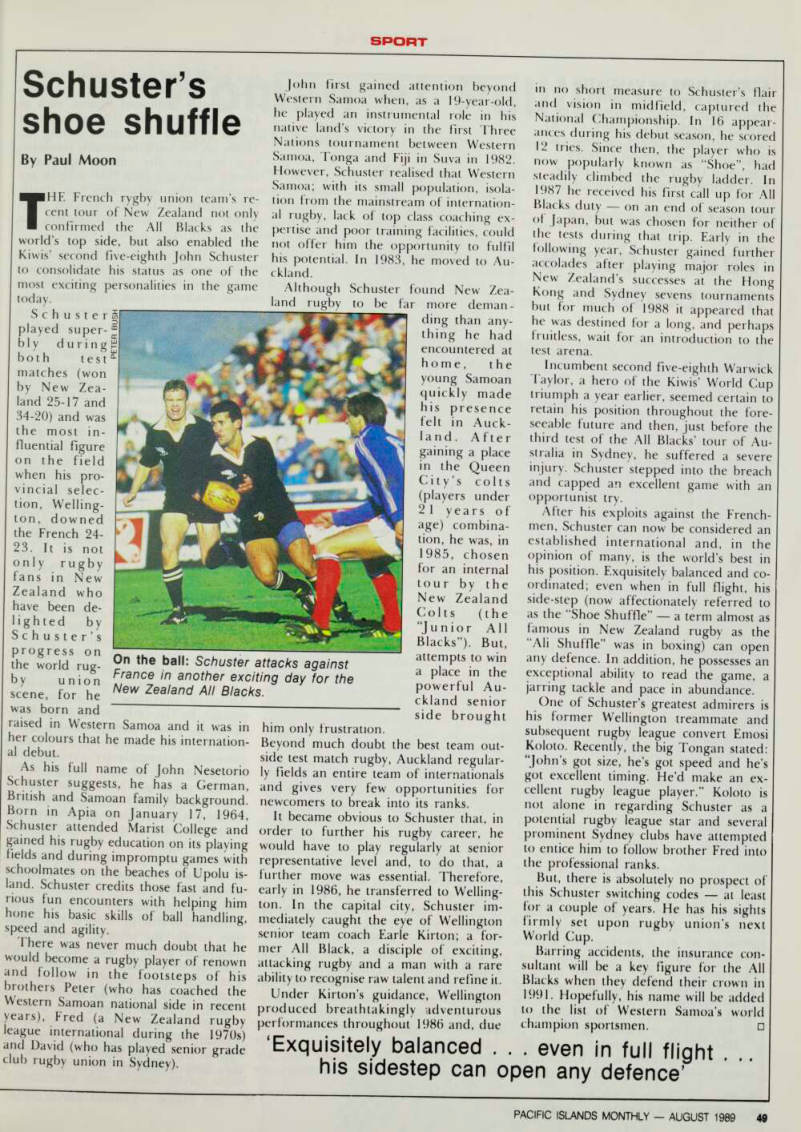
shoe shuffle
By Paul Moon
THE French rygby union team’s re cent tour of New Zealand not only confirmed the All Blacks as the world’s top side, but also enabled the Kiwis’ second five-eighth John Schuster to consolidate his status as one of the most exciting personalities in the game
today.
Schuster played super
bly during
both test matches (won by New Zea land 25-17 and 34-20) and was the most in
fluential figure
on the field when his pro vincial selec
tion, Welling
ton, downed the French 24- 23. It is not
only rugby
fans in New Zealand who have been de
lighted by
Schuster’s progress on the world rug
by union
scene, for he was born and
raised in Western Samoa and it was in her colours that he made his internation al debut.
As his full name of John Nesetorio Schuster suggests, he has a German, British and Samoan family background.
Born in Apia on January 17, 1964, Schuster attended Marist College and gained his rugby education on its playing fields and during impromptu games with schoolmates on the beaches of Upolu is land. Schuster credits those fast and fu rious fun encounters with helping him hone his basic skills of ball handling, speed and agility.
I here was never much doubt that he would become a rugby player of renown and follow in the footsteps of his brothers Peter (who has coached the Western Samoan national side in recent years), fred (a New Zealand rugby league international during the 19705) and David (who has played senior grade club rugby union in Sydney).
John first gained attention beyond Western Samoa when, as a 19-year-old, he played an instrumental role in his native land’s victory in the first Three Nations tournament between Western Samoa, Tonga and Fiji in Suva in 1982.
However, Schuster realised that Western Samoa; with its small population, isola tion from the mainstream of internation al rugby, lack of top class coaching ex pertise and poor training facilities, could not offer him the opportunity to fulfil his potential. In 1983, he moved to Au ckland.
Although Schuster found New Zea land rugby to be far more deman -
ding than any thing he had encountered at home, the young Samoan quickly made his presence felt in Auck land. A fter gaining a place in the Queen City’s colts (players under 21 years of age) combina tion, he was, in 1985, chosen for an internal tour by the New Zealand Colts (the “Junior All Blacks”). But, attempts to win a place in the powerful Au ckland senior side brought
him only frustration.
Beyond much doubt the best team out side test match rugby, Auckland regular ly fields an entire team of internationals and gives very few opportunities for newcomers to break into its ranks.
It became obvious to Schuster that, in order to further his rugby career, he would have to play regularly at senior representative level and, to do that, a further move was essential. Therefore, early in 1986, he transferred to Welling ton. In the capital city, Schuster im
mediately caught the eye of Wellington
senior team coach Earle Kirton; a for mer All Black, a disciple of exciting, attacking rugby and a man with a rare ability to recognise raw talent and refine it.
Under Kirton’s guidance, Wellington produced brealhtakingly adventurous performances throughout 1986 and, due
in no short measure to Schuster’s flair and vision in midfield, captured the National Championship. In 16 appear ances during his debut season, he scored 12 tries. Since then, the player who is now popularly known as “Shoe”, had steadily climbed the rugby ladder. In 1987 he received his first call up for All Blacks duty on an end of season tour of Japan, but was chosen for neither of the tests during that trip. Early in the following year, Schuster gained further accolades after playing major roles in New Zealand’s successes at the Hong Kong and Sydney sevens tournaments but for much of 1988 it appeared that he was destined for a long, and perhaps fruitless, wait for an introduction to the test arena.
Incumbent second five-eighth Warwick Taylor, a hero of the Kiwis’ World Cup triumph a year earlier, seemed certain to retain his position throughout the fore seeable future and then, just before the third test of the All Blacks’ tour of Au stralia in Sydney, he suffered a severe injury. Schuster stepped into the breach and capped an excellent game with an opportunist try.
After his exploits against the French men, Schuster can now be considered an established international and, in the opinion of many, is the world’s best in his position. Exquisitely balanced and co ordinated; even when in full flight, his side-step (now affectionately referred to as the “Shoe Shuffle” a term almost as famous in New Zealand rugby as the “Ali Shuffle” was in boxing) can open any defence. In addition, he possesses an exceptional ability to read the game, a jarring tackle and pace in abundance.
One of Schuster’s greatest admirers is his former Wellington treammate and
subsequent rugby league convert Emosi
Koloto. Recently, the big Tongan stated:
“John’s got size, he’s got speed and he’s got excellent liming. He’d make an ex
cellent rugby league player.” Koloto is
not alone in regarding Schuster as a potential rugby league star and several prominent Sydney clubs have attempted to entice him to follow brother Fred into the professional ranks.
But, there is absolutely no prospect of this Schuster switching codes at least for a couple of years. He has his sights firmly set upon rugby union’s next
World Cup,
Barring accidents, the insurance con sultant will be a key figure for the All Blacks when they defend their crown in 1991. Hopefully, his name will be added to the list of Western Samoa’s world champion sportsmen, □
‘Exquisitely balanced . . . even in full flight . his sidestep can open any defence’
On the ball: Schuster attacks against France in another exciting day for the New Zealand All Blacks.
Yasur, that’s
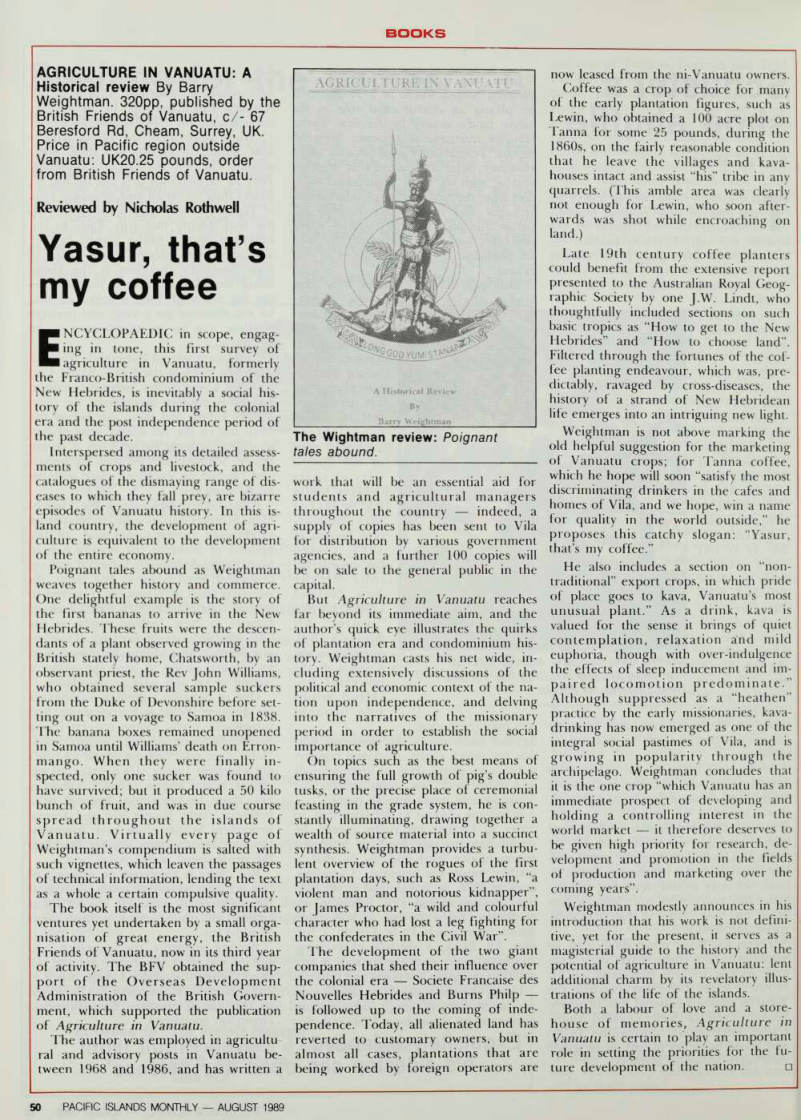
Books
Yasur, that’s my coffee
Agriculture In Vanuatu: A
Historical review By Barry Weightman. 320 pp, published by the British Friends of Vanuatu, cA 67 Beresford Rd, Cheam, Surrey, UK.
Price in Pacific region outside Vanuatu; UK20.25 pounds, order from British Friends of Vanuatu.
Reviewed by Nicholas Rothwell
Encyclopaedic in scope, engag ing in tone, this first survey of
agriculture in Vanuatu, formerly
the Franco-British condominium of the New Hebrides, is inevitably a social his tory of the islands during the colonial era and the post independence period of the past decade.
Interspersed among its detailed assess ments of crops and livestock, and the catalogues of the dismaying range of dis eases to which they fall prey, are bizarre episodes of Vanuatu history. In this is land country, the development of agri culture is equivalent to the development of the entire economy.
Poignant tales abound as Weightman weaves together history and commerce.
One delightful example is the story of the first bananas to arrive in the New Hebrides. These fruits were the descen dants of a plant observed growing in the British stately home, Chatsworth, by an observant priest, the Rev John Williams, who obtained several sample suckers from the Duke of Devonshire before set ting out on a voyage to Samoa in 1838.
The banana boxes remained unopened in Samoa until Williams’ death on Erron mango. When they were finally in spected, only one sucker was found to have survived; but it produced a 50 kilo bunch of fruit, and was in due course spread throughout the islands of Vanuatu. Virtually every page of Weightman’s compendium is salted with such vignettes, which leaven the passages of technical information, lending the text as a whole a certain compulsive quality.
The book itself is the most significant ventures yet undertaken by a small orga nisation of great energy, the British Friends of Vanuatu, now in its third year of activity. The BFV obtained the sup port of the Overseas Development Administration of the British Govern ment, which supported the publication of Agriculture in Vanuatu.
The author was employed in agricultu ral and advisory posts in Vanuatu be tween 1968 and 1986, and has written a
work that will be an essential aid for students and agricultural managers throughout the country indeed, a supply of copies has been sent to Vila for distribution by various government agencies, and a further 100 copies will be on sale to the general public in the
capital.
But Agriculture in Vanuatu reaches far beyond its immediate aim, and the author’s quick eye illustrates the quirks of plantation era and condominium his tory. Weightman casts his net wide, in cluding extensively discussions of the political and economic context of the na tion upon independence, and delving into the narratives of the missionary period in order to establish the social
importance of agriculture.
On topics such as the best means of ensuring the full growth of pig s double tusks, or the precise place of ceremonial feasting in the grade system, he is con
stantly illuminating, drawing together a
wealth of source material into a succinct
synthesis. Weightman provides a turbu
lent overview of the rogues of the first plantation days, such as Ross Lewin, “a violent man and notorious kidnapper”, or James Proctor, “a wild and colourful character who had lost a leg fighting for the confederates in the Civil War”.
The development of the two giant companies that shed their influence over the colonial era Societe Francaise des Nouvelles Hebrides and Burns Philp is followed up to the coming of inde pendence. Today, all alienated land has reverted to customary owners, but in almost all cases, plantations that are being worked by foreign operators are
now leased from the ni-Vanuatu owners.
Coffee was a crop of choice for many of the early plantation figures, such as Lewin, who obtained a 100 acre plot on Tanna for some 25 pounds, during the 1860 s, on the fairly reasonable condition that he leave the villages and kava houses intact and assist “his” tribe in any quarrels. (This amble area was clearly not enough for Lewin, who soon after wards was shot while encroaching on land.) Late 19th century coffee planters could benefit from the extensive report presented to the Australian Royal Geog raphic Society by one J.W. Lindt, who thoughtfully included sections on such basic tropics as “How to get to the New Hebrides” and “How to choose land”.
Filtered through the fortunes of the cof fee planting endeavour, which was, pre
dictably, ravaged by cross-diseases, the
history of a strand of New Hebridean life emerges into an intriguing new light.
Weightman is not above marking the
old helpful suggestion for the marketing
of Vanuatu crops; for Tanna coffee, which he hope will soon “satisfy the most discriminating drinkers in the cafes and homes of Vila, and we hope, win a name for quality in the world outside,” he proposes this catchy slogan: “Yasur, that’s my coffee.”
He also includes a section on “non traditional” export crops, in which pride of place goes to kava, Vanuatu’s most unusual plant.” As a drink, kava is valued for the sense it brings of quiet contemplation, relaxation and mild
euphoria, though with over-indulgence
the effects of sleep inducement and im
paired locomotion predominate.”
Although suppressed as a “heathen”
practice by the early missionaries, kava
drinking has now emerged as one of the integral social pastimes of Vila, and is
growing in popularity through the
archipelago. Weightman concludes that
it is the one crop “which Vanuatu has an immediate prospect of developing and holding a controlling interest in the world market it therefore deserves to be given high priority for research, de velopment and promotion in the fields of production and marketing over the
coming years”.
Weightman modestly announces in his introduction that his work is not defini tive, yet for the present, it serves as a magisterial guide to the history and the potential of agriculture in Vanuatu: lent additional charm by its revelatory illus trations of the life of the islands.
Both a labour of love and a store house of memories. Agriculture in Vanuatu is certain to play an important role in setting the priorities for the fu ture development of the nation. □
The Wightman review: Poignant tales abound.
Woman of Politics
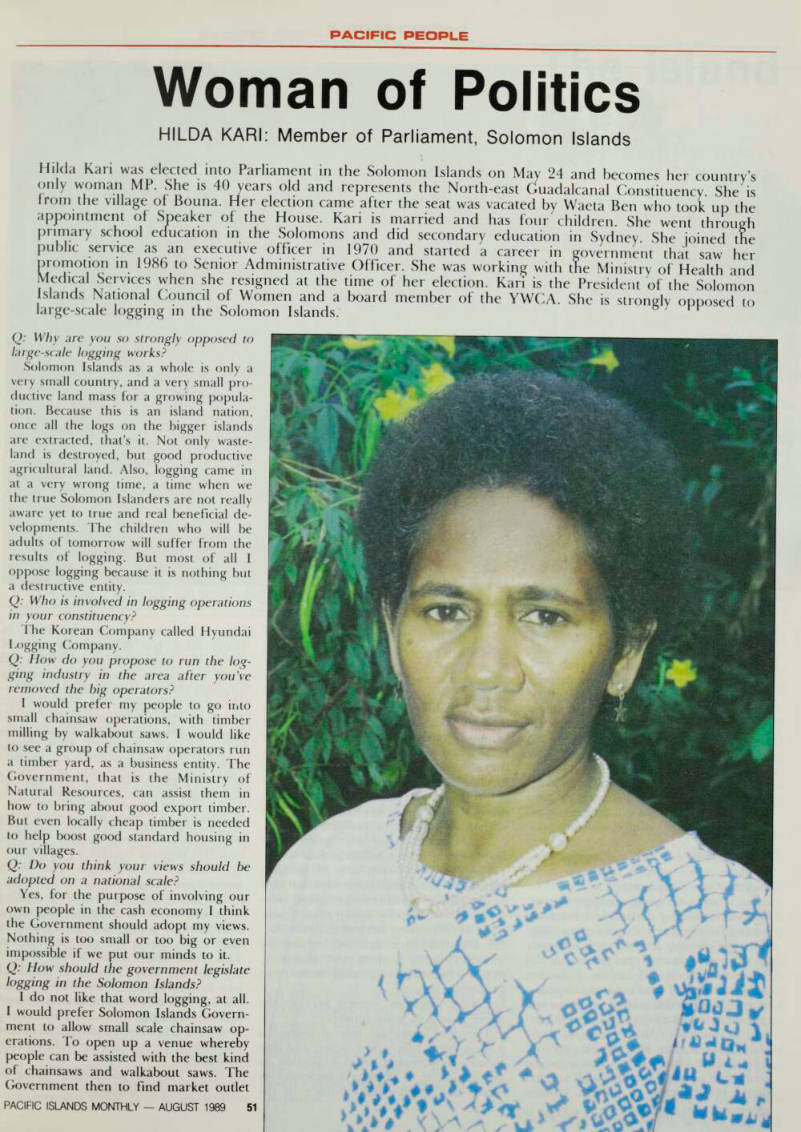
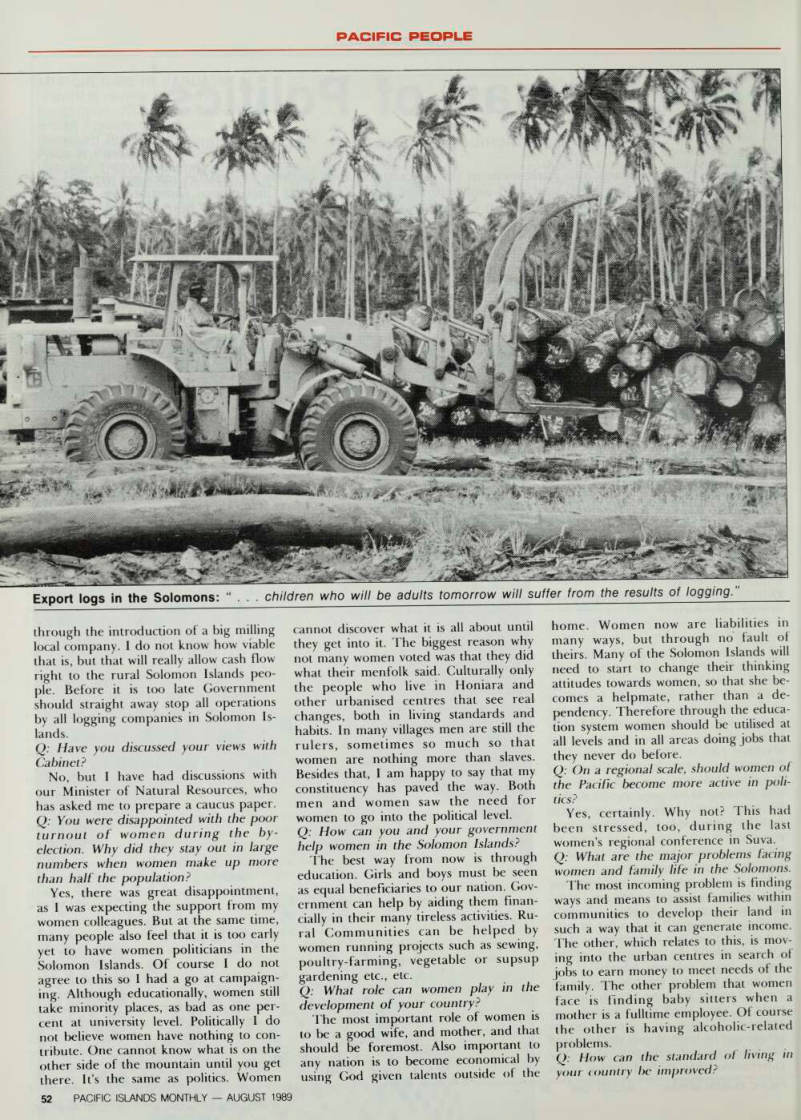
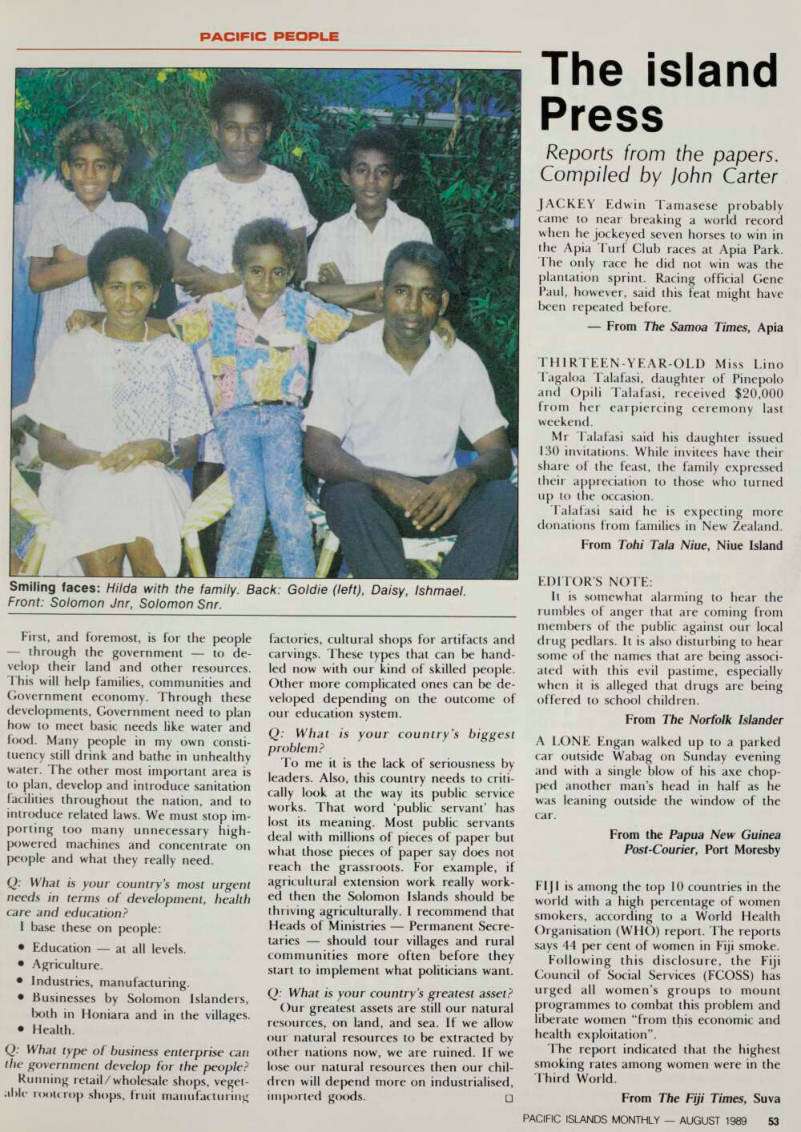
Pacific People
HILDA KARI: Member of Parliament, Solomon Islands Hilda Kari was elected into Parliament in the Solomon Islands on May 24 and becomes her country’s only woman MP. She is 40 years old and represents the North-east Guadalcanal Constituency She is from the village of Bouna. Her election came after the seat was vacated by Waeta Ben who took up the appointment of Speaker of the House. Kari is married and has four children. She went through primary school education in the Solomons and did secondary education in Sydney She joined the public service as an executive officer in 1970 and started a career in government that saw her promotion in 1986 to Senior Administrative Officer. She was working with the Ministry of Health and Serves when she resigned at the time of her election. Kari is the President of the Solomon Islands National Council of Women and a board member of the YWCA. She is strongly opposed to large-scale logging in the Solomon Islands.
Q: Why are you so strongly opposed to
large-scale logging works?
Solomon Islands as a whole is only a very small country, and a very small pro ductive land mass for a growing popula tion. Because this is an island nation, once all the logs on the bigger islands are extracted, that’s it. Not only waste
land is destroyed, but good productive
agricultural land. Also, logging came in at a very wrong time, a time when we the true Solomon Islanders are not really aware yet to true and real beneficial de velopments. The children who will be adults of tomorrow will suffer from the results of logging. But most of all I oppose logging because it is nothing but a destructive entity.
Q: Who is involved in logging operations in your constituency?
The Korean Company called Hyundai
Logging Company.
Q: How do you propose to run the log ging industry in the area after you’ve removed the big operators?
I would prefer my people to go into small chainsaw operations, with timber milling by walkabout saws. I would like to see a group of chainsaw operators run a timber yard, as a business entity. The Government, that is the Ministry of Natural Resources, can assist them in how to bring about good export timber.
But even locally cheap timber is needed to help boost good standard housing in
our villages.
Q: Do you think your views should be adopted on a national scale?
Yes, for the purpose of involving our own people in the cash economy I think the Government should adopt my views.
Nothing is too small or too big or even impossible if we put our minds to it.
Q: How should the government legislate logging in the Solomon Islands?
I do not like that word logging, at all.
I would prefer Solomon Islands Govern ment to allow small scale chainsaw op erations. To open up a venue whereby people can be assisted with the best kind of chainsaws and walkabout saws. The Government then to find market outlet
through the introduction of a big milling local company. I do not know how viable that is, but that will really allow cash flow right to the rural Solomon Islands peopie Before it is too late Government should straight away stop all operations by all logging companies in Solomon Islands Q Have you discussed your views with Cabinet?
No, but I have had discussions with our Minister of Natural Resources, who has asked me to prepare a caucus paper.
Q: You were disappointed with the poor Turnout of women during the byelection Why did they stay out in large
numbers when womL Jake up mofe
than half the population ?
Yes there Ls great disappointment, as Iwa expecfing g the support from my “menrauSues But at the same time,
Z peoK' Mthatkis too early
Tern TZ
not believe women have nothing to contribute. One cannot know what is on the other side of the mountain until you get there. It’s the same as politics. Women
cannot discover what it is all about until they get into it. The biggest reason why not many women voted was that they did what their menfolk said. Culturally only the people who live in Honiara and other urbanised centres that see real changes, both in living standards and habits. In many villages men are still the rulers, sometimes so much so that women are nothing more than slaves.
Besides that, 1 am happy to say that my constituency has paved the way. Both men and women saw the need for women to go into the political level.
Q: How can you and your government help women in the Solomon Islands?
The best way from now is through education. Girls and boys must be seen as equal beneficiaries to our nation. Government can help by aiding them finandally in their many tireless activities. Rural Communities can be helped by nomen in the women is to be a good wife, and mother, and that should be foremost. Also important to any nation is to become economical y using God given talents outside of the
home. Women now are liabilities m many ways, but thr^ theirs. Many of the Solomon Islands wi need to start to change their thin g attitudes towards women so that she be comes a helpmate rather-than a de pendency. Therefore through the ed tion system women should be utilised at all levels and in all areas doing jo s t at they never do before.
Q: On a regional scale, sh ou/d women o the Pacific become more active p ticsr
Yes, certainly. y •
been stressed, too during the last womens regional conference m Suva.
Q: What women and family life m the Solomons.
The most incoming problem is finding ways and means to assist families withm communities to develop their land m such a way that it can generate income.
rZ can family.
teo e g problems. KtAn A- Ar d of livimi in Q. ow ca . , P your coun ry [
Export logs in the Solomons: " ... children who will be adults tomorrow will sutler from the results of logging."
First, and foremost, is for the people through the government to develop their land and other resources.
This will help families, communities and Government economy. Through these developments, Government need to plan how to meet basic needs like water and r i w i ■ tood. Many people m my own constituency still drink and bathe in unhealthy T l • / water. Ihe other most important area is i,, • T to plan, develop and introduce sanitation r ‘-i-,- .. r , t . , facilities throughout the nation, and to i ia t nnriimr 3WS e mus sto P.lo nnwerpH unnecessary ig powered machines and concentrate on
people and what they really need.
7 7 Q: What is your country’s most urgent needs in terms of development, health care and education? 1 base these on people: • r . n i i • Education at all levels. . . gnculture. • Industries, manufacturing. • Businesses by Solomon Islanders, ij , ■ n both in Honiara and m the villages. • Health Q: What type of business enterprise can the government develop for the people?
Running retail/wholesale shops, vegel-
able roolcrop shops, fruit manufacturing
factories, cultural shops for artifacts and carvings. These types that can be hand led now with our kind of skilled people.
Other more complicated ones can be de veloped depending on the outcome of our education system. n. u/u * ■ . > .
Q: What is your country s biggest problem? 7 7 66 P ,, r , lo me it is the lack of seriousness by . ■ A , „ ■■ leaders. Also, this country needs to cnti • 7 , cally look at the way its public service . ** -pi . . / , v v , works. I hat word public servant has st its meaning. Most public servants deal w i t h millions of pieces of paper but ■ . f r Gi «hat those p.eces of paper say does not reach the grassroots. For example, if agricultural extension work really work ec* then the Solomon Islands should be thriving agriculturally. I recommend that Heads of Ministries Permanent Secre taries should tour villages and rural -■ f f , communities more often before they start tQ i m pl emen t w hat politicians want.
What ,s >' our greatest asset?
Our greatest assets are still our natural 5 , , , If n resources, on land, and sea. If we allow our natural resources to be extracted by other nations now, we are ruined. If we lose our natural resources then our chil dren will depend more on industrialised, imported goods. □
Smiling faces: Hilda with the family. Back: Goldie (left), Daisy, Ishmael.
Front: Solomon Jnr, Solomon Snr.
Press
The island Press Reports from the papers.
Compiled by John Carter
JACKEY Edwin Tamasese probably came to near breaking a world record when he jockeyed seven horses to win in the Apia Turf Club races at Apia Park. 1 he only race he did not win was the
plantation sprint. Racing official Gene
Paul, however, said this feat might have been repeated before.
From The Samoa Times, Apia
Thirteen-Year-Old Miss Lino
1 agaloa Talafasi, daughter of Pinepolo
and Opili Talafasi, received $20,000 from her earpiercing ceremony last weekend.
Mr Talafasi said his daughter issued 130 invitations. While invitees have their share of the feast, the family expressed their appreciation to those who turned up to the occasion.
Talafasi said he is expecting more donations from families in New Zealand.
From Tohi Tala Niue, Niue Island
Editor’S Note:
It is somewhat alarming to hear the rumbles of anger that are coming from members of the public against our local drug pedlars. It is also disturbing to hear some of the names that are being associ ated with this evil pastime, especially when it is alleged that drugs are being offered to school children.
From The Norfolk Islander A LONE Engan walked up to a parked
car outside Wabag on Sunday evening
and with a single blow of his axe chop ped another man’s head in half as he was leaning outside the window of the car.
From the Papua New Guinea Post-Courier, Port Moresby FIJI is among the top 10 countries in the world with a high percentage of women smokers, according to a World Health Organisation (WHO) report. The reports says 44 per cent of women in Fiji smoke.
Following this disclosure, the Fiji Council of Social Services (FCOSS) has urged all women’s groups to mount programmes to combat this problem and liberate women “from this economic and
health exploitation”.
The report indicated that the highest smoking rates among women were in the Third World.
From The Fiji Times, Suva
Taming of the islands
Out To The Past
THE early missionaries of the London Missionary Society are remembered in the Pacific for their role in the taming of the islands. Little , however , has been told of the Pacific Islanders , who having been converted themselves , wished to convert others. Here is their story , from the pages of Pacific Islands Monthly , July 1958.
WITHOUT the pioneering work
of such men as James Chal mers, C.W. Abel, James Gil mour, John Kemp-Welch, W.G. Lawes and others equally well known, the diffi culties of pacifying the Papuan natives would have been far more difficult than it was.
Through these pioneers of Christian religion and education, magistrates, pat rol officers, miners, traders and others were able to take advantage of the spade work already done. Following these stal warts were the Revs B.T. Butcher, E.
Pryce-Jones, Gabel Beharrel (who later went to Niue), W.N. Lawrence, C.F. Rich and E. Baxter Riley. However, none, or few, of their achievements could have been realised without the help of the Pacific Islanders, who having been con verted themselves, wished to convert others.
The first missionaries had reached Tahiti in the year 1797, so that by 1870, some of the converts were willing to help in civilising the untouched Papuans.
When the suggestion was made known to the Niue natives they greeted the news with great joy and the volunteers were far in excess of the numbers re
quired.
As however, the natives of the Loyalty Islands (of the New Caledonian group) had been asked first, it was from Lifu that the first eight native missionaries went to New Guinea. When the first meeting was called on that island practi cally very able bodied man and woman volunteered. The eight chosen left for their new work, and as soon as the news reached the native preachers of such places as Samoa, Rarotonga and Niue, they all offered their services. The Niueans were so anxious to be in the forefront of this movement that they had a ketch built, called it the Niue and presented it to the Society. This boat was still doing good service in Papua in 1914.
The great difficulty of doing a job of mission work in New Guinea was the lack of suitable land on to which to establish stations. The mainland was un healthy, and the natives wild and hostile to all aliens, irrespective of colour.
The Lifueans sailed from their home on April 30, 1871, in charge of two veteran European Missionaries, the Rev S. MacFarlane and the Rev. Murray.
Their vessel was the Surprise, and after a most strenuous voyage, she reached Darnley Island in the Torres Strait on July 1. Darnley Island is almost due south of Goaribari Island, Papua, and distant hardly more than 100 sea miles, but although the progress of the mis sionary work was good beyond all ex pectations, Goaribari Island was still heathen, 30 years later, in 1901.
It was decided to make Darnley Island the first settlement and eight teachers with their wives and children were land ed on the beach to start their task. The workers radiated from the new head quarters and worked on the nearby is lands of Dauan and Baibai, all arrange ments being concluded in a most satis factory manner. But they were still not established on any island or part of New Guinea, and both McFarlane and Mur ray were anxious to extend their sphere of operations. The services of evangelists from Samoa, Rarotonga and Niue were enlisted and the success attained by these
Polynesians was really outstanding.
These Polynesians were left entirely on their own, but practically civilised the whole of the coast of Papua from the Dutch boundary to East Cape. They suf fered many casualties, their actual losses in the early stages of their pioneering work being 122. Some died of malaria, some from dystentry; others were drowned, poisoned by the arrows of un friendly tribes; killed by the same natives with stone clubs. Others die from natural causes, but nothing held them back.
By 1894, 23 years after the first land ing, there were still only seven European LMS missionaries in the Papuan field, whilst there were 106 native ordained missionaries, 35 native preachers, 1150 church members, 27 Sunday schools, 105 day schools, with 6860 scholars. The acceptance of Christianity by the Sa moans and other Pacific Islands peoples, enabled the Mission to extend its pacify ing influence in a most successful man ner without the necessity of calling on too many Europeans.
James Chalmers’ became a legendary figure in Papua. His attitude towards all natives was one of exceeding kindness and understanding. The success which attended all his efforts was remarkable, but he was over-venturesome, and this in the end proved his undoing. He refused
to believe that he could not go on to the island of Goaribari without meeting any thing but kindness from the natives, but he and his companion, a new-chum named Tomkins, were clubbed to death
at Dopima.
Robin, the native skipper of the Niue, had pleaded with Chalmers to wait a few days before venturing on to the Island, beause the Goaribarians were making very “big feast” and would not tolerate any stranger in their midst at that time.
Chalmers took no heed but as soon as he and Tomkins were cleared of the Niue, Robin took what was left of his crew and heaved up the anchor, so that, if Tamate sensed danger and turned back, with the sails ready, they could sail out to sea without delay.
With the anchor almost on deck, Robin watched the progress of the two men, and saw that, as soon as Tomkins landed, he was clubbed and that Tamate being so close behind him, was unable to retreat and suffered the same fate. This put much fear into the skipper, and not having anything with which to beat off any marauders, he had the sails unfurled and with a good South-east wind, he managed to get well away before the dug-out canoes could get anywhere near him. He sailed into Daru and made his report to the Government Official who was there at the time.
There was much violent discussion ab out this awful crime, and then officers of the Territorial Government, raw and not
understanding the native psychology
made a mess of their efforts to bring the culprits to Moresby; or to bring about a proper understanding of the crime by the natives of the island.
Other outstanding early missionaries
included the Rev C.F. Rich, of Fife Bay, who with Mrs Rich, did splendid work in the area from Samarai to the west of his station; and "the Rev C.W. Abel of Kwa to, where the men were taught boat building, carpentry work and all trades which fitted them for the average job to be done in NG.
Most of the other white missionaries were to a certain extent successful, but could not be called outstanding. Some of them were quite satisfied to carry on where their former incumbent had left off; whilst others just did the routine job and called it a day. □
Advertisements & other items, pp. 55-56 (1 item)
anyhow
have a
Winfield
merest
s Mo*' nG
RNING
WV2 CC494/80
GOOD LOOKS RUN IN THE FAMILY
o 2 5 ,U!J World’s No. 1 Family of Multi-valve Automobiles Toyota introduces the all-new Corona. A sweeping beauty that slips through the wind with its powerful 2.0-litre 16-valve engine. Aerodynamic. Luxuriously appointed. And Corolla. The car of preference for more drivers in the world than any other. With sleek, spirited looks and a new 1.6-litre 16-valve engine. Two outstanding members of Toyota’s multi-valve family. With over 5 million multi-valves pro- I / duced and driven daily on roads throughout the world.
MULTI-VALVE
ENGINE
TOYOTA