Pacific
Islands
Month
American Samoa US$2.50 Australia A$2.50 Cook Islands NZ$3.00 Fiji F$1.75 FS. of Micronesia US$3.00 Guam US$3.00 Hawaii US$3.00 Kiribati A$2.50 Nauru A$2.50 New Caledonia CFP250 New Zealand (incl GST) $NZ3.45 Niue NZ$3.00 Norfolk Island A$3.00 Nth Marianas US$3.00 Papua New Guinea K$3.00 Rep. of Marshall US$3.00 Solomon Islands A$3.00 Tahiti CFP$300 Tonga P3.00
Usa Us$3.00
Vanuatu VT200- Western Samoa T2.75 ‘Recommended retail price only
July 1989
Slaughter on the high seas Islands unite against Asian driftnetters
Advertisements & other items, pp. 2-4 (1 item)
Leave the humdrum behind.
Own a Mazda 626, and
you own the road.
Boredom’s a strong emotion.
And at Mazda, we think there’s no good reason why any driver should have to suffer it.
That’s why we created the Mazda 626. A car offering equal measures of uncommon good looks. Unrestrained performance. And a remarkable degree of precision handling.
This last, especially, has earned the 626 much praise throughout Europe. Enthusiasts speak of the 626’s grip on all kinds of surfaces. Its assured cornering and straight-line stability. Its regard for everything, in fact, that pays off in enhanced driver feel.
Driver feel has long been a
Driority at Mazda. We’ve gone so far is to construct a Global Road Circuit in which every conceivable oad condition, from ice to Belgian cobblestone to city pothole, is luplicated. Sensors gauge our cars’ )erformance over these surfaces, as veil as through the many twists and urns we’ve designed to simulate European roadways.
The results include innovative and acclaimed suspension systems.
As well as the world’s first speedsensing, 4-wheel steering system.
Regrettably, some people will remain unaware of their options and, by choosing an ordinary car, suffer the consequences.
You needn’t be one of them.
Instead you can choose a Mazda.
Model and features shown may not be available in your area. Please consult your local Mazda dealer..
mazoa
© Mazda Motor Corporation
Fuels and lubricants.
Plastics. Chemicals. Bitumen.
Aviation Services. Bunkering.
Shell has penetrated even more of the Pacific to widen its network of offices, terminals and REGIONAL OFFICES: GUAM 671 477 4330. Also servicing Marshall Islands (Majuro), Northern Marianas (Saipan), Palau.
Fill 679.313933. Also servicing Tonga, Cook Islands, American Samoa. Western Samoa • PAPLA NEW' GUINEA 6’3 228 700. Also servicing Solomon Islands NEW CALEDONIA 687 283 720. Also servicing Tahiti, Vanuatu.
Network Shell,
now servicing
even more
of the Pacific.
distributors as well as service stations.
Now you can re-assess your source of supply, because Shell quality and value is close at hand, with the service to back it up.
Pacific
Islands
Monthly
Vol. 59 No. 18
Voice Of The Pacific
July, ’B9
Cover
The use of driftnets by Japanese and Taiwanese fishermen in the southern Pacific is threatening the fishing industries in the region.
The issue has become the biggest crisis facing the Pacific Islanas in recent times, and has clearly over shadowed French nuclear testing in French Polynesia. The South Paci fic Forum meeting in Tarawa this month will discuss ways of uniting member countries in the war against driftnet fishing. Page 8
The Region
Niue There’s a joke in Niue that by the turn of the century nobody will be living on the island. Why? A highly aid-dependent economy is forcing people to seek work in New Zealand. Page 11.
Fiji The interim government calls an eco nomic summit where the workers ask for more pay. Page 16 Papua New Guinea The trouble at Bougainville continues to flame and is causing the economy to overheat. Page 17 New Caledonia Results of June’s provincial elections show a strengthening of support for the Matignon Accord from both camps.
Page 24 French Polynesia The struggle for independence con tinues. Oscar Temaru gets credit for consistency. Page 21 Sport Michael Jones continues to be Western Samoa’s most exciting New Zealand All Black. Page 47. Competitors in the Mini South Pacific Games in Tonga next month face drug tests. Page 48
Business
Editor Jale Moala Editorial Adviser John Carter Business Manager Charlotte Thomas (Subscriptions/Inquiries) Contributors David Robie Ed Rampell Frank Senge Karen Mangnall Liz Thompson Paul Moon Richard Dinnen Robin Bromby Tony Doris
Publisher Geoffrey Hussey
Advertising Sales Sydney & Melbourne Fergus Maclagan (02) 412 3918; Brisbane Robert Walker (07) 371 0533 Adelaide Hastwell Williamson Representations (08) 79 9522
Our editorial office is now located at 20 Gordon Street, Suva. All editorial material and correspondence should be sent there and not to our old Syd ney address.
Cover prices are recommended retail only Registered by Australia Post, publication No NBP1210 Copyright Fiji Times Limited, Suva, Fiji
Finance Western Samoa has attracted cus tomers to its newly established finance centre and tax haven. Page 37
Shipping Aluminium boats have made Fiji’s Max Lane a mil lion-dollar man.
Even the Austra lians are buying from him. Page 40
Advertisements & other items, pp. 5-6 (3 items)
Departments
OPINION 7
FOCUS 27
ISLAND PRESS 49
BOOKS 50
PACIFIC PEOPLE 51
OUT OF THE PAST 54
5
PACIFIC ISLANDS MONTHLY JULY 1989
A Fiji Times Limited Production.
Founded 1930 (USPS 952480) 20 Gordon Street, Suva, Fiji; Telex: FJ2124; Telephone; (679) 314111; Fax: (679) 302011.
Pacific Islands Monthly (APPS No. NBP 1210) is published month ly by Fiji Times Limited, a division of Nationwide News, 2 Holt St, Sur ry Hills, NSW 2010. Second class postage paid at Honolulu, Hawaii, POSTMASTER. Send address changes to PACIFIC ISLANDS MONTHLY, PO Box 22250, Honolu lu, Hawaii 96822. Typeset and printed by Fiji Times Limited, 20 Gordon Street, Suva, Fiji.
Good Looks Run In The Family
World's No. 1 Family of Multi-valve Automobiles Toyota introduces the all-new Corona. A sweeping beauty that slips through the wind with its powerful 2.0-litre 16-valve engine. Aerodynamic. Luxuriously appointed. And Corolla. The car of preference for more drivers in the world than any other. With sleek, spirited looks and a new 1.6-litre 16-valve engine. Two outstanding members of Toyota’s multi-valve family. With over 5 million multi-valves produced and driven daily on roads throughout the world.
TOYOTA
MULTI-VALVE
ENGINE
TOYOTA
Standing alone
Opinion
THE REGION is again awash with worries. The assassination of Malipu Balakau in Papua New Guinea and the Bougainville crisis are drawing the country deeper into trouble. Fiji is still striving to find a new constitution. The French are continuing nuclear testing in French Polynesia. The tiny atolls are facing being swamped by rising seas. And a drug haul points to a new heroin route through Vanuatu. But none of these is grabbing as much attention as the attempt to stop the use of driftnets in the rich South Pacific albacore fisheries.
The war against the “wall of death”, as driftnets are now commonly known, is uniting the Pacific Island states like never before. Their fear is genuine; a collapse of fisheries in the south will deprive their canneries of stock and deny struggling economies much-needed foreign revenue.
But as they unite against Japan and Taiwan they also expose the weak ness of the small states to stand alone at a time of over-dependence on foreign economic aid. Japan and Taiwan are big aid donors to the region. Japan, in particular, has acquired a powerful influence. What they failed to conquer in World War Two they now buy with aid. This is why the struggle to remove Asian driftnetters from the South Pacific will be difficult.
It can be argued that Japan and Taiwan are using economic aid as leverage in their stand against a ban on driftnets. But it would be wrong to condemn individual island nations, some of which are among the poorest in the world, when they accept development aid funds from Taiwan and Japan. Albacore tuna is one thing. Financing development in countries where money is scarce, is another.
The Asians view the “wall of death” saga as an overreaction based on no concrete evidence from an indepth study of the southern fisheries.
They want such a study made, the result of which can form the framework on an agreement on driftnets. This is one of the things that will be considered at the South Pacific Forum meeting in Tarawa this month. The politicians in that meeting might draw up an agreement for a regional ban on driftnetters from the region’s Economic Zones. There is little else they can do. Most in the Forum meeting know their coun tries have other worries. Back home they will be looking for money to fund essential development projects. When the time comes to find that money, it is most likely Japan and Taiwan will be the ones signing the
cheques.
New Editor for PIM
FIJIAN journalist Jale Moala has been appointed the new Editor of Pacific Islands Monthly. The appoint ment completes the transfer of the magazine from Sydney to Suva. Moala, 35, worked for the daily news paper Fiji Sun for 11 years. He was the Associate Editor when he left in August 1987 to be Editor of a group of trade and tourism newspapers and magazines in Suva. He was senior writer for the regional maga zine Islands Business before joining Pacific Islands
Monthly.
Pacific Islands Monthly’s new editorial and produc tion address is: 20 Gordon Street Suva, GPO Box 1167. Telephone (069) 314111, Telex: FJ 2124, Facsi mile (679) 302011. All enquiries and subscriptions are to be addressed to Charlotte Thomas. □
Moala: Editor
Advertisements & other items, p. 7 (1 item)
Pacific
LAN D S
I M o N T H L ~Y~\ FIJI: Distribution, subscriptions and advertising: Fiji Times Limited, GPO Box 1167, Suva, Fiji Phone 31-4111 telex FJ2124 FRENCH POLYNESIA: Distribution: Hachette Pacifique 10 Ave Bruat, Papeete Phone 25-610 HAWAII: UNITED STATES: Distribution: PIM Hawaii, PO Box 22250, Honolulu, Hawaii. 96822. Advertising* Brian C Asqill, Apt 1308, 1676 Ala Moana Blvd Honolulu Hawaii, 96815. Phone (808) 955-9718.
JAPAN; Advertising and subscriptions: Universal Media Corporation, GPO Box 46, Tokyo Phone 666-3036 cable UNIMEDIA Tokyo, telex 2524665 MALAYSIA: Advertising and subscriptions: Worldwide Media Services, 57-B Komplex Damai, Jin Dato Haji Eusoft, Kuala Lumpur Phone 63-9340, cables WORLDMEDIA Kuala Lumpur, telex 31533 VANUATU; Distribution: The Vanuatu Stationery and Book Centre, PO Box 557 Port Vila Advertising: Norman Bros Bookshop Port Vila Phone 2232.
NEW CALEDONIA: Distribution: Depot Centre de Presse Michel Pentecost CBP2, Noumea Phone 27- 2434, 27-4729 NEW ZEALAND: Distribution: Gordon & Gotch, PO Box 584 , 2 Carr Road, Mt Roskill, Auckland 4 Advertising: McKay International Media Reps Ltd, C/- Albany PO, Auckland 10, New Zealand Phone 413-9119 Telex NZ22701, FAX 413-911 C WELLINGTON: Ross Quaid Media, 1 Scholes Lane Petone (04) 68-7593, PO Box 38699, Petone PAPUA NEW GUINEA: Distributicn: Gordon & Gotch, PO Box 3395, Port Moresby Phone 25-4551 25-4855 Advertising: Robert Walker, PO Box 600 Indooroopilly Old Australia 4068 Phone (07) 371-0533 SOLOMON ISLANDS: Distribution and Advertising: The Bookshop, (Norman Bros ) PO Box 503, Honiara PHILIPPINES: Advertising: The GF Group, 12 San Ignacio St., Uroaneta Village, Makati, Metro Manila. Phone 817-7299. telex 45950 and 4233 UNITED KINGDOM: F A Smyth and Associates, 23A Aylmer Parade, London N2OPO, England. Phone (01)340 5088, fax (01)341 9602 UNITED STATES MAINLAND: Advertising: Joshua B Powers Jr., Powers International Inc , Suite 708 , 271 Madison Ave , New York, NY 10016 Phone 867-9580, Subscriptions PIM, Hawaii, PO Box 22250, Honolulu Hawaii. 96822
SUBSCRIPTIONS
American Samoa US$45 Australia AUSS24 Canada US$45 Cook Islands AUSS46
F 'Ji F $24
French Polynesia US$45 Guam US$45 Hawaii US$45 Japan US$3B Kiribati AUSS46 Micronesia US$35 Nauru AUSS42 New Caledonia US$32 New Zealand AUSS42 Niue AUSS46 Norfolk Island AUSS42 Northern Marianas US$36 Papua New Guinea AUSS42 Solomon Islands AUSS46 Tonga AUSS46 Tuvalu AUSS46 United Kingdom Stg£2B US (Mainland) US$45 Vanuatu AUSS42 Western Samoa AUSS6O Elsewhere AUSS63 Payments to Pacific Islands Monthly: Subscriptions Dept GPO Box 1167, Suva, Fiji.
Subscriptions rates includes the cost of airspeeding to all destinations set out above. Direct airmail rates on application
Earthrust

Cover
Trying to stop the slaughter
The Pacific Islands are uniting like never before to eliminate the use of the destructive driftnets from the southern albacore fisheries. The issue will feature in discussions at the Forum meeting in Tarawa this month.
IMAGINE if the Pacific fishing fleets of Taiwan and Japan dropped their driftnets end-to-end in one night from west to east. They would stretch
from Sydney past Papeete, providing a
15-metre deep curtain that would hook fish, whales, turtles, ships’ propellers, and even birds. Such is the frightening ability of the driftnets to “strip-mine” the sea and empty it of its stock,hook line and sinker. This is why the nations of the Pacific are uniting like never before against its use in the rich southern alba core fishery and the Tasman Sea.
Now commonly known as the “wall of death”, driftnets or gillnets are made of fine mono-multifilament nylon mesh de ployed in straight lines to hang in the water like large curtains. They can be eight to 15 metres deep and are up to 60 kilometres long. Small floats keep them perpendicular to the surface and lead
weights keep the bottom edge hanging
straight down in the water.
Marine environmentalists say this is the most damaging method of fishing and causes irreversible ecological dam age. “It’s like dropping a bomb in the ocean, killing everything within reach and people come in, take what they want and throw the rest back into the sea,” said research biologist Samuel Laßudde, of the international environmental orga nisation Earthtrust. “Few people can im agine how damaging this technology is to
the resources of the sea. It’s like strip mining the ocean.
The issue, now so sensitive it has over shadowed French nuclear testing in French Polynesia, will be the focus of the South Pacific Forum meeting in Tarawa this month. Consensus will be sought for a regional treaty backed by all member countries banning the use of driftnets in their economic zones and putting a black ban on all driftnet vessels needing har bour facilities for transhipment, refuell ing and other services. Regional canner ies will also be asked to stop buying alba core tuna from driftnet vessels.
The islands are getting the full back ing of New Zealand and Australia. Both have imposed territorial restrictions in cluding the banning of driftnets from economic zones, the denial of access to foreign driftnet vessels and a ban on transhipment. New Zealand warned that ships could be confiscated if they carried driftnets in New Zealand waters. And the Auckland Harbour Board has voted unanimously to ban driftnet vessels.
In Nairobi on May 29 New Zealand environmental expert John Gilbert told a United Nations environmental panel that driftnet fishing is fast depleting Pacific Islands marine resources and threaten ing the diversity of life in the sea. “With its large by-catch of unwanted fish marine mammals and birds, drift gill netting is devastating marine resources,”
he said. He called for it to be outlawed, and immediately won the support of Au stralia and the international environmen tal organisation, Greenpeace. A month later Taiwan succumbed to an American ultimatum and agreed to sign a North Pacific driftnet agreement with the Un ited States. The agreement, among other things, will allow for “high seas board ing” of Taiwanese driftnet vessels and
requires satellite transponders placed on
all Taiwanese ships so the US can keep track of fishing vessels.
While the United States was able to flex its muscles and force Taiwan to an agreement, the tiny, aid-dependent Paci fic Island nations are finding the battle tougher without the same political and economic advantages. A conference in Suva on June 26-28 between Pacific Is land countries, Taiwan, South Korea and Japan magnified the weakness of the small states to stand alone. South Korea agreed in that meeting to withdraw us driftnet research vessel from the South Pacific. But Taiwan and Japan bluntly refused to compromise and forced an
impasse in the negotiation.
Both these Asian economic powers en joy a lot of influence in the region.
Japan, for example has become one of the bigger aid donors to the Pacific Is lands, providing financial assistance for a
variety of project with particular atten
tion to the development of the fishing
Earthrust
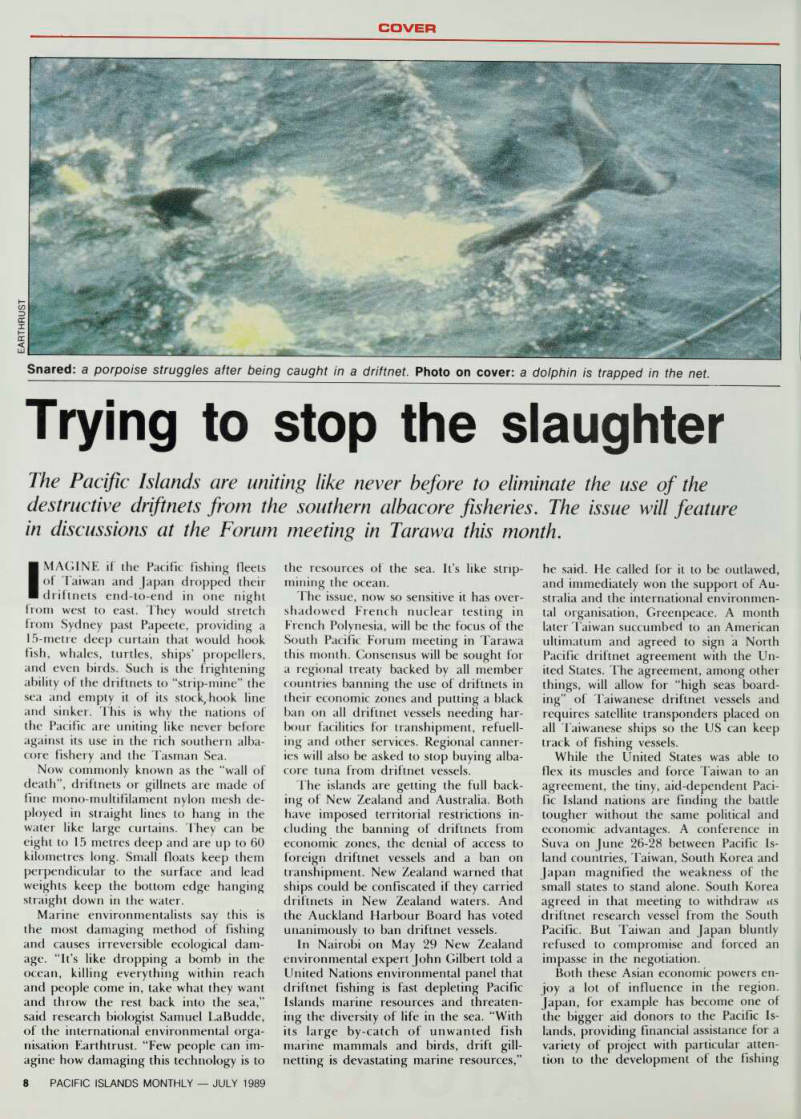
Snared: a porpoise struggles after being caught in a driftnet. Photo on cover: a dolphin is trapped in the net.
industry. Within hours of Japan telling the Suva conference it would not stop the use of driftnets in the South Pacific, Western Samoa announced it was accept ing nearly US$ll.4 million from Japan to pay for the second phase of the Apia port development. (Japan provides near ly 50 percent of Western Samoa’s total aid programme). The Same day Japan and the Solomon Islands signed an agreement in Honiara for the Japanese government to provide US$7.4 million to pay for the construction of a fishing pro ject at Noro. The facilities include a cold
storage, a wharf, ice-making plant and workshop. It will be the new base for an expanded cannery owned jointly by the Solomons government and a Japanese company. In Tonga, Taiwan is spending US$l.B million for the construction of an indoor stadium in Nukualofa to be used for the Mini South Pacific Games next month.
The list doesn’t end there. Last month Taiwan shipped into Suva the first of the Hyundai Sonatas it’s giving Fiji for use by government ministers. Japan at about the same time agreed to provide a furth
er grant of US$l.7 million to buy fishing equipment for the rural areas. Fiji’s fisheries department is seeking another
US$l.6 million, again to buy fishing
equipment. Japanese and Taiwanese aid
funds are financing projects throughout
the Pacific Islands. It was noted at the Suva conference, for example, that Fiji, which usually provides a pivotal role in regional decisions, was non-committal on the driftnet issue.
I he albacore fishery between latitude 30 and 40 south, is one of the richest in the world having been newly-discovered by the Asian driftnetters who once con centrated in the North Pacific. The num ber of driftnet vessels has grown from 10 Japanese and seven Taiwanese in the 1987/88 season to at least 50 Japanese and 130 Taiwanese ships this year. The attraction is the highly-priced albacore tuna whose white flesh is fetching US$lOOO a tonne in the United States.
Forum Fisheries Agency estimates, however, predict a collapse of the fishery within five years if driftnetting is allowed to continue at its current rate.
Such a situation would be disastrous for the longline industries in Fiji, Tonga, french Polynesia, Solomon Islands, the Cook Islands and Vanuatu.
Japan argues that the Forum Fisheries Agency does not have concrete evidence to back its argument on the albacore stock available and the sustainable level of exploitation. The agency admits such a lack of data and points only at the history of driftnet fishing in the North Pacific to draw parallels in the south. It also accuses Taiwanese and Japanese fleets in the south of not providing com plete information on the amount of catch being taken- For Asians, driftnets are essential.
They are economical. Ships do not re quire the large crews needed by the longliners. Japan pointed out that a workshop on South Pacific Albacore Re source (SPAR) in Suva in June deter mined that the damage to the albacore fisheries caused by driftnets was “un clear”. It is therefore necessary to do an
indepth study, which Japan is prepared
to help, into “all kinds of fisheries”. This was supported by Taiwan which said that while it was “very much concerned about the possibility of over-exploitation of the southern albacore stock” they had very little information on the available stock.
“We shall very much like to realise the exact stock status of this species before something on the conservation can be done,” a Taiwan statement said. It offered to provide scientists to help in a study to determine the Maximum Sus tainable Yield of the stock. Based only on such a scientific evaluation will it go into a conservation and management agreement concerning the southern alba core stock. □
Advertisements & other items, pp. 9-10 (1 item)
Ǥ Samsung
PRODUCTS FOR PEOPLE WITH MORE
SENSE THAN MONEY
To own a Samsung TV Screen, Samsung Video Deck and Samsung Remote Control Unit!
That’d Great!
That makes the Samsung Combination the most inexpensive of its iJILo S° or . best view. Samsung quality is good enough for the 1988 Olympic Games. Should be ideal for your home!
Available at selected Duty Free Dealers and Burns Philp Home Centres throughout Fiji. **
QC SAMSUNG
SOLE DISTRIBUTORS:-
CORRIE & COMPANY
HEAD OFFICE
G.P.O. BOX 45. SUVA
TLX: FJ2166
CABLES: CORRICO' SUVA
TELEPHONE: 386777
BANKERS; WESTPAC, SUVA
FAX: (679) 300610
BRANCH OFFICE:
161 VITOGO PARADE
G.P.O. BOX 83. LAUTOKA
CABLES: “CORRICO” LAUTOKA
TELEPHONE: 60137
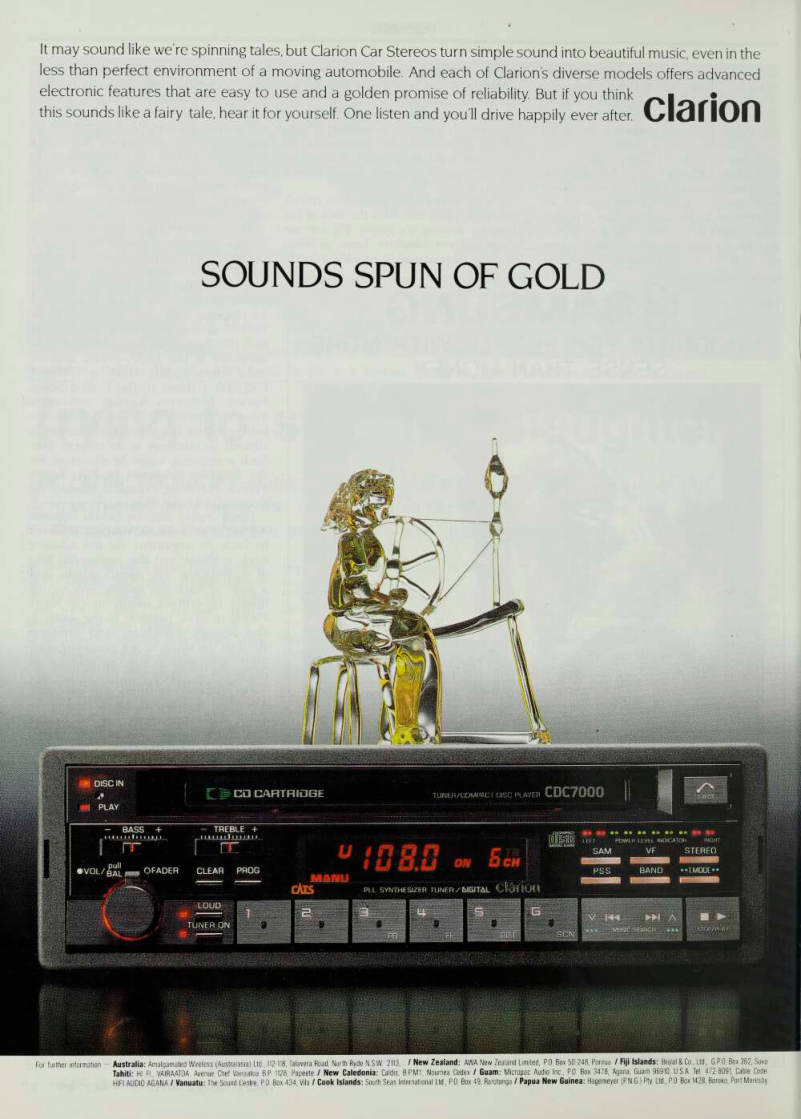
It may sound like we’re spinning tales, but Clarion Car Stereos turn simple sound into beautiful music, even in the less than perfect environment of a moving automobile. And each of Clarion's diverse models offers advanced electronic features that are easy to use and a golden promise of reliability. But if you think this sounds like a fairy tale, hear it for yourself. One listen and you'll drive happily ever after.
clarion
SOUNDS SPUN OF GOLD
A V i.A
l CD CARTRIDGE
u rnon I u u.u
ON UCH
A ■ - For further information Australia: Amalgamated Wireless (Australasia) Ltd, 112-118, Talavera Road, North Ryde N S W 2113, / New Zealand: AWA New Zealand Limited, PO. Box 50-248, Ponrua / Fiji Islands: Brijlal & Co, Ltd, G PO Box 362, Suva Tahiti: HI FL, VAIRAATOA Avenue Chef Vairaatoa BP. 1128, Papeete / New Caledonia: Caldis, B.P.M1, Noumea Cedex / Guam: Micropac Audio Inc., PO Box 3478, Agana, Guam 96910, U S A, Tel: 472-8091, Cable Code: HIFI AUDIO AGANA / Vanuatu: The Sound Centre, PO Box 434, Vila / Cook Islands: South Seas International Ltd., PO Box 49, Rarotonga / Papua New Guinea: Hagemeyer (PN G.) Pty Ltd, PO. Box 1428, Boroko, Port Moresby.
Who will turn out the lights?


The Region
Niue
By Karen Mangnall
LEGISLATORS on the tiny island of Niue drew a collective deep breath recently and took a tenta tive step towards loosening ties with New Zealand. Niue’s 2000 or so residents now face the prospect of a January referen dum on up to 37 changes to the con stitution first drawn up in 1974 when the island became self-governing in free association with New Zealand.
Changes include dumping New Zea land’s Governor-General as head of state and installing instead a Niuean Gov ernor-General, tipped to be 80-year-old Sir Robert Rex who may retire early from his post as Premier. The legislators also voted for dual Niuean and New Zealand citizenship, for localising the New Zealand-dominated Public Service Commission and for reducing the num ber of MPs from 20 to 18. The changes are now being drafted into law although at the time of writing no comment has come from New Zealand.
The three-day debate centred on giv ing Niue greater freedom for indepen dent economic and political develop ment. Niue hasn’t shown much of a taste for independence since it was annexed to New Zealand in 1901. After the Second World War, wlien the United Nations was stoking the fires of self determination amongst the world’s col onies, Niue said hands off. New Zealand aid has kept Niueans in a fashion to
which they’d already become quietly
addicted by the time of self-government in 1974. Last year, New Zealand put Niue on an intravenous drip-feed of $lO million a year for three years in a last ditch effort to revive the island (see box, pl 3). So far the Niue Concerted Action Plan (NCAP) hasn’t worked. New Zea land is threatening to cut off Niue’s supply and the constitutional debate is one of the withdrawal symptoms.
AH the money hasn’t turned the tide of Niueans departing at such a rate that while 10,000 now live in New Zealand, probably fewer than 2000 live back on the island. And while it’s a standing joke that by the turn of the century nobody will be living on Niue, it’s less of a joke that the last person to turn out the lights is likely to be a public servant. Two thirds of New Zealand’s aid goes to Niue’s overstuffed public service and at the moment the bureaucrats are feeling raw.
In April, the New Zealand Auditor General released an “unusually blunt” report calling Niue’s Cabinet negligent with aid money and criticising the gov
eminent for failing to protect the in terests of taxpayers. A few days later, Foreign Affairs Minister Russell Marshall flew over to warn that Niue must halve its public service in the next two years or face aid cuts. Marshall says he wasn’t “explicitly holding a stick” at the Niue Government but he made it clear it
wasn’t easy to get $lO million from his Cabinet colleagues when New Zealand’s tightening its belt and when Niue wasn’t making any inroads into its public ser vice as promised under the NCAP.
Marshall told Sir Robert Rex and his three ministers that he’d need to see “substantial progress made in the next
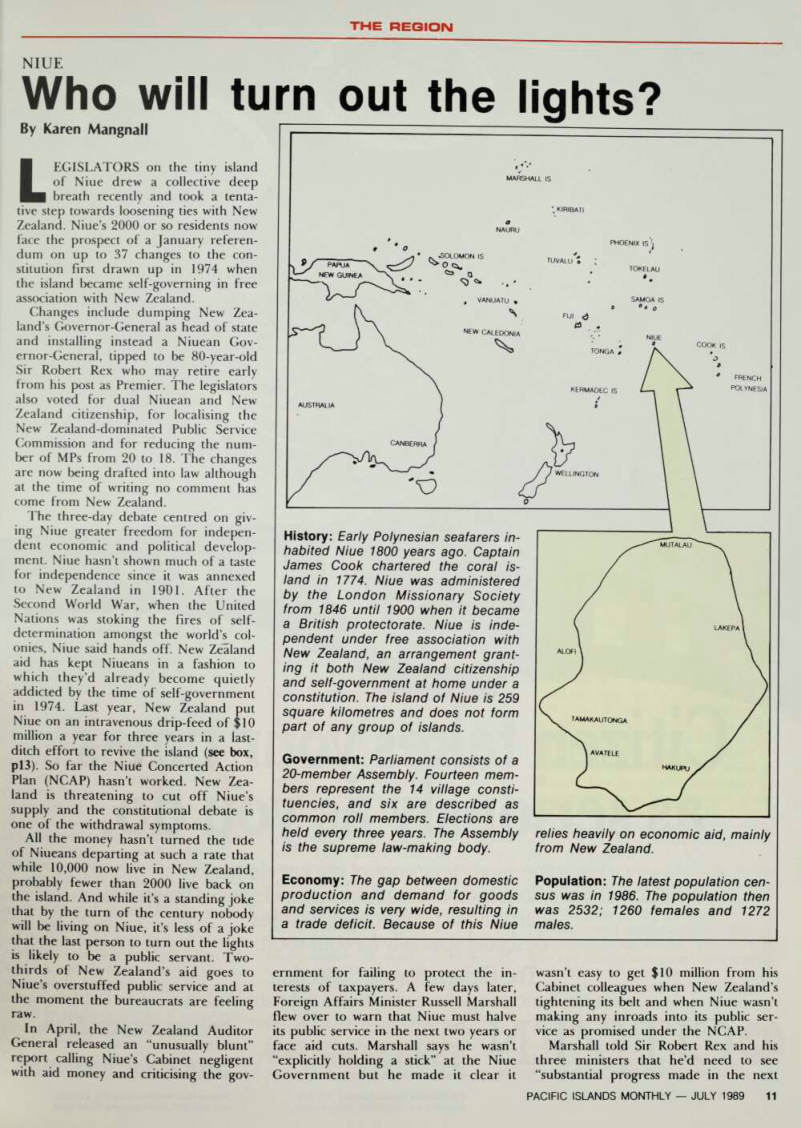
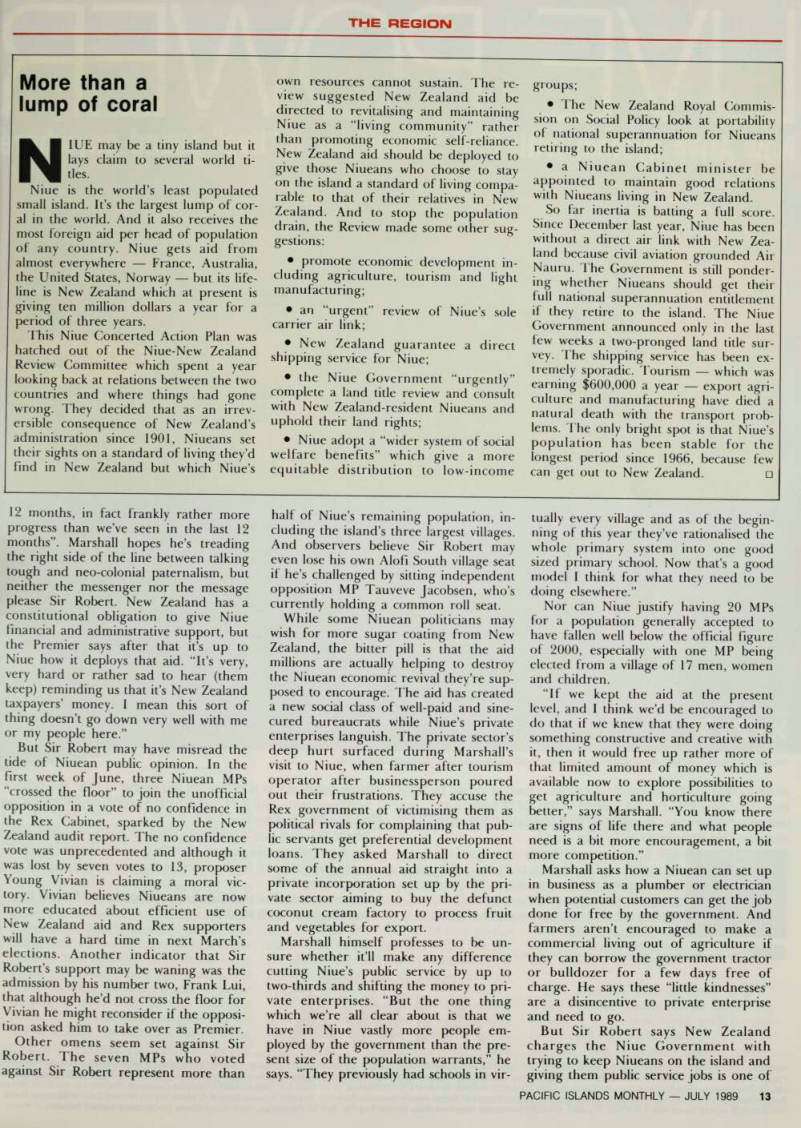
History: Early Polynesian seafarers in habited Niue 1800 years ago. Captain James Cook chartered the coral is land in 1774. Niue was administered by the London Missionary Society from 1846 until 1900 when it became a British protectorate. Niue is inde pendent under free association with New Zealand, an arrangement grant ing it both New Zealand citizenship and self-government at home under a constitution. The island of Niue is 259 square kilometres and does not form part of any group of islands.
Government: Parliament consists of a 20-member Assembly. Fourteen mem bers represent the 14 village consti tuencies, and six are described as common roll members. Elections are held every three years. The Assembly is the supreme law-making body.
Economy: The gap between domestic production and demand for goods and services is very wide, resulting in a trade deficit. Because of this Niue
relies heavily on economic aid, mainly from New Zealand.
Population: The latest population cen sus was in 1986. The population then was 2532; 1260 females and 1272 males.
-12 months, in fact frankly rather more progress than weve seen in the last 12 months’’. Marshall hopes he’s treading the right side of the hne between talking tough and neo-colomal paternalism, but neither the messenger nor the message please Sir Robert. New Zealand has a constitutional obligation to give Niue financial and administrative support, but the Premier says after that it’s up to Nme how it deploys that aid. “It’s very, very hard or rather sad to hear (them keep) reminding us that it’s New Zealand taxpayers money. I mean this sort of thing doesn’t go down very well with me or my people here.
Robert may have misread the tide of Niuean public opinion. In the irst week of June, three Niuean MPs crossed the floor to join the unofficial opposition in a vote of no confidence in the Rex Cabinet, sparked by the New Zealand audit report. The no confidence vote was unprecedented and although it was lost by seven votes to 13, proposer Voung Vivian is claiming a moral vietory. Vivian believes Niueans are now more educated about efficient use of New Zealand aid and Rex supporters will have a hard time in next March’s elections. Another indicator that Sir Robert’s support may be waning was the admission by his number two, Frank Lui, that although he d not cross the floor for Vivian he might reconsider if the opposition asked him to take over as Premier.
Other omens seem set against Sir Robert. The seven MPs who voted against Sir Robert represent more than
half of Niue’s remaining population, in
eluding the island’s three largest villages,
And observers believe Sir Robert may even lose his own Alofi South village seat
if he’s challenged by sitting independent
opposition MP Tauveve Jacobsen, who’s currently holding a common roll seat.
While some Niuean politicians may wish for more sugar coating from New Zealand, the bitter pill is that the aid
millions are actually helping to destroy
the Niuean economic revival they’re sup posed to encourage. The aid has created a new social class of well-paid and sine cured bureaucrats while Niue’s private enterprises languish. The private sector’s deep hurt surfaced during Marshall’s visit to Niue, when farmer after tourism operator after businessperson poured out their frustrations. They accuse the Rex government of victimising them as
political rivals for complaining that pub
lie servants get preferential development loans. They asked Marshall to direct some of the annual aid straight into a private incorporation set up by the pri vate sector aiming to buy the defunct coconut cream factory to process fruit and vegetables for export.
Marshall himself professes to be un sure whether it’ll make any difference cutting Niue’s public service by up to two-thirds and shifting the money to pri vate enterprises. “But the one thing which we’re all clear about is that we have in Niue vastly more people em ployed by the government than the pre sent size of the population warrants,” he says. “They previously had schools in vir
tually every village and as of the begin ning of this year they’ve rationalised the whole primary system into one good sized primary school. Now that’s a good model I think for what they need to be
doing elsewhere.”
Nor can Niue justify having 20 MPs for a population generally accepted to have fallen well below the official figure of 2000, especially with one MP being elected from a village of 17 men, women and children.
“If we kept the aid at the present level, and I think we’d be encouraged to do that if we knew that they were doing something constructive and creative with it, then it would free up rather more of that limited amount of money which is available now to explore possibilities to get agriculture and horticulture going better,” says Marshall. “You know there are signs of life there and what people need is a bit more encouragement, a bit more competition.”
Marshall asks how a Niuean can set up in business as a plumber or electrician when potential customers can get the job done for free by the government. And farmers aren’t encouraged to make a commercial living out of agriculture if they can borrow the government tractor or bulldozer for a few days free of charge. He says these “little kindnesses” are a disincentive to private enterprise and need to go.
But Sir Robert says New Zealand charges the Niue Government with trying to keep Niueans on the island and giving them public service jobs is one of
the only ways of doing so. His misgivings are shared by Niue’s director of econo mic planning, Toke Talagi, who says Niue doesn’t have the population base to allow it the luxury of laying off public sector employees without enough private sector jobs to take up the slack. “In New Zealand at the present moment, the dole is so much easier, the benefits are so much easier to get that what they would be normally getting out here. So there’s always that expectation that if things are tough here things are easier out there and in fact it is easier in New Zealand.”
Fifty years ago Niue was a prosperous, self-reliant island. Only three per cent of its population was in fulltime paid em ployment; the rest working as smallhold farmers. Today, thanks to aid money, Niue’s Government provides most of the remuneration for cash crops and hand icrafts. It employs more than half of the active workforce and controls most of the island’s assets including government farms and development blocks. But ex ports cover only a fifth of imports. A significant proportion of imports is food stuffs. In many villages half the aid-built houses are empty. Abandoned lime and passionfruit plantations give mute testi mony to the repeated failures of govern
ment-sponsored development projects.
Niue’s tendency to go big on single cash crops limes, passionfruit and soon apparently pineapples was inau gurated by the New Zealand post-war colonial administration which would make inflated predictions for the success of the latest flavour-of-the-month pro duct which would soon collapse. In the
meantime, imports kept rising and the
trade deficit grew. In the 19605, as New Zealand espoused self-determination, it started a large capital works programme and stressed social welfare at the ex pense of economic development. In the five years to self-government in 1974, three-quarters of Niue’s aid went on the public service. The stagnant economy, raised expectations and the inequalities created with the new, richer class of pub lic servants meant Niueans began to flood to New Zealand when the island’s airport opened in 1971.
Niue’s isn’t an idyllic tropical island paradise. Less than one-third of its sur face is suitable for cultivation, its soils are shallow and deficient, its marine re sources are relatively scarce and its rain fall variable. Niue’s physical environment offers little yet for the past 40 years New Zealand has invested large sums on a primary-product export economy in the belief the island could become a viable trading nation. And all the evidence points to the fact that aid spending on “social welfare” to maintain Niue’s living standard merely encourages young Niueans to debunk for New Zealand.
Talagi favours the Niue government
establishing certain industries then sell ing or leasing them to the private sector.
He concedes the government doesn’t favour his approach because of its past
record of backing development projects
which have gone bust. The recent audit report criticised the Niue Government’s persistent failure to enforce contracts with local and foreign organisations, a failure which has cost jobs and hundreds of thousands of dollars in lost revenue and written-off loans. The audit report has sent many of Niue’s politicians and bureaucrats into a defensive crouch.
“I don’t think that it’s right or fair to expect Cabinet to go and stand over each department and watch over them,” says Sir Robert. “That’s political interfer
ence. We make the policies and (there are) different departments to carry (them) out and if there’s any squander ing I don’t see why the auditor should point an accusing finger at us.”
I alagi says Niueans are justified in feeling unfairly blamed for all of Niue’s economic failings. It’s taken the Niue government 15 years to try to wean Niueans off expecting to be “spoon fed” by a New Zealand administration which once had been only too happy to give the islanders anything they wanted. The Niue Government must change that atti tude, Talagi says, so that the next gen eration is taught that “there’s nothing free in this world and there’s no expecta tion that people will continue doing things for you just because you happen to exist”.
Independent opposition MP Tauveve Jacobsen is a vocal critic of aid spending which she blames for creating a welfare mentality amongst Niueans. Jacobsen says the emphasis on the public service means there are no promotions, no motivation and little incentive to excell.
“Whereas if you put a lot of these people out into working for themselves it’s amazing what they’ll come up with,” she says. “They’re very talented, they’re bril liant.”
Jacobsen says the “work ethic” is im portant in restoring a nation’s pride but Niue must act immediately to spend its aid money more effectively and entice young Niueans to return home or the island will be lost. “They’ll probably turn the lights out on us and say goodnight.
And that would be it for us. We’d prob ably be left to crawl with the crabs. This place isn’t going to get better with peo
ple just sitting waiting for handouts,”
Jacobsen says. “This place is going to get better when everybody gets out, pick and shovel, and they’re just gonna have to work.” Q
Nz Embassy
Russell Marshall: signs of life in Niue.
Advertisements & other items, p. 12 (1 item)
Citizen t
It) m <S> o o> <v> sS> <>> -1 a UP fflK
es your times
as seriously as you do.
For some sports time control is a key element.
The Citizen Sports Collection is a winning range of special timepieces
with unique performance features
designed specially for your sport.
The Citizen Sports Collection.
For the serious sportsman... We’ve got your Watch.
©CITIZEN
CITIZEN IS A REGISTERED TRADEMARK OF CITIZEN WATCH CO., JAPAN.
FOR FURTHER INFORMATION, PLEASE CONTACT: New Zealand: Citizen Watches (N.Z.) Ltd., P.O. Box 9518, Auckland, New Zealand.
Australia:Citizen Watches Australia Pty. Ltd., Tel: 543 393. Telex: 21429. Fax: 544177. 122 Old Pittwater Road, Brookvale, NSW 2100.
Tel: 939 7077. Cable: Citizen Sydney. Tahiti: Morgan Vernex, Fare Ute B.P. 449, Tahiti.
Telex: AA26633. Fax: 932864. Tel: 2.03.09.
Fiji Islands: Tappoo Limited, P.O. Box, Sigatoka, Fiji. Tel: 50199. Telex: FJ4244.
Papua New Guinea: Kara Pty. Limited, P.O. Box 392, Port Moresby. Tel 25 6044
More than a lump
lump of coral
NIUE may be a tiny island but it lays claim to several world ti tles.
Niue is the world’s least populated small island. It’s the largest lump of cor al in the world. And it also receives the most foreign aid per head of population of any country. Niue gets aid from almost everywhere France, Australia, the United States, Norway but its life line is New Zealand which at present is giving ten million dollars a year for a period of three years.
This Niue Concerted Action Plan was hatched out of the Niue-New Zealand Review Committee which spent a year looking back at relations between the two countries and where things had gone wrong. They decided that as an irrev ersible consequence of New Zealand’s administration since 1901, Niueans set their sights on a standard of living they’d find in New Zealand but which Niue’s
own resources cannot sustain. The review suggested New Zealand aid be directed to revitalising and maintaining
Niue as a “living community” rathe?
‘ han P gnomic self-reliance. ew ' ea and aid should be deployed to give those Niueans who choose to stay on the island a standard of living comparab , e of tbeir re , atives B in N P ew Zealand And population drai Review J some P )t er gestions . SUg * promote economic development in
“gagncrikure, tourism and light
manufacturing,
* an “urgent” review of Niue’s sole carrier air link; * New Zealand guarantee a direct shl i service for B Ni 1, 8 „ , „ * the Niue Government urgently ™"'P^ e 3 'and title review and consult wlth New Zealand-resident Niueans and u P hold their land rights; • Niue adopt a “wider system of social welfare benefits” which give a more equitable distribution to low-income
groups; ' XT . , „ . ■ The Ne « Zealand Royal Commis -7" ° n S “' al PollC >' look a ‘ Po«ab>lity . a Niuean Cabinet minister be appointed to maintain good relations with Niueans living in New Zealand.
So far inertia is batting a full score, Since December last year, Niue has been without a direct air ink with New Zea . ■ whether Niueans should g!Tthdr full national superannuation entitlement if they retire to the island. The Niue Government announced only in the last few 3 two-pronged land title sur vey. The shipping service has been ex tremely sporadic. Tourism - which was earning $600,000 a year export aeri cukure and manufacturing have died a nalura death wjth the tr ° rt b . lems. The oniy bri b( tis P bat ,si ue ' s population has been stable for the longest period since 1966, because few can get out to New Zealand. □
Advertisements & other items, p. 14 (1 item)
Aiwa
I I I I
550! PMPO
m ■ . ?«% Ms, Stereo Component System X-777 The Oya Saikutsujo in Tochigi, Japan is often the stage for live performances of traditional Japanese music AlWA’s original DSL (dynamic super loudness) is joined by the incredible new BBE Sound system in the X-777 system to deliver a “live music” experience into any listening spaceeven the Oya Saikutsujo in Tochigi Japan.
BBE Sound was originally developed by Barcus Berry Electronics of the U.S. for use in professional sound systems. BBE results in clearer sound, with enhanced definition of both vocals and instruments for a sound that’s more like live.
BBE
PROCESSOR
Now, AIWA is the first to offer the magic of BBE in a home audio system—the X-777, with high power output through 3-wa> bass-reflex speakers.
The X-777 also has a complete array of convenience features, such as full remote control, CBRS, CD edit, feather-touch 1C logic control in its double deck, wake-up volume control, and much more.
Discover soon the high-power sound of the X-777, and hear the magic of LIVE POWER.
'» The word “BBE” and the “BBE symbol” are trademarks of BBE Sound, Inc.
Digital Audios. Video
AIWA
Mobex Pty., Ltd. Unit 1,70 Gibbes Street Chatswood N.S.W. 2067 AUSTRALIA PHONE: 001-61-2-4066277/Oceania Indent Agency (P.N.G.) Pty., Ltd. Ago St., Gordon Box 5518, Boroko, Port Moresby, Papua New Guinea PHONE: 256411/The Sound Centre Ltd. P.O. Box 434 Port Vila, Vanuatu PHONE: 2035/P. Hargovind Bros. 190 Renwick Road P.O. Box 409 Suva Fiji PHONE: 24350/Octavium Group Ltd. 33 Constellation Drive Mairangi Bay, Auckland 10 NEW ZEALAND PHONE: 001 -64-9-479-1272/Hifivox 19 av. Foch B.P. 1458 NOUMEA Nouvelle-Caledonie PHONE: 001-687-27.24.66/Harvesii Pacific Limited P.O. Box 517, Honiara, Solomon Islands PHONE: 131/Fare-Hi-Fi Stereo Rue de Marechal Foch P.O. Box 269, Papeete Tahiti R.C. 6604 A TAHITI PHONE: 2.48.14/Micropac Audio, Inc: P.O. Box 3478 Agana, Guam 96910 PHONE: 472-8091, 472-8297/Rarotonga Duty Free Shop Private Bag P.O. Box 92, Rarotonga, Cook Island/Nauru Co-Operative Society Republic of Nauru
Kari’s a first for women
Solomon Islands
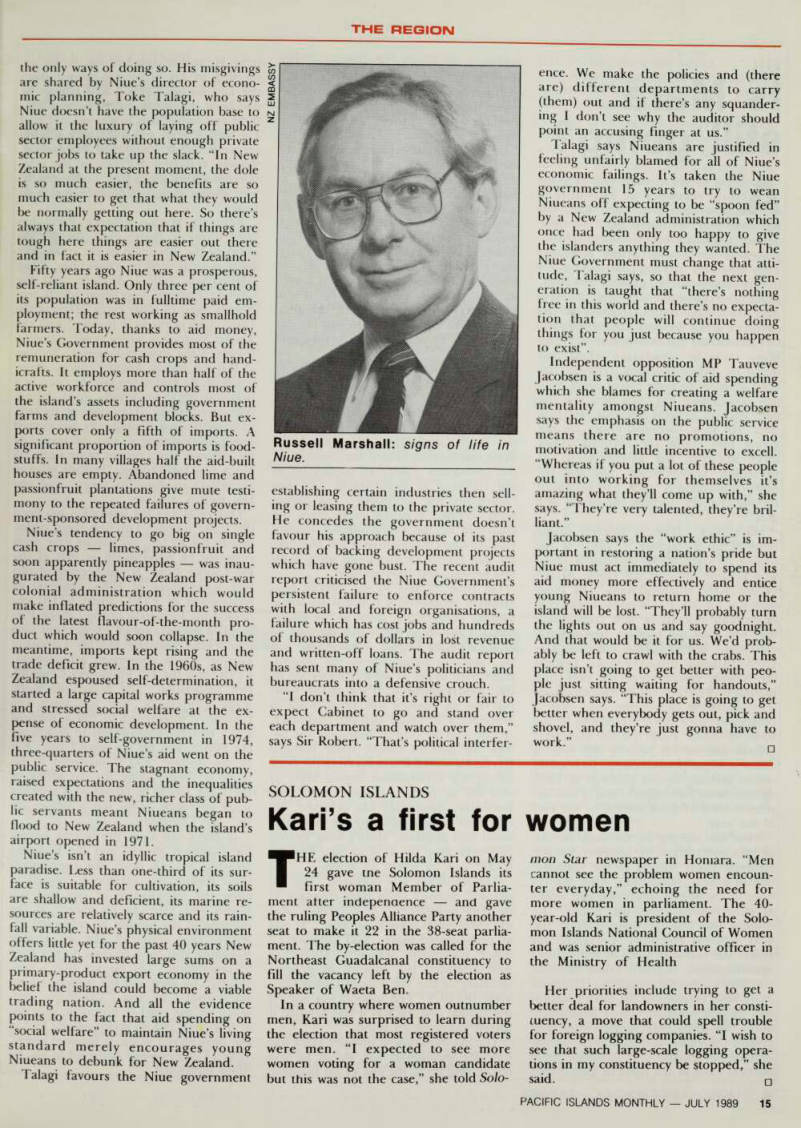
THE election of Hilda Kari on May 24 gave me Solomon Islands its first woman Member of Parlia ment alter independence and gave the ruling Peoples Alliance Party another seat to make it 22 in the 38-seat parlia ment. The by-election was called for the Northeast Guadalcanal constituency to fill the vacancy left by the election as Speaker of Waeta Ben.
In a country where women outnumber men, Kari was surprised to learn during the election that most registered voters were men. “I expected to see more women voting for a woman candidate but this was not the case,” she told Solo
mon Star newspaper in Honiara. “Men cannot see the problem women encoun ter everyday,” echoing the need for more women in parliament. The 40year-old Kari is president of the Solo mon Islands National Council of Women and was senior administrative officer in the Ministry of Health Her priorities include trying to get a better deal for landowners in her consti tuency, a move that could spell trouble for foreign logging companies. “1 wish to see that such large-scale logging opera tions in my constituency be stopped,” she said. D
still going?
Fiji
Is Mara still going?
AS Fiji enters its third year of post coup recovery it encounters another crisis: to keep Ratu Sir Kamisese Mara or dump him. His most devout followers believe Mara is irre placeable as interim prime minister.
They quote his “sterling contribution . . . to the development, growth, progress, peace and harmony”, in the country.
And they want him to remain as the
country’s prime minister until parliamen
tary democracy has been restored. At 69 Mara must be wondering when that might be. While economic recovery has been achieved to some extent, work on a new constitution has been slow and the path back to general elections far from clear. His most hardened critics are not
giving him credit for anything. They
have accused his government of preaching “naked racism” and said the draft constitution is “racist and smacks of forcing changes through the barrel of a
gun”.
Mara took office as interim prime minister on December 5, 1987, at the urging of coup leader Sitiveni Rabuka, who became Minister for Home Affairs in the Mara administration. The man date was for Mara to rejuvenate the eco nomy and prepare a new constitution that will pave the way for new general elections. The economy has been re vived. Inflation dropped to 8.7 percent last month, compared to the post-coup highest of 11.8 percent in November last year. Inflation before the coup was 2 percent in April 1987. Projections by the Reserve Bank point to an economic growth rate of 7.3 percent this year, a boom in sugar production, an increase in tourist arrivals, record earnings of Fsss million from fish export, and a foreign reserve level of $3OO million by the end of the year.
That was the pat on the back for the interim government. It, however, has not achieved equal success in the formula tion of a new constitution. After the re lease of the draft constitution and weeks of submissions from the public, the country was still far from nearing the next general elections. Certainly not within the two-year term of the current administration. Deposed Prime Minister Dr Timoci Bavadra and his Coalition Party have been using the draft constitu tion to pick holes in Mara’s administra tion. The draft tries to guarantee and protect the rights and aspirations of the
indigenous Fijians and provides them
political clout in the form of guaranteed
numerical superiority in parliament. The interim government believes these guarantees will prevent violent strife be tween the two major races Fijians and Indians in future. The Coalition thinks the opposite will happen and has called for political equality among all the races. “There can be no lasting peace unless each of us are recognised as equals before the law, and particularly before the supreme law, which is the constitution,” says Dr Balwant Singh Rakka, president of the Indian dominated National Federation Party, the partner of Fiji Labour Party in Bavadra’s Coalition. “History has taught us that you can never progress if you take away one part of the national identity. We are prepared to bow but not to kneel to those who wish to subjugate us.”
Bavadra continued to stoke the fire of defiance. When addressing a Coalition rally at Ba, in Western Viti Levu, he accused the government and the military of striking a deal in the drawing up of the draft constitution. He alleged the draft constitution limited the freedom of the commoner Fijians to participate in the running of government and was
“outrightly not acceptable”. His allega
tions received a strong rebut from the chairman of the Constitutional Inquiry and Advisory Committee, Paul Manueli.
He said Bavadra’s allegations were “both mischievous and irresponsible”.
On June 29 and 30 the interim gov ernment sponsored a national economic summit in Suva that acted as the guide line for the mini national budget to be announced in August. While there was no Coalition participation, the govern ment tried to get as big a cross-section of the country involved. It was in this sum mit that an attempt was again made to keep Mara in office beyond December.
At the end of official business, just be fore the summit closed, trade unionist Jim Smith moved a motion from the floor calling for a resolution urging Mara to stay on as prime minister until par liamentary democracy was achieved. He called on those supporting his motion to stand and applaud. Mara’s most devout followers were the first to rise, then by trickle and by storm all stood.
The Coalition was outraged. The re solution received front page coverage in the daily newspaper, The Fiji Times, and the three-times-a-week Fiji Post. “It was an orchestrated move,” said Coalition fi
nance spokesman Mahendra Chaudhry
who attended the summit as general secretary of the Fiji Trades Union Con gress (FTUC). “The motion was not on the agenda and the way it was handled it forced everyone to stand.”
The question now is whether Mara will stay. He announced last March he was not staying on at the end of his two-year
term. He said it again in June during the meeting of his provincial council from the Lau Group. Within that period he
had been continually urged by organisa
tions and individuals to stay on and lead Fiji back to full economic and political recovery. Some suspect he would stay, despite reported friction in his rela tionship with Rabuka who, until recently, was always eager to publicly speak on issues.
Recently Mara’s Alliance Party has been trying to revive itself after falling apart in the aftermath of the coup. The party is structured on racial lines; Fijian Association, Indian Alliance, and the General Electors Association which rep resents those of other races. Many in the Fijian Association were involved with the Taukei Movement whose public agitation triggered the military takeover. Because of this the Indian Alliance quickly disin tegrated. Its leadership saw the coup as a betrayal of their loyalty to a Fijian dominated party. The attempt to rele gate Indian status politically has caused much disillusionment, and the revival of the Alliance Party cannot begin until Fiji has a new constitution. “Indians want to see what’s in store for them,” said one key Indian Alliance.
One of Mara’s big headaches has been the trade unions. Through their affilia tion to the FTUC, the unions have been regarded by government as part of the Fiji Labour Party. It was because of this that government in 1985 withdrew its recognition of FTUC when FTUC en dorsed the formation of the Labour Par ty. The withdrawal of recognition also meant the collapse of the Tripartite Forum, which comprised government, FTUC and the Fiji Employers Consulta tive Association. The Forum discussed wage guidelines. Not too long ago Chaudhry threatened to call a national strike to force government to re-activate the Forum and lift the wage freeze. But at the summit, FTUC managed to ac quire an undertaking for the lifting of the wage freeze in favour of a national wage guideline. “That was a victory for us,” says Chaudhry.
If Mara can keep the unions happy, the Coalition gagged and the economy growing he can delay the constitution until feeling has mellowed enough to allow the introduction of one that will favour one race. In his speech at the opening of the summit he reminded de legates that countries like the United Kingdom and New Zealand do not have a constitution. “Let me say that a con stitution by itself will not achieve econo mic growth,” he said. “The major chal lenge on the road to economic progress at this time, and no doubt we will face in the next eleven years, is national unity.”
Why 11 years no-one bothered to ask. So Mara didn’t tell. a
Getting
Papua New Guinea
Getting ready for the worst
ON June 7 the Papua New Guinea Cabinet instructed four of the country’s most powerful public servants to prepare a special report.
They were; Prime Minister’s Department Secretary, Paul Bengo; Finance and Planning Secretary, Morea Vele; Person nel Management (public services) Secret ary, Web Kanawi; and Governor of the Central Bank, Sir Henry Toßobert.
Their task was to draw up contingency plans to cushion the effects of a pro longed closure of the Bougainville Cop per mine, PNG’s biggest single export earner contributing K2OO million or 20 per cent of the annual national
budget.
Unlike four previous political commit tees before it and one after it, the four men public servants’ committee had a plan out in three weeks. What it has proposed are measures that are frighten ing to say the least and will have pro found effects on the largest and richest island nation in the South Pacific. Under the proposed measures the 50,000 strong
public service will grind to a virtual standstill and the PNG economy will be partly or wholly managed by the Inter national Monetary Fund should the Bougainville Copper closure be perma nent. At time of writing the mine had been closed for six weeks. Immediately though, and based on the assumption that BCL reopens for business in Au gust, the government has decided to im plement the following policies: • Cut K 25 million off planned recur rent expenditures in the 1989 budget,
• Tighten monetary policy by having
the Bank of PNG reduce the credit lend ing target to the range of 8 percent to 10 percent in 1989, • Implement cost-cutting measures in the Public Services to significantly reduce direct and indirect cost of employment, • Defer the announcement of the de cision of the Minimum Wages Board to make sure the board fully considers the economic effects of the mine closure, and • Allow decline in foreign reserves of K2O million more than had been antici pated at the time the 1989 budget was drawn up.
Should the mine remain closed for
longer the Sengo-Vele-Kanawi-Toßobert
committee has drawn up three scenarios preparing the nation for a three-month, six-month and an indefinite closure of the mine.
In the extreme: • The public service will be cut by a quarter with the remaining three quar
ters working three-day weeks • A be declared to in validate all contracts between govern ment and other parties • All decentralised powers to be with -7 Annual cuts in government expend |evds° f * K °° m ' Mlon ° Ver reCent , I-,,, , , . r t 0 overseas sources for ba f P a ; me ™ borro '™gs through International Monetary Fund which cost *" d * evere y dimm,st ' PNGs auton y d ltS lnternatlonal reputation; • T ax the population; * Reduce access to credit and higher interest rates; more drastic reforms in the public service with a likely need to retrench many more public servants; and • Reduce current wage levels The committee has assessed that for a three-month shut-down of the mine the nation would make a net loss to foreign reserves of K3O million and a direct re venue loss of K 46 million. A six-month closure would mean a K7O million loss to foreign reserves and Kl4O million of direct revenue. For scenario three the nation would lose Kl2O million in fore ign reserves and Kl5O million in direct revenue.
Two bullets and Balakau was dead
DEATH was always so close to Malipu Balakau, Papua New Guinea s Communication Mimster. As a highlander he witnessed people being brutally hacked to death in tribal conflicts that often rage throughout the
highlands, but particularly m hig Enga
province. But death and particularly violent death of the kinds he witnessed as farthest from him when he became a big man , a Member of Parliament in June 1987. Highlanders respect big men. l wo years later, last June 30, two bullets rom an unknown gunman broke the le K d thr^ w l L he vola J lle highlands and PNG into further confusion.
A gang surrounded Balakau’s home at Newtown Mt Hagen, between 7 and ~p m ? n . F u nday ’ J une 30> Apparently, there had been a domestic argument be- W f Cr \!f WO ° 1S Wlves - The first wife, Monica was in his car outside the house. Balakau sent one of his security Doys to fetch his briefcase from the car. l he gang moved m and held a gun to the security s mouth and told both the wile and boy to shut up. When the security boy tailed to return, Balakau
went to investigate. He was shot at point blank range by a masked man. The first bullet entered his neck and the second hit him in the forehead. He died instant ly. The gang took off in his car.
His untimely death caused wholesale destruction in his home town Wabag, the headquarters of Enga province and Mt Hagen. Very early on the Saturday, friends and relatives set alight a wholesale shop owned by Bromley and Manton company in Wabag, and later damaged and looted two of the com pany’s retail outlets. The PNG Banking Corporation was stoned and nearly set on fire but police moved in to disperse the crowd. At dawn the Engans set off in 15 truck loads for Mt Hagen, three hours drive away.
In Mt Hagen the Engans met at the Pope John Paul Oval for a mourning ceremony but that did not last long, Angry relatives rampaged through
shops, stoning buildings and grabbing
anything they could lay their hands on.
Bromley and Menton Co again became a victim when its supermarket was broken into and looted, local company, Wamp
Nga had most of its glass windows broken. Police prevented further trouble The Government of Prime Minister Rabbie Namaliu, facing a vote of no con fidence motion five days away at the time the Minister was shot, was caught flat footed. Most of the nation’s riot squads were on Bougainville conducting a state of emergency operation to flush out militants there.
Gingerly, the Government faked some announcements about the body being shipped to Port Moresby for the state funeral and when nothing happened
finally brought it on Sunday.
Namaliu wept as the coffin was taken off the plane. A small group of Engans gathered at the Jackson Airport and mourned without incident, except two women flung themselves at the moving ambulance carrying the late Minister’s body. At time of writing, however, one relative said: “It is quiet now but the underlying passions are there. The sym pathy is coming out now, but after they talk we will know. They are curious as to why he was killed.” □
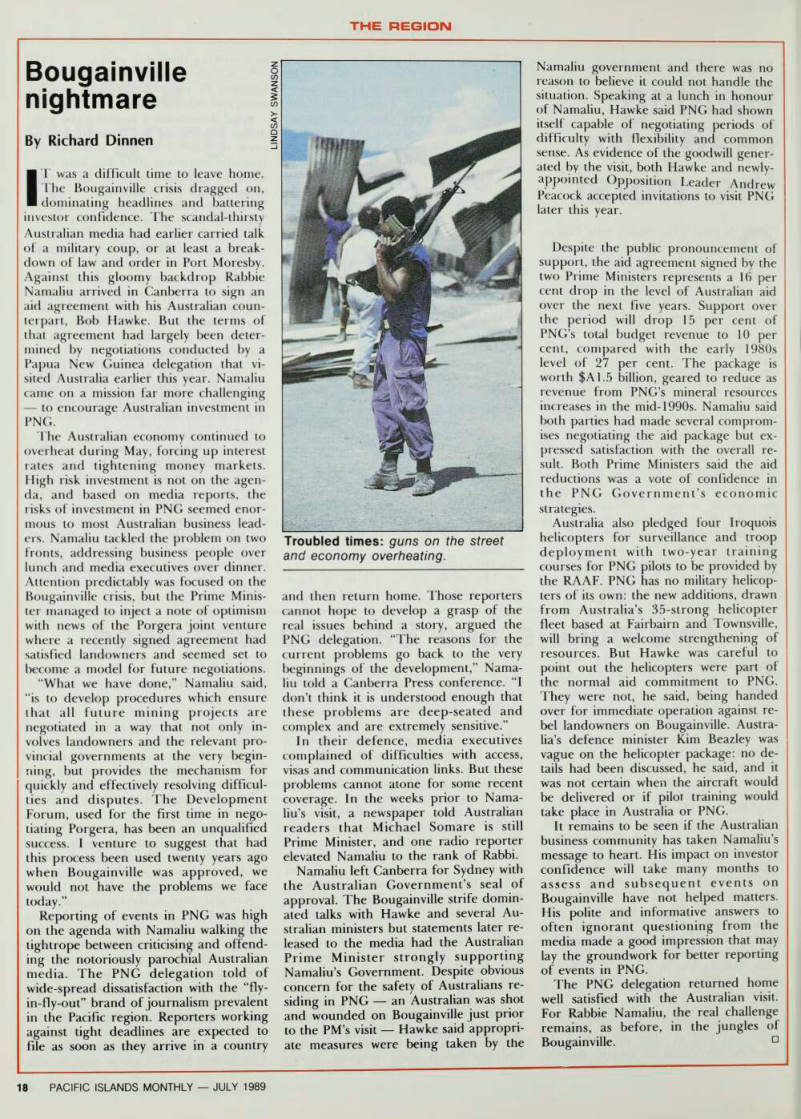
Lindsay Swanson
Bougainville nightmare
By Richard Dinnen
IT was a difficult time to leave home.
The Bougainville crisis dragged on,
dominating headlines and battering
investor confidence. The scandal-thirsty Australian media had earlier carried talk of a military coup, or at least a break down of law and order in Port Moresby, Against this gloomy backdrop Rabbie Namaliu arrived in Canberra to sign an aid agreement with his Australian coun terpart, Bob Hawke. But the terms of that agreement had largely been deter mined by negotiations conducted by a Papua New Guinea delegation that vi sited Australia earlier this year. Namaliu came on a mission far more challenging to encourage Australian investment in
Png.
The Australian economy continued to overheat during May, forcing up interest rates and tightening money markets.
High risk investment is not on the agen da, and based on media reports, the risks of investment in PNG seemed enor mous to most Australian business lead ers. Namaliu tackled the problem on two fronts, addressing business people over lunch and media executives over dinner.
Attention predictably was focused on the Bougainville crisis, but the Prime Minis ter managed to inject a note of optimism with news of the Porgera joint venture where a recently signed agreement had satisfied landowners and seemed set to become a model for future negotiations.
“What we have done,” Namaliu said, “is to develop procedures which ensure that all future mining projects are negotiated in a way that not only in volves landowners and the relevant pro vincial governments at the very begin ning, but provides the mechanism for quickly and effectively resolving difficul ties and disputes. The Development Forum, used for the first time in nego tiating Porgera, has been an unqualified success. I venture to suggest that had this process been used twenty years ago when Bougainville was approved, we would not have the problems we face
today.”
Reporting of events in PNG was high on the agenda with Namaliu walking the tightrope between criticising and offend ing the notoriously parochial Australian media. The PNG delegation told of wide-spread dissatisfaction with the “fly
in-fly-out” brand of journalism prevalent
in the Pacific region. Reporters working
against tight deadlines are expected to
file as soon as they arrive in a country
and then return home. Those reporters cannot hope to develop a grasp of the real issues behind a story, argued the PNG delegation. “The reasons for the current problems go back to the very beginnings of the development,” Nama liu told a Canberra Press conference. “I don’t think it is understood enough that these problems are deep-seated and complex and are extremely sensitive.”
In their defence, media executives complained of difficulties with access, visas and communication links. But these problems cannot atone for some recent coverage. In the weeks prior to Nama liu’s visit, a newspaper told Australian readers that Michael Somare is still Prime Minister, and one radio reporter elevated Namaliu to the rank of Rabbi.
Namaliu left Canberra for Sydney with the Australian Government’s seal of approval. The Bougainville strife domin ated talks with Hawke and several Au stralian ministers but statements later re leased to the media had the Australian
Prime Minister strongly supporting
Namaliu’s Government. Despite obvious concern for the safety of Australians re siding in PNG an Australian was shot
and wounded on Bougainville just prior
to the PM’s visit Hawke said appropri ate measures were being taken by the
Namaliu government and there was no reason to believe it could not handle the situation. Speaking at a lunch in honour of Namaliu, Hawke said PNG had shown
itself capable of negotiating periods of
difficulty with flexibility and common sense. As evidence of the goodwill gener ated by the visit, both Hawke and newly
appointed Opposition Leader Andrew
Peacock accepted invitations to visit PNG later this year.
Despite the public pronouncement of support, the aid agreement signed by the two Prime Ministers represents a 16 per cent drop in the level of Australian aid over the next five years. Support over the period will drop 15 per cent of PNG’s total budget revenue to 10 per cent, compared with the early 1980 s level of 27 per cent. The package is worth SAI.S billion, geared to reduce as revenue from PNG’s mineral resources increases in the mid-19905. Namaliu said both parties had made several comprom ises negotiating the aid package but ex pressed satisfaction with the overall re sult. Both Prime Ministers said the aid reductions was a vote of confidence in the PNG Government’s economic
strategies.
Australia also pledged four Iroquois helicopters for surveillance and troop
deployment with two-year training
courses for PNG pilots to be provided by the RAAF. PNG has no military helicop ters of its own; the new additions, drawn
from Australia’s 35-strong helicopter
fleet based at Fairbairn and Townsville, will bring a welcome strengthening of resources. But Hawke was careful to point out the helicopters were part of the normal aid commitment to PNG.
They were not, he said, being handed over for immediate operation against re bel landowners on Bougainville. Austra lia’s defence minister Kim Beazley was vague on the helicopter package: no de tails had been discussed, he said, and it was not certain when the aircraft would be delivered or if pilot training would take place in Australia or PNG.
It remains to be seen if the Australian business community has taken Namaliu’s message to heart. His impact on investor confidence will take many months to assess and subsequent events on Bougainville have not helped matters.
His polite and informative answers to often ignorant questioning from the media made a good impression that may
lay the groundwork for better reporting
of events in PNG.
The PNG delegation returned home well satisfied with the Australian visit.
For Rabbie Namaliu, the real challenge remains, as before, in the jungles of
Bougainville. D
Lindsay Swanson
Troubled times: guns on the street and economy overheating.
Advertisements & other items, pp. 19-20 (1 item)
communications
How to develop a
network that
pays for itself.
n you invest in OTC telecommunications you 9P re than the best telecommunications system able. also get expertise that has made TC Australia’s leafing international telecommunications ompany.
By training todptmr staff in all aspects of financial planing and cojygoccounting your system will operate on a#)und fman JR basis. for itself An investment in wur econo^.
ountry c3#develop
in fast-moving
a mod#n teleco Our experience in the international arena has taught us valuable lessons about the reliability of equipment and supply.
Making the right decision.
For an objective appraisal of your communication needs contact OTC now. Phone or write to Mr. Peter Shore, Executive Director, OTC International Ltd., GPO Box 7000., Sydney NSW 2001 Australia. Tel (612) 2875410, Fax (612) 2875617. rese In todaf s world, n To grow itTnust comp and to gain access to t network is essential.
Bringing world markets to you Australia, like many nations, is a long way from the worlds business capitals.
However, through OTCs advanced communications network, the world is now on our doorstep.
OTC is the worlds leading exponent of thin route satellite systems for isolated areas. OTC was one of the founders of Intelsat. And, in the development of optical fibre cable systems, OTC is a pioneer.
This technology which put Australia at the forefront of communications is now available to you through OTC International.
Tailor-made telecommunications.
OTC gives you the choice of the worlds best communications system which can be specifically designed to meet your needs.
Because we design and operate our own system, we can offer you our experience in integrating the best software and hardware available. / /
TRADE MARK
CAUTIONARY
NOTICE IN NAURU
Notice is hereby given that Matsushita Electric Industrial Co, Ltd, a corporation duly organised and existing under the laws of Japan, of 1006 Ohaza Kadoma, Kadoma-shi, Osaka Prefecture, Japan, Manufacturers, is the sole proprietor in Nauru and elsewhere of the following trade mark:
PANA
used in respect of: Catalyst, oxidation catalyst, catalyst for exhaust gas purification, plastic moulding materials, ceramic materials, rodent repellent, toner, developer for copier, absorbent Class 1.
Ferrite Class 6.
Machines and machine tools; motors (except for land vehicles); machine couplings and belting (except for land vehicles); large size agricultural implements; incubators Class 7.
Ftand tools and instruments; cutlery; forks and spoons; side arms Class 8.
Scientific, nautical, surveying and electrical apparatus and instruments (including wireless), weighing, measuring, signalling, checking (supervision), lifesaving and teaching apparatus and instruments coin or counter-freed apparatus; talking machines; cash registers: calculating machines: fireextinguishing apparatus, but excluding optical, photographic and cinematographic apparatus and instruments, their parts and accessories Class 9.
Surgical, medical, dental and veterinary instruments and apparatus (including artificial limbs, eyes and teeth) Class 10.
Installations for lighting, heating, steam generating, cooking, refrigerating, drying, ventilating, water supply and sanitary purposes Class 11.
Vehicles; apparatus for locomotion by land, air or water Class 12.
Precious metals and their alloys and goods in precious metals or coated therewith (except cutlery, forks and spoons), jewellery, precious stones, horological and other chronometric instruments Class 14.
Musical instruments (other than talking machines and wireless apparatus) Class 15.
Paper, cardboard articles of paper or of cardboard (not included in other classes); printed matter, newspapers and periodicals, books; book-binding material; stationery, adhesive materials (stationery): artists’ materials; paint brushes; typewriters and office requisites (other than furniture); instructional and teaching material (other than apparatus): playing cards; printers’ type and cliches (stereotype), but excluding optical, photographic and cinematographic paper Class 16.
Plastic moulding materials Class 17.
Building materials, natural and artificial stone, cement, lime, mortar, plaster and gravel; pipes of earthenware or cement; road-making materials: asphalt, pitch and bitumen; portable buildings; stone monuments: chimney pots Class 19.
Furniture, mirrors, picture frames; articles (not included in other classes) of wood, cork, reeds, cane, wicker, horn, bone, ivory, whalebone, shell, amber, mother-of-pearl, meerschaum, celluloid, substitutes for all these materials, or of plastics Class 20.
Mail boxes (letter boxes), audio cleaners, cloth cleaners, dress brushes, bath brushes Class 21.
Games and playthings; gymnastic and sporting articles (except clothing); ornaments and decorations for Christmas trees Class 28.
The said proprietor claims all rights in respect of the above trade mark and will take all necessry legal steps against any person or company infringing their said rights.
DAVIES & COLLISON
Patent Attorneys
One Little Collins Street, Melbourne, Victoria. 3000. AUSTRALIA.
consistency
French Polynesia
An Oscar for
By Tony Doris
THE French press generally doesn’t award Oscars for anti-colonial per formances, but they recently gave
“independentiste” politician Oscar
Temaru credit for consistency. That was about all that they gave him credit for.
Temaru, 44-year-old leader of the Polynesian independence movement, was the guest of honour on June 15 of the Club de la Presse de Tahiti et Ses lies.
The Faaa mayor and member of the 41seat French Polynesia Territorial Assem bly spent an hour-and-a-half pressing his
points and parrying the questions of
sceptical, French reporters. It was a stand-off.
Temaru is one of Tahiti’s most quoted politicians outside Tahiti, because of his stands on independence and his opposi tion to France’s nuclear testing program me in French Polynesia. For years, fore
ign journalists writing on those issues
have called on him for comment. Every March he leads a five-day anti-nuclear march from one end of Tahiti to the other. It was his supporters who added their own “exhibit” to the World En
vironment Day exposition at the Museum of “Tahiti and Her Isles” on June 4: a score of anti-nuclear placards at the museum entrance. Even more re cently he called on the Territorial Assembly to organize a vote of the Polynesian population on the question of independence. The Assembly worried about a foreign “invasion” that might occur as a result of the European econo mic unification planned for 1992 has yet to announce when, or if, such a de bate will be held.
Many people in Tahiti support inde pendence in one form or another, but never more than 10 percent of the vote in any given election. It is Temaru, however who has been the most vocal, the most visible as leader of the political party, the Polynesian Liberation Front.
If it was a repeat performance June 15, it nonetheless had its surprises. “To say that it’s necessary to prepare for inde pendence before granting it is a stall tac tic,” he told the audience of 75 people, who included a few reporters and mostly members of the general public who attended the session. There are compe tent Polynesians capable of leading a non-French Polynesia now, he claimed.
To buttress his point, he presented copies of the 1960 United Nations re solution urging all nations to “respect the sovereign rights and territorial in tegrity of all peoples.” Among the sent ences underlined by Temaru was the
statement: “The lack of preparation in the political, economic or social domains or in that of education must never be used as a pretext for delaying independ ence.” If a vote were held, he claimed, 90 percent of Polynesians would vote for independence. The problem, the one that the French press jabbed at, is how to define the term “Polynesian”.
Temaru used the word “Maohi”, the Tahitian name for the original Polyne sian race in these islands. But Polynesia of the late 20th Century is a land of mixed bloods. How does one decide who is Maohi and who isn’t? A way could be defined, because the Maohis are a dis tinct people, Temaru said. “We’re not French . . . We’re Maohi.” 1 he economics of independence was another item high on the journalists’ list of questions. What did Temaru think would happen if French support were withdrawn from this overseas territory?
While not rejecting French assistance, Temaru called for Polynesian control over the economy, including control of the airport and customs operations. The current economy is a false one that arose because of the European presence, he said.
One reporter, pointing to Temaru’s call for independence from European ways, asked whether that covered reli gion as well. “We pray to a universal God,” Temaru said. “I don’t think that Christ is French . . .”
New chapter in bid for compact
Palau
By Ed Rampell
PALAU and the United States turned another chapter in their search for a compact of free association when government officials signed an agreement in Guam on May 26 that could unlock the deadlocked rati fication process. This episode of the on again off-again South Seas sojourn was signed by Palau vice-president Kuniwo Nakamura, the head of Palau’s political status commission, and United States State Department official James Berg, of the Office of Freely Associated States. If achieved, the compact of free association would provide Palau with total inde pendence from Washington and a sub stantial United States economic aid pack age. In return Palau would allow United States sweeping military access to its strategically-located waters.
The elusive Compact quest has witnes sed the mysterious deaths of two presi dents, a virtual reign of terror, historic court cases, and the bankrupting of the Micronesian nation through a suspicious power project. The accord’s evasive
Oceanic odyssey has island hopped from Koror to Honolulu to Saipan to New York to Washington over the years. At stake is the world’s first nuclear free con stitution, banning the transit of nuclear
powered and capable ships and planes.
The Compact’s subsidiary agreements
signed at Guam provides Palau with additional funding for a public auditor,
special prosecutor, drug/alcohol abuse
treatment and prevention, plus a new
hospital and prison. The understanding
also assists the tiny republic in paying off a staggering US$4B million debt accumu lated for the dubious IPSECO power project, as well as SUS 2 million in un paid medical bills. In late 1988, the Un ited States House of Representatives
proposed legislation approving the
above, but the Reagan Administration agreed to a compromise minutes too late for Congress to vote on it After the Bush Administration took office and indicated it would support the compromise, Insular and International Affairs Subcommittee Chairman Ron de Lugo and 65 other members of the House sponsored the legislation in
March. Previous Senate legislation did not contain the additional provisions, nor did earlier versions of the agreement Berg had proposed. A February visit to Palau by members of the Interior and Insular Affairs Committee, and Interior
Secretary Manuel Lujan, also helped
pave the way for the latest development.
Nakamura and Berg’s signing of the en hanced accord helped open the stymied path for United States Congressional and Palauan action on the Compact.
It remains to be seen whether the Guam accord is a major breakthrough in the tortuous Compact ratification pro cess, or just another bureaucratic man oeuvre and ploy. Long-time Palau watch ers know that time and again, like a soap opera or serial, the nuclear free constitu tion has been snatched out of the jaws of certain defeat the last possible moment.
In addition to the nuclear issue, a ma
jor stumbling block is the Compact’s
sweeping land use provisions, which, cri tics insist, could allow the Pentagon to seize one third of Palau (which has the
Trust Territory’s largest single island)
for military bases. The United States maintains that it has no intention of ex cercising its option, yet refuses to .re move the wide ranging land use stipula tions from the Compact. □
Kabua clears doubt on rubbish
Marshall Islands
IN what is seen as trying to put the record straight, Marshall Islands Pres ident Amata Kabua said his govern ment has not accepted any deal to offer a dumpsite for American rubbish. “No thing has been done yet,” Kabua said June 28 in Suva. “If it is something that will destroy our ecology then we’ll not accept it.”
Admiralty Pacific, a United States company, has offered to pay a fee of nearly US$56 million for the right to dump United States domestic rubbish in the Marshalls. The offer has attracted a lot of criticisms from home and abroad.
But Kabua maintains that while the offer has been made his government will not enter into negotiation with Admiralty Pacific unless favourable results are re ceived from feasibility studies.
“They say this is non-toxic domestic garbage but like any other nation when someone talks about bringing garbage to your backyard you feel bad,” Kabua said.
“Garbage is not a very interesting thing.”
Those strongly behind the scheme are the people of Ebeye on the Kwajalein Atoll. The island, about three miles from
the United States missile base, is one of the most over-populated communities in the world. At least 10,000 Marshallese workers live in crowded conditions on the tiny coral island. They see the dump ing of rubbish on their reef as one possi bility of enlarging and linking the chain of islands on the atoll. Representatives from Ebeye have had talks with the gov ernment and Admiralty Pacific. But the government was not budging.
Says Kabua: “We told Admiralty to go back and do the feasibility study for it, give us a plan showing how the garbage will be placed and show what effect it will have on our eco-system. We told them to take their proposal to the Un ited States EPA (Environmental Protec tion Agency) and see if they’ll approve the scheme. If they do approve it then they can come back to us because we also have our own EPA people. We’ll prob ably bring some of the experts in New Zealand to look this thing up. If it’s not toxic and safe then we’ll accept it be cause it can be a good thing to built land with. But nothing has been done yet. I think it’ll take about a year to do the
study.”
Admiralty Pacific tried to get the Mar shall Islands government to pay for the feasibility study. “I said no, that’s your proposition you fund it yourself, take to your own affairs in the United States and you come and see us,” says Kabua.
“This company has not done its home work yet.” Asked why the Americans are so eager to ship their rubbish miles offshore, Kabua said: “It’s cheaper than taking it by truck to an inland dump.”
He said it is twice as expensive to dump the rubbish in the U.S.
On Marshall Islands joining SPARTE CA, the South Pacific Regional Trade and Economic Cooperation Agreement which gives preferential trade access into Australia and New Zealand for island countries, Kabua said it did not mean much if trade was not available. He said countries like the Marshalls which lacked an export industry could not utilise SPARTECA. He believed that for SPAR TECA to be beneficial New Zealand and Australia should extend industrial aid to help set up small export industries in the smaller island countries. □
Advertisements & other items, p. 22 (1 item)
Suddenly, New Zealand is a whole lot closer.
And so too is a potential market of 3.2 million New Zealanders.
As a Forum Island nation, exploration and development of new markets can be a difficult and frustrating exercise.
Now, through the establishment in New Zealand of the South Pacific Trade Office, you have direct access to a variety of services that are specifically geared to assist you in the export and promotion of South Pacific products into New Zealand.
Services include market research, marketing plans, identification of potential customers, office facilities, product displays, participation in trade fairs, and secondments.
For further details contact...
SOUTH PACIFIC
TRADE OFFICE
Jetset Centre, 44 Emily Place, P.O. Box 774, Auckland 1, New Zealand.
Phone (09) 302-0465, Fax (09) 776-642, Telex SPTO NZ63328 Madison 3589
Talat Mehmood
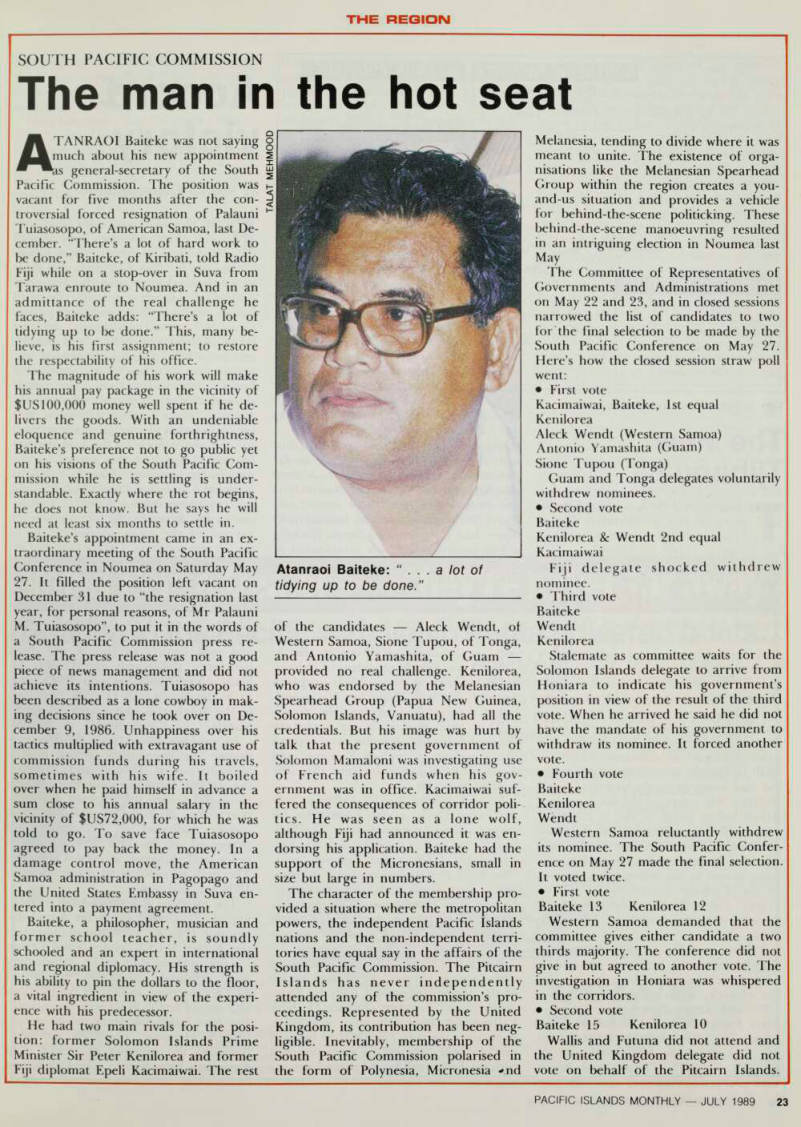
South Pacific Commission
The man in the hot seat
ATANRAOI Baiteke was not saying much about his new appointment as general-secretary of the South Pacific Commission. The position was vacant for five months after the con troversial forced resignation of Palauni Tuiasosopo, of American Samoa, last De cember. “There’s a lot of hard work to be done,” Baiteke, of Kiribati, told Radio Fiji while on a stop-over in Suva from Tarawa enroute to Noumea. And in an admittance of the real challenge he faces, Baiteke adds: “There’s a lot of tidying up to be done.” This, many be lieve, is his first assignment; to restore the respectability of his office.
The magnitude of his work will make his annual pay package in the vicinity of SUS 100,000 money well spent if he de livers the goods. With an undeniable
eloquence and genuine forthrightness,
Baiteke’s preference not to go public yet on his visions of the South Pacific Com mission while he is settling is under standable. Exactly where the rot begins, he does not know. But he says he will need at least six months to settle in.
Baiteke’s appointment came in an ex traordinary meeting of the South Pacific Conference in Noumea on Saturday May 27. It filled the position left vacant on December 31 due to “the resignation last year, for personal reasons, of Mr Palauni M. Tuiasosopo”, to put it in the words of a South Pacific Commission press re lease. The press release was not a good piece of news management and did not achieve its intentions. Tuiasosopo has been described as a lone cowboy in mak ing decisions since he took over on De cember 9, 1986. Unhappiness over his tactics multiplied with extravagant use of commission funds during his travels, sometimes with his wife. It boiled over when he paid himself in advance a sum close to his annual salary in the vicinity of $U572,000, for which he was told to go. To save face Tuiasosopo agreed to pay back the money. In a damage control move, the American Samoa administration in Pagopago and the United States Embassy in Suva en tered into a payment agreement.
Baiteke, a philosopher, musician and former school teacher, is soundly schooled and an expert in international and regional diplomacy. His strength is his ability to pin the dollars to the floor, a vital ingredient in view of the experi ence with his predecessor.
He had two main rivals for the posi tion: former Solomon Islands Prime Minister Sir Peter Kenilorea and former Fiji diplomat Epeli Kacimaiwai. The rest
of the candidates Aleck Wendt, of Western Samoa, Sione Tupou, of Tonga, and Antonio Yamashita, of Guam provided no real challenge. Kenilorea, who was endorsed by the Melanesian Spearhead Group (Papua New Guinea, Solomon Islands, Vanuatu), had all the credentials. But his image was hurt by talk that the present government of Solomon Mamaloni was investigating use of French aid funds when his gov ernment was in office. Kacimaiwai suf fered the consequences of corridor poli tics. He was seen as a lone wolf, although Fiji had announced it was en dorsing his application. Baiteke had the support of the Micronesians, small in size but large in numbers.
The character of the membership pro vided a situation where the metropolitan powers, the independent Pacific Islands nations and the non-independent terri tories have equal say in the affairs of the South Pacific Commission. The Pitcairn Islands has never independently attended any of the commission’s pro
ceedings. Represented by the United
Kingdom, its contribution has been neg
ligible. Inevitably, membership of the
South Pacific Commission polarised in the form of Polynesia, Micronesia *nd
Melanesia, tending to divide where it was meant to unite. The existence of orga nisations like the Melanesian Spearhead Group within the region creates a you and-us situation and provides a vehicle for behind-the-scene politicking. These behind-the-scene manoeuvring resulted in an intriguing election in Noumea last
May
The Committee of Representatives of Governments and Administrations met on May 22 and 23, and in closed sessions narrowed the list of candidates to two for the final selection to be made by the South Pacific Conference on May 27.
Here’s how the closed session straw poll went: • First vote Kacimaiwai, Baiteke, Ist equal Kenilorea Aleck Wendt (Western Samoa) Antonio Yamashita (Guam)
Sione Tupou (Tonga)
Guam and Tonga delegates voluntarily withdrew nominees. • Second vote Baiteke Kenilorea & Wendt 2nd equal Kacimaiwai
Fiji delegate shocked withdrew
nominee. • Third vote Baiteke Wendt Kenilorea Stalemate as committee waits for the Solomon Islands delegate to arrive from Honiara to indicate his government’s position in view of the result of the third vote. When he arrived he said he did not have the mandate of his government to withdraw its nominee. It forced another vote. • Fourth vote Baiteke Kenilorea Wendt Western Samoa reluctantly withdrew its nominee. The South Pacific Confer ence on May 27 made the final selection.
It voted twice. • First vote Baiteke 13 Kenilorea 12 Western Samoa demanded that the committee gives either candidate a two thirds majority. The conference did not give in but agreed to another vote. The investigation in Honiara was whispered in the corridors. • Second vote Baiteke 15 Kenilorea 10 Wallis and Futuna did not attend and the United Kingdom delegate did not vote on behalf of the Pitcairn Islands.
Talat Mehmood
Atanraoi Baiteke: “... a lot of tidying up to be done."
Tjibaou?
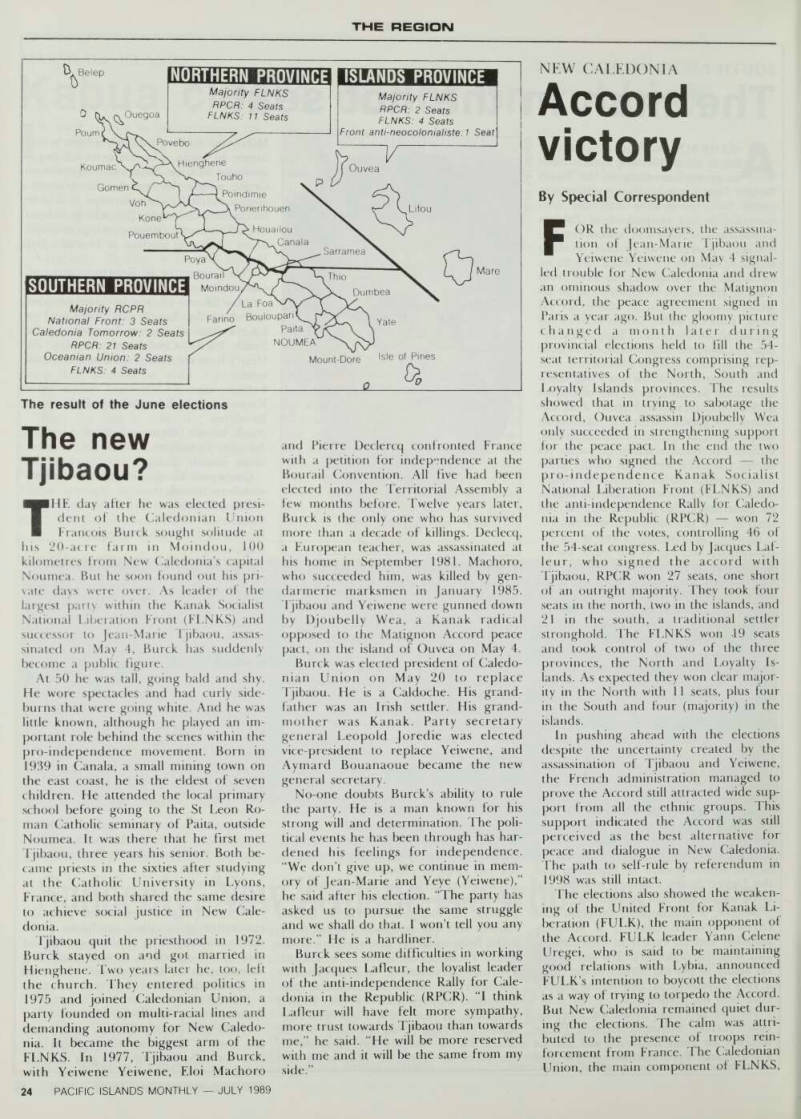
The new Tjibaou?
THE day after he was elected presi dent of the Caledonian Union Francois Burck sought solitude at his 20-acre farm in Moindou, 100 kilometres from New Caledonia’s capital Noumea. But he soon found out his pri vate days were over. As leader of the largest party within the Kanak Socialist National Liberation Front (FLNKS) and successor to Jean-Marie Tjibaou, assas sinated on May 4, Burck has suddenly
become a public figure.
At 50 he was tall, going bald and shy.
He wore spectacles and had curly side burns that were going white. And he was little known, although he played an im portant role behind the scenes within the pro-independence movement. Born in 1939 in Canala, a small mining town on the east coast, he is the eldest of seven children. He attended the local primary school before going to the St Leon Ro man Catholic seminary of Paita, outside Noumea. It was there that he first met Tjibaou, three years his senior. Both be came priests in the sixties after studying at the Catholic University in Lyons, France, and both shared the same desire to achieve social justice in New Cale donia.
Tjibaou quit the priesthood in 1972.
Burck stayed on and got married in Hienghene. Two years later he, too, left the church. They entered politics in 1975 and joined Caledonian Union, a party founded on multi-racial lines and demanding autonomy for New Caledo nia. It became the biggest arm of the FLNKS. In 1977, Tjibaou and Burck, with Yeiwene Yeiwene, Eloi Machoro
and Pierre Declercq confronted France with a petition for independence at the Bourail Convention. All five had been elected into the Territorial Assembly a few months before. Twelve years later, Burck is the only one who has survived more than a decade of killings. Declecq, a Furopean teacher, was assassinated at his home in September 1981. Machoro, who succeeded him, was killed by gen darmerie marksmen in January 1985.
Tjibaou and Yeiwene were gunned down by Djoubelly Wea, a Kanak radical opposed to the Matignon Accord peace pact, on the island of Ouvea on May 4.
Burck was elected president of Caledo nian Union on May 20 to replace Tjibaou. He is a Caldoche. His grand father was an Irish settler. His grand mother was Kanak. Party secretary
general Leopold Joredie was elected
vice-president to replace Yeiwene, and Aymard Bouanaoue became the new
general secretary.
No-one doubts Burck’s ability to rule the party. He is a man known for his strong will and determination. The poli tical events he has been through has har dened his feelings for independence.
“We don’t give up, we continue in mem ory of Jean-Marie and Yeye (Yeiwene),” he said after his election. “The party has asked us to pursue the same struggle and we shall do that. I won’t tell you any more.” He is a hardliner.
Burck sees some difficulties in working with Jacques Lafleur, the loyalist leader of the anti-independence Rally for Cale donia in the Republic (RPCR). “I think Lafleur will have felt more sympathy, more trust towards Tjibaou than towards me,” he said. “He will be more reserved with me and it will be the same from my side.”
The result of the June elections
victory
New Caledonia
Accord victory
By Special Correspondent
FOR the doomsayers, the assassina tion of Jean-Marie Tjibaou and Yeiwene Yeiwene on May 4 signal led trouble for New Caledonia and drew an ominous shadow over the Matignon Accord, the peace agreement signed in Paris a year ago. But the gloomy picture changed a month later during provincial elections held to fill the 54seat territorial Congress comprising rep resentatives of the North, South and Loyalty Islands provinces. The results showed that in trying to sabotage the Accord, Ouvea assassin Djoubelly Wea only succeeded in strengthening support for the peace pact. In the end the two parties who signed the Accord the pro-independence Kanak Socialist National Liberation Front (FLNKS) and the anti-independence Rally for Caledo nia in the Republic (RPCR) won 72 percent of the votes, controlling 46 of the 54-seat congress. Led by Jacques Laf leur, who signed the accord with Tjibaou, RPCR won 27 seats, one short of an outright majority. They took four seats in the north, two in the islands, and 21 in the south, a traditional settler stronghold. The FLNKS won -19 seats and took control of two of the three provinces, the North and Loyalty Is lands. As expected they won clear major ity in the North with 11 seats, plus four in the South and four (majority) in the islands.
In pushing ahead with the elections despite the uncertainty created by the assassination of Tjibaou and Yeiwene, the French administration managed to prove the Accord still attracted wide sup port from all the ethnic groups. This support indicated the Accord was still perceived as the best alternative for peace and dialogue in New Caledonia.
The path to self-rule by referendum in 1998 was still intact.
The elections also showed the weaken ing of the United Front for Kanak Li beration (FULK), the main opponent of the Accord. FULK leader Yann Celene Uregei, who is said to be maintaining good relations with Lybia, announced FULK’s intention to boycott the elections as a way of trying to torpedo the Accord.
But New Caledonia remained quiet dur ing the elections. The calm was attri buted to the presence of troops rein forcement from France. The Caledonian Union, the main component of FLNKS,
also organised militant groups to help the troops, especially on Lifou, the main island in the Loyalties, where FULK had its greatest support.
Does this mean that the main rivals of Caledonian Union will now disappear
from the political stage? Unlikely. Many
will continue to remain and will not trust the Accord and the lack of absolute guarantee for independence under its terms. The Kanak Liberation Party (PALIKA), the second biggest party in FLNKS, for example, accused Caledo nian Union officials of selfishness be cause the two Kanak provincial presi dents Leopold Joredie (North) and Richard Kaloi (Loyalty Islands), and three of the four vice-presidents be long to Caledonian Union. PALIKA’s attitude is worrying those keen to main tain unity in the wake of Tjibaou’s death.
Tjibaou’s dream was to take advantage of the time allowed in the 10-year interm period leading up to the referendum in 1998 to instill confidence in the ability of the Kanaks to effectively manage an in dependent New Caledonia. He was to embark on an extensive programme of economic development, training and re form to prepare the Kanaks for inde pendence. He knew that only by proving their ability to government their own
affairs were the Kanaks likely to gain confidence, and votes, in those now
opposed to independence. Francois
Burck, who succeeds him as president of Caledonian Union, will undoubtedly fol low the same path. Lafleur, on the other hand, is confident his success in the economically developed South will give him the ground from where he can show by example the benefits of remain ing within the economic umbrella of Prance. But he has missed his biggest clout by losing that absolute majority in the Congress by a vote.
Lafleur knew the significance of the result of the elections. He offered “to continue ... We shall consolidate the peace and continue our policy for ba lance and justice. If they wish to work in this spirit, all the elected members of the Congress will be welcome. The Caledo nian (Union) understood the indepen dentists were sincere when they signed the Matignon Accord and they also understood the RPCR wanted peace”.
Burck was almost overwhelmed with joy and paid tribute to the spirit of Tjibaou.
“Jean-Marie Tjibaou will be happy tonight,” he said as his party celebrated after the elections on Sunday night, June 11. “Voters understood the importance of the stakes of the Matignon Accord.”
One of the surprises of the election was the political shift of the Wallisian and Futunian community settled in New Caledonia as workers during the nickle boom of the sixties. Their population of 15,000 amount to 10 percent of the total population of the territory. Traditionally they supported RPCR which gave them economic and political security in the set tler-dominated South. But because of uncertainty over their residence after in dependence, they formed the Oceanian Union to talk directly to the Kanaks.
I hey have refused to take a precise stand on the independence issue although they feel closer to the Kanaks than to the Europeans. Oceanian Union won two seats in the South, or 40 per cent of the communal votes. This shift is crucial during the 1998 referendum be cause people from Wallis and Futuna are likely to swing in favour of the Kanaks
and independence.
• Simon Loueckhote, a 32-year-old Kanak opposed to independence was elected on June 26 chairman of a new territorial Congress, with the aid of votes from the extreme-right National Front.
Loueckhote, a member of the Rally for Caledonia in the Republic (RPCR) party, won 29 votes out of the 53. □
Advertisements & other items, p. 25 (1 item)
Volvo Renta Dealers —they’re never far away.
Boating in the Pacific with Volvo Renta powered boats.
I Papua
[New Guinea
I Guam
4 PENTA
Solomon Is.
PENT* £
New V Caledonia Australia New Zealand Papua New Guinea Aqua Service Marine PO Box 7, Lae Phone: 42 2587 Solomon Islands Melanesia Holdings Ltd PO Box 173, Honiara Phone: 23749 F '|i ■W.Ui •• * Tahiti
When you cruise through the Pacific,
rest assured that an authorised Volvo
Renta service centre is never far away.
Volvo Penta are supported by a truly
international network of dedicated
service dealers, with factory trained
personnel and genuine Volvo
Penta parts to protect your
investment. Dealers are
strategically located in the
Pacific area so you don’t have
to detour from course or
back-track.
Fiji Leebrown Ltd PO Box 1081, Suva Phone: 25795 New Caledonia N. Johnston + Cie BP 52, Noumea Phone: 272697 Tahiti Comptoir Polynesian BP 628, Papeete Phone: 28027 Guam Pacific Orient Company PO Box 6247, Tamuning Phone: 646 1400 S-405 08 Gothenberg, Sweden Telex 20755 S
businessman, Z Vl hal
Vanuatu
Vila's big drug bust
. . • i .
VANUATU has been identified as part of the heroin route be tween Asia and Australia fol lowing drug seizures in both Sydney and Port Vila. The seizures, worth more than SA6O million revealed that the heroin SAhU million, revealed that the heroin apparently was carried m a mini-bus by Ship to Pori Vila, then transhipped by container to Sydney.
For reasons neither the Vanuatu oolice nor the Australian Federal Police Sn determine sS auamides of he
Tere aICdW “eft in
theZini bus Vanuatu nohce sav a local
businessman, Z Vl hal
been charged with offences relating to the drug smuggling. The quantity of the drugs found in the mini-bus was compa ratively small about 800 grams, with a street value of less than SUSI million.
Vanuatu’s deputy police commissioner
has been quoted as saying that Vanuatu has been used as a staging post for ship ments of heroin to Australia.
That route may now be broken follow
ing the arrests in Sydney and Port Vila.
Australian police believe they have pene trated one of Hong Kong’s most impor tant triad gangs following the seizure of
the 50 kilogram shipment in Sydney.
The operation against the drug runners
was dearly well-organised.
It seems that the shipment was orga nised by the Big Circle triad gang in Hong Kong after they had imported the
drugs from Thailand. Fifty-six premises
were raided in Hong Kong and five men arrested. The heroin then went to Vanuatu where it was loaded on board the Hong Kong-registered ship Nimos and arrived in Sydney in the first week of May, according to the Australian police. Then homes and restaurants in Sydney and Melbourne were raided where several Asian men were captured,
along with handguns and cash, police
have alleged.
The Australian Federal Police officer
in charge of the operation, Superinten
dent Cliff Foster, said the raids followed months of surveillance. He said the arrests had dented the image and finan cial backbone of the Big Circle Gang, which rivals the 14K Triads.
“We’re alleging that two of them were probably just below the top man. They
were wholesalers. They were actually going to sell the drugs that gives us reason to believe we’ve hit the top,” said
Superintendent Foster.
The discovery of the drugs which had come via Vanuatu had been preceded on May 2 when two Asian men were arrested in Sydney after 10.3 kg of he roin had been found in a suitcase in a
Qantas jet cargo hold.
The drugs which allegedly were ship
ped aboard Nimos were found in a re frigerator in a house in an inner Sydney suburb. The heroin was high grade and almost pure.
Meanwhile, drug enforcement agen cies fear a flood of heroin into Australia after a record crop in Asia’s Golden Triangle. Burmese sources estimate this year’s crop at 4.5 tonnes of heroin that is three times the crop yield of last year. □
Advertisements & other items, p. 26 (2 items)
Forum seeks aid
for shipping line
THE Forum Secretariat in Suva is seek ing Japanese funding for a new ship for the regional shipping service, Pacific Forum Line.
The Pacific Islands Rely
ON THE ENERGY OF BORAL
3 w.\ All through the Pacific Islands, people rely on Boral Speed-E-Gas LP Gas for their energy needs.
Boral has terminals throughout the area, and is proud to be a leading supplier.
Speed-E-Gas is clean, efficient and low in cost.
It’s the ideal energy source for cooking and water heating in homes, motels and hotels, and for a wide range of industrial uses.
So call Boral. We have the energy you're looking for. llissiiiiii* Norfolk Island Norfolk Island 2419 Papua New Guinea Port Moresby 214248 Lae 42 2574 Rabaul 921225 Wewak 862125 Tonga Nukualofa 21388 Cook Islands Rarotonga 24460 American Samoa Pago Pago 633 2170 Fiji Suva 24035 Lautoka 60088 Sigatoka 50578 Labasa 82973 i
BORAL GAS
Vanuatu Santo 455 Port Vila 2046 Solomon Islands Honiara 21833 Boral Gas Limited, Bth Floor, IBM House, 168 Kent St., Sydney, NSW 2000. Tel: (02) 278512.
Land of the Dani
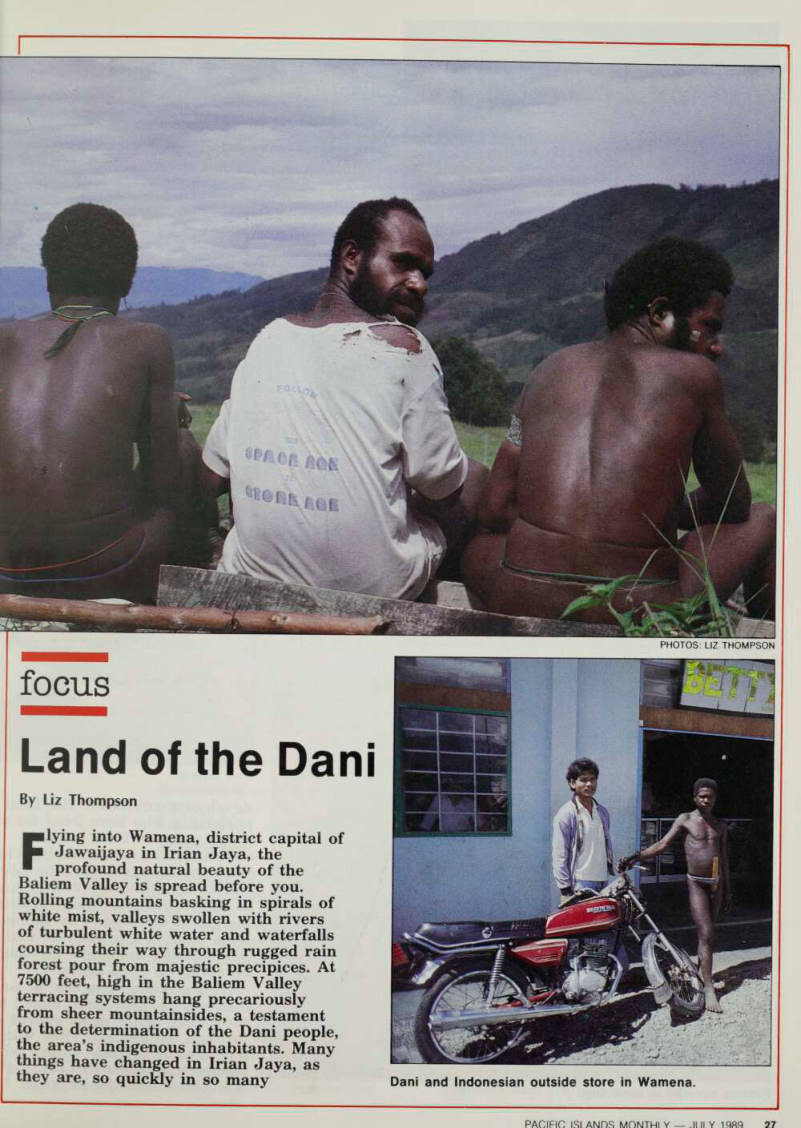
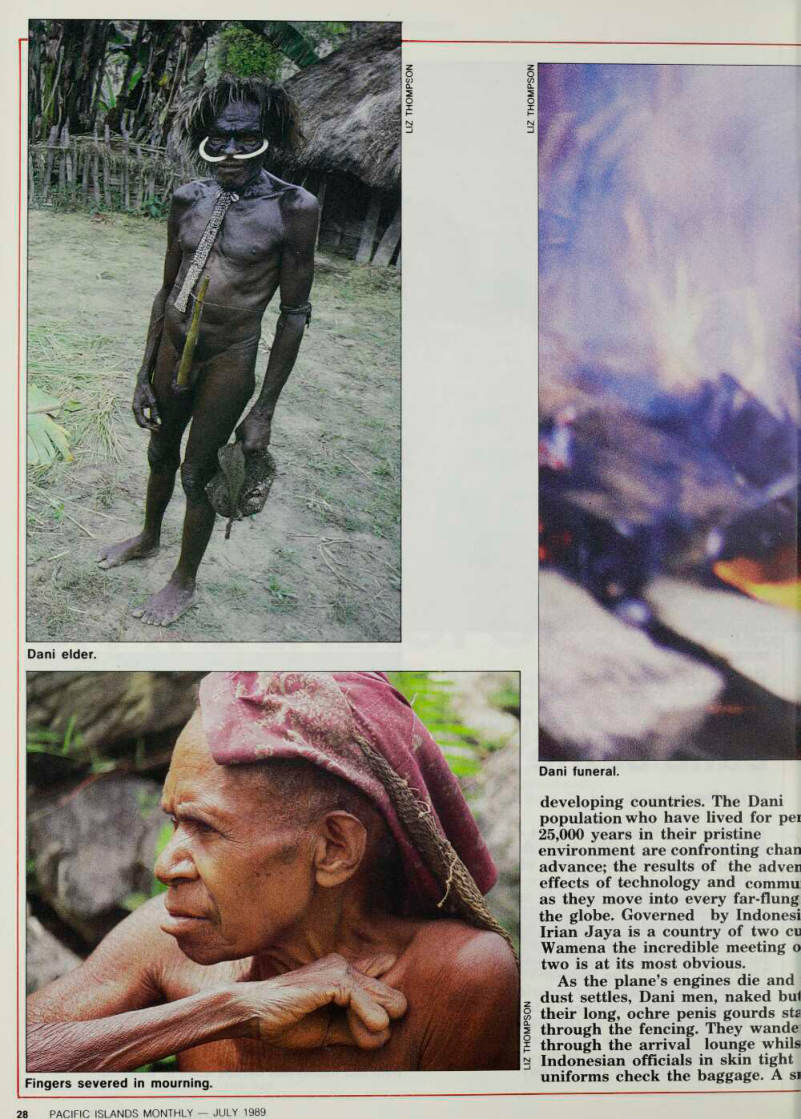
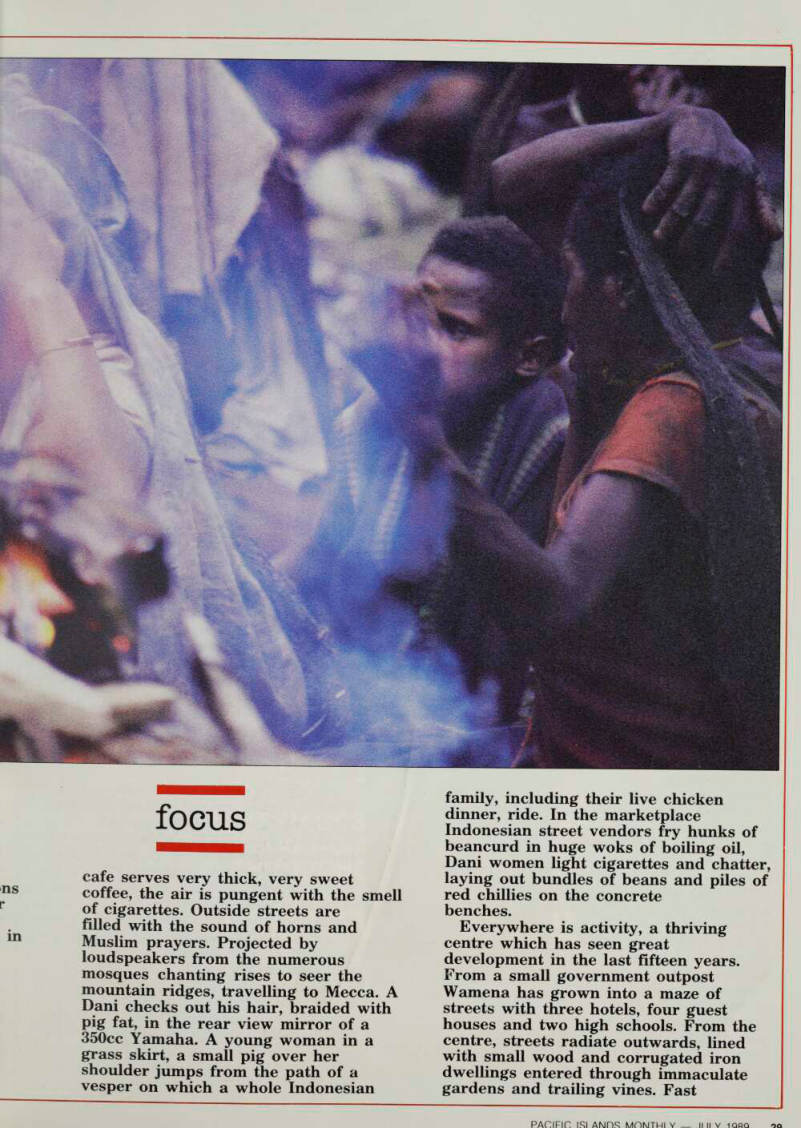
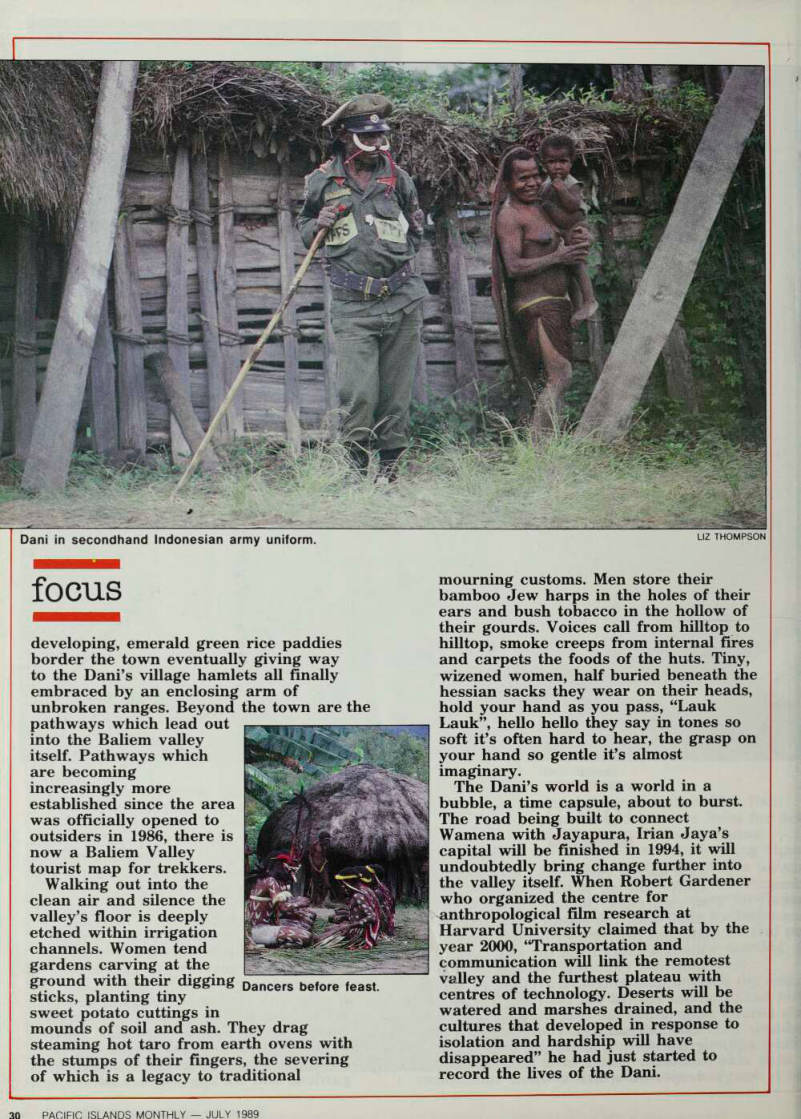
focus
By Liz Thompson
Flying into Wamena, district capital of Jawaijaya in Irian Jaya, the profound natural beauty of the Baliem Valley is spread before you.
Rolling mountains basking in spirals of white mist, valleys swollen with rivers of turbulent white water and waterfalls coursing their way through rugged rain forest pour from majestic precipices. At 7500 feet, high in the Baliem Valley terracing systems hang precariously from sheer mountainsides, a testament to the determination of the Dani people, the area’s indigenous inhabitants. Many things have changed in Irian Jaya, as they are, so quickly in so many
Photos: Liz Thompson
Dani and Indonesian outside store in Wamena.
developing countries. The Dani population who have lived for pei 25,000 years in their pristine environment are confronting chan advance; the results of the adven effects of technology and commu as they move into every far-flung the globe. Governed by Indonesi Irian Jay a is a country of two cu Wamena the incredible meeting o two is at its most obvious.
As the plane’s engines die and dust settles, Dani men, naked bul their long, ochre penis gourds sta through the fencing. They wande through the arrival lounge whils Indonesian officials in skin tight uniforms check the baggage. A si
Dani elder.
Fingers severed in mourning.
Dani funeral.
Liz Thompson
Liz Thompson
Liz Thompson
ns r in
cafe serves very thick, very sweet coffee, the air is pungent with the smell of cigarettes. Outside streets are filled with the sound of horns and Muslim prayers. Projected by loudspeakers from the numerous mosques chanting rises to seer the mountain ridges, travelling to Mecca. A Dani checks out his hair, braided with pig fat, in the rear view mirror of a 350 cc Yamaha. A young woman in a grass skirt, a small pig over her shoulder jumps from the path of a vesper on which a whole Indonesian
family, including their live chicken dinner, ride. In the marketplace Indonesian street vendors fry hunks of beancurd in huge woks of boiling oil, Dani women light cigarettes and chatter, laying out bundles of beans and piles of red chillies on the concrete benches.
Everywhere is activity, a thriving centre which has seen great development in the last fifteen years.
From a small government outpost Wamena has grown into a maze of streets with three hotels, four guest houses and two high schools. From the centre, streets radiate outwards, lined with small wood and corrugated iron dwellings entered through immaculate gardens and trailing vines. Fast
developing, emerald green rice paddies border the town eventually giving way to the Dani’s village hamlets all finally embraced by an enclosing arm of unbroken ranges. Beyond the town are the
pathways which lead out into the Baliem valley itself. Pathways which
are becoming
increasingly more established since the area was officially opened to outsiders in 1986, there is now a Baliem Valley tourist map for trekkers.
Walking out into the clean air and silence the valley’s floor is deeply etched within irrigation channels. Women tend gardens carving at the
ground with their digging Dancer s before feast. sticks, planting tiny sweet potato cuttings in mounds of soil and ash. They drag steaming hot taro from earth ovens with the stumps of their fingers, the severing of which is a legacy to traditional
mourning customs. Men store their bamboo Jew harps in the holes of their ears and bush tobacco in the hollow of their gourds. Voices call from hilltop to hilltop, smoke creeps from internal fires and carpets the foods of the huts. Tiny, wizened women, half buried beneath the hessian sacks they wear on their heads, hold your hand as you pass, “Lauk Lauk”, hello hello they say in tones so soft it’s often hard to hear, the grasp on your hand so gentle it’s almost imaginary.
The Dani’s world is a world in a bubble, a time capsule, about to burst.
The road being built to connect Wamena with Jayapura, Irian Jaya’s capital will be finished in 1994, it will undoubtedly bring change further into the valley itself. When Robert Gardener who organized the centre for anthropological film research at Harvard University claimed that by the year 2000, ‘Transportation and communication will link the remotest valley and the furthest plateau with centres of technology. Deserts will be watered and marshes drained, and the cultures that developed in response to isolation and hardship will have disappeared” he had just started to record the lives of the Dani.
Liz Thompson
Dani in secondhand Indonesian army uniform.
Advertisements & other items, pp. 29-31 (2 items)
focus
29
PACIFIC ISI ANDS MDMTHI Y .11 II V IQ«Q
Pacific
ISLANDS
M O
EIGHT PAGES OF BUSINESS AND
FINANCIAL NEWS FROM
THROUGHOUT THE PACIFIC
EDITED BY ROBIN BROMBY
Garments war enters new phase
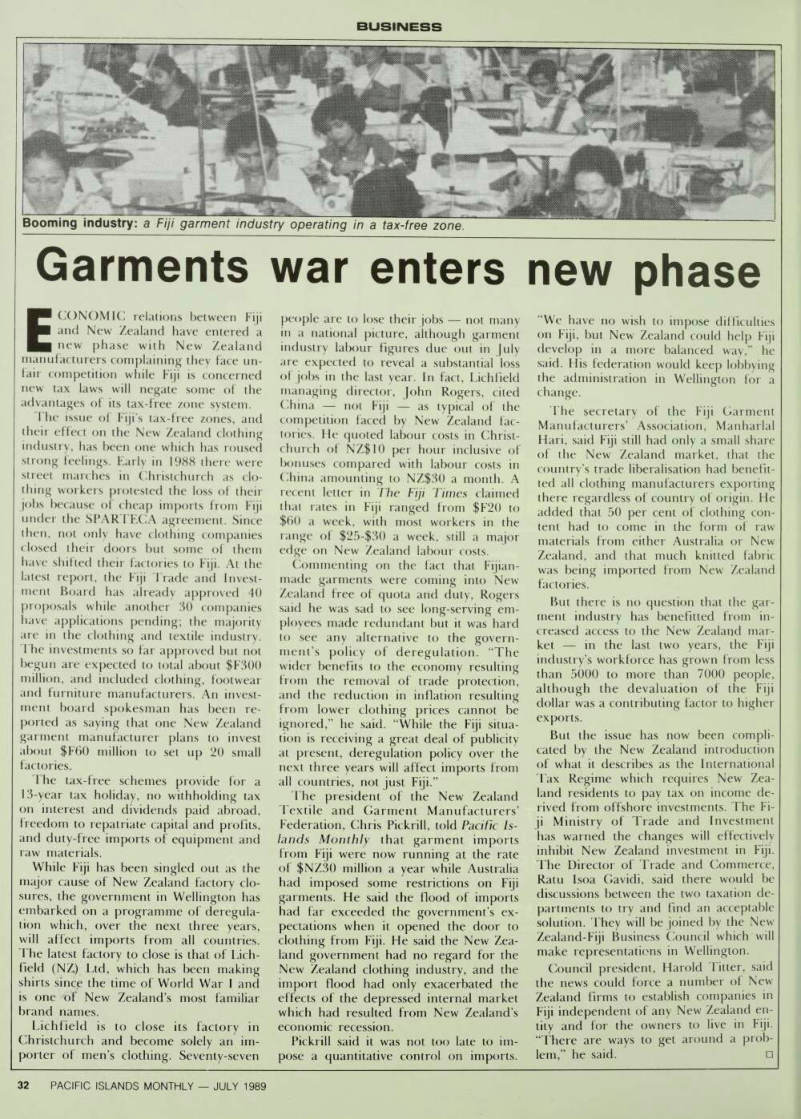
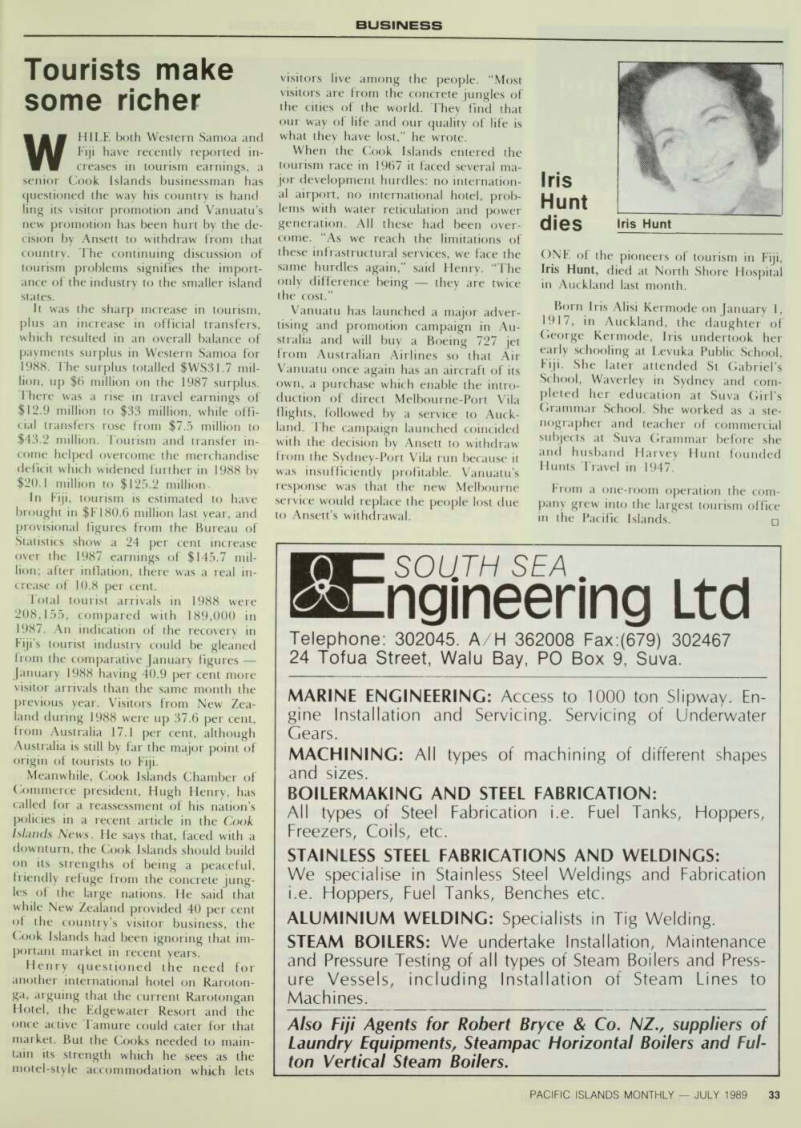
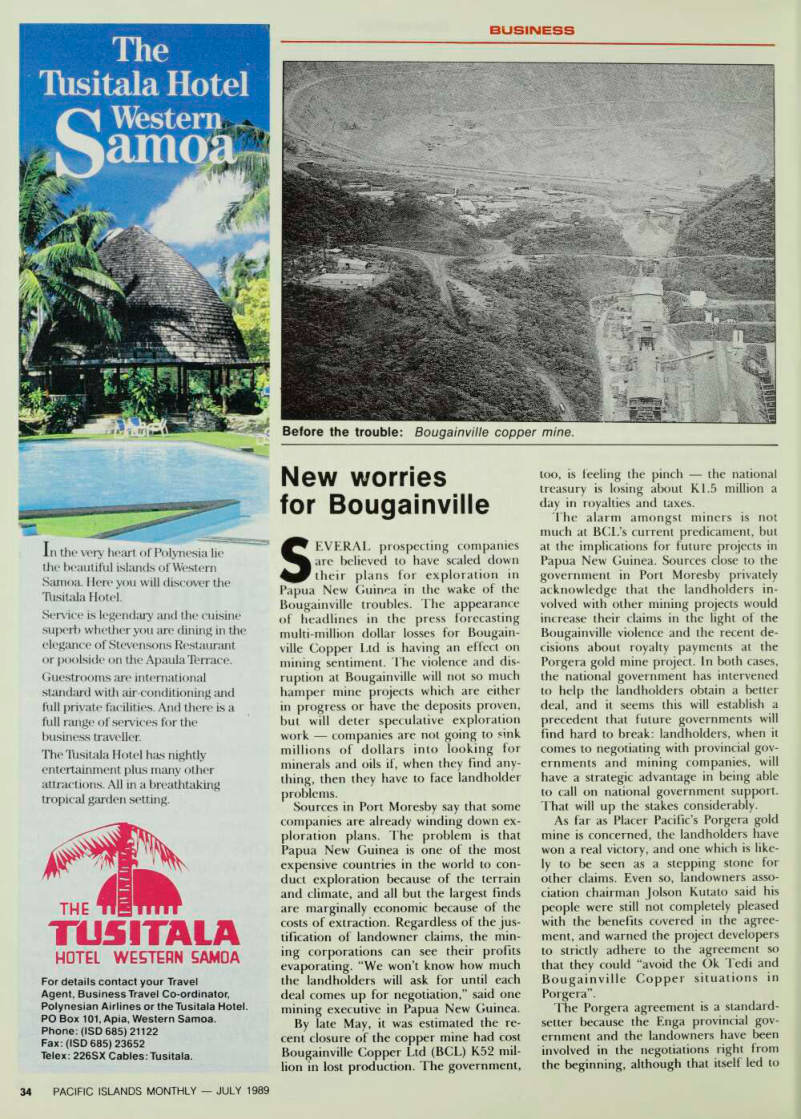
Business
ECONOMIC relations between Fiji
and New Zealand have entered a new phase with New Zealand manufacturers complaining they face un fair competition while Fiji is concerned new tax laws will negate some of the advantages of its tax-free zone system.
The issue of Fiji’s tax-free zones, and their effect on the New Zealand clothing industry, has been one which has roused strong feelings. Early in 1988 there were street marches in Christchurch as clo thing workers protested the loss of their jobs because of cheap imports from Fiji under the SPARFECA agreement. Since
then, not only have clothing companies
closed their doors but some of them have shifted their factories to Fiji. At the latest report, the Fiji Trade and Invest ment Board has already approved 40 proposals while another 30 companies
have applications pending; the majority
are in the clothing and textile industry.
I he investments so far approved but not begun are expected to total about SF3OO million, and included clothing, footwear and furniture manufacturers. An invest ment board spokesman has been re ported as saying that one New Zealand garment manufacturer plans to invest about SF6O million to set up 20 small factories.
The tax-free schemes provide for a
13-year tax holiday, no withholding tax
on interest and dividends paid abroad,
freedom to repatriate capital and profits,
and duty-free imports of equipment and
raw materials.
While Fiji has been singled out as the major cause of New Zealand factory clo sures, the government in Wellington has embarked on a programme of deregula tion which, over the next three years, will affect imports from all countries.
The latest factory to close is that of Lich field (NZ) Ltd, which has been making shirts since the time of World War I and is one of New Zealand’s most familiar brand names.
Lichfield is to close its factory in Christchurch and become solely an im porter of men’s clothing. Seventy-seven
people are to lose their jobs not many in a national picture, although garment industry labour figures due out in July are expected to reveal a substantial loss of jobs in the last year. In fact, Lichfield
managing director, John Rogers, cited
China not Fiji as typical of the competition faced by New Zealand fac tories. He quoted labour costs in Christ church of NZ$lO per hour inclusive of bonuses compared with labour costs in China amounting to NZ$3O a month. A recent letter in The Fiji Times claimed that rates in Fiji ranged from SF2O to $6O a week, with most workers in the range of $25-$3O a week, still a major edge on New Zealand labour costs.
Commenting on the fact that Fijian made garments were coming into New Zealand free of quota and duty, Rogers said he was sad to see long-serving em ployees made redundant but it was hard to see any alternative to the govern ment’s policy of deregulation. “The wider benefits to the economy resulting from the removal of trade protection, and the reduction in inflation resulting from lower clothing prices cannot be ignored,” he said. “While the Fiji situa tion is receiving a great deal of publicity at present, deregulation policy over the next three years will affect imports from all countries, not just Fiji.”
The president of the New Zealand Textile and Garment Manufacturers’
Federation, Chris Pickrill, told PaciTic Is lands Monthly that garment imports from Fiji were now running at the rate of SNZ3O million a year while Australia had imposed some restrictions on Fiji garments. He said the flood of imports had far exceeded the government’s ex pectations when it opened the door to clothing from Fiji. He said the New Zea land government had no regard for the New Zealand clothing industry, and the import flood had only exacerbated the effects of the depressed internal market which had resulted from New Zealand’s economic recession.
Pickrill said it was not too late to im pose a quantitative control on imports.
“We have no wish to impose difficulties on Fiji, but New Zealand could help Fiji develop in a more balanced way,” he said. His federation would keep lobbying the administration in Wellington for a
change.
The secretary of the Fiji Garment Manufacturers’ Association, Manharlal Hari, said Fiji still had only a small share of the New Zealand market, that the country’s trade liberalisation had benefit ted all clothing manufacturers exporting there regardless of country of origin. He added that 50 per cent of clothing con tent had to come in the form of raw materials from either Australia or New Zealand, and that much knitted fabric was being imported from New Zealand factories.
But there is no question that the gar ment industry has benefitted from in creased access to the New Zealand mar ket in the last two years, the Fiji industry’s workforce has grown from less than 5000 to more than 7000 people, although the devaluation of the Fiji dollar was a contributing factor to higher exports.
But the issue has now been compli cated by the New Zealand introduction of what it describes as the International Tax Regime which requires New Zea land residents to pay tax on income de rived from offshore investments. The Fi ji Ministry of Trade and Investment has warned the changes will effectively inhibit New Zealand investment in Fiji.
The Director of Trade and Commerce, Ratu Isoa Gavidi, said there would be discussions between the two taxation de partments to try and find an acceptable solution. They will be joined by the New Zealand-Fiji Business Council which will
make representations in Wellington.
Council president, Harold Titter, said the news could force a number of New Zealand firms to establish companies in Fiji independent of any New Zealand en tity and for the owners to live in Fiji.
“There are ways to get around a prob lem,” he said. □
Booming industry: a Fiji garment industry operating in a tax-free zone.
Tourists make
some richer
WHILE both Western Samoa and Fiji have recently reported in creases in tourism earnings, a senior Cook Islands businessman has questioned the way his country is hand ling its visitor promotion and Vanuatu’s new promotion has been hurt by the de cision by Ansett to withdraw from that country. The continuing discussion of
tourism problems signifies the import
ance of the industry to the smaller island states.
It was the sharp increase in tourism, plus an increase in official transfers, which resulted in an overall balance of payments surplus in Western Samoa for 1988. The surplus totalled SWS3I.7 mil lion, up $6 million on the 1987 surplus.
I here was a rise in travel earnings of $12.9 million to $33 million, while offi cial transfers rose from $7.5 million to $43.2 million. Tourism and transfer in come helped overcome the merchandise deficit which widened further in 1988 by $20.1 million to $125.2 million.
In Fiji, tourism is estimated to have brought in $F 180.6 million last year, and provisional figures from the Bureau of Statistics show a 24 per cent increase over the 1987 earnings of $145.7 mil lion; after inflation, there was a real in crease of 10.8 per cent.
Total tourist arrivals in 1988 were 208,155, compared with 189,000 in 1987. An indication of the recovery in
Fiji’s tourist industry could be gleaned
from the comparative January figures
January 1988 having 40.9 per cent more visitor arrivals than the same month the previous year. Visitors from New Zea land during 1988 were up 37.6 per cent, from Australia 17.1 per cent, although Australia is still by far the major point of origin of tourists to Fiji.
Meanwhile, Cook Islands Chamber of
Commerce president, Hugh Henry, has
called for a reassessment of his nation’s policies in a recent article in the Cook Islands News. He says that, faced with a downturn, the Cook Islands should build on its strengths of being a peaceful,
friendly refuge from the concrete jung
les of the large nations. He said that while New Zealand provided 40 per cent of the country’s visitor business, the Cook Islands had been ignoring that im portant market in recent years.
Henry questioned the need for another international hotel on Raroton ga, arguing that the current Rarotongan Hotel, the Edgewater Resort and the once active Tamure could cater for that market. But the Cooks needed to main tain its strength which he sees as the motel-style accommodation which lets
visitors live among the people. “Most visitors are from the concrete jungles of the cities of the world. They find that our way of life and our quality of life is what they have lost,” he wrote.
When the Cook Islands entered the tourism race in 1967 it faced several ma jor development hurdles: no internation al airport, no international hotel, prob lems with water reticulation and power generation. All these had been over come. “As we reach the limitations of these infrastructural services, we face the same hurdles again,” said Henry. “The
only difference being they are twice
the cost.”
Vanuatu has launched a major adver tising and promotion campaign in Au stralia and will buy a Boeing 727 jet from Australian Airlines so that Air Vanuatu once again has an aircraft of its own, a purchase which enable the intro duction of direct Melbourne-Port Vila flights, followed by a service to Auck land. Ihe campaign launched coincided with the decision by Ansett to withdraw from the Sydney-Port Vila run because it
was insufficiently profitable. Vanuatu’s
response was that the new Melbourne service would replace the people lost due to Ansett’s withdrawal.
ONE of the pioneers of tourism in Fiji, Iris Hunt, died at North Shore Hospital in Auckland last month.
Bo™ Iris A,isi Kermode on January 1, ‘ ’ ln Auckland, the daughter of (,eor g e Kermode, Iris undertook her ar V schooling at Levuka Public School, ¥*•{*• l aler attended St Gabriel’s School Waverley in Sydney and com- J? etec her education at Suva Girl’s Grammar Sch °ol. She worked as a ste nograPher and teacher of commercial sub J ects at Su va Grammar before she and husband Harvey Hunt founded Hunts I ravel in 1947.
From a one-room operation the corn pany grew into the largest tourism office in the Pacific Islands. n
Iris Hunt dies
Iris Hunt
New worries
for Bougainville
SEVERAL prospecting companies
are believed to have scaled down their plans for exploration in Papua New Guinea in the wake of the Bougainville troubles. The appearance of headlines in the press forecasting multi-million dollar losses for Bougain ville Copper Ltd is having an effect on mining sentiment. The violence and dis ruption at Bougainville will not so much hamper mine projects which are either in progress or have the deposits proven, but will deter speculative exploration work companies are not going to sink millions of dollars into looking for minerals and oils if, when they find any thing, then they have to face landholder
problems.
Sources in Port Moresby say that some companies are already winding down ex
ploration plans. The problem is that
Papua New Guinea is one of the most expensive countries in the world to con duct exploration because of the terrain and climate, and all but the largest finds are marginally economic because of the costs of extraction. Regardless of the jus tification of landowner claims, the min ing corporations can see their profits evaporating. “We won’t know how much the landholders will ask for until each deal comes up for negotiation,” said one mining executive in Papua New Guinea.
By late May, it was estimated the re cent closure of the copper mine had cost Bougainville Copper Ltd (BCL) K 52 mil lion in lost production. The government,
too, is feeling the pinch the national treasury is losing about K 1.5 million a day in royalties and taxes.
The alarm amongst miners is not much at BCL’s current predicament, but at the implications for future projects in Papua New Guinea. Sources close to the government in Port Moresby privately acknowledge that the landholders in volved with other mining projects would increase their claims in the light of the Bougainville violence and the recent de cisions about royalty payments at the Porgera gold mine project. In both cases, the national government has intervened to help the landholders obtain a better deal, and it seems this will establish a precedent that future governments will find hard to break: landholders, when it comes to negotiating with provincial gov ernments and mining companies, will have a strategic advantage in being able to call on national government support.
That will up the stakes considerably.
As far as Placer Pacific’s Porgera gold mine is concerned, the landholders have won a real victory, and one which is like ly to be seen as a stepping stone for other claims. Even so, landowners asso ciation chairman Jolson Kutato said his
people were still not completely pleased
with the benefits covered in the agree ment, and warned the project developers to strictly adhere to the agreement so that they could “avoid the Ok Tedi and
Bougainville Copper situations in
Porgera”.
The Porgera agreement is a standard setter because the Enga provincial gov ernment and the landowners have been involved in the negotiations right from the beginning, although that itself led to
Before the trouble: Bougainville copper mine.
the agreement taking much longer than expected.
The landholders won 20 per cent of the royalty instead of the five per cent originally offered, which should mean that they will receive about KlO million, There will also be a 2.49 per cent equity share of operating profit, compensation payments of about Kl 5 million, relocation of Kl 6 million, employment of about 500 Porgera people on the project, a new hospital, a new international primary school, high school and vocational centre and a K 4 million grant for the construction of community facilities in the Progera district.
The national government is expected to receive K 589 million in taxes during the life of the project, K 49 million as royalty, 70 per cent of taxes to be paid in the first eight years, personal taxes from mine workers of about K7O milhon. The Enga provincial government’s share of the royalty will come to just under K4O million, K 39 million in a special support grant, 2.49 per cent of the profit from the mine which will double if the provincial government takes up an option to purchase additional equity.
The mine, during its lifetime, is expected to produce K 3900 million in gold.
The big question is whether the settlement will seem as good in future years when, or if, other landholder groups manage to extract even better deals, Since independence, there has been a growing feeling among the people that they were not getting a big enough share of resources projects. While the national government has reaped huge amounts from mining, this income was not generally seen by the people as directly benefiting them. What the government was getting did not satisfy the needs of the landholders.
A constant problem has been that the laws of Papua New Guinea set down the mining and royalty laws, but the politicians have constantly egged on their constituents, telling them that they should agitate for a greater share of the mining pie. The politicians have rolled the pork barrel and made their contribution to the rising expectations of the landowners. The mining companies were particularly alarmed at the Porgera negotialions, when the Enga government would make a deal with the national government, then come back with fresh demands.
I he risk is not so much in terms of the proven mineral or oil deposits: CRA Ltd, for example, is proceeding with its
Haiden Valley gold prospect despite the
demands earlier this year from the Wau people for K 4 million compensation and free equity in the project (the Lihir mine will similarly go ahead). At the time, business people in Port Moresby were
alarmed especially by the new element the demand for free equity because even the national government had not received this in the past. The govern ment’s share in mineral extraction, or oil, was paid for either directly or through forgoing income until the share was paid. Yet in the Porgera case, this very principle of free equity has been established and will surely be part of fu ture mining or oil agreements, There is hardly likely to be any com pany announcements about the scaling down of exploration activity the corn panics do not want to prejudice their relationship with the government or cre ate future problems with landholders, But it seems certain that some explora tion programmes and plans have been shelved, or at least postponed. The new trend in landholder agreements will affect confidence among the grass-roots explorers which face costs astronomic even by world mining standards. A jung le seismic survey could cost up to $A60,000 a kilometre compared with $7OOO on mainland Australia. Helicopter companies charge up to SUS6OO a day and drilling one well for oil can swallow as much as SAIO million, In the Porgera case, the concessions were made from the national govern menfs share but what the mining com panics worry about is that demands in crease to the point where the companies will be expected to forgo part of their income from resources developments, True, the Bougainville deal was made before independence and was to the dis advantage of the traditional landowners, not to mention the massive environmen tal damage to the land and rivers around Bougainville, but the demarcation be tween that agreement and the economics of today’s new mines is likely to become blurred. What mining companies in Papua New Guinea are saying and their policies do not necessarily coincide with the PNG government’s is that in the next 10 years there will be a turn down in the amount of exploration work undertaken in Papua New Guinea, In his recent visit to Australia, Prime Minister Rabbie Namaliu stressed the difference between the colonial origins of the Bougainville agreement and the new Porgera deal, and that the latter would form the basis for future agree ments. He knows that confidence is a fragile thing and that the whole econo mic structure of his country is depen dent upon the mining and oil industries, But, now that the concessions have been made at Porgera, what is to stop others asking for more in the future, and will the frustration of these de mands lead to the frustration which has provoked the Bougainville troubles? □
Air Tungaru’s
737 hits snag
AIR 1 ungaru s planned new service between Hawaii and Kiribati has hit a snag the United States Federated Aviation Administration will not permit a Boeing 737 to fly the Christmas Island-Tarawa leg without an alternative airport. The airline is now in vestigating two ways to get around the problem: upgrading the airport at Can ton Island, which would meet the FAA’s objections, or try and find a Boeing 727 which, with three engines instead of the two-engined 737, would not require an alternative airfield on the four-hour haul to Tarawa.
The delay to the service, which was to have been operated by a leased Aloha Airlines 737, was announced by Kiribati’s Secretary for Transport and Com munications, Ikakeau Tonganibeia, who said the airport at Canton could not have been readied in time for the June inauguration of the new service.
Kiribati has been trying to find a new air link since Air Nauru’s 737 aircraft were grounded by New Zealand civil aviation authorities and the country has been dependent on a weekly Airline of the Marshall Islands Nadi-Funafuti- Tarawa-Majuro flight on which both pas senger and freight space is inadequate.
In 1979 Air Nauru had financed the lease of a 8727-100 QC aircaft to Air Tungaru so that the airline could estab lish an international air service but it soon racked up a SUSI million loss the problem, as with so many other car riers, was that Air Tungaru could not gain access to any of the more lucrative Pacific routes that were jealously guarded by the major international car riers. Air Tungaru had to sell the air craft.
The airstrip at Canton (spelled Kanton by the Kiribati government) Island is suitable for use by a 737, according to Air Tungaru. But it needs trees on either side of the runway to be cut down which is not a major problem and there is no fire truck on the island which is a major problem as one is re quired by FAA regulations. There would also need to be a refuelling facility.
The delay on the service is a headache for Air Tungaru. All the flights through to Christmas Island from Hawaii had been fully booked more than a month into the new schedule. There will also be a cargo backlog. When the services do get underway, Air Tungaru may have to offload some passengers in order to make space for all the fresh food which is required on Tarawa. □
Advertisements & other items, pp. 33-34 (2 items)
Engineering Ltd
c SOUJH SEA ,
Telephone: 302045. A/H 362008 Fax:(679) 302467 24 Tofua Street, Walu Bay, PO Box 9, Suva.
MARINE ENGINEERING: Access to 1000 ton Slipway. Engine Installation and Servicing. Servicing of Underwater Gears.
MACHINING: All types of machining of different shapes and sizes.
BOILERMAKING AND STEEL FABRICATION:
All types of Steel Fabrication i.e. Fuel Tanks, Hoppers, Freezers, Coils, etc.
STAINLESS STEEL FABRICATIONS AND WELDINGS:
We specialise in Stainless Steel Weldings and Fabrication i.e. Hoppers, Fuel Tanks, Benches etc.
ALUMINIUM WELDING: Specialists in Tig Welding.
STEAM BOILERS: We undertake Installation, Maintenance and Pressure Testing of all types of Steam Boilers and Pressure Vessels, including Installation of Steam Lines to Machines.
Also Fiji Agents for Robert Bryce & Co. NZ., suppliers of Laundry Equipments, Steampac Horizontal Boilers and Fulton Vertical Steam Boilers.
The
Thsitala Hotel
Western
amoa
c P* VL - »• 1*3 In the very heart of Polynesia lie the beautiful islands of Western Samoa. Here you will discover the Thsitala Hotel.
Service is legendary and the cuisine superb whether you are dining in the elegance of Stevensons Restaurant or poolside on the ApaulaTbrrace.
Guestrooms are international standard with air-conditioning and full private facilities. And there is a full range of services for the business traveller.
The Thsitala Hotel has nightly entertainment plus many other attractions. All in a breathtaking tropical garden setting.
THE
TUSITALA
HOTEL WESTERN SAMOA
For details contact your Travel Agent, Business Travel Co-ordinator, Polynesian Airlines or the Tusitala Hotel.
PO Box 101, Apia, Western Samoa.
Phone: (ISO 685) 21122 Fax: (ISO 685) 23652 Telex: 226SX Cables: Tusitala.
Business
Growing need
for indigenous businesses
By Grady Timmons
THE need for more indigenous businesses is a pressing concern in the Pacific islands. Recent history shows a heavy dependence on govern ment as the vehicle for development with less than satisfactory results. Now that government funds are in increasing ly short supply, Pacific island leaders are turning to the private sector to try to achieve a more balanced pattern of
growth. Indigenous businesses, say
many, are a key to making this happen.
Thus, the recent publication of Island Entrepreneurs: Problems and Perform ances in the Pacific, is timely and re ances in the Pacific, is timely and re levant. Edited by former Center Re search Associate Te’o I.J. Fairbairn, this book examines the major aspects of in
digenous entrepreneurship with emph
asis on the Cook Islands, Fiji, the Mar shall Islands, Papua New Guinea, Tonga and Western Samoa. It focuses on the motives of indigenous entrepreneurs for going into business, their training and educational backgrounds, their methods of operating and establishing businesses, and the reasons attributed to their suc cesses and failures.
According to Fairbairn, the potential of indigenous entrepreneurship is at the forefront of current development think ing. The reasons are many, but among
the most important, he says, is that
“strengthening indigenous island entrep
reneurship is necesssary if island peoples are to make a substantial contribution to the growth process.”
More indigenous businesses, he adds, “would help balance the economy, prom ote greater self-reliance and strengthen national identity and cohesion.”
The current situation, however, is far from encouraging. The private sector of most Pacific island economies is domin ated by non-indigenous entrepreneurs, primarily multinational firms which are active in such areas as manufacturing, mining, forestry, banking, tourism and
trading.
Fairbairn says that the indigenous business sector as it now exists is poorly
developed, essentially occupying the
periphery of the commercial sector. Op erations tend to be small and family oriented, are often conducted from make-shift premises, and are usually lo cated in rural areas.
The failure rate, says Fairbairn, has been high, although the situation varies from country to country. In the Cook Islands and Western Samoa, indigenous entreprenuers have done reasonably well. This is contrasted with Fiji, French Polynesia and the French territories of New Caledonia, where Fail bairn says in digenous entrepreneurship is at an “abysmally low level of development.”
The problem is particularly trouble some in Fiji, where the contrast between Fiji-Indians and indigenous Fijians is striking. Indeed, says Fairbairn, a major factor in the recent military coups in Fiji “probably relates to the longstanding grievances on the part of indigenous Fi jians over their virtual exclusion from
effective participation in the commercial business sector.”
One of the crucial questions the book explores is “why have the indigenous peoples of the Pacific region fallen so far behind?” Past research, says Fairbairn, shows that lack of mobility and limited experience and know-how are all factors.
So is weak motivation, which he says is often related to value systems and pre ferences rooted in the traditional cul tures.
Curiously, says Fairbairn, a vigorous entrepreneurship existed among many Pacific peoples prior to European con tact. In Papua New Guinea, a primitive form of capitalism existed that was “characterized by clear-cut concepts of
ownership of resources, employment,
profit, and accumulation of wealth.”
Similarly, extensive trade existed be tween many Pacific islands, particularly those in adjacent geographical groups.
In the 1860 s, during the post-contact period, a flurry of entrepreneurial activ ity occurred in the Cook Islands, and more recent examples include Papua New Guinea.
Moreover, says Fairbairn, indigenous entrepreneurship is tied to the need for a better balance between indigenous and non-indigenous businesses. “There is a growing dissatisfaction with the status quo,” he writes, “which is overwhelming ly dominated by multinational corpora tions and other non-indigenous groups in the business life of the region. • Island Entrepreneurs: Problems and Performances in the Pacific ($10) is an East-West Center book distributed by the University of Hawaii Press. To obtain a copy write to Uni versity of Hawaii Press, Order Department, 2840 Kolowalu Street, Honolulu. HI 96822. Or call (808) 948-8255. Postage will be billed. Copies may also be obtained by visiting the East-West Center Distribution Office, John A. Bums Hall, Room 1079. □
Things get desperate in New Zealand
THE desperate state of business in New Zealand was revealed when the Bank of New Zealand, which conducts 40 per cent of that country’s banking, disclosed it may have to write off as much as SNZI.29 billion in loans.
This was followed a week later by the
government in Wellington announcing
that it was pumping SNZ2OO million into the bank to prevent an international cri sis of confidence in the country’s largest financial institution.
The bank’s woes was the latest (but not the last) indicator of just how bad things are in the New Zealand economy. Sever
al major corporations, including the
Equiticorp group, have already toppled
since the sharemarket crash of 1987 and the investing public has shown almost total lack of confidence in most other
companies. Pacer Kerridge Corporation
Ltd, which operates the major cinema
chain in New Zealand and has property investments, has seen its shares go from more than SNZI4 to less than 10 cents in the space of two years.
It is becoming clear that the three overseas-owned major banks which oper ate in New Zealand had been reasonably cautious in the heady days before the sharemarket crumbled, but the Bank of New Zealand had been eager to lend, both to companies and to individuals, during the boom of 1986-87.
The end result was that the Bank announced a loss of $NZ633.4 million for the year to March 31, 1989, which came after the operating profit was more than wiped out by the provision of $1.29 million for bad and doubtful debts. It was the worse result ever reported by a New Zealand company.
In order to recoup some of the loss, the government (which owns 84 per cent
of BNZ) will effectively sell off 29 per cent of the share capital to a company controlled by America’s Cup yachting millionaire Michael Fay. The bank will make a 7-for-10 rights cash issue of shares, but instead of the government taking up its full entitlement to the new shares at a cost of SNZBSO million, it plans to divert $3OO million worth of shares to Fay’s company, Capital Markets Ltd. The end result will be that the New Zealand government will own 53 per cent of BNZ, Capital Markets 29 per cent and the public 18 per cent.
Observers in Wellington expect that Capital Markets will eventually move to acquire the remainder of the govern ment’s shareholdings. This will take some time, and would mean that Fay would have to raise considerably more capital; however, he has already indi cated that Capital Markets will soon res
tructure, presumably to enlarge its capit
al base. □
Selling a tax haven
tax haven
WESTERN Samoa’s off-shore banking centre is now operat ing, and the country has begun an international search for customers.
Promotional efforts have been under taken in Hong Kong, Hawaii and Mexico City, but the centre’s foreign companies registrar, Stanley Uren, said there had already been considerable interest from Europe. It is understood that more than
30 companies have already registered in
Apia under the new tax haven legisla tion.
Uren held a similar position with the Vanuatu government’s finance centre for eight years before moving to Western Samoa late last year. He told Pacific Is lands Monthly that he considered the Western Samoa legislation the best in the world, and the country would appeal to many investors because of its political stability. He said many companies which had originally set up in Port Vila had
been disappointed by the political events
in Vanuatu, while the Cook Islands did not offer the infrastructure to back up its finance centre.
Uren’s first task upon arrival in Apia was to redraft the legislation already pas sed by the Western Samoan legislature, the Legislative Assembly. He said the law contained mistakes and omissions, and it has now been amended and reprinted.
One source of business will not be available to the new finance centre: Au stralia is now preparing to change its tax laws to prevent its nationals from taking advantage of tax havens, and New Zea land is expected to follow suit. The Au stralian move, while foreshadowed for some time, gained urgency when it was revealed that some major corporations, including Australian Airlines and Bond Corporation, were using companies in
the Cook Islands as part of their finan cial structure.
It will cost just US$4OO to register a company in Western Samoa under the International Companies Act 1987. Such companies will be exempt from income or other taxes, there are no currency or exchange controls and no levies on the remission of currency from Western Samoa. No tax treaties have been en tered into with any other country. Secre cy provisions are also strict, and violation can result in up to five years in prison or a fine of SWSSO,OO().
Incorporation of an international com pany takes no more than two days, no government fee is payable or prior approval required. There is no mini mum capital reuirement and shares may have a par value or be of no-par value.
There need be only one director, although there must be a residential secretary which may be a residential trust company or an officer of a trust company. Already one trust company has opened its doors in Apia: Asiaciti
Trust Company Ltd, which also has offices in Port Vila, Hong Kong and Singapore. European Pacific Trust Com pany (Western Samoa) Ltd, which is associated with the main trust company in the Cook Islands’ finance centre, has applied for a trust company licence in Western Samoa. Most companies reg istered in Apia under the new legislation will not need to appoint auditors.
Uren said the Off-Shore Banking Act 1987 had been framed to keep out the shell and “funny” banks. There are three classes of licence: the A licence will be granted only to companies with a paid up capital of SUSIO million, and may transact international banking business through an office in Western Samoa.
Uren said such licences will go only to banks with sound international reputa tion. An A-class licence holder may also operate as a bank within the country, and the government is looking to see one other major commercial bank open its doors in Western Samoa. This would be in addition to the two existing banks, Pacific Commercial Bank and Bank of Western Samoa. It is understood that the ANZ Banking Group Ltd is a leading contender for such a licence.
A B-class licence will go to companies with paid-up capital of |US2 million and these banks must operate through a reg istered trust company. They cannot accept deposits of less than SUS 100,000.
A 82-licence holder must have capital paid up of $U5250,000 and there are severe limits on the business it can trans act, it cannot solicit or accept deposits from the public nor can it have cheque facilities. All banks must be audited.
Meanwhile, the Western Samoan gov ernment is proceeding with improve ments to communications. By the middle of next year the number of international telephone circuits will be doubled. There are already eight accountancy firms, in
cluding Coopers Sc Lybrand and Price
Waterhouse, and six legal firms open for business in Apia. n
Apia: Western Samoa’s capital and new finance centre.
Advertisements & other items, p. 37 (1 item)
Stamp
COLLECTION!
Beautiful First Day Covers and Postcards of Solomon are now on sale. 1989 release dates Islands Stamps are as follows
* ORCHIDS PTII 20th Jan
* 125TH ANNIVERSARY OF RED CROSS 16TH MAY.
* NUBIBRANCHES JULY
* 20TH ANNIVERSARY OF MOON LANDING AUG /SEPT.
* XMAS. OCT.
* CHILDREN’S GAMES NOW
For orders contact Solomon Islands Philatelic Bureau Ltd.
C/- General Post Office Honiara, Solomon Islands Tel. (Honiara) 22108
HOW ON EARTH AM I GOING TO TAKE
ALL THIS HOME ?
DHL IT!
DHL has years of experience cnefully 'coding and shipping Fiji's outstanding wods of art directly to your home doorstep.
Of reputation has been built on cuing tor your valuables Don't tdre chances phone us we're here to Just call DHL we'll do the rest n A
WORLDWIDE EXPRESS
FOR SALE
EX-AUSTRALIAN GOVERNMENT
Ex Australian Government Bulldozers Cranes Tractors Post Hole Borers Forklifts Loaders Loaders backhoes Elevating Platforms Trenchers Road Graders Road Rollers Garbage Compactors Street Sweepers Excavators 4x4 x 6x6 Heavy Duty Trucks Generators Compressors Prime Movers etc.
'Low Kim Low Hr Units
COUSINS TRUCK & MACHINERY SALES
P.O. BOX 191 ARCHERFIELD
BRISBANE OLD 4108
PHONE (07) 277 1822
FAX (07) 274 1389
New Pago seafood plant
Trade Winds
Fiji plans boost in sugar
THE Fiji Sugar Corporation is embark
ing on a capital development program
me expected to cost SFI3O million over the next five years it will increase FSC’s production capacity to 600,000 tonnes a year.
The programme includes massive re habilitation and upgrading of factory equipment, transport infrastructure and communication systems. One of the top priorities is the upgrading at the Lauto ka Mill before the 1990 season whereby a diffusor costing $l2 million will extract cane juice instead of crushing, this achieving a higher extraction rate. The Rarawai Mill is to have two of its
crushing mills replaced.
The corporation has replaced all
weight registering equipment at its mills
with modern scales, has installed compu ters to collect the weights and pass them after validation of grower information to the cane accounting system.
The crushing season started on June 6, and ends in early January.
Solomon Air rise pause
SOLOMON Airlines has been asked to stagger its intended fare increases in the public interest. The Minister for Tour ism and Aviation, Victor Ngele, said the introduction of the full nine per cent increase was too great for travellers to absorb immediately. The airline in creased the fares by four per cent in June, with the balance of five per cent due in October.
New Pago seafood plant
THE American Samoan Government has leased Tautai Fisheries Company a site in the Malaloa area of Pago Pago har bour for a new seafood processing facil ity. The new plant will process fresh and frozen fish bought from local fishermen as well as from the canneries.
Tautai’s major products are fish steaks
cut to a size suitable for a single meal.
The company has opened new markets in the United States of American Samoa seafood after identifying buyers on the West Coast for portioned swordfish, shark, marlin and other species. The company’s limited facilities have been a
major impediment to greater production
and sales.
EIE invests in Tahiti
THE fast-growing Japanese interests in the South Pacific have grown still further with the EIE group agreeing to invest SUSISO million in building 100 new rooms at the Tahiti Beachcomber, re novation of the Moorea Beachcomber and the Hyatt Regency Tahara’a. The investment will be channelled through its
subsidiary Tahiti Holdings B.V.
Air France has now opened its weekly Tokyo-Tahiti service, while UTA oper ates twice a week between Noumea and
Tokyo.
Henry plans housing loan
COOK Islands Development Bank lend ing activities are to be expanded to in clude housing finance, the Prime Minis ter, Geoffrey Henry, told the recent Asian Development Bank meeting in
Beijing. He said this would not only stimulate the building industry, with the multiplier effect on the rest of the eco
nomy, but would help people returning
to the Cook Islands with little prospect of being able to save for their own home.
PNG banks lend more
PAPUA New Guinea’s Central Bank has lowered the liquid assets ratio, which means that banks will now have to hold 12 per cent of total deposits in cash in stead of the previous 14 per cent. This is aimed at stimulating commercial bank lending and is expected to free up about K2O million.
Governor Sir Henry Toßobert said the Central Bank was worried there was too little money being lent, and the addition al cash should allow a fall in interest rates. There has been a serious down turn of business in the non-mining pri vate sector during the first four months of 1989. Commercial banks have not been lending enough money to maintain the targeted lending growth rate of be tween nine and eleven per cent.
The Central Bank has also removed the penalty it had placed of commercial banks seeking to borrow from its Dis count Facility. The penalty was intro duced last year when the Central Bank wanted to curtail lending.
U.S. accepts Cooks taro
UNITED States authorities have allowed the import of 30 tonnes of taro a month from the Cook Islands. Now Cooks’
Trade and Agriculture Minister Vaine Tairea is seeking an agent in Hawaii to handle the new trade. The Minister is also looking at the possibility of pureeing pawpaws for export to Hawaii.
Samoan bananas banned
MEALY Bug Disease was discovered in a shipment of Western Samoan bananas arriving in Auckland, which has led to New Zealand ban on the crop until the problem has been overcome. Western Samoan Minister of Agriculture, Pule Lameko, said his government was now promoting scientific efforts to over come the poor quality of bananas, and would be taking steps to increase sub sidies to farmers.
PNG gets navigation aids
THE Queensland Department of Har bours and Marine will supply solar powered navigation beacons to the Mis ima Mining Company which is develop ing a port to serve its goldmine on the island of Misima. The contract is worth $A 16,000.
Moorea hotel in Tahiti: getting EIE funding.
Evercrisp plans
chip factory
AN Australian company is planning a K 3 million potato chip factory using potatoes grown in Papua New Guinea.
An agronomist from Evercrisp Snack Products Pty Ltd is in Mount Hagen growing seeds which will be distributed to growers throughout the Highlands.
The factory is planned to be in produc tion by September 1990.
The company agronomist will also teach farmers how to grow the special type of potato needed for making chips.
The company will, in the meantime, con centrate on raising potato chip sales in preparation for local production.
The project is being welcomed by Papua New Guinea potato farmers who have been struggling for years to find a suitable long-term market for their pro duce. In the past, many of the potatoes grown in the Highlands have been thrown away because of the high freight costs and limited market within Papua New Guinea.
Tonga’s bank opens
NATIONAL Reserve Bank of Tonga is due to open this month and will take over central bank functions from the Bank of Tonga. The new organisation will regulate the issue of currency and manage international exchange, the country’s foreign reserves and promote the financial stability of the Tongan eco nomy.
The bank’s authorised capital is Ts 2 million and is currently seeking em ployees in preparation for its opening.
Luganville develops
THE Vanuatu government is to establish an industrial estate in Luganville, on the island of Espiritu Santo, in order to en courage companies and industries to establish themselves in the town. The Minister for Trade, Commerce and In dustry, Harold Qualao, said the govern ment wanted to see Luganville de veloped as a major commercial centre in Vanuatu.
Expansion at Airport
AN increase in international traffic, much of it from Japan, has led Hawaii’s Department of Transportation to build a new international arrivals building at Honolulu Airport. While most of the visitor increase is due to Japan’s 10 Mil lion Plan that encourages its nationals to travel abroad, the department is expect ing a new wave of international passen gers to come from Europe.
The design for the new facility in cludes four floors.
Tuvalu strikes northwards
THE new Pacific Forum Line shipping service which runs from Fiji, to Tuvalu, Kiribati and the Marshall Islands has already generated new trade. Tuvalu, whose only links with the Marshall Is lands previously had been the Airline of Marshall Islands flight, has now negoti ated export orders to that country for sweet potatoes, honey, jams, soap and copra. A Tuvalu trade delegation has also visited Kiribati, and the country will soon send a trade mission to Australia and New Zealand to investigate export
possibilities there.
Marshalls join SPARTECA
THE Republic of the Marshall Islands has joined the South Pacific Regional Trade and Economic Co-operation Agreement (SPARTECA) in the hope of expanding its trade with the countries of the region. The Marshall Islands (pop. 30,000) now has a regular shipping ser vice provided by Forum Line.
The Marshall Islands are eager to les sen their trade dependence on the Un ited States, and are looking to make more purchases of supplies among the countries of the South Pacific.
Placer told to clear up
PLACER Pacific Ltd has been told to clear up after mine wastes from the com pany’s gold mine on the Papua New Is land of Misima had polluted water in creeks and rivers. The water is used by local villagers. Environment and Con servation Minister Jim Yer Waim said the pollution posed a serious health threat, and there was now a shortage of
drinking and cooking water.
The minister said the company had
failed to honour a compensation agree ment within the villagers under which Placer would build alternative water supply systems if natural sources were affected.
Fiji Air makes profit
Fiji’s domestic airline, Fiji Air, had sur vived the aftermath of the tourism downturn by cutting back scheduled ser vices to non-profitable destinations and had also increased charter flights. The company recorded a profit of SUS3O,OOO for the year to December 31, 1988.
Fiji, Australia talk tax
AUSTRALIA and Fiji are to negotiate later this year over a double-taxation agreement. The proposed agreement would prevent companies operating in both countries being taxed twice, and would involve Australia’s recognition of certain Fijian taxation concessions to
foreign investors.
Talair gets Dash 8
PAPUA New Guinea’s largest third-level airline, Talair, has been given the go ahead by the national government in Port Moresby to buy its second Dash 8 aircraft. The new 36-seater plane will en ter service this month.
Talair now serves 193 aerodromes with more than 600 flights a week, and operates charter and freight services as well. The company has said its latest air craft will further its plans to replace pis ton-engined aeroplanes with fast and re liable turbine commuter aircraft.
Loan funds Fiji phones
FIJI is to acquire new equipment for the national telephone network and to send telecommunications staff abroad for training. The Department of Posts and Telecommunications will borrow SUSB million from the World Bank to pay for the projects. The department is to be privatised by November.
Fiji hits top 10
A WORLD survey has ranked Fiji in the top 10 of the world’s 60 sugar-producing countries. The survey by the Landwell Mills Commodities Studies adds that Fiji is the world’s number six as far as mill
performance goes.
But the report says Fiji needs to cut its fields costs where it is ranked 21st in the world. Fiji continues to grow as a highly efficient sugar producer and its strength lies in its mill performance, it says.
Marshalls Ambassador Laurence Ed wards (left) and Forum Secretariat secretary general Henry Naisalu sign the agreement in Suva allowing the Marshalls to join SPARTECA.
Advertisements & other items, p. 38 (1 item)
Bellfoundries
BAGOT
Supplying tuned bronze bells in Australia and Pacific Islands since 1977 Postal Address: Box 421, North Adelaide, SA 5006, Australia Telephone: (08) 267 1306 Office: 147 Ward St, North Adelaide, SA Workshop: 346 Carrington St, Adelaide, SA
Cruising after pre-coup blues
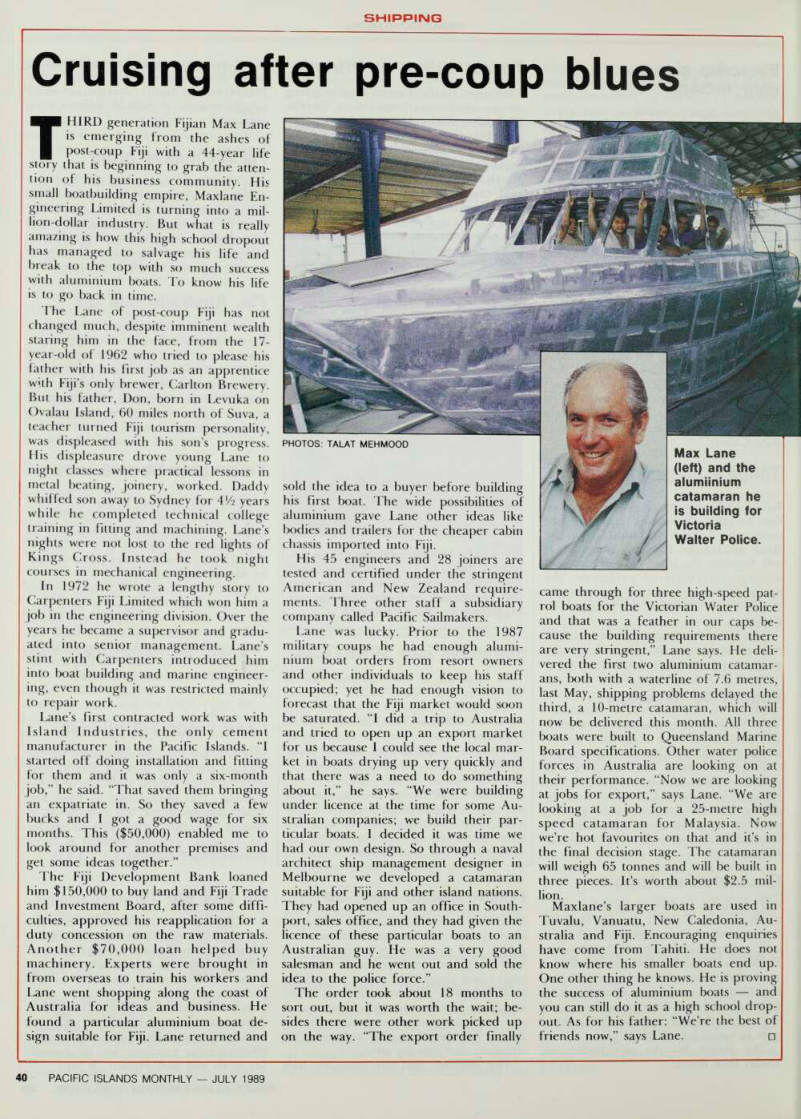
Shipping
T HIRD generation Fijian Max Lane is emerging from the ashes of post-coup Fiji with a 44-year life story that is beginning to grab the atten tion of his business community. His small boatbuilding empire, Maxlane En gineering Limited is turning into a mil lion-dollar industry. But what is really amazing is how this high school dropout has managed to salvage his life and break to the top with so much success with aluminium boats. To know his life is to go back in time.
The Lane of post-coup Fiji has not changed much, despite imminent wealth staring him in the face, from the 17year-old of 1962 who tried to please his father with his first job as an apprentice with Fiji’s only brewer, Carlton Brewery.
But his father, Don, born in Levuka on Ovalau Island, 60 miles north of Suva, a teacher turned Fiji tourism personality, was displeased with his son’s progress.
His displeasure drove young Lane to night classes where practical lessons in metal beating, joinery, worked. Daddy whiffed son away to Sydney for 4‘/> years while he completed technical college
training in fitting and machining. Lane’s
nights were not lost to the red lights of Kings Cross. Instead he took night courses in mechanical engineering.
In 1972 he wrote a lengthy story to Carpenters Fiji Limited which won him a job in the engineering division. Over the years he became a supervisor and gradu ated into senior management. Lane’s stint with Carpenters introduced him into boat building and marine engineer ing, even though it was restricted mainly to repair work.
Lane’s first contracted work was with Island Industries, the only cement manufacturer in the Pacific Islands. “I started off doing installation and fitting for them and it was only a six-month job,” he said. “That saved them bringing an expatriate in. So they saved a few bucks and I got a good wage for six months. This ($50,000) enabled me to look around for another premises and get some ideas together.”
The Fiji Development Bank loaned him $150,000 to buy land and Fiji Trade and Investment Board, after some diffi culties, approved his reapplication for a duty concession on the raw materials.
Another $70,000 loan helped buy machinery. Experts were brought in from overseas to train his workers and Lane went shopping along the coast of Australia for ideas and business. He found a particular aluminium boat de sign suitable for Fiji. Lane returned and
sold the idea to a buyer before building his first boat. The wide possibilities of aluminium gave Lane other ideas like bodies and trailers for the cheaper cabin
chassis imported into Fiji.
His 45 engineers and 28 joiners are tested and certified under the stringent American and New Zealand require ments. Three other staff a subsidiary company called Pacific Sailmakers.
Lane was lucky. Prior to the 1987 military coups he had enough alumi nium boat orders from resort owners and other individuals to keep his staff occupied; yet he had enough vision to forecast that the Fiji market would soon be saturated. “1 did a trip to Australia and tried to open up an export market for us because I could see the local mar ket in boats drying up very quickly and that there was a need to do something about it,” he says. “We were building under licence at the time for some Au stralian companies; we build their par ticular boats. 1 decided it was time we had our own design. So through a naval architect ship management designer in Melbourne we developed a catamaran suitable for Fiji and other island nations.
They had opened up an office in South port, sales office, and they had given the licence of these particular boats to an Australian guy. He was a very good salesman and he went out and sold the idea to the police force.”
The order took about 18 months to sort out, but it was worth the wait; be sides there were other work picked up on the way. “The export order finally
came through for three high-speed pat rol boats for the Victorian Water Police and that was a feather in our caps be cause the building requirements there are very stringent,” Lane says. He deli vered the first two aluminium catamar ans, both with a waterline of 7.6 metres,
last May, shipping problems delayed the
third, a 10-metre catamaran, which will now be delivered this month. All three boats were built to Queensland Marine Board specifications. Other water police forces in Australia are looking on at their performance. “Now we are looking at jobs for export,” says Lane. “We are looking at a job for a 25-metre high speed catamaran for Malaysia. Now we’re hot favourites on that and it’s in the final decision stage. The catamaran will weigh 65 tonnes and will be built in three pieces. It’s worth about $2.5 mil lion.
Maxlane’s larger boats are used in Tuvalu, Vanuatu, New Caledonia, Au
stralia and Fiji. Encouraging enquiries
have come from Tahiti. He does not know where his smaller boats end up.
One other thing he knows. He is proving the success of aluminium boats and you can still do it as a high school drop out. As for his father: “We’re the best of friends now,” says Lane. □
Photos: Talat Mehmood
Max Lane (left) and the alumiinium catamaran he is building for Victoria Walter Police.
Schedules
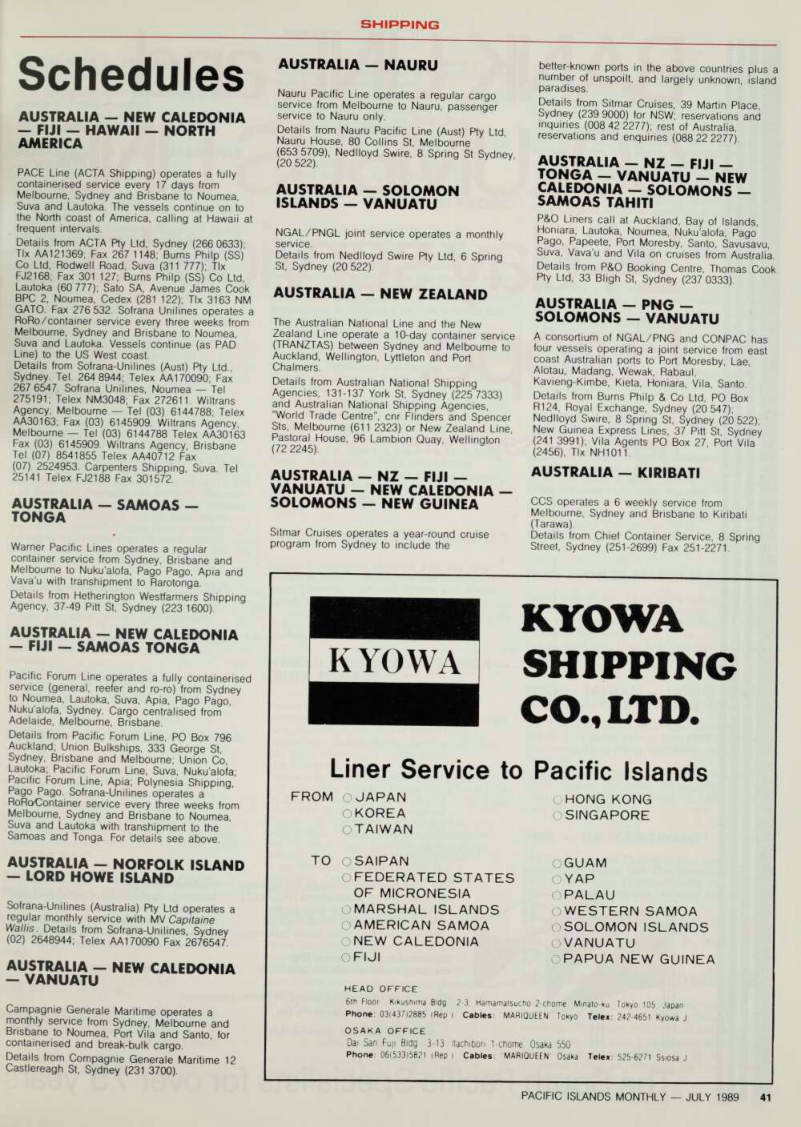

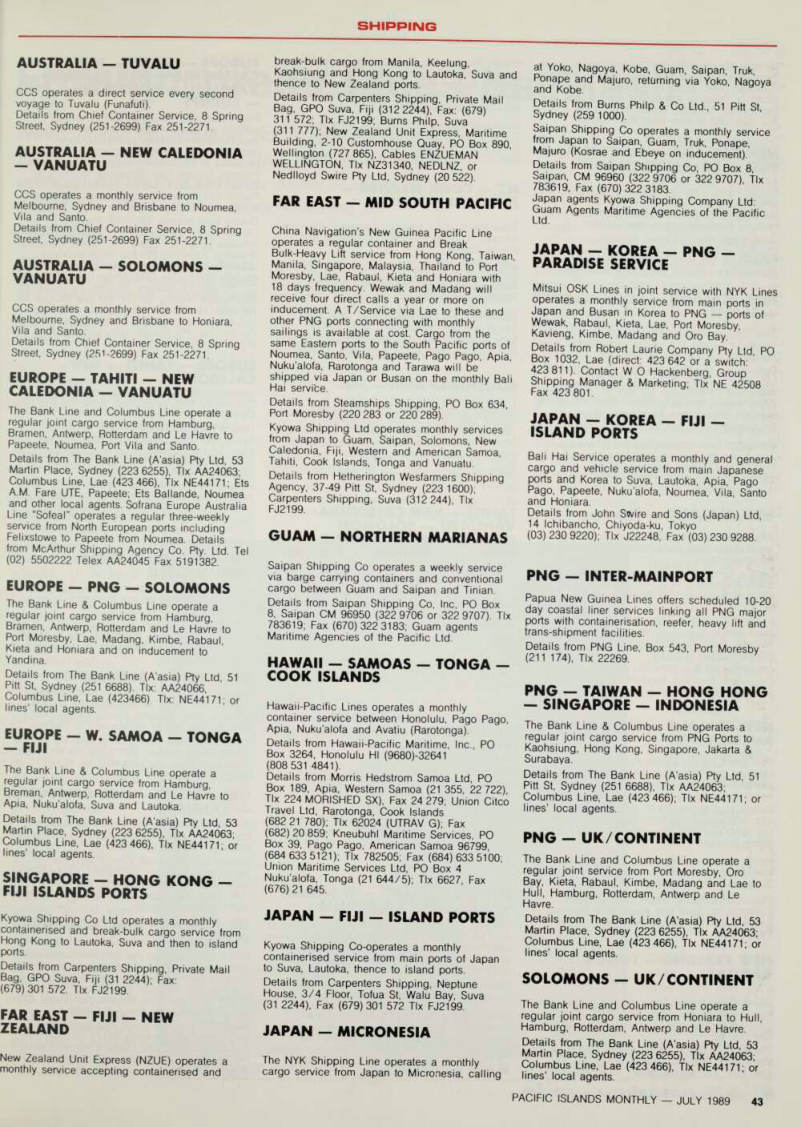
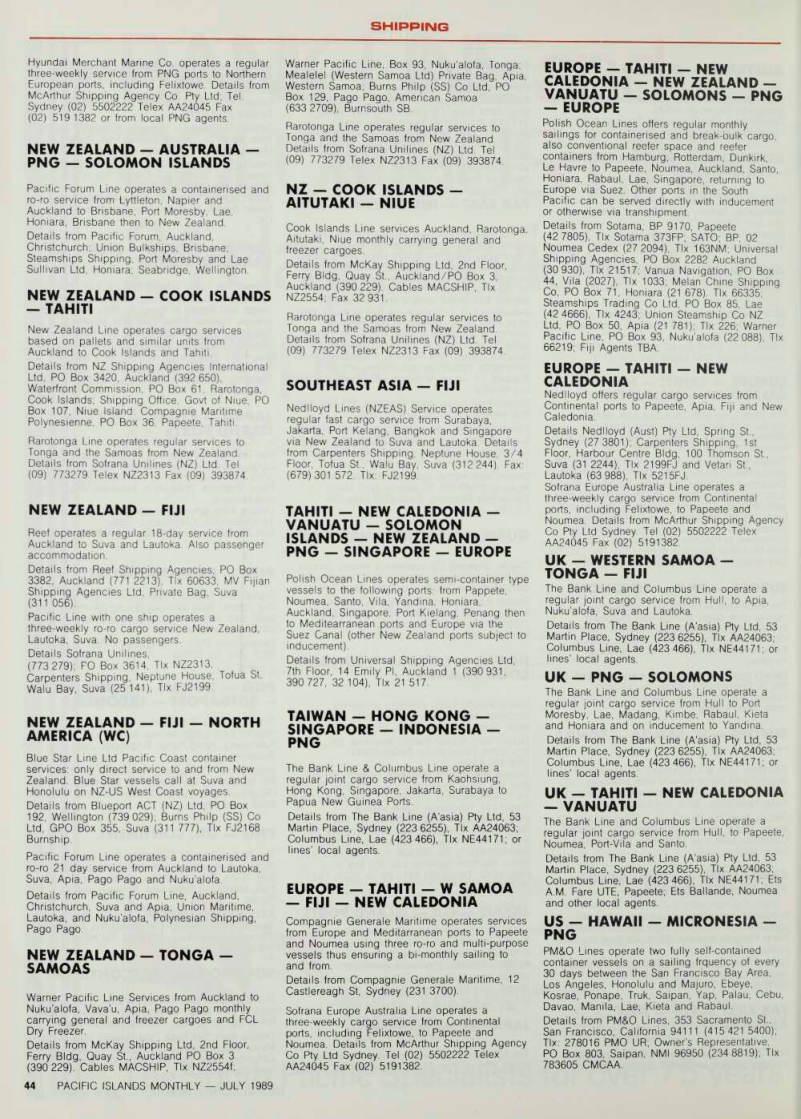
Australia New Caledonia
- Fiji Hawaii - North
America
PACE Line (ACTA Shipping) operates a fully containerised service every 17 days from Melbourne, Sydney and Brisbane to Noumea, Suva and Lautoka. The vessels continue on to the North coast of America, calling at Hawaii at frequent intervals.
Details from ACTA Pty Ltd, Sydney (266 0633) Tlx AA121369; Fax 267 1148; Burns Philp (SS) Co Ltd, Rodwell Road, Suva (311 777); Tlx FJ2168; Fax 301 127; Burns Philp (SS) Co Ltd, Lautoka (60 777); Sato SA, Avenue James Cook BPC 2, Noumea, Cedex (281 122); Tlx 3163 NM GATO. Fax 276 532. Sofrana Unilines operates a Roßo/container service every three weeks from Melbourne, Sydney and Brisbane to Noumea, Suva and Lautoka. Vessels continue (as PAD Line) to the US West coast.
Details from Sofrana-Unilines (Aust) Pty Ltd., Sydney. Tel. 264 8944; Telex AA170090; Fax 267 6547. Sofrana Unilines, Noumea Tel 275191; Telex NM3048; Fax 272611. Wiltrans Agency, Melbourne Tel (03) 6144788; Telex AA30163; Fax (03) 6145909. Wiltrans Agency, Melbourne Tel (03) 6144788 Telex AA30163 Fax (03) 6145909. Wiltrans Agency, Brisbane Tel (07) 8541855 Telex AA40712 Fax (07) 2524953. Carpenters Shipping, Suva. Tel 25141 Telex FJ2IBB Fax 301572.
Australia Samoas
Tonga
Warner Pacific Lines operates a regular container service from Sydney, Brisbane and Melbourne to Nuku’alofa, Pago Pago, Apia and Vava’u with transhipment to Rarotonga.
Details from Hetherington Westfarmers Shipping Agency, 37-49 Pitt St. Sydney (223 1600).
Australia New Caledonia
Fiji Samoas Tonga
Pacific Forum Line operates a fully containerised service (general, reefer and ro-ro) from Sydney to Noumea, Lautoka, Suva, Apia, Pago Pago, Nukualofa, Sydney. Cargo centralised from Adelaide, Melbourne, Brisbane, Details from Pacific Forum Line, PO Box 796 Auckland; Union Bulkships, 333 George St, Sydney, Brisbane and Melbourne; Union Co, Lautoka; Pacific Forum Line, Suva, Nuku’alofa; Pacific Forum Line, Apia; Polynesia Shipping, Pago Pago. Sofrana-Unilines operates a RoßoContainer service every three weeks from Melbourne, Sydney and Brisbane to Noumea, Suva and Lautoka with transhipment to the Samoas and Tonga. For details see above.
Australia - Norfolk Island
Lord Howe Island
Sofrana-Unilines (Australia) Pty Ltd operates a regular monthly service with MV Capitaine Wallis. Details from Sofrana-Unilines, Sydney (02) 2648944; Telex AA170090 Fax 2676547.
Australia - New Caledonia
Vanuatu
Campagnie Generale Maritime operates a monthly service from Sydney, Melbourne and Brisbane to Noumea, Port Vila and Santo, for containerised and break-bulk cargo.
Details from Compagnie Generale Maritime 12 Castlereagh St, Sydney (231 3700).
Australia Nauru
Nauru Pacific Line operates a regular cargo service from Melbourne to Nauru, passenger service to Nauru only.
Details from Nauru Pacific Line (Aust) Pty Ltd, Nauru House, 80 Collins St, Melbourne (653 5709), Nedlloyd Swire, 8 Spring St Sydney (20 522). y y
Australia Solomon
Islands Vanuatu
NGAL/PNGL joint service operates a monthly service.
Details from Nedlloyd Swire Pty Ltd, 6 Spring St, Sydney (20 522).
Australia New Zealand
The Australian National Line and the New Zealand Line operate a 10-day container service (TRANZTAS) between Sydney and Melbourne to Auckland, Wellington, Lyttleton and Port Chalmers.
Details from Australian National Shipping Agencies. 131-137 York St, Sydney (225 7333) and Australian National Shipping Agencies, “World Trade Centre”, cnr Flinders and Spencer Sts, Melbourne (611 2323) or New Zealand Line, Pastoral House, 96 Lambion Quay, Wellington (72 2245).
Australia - Nz - Fiji
Vanuatu New Caledonia
Solomons New Guinea
Sitmar Cruises operates a year-round cruise program from Sydney to include the
better-known ports in the above countries plus a number of unspoilt, and largely unknown, island paradises.
Details from Sitmar Cruises, 39 Martin Place, Sydney (239 9000) for NSW; reservations and inquiries (008 42 2277); rest of Australia, reservations and enquiries (088 22 2277).
Australia Nz Fiji
Tonga Vanuatu New
Caledonia Solomons
Samoas Tahiti
P&O Liners call at Auckland, Bay of Islands, Honiara, Lautoka, Noumea, Nuku’alofa, Pago Pago, Papeete, Port Moresby, Santo, Savusavu, Suva, Vava’u and Vila on cruises from Australia.
Details from P&O Booking Centre, Thomas Cook Pty Ltd. 33 Bligh St, Sydney (237 0333).
Australia Png
Solomons Vanuatu
A consortium of NGAL/PNG and CONPAC has four vessels operating a joint service from east coast Australian ports to Port Moresby, Lae, Alotau, Madang, Wewak, Rabaul, Kavieng-Kimbe, Kieta, Honiara, Vila. Santo.
Details from Burns Philp & Co Ltd, PO Box R 124, Royal Exchange, Sydney (20 547); Nedlloyd Swire. 8 Spring St, Sydney (20 522); New Guinea Express Lines, 37 Pitt St, Sydney (241 3991); Vila Agents PO Box 27, Port Vila
(2456), Tlx Nhioii.
Australia Kiribati
CCS operates a 6 weekly service from Melbourne, Sydney and Brisbane to Kiribati (Tarawa).
Details from Chief Container Service, 8 Spring Street. Sydney (251-2699) Fax 251-2271.
Australia Tuvalu
CCS operates a direct service every second voyage to Tuvalu (Funafuti).
Details from Chief Container Service, 8 Spring Street, Sydney (251-2699) Fax 251-2271
Australia New Caledonia
Vanuatu
CCS operates a monthly service from Melbourne, Sydney and Brisbane to Noumea, Vila and Santo.
Details from Chief Container Service, 8 Spring Street, Sydney (251-2699) Fax 251-2271.
Australia Solomons
Vanuatu
CCS operates a monthly service from Melbourne, Sydney and Brisbane to Honiara, Vila and Santo.
Details from Chief Container Service, 8 Spring Street, Sydney (251-2699) Fax 251-2271.
Europe - Tahiti - New
Caledonia Vanuatu
The Bank Line and Columbus Line operate a regular joint cargo service from Hamburg, Bramen, Antwerp, Rotterdam and Le Havre to Papeete, Noumea, Port Vila and Santo.
Details from The Bank Line (A’asia) Pty Ltd, 53 Martin Place, Sydney (223 6255), Tlx AA24063; Columbus Line, Lae (423 466), Tlx NE44171; Ets A M. Fare UTE, Papeete; Ets Ballande, Noumea and other local agents. Sofrana Europe Australia Line “Sofeal” operates a regular three-weekly service from North European ports including Felixstowe to Papeete from Noumea. Details from McArthur Shipping Agency Co. Pty. Ltd Tel (02) 5502222 Telex AA24045 Fax 5191382.
Europe Png Solomons
The Bank Line & Columbus Line operate a regular joint cargo service from Hamburg, Bramen, Antwerp, Rotterdam and Le Havre to Port Moresby, Lae, Madang, Kimbe, Rabaul, Kieta and Honiara and on inducement to Yandina.
Details from The Bank Line (A'asia) Pty Ltd 51 Pitt St, Sydney (251 6688). Tlx: AA24066, Columbus Line, Lae (423466) Tlx: NE44171; or lines' local agents.
Europe W. Samoa Tonga
The Bank Line & Columbus Line operate a regular joint cargo service from Hamburg, Breman, Antwerp, Rotterdam and Le Havre to Apia, Nukualofa, Suva and Lautoka.
Details from The Bank Line (A’asia) Pty Ltd 53 Martin Place. Sydney (223 6255), Tlx AA24063; Columbus Line. Lae (423 466), Tlx NE44171; or lines' local agents.
Singapore Hong Kong
Fiji Islands Ports
Kyowa Shipping Co Ltd operates a monthly containerised and break-bulk cargo service from Hong Kong to Lautoka, Suva and then to island ports.
Details from Carpenters Shipping, Private Mail Bag, GPO Suva, Fiji (31 2244); Fax: (679)301 572. Tlx FJ2199.
Far East Fiji New
Zealand
New Zealand Unit Express (NZUE) operates a monthly service accepting containerised and
break-bulk cargo from Manila, Keelung, Kaohsiung and Hong Kong to Lautoka, Suva and thence to New Zealand ports.
Details from Carpenters Shipping, Private Mail Bag, GPO Suva. Fiji (312 2244), Fax: (679) 311 572; Tlx FJ2199; Burns Philp, Suva (311 777); New Zealand Unit Express, Maritime Building, 2-10 Customhouse Quay, PC Box 890 Wellington (727 865), Cables ENZUEMAN
Wellington, Tlx Nz31340, Nedlnz, Or
Nedlloyd Swire Pty Ltd, Sydney (20 522).
Far East Mid South Pacific
China Navigation’s New Guinea Pacific Line operates a regular container and Break Bulk-Heavy Lift service from Hong Kong, Taiwan, Manila. Singapore, Malaysia. Thailand to Port Moresby, Lae, Rabaul, Kieta and Honiara with 18 days frequency. Wewak and Madang will receive four direct calls a year or more on inducement. A T/Service via Lae to these and other PNG ports connecting with monthly sailings is available at cost. Cargo from the same Eastern ports to the South Pacific ports of Noumea. Santo. Vila. Papeete, Pago Pago, Apia, Nuku’alofa, Rarotonga and Tarawa will be shipped via Japan or Busan on the monthly Bali Hai service.
Details from Steamships Shipping, PO Box 634 Port Moresby (220 283 or 220 289).
Kyowa Shipping Ltd operates monthly services from Japan to Guam, Saipan, Solomons, New Caledonia, Fiji, Western and American Samoa, Tahiti, Cook Islands, Tonga and Vanuatu.
Details from Hetherington Wesfarmers Shipping Agency, 37-49 Pitt St, Sydney (223 1600); Carpenters Shipping, Suva (312 244), Tlx FJ2199.
Guam Northern Marianas
Saipan Shipping Co operates a weekly service via barge carrying containers and conventional cargo between Guam and Saipan and Tinian.
Details from Saipan Shipping Co, Inc, PO Box 8, Saipan CM 96950 (322 9706 or 322 9707). Tlx 783619; Fax (670)322 3183; Guam agents Maritime Agencies of the Pacific Ltd.
Hawaii Samoas Tonga
Cook Islands
Hawaii-Pacific Lines operates a monthly container service between Honolulu, Pago Pago, Apia, Nuku’alofa and Avatiu (Rarotonga).
Details from Hawaii-Pacific Maritime, Inc., PO Box 3264, Honolulu HI (9680)-32641 (808 531 4841).
Details from Morris Hedstrom Samoa Ltd, PO Box 189. Apia, Western Samoa (21 355, 22 722), Tlx 224 MORISHED SX). Fax 24 279; Union Citco Travel Ltd. Rarotonga, Cook Islands (682 21 780); Tlx 62024 (UTRAV G); Fax (682) 20 859; Kneubuhl Maritime Services, PO Box 39, Pago Pago, American Samoa 96799, (684 633 5121); Tlx 782505; Fax (684)633 5100; Union Maritime Services Ltd, PO Box 4 Nuku’alofa, Tonga (21 644 / 5); Tlx 6627, Fax (676) 21 645.
Japan Fiji Island Ports
Kyowa Shipping Co-operates a monthly containerised service from main ports of Japan to Suva, Lautoka, thence to island ports.
Details from Carpenters Shipping, Neptune House, 3/4 Floor, Tofua St, Walu Bay, Suva (31 2244), Fax (679)301 572 Tlx FJ2199.
Japan Micronesia
The NYK Shipping Line operates a monthly cargo service from Japan to Micronesia, calling
at Yoko, Nagoya, Kobe. Guam, Saipan, Truk.
Ponape and Majuro, returning via Yoko, Nagoya and Kobe.
Details from Burns Philp & Co Ltd. 51 Pitt St Sydney (259 1000).
Saipan Shipping Co operates a monthly service from Japan to Saipan, Guam, Truk, Ponape, Majuro (Kosrae and Ebeye on inducement).
Details from Saipan Shipping Co. PC Box 8 Saipan, CM 96960 (322 9706 or 322 9707) tlx 783619, Fax (670)322 3183.
Japan agents Kyowa Shipping Company Ltd Guam Agents Maritime Agencies of the Pacific Ltd.
Japan Korea Png
Paradise Service
Mitsui OSK Lines in joint service with NYK Lines operates a monthly service from main ports in Japan and Busan in Korea to PNG ports of Wewak, Rabaul, Kieta, Lae, Port Moresby, Kavieng, Kimbe, Madang and Oro Bay.
Details from Robert Laurie Company Pty Ltd, PC Box 1032, Lae (direct: 423 642 or a switch: 423 811). Contact W O Hackenberg, Group Shipping Manager & Marketing; Tlx NE 42508 Fax 423 801.
Japan Korea Fiji
Island Ports
Bali Hai Service operates a monthly and general cargo and vehicle service from main Japanese ports and Korea to Suva, Lautoka, Apia, Pago Pago, Papeete, Nukualofa, Noumea, Vila, Santo and Honiara.
Details from John Swire and Sons (Japan) Ltd, 14 Ichibancho, Chiyoda-ku, Tokyo (03) 230 9220); Tlx J 22248, Fax (03) 230 9288.
Png Inter-Mainport
Papua New Guinea Lines offers scheduled 10-20 day coastal liner services linking all PNG major ports with containerisation, reefer, heavy lift and trans-shipment facilities.
Details from PNG Line, Box 543, Port Moresby (211 174), Tlx 22269.
Png Taiwan Hong Hong
- Singapore Indonesia
The Bank Line & Columbus Line operates a regular joint cargo service from PNG Ports to Kaohsiung, Hong Kong, Singapore, Jakarta & Surabaya.
Details from The Bank Line (A’asia) Pty Ltd, 51 Pitt St, Sydney (251 6688), Tlx AA24063; Columbus Line, Lae (423 466); Tlx NE44171; or lines’ local agents.
Png Uk/Continent
The Bank Line and Columbus Line operate a regular joint service from Port Moresby, Oro Bay, Kieta, Rabaul, Kimbe, Madang and Lae to Hull, Hamburg, Rotterdam, Antwerp and Le Havre.
Details from The Bank Line (A'asia) Pty Ltd, 53 Martin Place, Sydney (223 6255), Tlx AA24063; Columbus Line, Lae (423 466), Tlx NE44171; or lines’ local agents.
Solomons - Uk/Continent
The Bank Line and Columbus Line operate a regular joint cargo service from Honiara to Hull, Hamburg, Rotterdam. Antwerp and Le Havre.
Details from The Bank Line (A’asia) Pty Ltd, 53 Martin Place, Sydney (223 6255), Tlx AA24063; Columbus Line, Lae (423 466), Tlx NE44171; or lines’ local agents.
Hyundai Merchant Marine Co. operates a regular three-weekly service from PNG ports to Northern European ports, including Felixtowe. Details from McArthur Shipping Agency Co. Pty Ltd; Tel.
Sydney (02) 5502222 Telex AA24045 Fax (02) 519 1382 or from local PNG agents.
New Zealand - Australia -
Png Solomon Islands
Pacific Forum Line operates a containerised and ro-ro service from Lyttleton, Napier and Auckland to Brisbane, Port Moresby. Lae, Honiara, Brisbane then to New Zealand.
Details from Pacific Forum, Auckland, Christchurch; Union Butkships, Brisbane; Steamships Shipping, Port Moresby and Lae Sullivan Ltd, Honiara; Seabridge, Wellington.
New Zealand Cook Islands
Tahiti
New Zealand Line operates cargo services based on pallets and similar units from Auckland to Cook Islands and Tahiti.
Details from NZ Shipping Agencies International Ltd, PO Box 3420, Auckland (392 650), Waterfront Commission, PO Box 61, Rarotonga, Cook Islands; Shipping Office, Govt of Niue, PO Box 107, Niue Island: Compagnie Maritime Polynesienne, PO Box 36, Papeete, Tahiti Rarotonga Line operates regular services to Tonga and the Samoas from New Zealand.
Details from Sofrana Unilines (NZ) Ltd. Tel (09) 773279 Telex NZ2313 Fax (09) 393874.
New Zealand Fiji
Reef operates a regular 18-day service from Auckland to Suva and Lautoka. Also passenger accommodation.
Details from Reef Shipping Agencies, PO Box 3382, Auckland (771 2213), Tlx 60633; MV Fijian Shipping Agencies Ltd, Private Bag, Suva (311 056).
Pacific Line with one ship operates a three-weekly ro-ro cargo service New Zealand, Lautoka, Suva. No passengers Details Sofrana Unilines, (773 279); PO Box 3614, Tlx NZ2313, Carpenters Shipping, Neptune House, Tofua St, Walu Bay, Suva (25 141), Tlx FJ2199.
New Zealand - Fiji - North
America (Wc)
Blue Star Line Ltd Pacific Coast container services: only direct service to and from New Zealand. Blue Star vessels call at Suva and Honolulu on NZ-US West Coast voyages.
Details from Blueport ACT (NZ) Ltd, PO Box 192, Wellington (739 029); Burns Philp (SS) Co Ltd, GPO Box 355, Suva (311 777), Tlx FJ2168 Burnship.
Pacific Forum Line operates a containerised and ro-ro 21 day service from Auckland to Lautoka, Suva, Apia, Pago Pago and Nuku’alofa.
Details from Pacific Forum Line, Auckland, Christchurch, Suva and Apia, Union Maritime, Lautoka, and Nuku’alofa, Polynesian Shipping, Pago Pago.
New Zealand Tonga
Samoas
Warner Pacific Line Services from Auckland to Nuku’alofa, Vava’u, Apia, Pago Pago monthly carrying general and freezer cargoes and FCL Dry Freezer.
Details from McKay Shipping Ltd, 2nd Floor, Ferry Bldg, Quay St., Auckland PO Box 3 (390 229). Cables MACSHIP, Tlx NZ2554f:
Warner Pacific Line, Box 93, Nuku’alofa, Tonga; Mealelel (Western Samoa Ltd) Private Bag, Apia, Western Samoa; Burns Phi Ip (SS) Co Ltd, PO Box 129, Pago Pago, American Samoa (633 2709), Burnsouth SB.
Rarotonga Line operates regular services to Tonga and the Samoas from New Zealand.
Details from Sofrana Unilines (NZ) Ltd. Tel (09) 773279 Telex NZ2313 Fax (09) 393874.
Nz - Cook Islands -
Aitutaki - Niue
Cook Islands Line services Auckland, Rarotonga, Aitutaki, Niue monthly carrying general and freezer cargoes.
Details from McKay Shipping Ltd, 2nd Floor, Ferry Bldg, Ouay St., Auckland/PO Box 3, Auckland (390 229). Cables MACSHIP, Tlx NZ2554; Fax 32 931.
Rarotonga Line operates regular services to Tonga and the Samoas from New Zealand.
Details from Sofrana Unilines (NZ) Ltd. Tel (09) 773279 Telex NZ2313 Fax (09) 393874.
Southeast Asia Fiji
Nedlloyd Lines (NZEAS) Service operates regular fast cargo service from Surabaya, Jakarta, Port Kelang, Bangkok and Singapore via New Zealand to Suva and Lautoka. Details from Carpenters Shipping, Neptune House, 3/4 Floor, Tofua St., Walu Bay, Suva (312 244), Fax: (679)301 572. Tlx: FJ2199,
Tahiti - New Caledonia -
Vanuatu - Solomon
Islands - New Zealand -
Png Singapore Europe
Polish Ocean Lines operates semi-container type vessels to the following ports: from Pappete, Noumea, Santo, Vila, Yandina, Honiara, Auckland, Singapore, Port Kielang, Penang then to Meditearranean ports and Europe via the Suez Canal (other New Zealand ports subject to inducement).
Details from Universal Shipping Agencies Ltd, 7th Floor, 14 Emily PI, Auckland 1 (390 931, 390 727, 32 104), Tlx 21 517.
Taiwan - Hong Kong -
Singapore - Indonesia -
Png
The Bank Line & Columbus Line operate a regular joint cargo service from Kaohsiung, Hong Kong, Singapore, Jakarta, Surabaya to Papua New Guinea Ports.
Details from The Bank Line (A’asia) Pty Ltd, 53 Martin Place, Sydney (223 6255), Tlx AA24063; Columbus Line, Lae (423 466), Tlx NE44171; or lines’ local agents.
Europe - Tahiti - W Samoa
Fiji - New Caledonia
Compagnie Generale Maritime operates services from Europe and Mediterranean ports to Papeete and Noumea using three ro-ro and multi-purpose vessels thus ensuring a bi-monthly sailing to and from.
Details from Compagnie Generale Maritime, 12 Castlereagh St, Sydney (231 3700).
Sofrana Europe Australia Line operates a three-weekly cargo service from Continental ports, including Felixtowe, to Papeete and Noumea. Details from McArthur Shipping Agency Co Pty Ltd Sydney. Tel (02) 5502222 Telex AA24045 Fax (02) 5191382.
Europe Tahiti New
Caledonia New Zealand
Vanuatu Solomons Png
Europe
Polish Ocean Lines offers regular monthly sailings for containerised and break-bulk cargo, also conventional reefer space and reefer containers from Hamburg, Rotterdam, Dunkirk, Le Havre to Papeete, Noumea, Auckland, Santo, Honiara, Rabaul, Lae, Singapore, returning to Europe via Suez. Other ports in the South Pacific can be served directly with inducement or otherwise via transhipment.
Details from Sotama, BP 9170, Papeete (42 7805), Tlx Sotama 373FP; SATO; BP, 02 Noumea Cedex (27 2094), Tlx 163 NM; Universal Shipping Agencies, PO Box 2282 Auckland (30 930), Tlx 21517; Vanua Navigation, PO Box 44, Vila (2027), Tlx 1033; Melan Chine Shipping Co, PO Box 71, Honiara (21 678). Tlx 66335; Steamships Trading Co Ltd, PO Box 85, Lae (42 4666), Tlx 4243; Union Steamship Co NZ Ltd, PO Box 50, Apia (21 781); Tlx 226; Warner Pacific Line, PO Box 93, Nukualofa (22 088), Tlx 66219; Fiji Agents TBA.
Europe Tahiti New
Caledonia
Nedlloyd offers regular cargo services from Continental ports to Papeete, Apia, Fiji and New Caledonia.
Details Nedlloyd (Aust) Pty Ltd, Spring St., Sydney (27 3801); Carpenters Shipping, Ist Floor, Harbour Centre Bldg, 100 Thomson St., Suva (31 2244), Tlx 2199FJ and Vetari St., Lautoka (63 988), Tlx 5215FJ.
Sofrana Europe Australia Line operates a three-weekly cargo service from Continental ports, including Felixtowe, to Papeete and Noumea. Details from McArthur Shipping Agency Co Pty Ltd Sydney. Tel (02) 5502222 Telex AA24045 Fax (02) 5191382.
Uk - Western Samoa -
Tonga Fiji
The Bank Line and Columbus Line operate a regular joint cargo service from Hull, to Apia, Nuku'alofa, Suva and Lautoka.
Details from The Bank Line (A’asia) Pty Ltd, 53 Martin Place, Sydney (223 6255), Tlx AA24063; Columbus Line, Lae (423 466), Tlx NE44171; or lines’ local agents.
Uk Png Solomons
The Bank Line and Columbus Line operate a regular joint cargo service from Hull to Port Moresby, Lae, Madang, Kimbe, Rabaul, Kieta and Honiara and on inducement to Yandina.
Details from The Bank Line (A’asia) Pty Ltd, 53 Martin Place, Sydney (223 6255), Tlx AA24063; Columbus Line, Lae (423 466), Tlx NE44171; or lines’ local agents.
Uk Tahiti New Caledonia
Vanuatu
The Bank Line and Columbus Line operate a regular joint cargo service from Hull, to Papeete, Noumea, Port-Vila and Santo.
Details from The Bank Line (A’asia) Pty Ltd, 53 Martin Place, Sydney (223 6255), Tlx AA24063; Columbus Line, Lae (423 466), Tlx NE44171; Ets A M. Fare UTE, Papeete; Ets Ballande, Noumea and other local agents.
Us Hawaii - Micronesia -
Png
PM&O Lines operate two fully self-contained container vessels on a sailing frquency of every 30 days between the San Francisco Bay Area, Los Angeles, Honolulu and Majuro, Ebeye, Kosrae, Ponape, Truk, Saipan, Yap, Palau, Cebu, Davao, Manila, Lae, Kieta and Rabaul.
Details from PM&O Lines, 353 Sacramento St., San Francisco, California 94111 (415 421 5400); Tlx: 278016 PMC UR; Owner’s Representative, PO Box 803, Saipan, NMI 96950 (234 8819); Tlx
783605 Cmcaa.
Advertisements & other items, pp. 41-42 (1 item)
Co., Ltd.
KYOWA
KYOWA
SHIPPING
CO., LTD.
Liner Service to Pacific Islands
FROM OJAPAN
OKOREA
©TAIWAN
TO OSAIPAN
OFEDERATED STATES
OF MICRONESIA
©MARSHAL ISLANDS
©AMERICAN SAMOA
©NEW CALEDONIA
FIJI
©HONG KONG
©SINGAPORE
©GUAM
©YAP
©PALAU
©WESTERN SAMOA
©SOLOMON ISLANDS
©VANUATU
©PAPUA NEW GUINEA
HEAD OFFICE
6tn Floor Kikushima Bldg 2-3. Hamamatsucho 2-chome Mmalo-ku Tokyo 105. Japan Phone: 03(437)2885 (Rep ) Cables. MARIQUEEN Tokyo Telex: 242-4651 Kyowa J
OSAKA OFFICE
Dai San Pup Bldg 3-13 llachibon 1-chome Osaka 550 Phone: 06(533)5821 (Rep ) Cables: MARIQUEEN Osaka Telex: 525-6271 Ssiosa J
BANK LINE and
COLUMBUS LINE
24 day service to
Europe.
Need we say more...
G The Joint Service Partners offer facilities for shipment of: Containers (FCL/LCL) and Break-bulk Cargo plus reefer space and deeptanks for carriage of vegetable oils and other liquid bulk cargo.
Carriers also accept heavy lifts, overlength and cumbersome parcels.
Ports of Service; Loading: Papeete, Apia, Suva, Lautoka Noumea, Port Vila, Santo, Honiara, Port Moresby, Lae, Madang, Kimbe, Rabaul, Kieta, Darwin. For; Rotterdam, Antwerp, Hamburg, Hull, Dunkirk, Le Havre.
Additional ports on enquiry.
Please contact our regional offices for further information: The Bank Line (Australasia) Pty Ltd Columbus Line Reederei GmbH Suite 701, 51 Pitt St, P.O. Box 1 667, Lae/Papua New Guinea.
Sydney NSW, Australia 2000 Phone: 423466/423487/A.H. 422481 Phone 251 6688 Telex 24063 Telex; Colline N E 441 71 The South Pacific Specialists for over 75 years
Foreign press faces backlash
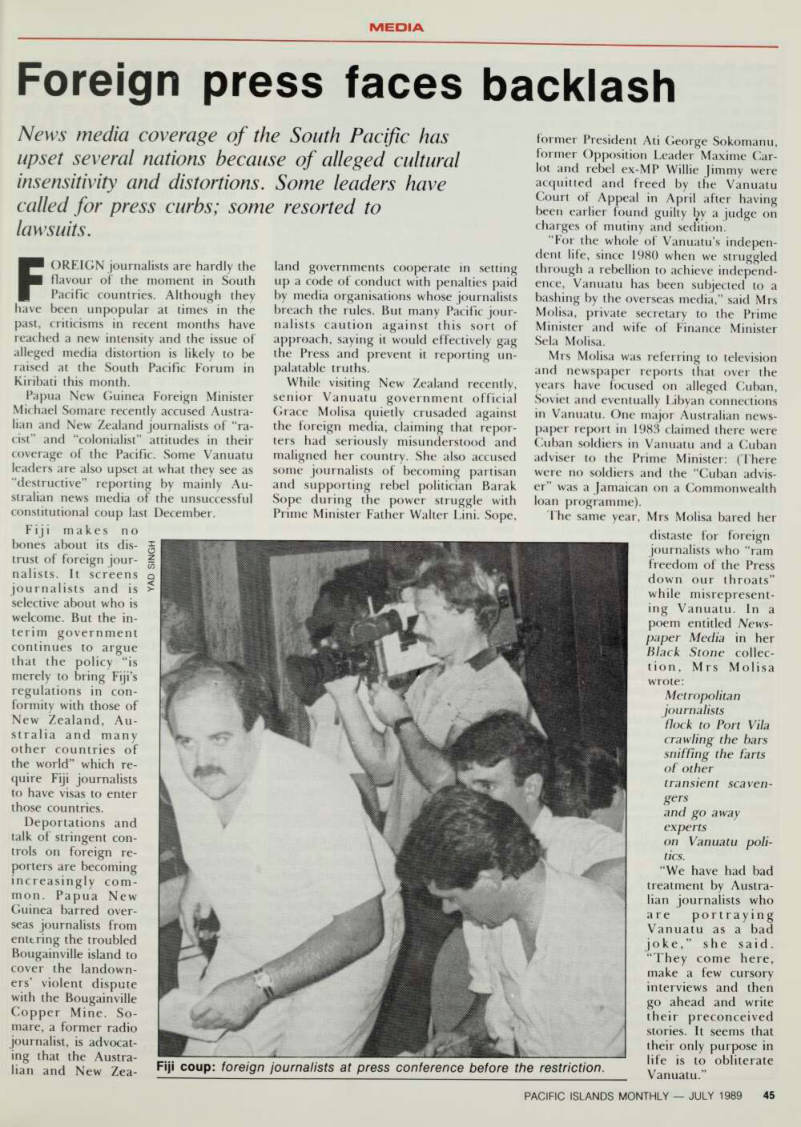
Media
News media coverage of the South Pacific has upset several nations because of alleged cultural insensitivity and distortions. Some leaders have called for press curbs; some resorted to lawsuits.
FOREIGN journalists are hardly the
flavour of the moment in South
Pacific countries. Although they
have been unpopular at times in the past, criticisms in recent months have reached a new intensity and the issue of alleged media distortion is likely to be raised at the South Pacific Forum in Kiribati this month.
Papua New Guinea Foreign Minister Michael Somare recently accused Austra lian and New Zealand journalists of “ra cist” and “colonialist” attitudes in their coverage of the Pacific. Some Vanuatu leaders are also upset at what they see as
“destructive” reporting by mainly Au
stralian news media of the unsuccessful constitutional coup last December.
Fiji makes no bones about its dis
trust of foreign jour
nalists. It screens journalists and is selective about who is welcome. But the in terim government continues to argue that the policy “is
merely to bring Fiji’s
regulations in con formity with those of New Zealand, Au stralia and many other countries of the world” which re quire Fiji journalists to have visas to enter those countries.
Deportations and talk of stringent con trols on foreign re porters are becoming
increasingly com
mon. Papua New Guinea barred over seas journalists from entering the troubled Bougainville island to cover the landown ers’ violent dispute with the Bougainville Copper Mine. So mare, a former radio journalist, is advocat ing that the Austra lian and New Zea
land governments cooperate in setting up a code of conduct with penalties paid by media organisations whose journalists breach the rules. But many Pacific jour nalists caution against this sort of approach, saying it would effectively gag the Press and prevent it reporting un palatable truths.
While visiting New Zealand recently, senior Vanuatu government official Grace Molisa quietly crusaded against the foreign media, claiming that repor ters had seriously misunderstood and maligned her country. She also accused some journalists of becoming partisan and supporting rebel politician Barak
Sope during the power struggle with
Prime Minister Father Walter Lini. Sope,
former President Ati George Sokomanu, former Opposition Leader Maxime Car lot and rebel ex-MP Willie Jimmy were acquitted and freed by the Vanuatu Court of Appeal in April after having been earlier found guilty by a judge on charges of mutiny and sedition.
“For the whole of Vanuatu’s indepen dent life, since 1980 when we struggled through a rebellion to achieve independ ence, Vanuatu has been subjected to a bashing by the overseas media,” said Mrs Molisa, private secretary to the Prime Minister and wife of Finance Minister Sela Molisa.
Mrs Molisa was referring to television and newspaper reports that over the years have focused on alleged Cuban, Soviet and eventually Libyan connections in Vanuatu. One major Australian news paper report in 1983 claimed there were Cuban soldiers in Vanuatu and a Cuban adviser to the Prime Minister: (There were no soldiers and the “Cuban advis er” was a Jamaican on a Commonwealth loan programme).
The same year, Mrs Molisa bared her
distaste for foreign journalists who “ram freedom of the Press down our throats”
while misrepresent
ing Vanuatu. In a poem entitled News paper Media in her Black Stone collec tion, Mrs Molisa wrote:
Metropolitan
journalists
flock to Port Vila crawling the bars sniffing the farts of other transient scaven gers and go away experts on Vanuatu poli tics.
“We have had bad treatment by Austra lian journalists who
are portraying
Vanuatu as a bad joke,” she said.
“They come here, make a few cursory interviews and then go ahead and write
their preconceived
stories. It seems that their only purpose in life is to obliterate Vanuatu.”
Fiji coup: foreign journalists at press conference before the restriction.
Mrs Molisa accused some foreign jour nalist of blowing events out of propor
tion, sensationalising and manipulating
political events. She believes Vanuatu’s constitutional crisis got out of hand last year because foreign journalists encour aged Sope with “false hopes of power”.
Asked about criticisms by Pacific jour nalists that Vanuatu government minis ters and officials are frequently difficult to interview or unavailable for state ments, Mrs Molisa replied: “Journalists often arrogantly think they are in Au stralia, or somewhere, where a minister has up to 20 staff to deal with the news media. Vanuatu is a developing country with extremely limited resources and hard-pressed staff. The government doesn’t even have a fax machine. Deal ing with journalists is the least of our
priorities.”
“Let’s face it,” Mrs Molisa said. “How free is a free press really? Why should we have the free press rammed down our throats when all it matters to them are the profits at the end of the year?
Why should we allow our economy to be sabotaged? When the Australian media wants blood it makes sure it gets it.” But Mrs Molisa stresses that not all foreign journalists are in her bad books. Some, she says, try to report issues with sensi
tivity and understanding.
Would Vanuatu consider curbs on
foreign journalists, as Fiji has endorsed
and as Somare advocates? “Why should we? It is up to the foreign media to act more responsibly,” she said, although her government had expelled Radio Au
stralia’s Pacific correspondent, Jimima
Garrett, during the height of the consti tutional crisis last December.
However Bishop Patelisio Finau, of Tonga, head of the kingdom’s minority Catholic Church and Editor of the church’s hard-hitting newspaper Taumu’s Lelei, had a different view. He called for more openness and accused politicians of over-reacting to the cover age of local events by the overseas media.
“These are important events which must be told,’ he said. “How these jour nalists report these events indicates how the outside world sees our lives. We must accept their point of view. We cre ated the trouble not them. We cannot just take their aid problems.”
It was a television report involving Vanuatu that stung Somare into making a public outburst over reporting in the region. The report, on Townsville-based North Queensland Television, is watched by many people in the Papua New Guinea capital of Port Moresby.
Broadcast on the station’s Today Show, the report cited Papua New Guinea Opposition allegations that the government had asked for Australian troops if a planned demonstration by PNG soldiers erupted violently. The Rabbie Namaliu government denied the allegations. The report showed library footage of riots in 1986 after the High lands leader lambakey Okuk died, and a picture of Father Lini which it identified as “PNG Foreign Minister Michael So mare”. The blunder and slanted style of the report upset many in Papua New Guinea. “I’m not a sick man with a para lysed right arm,” Somare snapped, and he threatened to ban any further visits by Channel Nine news teams. He used the opportunity to criticise Australian and New Zealand journalists covering
the region.
Besides his call for a code of conduct to curb what he described as racist jour nalism, Somare also advocated that Au stralia and New Zealand jointly fund an exchange programme in the region to foster greater awareness of Pacific coun tries and cultures. Somare will be the key speaker of the opening of the Pacific Islands News Association conference and workshop in Honiara in October. His ideas on the code of conduct will feature in discussions on freedom of information
and journalism ethics, key topics being
drawn up in the conference blueprint.
In Suva, Information Minister Ratu Inoke Kubuabola said Fiji has had “con
siderable experience of misrepresenta tion by the media recently, mostly by outsiders insensitive to our situation, and indifferent to the consequences of their falsification.”
Kubuabola was speaking at the open ing of a regional broadcasters manage ment symposium in Suva. “The very fact that you are here for this symposium is an indication that you can freely discuss and exchange views in Fiji,” the minister said.
In New Zealand, a recent two-part TVNZ Eyewitness News programme, Fiji: One Country, Two Cultures has been accused of a distorted portrayal of land rights and race relations. The Coali tion for Democracy in Fiji protested to both the Listener and TVNZ, claiming the programme was propaganda and that no critics of the interim government had been interviewed.
In Hawaii, a federal judge recently threw out a libel suit filed against Hon olulu Magazine after an article by Hon olulu-based writer Ed Rampell about the 1985 assassination of Belau President Haruo Remeliik quoted allegations from an anonymous letter.
The August 1987 magazine article re ported several conspiracy theories about President Remeliik’s murder. One of the theories involved an anonymous letter
received by the Remeliik family alleging
a millionaire Belau businessman was involved. The businessman sued the magazine and Rampell for defamation,
seeking US$5 million in general damages
and US$5O million in punitive and ex
emplary damages.
Honolulu Magazine’s lawyer, Jeffrey
Portnoy, argued for the lawsuit’s dismis sal on grounds that the letter did exist and the magazine did not implicate the businessman in the killing. The maga
zine had simply reported allegations
against the businessman as one of several theories in the still unsolved murder.
Judge Sam King upheld the defence
case, Portnoy hailed the ruling as an im portant one. □
Tonga’s newest paper
A motley crew of former missionar ies and school leavers are pun
ching computer keyboards in
Tonga to produce the country’s newest independent newspaper, The Times of Tonga. The paper hit the street for the first time on the rainy morning of Thursday April 13 this year with the
aim of becoming “the major print
media in the kingdom”.
The Times is published by Lali Com munications. Publisher Kalafi Moala owns 80 per cent of the company, his
brother Pita holds 20 per cent, Austra lian missionary Tom Hallas 2.5 per cent and Honolulu businessman Sandy Santiago 2.5 per cent.
Moala, 41, was a Wesleyan missionary in Papua New Guinea, Hawaii, Hong Kong and Japan. His opposition in Tonga are the government weekly, Tonga Chronicle, the Catholic weekly Tauinu’a Lelei, the hard-hitting news heet Kele’a and the Matangi Tonga news magazine which comes out every two months.
Times of Tonga is fitted with nearly $130,000 worth of Macintosh compu
ters for word processing, typesetting and page layouts. The hardware, and software were bought with money drawn from Moala’s savings and “dona tions from friends”. The building they are in was bought with a loan from Bank of Tonga.
Times of Tonga covers Pacific and world news strongly while its sister pap er, the vernacular Koe Taimi o Tonga, is strong on local news and features.
World and Pacific news is drawn from a New Zealand Press Association service at the cost of SNZ3OO a week. □
Amazing
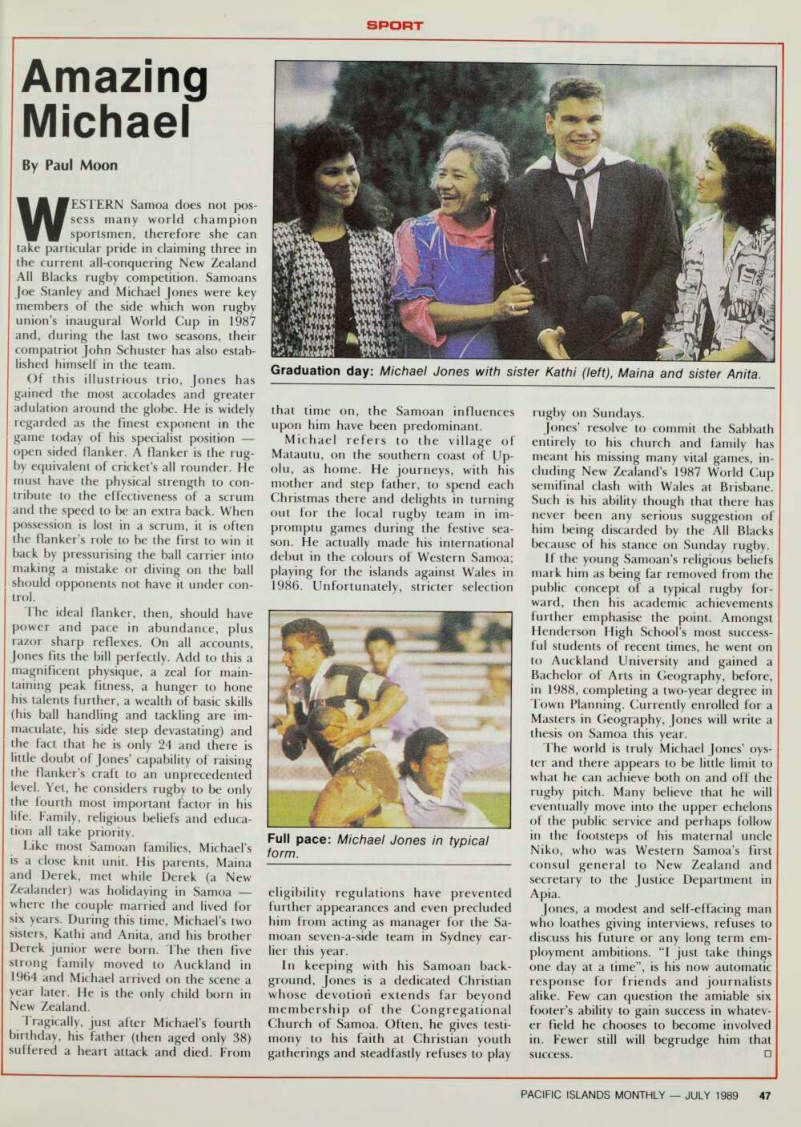
Sport
Amazing Michael
By Paul Moon
WESTERN Samoa does not pos sess many world champion sportsmen, therefore she can take particular pride in claiming three in the current all-conquering New Zealand All Blacks rugby competition. Samoans Joe Stanley and Michael Jones were key members of the side which won rugby union’s inaugural World Cup in 1987 and, during the last two seasons, their compatriot John Schuster has also estab lished himself in the team.
Of this illustrious trio, Jones has gained the most accolades and greater adulation around the globe. He is widely regarded as the finest exponent in the
game today of his specialist position
open sided flanker. A flanker is the rug by equivalent of cricket’s all rounder. He must have the physical strength to con tribute to the effectiveness of a scrum and the speed to be an extra back. When possession is lost in a scrum, it is often the flanker’s role to be the first to win it back by pressurising the ball carrier into making a mistake or diving on the ball should opponents not have it under con trol.
The ideal flanker, then, should have power and pace in abundance, plus razor sharp reflexes. On all accounts, Jones fits the bill perfectly. Add to this a magnificent physique, a zeal for main taining peak fitness, a hunger to hone his talents further, a wealth of basic skills (his ball handling and tackling are im maculate, his side step devastating) and the fact that he is only 24 and there is little doubt of Jones’ capability of raising the flanker’s craft to an unprecedented level. Yet, he considers rugby to be only the fourth most important factor in his life. Family, religious beliefs and educa tion all take priority.
Like most Samoan families, Michael’s is a close knit unit. His parents, Maina and Derek, met while Derek (a New Zealander) was holidaying in Samoa where the couple married and lived for six years. During this time, Michael’s two sisters, Kathi and Anita, and his brother Derek junior were born. The then five strong family moved to Auckland in 1964 and Michael arrived on the scene a year later. He is the only child born in New Zealand.
Tragically, just after Michael’s fourth birthday, his father (then aged only 38) suffered a heart attack and died. From
that time on, the Samoan influences upon him have been predominant.
Michael refers to the village of Matautu, on the southern coast of Up olu, as home. He journeys, with his mother and step father, to spend each Christmas there and delights in turning out for the local rugby team in im promptu games during the festive sea son. He actually made his international debut in the colours of Western Samoa; playing for the islands against Wales in 1986. Unfortunately, stricter selection
eligibility regulations have prevented
further appearances and even precluded him from acting as manager for the Samoan seven-a-side team in Sydney earber this year.
In keeping with his Samoan background, Jones is a dedicated Christian whose devotion extends far beyond
membership of the Congregational
Church of Samoa. Often, he gives testimony to his faith at Christian youth
gatherings and steadfastly refuses to play
rugby on Sundays.
Jones’ resolve to commit the Sabbath entirely to his church and family has meant his missing many vital games, in cluding New Zealand’s 1987 World Cup semifinal clash with Wales at Brisbane.
Such is his ability though that there has never been any serious suggestion of him being discarded by the All Blacks because of his stance on Sunday rugby.
If the young Samoan’s religious beliefs mark him as being far removed from the public concept of a typical rugby for ward, then his academic achievements further emphasise the point. Amongst Henderson High School’s most success ful students of recent times, he went on to Auckland University and gained a Bachelor of Arts in Geography, before, in 1988, completing a two-year degree in Town Planning. Currently enrolled for a Masters in Geography, Jones will write a thesis on Samoa this year.
The world is truly Michael Jones’ oys ter and there appears to be little limit to what he can achieve both on and off the rugby pitch. Many believe that he will eventually move into the upper echelons of the public service and perhaps follow in the footsteps of his maternal uncle Niko, who was Western Samoa’s first consul general to New Zealand and secretary to the Justice Department in
Apia.
Jones, a modest and self-effacing man who loathes giving interviews, refuses to discuss his future or any long term em
ployment ambitions. “I just take things
one day at a time”, is his now automatic response for friends and journalists alike. Few can question the amiable six footer’s ability to gain success in whatev er field he chooses to become involved in. Fewer still will begrudge him that success. □
Full pace: Michael Jones in typical form.
Graduation day: Michael Jones with sister Kathi (left), Maina and sister Anita.
Crackdown on drugs
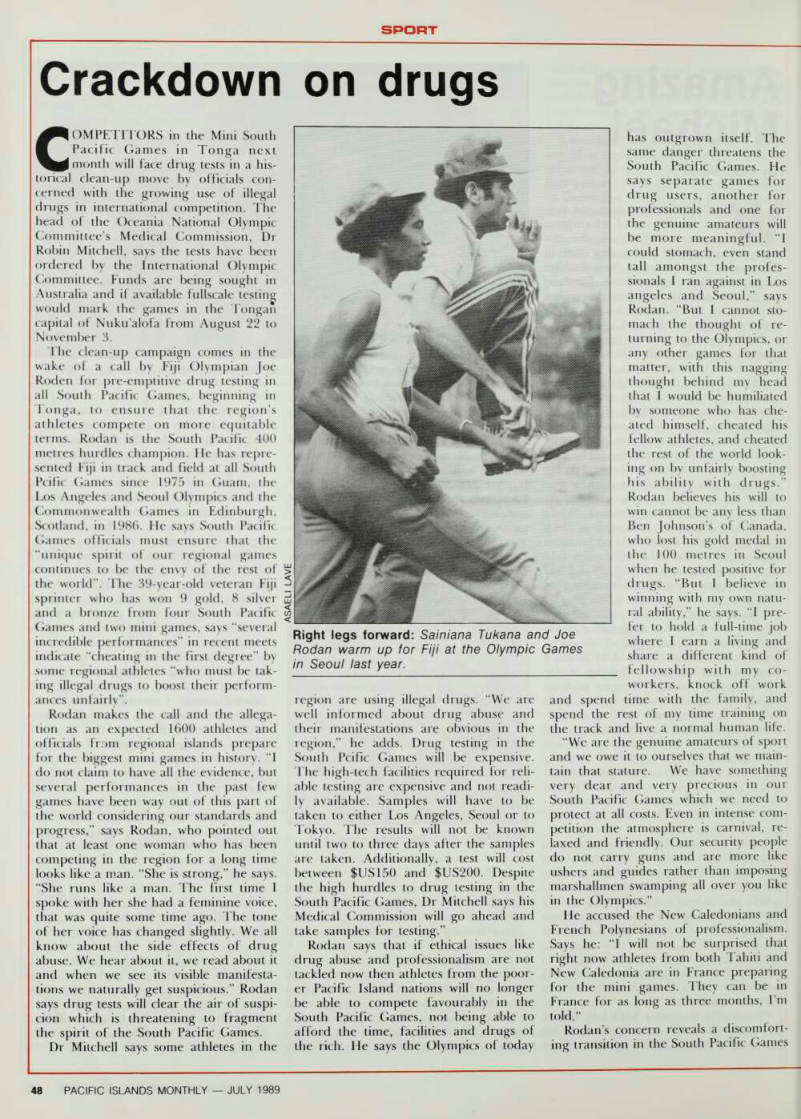
COMPETITORS in the Mini South Pacific Games in Tonga next month will face drug tests in a his torical clean-up move by officials con cerned with the growing use of illegal drugs in international competition. The head of the Oceania National Olympic Committee’s Medical Commission, Dr Robin Mitchell, says the tests have been ordered by the International Olympic Committee. Funds are being sought in Australia and if available fullscale testing would mark the games in the Tongan capital of Nuku’alofa from August 22 to November 3.
The clean-up campaign comes in the wake of a call by Fiji Olympian Joe
Roden for pre-emptitive drug testing in
all South Pacific Games, beginning in Tonga, to ensure that the region’s athletes compete on more equitable terms. Rodan is the South Pacific 400 metres hurdles champion. He has repre sented Fiji in track and field at all South Pcific Games since 1975 in Guam, the Los Angeles and Seoul Olympics and the Commonwealth Games in Edinburgh, Scotland, in 1986. He says South Pacific Games officials must ensure that the
“unique spirit of our regional games
continues to be the envy of the rest of the world”. The 39-year-old veteran Fiji sprinter who has won 9 gold, 8 silver and a bronze from four South Pacific Games and two mini games, says “several incredible performances” in recent meets indicate “cheating in the first degree” by some regional athletes “who must be tak ing illegal drugs to boost their perform
ances unfairly”.
Rodan makes the call and the allega tion as an expected 1600 athletes and officials from regional islands prepare for the biggest mini games in history. “I do not claim to have all the evidence, but several performances in the past few games have been way out of this part of the world considering our standards and progress,” says Rodan, who pointed out that at least one woman who has been competing in the region for a long time looks like a man. “She is strong,” he says.
“She runs like a man. The first time I spoke with her she had a feminine voice, that was quite some time ago. The tone of her voice has changed slightly. We all know about the side effects of drug abuse. We hear about it, we read about it and when we see its visible manifesta tions we naturally get suspicious.” Rodan says drug tests will clear the air of suspi cion which is threatening to fragment the spirit of the South Pacific Games.
Dr Mitchell says some athletes in the
region are using illegal drugs. “We are well informed about drug abuse and their manifestations are obvious in the region,” he adds. Drug testing in the South Pcific Games will be expensive.
The high-tech facilities required for reli able testing are expensive and not readi ly available. Samples will have to be taken to either Los Angeles, Seoul or to Tokyo. The results will not be known until two to three days after the samples are taken. Additionally, a test will cost between SUSISO and SUS2OO. Despite the high hurdles to drug testing in the South Pacific Games, Dr Mitchell says his Medical Commission will go ahead and
take samples for testing.”
Rodan says that if ethical issues like drug abuse and professionalism are not tackled now then athletes from the poor er Pacific Island nations will no longer be able to compete favourably in the South Pacific Games, not being able to afford the time, facilities and drugs of the rich. He says the Olympics of today
has outgrown itself. The same danger threatens the South Pacific Games. He says separate games for drug users, another for professionals and one for the genuine amateurs will be more meaningful. “I could stomach, even stand tall amongst the profes sionals I ran against in Los angeles and Seoul,” says Rodan. “But I cannot sto mach the thought of re turning to the Olympics, or any other games for that matter, with this nagging thought behind my head that I would be humiliated by someone who has che ated himself, cheated his fellow athletes, and cheated the rest of the world look
ing on by unfairly boosting
his ability with drugs.”
Rodan believes his will to win cannot be any less than Ben Johnson’s of Canada, who lost his gold medal in the 100 metres in Seoul when he tested positive for drugs. “But I believe in winning with my own natu ral ability,” he says. “I pre fer to hold a full-time job where I earn a living and share a different kind of fellowship with my co workers, knock off work
and spend time with the family, and spend the rest of my time training on the track and live a normal human life.
“We are the genuine amateurs of sport and we owe it to ourselves that we main tain that stature. We have something very dear and very precious in our South Pacific Games which we need to protect at all costs. Even in intense com petition the atmosphere is carnival, re laxed and friendly. Our security people do not carry guns and are more like ushers and guides rather than imposing marshallmen swamping all over you like in the Olympics.”
He accused the New Caledonians and
French Polynesians of professionalism.
Says he: “I will not be surprised that right now athletes from both Tahiti and New Caledonia are in France preparing for the mini games. They can be in France for as long as three months, I’m told.”
Rodan’s concern reveals a discomfort ing transition in the South Pacific Games
Asaeli Lave
Right legs forward: Sainiana Tukana and Joe Rodan warm up for Fiji at the Olympic Games in Seoul last year.
which has seen the rest of the Pacific
Islands nations unconsciously teaming
up against their more industrious French territories. The three French territories of New Caledonia (24), Tahiti (6) and Wallis 8c Futuna (1) dominate the 18nation South Pacific Games record books in track and field. Collectively, the three hold 31 records out of a possible 38. Fiji (4), Papua New Guinea (1), Western Samoa (1) and Tonga (1) share the other seven records.
Chasing the French in the South Pacific Games is no longer a personal pursuit of excellence. It has now involved governments which see the medal tally as a measure of social and economic well being. Fiji, Tonga, Western Samoa and American Samoa are sending their athletes offshore in pursuit of better technique to match the French territor ies.
According to Rodan the games in Tonga this year might witness another transformation. He predicts the hosts to lead a single-handed assault to wrest dominance away from the French territories. Tonga, as host, will be numerical-
ly superior.
Alain Lazare, New Caledonia’s South Pacific long-distance champion, is the stayer to watch in Tonga. Also from New Caledonia, Brigitte Hardel should have too much power for her fellow women in the sprints, the jumps and the pentathlon. Brothers Paul and Clement Poaniewa, will make jumping a family affair for New Caledonia.
Tahiti has always been strong in the team sports. But their reduction in Tonga will effectively clip their chances of a medal haul. Western Samoa will be seek- ' n § in the boxing ring. Willie Fong will be the man to beat in the 110 metres hurdles. Henry Smith who lives out of
New Zealand, will be strong in the field.
American influence has always made American Samoa a force in basketball.
Vanuatu can also surprise. Jerry Jere maia, sprinted 100 metres in 10.6 sec in the Seoul Olympics last year. Papua New Guinea’s Akali Tuna is a university stu dent with speed and stamina which makes him a strong contender from 100 metres to 800 metres. He is a 400-metres specialist who clocked 47.36 in the Seoul Olymics. “He’ll be strong. He’ll be good and he’ll win for Papua New Guinea in
Tonga,” says Rodan. Fiji’s Seoul Olym
pics experience indicates strength in the middle distances. The youthful trio of Lui Muavesi, Braeman Yee and Henry Rogo will team up to challenge Lazare in the 800 metres and the 1500 metres.
They will also form the core of the 4x400 metres relay team. Sainiana Tuka na provided the surprises of the New Caledonian games in 1987.”
Rodan says whoever wants to win the 400 metres sprint should be running be low 47 seconds or forget the gold. “My only ambition now is to set a new Fiji record for the 400 metres and if I appear in Tonga come the Mini Games then I will be one of the individuals to look out for.” Rodan’s Fiji record is 47.8 seconds.
At the end of it all Rodan is convinced that the Pacific way will come out the ultimate winner. “There is something ab out the Pacific people that just sets them apart. Perhaps it’s their culture, perhaps it’s the way they are brought up. 1 can not really put my thumb on it. But what ever it is, let us keep the South Pacific Games the way it has been.” After all, it has taken more than a quarter of a cen tury for the friendliest games to get to
the kingdom dubbed by Captain James
Cook “The Friendly Isles”.
Advertisements & other items, p. 49 (1 item)
Program
The
Island Press
Reports from the papers,
compiled by John Carter
QANTAS has reprimanded employees responsible for the late delivery to Fiji of a coffin containing the body of a Fiji Indian businessman who died in Australia.
The body of Jag Mohan Singh was to have been unloaded at Nadi. But it was flown to Papeete and Los Angeles. Delivery was finally made 36 hours later, a Qantas statement said.
From the Fiji Times, Suva “I’VE been in this business for 32 years, ever since I was 22, and I’ve never seen so many people receive the Holy Ghost (holy spirit) with such an urgency!”
So said Theophilus Price, an American Apostolic Revival Bishop, when he left Rarotonga impressed by what he saw in the Cook Islands’ new Apostolic Revival
Fellowship Church.
From the Cook Islands News, Rarotonga
PROGRAM
DIRECTOR
The Foundation for the South Pacific (FSP) is seeking an innovative individual with solid background in Development and Planning as Program Director to be based in Fiji. Director to work with senior field staff in strategic planning, project design, proposal writing, fund raising, reporting to donors, and evaluation. Duties also include liaisoning with donors and government officials. Ideal candidates will possess a master’s degree in development or related field, a minimum of 5 years experience at a management level, 3 of which were in a developing country, computer literacy, strong writing and communications skills. Knowledge of the South Pacific a plus although not required. Travel approximately 40 percent of the time.
Send resume with salary history/ requirements to Pat Monahan, Executive Vice President FSP, 200 West 57th Street, NY, NY 10019.
Macmillan Brown Centre for Pacific Studies
University of Canterbury
Research and Visiting Fellows for 1990
The Centre invites applications from those interested in its Research and Visiting Fellows programme for 1990. Successful applicants will be picked on the relevance of their interests to the centres activities.
Applicants without conventional qualifications will be considered on the basis of experience and research interest. For more information about the Centre’s research programme and fellowships please write to: The Director Macmillan Brown Centre for Pacific Studies University of Canterbury Private Bag Christchurch, NEW ZEALAND.
In search of the best fiction
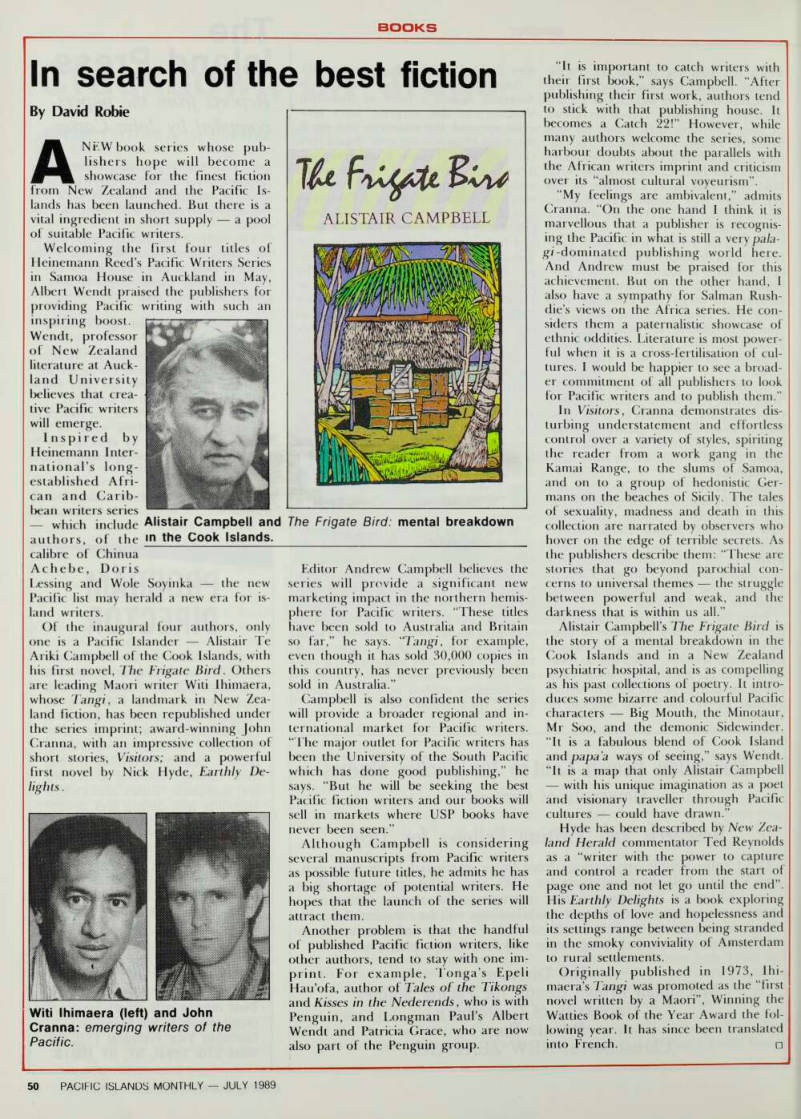
By David Robie
ANEW book series whose pub lishers hope will become a showcase for the finest fiction from New Zealand and the Pacific Is lands has been launched. But there is a vital ingredient in short supply a pool of suitable Pacific writers.
Welcoming the first four titles of Heinemann Reed’s Pacific Writers Series in Samoa House in Auckland in May, Albert Wendt praised the publishers for providing Pacific writing with such an
inspiring boost.
Wendt, professor
of New Zealand literature at Auck
land University
believes that crea tive Pacific writers will emerge.
Inspired by
Heinemann Inter
national’s long
established Afri can and Carib bean writers series which include authors, of the calibre of Chinua Achebe, Doris
Lessing and Wole Soyinka the new Pacific list may herald a new era for is land writers.
Of the inaugural four authors, only one is a Pacific Islander Alistair Te Ariki Campbell of the Cook Islands, with his first novel, The Frigate Bird. Others are leading Maori writer Witi Ihimaera, whose Tangi, a landmark in New Zea land fiction, has been republished under the series imprint; award-winning John Cranna, with an impressive collection of short stories, Visitors; and a powerful first novel by Nick Hyde, Earthly De lights .
Editor Andrew Campbell believes the series will provide a significant new marketing impact in the northern hemis phere for Pacific writers. “These titles have been sold to Australia and Britain so far,” he says. ‘Tfangi, for example, even though it has sold 30,000 copies in this country, has never previously been sold in Australia.”
Campbell is also confident the series will provide a broader regional and in ternational market for Pacific writers.
“The major outlet for Pacific writers has been the University of the South Pacific which has done good publishing,” he says. “But he will be seeking the best Pacific fiction writers and our books will sell in markets where USP books have never been seen.”
Although Campbell is considering
several manuscripts from Pacific writers as possible future titles, he admits he has a big shortage of potential writers. He hopes that the launch of the series will attract them.
Another problem is that the handful of published Pacific fiction writers, like other authors, tend to stay with one im
print. For example, Tonga’s Epeli
Hau’ofa, author of Tales of the Tikongs and Kisses in the Nederends , who is with Penguin, and Longman Paul’s Albert Wendt and Patricia Grace, who are now also part of the Penguin group.
“It is important to catch writers with their first book,” says Campbell. “After publishing their first work, authors tend to stick with that publishing house. It becomes a Catch 22!” However, while many authors welcome the series, some harbour doubts about the parallels with the African writers imprint and criticism over its “almost cultural voyeurism”.
“My feelings are ambivalent,” admits Cranna. “On the one hand I think it is marvellous that a publisher is recognis ing the Pacific in what is still a very pala
gi-dominated publishing world here.
And Andrew must be praised for this achievement. But on the other hand, I also have a sympathy for Salman Rush die’s views on the Africa series. He con siders them a paternalistic showcase of ethnic oddities. Literature is most power ful when it is a cross-fertilisation of cul tures. I would be happier to see a broad er commitment of all publishers to look for Pacific writers and to publish them.”
In Visitors, Cranna demonstrates dis turbing understatement and effortless control over a variety of styles, spiriting the reader from a work gang in the Kamai Range, to the slums of Samoa, and on to a group of hedonistic Ger mans on the beaches of Sicily. The tales of sexuality, madness and death in this collection are narrated by observers who hover on the edge of terrible secrets. As the publishers describe them: “These are stories that go beyond parochial con cerns to universal themes the struggle between powerful and weak, and the darkness that is within us all.”
Alistair Campbell’s The Frigate Bird is the story of a mental breakdown in the Cook Islands and in a New Zealand
psychiatric hospital, and is as compelling
as his past collections of poetry. It intro duces some bizarre and colourful Pacific characters Big Mouth, the Minotaur, Mr Soo, and the demonic Sidewinder.
“It is a fabulous blend of Cook Island and papa'a ways of seeing,” says Wendt.
“It is a map that only Alistair Campbell with his unique imagination as a poet and visionary traveller through Pacific cultures could have drawn.”
Hyde has been described by New Zea land Herald commentator Ted Reynolds as a “writer with the power to capture and control a reader from the start of page one and not let go until the end”.
His Earthly Delights is a book exploring the depths of love and hopelessness and its settings range between being stranded in the smoky conviviality of Amsterdam to rural settlements.
Originally published in 1973, Ihi maera’s Tangi was promoted as the “first novel written by a Maori”, Winning the Watties Book of the Year Award the fol lowing year. It has since been translated into French. □
Witi Ihimaera (left) and John Cranna: emerging writers of the Pacific.
Alistair Campbell and The Frigate Bird: mental breakdown in the Cook Islands.
Advertisements & other items, p. 50 (1 item)
50
BOOKS
Educating the Pacific
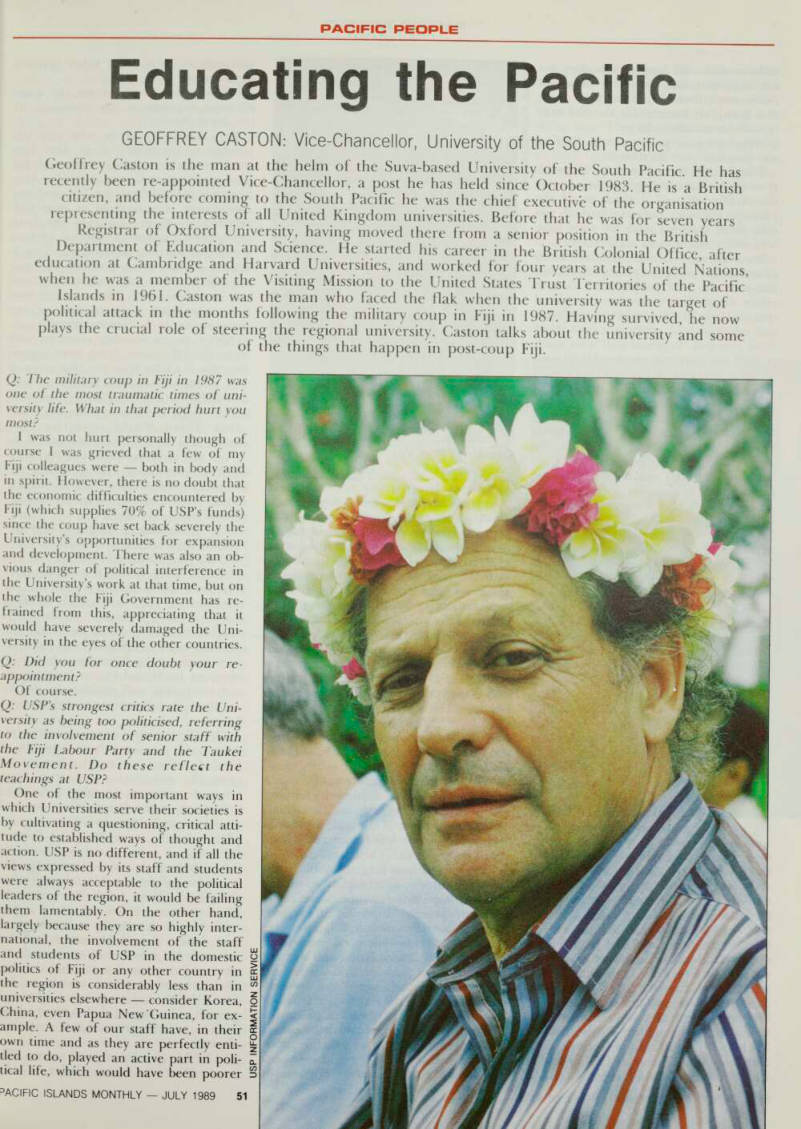
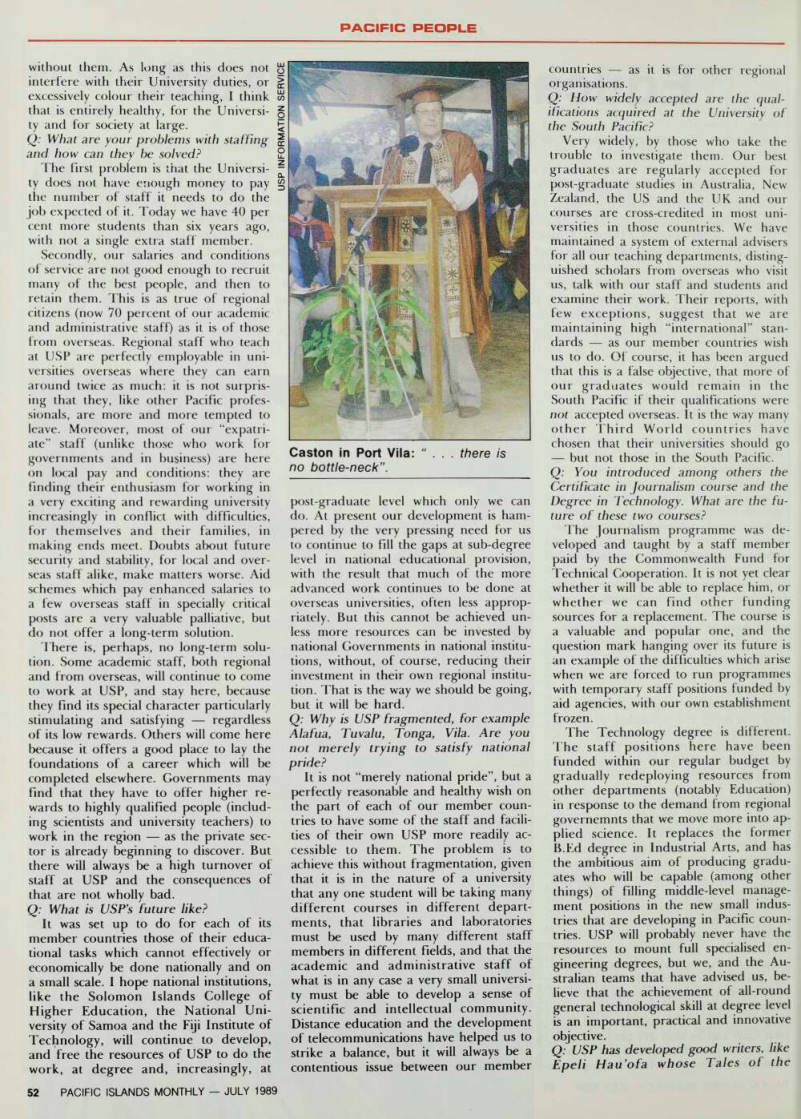
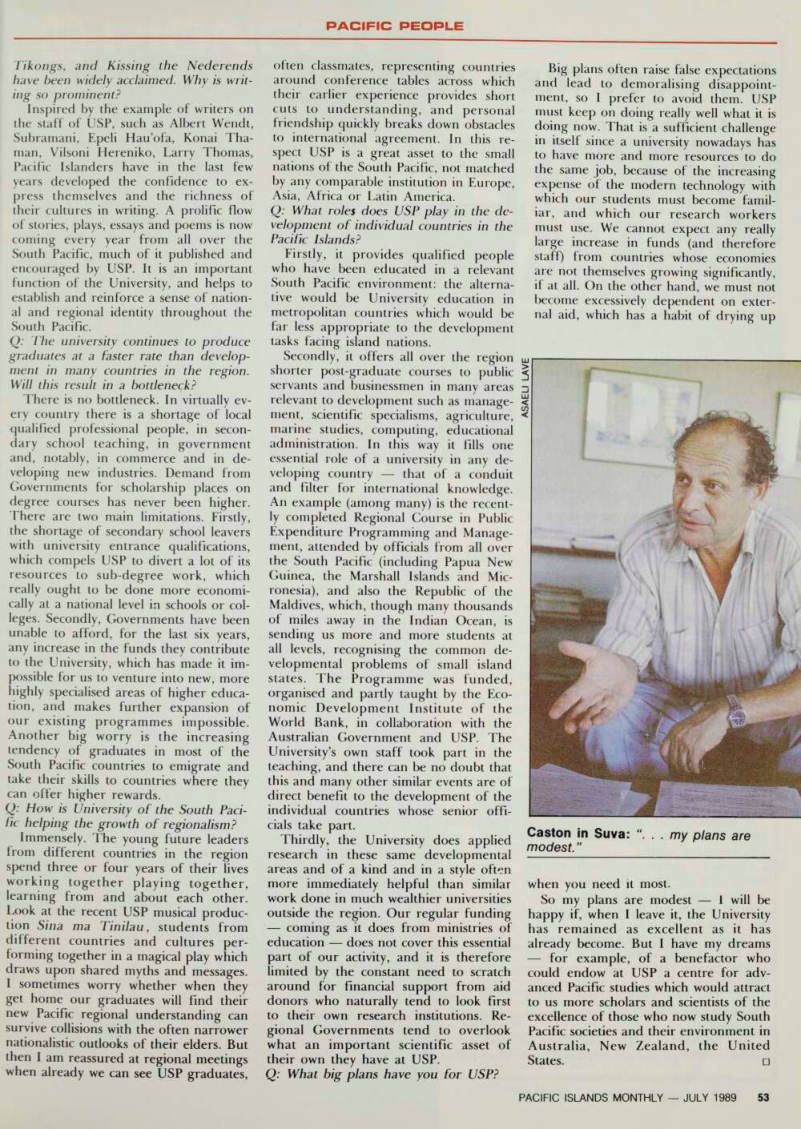
Pacific People
GEOFFREY GASTON; Vice-Chancellor, University of the South Pacific Geoffrey Gaston is the man at the helm of the Suva-based University of the South Pacific He has recently been re-appointed Vice-Chancellor, a post he has held since October 1983 He is a British citizen, and before coming to the South Pacific he was the chief executive of the organisation representing the interests of all United Kingdom universities. Before that he was for seven years Registrar of Oxford University, having moved there from a senior position in the British Department of Education and Science. He started his career in the British Colonial Office after education at Cambridge and Harvard Universities, and worked for four years at the United Nations when he was a member of the Visiting Mission to the United States Trust Territories of the Pacific Islands in 1961. Caston was the man who faced the flak when the university was the target of political attack in the months following the military coup in Fiji in 1987. Having survived he now plays the crucial role of steering the regional university. Caston talks about the university and some of the things that happen in post-coup Fiji.
Q: The military coup in Fiji in 1987 was one of the most traumatic times of uni versity life. What in that period hurt you most?
I was not hurt personally though of course I was grieved that a few of my Fiji colleagues were both in body and in spirit. However, there is no doubt that the economic difficulties encountered by Fiji (which supplies 70% of USP’s funds) since the coup have set back severely the University’s opportunities for expansion and development. There was also an ob vious danger of political interference in the University’s work at that time, but on the whole the Fiji Government has re frained from this, appreciating that it would have severely damaged the Uni versity in the eyes of the other countries.
Q: Did you for once doubt your re appointment?
Of course.
Q: USP’s strongest critics rate the Uni
versity as being too politicised, referring
to the involvement of senior staff with the Fiji Labour Party and the Taukei Movement. Do these reflect the teachings at USP?
One of the most important ways in which Universities serve their societies is by cultivating a questioning, critical atti tude to established ways of thought and action. USP is no different, and if all the views expressed by its staff and students were always acceptable to the political leaders of the region, it would be failing them lamentably. On the other hand, largely because they are so highly inter national, the involvement of the staff and students of USP in the domestic politics of Fiji or any other country in the region is considerably less than in universities elsewhere consider Korea, China, even Papua New Guinea, for ex ample. A few of our staff have, in their own time and as they are perfectly enti tled to do, played an active part in poli tical life, which would have been poorer
Usp Information Service
without them. As long as this does not interfere with their University duties, or excessively colour their teaching, I think that is entirely healthy, for the Universi ty and for society at large.
Q: What are your problems with staffing and how can they be solved?
The first problem is that the Universi ty does not have enough money to pay the number of staff it needs to do the job expected of it. Today we have 40 per cent more students than six years ago, with not a single extra staff member.
Secondly, our salaries and conditions of service are not good enough to recruit many of the best people, and then to retain them. This is as true of regional citizens (now 70 percent of our academic and administrative staff) as it is of those from overseas. Regional staff who teach at USP are perfectly employable in uni versities overseas where they can earn around twice as much: it is not surpris ing that they, like other Pacific profes sionals, are more and more tempted to leave. Moreover, most of our “expatri ate” staff (unlike those who work for governments and in business) are here on local pay and conditions: they are finding their enthusiasm for working in
a very exciting and rewarding university
increasingly in conflict with difficulties, for themselves and their families, in making ends meet. Doubts about future security and stability, for local and over seas staff alike, make matters worse. Aid schemes which pay enhanced salaries to a few overseas staff in specially critical posts are a very valuable palliative, but do not offer a long-term solution.
There is, perhaps, no long-term solu tion. Some academic staff, both regional and from overseas, will continue to come to work at USP, and stay here, because
they find its special character particularly
stimulating and satisfying regardless
of its low rewards. Others will come here because it offers a good place to lay the foundations of a career which will be completed elsewhere. Governments may find that they have to offer higher re
wards to highly qualified people (includ
ing scientists and university teachers) to work in the region as the private sec tor is already beginning to discover. But there will always be a high turnover of staff at USP and the consequences of that are not wholly bad.
Q: What is USP’s future like?
It was set up to do for each of its member countries those of their educa tional tasks which cannot effectively or economically be done nationally and on a small scale. I hope national institutions, like the Solomon Islands College of Higher Education, the National Uni versity of Samoa and the Fiji Institute of Technology, will continue to develop, and free the resources of USP to do the work, at degree and, increasingly, at
post-graduate level which only we can do. At present our development is ham pered by the very pressing need for us to continue to fill the gaps at sub-degree level in national educational provision, with the result that much of the more advanced work continues to be done at overseas universities, often less approp riately. But this cannot be achieved un less more resources can be invested by national Governments in national institu tions, without, of course, reducing their investment in their own regional institu tion. That is the way we should be going, but it will be hard.
Q: Why is USP fragmented, for example Alafua, Tuvalu, Tonga, Vila. Are you
not merely trying to satisfy national
pride?
It is not “merely national pride”, but a perfectly reasonable and healthy wish on the part of each of our member coun tries to have some of the staff and facili ties of their own USP more readily ac cessible to them. The problem is to achieve this without fragmentation, given that it is in the nature of a university that any one student will be taking many different courses in different depart ments, that libraries and laboratories must be used by many different staff members in different fields, and that the academic and administrative staff of what is in any case a very small universi ty must be able to develop a sense of scientific and intellectual community.
Distance education and the development of telecommunications have helped us to strike a balance, but it will always be a contentious issue between our member
countries as it is for other regional organisations.
Q: How widely accepted are the qual ifications acquired at the University of the South Pacific?
Very widely, by those who take the trouble to investigate them. Our best graduates are regularly accepted for post-graduate studies in Australia, New Zealand, the US and the UK and our courses are cross-credited in most uni versities in those countries. We have maintained a system of external advisers
for all our teaching departments, disting
uished scholars from overseas who visit us, talk with our staff and students and examine their work. Their reports, with few exceptions, suggest that we are
maintaining high “international” stan
dards as our member countries wish us to do. Of course, it has been argued that this is a false objective, that more of our graduates would remain in the South Pacific if their qualifications were not accepted overseas. It is the way many other Third World countries have chosen that their universities should go but not those in the South Pacific.
Q: You introduced among others the Certificate in Journalism course and the Degree in Technology. What are the fu ture of these two courses?
The Journalism programme was de veloped and taught by a staff member paid by the Commonwealth Fund for Technical Cooperation. It is not yet clear whether it will be able to replace him, or whether we can find other funding sources for a replacement. The course is a valuable and popular one, and the question mark hanging over its future is an example of the difficulties which arise when we are forced to run programmes with temporary staff positions funded by aid agencies, with our own establishment frozen.
The Technology degree is different.
The staff positions here have been
funded within our regular budget by
gradually redeploying resources from
other departments (notably Education)
in response to the demand from regional governemnts that we move more into ap plied science. It replaces the former B.Ed degree in Industrial Arts, and has the ambitious aim of producing gradu ates who will be capable (among other things) of filling middle-level manage ment positions in the new small indus tries that are developing in Pacific coun tries. USP will probably never have the resources to mount full specialised en gineering degrees, but we, and the Au stralian teams that have advised us, be lieve that the achievement of all-round
general technological skill at degree level
is an important, practical and innovative
objective.
Q: USP has developed good writers, like Epeli Hau’ofa whose Tales of the
Usp Information Service
Gaston in Port Vila: "... there is no bottle-neck”.
Tikongs, and Kissing the Nederends have been widely acclaimed. Why is writ ing so prominent?
Inspired by the example of writers on the staff of USP, such as Albert Wendt, Subramani, Epeli Hau’ofa, Konai Tha man, Vilsoni Hereniko, Larry Thomas, Pacific Islanders have in the last few years developed the confidence to ex press themselves and the richness of their cultures in writing. A prolific flow of stories, plays, essays and poems is now coming every year from all over the South Pacific, much of it published and encouraged by USP. It is an important function of the University, and helps to establish and reinforce a sense of nation
al and regional identity throughout the
South Pacific.
Q: The university continues to produce graduates at a faster rate than develop ment in many countries in the region.
Will this result in a bottleneck?
There is no bottleneck. In virtually ev ery country there is a shortage of local
qualified professional people, in secon
dary school teaching, in government and, notably, in commerce and in de veloping new industries. Demand from Governments for scholarship places on degree courses has never been higher.
There are two main limitations. Firstly, the shortage of secondary school leavers
with university entrance qualifications,
which compels USP to divert a lot of its resources to sub-degree work, which really ought to be done more economi cally at a national level in schools or col leges. Secondly, Governments have been unable to afford, for the last six years, any increase in the funds they contribute to the University, which has made it im possible for us to venture into new, more
highly specialised areas of higher educa
tion, and makes further expansion of
our existing programmes impossible.
Another big worry is the increasing tendency of graduates in most of the South Pacific countries to emigrate and take their skills to countries where they can offer higher rewards.
Q: How is University of the South Paci
fic helping the growth of regionalism?
Immensely. The young future leaders from different countries in the region spend three or four years of their lives
working together playing together,
learning from and about each other.
Look at the recent USP musical produc tion Sina ma Tinilau , students from different countries and cultures per forming together in a magical play which draws upon shared myths and messages.
I sometimes worry whether when they get home our graduates will find their new Pacific regional understanding can survive collisions with the often narrower nationalistic outlooks of their elders. But then I am reassured at regional meetings when already we can see USP graduates,
often classmates, representing countries around conference tables across which their earlier experience provides short cuts to understanding, and personal friendship quickly breaks down obstacles to international agreement. In this re spect USP is a great asset to the small nations of the South Pacific, not matched by any comparable institution in Europe, Asia, Africa or Latin America.
Q: What roles does USP play in the de velopment of individual countries in the Pacific Islands?
Firstly, it provides qualified people who have been educated in a relevant South Pacific environment: the alterna tive would be University education in metropolitan countries which would be far less appropriate to the development tasks facing island nations.
Secondly, it offers all over the region shorter post-graduate courses to public servants and businessmen in many areas relevant to development such as manage ment, scientific specialisms, agriculture, marine studies, computing, educational administration. In this way it fills one essential role of a university in any de veloping country that of a conduit and filter for international knowledge.
An example (among many) is the recent ly completed Regional Course in Public Expenditure Programming and Manage ment, attended by officials from all over the South Pacific (including Papua New Guinea, the Marshall Islands and Mic ronesia), and also the Republic of the Maldives, which, though many thousands of miles away in the Indian Ocean, is sending us more and more students at all levels, recognising the common de velopmental problems of small island states. The Programme was funded, organised and partly taught by the Eco nomic Development Institute of the World Bank, in collaboration with the Australian Government and USP. The University’s own staff took part in the teaching, and there can be no doubt that this and many other similar events are of direct benefit to the development of the individual countries whose senior offi cials take part.
Thirdly, the University does applied
research in these same developmental areas and of a kind and in a style often more immediately helpful than similar work done in much wealthier universities outside the region. Our regular funding coming as it does from ministries of education does not cover this essential part of our activity, and it is therefore limited by the constant need to scratch around for financial support from aid donors who naturally tend to look first to their own research institutions. Re gional Governments tend to overlook what an important scientific asset of their own they have at USP.
Q: What big plans have you for USP?
Big plans often raise false expectations and lead to demoralising disappoint ment, so I prefer to avoid them. USP must keep on doing really well what it is doing now. That is a sufficient challenge in itself since a university nowadays has to have more and more resources to do the same job, because of the increasing expense of the modern technology with which our students must become famil iar, and which our research workers must use. We cannot expect any really large increase in funds (and therefore staff) from countries whose economies are not themselves growing significantly, if at all. On the other hand, we must not become excessively dependent on exter nal aid, which has a habit of drying up
when you need it most.
So my plans are modest 1 will be happy if, when I leave it, the University has remained as excellent as it has already become. But I have my dreams for example, of a benefactor who could endow at USP a centre for adv anced Pacific studies which would attract to us more scholars and scientists of the excellence of those who now study South Pacific societies and their environment in Australia, New Zealand, the United States. □
Asaeli Lave
Caston in Suva: "... my plans are modest.”
Six-foot men with five-foot axes
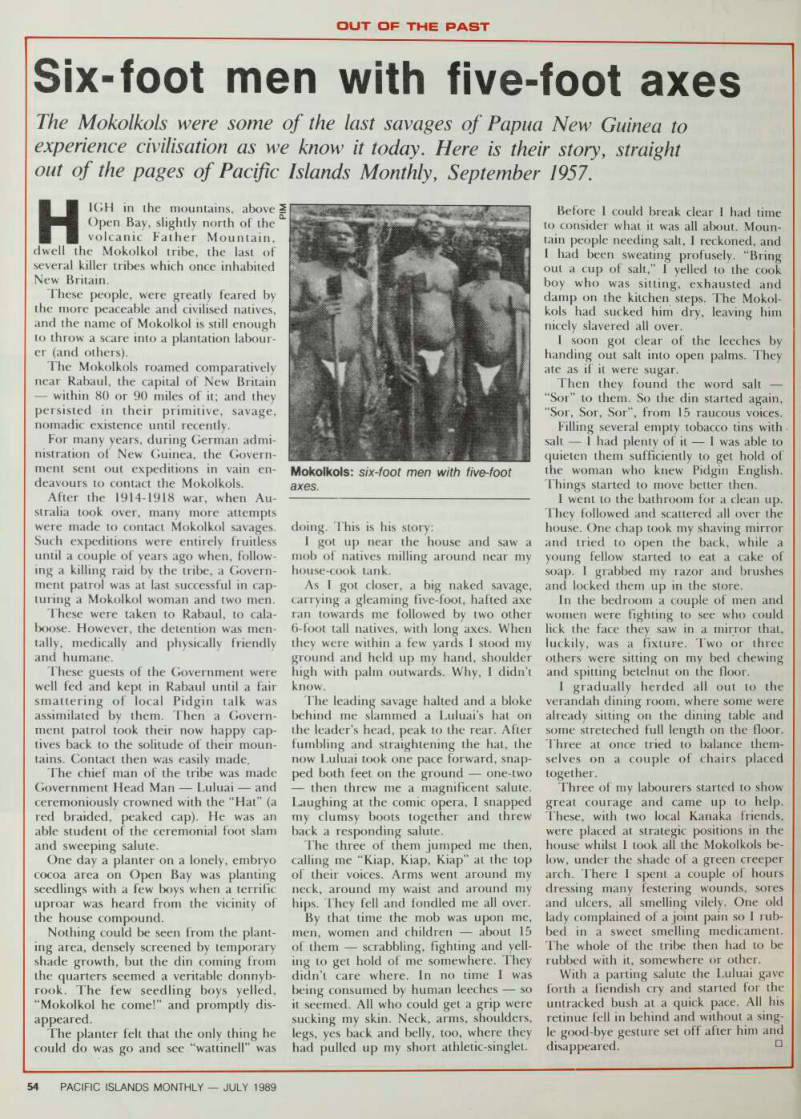
Out Of The Past
The Mokolkols were some of the last savages of Papua New Guinea to experience civilisation as we know it today. Here is their story, straight out of the pages of Pacific Islands Monthly, September 1957.
HIGH in the mountains, above Open Bay, slightly north of the volcanic Father Mountain, dwell the Mokolkol tribe, the last of several killer tribes which once inhabited New Britain.
These people, were greatly feared by
the more peaceable and civilised natives, and the name of Mokolkol is still enough to throw a scare into a plantation labour er (and others).
The Mokolkols roamed comparatively near Rabaul, the capital of New Britain within 80 or 90 miles of it; and they persisted in their primitive, savage, nomadic existence until recently.
For many years, during German admi nistration of New Guinea, the Govern ment sent out expeditions in vain en deavours to contact the Mokolkols.
After the 1914-1918 war, when Au stralia took over, many more attempts were made to contact Mokolkol savages.
Such expeditions were entirely fruitless until a couple of years ago when, follow ing a killing raid by the tribe, a Govern ment patrol was at last successful in cap turing a Mokolkol woman and two men.
These were taken to Rabaul, to cala boose. However, the detention was men
tally, medically and physically friendly
and humane.
These guests of the Government were well fed and kept in Rabaul until a fair smattering of local Pidgin talk was assimilated by them. Then a Govern ment patrol took their now happy cap tives back to the solitude of their moun tains. Contact then was easily made.
The chief man of the tribe was made Government Head Man Luluai and ceremoniously crowned with the “Hat” (a red braided, peaked cap). He was an able student of the ceremonial foot slam and sweeping salute.
One day a planter on a lonely, embryo cocoa area on Open Bay was planting seedlings with a few boys when a terrific uproar was heard from the vicinity of the house compound.
Nothing could be seen from the plant
ing area, densely screened by temporary
shade growth, but the din coming from the quarters seemed a veritable donnyb
rook. The few seedling boys yelled,
“Mokolkol he come!” and promptly dis
appeared.
The planter felt that the only thing he could do was go and see “wattineU” was
doing. This is his story: I got up near the house and saw a mob of natives milling around near my house-cook tank.
As I got closer, a big naked savage, carrying a gleaming five-foot, hafted axe ran towards me followed by two other 6-foot tall natives, with long axes. When they were within a few yards I stood my ground and held up my hand, shoulder high with palm outwards. Why, I didn’t know.
The leading savage halted and a bloke behind me slammed a Luluai’s hat on the leader’s head, peak to the rear. After fumbling and straightening the hat, the now Luluai took one pace forward, snap ped both feet on the ground one-two then threw me a magnificent salute.
Laughing at the comic opera, I snapped my clumsy boots together and threw back a responding salute.
The three of them jumped me then, calling me “Kiap, Kiap, Kiap” at the top of their voices. Arms went around my neck, around my waist and around my hips. They fell and fondled me all over.
By that time the mob was upon me, men, women and children about 15
of them scrabbling, fighting and yell
ing to get hold of me somewhere. They didn’t care where. In no time I was being consumed by human leeches so it seemed. All who could get a grip were sucking my skin. Neck, arms, shoulders, legs, yes back and belly, too, where they had pulled up my short athletic-singlet.
Before 1 could break clear I had time to consider what it was all about. Moun tain people needing salt, I reckoned, and
I had been sweating profusely. “Bring
out a cup of salt,” I yelled to the cook boy who was sitting, exhausted and damp on the kitchen steps. The Mokol kols had sucked him dry, leaving him nicely slavered all over.
I soon got clear of the leeches by handing out salt into open palms. They ate as if it were sugar.
Then they found the word salt “Sor” to them. So the din started again, “Sor, Sor, Sor”, from 15 raucous voices.
Filling several empty tobacco tins with salt I had plenty of it I was able to quieten them sufficiently to get hold of the woman who knew Pidgin English.
Things started to move better then.
I went to the bathroom for a clean up.
They followed and scattered all over the house. One chap took my shaving mirror and tried to open the back, while a young fellow started to eat a cake of soap. I grabbed my razor and brushes and locked them up in the store.
In the bedroom a couple of men and women were fighting to see who could lick the face they saw in a mirror that, luckily, was a fixture. Two or three others were sitting on my bed chewing and spitting betelnut on the floor.
I gradually herded all out to the verandah dining room, where some were already sitting on the dining table and some streteched full length on the floor.
Three at once tried to balance them selves on a couple of chairs placed
together.
Three of my labourers started to show great courage and came up to help.
These, with two local Kanaka friends, were placed at strategic positions in the house whilst I took all the Mokolkols be low, under the shade of a green creeper arch. There I spent a couple of hours dressing many festering wounds, sores and ulcers, all smelling vilely. One old lady complained of a joint pain so 1 rub bed in a sweet smelling medicament.
The whole of the tribe then had to be rubbed with it, somewhere or other.
With a parting salute the Luluai gave forth a fiendish cry and started for the untracked bush at a quick pace. All his retinue fell in behind and without a sing le good-bye gesture set off after him and
disappeared. D
Pim
Mokolkols: six-foot men with five-foot axes.
Advertisements & other items, pp. 55-56 (1 item)
Traffic
CH> PIONEER
The future of sound and vision.
v. w m r
TRAFFIC
TAMERS
fmiau'is che
KEH-7050QR & CDX-3
Pure Sound, Pure Power...
Relax! Let Pioneer’s Traffic Tamers drown out the din.
Our CD Players do it with pure sound, while our Stereo Cassette/Tuners do it with pure power.
Pioneer-original high-tech laser-optics make CD sound even better in the stylish, new CDX-3 at an affordable price.
A great match for it is the new KEH-7050CR with a 7-band graphic equalizer —15 W four or 25W into the standard two channels. That’s high power plus!
If you think this all sounds great in the middle of a traffic jam, wait till you hit the open road and turn up the volume!
KEH-7050QR has switchable Dual Illumination (green or amber).
Anti-theft Quick-Release System.
For further information, please contact: Australia; Pioneer Electronics Australia Pty. Ltd. (Incorporated in Victoria), P.O. Box 295. Mordialloc, Victoria, 3195 Tel; 580-9911 Fiji Islands: Brijlal & Company. G.PO. Box No. 362, Suva, Fiji Islands Tel: 22258 New Zealand: Monaco Corporation Ltd , 41 Poland Road, Glenfield, Auckland.
New Zealand Tel: (09) 444-9144 Norfolk Island: Burnt Pine Traders Ltd., PC. Box 21, Norfolk Island Vanuatu: Burns Philp (Vanuatu) Ltd., Vila, Vanuatu Nauru Island: Jacob Enterprises, P.O. Box N 0.4, Republic of Nauru Tahiti; Tahiti Hi-Fi, P.O. Box 848. Papeete, Tahiti New Caledonia: Menard Pacifique Sari, B P. 3899, Noumea, New Caledonia Tel: 27*62.23 American Samoa: Transpac Corporation, P.O. Box 1477, Pago Pago, American Samoa 96799 Tel: 633-5224 Rarotonga: South Seas International Ltd . P.O Box 49, Rarotonga, Cook Islands Tel: 2327
The Mark of Distinction The Mitsubishi Diamonds Only those of true distinction, poise and grace are invited to wear the Mitsubishi Three- Diamonds mark. One of the more shapely yet to be dressed in the Diamonds is the new Mitsubishi Galant. A classic beauty both sensual and svelte. Its gently flowing body whispers refinement and the promise of excitement.
It invites personal intimacy. To be touched, driven, experienced. And the experience is uniquely seductive.
The Galant is the product of both cool logic and warm emotion. The most advanced automotive technology available was brought to life in a natural organic design of elegant flowing lines and contoured surfaces.
In developing a passenger vehicle worthy of wearing the Three-Diamonds, the designers and engineers at Mitsubishi set out to produce a car whose systems worked as a single ‘thinking’ organism. One that would actively promote safe, convenient and exhilarating driving.
Any less, and it wouldn’t be a Mitsubishi.
The result is truly inspired. It so impressed the editorial staff of the respected US automotive journal, Motor Trend, that it quickly became their choice for the 1989 Import Car of the Year Award. Amid praise like, “a virtuoso effort”, the Galant was selected for the coveted award over the finest models from car markers around the world.
The Mitsubishi Galant is a new experience with the time-honoured reverence of beauty. The organic experience. But then, diamonds have always looked great on nicely curved forms.
MITSUBISHI QRLRNT
A
MITSUBISHI
MOTORS
AMERICAN SAMOA: MORRIS SCANLAN SERVICE INC. PO Box 367, P. 90 Pago. Tel 633-5520/ AUSTRALIA; MITSUBISHI MOTORS AUSTRALIA LTD. Ete 1284. South Road C SMIEUi 275-7223/ FUI: NIVIS MOTOR & MACHINERY CO.. LTD. G.P.O Box 150. Suva, Tel 38341 l/FRENCH POLYNESIA (TAHITI): ETS-BREDIN FRERESETFILS PO. Box 21 Papeete, Tahiti. Tel, 4-202-58/ NEW CALEDONIA. SOCIETH □■IMPORTATION D AUTO DU PACIFIQUE SUD S.A. BP 438 Rond Point du Pacifque, Noumea, Tel. 274144/NEW ZEALAND: MITSUBISHI MOTORS RVKT PO^racßßHoniara NORFOLK ISLAND: BORRYS LTD. PO Box 169, Norfolk Island, Tel 2114/PAPUA NEW GUINEA: TOBA PTY LTD. PO Box 503, Port Moresby Tel 21 -J^ /S O L OMON -HARVEST RACIFTC LTD GP 0 B °* ® B N £° n £ r ® Guadalcanal Tel 30128/TONGA: SITANI MAFI CO.. LTD. PO Box 83, NukuALOFA. Tel 21-044/VANUATU: SOCOMETRA B P 06 Route de Lagon, Port-VHa. Tel. 2314/WESTERN SAMOA A M. MACDONALD HOLDINGS LTC