Pacific
Islands
Monthly
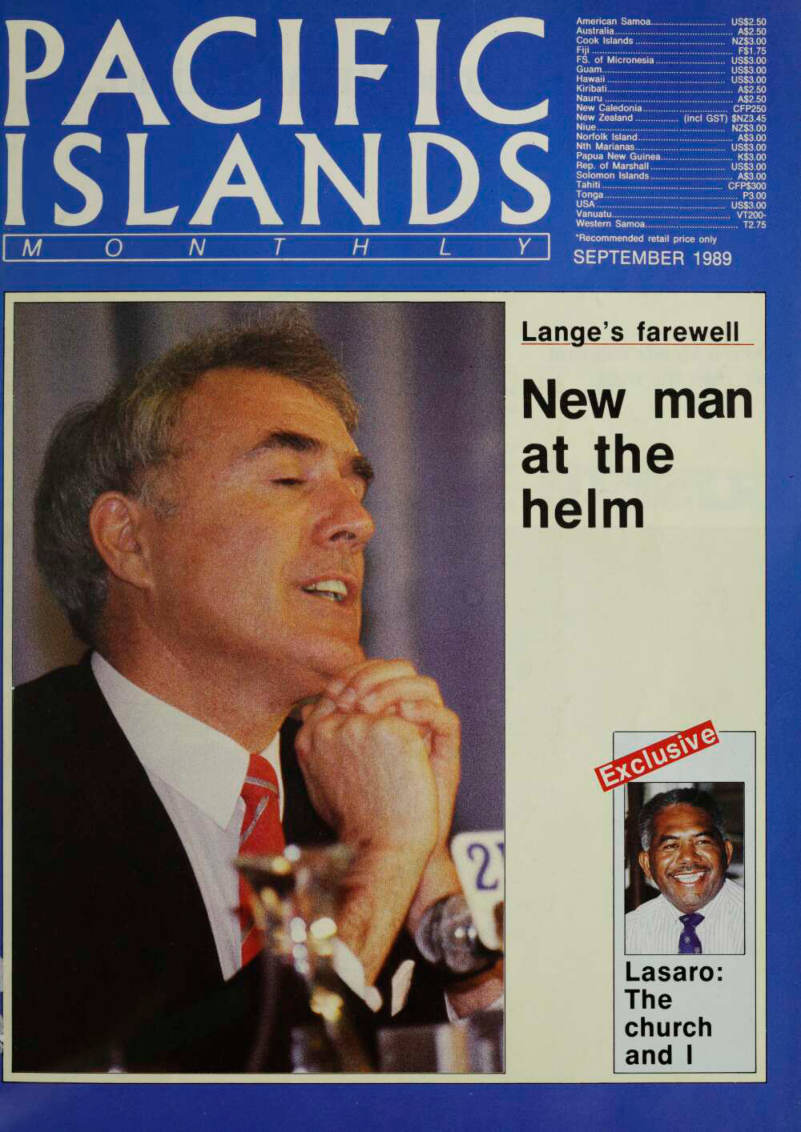
American Samoa US$2.5O Australia A 52.50 Cook Islands NZ$3.OO Fiji F 51.75 FS. of Micronesia US$3.OO Guam US$3.OO Hawaii US$3.OO Kiribati A 52.50 Nauru A 52.50 New Caledonia CFP2SO New Zealand (incl GST) $NZ3.45 Niue NZ$3.OO Norfolk Island : A 53.00 Nth Marianas US$3.OO Papua New Guinea K 53.00 Rep. of Marshall US$3.OO Solomon Islands A 53.00 Tahiti CFPS3OO Tonga P 3.00
Usa Us$3.Oo
Vanuatu VT2OO - Samoa T 2.75 ‘Recommended retail price only
September 1989
Lange’s farewell New man at the helm
Lasaro: The church and I
Advertisements & other items, pp. 2-4 (1 item)
Leave the humdrum behind
Own a Mazda 626, and
you own the road.
Boredom’s a strong emotion.
And at Mazda, we think there’s no good reason why any driver should have to suffer it.
That’s why we created the Mazda 626. A car offering equal measures of uncommon good looks. Unrestrained performance. And a remarkable degree of precision handling.
This last, especially, has earned the 626 much praise throughout Europe. Enthusiasts speak of the 626’s grip on all kinds of surfaces. Its assured cornering and straight-line stability. Its regard for everything, in fact, that pays off in enhanced driver feel.
Driver feel has long been a
priority at Mazda. We’ve gone so far is to construct a Global Road Circuit in which every conceivable 'oad condition, from ice to Belgian cobblestone to city pothole, is luplicated. Sensors gauge our cars’ performance over these surfaces, as veil as through the many twists and urns we’ve designed to simulate European roadways.
The results include innovative and acclaimed suspension systems.
As well as the world’s first speedsensing, 4-wheel steering system.
Regrettably, some people will remain unaware of their options and, by choosing an ordinary car, suffer the consequences.
You needn’t be one of them.
Instead you can choose a Mazda.
Model and features shown may not be available in your area. Please consult your local Mazda dealer.
mazoa
© Mazda Motor Corporation
TRAFFIC
TAMERS
hmiuu. (s chE
KEH-7050QR & CDX-3
Pure Sound, Pure Power...
Relax! Let Pioneer’s Traffic Tamers drown out the din.
Our CD Players do it with pure sound, while our Stereo Cassette/Tuners do it with pure power.
Pioneer-original high-tech laser-optics‘make CD
sound even better in the stylish, new CDX-3 at an
affordable price.
A great match for it is the new KEH-7050QR with a 7-band graphic equalizer -15 W into four or 25W into the standard two channels. That’s high power
plus!
If you think this all sounds great in the middle of a traffic jam, wait till you hit the open road and turn up
the volume!
KEH-7050QR has switchable Dual Illumination (green or amber).
Anti-theft Quick-Release System.
For further information, please contact: Australia: Pioneer Electronics Australia Pty. Ltd. (Incorporated in Victoria), P.O. Box 295, Mordialloc, Victoria. 3195 Tel: 580-9911 Fiji Islands; Brijlal & Company, G.P O. Box No. 362, Suva, Fiji Islands Tel: 22258 New Zealand: Monaco Corporation Ltd., 41 Poland Road, Glenfield, Auckland New Zealand Tel: (09) 444-9144 Norfolk Island; Burnt Pine Traders Ltd., P.O. Box 21, Norfolk Island Vanuatu; Burns Philp (Vanuatu) Ltd,, Vila, Vanuatu Nauru Island: Jacob Enterprises, P.O. Box N 0.4, Republic of Nauru Tahiti: Tahiti Hi-Fi, P.O, Box 848, Papeete, Tahiti New Caledonid: Menard Pacifique Sari, B.P. 3899, Noumea, New Caledonia Tel: 27*62.23 American Samoa: Transpac Corporation, P.O. Box 1477, Pago Pago, American Samoa 96799 Tel: 633-5224 Rarotonga: South Seas International Ltd , P.O. Box 49, Rarotonga.
Cook Islands Tel: 2327
Pacific
Islands
Monthly
Vol 59 No. 20
Voice Of The Pacific
September 1989
Cover
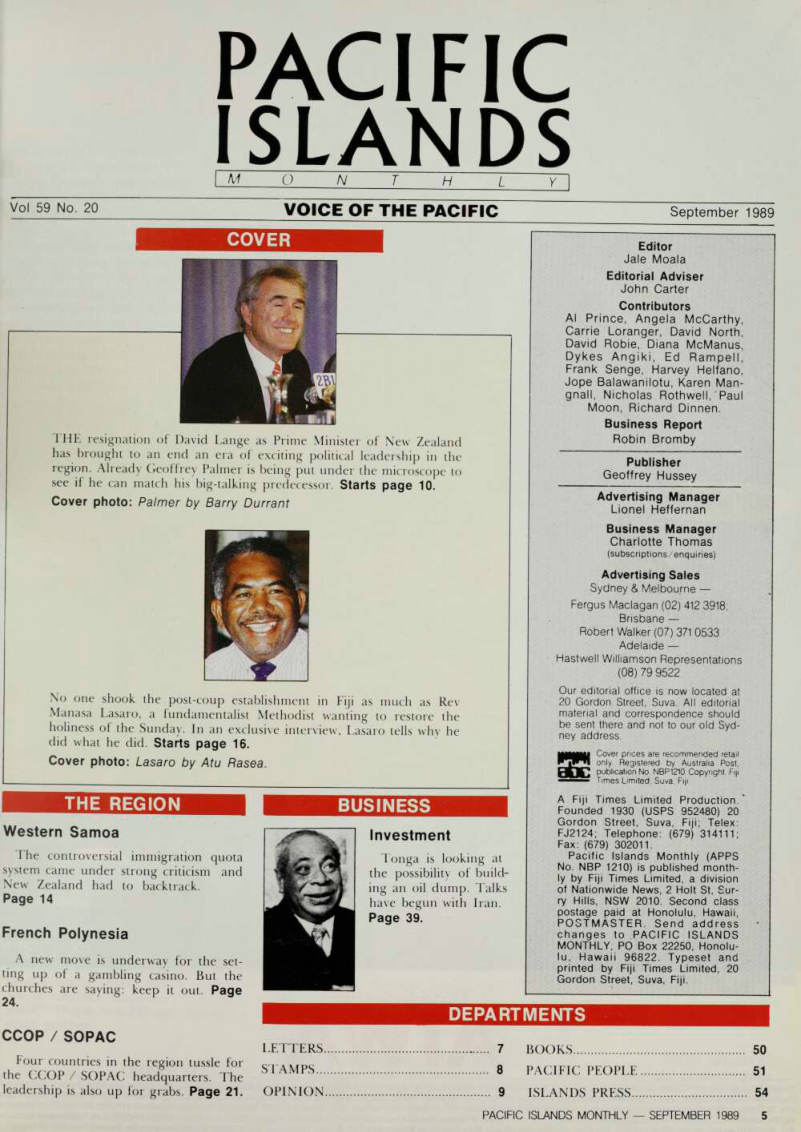
THE resignation of David Lange as Prime Minister of New Zealand has brought to an end an era of exciting political leadership in the region. Already Geoffrey Palmer is being put under the microscope to see if he can match his big-talking predecessor. Starts page 10.
Cover photo: Palmer by Barry Durrant
No one shook the post-coup establishment in Fiji as much as Rev Manasa Lasaro, a fundamentalist Methodist wanting to restore the holiness of the Sunday. In an exclusive interview, Lasaro tells why he did what he did. Starts page 16.
Cover photo: Lasaro by Atu Rasea.
The Region
Western Samoa The controversial immigration quota system came under strong criticism and New Zealand had to backtrack.
Page 14
French Polynesia
A new move is underway for the set ting up of a gambling casino. But the churches are saying: keep it out. Page 24.
Ccop / Sopac
Four countries in the region tussle for the CCOP / SOPAC headquarters. The leadership is also up for grabs. Page 21.
Business
Investment Tonga is looking at the possibility of build ing an oil dump. Talks have begun with Iran.
Page 39.
Editor Jale Moala Editorial Adviser John Carter Contributors Al Prince, Angela McCarthy, Carrie Loranger, David North, David Robie, Diana McManus, Dykes Angiki, Ed Rampell, Frank Senge, Harvey Helfano, Jope Balawanilotu, Karen Man gnall, Nicholas Rothwell,' Paul Moon, Richard Dinnen.
Business Report Robin Bromby
Publisher Geoffrey Hussey
Advertising Manager Lionel Heffernan Business Manager Charlotte Thomas (subscriptions/enquiries) Advertising Sales Sydney & Melbourne Fergus Maclagan (02) 412 3918: Brisbane Robert Walker (07) 371 0533 Adelaide Hastwell Williamson Representations (08) 79 9522 Our editorial office is now located at 20 Gordon Street, Suva. All editorial material and correspondence should be sent there and not to our old Syd ney address.
Cover prices are recommended retail only Registered by Australia Post, publication No NBPI2IO Copyright Fiji Times Limited, Suva, Fiji
Advertisements & other items, pp. 5-6 (3 items)
Departments
LETTERS 7
STAMPS 8
OPINION 9
BOOKS 50
PACIFIC PEOPLE 51
ISLANDS PRESS 54
5
PACIFIC ISLANDS MONTHLY SEPTEMBER 1989
A Fiji Times Limited Production. * Founded 1930 (USPS 952480) 20 Gordon Street, Suva, Fiji; Telex: FJ2124; Telephone; (679) 314111; Fax: (679) 302011.
Pacific Islands Monthly (APPS No. NBP 1210) is published month ly by Fiji Times Limited, a division of Nationwide News, 2 Holt St, Sur ry Hills, NSW 2010. Second class postage paid at Honolulu, Hawaii, POSTMASTER. Send address changes to PACIFIC ISLANDS MONTHLY, PO Box 22250, Honolu lu, Hawaii 96822. Typeset and printed by Fiji Times Limited, 20 Gordon Street, Suva, Fiji.
Aiwa*
miTu
gti
d CO dubbing
The new high speed dubbing feature on the AIWA X-D9OO system allows you to dub CDs in about half the playing time.
And, it’s the world’s first midi component system with new high definition BBE sound originally developed for audio professionals. BBE brings out more sonic detail, particularly in vocals and solos.
In combination with AlWA’s original DSL and a full 1000W(PMPO)high power output, you’ll enjoy authentic soundstage presence.
The X-D9OO also offers audio/video compatibility, with 3 A/V inputs and 2 AN outputs, along with a built-in AN surround sound system. It’s everything you could want in a genuine high quality separate component system.
lOOOwPMPO
* - Mini Hill* '■'s3* N Pure Hi-Fi Component System
X-D9OO
UUU The word “BBE” and the “BBE symbol” are trademarks of BBE Sound, Inc.
Digital Audio&Video
AIWA*
Mobex Pty., Ltd. Unit 1,70 Gibbes Street Chatswood N.S.W. 2067 AUSTRALIA PHONE: 001-61-2-4066277/Oceania Indent Agency (P.N.G.) Pty., Ltd. Ago St., Gordon Box 5518, Boroko, Port Moresby, Papua New Guinea PHONE: 256411/The Sound Centre Ltd. P.O. Box 434 Port Vila, Vanuatu PHONE: 2035/P. Hargovind Bros. 190 Renwick Road P.O. Box 409 Suva Fiji PHONE: 24350/Octavium Group Ltd. 33 Constellation Drive Mairangi Bay, Auckland 10 NEW ZEALAND PHONE: 001-64-9-479-1272/Hifivox 19 av. Foch B.P. 1458 NOUMEA Nouvelle-Cal6donie PHONE: 001-687-27.24.66/Harvest Pacific Limited P.O. Box 517, Honiara, Solomon Islands PHONE: 131/Fare-Hi-Fi Stereo Ruede Marechal Foch P.O. Box 269, Papeete Tahiti R.C. 6604 A TAHITI PHONE; 2.48.14/Micropac Audio, Inc. pn Rnv %a7r Anana Rnam qrqi n pmomp- 47o.snQi 479.ft9Q7/Ramtnnna Ontu Free Shoo Private Bao P.O. Box 92. Rarotonaa, Cook Island/Nauru Co-Operative Society Republic of Nauru
of Robie
Tropicalities
Letters
In defence of Robie
STEPHEN Henningham is entitled to his views (“Too much on Wea?” PIM August 1989), but there are several mis representations that need to be answered. Contrary to his claim, my arti cle (June 1989 cover story) in no way endorsed Wea or the tragic assassina tions in New Caledonia.
The murders were an abomination.
My article was a rather more balanced perspective on the circumstances that led to the assassinations than most other hys terical accounts. Part of the text was sub stantially shortened by the editors be cause of a limit on space. Unfortunately in the process much of the copy in the victims panel praising the dedication and vision of Tjibaou and Yeiwene was not actually printed. My statement which clearly read “embraced a development programme . . .” was somehow changed in the editing to “halted the implementa tion of a development plan”.
Henningham made a big issue of fac tual “errors” and then cited a number of literals in names any third-former would realise they were typographical errors.
I understood that a journalist in New Caledonia was filing a main article on the funeral and the political fallout from the assassinations. My understanding was that my article would be a supportive
backgrounder.
Henningham attacks an accompanying
article from Paris while giving the im pression it was part of my coverage. It was quite obvious that France had de cided to press ahead with the elections after the article was written and the deadline for the magazine had passed.
David Robie
Auckland, New Zealand
Snake problem
I CAN’T understand the authorities in Guam waiting all this time to do some thing about the snake problem. The snakes are thriving because they have no natural enemy there. May I suggest a simple solution: introduce “The Mon goose”. That is why Fiji does not have a snake problem.
Andrew Watson
Victoria, Australia
Greenhouse Effect
WE refer to your special report on the Greenhouse Effect, in the April/May 1989 issue of Pacific Islands Monthly.
You are absolutely right to draw atten tion to this very real and terrible threat to the existence of many hundreds of thousands of innocent victims and their islands.
The so-called ‘Greenhouse Effect’ is preventable. It is not inevitable. It is caused entirely by the accelerated burn ing of hydrocarbon fossil fuels worl dwide in high-flying aircraft, in ships, in power stations, in trains, buses, trucks, military vehicles, private cars, public buildings, hotels, hospitals, pri vate houses, in bulldozers, motorised farm equipment, big lorries, you name it.
Hydrogen is the only non-polluting
fuel. More than 200 years ago, the French and the British made hydrogen gas and used it in their balloons. The French made the first international ae rial voyage when Blanchard, the French aeronaut and his passenger, the American Doctor Jeffries in his leopard-skin hat, made their crossing of the English Channel to France in 1785, in their Hydrogen balloon.
In the early years of this century the whole of England cooked and was lit by practically pure hydrogen, made from coal and called coal-gas. It was replaced by electricity, made by burning coal to produce steam to run turbines, driving electric dynamos, and, later, big alter nators. Later the coal was sup plemented by oil. That is where the world went wrong. We should have stayed with Hydrogen. We had the
underground piping network. Hyd
rogen should have been pumped to in dustrial centres, and there used in tur bines, which were the forerunners of today’s internal combustion turbines, to make electricity thus saving the cost of overhead transmission cables and their power losses.
AH existing fossil fuel burning en gines can run on Hydrogen the only non-polluting fuel. As long ago as 1958 the Lockheed Aircraft Company flew a jet transport plane, fuelled entirely by Hydrogen gas, carried in insulated tanks, as liquid Hydrogen. Hydrogen fuel is lighter than high-polluting, oil based jet fuel, and take off runs could be shorter.
Hydrogen can be made from the sea.
Ships of all kinds: passenger-liner cruise ships, container ships, cargo ships and others, could make Hydrogen from the sea.
There is one problem. This world has a very powerful oil lobby. Many governments in the big industrial coun
tries are members, and have a big in vestment in perpetuating the use of oil fuel. If President Bush, Margaret I hatcher, President Mitterrand, Gor bachev, and the leaders of Canada, Au stralia, New Zealand, Germany, Italy, Switzerland, all the South American states, and the Indian and Far Eastern nations and China. Get their scientists to discover how oil could be trans formed into Hydrogen, the oil lobby would be with us not against us.
J H Millar
Monte Carlo, Monaco
Not my line
I REFER to my article “Women who mean business” which appeared in June 1989. I did not write the article’s intro duction which states, “Pacific societies are male dominated bastions of chauvinism”.
Being careful not to use such radical feminist remarks in my article, I find it rather distressing that you have chosen to do so in a context which implies that I have little sympathy with Pacific tradition and culture. 1 disassociate myself from that state ment. The purpose of my article was to applaud women’s personal achievements and progress in a changing world. It was not meant as a scathing criticism of the existing order which has, in the past, served Pacific peoples adequately.
Diana Mcmanus
Funafuti, Tuvalu
Forest issue
YOU can’t have it both ways. Your April/May issue opens with the justifi able lament that whole countries are threatened with obliteration by the Greenhouse Effect (the result largely of industrialisation and the felling of forests). Yet later in the same issue there is the heading, “Wilderness destruction threatens development.” Should this not read the otherway around? There is a further irony in that the article (which in fact is a critique of environmental des truction) comes from the World Bank, one of the major sources for funding of
large-scale ecologically disastrous de
velopment projects,
Paul Sharrad
University of Woolongong, Australia.
Problems for
Stamps
Problems for the collectors
By John Hunter
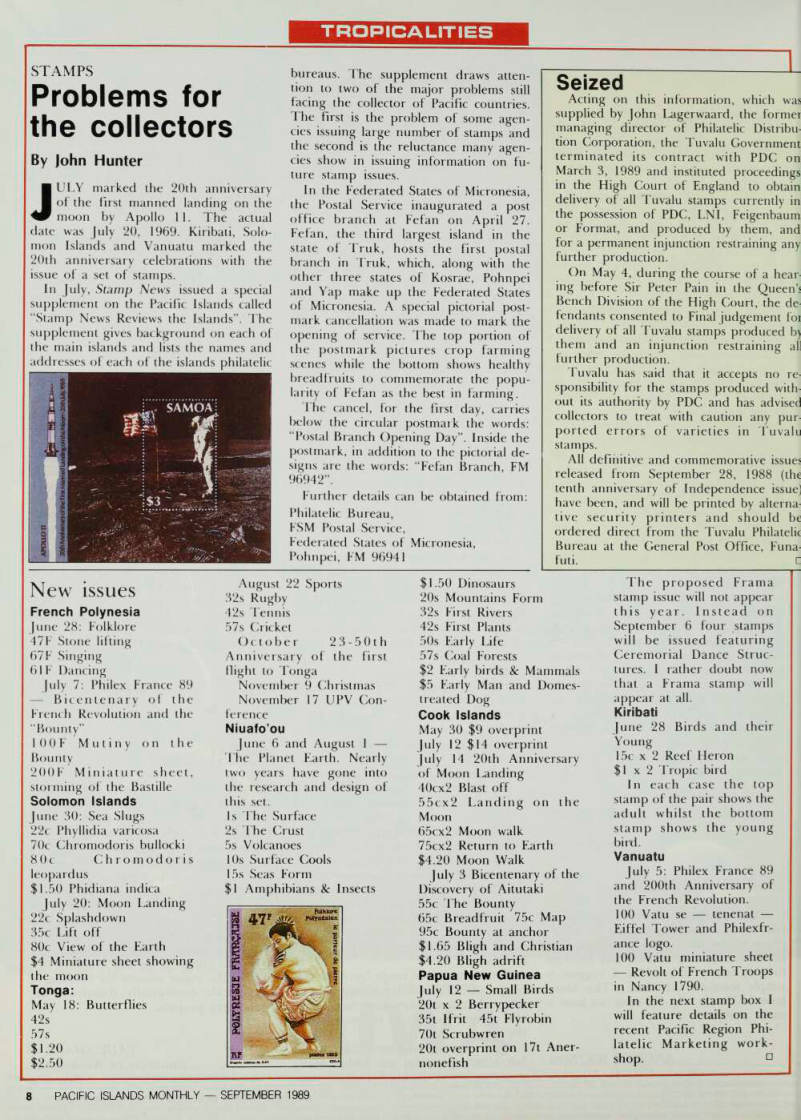
JULY marked the 20th anniversary of the first manned landing on the moon by Apollo 11. The actual date was July 20, 1969. Kiribati, Solo mon Islands and Vanuatu marked the 20th anniversary celebrations with the issue of a set of stamps.
In July, Stamp News issued a special supplement on the Pacific Islands called “Stamp News Reviews the Islands”. The
supplement gives background on each of
the main islands and lists the names and addresses of each of the islands philatelic
bureaus. The supplement draws atten tion to two of the major problems still facing the collector of Pacific countries.
The first is the problem of some agen cies issuing large number of stamps and the second is the reluctance many agen cies show in issuing information on fu ture stamp issues.
In the Federated States of Micronesia, the Postal Service inaugurated a post office branch at Fefan on April 27.
Fefan, the third largest island in the state of Truk, hosts the first postal branch in Truk, which, along with the other three states of Kosrae, Pohnpei and Yap make up the Federated States of Micronesia. A special pictorial post mark cancellation was made to mark the opening of service. The top portion of
the postmark pictures crop farming
scenes while the bottom shows healthy breadfruits to commemorate the popu larity of Fefan as the best in farming.
The cancel, for the first day, carries below the circular postmark the words; “Postal Branch Opening Day”. Inside the postmark, in addition to the pictorial de signs are the words: “Fefan Branch, FM 96942”.
Further details can be obtained from: Philatelic Bureau, FSM Postal Service, Federated States of Micronesia, Pohnpei, FM 96941
Seized
Acting on this information, which was supplied by John Lagerwaard, the former managing director of Philatelic Distribu tion Corporation, the Tuvalu Government terminated its contract with PDC on March 3, 1989 and instituted proceedings in the High Court of England to obtain delivery of all Tuvalu stamps currently in the possession of PDC, LNI, Feigenbaum or Format, and produced by them, and for a permanent injunction restraining any further production.
On May 4, during the course of a hear ing before Sir Peter Pain in the Queen’s Bench Division of the High Court, the de fendants consented to Final judgement for delivery of all Tuvalu stamps produced by them and an injunction restraining all further production.
Tuvalu has said that it accepts no re sponsibility for the stamps produced with out its authority by PDC and has advised collectors to treat with caution any pur ported errors of varieties in Tuvalu stamps.
All definitive and commemorative issues released from September 28, 1988 (the tenth anniversary of Independence issue) have been, and will be printed by alterna tive security printers and should be ordered direct from the Tuvalu Philatelic Bureau at the General Post Office, Funa futi. □
New issues
French Polynesia June 28: Folklore 47F Stone lifting
67F Singing
61F Dancing July 7: Philex France 89 Bicentenary of the French Revolution and the
“Bounty”
100 F Mutiny on the Bounty 200 F Miniature sheet, storming of the Bastille Solomon Islands June 30: Sea Slugs 22c Phyllidia varicosa 70c Chromodoris bullocki 80c Chromodoris
leopardus
$1.50 Phidiana indica July 20: Moon Landing
22c Splashdown
35c Lift off 80c View of the Earth $4 Miniature sheet showing the moon Tonga: May 18; Butterflies 42s 57s $1.20 $2.50
August 22 Sports
32s Rugby
42s Tennis 57s Cricket October 23-50th Anniversary of the first
flight to Tonga
November 9 Christmas November 17 UPV Con ference Niuafo’ou June 6 and August 1 The Planet Earth. Nearly two years have gone into the research and design of this set.
Is The Surface 2s The Crust 5s Volcanoes 10s Surface Cools 15s Seas Form $1 Amphibians & Insects
$1.50 Dinosaurs 20s Mountains Form 32s First Rivers 42s First Plants 50s Early Life 57s Coal Forests $2 Early birds & Mammals $5 Early Man and Domes treated Dog Cook Islands May 30 $9 overprint July 12 $l4 overprint July 14 20th Anniversary of Moon Landing 40cx2 Blast off 55cx2 Landing on the Moon 65cx2 Moon walk 75cx2 Return to Earth $4.20 Moon Walk July 3 Bicentenary of the Discovery of Aitutaki 55c The Bounty 65c Breadfruit 75c Map 95c Bounty at anchor $1.65 Bligh and Christian $4.20 Bligh adrift Papua New Guinea July 12 Small Birds 20t x 2 Berrypecker 35t Ifrit 45t Flyrobin 70t Scrubwren 20t overprint on 17t Aner nonefish
The proposed Frama stamp issue will not appear this year. Instead on September 6 four stamps will be issued featuring Ceremorial Dance Struc tures. I rather doubt now that a Frama stamp will appear at all.
Kiribati June 28 Birds and their Young 15c x 2 Reef Heron slx2 Tropic bird In each case the top stamp of the pair shows the adult whilst the bottom stamp shows the young bird.
Vanuatu July 5: Philex France 89 and 200th Anniversary of the French Revolution. 100 Vatu se tenenat Eiffel Tower and Philexfr
ance logo.
100 Vatu miniature sheet Revolt of French Troops in Nancy 1790.
In the next stamp box I will feature details on the recent Pacific Region Phi latelic Marketing work
shop. D
Say it
Pacific
Islands
Monthly
Opinion
Say it again, Lange
THE passing of David Lange from Prime Minister to a position outside Cabinet brings to an end an exciting period of political leadership in the region. No other leader in the Pacinc had his wits. Few had his courage.
From encouraging social reforms in New Zealand to standing up for a nuclear-free Pacinc, Lange demonstrated a unique quality that was typi cally Pacific and politically courageous.
One of the hallmarks of his political leadership was his remarkable verbal quality. He will be remembered for some of the smartest political repartee in New Zealand’s political history. As he came under increasing pressure, his quick wit often became focused with devastating effect on bis political foes within his own party and against press gallery journalists.
On Labour backbencher Bill Sutton, who tried to force Lange into reinstating rival Roger Douglas into the cabinet: “A candidate for a brain transplant . . . they can’t find a compatible
On Opposition Leader Jim Bolger:
Mogadon Man” (after a popularly prescribed brand of sleeping; pill).
On the Pacific and travel: The Pacific is ill-named. It was named by a PR agency in my opinion, having been on it for the last week.”
On France and the bombing in Auckland harbour of the Greenpeace anti-nuclear ship Rainbow Warrior: “ . . . the French are never more intractable than when they are 100
percent wrong.”
On a visit to France’s nuclear test site at Moruroa Atoll by the French Prime Minister and Defence Minister; ... I notice the Prime Minister has a little more sense, he didn’t swim in the waters of Moruroa, but the Minister of Defence apparently took it upon himself to learn how to glow in the dark or something he was there. ”
On Anzus;
“A moron in a hurry could see that it wasn’t a security guarantee.”
On a backbencher Mr who predicted a United States dirty tricks cam paign over New Zealand’s anti-nuclear stance, including efforts to com promise MPs: / ve been waiting a month now to be compromised and all that hap pened was that Naomi [Lange’s wife] turned up.”
On NZ’s Security Intelligence Service: Intelligence gathering is not wearing a mackintosh, a dark hat and a false beard ana lurking through a drainpipe. Intelligence gathering is % 0 * n g to party and listening to what journalists say and report- On New Zealanders: ‘lt’s in the psyche of every New Zealander to think they can run a milkbar, even though the Mercantile Gazette proves not a heck of a lot of them are particularly good at it. ”
On himself: “Because the family’s young and the nature of the job is demanding it happens that most of the time I sleep in Wellington, Naomi, my wife, sleeps in Auckland, and when we sleep together the Deputy Prime Minis
ter rings up.” o
Advertisements & other items, p. 9 (1 item)
FIJI: Distribution, subscriptions and advertising: Fiji
Times Limited, GPO Box 1167, Suva, Fiji. Phone 31 -4111 telex FJ2124 FRENCH POLYNESIA: Distribution: Hachette Pacifique 10 Ave Bruat, Papeete Phone 25-610 HAWAII. UNITED STATES: Distribution: PIM Hawaii PO Box 22250, Honolulu, Hawaii, 96822 Advertising: Brian C Asgill, Apt 1308,1676 Ala Moana Blvd Honolulu Hawaii, 96815 Phone (808) 955-9718 JAPAN: Advertising and subscriptions: Universal Media Corporation, GPO Box 46, Tokyo Phone 666-3036 cable UNIMEDIA Tokyo, telex 2524665 MALAYSIA Advertising and subscriptions: Worldwide Media Services, 57-B Komplex Damai, Jin Dato Haji Eusoff, Kuala Lumpur Phone 63-9340, cables WORLDMEDIA Kuala Lumpur, telex 31533 VANUATU: Distribution: The Vanuatu Stationery and Book Centre, PO Box 557 Port Vila Advertising: Norman Bros Bookshop Port Vila Phone 2232 NEW CALEDONIA: Distribution: Depot Centre de Presse Michel Pentecost CBP2, Noumea Phone 27- 2434, 27-4729 NEW ZEALAND: Distribution: Gordon & Gotch, PO Box 584, 2 Carr Road, Mt Roskill, Auckland 4 Advertising: McKay International Media Reps Ltd, C/- Albany PO, Auckland 10, New Zealand Phone 413-9119 Telex NZ22701, FAX 413-9110 WELLINGTON: Ross Quaid Media, 1 Scholes Lane Petone (04) 68-7593, PO Box 38699, Petone PAPUA NEW GUINEA: Distribution: Gordon & Gotch PO Box 3395, Port Moresby Phone 25-4551 25-4855 Advertising; Robert Walker, PO Box 600 Indooroopilly Old Australia 4068 Phone (07) 371-0533 SOLOMON ISLANDS: Distribution and Advertising: The Bookshop, (Norman Bros.) PO Box 503, Honiara PHILIPPINES: Advertising: The GF Group, 12 San Ignacio St, Uroaneta Village, Makati, Metro Manila Phone 817 7299, telex 45950 and 4233 UNITED KINGDOM: F A Smyth and Associates, 23A Aylmer Parade, London N2OPO, England Phone (01 )340 5088, fax (01)341 9602 UNITED STATES MAINLAND: Advertising: Joshua B Powers Jr, Powers International Inc , Suite 708 , 271 Madison Ave , New York, NY 10016 Phone 867-9580, Subscriptions PIM, Hawaii, PO Box 22250 Honolulu Hawaii, 96822
SUBSCRIPTIONS
American Samoa US$45 Australia AUSS3O Canada US$45 Cook Islands AUSS46 Fiji Fs24 French Polynesia US$45 Guam US$45 Hawaii US$45 Japan US$3B Kiribati AUSS46 Micronesia US$35 Nauru AUSS42 New Caledonia US$32 New Zealand AUSS42 Solomon Islands AUSS46 Tonga AUSS46 Tuvalu AUSS46 United Kingdom Stg £2B US (Mainland) US$45 Vanuatu UASS42 Western Samoa AUSS6O Elsewhere US$63 Payments to Pacific Islands Monthly: Subscriptions Dept, GPO Box 1167. Suva, Fiji.
Subscriptions rates includes the cost of airspeeding to all destinations set out above. Direct airmail rates on application.
End of an era
Cover
For five years , David Lange presided over some of the most dramatic reforms in New Zealand for half a century. Last month he suddenly stepped aside and fellow lawyer Geoffrey Palmer took over the reins. David Robie reports.
ONE night last month an earth quake gripped central New Zealand, shaking all the way from Gisborne in the north to the south ern city of Christchurch. Although there were no reports of serious damage, the tremors were symbolic of a dramatic
political upheaval taking place.
Delivering his budget speech that
night, Tuesday, August 8, Opposition Leader Jim Bolger stopped for a mo ment during the tremors and looked around the chamber. “It isn’t shaking half as much as the Labour govern ment,” he jibed. But Geoffrey Palmer, New Zealand’s new Prime Minister of just a few hours, snorted back that the quake was far more interesting than any
thing Bolger had said.
Certainly the tremors couldn’t match the seismic shock that for the previous 36 hours had followed former Prime Minister David Lange’s dramatic resigna tion. Just as Lange had presided over a roller-coaster five years in office in which New Zealand experienced some of the most far-reaching reforms for half a century, he bowed out in a charismatic
and jocular style.
Lange will be remembered interna tionally as the prime minister that chal lenged the superpowers to keep nuclear weapons out of the South Pacific, and opened the door to a free market eco nomy. Yet at home his dream or reshap ing the social welfare state that had once
led the world with improvements that fitted the overhauled economy had bare
ly begun to become a reality.
For many New Zealanders who sup ported his nuclear-free stance the econo
mic reality and growing polarisation be
tween the country’s wealthy and the poor had turned their hopes sour, Lange’s astute sense of timing and courage to bow out, however have apparently ensured that his successors are now totally committed to his goal he has halted the “New Right jugger naut”, as he put it. Less than a week after taking office, Prime Minister Palmer de clared to a standing ovation at a rally of ruling party faithful he would honour
Lange’s vision.
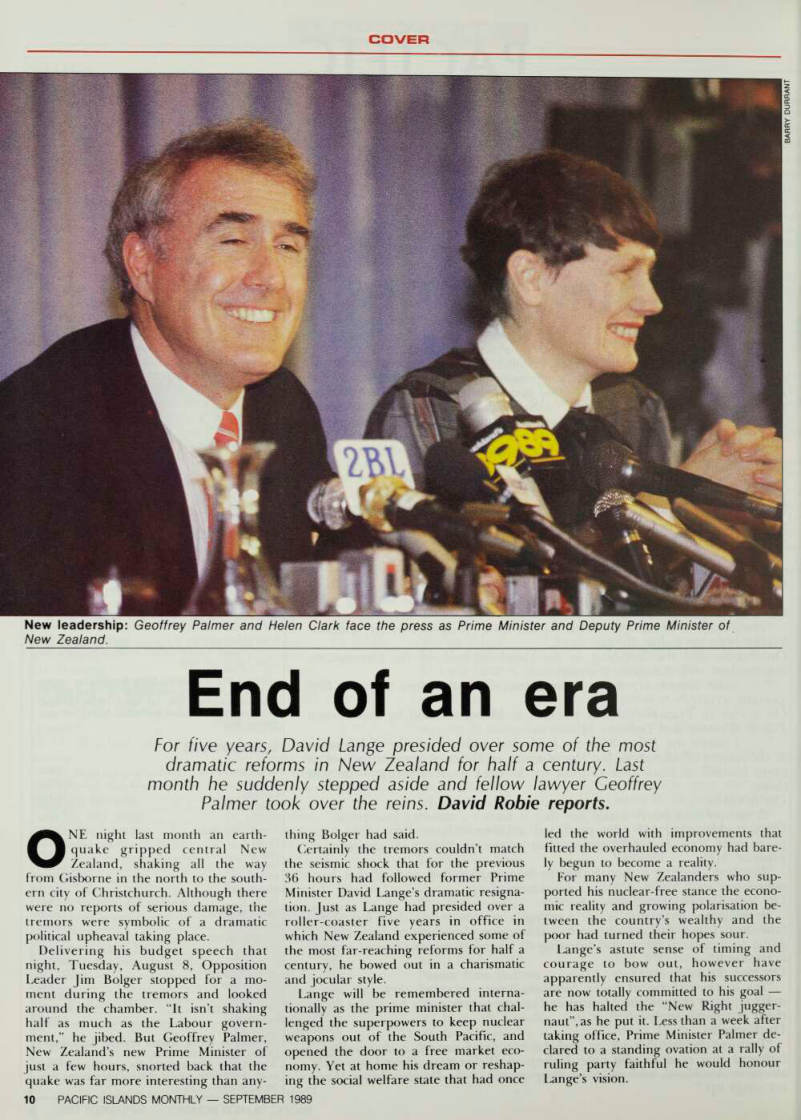
New leadership: Geoffrey Palmer and Helen Clark face the press as Prime Minister and Deputy Prime Minister of New Zealand.
The rejuvenation and new-found popularity of the government has boosted its morale as it tries to regain credibility for next year’s general elec tion after a bitter 18 months of feuding.
But the revival poses problems for both the opposition National Party, and the fledgling New Labour Party, led by re negade left-wing Labour MP Jim Ander ton, which has been gaining fast-growing support.
Although Palmer lacks the charisma and witty sparkle of Lange “boring”, perhaps, as many commentators and newspapers brand him he has reshuf fled a highly gifted cabinet and packed his front benches with social reformers.
Deputy Prime Minister Helen Clark, the first woman to hold such high political office, is flag-bearer of the left-wing of the party and has quickly demonstrated skills as a tough minister.
Reported at first as a victory for the
Right, within two days Lange’s resigna
tion had become a triumph for the Left.
“Clearly it was neither”, remarked Sun day Times commentator Robert Mann ion. “The Right could hardly be pleased with a Palmer-Clark leadership; the Left had not wanted to see Lange go in the
first place.”
Lange’s rehabilitated arch-rival Roger Douglas, architect of the so-called “Rogernomics” economic strategy which he steered as Finance Minister, was given 12th ranking in the new cabinet with the portfolios of police, im migration and “special projects” safely out of the economic limelight. Clark had comfortably defeated Douglas in the bal lot for the deputy’s job and she added the labour portfolio to her controversial role as Health Minister.
The chief Douglas lieutenant, Richard Prebble, was successfully kept out of cabinet when Lange accepted the post of Attorney-General (outside cabinet) and prevented the need for the election of a 20th minister. Prebble, former Pacific Affairs Minister whose wife Nancy is Fi jian, wields formidable political mana among Pacific Islands communities, par ticularly in Auckland.
Nancy Prebble accused the new lead
ership of being dominated by “university
politics” and too much “backscratching”.
Declaring her husband and Douglas had been caught like “chooks without their
heads” by Lange’s resignation, she
added; “If he was a big man he would have wanted the best team to carry us through to the election.”
Both Palmer and Clark, a former
chairperson of the parliamentary foreign
affairs select committee, have a broad view of the Pacific and New Zealand’s role in the region. But their administra tion is unlikely to be marked by the flamboyant style of Lange who made a stunning visit to Noumea to talk with
pro and anti-independence parties shortly after being elected to office in 1984, and who made a savage attack on Ratu Sir Kamisese Mara in post-coup Fiji.
One of the first major tasks of the new Palmer administration was to make a decision on whether New Zealand would participate in the proposed ANZAC warship pact an issue that has bitterly divided New Zealanders for months. A week after Palmer took office, the Australian government showed its hand, putting pressure on New Zealand.
Pacific and Foreign Affairs Minister Russell Marshall declared on national television that “several Pacific nations are counting on our decision” to ensure
their security.
Announcing the selection of the Amecon consortium to build up to 12 West
German-designed Mako frigates, Austra
lian Defence Minister Kim Beazley said he expected New Zealand to make a de cision in a few weeks. Beazley added that regional defence cooperation would be come run down if New Zealand aban
doned the proposed joint project, but
Palmer refused to be rushed into a deci sion.
Opinion polls show more than 70 per cent of New Zealanders are opposed to the frigate proposal in which New Zea land could buy up to four ships at more than $3OO million each. (Australia has agreed to contract for 10 ships with a let-out clause that would allow only eight to be built or up to 12 if New Zealand joins the project). The majority of gov ernment MPs are also opposed, Peace campaigners and researchers
claim that by entering such an agree ment, New Zealand would be effectively forced into a “back door” accommoda tion with the ANZUS regional nuclear umbrella. Many critics condemn the New Zealand government for not seriously considering an alternative proposal for a Danish frigate design which is a fraction of the cost and arguably more suited to South Pacific regional patrol and fisher ies work.
Palmer plans to take centre stage on the “wall of death” driftnet fishing issue with an address at the United Nations General Assembly next month. He will plead for international action against the
ecological disaster.
Lange put up a brave face with his resignation, declaring there would be no labour market deregulation, and mini mum wage rates would remain. The so cial “caring and compassion”, a tradition al cornerstone of previous Labour gov ernments, would return.
He was even back to his wittiest self: “Can I tell you, Geoffrey I have changed my mind!”, he chortled at Pal mer during a joint press conference marking the handover of power. But in a television interview with the Australian Channel Nine network’s 60 Minutes which he didn’t want broadcast in New Zealand Lange was far more candid.
He warned he would remain a thorn in the side of the government MPs who had betrayed him.
“I’m going to show some of them the loyalty they have shown me . . . which isn’t much!” he said. Asked if he felt betrayed by his own party, he said: “I don’t feel betrayed I was betrayed.
Some of them said last year they were going to devote their lives to seeing me removed from the leadership. So they did that.” Adding that the leadership of the country was now in the right hands, Lange said that he doubted whether he could ever again be friends with Roger Douglas.
Two days after the interview was shown in Austra lia, Douglas flew across the Tas man to address a
right-wing busi
ness group cam paigning to have him made prime minister of a so called Australian and New Zealand federation (see Business Section).
His hosts were the HR. Nicholls
Society, once
branded by Au stralian Prime
Minister Bob Hawke as “political troglo dytes and economic lunatics.”
Ironically, the government upheaval
was matched by a dramatic leadership tremor in the opposition National Party and a vital development in the evolving
sovereignty political debate within
Maoridom.
The ousting of National’s party presi dent Neville Young by Auckland lawyer John Collinge was expected to herald a
reshuffling of Opposition Leader Jim
Bolger’s shadow lineup. Suggestions of a challenge for Deputy Leader Don McKinnon’s job by finance spokesperson Ruth Richardson fuelled renewed spe culation about the ambitions of Nation al’s high-flying and abrasive Winston Pe ters, who regularly tops opinion polls for his party.
While the opposition was trying to sort out of its troubles to be able to confront the rejuvenated and popular Labour government, more than 2000 Maori peo ple from 50 tribes were meeting in a historic hui whakakotahi (meeting of un ity). Three of the four Maori MPs Maori Affairs Minister Koro Wetere was absent because of illness and the Maori Queen , Dame Te Atairangi ka’ahu, were among those present.
The issues centred on a conflict over Maori self-government should it be along tribal or democratic lines? Mana Motuhake party leader Matiu Rata, a former Maori Affairs Minister, favours
the creation of seven Maori re
gional authorities,
with each one
being elected by
voters on the Maori electoral roll. However, the hui was organised on behalf of the Tuwharetoa para mount chief, Sir Hepi Te Heuheu, with the aim of
Barry Durrant
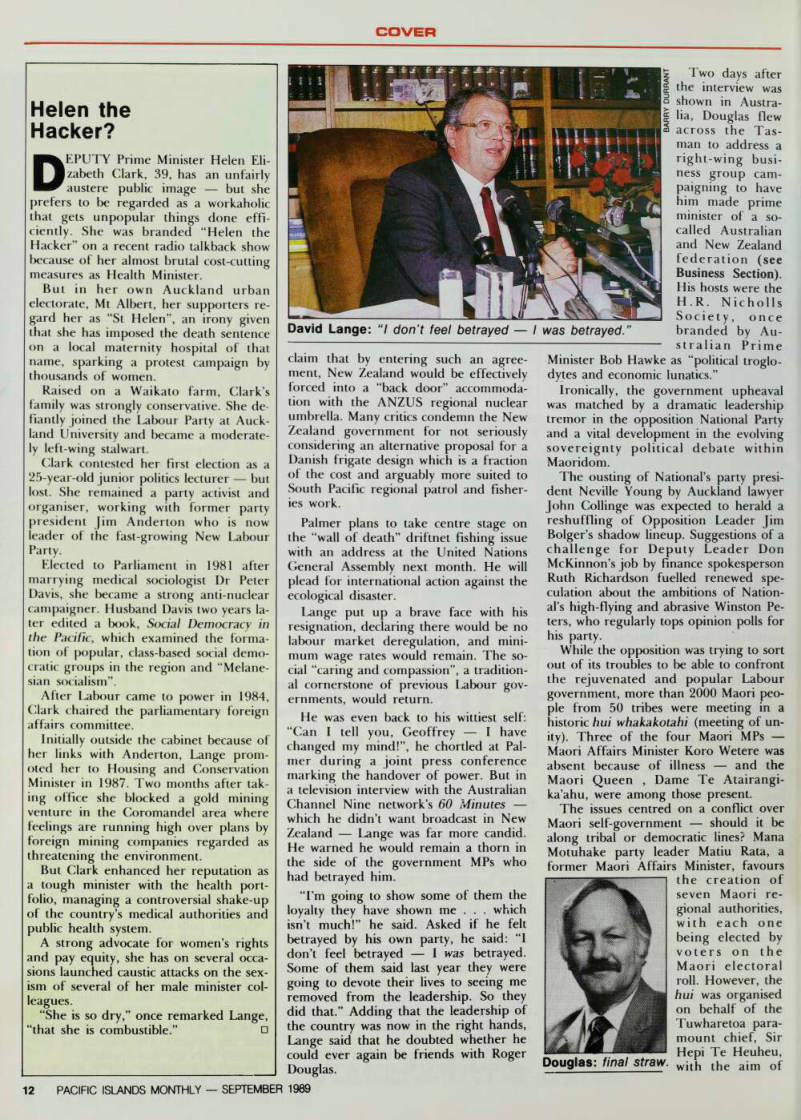
David Lange: “I don't feel betrayed - I was betrayed."
Douglas: final straw.
forming an iwi (tribal) based structure.
Although the hui gave the go ahead for a unified congress, it left decisions on the details of whether it should be regional or tribal to a group of tribal elders. They are expected to report back to another hui later in the year.
Organisers have been campaigning to prevent the congress plan being com
promised by any state-funded help. The
state-funded Iwi Transition Agency was blocked from holding seminars linked with the hui, and the issue of how the congress would relate to long-established groups such as the Maori Council and the Maori Women’s Welfare League both being funded by the government has yet to be decided.
Newspaper and public reaction to Lange’s resignation, once they had re
gained their breath, was generally posi
tive. Describing it as an “honourable act”, the influential New Zealand Herald said Lange’s final gesture was an “hon ourable one, all too rare in New Zealand politics ... Mr Lange had sought a
pledge of personal loyalty from those
standing for the cabinet vacancies. He did not get it from Mr Douglas. The tragedy of the long struggle between Mr Lange and Mr Douglas is that both are motivated by a sense of the country’s best interests. Neither seems consumed by personal ambition or the exercise of power for its own sake.”
The Auckland Star, the country’s ma jor afternoon daily, noted that the eco nomic and social strengths of the recent budget, and Palmer’s early reaffirmation of David Caygill as Finance Minister de monstrated that the new leader realised that above all New Zealanders wanted
continuity.
“The new prime minister has been criticised for not being a populist,” the Star said. “In a half-hearted sort of way the proverbial Kiwi clobbering machine has risen on its knee to throw away epithets like ‘intellectual’ and ‘austere’ as if academic qualifications and the ability to pronounce words of more than two
syllables, plus know their meanings, is
somehow a liability for a prime minister.”
Palmer is an advocate of rationality in
politics. “It is a refreshing concept,”
added the Star, “and given the choice between rational politics and populism, the electorate at large is unlikely to be
seduced by baby-kissing.”
David Russell Lange, the son of a local doctor and a former nurse from Tasma nia, was born in Auckland in 1942. He became a Methodist lay preacher and joined the Labour Party in 1961 while studying law part-time and working for a law firm representing trade unions.
After marrying his English-born wife Naomi at a Methodist mission in London during a working holiday in 1967, he
took up liberal legal practice in New Zea land and became active for the party, then in opposition.
Elected to Parliament in a 1977 by election, he immediately gained national attention because of his bulk (176 kilos) and his oratory skills. Forging an alliance with Roger Douglas and other members of the so-called “fish and chip” club (in cluding Prebble), he was eventually elected Opposition Leader to replace Bill (later Sir Wallace) Rowling.
When the then Prime Minister Sir Robert Muldoon called a snap election in June 1984, Lange led Labour to a land slide victory. Treasury officials advised a post-election devaluation to restore con fidence in the economy. Douglas, as the new Finance Minister, did that and also removed interest rate controls and im port licensing in his first moves of
Rogernomics.
Elected on a nuclear-free platform, Lange addressed the United Nations over the need for a nuclear-free zone in the South Pacific. A few months later, in February 1985, the Lange government barred entry to a United States warship, the USS Buchanan, which could poten tially carry nuclear weapons.
Washington retaliated by calling off
military exercises with New Zealand and blocking access to intelligence. But it took until June 1986 before the final ANZUS break came when US Secretary of State George Shultz told Lange that the American security guarantee for New Zealand had been withdrawn.
In the meantime, the new economic direction was in full swing with the intro duction of a 10 per cent comprehensive goods and services tax (GST, which was increased to 12.5 per cent this year), abolition of several tax deductions and higher “user pays” charges for govern ment services.
When French secret service agents sabotaged the Greenpeace anti-nuclear flagship Rainbow Warrior in Auckland harbour on July 10, 1985, killing Portu
guese-born photographer Fernando
Pereira, the Lange government acted de cisively. In spite of the later release of two French agents who were jailed for 10 years for their role in the bombing, Lange was regarded as a national leader defending New Zealand’s honour.
In September 1986, he was nominated for the Nobel peace prize.
The same year, Rogernomics was tak ing force with NZ$BOO million being slashed from government spending in
May 1986, and again two months later.
Government departments began to be dismantled or corporatised the Post Office and Forest Service being among the first to be carved up.
Feuding finally began in public be
tween Lange and Douglas in January 1987 after the Finance Minister announced a flat rate on all incomes and a privatisation programme aimed at cut ting the national debt by one third.
Lange overturned the tax package.
Eventually, as tension mounted, Lange sacked State-Owned Enterprises Minister Richard Prebble in November 1988, and succeeded in forcing Douglas to resign two months later.
Lange is credited with changing New Zealand at least as much as two previous major periods of reforms under the John Balance-Richard Seddon adminis tration in the 1890 s and under Michael Joseph Savage’s first Labour government in the 19305.
Although Lange cited health reasons (after surgery last year to unblock a vein) as the major factor for his resignation, it was the re-election of Douglas to the cabinet last month after months of pub lic sniping and attacks on the Prime Minister that became the final straw. □
Palmer the Smart
LIKE David Lange, Prime Minister Geoffrey Winston Russell Palmer is aged 47 and he is another liber al lawyer with a commitment to human rights. But their similarities end there.
Long a loyal deputy to Lange, the se rious and self-effacing Palmer had been overshadowed by the ebullience of his predecessor. Trying to find epithets that weren’t dull, one newspaper editorial de scribed the new leader thus: “His strengths are his astonishing capacity for detail, his intellectual breadth, his luminous honesty of pur pose, the fact that he retreats to the evi dence before decision-making, and his
loyalty.”
While Palmer concedes “my style of communication isn’t as brilliant as [Lange’s]”, he insists it would have been difficult to follow his predecessor’s wit and oratorical skills.
“But,” observed the New Zealand Herald wryly, “the difference lies in Pal mer’s desire to call a spade a tool for digging up the ground.”
Rather than Left or Right, Palmer occupies the Centre of the Labour gov ernment and regards himself as some thing of a technocrat. He is regarded as typical of the liberal, well-educated pro fessionals who now dominate the Labour government.
His wife, Margaret, a childhood sweetheart, is a self-employed psychotherapist. The couple turned down the official prime ministerial resi dence Vogel House, preferring to use it only for functions.
Their son, Matthew, who has econo mics and law degrees, recently departed from New Zealand’s Treasury for the United States to do post-graduate studies at Yale University; their daughter, Rebe
kah, is a journalist on a student news paper at Wellington’s Victoria Uni
versity.
Himself the son of the editor of the Nelson Evening Mail, Geoffrey Palmer had edited the same student newspaper, Salient, while he studied for political sci ence and law degrees.
After completing a law doctorate at Chicago University, Palmer became a law professor in universities in lowa and Vir
ginia.
In 1968 he wrote a white paper on accident compensation which provided a basis for New Zealand’s model system introduced six years later. Many of the principles he laid down then have been incorporated in the July budget or will be introduced before next year’s general election.
Palmer entered politics in 1974 and five years later was selected in a by election to the urban seat of Christ church Central. As Labour’s deputy leader in 1983 and Deputy Prime Minis ter the following year, he carried out the
legal and administrative spadework
necessary to launch Rogernomics.
In fact, Palmer wrote the State-Owned Enterprises Act, drafting the framework enabling state corporations to become “successful businesses”.
He has also steered parliamentary re forms which he advocated in his 1979 book Unbridled Power? But he failed to push through his proposed Bill of Rights and proportional representation in the electoral system.
Palmer believes the state should be prepared to intervene in the market to ensure fair access to all citizens to health care, education and social welfare. He advocated legal recognition of the 1840 Treaty of Waitangi in a step towards
genuine partnership with the indigenous
Maori people. □
Helen the Hacker?
Hacker?
DEPUTY Prime Minister Helen Eli zabeth Clark, 39, has an unfairly austere public image but she prefers to be regarded as a workaholic that gets unpopular things done effi ciently. She was branded “Helen the Hacker” on a recent radio talkback show because of her almost brutal cost-cutting measures as Health Minister.
But in her own Auckland urban electorate, Mt Albert, her supporters re gard her as “St Helen”, an irony given that she has imposed the death sentence on a local maternity hospital of that name, sparking a protest campaign by thousands of women.
Raised on a Waikato farm, Clark’s family was strongly conservative. She de fiantly joined the Labour Party at Auck land University and became a moderate
ly left-wing stalwart.
Clark contested her first election as a
25-year-old junior politics lecturer but
lost. She remained a party activist and organiser, working with former party president Jim Anderton who is now leader of the fast-growing New Labour Party.
Elected to Parliament in 1981 after marrying medical sociologist Dr Peter Davis, she became a strong anti-nuclear campaigner. Husband Davis two years la ter edited a book, Social Democracy in the Pacific , which examined the forma tion of popular, class-based social demo cratic groups in the region and “Melane sian socialism”.
After Labour came to power in 1984, Clark chaired the parliamentary foreign affairs committee.
Initially outside the cabinet because of her links with Anderton, Lange prom oted her to Housing and Conservation Minister in 1987. Two months after tak ing office she blocked a gold mining venture in the Coromandel area where feelings are running high over plans by foreign mining companies regarded as threatening the environment.
But Clark enhanced her reputation as a tough minister with the health port folio, managing a controversial shake-up of the country’s medical authorities and public health system.
A strong advocate for women’s rights and pay equity, she has on several occa sions launched caustic attacks on the sex ism of several of her male minister col
leagues.
“She is so dry,” once remarked Lange, “that she is combustible.” □
Advertisements & other items, p. 13 (1 item)
Kenwood
s a
M-422CD
Compact Remote Controlled HiFi System • Peak music power output 390 W •SOW x 2 (lEC, 8 ohms) • Motor-driven volume control • Quartz synthesizer tuner • Station name preset •Timer •Double oversampling CD player •Full-logic double cassette deck •Synchro recording with CD player •Fully automatic turntable »80W 3-way bass reflex speaker system • Optional 7-band graphic equalizer KENWOOD CORPORATION Shionogi Shibuya Building, 17-5, 2-chome Shibuya, Shibuya-ku, Tokyo 150, Japan
The last waltz
Western Samoa
By Karen Mangnall
FOR more than 40 years, New Zea land’s Pacific Island communities and the Labour Party have waltzed serenely together across the parquet dance floor of politics. Between dances, the Island voters may flirt a little with National or newcomer New Labour, but they’re always sitting by the wall ready for whenever Labour has a space in its dance card. Lately, however, there’ve been signs the 130,000-strong Island electorate is less than impressed with some of Labour’s fancy footwork.
The faux pas came, as it often does for Labour, over immigration.
In late April, Employment Minister Phil Goff announced the Government might scrap Western Samoa’s special im migration quota. Goff claimed the 1100 Samoans who came each year to New Zealand under the quota were contribut ing to the country’s record unemploy ment (estimated at 170,000 up to one-in ten of the workforce). Goff said prefer ence for jobs should go to those already in New Zealand and, anyway, demand had dropped for unskilled Samoan labour.
It caught Western Samoa completely
by surprise. Prime Minister Tofilau Eti Alesana, in Auckland for heart surgery, admitted later he’d felt “humiliated” by the lack of prior consultation. The quota was part of the bilateral Treaty of Friendship and had been part of West ern Samoa’s trade-off for letting New Zealand legislate to overturn a 1982 Privy Council decision giving 100,000 Sa moans citizenship of New Zealand.
Consul-general in Auckland, Afamasa ga Toleafoa, pointed out that to get in under the quota, Samoans first had to
prove they’d jobs waiting and guaran
teed financial support. They generally took menial jobs shunned by New Zealanders in remote locations where no one else wanted to live.
Geoffrey Palmer, Deputy Prime Minis ter at the time, chimed in that the worry was actually about overstayers: Samoans apparently comprised 6000 of the esti mated 17,000 overstayers. And Palmer diverted from a Pacific tour to Apia to explain it all.
Then Pacific Island Affairs Minister Russell Marshall released figures to show the problem was actually the increase in Samoan permanent residents outside the quota. Overall, a threefold rise in im migration in the past seven years, with 4000 permanent residencies granted last year. Critics countered that nearly 800 of them were Samoans who’d voluntarily regularised their citizenship under a one-off amnesty and a large proportion
of the rest were allowed in under recently relaxed criteria for family reunificat,on - By now Labour was offside not only with Samoans but also the Tongans, who’d been campaigning against unfair targeting of Pacific Islanders as over-
stayers. The public and political Opposi-
tion were ridiculing unemployment as a reason for axing the quota. And several of Labour’s Pacific Island branches held meetings condemning the quota issue as “racist ’ and a political football designed to garner marginal votes.
With the South Pacific Forum looming in July, David Lange, Prime Minister at the time, made a last minute decision to go to Apia, ostensibly for the June independence celebrations but really to save some face. There he tried to lock in the parameters for the quota debate: a bilateral approach to overstayers and clamping down on adoption rules which allowed New Zealand Samoans to adopt teenage relatives as infants.
If the Western Samoan Government was quietly skeptical, the local press was
less inhibited. Lange was visibly disgrun-
tied at an unusually stroppy press conference. The independent Samoa Observer summed it up on the front page:
Desperate Lange Tries Again.
Lange waited until after the Forum to make the final announcement; the quota remained; adoption laws would be tightened; there’d be “greater invigilation” of
intending migrants’ claims of jobs and accommodation; and New Zealand would take up a long-standing Samoan offer of two immigration attaches to sort
out overstaying.
Some Samoans already in New Zea land who got permanent residency under the family reunification scheme would be deducted from the quota.
Lange conceded the Western Samoan argument that immigration would fall off to about 2000 a year anyway.
Consul-general Toleafoa says the whole debate shows the gradual “water mg down” of the bilateral special rela tionship at the same time as the New Zealand-based Samoan community strengthens its political influence. 7 “If any good’s come out of it it’s given a reason to go back over the rela ion hip with New Zealand,” Toleafoa says "p J ticularly younger Cabinet Ministers have no background and maybe not even an interest in any relationship with Samoa.
It’s a sad thing in a way. Their own orientation is far more regional and they don’t appreciate why there was a quota in the first place.”
But Toleafoa says the Western Sa moans do feel they were unfairly singled out, particularly over the unemployment argument. “We’ve since had a look at the figures which show a comparable jump in permanent residencies from other countries during the period that caused New Zealand to look at us.”
The latest immigration statistics show that last year Western Samoa recorded only the tenth biggest jump in perma nent residence to New Zealand, behind such countries as Taiwan, Tonga Japan Malaysia and China. All these countries benefitted from expanded immigration criteria introduced in the past year, Toleafoa says the New Zealand Gov ernment has done a lot of “media man ipulation” for reasons Western Samoa accepts.
Af t u„ n „ . ... ,
as ■ T to
with . -5° S md^ tlon p’
Winston Peters iJ 'f 8 N . atl p na S Minister stakes Pet P r £ erre ' d p ™ e d f nrofife h T ° f h, j n r y n ashm S Maon and S ™ dera ’ 8 WOmeS T re ' al, ° nS and V,olenl cnme ' . Wha ! 1 an g e sa V s privately in discus s,ons w,th the Samoa n Government is not necessar ily what he’s saying publicly, he as Bot8 ot to sell that P° ,ic Y to a caucus t * iat . s vei 7’ vei 7 rebellious and giving Ministers a lot of strife,” says Toleafoa.
He believes this time the bash-a-Pacific
Islander immigration campaign didn’t
win the public support expected, “It’s been said to us by a lot of people that ‘it’s the bogeyman again’, that the
immigration issue’s being brought out
again because it’s that time of the year,”
Toleafoa says. “But that’s not what we’re
saying.” □
A closer
South Pacific Commission
A closer look at fisheries
TUNA purse seining, long lining, gill
netting and deep sea snapper fishing were amongst the many subjects discussed at the South Pacific Commission’s 21st Regional Technical Meeting on Fisheries (RTMF) at Noumea from August 7-11. Some coun tries have shown interest in the develop ment of local pearl culture industries. It was decided to establish a special Interest Group on the topic to compile and circu late information packages to member countries and interested organisations.
The meeting approved the in-depth
feasibility studies done by SPC and its consultants for a regional small-scale purse seine test fishing project. It recom mended that the project proceed to Phase 3 Implementation stage, with funding sought by the SPC. This will mean the deployment of a number of FADS (fish aggregation devices) in
strategic places, the charter of a project vessel (possibly European), and the use of the industrial support centres of Pal kula, Vanuatu; Levuka, Fiji, and Pago Pago. The entire project covers a vast area and will cost approximately $U54.25 million.
The study will determine if there are enough tuna outside the fishing grounds being exploited by larger nations like the United States and Japan, to be commer cially viable.
Dr Jeff Polovina, of the US National Marine Fisheries Service, Honolulu, pre sented research results on deep water snapper populations. They show a Max imum Sustainable Yields (MSY) of 10- 30% of initial standing stocks. Tongan and Fijian stocks appear to be going through the process of being fished down as the larger, older snappers dis appear.
A workshop on coastal long-lining stu died the Fiji experience presented by Graham Southwick, of Wasawasa Fisher ies, Suva. The tip was to attach light sticks to the branch lines to help increase the catch, either by attracting the bill-fish or the smaller fish they prey upon. Tuna were also attracted. □
The church and I
Fiji
For most of this year Rev Manasa Lasaro was the biggest threat in Fiji as the interim government steered the country back to political and economic stability. A fundamentalist Methodist Church general secretary, he stood up against the government and challenged its wisdom to relax the Sunday Observance Decree, and allow agricultural work and leisure sport. Lasaro chose the roads as his battlegrounds, blocking them on Sundays and disrupting traffic and other services. To some Lasaro was a trouble-maker. To others he was an idealist fighting for his faith.
What really drives this man? Jope Balawanilotu had an exclusive interview with Lasaro in Suva:
What events led to the division in the Methodist Church in Fiji?
The issues and events involving the church now are part of the national crisis that we’ve been facing over the past two years. The crisis has got to do with Fi jians as a people who are trying to keep their own identity, who are trying to see what their future is in their own country.
And when you’re talking about the Fijian
people you’re really talking about the
Methodist Church. The personalities who are involved are the grassroots on the one hand and the well to do Fijians on the other hand.
Why is a strict observance of the Sunday important?
This has always been the stand of the Methodist Church in Fiji: Not a total ban on activities on Sunday but it has got to be observed with provision for essential services like hospitals and PWD (Public Works Department) controlled transport system to facilitate worship in the urban centres. Sunday has its additional special significance to Fijians and its observance helps Fijians maintain values which set them apart as a people. There are cer tain human values which we need to hold on to keep us sane and human. The Fijians look to the observance of Sunday as a means of maintaining these values.
People ought to be free to worship on Sunday and not being interfered with.
We’ve got instances where people are worshipping and in the next building people are on a building construction programme. In the rural areas, where some Fijians have moved away from their villages to settle on their farms, Sunday brings them back to their vil lages, to their communities, to their fami lies to worship together. So Sunday is very important to Fijians as a uniting in fluence. This is nothing new and the fight to observe Sunday is not new either. It has been going on for years.
And as long as Fijians want to observe
Sunday the way they have in the past they will continue to fight for it.
In ensuring that your faith and beliefs are respected and in view of the presence of others in Fiji who have other beliefs con trary to yours and your followers, is there a common ground for compromise?
The common ground through which we can exist together in this country is that we’re asking the other people of
other faith to respect us and to respect our faith. We’re not asking them to be lieve in what we believe, but to respect what we believe in the same way we re spect their holy days and the way they worship. And for us as Methodist Christ ians we ask them to observe Sunday and not to interfere with Sunday. Besides we’re asking for only one day in the week.
Has the church got a role in government?
The history of this country is testi mony of the role of the church in the development of its people. Before any successful government the missionaries came and enlightened the people. The missionaries were not only teachers of
the gospel. They also laid down the foundations upon which education grew.
Then government came later after numerous attempts. But it was all made possible because the churches laid down the foundations. Today, because of the changing circumstances that have come
with time, we’ve got to broaden the role of the church. And the church has got to be involved in very critical issues it has never been involved with before. The question of land, race, oppression and corruption are critical issues the church cannot be seen to shy away from. And in making its stand the church has often been unduly criticised. While the church plays a sort of watchdog role on govern ment it cannot be expected to be a spec tator. The church has got to be involved in a very concrete way. We’ve got to be involved because the church is about people who must have a better way of life, dignity and justice.
Has the government got a role in the church?
The government and the church have to work together. They have to sort out their differences and they also have to sort out where their boundary lines lie; where the government should be in volved and where the church has to be involved. Government has a specific role and the church has got a specific role.
The common ground is the government is involved with the lives of the people and the church is also involved with the lives of the people. They’ve got to watch each other. There has to be a healthy relationship between the two institutions.
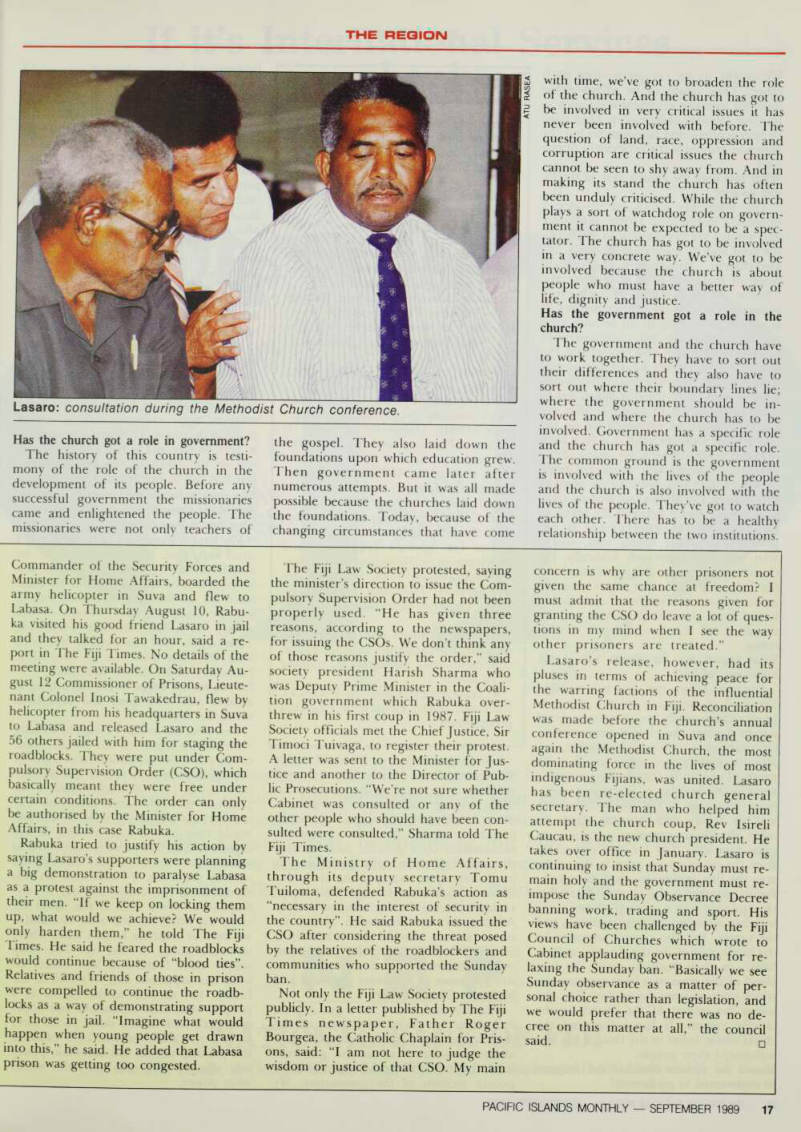
Lasaro: consultation during the Methodist Church conference.
Atu Rasea
We ought to be complementing each other. They ought to be afriad to be involved together in critical areas such as this one (Sunday observance). They must be independent and autonomous but the common ground is the betterment of our lives.
What role does the church play in the Fi jian society?
The Fijian life stands on three very important institutions. Firstly, the vanua and when I say the vanua it’s the people, the land and its traditions. Secondly, the government. And thirdly, the church.
None of these can work independently.
They’ve got to complement each other because their roles are complementary. It is not an easy thing to do because each institution has its own administrative machinery. Perhaps the vanua and the church have an easier job of liaising and working together whereas the govern ment is seen to be the one which has to come to the vanua or to the church. It’s a very peculiar set up which we do not see in other cultures yet it is a very heal thy machinery which we must draw strength from. Because there are times we will conflict and, sadly, to the point of antagonism. I’ve always said that we must maintain a balance between the three all the time. If the government is too powerful over the vanua well, you’ve seen what has happened. Biblically, the church ought to be the conscience and the light that guide the vanua and the government or the totality of society. But in the same way the church is not the overlord of the government or the vanua.
What impact has the church had in the Fijian way of life?
For most Fijians the church is our life.
You look at the Fijian villages, the only programmes which are continuous from day to day are the church programmes.
On Sunday we worship together, on
Monday most programmes are for the youth, Tuesday is for the women’s fel lowship, Wednesday is for prayer meet
ings, Thursday is for men’s fellowship
and on Friday and Saturday there are other church programmes going on. At grass root level they are well organised.
Even the newly set up areas in the urban area the first institution which brings the Fijians together is the church. After that the people then group themselves together according to their traditions and the vanua . But the church seems to be the binding force. So the church, or their belief, or their faith, is really the life blood of the grass root level communities which operate from day to day. You also notice the impact of the church in the chiefly system. It has influenced the chiefs whose belief in the church has also influenced their people.
Should the various churches and religions be represented in parliament?
Yes, I should think so. This will enable the voices of the various churches and religions to be heard at the top level de cision making machinery of our govern ment. I will not want these representa tives to be elected from the various de nominations on a political basis because that would tie them up in parliament or in cabinet. As an example, the Methodist Church might want to elect their repre sentative during their annual conference.
Additionally, the population of the de nominations should be taken into account in determining the number of
representatives.
Are you aware of the power you wield as a Methodist Church leader?
I understand that I have got a great influence over many members of the church and that’s simply because I have always been involved at the grassroot level, the most underpriviledged and the poorer sections of the community. My
background is one where I was raised from a very poor family. I have always been involved with the squatters, the un attached young people, ex-prisoners, the youth it has been my life. That is my calling and that it is my commitment. We had that fight with the government some years back over the resettlement of some people in Raiwaqa, Raiwai and the most recent case at the Jittu Estate. My stand has to do a lot with my background and also my training, and the nature of my work in the church. Although I’m the general secretary of the church, I do not see myself as a pen pusher behind a desk. I see myself as a catalyst, initiator, adviser and counsellor.
Do you believe in the Fijian chiefly system and its leadership?
Yes, I do believe in the chiefly system very very strongly. And I do believe in their role as traditional leaders of Fiji. At the same time I’m always critical about how the traditional leadership has been used in many cases in making critical
political decisions. Traditional leadership
is here to stay and it has a very specific role in the fabric of the Fijian society.
But it is not to be exploited and abused.
You seem to have a hold on army comman der Major-General Sitiveni Rabuka. How have you managed this?
We have always been very close and I don’t deny that. We argue, we fight, we also have our own battles to fight. But we’ve always been good friends. He came after me to Bucalevu Provincial School and he entered Queen Victoria School while I was at Ratu Kadavulevu School in Tailevu. So our relationship has been long standing and one of very close friendship and I cannot hide that.
Do you see his coups in 1987 as helping to achieve your own goals and aspirations within the church?
Yes, I see his military coups as helping some of my objectives but not all. Some of the goals, the aspirations and hopes of the Fijians were achieved by that particu lar event in 1987. But others have to be achieved through other processes. For me that was a clear-cut intervention that would have helped achieve some of our objectives but others we would have to
achieve quite democratically through the
normal processes. To elaborate on this more, what the coup did was to say: Stop, let’s have a look at this again be cause the whole life was a rat race and if we were to continue I don’t know where we were going to end up. The coup simply said: Stop, and let’s reflect on what has happened and let’s look to the future. Let us look at the Fijians as a
people, what their aspirations and hopes
are. Let’s look at the other races. Let’s look at the achievements. Let’s examine the political power, the economic power and who controls who and who wields what power.
Sunday
tug-of-war
FOR nearly eight months the
Methodist Church of Fiji was being rocked by a dispute over the sanctity of the Sunday. On one side stood the church President, Rev Josateki Koroi, and a handful of moderates who saw the Sunday as being made for man and not vice versa. On the other stood the church general secretary, Rev Man asa Lasaro, and most of the 75 per cent
of the indigenous Fijian population who
are Methodists. They want to keep the Sunday holy and free of the encumber ances of trading and work, much to the indignation of the Indian population who would rather work on their farm.
For all of those eight months Lasaro stood up for his belief as a fundamental ist Methodist to protect the holiness of the Sunday. He organised roadblocks in Suva, staged a religious coup which tried to overthrow Koroi, and defied a sup reme court judgement which ruled his coup illegal. For the interim govern ment, trying to show the world poli tical problems were under wrap and the economy was blooming, Lasaro was a pain in the neck. Having being one of the strongest supporters of the military coups of 1987, many thought his bold
ness stemmed from his very close friendship with coup leader Major- General Sitiveni Rabuka. He was un stoppable. By a series of quick political manouevres, which included moving his protest base home to Labasa, on the second largest island of Vanua Levu Lasaro slowly won the upper hand.
Koroi and his handful of moderates were isolated. Lasaro, although having lost the attempt to overthrow the legiti mate church leadership, became the glorified liberator of the mostly rural based Methodist Church.
The Methodist Church in Fiji was split. On one hand stood the die-hard fundamentalists, mostly uneducated from the rural areas. On the other stood Koroi and a handful of backers whose moderate views were welcomed by the non-Methodists who believed that to work, to play and to trade on Sunday was a basic human right. Then it hap pened. Lasaro organised a roadblock in Labasa and Chief Magistrate Apaitia Seru put him in jail for six months. By the first week of August Lasaro and 56 of his supporters were in jail in Labasa for unlawful obstruction. Some said it was “God’s will” that Lasaro was in jail, safely out of the way at a time when the church was preparing for its annual con ference in which all major decisions were made. They were wrong.
On Wednesday August 9, Rabuka,
Commander ol the Security Forces and Minister for Home Affairs, boarded the army helicopter in Suva and flew to Labasa. On Thursday August 10, Rabu ka visited his good friend Lasaro in jail and they talked for an hour, said a re port in The Fiji Times. No details of the meeting were available. On Saturday Au gust 12 Commissioner of Prisons, Lieute nant Colonel Inosi Tawakedrau, flew by helicopter from his headquarters in Suva to Labasa and released Lasaro and the 56 others jailed with him for staging the roadblocks. They were put under Com pulsory Supervision Order (CSO), which basically meant they were free under certain conditions. The order can only be authorised by the Minister for Home Affairs, in this case Rabuka.
Rabuka tried to justify his action by saying Lasaro’s supporters were planning a big demonstration to paralyse Labasa as a protest against the imprisonment of their men. “If we keep on locking them up, what would we achieve? We would only harden them,” he told The Fiji Times. He said he feared the roadblocks would continue because of “blood ties”.
Relatives and friends of those in prison were compelled to continue the roadb locks as a way of demonstrating support for those in jail. “Imagine what would happen when young people get drawn into this,” he said. He added that Labasa prison was getting too congested.
The Fiji Law Society protested, saying the minister’s direction to issue the Com pulsory Supervision Order had not been properly used. “He has given three reasons, according to the newspapers, for issuing the CSOs. We don’t think any of those reasons justify the order,” said society president Harish Sharma who was Deputy Prime Minister in the Coali tion government which Rabuka over threw in his first coup in 1987. Fiji Law Society officials met the Chief Justice, Sir Timoci Tuivaga, to register their protest.
A letter was sent to the Minister for Jus tice and another to the Director of Pub lic Prosecutions. “We’re not sure whether Cabinet was consulted or any of the other people who should have been con sulted were consulted,” Sharma told The
Fiji Times.
The Ministry of Home Affairs, through its deputy secretary Tomu Tuiloma, defended Rabuka’s action as “necessary in the interest of security in the country”. He said Rabuka issued the CSO after considering the threat posed by the relatives of the roadblockers and communities who supported the Sunday ban.
Not only the Fiji Law Society protested publicly. In a letter published by The Fiji Times newspaper, Father Roger Bourgea, the Catholic Chaplain for Pris ons, said: “I am not here to judge the wisdom or justice of that CSO. My main
concern is why are other prisoners not given the same chance at freedom? I must admit that the reasons given for granting the CSO do leave a lot of ques tions in my mind when I see the way other prisoners are treated.”
Lasaro’s release, however, had its pluses in terms of achieving peace for the warring factions of the influential Methodist Church in Fiji. Reconciliation was made before the church’s annual conference opened in Suva and once again the Methodist Church, the most dominating force in the lives of most indigenous Fijians, was united. Lasaro has been re-elected church general secretary. The man who helped him attempt the church coup, Rev Isireli Caucau, is the new church president. He takes over office in January. Lasaro is continuing to insist that Sunday must re main holy and the government must re impose the Sunday Observance Decree banning work, trading and sport. His views have been challenged by the Fiji Council of Churches which wrote to Cabinet applauding government for re laxing the Sunday ban. “Basically we see Sunday observance as a matter of per sonal choice rather than legislation, and we would prefer that there was no de cree on this matter at all,” the council said. □
Fact File
Name: Manasa Lasaro Date of birth: December 28, 1943, at Labasa, Vanua Levu Marital Status: married to Nanise; five children 4 boys and a girl Resident: Nawanawa Road, Lot 16, Nasinu Village: Tavea, Lekutu, Bua, Vanua Levu Academic and vocational qualifica tions: Ordained Methodist Minister (1972) Methodist Church in Fijji
Methodist Theological College, Davuile
vu Diploma Theology (1969);
University of Wales, Swansea Diplo ma Social Administration (Distinction) (1972); University of Reading M.A. Rural
Sociology and Development (1977);
Royal Institute of Public Administration (4 months) Personnel Manage ment (1984); University of Wales National Planning and National De velopment (4 months) (1976) Work experience: 1972-1974, Director, Christian Citizenship and Social Servic es 1975-1979, Lecturer, Pacific Theolo
gical College (Sociology and Develop
ment Studies); 1980-1984, Co-Director, Centre for Applied Technology and Development Management of Train ing Programmes; 1985, Secretary, So cial Services, Methodist Church Fiji; 1986, General Secretary, Methodist Church. • Mainly involved with grassroot de velopment programmes in adult educa
tion, community development, training
at all levels. • Travelled extensively on UNESCO, FAO and World Council of Churches programmes. □
Advertisements & other items, p. 19 (1 item)
If it’s International Services
you can bank on us. * o#^ & m &
cfS
j^V \s& sp « N 0 <P As Fiji’s own bank, the NBF understands business in Fiji.
And that means a full understanding of what Fiji businessmen require internationally as well as overseas investors require in Fiji.
If it involves export, import, or investment, the NBF has the expertise to provide all the service you require.
The NBF, covering Fiji and the World for you.
NBF
NATIONAL BANK OF FIJI
Cnr. Victoria Parade & Gordon Street, Suva, Fiji Islands. Telephone 311-999. Telex 2135 FJ.
promises
Rocard’S Visit
Promises, promises
MICHEL Rocard’s whirlwind tour of the Pacific last month co vered seven destinations and left a trail of promises and hope. There was disappointment, however, when the French Prime Minister visited the nuc lear lest site at Mururoa, his last destina tion on a week-long tour of the region.
Rocard said his government would not give in to pressure from Pacific Islands governments for an end to French nuc lear testing in the region. He said a plan ned reduction in the number of test blasts each year could even be “re viewed”, a hint that such a review could be upwards. This was a backtrack from a statement he made in June suggesting the number of test explosions at Murur oa would be cut from 1990. He said this could be reviewed “if the international context demands, as the sufficiency of our nuclear deterrent and its credibility must be assured”. He pointed out that talks to be held in Papeete on the nuc lear tests base would have “no decision
making authority”.
In Fiji Rocard promised to increase development aid to meet the country’s “numerous needs”. He mentioned dis cussion with Cabinet over the possibilities of French help for solar energy projects, agricultural projects and motor vehicles maintenance programmes. The army clearly missed out when Rocard said his government had no intention of provid ing military aid to anyone in the region.
But army commander Major-General Sitiveni Rabuka was decorated with the Insignia of the Commander of the Le gion of Honour by French ambassador Daniel Dupont in the presence of Rocard. The decoration was for bravery in Lebanon in 1980 when Rabuka went to the assistance of a French soldier under heavy fire and saved his life.
Then in an embarrassing event, the Fiji Military Forces were late for Rocard’s
departure from Nausori Airport, forcing
the French Prime Minister to leave Fiji without the guard of honour which he was to have inspected on the way to boarding his plane. Rabuka said there was going to be an internal inquiry.
The big promise in New Caledonia was the possibility that Paris might par don Kanak separatists jailed last year af ter violence erupted in the French terri
tory, resulting in kidnapping and shoot outs with troops. Such an amnesty could free 20 Kanaks. Rocard told the north ern regional assembly in New Caledonia that violence was no longer a political instrument in the territory. And he promised economic aid to boost develop ment throughout the territory, a move seen as an effort to bolster support for the Matignon Accord, a treaty signed in Paris last year allowing for a referendum on independence in 1998.
In Papeete, Rocard agreed to more autonomy for French Polynesia, agreeing in principle to a blueprint for such an arrangement. Discussions centred on proposals for the creation of five councils representing the five island groups. This is aimed at helping to decentralise pow er. The promise in French Polynesia was the assurance that Paris would sponsor a roundtable discussion this year to hear views on nuclear testing at Mururoa.
The issue was cause for a protest which greeted Rocard on his arrival at Papeete.
At least 350 people, waving placards and singing chants crowded a bridge where the prime ministerial motorcade was to have passed. The protest was led by staunch anti-nuclear activist Oscar Temaru, leader of the Tavini Huiraatira Party. □
Advertisements & other items, p. 20 (1 item)
Suddenly, New Zealand is a whole lot closer.
And so too is a potential market of 3.2 million New Zealanders.
As a Forum Island nation, exploration and development of new markets can be a difficult and frustrating exercise.
Now, through the establishment in New Zealand of the South Pacific Trade Office, you have direct access to a variety of services that are specifically geared to assist you in the export and promotion of South Pacific products into New Zealand.
Services include market research, marketing plans, identification of potential customers, office facilities, product displays, participation in trade fairs, and secondments.
For further details contact. . . .
SOUTH PACIFIC
TRADE OFFICE
Jetset Centre, 44 Emily Place, P.O. Box 774, Auckland 1, New Zealand.
Phone (09) 302-0465, Fax (09) 776-642, Telex SPTO NZ63328 Madison 3589
Pacific Way
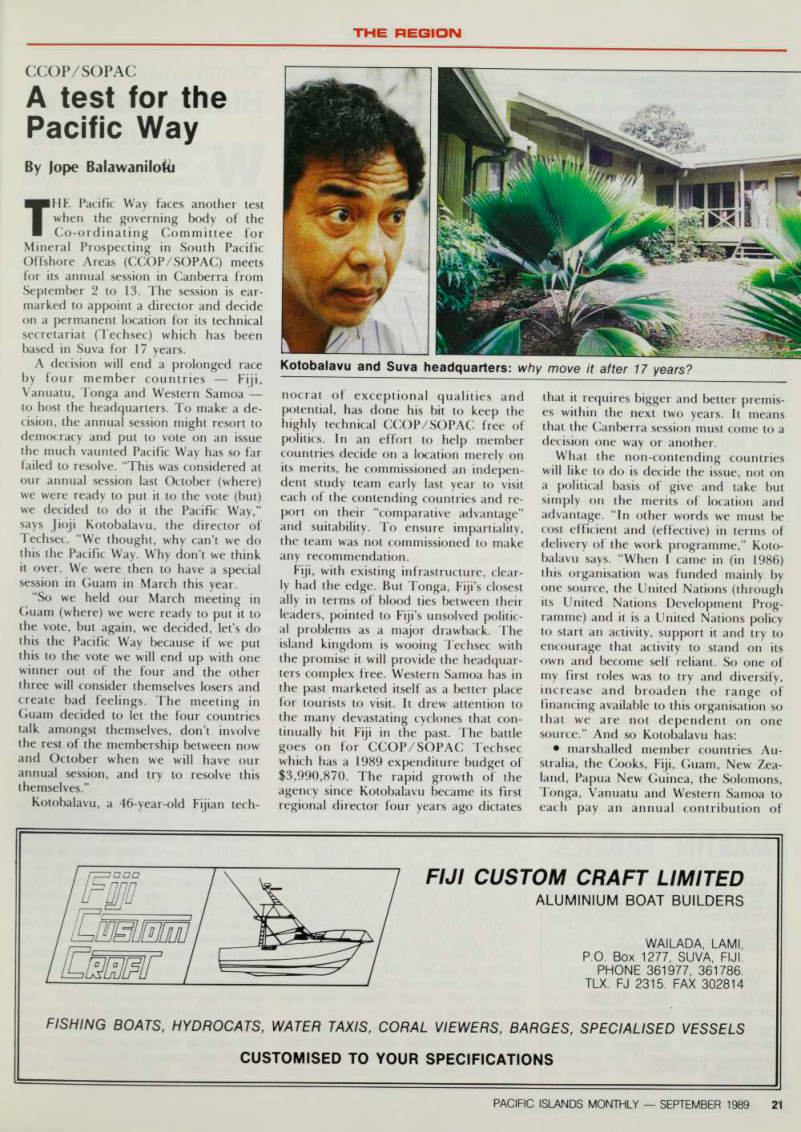
Ccop/Sopac
A test for the Pacific Way
By Jope Balawanilotu
THE Pacific Way faces another test when the governing body of the Co-ordinating Committee for Mineral Prospecting in South Pacific Offshore Areas (CCOP/SOPAC) meets for its annual session in Canberra from September 2 to 13. The session is ear marked to appoint a director and decide on a permanent location for its technical secretariat (Techsec) which has been based in Suva for 17 years.
A decision will end a prolonged race by four member countries Fiji, Vanuatu, Tonga and Western Samoa to host the headquarters. To make a de cision, the annual session might resort to democracy and put to vote on an issue the much vaunted Pacific Way has so far failed to resolve. “This was considered at our annual session last October (where) we were ready to put it to the vote (but) we decided to do it the Pacific Way,” says Jioji Kotobalavu, the director of Techsec. “We thought, why can’t we do this the Pacific Way. Why don’t we think it over. We were then to have a special session in Guam in March this year.
“So we held our March meeting in Guam (where) we were ready to put it to the vote, but again, we decided, let’s do this the Pacific Way because if we put this to the vote we will end up with one winner out of the four and the other three will consider themselves losers and create bad feelings. The meeting in Guam decided to let the four countries talk amongst themselves, don’t involve the rest of the membership between now and October when we will have our annual session, and try to resolve this themselves.”
Kotobalavu, a 46-year-old Fijian tech-
nocrat of exceptional qualities and potential, has done his bit to keep the highly technical CCOP/SOPAC free of politics. In an effort to help member countries decide on a location merely on its merits, he commissioned an indepen dent study team early last year to visit each of the contending countries and re port on their “comparative advantage” and suitability. To ensure impartiality, the team was not commissioned to make any recommendation.
Fiji, with existing infrastructure, clear ly had the edge. But Tonga, Fiji’s closest ally in terms of blood ties between their leaders, pointed to Fiji’s unsolved politic al problems as a major drawback. The island kingdom is wooing Techsec with the promise it will provide the headquar ters complex free. Western Samoa has in the past marketed itself as a better place for tourists to visit. It drew attention to the many devastating cyclones that con tinually hit Fiji in the past. The battle goes on for CCOP/SOPAC Techsec which has a 1989 expenditure budget of $3,990,870. The rapid growth of the agency since Kotobalavu became its first regional director four years ago dictates
that it requires bigger and better premis es within the next two years. It means that the Canberra session must come to a decision one way or another.
What the non-contending countries will like to do is decide the issue, not on a political basis of give and take but simply on the merits of location and advantage. “In other words we must be cost efficient and (effective) in terms of delivery of the work programme,” Koto balavu says. “When I came in (in 1986) this organisation was funded mainly by one source, the United Nations (through its United Nations Development Prog ramme) and it is a United Nations policy to start an activity, support it and try to encourage that activity to stand on its own and become self reliant. So one of my first roles was to try and diversify, increase and broaden the range of financing available to this organisation so that we are not dependent on one source.” And so Kotobalavu has: • marshalled member countries Au stralia, the Cooks, Fiji, Guam, New Zea land, Papua New Guinea, the Solomons, Tonga, Vanuatu and Western Samoa to each pay an annual contribution of
Kotobalavu and Suva headquarters: why move it after 17 years?
$9750 with adjusted contributions from Tuvalu and the Kiribati; • Australia, New Zealand and Fiji
making voluntarily contributions of
$402,015 plus, $359,820, and $145,000
respectively.
• won donations from Canada
($1,131,405), the European Community
($885,050), France ($295,145), the Un
ited Nations Development Programme
($75,350), and the Commonwealth Fund for Technical Co-operation ($52,800); and • attracted from other donor coun tries, including the Netherlands and
other agencies, expertise, equipment,
shiptime and other technical services all worth $8 million.
Kotobalavu has brought CCOP/ SOPAC Techsec a long way since the
United Nations Development Program
me gave it in 1972 an initial funding of $0.75 million and provided the manage ment. The Fiji Government provided free office space. Techsec in Suva today has a staff component that resembles a mini world community, where world ex perts pass on knowhow to regional understudies, with a computerised nerve centre to facilitate its highly technical work programme. The secrecy of most of its findings has helped Techsec turn into a low profile agency. But good news like finds of cobalt (which is used in spacecraft) in commercial quantities off the Cooks do get out. Over the Creenouse Effect phenomenon, Techsec is not over reacting, which it could do to attract research money for its scientists.
Instead it is going about its own sea level
monitoring programme.
Kotobalavu’s efforts, have not gone unnoticed. Forum 20 in Tarawa in July commended the work programme he presented in a 60-page dossier. In re sponse to the expiry of his contract in January, Kotobalavu says potential candi dates from the region have telephoned to say they will not apply for the job if Kotobalavu decides to stay on. “I find their gesture very touching and again
you find this (prevalent) amongst we islanders and I will not be surprised that the few who have applied are not Pacific Islanders,” he says.
What Kotobalavu does not know is that when applications closed in July, 15 had applied for his job. The annual six
figure package associated with regional
agency secretariat executives is an irre sistable attraction. Some contenders say Kotobalavu is not available for the direc torship because he has been selected for nomination by the Pacific caucus of ministers in the African Caribbean Paci fic (AGP) group for secretary general in Brussels.
The AGP group of ministers meet in two sessions (October 2-5 and October 10-13) in Brussels where it will also appoint its secretary general (currently Edwin Carrington, of Trinidad and Tobago from the Caribbean). In a num bers game in Brussels, the Pacific has no chance. The 66-member AGP comprises of 44 nations from the African conti nent, 14 from the Caribbean and eight from the Pacific. There is, however, a small chance for the Pacific depen dent on the understanding that the post of secretary general should rotate be tween the regional groups of the AGP.
The African nations have had two con secutive five-year terms and the Carib bean group has had Carrington for five years. The Caribbeans are eligible for another term. But all groups have nominated candidates.
Kotobalavu says the most the Pacific can expect out of Brussels is “making the point that the region has a role to play in the AGP and that it has the capability and preparedness to handle it”. He says Pacific leaders “have been very nice and it has been very touching that they should approach me because obviously it means that they have confidence in me.
It has been very touching in the same way that I find touching messages from senior officials from Pacific island coun tries saying that so long as I’m here they will not apply for the job of director of
The Ccop/Sopac.”
Sentimental. But the hard realities in clude the fact that 15 candidates feel they can do better than Kotobalavu as director of Techsec. The Pacific group of ministers’ showing of confidence in Kotobalavu effectively places him in a precarious position. For while the Pacific will be putting up Kotobalavu to make a point in Brussels in the northern hemis phere, the CCOP/SOPAC will be decid ing down under in Canberra where to permanently locate Techsec and who should head it.
The questions arising are what role and in what shape will the Pacific Way have in the derision making. □
Advertisements & other items, pp. 21-22 (1 item)
l^SsuTM
ana
FIJI CUSTOM CRAFT LIMITED
ALUMINIUM BOAT BUILDERS
WAILADA, LAMI,
P.O. Box 1277, SUVA, FIJI.
PHONE 361977, 361786.
TLX. FJ 2315. FAX 302814
FISHING BOATS, HYDROCATS, WATER TAXIS, CORAL VIEWERS, BARGES, SPECIALISED VESSELS
CUSTOMISED TO YOUR SPECIFICATIONS
MARTIN FABRICS
FIJI’S ONLY HOUSE OF FASHION WEAR
* FLORAL DRESS PRINTS * HABUTAE SILK * 100% COTTON PRINTS * FANCY FABRICS * TAPA PRINTS * MENS SUITING &
* ISLAND PRINTS SHIRTING MATERIAL
LARGEST SELECTION IN FIJI OF
* CURTAIN FABRIC FROM SWEDEN
AVAILABLE AT ALL
MARTIN FABRICS RETAIL OUTLET
SUVA
281 VICTORIA PRO.
BA TOWN
MAIN STREET
NADI TOWN
OPP. NAMOTOMOTO VILLAGE
LAUTOKA
BILA STREET
MARTINS CORNER
4 MILES NABUA
Hidden past
Tonga
WOULD you believe that Tonga pu might have had a small in dustries centre on the site of the present one at Ma’ufanga as early as the sth century A.D.?
Among a number of remarkable find
ings during archaeological exploration of
the area last February by Australian archaeologist Dirk H.R. Spenneman and a team of local workers were evidences of storage pits, north of the present Gol den Passions (Tonga) Ltd, dating from that time. Exploration was also made near the site of the present sewerage treatment complex and near Royal Brewery and Tonga Industrial Gases.
Analysis of the findings, since conducted by Spenneman at the Australian Nation al University in Canberra, indicate that the pits were possibly used for the fer mentation of breadfruit, bananas, and the like.
Two enormous earth ovens were unco vered, each containing 800-l,oookgs of oven stones, compared to the 30-50 kgs used in a typical family umu. Moreover, the clay walls of the two ovens show a thick layer of burnt brick-red soil, sug
gesting that they were used regularly
and for quite some time. Shards of un decorated pottery from the late Lapita era which date from the 3rd-sth centur ies A.D. were found as well, yet, remark ably, no structural evidence for. houses or house mounds were uncovered, de
spite large-scale excavations.
Spennemann believes that ovens were likely built for the household of a high ranking chief and “may well prove to form a keystone in the future under standing of the genesis of Tonga’s chief ly system. Dating to the sth and 6th cen turies A.D. they are so far the earliest archaeological evidence for any social differentiation”.
The single most outstanding feature
encountered during the exploration,
according to Spenneman, was a ritual burial in an earth oven. This was found near today’s sewerage tanks. The burial differed from the norm “in every single aspect”. The body, that of a man be tween 30-45 years of age, had been buried in soil rather than coral sand, the head pointing west rather than east; the body was found in a slumped position (suggesting that it had not been wrapped in mats), the skull of another person a youth age 14-18, sex unknown be tween its knees. A second umu had been built over the belly of the dead man.
The skeletal remains are awaiting furth
er specialist analysis, Spennemann said.
adventures
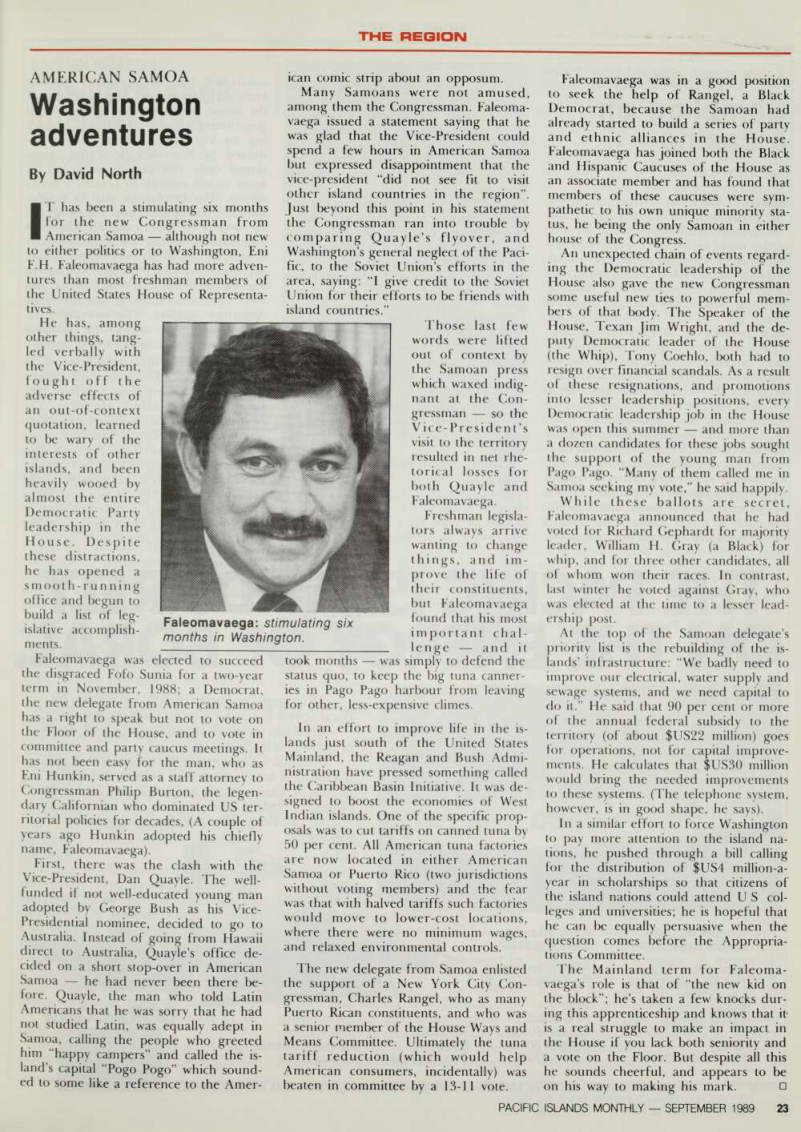
American Samoa
Washington
By David North
IT has been a stimulating six months for the new Congressman from American Samoa although not new to either politics or to Washington, Eni F.H. Faleomavaega has had more adven tures than most freshman members of the United States House of Representa tives.
He has, among other things, tang led verbally with the Vice-President, fought off the adverse effects of an out-of-context quotation, learned to be wary of the interests of other islands, and been heavily wooed by almost the entire Democratic Party leadership in the
House. Despite
these distractions, he has opened a
smooth-running
office and begun to build a list of leg
islative accomplish
ments.
Faleomavaega was elected to succeed the disgraced Fofo Sunia for a two-year term in November, 1988; a Democrat, the new delegate from American Samoa has a right to speak but not to vote on the Floor of the House, and to vote in committee and party caucus meetings. It has not been easy for the man, who as Fni Hunkin, served as a staff attorney to Congressman Philip Burton, the legen dary Californian who dominated US ter ritorial policies for decades, (A couple of years ago Hunkin adopted his chiefly
name, Faleomavaega).
First, there was the clash with the Vice-President, Dan Quayle. The well funded if not well-educated young man adopted by George Bush as his Vice- Presidential nominee, decided to go to Australia. Instead of going from Hawaii direct to Australia, Quayle’s office de cided on a short stop-over in American Samoa he had never been there be fore. Quayle, the man who told Latin Americans that he was sorry that he had not studied Latin, was equally adept in Samoa, calling the people who greeted him “happy campers” and called the is land’s capital “Pogo Pogo” which sound ed to some like a reference to the Amer-
ican comic strip about an opposum.
Many Samoans were not amused, among them the Congressman. Faleoma vaega issued a statement saying that he was glad that the Vice-President could spend a few hours in American Samoa but expressed disappointment that the vice-president “did not see fit to visit other island countries in the region”.
Just beyond this point in his statement the Congressman ran into trouble by
comparing Quayle’s flyover, and
Washington’s general neglect of the Paci fic, to the Soviet Union’s efforts in the area, saying: “I give credit to the Soviet Union for their efforts to be friends with island countries.”
Those last few words were lifted out of context by the Samoan press which waxed indig nant at the Con gressman so the Vice-President’s visit to the territory resulted in net rhe torical losses for both Quayle and
Faleomavaega.
Freshman legisla
tors always arrive
wanting to change
things, and im prove the life of their constituents,
but Faleomavaega
found that his most
important chal
lenge and it
took months was simply to defend the status quo, to keep the big tuna canner ies in Pago Pago harbour from leaving for other, less-expensive climes.
In an effort to improve life in the is lands just south of the United States Mainland, the Reagan and Bush Admi nistration have pressed something called the Caribbean Basin Initiative. It was de signed to boost the economies of West Indian islands. One of the specific prop osals was to cut tariffs on canned tuna by 50 per cent. All American tuna factories are now located in either American Samoa or Puerto Rico (two jurisdictions without voting members) and the fear was that with halved tariffs such factories would move to lower-cost locations, where there were no minimum wages, and relaxed environmental controls.
The new delegate from Samoa enlisted the support of a New York City Con gressman, Charles Rangel, who as many Puerto Rican constituents, and who was a senior member of the House Ways and Means Committee. Ultimately the tuna tariff reduction (which would help American consumers, incidentally) was beaten in committee by a 13-11 vote.
Faleomavaega was in a good position
to seek the help of Rangel, a Black Democrat, because the Samoan had already started to build a series of party and ethnic alliances in the House.
Faleomavaega has joined both the Black and Hispanic Caucuses of the House as an associate member and has found that members of these caucuses were sym pathetic to his own unique minority sta tus, he being the only Samoan in either house of the Congress.
An unexpected chain of events regard ing the Democratic leadership of the House also gave the new Congressman some useful new ties to powerful mem bers of that body. The Speaker of the House, Texan Jim Wright, and the de puty Democratic leader of the House (the Whip), Tony Coehlo, both had to resign over financial scandals. As a result of these resignations, and promotions into lesser leadership positions, every Democratic leadership job in the House was open this summer and more than a dozen candidates for these jobs sought the support of the young man from Pago Pago. “Many of them called me in Samoa seeking my vote,” he said happily.
While these ballots are secret, faleomavaega announced that he had voted for Richard Gephardt for majority leader, William H. Gray (a Black) for whip, and for three other candidates, all of whom won their races. In contrast, last winter he voted against Gray, who was elected at the time to a lesser lead
ership post.
At the top of the Samoan delegate’s priority list is the rebuilding of the is lands’ infrastructure: “We badly need to improve our electrical, water supply and sewage systems, and we need capital to do it.” He said that 90 per cent or more of the annual federal subsidy to the territory (of about SUS 22 million) goes
for operations, not for capital improve
ments. He calculates that SUS3O million would bring the needed improvements to these systems. (The telephone system, however, is in good shape, he says).
In a similar effort to force Washington to pay more attention to the island na tions, he pushed through a bill calling for the distribution of SUS 4 million-a year in scholarships so that citizens of the island nations could attend U S col leges and universities; he is hopeful that he can be equally persuasive when the question comes before the Appropria tions Committee.
The Mainland term for Faleoma vaega’s role is that of “the new kid on the block”; he’s taken a few knocks dur ing this apprenticeship and knows that it* is a real struggle to make an impact in the House if you lack both seniority and a vote on the Floor. But despite all this he sounds cheerful, and appears to be on his way to making his mark. □
Faleomavaega: stimulating six months in Washington.
Gambling on
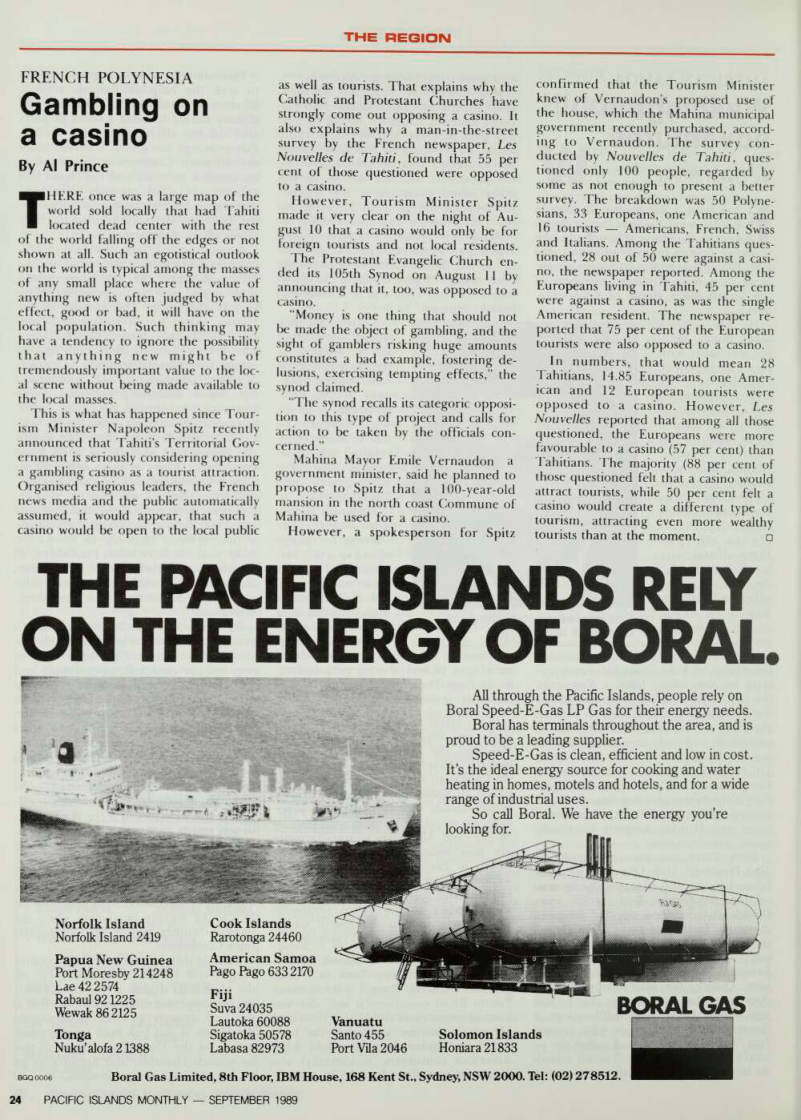
French Polynesia
Gambling on a casino
By Al Prince
THERE once was a large map of the world sold locally that had Tahiti located dead center with the rest of the world falling off the edges or not shown at all. Such an egotistical outlook on the world is typical among the masses of any small place where the value of anything new is often judged by what effect, good or bad, it will have on the local population. Such thinking may have a tendency to ignore the possibility that anything new might be of tremendously important value to the loc al scene without being made available to the local masses.
This is what has happened since Tour
ism Minister Napoleon Spitz recently
announced that Tahiti’s Territorial Gov
ernment is seriously considering opening
a gambling casino as a tourist attraction.
Organised religious leaders, the French news media and the public automatically assumed, it would appear, that such a casino would be open to the local public
as well as tourists. That explains why the Catholic and Protestant Churches have strongly come out opposing a casino. It also explains why a man-in-the-street survey by the French newspaper, Les Nouvelles de Tahiti, found that 55 per cent of those questioned were opposed to a casino.
However, Tourism Minister Spitz made it very dear on the night of Au gust 10 that a casino would only be for foreign tourists and not local residents.
The Protestant Evangelic Church en ded its 105th Synod on August 11 by announcing that it, too, was opposed to a casino.
“Money is one thing that should not be made the object of gambling, and the sight of gamblers risking huge amounts constitutes a bad example, fostering de lusions, exercising tempting effects,” the synod claimed.
“The synod recalls its categoric opposi tion to this type of project and calls for action to be taken by the officials con cerned.”
Mahina Mayor Emile Vernaudon a government minister, said he planned to propose to Spitz that a 100-year-old mansion in the north coast Commune of Mahina be used for a casino.
However, a spokesperson for Spitz
confirmed that the Tourism Minister knew of Vernaudon’s proposed use of the house, which the Mahina municipal government recently purchased, accord ing to Vernaudon. The survey con ducted by Nouvelles de Tahiti , ques tioned only 100 people, regarded by some as not enough to present a better survey. The breakdown was 50 Polyne sians, 33 Europeans, one American and 16 tourists Americans, French, Swiss and Italians. Among the Tahitians ques tioned, 28 out of 50 were against a casi no, the newspaper reported. Among the Europeans living in Tahiti, 45 per cent were against a casino, as was the single American resident. The newspaper re ported that 75 per cent of the European tourists were also opposed to a casino.
In numbers, that would mean 28 Tahitians, 14.85 Europeans, one Amer ican and 12 European tourists were opposed to a casino. However, Les Nouvelles reported that among all those questioned, the Europeans were more favourable to a casino (57 per cent) than Tahitians. The majority (88 per cent of those questioned felt that a casino would attract tourists, while 50 per cent felt a casino would create a different type of tourism, attracting even more wealthy tourists than at the moment. □
Advertisements & other items, p. 24 (1 item)
On The Energy Of Boral
THE RACIFIC ISLANDS RELY
m > :••• • •• • ■ All through the Pacific Islands, people rely on Boral Speed-E-Gas LP Gas for their energy needs.
Boral has terminals throughout the area, and is proud to be a leading supplier.
Speed-E-Gas is clean, efficient and low in cost.
It’s the ideal energy source for cooking and water heating in homes, motels and hotels, and for a wide range of industrial uses.
So call Boral. We have the energy you’re looking for.
Norfolk Island Norfolk Island 2419 Papua New Guinea Port Moresby 214248 Lae 42 2574 Rabaul 921225 Wewak 862125 Tonga Nuku’alofa 21388 Cook Islands Rarotonga 24460 American Samoa Pago Pago 633 2170 Fiji Suva 24035 Lautoka 60088 Sigatoka 50578 Labasa 82973 1 j Vanuatu Santo 455 Port Vila 2046
BORAL GAS
Solomon Islands Honiara 21833 Boral Gas Limited, Bth Floor, IBM House, 168 Kent St., Sydney, NSW 2000. Tel: (02) 278512.
Lawyers seek
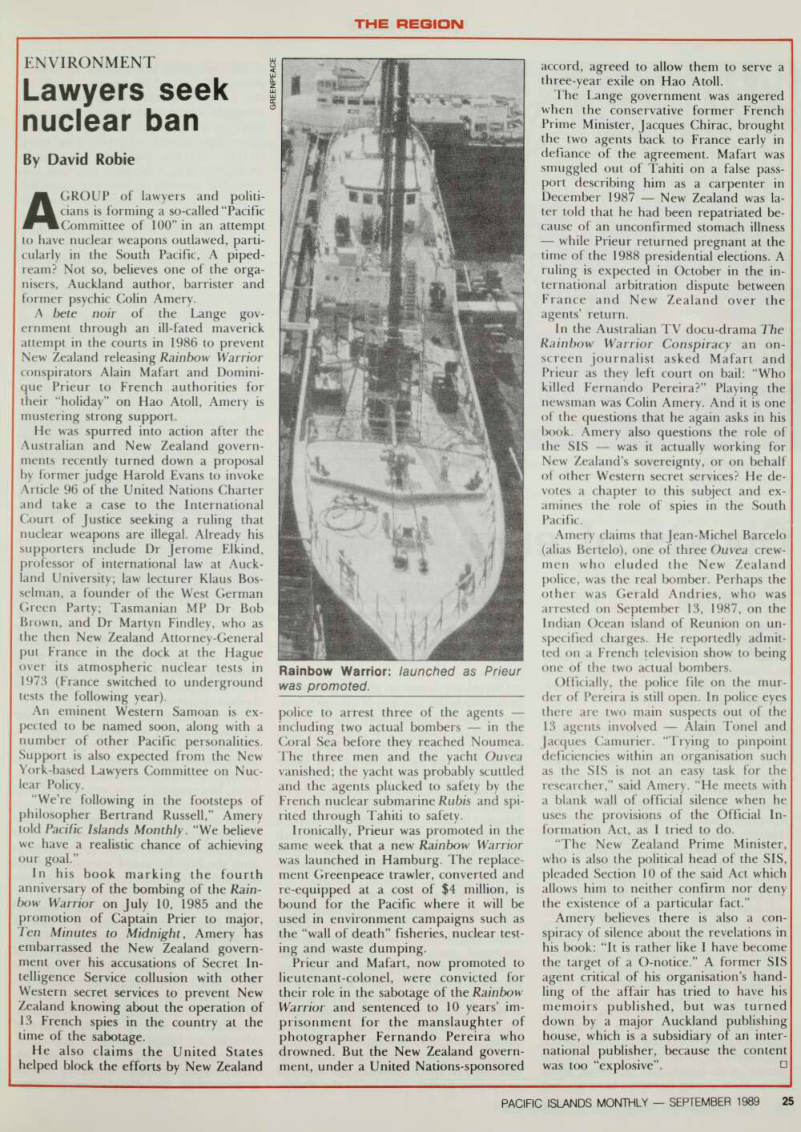
Environment
Lawyers seek nuclear ban
By David Robie
A GROUP of lawyers and politi cians is forming a so-called “Pacific Committee of 100” in an attempt to have nuclear weapons outlawed, parti cularly in the South Pacific, A piped ream? Not so, believes one of the orga nisers, Auckland author, barrister and former psychic Colin Amery.
A bete noir of the Lange gov ernment through an ill-fated maverick attempt in the courts in 1986 to prevent New Zealand releasing Rainbow Warrior conspirators Alain Mafart and Domini que Prieur to French authorities for their “holiday” on Hao Atoll, Amery is mustering strong support.
He was spurred into action after the Australian and New Zealand govern ments recently turned down a proposal by former judge Harold Evans to invoke Article 96 of the United Nations Charter and take a case to the International Court of Justice seeking a ruling that nuclear weapons are illegal. Already his supporters include Dr Jerome Elkind, professor of international law at Auck land University; law lecturer Klaus Bos selman, a founder of the West German Green Party; Tasmanian MP Dr Bob Brown, and Dr Martyn Findley, who as the then New Zealand Attorney-General put France in the dock at the Hague over its atmospheric nuclear tests in 1973 (France switched to underground tests the following year).
An eminent Western Samoan is ex pected to be named soon, along with a number of other Pacific personalities.
Support is also expected from the New York-based Lawyers Committee on Nuc lear Policy.
“We’re following in the footsteps of philosopher Bertrand Russell,” Amery told Pacific Islands Monthly. “We believe we have a realistic chance of achieving
our goal.”
In his book marking the fourth anniversary of the bombing of the Rain bow Warrior on July 10, 1985 and the promotion of Captain Prier to major, Ten Minutes to Midnight, Amery has embarrassed the New Zealand govern ment over his accusations of Secret In telligence Service collusion with other Western secret services to prevent New Zealand knowing about the operation of 13 French spies in the country at the time of the sabotage.
He also claims the United States helped block the efforts by New Zealand
police to arrest three of the agents including two actual bombers in the Coral Sea before they reached Noumea.
The three men and the yacht Ouvea vanished; the yacht was probably scuttled and the agents plucked to safety by the French nuclear submarine Rubis and spi rited through Tahiti to safety.
Ironically, Prieur was promoted in the same week that a new Rainbow Warrior was launched in Hamburg. The replace ment Greenpeace trawler, converted and re-equipped at a cost of $4 million, is bound for the Pacific where it will be used in environment campaigns such as the “wall of death” fisheries, nuclear test
ing and waste dumping.
Prieur and Mafart, now promoted to lieutenant-colonel, were convicted for their role in the sabotage of the Rainbow Warrior and sentenced to 10 years’ im prisonment for the manslaughter of photographer Fernando Pereira who drowned. But the New Zealand govern ment, under a United Nations-sponsored
accord, agreed to allow them to serve a three-year exile on Hao Atoll.
The Lange government was angered when the conservative former French Prime Minister, Jacques Chirac, brought the two agents back to France early in defiance of the agreement. Mafart was smuggled out of Tahiti on a false pass port describing him as a carpenter in December 1987 New Zealand was la ter told that he had been repatriated be cause of an unconfirmed stomach illness while Prieur returned pregnant at the time of the 1988 presidential elections. A ruling is expected in October in the in ternational arbitration dispute between France and New Zealand over the agents’ return.
In the Australian TV docu-drama The Rainbow Warrior Conspiracy an on screen journalist asked Mafart and Prieur as they left court on bail: “Who killed Fernando Pereira?” Playing the newsman was Colin Amery. And it is one of the questions that he again asks in his book. Amery also questions the role of the SIS was it actually working for New Zealand’s sovereignty, or on behalf of other Western secret services? He de votes a chapter to this subject and ex amines the role of spies in the South Pacific.
Amery claims that Jean-Michel Barcelo (alias Bertelo), one of three Ouvea crew men who eluded the New Zealand police, was the real bomber. Perhaps the other was Gerald Andries, who was arrested on September 13, 1987, on the Indian Ocean island of Reunion on un
specified charges. He reportedly admit
ted on a French television show to being one of the two actual bombers.
Officially, the police file on the mur der of Pereira is still open. In police eyes there are two main suspects out of the 13 agents involved Alain Tonel and Jacques Camurier. “Trying to pinpoint deficiencies within an organisation such as the SIS is not an easy task for the researcher,” said Amery. “He meets with a blank wall of official silence when he uses the provisions of the Official In formation Act, as I tried to do.
“The New Zealand Prime Minister, who is also the political head of the SIS, pleaded Section 10 of the said Act which allows him to neither confirm nor deny the existence of a particular fact.”
Amery believes there is also a con spiracy of silence about the revelations in his book: “It is rather like I have become the target of a O-notice.” A former SIS agent critical of his organisation’s hand ling of the affair has tried to have his memoirs published, but was turned
down by a major Auckland publishing
house, which is a subsidiary of an inter national publisher, because the content was too “explosive”. □
Rainbow Warrior: launched as Prieur was promoted.
Ghosts of empires past
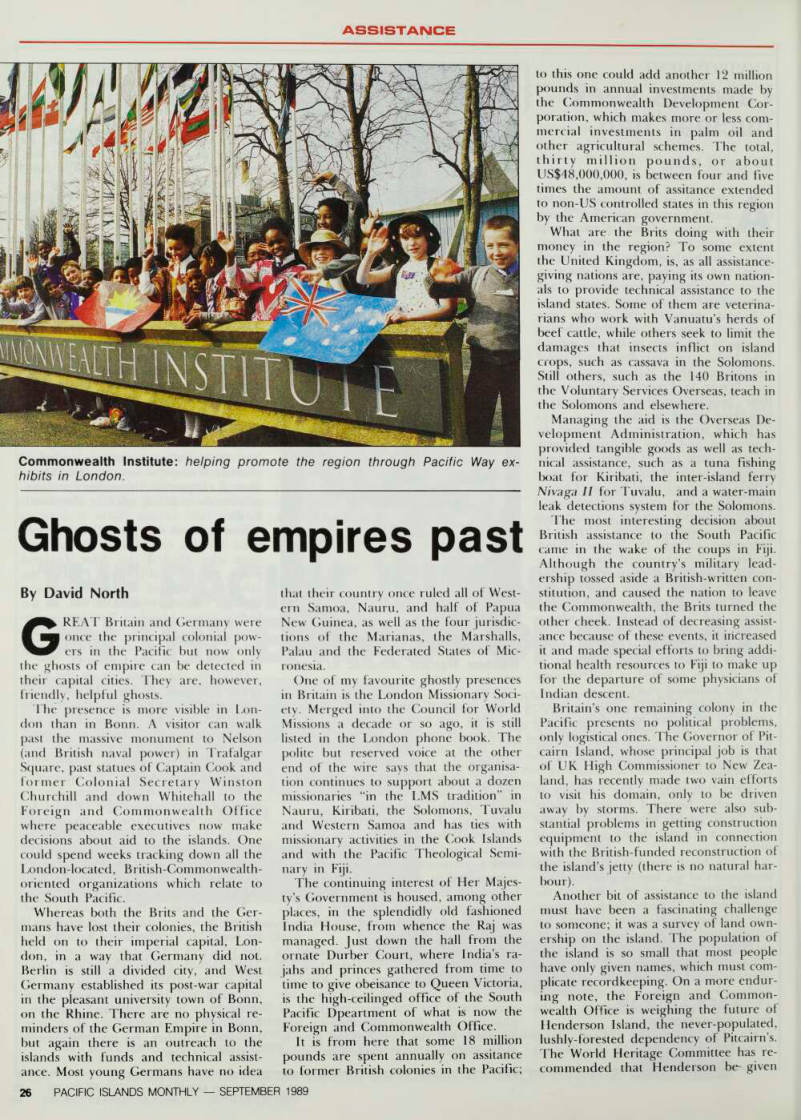
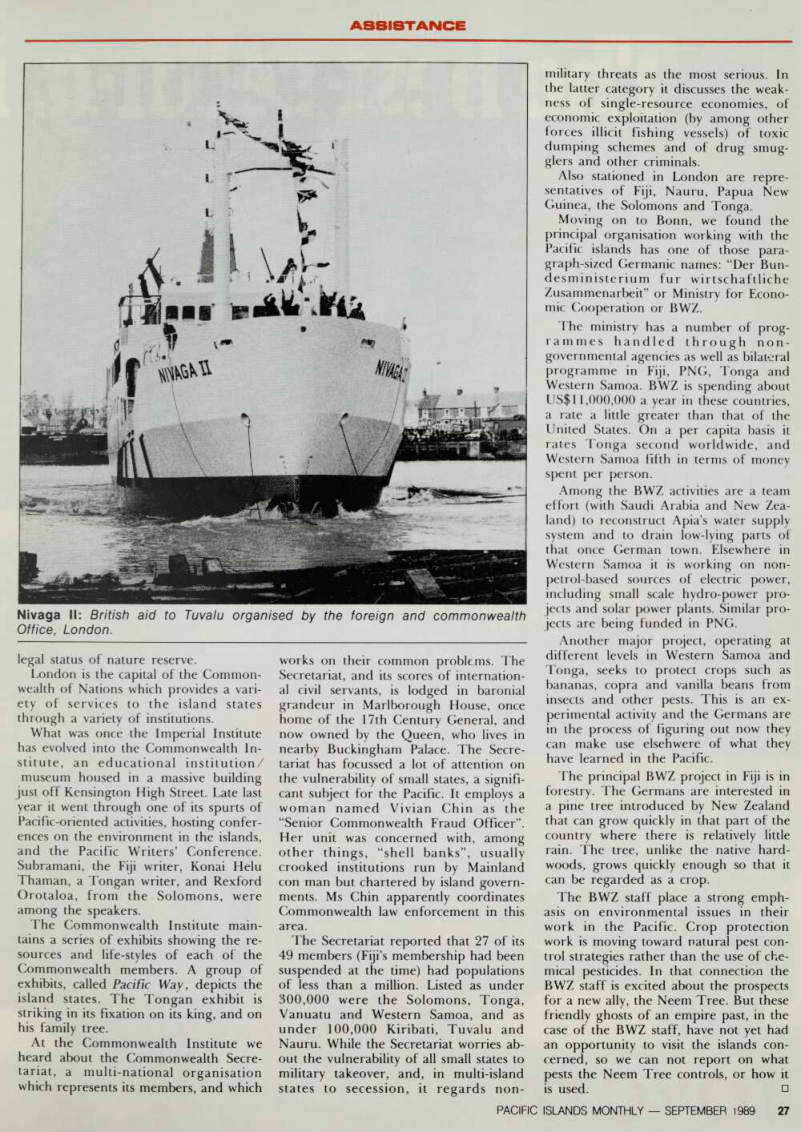
Assistance
By David North
GREAT Britain and Germany were once the principal colonial pow ers in the Pacific but now only the ghosts of empire can be detected in their capital cities. They are, however,
friendly, helpful ghosts.
The presence is more visible in Lon don than in Bonn. A visitor can walk past the massive monument to Nelson (and British naval power) in Trafalgar Square, past statues of Captain Cook and former Colonial Secretary Winston Churchill and down Whitehall to the Foreign and Commonwealth Office where peaceable executives now make decisions about aid to the islands. One could spend weeks tracking down all the London-located, British-Commonwealth oriented organizations which relate to the South Pacific.
Whereas both the Brits and the Ger mans have lost their colonies, the British held on to their imperial capital, Lon don, in a way that Germany did not.
Berlin is still a divided city, and West Germany established its post-war capital in the pleasant university town of Bonn, on the Rhine. There are no physical re minders of the German Empire in Bonn, but again there is an outreach to the islands with funds and technical assist ance. Most young Germans have no idea
that their country once ruled all of West ern Samoa, Nauru, and half of Papua New Guinea, as well as the four jurisdic tions of the Marianas, the Marshalls, Palau and the Federated States of Mic ronesia.
One of my favourite ghostly presences in Britain is the London Missionary Soci ety. Merged into the Council for World Missions a decade or so ago, it is still listed in the London phone book. The polite but reserved voice at the other end of the wire says that the organisa tion continues to support about a dozen missionaries “in the LMS tradition” in Nauru, Kiribati, the Solomons, Tuvalu and Western Samoa and has ties with missionary activities in the Cook Islands and with the Pacific Theological Semi nary in Fiji.
The continuing interest of Her Majes ty’s Government is housed, among other places, in the splendidly old fashioned India House, from whence the Raj was managed. Just down the hall from the ornate Durber Court, where India’s ra jahs and princes gathered from time to time to give obeisance to Queen Victoria, is the high-ceilinged office of the South Pacific Dpeartment of what is now the Foreign and Commonwealth Office.
It is from here that some 18 million pounds are spent annually on assitance to former British colonies in the Pacific;
to this one could add another 12 million pounds in annual investments made by the Commonwealth Development Cor poration, which makes more or less com mercial investments in palm oil and other agricultural schemes. The total, thirty million pounds, or about U 5548,000,000, is between four and five times the amount of assitance extended to non-US controlled states in this region by the American government.
What are the Brits doing with their money in the region? To some extent the United Kingdom, is, as all assistance giving nations are, paying its own nation als to provide technical assistance to the island states. Some of them are veterina rians who work with Vanuatu’s herds of beef cattle, while others seek to limit the damages that insects inflict on island crops, such as cassava in the Solomons.
Still others, such as the 140 Britons in the Voluntary Services Overseas, teach in the Solomons and elsewhere.
Managing the aid is the Overseas De velopment Administration, which has provided tangible goods as well as tech nical assistance, such as a tuna fishing boat for Kiribati, the inter-island ferry Nivaga II for Tuvalu, and a water-main leak detections system for the Solomons.
The most interesting decision about British assistance to the South Pacific came in the wake of the coups in Fiji.
Although the country’s military lead
ership tossed aside a British-written con stitution, and caused the nation to leave the Commonwealth, the Brits turned the other cheek. Instead of decreasing assist ance because of these events, it increased it and made special efforts to bring addi tional health resources to Fiji to make up for the departure of some physicians of Indian descent.
Britain’s one remaining colony in the Pacific presents no political problems, only logistical ones. The Governor of Pit cairn Island, whose principal job is that of UK High Commissioner to New Zea land, has recently made two vain efforts to visit his domain, only to be driven away by storms. There were also sub stantial problems in getting construction equipment to the island in connection with the British-funded reconstruction of the island’s jetty (there is no natural har bour).
Another bit of assistance to the island must have been a fascinating challenge to someone; it was a survey of land own ership on the island. The population of the island is so small that most people have only given names, which must com plicate recordkeeping. On a more endur ing note, the Foreign and Common wealth Office is weighing the future of Henderson Island, the never-populated,
lushly-forested dependency of Pitcairn’s.
The World Heritage Committee has re commended that Henderson be- given
Commonwealth Institute: helping promote the region through Pacific Way ex hibits in London.
legal status of nature reserve.
London is the capital of the Commonwealth of Nations which provides a variety of services to the island states through a variety of institutions.
What was once the Imperial Institute has evolved into the Commonwealth Institute, an educational institution/ museum housed in a massive building just off Kensington High Street. Late last year it went through one of its spurts of Pacific-oriented activities, hosting conferences on the environment in the islands, and the Pacific Writers’ Conference, Subramani, the Fiji writer, Konai Helu Thaman, a Tongan writer, and Rexford Orotaloa, from the Solomons, were among the speakers.
The Commonwealth Institute maintains a series of exhibits showing the resources and life-styles of each of the Commonwealth members. A group of exhibits, called Pacific Way, depicts the island states. The Tongan exhibit is striking in its fixation on its king, and on his family tree.
At the Commonwealth Institute we heard about the Commonwealth Secretariat, a multi-national organisation which represents its members, and which
works on their common problems. The Secretariat, and its scores of internation al civil servants, is lodged in baronial grandeur in Marlborough House, once home of the 17th Century General, and now owned by the Queen, who lives in nearby Buckingham Palace. The Secre tariat has focussed a lot of attention on the vulnerability of small states, a signifi cant subject for the Pacific. It employs a woman named Vivian Chin as the “Senior Commonwealth Fraud Officer”.
Her unit was concerned with, among other things, “shell banks”, usually crooked institutions run by Mainland con man but chartered by island govern ments. Ms Chin apparently coordinates Commonwealth law enforcement in this area.
The Secretariat reported that 27 of its 49 members (Fiji’s membership had been suspended at the time) had populations of less than a million. Listed as under 300,000 were the Solomons, Tonga, Vanuatu and Western Samoa, and as under 100,000 Kiribati, Tuvalu and Nauru. While the Secretariat worries ab out the vulnerability of all small states to military takeover, and, in multi-island states to secession, it regards non
military threats as the most serious. In the latter category it discusses the weak ness of single-resource economies, of economic exploitation (by among other forces illicit fishing vessels) of toxic dumping schemes and of drug smug glers and other criminals.
Also stationed in London are repre sentatives of Fiji, Nauru, Papua New Guinea, the Solomons and Tonga.
Moving on to Bonn, we found the
principal organisation working with the
Pacific islands has one of those para graph-sized Germanic names; “Der Bun desministerium fur wirtschaftliche Zusammenarbeit” or Ministry for Econo mic Cooperation or BWZ.
The ministry has a number of prog rammes handled through non governmental agencies as well as bilateral programme in Fiji, PNG, Tonga and Western Samoa. BWZ is spending about US$ll,OOO,OOO a year in these countries, a rate a little greater than that of the United States. On a per capita basis it rates Tonga second worldwide, and Western Samoa fifth in terms of money spent per person.
Among the BWZ activities are a team effort (with Saudi Arabia and New Zea land) to reconstruct Apia’s water supply system and to drain low-lying parts of that once German town. Elsewhere in Western Samoa it is working on non petrol-based sources of electric power, including small scale hydro-power pro jects and solar power plants. Similar pro jects are being funded in PNG.
Another major project, operating at
different levels in Western Samoa and Tonga, seeks to protect crops such as bananas, copra and vanilla beans from insects and other pests. This is an ex perimental activity and the Germans are in the process of figuring out now they can make use elsehwere of what they have learned in the Pacific.
The principal BWZ project in Fiji is in forestry. The Germans are interested in a pine tree introduced by New Zealand that can grow quickly in that part of the country where there is relatively little rain. The tree, unlike the native hard woods, grows quickly enough so that it can be regarded as a crop.
The BWZ staff place a strong emph asis on environmental issues in their work in the Pacific. Crop protection work is moving toward natural pest con trol strategies rather than the use of che mical pesticides. In that connection the BWZ staff is excited about the prospects for a new ally, the Neem Tree. But these friendly ghosts of an empire past, in the case of the BWZ staff, have not yet had an opportunity to visit the islands con cerned, so we can not report on what pests the Neem Tree controls, or how it is used. □
Nivaga II: British aid to Tuvalu organised by the foreign and commonwealth Office, London.
Advertisements & other items, pp. 28-29 (1 item)
Toyota
The Toyota Hilux is the world’s most popular pick-up.
And the Hilux 4X4 is the best-selling Hilux of them all. Which stands to reason. People around the world respect Toyota’s attention to style. Hilux’s car-like comfort. Rugged reliability. And as you might expect from Toyota, power. This, of course, is the most important asset for a truck. And happily, the Hilux 4X4 offers a choice of four powerful engines: 2.8 and 2.4-litre diesel engines. Plus 2.2 and 1.8-litre petrol engines. When it comes to power and good looks, nobody can beat Toyota. Nobody.
e -- ; - 5 Mk * * -- -> 1 ST» m <■-. 9 •■*- N. % % r i •V > ■J*- »i XhhU f fe
Society
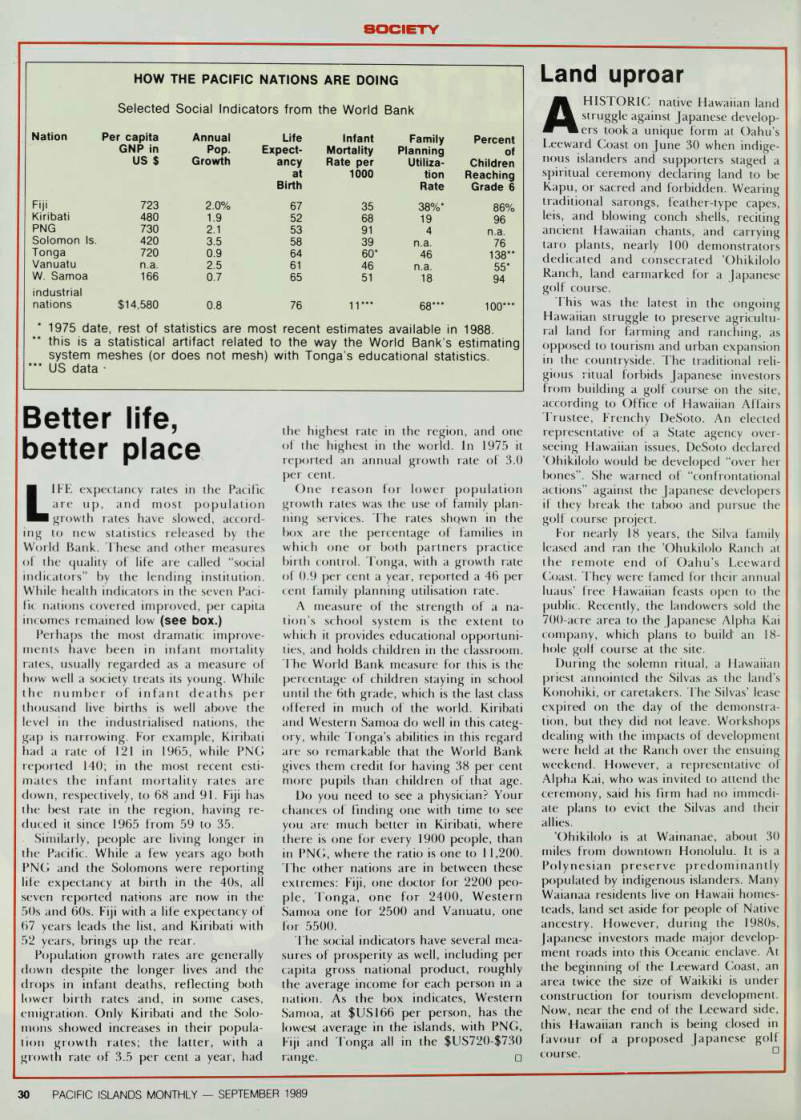
How The Pacific Nations Are Doing
Selected Social Indicators from the World Bank
Nhation Per capita Annual Life Infant Family Percent GNP in
Pop.
Expect-
Mortality
Planning
of US $ Growth ancy Rate per Utiliza- Children at 1000 tion
Reaching
Birth Rate Grade 6
Fiji
723 2.0% 67 35 38%* 86% Kiribati 480 1.9 52 68 19 96
Png
730 2.1 53 91 4 n.a.
Solomon Is. 420 3.5 58 39 n.a. 76
Tonga
720 0.9 64 60* 46 138** Vanuatu n.a. 2.5 61 46 n.a. 55* W. Samoa 166 0.7 65 51 18 94 industrial nations $14,580 0.8 76 11*** 68*** 100*** * 1975 date, rest of statistics are most recent estimates available in 1988. ** this is a statistical artifact related to the way the World Bank’s estimating system meshes (or does not mesh) with Tonga’s educational statistics. *** US data •
better place
Better life, better place
LIFE expectancy rates in the Pacific are up, and most population growth rates have slowed, accord ing to new statistics released by the World Bank. These and other measures of the quality of life are called “social indicators” by the lending institution.
While health indicators in the seven Paci fic nations covered improved, per capita incomes remained low (see box.) Perhaps the most dramatic improve ments have been in infant mortality rates, usually regarded as a measure of how well a society treats its young. While the number of infant deaths per thousand live births is well above the level in the industrialised nations, the gap is narrowing. For example, Kiribati had a rate of 121 in 1965, while PNG reported 140; in the most recent esti mates the infant mortality rates are down, respectively, to 68 and 91. Fiji has the best rate in the region, having re duced it since 1965 from 59 to 35.
Similarly, people are living longer in
the Pacific. While a few years ago both PNG and the Solomons were reporting life expectancy at birth in the 40s, all seven reported nations are now in the 50s and 60s. Fiji with a life expectancy of 67 years leads the list, and Kiribati with 52 years, brings up the rear.
Population growth rates are generally
down despite the longer lives and the drops in infant deaths, reflecting both lower birth rates and, in some cases, emigration. Only Kiribati and the Solo mons showed increases in their popula tion growth rates; the latter, with a growth rate of 3.5 per cent a year, had
the highest rate in the region, and one of the highest in the world. In 1975 it reported an annual growth rate of 3.0 per cent.
One reason for lower population growth rates was the use of family plan ning services. The rates shqwn in the box are the percentage of families in which one or both partners practice birth control. Tonga, with a growth rate of 0.9 per cent a year, reported a 46 per cent family planning utilisation rate.
A measure of the strength of a na tion’s school system is the extent to which it provides educational opportuni ties, and holds children in the classroom.
The World Bank measure for this is the percentage of children staying in school until the 6th grade, which is the last class offered in much of the world. Kiribati and Western Samoa do well in this categ ory, while Tonga’s abilities in this regard are so remarkable that the World Bank gives them credit for having 38 per cent more pupils than children of that age.
Do you need to see a physician? Your chances of finding one with time to see you are much better in Kiribati, where there is one for every 1900 people, than in PNG, where the ratio is one to 11,200.
The other nations are in between these extremes: Fiji, one doctor for 2200 peo ple, Tonga, one for 2400, Western Samoa one for 2500 and Vanuatu, one for 5500.
The social indicators have several mea sures of prosperity as well, including per
capita gross national product, roughly
the average income for each person in a nation. As the box indicates, Western Samoa, at SUSI 66 per person, has the lowest average in the islands, with PNG, Fiji and Tonga all in the SUS72O-$730 range. □
Land uproar
A HISTORIC native Hawaiian land
struggle against Japanese develop
ers took a unique form at Oahu’s Leeward Coast on June 30 when indige nous islanders and supporters staged a spiritual ceremony declaring land to be Kapu, or sacred and forbidden. Wearing traditional sarongs, feather-type capes, leis, and blowing conch shells, reciting ancient Hawaiian chants, and carrying taro plants, nearly 100 demonstrators dedicated and consecrated ’Ohikilolo Ranch, land earmarked for a Japanese golf course.
This was the latest in the ongoing Hawaiian struggle to preserve agricultu ral land for farming and ranching, as opposed to tourism and urban expansion in the countryside. The traditional reli gious ritual forbids Japanese investors from building a golf course on the site, according to Office of Hawaiian Affairs Trustee, Frenchy DeSoto. An elected representative of a State agency over seeing Hawaiian issues, DeSoto declared ’Ohikilolo would be developed “over her bones”. She warned of “confrontational actions” against the Japanese developers if they break the taboo and pursue the
golf course project.
For nearly 18 years, the Silva family leased and ran the ’Ohukilolo Ranch at the remote end of Oahu’s Leeward Coast. They were famed for their annual luaus’ free Hawaiian feasts open to the public. Recently, the landowers sold the 700-acre area to the Japanese Alpha Kai company, which plans to build an 18hole golf course at the site.
During the solemn ritual, a Hawaiian priest annointed the Silvas as the land’s Konohiki, or caretakers. The Silvas’ lease expired on the day of the demonstra tion, but they did not leave. Workshops
dealing with the impacts of development
were held at the Ranch over the ensuing weekend. However, a representative of Alpha Kai, who was invited to attend the ceremony, said his firm had no immedi ate plans to evict the Silvas and their allies. ’Ohikilolo is at Wainanae, about 30 miles from downtown Honolulu. It is a Polynesian preserve predominantly
populated by indigenous islanders. Many
Waianaa residents live on Hawaii homes teads, land set aside for people of Native ancestry. However, during the 1980 s, Japanese investors made major develop ment roads into this Oceanic enclave. At the beginning of the Leeward Coast, an area twice the size of Waikiki is under construction for tourism development.
Now, near the end of the Leeward side, this Hawaiian ranch is being closed in favour of a proposed Japanese golf course. D
Pacific
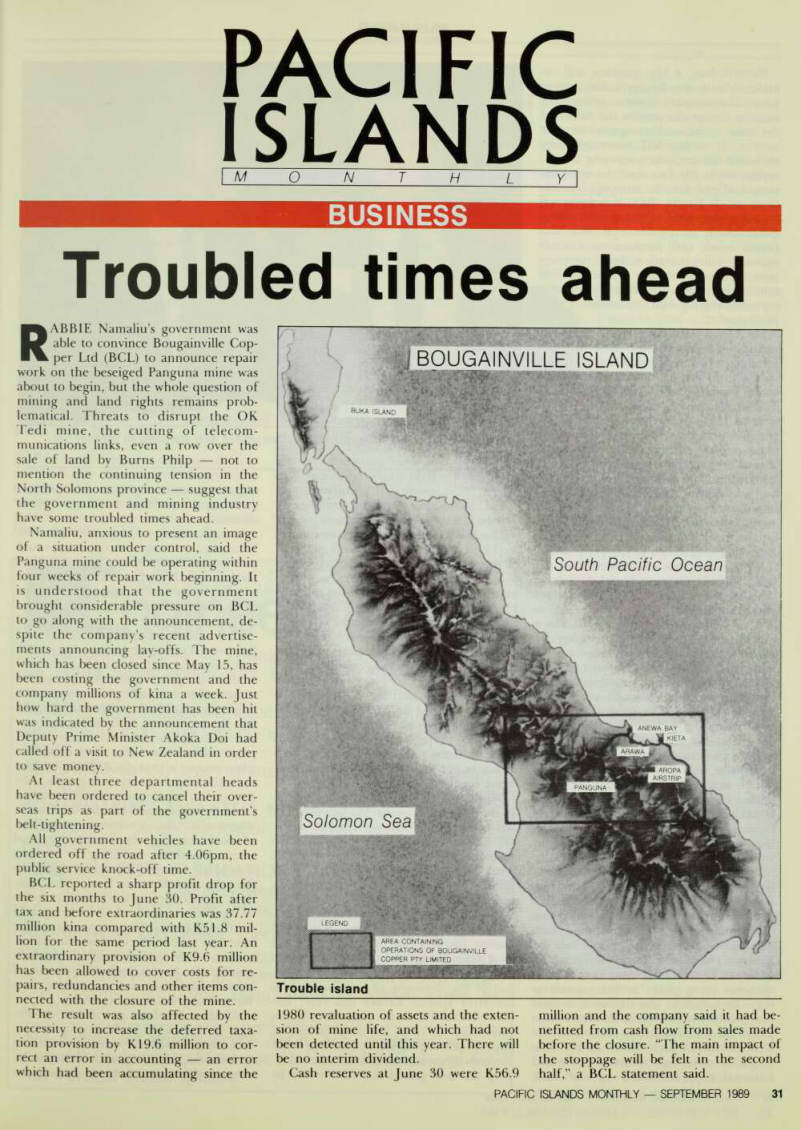
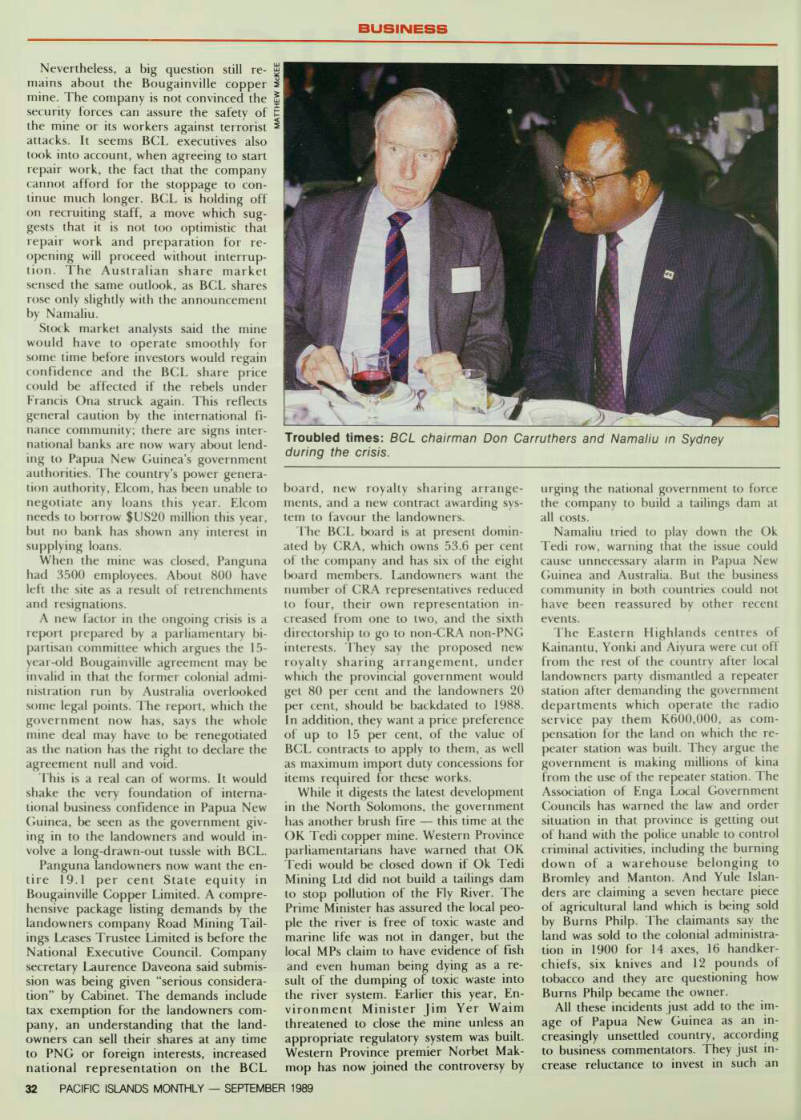
Islands
Monthly
Business
Troubled times ahead
RABBIE Namaliu’s government was able to convince Bougainville Cop per Ltd (BCL) to announce repair work on the beseiged Panguna mine was about to begin, but the whole question of
mining and land rights remains prob
lematical. Threats to disrupt the OK Tedi mine, the cutting of telecom munications links, even a row over the sale of land by Burns Philp not to mention the continuing tension in the North Solomons province suggest that the government and mining industry have some troubled times ahead.
Namaliu, anxious to present an image of a situation under control, said the Panguna mine could be operating within four weeks of repair work beginning. It is understood that the government brought considerable pressure on BCL to go along with the announcement, de spite the company’s recent advertise ments announcing lay-offs. The mine, which has been closed since May 15, has been costing the government and the company millions of kina a week. Just how hard the government has been hit was indicated by the announcement that Deputy Prime Minister Akoka Doi had called off a visit to New Zealand in order to save money.
At least three departmental heads have been ordered to cancel their over seas trips as part of the government’s
belt-tightening.
All government vehicles have been ordered off the road after 4.06 pm, the public service knock-off time.
BCL reported a sharp profit drop for the six months to June 30. Profit after tax and before extraordinaries was 37.77 million kina compared with K 51.8 mil lion for the same period last year. An extraordinary provision of K 9.6 million has been allowed to cover costs for re pairs, redundancies and other items con nected with the closure of the mine.
The result was also affected by the necessity to increase the deferred taxa tion provision by K 19.6 million to cor rect an error in accounting an error which had been accumulating since the
1980 revaluation of assets and the exten sion of mine life, and which had not been detected until this year. There will be no interim dividend.
Cash reserves at June 30 were K 56.9
million and the company said it had be nefitted from cash flow from sales made before the closure. “The main impact of the stoppage will be felt in the second half,” a BCL statement said.
Trouble island
Nevertheless, a big question still re mains about the Bougainville copper mine. The company is not convinced the security forces can assure the safety of the mine or its workers against terrorist attacks. It seems BCL executives also took into account, when agreeing to start repair work, the fact that the company cannot afford for the stoppage to con tinue much longer. BCL is holding off on recruiting staff, a move which sug gests that it is not too optimistic that repair work and preparation for re
opening will proceed without interrup
tion. The Australian share market sensed the same outlook, as BCL shares rose only slightly with the announcement by Namaliu.
Stock market analysts said the mine would have to operate smoothly for some time before investors would regain confidence and the BCL share price could be affected if the rebels under Francis Ona struck again. This reflects general caution by the international fi nance community; there are signs inter national banks are now wary about lend ing to Papua New Guinea’s government authorities. The country’s power genera tion authority, Elcom, has been unable to negotiate any loans this year. Elcom needs to borrow SUS2O million this year, but no bank has shown any interest in
supplying loans.
When the mine was closed, Panguna had 3500 employees. About 800 have left the site as a result of retrenchments
and resignations.
A new factor in the ongoing crisis is a
report prepared by a parliamentary bi
partisan committee which argues the 15year-old Bougainville agreement may be invalid in that the former colonial admi nistration run by Australia overlooked some legal points. The report, which the government now has, says the whole mine deal may have to be renegotiated as the nation has the right to declare the agreement null and void.
This is a real can of worms. It would shake the very foundation of interna tional business confidence in Papua New Guinea, be seen as the government giv ing in to the landowners and would in volve a long-drawn-out tussle with BCL.
Panguna landowners now want the en tire 19.1 per cent State equity in Bougainville Copper Limited. A compre hensive package listing demands by the landowners company Road Mining Tail ings Leases Trustee Limited is before the National Executive Council. Company secretary Laurence Daveona said submis sion was being given “serious considera tion” by Cabinet. The demands include tax exemption for the landowners com pany, an understanding that the land owners can sell their shares at any time to PNG or foreign interests, increased national representation on the BCL
board, new royalty sharing arrange ments, and a new contract awarding sys tem to favour the landowners.
The BCL board is at present domin ated by CRA, which owns 53.6 per cent of the company and has six of the eight board members. Landowners want the number of CRA representatives reduced to four, their own representation in creased from one to two, and the sixth directorship to go to non-CRA non-PNG interests. They say the proposed new
royalty sharing arrangement, under
which the provincial government would get 80 per cent and the landowners 20 per cent, should be backdated to 1988.
In addition, they want a price preference of up to 15 per cent, of the value of BCL contracts to apply to them, as well as maximum import duty concessions for items required for these works.
While it digests the latest development in the North Solomons, the government has another brush fire this time at the OK Tedi copper mine. Western Province parliamentarians have warned that OK Tedi would be closed down if Ok Tedi Mining Ltd did not build a tailings dam to stop pollution of the Fly River. The Prime Minister has assured the local peo ple the river is free of toxic waste and marine life was not in danger, but the local MPs claim to have evidence of fish and even human being dying as a re sult of the dumping of toxic waste into the river system. Earlier this year, En vironment Minister Jim Yer Waim threatened to close the mine unless an appropriate regulatory system was built.
Western Province premier Norbet Mak mop has now joined the controversy by
urging the national government to force the company to build a tailings dam at all costs.
Namaliu tried to play down the Ok Tedi row, warning that the issue could cause unnecessary alarm in Papua New Guinea and Australia. But the business community in both countries could not have been reassured by other recent events.
The Eastern Highlands centres of Kainantu, Yonki and Aiyura were cut off from the rest of the country after local landowners party dismantled a repeater station after demanding the government departments which operate the radio service pay them K 600,000, as com pensation for the land on which the re peater station was built. They argue the government is making millions of kina from the use of the repeater station. The Association of Enga Local Government Councils has warned the law and order situation in that province is getting out of hand with the police unable to control criminal activities, including the burning down of a warehouse belonging to Bromley and Manton. And Yule Islan ders are claiming a seven hectare piece of agricultural land which is being sold by Burns Philp. The claimants say the land was sold to the colonial administra tion in 1900 for 14 axes, 16 handker chiefs, six knives and 12 pounds of tobacco and they are questioning how Burns Philp became the owner.
All these incidents just add to the im age of Papua New Guinea as an in
creasingly unsettled country, according
to business commentators. They just in crease reluctance to invest in such an
Matthew Mckee
Troubled times: BCL chairman Don Carruthers and Namaliu in Sydney during the crisis.
economic environment.
Meanwhile, a company to be floated on the Australian Stock Exchange has come to a deal with landowners which may provide a precedent for future min ing ventures. Porgera Gold Dredging (PNG) Ltd will offer 11.4 per cent of shares to the Papua New Guinea public and guaranteed local landowners up to 50 per cent of the mine’s net proceeds.
The company will seek alluvial gold downstream from the giant Porgera pro ject.
Previously illegal miners were exploit ing these alluvial deposits. The landown ers’ rights will be exercised through the involvement in the mining project of Ipi li Porgera Investments Ltd, a company with 3332 shareholders, including 2600 who are members of land-owning clans in the area. Ipili secured the rights to the tenements and then reached agree ment with the Australian partners. □ PNG gets into fruit RABAUL will host an international fruit conference in November, reflecting the government’s eagerness to see the coun try establish its own fruit industry rather than continue to rely heavily on imports from Australia and New Zealand.
Solomons
New wave in Solomons
A CLEAR change in economic direction has been signalled in recent speeches in the Solomon Islands, with Prime Minister Solomon Mamaloni calling for harder work and belt-tightening while Governor-General Sir George Lepping has indicated the
country’s foreign policy would now con
centrate on trade links.
Speaking in Honiara on the eleventh anniversary of
independence, Mamaloni
called on all sectors of the country’s economy to be de dicated, work harder and co-operate in all areas of de velopment in order to help restore the Solomon Islands’ shaky economy.
The Prime Minister recal led that in 1984, when peo ple were spending freely, he had warned that more money should be saved.
“The more money people
had in their pockets and bank savings, the more they spent it on imported lux-
uries instead of investing in income
generating ventures. Consequently, by
late 1984 the volume of imports to Solo mon Islands rose dramatically while ex ports decreased,” he said.
The adventure of Cyclone Namu in 1986 turned the snowball into an avalan che and the nation’s economy had gone from bad to worse.
Mamaloni said the government would now aim at making sure that capital flows were used to help the economy recover, a task made harder by the dis mal economic performance in recent
years, including the inflation rate jumping from seven per cent in 1984 to 22 per cent in 1988.
“The increase in budget deficit from $l2 million in 1984 to over $7O million in 1988 was staggering, to say the least,” he said. Foreign debt went from SSI 79 mil lion to $2BO million over the same period. The current account sagged from a sur plus of $8.6 million to a de ficit of $B.B million, and the value of the Solomon Islands
dollar declined by about ou per cent against other currencies.
The previous government had mis directed investment priorities and fore ign aid had been used inefficiently, the Prime Minister continued. “In addition, we have also inherited a defunct public service and a demoralised private sector.
The situation is both fragile and poten
tially explosive and requires a major
surgery to put the country back on its feet.” To blame it all on Namu was avoiding reality and “it is time we faced squarely the barest of realities facing us today,” said Mamaloni.
To pull itself out of the present “com atose state”, the Solomon Islands needed to place more emphasis on the role of the rural people whose participation would be crucial. Mamaloni signalled he had come to the same conclusion as lead ers in Papua New Guinea by giving high priority to building a sound economic base in the countryside.
“Improvement to the national eco nomy does not mean mass production of futile plans, masses and masses of papers and computers or sitting in our cool offices drinking cup after cup of coffee,” he said. Rather, everyone had to work harder, with the national and provincial governments taking the lead. The public service needed to reinstate its respecta bility and seriousness as the chief orga niser of government policies. The Prime Minister warned the public service that it must “re-attune itself to service the wel fare and interests of the public at large”.
The whole government apparatus would be overhauled, and management of fore
Lepping: trade links.
ign aid funds improved. It was essential that the Solomon Island Government lived within its means.
Waste through mis-spending, abuse of government property and duplication would all be attacked. “The establish ment of the highly unpopular three-men junta is aimed at curbing ministerial careless spendings of public funds.
Those, especially public officers, who dare to complain against the junta are
doing nothing else but making self
confessions of their past sins,” Mamaloni continued.
The private sector would benefit from new concessions, tariffs, tax incentives.
Mamaloni also broke the news that the government planned to phase out the export of whole logs.
At the opening of the Solomon Islands
parliament, Governor-General Lepping
set out the government’s five-year prog ramme of economic and constitutional reforms. Core projects would include
processing of timber projects, develop
ment and rehabilitation of the coconut
industry, expansion of cocoa develop
ment and the establishment of a spices industry on a commercial basis. Agricul ture will be geared to transform it from what has traditionally been a low pro ductive sector to a modern and commer cial enterprise within 10 years.
The Governor-General also announced the Solomon Islands would make changes to its overseas representa tion to aim it more directly toward the nation’s trade needs. The links will now be based on the requirement for trade and market promotion; already the gov ernment has announced the closure of the Solomon Islands mission at the Un ited Nations on the grounds of cost. The country is now looking at opening an office in Brisbane to look after trade links with Australia, Papua New' Guinea and Indonesia.
Meanwhile, the Solomon Islands will raise the possibility with the two other members of the Melanesian Spearhead Group Papua New Guinea and Vanuatu — of giving economic aid to the poorer nations of the South Pacific, in cluding Tuvalu and Niue.
Mamaloni, who is the most enthusiastic proponent of the three countries form ing the Federated States of Melanesia, said such a union would allow the mem ber countries to divert assistance to those neighbours with few natural resources so that the smaller states could be less re liant on aid from Australia and New Zealand. I=l More Fijian involvement FIJIANS are to be encouraged to play a greater part in the tourism industry, said the nation’s Minister for Trade and Commerce, Berenado Vunibobo.
Advertisements & other items, p. 33 (1 item)
Engineering Ltd
rac SOUTH SEA .
Telephone: 302045. A/H 302008 Eax:(679) 302467 24 Tofua Street, Walu Bay, PO Box 9, Suva.
MARINE ENGINEERING: Access to 1000 ton Slipway. Engine Installation and Servicing. Servicing of Underwater Gears.
MACHINING: All types of machining of different shapes and sizes.
BOILERMAKING AND STEEL FABRICATION:
All types of Steel Fabrication i.e. Fuel Tanks, Hoppers, Freezers, Coils, etc.
STAINLESS STEEL FABRICATIONS AND WELDINGS:
We specialise in Stainless Steel Weldings and Fabrication i.e. Hoppers, Fuel Tanks, Benches etc.
ALUMINIUM WELDING: Specialists in Tig Welding.
STEAM BOILERS: We undertake Installation, Maintenance and Pressure Testing of all types of Steam Boilers and Pressure Vessels, including Installation of Steam Lines to Machines.
Fiji Agents for Robert Bryce & Co. NZ., suppliers of Laundry Equipments, Steampac Horizontal Boilers and Fulton Vertical Steam Boilers.
small-holdings
Chance for small-holdings
THE World Bank is looking at de
veloping small-scale development
guidelines suited to South Pacific economies. South Pacific Trade Commis sioner Bill McCabe said the bank sent a
team through the region in February,
and recently invited him to discuss the
project more fully.
The proposal is for the bank’s subsidi ary, International Finance Corporation, to assess small business proposals which are unable to raise local financial back ing. The corporation will not be provid ing the money itself, but will bring in the skills necessary to help business people develop what McCabe calls bankable documents. “It will be a matter of hold ing the company’s hands in the initial stages,” he said.
In the past, the corporation’s mini mum sized project was about SUSS mil lion, which meant that few businesses in the Pacific island states would qualify.
The new scheme would be looking at projects as small as $250,000 in initial capital. McCabe said it was not until the
World Bank team visited the region that the international agency realised the need for a scaled-down programme.
The problem is not money rather, it is finding sound projects. That is why International Finance Corporation will
concentrate on providing help in shap
ing projects rather than putting money
up itself (although it may take a small equity share in some business opera tions). Fiji, for example, has a banking system with substantial cash reserves, and even the smaller countries send money abroad for investment because of the lack of local opportunities.
Banks, said McCabe, will be more will ing to lend to local projects if the World Bank is involved. The bank’s finance corporation could take a 10 per cent equity share and have a representative on the board of directors of the new companies which would make bank man gers feel a great deal more comfortable.
Existing official aid programmes tend to be more geared to government-linked projects. McCabe believes the new World Bank initiative will provide the missing link in the Pacific the expertise needed at the level of private business to generate local capital formation and pro vide the management support in the first crucial years of new business ventures. □
Advertisements & other items, p. 34 (1 item)
Styrobilt
Manufacturers & Builders of Export Housing for the Pacific Region Manufactured in Fiji by
HARTWELL LTD
WAILADA INDUSTRIAL ESTATE
P.0.80x 13766 Suva Tel: 362-928, Fax 301572
Signal of good times
good times
FIJI’S government has signalled its belief that good times are return ing by easing financial manage ment in a mini-budget delivered in early August. Wages will rise (although are still far short of what workers want) and tariffs have been changed to bring Fiji more in line with world prices.
Finance Minister Josevata Kamikamica is now predicting economic growth of between eight and nine per cent for the year, up from the 3.4 per cent estimated in the last budget in December. The minister said the outlook for 1989 had improved significantly, with the tax-free factories swelling employment figures and more tourists arriving then had been expected. Inflation was running at slightly lower levels than predicted.
Manufacturing employment was up 40 per cent this year.
Another factor was increases in sugar production with output expected to be 450,000 tonnes or more, compared with the 350,000 tonnes originally projected.
Kamikamica said the devaluation of the Fiji dollar in 1987 should have cushioned manufacturers against undue hardships, and gave local producers an
advantage over imported goods. He said
it was necessary to allow companies in Fiji to adjust to the world market gra dually, which had led to the government to developing a new tariff standard. Im port licensing has been removed from 34 items which are also made in Fiji, and
will be replaced by an import duty on many items of 57.5 per cent. “We realise that there are many producers who are competitive with lower levels of protec tion. The measures announced are the first move toward giving local manufac turers a level playing field through uni form levels of protection,” the minister said.
Tariff rates would be reduced over a five-year period to more appropriate levels, he said.
But the transport and hotel industries have been singled out for special help.
The government will provide about $F500,000 to pay for a three cents a litre subsidy on diesel fuel for bus operators, tariffs are down on bus tyres and tubes, while bus chassis and engines may be imported free of duty. Tariff concessions have also been made on some spare parts. The hotels will get an import duty break for furniture, fittings, tools and uniforms, while duty has also been lo wered on sports equipment and boats purchased by resorts.
Meanwhile, Fiji workers will get a six per cent wage hike backdated to July 1, although wages councils will be able to recommend higher increases to those earning less than the minimum wage.
This new wage guideline is expected to add $6.1 million to the government sal ary bill. Pensioners will also get the rise and consideration was being given to ad justing allowances to ex-servicemen.
Kamikamica said Fiji had to prepare for the day when it no longer received special treatment from overseas coun tries, such as concessions available through the Lome Convention or the
SPARTECA agreement. He said already some of the benefits were being wound down.
He said government policy was aimed
at restraining public spending, reform
ing the taxation system to minimise mar ket distortions and establishing a wage system based on international competi tiveness. Taxes would be reduced when possible, and the user-pay principle would be introduced more widely. Cor poratisation or privatisation would be ex plored in terms of government enter prises.
“Growth of revenues should come from growth of our economy, rather than increases in rates of taxation,” said the minister. “In particular, the rates of income tax on wage and salary earners must be brought down to levels which do not penalise effort or remove incentive.”
The mini-budget and its stated aims of anticipating the day when Fiji would lose special concessions such as SPARTECA coincided with growing debate in New Zealand over the free access granted there to Fiji garment manufacturers which, it is being claimed, is putting New Zealanders out of jobs. A government member of Parliament, Clive Mathewson (Dunedin West), says he will take the matter up with the New Zealand govern ment in Wellington. He said the com petition from Fiji, with its tax conces sions at low wage structures, as putting too much pressure on New Zealand manufacturers. Mathewson said he would ask Commerce Minister David
Butcher to apply a special safeguard
under the SPARTECA agreement
against Fiji garments. □
Good news, bad news
By Karen Mangnall
NEW Zealand’s July budget held
good and bad news for Pacific nations.
The bad news is that there’ll be no exceptions to the new company tax laws.
New Zealand companies will have to pay full tax rates on any profits on invest ments in the Pacific, whether the profits are repatriated or not.
Pacific countries, particularly Tonga
and the Cook Islands, are arguing the tax regime will be unfairly punitive to their economies. Tonga made a strong complaint at the pre-Forum regional trade committee and Cooks Prime Minis ter Geoffrey Henry raised the issue at the Forum itself.
New Zealand’s Ministry of External Relations and Trade apparently believes the tax disadvantages won’t be sufficient to dissuade a serious investor from put
ting money into Pacific ventures. Coun tries like Fiji with their special manufac
turing zones still provide enough incen
tives to outweigh paying tax on profits in New Zealand.
But South Pacific Trade Office direc tor Steve Houlihan says the tax regime will inevitably act as one more disincen tive for New Zealand companies to ven ture into the Pacific, with its small work forces and isolation.
The good news is that the New Zea land Government, after 10 years of lob bying from its self-governing territories, has agreed to pay half of an individual’s pension entitlement if that person lives outside the country for six months or longer each year.
Niue’s government representative in Auckland, Ikipa Togatule, says the pen sion pay-out is good news for Niue which is fighting to stem the tide of de population to New Zealand.
“Many of our retired folk are still very active and still have properties on Niue,” says Togatule. “If they can rely on a regular pension income, this will encour age them to move back to Niue.”
The pension announcement has also been welcomed by Western Samoa but the Cook Islands is less enthusiastic. The Cooks Government representative in Wellington, laveta Short, says his Gov ernment has always believed its people to be entitled to the full pension payout.
Although the budget announcement is a “step in the right direction”, Short says the Cooks Government will probably want to keep negotiating for a fuller payout. Short doesn’t believe a 50 per cent entitlement is going to be enough to make it worthwhile for retired Cook Islanders to move back to the islands.
“I think most of them will be financial ly better off here,” he says. “And most of them have been here for many years, their homes, friends and families are here so it will be very hard for them to pick up and move.” □
Seeking a
Pacific Federation
A BOOK just published in New
Zealand calls for the settingup of a South Pacific Federation, in which Australia and New Zealand would be joined by many of the small island states of the region. The author is Jack Ridley, an engineer and former National Party member of parliament.
Ridley argues the success of the Euro pean Economic Community (EEC) and, closer to home, the Association of South east Asian Nations (ASEAN) does pose a threat to a fragmented South Pacific.
“With the present economic situation in New Zealand, and sell-outs and takeov ers by Australia and the disturbances in the South Pacific islands, we urgently need to do something to protect our position,” he writes.
Faking the European Economic Com munity as the yardstick, Ridley said the South Pacific Federation would have as its aims; • Development of natural resources, tariff elimination and currency stabilisa tion • Defence of the region and elimina tion of nuclear weapons and testing • Support for the Law of the Sea • Promotion of tourism • Development of efficient sea and air
transportation.
The federation would have only those powers which were necessary for achiev ing these objectives, and powers would only be exercised with the consensus of all members. Ridley, on the basis of population and economic factors, has set out his ideas for representation on the
federation’s governing body. Australia
would have 24 members. New Zealand 7, Papua New Guinea 5, Fiji, Solomon Is lands, Western Samoa and New Caledo nia 2 each, with one representative from each of Vanuatu, French Polynesia, Ton ga, Kiribati and the Cook Islands (with Tuvalu being omitted without any ex
planation).
The book has been given additional authority in the form of an introduction by former New Zealand Governor- General Sir David Beattie, who says Rid ley’s ideas need to be heard. The book
comes against a background of growing
debate in both Australia and New Zea land about the future relationship of the two countries. A great many leaders of opinion in New Zealand are talking in terms of a full currency union between the two countries now that the Closer Economic Relationship (CER) is almost
complete.
Such a currency union would inevit
ably lead to common policies on tariffs, with the prospect of full political union in the future (with the Australian Con stitution containing provision for New Zealand to become a state of the Austra lian Commonwealth making such a move
relatively simple the provision dates
from the 1890 s when New Zealand with drew at the last moment from what was to have been the Confederation of Au stralasia). The closer economic ties be tween the two countries has immense im plications for the small South Pacific states.
Ridley acknowledges the development
of various regional bodies, including the Forum, but maintains that none of them has the capacity to undertake full re sources development. “It is accepted that the Pacific way is the way of consensus but a start must be made somewhere and the basic concept laid down. We cannot go on having a proliferation of organisa tions.”
He says that the island territories have considerable constraints on their econo mic development. These include the fact that some countries are still ruled by a colonial power, but more commonly the strain of having to finance government programmes internally, the high cost of
imported fuels, an over-reliance on im ported food, lack of diversity of exports and an overdependence on foreign aid.
The book argues that only as part of a South Pacific Federation will the re sources be found to develop these econo mies to their fullest extent.
Ridley’s arguments will be dismissed summarily by many. The idea of sur rendering some powers, so soon after independence, will not sit well in some island capitals. But the point he makes about the inability of most of the small island states to develop their economies beyond being aid-reliant is valid; many experts have assumed that will always be the case. It is also undeniable that the world is grouping into trading blocs, and is it possible for £very small nations to survive on their own? Australia and New Zealand are moving together, and the new trans-Tasman relationship will be crucial to the immediate neighbours.
Ridley’s book while not perhaps the right answer at least starts to pose some of the relevant questions about the future. • The Tasman Challenge: Towards a South Pacific Federation by Jack. Ridley, published by Moana Press, 19 Roderick St, Tauranga, New Zea land. □
Expensive defects
A KIRIBATI parliamentary committee has launched an investigation into the repair of the Moanaraoi in Fiji. The ship was dry-docked in Suva earlier this year and repair costs amounted to |U5225,000. The British government paid for half the cost.
But the Government of Kiribati alleges the expensive repair work had defects.
Kaiarake Taburuea, the chairman of the
Kiribati Shipping Corporation, which
runs Moanaraoi, said the vessel could no longer go on long voyages and had been withdrawn from all overseas trips.
Export loss
A SHIPPING executive in Papua New Guinea said the country lost at least SUS 42 million in log exports in the past two vears because of the lack of control in tne use of overseas ships. Wayne Cross, a director of Papua Gulf Snip ping, said freight rates had increased by at least 114 per cent in that period. □
Essential business
PETER Tashjian arrived in Papua New Guinea in 1985 to teach a course and found there was no appropriate tex tbook. Business Organisations in Papua New Guinea is the result of his efforts to come up with such a textbook. While this book was drafted with his own course at the Papua New Guinea University of Technology in Lae in mind, it will be essential to any person or company doing business in that country. It starts
with unincorporated organisations (sole
traders, partnerships, etc) and then goes on to outline PNG law relating to com panics, including an outline of the Com panics Act (soon to be amended in light of the proposed Port Moresby stock ex , \ y , ’ , change being established), directors and their responsibilities, and much else.
•« is appropriate the book has been issued by a law publishing company, be cause Tashjian has given an authoritative guide to business law and practice in Papua New Guinea. The book was also needed because of the growing foreign investment in the country, from both Australian mining an oil interests and Asian capital, formation. The one qual ification is that so much of the book, particularly the part dealing with share transfers, auditing and so on, will have to be revised next year in light of
changes proposed to the Companies Act,
new securities regulations and other mat ters now being studied by the Papua New Guinea government, • Business Organisations in Papua New Gunea. by p eter c Tashjian. The Law Book Company, Syd ney. $A29.50. D
Garments
of wrath
By Richard Dinnen
ORGANISERS may now wish they had not staged a display of Fiji made clothing at the Apparel Expo ’B9 at Sydney’ Darling Harbour Exhibition Centre. Only dedicated clo
thing trade figures braved Sydney’s big
wet to attend a late July showing of the
industry’s latest styles. The Fiji display
was designed to lure Australian manu facturers into “off-shore” arrangements with island-based manufacturers. The quality of the garments on display was equal to anything else on show and some good P.R. was reportedly affected.
But a picket line staged outside the Expo by the Clothing and Allied Trades Union of Australia may have negated much of that public relations effort. Un ion members were protesting, at the re quest of the Fiji Trades Union Congress, over “appalling” conditions for workers
employed in the Fiji garment industry.
They urged visitors to boycott Fiji-made
clothes and at least some traders were
sympathetic.
It was a protest on two fronts, said Union state secretary Kevin Boyd. “We want to expose the sub-standard wages and conditions in the Fijian garment in dustry and support the right for workers there to organise unions,” Boyd said.
Also of concern was the likely effect on the Australian clothing industry of
cheap, duty-free imports of Fiji-made
garments.
“Fiji is encouraging companies from Sydney and Australia to transfer their manufacturing operations over there and then export the goods back to Au stralia,” Boyd said. His members feel the South Pacific Regional Trade and Eco nomic Co-operation Agreement (SPAR TECA) between Australia, New Zealand and Forum nations is being abused.
“Under SPARTECA, provided labour makes up 50 per cent of the landed con tent of the goods, then they can arrive in Australia duty free. This is not benefit ting the people in Fiji at all. Most of the garments on display here are being pro duced for Australian companies by ex ploited Fiji workers. Australian com panies, who aren’t allowed to exploit labour at home, are going to Fiji and are exploiting the labour over there.
“That means we’ll have further down turn in the Australian industry. This country will finish up being flooded by goods made in Fiji. It means that we’ve got a Korea or a Taiwan on our door steps.”
Australian clothing workers are acutely aware of the threat posed to their jobs by the Fiji “sweat-shops”. New Zealand clothing manufacturers already have felt the impact of cheap imports from island manufacturers and have laid off work ers. While the Sydney protest was aimed at saving Australian jobs, there was genuine concern for Fiji workers.
“They work in sweat shop conditions for as little as 50 cents an hour. You can’t live on that, even in Fiji,” says Boyd. “It’s a totally unfair situation. It’s
particularly digusting that Australian
manufacturers are involved in this ex ploitation of labour to the extent that they support the Fijian Government in not allowing people to organise in trade unions.”
Garment industry workers in Fiji have waged a long fight to register a trade union but have met with official resist ance and clandestine harrassment. A un ion was finally registered in late July.
Demonstrators outside the Sydney ex hibition were critical of Fiji’s interim gov ernment’s record on industrial relations and workers’ rights. Things were better before the coups, some said. Most anger was directed at multinational and Fiji companies. The protesters say SPARTE CA is being abused by these companies to reap huge profits from the lucrative Australia-New Zealand clothing market at the expense of under-pa id Fiji workers.
In Fiji, garments manufacturers’ spokesman Padam Lala rubbished the 50 cents pay claim, saying wages had in creased substantially in recent years to match the quality of work demanded by the exporters. “In all honesty you can never find anyone in Fiji to work for you for 50 cents an hour,” he said. “Fifty cents is history. Of course there is a dif ference in the standards of living in Au stralia and Fiji but when you compare the Fiji garments industry with those in Taiwan and Sri Lanka, we are very high ly competitive.” He also rubbished allegations Fiji garments were threaten ing the Australian industry. “We are not even causing a ripple in the Australian market,” he said. “In fact we are enhanc ing the Australian textile industry.” □
Domestic deal sought for Air Vanuatu
VANUATU S government is moving to take control of the two internal private airlines, Air Melanesie and Dovair, and may incorporate them in Air Vanuatu. Details of the proposal are sketchy and even the two airlines are still in the dark about what the government intends. A brief press release was made by the government and broadcast on Radio Vanuatu, but attempts to contact officials of the Civil Aviation Department have been unsuccessful, and the airlines involved have not been contacted directly by the dep a rtment.
Air Melanesia is owned by Australian businessman Dennis Buchanan, who also operates Talair in Papua New Guinea, Air Melanesie has seven aircraft ranging from the 20 seater Bandierante and 1 win Otters to nine-seater Islanders. It Hies to 27 destinations around the arc upe ago. 1 he airline was founded 28 years ago, and was taken over by Buchanan m 1980. It also operates charter
flights to other South Pacific territories, including New Caledonia and Fiji.
Dovair is a more recent arrival on the Vanuatu aviation scene, and its sharehol ders include Vietnamese businessman Dinh Van Than who is now naturalised as a Vanuatu citizen. Dovair has four aircraft, one Bandierante, two Islanders and a 10-seater Beech Excalibur. The airline is run by Sunflower Airlines Ltd which is based in Nadi. Sunflower’s man aging director Don Collingwood told Pacific Islands Monthly that incorpora tion of the two domestic companies with in Air Vanuatu (which operates two days a week with a Boeing 727 to Australia and plans to fly to Auckland later this year) would make sense and result in natural cost savings. Than has indicated that he is prepared to sell his interest in the airline.
However, Buchanan is less enthusiastic to quit Vanuatu aviation. He said his company would sell “if the price is right” but did not see any advantage in the
government acquiring the two small air lines, Observers see one major flaw m the g overnments proposal: taking over both domest,c operators would eliminate corn pet,Uon ? n ,nternal services, and thus reVCrSe ‘ h . e * m P r °vement m airline ser v,ces j wh,ch occurred when Dovair S A tarted “ P as a nval t 0 A,r Melanesi <;- Apart from havin S to come up Wlth c ° m P ensatlon for the existing owners, Vanuatu government would be left w . lth f wo a, ™ nes whl^ h make onl y mar ?/ nal P , rofltS at . th f moment - Alr Vanuatu J s international services are not Y et producing major returns so it is hard to ,. see the fmanc,al ** nefltB of natlonallsatlon move, Radio Vanuatu reported Cabinet has told the Civil Aviation Department to prepare a detailed study of the airline takeover proposal. The government will
shortly begin negotiations to secure fi
nance for the deal. □
Tonga bank profit down
Trade Winds
Solpac reports new work
IN its latest report to the Australian Stock Exchange, the Australian-based ex plorer Solomon Pacific Resources NL Solpac has released details of field work which has begun on both the Wainivesi prospect in Fiji and at Malukuna in the Solomon Islands.
Work has started in Fiji after the wet season break, with exploration concen trated on the follow-up of regional targets which are within two kilometres of the Wainivesi mine area. Moderate to strong sulphide mineralisation was found about 400 metres west of the mine and assays are awaited. At about two kilometres from the mine, further in dications of base metal anomaly were discovered. Detailed soil sampling and trenching are planned for the next quarter.
Field work resumed at the Malukuna prospect with Poseidon Exploration Ltd becoming the operators of the joint ven ture. An intensive exploration program me of soil and rock chip sampling began and preparations were under way to ev aluate several regional targets in the li cence area. A team of up to five geolog ists was expected to be working on the project during August. On Choiseul and Santa Isabel islands a review of gold ex ploration results to date is in progress with a view to seeking a joint venture partner to conduct further work.
Cook Islands hook-up COOK Islands is to have a high-quality inter-island and overseas telephone ser vice available 24 hours a day under a new service to be introduced by OTC International, of Australia, and its New Zealand counterpart, Telecom Networks and International Ltd. The country’s parliament will need to pass new legisla tion setting up Telecom Cook Islands, which will be 60 per cent owned by the government and the balance by the over seas partners. Eventually full ownership will pass to the Cook Islands, and Tele com Cook Islands will be responsible for managing the country’s merged national and international telecommunications service.
Tuvalu pig trial THE British government has provided |ABO,OOO to Tuvalu so the small Pacific nation can conduct trials to determine whether small piggeries can be viable on the outer islands and provide meat to the capital of Funafuti. Pig breeding stock will be supplied to small-scale com mercial farmers, and pigs are being
brought from Fiji for the experiment.
Yap imports Sri Lankans
TAKING advantage of free access to the United States market, a joint venture company established on the island of Yap in the Federated States of Mic ronesia is opening a garment factory.
Because the local population is not keen to take up fulltime employment, the company has imported 250 women workers from Sri Lanka. Eventually the company, part-owned by the Taiwan cor
poration Kingtex, plans to train local
employees. It was intended to bring in 700 Sri Lankan workers.
New Burke ship THE John Burke Group has introduced the 5000-tonne vessel, Royal Star, in an effort to expand the company’s service between Australia and Papua New Guinea. She will carry both breakbulk and containerised cargo.
Tonga bank profit down
PROFITS were down 21 per cent to $T3.068 million for the Bank of Tonga to the year ended last December 31. But chairman Frank Conroy said the result was excellent in a difficult year, includ ing a fall in Australian dollar deposit rates income from this source drop ped from $T4.857 million to $T3.917 million. But local interest income was up.
The year also included computerisation of the Vava’u branch and the continued upgrading of the main computer
operated programmes.
PNG gold production down
PAPUA New Guinea’s gold production declined last year for the second time in a row. Consolidated Goldfields Pic re ports that 33 tonnes were exported last year, most of that coming from the Ok Tedi and Bougainville mines but both mines had production interrupted, Ok Tedi by a strike and Bougainville by the mine’s closure on May 15. It is expected that exports will fall again this year with the continuing closure of Bougainville, but this will be partly offset from the start of work at the Misima mine.
Coleman’s Asian stand AMERICAN Samoa’s Governor, Peter Tali Coleman, told a group of visiting Hong Kong businessmen that the terri tory would continue to be selective about the foreign investment it allowed. He said American Samoa was not poor, money would not open all doors and that Asian investment would be assessed selectively.
Kiribati copra link A PRIVATE shipping company, believed to be owned by Kum Kee family in terests, is to come to the rescue of Kiri bati copra exporters. Its new 200-tonne ship, the Tovata , is to provide a regular service to Majuro in the Marshall Islands an established market for Kiribati suppliers but one which has been ham pered recently by shipping problems.
Coffee agency warning PAPUA New Guinea’s parliamentary opposition has warned of problems “worse than Bougainville” if the govern ment abolishes the Coffee Development Agency (CDA). Opposition leader Paias Wingti predicted that the employment and cuts in export revenue which would follow the CDA’s closure would cause chaos in the country. The agency was established in 1987 to combat coffee rust and rehabilitate smallholder plantations.
Wingti’s statement followed the govern ment decision to abolish the CDA and distribute the agency’s K 3.5 million budget among the coffee-growing pro vinces.
Sugar profits down
LOWER sugar content in cane due to bad weather depressed the profit for the year to March 31 for the Fiji Sugar Cor poration. The corporation announced a net profit of SFIO.B million, compared with $ll.B million the previous year.
Chairman Lyle Cupit said another prob lem for ESC was the resignation of many Fiji Indian white collar staff after the military coups; the corporation had also lost Indian tradesmen.
Berghuser buys into cannery
PROMINENT Papua New Guinea businessman Sir Hugo Berghuser has ex tended his meat canning interest with the purchase of a quarter share in the Morobe Food Processing Company for K 500,000. The stake was purchased from J C Hutton company, in Australia.
The Morobe operation, which is three quarter-owned by the Morobe provincial government, is in receivership. Sir Hugo, who owns a meat cannery in Port Mores by, has said he wants the Morobe com pany to continue providing local employ ment.
More cargo space for Pago HAWAIIAN Airlines’ decision to use LlOll TriStar wide-bodied jets on its Honolulu-Sydney route will mean in creased cargo capacity into Pago Pago, which will remain the one stopover on the weekly service. The service will begin in early September, and the TriStars car ry 350 people compared with 194 on the existing DC-8 service. But the large jet also has considerably greater cargo hold space, and a Hawaiian Airlines spokesperson said the company was looking for extra cargo revenue from its improved connection with American Samoa.
Asians eye Pacific links SEVERAL Asian countries, particularly Thailand and South Korea, are in terested in extending their airline ser vices to the South Pacific, according to Fiji’s Secretary for Civil Aviation, Robin Yarrow. He said, when speaking to a regional workshop in Fiji to discuss civil aviation, that some interest could be de scribed as “definite”.
Niugini Airbus approved
AIR Niugini has been given government permission to buy a second Airbus at the cost of SUS 62 million. In the meantime, the national carrier will lease an Airbus from Australian Airlines until the new aircraft is delivered. Prime Minister Rab bie Namaliu, in announcing the govern ment’s purchase of the aircraft, said it would enable Air Niugini to expand its services to New Zealand and Fiji.
Vanuatu bans potato imports
VANUATU, in a bid to encourage local production of the root vegetables, has banned imports of potatoes. The govern ment has indicated it will reconsider the ban in January if local production does not meet the country’s needs.
New permit rule for Tuvalu PERMITS are needed for imported fruit and vegetables following the discovery of new pests in Tuvalu, including an insect which destroys pawpaw trees and one which attacked beans and cabbages. The country’s Agriculture Department sus pects the pests arrived in vegetables im ported from Fiji.
Command gets PNG foothold THE Australian company, Command Petroleum NL, has become a player in the Papua New Guinea oil search after an equity-for-assets swap with troubled explorer Kundu Petroleum Ltd. Com mand now has a 15 per cent carried interest in one of Kundu’s main licences, PPL6B, after a SA3.B million scheme of arrangement with Kundu’s shareholders and creditors (Kundu having earlier this year requested suspension from the Au stralian Stock Exchange after it ran into financial difficulties).
Kundu shareholders will get six mil lion Command shares on the basis of one Command share for every 15.4 Kundu stock units, while creditors will receive shares at the equivalent of 66tf in the dollar.
New Hawaiian carrier DISCOVERY Airlines will begin operat ing as a new inter-island carrier in De cember with a fleet of five new BAe 146- 200 jets, the fleet to be expanded to 12 aircraft when all the new aircraft are del ivered. Discovery will develop an exten sive network in the Hawaiian islands.
Tonga interest limit set TONGA’S new National Reserve Bank has set 13.5 per cent as the maximum interest rate which can be charged by local banks on new loans. Banks have also been told their average rate must not go above 11.5 per cent.
It is expected that the new high limit, up from 10 per cent, will lead to in creased interest paid on deposits, and the government hopes that more money will thus be attracted to accounts at the Bank of Tonga and so provide more sav
ings for investment lending.
Lure for investors
investors
THE United States Department of the Interior has launched an attractive newsletter designed to encourage those with money to invest in the Federated States of Micronesia and the Republics of the Marshall Islands and Palau.
Operating on the premise that the more that investors know about distant places, the more likely they are to invest, Micronesian Investment has been launched. Funded by a grant from the Department to FSM, the quarterly publication is edited by Roger Stillwell, an old
Pacific hand working out of Washington.
The first issue starts with the basics: where the islands are, what their rela tions to the United States are, how to get more information about them, and why one should consider making such an in vestment. Later issues will cover the spe cific investment and development poli cies, and the specific investment oppor tunities, in the three island territories.
In the first issue, the rationale for in vesting in the Marshalls, for example, includes “the Government welcomes foreign investment . . . low political risks for projects, because of high political sta bility and non-adversarial labour rela tions ... no exchange rate risks. In the Marshall Islands the currency is the US dollar . . . goods produced in the Mar shall Islands can enter the US market at very preferential rates or even duty free.”
Investors interested in the islands, or island officials interested in this kind of publication, can write for a copy from Stillwell Communications, PO Box 5980, Washington D.C., 20016, USA. For the moment, at least, subscriptions are free.n
Oil talks
with Iran
IRAN and Tonga are discussing the
setting up of a crude oil storage de pot on one of Tonga’s islands. King Taufa’ahau Tupou IV said the project would involve pumping water out of a crater on the island of Nuafou’ou, cover ing its bed with concrete and installing tanks. Iranian crude oil would be stored on the island for distribution by tanker to refineries in New Zealand and South America.
Nuafou’ou is 650 kilometres north of Tongatapu and is also known as Tin Can Island. The crater was formed by a vol canic eruption.
The King said the island was ideal for oil storage because it had good deep wa ter access for supertankers. The talks with Iran began last year after a three man delegation visited Tonga, and it is proposed the Tongans visit Tehran soon for more discussion on the scheme and also about diplomatic links between the two countries. If the project went ahead, said the King, a storage depot would be built on Tongatapu for refined petrol and diesel and aviation fuel. There was also the possibility of an oil refinery being built. □!
King Taufa’ahau
Shipping
by air
CARPENTERS Shipping and Ansett
International Air Freight have started a joint venture which pro vides a cheaper alternative in the air freight service. The venture gives Fiji businessmen and individuals access to an efficient air freight service to any des tination in the world, says Carpenters Shipping general manager Shiri Ram.
And Ram says the ultimate intention for Carpenters Shipping is to extend the service to cover the entire South Pacific island nations which Carpenters has been serving for as long as current gen erations can remember.
Navitalai Naisoro, Fiji’s permanent secretary for Trade and Commerce, hails the venture and says the service will promote Fiji’s new export-oriented eco nomic thrust. He elaborates that the new service will facilitate Fiji’s growing gar ment exports as the industry looks at expansion programmes which includes
the ability to swiftly supply seasonal
fashion orders.
“Carpenters has tapped into the Ansett worldwide consolidation service using Sydney as the hub to gain the be nefits of Ansett’s huge buying power with the international airlines,” says Naisoro. “Fiji citizens will now be able to choose from door to door courier service and consolidation services as well as the traditional direct but expensive air
freight service presently available.”
Ram says Carpenters Shipping and Air Cargo Services, which will be known as Carpair Cargo, is able to offer cheaper freight than the airlines because its con solidation services enables it to enjoy a break point. Freight of cargo through the airlines is dearer because they do not have consolidation services which force them to charge a minimum rate regard less of the sizes of packages. Whilst Car pair Cargo is a new venture the services it provides is not exactly new. Carpenters Shipping has been providing it for Fiji businessmen since 1975, but on a one way traffic to bring in imports. Ram says a year ago Carpenters Shipping decided to provide a two-way service to cater for the new demands of an export-oriented Fiji economy.
For a year its 15-year-old Nadi office has been involved in air freighting ex ports of fresh vegetables, ginger and fresh fish through its consolidation ser vices where it provides a cheaper alternative by hiring containers. But it has not been all-systems go because of insufficient volume and sometimes be cause of limited air freight space. Ram says air freight space out of Fiji is still very limited “mainly because we do not
have terminators. That’s when planes come to Nadi, stop and starts again from here. Instead flights are invariably en route elsewhere”.
“This new venture which we have started in Suva (on July 20 this year) is merely a link between Carpenters and Ansett Ansett Australia, Ansett New Zealand,” Ram says. “We have also been associated for many years with other couriers from Australia with worldwide bases like McGregor Sea and Air Freights Services and Air Express Inter national, which is an American outfit but
they’re very big.”
Ansett belongs to TNT, another worl dwide courier service multinational.
The joint venture has in effect brought together two multinationals and given them access into the market. The spin-off of their collective buying power is a cheaper air freight rate. “Economists have noted that as economies develop
they go through various phases,” says
Naisoro. “The first phase is generally natural resource based, mainly agricultu ral. The second phase is the develop ment of the manufacturing and indust rial sectors with the movement of em
ployment opportunties from the primary
sector towards the secondary or indust rial sector. The third phase, which is the
present experience of major metropoli
tan countries such as the US and Japan, involves a further transition to the ser vices sector. In fact the economies of Japan and the US are characterised by the increasing share and growth of the services and tertiary sector relative to the
secondary and primary sectors,
“The global economy in the future will not be characterised by the comparative advantage in manufacturing but in corn parative advantage in the services sector, It is the economy with the best de veloped and comparative service sector that will have the best developed interna tional comparative advantage. The effort
by the Carpenters/Ansett joint venture
in setting up a modern freight service facility is therefore a significant contribu tion to the country’s long term competi live position.”
The cheaper air freight rates, the col lective buying power of Carpenters and Ansett, the booming garment industry, the growth of Fiji’s exports, and the ac cess provided by the two partners’ worl dwide courier networks complete the checklist for a smooth takeoff. □
Nivaga on charter THE Fiji-owned inter-island vessel Niva ga has left Suva for the Cook Islands on a 12-month charter. The ship’s agents, Interpot Shipping Limited, told The Fiji Times newspaper the vessel will service the Cooks as an inter-island cargo and passenger ship.
Nivaga might have to be registered in the Cook Islands to avoid expensive Fiji shipping regulations which would re quire the vessel to have on board a first, second and third officer during services
beyond Fiji waters.
The ship was bought by JKS Holdings from the Government of Tuvalu last month for SUSIOO,OOO.
Stowaway bill
NEW Zealand immigration officials and a Tauranga shipping agency are in dis pute over two Tongan stowaways and who should pay their bill. The immigra tion department wrote to Shipping En terprises saying the company should pay SUS3SOO in airfares and other expenses incurred by the two youths alleged to have come off its ship, Amer Shanti.
But Shipping Enterprises insist the youths were found at least a kilometre from the ship and there was no proof they were aboard Amer Shanti. The agency said the ship was searched before she left Tonga. There were no stow aways found on board.
Stopped by a sand bar
WESTERN Samoa’s newest ship
ping service has struck a prob lem or, at least, a sand bar.
Polynesian Searoad Company, which
spent SUS 110,000 developing the port, finds now that its ship cannot get in and out of the harbour except at high tide.
The company planned to ply between Pago Pago and Aleipata at the western end of Western Samoa, reducing the time of transit to Apia because it was quicker for people to use the road from Aleipata than sail all the way to the Western Samoan capital.
But the sand banks near the wharf have led the company to cancelling ser vices with the vehicular ferry Navigator.
On its first voyage the ship became stuck
on a sand bank near the Aleipata wharf and had to wait for the high tide.
Work on dredging the seabed cannot go ahead until hydrographic studies are completed. This would make it possible for work to be done so that new sand deposits do not replace ones which have been dredged away.
Polynesian Searoad had proposed to run a daily service between Pago Pago in American Samoa and Aleipata, with a
once-weekly voyage between Pago Pago
and Apia for heavy cargoes. The com pany sees potential in people from the
American territory taking the daily re
turn trip to Aleipata to buy fresh pro duce and for tourists to move rental cars between the two parts of Samoa. □
Schedules

Australia New Caledonia Fiji Hawaii North America Pace Line (ACTA Shipping) operates a fully containerised service every 17 days from Melbourne, Sydney and Brisbane to Noumea, Suva and Lautoka. The vessels continue on to the North coast of America, calling at Hawaii at frequent intervals.
Contact; ACTA Pty Ltd, Sydney (266 0633); Tlx AA121369; Fax 267 1148; Burns Philp (SS) Co Ltd, Rodwell Road. Suva (311 777); Tlx FJ2168; Fax 301 127; Burns Philp (SS) Co Ltd, Lautoka (60 777); Sato SA, Avenue James Cook BPC 2, Noumea, Cedex (281 122); Tlx 3163 NM GATO. Fax 276 532.
Sofrana Unilines operated a Roßo/container service every three weeks from Melbourne, Sydney and Brisbane to Noumea, Suva and Lautoka. Vessels continue (as PAD Line) to the US West coast. Contact: Sofrana-Unilines (Aust) Pty Ltd., Sydney. Tel. 264 8944; Telex AA170090; Fax 267 6547. Sofrana Unilines, Noumea Tel 275191; Telex NM3048; Fax 272611. Wiltrans Agency, Melbourne Tel (03) 6144788; Telex AA30163; Fax (03) 6145909. Wiltrans Agency, Melbourne Tel (03) 6144788 Telex AA30163 Fax (03) 6145909. Wiltrans Agency, Brisbane Tel (07) 8541855 Telex AA40712 Fax (07) 2524953. Carpenters Shipping, Suva.
Tel 25141 Telex FJ2IBB Fax 301572.
Australia Samoas Tonga Warner Pacific Lines operates a regular container service from Sydney, Brisbane and Melbourne to Nukualofa, Pago Pago, Apia and Vava’u with transhipment to Rarotonga. Contact: Hetherington Westfarmers Shipping Agency, 37-49 Pitt St, Sydney (223 1600).
Australia New Caledonia
Fiji Samoas Tonga
Pacific Forum Line operates a fully containerised service (general, reefer and ro-ro) from Sydney to Noumea, Lautoka, Suva, Apia, Pago Pago, Nukualofa, Sydney. Cargo centralised from Adelaide, Melbourne, Brisbane. Contact: Pacific Forum Line, PC Box 796, Auckland; Union Bulkships, 333 George St, Sydney, Brisbane and Melbourne; Union Co, Lautoka; Pacific Forum Line, Suva, Nukualofa; Pacific Forum Line, Apia; Polynesia Shipping, Pago Pago.
Sofrana Unilines operated a Roßo/container service every three weeks from Melbourne, Sydney and Brisbane to Noumea, Suva and Lautoka with transhipment to the Samoas and Tonga.
For details see above.
Australia Norfolk Island
Lord Howe Island
Sofrana-Unilines (Australia) Pty Ltd operates a regular monthly service with MV Capitaine Wallis. Contact: Sofrana-Unilines, Sydney (02) 2648944; Telex AA170090 Fax 2676547.
Australia New Caledonia Vanuatu Campagnie Generale Maritime operates a monthly service from Sydney, Melbourne and Brisbane to Noumea, Port Vila and Santo, for containerised and break-bulk cargo. Contact: Compagnie Generale Maritime 12 Castlereagh St, Sydney (231 3700).
Australia Nauru Nauru Pacific Line operates a regular cargo service from Melbourne to Nauru, passenger service to Nauru only. Contact: Nauru Pacific Line (Aust) Pty Ltd, Nauru House, 80 Collins St, Melbourne (653 5709), Nediloyd Swire, 8 Spring St, Sydney, (20 522).
Australia Solomon Islands Vanuatu NGAL/PNGL joint service operates a monthly service. Contact: Nediloyd Swire Pty Ltd, 6 Spring St, Sydney (20 522).
Australia New Zealand The Australian National Line and the New Zealand Line operate a 10-day container service (TRANZTAS) between Sydney and Melbourne to Auckland, Wellington, Lyttleton and Port Chalmers.
Contact; Australian National Shipping Agencies, 131-137 York St, Sydney
(225 7333) and Australian National Shipping Agencies, “World Trade Centre”, cnr Flinders and Spencer Sts, Melbourne (611 2323) or New Zealand Line, Pastoral House, 96 Lambion Quay. Wellington (72 2245).
Australia NZ Fiji Vanuatu New Caledonia Solomons New Guinea Sitmar Cruises operates a year-round cruise programme from Sydney to include the better-known ports in the above countries plus a number of unspoilt, and largely unknown, island paradises. Contact: Sitmar Cruises, 39 Martin Place, Sydney (239 9000) for NSW; reservations and inquiries (008 42 2277); rest of Australia, reservations and enquiries (088 22 2277).
Australia NZ Fiji Tonga Vanuatu New
Caledonia Solomons
Samoas Tahiti P&O Liners call at Auckland, Bay of Islands, Honiara, Lautoka, Noumea, Nukualofa, Pago Pago, Papeete, Port Moresby, Santo, Savusavu, Suva, Vava’u and Vila on cruises from Australia.
Contact; P&O Booking Centre, Thomas Cook Pty Ltd, 33 Bligh St, Sydney (237 0333).
Australia PNG Solomons Vanuatu A consortium of NGAL/PNG and CONPAC has four vessels operating a joint service from east coast Australian ports to Port Moresby, Lae, Alotau, Madang, Wewak, Rabaul, Kavieng-Kimbe, Kieta, Honiara, Vila, Santo. Contact: Burns Philp & Co Ltd, PO Box R 124, Royal Exchange, Sydney (20 547); Nedlloyd Swire, 8 Spring St, Sydney (20 522); New Guinea Express Lines, 37 Pitt St. Sydney (241 3991); Vila Agents, PO Box 27, Port Vila (2456), Tlx
Nhioii.
Australia Kiribati
CCS operates a 6 weekly service from Melbourne, Sydney and Brisbane to Kiribati (Tarawa). Contact; Chief Container Service, 8 Spring Street, Sydney (251-2699) Fax 251-2271.
Australia Tuvalu
CCS operates a direct service every second voyage to Tuvalu (Funafuti).
Contact: Chief Container Service, 8 Spring Street, Sydney (251-2699) Fax 251-2271.
Australia New Caledonia
Vanuatu CCS operates a monthly service from Melbourne, Sydney and Brisbane to Noumea, Vila and Santo. Contact: Chief Container Service, 8 Spring Street, Sydney (251-2699) Fax 251-2271.
Australia Solomons
Vanuatu CCS operates a monthly service from Melbourne, Sydney and Brisbane to Honiara, Vila and Santo. Contact; Chief Container Service, 8 Spring Street, Sydney (251-2699) Fax 251-2271.
Europe Tahiti New
Caledonia Vanuatu
The Bank Line and Columbus Line operate a regular joint cargo service from Hamburg, Bramen, Antwerp, Rotterdam and Le Havre to Papeete, Noumea, Port Vila and Santo. Contact: The Bank Line (A’asia) Pty Ltd, 53 Martin Place, Sydney (223 6255), Tlx AA24063; Columbus Line, Lae (423 466), Tlx NE44171; Ets A.M. Fare UTE, Papeete: Ets Ballande, Noumea and other local agents.
Sofrana Europe Australia Line “Sofeal” operates a regular three-weekly service from North European ports including Felixstowe to Papeete from Noumea.
Contact: from McArthur Shipping Agency Co Pty Ltd., Tel (02) 5502222 Telex AA24045 Fax 5191382.
Europe PNG Solomons
The Bank Line & Columbus Line operate a regular joint cargo service from Hamburg, Bramen, Antwerp, Rotterdam and Le Havre to Port Moresby, Lae, Madang, Kimbe, Rabaul, Kieta and Honiara and on inducement to Yandina. Contact: The Bank Line (A’asia) Pty Ltd, 51 Pitt St, Sydney (251 6688). Tlx: AA24066, Columbus Line,
Lae (423466) Tlx: NE44171; or lines' local agents.
Rarotonga Line operates regular services to Tonga and the Samoas from New Zealand. Contact Sofrana Unilines (NZ) Ltd.
Tel (09) 773279 Telex NZ2313 Fax (09) 393874.
Europe W. Samoa
Tonga Fiji
The Bank Line & Columbus Line operate a regular joint cargo service from Hamburg, Breman, Antwerp, Rotterdam and Le Havre to Apia, Nuku’alofa, Suva and Lautoka. Contact: The Bank Line (A’asia) Pty Ltd, 53 Martin Place, Sydney (223 6255), Tlx AA24063; Columbus Line, Lae (423 466), Tlx NE44171; or lines’ local agents.
Singapore Hong Kong
Fiji Islands ports
Kyowa Shipping Co Ltd operates a monthly containerised and break-bulk cargo service from Hong Kong to Lautoka, Suva and then to island ports. Contact: Carpenters Shipping, Private Mail Bag, GPO Suva, Fiji (31 2244); Fax: (679) 301 572. Tlx FJ2199.
Far East Fiji New Zealand New Zealand Unit Express (NZUE) operates a monthly service accepting containerised and break-bulk cargo from Manila, Keelung, Kaohsiung and Hong Kong to Lautoka, Suva and thence to New Zealand ports. Contact: Carpenters Shipping, Private Mail Bag, GPO Suva, Fiji (312 2244), Fax: (679) 311 572; Tlx FJ2199; Burns Philp, Suva (311 777); New Zealand Unit Express, Maritime Building, 2-10 Customhouse Quay, PO Box 890, Wellington (727 865), Cables ENZUEMAN
Wellington, Tlx Nz31340, Nedlnz, Or
Nedlloyd Swire Pty Ltd, Sydney (20 522).
Far East Mid South Pacific China Navigation’s New Guinea Pacific Line operates a regular container and Break Bulk-Heavy Lift service from Hong Kong, Taiwan, Manila, Singapore, Malaysia, Thailand to Port Moresby, Lae, Rabaul, Kieta and Honiara with 18 days frequency.
Wewak and Madang will receive four direct calls a year or more on inducement. A T/service via Lae to these and other PNG ports connecting with monthly sailings is available at cost. Cargo from the same Eastern ports to the South Pacific ports of Noumea, Santo, Vila, Papeete, Pago Pago, Apia, Nuku’alofa, Rarotonga and Tarawa will be shipped via Japan or Busan on the monthly Bali Hai service. Contact Steamships Shipping, PO Box 634, Port Moresby (220 283 or 220 289).
Kyowa Shipping Ltd operates monthly services from Japan to Guam, Saipan, Solomons, New Caledonia, Fiji, Western and American Samoa, Tahiti, Cook Islands, Tonga and Vanuatu. Contact: Hetherington Wesfarmers Shipping Agency, 37-49 Pitt St, Sydney (223 1600); Carpenters Shipping, Suva (312 244), Tlx FJ2199.
Guam Northern Marianas
Saipan Shipping Co operates a weekly service via barge carrying containers and conventional cargo between Guam and Saipan and Tinian. Contact: Saipan Shipping Co. Inc, PC Box 8, Saipan CM 96950 (322 9706 or 322 9707). Tlx 783619; Fax (670) 322 3183; Guam agents Maritime Agencies of the Pacific Ltd.
Hawaii Samoas Tonga
Cook Islands
Hawaii-Pacific Line operates a monthly container service between Honolulu, Pago Pago, Apia, Nukualofa and Avatiu (Rarotonga). Contact: Hawaii-Pacific Maritime, Inc., PC Box 3264, Honolulu HI (9680)-32641 (808 531 4841) Morris Hedstrom Samoa Ltd, PC Box 189, Apia, Western Samoa (21 355, 22 722), Tlx 224 MORISHED SX), Fax 24 279; Union Citco Travel Ltd, Rarotonga, Cook Islands (682) 21 780); Tlx 62024 (UTRAV G); Fax (682) 20 859; Kneubuhl Maritime Services, PC Box 39, Pago Pago, American Samoa 96799, (684 633 5121); Tlx 782505; Fax (684) 633 5100; Union Maritime Services Ltd, PC Box 4 Nukualofa, Tonga (21 644/5); Tlx 6627, Fax (676) 21 645.
Japan Fiji Island Ports
Kyowa Shipping Coperates a monthly containerised service from main ports of Japan to Suva, Lautoka, thence to island ports. Contact: Carpenters Shipping, Neptune House, 3/4 Floor, Tofua St, Walu Bay, Suva (31 2244); Fax (679) 301 572 Tlx FJ2199.
Japan Micronesia
The NYK Shipping Line operates a monthly cargo service from Japan, to Micronesia, calling at Yoko, Nagoya, Kobe, Guam, Saipan, Truk, Ponape and Majuro, returning via Yoko, Nagoya and Kobe.
Contact: Burns Philp & Co Ltd, 51 Pitt St, Sydney (259 1000).
Saipan Shipping Co operates a monthly service from Japan to Saipan, Guam, Truk, Ponape, Majuro (Kosrae and Ebeye on inducement). Contact; Saipan Shipping Co, PC Box 8, Saipan, CM 96960 (322 9706 or 322 9707). Tlx 783619, Fax (670) 322 3183.
Japan agents: Kyowa Shipping Company Ltd; Guam Agents: Maritime Agencies of the Pacific Ltd.
Japan Korea PNG
Paradise Service
Mitsui OSK Lines in joint service with NYK Lines operates a monthly service from main ports in Japan and Busan in Korea to PNG ports of Wewak, Rabaul, Kieta, Lae, Port Moresby, Kavieng, Kimbe, Madang and Oro Bay. Contact: Robert Laurie Company Pty Ltd, PC Box 1032, Lae (direct: 423 642 or a switch: 423 811).
Contact W O Hackenberg, Group Shipping Manager & Marketing; Tlx NE 42508 Fax 423 801.
Japan Korea Fiji
Island Ports
Bali Hai Service operates a monthly and general cargo and vehicle service from
main Japanes ports and Korea to Suva, Lautoka, Apia, Pago Pago, Papeete, Nukualofa, Noumea, Vila, Santo and Honiara. Contact: John Swire and Sons (Japan) Ltd, 14 Ichibancho, Chiyoda-ku, Tokyo (03) 230 9220; Tlx J 22248, Fax (03) 230 9288.
PNG Inter-Mainport
Papua New Guinea Lines offers scheduled 10-20 day coastal liner services linking all PNG major ports with containerisation, reefer, heavy lift and trans-shipment facilities. Contact: PNG L'ne, Box 543, Port Moresby (211 174), Tlx 22269.
PNG Taiwan Hong Kong
Singapore Indonesia
The Bank Line & Columbus Line operates a regular joint cargo service from PNG Ports to Kaohsiung. Hong Kong, Singapore, Jakarta & Surabaya. Contact: The Bank Line (A’asia) Pty Ltd, 51 Pitt St, Sydney (251 6688); Tlx AA24063; Columbus Line, Lae (423 466); Tlx NE44171; or lines’ local agents.
PNG UK/Continent The Bank Line and Columbus Line operate a regular joint service from Port Moresby, Oro Bay, Kieta, Rabaul, Kimbe, Madang and Lae to Hull, Hamburg,
Rotterdam, Antwerp and Le Havre. Contact: The Bank Line (A’asia) Pty Ltd, 53 Martin Place, Sydney (223 6255), Tlx AA24063; Columbus Line, Lae (423 466), Tlx NE44171; or lines’ local agents.
Solomons UK/Continent
The Bank Line and Columbus Line operate a regular joint cargo service from Honiara to Hull, Hamburg, Rotterdam, Antwerp and Le Havre. Contact: The Bank Line (A’asia) Pty Ltd, 53 Martin Place, Sydney (223 6255), Tlx AA24063; Columbus Line, Lae (423 466), Tlx NE44171; or lines’ local agents.
Hyundai Merchant Marine Co operates a regular three-weekly service from PNG ports to Northern European ports, including Felixtowe. Contact: McArthur Shipping Agency Co. Pty Ltd; Tel. Sydney (02) 5502222 Telex AA24045 Fax (02) 519 1 382 or from local PNG agents.
New Zealand Australia PNG Solomon Islands Pacific Forum Line operates a containerised and ro-ro service from Lyttleton, Napier and Auckland to Brisbane, Port Moresby, Lae, Honiara, Brisbane then to New Zealand. Contact: Pacific Forum, Auckland, Christchurch; Union Bulkships, Brisbane: Steamships Shipping, Port Moresby and Lae Sullivan Ltd, Honiara: Seabridge, Wellington.
New Zealand Cook Islands Tahiti New Zealand Line operates cargo services based on pallets and similar units from Auckland to Cook Islands and Tahiti.
Contact: NZ Shipping Agencies International Ltd, PC Box 3420, Auckland (392 650), Waterfront Commission, PC Box 61, Rarotonga, Cook Islands; Shipping Office, Govt of Niue, PO Box 107, Niue Island: Compagnie Maritime Polynesienne, PO Box 36, Papeete, Tahiti.
New Zealand Fiji Pacific Line with one ship operates a three-weekly ro-ro cargo service New Zealand, Lautoka, Suva. No passengers.
Contact: Sofrana Unilines, (773 279); PO Box 3614, Tlx NZ2313, Carpenters Shipping, Neptune House, Tofua St, Walu Bay, Suva (25 141), Tlx FJ2199.
New Zealand Fiji North
America (WC)
Blue Star Line Ltd Pacific Coast container services: only direct service to and from New Zealand. Blue Star vessels call at Suva and Honolulu on NZ-US West Coast voyages. Contact: Blueport ACT (NZ) Ltd. PO Box 192, Wellington (739 029); Burns Philp (SS) Co Ltd, GPO Box 355, Suva (311 777), Tlx FJ2168 Burnship.
Pacific Forum Line operates a containerised and ro-ro 21 day service from Auckland to Lautoka, Suva, Apia, Pago Pago and Nukualofa. Contact: Pacific Forum Line, Auckland, Christchurch, Suva and Apia, Union Maritime, Lautoka, and Nukualofa, Polynesian Shipping, Pago Pago.
New Zealand Tonga Samoas Warner Pacific Line Services from Auckland to Nukualofa, Vava’u, Apia, Pago Pago monthly carrying general and freezer cargoes and FCL Dry Freezer. Contact: McKay Shipping Ltd, 2nd Floor, Ferry Bldg, Quay St., Auckland PO Box 3 (390 229).
Cables MACSHIP, Tlx NZ2554f; Warner Pacific Line, Box 93, Nukualofa, Tonga; Mealelel (Western Samoa Ltd), Private Bag, Apia, Western Samoa; Burns Philp (SS) Co Ltd, PO Box 129, Pago Pago, American Samoa (633 2709), Burnsouth SB.
Rarotonga Line operates regular services to Tonga and the Samoas from New Zealand. Contact: Sofrana Unilines (NZ) Ltd. Tel (09) 773279 Telex NZ2313 Fax (09) 393874.
NZ Cook Islands Aitutaki Niue Cook Islands Line services Auckland, Rarotonga, Aitutaki, Niue monthly carrying general and freezer cargoes. Contact: McKay Shipping Ltd, 2nd Floor, Ferry Blag, Quay St, Auckland/PO Box 3, Auckland (390 229). Cables: MACSHIP, Tlx NZ2554; Fax 32 931.
Rarotonga Line operates regular services to Tonga and the Samoas from New Zealand. Contact: Sofrana Unilines (NZ) Ltd, Tel. (09) 773279 Telex NZ2313 Fax (09) 393874.
Advertisements & other items, pp. 41-44 (1 item)
Passenger Vessel For Sale
► ★ MV “Ratu Bulumakau 1 * Licensed for 150 Pax * Powered by Ix3oo HP Kelvin Diesel * Length —80 ft * Built-in Singapore Mpte in ENQUIRIES:
i’fll ISLANDS IN THE SUN
P.O. Box 364, Lautoka, Fiji.
RESORTS & CRUISES Phone: 61500. Fax: 64496
BANK LINE and
COLUMBUS LINE
24 day service to
Europe.
Need we say more...
Q The Joint Service Partners offer facilities for shipment of: Containers (FCiyLCL) and Break-bulk Cargo plus reefer space and deeptanks for carriage of vegetable oils and other liquid bulk cargo.
Carriers also accept heavy lifts, overlength and cumbersome parcels.
Ports of Service: Loading: Papeete, Apia, Suva, Lautoka, Noumea, Port Vila, Santo, Honiara, Port Moresby, Lae, Madang, Kimbe, Rabaul, Kieta, Darwin. For: Rotterdam, Antwerp, Hamburg, Hull, Dunkirk, Le Havre.
Additional ports on enquiry.
Please contact our regional offices for further information: The Bank Line (Australasia) Pty Ltd Columbus Line Reederei GmbH Suite 701, 51 Pitt St, P.O. Box 1 667, Lae/Papua New Guinea.
Sydney, NSW, Australia 2000 Phone: 423466/423487/A.H. 422481 Phone 251 6688 Telex 24063 Telex; Colline NE 441 71 The South Pacific Specialists for over 75 years
KYOWA
KYOWA
SHIPPING
CO., LTD.
Liner Service to Paciffic Islands
FROM OJAPAN
OKOREA
OTAIWAN
O THAILAND
TO OSAIPAN
OFEDERATED STATES
OF MICRONESIA
OMARSHAL ISLANDS
©AMERICAN SAMOA
ONEW CALEDONIA
O FIJI
OHONG KONG
OSINGAPORE
OPHILIPPINES
O MALAYSIA
©INDONESIA
©GUAM
©YAP
©PALAU
©WESTERN SAMOA
©SOLOMON ISLANDS
©VANUATU
©PAPUA NEW GUINEA
HEAD OFFICE
6th Floor., Kikushima Bldg . 2-3, Hamamatsucho 2-chome, Mmato-ku, Tokyo 105, Japan Phone: 03(437)2885 (Rep ) Cables; "MARIQUEEN" Tokyo Telex: 242-4651 Kyowa J.
OSAKA OFFICE:
Dai San Fuji Bldg., 3-13, Itachibori 1-chome, Osaka 550.
Phone: 06(533)5821 (Rep ) Cables: 'MARIQUEEN'' Osaka Telex: 525-6271 Ssiosa J,
Asaeli Lave
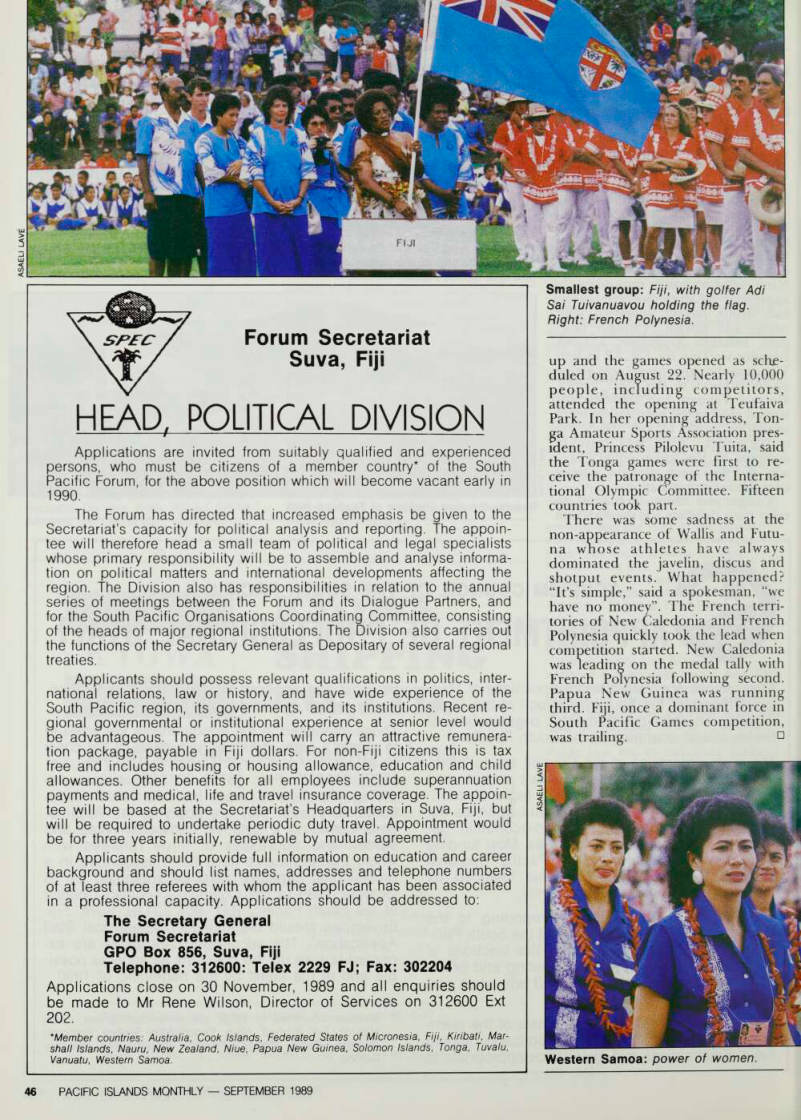
Sports
Vanuatu’s got ’93
VANUATU’S landslide victorv in taking the 1993 Mini Soutn Pacific Games home to Port Vila is likely to result in the staging of the biggest mini games on record.
In its submission at the South Pacific Games Council meeting in Nuku’alofa last month, Vanuatu said it was prepared to host 14 sports.
Nine sports were immediately approved; athletics, soccer, basket ball, tennis, boxing, volleyball, golf, netbal and squash. Vanuatu dele fate, Fanaura Kingstone, a Cook slander working for ESCAP in Port Vila, said the government was giving all its support to the 1993 games.
He said Vanuatu had facilities now to host the games, but improvement would be made to suit newer re
quirements. This was quickly
accepted by the games council as a sort of a guarantee after the worries
over Tonga’s preparation.
Tonga just about managed to
meet their deadline for the 3rd Mini
Games in Nuku’alofa. While grass was growing, there were bold patch es. But the facilities the stadium at Teufaiva Park and the indoor gymnasium at Atele were ready For use. Tonga almost lost the games early this year because they got behind preparing the facilities.
Last November games president Lysis Lavigne arrived in Nuku’alofa to inspect the facilities. He found none. And the games were less than a year away.
After some tough decisions and hard work, Tonga managed to catch
Asaeli Lave
Applause: King Taufa’ahau Tupou and Queen Mata’aho at the opening of the 3rd mini South Pacific Games.
Asaeli Lave
Ready: the new stadium at Teufaiva Park.
up and the games opened as sche duled on August 22. Nearly 10,000
people, including competitors,
attended the opening at Teufaiva Park. In her opening address, Ton ga Amateur Sports Association pres ident, Princess Pilolevu Tuita, said the Tonga games were first to re ceive the patronage of the Interna tional Olympic Committee. Fifteen countries took part.
There was some sadness at the non-appearance of Wallis and Futu na whose athletes have always dominated the javelin, discus and
shotput events. What happened?
“It’s simple,” said a spokesman, “we have no money”. The French terri tories of New Caledonia and French Polynesia quickly took the lead when competition started. New Caledonia was leading on the medal tally with
French Polynesia following second.
Papua New Guinea was running third. Fiji, once a dominant force in South Pacific Games competition, was trailing. D
Smallest group: Fiji, with golfer Adi Sai Tuivanuavou holding the flag.
Right: French Polynesia.
Western Samoa: power of women.
Asaeli Lave
Advertisements & other items, pp. 45-46 (1 item)
Appointment Of Professional Staff
TOURISM COUNCIL OF THE SOUTH PACIFIC
Applications are invited for four positions of Tourism Officers of the Tourism Council of the South Pacific, an inter-governmental organisation of twelve island countries of the South Pacific.
The main objectives of the Council are to promote, coordinate, plan and implement projects and activities designed to strengthen regional cooperation in tourism development and optimise the contribution of tourism to socio-economic development of the member countries. Most funding is currently provided by the Pacific Regional Tourism Development Programme financed by the European Economic Community.
The Tourism Officers will be reporting to the Director of the Tourism Council of the South Pacific and will be responsible for the functions of planning and development, marketing and promotion, research and statistics, and education and training respectively.
The posts are restricted to nationals of the member countries* of the TCSP. Applicants should have qualifications and experience appropriate to the post and a record of achievement in tourism in the region at middle and senior level.
Those interested in the appointments are advised to obtain a copy of further particulars of the posts available from the Secretariat (Phone: [679] 315277; Fax: [679] 301995) before applying. Applicants must indicate which funcor post(s) they are applying for. Applications including a detailed curriculum vitae and names and addresses of three referees with whom the applicants have been associated in a professional capacity, must be submitted by 15 October 1989 to the Chairman, Tourism Council of the South Pacific, P.O. Box 13119, Suva, Fiji.
Envelopes should be marked "Professional Staff Application”. The successful candidates are expected to take up the positions as soon as possible and at the latest by the beginning of 1990. * Member countries of TCSP are American Samoa, Cook Islands, Fiji, Kiribati, Niue, Papua New Guinea, Solomon Islands, Tahiti, Tonga, Tuvalu, Vanuatu and Western Samoa.
Forum Secretariat
Suva, Fiji
HEAD. POLITICAL DIVISION
Applications are invited from suitably qualified and experienced persons, who must be citizens of a member country* of the South Pacific Forum, for the above position which will become vacant early in 1990.
The Forum has directed that increased emphasis be given to the Secretariat’s capacity for political analysis and reporting. The appointee will therefore head a small team of political and legal specialists whose primary responsibility will be to assemble and analyse information on political matters and international developments affecting the region. The Division also has responsibilities in relation to the annual series of meetings between the Forum and its Dialogue Partners, and for the South Pacific Organisations Coordinating Committee, consisting of the heads of major regional institutions. The Division also carries out the functions of the Secretary General as Depositary of several regional treaties.
Applicants should possess relevant qualifications in politics, international relations, law or history, and have wide experience of the South Pacific region, its governments, and its institutions. Recent regional governmental or institutional experience at senior level would be advantageous. The appointment will carry an attractive remuneration package, payable in Fiji dollars. For non-Fiji citizens this is tax free and includes housing or housing allowance, education and child allowances. Other benefits for all employees include superannuation payments and medical, life and travel insurance coverage. The appointee will be based at the Secretariat’s Fleadquarters in Suva, Fiji, but will be required to undertake periodic duty travel. Appointment would be for three years initially, renewable by mutual agreement.
Applicants should provide full information on education and career background and should list names, addresses and telephone numbers of at least three referees with whom the applicant has been associated in a professional capacity. Applications should be addressed to: The Secretary General Forum Secretariat GPO Box 856, Suva, Fiji Telephone: 312600: Telex 2229 FJ; Fax: 302204 Applications close on 30 November, 1989 and all enquiries should be made to Mr Rene Wilson, Director of Services on 312600 Ext 202. *Member countries: Australia, Cook Islands, Federated States of Micronesia, Fiji, Kiribati, Marshall Islands, Nauru, New Zealand, Niue, Papua New Guinea, Solomon Islands, Tonga, Tuvalu, Vanuatu, Western Samoa.
Pieces of
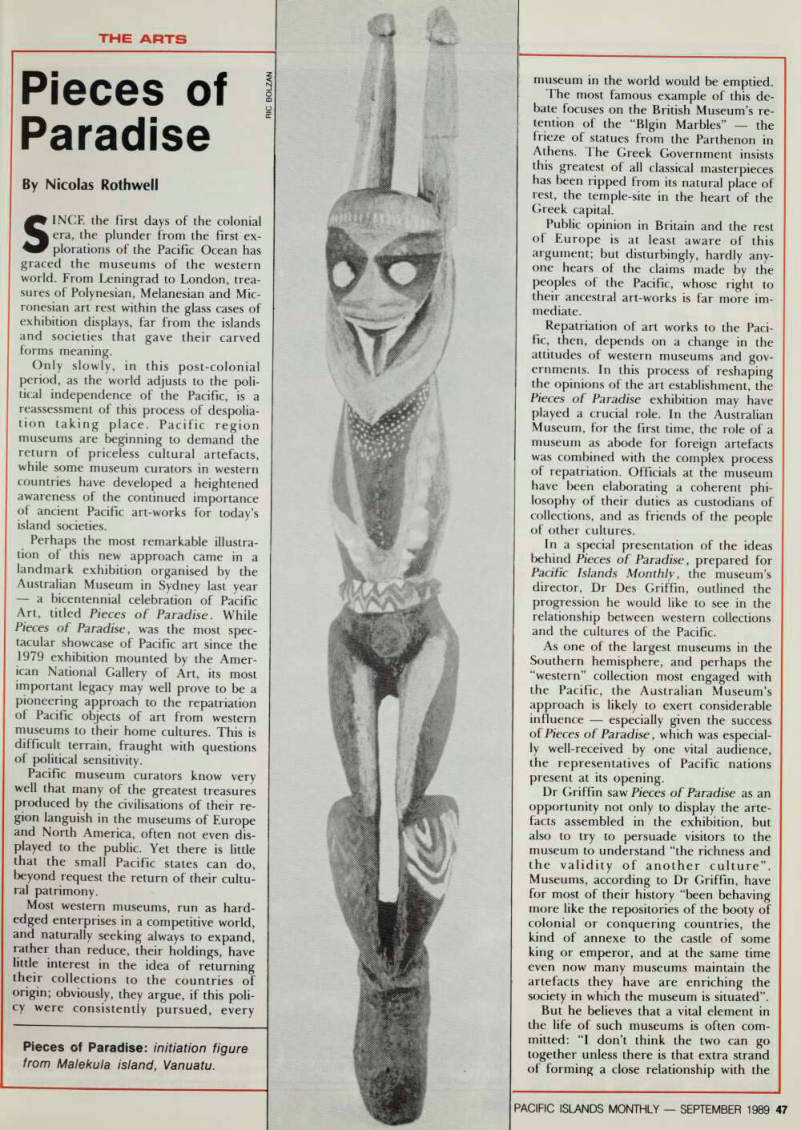
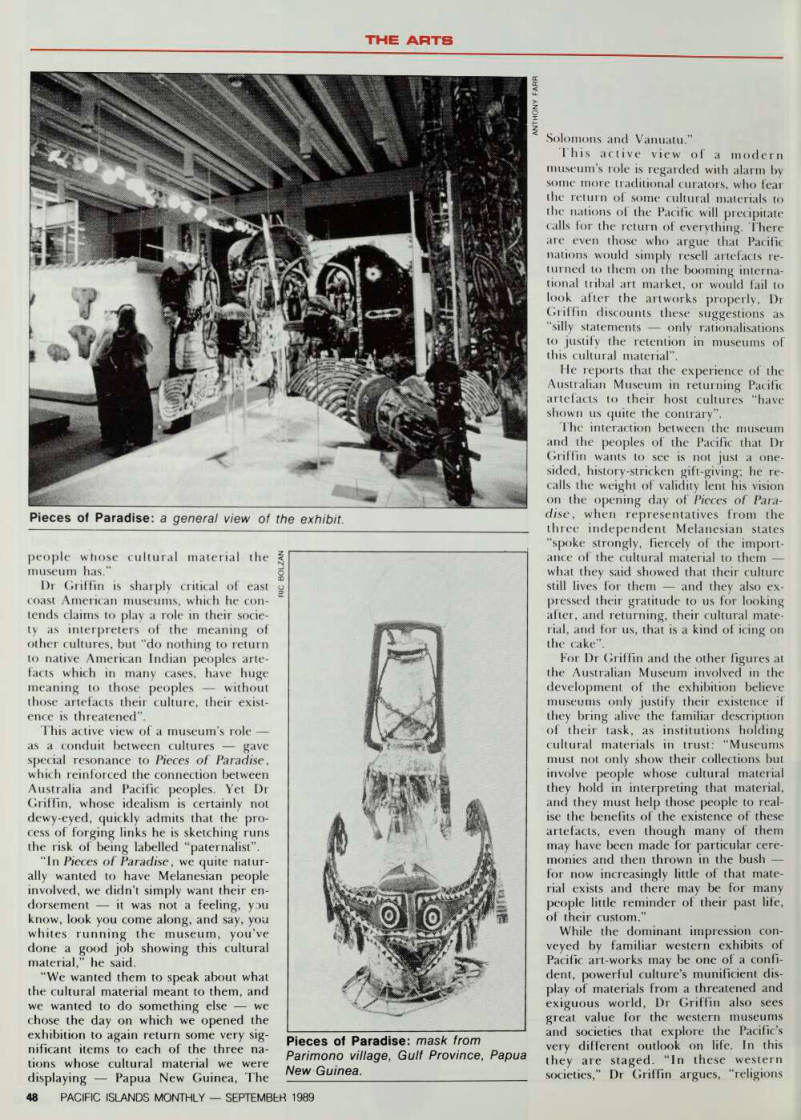
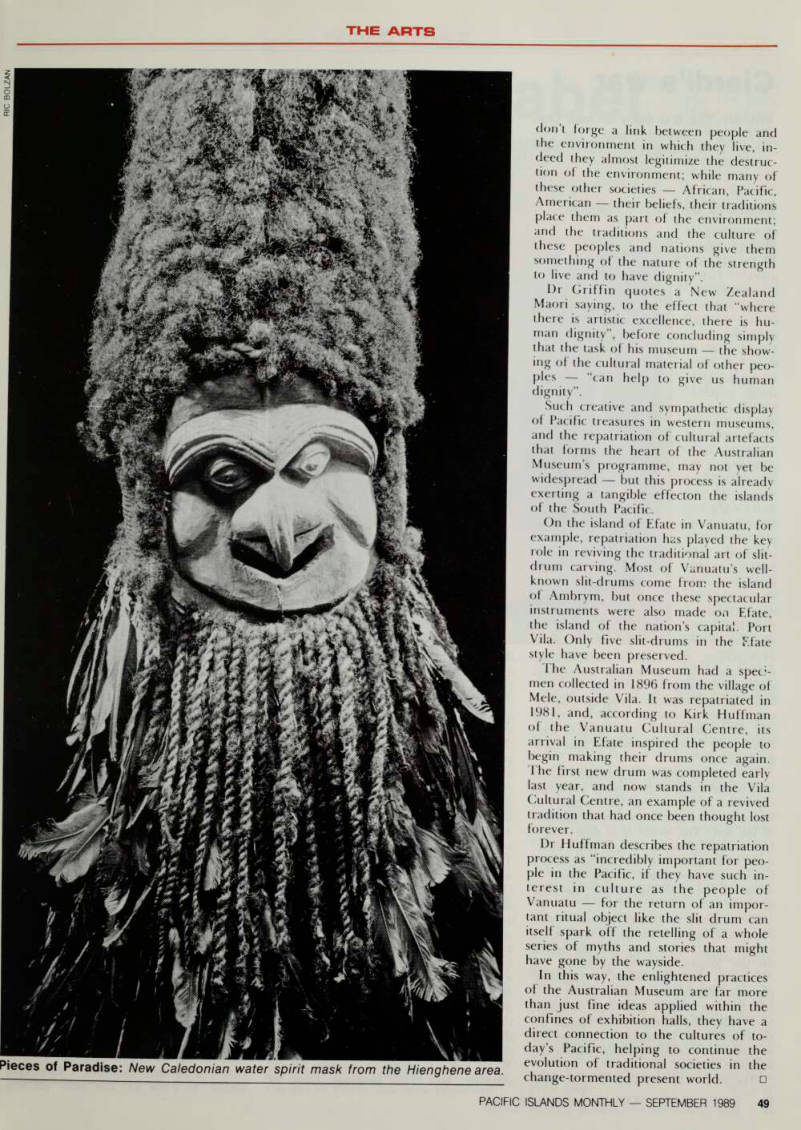
The Arts
Pieces of Paradise
By Nicolas Rothwell
SINCE the first days of the colonial era, the plunder from the first ex plorations of the Pacific Ocean has graced the museums of the western world. From Leningrad to London, trea sures of Polynesian, Melanesian and Mic ronesian art rest within the glass cases of exhibition displays, far from the islands and societies that gave their carved forms meaning.
Only slowly, in this post-colonial period, as the world adjusts to the poli tical independence of the Pacific, is a reassessment of this process of despolia
tion taking place. Pacific region
museums are beginning to demand the return of priceless cultural artefacts, while some museum curators in western countries have developed a heightened awareness of the continued importance of ancient Pacific art-works for today’s island societies.
Perhaps the most remarkable illustra tion of this new approach came in a landmark exhibition organised by the Australian Museum in Sydney last year a bicentennial celebration of Pacific Art, titled Pieces of Paradise. While Pieces of Paradise, was the most spec tacular showcase of Pacific art since the 1979 exhibition mounted by the Amer ican National Gallery of Art, its most important legacy may well prove to be a pioneering approach to the repatriation of Pacific objects of art from western museums to their home cultures. This is difficult terrain, fraught with questions
of political sensitivity.
Pacific museum curators know very well that many of the greatest treasures produced by the civilisations of their re gion languish in the museums of Europe and North America, often not even dis played to the public. Yet there is little that the small Pacific states can do, beyond request the return of their cultu
ral patrimony.
Most western museums, run as hard edged enterprises in a competitive world,
and naturally seeking always to expand,
rather than reduce, their holdings, have little interest in the idea of returning their collections to the countries of origin; obviously, they argue, if this poli cy were consistently pursued, every
museum in the world would be emptied.
The most famous example of this de bate focuses on the British Museum’s re tention of the “Elgin Marbles” the frieze of statues from the Parthenon in Athens. The Greek Government insists this greatest of all classical masterpieces has been ripped from its natural place of rest, the temple-site in the heart of the
Greek capital.
Public opinion in Britain and the rest of Europe is at least aware of this argument; but disturbingly, hardly any one hears of the claims made by the peoples of the Pacific, whose right to their ancestral art-works is far more im mediate.
Repatriation of art works to the Paci fic, then, depends on a change in the attitudes of western museums and gov ernments. In this process of reshaping the opinions of the art establishment, the Pieces of Paradise exhibition may have played a crucial role. In the Australian Museum, for the first time, the role of a museum as abode for foreign artefacts was combined with the complex process of repatriation. Officials at the museum have been elaborating a coherent phi losophy of their duties as custodians of collections, and as friends of the people of other cultures.
In a special presentation of the ideas behind Pieces of Paradise, prepared for Pacific Islands Monthly, the museum’s director, Dr Des Griffin, outlined the progression he would like to see in the relationship between western collections and the cultures of the Pacific.
As one of the largest museums in the Southern hemisphere, and perhaps the “western” collection most engaged with the Pacific, the Australian Museum’s approach is likely to exert considerable influence especially given the success of Pieces of Paradise, which was especial ly well-received by one vital audience, the representatives of Pacific nations present at its opening.
Dr Griffin saw Pieces of Paradise as an opportunity not only to display the arte facts assembled in the exhibition, but also to try to persuade visitors to the museum to understand “the richness and the validity of another culture”.
Museums, according to Dr Griffin, have for most of their history “been behaving more like the repositories of the booty of colonial or conquering countries, the kind of annexe to the castle of some king or emperor, and at the same time even now many museums maintain the artefacts they have are enriching the society in which the museum is situated”.
But he believes that a vital element in the life of such museums is often com mitted: “I don’t think the two can go together unless there is that extra strand of forming a close relationship with the
Pieces of Paradise: initiation figure from Malekula island, Vanuatu.
Ric Bolzan
people whose cultural material the museum has.”
Dr Griffin is sharply critical of east coast American museums, which he con tends claims to play a role in their socie ty as interpreters of the meaning of other cultures, but “do nothing to return to native American Indian peoples arte facts which in many cases, have huge meaning to those peoples without those artefacts their culture, their exist ence is threatened”.
This active view of a museum’s role as a conduit between cultures gave special resonance to Pieces of Paradise, which reinforced the connection between Australia and Pacific peoples. Yet Dr Griffin, whose idealism is certainly not dewy-eyed, quickly admits that the pro cess of forging links he is sketching runs the risk of being labelled “paternalist”.
“In Pieces of Paradise, we quite natur ally wanted to have Melanesian people involved, we didn’t simply want their en dorsement it was not a feeling, you know, look you come along, and say, you whites running the museum, you’ve done a good job showing this cultural material,” he said.
“We wanted them to speak about what the cultural material meant to them, and we wanted to do something else we chose the day on which we opened the exhibition to again return some very sig nificant items to each of the three na tions whose cultural material we were displaying Papua New Guinea, The
Solomons and Vanuatu.”
This active view of a modern museum’s role is regarded with alarm by some more traditional curators, who fear the return of some cultural materials to the nations of the Pacific will precipitate calls for the return of everything. There are even those who argue that Pacific nations would simply resell artefacts re turned to them on the booming interna tional tribal art market, or would fail to look after the artworks properly, Dr Griffin discounts these suggestions as
“silly statements only rationalisations
to justify the retention in museums of this cultural material”.
He reports that the experience of the Australian Museum in returning Pacific artefacts to their host cultures “have shown us quite the contrary”.
The interaction between the museum and the peoples of the Pacific that Dr Griffin wants to see is not just a one sided, history-stricken gift-giving; he re calls the weight of validity lent his vision on the opening day of Pieces of Para dise, when representatives from the three independent Melanesian states
“spoke strongly, fiercely of the import
ance of the cultural material to them what they said showed that their culture still lives for them and they also ex pressed their gratitude to us for looking after, and returning, their cultural mate rial, and for us, that is a kind of icing on the cake”.
For Dr Griffin and the other figures at the Australian Museum involved in the development of the exhibition believe museums only justify their existence if
they bring alive the familiar description
of their task, as institutions holding cultural materials in trust; “Museums must not only show their collections but involve people whose cultural material they hold in interpreting that material, and they must help those people to real ise the benefits of the existence of these artefacts, even though many of them may have been made for particular cere monies and then thrown in the bush for now increasingly little of that mate rial exists and there may be for many people little reminder of their past life, of their custom.”
While the dominant impression con veyed by familiar western exhibits of Pacific art-works may be one of a confi dent, powerful culture’s munificient dis play of materials from a threatened and exiguous world, Dr Griffin also sees great value for the western museums and societies that explore the Pacific’s very different outlook on life. In this they are staged. “In these western societies,” Dr Griffin argues, “religions
Pieces of Paradise: a general view of the exhibit.
Ric Bolzan
Anthony Farr
Pieces of Paradise: mask from Parimono village, Gulf Province, Papua New Guinea.
don t forge a link between people and the environment in which they live, in deed they almost legitimize the destruc tion of the environment; while many of these other societies African, Pacific, American their beliefs, their traditions place them as part of the environment; and the traditions and the culture of these peoples and nations give them something of the nature of the strength to live and to have dignity”.
Dr Griffin quotes a New Zealand Maori saying, to the effect that “where there is artistic excellence, there is hu
man dignity”, before concluding simply
that the task of his museum the show ing of the cultural material of other peo- Pj es “can help to give us human
dignity”.
Such creative and sympathetic display of Pacific treasures in western museums, and the repatriation of cultural artefacts that forms the heart of the Australian Museum’s programme, may not yet be widespread but this process is already exerting a tangible effecton the islands of the South Pacific.
On the island of Efate in Vanuatu, for example, repatriation has played the key role in reviving the traditional art of slit drum carving. Most of Vanuatu’s well known slit-drums come from the island of Ambrym, but once these spectacular instruments were also made on Efate, the island of the nation’s capital. Port Vila. Only five slit-drums in the Efate style have been preserved.
The Australian Museum had a speci men collected in 1896 from the village of Mele, outside Vila. It was repatriated in 1981, and, according to Kirk Huffman of the Vanuatu Cultural Centre, its arrival in Efate inspired the people to begin making their drums once again.
The first new drum was completed early last year, and now stands in the Vila Cultural Centre, an example of a revived tradition that had once been thought lost forever.
Dr Huffman describes the repatriation process as “incredibly important for peo ple in the Pacific, if they have such in terest in culture as the people of Vanuatu for the return of an impor tant ritual object like the slit drum can itself spark off the retelling of a whole series of myths and stories that might have gone by the wayside.
In this way, the enlightened practices of the Australian Museum are far more than just fine ideas applied within the confines of exhibition halls, they have a direct connection to the cultures of to day’s Pacific, helping to continue the evolution of traditional societies in the change-tormented present world. □
Ric Bolzan
Pieces of Paradise: New Caledonian water spirit mask from the Hienghene area.
Harvey Helfand
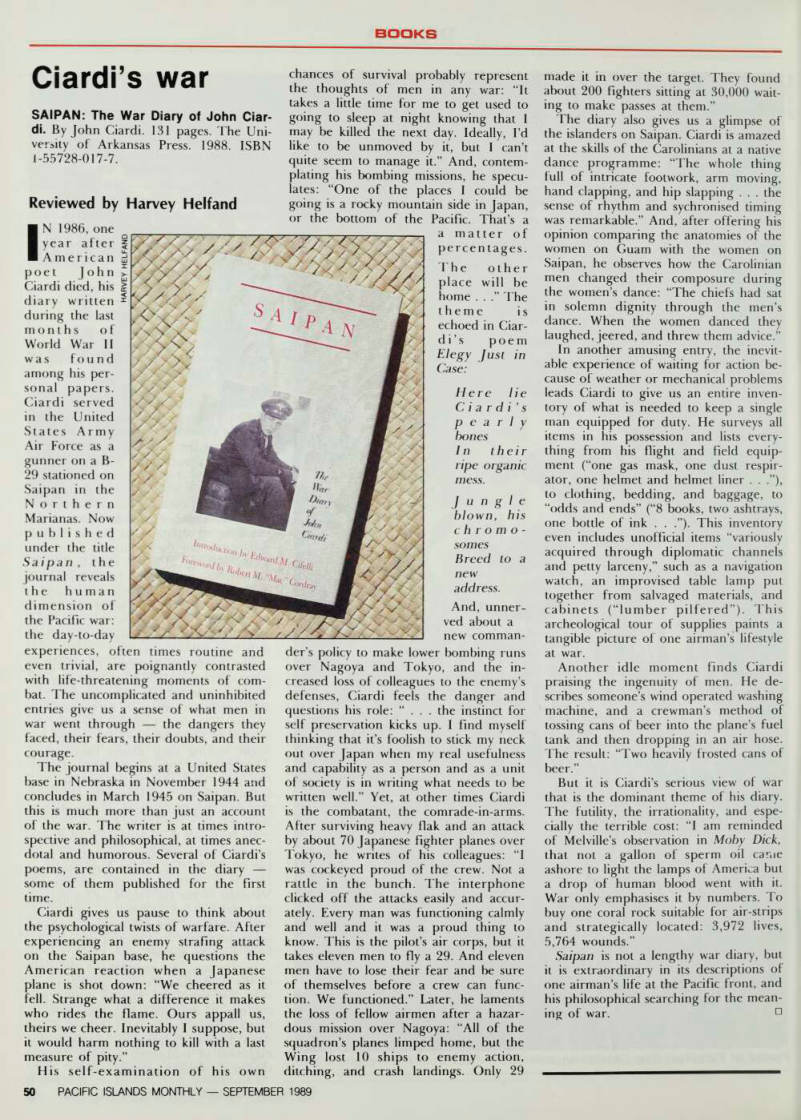
Books
Ciardi’s war
SAIPAN: The War Diary of John Ciar di. By John Ciardi. 131 pages. The Uni versity of Arkansas Press. 1988. ISBN 1-55728-017-7.
Reviewed by Harvey Helfand
IN 1986, one year after American poet John Ciardi died, his
diary written
during the last months of World War II was found among his per sonal papers.
Ciardi served in the United States Army Air Force as a gunner on a B -29 stationed on Saipan in the Northern Marianas. Now published under the title Saipan , the
journal reveals
the human dimension of the Pacific war: the day-to-day
experiences, often times routine and even trivial, are poignantly contrasted with life-threatening moments of com bat. The uncomplicated and uninhibited entries give us a sense of what men in
war went through the dangers they
faced, their fears, their doubts, and their courage.
The journal begins at a United States base in Nebraska in November 1944 and concludes in March 1945 on Saipan. But this is much more than just an account of the war. The writer is at times intro spective and philosophical, at times anec dotal and humorous. Several of Ciardi’s poems, are contained in the diary some of them published for the first time.
Ciardi gives us pause to think about the psychological twists of warfare. After experiencing an enemy strafing attack on the Saipan base, he questions the American reaction when a Japanese plane is shot down: “We cheered as it fell. Strange what a difference it makes who rides the flame. Ours appall us, theirs we cheer. Inevitably I suppose, but it would harm nothing to kill with a last measure of pity.”
His self-examination of his own
chances of survival probably represent the thoughts of men in any war: “It takes a little time for me to get used to going to sleep at night knowing that I may be killed the next day. Ideally, I’d like to be unmoved by it, but I can’t quite seem to manage it.” And, contem plating his bombing missions, he specu lates: “One of the places I could be going is a rocky mountain side in Japan, or the bottom of the Pacific. That’s a
a matter of percentages.
The other place will be home . . .” The theme is echoed in Ciar di’s poem Elegy Just in Case: Here lie Ciardi’s
pearly
bones In their
ripe organic
mess.
Jungle
blown, his chro m o somes Breed to a new address.
And, unner ved about a new comman
dec’s policy to make lower bombing runs over Nagoya and Tokyo, and the in creased loss of colleagues to the enemy’s defenses, Ciardi feels the danger and questions his role: “ . . . the instinct for self preservation kicks up. I find myself thinking that it’s foolish to stick my neck out over Japan when my real usefulness and capability as a person and as a unit of society is in writing what needs to be written well.” Yet, at other times Ciardi is the combatant, the comrade-in-arms.
After surviving heavy flak and an attack by about 70 Japanese fighter planes over Tokyo, he writes of his colleagues: “I was cockeyed proud of the crew. Not a rattle in the bunch. The interphone clicked off the attacks easily and accur
ately. Every man was functioning calmly
and well and it was a proud thing to know. This is the pilot’s air corps, but it takes eleven men to fly a 29. And eleven men have to lose their fear and be sure of themselves before a crew can func tion. We functioned.” Later, he laments the loss of fellow airmen after a hazar dous mission over Nagoya: “All of the
squadron’s planes limped home, but the
Wing lost 10 ships to enemy action, ditching, and crash landings. Only 29
made it in over the target. They found about 200 fighters sitting at 30,000 wait ing to make passes at them.”
The diary also gives us a glimpse of the islanders on Saipan. Ciardi is amazed at the skills of the Carolinians at a native dance programme: “The whole thing full of intricate footwork, arm moving, hand clapping, and hip slapping ... the
sense of rhythm and sychronised timing
was remarkable.” And, after offering his opinion comparing the anatomies of the women on Guam with the women on Saipan, he observes how the Carolinian men changed their composure during the women’s dance: “The chiefs had sat in solemn dignity through the men’s dance. When the women danced they laughed, jeered, and threw them advice.”
In another amusing entry, the inevit able experience of waiting for action be cause of weather or mechanical problems leads Ciardi to give us an entire inven tory of what is needed to keep a single man equipped for duty. He surveys all items in his possession and lists every thing from his flight and field equip ment (“one gas mask, one dust respir ator, one helmet and helmet liner . . .”),
to clothing, bedding, and baggage, to
“odds and ends” (“8 books, two ashtrays, one bottle of ink . . .”). This inventory even includes unofficial items “variously
acquired through diplomatic channels
and petty larceny,” such as a navigation watch, an improvised table lamp put together from salvaged materials, and cabinets (“lumber pilfered”). This
archeological tour of supplies paints a
tangible picture of one airman’s lifestyle
at war.
Another idle moment finds Ciardi praising the ingenuity of men. He de scribes someone’s wind operated washing machine, and a crewman’s method of tossing cans of beer into the plane’s fuel tank and then dropping in an air hose.
The result: “Two heavily frosted cans of beer.”
But it is Ciardi’s serious view of war that is the dominant theme of his diary.
The futility, the irrationality, and espe cially the terrible cost: “I am reminded of Melville’s observation in Moby Dick, that not a gallon of sperm oil came ashore to light the lamps of America but a drop of human blood went with it.
War only emphasises it by numbers. To buy one coral rock suitable for air-strips and strategically located: 3,972 lives, 5,764 wounds.”
Saipan is not a lengthy war diary, but it is extraordinary in its descriptions of one airman’s life at the Pacific front, and his philosophical searching for the mean ing of war. D
Harvey Helfand
The songs of Mabel
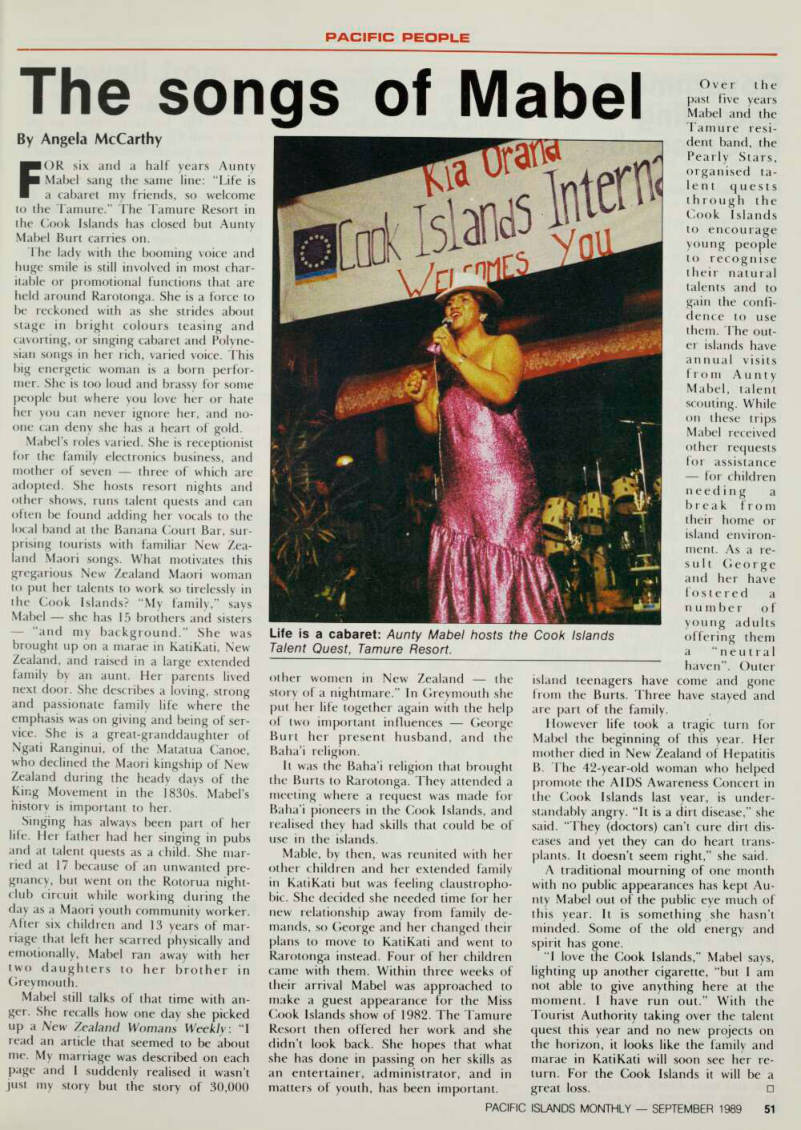
Pacific People
By Angela McCarthy
FOR six and a half years Aunty Mabel sang the same line: “Life is a cabaret my friends, so welcome to the Tamure.” The Tamure Resort in the Cook Islands has closed but Aunty Mabel Burt carries on.
The lady with the booming voice and huge smile is still involved in most char itable or promotional functions that are held around Rarotonga. She is a force to be reckoned with as she strides about stage in bright colours teasing and
cavorting, or singing cabaret and Polyne
sian songs in her rich, varied voice. This big energetic woman is a born perfor mer. She is too loud and brassy for some people but where you love her or hate her you can never ignore her, and no one can deny she has a heart of gold.
Mabel’s roles varied. She is receptionist for the family electronics business, and mother of seven three of which are adopted. She hosts resort nights and other shows, runs talent quests and can often be found adding her vocals to the local band at the Banana Court Bar, sur prising tourists with familiar New Zea land Maori songs. What motivates this gregarious New Zealand Maori woman to put her talents to work so tirelessly in the Cook Islands? “My family,” says Mabel she has 15 brothers and sisters “and my background.” She was brought up on a marae in Kati Kati, New Zealand, and raised in a large extended family by an aunt. Her parents lived next door. She describes a loving, strong and passionate family life where the emphasis was on giving and being of ser vice. She is a great-granddaughter of Ngati Ranginui, of the Matatua Canoe, who declined the Maori kingship of New Zealand during the heady days of the King Movement in the 1830 s. Mabel’s history is important to her.
Singing has always been part of her life. Her father had her singing in pubs and at talent quests as a child. She mar ried at 17 because of an unwanted pre gnancy, but went on the Rotorua night club circuit while working during the day as a Maori youth community worker.
After six children and 13 years of mar riage that left her scarred physically and emotionally, Mabel ran away with her two daughters to her brother in
Greymouth.
Mabel still talks of that time with an ger. She recalls how one day she picked up a New Zealand Womans Weekly : “I read an article that seemed to be about me. My marriage was described on each page and I suddenly realised it wasn’t just my story but the story of 30,000
other women in New Zealand the story of a nightmare.” In Creymouth she put her life together again with the help of two important influences George Burt her present husband, and the
Baha’i religion.
It was the Baha’i religion that brought the Burts to Rarotonga. They attended a meeting where a request was made for Baha’i pioneers in the Cook Islands, and realised they had skills that could be of use in the islands.
Mable, by then, was reunited with her other children and her extended family in Kati Kati but was feeling claustrophobic. She decided she needed time for her new relationship away from family demands, so George and her changed their plans to move to Kati Kati and went to Rarotonga instead. Four of her children came with them. Within three weeks of their arrival Mabel was approached to make a guest appearance for the Miss Cook Islands show of 1982. The Tamure Resort then offered her work and she didn’t look back. She hopes that what she has done in passing on her skills as an entertainer, administrator, and in matters of youth, has been important.
Over the past five years Mabel and the Tamure resi dent band, the Pearly Stars, organised ta lent quests
through the
Cook Islands to encourage young people to recognise their natural talents and to gain the confi dence to use them. The out er islands have annual visits
from Aunty
Mabel, talent
scouting. While
on these trips Mabel received other requests for assistance — for children
needing a
break from their home or island environ ment. As a re sult George and her have fostered a number of young adults
offering them
a “neutral haven”. Outer
island teenagers have come and gone from the Burts. Three have stayed and are part of the family, However life took a tragic turn for Mabel the beginning of this year. Her mother died in New Zealand of Hepatitis B. The 42-year-old woman who helped promote the AIDS Awareness Concert in the Cook Islands last year, is under standably angry. “It is a dirt disease,” she said. “They (doctors) can’t cure dirt dis eases and yet they can do heart trans plants. It doesn’t seem right,” she said, A traditional mourning of one month with no public appearances has kept Au nty Mabel out of the public eye much of this year. It is something she hasn’t minded. Some of the old energy and spirit has gone.
“I love the Cook Islands,” Mabel says, lighting up another cigarette, “but I am not able to give anything here at the moment. I have run out.” With the Tourist Authority taking over the talent quest this year and no new projects on the horizon, it looks like the family and marae in Kati Kati will soon see her re turn. For the Cook Islands it will be a great loss. □
Life is a cabaret: Aunty Mabel hosts the Cook Islands Talent Quest, Tamure Resort.
according
Government according to Crocombe
By David Robie
PACIFIC Islands governments should look at overhauling their political and administra tive systems and adapt them according to their own needs, believes one of the re
gion’s leading academics. The people of
the Pacific needn’t be overwhelmed by the wholesale adoption of foreign mod els. “There is an urgent need for an effective, flexible linkage between the government and the young and creative sectors of the population,” says Ron Cro combe. “Alas, not much of the scope for creative adaption has been grasped as yet.”
Crocombe, honoured as the University of the South Pacific’s first professor emeritus on his retirement to the Cook Islands, argues in his revised book The South PaciTic: An Introduction for a move away from the rapid post-colonial growth of relatively inefficient bureauc racies.
Independent Pacific nations are “con strained by a lack of confidence a hangover from colonial patterns by the new dependency on foreign govern ments and foreign experts” who come mainly from nations which were pre viously the colonial powers. As one cynic notes, the metropolitan colonial offices are as powerful as ever but are now named Ministries of Foreign Affairs!
While noting the relatively low propor tion of the population last year who were civil servants in the Solomon Islands (1.5 per cent) and Vanuatu (1.7 per cent), and even Kiribati (3.1 per cent) which just tops the “developing country” aver age of 3 per cent, he points the finger at several other countries. The Cook Is lands, for example, has a higher propor tion than the official figure of 11 per cent and Niue is even higher.
“Other problems include nepotism and political favouritism,” says Crocombe.
“The small total populations are made effectively much smaller by the concen tration of higher education, power and
privilege and/or professional back
ground.” He stresses that the great majority of people in positions of power - and of the young elite at the Pacific universities are sons and daughters of a small minority in the previous genera tion who were either ministers of reli
gion, civil servants, people of hereditary
privilege, or involved in business.
Crocombe cites examples of corrup tion and cases where national resources
have been usurped for the personal be nefit of those in power. He is critical of the financial impropriety involving “a disturbing number of leaders in politics and the bureaucracy, but police action at that level is rare”. Papua New Guinea’s former Foreign Minister Ted Diro was shown by a commission of inquiry last year to have accepted large sums of money from General Benny Murdani, then commander of the Indonesian armed forces, and to have negotiated a treaty of friendship between his country and Indonesia which was more favour able to Jakarta than Port Moresby.
The commission passed on evidence of $9 million being diverted for personal gain to the police, but no charges were filed.
In Vanuatu last year, independent au ditors targeted Barak Sope, leader of the ill-fated constitutional coup against the leadership of Prime Minister Father Wal ter Lini. Sope was responsible for the Vila Urban Land Corporation (VUL CAN). The auditors found VULCAN collapsed because of misuse of funds, mostly for operation costs and salaries.
Sope also negotiated the purchase of
large quantities of arms and ammunition from abroad. The arms and ammunition were never bought.
In the Cook Islands and Tonga there have been scandals about civil servants drawing travel and other allowances far higher than their salaries and the actual costs. “There are several countries in the Pacific where this is now a problem of massive proportions relative to the size of the national economy,” Crocombe says. He singles out Fiji, Papua New Guinea, Tonga and Western Samoa as being hit by this problem more than other countries.
This fifth edition of a book, regarded at many universities and institutions as a sort of “bible” of the region, has been published by the University of the South Pacific in association with the University of Canterbury. The author carried out his extensive revision while he was at Canterbury’s Centre for Pacific Studies.
Although an extra 33 pages have been
MR unseated
PAPUA New Guinea’s former Defence Minister, James Pokasul, lost his seat in Parliament following a successful election petition. The court has nullified his elec tion in 1987 for the Manua Open consti tuency, citing bribery and undue influ ence as the reasons.
In his ruling, Justice Hinschiliffe said Pokasui gave out war pension cheques during the election campaign to win votes.
added, Crocombe deals with the Fiji coups in less than three pages and the Vanuatu crisis in half a page.
About Fiji, he says: “Most people familiar with Fiji realised that the indige nous Fijian people would not tolerate a government dominated by the interests of the Indian community and that harmonious survival depended on a Fi jian majority in power.” Commentators have blamed the coup on a class strug gle, the chiefs, South African mercenar ies, the CIA and various other factors, “but in my view the key issue was ethnic ity, a factor which Marxist interpreta tions in particular have great difficulty in
understanding”.
With the population delicately ba lanced between Indians and Fijians, Cro combe foresees a difficult task ahead. He points out that at a similar population balance between the immigrant English and indigenous Maori people in New Zealand the race wars began. “This is precluded in Fiji by the Fijian monopoly over coercive forces,” he says. “The welding of these two very different cul tures, plus European, Chinese and other minorities into a unified nation, will be a major task for another generation at least.”
The only benefit for Fiji’s neighbours
from the coup is that its dominance in Pacific regional affairs has been curbed.
Crocombe also sees ethnicity as a signi ficant factor in Vanuatu’s problems, with most people of the capital island of Efate
supporting Barak Sope and the opposi
tion. Land rights is also a factor. “Per sonal ambition for power and material resources,” he says, “is more clearly evi dent here than in most Pacific political contests.”
In Tonga, Crocombe warns that the climate of world opinion is “no longer sympathetic” to such a kingdom with its
heriditary elite and expanding
bureaucracy. “But the aristocracy and its associated non-aristocratic elite,” he adds, “is unlikely to reshape society voluntarily, either far enough or fast enough to meet the mounting desire for
change.” □
Melanesian union
THE president of Vanuatu’s National Democratic Party, John Naupa, has suc cessfully sought a merger with the Melanesian Progressive Party. Melane sian Progressive Party is led by former Immigration Minister Barak Sope.
Naupa and Sope were both members of a rival government set up by former President George Sokomanu last De cember.
Farewell from
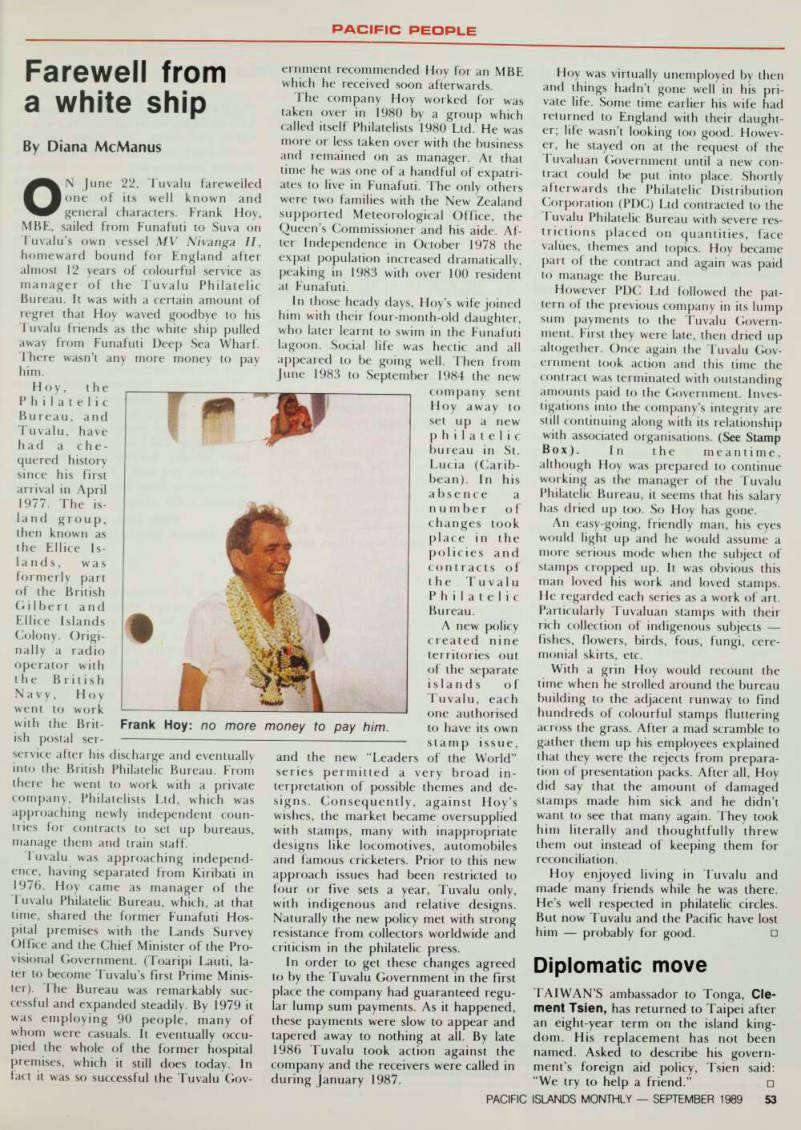
a white ship
By Diana McManus
ON June 22, Tuvalu fareweiled one of its well known and general characters. Frank Hoy, MBE, sailed from Funafuti to Suva on Tuvalu’s own vessel MV Nivanga //, homeward bound for England after almost 12 years of colourful service as manager of the Tuvalu Philatelic Bureau. It was with a certain amount of regret that Hoy waved goodbye to his Tuvalu friends as the white ship pulled away from Funafuti Deep Sea Wharf.
There wasn’t any more money to pay him.
Hoy, the Philatelic Bureau, and Tuvalu, have had a che
quered history
since his first arrival in April 1977. The is land group, then known as the Ellice Is lands, was
formerly part
of the British Gilbert and Ellice Islands
Colony. Origi
nally a radio operator with the British Na vy, Hoy went to work with the Brit ish postal ser
service after his discharge and eventually into the British Philatelic Bureau. From there he went to work with a private company, Philatelists Ltd, which was
approaching newly independent coun-
tries for contracts to set up bureaus, manage them and train staff.
I uvalu was approaching independence, having separated from Kiribati in 1976. Hoy came as manager of the I uvalu Philatelic Bureau, which, at that time, shared the former Funafuti Hospital premises with the Lands Survey Of fice and the Chief Minister of the Provisional Government. (Toaripi Lauti, later to become Tuvalu’s first Prime Minister). Ihe Bureau was remarkably suecessful and expanded steadily. By 1979 it was employing 90 people, many of whom were casuals. It eventually occupied the whole of the former hospital premises, which it still does today. In fact it was so successful the Tuvalu Gov-
ernment recommended Hoy for an MBE which he received soon afterwards.
The company Hoy worked for was taken over in 1980 by a group which called itself Philatelists 1980 Ltd. He was more or less taken over with the business and remained on as manager. At that time he was one of a handful of expatri ates to live in Funafuti. The only others were two families with the New Zealand supported Meteorological Office, the Queen’s Commissioner and his aide. Af ter Independence in October 1978 the
expat population increased dramatically,
peaking in 1983 with over 100 resident at Funafuti.
In those heady days, Hoy’s wife joined him with their four-month-old daughter, who later learnt to swim in the Funafuti lagoon. Social life was hectic and all appeared to be going well. Then from June 1983 to September 1984 the new
company sent Hoy away to set up a new philatelic bureau in St.
Lucia (Carib bean). In his absence a number of
changes took
place in the policies and contracts of the Tuvalu Philatelic Bureau.
A new policy created nine territories out of the separate islands of Tuvalu, each one authorised to have its own stamp issue,
and the new “Leaders of the World” series permitted a very broad in terpretation of possible themes and de
signs. Consequently, against Hoy’s
wishes, the market became oversupplied with stamps, many with inappropriate designs like locomotives, automobiles and famous cricketers. Prior to this new approach issues had been restricted to four or five sets a year, Tuvalu only, with indigenous and relative designs.
Naturally the new policy met with strong resistance from collectors worldwide and criticism in the philatelic press.
In order to get these changes agreed to by the Tuvalu Government in the first place the company had guaranteed regu lar lump sum payments. As it happened, these payments were slow to appear and tapered away to nothing at all. By late 1986 Tuvalu took action against the company and the receivers were called in during January 1987.
Hoy was virtually unemployed by then
and things hadn’t gone well in his pri vate life. Some time earlier his wife had returned to England with their daught er; life wasn’t looking too good. Howev er, he stayed on at the request of the Tuvaluan Government until a new con tract could be put into place. Shortly afterwards the Philatelic Distribution Corporation (PDC) Ltd contracted to the I uvalu Philatelic Bureau with severe res trictions placed on quantities, face values, themes and topics. Hoy became part of the contract and again was paid to manage the Bureau.
However PDC Ltd followed the pat tern of the previous company in its lump sum payments to the Tuvalu Govern ment. First they were late, then dried up altogether. Once again the Tuvalu Gov ernment took action and this time the contract was terminated with outstanding amounts paid to the Government. Inves tigations into the company’s integrity are
still continuing along with its relationship
with associated organisations. (See Stamp Box). In the meantime,
although Hoy was prepared to continue
working as the manager of the Tuvalu Philatelic Bureau, it seems that his salary has dried up too. So Hoy has gone.
An easy-going, friendly man, his eyes would light up and he would assume a more serious mode when the subject of stamps cropped up. It was obvious this man loved his work and loved stamps.
He regarded each series as a work of art.
Particularly Tuvaluan stamps with their rich collection of indigenous subjects fishes, flowers, birds, fous, fungi, cere monial skirts, etc.
With a grin Hoy would recount the time when he strolled around the bureau building to the adjacent runway to find hundreds of colourful stamps fluttering across the grass. After a mad scramble to gather them up his employees explained that they were the rejects from prepara tion of presentation packs. After all, Hoy did say that the amount of damaged stamps made him sick and he didn’t want to see that many again. They took him literally and thoughtfully threw them out instead of keeping them for reconciliation.
Hoy enjoyed living in Tuvalu and made many friends while he was there.
He’s well respected in philatelic circles.
But now Tuvalu and the Pacific have lost him probably for good. □
Diplomatic move
TAIWAN’S ambassador to Tonga, Cle ment Tslen, has returned to Taipei after an eight-year term on the island king dom. His replacement has not been named. Asked to describe his govern ment’s foreign aid policy, Tsien said: “We try to help a friend.” □
Frank Hoy: no more money to pay him.
Reports from the papers. Compiled by John Carter.
The Islands Press
MEDICAL statistics reveal that Papua New Guinea experiences more than 1000 new cancer cases each year. And the trend, according to the PNG Cancer Relief Society, may continue to rise, if preventive measures were not taken at an earlier stage.
The types of cancer already diagnosed in the country which were on the in crease, had all been attributed to the ex cessive drinking of alcohol, smoking and
chewing betelnut.
From the Papua New Guinea Post-Courier, Port Moresby AFTER a couple of weeks of several in cidences of violence and some very se rious strained relationships between stu dents (and some supporters) of Tupou College (Toloa) and Liahona High School, the two schools seems to have reached a peace accord.
Things came to a head when students of Toloa and Liahona attacked each other at Tupou High School after a vol leyball game. The fight resulted in a couple of students being rushed to hos
pital due to injuries.
From the Times of Tonga, Nukualofa POLICE yesterday arrested 10 people as part of a crackdown on beer drinking in
public places.
“We have been warning people for a long time, but they do not seem to take
these warnings seriously,” police spokes
man ASP Romanu Tikotikoca said.
“We are now beginning to crack down on the culprits.” So far all the arrests have been made in Suva.
From the Fiji Times, Suva THE idyllic islands of Micronesia are some of the final frontiers for Australian tourists.
Fewer than 500 Australians visited the region last year, but the introduction of
direct flights (Continental Airlines) three times a week from Sydney and Brisbane to Guam has sparked interest in the re gion on which hoteliers and resort oper ators are keen to cash in.
One of the biggest problems facing
tourism in Guam and the other islands of the region is that many Australians have no idea where Micronesia is.
From the Fiji Times, Suva PNG’S population is predicted to hit the 9 million mark in only 45 years if effec
tive family planning is ignored.
This prediction is by the Health De partment which also warns that this un controlled high growth could lead to drastic social" and economic problems.
But the department suggests that while the population increase is inevit able, an effective control program now would limit the growth to only 7 million in 40 years.
More startling is the fact that more than 40 per cent of the present popula tion is children under the age of 15 years, whose dependency hinges on the wellbeing of the adult population.
From the Papua New Guinea Post-Courier, Port Moresby SPECTACULAR bush clad mountains,
rugged natural beauty & villages and
tribesman uninfluenced by 20th century life; the Morobe Highlands has it all! . . .
The most unique of the many attractions can be viewed at Angibena, Aseki & Oiwa. Mummified bodies, preserved by the traditional method of “smoking” are a spectacular sight in itself. These once ferocious Tribesmen are set to rest on platforms, sheltered from the elements under overhanging rocks. There is no where else in PNG where Tourists have access to visit similar sacred cities.
From The Reporter, Papua New Guinea University of Technology
“EARTHMOVERS logging operation
has ruined the water on the other side of Olive, our village. The mangroves and reefs don’t have shellfish and other marine products any more before it was a rich area. The government doesn’t
supervise the logging operation enough
Earthmovers (plus Pacific Timbers and KTC) dump gallons of old engine oil into the ground of rivers, which causes terrible pollution. Red ground only remains after the logs have been taken. People cannot use that land after wards for gardening as it is infertile.
Loya cane and bush material for house building has disappeared. And the money paid to people who are not the rightful landowners has never been used for the community.”
This moving testimony from Gilbert
Murray, acting village organiser of Olive,
Roviana lagoon, Western Province, is echoed by many people in this area who are fighting hard to stop Earthmovers from moving further into their land.
They have just won a court case to stop the company from logging Dora Island,
opposite Olive village.
From Link, publication of the Solomon Islands Development Trust, Honiara DO you live anywhere near the corner of Fly/Mumeng? Have you found any
dog bowls in your garden recently?
Some of our local canine population are definitely rascals. We have lost at least 5 bowls from our balcony since March.
Some are only ice-cream cartons but two are more substantial plastic bowls. We cannot consume enough ice-cream to keep up so we’d appreciate having the bowls returned if you find them.
Steve & Ann Bedding From The Reporter, Papua New Guinea University of Technology
Advertisements & other items, pp. 54-56 (1 item)
Dhl It!
FOR SALE
EX-AUSTRALIAN GOVERNMENT
Ex Australian Government Bulldozers Cranes Tractors Post Hole Borers Forklifts Loaders Loaders backhoes Elevating Platforms Trenchers Road Graders Road Rollers Garbage Compactors Street Sweepers Excavators 4x4 x 6x6 Heavy Duty Trucks Generators Compressors Prime Movers etc.
'Low Kim Low Hr Units
COUSINS TRUCK & MACHINERY SALES
P.O. BOX 191 ARCHERFIELD
BRISBANE OLD 4108
PHONE (07) 277 1822
FAX (07) 274 1389
DHL IT!
DHL has years of experience carefully packing and shipping Fiji's outstanding works of art directly to your home doorstep.
I w V: Our reputation has been built on caring lor your valuables. Don't tdre chances, phone us we're here to (dp.
BAGOT
BELLFOUNDRIES
Supplying tuned
bronze bells in Australia and Pacific Islands since 1977 Postal Address: Box 421, North Adelaide, SA 5006, Australia Telephone: (08) 267 1306 Office: 147 Ward St, North Adelaide, SA Workshop: 346 Carrington St, Adelaide, SA
It may sound like were spinning tales, but Clarion Car Stereos turn simple sound into beautiful music, even in the less than perfect environment of a moving automobile. And each of Clarions diverse models offers advanced electronic features that are easy to use and a golden promise of reliability. But if you think this sounds like a fairy tale, hear it for yourself. One listen and you'll drive happily ever after.
clarion
SOUNDS SPUN OF GOLD
CD CARTRIDGE
TUNH'/GOMPACI DILC PLAYER
CDC7OOO
i rr rf
j i •VOI / baL OFADEH CHAR MHOG
[ I OUIJ
1
Tl JUI H UN
u man
I u u.u
ON UCH
HAND ••T.MODI
m •.VNiMti.t/m minim WBITAL ‘ • • • • 1 I 3 14 S B
wmjm
FD FF RPI RON
V A For further information Australia: Amalgamated Wireless (Australasia) Ltd., 112-118, Talavera Road, North Ryde NS W 2113, / New Zealand: AWA New Zealand Limited, P.O Box 50-248, Ponrua / Fiji Islands: Brijlal &Co Ltd GPO Box 362 Suva Tahiti: HI FI., VAIRAATOA Avenue Chef Vairaatoa B P 1128, Papeete / New Caledonia: Caldis, B.PMI, Noumea Cedex / Guam: Micropac Audio Inc , PO. Box 3478, Agana, Guam 96910, US A Tel: 472-8091, Cable Code: HIFI AGANA / Vanuatu: The Sound Centre, PO. Box 434, Vila I Cook Islands: South Seas International Ltd., P.O, Box 49, Rarotonga / Papua New Guinea; Hagemeyer (PN G.) Pty Ltd., PO Box 1428, Boroko, Port Moresby
Looking for a Hard ffimespj
MITSUBISHI
Ji c/y/^/vv AA * * « J :-vv The Mitsubish! Galanl, Ist Group N, 4th Overall in the 1989 Acropolis Rally. Round 6 ol the WRC Finding the ideal conditions in which to put your theories to the test can sometimes take you a little out of your way. As in the case of testing the advanced technology incorporated in the Mitsubishi Galant.
They entered the Galant in some of the most grueling rounds of the World Rally Championship looking for those conditions.
So, from the rocky trails of the Acropolis Rally to the high-speed tracks of the Finnish 1000 Lakes Rally, the Mitsubishi Galant’s organic performance is being put to the test.
Mitsubishi Motors regards all motor sports events as the ultimate proving ground for their automotive technology. And where better to test the embodiment of organic performance, Dynamic-4? Four comprehensive drive systems: 4-wheel drive, 4-wheel steering, 4-wheel independent suspension and 4-wheel anti-lock braking are melded into a single, thinking performance.
An organic performance.
This approach —testing the worth of their technology under the rigors of competition maintains Mitsubishi s finely honed competitive and innovative edge.
And the test results become another part in Mitsubishi’s ever evolving production philosophy —the organic performance.
MITSUBISHI GRLRNT
A Ml
AMERICAN~sTMOATMORRis~SCANLAf7 SERVICE FV^ate'sa^ 1
275-7223/FIJI: NIVIS MOTOR & MACHINERY CO. LTD. G P O Bo:*150. pa J t Noumea Tel 274144/NEW ZEALAND: MITSUBISHI MOTORS NEW 2 LAND L harvest PACIFIC LTD Gi