Mara stays
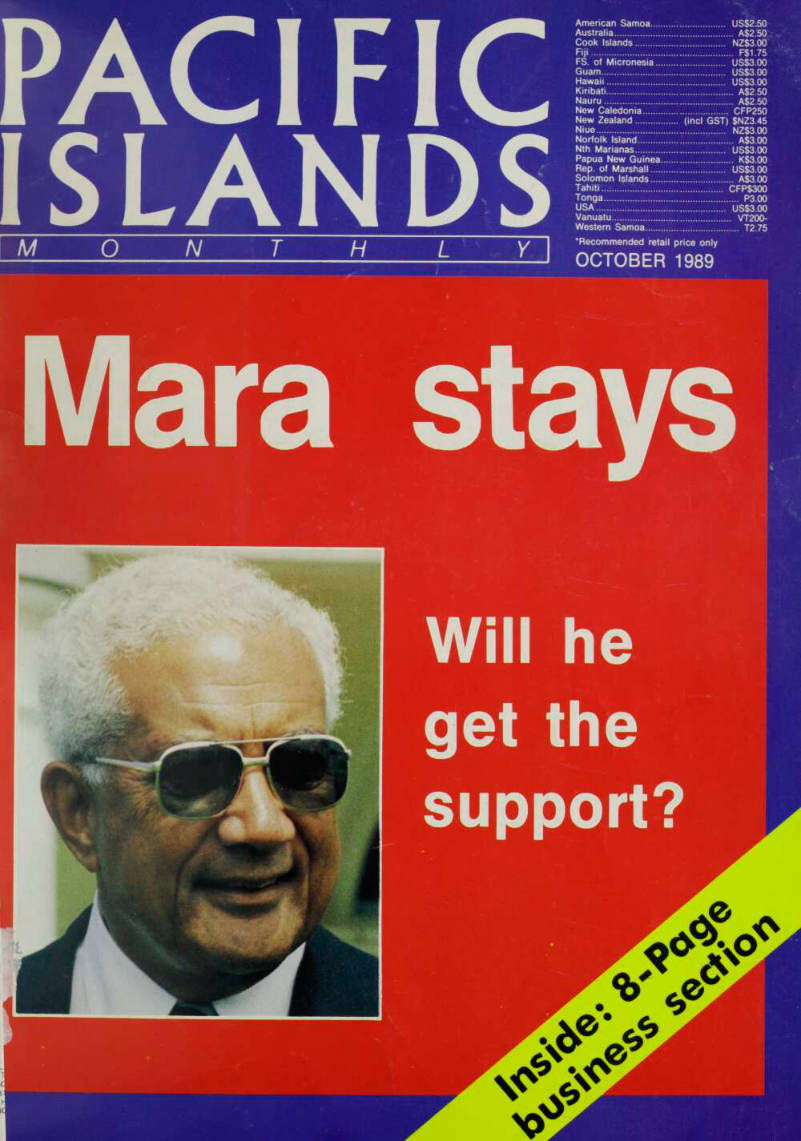



Pacific
Islands
American Samoa US$2.5O Australia A 52.50 Cook Islands NZ$3.OO Fiji F 51.75 FS. of Micronesia US$3.OO Guam US$3.OO Hawaii US$3.OO Kiribati A 52.50 Nauru A 52.50 New Caledonia CFP2SO New Zealand (incl GST) $NZ3.45 Niue NZ$3.OO Norfolk Island A 53.00 Nth Marianas US$3.OO Papua New Guinea K 53.00 Rep. of Marshall US$3.OO Solomon Islands A 53.00 Tahiti... CFPS3OO Tonga P 3.00
Usa Us$3.Oo
Vanuatu VT2OO - Samoa T 2.75 'Recommended retail price only
October 1989
Mara stays
Will he get the support?
Cover photo: Mara, by Pradeep Maharaj, Ministry of Information, Suva.
Advertisements & other items, pp. 2-4 (1 item)
HONDA. Progress Distinction.
Honda maintains
control when things
begin to slip.
Our ALB Anti-Lock Braking system automatically
pumps the brakes to help keep your grip on the road.
A sudden change in road conditions can challenge the skills of even the most professional driver. The situation often requires a split-second decision on how to apply the brakes.
Honda is always concerned about driver and rider alike.
So we created an ALB Anti-Lock Braking system that pumps the brakes for you.
Guided by computer. ALB helps prevent wheel lock-ups. especially when braking in wet weather.
ALB is just one of the many technologies we’ve developed to help you maintain control when it’s needed most.
Because when you can feel confident, then so can we.
iHONDA
ionda engines also powered the Honda Marlboro McLaren team to win the 1988 ormula One Constructors' Championship. This follows consecutive victories f the Williams Honda team in 1986 and 1987. c h A r °D , R °d D Tu jL a c m n me Vic,or ' a 3043/ NEW ZEALAND: Honda New Zealand Ltd. P 0 Box 97-340, South Auckland/PAPUA NEW GUINEA: Toba Pty., Ltd. P O Box evplnnmpnt f ono 3 f ARL B P 1 665, Pa P ee,e/ KIRIBATI; Atoll Motor & Marino Services P 0 Box 49, Bairiki Tarawa, Republic of Kiribati/U.S. TRUST TERRITORY- United Micronesia SoS C °° k lslands Motor Centre Ltd. P O. Box 74, Rarotonga/GUAM: Mark’s Motor Co., Inc, P O Boll W SAMOA 2052 Suva Fm/AMERICAN SAMOA- Holiriav Mntor^p o^o^ LANDS j Ku6n & C °" Ltd ' P 0 Box 537 ' H o niar a / NAURU; Nauru Cooperation Republic of Nauru/FIJI: Coral Island Motors Ltd. P O Box t w n ,L SAM OA Holiday Motors, Parts and Service P 0 Box 968, Pago Pago, American Samoa 96799 Heleck's Service Center Ltd P 0 Box 1138 Paco r - 3nga Industrial Traders P O Box 1035, Nukualofa. Tonga/NORFOLK ISLAND: Duncombe Bay Garage P 0 Box 220. Norfolk Island South Par if* PRsq/vaNiiATii- MnnH. L, i I tri on Dav mot o^ri
The
fastest
way
there
IS
here
A r Canada and Europe by Canadian. The fastest and most direct way out of Fiji.
Canadian Airlines has been here in Fiji looking after passengers for 40 years. And there’s no doubt that we’ll be here for many more years to come.
II VV V II Uv I Iw I v/ i V-/ • iii w* ' ' j
Canadian
Canadian Airlines International l
Cawdd\>r\
lilMlimii 40
VKS
WkSOHAPObOH 81854
Pacific
Islands
Monthly
Vol 59 No. 21
Voice Of The Pacific
October 1989
Cover
THE two-year term of Fiji’s interim government ends on December 5. In a not-so-surprising turn of events, post-coup PM Ratu Sir Kamisese Mara decides to stay on after striking a deal with military strongman Major-General Sitiveni Rabuka. Starts Page 10.
The Region
Defence A look at the frigate venture by New Zealand and Australia and its impact in the region. Page 16 Palau An auditor’s report shows how Palau is doing everything wrong and heading into heavy debt. Page 18 Nauru I he tall of Hammer Deßoburt, for the third time, does not seem to have shaken the people of this rich nation so much now. Page 20 French Polynesia I he visit of French Prime Minister Michel Rocard shows how closer is French Polynesia from the Cook Islands. Page 21 Cook Islands Finally Geoffrey Henry is getting the Australian patrol boat only after making sure he can afford it. Page 24 Hawaii Legal loopholes are stopping indigenous Hawaiians from getting land.
Page 15 Papua New Guinea It was not the happiest anniversary that Rabbie Namaliu helped to celebrate as his country ended 14 years of independence. Page 23
Business
A special mining survey shows that while Bougainville continues to worry big in vestors, there are good signs in other prospecting work in the region.
Editor Jale Moala Editorial Adviser John Carter Contributors Al Prince, Belinda Meares, Carrie Loranger, David North, David Robie, Diana McManus, Dykes Angiki, Ed Rampell, Frank Senge, Jope Balawanilotu, Karen Man gnall, Nicholas Rothwell, Paul Moon, Richard Dinnen.
Business Report Robin Bromby
Publisher Geoffrey Hussey
Advertising Manager
Lionel Heffernan
Business Manager
Charlotte Thomas
(subscriptions/enquiries)
Advertising Sales • Fiji; Peter Prasad. Tel (679) 314111 • Sydney & Melbourne: Fergus Maclagan, Tel (02) 4123918 • Brisbane: Robert Walker. Tel (07) 3710533 • Adelaide: Hastwell Williamson Representations, Tel (08) 799522 Our editorial office is now located at 20 Gordon Street, Suva, Fiji. (PO Box 1167 Suva). All edito rial material and correspondence should be sent there and not to our old Sydney address.
Cover prices are recommended retail only Registered by Australia Post, publication No.
NBP 1210. Copyright. Fiji Times Limited, Suva, Fiji.
Advertisements & other items, p. 5 (2 items)
Departments
LETTERS 6
STAMPS 8
OPINION 9
BOOKS 47
PACIFIC PEOPLE 51
ISLANDS PRESS 54
5
PACIFIC ISLANDS MONTHLY OCTOBER 1989
A Fiji Times Limited Production.
Founded 1930 (USPS 952480). 20 Gordon Street, Suva, Fiji. Telex FJ2124, Tel (679) 3141 11, Fax (679) 302011.
Pacific Islands Monthly (APPS No.
NBP 1210) is published monthly by Fiji Times Limited, a division of Nationwide News, 2 Holt St, Surry Hills, NSW 2010. Second class post age paid to Honolulu, Hawaii, POST
MASTER.
Send address changes to. Pacific Islands Monthly, PO Box 2250, Hon olulu, Hawaii 96822. Typeset and Printed by Fiji Times Limited, 20 Gor don Street, Suva, Fiji.
Japan
Tropica Lit Ibs
Letters
Japan and Fiji
WE Japanese find it very important that we should be more inter nationalised. The Japanese gov ernment is campaigning that more than 10 million Japanese should travel over seas for the purpose of internationalisa tion. What is “internationalisation” for the Japanese? When I look at most of the Japanese coming to Fiji, interna tionalisation seems to be spending money overseas or investing money over seas.
Since Air Pacific began its Tokyo ser vice, the tourism industry in Fiji has em ployed coordinators specialised in deal ing with Japanese tourists. Japanese tourists take it for granted that they should be served in the Japanese lan guage and in the Japanese way. It means that the Japanese tourist does not want to l>e adjusted to the country where they travel to and that they expect the people of that country to be adjusted to them because they have the money. In this sense, internationalisation could be de fined as Japanising the country by eco nomic power. In Fiji, a huge Japanese multi-million dollar resort project has been causing trouble to the residents of the area.
I’ve been living in Fiji for nearly two years, and I have a lot of lovely friends. 1 love the people and the nature of Fiji.
That’s why I don’t want to see this beautiful country and the life of the peo ple destroyed by the economic power of the Japanese. 1 know how much the en vironment of Japan had been destroyed and so many innocent people killed by the heavy pollution caused by the pro cess of rapid economic growth in the 19605. I don’t want to see the same tragedy in Fiji. I want the people of Fiji to study not only the success story of Japan but also the failure story.
Fiji is neither for tourists nor foreign investors. Fiji is for the people of Fiji who have created their own unique cul ture, language and custom. I have to admit that in this world, to improve the standard of people’s life, economic growth is essential. However, if Fiji makes a wrong choice and emphasises economic growth and neglects the pre servation of the environment and tradi tional lifestyle, than Fiji will be ruined, and controlled by foreigners in the fu ture.
Fiji is for the people of Fiji; Fight to protect this beautiful country.
Shigetoshi Takagi
japan Overseas Cooperation Volunteers, Town and Country Planning, Suva
Pearls
“PEARLS in Peril” (PIM June 1989) challenged the honesty of Mr Toma, the MP for Manihiki by reporting that he “maintains that the Island Council has a 30 per cent share in the Com pany, but a search of the company re cords in Rarotonga indicates that Yves Tchen Pan holds 95 per cent of the company.” The register of shareholders is kept at the Registered Office of the Company in Rarotonga, and this shows a transfer of one third of the capital of the Company by Yves Tchen Pan to the Manihiki Island Council in September 1988. On the $1.5 million invested by Yves Tchen Pan “from which locals de rived ancillary benefits”, those ancillary benefits totalled in excess of $600,000 spent in Manihiki in eight months, which is quite substantial for a total population of 600 men, women and children.
The most interesting omission is the article fails to mention the Marine Re sources programme was linked to a joint venture with an Australian entrep reneur, who the Island Council did not want operating in Manihiki for very good reasons. The offensive part of the article are the racial undertones in the portrayal of the Manihiki Island Coun cil as just a bunch of natives, who don’t know what they are doing.
The black pearl industry in Manihiki is one of the few success stories in the Pacific.
R W Tylor
Company Secretary Cook Islands Pearls Ltd Rarotonga
Robie
I’M not quite certain when I began read ing Pacific Islands Monthly. It must be more than 15 years ago. Those who chronicle the lives of peoples and coun tries in your vast area, become reliable, informative friends. One comes to watch for the bylines with anticipation.
Of these friends your pages offer readers, I can think of none finer than David Robie. Because I long ago served my time as a newspaperman and as a foreign correspondent to a weekly Mex ican newsmagazine, perhaps I may be allowed to pronounce Robie a journalist’s journalist. He is balanced, thorough and courageous, and he writes extraordinari ly well.
Galal Kernahan
Newport Beach California
Paradise
My wife and children lived with me O, this was many years ago Beside a sunny tropic sea In scenes my boys will never know.
Between the reefs along the shore We swam, or waded through a gap.
The ocean was our only store Our island home, Elugelap.
A ship came to our land one day.
A white man in a navy cap Persuaded us to go away And so we left Elugelap.
And now there is no trace of land, Nor coral reef beyond the foam.
There are no palms, no hills of sand; The seas have covered up our home.
Now, sharks and flying-fish abound Where once we set our lobster trap, And there remains no fishing ground Where once there was Elugelap.
No-one can calculate our loss.
You will not find it on the map.
There is a hole, a mile across Where once there was Elugelap.
Ralph A Lewin
California,
Usa
Penpal
I READ with great interest the request from a young man in Paplia New Guinea for a pen pal in your October 1988 issue. I, too, would like to issue a similar request to the readers of your fine magazine. Incidentally, I had read your magazine when I was a high school student in Hawaii back in the 19605, and only recently rediscovered it through a pen pal in Australia who was kind enough to send me copies of it.
I am a 41-year-old housewife, mother of four, still interested in corresponding with people all over the world, especially in the Pacific Islands. I have numerous hobbies and am particularly interested in writing to other women near my age, but will answer all the letters I receive from people of any age. Can your readers help me?
Thank you for maintaining the excel lent level of quality of your magazine through the years and I look forward to hearing from some of your readers.
(Mrs) Virginia C Mccaffey
11107 Rhode Island Avenue South, Bloomington, Minnesota 55438,
Usa.
cargo cult
Letters
Tanna and cargo cult
THE article Waiting for the skies to open (PIM March 1989) failed to discuss the possible causes and roots for the rise of the John Frum cargo cult on the is land Tanna in Vanuatu. Frumism was and still is a result of several forces at work. • Traditional mythology and cosmic vi sion The island of Tanna has an active vol cano. The volcano became part of the fear centred around ancestral gods and the creation of myths. These secular values and beliefs controlled and ritual ised yearly events. The arrival of the Europeans was seen by the local people as a disaster which needed an explana tion. But while attempts were made to explain the arrival of the “white people” during the war, the locals were never able to understand their presence. • Racist colonial attitudes The oppression and suppression of
the people was challenged during the
war. They saw for the first time there were a lot of different races. The Amer ican troops were friendlier than the early colonial rulers. While ideas to challenge the former rulers was creeping into the minds of the people, the return of the former rulers after the war was not accepted in certain areas of the country.
For instance, in New Guinea, the people of the Rai Coast saw the Japanese as liberators from the one time exploita tive Germans and the Australians, who fled when the Japanese arrived. The people were left there to die. Why then should those who fled be allowed to come back after the war? The result of this was in many cases the rise of the so called cargo cults. I do not adhere to this word any more, as it is out of date.
Colonialism and the destruction of the traditional practices in Melanesia is the result of the work of the missionaries in converting the people to a new religion.
The missionaries were the agents of the colonial rulers. They were the first to
“pacify the people”. They, however, did
not realise that they were venturing into areas that already had their own religion and beliefs.
For many of the islanders the new reli gion was very similar in a lot of respect.
Holy Communion, for instance, was the same as a ritualised “cannibal rite” of the past for traditional gods; the second coming of Christ was the same as waiting for the ancestors to return. (I am not implying this to be the exact meaning, but I am trying to translate the message of these Christian religious rituals into native language and make a comparison
to traditional religious ritual). The Ten Commandments were the same as “social sanctions” provided within the tradition al order. In the case of Melanesians, if one breaks the rules dies or re venge was taken. Thus, to avoid it one had to adhere to the social sanctions.
Then questions had to be asked: why was the Christian god giving the white men a lot of goods and cargo? Why was
the missionary preaching about living
together in harmony with the people
while they lived in better houses away from the village? Why were the fore
igners fighting each other when they
told Melanesians not to fight each other?
Why were the traditional gods not giving the people what the Europeans had?
With such questions, a lot of the people joined Christianity in order to have European wealth and learn the Euro pean religious secrets.
But Christianity did not answer some of the questions, resulting in a return to ancestral gods and in some cases a mix of the old and new beliefs.
The final question is what were the alternatives for the people of Tanna? To simply see it as people waiting for Frum to come back is a myth. Scholars should by now have given both the positive and the negative sides of these movements.
John Frum is traditionally (Kastom) in spired and political. Followers will make amendments and adjust to suit the changing situations in Vanuatu. These changes will be for the betterment of the people. Waiting for the skies to open is never the aim of the movement.
Sam T. Kaima
University of Hawaii, Manoa
New Caledonia
YOUR article On not going bananas in the Pacific (PIM February 1989) brought memories of olden days when I visited New Caledonia. Journalists who reported the news on New Caledonia are not French nationals. They are strangers.
They do not know about this country by gathering information from people who are not up-to-date with the situation in
the territory.
It is unfair to compare the fate of the French ex-colonies, notably in Africa, with other former colonies like New Zea land, Canada, Australia and United States. You imply that France had left behind only hatred and humiliation while referring to Africa. I disagree with you if you compare the present situation of francophone Africa. French record is still the best.
In New Caledonia, I would agree that for a long time France is still looking inward. The real chance has taken place after the two elections, and the territory will expand its relations with all Pacific
nations.
The French government is trying to remedy this situation by implementing an elaborate plan of political, economic and social development. The majority of the ethnic population still prefer France to run the country to allow the popula tion in 10 or 20 years to decide their own future.
Your article says that the French are lousy colonisers. I disagree completely. I think that other nations will soon realise how important are the French in the South Pacific.
The death of Messrs Tjibaou and Yeiwene left New Caledonia in good terms politically. Several thousand peo ple converged and paid their respects.
Annick Kikimimi
Tomo Village , New Caledonia.
Sources
UNDER Vanuatu pioner sought (PIM March 1989) you published an appeal
for information regarding Captain
Ronald (or Donald?) McLeod. I have written to Mr Jenkins personally, sug gesting sources of information, but his letters had reminded me that many peo ple researching their Pacific Island con nections may not know of the Cumula tive Index to Pacific Islands Monthly . . . 1935-1945 (Sydney: Pacific Publications, 1968), its successor, The Cumulative In dex to Pacific Islands Monthly . . . 1945- 1955 (Canberra: Pacific Manuscripts Bureau, 1984) or the “Index to obitur aties in the Pacific Islands Monthly . . . 1945-1955 in The PMB Book of Pacific Indexes (Canberra: Pacific Manuscripts Bureau, 1988).
American Whalers and Traders in the Pacific (Canberra: Pacific Manuscripts Bureau, 1978), The Catholic Church in the Western Pacific: a guide to record on microfilm (Canberra; Pacific Manuscripts Bureau, 1986) and An Index to the Quarterly Jottings from the New Heb rides (Canberra: Pacific Manuscripts Bureau, 1988) while particularly useful for American or missionary connections, also deals with a surprisingly wide range of both notable and ordinary people.
The Bureau’s publications and micro films are accessible in the Bureau’s Mem ber Libraries or may be purchased by non-member libraries and individuals direct from the Bureau. Enquiries are welcome.
Bess Flores
Executive Officer Pacific Manuscripts Bureau , Room 22-1 Block Research School of Pacific Studies Australian National University GPO Box 4 , Canberra, ACT 2601.
Regional
Stamps
Regional effort
A RECENT regional philatelic
marketing workshop at the Forum Secretariat in Suva outlined poli cies regarding sales. One of the Pacific’s prolific issuers, Tuvalu, reported on its bad track record of over-issuing and assured delegates that it was restricting future issues after being led astray by a contracted consortium for the past four years. The Pacific’s other offender in over-issuing, the Cook Islands, did not attend. Others who attended were Mar shall Islands, Solomon Islands, Tonga, Vanuatu, Western Samoa and Fiji. Each bureau was aware of the need for a re
sponsible issuing policy to uphold repu
tation. Even the Solomon Islands, licking its wounds from the America’s Cup fias co, was outspoken on this area. The workshop discussed matters relating to promotion, new markets, stamp designs, printing and exhibitions.
There was concern over: • inefficient communication between issuing bureaux and customers • lack of control over marketing due to policies of agents in the United Kingdom and the United States • recent moves by Australia Post to cut back on its sales outlets, combined with a general lack of promotion of Forum Is land Countries’ stamps in Australia by
this organisation
• costs to Forum Island Countries’ bureaux of current agency arrangements • recent official fraud investigations into activities of some philatelic bodies in the United Kingdom which could adversely affect Pacific marketing arrangements worldwide.
The workshop resolved to co-operate and consult jointly on all aspects of phi latelic stamp production, marketing and publicity, and establish an annual Pacific stamp to be limited to two (stamps per country and to be launched, where possi ble, at the World Stamp Exhibition, New Zealand on August 24, 1990, under the
following principles:
• two values per participating country • a common theme relevant to the Pacific
• common logo on stamps to be copyr ighted for use only by approved coun tries • themes to be planned up to five years in advance • The 1990 Pacific Theme to be Mail Service in the Pacific • design of first-day covers to be co ordinated, and special postmarks to be
designed
• Pacific stamps to be designed and produced in the region • Pacific issues to be jointly marketed by participating countries.
It was also decided to work towards jointly producing a quarterly Pacific stamp bulletin to be co-ordinated and
produced out of Sydney with printing
and production to be subject to competi tive tender, and to meet on an annual basis in conjunction with an appropriate exhibition, to discuss initiatives, strategies and on-going policy.
Unfortunately the delegates at the workshop were not decision-makers from their bureaus and could only make recommendations.
ONE hundred and seven Postal Admi nistrations will be represented at Stamp World London 90, the international stamp exhibition at Alexandra Palace, London from May 3 to May 17. Coun tries from the Pacific region that will be represented are Australia, Fiji, Nauru, Norfolk Island, Papua New Guinea, Pit cairn Islands, Samoa, Solomon Islands and Vanuatu.
New issues Penrhyn July 24 First landing on the moon: 55c, 75c, 95c, $1.25, $1.75. Featuring scenes of the moon landing.
Norfolk Island When Norfolk Island was closed as a penal settlement and the convicts were taken away in 1856, it became the home of the entire population of Pitcairn Is land, who were removed to Norfolk Is land in the vessel Morayshire, arriving on June 8, 1856. Subsequently a few re turned to re-settle Pitcairn Island.
While Pitcairn remained a dependency of Great Britain, Norfolk Island became a territory under the authority of the Commonwealth of Australia. Recognition of need for change in the form of admi nistration of Norfolk Island led in 1975 to a Royal Commission to enquire into the island’s future status and the most appropriate form of administration if its
constitutional position were changed.
This in turn led to the Norfolk Island Act 1979, which established a Legislative
Assembly to replace the Advisory Coun
cil System that had served for so long.
On August 10, 1979 the first Norfolk Island Legislative Assembly held its inau
gural meeting.
To commemorate the successful com pletion of 10 years progress in internal self-government, four postage stamps were issued on September 1. They fea ture the Norfolk Island flag (41tf); a bal lot box that has seen nearly a century of use (55 i)\ the Norfolk Island Act 1979 ($1.00), and the Armorial Ensigns for Norfolk Island ($1.10).
September 1 Aerogramme issue no 6 Parts 1 and 2: 41c and 60c. Mutiny on the Bounty.
September 25 75 Years of Red Cross in Norfolk Island: $1 Red Cross at work.
Aitutaki July 28 20th anniversary of the moon landing; 75c, $1.15 scenes featur ing the moon landing, $l.BO, $6.40 mini ature sheet.
Niue July 20 20th anniversary of the moon landing; $1.50 x 3 featuring scenes of the landing, $1.15 souvenir sheet.
Samoa July 31 birds definitive part 3; $lO Common Fairy Tern, $2O Shy Albatross.
Tuvalu July 31 living reef part 3: 40c Pen nart Coralfish, 50c Aremone Fish, 60c Batfish, 90c Threadfin Coralfish. D
Advertisements & other items, p. 8 (1 item)
8
T RO PICA LIT lES
PACIFIC ISLANDS MONTHLY OCTOBER 1989
Pacific
Islands
Monthly
Opinion
Who’s our man?
IT’S that time of the year again when the phone rings and people ask: who will be the Pacific Man of the Year?
Mara? Ona? Lange? It’s still anyone’s race. The field, however, is getting smaller. In the end it won’t be easy.
It’s hard to pick a winner in a field of favourites.
How do you pick a Pacific Man of the Year? There are no set rules. What wins most credit is news impact. A few names come to mind: Ratu Sir Kamisese Mara, interim prime minister of post coup Fiji, has led his country back from the brink of economic disaster into an envious position in the Pacific Islands. Such a remarkable achievement puts him high up on the list of those still in the race.
Francis Ona will never win a medal in Papua New Guinea. But his rebellion in the jungles of Bougainville has focussed world attention on his country. He might be a fugitive but he has certainly been news most of this year.
Philip Muller, director of the Forum Fisheries Agency, has succeeded in bringing world attention to the use of driftnets in the South Pacific tuna fisheries.
Rabbie Namaliu, as Prime Minister of Papua New Guinea, probably has the most difficult job in the region.
A rebellion, two assassinations, and a shaky economy have brought out the best in him. He is tough.
Not many leaders voluntarily give up power to bring unity to his party. David Lange did as Prime Minister of New Zealand. And in doing so he’s won more friends.
Does it need to be a man? No. We can have a Pacific Woman of the Year. But who? □
Advertisements & other items, p. 9 (1 item)
FIJI: Distribution, subscriptions and advertising: Fiji
Times Limited, GPO Box 1167, Suva, Fiji Phone 31 -4111 telex FJ2124 FRENCH POLYNESIA: Distribution: Hachette Pacifique 10 Ave Bruat, Papeete Phone 25-610 HAWAII: UNITED STATES: Distribution. PIM Hawaii PO Box 22250, Honolulu, Hawaii, 96822 Advertising: Brian C Asgill, Apt 1308, 1676 Ala Moana Blvd Honolulu Hawaii, 96815 Phone (808) 955-9718 JAPAN: Advertising and subscriptions: Universal Media Corporation, GPO Box 46, Tokyo Phone 666-3036 cable UNIMEDIA Tokyo, telex 2524665 MALAYSIA Advertising and subscriptions: Worldwide Media Services, 57-B Komplex Damai, Jin Dato Haji Eusoff, Kuala Lumpur Phone 63-9340, cables WORLDMEDIA Kuala Lumpur, telex 31533 VANUATU: Distribution: The Vanuatu Stationery and Book Centre, PO Box 557 Port Vila Advertising: Norman Bros Bookshop Port Vila Phone 2232 NEW CALEDONIA: Distribution: Depot Centre de Presse Michel Pentecost CBP2, Noumea Phone 27- 2434, 27-4729 NEW ZEALAND: Distribution: Gordon & Gotch, PO Box 584 , 2 Carr Road, Mt Roskill, Auckland 4 Advertising: McKay International Media Reps Ltd, CA Albany, PO Box 8, Auckland 10, New Zealand Phone 419-0561, Fax 419-2243 WELLINGTON: Ross Ouaid Media, 1 Scholes Lane Petone (04) 68-7593, PO Box 38699, Petone PAPUA NEW GUINEA: Distribution: Gordon & Gotch PO Box 3395, Port Moresby Phone 25-4551 25-4855 Advertising: Robert Walker, PO Box 600, Indooroopilly Old Australia 4068 Phone (07) 371-0533 SOLOMON ISLANDS: Distribution and Advertising; The Bookshop, (Norman Bros ) PO Box 503, Honiara PHILIPPINES: Advertising: The GF Group, 12 San Ignacio St , Uroaneta Village, Makati, Metro Manila Phone 817-7299, telex 45950 and 4233 UNITED KINGDOM; F A Smyth and Associates, 23A Aylmer Parade. London N2OPO, England Phone (01)340 5088, fax (01)341 9602 UNITED STATES MAINLAND: Advertising: Joshua B Powers Jr , Powers International Inc , Suite 708 271 Madison Ave , New York, NY 10016 Phone 867-9580, Subscriptions PIM, Hawaii, PO Box 22250, Honolulu Hawaii, 96822
SUBSCRIPTIONS
American Samoa US$45 Australia AUSS3O Canada US$45 Cook Islands AUSS46 Fiji Fs24 French Polynesia US$45 Guam US$45 Hawaii US$45 Japan US$3B Kiribati AUSS46 Micronesia US$35 Nauru AUSS42 New Caledonia US$32 New Zealand AUSS42 Solomon Islands AUSS46
Tonga AUSS46
Tuvalu AUSS46 United Kingdom Stg £2B US (Mainland) US$45 Vanuatu UASS42 Western Samoa AUSS6O Elsewhere US$63 Payments to Pacific Islands Monthly: Subscriptions Dept, GPO Box 1167, Suva, Fiji.
Subscriptions rates includes the cost of airspeeding to all destinations set out above. Direct airmail rates on application.
Who’s on Mara’s side
Cover
Fiji continues to rebuild from the military coups of 1987. The economy is growing. The only major worry is the new constitution. With Ratu Sir Kamisese Mara staying as leader , there seems to be hope.
By Jale Moala
Rabuka and the President, Ratu Sir Penaia Ganilau, met in Suva on Septem ber 28. A statement from Government House that evening said the President “had prevailed” over Mara to continue as head of government after his two-year term expires on December 5. Mara told AAP he accepted with conditions based on the trimming of Rabuka’s power both as a military leader and as a Cabinet minister. It was an about-turn for Mara who announced last May his desire to retire from politics and go home to his people in the Lau Group of islands.
Even when Pacific Islands Monthly asked him on September 18 if there was any thing that could change his mind, Mara said: “I have no wish to continue ... No thing can change my mind. I’ve had
enough.”
After falling to the precipice of disas ter in 1987, Fiji’s economy picked up growth during Mara’s term of office.
RATU Sir Kamisese Mara’s decision to stay on as Fiji’s interim Prime Minister was just as soothing to Fiji’s million-dollar investors as it was to many Indians. Both communities, fear ing the radicalism of the military strong men, see the 69-year-old Mara as the stabilising force in a country still uncer tain about its political future. The fear that coup leader Major-General Sitiveni Rabuka would march back into control was always in danger of causing the eco nomy to overheat. For the Indians, the army was always a threat and the pub lication of a report late last month in which the army called for radical
changes favouring the indigenous Fijians
seemed to justify their suspicion of the
military.
Mara’s decision was announced by Au stralian Associated Press after Mara,
The Asian Development Bank predicts a growth of at least two to three per cent this year and next year. The growth rate in 1987, the year of Rabuka’s two milit ary coups, had dropped to a negative eight per cent. But a significant turn around in 1988, when Mara was back in office, saw the economy growing by two per cent.
Mara must be basking in the comfort
ing thought that the economic security
he seems to provide will bring him the friends he needs for an extended term in office. Obviously the business com
munity have been overjoyed, particularly
that Mara made his announcement three days after the publication of the army report which said some multinationals like Burns Philp was having it “too good for too long at our expenses”. That army report, presented by Rabuka to Mara and Ganilau in May, was a billboard of anxiety for the Indian community. Politi
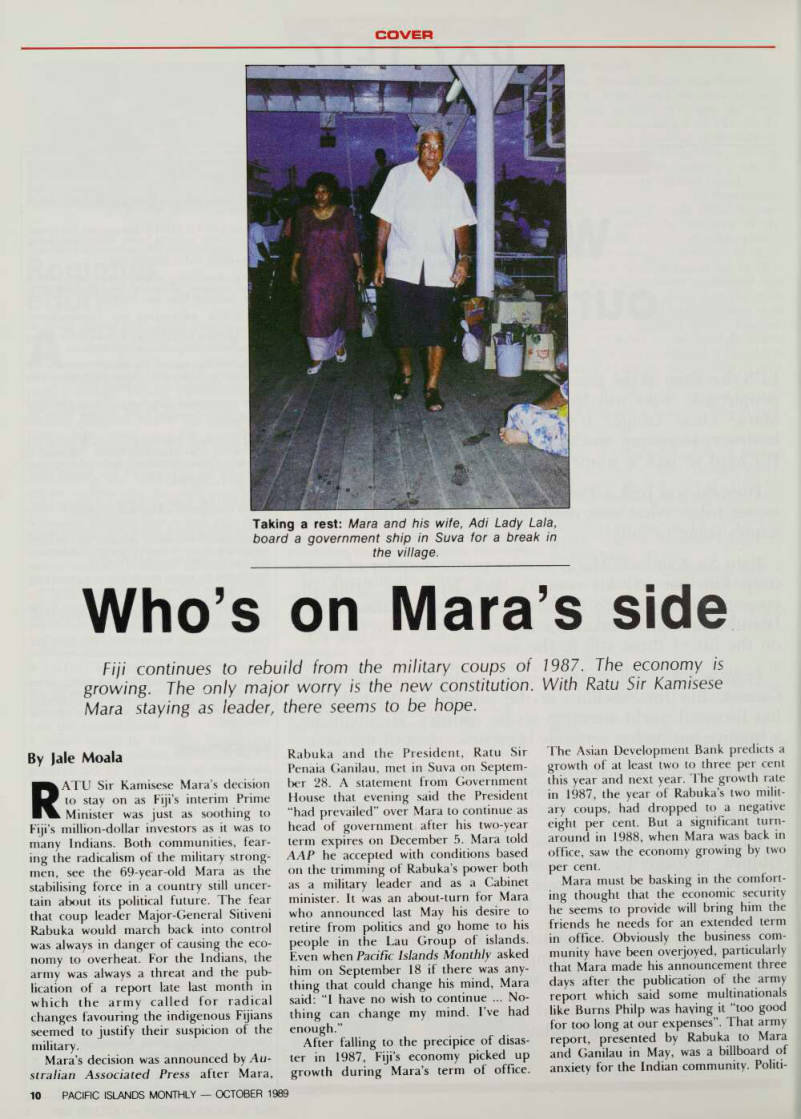
Taking a rest: Mara and his wife, Adi Lady Lala, board a government ship in Suva for a break in the village.
cians and diplomats were alarmed by the report which called for the expulsion of the Indian ambassador and the Austra lian defence attache and a shift in de fence agreement to Asian countries.
It was clearly evident that given the choice on who to choose, most people would pick Mara, even if many would not agree with his politics. An example was the Indian businessman who met his board of directors on September 25 to discuss an expansion programme in
Suva. During the meeting, they received
a faxed copy of the army report which was published by the Australian Finan cial Review that day. The businessman said the arrival of the report immediate ly changed their attitude towards invest ing a large sum of money in Fiji. Sus pecting that the army would be back in power in December, the group retired from their meeting without making any firm decision. Mara’s announcement three days later relieved the pressure.
While Mara is undoubtedly winning friends because of his economic policies, he will continue to be wary of his politic al foes. The National Federation Party/ Labour Coalition has refused to accept his role, calling instead for direct parti cipation in the formulation of the new constitution. President Dr Balwant Singh Rakka, speaking in the absence of Dr Timoci Bavadra, rejected Mara’s con tinued leadership and said it was Mara’s endorsement of a racially-biased draft constitution. Rakka’s praises were directed at deposed Prime Minister Dr Timoci Bavadra who during the time of writing was being treated in Auckland for cancer of the spine which one source said was probably malignant. Mara, too, has big health problems. He said he had three heart attacks in the past two years and his doctor advised him to rest reg
ularly.
When Mara took office on December 5, 1987, he did so with caution. He knew the coup had made him unpopular among Indians, and to some extent among Fijians. He therefore did not make too many changes to the 20member Cabinet he inherited from Rabuka’s military government. Notable was his dismissal of Fijian Nationalist Party leader Sakeasi Butadroka and Taukei Movement strongman Ratu Meli Vesikula whom he said “were openly hostile” to him. This December he is ex pected to cut the size of Cabinet. Who will go is a guessing game. But men like Deputy Prime Minister Josevata Kamika mica, Trade Minister Berenado Vunibo bo, Tourism Minister David Pickering, Works and Communications Minister Apisai Tora and Education Minister Filipe Bole will form the core of the new government. They will be the men Mara will rely on as he continually takes those
holidays prescribed by his doctor. □
Fijians get
the numbers
THE report on Fiji’s proposed new constitution has suggested a bicameral legislature, numerical
superiority for the Indigenous Fijians
and more power to the chiefs. “It is cer tainly not going to please everyone,” said The Fiji Times the day after the report was released, “but the committee, work ing within its term of reference, has pre sented a compromise package that it hopes will be acceptable to all the diffe rent communities.”
The proposal is for a 69-member com munally-elected House of Representa tives comprising of 37 Fijians, 27 Indi ans, four General Electors (or others) and one Rotuman. Thirty of the Fijian members are to be elected from the pro vinces and seven from the urban centres.
Elections are to be held every four years instead of the five-year life of Parliament practised before the military coup of 1987.
The report, by the Constitutional In quiry and Advisory Committee (CIAC), elevates Fijian chiefs to a position of power by making the Upper House the Senate of Chiefs. It is to have 34 mem bers, 24 of whom will be Fijian chiefs appointed by the President on the advice of the Great Council of Chiefs. The 10 other members will be appointed by the President, one of whom will be a Rotu man appointed on the advice of the Rotuma Island Council. The other nine members will be appointed by the Presi dent from the other racial communities with the President making the appoint ments according to his “own deliberate
judgment”.
In submissions received by the Consti tutional Inquiry and Advisory Commit tee, Fijians repeatedly expressed the fear that their already disadvantaged social and economic position and prospects would deteriorate further “unless consti tutional changes were made and affirma tive actions were taken to redress the situation in their favour”.
“Indians were generally united in their view that the fear expressed by the Fi jians that they would be dominated by them in the future was groundless,” said the constitutional report. They argued that the present social and economic problems of the Fijians resulted from the
development policies implemented by
the Alliance Party which ruled Fiji from independence to 1987. Most Indian sub missions argued against increasing Fijian membership in parliament as being the solution to Fijian problems. They say the
remedy could be found in raising the Fijian level of motivation, individual atti tude and dedication “to the improve ment in their education, commercial en trepreneurship, and in engaging them selves in productive activities”.
Overall, Indians called for equality through the “urgent need to reach con census on a new constitution based on democratic ideals of liberty, personal freedom and equality”. The Indian view was supported by the National Federa tion Party-Labour Coalition which urged the return to pre-coup constitution. This
was totally rejected by the Fijian
Nationalist Party whose leader Sakeasi Butadroka had in the past called for the expulsion of Indians from Fiji. The par ty submitted an eight-point proposal that it wanted to be part of the new constitu tion. These include giving the indige nous Fijians 75 per cent control of Par liament.
The report is a watered down version of the draft constitution released by Cabinet early this year. Changes include the proposal for a bicameral system in stead of a single chamber parliament proposed by the draft. The report also spoke against the Commander of the Fiji Military Forces being an automatic Mem ber of Parliament and becoming Minister responsible for security. The committee believes “that for proper accountability between legislative and executive arms of government, the ministerial and execu tive responsibilities of government should not be fused in one person.”
Many saw the draft constitution as giv ing too much power to the army, and
encouraging religious bias. The Septem
ber report notes that many were uncom fortable with reference to Christianity in the preamble and section one of the draft. It proposes then that Fiji should be a sovereign democratic republic, omit ting the word “Christianity”. Says the re port; “Recognition should be given to the historical role of Christianity but reli gious freedom and worship should be guaranteed to people of all faiths.” Also of comfort to many was the rejection of any power given the Minister for Im migration to cancel the citizenship of a person, it is suggested instead that citizenship should only be revoked by a two-thirds vote in parliament.
Generally, the report won the support of the Fijians and failed to have that of the Indians. The Fiji Times sums it up by saying the Fijians, “will accept nothing short of paramountcy in any political sys tem. The leaders of the Indian commun ity should take a hard, serious look at the committee’s proposals before reject ing them outright.” In Fiji, the question is: Are the Indians willing to do that? □
What do the Fijians want?
IN announcing his intention to continue as Fiji's interim Prime Minister , Ratu Sir Kamisese Mara will now be judged by indigenous Fijians on how best he is able to safeguard their interests. But the Fijians have a problem, as Mara told /ope Balawanilotu last month:
• Mara on the indigenous Fijians and what they want: I’m quite happy with what has been done. To say that I have caused the de gradation of the Fijians is really trying to avoid the real issue. The Fijians them selves have got to pick themselves up from the bootstraps that they now wear.
I don’t think anyone can help the Fi jian people as a whole, entirely. They are crying about the achievements of the In dians. Why can’t they achieve the achie vents of the Indians? It is very difficult to explain to them that you’ve got to change what you hold dear to you your customs and traditions in order to be like the Indians. I think what can be done is for Fijians to strive as Yavusa (communal divisions) or provinces, if possible, to get ahead. And there ought to be a friendly rivalry.
I have been accused by (Fijian Nationalist Party leader Sakeasi) Butad roka and the nationalists that I’ve let the Fijians down. It’s not as if the Fijians were puppets and I just pull the strings and they work. No one can do that. The Fijians themselves have got to realise and find out what they can do.
I was one of the first five (Fijians) to own cars when I first came back (from overseas studies) in 1950. Look at the number of Fijians who own cars today.
Look at the phone books from the 1950 s onwards. You’ll find a few Fijians who had telephone at the time compared to the large number of today. Yet people are still complaining that we have not progressed, that we have gone downhill. • On the draft constitution: The draft constitution may not be the ideal constitution but what would be the ideal constitution? There are over 150 nations in the United Nations (and) they all pronounce to the world that they are democratic governments and we all know that they are not the same. We have now a draft. From my own perusal of the draft, I have no quarrels over it at all. I must say they’ve done a very, very good job. The very fact that they came out unanimous in their report is an achieve ment. There are actually six Indians, supposed to have been seven Fijians but one, Rakoto, left half way through to become the Consul General in Sydney, one Chinese and three other general
electors (in the Constitutional Inquiry and Advisory Committee).
I found from the report that they had reasons for the decisions they’ve made and I learned afterwards that they’re prepared to stand up in any meeting to
explain the reasons why they’ve made
them. I commend each and everyone of the those members of the committee, especially the leader because it must be his leadership that kept the group together and came out as one in the end.
As I’ve said I have no quarrels with their recommendations.
I really think that in the previous Con stitution, if the Fijians were united there wouldn’t be any trouble. There was di vision then, and if there is going to be division even with a majority there will be a problem.
With the assumption that the draft constitution is approved as ammended by the committee, it will take a year for an election to take place. And my wish and hope is that we agree to that and have a 10-year period in which we practise the constitution and we have another review
at the end of 10 years and that perhaps every 10 years we should have a review.
No constitution in itself is perfect. If it is the will of the people to live together and work out a constitution for the be nefit of all, that will be beneficial to the
people.
• Mara on the constitutional summit:
These people have already spent eight
months receiving individual’s oral and written submissions. They’ve gone around and looked at groups. Haven’t they combed Fiji? What else can we get out of a summit? I thought they’ve done their work so well to eliminate the need of a summit and all it has to do is from Cabinet to the President to the Council of Chiefs, and promulgate it. • Mara on his involvement in post-coup governments: When I lost the election in ’B7 I stated that I supported the process of democra cy then. I vacated my office and I moved in to the Opposition and I had thought that my period in the Opposition is a
period of preparation to actually retire
from politics. I think I’ve had a good
innings.
The coup took place and I was alleged to be the mastermind. I didn’t know any thing about it. I came because what I had built up over the 17 years was at risk of being destroyed. I wanted to come and keep it together.
After, there was a long period of great uncertainty the period in which the (Governor-General) took over as leader and we were advisors, but we didn’t quite know where we stood at the time.
My advice was not taken up as I would have expected. It was a disappointing
period.
And when Rabuka took over (again) it was quite a relief. At least someone knew what he was going to do because we were all uncertain. We thought we were going to be in the Commonwealth and I took a trip to the UK to find out whether it was still possible or not and I found out it wasn’t. So 1 said to myself; thank God for that, someone is going to map out the future of Fiji, good luck to them.
I then, quite frankly, didn’t quite
know where I stood at the time. I still had security around the house I was given. No one told me that I was com pletely out. I didn’t know whether 1 was actually restricted, so to speak, to my residence and for two months I didn’t quite know where 1 stood. Then after two months the period of the military government came to an end, suddenly, and the President took over. The Presi dent asked me to lead a government. I was in Lau when the announcement was made. I then took it up as a challenge. 1 had a number of Cabinet Ministers who were there and I didn’t want to
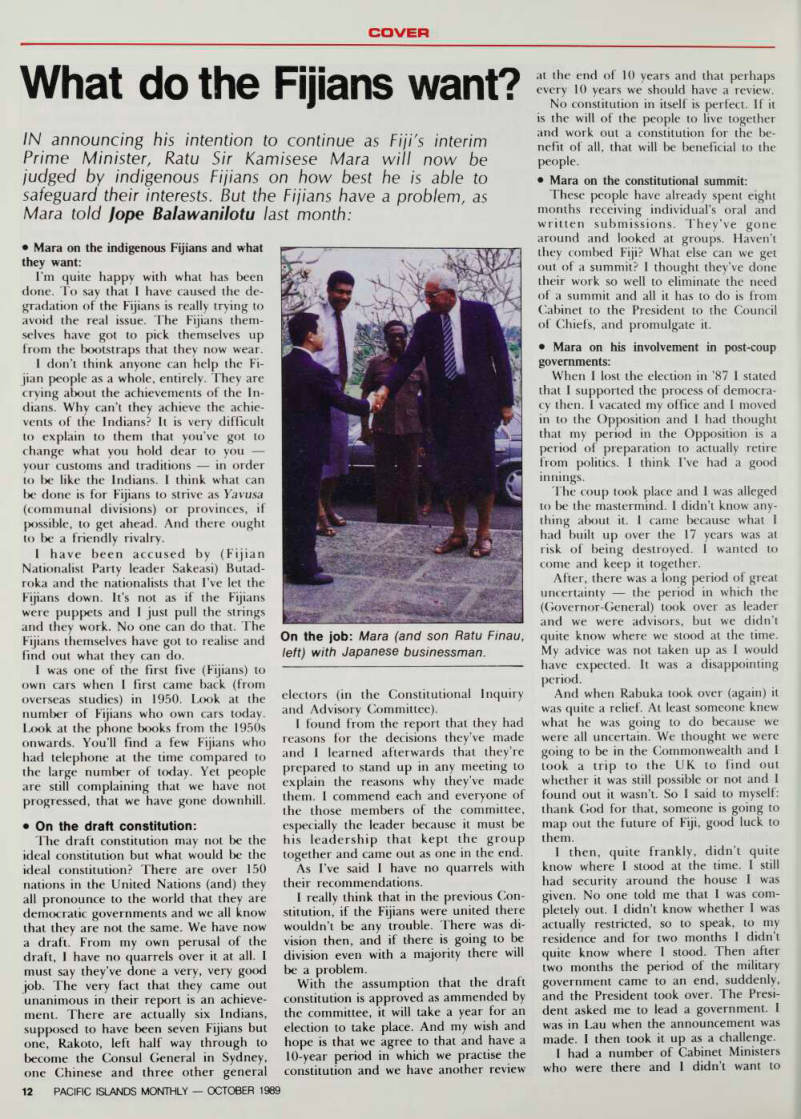
On the job: Mara (and son Ratu Finau, left) with Japanese businessman.
create animosity right from the very be ginning. I thought I could make do with all who were there accept some who were openly hostile to me (Sakeasi) Butadroka for one and (Ratu Meli) Vesi kula for the other. They said openly
during their short period how incapable
I was and I was to be blamed for all that has caused the dissatisfaction of the Fi jians. But I took on the Cabinet that I (have) now and decided at the time that unless we have a clear objective we wouldn’t get anywhere.
The greatest priority as I saw then was the recovery of the economy not only for the sake of the people who had lost their jobs and the people who aspire to get jobs, but one of the greatest causes of dissastisfaction that caused the coup was the fact the Fijians didn’t think that they have a fair share of the cake. And now the thing to do is to increase that cake, even though the period is very short. And the other, of course, is get a constitution a draft constitution.
Under the circumstances it looked very difficult and looked almost impossible.
During those two years I actually had three heart attacks. Fortunately 1 had treatment in Australia and I found as the tension began to resolve I was able to survive. The doctor told me, and I be lieve that it was the tension that caused the heart attack. And I was told at the time if you want to work you work for two months you take 10 days, two months take 10 days. I was very happy with that sort of timetable, but it was impossible. You can’t control events for up to two months and then you let go.
So that was how the heart attacks came on.
But because of the sense of emergency that was instilled into the Cabinet, they did do their job. Everyone must be com mended for what they’ve done. Some of them also had health problems in en deavouring to carry out their duties, but I think we’ve all been very satisfied now that the economy has shown to be not only recovered but even better than it was in 1986, and there is a draft con stitution. • Mara on the Fiji Military Forces: I would like to see them go back to barracks, modify their system of training in order to develop national youth train ing so that instead of our people going to the army to go to Lebanon or to be in the barracks, they have a system where people can serve for a year or two years then back to their villages. At least you can instil discipline into them, some form of training and then they can go back for the benefit of their people.
They can’t train every Fijian to get into the army because at the end of it they will just look for pension and they’re not going to be productive units in the economy of Fiji. But with a little
army discipline in the early parts of your lives you can be a very useful unit.
I wish that they concentrate on de
veloping a national youth training
scheme. They have the facilities, they have the manpower and people like to be in uniform.
I know that practically all the Afri can countries with the exception of Tanzania, Zambia and Malawi and, of course, the smaller ones Bohtswana and Swaziland have been led by the milit ary. What the military did was to try and destroy the custom and tradition that structure which doesn’t allow them to be the leaders. The influence of the military out there was to go against customs and traditions because they want the loyalty and support of the people, and their chiefs are not usually the ones who sup port them.
I’m surprised at the great difference here in Fiji. The military said they sup port the chiefly system. Yet there are two divisive things which they’ve sup ported. One is the secession in the Methodist Church and the other is the fourth confederacy. If they want the uni ty of the people of Fiji those two issues could be left over till we’ve returned to
normalcy, then tackle them. To tackle them now when we are not united, it makes fun of the 37-27 (Fijian-Indian ratio in a new parliament). You’re actual ly dividing 37 by two on the Methodist issue, you’re dividing 37 by four over the
fourth confederacy.
On what influence can make me change my mind and carry on lead ership: those two issues will never, never attract me to the leadership.
I pity the man who is going to take over because the army who brought all these about is now supporting those divi sive issues. • If there is no return to barrack?
God help Fiji.
• Mara on whether Cabinet was worried about Major-General Sitiveni Rabuka’s role in the Methodist Church crisis: It has always been a questioning of his role after he has done something. No discussion before he did anything. • Mara on the Fourth Confederacy and talk of secession: They seem to think that they have the upper hand by holding us to ransom: if you don’t do this we’ll get away. Well, every part of Fiji can do that. So it’s an empty threat really. • Mara on an offer from the East-West Centre in Honolulu: There was an offer to spend a sabatical year at the centre where you can do your own research. My objective of spending a year is to gather all my papers and books and try and sort them out for future use, if I can put them into a book. I’m sure I can find people there who could help me to do it, that my experience could be translated into paper for the benefit of the world. I don’t know if the offer is still in extent.
Meantime my hopes have been bouyed by the fact that I’ve been invited in my next trip to Europe to visit my college, Wad ham, in Oxford, because there’s also an opportunity there for a similar thing.
I prefer the Hawaiian one because it is nearer home, the climate is better and there are, already, people there who have done research in the Pacific who will be of great help. • Mara on Fiji’s move to set up an oil company and buy oil from Indonesia: What we thought could be done through the friendly attitude of Indone sia, was to get us the oil from Indonesia like Mobil, Shell and others. We re fine it either in Australia or Whangarei, in Auckland, or in Hawaii and then we bring it here and sell it to them. The margin they make here, they say, is six cents a litre and the Australians and New Zealanders will be very, very happy to make three cents a litre.
If we can get a bit of that margin, we thought a Fijian shareholder could come from that margin, if half of that margin could be freed.
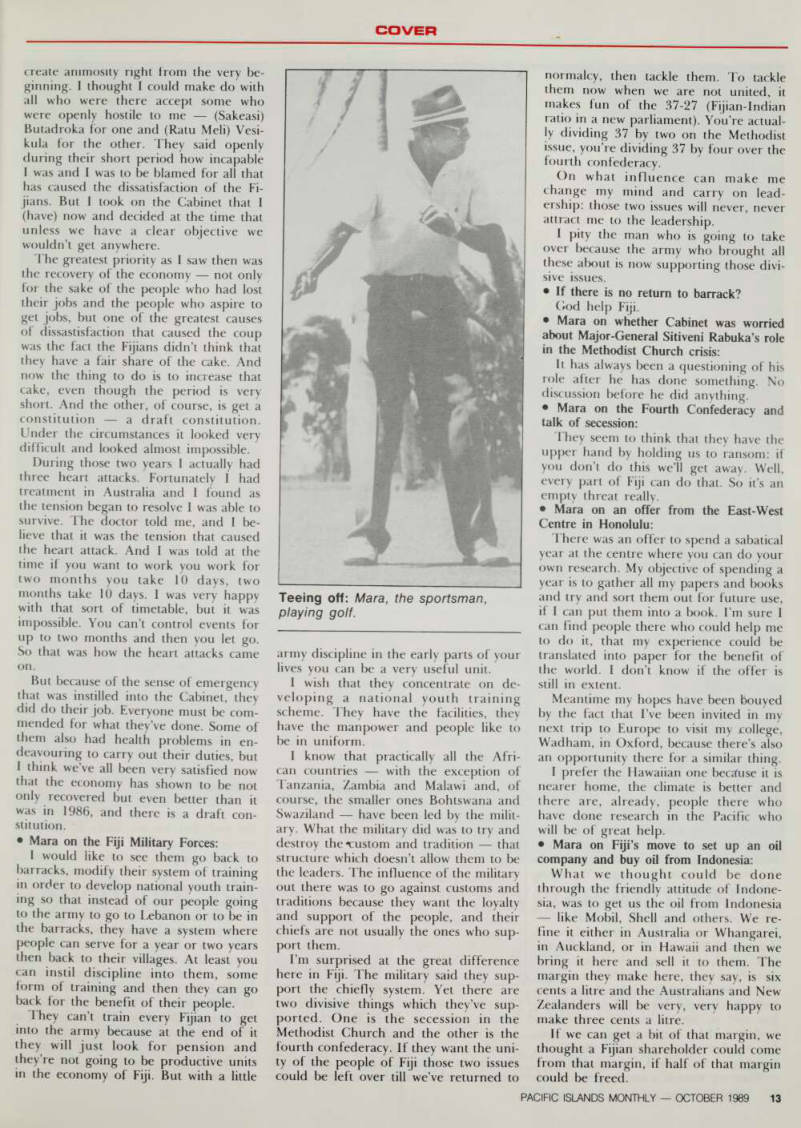
Teeing off: Mara, the sportsman, playing golf.
We have more control over the price of oil. The oil companies are fighting very hard, they’ve got the money, they can put out disinformation about this and about that.
They’ve got Dr Fesharaki who we have been trying to get to make a statement about how he has been encouraging us all along, but now he is saying that it is no good. Well, he must have got some good reason to change his mind sudden ly like that.
But all we ask is the oil companies should give us a tender and how much could they buy the oil for if we bring it to Vuda. None of them has been able to do that. We know the price. We know what they ought to pay.
I had one man from the university who was investigating for me but unfor tunately he is an Indian from Malaysia, I think, and he took off at the coup. He told me there was money in it and he was sent over here by Dr Fesharaki and I’m surprised that Dr Fesharaki has now publicly changed his mind, whether he has said so himself or it’s some man ipulation of his statement because it was his number two or number three who came here and talked about it.
What we want is a steady price of oil.
They’re now blaming government for putting tax on it. Well, that tax could come down. But development now is on wheel particularly for the Fijians in the more remote area outboard motors, trucks. And their margin can go
up and down and repayments to the bank or wherever they got their trucks from can be snuffed out very quickly unless they know what the price is going to be for the next six months or year.
But when it goes up and down like that they are the ones we want to help. • Mara on why Mobil, Shell and British Petroleum will not decentralise their opera tions by building storage facilities in the outlying islands: They say their business here is not big enough to warrant such a big capital out lay and that we are lucky to get their services. Then why is it that they’re trying to oppose our endeavours to try and buy our own oil? Because they are making good money. Gas Coral Gas comes from Melbourne and we’re paying the price as if we are importing it from Singapore. Similarly with oil. Most of our oil comes from Australia and we’re paying the transport cost from Singa
pore. And they’re making good money
because we’re paying transport money from Singapore. They’re not transport ing it from Singapore. That’s the sort of money that we know they’re making. All we want is to control from source to Vuda. Let them take it from Vuda to the consumer. D
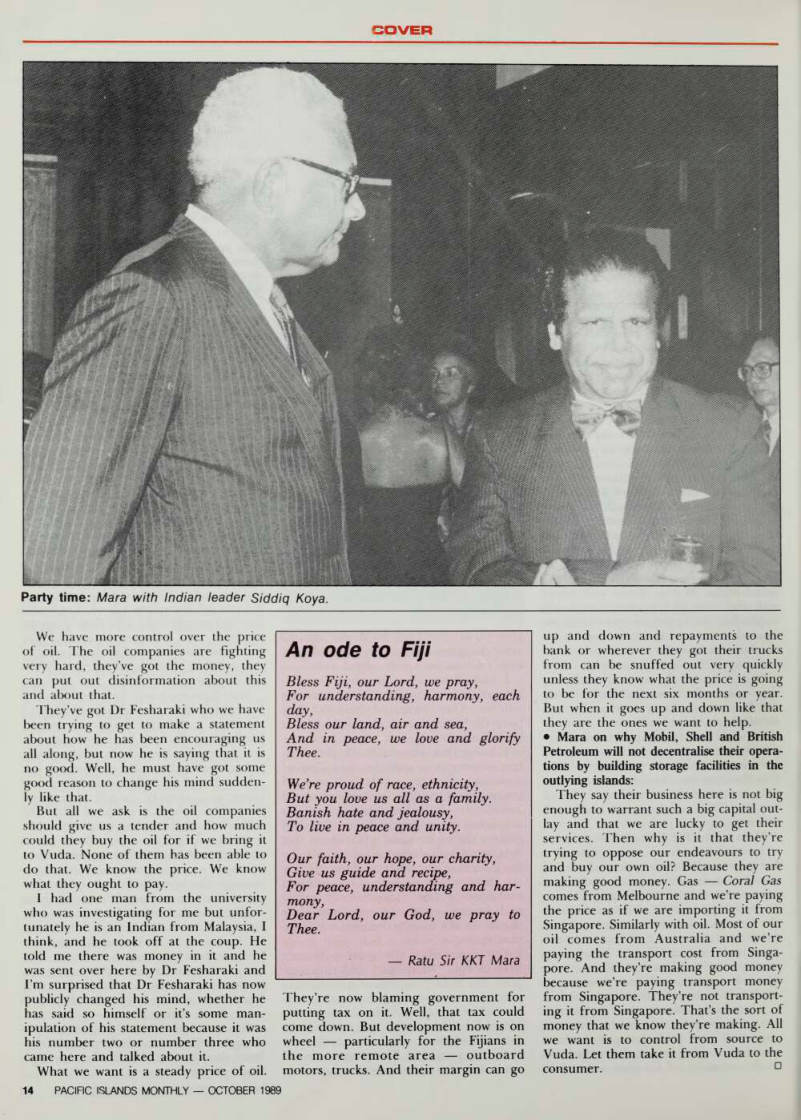
Party time; Mara with Indian leader Siddiq Koya.
An ode to Fiji
Bless Fiji, our Lord, we pray, For understanding, harmony, each day, Bless our land, air and sea, And in peace, we love and glorify Thee.
We’re proud of race, ethnicity.
But you love us all as a family.
Banish hate and jealousy, To live in peace and unity.
Our faith, our hope, our charity, Give us guide and recipe, For peace, understanding and har mony, Dear Lord, our God, we pray to Thee.
Ratu Sir KKT Mara
An oversight
The Region
Hawaii
By Ed Rampell
HAWAII Senator Daniel Inouye calls August’s United States
Congressional meetings regard-
ing the Hawaiian Home Lands the state’s ‘‘most important hearings since statehood . These are the first such oversight hearings since Congress established the 192,000-acre Native Hawaiian Land Trust in 1920.
The Congressional panel looked into problems besetting the Hawaiian Home Lands, set aside for residential and agricultural use. In order to use the land, homesteaders must prove they are of at least 50 percent Hawaiian blood. Only about 60,000 of the State’s estimated 200,000 Hawaiians currently qualify. Recent efforts to establish a single definition Hawaiian with one beneficiary class has generated intense controversy.
Much of the earmarked property does not have any infrastructure, including water, power, and roads. There is an overall lack of funding for home build-
ing and other basic needs. The waiting list for Hawaiian Home Lands has about 18,000 names on it. Generally, each name represents a family, not an indi vidual.
Some Hawaiians claim some potential homesteaders have been on the waiting list for over 30 years, and that some na tives have died while waiting to receive their land. There frequently seems to be a Catch-22 situation, where the land ex ists but is often unavailable to eligible islanders.
The US Senators and Representatives will consider these problems, along with dissident demands to transfer control of the Hawaiian Home Lands from a State department to a sovereign Hawaiian organisation. Although not scheduled on the agenda, native activists used the hearings as a platform for their Hawaiian self determination movement.
Groups such as Ka Lahui Hawaii, the Sovereign Hawaiian Nation, seek the same tribal and reservation rights Amer ican Indians have in the continental Un ited States.
Senator Inouye, a Democrat, chairs the Senate Select Committee on Indian Affairs, which held the hearings, along with its counterpart in the US House of
Representatives (Congress’ lower cham
ber). Most of the participants represent states such as Alaska and Arizona, where many native Americans live. The meet ings were held throughout August at Oahu, Kauai, Moloka’i, and the Big Is land, where homesteaders and potential land users aired their concerns. 1 he panel examined Hawaiian history, and how the overthrow of the Polynesian monarchy and American annexation of the Islands affected the Native people, who are now largely landless. The hear ing will also deal with how Washington can improve the Home Lands situation, as well as the trust relationship between the Federal trustee and the Hawaiian be neficiaries.
In a related development, the Office of Hawaiian Affairs, (OHA) launched “Operation Ohana”, in an effort to regis ter all living Hawaiians on and off island. OHA, a State agency dedicated to bettering conditions for Hawaiians, is seeking enrolment of the estimated 270,000 Hawaiians living worldwide in order to upgrade their benefits and en titlement programmes. August marked Hawaii’s 30th anniversary of statehood, but some of the fiftieth state’s indige nous inhabitants still waiting for the re turn of their lands were not be celeb ing. □
Advertisements & other items, p. 15 (1 item)
Suddenly, New Zealand is a whole lot closer.
And so too is a potential market of 3.2 million New Zealanders.
As a Forum Island nation, exploration and development of new markets can be a difficult and frustrating exercise.
Now, through the establishment in New Zealand of the South Pacific Trade Office, you have direct access to a variety of services that are specifically geared to assist you in the export and promotion of South Pacific products into New Zealand.
Services include market research, marketing plans, identification of potential customers, office facilities, product displays, participation in trade fairs, and secondments.
For further details contact...
SOUTH PACIFIC
TRADE OFFICE
Jetset Centre, 44 Emily Place, P.O. Box 774, Auckland 1, New Zealand.
Phone (09) 302-0465, Fax (09) 776-642, Telex SPTO NZ63328 Madison 3589
frigate deal
Defence
Questions over frigate deal
NEW Zealand has decided to buy at least two ships under the
proposed joint frigate venture
with Australia. The concession from Wellington to its trans-Tasman ally in Canberra is more the result of political pressure from Canberra than the needs of the Royal New Zealand Navy.
What has become clear is the frigates are suited to operating as part of a lar ger naval force, reflecting Australia’s preoccupation with the possibility of fighting a war against an Asian power, rather than as single vessels meeting the contingencies that could arise in the South Pacific. New Zealand’s govern ment really had little option: such was the pressure from Australian Prime Minister Bob Hawke that a refusal to join the project would have led to a se rious rift between the two powers.
The underlying problem apart
from money to the cash-strapped New Zealanders is that the two countries
have different foreign policy objectives.
New Zealand sees its future in the South Pacific, but Australia, notwithstanding the interest now being shown by Foreign Minister Gareth Evans in the South Seas, has Asia at the top of its agenda.
What should be of concern to the states of the South Pacific is that the decision to buy the frigates greatly dimi nishes the New Zealand navy’s ability to carry out a variety of roles in the region.
The Australians, who designed the ships, have as their defence priority fending off an attack from Indonesia or another Asian power rather than fisheries patrol in the vast expanse of the Pacific or com ing to the aid of cyclone victims on some coral atoll.
Just how inadequate New Zealand’s ability is to fulfil its defence obligations in the region was shown by an exercise early this year. The New Zealand army has no method by which it can transport its men or helicopters by sea. In January, when a major exercise was being held in the South Island, the government was forced to charter a Dutch freighter in order to move troops and helicopters across Cook Strait. But even a freighter is not adequate to take all the men and equipment which would be needed in the case of a military emergency.
The Royal New Zealand Air Force was similarly stretched during the exercise: it had to borrow four helicopters from Au stralia after its own machines were grounded because of their age. The RNZAF, at the beginning of 1989, main tained eight bases but had only 33 pilots Hying in a military role. Tanks and artil
lery are antiquated and practically use
less.
The critics of the frigate plan for New
Zealand have argued the better idea would be to buy small ships (from an Asian shipbuilder, which would be con
siderably cheaper than using Australian
yards) for fishery patrol duties in tan dem with the Orion maritime surveill ance aircraft, and to buy or build an all-purpose merchant ship, which could be used not only to transport troops and equipment but meet most South Pacific
contingencies.
The head of the Peace Research Cen tre at the Australian National University in Canberra, Andrew Mack, argues that such a ship would be a cost-effective, and in some ways superior, alternative to the frigates. “It would have speed and range comparable to the Anzac frigates and better sea-keeping ability. It would be configured to operate at least two heavy-lift helicopters, which would be of far greater use in South Pacific opera tions that the frigates’ medium Seahawk
helicopter,” he wrote recently.
A converted merchantman would have
a large carrying capacity and could
evacuate large numbers of people in the event of a natural disaster or political uprising, and could include a hospital section. Mack has also argued the fri gates have been shown, especially in the Falklands War, to be very vulnerable to missile attack even within a large naval force, let alone by themselves without any air support.
Those who favour the frigates argue New Zealand does have a need for such
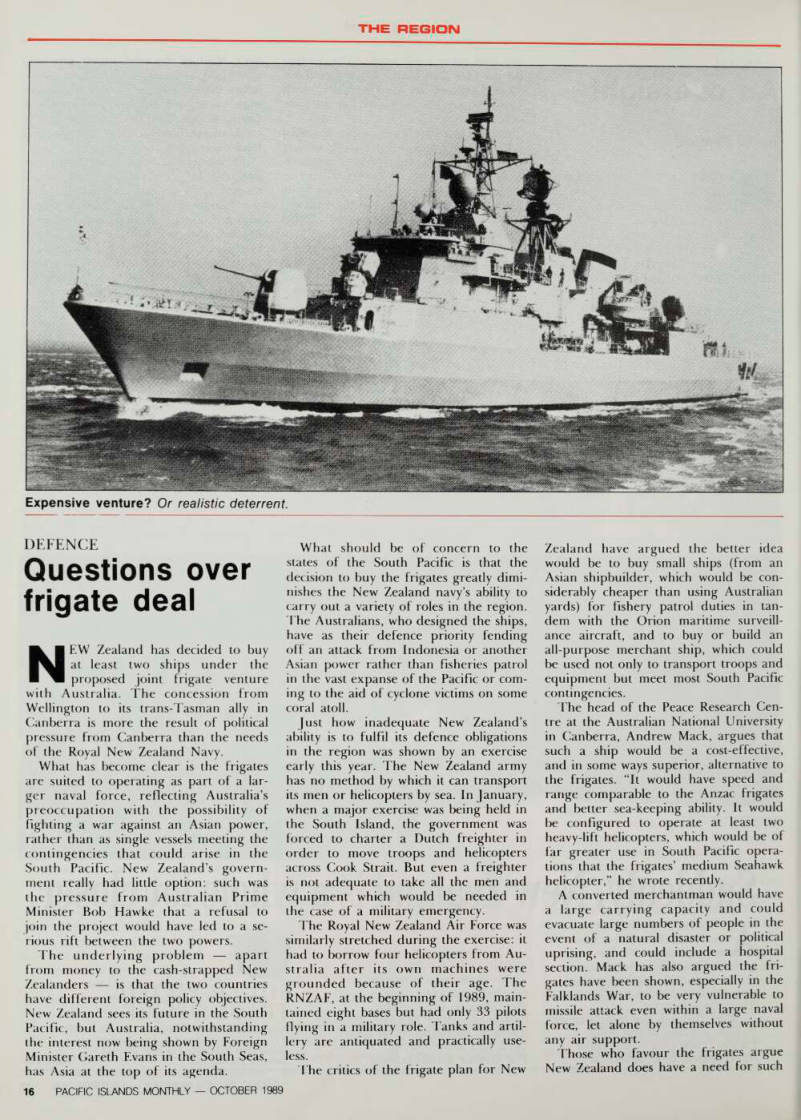
Expensive venture? Or realistic deterrent.
ships. In a joint article published recent ly, a former Australian Secretary of De fence, Denis McLean, and Australian strategic expert Desmond Ball, pointed out that all the maritime and air links from the east coast of Australia and from New Zealand to northeast Asia go through or over the Solomon Islands and eastern Papua New Guinea 7O per cent of New Zealand’s trade went by that route or across the Pacific to the Panama Canal, while 60 per cent of Au stralian trade went by all Pacific routes.
The authors pointed out that New Zealand had defence obligations to the Cook Islands and Tokelau, and impor tant strategic interests in other Pacific states.
The article said there are two principal zones known as “choke points”: the sea route passing by way of the Coral Sea and the Solomon Islands, and the nar row channel across the north of Austra lia through the Torres Strait and Timor Sea. “Basic interests in both countries would be at risk should a hostile power become established in these areas with the capacity to interrupt trade and com munications,” the article added.
Another point is the division within the New Zealand defence establishment
of the frigate question. While sea-going
officers want the new vessels (it was feared many might leave the navy if smaller ships without a full wartime capability were bought), it is known that the opinion at the top of the Defence Department was that frigates could not be considered the nation’s top priority there was no point having a trained army if it could not be moved over wa ter. They also argued the frigates had no transport role; the ships carry only one small helicopter while the army needs helicopters which can transport sizable numbers of troops and a ship to carry
equipment.
What is clear is that Australian press ure has pushed New Zealand into a ma jor military decision unsuited to its role as a power in the South Pacific.
The NZSIOOO million deal threatened to split the New Zealand Labour Party only weeks after new Prime Minister
Geoffrey Palmer’s rejuvenated cabinet
had dramatically recovered in opinion
polls. It also provoked bitter opposition
from critics who accused the government of betraying the country’s sovereignty and undermining the nuclear-free stance.
A caucus vote confirming the decision came on September 7, just two days after allegations surfaced that a prominent Australian trade unionist who had been
regularly visiting New Zealand to lobby
in favour of the deal was actually work ing on behalf of the contractor. Labour
Party foreign policy officials arguing
against the deal claimed in a report con demning the government that ministers
justified the frigate purchase on the
grounds that Australia and the United States might no longer consult New Zea land about events in the Pacific.
Palmer admitted an overhaul of fore ign policy was needed with fresh initia tives in the Pacific showing some “vision” including economic and social policy, not just defence. The Prime Minister said New Zealand had not caught up with the increasing turmoil in the re
gion! “Look at Fiji, what happened
there, look at Bougainville, look at the difficulties in Vanuatu.”
However, opponents calling for a
genuine independent foreign policy in
the Pacific were bitter in their criticisms.
Kevin Hackwell, spokesman for the Just Defence coalition which waged a high profile campaign with a team of skilled researchers to an abortive bid to block the frigates deal, said the people of New Zealand had been betrayed: “It is a sad day for New Zealand when our foreign
policy is being dictated by Canberra.”
Disappointed Labour Party president
Ruth Dyson, another strong opponent,
said she hoped the frigate purchase
would become a springboard for other initiatives in the Pacific, such as aid and
development assistance. But, ignoring
the growing popularity of the rival “re born” New Labour Party which opposes the frigates, she claimed the deal would not lead to critics withdrawing support for the government because of their anti-nuclear beliefs. (According to opin ion polls, more than seven out of 10 New Zealanders support the nuclear-free
policy).
Dyson warned that if the opposition National Party regained power it would mean the return of nuclear-powered and nuclear-armed warships in New Zealand ports. “This will never happen under a Labour government,” she added.
A leak of a document by Labour Par ty’s influential foreign affairs and secur ity policy committee embarrassed the government by citing a claim from Fore ign Affairs Minister Russell Marshall that
New Zealand’s foreign policy was being
made on “an ad hoc and piecemeal basis”. Accusing the New Zealand armed forces of an “outright political role”, the document also said the frigate policy appeared to be “based on a historical need to associate with more powerful Western allies in order to preserve poli
tical patronage”.
Popular opposition MP Winstor Peters
upstaged his party leader Jim Bolger’s
muted criticism by launching a blistering
attack in a snap parliamentary debate.
Peters branded the decision “economic and social lunacy”, saying that while Labour had created a growing number of poor people in the country, it had decided to spend $lOOO million on fri gates. He also criticised the hypocrisy of the Palmer government which was taking the first step back to a nuclear policy with the deal while claiming it was nuc lear-free.
However, former Prime Minister David Lange denied the purchase meant “any deviation at all” in New Zealand
foreign policy. Bolger described the fri
gates as the world’s most expensive fisheries patrol craft. □
Four years late
and $40m more
THE first Anzac frigate will not be delivered to New Zealand until March 1998 four years later
than originally planned and meaning
NZ$4O million extra in refits to extend the life of the Navy’s present four veter an frigates. The ageing Waikato and the Southland are the first of New Zealand’s ships destined for the scrapyard.
But while the “unit” ship cost is about NZ$3OO million, it has been revealed that the overall Anzac project cost
including training, maintenance and
spares has boosted the price of each ship to $471 million. The “real” price with full armaments and a helicopter is estimated at more than $5OO million each. If New Zealand finally does take up its option and buy four frigates it could save $BO million.
Meanwhile, in Australia, Victorian Trades Hall Council secretary John Halfpenny, has denied allegations of im proper or dishonest actions over the fri gate deal linked to the Transfield group, a major partner of the Melbourne-based Amecon consortium which won the con tract. Transfield also issued a statement denying the accusations.
Australian Prime Minister Bob Hawke told Parliament that a report of allega
tions by Halfpenny’s estranged wife,
Margaret, over the unionist’s lobbying activities in New Zealand in favour of the deal had been passed on to federal
police for investigation.
Aired under parliamentary privilege,
Margaret Halfpenny’s statement to the National Crime Authority said her hus band had travelled to New Zealand at least 10 times in the past two years to lobby for Amecon. “John argues that he is assisting the workers by giving the contract to the Williamstown [Mel bourne] dock area,” she said, “but I’m sure that John didn’t tell any one of the workers that he was representing Trans field.” □
it wrong
Palau
How to do it wrong
By David North
ALTHOUGH the words are muted, the latest United States Govern ment report on Palau shows an island government marred by extensive corruption, conflict-of-interest and fiscal irresponsibility, as well as lax laws and law-enforcement procedures. Or, to put a more cheerful face on it, it shows how crafty island leaders can secure tangible benefits for their constituents while man
ipulating a series of supposedly sophisti
cated Mainland governments and businessmen.
The two-volume report, filled with specific, damning evidence of island mis behaviour and lack of United States Gov
ernment monitoring, was prepared by
the United States General Accounting Office, (GAO) an investigatory arm of the US Congress. The GAO is known for its ultra-careful work, and its deadly dull prose. Its writers would rather not make a mistake than say anything in teresting, so one must comb the 186 pages of these reports to find its gems.
The report, US Trust Territory: Issues Associated With Palau’s Transition to Self-Government, comes at a time when the Congress is working out an even larger allocation of money to the well-funded islands in hopes that the Compact of Free Association will finally be ratified, but more on that later.
The GAO report does not deal with the nuclear presence issues that have sty mied the Compact, instead it focusses on the matters more amenable to the analy sis of accountants and lawyers govern ment contracts, corruption and law en forcement.
Two small items unearthed by GAO are symptomatic of the condition of the island’s government the lack of cus toms inspectors at the airport, and the government’s expenditures on the house of the late President Lazarus Salii.
Drugs are a growing problem on Palau (see box), and job slots had been created for customs inspectors to open luggage at the airport, but somehow money nev er could be found to fill the jobs, so
luggage was rarely inspected. This de
spite the outpouring, GAO says, of $156,031,000 in US funds to Palau in the period 1981 through 1988. (By ex amining GAO data one can see that the government of Palau gets four to five times as much money per capita in aid than Mainland jurisdictions). How will the lack of customs inspectors be solved?
Uncle Sam has been convinced to come
up with another US$4OO,OOO earmarked for customs officers on Palau. (Similarly, Palau is looking to the Congress to fund the office of an inspector-general to search out fraud, corruption and abuse).
As for the late President’s house, GAO
explored two interesting questions: who
owned it (it was either Salii or his land lord), and should the island government have paid $90,000 for expanding and remodelling it? What is clear from the records is that the island government paid an unnamed landlord $750 a month rent on the place, but it is not at all clear who owned the house at the time. If Salii owned it, then the “land lord” was receiving funds under false pretences. (Here and elsewhere the is land paper trail disappears GAO’s dutiful accountants could not find land sales records on this case.) Of greater moment were the contrac tual manipulations which came in all sizes and shapes.
There was the big bond issue, for US$39B million, that was to be issued through Matthews and Wright, the since indicted Mainland underwriters. GAO notes that the Palau National Develop ment Banking Corporation board mem bers had scant notice of this blockbuster, and signed the papers under pressure from Salii’s associates. The bond issue, later aborted but not because of Palau’s intervention, “appears to have exceeded
Palau’s needs and would have been diffi cult to repay,” GAO says gently. In fact, the debt would have been equal to more than US$2B,OOO for every man, woman and child in the islands.
Then there was the airport. By Pacific standards, Palau’s current landing field is well above average, but the island’s leaders wanted a bigger and better air port and did not want to pay for it.
So, without going through competitive
bidding, and without informing the legislature (the OEK) Palau gave a Japanese firm, Howa Co. Ltd., and an American one GIG International Ltd., the right to build the airport, at their expense, in return for future revenues from the airport and the right to control tourism development rights (such as hotels) in the area. Palau’s Attorney General eventually cancelled the con tract; earlier he had received the mes sage that he “would be history” if he sought to block the deal.
If airports could be built without funds, maybe roads could be, too. A ma
jor Japanese firm, Kawasho Corporation,
agreed to build a 2.5-mile road and wa ter distribution system for the State of Melekeok; (Palau’s 14,000 or so citizens have 16 state governments). The road was built, at a cost of about US$5 million but Melekeok had little money to pay for it. The builders then sought to get Palau
to keep the late President Remeliik’s promises on the matter, to pay for it out of the Compact-connected capital improvement funds (of about US$46 millions but these have not yet arrived.
Kawasho has been paid only $222,000 for its efforts.
GAO is worried that this, and similar road-building projects, none of which are included in the National Develpment Plan, will obligate the $46 million which is needed, GAO feels, for higher priority
projects.
To what extent are Palau’s politicians
profiting by these questionable expendi-
tures? GAO is interested in the question, but does not offer many specifics. It does state that an unnamed member of ionnnn USe n eg ;" eS had $20,000 in Gorones International Construction Corporation which secured without competitive bidding, the halfm.lhon-dollar-a-year contract to manage t e is an s controversia power p am Tha contract was two years old when the legislator reported that he had to date, secured a $12,000 return on his investment. GAO adds that such dealmgs, which would be contrary to most smCms ' aPe n ° Y Similarly, Palau law apparently does not prevent an appointed official from advising the government to sign a con-
tract with a firm he owns. An unnamed consultant to President Salii served as president of Pacific Ventures Inc. at the time that Palau signed two contracts with that firm one to build a new capital building and lease it back to Palau, (yet another instance of creative financing) and the olher 10 '“f a A sencs of A com ' memorative coins. The Assistant Attorne >' General who passed on the contract was also an ‘"corporator of the firm.
GAO’s reaction to all of this was to say that the US Department of the Interior should pay more attention to what is happening in Palau. It made no recommendations for any changes in the way Palau conducts its government.
Meanwhile the deadlock over Palau’s relations with the Mainland continues, As previousl report ed there have been numerous referenda seeking to secure the needed 75 nt appr * va for the us to use nuc f ear mate Vials in the islands, all of which secure 61 percent to 72 nt of lhe vote Wlt |,„ u t that thre e- q uarters approval, Washington will not let the Compact go into effect. Then, in 1987> there was ” botched effort to amend the Palau Constitution in such a Way that the 75 per Cent appr ° Val prOV ‘sion could be softened; that effort was thrown out by courts saying that there had not been enough votes in the legislature to bring it to the people.
The current situation is that the Main land House of Representatives has pas sed a bill pressed by its Interior Commit tee which would give Palau another US$9 million if it approved the Com pact, but it is doubtful that the addition al dollars would attract the needed addi tional votes. The bill was scheduled for a Senate hearing in September, but the
hearing was postponed (as often hap
pens in Washington).
Meanwhile a potential solution to the deadlock has emerged from the latest round of constitution litigation. There are two ways of getting a constitutional referendum on the ballot in Palau; one is to secure a three-quarters vote from each house of the EOK, but that appears unlikely given the mood of the legisla ture. The other way is to secure a peti tion signed by one quarter of the voters.
Were such a petition submitted the chances are good that the voters would
again produce a substantial majority for
the Compact (in this case voting for an amendment to the constitution making the nuclear approval subject only to a majority vote.) In the last constitutional referendum voters approved that prop osed change by the needed margin (a majority of the voters in three-quarters of the states) and probably would do so again but there appears to be no effort to submit such a petition. □
Drug ring
Guam
Drug ring under wrap
WITH a shoestring grant of $U563,000 Guam and federal police opened a ‘front’ store on Guam in June of 1988 with the intention of breaking a stolen property ring that had been plaguing the island. At ‘Zane’s
U.S. Surplus’ they videotaped ring mem
bers who sold them the stolen stereos and appliances and within six months had enough evidence to wrap up the
operation.
But then something unexpected hap
pened. Operation SCORPION began to
expand its territory as those who were caught began to cooperate and talk ab out the heroin habits they stole to feed, who was selling them the illegal narcotic, where it was coming from and how it was smuggled into Guam and on to the mainland United States.
SCORPION gave birth to FRUITBAT which, by the time the operation was over, had led to the arrest on 40 people, mostly residents of Guam and Palau, in
connection with a heroin and marijuana smuggling ring that had been doing a multi-million dollar business annually since 1984. Twenty of those arrested
have already pleaded guilty and prosecu
tion of the remaining half for continuing criminal enterprise and violation of US narcotic laws was expected to begin in
September.
Many of those arrested on Guam
allegedly fed their habits through burg
laries, robberies and murder. The ring traded heroin and marijuana for guns and profits from marijuana sales were used to buy heroin from Thailand and the Philippines. The multi-kilo ship ments were smuggled into Palau and Guam and shipped on to the United States, according to federal indictments.
The heroin was 90 per cent pure, worth about SUSI million a kilo, and was brought in from 1984 to 1989.
The Guam sting operation and arrests also led to the arrest in Palau of 11 indi viduals, some of whom are alleged to be the leaders of the ring. They were apprehended by a team of federal and Guam drug enforcement agents who flew to Palau unannounced, made the arrests with the help of Palau police and brought those arrested to Guam where
they were charged in US District Court under the federal statutes.
A US Magistrate was brought in from Nevada. The judge refused bail for defendants considered a community danger or flight risk and set bail for others for amounts ranging from SUSI million
To Sus2O,Ooo.
According to the charges, Palauan nationals Melwert Tmetuchel, Leslie Tewid and Angehenio Sabino convicted three years ago of the 1985 murder of Palau President Haruo Remeliik headed up the smuggling operation, Their convictions on the Remeliik assassination were later reversed after their US American Civil Liberties Union
lawyers successfully argued the men’s
rights to a fair trial had been violated.
Also arrested on Palau were Hokkons Baules, a member of the Palau status commission and a former delegate, and francisco Asanuma, once a delegate in the Palau National Congress. Baules
pleaded guilty to limited participation in
alleged ring, saying he only took part in early 1984 before he became a senator.
Melwert Tmeteuchel is the son of Roman Tmetuchel, prominent Palau leader and businessman, who ran for President last year, losing by 31 votes to incumbent
president Ngiratkel Etpison. Melwert was
the operation’s ‘kingpin’, U.S. Drug En
forcement Administration officials charge. He faces counts of continuing
criminal enterprise, conspiracy to import
and distribute heroin and conspiracy to
import marijuana.
A lawyer retained by Palauan defen dants is seeking a US Supreme Court
ruling, arguing his clients rights were
violated by their arrest and transport to Guam from a trust territory. US officials said they took the men to Guam because it has the closest US District Court. Since Palau remains a trusteeship under US administration, arrests can be made there for violation of US narcotics laws, federal law enforcement officers argue, pointing out that secrecy and speed were needed because officials feared news of the coming arrests would have sent the suspects into hiding.
SCORPION, in which police posed as buyers of stolen property, and FRUIT BAT, in which local and federal agents participated, set new standards for federal-Guam law enforcement coopera tion. Both operations required close coordination of the Guam police, FBI, Naval Investigative Service, US Drug En forcement Agency, US attorney’s office,
the Guam Attorney General’s office and other Guam bureaus and departments.
Guam leaders, who praised the new alliance, believe the indictments also will bring convictions for six unsolved mur ders on Guam and a host of burglaries, Guam Governor Joseph Ada praised the teamwork, pledging to continue Guam’s cooperation with federal and Palau au thorities until the drug traffickers are put behind bars. “We’re gonna get you,”
Ada warned. “We’re gonna put you be hind bars.”
Palauan leaders were ambivalent. Pres
idem Etpison, through a spokesman said
“not everyone agrees that the bust was good for Palau.” Many question whether the crime fit the response, the spokes man said. At least 60 heroin addicts have been identified on Palau and numerous burglaries have been attributed to the need to get money for heroin habits, United States Congressional leaders also have urged action to deal with the drug use problem in Palau. Etpison also expressed concern that the federal in tervention might herald a new activist US policy on Palau and wondered whether other federal authorities would
begin arresting and prosecuting Palauans
for white collar crime as well. □
The fall of
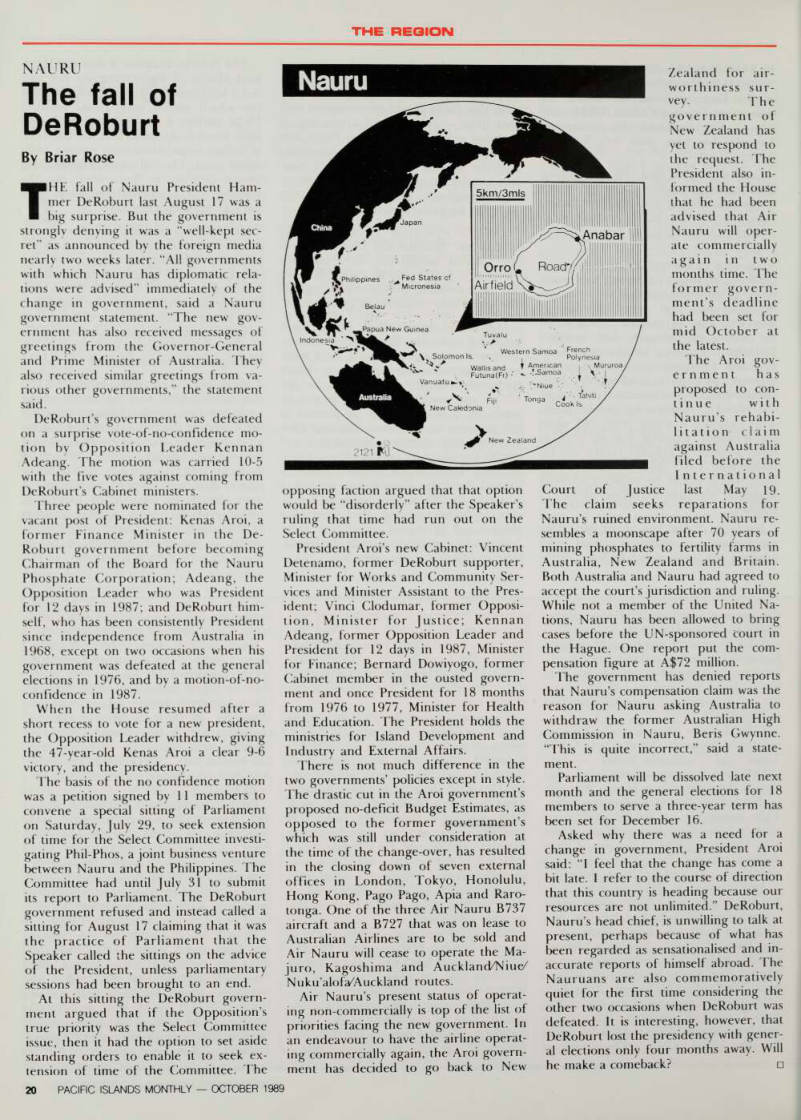
Nauru
The fall of Deroburt
By Briar Rose
THE fall of Nauru President Ham mer Deßoburt last August 17 was a big surprise. But the government is strongly denying it was a “well-kept sec ret” as announced by the foreign media nearly two weeks later. “All governments with which Nauru has diplomatic rela tions were advised” immediately of the change in government, said a Nauru government statement. “The new gov ernment has also received messages of greetings from the Governor-General and Prime Minister of Australia. They also received similar greetings from va rious other governments,” the statement said.
Deßoburt’s government was defeated on a surprise vote-of-no-confidence mo tion by Opposition Leader Kennan Adeang. The motion was carried 10-5 with the five votes against coming from Deßoburfs Cabinet ministers.
Three people were nominated for the vacant post of President: Renas Aroi, a former Finance Minister in the De- Roburt government before becoming Chairman of the Board for the Nauru
Phosphate Corporation; Adeang, the
Opposition Leader who was President for 12 days in 1987; and Deßoburt him self, who has been consistently President since independence from Australia in 1968, except on two occasions when his government was defeated at the general elections in 1976, and by a motion-of-no confidence in 1987.
When the House resumed after a short recess to vote for a new president, the Opposition Leader withdrew, giving the 47-year-old Renas Aroi a clear 9-6
victory, and the presidency.
The basis of the no confidence motion was a petition signed by 11 members to convene a special sitting of Parliament on Saturday, July 29, to seek extension of time for the Select Committee investi gating Phil-Phos, a joint business venture between Nauru and the Philippines. The Committee had until July 31 to submit its report to Parliament. The Deßoburt government refused and instead called a sitting for August 17 claiming that it was the practice of Parliament that the Speaker called the sittings on the advice of the President, unless parliamentary sessions had been brought to an end.
At this sitting the Deßoburt govern ment argued that if the Opposition’s true priority was the Select Committee issue, then it had the option to set aside standing orders to enable it to seek ex tension of time of the Committee. The
opposing faction argued that that option
would be “disorderly” after the Speaker’s ruling that time had run out on the Select Committee.
President Aroi’s new Cabinet: Vincent Detenamo, former Deßoburt supporter, Minister for Works and Community Services and Minister Assistant to the Presidem; Vinci Clodumar, former Opposition, Minister for Justice; Kennan Adeang, former Opposition Leader and President for 12 days in 1987, Minister for Finance; Bernard Dowiyogo, former Cabinet member in the ousted government and once President for 18 months from 1976 to 1977, Minister for Health and Education. The President holds the ministries for Island Development and Industry and External Affairs.
There is not much difference in the
two governments’ policies except in style.
The drastic cut in the Aroi government’s proposed no-deficit Budget Estimates, as opposed to the former government’s which was still under consideration at the time of the change-over, has resulted in the closing down of seven external offices in London, Tokyo, Honolulu, Hong Kong, Pago Pago, Apia and Rarotonga. One of the three Air Nauru 8737 aircraft and a 8727 that was on lease to Australian Airlines are to be sold and Air Nauru will cease to operate the Ma-
jure, Kagoshima and Auckland/Niue/
Nuku’alofa/Auckland routes.
Air Nauru’s present status of operating non-commercially is top of the list of priorities facing the new government. In an endeavour to have the airline operat-
ing commercially again, the Aroi govern-
ment has decided to go back to New
Zealand for air worthiness sur vey. The government of New Zealand has yet to respond to the request. The President also in formed the House that he had been advised that Air Nauru will oper
ate commercially
again in two months time. The former govern ment’s deadline had been set for mid October at the latest.
The Aroi gov ernment has proposed to con tinue with Nauru’s rehabi litation claim
against Australia
filed before the International
Court of Justice last May 19.
The claim seeks reparations for Nauru’s ruined environment. Nauru re sembles a moonscape after 70 years of
mining phosphates to fertility farms in
Australia, New Zealand and Britain.
Both Australia and Nauru had agreed to accept the court’s jurisdiction and ruling.
While not a member of the United Na tions, Nauru has been allowed to bring cases before the UN-sponsored court in the Hague. One report put the com pensation figure at As 72 million.
The government has denied reports that Nauru’s compensation claim was the reason for Nauru asking Australia to withdraw the former Australian High Commission in Nauru, Beris Gwynne.
“This is quite incorrect,” said a state ment.
Parliament will be dissolved late next month and the general elections for 18 members to serve a three-year term has been set for December 16.
Asked why there was a need for a change in government, President Aroi said: “I feel that the change has come a bit late. I refer to the course of direction that this country is heading because our resources are not unlimited.” Deßoburt, Nauru’s head chief, is unwilling to talk at present, perhaps because of what has been regarded as sensationalised and in accurate reports of himself abroad. The Nauruans are also commemoratively quiet for the first time considering the other two occasions when Deßoburt was defeated. It is interesting, however, that Deßoburt lost the presidency with gener al elections only four months away. Will he make a comeback? □
Advertisements & other items, p. 20 (1 item)
20
PACIFIC ISLANDS MONTTHLY OCTOBER 1989
THE REGION
kissing cousins
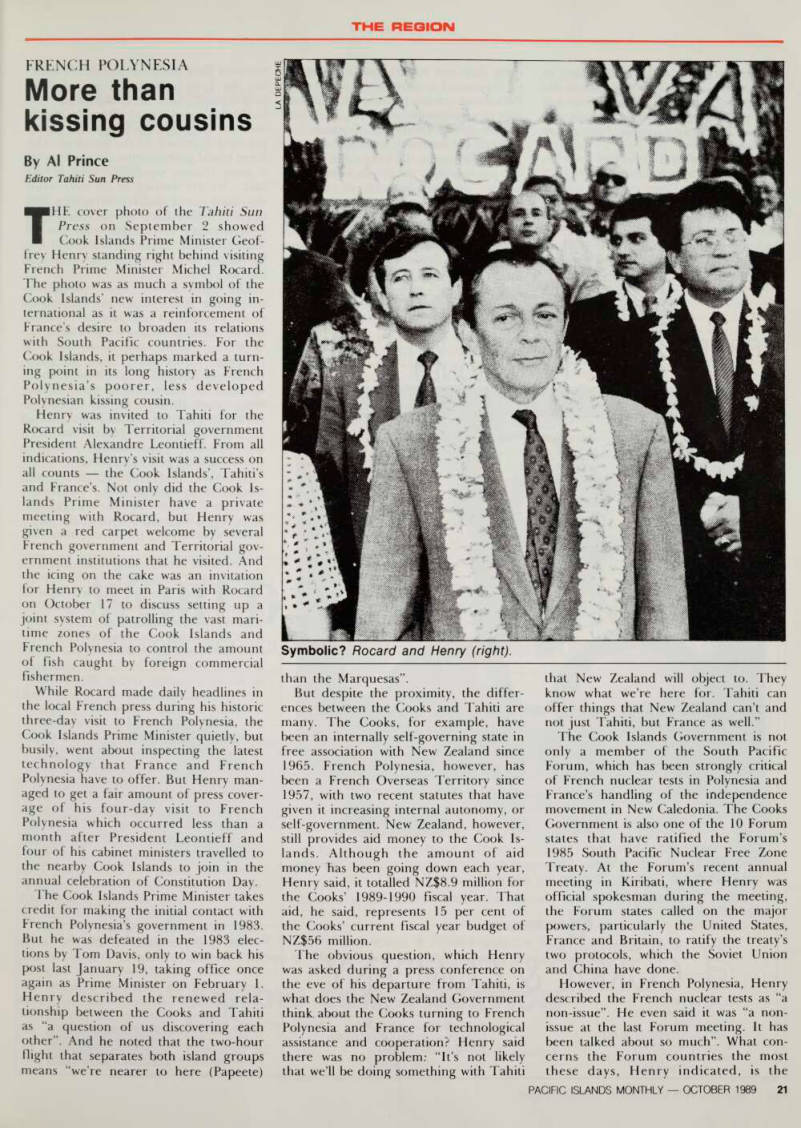

French Polynesia
More than kissing cousins
By Al Prince
Editor Tahiti Sun Press
THE cover photo of the Tahiti Sun Press on September 2 showed Cook Islands Prime Minister Geof
frey Henry standing right behind visiting
French Prime Minister Michel Rocard.
The photo was as much a symbol of the Cook Islands’ new interest in going in ternational as it was a reinforcement of France’s desire to broaden its relations with South Pacific countries. For the Cook Islands, it perhaps marked a turn ing point in its long history as French
Polynesia’s poorer, less developed
Polynesian kissing cousin.
Henry was invited to Tahiti for the Rocard visit by Territorial government President Alexandre Leontieff. From all indications, Henry’s visit was a success on all counts the Cook Islands’, Tahiti’s and France’s. Not only did the Cook Is lands Prime Minister have a private meeting with Rocard, but Henry was given a red carpet welcome by several French government and Territorial gov ernment institutions that he visited. And the icing on the cake was an invitation for Henry to meet in Paris with Rocard on October 17 to discuss setting up a joint system of patrolling the vast mari time zones of the Cook Islands and French Polynesia to control the amount
of fish caught by foreign commercial
fishermen.
While Rocard made daily headlines in the local French press during his historic three-day visit to French Polynesia, the Cook Islands Prime Minister quietly, but busily, went about inspecting the latest technology that France and French Polynesia have to offer. But Henry man aged to get a fair amount of press cover age of his four-day visit to French Polynesia which occurred less than a month after President Leontieff and four of his cabinet ministers travelled to the nearby Cook Islands to join in the annual celebration of Constitution Day.
The Cook Islands Prime Minister takes credit for making the initial contact with French Polynesia’s government in 1983.
But he was defeated in the 1983 elec tions by Tom Davis, only to win back his post last January 19, taking office once again as Prime Minister on February 1.
Henry described the renewed rela tionship between the Cooks and Tahiti as “a question of us discovering each other”. And he noted that the two-hour flight that separates both island groups means “we’re nearer to here (Papeete)
than the Marquesas”.
But despite the proximity, the differences between the Cooks and Tahiti are many. The Cooks, for example, have been an internally self-governing state in free association with New Zealand since 1965. French Polynesia, however, has been a French Overseas Territory since 1957, with two recent statutes that have given it increasing internal autonomy, or self-government. New Zealand, however, still provides aid money to the Cook Islands. Although the amount of aid money has been going down each year, Henry said, it totalled NZ$B.9 million for the Cooks’ 1989-1990 fiscal year. That aid, he said, represents 15 per cent of the Cooks’ current fiscal year budget of NZ$56 million.
The obvious question, which Henry was asked during a press conference on the eve of his departure from Tahiti, is what does the New Zealand Government think, about the Cooks turning to French Polynesia and France for technological assistance and cooperation? Henry said there was no problem: “It’s not likely that we’ll be doing something with Tahiti
that New Zealand will object to. They know what we’re here for. Tahiti can offer things that New Zealand can’t and not just Tahiti, but France as well.”
The Cook Islands Government is not only a member of the South Pacific Forum, which has been strongly critical of French nuclear tests in Polynesia and France’s handling of the independence movement in New Caledonia. The Cooks Government is also one of the 10 Forum states that have ratified the Forum’s 1985 South Pacific Nuclear Free Zone Treaty. At the Forum’s recent annual meeting in Kiribati, where Henry was
official spokesman during the meeting,
the Forum states called on the major powers, particularly the United States, France and Britain, to ratify the treaty’s two protocols, which the Soviet Union and China have done.
However, in French Polynesia, Henry described the French nuclear tests as “a non-issue”. He even said it was “a non issue at the last Forum meeting. It has been talked about so much”. What con cerns the Forum countries the most these days, Henry indicated, is the
Symbolic? Rocard and Henry (right).
Japanese practice of drift-net fishing in the South Pacific. Henry said during the Forum meeting: “The fisheries issue has drawn us all together against Japan and Taiwan the two countries have got us against them now. The issue of fisheries has certainly been a powerful force in drawing the Forum countries together.”
And although Tahiti does not qualify to be a Forum member because of its non-independent status, the fisheries issue has drawn it, along with France, closer to the Cook Islands and Kiribati.
The Cooks’ 15 islands are scattered over
more than two million square kilometres of ocean. By comparison, French Polynesia’s more plentiful islands are part of an economic zone that totals four million square kilometres of ocean.
When the economic maritime zones of French Polynesia, the Cooks and Kiribati are put together, the result is some nine million square kilometres of ocean, a
huge area to patrol.
The Cooks are getting their first pat rol boat on October 2, Kiribati is looking at getting its first patrol boat also, Henry said. French Polynesia’s Territorial gov
eminent does not have any patrol boats, but the French Navy has several ships permanently based in Tahiti and New Caledonia, another of France’s Pacific overseas territory. Henry showed a very practical approach to the problem. The three island governments are working on
a joint fishing operation venture, he
said. “We are looking at the time when the Cook’s and Tahiti’s fishermen fish together rather than buy back their own fish in cans.” French Polynesia has 18 fishing vessels for the venture and the Cooks are hoping to have six vessels it can use, Henry said.
The Cook Islands’ fishing problem is
simple, he said. Rarotonga, the biggest
of the Cooks with a population of 9000, has 21 restaurants, all of which are short of fresh fish, he said. Henry said his meeting with French Prime Minister Rocard on August 24 dealt with direct cooperation from France and indirect
cooperation through French Polynesia.
Henry said the Cook Islands are looking for cooperation from France “in every
way possible economically, socially,
technologically and educationally”.
Speaking of French Polynesia, the Cooks Prime Minister said, “This coun try leads the Pacific in solar energy, tele communications and hydroelectricity,” which were among the installations that he visited.
Television broadcasting is scheduled to begin in the Cooks shortly before Christ mas, he said. Besides locally-produced programmes, there will be programmes sent from New Zealand and daily world news broadcasts transmitted from New Zealand by satellite. However, the Cooks are also interested in French assistance to set up a satellite system that will per mit the transmission of French and Tahitian language television program mes to the Cooks and the eventual trans mission of programmes from the Cooks to Tahiti.
During the Cook Islands Prime Minis ter’s visit to French Polynesia members of his government met with the Caisse Centrale de Cooperation Economique to negotiate an agreement for a 15-year loan of 660 million French Pacific francs (about $5.7 million) for a thermo electricity plant on Rarotonga. This would be the Caisse Centrale’s first loan to the Cooks. If the loan is approved next month by the Caisse Centrale in Paris, interest rate will be 7 per cent.
But Henry emphasised that the Cooks are not just turning to France for aid.
The Australian Government recently announced Asl million in economic aid for the Cooks, he said. And the Cooks should know sometime this month how much economic assistance it will be re ceiving from the United States over the next three years. Henry expects the amount to be “significant”. n
Advertisements & other items, p. 22 (1 item)
«B Samsung
PRODUCTS FOR PEOPLE WITH MORE
SENSE THAN MONEY
To own a Samsung TV Screen, Samsung Video Deck and Samsung Remote Control Unit!
That’d Great!
That makes the Samsung Combination the most inexpensive of its kind. Go for the best view. Samsung quality is good enough for the 1988 Olympic Games. Should be ideal for your home!
Available at selected Duty Free Dealers and Burns Philp Home Centres throughout Fiji.
SAMSUNG
SOLE DISTRIBUTORS:-
CORRIE & COMPANY
HEAD OFFICE
G.P.O. BOX 45, SUVA
TLX: FJ2166
CABLES: 'CORRICO’ SUVA
TELEPHONE: 386777
BANKERS; WESTPAC, SUVA
FAX: (679) 300610
BRANCH OFFICE:
161 VITOGO PARADE
G.P.O. BOX 83, LAUTOKA
CABLES: “CORRICO" LAUTOKA
TELEPHONE: 60137
14th birthday
Papua New Guinea
A not so happy 14th birthday
By Liz Thompson
PAPUA New Guinea was fourteen years old as a sovereign nation on September 16. The opening of the 15th anniversary is looked on with both fear and enthusiasm by most. In the face of continuing unrest and no solution to the Bougainville crisis, Nama liu warned the nation in his independ ence day address that the country must set aside its differences. Indeed, as the Bougainville copper mine remained closed, the financial figures for next year are continually bleaker. With the mine providing 17 per cent of the national and 40 per cent of export revenue, 1990 finances are going to be hard hit. The continuing drop in world copra and cof fee prices, two of Papua New Guinea’s other major exports, half the copra
being previously produced in Bougain
ville, does not improve the economic outlook.
Negotiations took another tragic turn
on Sunday, September 10 when John Bika, the Minister for Commerce who headed a commission responsible for negotiating with the landowners, was shot dead at home in front of his family.
Bika was on his way to Port Moresby to see the signing of an agreement he had been instrumental in engineering be tween the National government and the landowners. The agreement was reached after exhaustive talks between both par ties. Offers by the national government included half the government’s equity in the mine on very reasonable terms,
greatly improved compensation and
community developments valued at ab out K2OO million. In addition to this Bougainville Copper Limited has come forward with a package worth K4O mil lion to cover a seven-year period. Prime Minister Rabbie Namaliu called the agreement “a very generous package by anyone’s standards”. The signing was seen as a landmark. But due to the shooting of Bika, it was indefinitely post poned.
Justice Minister Bernard Narakobi confirmed the growing opinion that the
militants were increasingly alienating
themselves from the rest of the com munity. In the killing of Bika the people of Bougainville had lost a good leader
and the people of PNG had lost a man of reconciliation. He had appealed to the North Solomons people not to be “fooled anymore by the militants with
their propaganda and trickery”.
The unusually large degree of orga
nisation amongst the militants and their supply of arms point to the possibility someone was helping from outside.
Namaliu agreed that could be the case: It is not possible for a group to purpor trate these kind of activities or this kind of violence for the past 10 months with out them having advisers or people trained in military tactics,” he said. He added that the government knew the militants were getting weapons from within the province and from other parts of Papua New Guinea, again pointing to the existence of a far broader network.
Namaliu said government had a good idea who were helping the militants but he didn’t say if they were locals or fore
igners.
The government continues to promote policies that can diversify the economy.
Agriculture is being encouraged more
than anything else to help rural develop ment and put the brakes on urban drift.
The Bougainville rebellion continues to haunt the government. □
Advertisements & other items, p. 23 (1 item)
World Leaders In ...
FORMWORK, SCAFFOLDING and SUPPORT SYSTEMS FOR HIRE and SALE
SfMSt
y mm i Si mm ■■ S* * ? ■ »* :» « r' mm im % m m. t&: m. ‘U’ Form Steel Flex Forms • Major Slim Soldiers • Form Hardware • Special Forms • Acrowskaf Tubes & Fittings • Shore Brace • Metric Frames • Acrow Props
ACROW CONSTRUCTION
Wailada Industrial Estate, Lot 14-16, Section 36 Lami, Suva. Bouwalu Street, Phone: 361 322 Namoli Industrial Estate, Lautoka Fax: 302 929 Phone; 61944
patrol boat
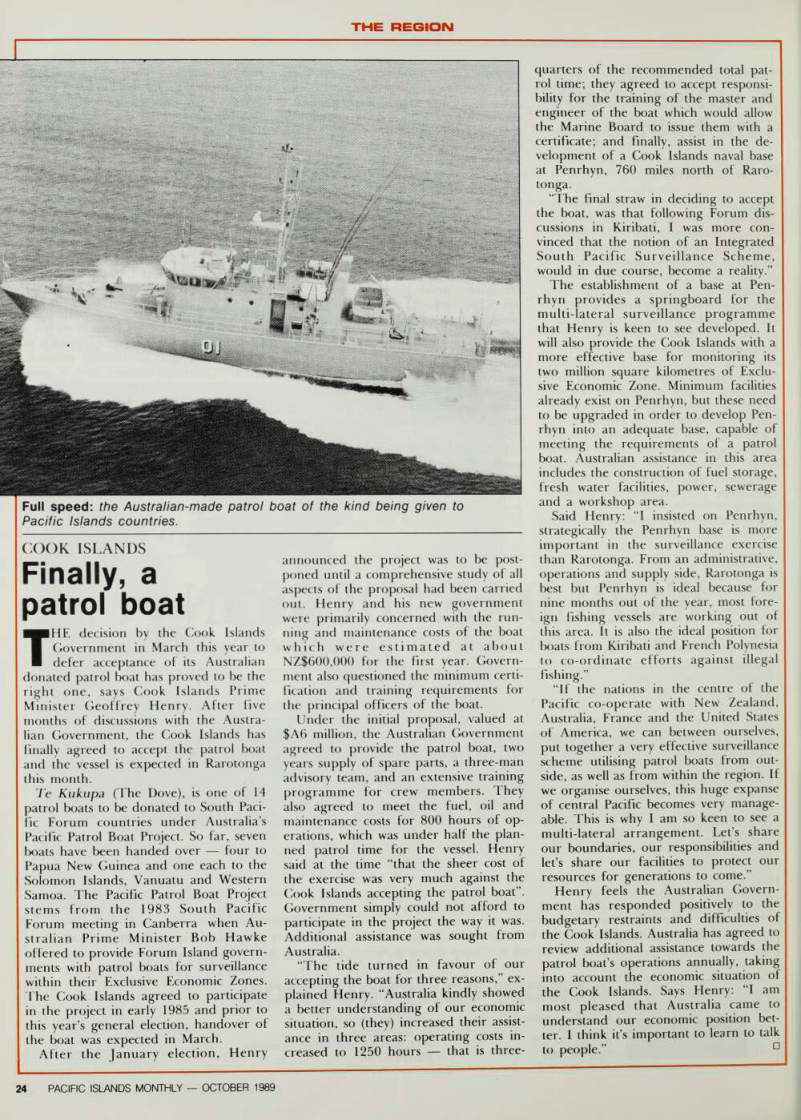
Cook Islands
Finally, a
THE decision by the Cook Islands Government in March this year to defer acceptance of its Australian donated patrol boat has proved to be the right one, says Cook Islands Prime Minister Geoffrey Henry. After five months of discussions with the Austra lian Government, the Cook Islands has finally agreed to accept the patrol boat and the vessel is expected in Rarotonga this month.
Te Kukupa (The Dove), is one of 14 patrol boats to be donated to South Paci fic Forum countries under Australia’s Pacific Patrol Boat Project. So far, seven boats have been handed over four to Papua New Guinea and one each to the Solomon Islands, Vanuatu and Western Samoa. The Pacific Patrol Boat Project stems from the 1983 South Pacific Forum meeting in Canberra when Au stralian Prime Minister Bob Hawke offered to provide Forum Island govern ments with patrol boats for surveillance within their Exclusive Economic Zones, 4 he Cook Islands agreed to participate in the project in early 1985 and prior to this year’s general election, handover of the boat was expected in March.
After the January election, Henry
announced the project was to be post poned until a comprehensive study of all aspects of the proposal had been carried out. Henry and his new government were primarily concerned with the run ning and maintenance costs of the boat which were estimated at about NZ$6OO,OOO for the first year. Govern ment also questioned the minimum certi fication and training requirements for the principal officers of the boat, Under the initial proposal, valued at SA6 million, the Australian Government agreed to provide the patrol boat, two years supply of spare parts, a three-man advisory team, and an extensive training programme for crew members. They also agreed to meet the fuel, oil and maintenance costs for 800 hours of op erations, which was under half the plan ned patrol time for the vessel. Henry said at the time “that the sheer cost of the exercise was very much against the Cook Islands accepting the patrol boat”, Government simply could not afford to participate in the project the way it was.
Additional assistance was sought from Australia.
“The tide turned in favour of our accepting the boat for three reasons,” ex plained Henry. “Australia kindly showed a better understanding of our economic situation, so (they) increased their assist ance in three areas: operating costs in creased to 1250 hours that is three
quarters of the recommended total pat rol time; they agreed to accept responsi bility for the training of the master and engineer of the boat which would allow the Marine Board to issue them with a certificate; and finally, assist in the de velopment of a Cook Islands naval base at Penrhyn, 760 miles north of Raro tonga.
“The final straw in deciding to accept the boat, was that following Forum dis cussions in Kiribati, I was more con vinced that the notion of an Integrated South Pacific Surveillance Scheme, would in due course, become a reality.”
The establishment of a base at Pen
rhyn provides a springboard for the
multi-lateral surveillance programme that Henry is keen to see developed. It will also provide the Cook Islands with a more effective base for monitoring its two million square kilometres of Exclu sive Economic Zone. Minimum facilities already exist on Penrhyn, but these need to be upgraded in order to develop Pen rhyn into an adequate base, capable of
meeting the requirements of a patrol
boat. Australian assistance in this area includes the construction of fuel storage, fresh water facilities, power, sewerage and a workshop area.
Said Henry: “I insisted on Penrhyn, strategically the Penrhyn base is more important in the surveillance exercise than Rarotonga. From an administrative, operations and supply side, Rarotonga is best but Penrhyn is ideal because for nine months out of the year, most fore ign fishing vessels are working out of this area. It is also the ideal position for boats from Kiribati and French Polynesia to co-ordinate efforts against illegal
fishing.”
“If the nations in the centre of the Pacific co-operate with New Zealand, Australia, France and the United States of America, we can between ourselves, put together a very effective surveillance scheme utilising patrol boats from out side, as well as from within the region. If we organise ourselves, this huge expanse of central Pacific becomes very manage able. This is why I am so keen to see a multi-lateral arrangement. Let’s share our boundaries, our responsibilities and let’s share our facilities to protect our resources for generations to come.”
Henry feels the Australian Govern ment has responded positively to the budgetary restraints and difficulties of the Cook Islands. Australia has agreed to review additional assistance towards the
patrol boat’s operations annually, taking
into account the economic situation of the Cook Islands. Says Henry: “I am most pleased that Australia came to understand our economic position bet ter. I think it’s important to learn to talk to people.” D
Full speed: the Australian-made patrol boat of the kind being given to Pacific Islands countries.
Pacific
Islands
Month Ly
Business
Millions down the drain
Reports highlight misuse of funds
By Robin Bromby
TWO recent reports have pinpointed areas of financial management problems in the region. The Audit Department in Western Samoa has iden tified what it terms irregularities in gov ernment department accounts, while in Papua New Guinea it is claimed more than KBO million has been wasted on
rural development programmes during
the past 10 years.
Western Samoa’s Acting Controller and Chief Auditor, Fatalevave Leni War ren, has warned against public com placency towards the list of irregularities in government finances contained in the Audit Department’s latest report. War ren said that audit and departmental controls had not been intensive enough to bring “the inevitable thefts, defalca tions and rackets to light ”. The biggest losses were due to motor accidents which cost W 5568,633 in the six months to June 1989. Then followed misappropri ated cash ($33,242) and loss of stores through theft and burglary ($19,745).
The report said the Audit Department had difficulty determining the extent of
telephone charges caused by private
calls, that there was a five-year backlog with the English Hansard and the Par liamentary bar accounts were confused, it not being clear whether some mem bers’ accounts had been paid. The Attor ney-General’s office had not submitted an annual report to the Prime Minister and financial reports were not always completed on time.
Warren reported the Broadcasting De partment had not supplied any financial accounts since 1980. An audit showed debtors owing $30,722 but this was not accurate as ledgers were posted only to November 1987 and journals to August 1987, and no action had been taken to recover money in arrears. The Audit De partment blames the shortage of experi enced staff and an inadequate internal
control system.
While the Customs Department had made improvements, the same could not be said for the Education Department in Western Samoa. Accounts had been de layed and the department had not com
plied with regulations governing hand
ling of cash and maintenance of accounts. Some personal files could not be found; where they could be, cases of both overpayment and underpayment of salaries were discovered. Leave records and attendance books were not properly kept, the report said. It could not verify that overseas calls were private or offi cial. It was found that in stationery stock records some figures had been altered.
The Health Department was also criti cised for inadequate financial controls.
In Port Moresby, the Institute of Ap plied Social and Economic Research has just published a report on the country’s five Integrated Rural Development Prog rammes, which were designed to im prove living standards in the lesser de veloped provinces. It concludes that much of the KB2 million spent, which was largely provided by the World Bank and Asian Development Bank, was mis used project planning was poor, rushed and unrelated to political, social, administrative or cultural realities.
The five projects were established in the East Sepik, Southern Highlands, Enga, West Sepik and Thimbu pro vinces.
The Southern Highlands Rural De velopment Project (SHRDP) cost more than K 23 million and failed in its main objective, which was to establish
cash cropping.
The institute’s report said the South ern Highlands project was the largest of the five in Papua New Guinea and was regarded as a show piece and model for the other provinces. But there were problems from the outset: the impetus had come from local politicians, but when the SHRDP was taken over by the
Department of Finance the local leaders rejected it “it was no longer theirs and they no longer wanted it”, the report said.
The Poroma-Koroba Highway was completed a year ahead of schedule, but there were many delays in recruiting ex patriate staff. But the greatest problem was that the management structure for cash cropping was so complex that those recruited to run it did not have adequate skills.
The project involved the planting of coffee, tea and other crops, electrifica tion, the highway, roads into the planta tions, schools and health facilities. Poor programme management meant loan spending was too slow and the World Bank extended the deadline for comple tion. When it came to completion, both the provincial secretary and the South ern Highlands provincial government re fused to accept responsibility for the project. Eventually a handover was com
pleted.
The report summed up the problems as: • The whole project was complex and unwieldy, there were management con flicts and provincial leaders felt they were locked into a situation over which they had no control. • Recruitment was impossibly slow;
halfway through the project’s life, only
eight of 18 expatriate positions and 16 of the 45 local jobs were filled. • There was little time for training and integration between staff was often non-existent. • There was no clear statement of objectives, so that there were different views of the aims. • Monitoring was largely viewed as a nuisance and it was this which led to the failure of the project’s main income generator, cash cropping. • Key members left without handing over reports on what they had done. • There was little supervision by the national government. □
States agree
on energy
PACIFIC states have agreed to establish a multi-state energy au thority along the lines of the Forum Fisheries Agency. This followed a meeting in Honolulu at the East-West Centre which brought together energy ministers and officials from the Cook Is lands, Federated States of Micronesia, Fiji, Kiribati, Palau, Solomon Islands, Tonga, Tuvalu and Western Samoa.
Several companies also participated in the meeting, including British Pet roleum, Hawaiian Electric, Mobil Oil, Pacific Resources Inc and Shell Oil.
The proposal for a regional energy agency was raised by a joint mission from the Pacific Forum Secretariat and the United Nations Development Prog ram (UNDP). Mission leader Fereidun Fesharaki from the East-West Centre said the argument against a pro liferation of new agencies was under stood. “In the case of energy we do not suggest new programmes but rather the consolidation of existing activities into a more permanent and effective form,”
Fesharaki said.
It has been recommended the new body be called the Pacific Forum Energy Agency under the Forum umbrella but without the day-to-day Forum Secretariat control of activities or budget.
Fesharaki told Pacific Islands Monthly it was inevitable the new agency would be located in Fiji “although not everyone was happy about that”. The prime task would be for the new agency to plan funding of energy programmes, and to negotiate new grants after current UNDP aid expires in 1991. But, long term, it was important that officials in volved in energy policies were well trained and knowledgeable when it came to negotiating contracts. Fesharaki said Fiji was able to negotiate petroleum sup plies at a price cheaper than available in either Los Angeles or Hawaii.
“They have learned the knack of it,”
he said. “There is a need in all the coun tries to get good information. The oil
companies are happier when they feel
that, in negotiations, the other side knows what it is doing.”
The agency would also concentrate on looking for the most efficient ways of using oil and electricity. Demand for electricity would increase with growing urbanisation in the Pacific island states, Fesharaki said. It is proposed that an annual regional energy meeting should review progress of the new agency, as well as decide policy, approve work plans and look at programmes for training.
The mission which reported to the re cent conference in Hawaii identified priorities as exploration of new and re newable energy technologies, energy management techniques, advice on en vironmental issues and working more closely with the World Bank, Asian De velopment Bank and other potential donors.
This was the second meeting of energy ministers, the 1988 conference having been the first time the leaders and their officials had met to discuss regional and international energy issues. This year, as well as companies mentioned above, the ministers were joined by observers from the Asian Development Bank, United States Department of Energy, Australian Department of Primary Industries and Energy and several Hawaiian and Pacific
regional organisations.
In his opening speech, Hawaii’s Lieutenant Governor, Benjamin Cayeta no, said the state was ready to share its expertise in alternative energy with other Pacific Islanders. He told delegates Hawaii was proud of its achievements in ocean thermal, solar and wind genera tion.
Meanwhile, a former director of ener gy for the Fiji Government has called on Australia to provide more assistance for the Pacific states to develop technology so they could harness local energy re sources. Suliana Siwatibau told an aid conference in Sydney it was essential that the island states reduce their depend ence on expensive imported fuel. □
New hope
for cocoa
COCOA yields could leap as much
30 per cent with the release in Papua New Guinea of a new che mical which will combat two major crop diseases canker and blackpod. The chemical, named Fos-ject 600, was de veloped at the Papua New Guinea Cocoa and Coconut Research Institute in col laboration with an Australian company, UIM Agrochemicals (Australia) Ltd.
The Fos-ject 600 fungicide, a type of neutralised phosphorous acid, is injected into the cocoa tree trunk through a syringe technique. The director of the Cocoa and Coconut Research Institute, Dr Mark Holderness, said the economic life of a cocoa tree could be prolonged significantly with the new fungicide; tests over three years showed canker was re duced by an average 90 per cent, black pod by 50 per cent.
Blackpod is the greatest headache
(apart from falling world prices) for
Papua New Guinea’s cocoa farmers and the country’s growers will be the first to use the new fungicide. Other applica
tions, including a gas-powered injector,
are also being tested. Dr Holderness said an added bonus of the syringe injection method was its not being restricted by weather conditions. The research insti tute conducted trials over 70 hectares at
various cocoa growing regions incorpor
ating diverse climatic conditions and
management practices.
It was also safe for users, and for the environment, he said. The tests had shown there was no need for chemical residues or flavour taint.
The New Guinea Islands Produce Company has welcomed the new pro duct. A company spokesman said it would help boost production and that all smallholder growers should be im mediately educated on how to apply the new method of controlling canker and blackpod. He also called on the Agricul ture Bank or a government agency to help supply syringes and the chemical in bulk to growers. □
Tourism’s going to school
A TOURISM school is to be estab lished as part of Papua New Guinea’s new push to become a major tourist destination. The school, to be located within the Lae Technical Col lege, will train nationals in hotel, cater ing and tourism both within the public sector and in private ventures.
Prime Minister Rabbie Namaliu and Tourism Minister Gerald Beona have announced a five-year plan which will allow investors such incentives as tax
holidays, reduced airfares and accom modation charges, lower interest rates on loans and the exemption from tariffs of
capital equipment imported for hotels
and motels. “The government wants to aim at 60,000 arrivals a year compared with the 37,000 people who visited Papua New Guinea in 1987. The Prime Minister said infrastructural facilities such as airports, roads, hotels, water sup plies and sanitation, as well as electricity supplies and telephone services, would
be improved to attract tourists.
These improvements would also help open up rural areas, and the tourism benefits would need to go directly to the people and the country. “The imple mentation of the national tourism de velopment plan will be controlled so that it generates both economc and socio cultural benefits without serious disrup tion to traditional cultures and lifestyles of Papua New Guinea,” Namaliu said.
He said the government, through the Department of Culture and Tourism, would encourage more national parti
cipation. □
FINANCIALLY-troubled Hawaiian
New owners for Hawaiian Air
Airlines is about to get a new own er, a group of investors including the highly-regarded Peter V. Ueberroth, formerly the csar of professional baseball in the United States. Ueberroth, his brother John, and, leading the group, California investor J. Thomas Talbott, have agreed to buy 51 percent of Hawaii Air, and to invest an unstated amount of additional capital in the business.
Hawaiian Airlines parent company, HAL Inc., had fallen on bad times, re porting a net loss of US $19.1 million in the first six months of this year. At the time of the sale HAL had a negative net worth of US$B.5 million. The line, however, has a fleet of 29 aircraft, and operates flights between a number of locations on the US West Coast and in the Pacific, including American Samoa, Western Samoa, Tonga, Tahiti, Guam, Australia and New Zealand. The airline’s hub, and its central office, are in Hon olulu. It also does a global charter busi ness, for the US military and other cus tomers, and runs an inter-island service within the Hawaiian chain of islands.
One of its scheduled routes, on which it has a monopoly, is between Hawaii, Apia and Pago Pago. It carries the mail and medical supplies, and is used by Un ited States Government and American Samoan officials as they move back and forth in their work.
Hawaiian Airlines operation on this route has been the subject of frequent and sharp criticism for repeated delays and unpredictable practices. The carrier uses DCBs and L-1011s on this route, and charges $350 for a full-price one way coach fare (though most tickets are sold at various discounts). A round-trip, discounted fare from Los Angeles to Pago Pago and back costs $Bl9.
American Samoa’s congressman, Eni
F.H. Faleomaveaga, a frequent flyer on
airline, welcomed the new ownership. “I hope that this name means that Amer ican Samoa will get better service; I do feel that the Samoa route was given too low a priority in the past.” The Con gressman said that he planned to meet with the new owners in the near future.
Ueberroth is known as an ambitious and restless man. He rose to fame in the
United States when he successfully man aged the extravaganza which were the 1984 Olympics in Los Angeles. He went on to the highly visible position of Base ball Commissioner and during his term in the post he was occasionally men tioned as a long-shot possibility for the White House. After leaving baseball to return to business, he tried to gain con trol of Eastern Airline, a major US Mainland air system, but failed. In the Hawaii Air venture he apparently has succeeded in another of his life goals, to control an airline.
Ueberroth’s colleague, tipped to be the new board chairman of Hawaiian Air lines, is Talbott, the founder of Jet America, a West Coast airline.
The formal transfer of ownership, a$ is often the case with American corpora tions, will take a while. The Board of Directors of HAL Inc. has voted unani mously to recommend the sale to the stockholders, who will assemble, in Hon olulu, in October 19 to vote on the mat ter. Then, if the vote is favourable, as expected, it will be necessary to secure the approval of various transportation and financial regulatory agencies in Washington before the new owners can take over. □
PNG relaxes
aviation rules
ANY international airline which wishes to operate charter flights into Papua New Guinea will be free to do so under new civil aviation regulations, and Port Moresby, Nadzab and Wewak will be open to international air charter operators. 1 he radical new policy, which changes the entire groundrules for aviation poli cy in Papua New Guinea, was announced in Parliament by Civil Aviation Minister Bernard Vogae. The government wants to generate a more independent and
economically viable aviation industry,
boost business and promote tourism. Un til now, the country has had a highly controlled civil aviation industry with considerable powers residing with the minister of the day.
I he new policy provides for greater domestic and international competition, removal of government control of air lares, direct access for international air charter companies to the above mentioned three entry ports, encourag ing localisation of the aviation industry, subsidies to rural opeators and the con version of the Civil Aviation Department into a commercial statutory body.
Initially, only half the trunk routes within Papua New Guinea are to be de regulated to allow airlines, including Air Niugini and Talair, to adjust gradually
to the changes, but all rural routes will be thrown open to competition.
Fares will be left to the market forces; the government wants to see fares drop and has indicated it will re-enter the in dustry to control fares if they do go too
high. Existing foreign-owned airlines
must increase local ownership, and all new operators will be required to have a local shareholding. Meanwhile, the gov ernment will be moving to reduce the number of foreigners working in the air line industry in Papua New Guinea by
seeking help in training from Singapore.
The most immediate change will be the ability of private companies, such as Talair and Douglas Airways, to compete with Air Niugini on routes where the national carrier has had a monopoly. □
Advertisements & other items, pp. 27-29 (2 items)
Fiji Custom Craft Limited
rzzjaan o n
ALUMINIUM BOAT BUILDERS
WAILADA, LAMI,
P.O. Box 1277, SUVA, FIJI,
PHONE 361977, 361786,
TLX. FJ 2315. FAX 302814
FISHING BOATS, HYDROCATS, WATER TAXIS, CORAL VIEWERS, BARGES, SPECIALISED VESSELS
CUSTOMISED TO YOUR SPECIFICATIONS
Toyota
The Toyota Hilux is the world’s most popular pick-up.
And the Hilux 4X4 is the best-selling Hilux of them all. Which stands to reason. People around the world respect Toyota’s attention to style. Hilux’s car-like comfort. Rugged reliability. And as you might expect from Toyota, power. This, of course, is the most important asset for a truck. And happily, the Hilux 4X4 offers a choice of four powerful engines: 2.8 and 2.4-litre diesel engines. Plus 2.2 and 1.8-litre petrol engines. When it comes to power and good looks, nobody can beat Toyota. Nobody.
sab I ms* ■ = ( i 4 i vurn
Looking good
THE offshore finance industry in the Cook Islands took a major step forward recently when its largest
registered trustee company, European
Pacific Trust Company (Cook Islands) Limited, opened the doors to its new building the European Pacific Centre in downtown Avarua, Rarotonga. The European Pacific Centre houses the offices of the European Pacific Trust Company (Cook Islands) Limited and
the European Pacific Banking Corpora
t'()n - The company began operating in 1982, as the Cook Islands Trust Cor poration Limited, and was the first reg istered trustee company to be set up under the Cook Islands Offshore Fi nance Legislation. In November 1987, the company became a wholly owned subsidiary of the European Pacific Group and changed its name in 1988 to reflect this. It began in modest premises in Mercury House and as the business grew, expanded to other locations. In planning for the European Pacific Cen tre, Managing Director Trevor Clarke said that for efficiency, the group wanted all parts of the operation to be in one location. The group also desired prestigious premises and a comfortable,
pleasant working environment for staff.
Says Clarke: “It was important to have a building that reflected our high profes sional standards but one that was not inappropriate to the physical environ ment of Avarua.” Designed and built by Fletchers New Zealand, the hexagonal building is an outstanding addition to the Avarua landscape. Although contem porary in design, the exterior of the building still manages to capture the feel of the Pacific.
Once inside the building, it is easy to see that the company has achieved its much desired Pacific theme. Artwork from all round the Pacific covers most available wall space. While prominence has of course been given to Cook Islands art, the company’s collection includes work from Western Samoa, Tonga, Fiji, Solomon Islands, Papua New Guinea nd Vanuatu, as well as Australian Abor iginal and New Zealand Maori pieces.
“We are the largest offshore trust com pany in the South Pacific,” says Clarke.
“We played a leading role in the estab lishment of an offshore finance centre in the Cook Islands and its subsequent de velopment. We have a staff of forty which includes nine professional accoun tants and five lawyers. We are terribly committed to the Cook Islands and this building is a reflection of that commit ment □
Flying time
GUAM’S aviation world is in the news with Air Micronesia ex panding its fleet and services, a move by Taiwanese businessman into the area, and Continental’s plans to use Guam increasingly as a hub for its ser vices into Micronesia.
Air Micronesia is now using two F-27 turbo-prop aircraft for increased fre quency to the islands of Rota and
Saipan. Previously it operated just two
flights a week with a 727, but the people on Rota have been lobbying for a belter deal so they could expand their tourism businesses. Now the smaller aircraft will
fly Guam-Rota-Saipan twice daily, and a
third service Guam-Rota. A 1 Camacho, of Air Micronesia, told Pad tic Islands Monthly the Japanese were the main customers, flying to Rota on day excur sions; the island has a relatively new air port and terminal building, and tourism is second only to vegetables as a source of income. The main attractions are the beaches clean and unspoiled; archaeological sites and the many signs
of former Japanese occupation.
Apart from the 727, the services to
Rota were formerly operated by small
aircraft which tended to experience de
lays through technical problems. The
new service will add considerable freight capacity to the sector.
The United States government is sub sidising the Air Micronesia run under the Essential Air Service (FAS) program me. Saipan, too, is delighted with the new service, and Senate President Ben jamin T. Manglona said the island had suffered economically in recent years due to unreliable air transportation.
Only one of the F-27s will be needed to operate the daily runs, but Air Mic ronesia has taken two machines from another Continental subsidiary, Britt Airways, of Cleveland, so that flights will not be disrupted by technical faults.
Meanwhile, the chairman of Formosa Airlines, Hsin Chi-hsui, has paid US$9 million for a 45 per cent share of Guam Marianas Air. The plan for the airline includes leasing Short-360s for services between Guam and nearby islands, and Boeing 757 aircraft for services to Hawaii and Tokyo, with Taipei, Manila and Hong Kong also on the list of future destinations. Formosa Airlines is a Hong Kong-based carrier which operates into several southern Chinese cities.
Continental, too, is looking at more services out of Guam. The airline’s vice president for the Pacific-Asia area, Paul Casey, was quoted as saying flights be tween Guam and Bali, Darwin, Perth and Adelaide were being considered.
Burns Philp
Big lift for Burns Philp
IN a result which reflects a significant turnaround in the Fiji economy, Burns Philp (South Sea) Co Ltd has reported a record operating after-tax profit of F 54.609 million, a lift of 188 per cent on the previous year’s figure of F$ 1.597 million. Directors have recom mended a final dividend of 8.5 cents a share, plus a special dividend of 10 cents due to the group’s high liquidity. That, with the interim dividend, brings the tot al payout to shareholders for the year to 25 cents.
Group sales revenue at F 575.09 mil lion was up 17 per cent on last year. The directors announced that “this result re flects the significant turnaround in the
Fiji economy. Continuing stability under
the interim government brought a strong upsurge in consumer spending, benefitting the automotive, home centres and shipping businesses. In conjunction with the outstanding Fiji sector result,
branches outside Fiji again produced a
steady performance”.
Results in the second half of the finan cial year to June 30 were well ahead of the first six months.
The directors noted that Fiji’s eco nomy rebound was led by high sugar prices and increasing tourist numbers.
The report said all Fiji divisions and sub sidiaries of Burns Philp (South Sea) ex ceeded expectations, the higher consum er spending combining with earlier rationalisation of the Fiji businesses, Tonga, American Samoa, Western Samoa and Niue operations all produced
steady results.
The one disappointment expressed by
the directors was the Fiji’s exchange con trol restrictions prevented surplus funds from the disposal of non-strategic assets being invested at higher interest rates offshore. But the funds were used to reduce borrowings and, hence, interest expense.
The recovery of Burns Philp (South Sea) after the military coups in Fiji has been remarkable. After the first coup, the company found that trading was running at about 38 per cent of normal volume. It then climbed back to 75 per cent only to be knocked back to 40 per cent by the second coup. The company also lost much of its Indian middle man
agement through emigration.
A motor showroom in Ba and a timber yard in Lautoka were closed, while the company decided not to rebuild after a fire in Sigatoka. The company estimated the coups cost at about Asll million in book value, and staff levels fell from 842 to about 500. □
Mining
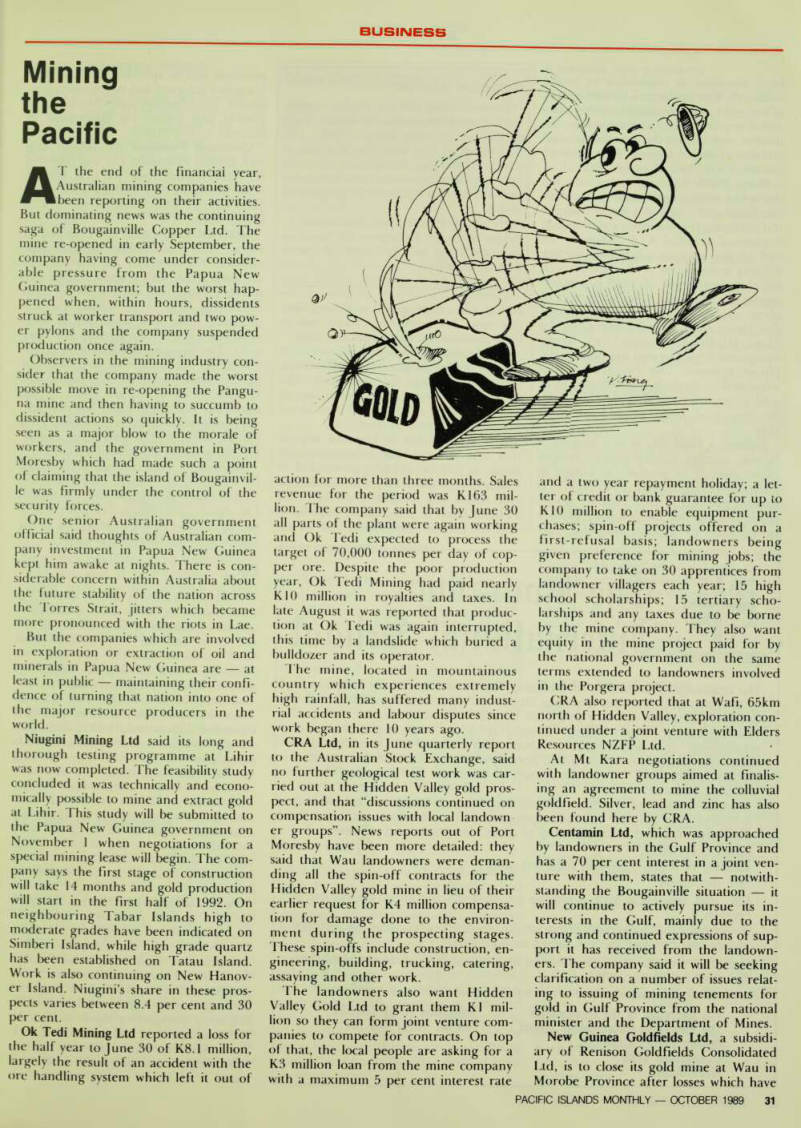
the Pacific
AT the end of the financial year, Australian mining companies have been reporting on their activities.
But dominating news was the continuing saga of Bougainville Copper Ltd. The mine re-opened in early September, the company having come under consider able pressure from the Papua New Guinea government; but the worst hap pened when, within hours, dissidents struck at worker transport and two pow er pylons and the company suspended production once again.
Observers in the mining industry con sider that the company made the worst possible move in re-opening the Pangu na mine and then having to succumb to dissident actions so quickly. It is being seen as a major blow to the morale of workers, and the government in Port Moresby which had made such a point of claiming that the island of Bougainvil le was firmly under the control of the security forces.
One senior Australian government official said thoughts of Australian com pany investment in Papua New Guinea kept him awake at nights. There is con siderable concern within Australia about the future stability of the nation across the Torres Strait, jitters which became more pronounced with the riots in Lae.
But the companies which are involved in exploration or extraction of oil and minerals in Papua New Guinea are at least in public maintaining their confi dence of turning that nation into one of the major resource producers in the world.
Niugini Mining Ltd said its long and thorough testing programme at Lihir was now completed. The feasibility study concluded it was technically and econo mically possible to mine and extract gold at Lihir. This study will be submitted to the Papua New Guinea government on November 1 when negotiations for a special mining lease will begin. The com pany says the first stage of construction will take 14 months and gold production will start in the first half of 1992. On neighbouring Tabar Islands high to moderate grades have been indicated on Simberi Island, while high grade quartz has been established on Tatau Island.
Work is also continuing on New Hanov er Island. Niugini’s share in these pros pects varies between 8.4 per cent and 30 per cent.
Ok Tedi Mining Ltd reported a loss for the half year to June 30 of KB.l million, largely the result of an accident with the ore handling system which left it out of
action for more than three months. Sales revenue for the period was K 163 million. Ihe company said that by June 30 all parts of the plant were again working and Ok Tedi expected to process the target of 70,000 tonnes per day of copper ore. Despite the poor production year, Ok Tedi Mining had paid nearly KlO million in royalties and taxes. In late August it was reported that production at Ok Tedi was again interrupted, this time by a landslide which buried a bulldozer and its operator.
The mine, located in mountainous country which experiences extremely high rainfall, has suffered many industrial accidents and labour disputes since work began there 10 years ago.
CRA Ltd, in its June quarterly report to the Australian Stock Exchange, said no further geological test work was carned out at the Hidden Valley gold prospeel, and that “discussions continued on compensation issues with local landown er groups”. News reports out of Port Moresby have been more detailed: they said that Wau landowners were demanding all the spin-off contracts for the Hidden Valley gold mine in lieu of their earlier request for K 4 million compensation for damage done to the environmenl during the prospecting stages.
These spin-offs include construction, en-
gineering, building, trucking, catering,
assaying and other work.
The landowners also want Hidden Valley Gold Ltd to grant them KI million so they can form joint venture companics to compete for contracts. On top of that, the local people are asking for a K 3 million loan from the mine company with a maximum 5 per cent interest rate
and a two year repayment holiday; a let ter of credit or bank guarantee for up to KIO million to enable equipment pur chases; spin-off projects offered on a first-refusal basis; landowners being given preference for mining jobs; the company to take on 30 apprentices from landowner villagers each year; 15 high school scholarships; 15 tertiary scho larships and any taxes due to be borne by the mine company. They also want equity in the mine project paid for by the national government on the same terms extended to landowners involved in the Porgera project, CRA also reported that at Wafi, 65km north of Hidden Valley, exploration con tinned under a joint venture with Elders Resources NZFP Ltd.
At Mt Kara negotiations continued with landowner groups aimed at finalis ing an agreement to mine the colluvial goldfield. Silver, lead and zinc has also been found here by CRA.
Centamin Ltd, which was approached by landowners in the Gulf Province and has a 70 per cent interest in a joint ven ture with them, states that notwith standing the Bougainville situation it will continue to actively pursue its in terests in the Gulf, mainly due to the strong and continued expressions of sup port it has received from the landown ers. The company said it will be seeking clarification on a number of issues relat ing to issuing of mining tenements for gold in Gulf Province from the national minister and the Department of Mines, New Guinea Goldfields Ltd, a subsidi ary of Renison Goldfields Consolidated Ltd, is to close its gold mine at Wau in Morobe Province after losses which have
been described as amounting to “many millions”. The problem is a combination of low gold price, increased mining costs and lower treatment rate caused by the harder rock where the remaining small amount of ore is located. It is planned the mine will close in early 1990.
Placer Pacific Ltd said heavy rain has
disrupted mining operations at the Mis
ima mine and a lack of suitable rock for rod surfacing has also been a problem. It is planned to spend K 7.5 million by the end of this year on upgrading the ore delivery system. The production forecast for the second half of 1989 is 160,000 ounces of gold and 1.1 million ounces of silver. At Porgera, the company reports that recent work includes upgrading the
Enga Highway, transporting heavy
equipment from Lae and upgrading tele phone systems. The Porgera mine is scheduled to produce 800,000 ounces of gold a year over the first six years, with the first gold being poured late next year.
Equatorial Gold NL is still seeking a farm-in partner to take part in further exploration of its prospect at Bulago in Southern Highlands Province. Its Kokoro prospect in Gulf Province is cur rently inactive but the company plans a programme of ground magnetic sur
veying, soil sampling and trenching later
this year. No work was carried out at Cape Lambert in East Sepik Province, An Australian construction company, Curtain Brothers, has entered a joint ven ture with the Enga Corporation for the excavation of the Porgera mine site, as well as building an airstrip, a town at the minesite, limestone pit and roads.
New Zealand Oil & Gas Ltd reports that seismic work and evaluation con tinues at PPL6B, PPL69 and PPLII2 in which it has various interests. Austin OIL NL, which has a stake in PPL6O and PPL 109 (both in the Papuan Fold Belt), said the licence commitment that an ex
ploration well be spudded in by last July 1 was not achieved and negotiations con tinued. The company states that it was of priority that Austin Oil maintained its interests in this licence.
Command Petroleum NL (whose deal with Kundu Petroleum Ltd was reported last issue) undertook its first seismic work in Papua New Guinea during the June quarter with work on the PPL76 licence area.
Mobil Oil Corporation has returned to Papua New Guinea after a seven-year absence. The company has entered into an agreement with Pacaro Niugini NL whereby Mobil will earn a 50 per cent interest in PPL 93 by drilling two ex ploration wells, with an option to earn another 25 per cent by drilling two more wells. The prospect is adjacent to recent discoveries including that at Hides and in the same trend as the lagifu and Hedinia fields which are 80km to the southeast. Although Mobil has not held any exploration interest in Papua New Guinea since 1982, it first began explor ing there for hydrocarbons in 1938.
Meanwhile, more oil has been found in PPLIOO, in which Chevron, BP, Ampol, BHP Petroleum and Oil Search Ltd share. The companies now believe the field may contain as much oil as the
lagifu deposits 16km south-east.
Fiji
Gold exploration is under way in Fiji undertaken by Beta Ltd, a company owned by Associated Gold Fields NL (47 per cent) and the New Zealand firm Gold Resources Ltd (53 per cent). At
Kadavu Island geological mapping,
geochemical sampling and magnetic sur
veys were completed in the June quarter.
These indicated that the Solodamu Reef extended 550 metres further than pre
viously thought. A drilling programme is
being planned. Field work is continuing on the Tunaloa project. The company said the Waimanu area needed further evaluation; at Mariko on Vanua Levu two quartz veins displaying epithermal characteristics (presence of gold) were located; work continues at Cebu Creek and Tai Koroviko, while the company is seeking a renewal of its licence at Rakiraki.
Pacific Islands Gold NL has attracted six joint venture partners to explore its tenement areas in Fiji. In its June quarterly report, the company said it undertook no field work on its Dakuni ba, Nasasa-Vunisei, Koroisa on Nairai prospects. But the 1989 field program me was under way at Naduri-Dreketi, follow-up prospecting done at Lautoka and assessment is under way at Colo-i- Suva. Recent reports say that mining could begin on some of the areas next year. D
Saipan gets parcel service UNITED Parcel Service has opened an office in Saipan, offering a door-to-door service for letters and parcels. The com pany initially offered a service only to the United States, but was planning to expand this to link Saipan with all the 175 countries in which UPS operates.
The new set-up will have as its major competitor the courier firm DHL.
PNG fishing probe
ALLEGATIONS of transfer pricing are behind a recommendation that Papua New Guinea set up a commission of in quiry into the fishing and prawn indus tries. The parliamentary Public Accounts Committee claims international com
panies are using transfer pricing
which involves adjustment to prices be tween various arms of a company to avoid taxation or royalties to take large sums of money out of the country.
The committee has paid particular atten tion to the deal between the Gulf provin cial government and its Japanese selling
agent, Isapea Japan Corporation.
The Japanese company made a sale total of K 4.3 million in 1987 but de clared a profit of only K 120,000, accord ing to the secretary of the Public Accounts Committee. The Gulf govern ment has said it had received no di vidend from the fishing venture since 1980.
Solomons get feed mill A NEW feed mill has been opened in West Honiara to supply Solomon Islands farmers with animal feed meals, includ ing fish, soybean, grain, copra and pre mix meals. The Livestock Development Authority says the new mill will help the country raise better poultry and pigs.
The mill will initially produce four ton nes of meal a day.
Fiji lending strengthens
FIJI’S surplus liquidity which followed the two military coups now seems to be diminishing as the rate of bank lending increases. Observers are getting the new trend as a sign that Fiji’s economy is moving back to normal. Lending in July reached 73.3 per cent (of the loans/de posit ratio) compared with 59 per cent after the second army intervention. At the beginning of this year the commer cial banks held FsBo million in interest free deposits with the Reserve Bank of Fiji; the Reserve had to enter the money market to soak up some of the excess
liquidity. Trading bank lending is now
increasing rapidly.
Trade Winds
New quarantine move ISLAND people taking fruit to New Zea land will soon need to have it inspected in their home country as well as at Auck land Airport. The New Zealand govern ment is introducing new quarantine reg ulations to stop fruitfly infection being carried into the country from the South Pacific region. Island people will have
any fruit inspected by quarantine offi
cials a few days before departure for New Zealand; the fruit will then be sea led and inspected again at Auckland. An official of the Ministry of Agriculture and Fisheries said the measures were necessary because of the large amount of fruits sent to Pacific people in New Zea land.
Funds query MONEY supplied to the Solomon Is
lands by the European Community had
sometimes been misspent or not accounted for, according to the Solomon Islands Auditor-General. A report states that between 1983 and 1988 the Solo mon Islands received 515465 million to help stabilise prices of export commod ities. About $l3 million of that had been used to pay off Government debts in other areas and there had been lapses in accounting. Prime Minister Solomon Mamaloni said the report was now being studied and he had not yet decided what action to take.
Samoans eye garments WESTERN Samoan businessmen attended a workshop in August aimed at expanding the country’s garment indus try. Sponsored by the United Nations
Development Program, the workshop
looked at the industry in its entirety from inception to export. The govern ment’s Economic Department said it was hoped the workshop would help lift the quality of produce for export.
Fiji Travelodges change hands
THE Travelodge hotels in Suva and Nadi have been bought by the Australian company, Essington Ltd, owners of the Sheraton Fiji resort. Essington also has plans for a 200-room luxury hotel on Vomo Island, off Lautoka.
Solomons coconut mill WORK has begun on the Solomon Is lands’ first coconut mill. It is being built at Yandina on Banika Island where there is already a deep-water wharf used by copra ships. Banika is one of the Rus sell Island group in Central Province which is heavily covered with coconut plantations. The mill is being con structed by a joint venture company, the partners being Lever Solomons Ltd (part of the plantation owning Lever group) and the national government. The new plant will produce 6000 tonnes of oil for export and 3500 tonnes of meal for animal use from next January. Mean while, Lever will continue its replanting
and plantation expansion programme.
Call for Fiji oil change MOBIL Oil and Shell have called for a
deregulated oil market in Fiji following
the government’s announcement it will support a new local oil company with 75 per cent Fijian ownership, the company to use oil imported from Indonesia.
Shell and Mobil are claiming that con sumers would benefit from lower prices if a free market system was used, and that a price surveillance authority would be enough to ensure that prices did not become unreasonable.
PNG delays fish deal PAPUA New Guinea’s government has decided it needs more time to consider a fishing agreement with the Soviet Union.
It had seemed in late August that the deal was finalised, and a signing cere mony in Port Moresby had been arranged but then called off at the last moment. The agreement may now have to wait until a Papua New Guinea delegation visits Moscow in a few months’ time.
Marshalls garbage warning THE Marshall Islands have been urged by the environment group, Greenpeace, to reject the US$l4O million deal with Admiralty Pacific Inc to allow the United States company to dump 15.5 million tonnes of waste and garbage in the coun try. President Amata Kabua has already
given preliminary approval to the
scheme, both to earn money and to raise land levels on the low-lying islands.
Greenpeace argues the rubbish will poison ground water and harm inshore marine life. The environmental body says Western Samoa, Papua New Guinea, Solomon Islands, Tonga, Vanuatu and Kiribati have all rejected similar prop osals.
Rubber potential
PAPUA New Guinea’s rubber produc tion could increase if growers adopted new methods, said the Secretary-General of the Association of Natural Rubber Producing Countries (ANRPC), Dr Abdul Madjid, on a recent visit to Port Moresby. He said the industry’s main im
pediment to higher production was the
high labour costs, and that Papua New Guinea needed to adopt diversification and plant other crops along with young rubber trees. This way people could be kept busy while waiting for the rubber trees to be ready for tapping. Dr Madjid
suggested pineapples and cocoa as good
supplementary crops.
Bancorp hits new high BANCORP Hawaii Inc, the holding company for Bank of Hawaii and its other subsidiaries, has become Hawaii’s first banking company to reach US$7.l billion in assets. Net profit for the first six months to June 30 reached a record U 5537.7 million, up 27.2 per cent on the same period last year. The interim re port attributed the good first half to strong performances by the Hawaiian Trust Company Ltd and finance opera tions in Hawaii and Guam. Its mainland subsidiary, First National Bank of Arizo na, was profitable for the first time.
The Bank of Hawaii operates in Guam, American Samoa, Saipan, Palau and the Federated States of Micronesia.
It is affiliated with the Bank of Tonga, Banque de Nouvelle Caledonie, Banque de Tahiti and Pacific Commercial Bank in Western Samoa.
New Vanuatu hotel group ARGUS International Hotels has taken over the Inter-Continental Hotel in Port Vila, renaming it the Radisson Royal Palms Resort. Argus is the Australian licensee for Radisson Hotels Internation al. The company said the move into Vanuatu was in line with its long-term plans to operate more than 20 hotels in the Pacific rim area by the early 19905.
The hotel is five minutes’ drive from Port Vila and is located on a lagoon front property.
Solomons turn to tourism AUSTRALIAN and Japanese tourists are to be targetted in an effort by the Solomon Islands to boost their tourism income. A new 10-year visitor plan is being formulated in Honiara. The main aim will be to slash the country’s US$l4O million foreign debt at a time when its
major commodity exports fish, palm
oil, copra and timber are in decline in terms of world prices.
The country attracted 18,000 visitors last year, mainly from Australia. The permanent secretary of the Ministry of Tourism and Aviation, Daniel Ho’ota, said the Solomon Islands was looking to earn US$BO million a year from tourism.
And a Solomon Airlines spokesman said the company planned to replace its ageing domestic fleet as well as develop agreements with Qantas, Air Pacific, Air Niugini and Air Vanuatu.
Turtle protection plan
WESTERN Samoa is alarmed at the de cline in turtle numbers and has launched a campaign to prevent their becoming an endangered species. The nation’s Fisher ies Division says the turtles are under heavy exploitation, and are also being
killed after eating plastic bags which
have been thrown into the sea. There are only two major nesting grounds left in Western Samoa.
Asian investment fears TONGA’S Chamber of Commerce is worried that Asian investors will come to dominate businesses in which local peo
ple are now involved, including retailing,
handicraft, small-scale textile manufac turing and agriculture. The chamber has called on the government to exercise more care in approving Asian invest ment proposals, and that foreigners would be best suited to projects Tongans were not involved in, such as building large tourist hotels.
Tuna catch fall-off FIJI’S Ministry of Primary Industries has reported a drop in this year’s catch of albacore tuna, the country’s third largest export commodity. A ministry spokes man said the cause could be bad weather earlier this year or gill net fishing by Japanese and Taiwanese boats.
The Fiji concerns are being mirrored in the Philippines. The 10 major canner ies in that country are operating at about 75 per cent capacity and one regional magazine recently headlined a fisheries story: “Where have all the tuna gone?”
Solomon Islands
Regent Mining Ltd has a joint venture with Newmont Australia Ltd which covers special prospecting licence (SPL) 137.
The company said work was now able to advance following the opening up of ac cess negotiations, and it has now sche
duled follow-up testing of drainage ano
malies.
Details of recent work undertaken by Solomon Pacific Resources NL were in cluded in last month’s issue of Pacific Islands Monthly. □
Advertisements & other items, p. 32 (1 item)
Jssl
IE ®je
The challenge and stability of a unique new Australian School is available to students who enrol as Overseas students in The Kooralbyn International School. Vacancies are now available for the 1990 school year.
The Kooralbyn International School is a non-denominational, coeducational, day and boarding school from Years 1-12. Established in 1985, and located in the beautiful Kooralbyn Valley it is one hour west of the Gold Coast and 1-1/4 hours south of Brisbane. The School offers the following features: ; a broad-based liberal education with emphasis on academic excellence, a challenging outdoor education program and an environment which fosters tolerance and understanding of other viewpoints and cultures. small class sizes. stability of highly qualified teaching staff, firm discipline.
ESL and Resource staff available for students requiring assistance in English. . .. , : A School of Achievement Program for students who show exceptional ability and promise in golf, tennis or equestrian. ; Curricula and co-curricula offerings encompassing a wide range of creative and performing arts.
For further information and enrolment enquiries please contact: The Secretary to the Headmaster le,e?I e,e ?. hon ?n72\ s l>iR 4 i 6 nft 88 The Kooralbyn International School Fax No. (075) 446.108.
Ogilvie Place, Kooralbyn, Queensland 4285
AUSTRALIA.
Making money
PAPUA New Guinea Banking Cor poration has announced a 15.1 per cent increase in profit with a pre tax result to December 31 of K 5.48 mil lion. The bank attributed this strong re sult to holding of operating costs, im proved interest margins and sound lend
ing growth.
The bank’s chairman, Übum Makarai, said continued growth in profitability stemmed from decisions made when in itiating the five-year plan in 1987 and,
with capital adequacy becoming an im
portant measure of a bank’s credibility in global markets, it was vital to stick to that strategy.
Bank income in the 1988 year reached K 63.8 million and new loans totalling KllO million were approved.
At December 31, the PNG Banking Corporation had representation at 42 locations around the country, with agents at 152 other places. Ninety per cent of the 1296 staff members are Papua New Guineans.
The bank’s major subsidiary, Namba wan Finance Ltd, reported a profit of K 2.02 million after tax and extraordin ary items. □
the Kirkpatricks
The sunny side of the Kirkpatricks
THE sun naturally plays a very im portant part in all our lives, but to Andrew and Pam Kirkpatrick, their lives and livelihood revolve round it somewhat more than most. In addition to running the Cook Islands Sun tourist newspaper, in partnership with Carolyn Short in absentia, they have also recently taken over the management of Sunrise Beach Motel in Ngatangiia, Rarotonga.
The latter venture coincided with the publication in mid-July, of the latest edi tion of the Sun newspaper. This, the third issue of the Cook Islands Sun , was Andrew and Pam’s inaugural edition as far as their own involvement is con cerned.
Their primary future plans for the paper are to further increae overseas distribution, to feature the outer islands more, to promote their Air Rarotonga “Meitaki Award” (given to the local resi dent who has been most helpful to visi
tors) and to include articles of cultural and historical significance in following editions. With regard to the Sunrise Beach Motel, after a clean up, repair and maintenance programme just com pleted, they are devoting their time to
marketing and promotion.
The Sunrise Beach Motel’s main attraction is privacy and seclusion in a lovely setting right on the sea. Andrew was quick to point out though that they may in the past have been a bit too pri vate and secluded, as not many people, even in Rarotonga, seemed to have been aware of the motel’s existence. Three different names in about three years have not really helped matters. The motel started off as the Moana Sunrise, then became Turangi Reef Lodge be fore becoming the Sunrise Beach Motel.
Andrew and Pam give the assurance that the sun does in fact rise out of the sea directly in line with the motel, so hopefully Sunrise Beach it will remain.
Guests have been known to have a few sundowners at the pool, too, from time to time. It is a lovely setting at any time of the day.
Shipping
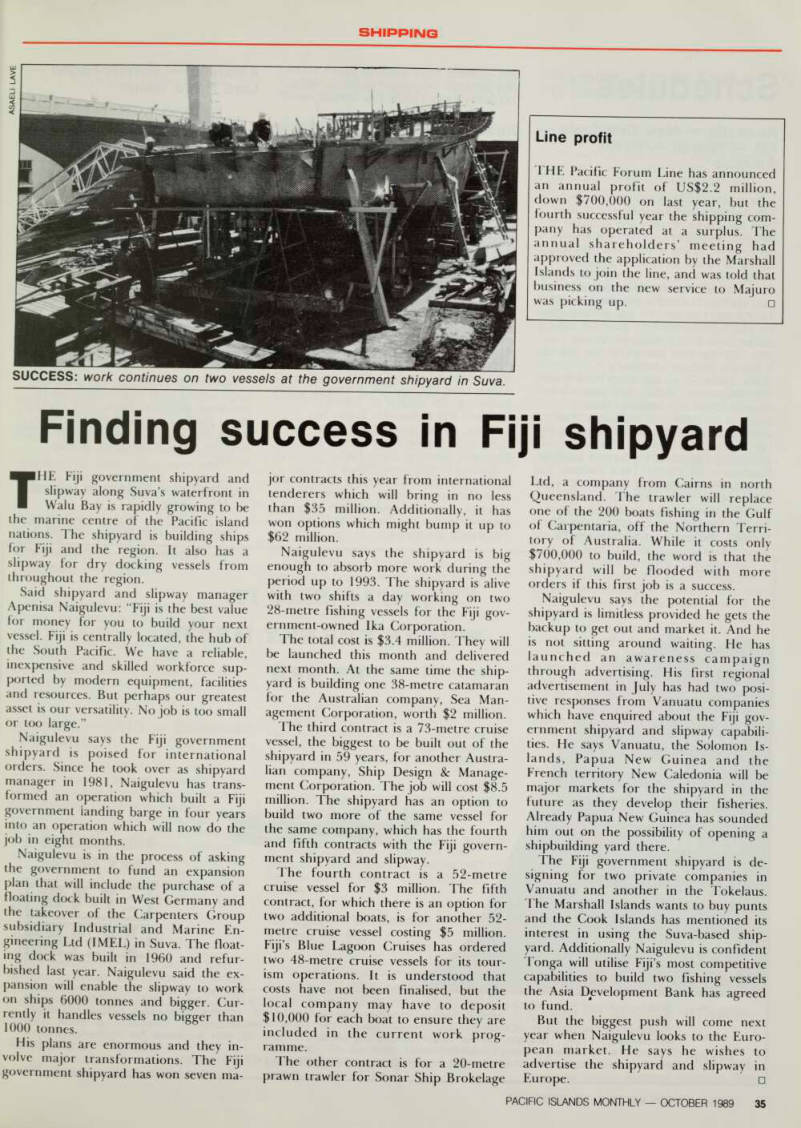
Line profit
1 HE Pacific Forum Line has announced an annual profit of US$2.2 million, down $700,000 on last year, but the fourth successful year the shipping com pany has operated at a surplus. The annual shareholders’ meeting had approved the application by the Marshall Islands to join the line, and was told that business on the new service to Majuro was picking up. □
SUCCESS: work continues on two vessels at the government shipyard in Suva.
Finding success in Fiji shipyard
THE Fiji government shipyard and slipway along Suva’s waterfront in Walu Bay is rapidly growing to be the marine centre of the Pacific island nations. The shipyard is building ships for Fiji and the region. It also has a
slipway for dry docking vessels from
throughout the region.
Said shipyard and slipway manager Apenisa Naigulevu: “Fiji is the best value for money for you to build your next vessel. Fiji is centrally located, the hub of the South Pacific. We have a reliable, inexpensive and skilled workforce sup ported by modern equipment, facilities and resources. But perhaps our greatest asset is our versatility. No job is too small or too large.”
Naigulevu says the Fiji government shipyard is poised for international orders. Since he took over as shipyard manager in 1981, Naigulevu has trans formed an operation which built a Fiji government landing barge in four years into an operation which will now do the job in eight months.
Naigulevu is in the process of asking the government to fund an expansion plan that will include the purchase of a floating dock built in West Germany and the takeover of the Carpenters Group subsidiary Industrial and Marine En gineering Ltd (IMEL) in Suva. The float ing dock was built in 1960 and refur bished last year. Naigulevu said the ex pansion will enable the slipway to work on ships 6000 tonnes and bigger. Cur rently it handles vessels no bigger than 1000 tonnes.
His plans are enormous and they in volve major transformations. The Fiji government shipyard has won seven ma
jor contracts this year from international tenderers which will bring in no less than $35 million. Additionally, it has won options which might bump it up to $62 million.
Naigulevu says the shipyard is big
enough to absorb more work during the period up to 1993. The shipyard is alive with two shifts a day working on two 28-metre fishing vessels for the Fiji government-owned Ika Corporation.
The total cost is $3.4 million. They will be launched this month and delivered next month. At the same time the shipyard is building one 38-metre catamaran for the Australian company, Sea Management Corporation, worth $2 million.
Tbe tbird contract is a 73-metre cruise vessel, the biggest to be built out of the shipyard in 59 years, for another Austra-
lian company, Ship Design & Manage-
ment Corporation. The job will cost $8.5 million. The shipyard has an option to build two more of the same vessel for the same company, which has the fourth and fifth contracts with the Fiji govern-
ment shipyard and slipway.
The fourth contract is a 52-metre cruise vessel for $3 million. The fifth contract, for which there is an option for two additional boats, is for another 52metre cruise vessel costing $5 million.
Fiji’s Blue Lagoon Cruises has ordered two 48-metre cruise vessels for its tourism operations. It is understood that costs have not been finalised, but the local company may have to deposit s lo ’ ooo for each boat to ensure they are included in the current work programme.
The other contract is for a 20-metre prawn trawler for Sonar Ship Brokelage
Ltd, a company from Cairns in north Queensland. The trawler will replace one of the 200 boats fishing in the Gulf of Carpentaria, off the Northern Terri tory of Australia. While it costs only $700,000 to build, the word is that the shipyard will be flooded with more orders if this first job is a success.
Naigulevu says the potential for the shipyard is limitless provided he gets the backup to get out and market it. And he is not sitting around waiting. He has launched an awareness campaign
through advertising. His first regional
advertisement in July has had two posi tive responses from Vanuatu companies which have enquired about the Fiji gov ernment shipyard and slipway capabili ties. He says Vanuatu, the Solomon Is lands, Papua New Guinea and the French territory New Caledonia will be major markets for the shipyard in the future as they develop their fisheries.
Already Papua New Guinea has sounded him out on the possibility of opening a shipbuilding yard there.
The Fiji government shipyard is de signing for two private companies in Vanuatu and another in the Tokelaus.
The Marshall Islands wants to buy punts and the Cook Islands has mentioned its interest in using the Suva-based ship yard. Additionally Naigulevu is confident Tonga will utilise Fiji’s most competitive capabilities to build two fishing vessels the Asia Development Bank has agreed to fund.
But the biggest push will come next year when Naigulevu looks to the Euro pean market. He says he wishes to advertise the shipyard and slipway in Europe. □
Schedules
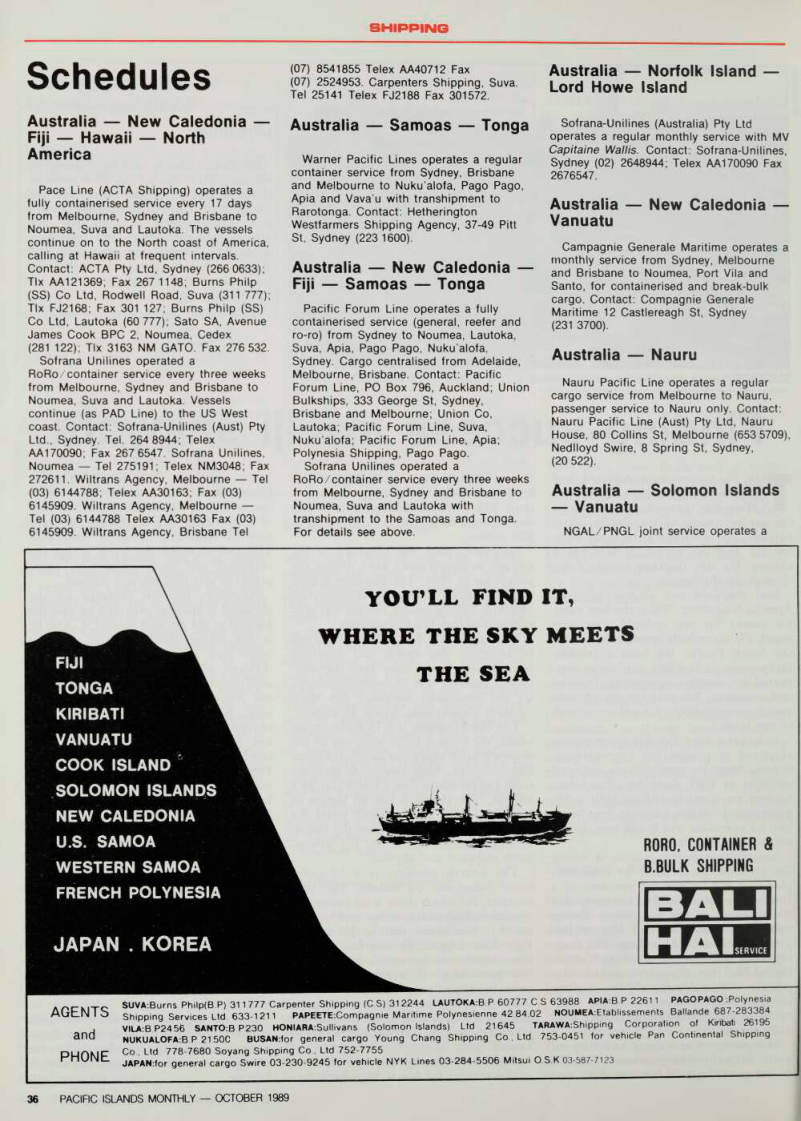
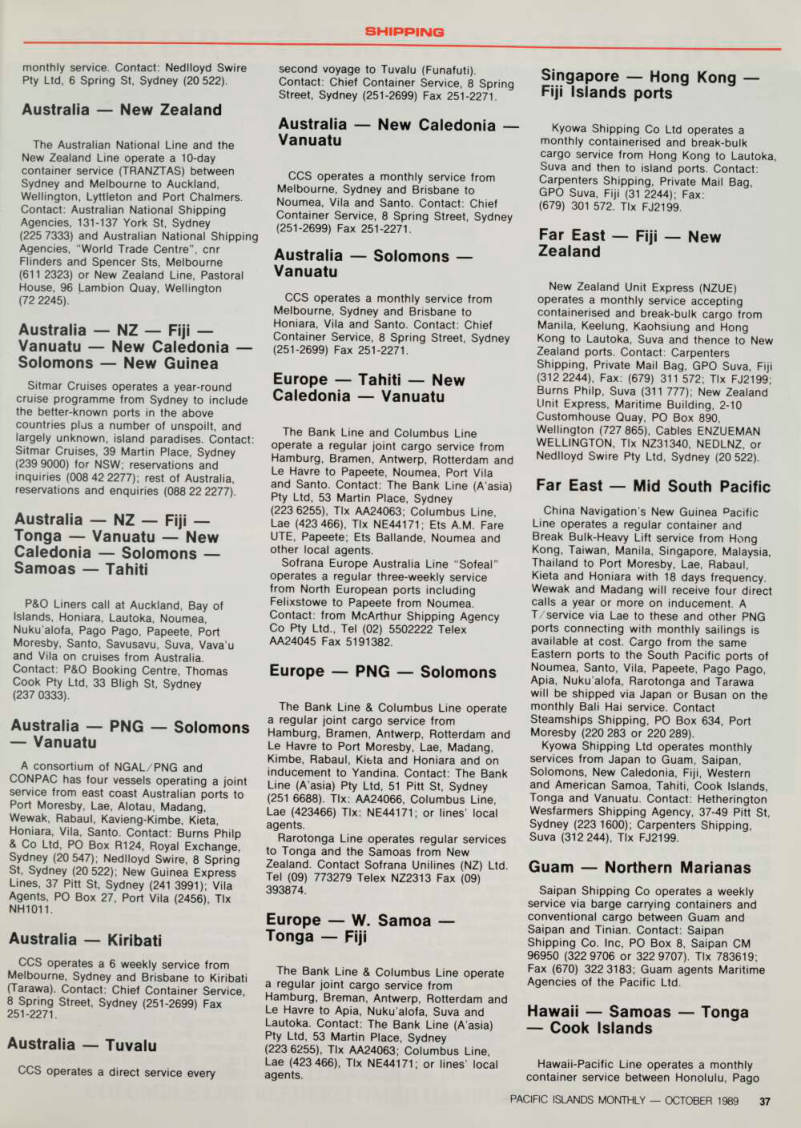
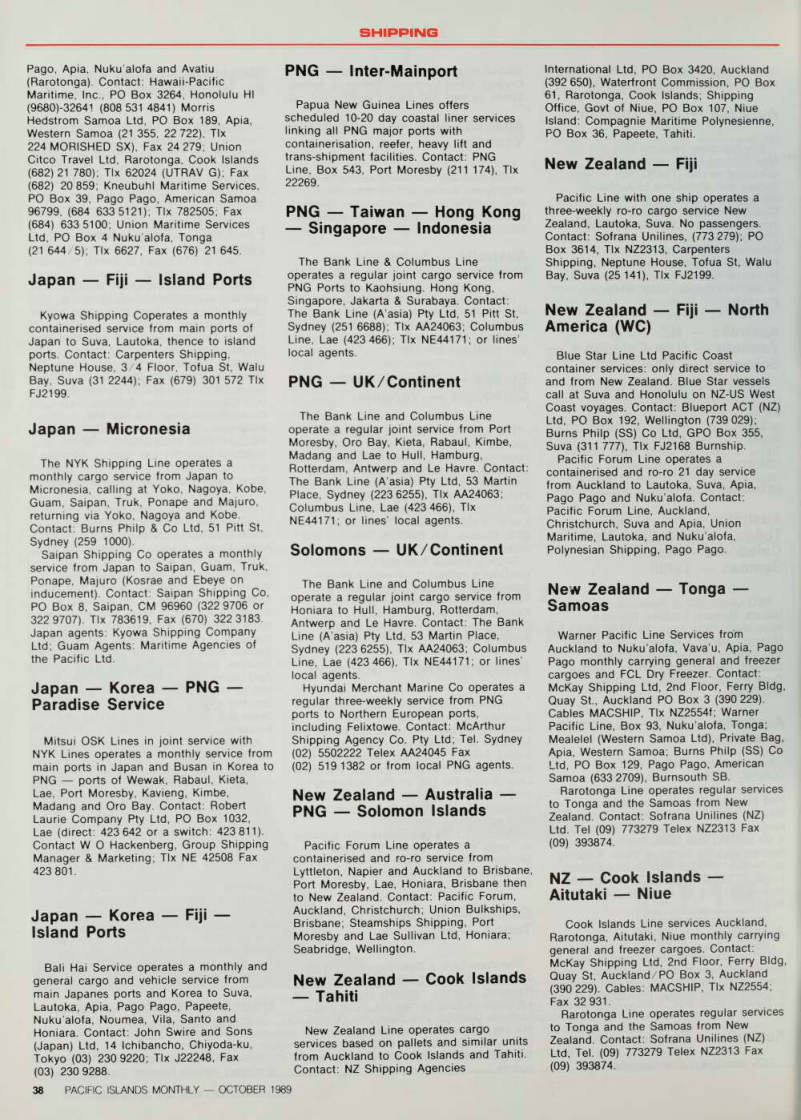
Australia New Caledonia
Fiji Hawaii North
America
Pace Line (ACTA Shipping) operates a fully containerised service every 17 days from Melbourne, Sydney and Brisbane to Noumea, Suva and Lautoka. The vessels continue on to the North coast of America, calling at Hawaii at frequent intervals.
Contact: ACTA Pty Ltd, Sydney (266 0633); Tlx AA121369; Fax 267 1148; Burns Philp (SS) Co Ltd, Rodwell Road, Suva (311 777); Tlx FJ2168; Fax 301 127; Burns Philp (SS) Co Ltd, Lautoka (60 777); Sato SA, Avenue James Cook BPC 2, Noumea, Cedex (281 122); Tlx 3163 NM GATO. Fax 276 532.
Sofrana Unilines operated a Roßo/container service every three weeks from Melbourne, Sydney and Brisbane to Noumea, Suva and Lautoka. Vessels continue (as PAD Line) to the US West coast. Contact: Sofrana-Unilines (Aust) Pty Ltd., Sydney. Tel. 264 8944; Telex AA170090; Fax 267 6547. Sofrana Unilines, Noumea Tel 275191; Telex NM3048; Fax 272611. Wiltrans Agency, Melbourne Tel (03) 6144788; Telex AA30163; Fax (03) 6145909. Wiltrans Agency, Melbourne Tel (03) 6144788 Telex AA30163 Fax (03) 6145909. Wiltrans Agency, Brisbane Tel
(07) 8541855 Telex AA40712 Fax (07) 2524953. Carpenters Shipping, Suva.
Tel 25141 Telex FJ2IBB Fax 301572.
Australia Samoas Tonga
Warner Pacific Lines operates a regular container service from Sydney, Brisbane and Melbourne to Nukualofa, Pago Pago, Apia and Vava’u with transhipment to Rarotonga. Contact: Hetherington Westfarmers Shipping Agency, 37-49 Pitt St, Sydney (223 1600).
Australia New Caledonia
Fiji Samoas Tonga
Pacific Forum Line operates a fully containerised service (general, reefer and ro-ro) from Sydney to Noumea, Lautoka, Suva, Apia, Pago Pago, Nukualofa, Sydney. Cargo centralised from Adelaide, Melbourne, Brisbane. Contact. Pacific Forum Line, PC Box 796, Auckland; Union Bulkships, 333 George St, Sydney, Brisbane and Melbourne; Union Co, Lautoka: Pacific Forum Line, Suva, Nukualofa; Pacific Forum Line, Apia: Polynesia Shipping, Pago Pago.
Sofrana Unilines operated a Roßo/container service every three weeks from Melbourne, Sydney and Brisbane to Noumea, Suva and Lautoka with transhipment to the Samoas and Tonga.
For details see above.
Australia Norfolk Island Lord Howe Island Sofrana-Unilines (Australia) Pty Ltd operates a regular monthly service with MV Capitaine Wallis. Contact: Sofrana-Unilines, Sydney (02) 2648944; Telex AA170090 Fax 2676547.
Australia New Caledonia Vanuatu Campagnie Generate Maritime operates a monthly service from Sydney, Melbourne and Brisbane to Noumea, Port Vila and Santo, for containerised and break-bulk cargo. Contact: Compagnie Generale Maritime 12 Castlereagh St, Sydney (231 3700).
Australia Nauru Nauru Pacific Line operates a regular cargo service from Melbourne to Nauru, passenger service to Nauru only. Contact; Nauru Pacific Line (Aust) Pty Ltd, Nauru House, 80 Collins St, Melbourne (653 5709), Nedlloyd Swire, 8 Spring St, Sydney, (20 522).
Australia Solomon Islands Vanuatu NGAL/PNGL joint service operates a
monthly service. Contact; Nedlloyd Swire Pty Ltd, 6 Spring St, Sydney (20 522).
Australia New Zealand The Australian National Line and the New Zealand Line operate a 10-day container service (TRANZTAS) between Sydney and Melbourne to Auckland, Wellington, Lyttleton and Port Chalmers.
Contact: Australian National Shipping Agencies, 131-137 York St, Sydney (225 7333) and Australian National Shipping Agencies, “World Trade Centre”, cnr Flinders and Spencer Sts, Melbourne (611 2323) or New Zealand Line, Pastoral House, 96 Lambion Quay, Wellington (72 2245).
Australia NZ Fiji Vanuatu New Caledonia Solomons New Guinea Sitmar Cruises operates a year-round cruise programme from Sydney to include the better-known ports in the above countries plus a number of unspoilt, and largely unknown, island paradises. Contact: Sitmar Cruises, 39 Martin Place, Sydney (239 9000) for NSW; reservations and inquiries (008 42 2277); rest of Australia, reservations and enquiries (088 22 2277).
Australia NZ Fiji Tonga Vanuatu New Caledonia Solomons Samoas Tahiti P&O Liners call at Auckland, Bay of Islands, Honiara, Lautoka, Noumea, Nukualofa, Pago Pago, Papeete, Port Moresby, Santo, Savusavu, Suva, Vava’u and Vila on cruises from Australia.
Contact: P&O Booking Centre, Thomas Cook Pty Ltd, 33 Bligh St, Sydney (237 0333).
Australia PNG Solomons Vanuatu A consortium of NGAL/PNG and CONPAC has four vessels operating a joint service from east coast Australian ports to Port Moresby, Lae, Alotau, Madang, Wewak, Rabaul, Kavieng-Kimbe, Kieta, Honiara, Vila, Santo. Contact: Burns Philp & Co Ltd, PO Box R 124, Royal Exchange, Sydney (20 547); Nedlloyd Swire, 8 Spring St, Sydney (20 522); New Guinea Express Lines, 37 Pitt St, Sydney (241 3991); Vila Agents, PO Box 27, Port Vila (2456), Tlx
Nhioii.
Australia Kiribati CCS operates a 6 weekly service from Melbourne, Sydney and Brisbane to Kiribati (Tarawa). Contact: Chief Container Service, 8 Spring Street, Sydney (251-2699) Fax 251-2271.
Australia Tuvalu CCS operates a direct service every
second voyage to Tuvalu (Funafuti).
Contact: Chief Container Service, 8 Spring Street, Sydney (251-2699) Fax 251-2271.
Australia New Caledonia
Vanuatu CCS operates a monthly service from Melbourne, Sydney and Brisbane to Noumea, Vila and Santo. Contact; Chief Container Service, 8 Spring Street, Sydney (251-2699) Fax 251-2271.
Australia Solomons
Vanuatu
CCS operates a monthly service from Melbourne, Sydney and Brisbane to Honiara, Vila and Santo. Contact: Chief Container Service, 8 Spring Street, Sydney (251-2699) Fax 251-2271.
Europe Tahiti New
Caledonia Vanuatu
The Bank Line and Columbus Line operate a regular joint cargo service from Hamburg, Bramen, Antwerp, Rotterdam and Le Havre to Papeete, Noumea, Port Vila and Santo. Contact: The Bank Line (A’asia) Pty Ltd, 53 Martin Place, Sydney (223 6255), Tlx AA24063; Columbus Line, Lae (423 466), Tlx NE44171; Ets A.M. Fare UTE, Papeete; Ets Ballande, Noumea and other local agents.
Sofrana Europe Australia Line "Sofeal” operates a regular three-weekly service from North European ports including Felixstowe to Papeete from Noumea.
Contact: from McArthur Shipping Agency Co Pty Ltd., Tel (02) 5502222 Telex AA24045 Fax 5191382.
Europe PNG Solomons
The Bank Line & Columbus Line operate a regular joint cargo service from Hamburg, Bramen, Antwerp, Rotterdam and Le Havre to Port Moresby, Lae, Madang, Kimbe, Rabaul, Kieta and Honiara and on inducement to Yandina. Contact: The Bank Line (A’asia) Pty Ltd, 51 Pitt St, Sydney (251 6688). Tlx; AA24066, Columbus Line, Lae (423466) Tlx: NE44171; or lines’ local agents.
Rarotonga Line operates regular services to Tonga and the Samoas from New Zealand. Contact Sofrana Unilines (NZ) Ltd.
Tel (09) 773279 Telex NZ2313 Fax (09) 393874.
Europe W. Samoa
Tonga Fiji
The Bank Line & Columbus Line operate a regular joint cargo service from Hamburg, Breman, Antwerp, Rotterdam and Le Havre to Apia, Nukualofa, Suva and Lautoka. Contact: The Bank Line (A’asia) Pty Ltd, 53 Martin Place, Sydney (223 6255), Tlx AA24063; Columbus Line, Lae (423 466), Tlx NE44171; or lines’ local agents.
Singapore Hong Kong
Fiji Islands ports
Kyowa Shipping Co Ltd operates a monthly containerised and break-bulk cargo service from Hong Kong to Lautoka, Suva and then to island ports. Contact: Carpenters Shipping, Private Mail Bag, GPO Suva, Fiji (31 2244); Fax: (679) 301 572. Tlx FJ2199.
Far East Fiji New Zealand New Zealand Unit Express (NZUE) operates a monthly service accepting containerised and break-bulk cargo from Manila, Keelung, Kaohsiung and Hong Kong to Lautoka, Suva and thence to New Zealand ports. Contact: Carpenters Shipping, Private Mail Bag, GPO Suva, Fiji (312 2244), Fax; (679) 311 572; Tlx FJ2199; Burns Philp, Suva (311 777); New Zealand Unit Express, Maritime Building, 2-10 Customhouse Quay, PO Box 890, Wellington (727 865), Cables ENZUEMAN
Wellington, Tlx Nz31340, Nedlnz, Or
Nedlloyd Swire Pty Ltd, Sydney (20 522).
Far East Mid South Pacific China Navigation’s New Guinea Pacific Line operates a regular container and Break Bulk-Heavy Lift service from Hong Kong, Taiwan, Manila, Singapore, Malaysia, Thailand to Port Moresby, Lae, Rabaul, Kieta and Honiara with 18 days frequency.
Wewak and Madang will receive four direct calls a year or more on inducement. A T/service via Lae to these and other PNG ports connecting with monthly sailings is available at cost. Cargo from the same Eastern ports to the South Pacific ports of Noumea, Santo, Vila, Papeete, Pago Pago, Apia, Nukualofa, Rarotonga and Tarawa will be shipped via Japan or Busan on the monthly Bali Hai service. Contact Steamships Shipping, PO Box 634, Port Moresby (220 283 or 220 289).
Kyowa Shipping Ltd operates monthly services from Japan to Guam, Saipan, Solomons, New Caledonia, Fiji, Western and American Samoa, Tahiti, Cook Islands, Tonga and Vanuatu. Contact; Hetherington Wesfarmers Shipping Agency, 37-49 Pitt St, Sydney (223 1600); Carpenters Shipping, Suva (312 244), Tlx FJ2199.
Guam Northern Marianas Saipan Shipping Co operates a weekly service via barge carrying containers and conventional cargo between Guam and Saipan and Tinian. Contact: Saipan Shipping Co. Inc, PO Box 8, Saipan CM 96950 (322 9706 or 322 9707). Tlx 783619; Fax (670) 322 3183; Guam agents Maritime Agencies of the Pacific Ltd.
Hawaii Samoas Tonga Cook Islands Hawaii-Pacific Line operates a monthly container service between Honolulu, Pago
Pago, Apia, Nukualofa and Avatiu (Rarotonga). Contact: Hawaii-Pacific Maritime, Inc., PO Box 3264, Honolulu HI (9680)-32641 (808 531 4841) Morris Hedstrom Samoa Ltd, PO Box 189, Apia, Western Samoa (21 355, 22 722), Tlx 224 MORISHED SX). Fax 24 279; Union Citco Travel Ltd, Rarotonga, Cook Islands (682) 21 780); Tlx 62024 (UTRAV G); Fax (682) 20 859; Kneubuhl Maritime Services, PO Box 39, Pago Pago, American Samoa 96799, (684 633 5121); Tlx 782505; Fax (684) 633 5100; Union Maritime Services Ltd, PO Box 4 Nukualofa, Tonga (21 644/5); Tlx 6627, Fax (676) 21 645.
Japan Fiji Island Ports
Kyowa Shipping Coperates a monthly containerised service from main ports of Japan to Suva, Lautoka. thence to island ports. Contact: Carpenters Shipping, Neptune House, 3/4 Floor, Tofua St, Walu Bay. Suva (31 2244); Fax (679) 301 572 Tlx FJ2199.
Japan Micronesia
The NYK Shipping Line operates a monthly cargo service from Japan to Micronesia, calling at Yoko, Nagoya, Kobe, Guam, Saipan, Truk, Ponape and Majuro, returning via Yoko, Nagoya and Kobe.
Contact: Burns Philp & Co Ltd, 51 Pitt St, Sydney (259 1000).
Saipan Shipping Co operates a monthly service from Japan to Saipan, Guam, Truk, Ponape, Majuro (Kosrae and Ebeye on inducement). Contact; Saipan Shipping Co, PO Box 8, Saipan, CM 96960 (322 9706 or 322 9707). Tlx 783619, Fax (670) 322 3183.
Japan agents: Kyowa Shipping Company Ltd; Guam Agents: Maritime Agencies of the Pacific Ltd.
Japan Korea PNG Paradise Service Mitsui OSK Lines in joint service with NYK Lines operates a monthly service from main ports in Japan and Busan in Korea to PNG ports of Wewak, Rabaul, Kieta, Lae, Port Moresby, Kavieng, Kimbe, Madang and Oro Bay. Contact: Robert Laurie Company Pty Ltd, PO Box 1032, Lae (direct: 423 642 or a switch: 423 811).
Contact W O Hackenberg, Group Shipping Manager & Marketing; Tlx NE 42508 Fax 423 801.
Japan Korea Fiji
Island Ports Bali Hai Service operates a monthly and general cargo and vehicle service from main Japanes ports and Korea to Suva, Lautoka, Apia, Pago Pago, Papeete, Nukualofa, Noumea, Vila, Santo and Honiara. Contact; John Swire and Sons (Japan) Ltd, 14 Ichibancho, Chiyoda-ku, Tokyo (03) 230 9220; Tlx J 22248, Fax (03) 230 9288.
PNG Inter-Mainport
Papua New Guinea Lines offers scheduled 10-20 day coastal liner services linking all PNG major ports with containerisation, reefer, heavy lift and trans-shipment facilities. Contact: PNG Line, Box 543, Port Moresby (211 174), Tlx 22269.
PNG Taiwan Hong Kong
Singapore Indonesia
The Bank Line & Columbus Line operates a regular joint cargo service from PNG Ports to Kaohsiung. Hong Kong, Singapore, Jakarta & Surabaya. Contact: The Bank Line (A’asia) Pty Ltd, 51 Pitt St, Sydney (251 6688); Tlx AA24063; Columbus Line, Lae (423 466); Tlx NE44171; or lines’ local agents.
PNG UK/Continent
The Bank Line and Columbus Line operate a regular joint service from Port Moresby, Oro Bay, Kieta, Rabaul, Kimbe, Madang and Lae to Hull, Hamburg, Rotterdam, Antwerp and Le Havre. Contact; The Bank Line (A’asia) Pty Ltd, 53 Martin Place, Sydney (223 6255), Tlx AA24063; Columbus Line, Lae (423 466), Tlx NE44171; or lines’ local agents.
Solomons UK/Continenl
The Bank Line and Columbus Line operate a regular joint cargo service from Honiara to Hull, Hamburg, Rotterdam, Antwerp and Le Havre. Contact: The Bank Line (A’asia) Pty Ltd, 53 Martin Place, Sydney (223 6255), Tlx AA24063; Columbus Line, Lae (423 466), Tlx NE44171; or lines’ local agents.
Hyundai Merchant Marine Co operates a regular three-weekly service from PNG ports to Northern European ports, including Felixtowe. Contact; McArthur Shipping Agency Co. Pty Ltd; Tel. Sydney (02) 5502222 Telex AA24045 Fax (02) 519 1382 or from local PNG agents.
New Zealand Australia
PNG Solomon Islands
Pacific Forum Line operates a containerised and ro-ro service from Lyttleton, Napier and Auckland to Brisbane Port Moresby, Lae, Honiara, Brisbane then to New Zealand. Contact; Pacific Forum, Auckland, Christchurch: Union Bulkships, Brisbane; Steamships Shipping, Port Moresby and Lae Sullivan Ltd, Honiara; Seabridge, Wellington.
New Zealand Cook Islands
Tahiti
New Zealand Line operates cargo services based on pallets and similar units from Auckland to Cook Islands and Tahiti.
Contact: NZ Shipping Agencies
International Ltd, PO Box 3420, Auckland (392 650), Waterfront Commission, PO Box 61, Rarotonga, Cook Islands: Shipping Office, Govt of Niue, PO Box 107, Niue Island: Compagnie Maritime Polynesienne, PO Box 36, Papeete, Tahiti.
New Zealand Fiji Pacific Line with one ship operates a three-weekly ro-ro cargo service New Zealand, Lautoka, Suva. No passengers.
Contact: Sofrana Unilines, (773 279); PO Box 3614, Tlx NZ2313, Carpenters Shipping, Neptune House, Tofua St, Walu Bay, Suva (25 141), Tlx FJ2199.
New Zealand Fiji North
America (WC)
Blue Star Line Ltd Pacific Coast container services: only direct service to and from New Zealand. Blue Star vessels call at Suva and Honolulu on NZ-US West Coast voyages. Contact: Blueport ACT (NZ) Ltd, PO Box 192, Wellington (739 029); Burns Philp (SS) Co Ltd, GPO Box 355, Suva (311 777), Tlx FJ2168 Burnship.
Pacific Forum Line operates a containerised and ro-ro 21 day service from Auckland to Lautoka, Suva, Apia, Pago Pago and Nukualofa. Contact: Pacific Forum Line, Auckland, Christchurch, Suva and Apia, Union Maritime, Lautoka, and Nukualofa, Polynesian Shipping, Pago Pago.
New Zealand Tonga
Samoas
Warner Pacific Line Services from Auckland to Nukualofa, Vava’u, Apia, Pago Pago monthly carrying general and freezer cargoes and FCL Dry Freezer. Contact: McKay Shipping Ltd, 2nd Floor, Ferry Bldg, Quay St., Auckland PO Box 3 (390 229).
Cables MACSHIP, Tlx NZ2554f; Warner Pacific Line, Box 93, Nukualofa, Tonga; Mealelel (Western Samoa Ltd), Private Bag, Apia, Western Samoa; Burns Philp (SS) Co Ltd, PO Box 129, Pago Pago, American Samoa (633 2709), Burnsouth SB.
Rarotonga Line operates regular services to Tonga and the Samoas from New Zealand. Contact: Sofrana Unilines (NZ) Ltd. Tel (09) 773279 Telex NZ2313 Fax (09) 393874.
NZ Cook Islands
Aitutaki Niue
Cook Islands Line services Auckland, Rarotonga, Aitutaki, Niue monthly carrying general and freezer cargoes. Contact: McKay Shipping Ltd, 2nd Floor, Ferry Bldg, Quay St, Auckland/PO Box 3, Auckland (390 229). Cables: MACSHIP, Tlx NZ2554; Fax 32 931.
Rarotonga Line operates regular services to Tonga and the Samoas from New Zealand. Contact; Sofrana Unilines (NZ) Ltd, Tel. (09) 773279 Telex NZ2313 Fax (09) 393874.
Advertisements & other items, pp. 36-39 (1 item)
Bali
YOU’LL FIND IT,
WHERE THE SKY MEETS
THE SEA
TONGA
KIRIBATI
VANUATU
COOK ISLAND
SOLOMON ISLANDS
ts#
NEW CALEDONIA
U.S. SAMOA
WESTERN SAMOA
FRENCH POLYNESIA
JAPAN . KOREA
RORO. CONTAINER &
B.BULK SHIPPING
BALI
HAI SERVICE
AGENTS
and
PHONE
SUVA:Burns Philp(B.P) 311777 Carpenter Shipping (C.S) 312244 LAUTOKArB P 60777 C S 63988 APIA-.8.P 22611 Shipping Services Ltd 633-1211 PAPEETE:Compagnie Maritime Polynesienne 42 84 02 NOUMEA:Etablissements Ballande 687-283384 VILA;B P 2456 SANTO:B P 230 HONlARA:Sullivans (Solomon Islands) Ltd 21645 TARAWA:Shipping Corporation of Kiribati 26195 NUKUALOFA:B P 21500 BUSANrfor general cargo Young Chang Shipping Co , Ltd 753-0451 for vehicle Pan Continental Shipping Co., Ltd 778-7680 Soyang Shipping Co, Ltd 752-7755 JAPANrfor general cargo Swire 03-230-9245 for vehicle NYK Lines 03-284-5506 Mitsui O S.K 03-587-7123
YOUR DIRECT EUROPEAN CONNECTION
1 * 4 ■ & -S,, jujfesr- ' .>4?.
EUROPE-SOUTH PACIFIC JOINT SERVICE
The South Pacific Specialists offer facilities for shipment of: Containers (FCL/LCL) and Breakbulk Cargo plus reefer space and deeptanks for carriage of vegetable oils and other liquid bulk cargo.
Carriers also accept heavy lifts, overlength and cumbersome parcels.
Ports of Service: Loading: Papeete, Apia, Suva, Lautoka, Noumea, Port Vila, Santo, Honiara, Port Moresby, Lae,Madang, Kimbe, Rabaul, Kieta, Darwin.
For: Rotterdam, Antwerp, Hamburg, Hull, Dunkirk, Le Havre.
Please contact our regional offices for further information: The Bank Line (Australasia) Pty Ltd Ground Floor 53 Martin Place Sydney NSW 2000 Telex AA24063 Telephone (02) 223 6255 Facsimile (02) 223 6549
- ROUND THE WORLD SERVICE
\\\ Columbus Line Reederei GmbH
-XXX P.O. Box 1667
Additional ports on enquiry.
Lae/Papua New Guinea Phone; 42 3466/42 3287 A.H. 42 2481 Telex; Colline NE 44 171
THE BANK LINE LTD LONDON
COLUMBUS LINE REEDEREI GMBH HAMBURG
C0L0024
experience
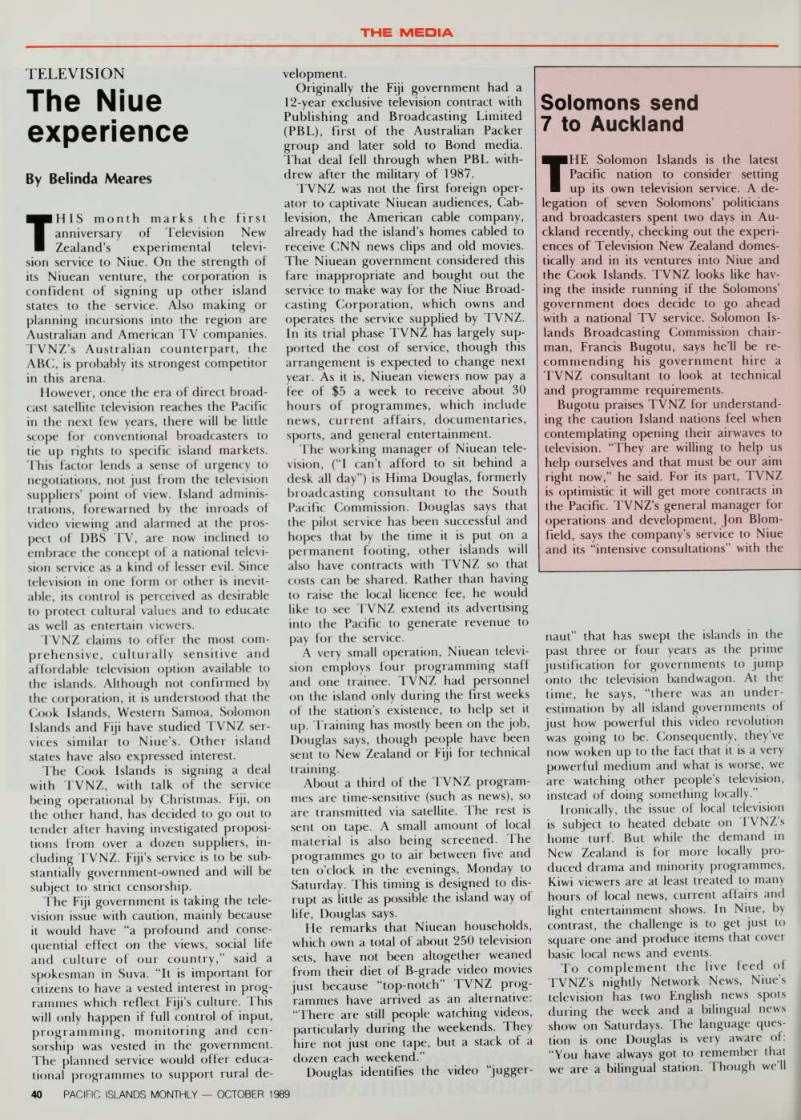
The Media
Television
The Niue experience
By Belinda Meares
THIS month marks the first anniversary of Television New Zealand’s experimental televi sion service to Niue. On the strength of its Niuean venture, the corporation is confident of signing up other island states to the service. Also making or planning incursions into the region are Australian and American TV companies.
TVNZ’s Australian counterpart, the ABC, is probably its strongest competitor in this arena.
However, once the era of direct broad cast satellite television reaches the Pacific in the next few years, there will be little scope for conventional broadcasters to tie up rights to specific island markets.
This factor lends a sense of urgency to negotiations, not just from the television suppliers’ point of view. Island adminis trations, forewarned by the inroads of video viewing and alarmed at the pros pect of DBS TV, are now inclined to embrace the concept of a national televi sion service as a kind of lesser evil. Since television in one form or other is inevit able, its control is perceived as desirable to protect cultural values and to educate as well as entertain viewers.
TVNZ claims to offer the most com
prehensive, culturally sensitive and
affordable television option available to the islands. Although not confirmed by the corporation, it is understood that the Cook Islands, Western Samoa, Solomon Islands and Fiji have studied TVNZ ser vices similar to Niue’s. Other island states have also expressed interest.
The Cook Islands is signing a deal with TVNZ, with talk of the service being operational by Christmas. Fiji, on the other hand, has decided to go out to
tender after having investigated proposi
tions from over a dozen suppliers, in cluding TVNZ. Fiji’s service is to be sub stantially government-owned and will be
subject to strict censorship.
The Fiji government is taking the tele vision issue with caution, mainly because it would have “a profound and conse quential effect on the views, social life and culture of our country,” said a spokesman in Suva. “It is important for citizens to have a vested interest in prog rammes which reflect Fiji’s culture. This will only happen if full control of input, programming, monitoring and cen sorship was vested in the government.
The planned service would offer educa tional programmes to support rural de
velopment.
Originally the Fiji government had a 12-year exclusive television contract with
Publishing and Broadcasting Limited
(PBL), first of the Australian Packer group and later sold to Bond media.
That deal fell through when PBL with drew after the military of 1987.
TVNZ was not the first foreign oper ator to captivate Niuean audiences, Cab levision, the American cable company, already had the island’s homes cabled to receive CNN news clips and old movies.
The Niuean government considered this fare inappropriate and bought out the service to make way for the Niue Broad casting Corporation, which owns and operates the service supplied by TVNZ.
In its trial phase TVNZ has largely sup ported the cost of service, though this arrangement is expected to change next year. As it is, Niuean viewers now pay a fee of $5 a week to receive about 30 hours of programmes, which include news, current affairs, documentaries, sports, and general entertainment.
The working manager of Niuean tele vision, (“I can’t afford to sit behind a desk all day”) is Hima Douglas, formerly broadcasting consultant to the South Pacific Commission. Douglas says that the pilot service has been successful and hopes that by the time it is put on a permanent footing, other islands will also have contracts with TVNZ so that costs can be shared. Rather than having to raise the local licence fee, he would like to see TVNZ extend its advertising into the Pacific to generate revenue to pay for the service.
A very small operation, Niuean televi sion employs four programming staff and one trainee. TVNZ had personnel on the island only during the first weeks of the station’s existence, to help set it up. Training has mostly been on the job,
Douglas says, though people have been
sent to New Zealand or Fiji for technical
training.
About a third of the TVNZ program mes are time-sensitive (such as news), so are transmitted via satellite. The rest is sent on tape. A small amount of local material is also being screened. The programmes go to air between five and ten o’clock in the evenings, Monday to Saturday. This timing is designed to dis rupt as little as possible the island way of life, Douglas says.
He remarks that Niuean households, which own a total of about 250 television sets, have not been altogether weaned from their diet of B-grade video movies just because “top-notch” TVNZ prog rammes have arrived as an alternative: “There are still people watching videos, particularly during the weekends. They hire not just one tape, but a stack of a dozen each weekend.”
Douglas identifies the video “jugger
naut” that has swept the islands in the past three or four years as the prime justification for governments to jump onto the television bandwagon. At the time, he says, “there was an under estimation by all island governments of just how powerful this video revolution
was going to be. Consequently, they’ve
now woken up to the fact that it is a very powerful medium and what is worse, we are watching other people’s television, instead of doing something locally.”
Ironically, the issue of local television is subject to heated debate on TVNZ’s home turf. But while the demand in New Zealand is for more locally pro duced drama and minority programmes, Kiwi viewers are at least treated to many hours of local news, current affairs and light entertainment shows. In Niue, by contrast, the challenge is to get just to square one and produce items that cover basic local news and events.
To complement the live feed of TVNZ’s nightly Network News, Niue’s television has two English news spots during the week and a bilingual news show on Saturdays. The language ques tion is one Douglas is very aware of; “You have always got to remember that we are a bilingual station. Though we’ll
start off with English programmes, even tually we’ll incorporate Niuean for every news and current affairs programme,” he says.
TVNZ’s executives say the corporation is very attentive to the needs of Niue and other potential Pacific clients. Jon Blomfield, general manager of TVNZ’s operations development division, ex plains that the Niue service is a pro totype that can be tailored to suit any particular situation. In the case of Niue, he says, TVNZ compiles draft program me schedules according to the client’s re quests and delivery of tapes and satellite feeds is timed to meet those schedules.
“The Niue Broadcasting Corporation is then totally free to remix, reformat, choose or not choose any of that mate rial it wishes,” he says.
In this way, the station controls the content and timing of the programmes it airs. Local input into those programming decisions is encouraged. For example, Niue’s broadcasters are advised by a committee of community representatives.
TVNZ conducts its own viewing research on the island and that information goes back to Christchurch, from where the Pacific services programmes are pack aged.
TVNZ also plays a consulting role, offering as much or as little hand holding as the fledgling island broadcas ters want, from advising on the legisla tive steps that might be needed to estab lish a television station, through to struc ture, organisation, staffing, skills de
velopment, revenue generation, equip
ment and technical services required to get a fully-fledged service on the air.
Keeping costs within the scope of li mited budgets is an obligation that TVNZ feels it is able to meet, Blomfield says. Before the advent of cheap video technology, television was not really a vi able prospect for the small and scattered Pacific island populations. “Indeed, it is still not easy,” he admits, “but one of the advantages of modern technology is that it is now possible to produce near pro fessional quality output with equipment that costs a fraction of what the profes sional organisations use. The formats we are suggesting for the Pacific Island na tions enables them to do a lot of local production at very modest cost.”
However it may appear at first glance, TVNZ’s motivation for initiating its Paci fic neighbours to the thrill of television is strategic rather than altruistic. As a com mercially-oriented state-owned enter
prise, the corporation is expected by the New Zealand government to turn a profit.
While the Niuean venture has not been a money-spinner for TVNZ to date, Blomfield is optimistic, saying: “If we get to the position of having several customers, we’ll have a service that is both economically viable for TVNZ and, at the same time an extremely cost effective source of programming mate rial for the Pacific nations.”
It is no secret that the determination of TVNZ’s Pacific push is influenced by a long-term goal. That is to break into the far more populous, and lucrative, Asian markets with English-language ser vices distributed by direct broadcast satellite. The logic behind this move is attributed to the recent deregulation of New Zealand’s broadcasting services which threatens to fragment TVNZ’s loc al commercial revenues by introducing competition. According to its director general, Julian Mounter, TVNZ’s foreign ventures are therefore designed to top up the corporation’s dwindling coffers so that it can continue to fulfil its local pro duction and public service objectives.
Against this background of intense re gional and global competition for televi sion audience share, a conference on the future of television in the Pacific is to be held in Suva in the end of November.
The meeting is organised by the Asia- Pacific Broadcasting Union and the South Pacific Commission, with support from the Fiji Broadcasting Commission, the Japanese Hoso Bunka Foundation, UNESCO and the French government.
Expected to attend are heads of the
region’s broadcasting organisations and
governmental broadcasting policy plan
ners, who will debate such vital issues as government control versus privately owned television and whether to attempt nationwide coverage or limit transmis sions to main population centres. They will discuss how to negotiate deals with
foreign suppliers, how to produce local
programmes and how to train personnel.
The economic and social implications of the advent of television will also be on the agenda. This debate presupposes that the conference’s key issue, The main decision; should we introduce tele vision?, is answered affirmatively.
From the field, Himo Douglas re sponds in light of the Niuean experi ence: “We have set the ball rolling and I guess it’s now a question of improving and consolidating the service and trying to produce more local input. We want to paint an island face on our television.
We want to enjoy what the international
programme suppliers are offering
TVNZ but, at the same time, we want a fairly substantial hibiscus displayed on the screen as well.” □
Solomons send
7 to Auckland
THE Solomon Islands is the latest Pacific nation to consider setting up its own television service. A de legation of seven Solomons’ politicians and broadcasters spent two days in Au
ckland recently, checking out the experi
ences of Television New Zealand domes tically and in its ventures into Niue and the Cook Islands. TVNZ looks like hav ing the inside running if the Solomons’ government does decide to go ahead with a national TV service. Solomon Is lands Broadcasting Commission chair man, Francis Bugotu, says he’ll be re commending his government hire a TVNZ consultant to look at technical and programme requirements.
Bugotu praises TVNZ for understand ing the caution Island nations feel when contemplating opening their airwaves to television. “They are willing to help us help ourselves and that must be our aim right now,” he said. For its part, TVNZ is optimistic it will get more contracts in the Pacific. TVNZ’s general manager for
operations and development, Jon Blom
field, says the company’s service to Niue and its “intensive consultations” with the
Cook Islands has created a “domino effect” in the region. Blomfield says TVNZ expects to sign a TV deal with the Cooks government by the time this goes to print. It’ll be an expanded ver sion of what TVNZ provides now to Niue. Blomfield also says TVNZ is still talking to Fiji about its plans and says several other Island nations are lining up
for negotiations.
The recently installed Solomons’ gov ernment hasn’t yet made it a policy deci sion to pursue a national television ser vice, something Bugotu says he’ll strong ly recommend as a result of the Auck land visit. Television has already hit the islands in a big way through video ren tals. “That’s one of the reasons why we want to get into live television broad casts, so that we can give an alternative that we can control,” Bugotu says. “It’s not easy to control video television.” An essential part of such control would be ensuring television programmes didn’t interfere with the culture of the Solo mon islanders. Bugotu says this means the Solomons’ broadcasting system will need restructuring so most of the prog rammes can be made locally rather than borrowed from abroad.
“Our primary aim is to get television to the people who are in the villages.
That’s the hardest place to get television into so it will be a long term process of development,” Bugotu says. Most of the Solomons’ 300,000 inhabitants live in iso lated villages on the six mountainous is lands which make up most of the island chain. Ironically, costs mean it will be the 20,000 residents in the capital, Honiara, who’ll probably get the first sight of any television service. Bugotu says the Solo mons’ government can afford start-up costs of $300,000 for Honiara. After that any new transmission stations would be phased in alongside the Solomon Islands
Broadcasting Corporation’s radio tele
communications network which is still
being installed.
The telecom network is a joint venture between the Solomons’ government and Cable and Wireless. The three regional stations (in Honiara, the western and the eastern ends of the chain) are to be joined by new stations on Malaita and Makira. Bugotu says any television ser vice won’t start for at least a year, until the new radio stations are on air. The Solomons’ government also has to sort out details like how much it’s willing to add to the national import bill to bring in television sets and how villagers in remote areas are going to buy and install them. □
Advertisements & other items, p. 42 (1 item)
Fisheries Advisor
f
UNITED STATES AGENCY FOR INTERNATIONAL DEVELOPMENT
Regional Development Office/South Pacific
FISHERIES ADVISOR
The USAID regional office based in Suva, Fiji, is seeking candidates for a Personal Services Contractor Fisheries Advisor. Interested fisheries professionals who are citizens of the United States or of independent Pacific island nations, are requested to contact the USAID, ADO Office, P.O. Box 218, Suva, Fiji.
Closing date for applications is October 30, 1989.
I. STATEMENT OF DUTIES
A. General The incumbent will be responsible for providing expert advice and assistance in the marine resources sector to the work of USAID Regional Office in Suva.
The contractor will work under the supervision of the Agricultural and Rural Development Officer.
B. Specific The incumbent: 1. Will be responsible for providing advice on the development and implementation of USAID strategy in marine resources, with attention to the development of projects in the marine reosurces sector. 2. Will manage the new Pacific Islands Marine Resources project which will serve some of the fisheries development requirements of five Pacific island countries. 3. Will maintain effective USAID working rela- :ionships with island country and regional personnel throughout the South Pacific who are responsible for coordinating or managing marine resources activities.
Will promote coordination and cooperation with other donors, including the Forum Fisheries Agency, the South Pacific Commission, the United Nations Development Program, and other regional agencies and organizations. 4. Will make site visits to the Island nations served >y USAID to assess needs, meets with appropriate public and private sectors personnel, and prepare trip reports and other marine resources program docummentation and reports as required. 5. Will attend technical meetings, for fisheries development and will represent USAID at other national, regional, and international meetings and conferences, as appropriate.
11. PERIOD OF CONTRACT
USAID intends to hire a qualified individual under a personal services contract for a period of two years, with the possibility of extension of the contract.
111. QUALIFICATIONS AND EXPERIENCE
USAID is seeking a highly motivated fisheries professional showing strong interest in marine resources planning and development.
A. Academic Qualifications A university degree in a marine resources development related field.
B. Professional Experience The candidate for the position should be able to demonstrate the following skills in his/her work experience; Marine Policy analysis Planning and management of international donor experience.
Knowledge of Pacific island marine resource economics Familiarity with USAID project assistance.
IV. This is a request for expressions of interest for qualified candidates and not a hiring commitment by USAID. Interested persons should send a completed US Governmernt form SFI7I or resume and dates of availability to: USAID, ADO Office, PO Box 218, Suva, Fiji.
Leaderless FLNKS
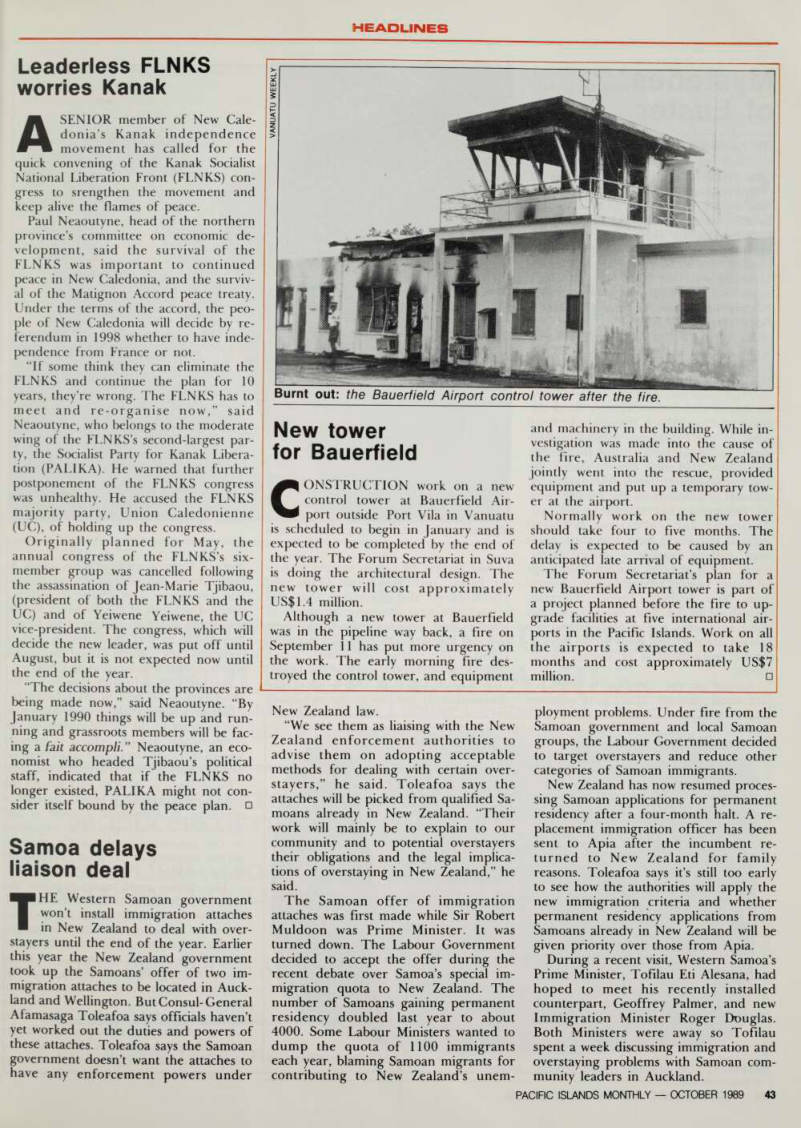
Headlines
Leaderless FLNKS worries Kanak
A SENIOR member of New Cale donia’s Kanak independence movement has called for the quick convening of the Kanak Socialist National Liberation Front (FLNKS) con gress to srengthen the movement and keep alive the flames of peace.
Paul Neaoutyne, head of the northern province’s committee on economic de velopment, said the survival of the FLNKS was important to continued peace in New Caledonia, and the surviv al of the Matignon Accord peace treaty.
Under the terms of the accord, the peo ple of New Caledonia will decide by re ferendum in 1998 whether to have inde pendence from France or not.
“If some think they can eliminate the FLNKS and continue the plan for 10 years, they’re wrong. The FLNKS has to meet and re-organise now,” said Neaoutyne, who belongs to the moderate wing of the FLNKS’s second-largest par ty, the Socialist Party for Kanak Libera tion (PALIKA). He warned that further postponement of the FLNKS congress was unhealthy. He accused the FLNKS majority party, Union Caledonienne (UC), of holding up the congress.
Originally planned for May, the
annual congress of the FLNKS’s six member group was cancelled following the assassination of Jean-Marie Tjibaou, (president of both the FLNKS and the UC) and of Yeiwene Yeiwene, the UC vice-president. The congress, which will decide the new leader, was put off until August, but it is not expected now until the end of the year.
“The decisions about the provinces are
being made now,” said Neaoutyne, “By
January 1990 things will be up and run ning and grassroots members will be fac ing a fait accompli. ” Neaoutyne, an eco nomist who headed Tjibaou’s political staff, indicated that if the FLNKS no longer existed, PALIKA might not con sider itself bound by the peace plan. □
Samoa delays
liaison deal
THE Western Samoan government won’t install immigration attaches in New Zealand to deal with over stayers until the end of the year. Earlier this year the New Zealand government took up the Samoans’ offer of two im migration attaches to be located in Auck land and Wellington. But Consul-General Afamasaga Toleafoa says officials haven’t yet worked out the duties and powers of these attaches. Toleafoa says the Samoan government doesn’t want the attaches to have any enforcement powers under
New Zealand law.
“We see them as liaising with the New Zealand enforcement authorities to advise them on adopting acceptable methods for dealing with certain over stayers,” he said. Toleafoa says the attaches will be picked from qualified Sa moans already in New Zealand. “Their work will mainly be to explain to our community and to potential overstayers
their obligations and the legal implica
tions of overstaying in New Zealand,” he said.
The Samoan offer of immigration attaches was first made while Sir Robert Muldoon was Prime Minister. It was turned down. The Labour Government decided to accept the offer during the recent debate over Samoa’s special im migration quota to New Zealand. The number of Samoans gaining permanent residency doubled last year to about 4000. Some Labour Ministers wanted to dump the quota of 1100 immigrants each year, blaming Samoan migrants for contributing to New Zealand’s unem
ployment problems. Under fire from the Samoan government and local Samoan groups, the Labour Government decided to target overstayers and reduce other
categories of Samoan immigrants.
New Zealand has now resumed proces sing Samoan applications for permanent residency after a four-month halt. A re placement immigration officer has been sent to Apia after the incumbent re turned to New Zealand for family reasons. Toleafoa says it’s still too early to see how the authorities will apply the new immigration criteria and whether
permanent residency applications from
Samoans already in New Zealand will be given priority over those from Apia.
During a recent visit, Western Samoa’s Prime Minister, Tofilau Eti Alesana, had hoped to meet his recently installed counterpart, Geoffrey Palmer, and new
Immigration Minister Roger Douglas.
Both Ministers were away so Tofilau spent a week discussing immigration and overstaying problems with Samoan com munity leaders in Auckland.
Vanuatu Weekly
New tower for Bauerfield
Construction work on a new control tower at Bauerfield Air port outside Port Vila in Vanuatu is scheduled to begin in January and is expected to be completed by the end of the year. The Forum Secretariat in Suva is doing the architectural design. The new tower will cost approximately US$l.4 million.
Although a new tower at Bauerfield was in the pipeline way back, a fire on September 11 has put more urgency on the work. The early morning fire des troyed the control tower, and equipment
and machinery in the building. While in vestigation was made into the cause of the fire, Australia and New Zealand jointly went into the rescue, provided equipment and put up a temporary tow er at the airport.
Normally work on the new tower should take four to five months. The delay is expected to be caused by an anticipated late arrival of equipment.
The Forum Secretariat’s plan for a new Bauerfield Airport tower is part of a project planned before the fire to up grade facilities at five international air ports in the Pacific Islands. Work on all the airports is expected to take 18 months and cost approximately US$7 million. □
Vanuatu Weekly
Burnt out: the Bauerfield Airport control tower after the fire.
Mysteries
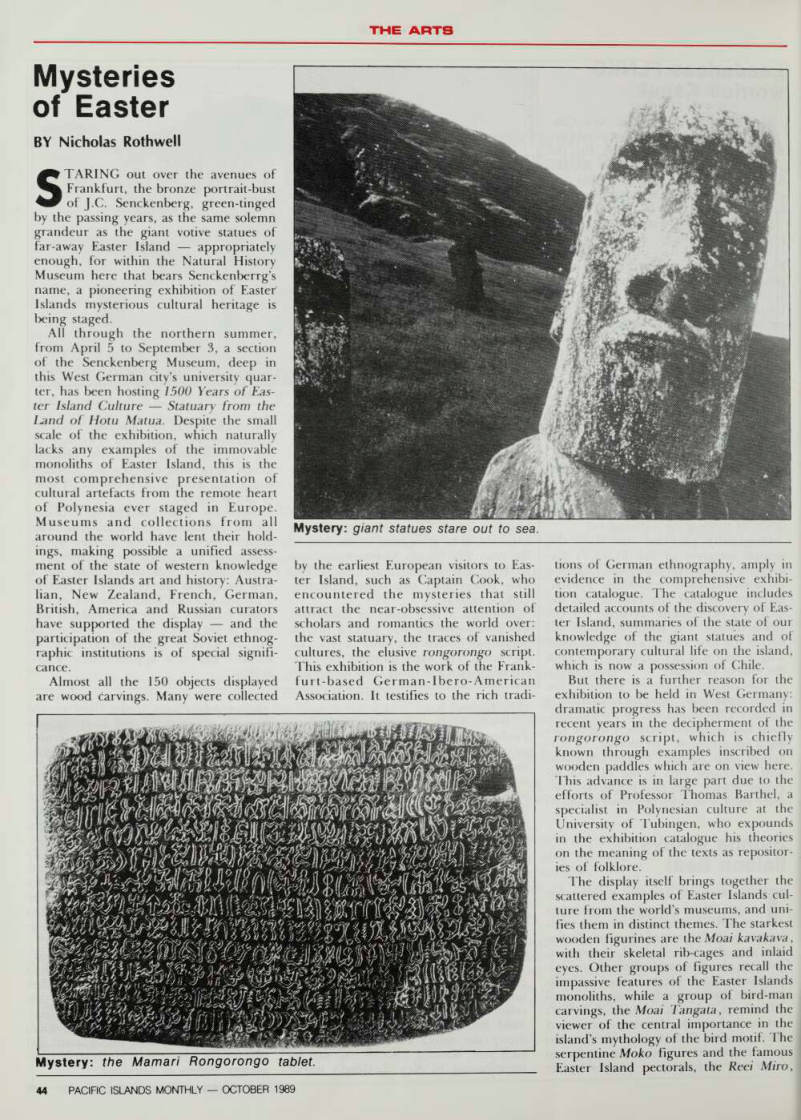

The Arts
Mysteries of Easter
BY Nicholas Rothwell
S TARING out over the avenues of Frankfurt, the bronze portrait-bust of J.C. Senckenberg, green-tinged by the passing years, as the same solemn grandeur as the giant votive statues of
far-away Easter Island appropriately
enough, for within the Natural History Museum here that bears Senckenberrg’s name, a pioneering exhibition of Easter Islands mysterious cultural heritage is
being staged.
All through the northern summer, from April 5 to September 3, a section of the Senckenberg Museum, deep in this West German city’s university quar ter, has been hosting 1500 Years of Eas ter Island Culture Statuary from the Land of Hotu Matua. Despite the small scale of the exhibition, which naturally lacks any examples of the immovable monoliths of Easter Island, this is the
most comprehensive presentation of
cultural artefacts from the remote heart of Polynesia ever staged in Europe.
Museums and collections from all around the world have lent their hold ings, making possible a unified assess ment of the state of western knowledge of Easter Islands art and history: Austra lian, New Zealand, French, German, British, America and Russian curators have supported the display and the participation of the great Soviet ethnog raphic institutions is of special signifi cance.
Almost all the 150 objects displayed are wood carvings. Many were collected
by the earliest European visitors to Eas ter Island, such as Captain Cook, who encountered the mysteries that still attract the near-obsessive attention of scholars and romantics the world over: the vast statuary, the traces of vanished cultures, the elusive rongorongo script.
This exhibition is the work of the Frank furt-based German-Ibero-American Association. It testifies to the rich tradi-
lions of German ethnography, amply in evidence in the comprehensive exhibi tion catalogue. The catalogue includes detailed accounts of the discovery of Eas ter Island, summaries of the state of our knowledge of the giant statues and of contemporary cultural life on the island, which is now a possession of Chile.
But there is a further reason for the exhibition to be held in West Germany: dramatic progress has been recorded in recent years in the decipherment of the rongorongo script, which is chiefly known through examples inscribed on wooden paddles which are on view here.
This advance is in large part due to the efforts of Professor Thomas Barthel, a specialist in Polynesian culture at the
University of Tubingen, who expounds
in the exhibition catalogue his theories on the meaning of the texts as repositor ies of folklore.
The display itself brings together the
scattered examples of Easter Islands cul ture from the world’s museums, and uni fies them in distinct themes. The starkest wooden figurines are the Moai kavakava, with their skeletal rib-cages and inlaid eyes. Other groups of figures recall the impassive features of the Easter Islands monoliths, while a group of bird-man carvings, the Moai Tangata , remind the viewer of the central importance in the island’s mythology of the bird motif. The serpentine Moko figures and the famous Easter Island pectorals, the Red Miro,
Mystery: the Mamari Rongorongo tablet.
Mystery: giant statues stare out to sea.
here seem to have little in common with the art of other Polynesian islands.
More familiar ground is reached with the great ceremonial staffs, the Ua , often decorated with human features. The di viding line between these double-headed rods and the paddles, known as Ao, often seems vestigial for some of the paddles also bear traces of anthropomor phic decoration. Various carved statuet tes of diverse size and subject twisted
figures, craning birds, kneeling women
with enlarged vulvas point to the complex range of Easter Island religion, and the importance for the culture of
the representation of spirits and symbols.
There are also specimens of the island’s petroglyphs stone slabs marked with incised designs that echo the statuary.
But the twin peaks of this exhibition are the objects specific to Easter Island culture, the rongorongo tablets and the
strange, squatting figures constructed
out of tapa, pounded bark-parchment.
Three of the most important rongoron
go inscriptions were brought together in
Frankfurt each one is covered by tiny inscriptions, and each has been the ob ject of years of study. There is the Aroukou-Kurenga tablet and the Mamari tablet, both held by the Mis sionaries of the Sacred Heart in Rome,
and the “large Leningrad tablet”, (see pic) from the Mikluho-Maclay Museum in the Soviet Union. All three are carved with examples of boustrophe don writing, so named because the script
runs first left to right, then right to left, tracing the pattern of an ox ploughing a field.
The most striking of the tapa figures, both from America’s Peabody Museum of Archaeology and Ethnology, are rich ly decorated male figures, painstakingly modelled, with individual fingers, toes and teeth. Their elaborate markings re call the tattoos and body traceries seen elsewhere in Polynesia: the technique of crafting a human shape from such plant material seems strangely reminiscent of the arts of certain Melanesian cultures and also of the prehistoric kingdoms of South America. The entire group of tapa figures, frozen in their glassy dis
play cases, grimacing and bulbous-eyed,
still seems possessed of fearsome magic force.
Though Easter Island may be half a world away, and these statutettes and plaques come from a lost age, the Senc kenberg Museum has briefly trans formed itself into a stage alive with the haunting potency of Polynesian civilisa tion. In its half-darkened spaces, bisected by the obsidian eyes of ever-staring deities, the frenetic rhythms of modern Germany recede an instant, and the spir it of Rapa Nui seems to survive distance and time. □
Mystery: tapa-modelled figure.
Advertisements & other items, p. 45 (1 item)
The Fiji Forest Industries
w w w
GROUP OF COMPANIES
Fiji Forest Industries Ltd, The Pacific Lumber Company Ltd, Timbers (Fiji) Ltd, Wood Products (Fiji) Ltd.
LARGEST EXPORTERS OF INDIGENOUS TIMBER
PRODUCERS OF PLYWOOD, BLOCKBOARD AND VENEER
SUPPLIERS ALSO OF A VARIETY OF TIMBER PRODUCTS
INCLUDING MOULDING, FINGER JOINTED AND LAMINATED
BOARDS
OUR PRODUCTS ARE AVAILABLE GREEN SAWN OR KILN
DRIED
Box 608, Lautoka, Fiji. Telephone; 61255 Telex: FJ5280 Facsimile; 60323
" “ " WkSON'ADDtSON 103.306
Hope for the
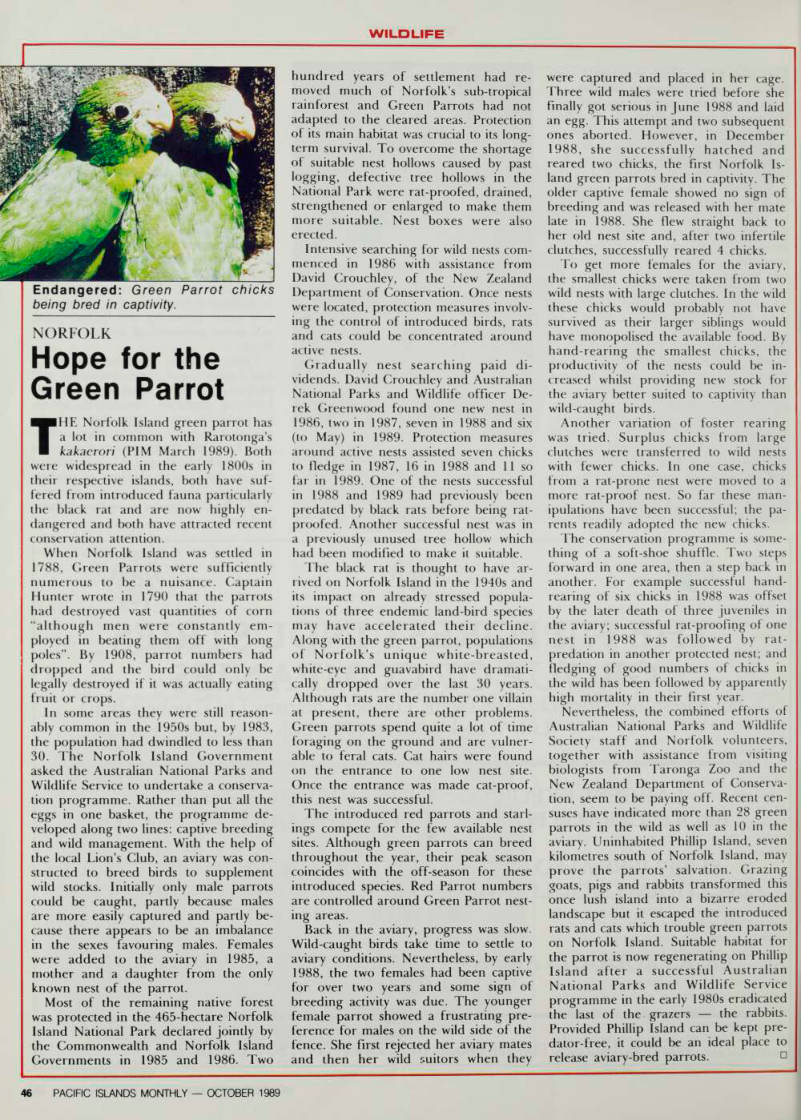
Wildlife
Norfolk
Hope for the Green Parrot
THE Norfolk Island green parrot has a lot in common with Rarotonga’s kakaerori (PIM March 1989). Both were widespread in the early 1800 s in their respective islands, both have suf fered from introduced fauna particularly the black rat and are now highly en dangered and both have attracted recent conservation attention.
When Norfolk Island was settled in 1788, Green Parrots were sufficiently numerous to be a nuisance. Captain Hunter wrote in 1790 that the parrots had destroyed vast quantities of corn “although men were constantly em ployed in beating them off with long poles”. By 1908, parrot numbers had dropped and the bird could only be legally destroyed if it was actually eating fruit or crops.
In some areas they were still reason ably common in the 1950 s but, by 1983, the population had dwindled to less than 30. The Norfolk Island Government asked the Australian National Parks and Wildlife Service to undertake a conserva tion programme. Rather than put all the eggs in one basket, the programme de
veloped along two lines: captive breeding
and wild management. With the help of the local Lion’s Club, an aviary was con structed to breed birds to supplement wild stocks. Initially only male parrots could be caught, partly because males are more easily captured and partly be cause there appears to be an imbalance in the sexes favouring males. Females were added to the aviary in 1985, a mother and a daughter from the only known nest of the parrot.
Most of the remaining native forest was protected in the 465-hectare Norfolk Island National Park declared jointly by the Commonwealth and Norfolk Island Governments in 1985 and 1986. Two
hundred years of settlement had re moved much of Norfolk’s sub-tropical rainforest and Green Parrots had not adapted to the cleared areas. Protection of its main habitat was crucial to its long term survival. To overcome the shortage of suitable nest hollows caused by past logging, defective tree hollows in the National Park were rat-proofed, drained, strengthened or enlarged to make them more suitable. Nest boxes were also erected.
Intensive searching for wild nests com menced in 1986 with assistance from David Crouchley, of the New Zealand Department of Conservation. Once nests were located, protection measures involv ing the control of introduced birds, rats and cats could be concentrated around active nests.
Gradually nest searching paid di
vidends. David Crouchley and Australian National Parks and Wildlife officer De rek Greenwood found one new nest in 1986, two in 1987, seven in 1988 and six (to May) in 1989. Protection measures around active nests assisted seven chicks to fledge in 1987, 16 in 1988 and 11 so far in 1989. One of the nests successful in 1988 and 1989 had previously been predated by black rats before being rat proofed. Another successful nest was in a previously unused tree hollow which had been modified to make it suitable.
The black rat is thought to have ar rived on Norfolk Island in the 1940 s and
its impact on already stressed popula
tions of three endemic land-bird species may have accelerated their decline.
Along with the green parrot, populations of Norfolk’s unique white-breasted, white-eye and guavabird have dramati cally dropped over the last 30 years.
Although rats are the number one villain at present, there are other problems.
Green parrots spend quite a lot of time foraging on the ground and are vulner able to feral cats. Cat hairs were found on the entrance to one low nest site.
Once the entrance was made cat-proof, this nest was successful.
The introduced red parrots and starl ings compete for the few available nest sites. Although green parrots can breed throughout the year, their peak season coincides with the off-season for these introduced species. Red Parrot numbers are controlled around Green Parrot nest
ing areas.
Back in the aviary, progress was slow.
Wild-caught birds take time to settle to
aviary conditions. Nevertheless, by early
1988, the two females had been captive for over two years and some sign of breeding activity was due. The younger female parrot showed a frustrating pre ference for males on the wild side of the fence. She first rejected her aviary mates and then her wild suitors when they
were captured and placed in her cage.
Three wild males were tried before she finally got serious in June 1988 and laid an egg. This attempt and two subsequent ones aborted. However, in December 1988, she successfully hatched and reared two chicks, the first Norfolk Is land green parrots bred in captivity. The older captive female showed no sign of breeding and was released with her mate late in 1988. She flew straight back to her old nest site and, after two infertile clutches, successfully reared 4 chicks.
To get more females for the aviary, the smallest chicks were taken from two wild nests with large clutches. In the wild these chicks would probably not have survived as their larger siblings would have monopolised the available food. By hand-rearing the smallest chicks, the productivity of the nests could be in creased whilst providing new stock for the aviary better suited to captivity than wild-caught birds.
Another variation of foster rearing was tried. Surplus chicks from large clutches were transferred to wild nests with fewer chicks. In one case, chicks from a rat-prone nest were moved to a more rat-proof nest. So far these man ipulations have been successful; the pa rents readily adopted the new chicks.
The conservation programme is some thing of a soft-shoe shuffle. Two steps forward in one area, then a step back in another. For example successful hand rearing of six chicks in 1988 was offset by the later death of three juveniles in the aviary; successful rat-proofing of one nest in 1988 was followed by rat predation in another protected nest; and fledging of good numbers of chicks in the wild has been followed by apparently high mortality in their first year.
Nevertheless, the combined efforts of Australian National Parks and Wildlife Society staff and Norfolk volunteers, together with assistance from visiting biologists from Taronga Zoo and the New Zealand Department of Conserva tion, seem to be paying off. Recent cen suses have indicated more than 28 green parrots in the wild as well as 10 in the aviary. Uninhabited Phillip Island, seven kilometres south of Norfolk Island, may prove the parrots’ salvation. Grazing goats, pigs and rabbits transformed this once lush island into a bizarre eroded landscape but it escaped the introduced rats and cats which trouble green parrots on Norfolk Island. Suitable habitat for the parrot is now regenerating on Phillip Island after a successful Australian National Parks and Wildlife Service programme in the early 1980 s eradicated the last of the grazers the rabbits.
Provided Phillip Island can be kept pre dator-free, it could be an ideal place to release aviary-bred parrots. n
Endangered: Green Parrot chicks being bred in captivity.
Ruling the
Books
Ruling the islands
DEFINING STATUS: A comprehensive analysis of the United States Territo rial Relations. By Arnold Leibowitz. 752 pages. Kluwer Academic Publishers, PO Box 358, Accord Station. Hingham, Mass 02018, United States. SUSIB9.
Reviewed by David North THIS is a blockbuster of a book on America’s rule of its island terri
tories encyclopedic, insightful,
outspoken and often angry.
It is a treasurehouse of information on important but rarely-researched island issues. And, as the title claims, it is com prehensive: 752 pages and thousands of footnotes long, well organised, and sprinkled with a light dusting of political and historical trivia. (For example, for many years after World War II United States citizens could not visit Guam with out military approval; one such citizen encountering this obstacle was the for midable Mainland politician John Con nally, later Governor of Texas. He com plained to President Kennedy, and the ban was lifted.) The author has one of those unusual legal specialties: he helps United States territories write their constitutions, and argues their cases in court, usually against the federal government. And he has been involved, in one way or another, with American Samoa, Guam, the Northern Marianas, and the three former Trust Territories: the Federated States of Micronesia, the Marshalls and Palau. (He has been, for example, coun sel to the President of Palau in some of the recent litigation before the Palau courts on various compact of Free Asso ciation issues.) It is from this background that Leibo witz views the U.S. relations with its ter ritories. His general position is that
Washington rarely approaches the terri
tories in a systematic, long-term manner; that the lack of island political power in the capital leads to frequent defeats for territorial interests; and that all three branches of the Mainland government, executive, legislative and judicial, seem to have a higher regard for their own positions and powers vis-a-vis the islands than they do of the islands’ abilities to govern themselves. (As a lawyer he has a particularly grim view of the pattern he sees in the courts, always ruling for ex tensions of federal power and rarely supporting the territories when they ob ject.) L-eibowitz spells this out by, first, out lining how the US Government, from even before the writing of the Constitu
tion, handled its relations with territor ies. They were at first regarded as potential states, and most remained in a transitional (territorial) role for only a few years. When the US was very young, under the Confederation (1776-1789) it had a single house legislature, and terri tories (like Tennessee) were granted a
single, non-voting delegate in the Con
gress. While that specific precedent still operates regarding American Samoa and Guam, the notion of territories (now dis tant and populated by non-whites) as potential states has dimmed.
After laying out the general patterns
of Washington-island relations, including
decades of rule by US Navy officers, the author moves to near-book-length chap ters on the relations between each of the territories and Washington. (The two Caribbean territories, Puerto Rico and the US Virgin Islands, are covered as well.) In each of these chapters he mixes a little history and a little anthropology, with generous doses of policy analysis, politics and law.
While Leibowitz usually supports the position of island governments, he offers some sharp advice to the territories on various subjects, such as on ethnic specific, land-tenure laws. He suggests
that allowing only Samoans, for example,
to own certain classes of land, is likely to be upset (on an equal rights basis) in federal courts, but that Samoa could reach the same general objective if land ownership were restricted to certain clas ses of residents of the territory, or if land could be alienated only for certain purposes.
Speaking of Samoa, I was a little dis mayed that the islands’ leading constitu tional scholar did not discuss the in teresting question of women and the Senate of American Samoa, although there is a thorough discussion of the evolution of the Samoan legislature.
While the lower house in American Samoa is elected by universal suffrage, and a secret ballot, the upper house is
chosen by the traditional meetings of the rnatais, the traditional family leaders.
The latter are 99 per cent male, and no woman has ever been elected to the Samoa Senate. What would happen to that practice if it came before a US dis trict court on the Mainland? I am not a lawyer but I am sure that the matai elec tion system would be dead in the water.
Returning to the broad thrust of his work, Leibowitz recommends: • that US policy toward the islands become more stable and more thought ful; • that US establish real limits to feder al power, giving the islands more power to run their own affairs; • that Washington support the move ment toward change in status of the ter ritories; • that, in the long-term, statehood be the objective for Guam (preferably joined with the Marianas) and that, if American Samoa can accept an end to ethnic land-tenure legislation and the control of its own immigration policy it too be encouraged to seek statehood; and • that, in the short-term, the federal government should move toward equal treatment in social and trade programs,
should enhance political representation
of the islands, and restrain its appetite for land in the islands. (The military occupies a lot of land in Guam, and in some of the former Territories.) Politicians, scholars, lawyers and jour nalists seeking to understand how the U.S. treats its islands need this volume.
It is the definitive book on the subject, and provides a solid underpinning for
policy making, scholarship and the text
generation of law suits. It is particularly valuable because it deals with all the rela tionships of Washington with all of the islands, on a wide range of subjects.
A note on the price: this is a result of privatisation, or how the private sector copes with a specialised product for an unwieldy market. But it is worth it. □
Advertisements & other items, p. 47 (1 item)
Acific Islands Year Book
16TH EDITION ONLY As4s A COPY
Buy your hard cover plastic jacketed copy today, by filling this coupon and enclosing your bank draft or money order to: PACIFIC ISLANDS
YEAR BOOK, P.O. BOX 1167, SUVA.
Please send me . . . copy(ies) of the 16th Edition of the Pacific Islands Year Book. I enclose herewith my cheque made payable to PACIFIC ISLANDS MONTHLY of A$ or debit $ to my □ Bankcard □ visa □ Mastercard (Card No:) Expiry Date:
MY NAME:
POSTAL ADDRESS: -
CITY:
COUNTRY:
TELEPHONE NUMBER:
Reflections on
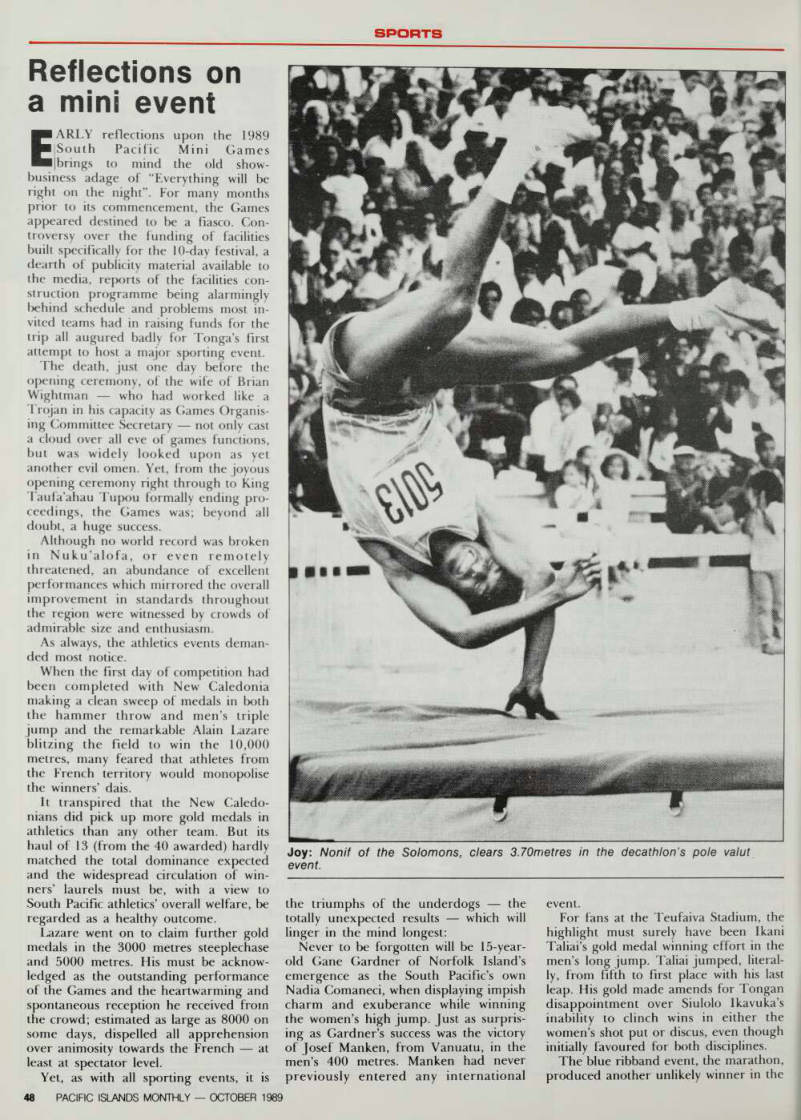
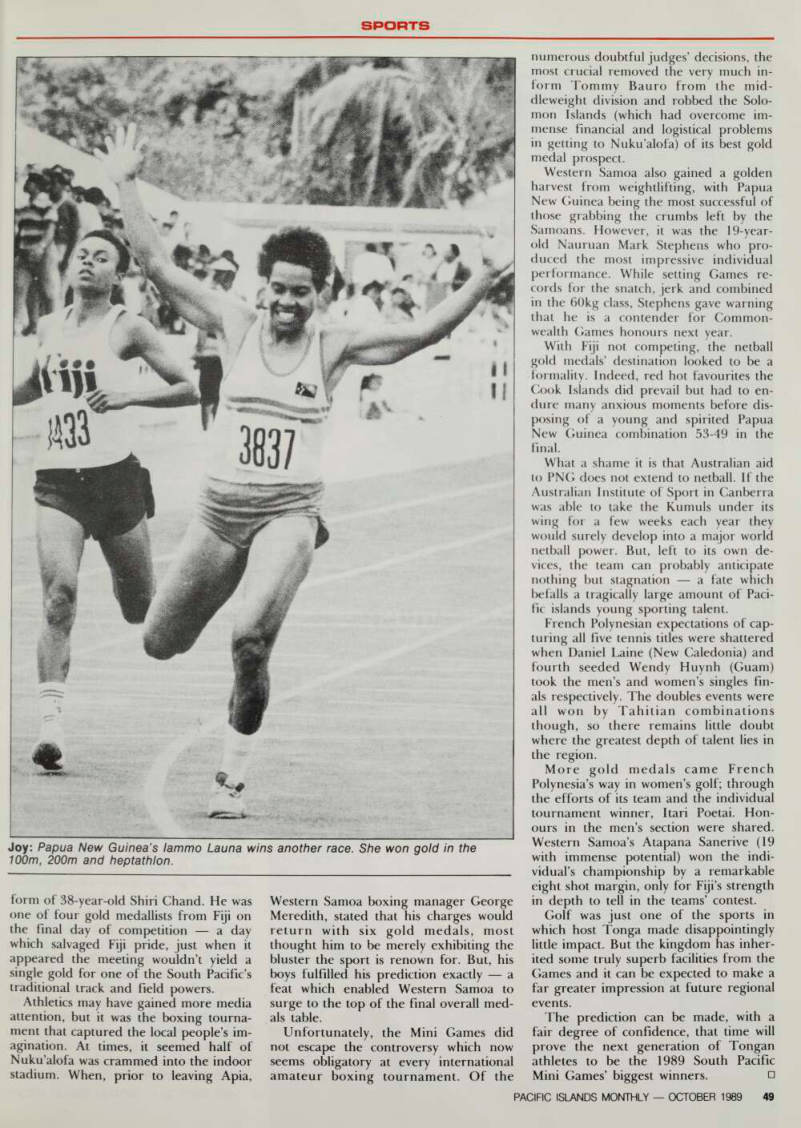
Sports
Reflections on a mini event
EARLY reflections upon the 1989 [South Pacific Mini Games (brings to mind the old show business adage of “Everything will be right on the night”. For many months prior to its commencement, the Games appeared destined to be a fiasco. Con troversy over the funding of facilities built specifically for the 10-day festival, a dearth of publicity material available to the media, reports of the facilities con
struction programme being alarmingly
behind schedule and problems most in vited teams had in raising funds for the trip all augured badly for Tonga’s first attempt to host a major sporting event.
The death, just one day before the opening ceremony, of the wife of Brian Wightman who had worked like a Trojan in his capacity as Games Organis ing Committee Secretary not only cast a cloud over all eve of games functions, but was widely looked upon as yet another evil omen. Yet, from the joyous
opening ceremony right through to King
Taufa’ahau Tupou formally ending pro ceedings, the Games was; beyond all doubt, a huge success.
Although no world record was broken in Nuku’alofa, or even remotely threatened, an abundance of excellent performances which mirrored the overall
improvement in standards throughout
the region were witnessed by crowds of admirable size and enthusiasm.
As always, the athletics events deman ded most notice.
When the first day of competition had been completed with New Caledonia making a clean sweep of medals in both the hammer throw and men’s triple jump and the remarkable Alain Lazare blitzing the field to win the 10,000 metres, many feared that athletes from the French territory would monopolise the winners’ dais.
It transpired that the New Caledo nians did pick up more gold medals in athletics than any other team. But its haul of 13 (from the 40 awarded) hardly matched the total dominance expected and the widespread circulation of win ners’ laurels must be, with a view to South Pacific athletics’ overall welfare, be regarded as a healthy outcome.
Lazare went on to claim further gold medals in the 3000 metres steeplechase and 5000 metres. His must be acknow
ledged as the outstanding performance
of the Games and the heartwarming and spontaneous reception he received from the crowd; estimated as large as 8000 on some days, dispelled all apprehension over animosity towards the French at least at spectator level.
Yet, as with all sporting events, it is
the triumphs of the underdogs the totally unexpected results which will linger in the mind longest: Never to be forgotten will be 15-year old Gane Gardner of Norfolk Island’s emergence as the South Pacific’s own Nadia Comaneci, when displaying impish charm and exuberance while winning the women’s high jump. Just as surpris ing as Gardner’s success was the victory of Josef Manken, from Vanuatu, in the men’s 400 metres. Manken had never previously entered any international
event.
For fans at the Teufaiva Stadium, the highlight must surely have been Ikani Taliai’s gold medal winning effort in the
men’s long jump. Taliai jumped, literal
ly, from fifth to first place with his last leap. His gold made amends for Tongan disappointment over Siulolo Ikavuka’s inability to clinch wins in either the women’s shot put or discus, even though initially favoured for both disciplines.
The blue ribband event, the marathon, produced another unlikely winner in the
Joy: Nonif of the Solomons, clears 3.70metres in the decathlon’s pole valut event.
form of 38-year-old Shiri Chand. He was one of four gold medallists from Fiji on the final day of competition a day which salvaged Fiji pride, just when it appeared the meeting wouldn’t yield a single gold for one of the South Pacific’s traditional track and field powers.
Athletics may have gained more media attention, but it was the boxing tournament that captured the local people’s imagination. At times, it seemed half of Nuku’alofa was crammed into the indoor stadium. When, prior to leaving Apia,
Western Samoa boxing manager George Meredith, stated that his charges would return with six gold medals, most thought him to be merely exhibiting the bluster the sport is renown for. But, his boys fulfilled his prediction exactly a feat which enabled Western Samoa to surge to the top of the final overall med als table.
Unfortunately, the Mini Games did not escape the controversy which now seems obligatory at every international amateur boxing tournament. Of the
numerous doubtful judges’ decisions, the most crucial removed the very much in form Tommy Bauro from the mid dleweight division and robbed the Solo mon Islands (which had overcome im mense financial and logistical problems in getting to Nukualofa) of its best gold medal prospect.
Western Samoa also gained a golden harvest from weightlifting, with Papua New Guinea being the most successful of those grabbing the crumbs left by the Samoans. However, it was the 19-year old Nauruan Mark Stephens who pro duced the most impressive individual performance. While setting Games re cords for the snatch, jerk and combined in the 60kg class, Stephens gave warning that he is a contender for Common wealth Games honours next year.
With Fiji not competing, the netball gold medals’ destination looked to be a formality. Indeed, red hot favourites the Cook Islands did prevail but had to en dure many anxious moments before dis posing of a young and spirited Papua New Guinea combination 53-49 in the final.
What a shame it is that Australian aid to PNG does not extend to netball. If the Australian Institute of Sport in Canberra was able to take the Kumuls under its wing for a few weeks each year they would surely develop into a major world netball power. But, left to its own de vices, the team can probably anticipate nothing but stagnation a fate which befalls a tragically large amount of Paci fic islands young sporting talent.
French Polynesian expectations of cap turing all five tennis titles were shattered when Daniel Laine (New Caledonia) and fourth seeded Wendy Huynh (Guam) took the men’s and women’s singles fin als respectively. The doubles events were all won by Tahitian combinations though, so there remains little doubt where the greatest depth of talent lies in
the region.
More gold medals came French
Polynesia’s way in women’s golf; through
the efforts of its team and the individual tournament winner, Itari Poetai. Hon ours in the men’s section were shared.
Western Samoa’s Atapana Sanerive (19 with immense potential) won the indi vidual’s championship by a remarkable eight shot margin, only for Fiji’s strength in depth to tell in the teams’ contest.
Golf was just one of the sports in which host Tonga made disappointingly little impact. But the kingdom has inher ited some truly superb facilities from the Games and it can be expected to make a far greater impression at future regional events.
The prediction can be made, with a fair degree of confidence, that time will prove the next generation of Tongan athletes to be the 1989 South Pacific Mini Games’ biggest winners. □
Joy: Papua New Guinea's lammo Launa wins another race. She won gold in the 100m, 200m and heptathlon.
to lose
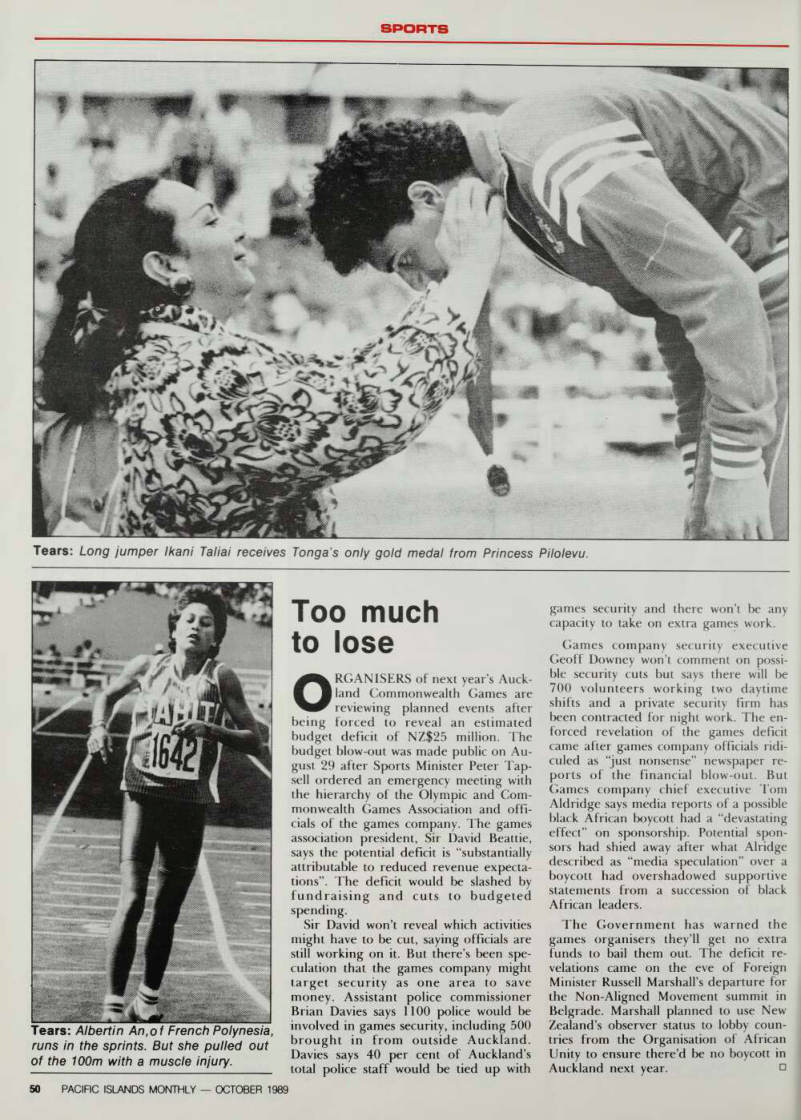
Too much to lose
ORGANISERS of next year’s Auck land Commonwealth Games are
reviewing planned events after
being forced to reveal an estimated budget deficit of NZ$25 million. The budget blow-out was made public on Au gust 29 after Sports Minister Peter Tap sell ordered an emergency meeting with the hierarchy of the Olympic and Com monwealth Games Association and offi cials of the games company. The games association president, Sir David Beattie, says the potential deficit is “substantially attributable to reduced revenue expecta tions”. The deficit would be slashed by fundraising and cuts to budgeted
spending.
Sir David won’t reveal which activities might have to be cut, saying officials are still working on it. But there’s been spe culation that the games company might target security as one area to save money. Assistant police commissioner Brian Davies says 1100 police would be involved in games security, including 500 brought in from outside Auckland.
Davies says 40 per cent of Auckland’s total police staff would be tied up with
games security and there won’t be any capacity to take on extra games work.
Games company security executive Geoff Downey won’t comment on possi ble security cuts but says there will be 700 volunteers working two daytime shifts and a private security firm has been contracted for night work. The en forced revelation of the games deficit came after games company officials ridi culed as “just nonsense” newspaper re ports of the financial blow-out. But Games company chief executive Tom Aldridge says media reports of a possible black African boycott had a “devastating effect” on sponsorship. Potential spon sors had shied away after what Alridge described as “media speculation” over a
boycott had overshadowed supportive
statements from a succession of black African leaders.
The Government has warned the games organisers they’ll get no extra funds to bail them out. The deficit re velations came on the eve of Foreign Minister Russell Marshall’s departure for the Non-Aligned Movement summit in Belgrade. Marshall planned to use New Zealand’s observer status to lobby coun tries from the Organisation of African Unity to ensure there’d be no boycott in Auckland next year. □
Tears: Long jumper Ikani Taliai receives Tonga’s only gold medal from Princess Pilolevu.
Tears: Albertin An,of French Polynesia, runs in the sprints. But she pulled out of the 100m with a muscle injury.
New horizon
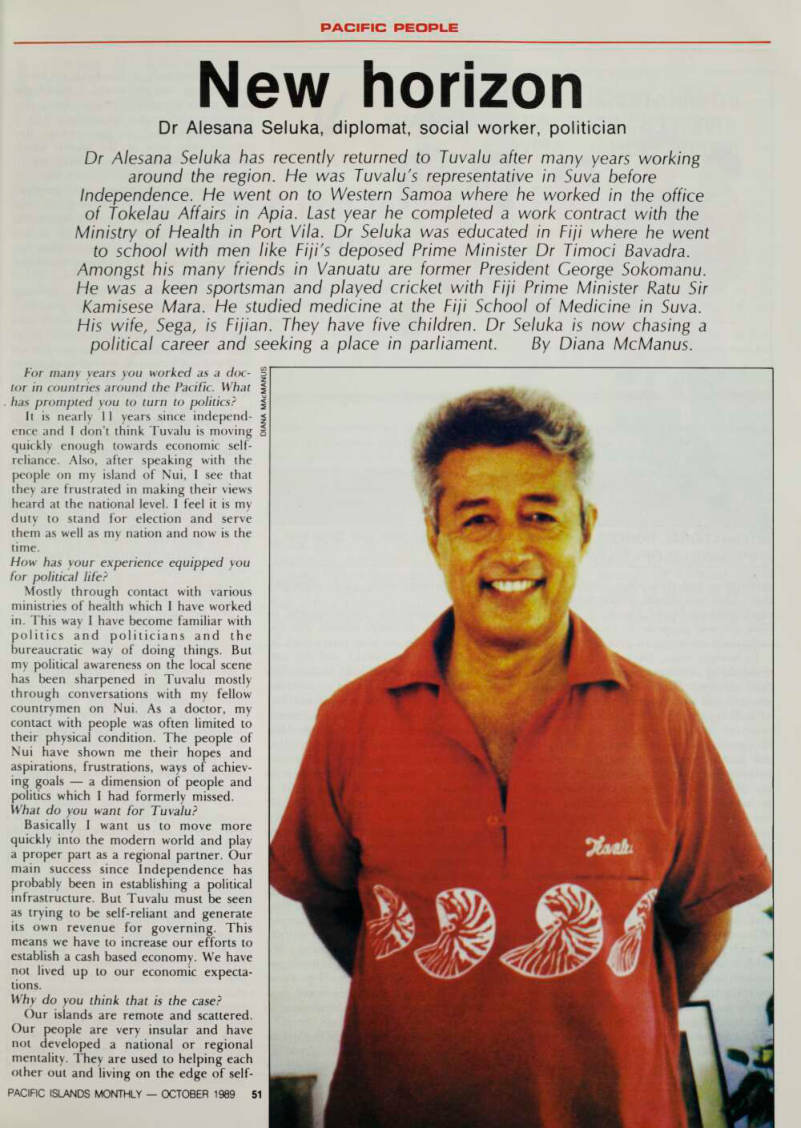
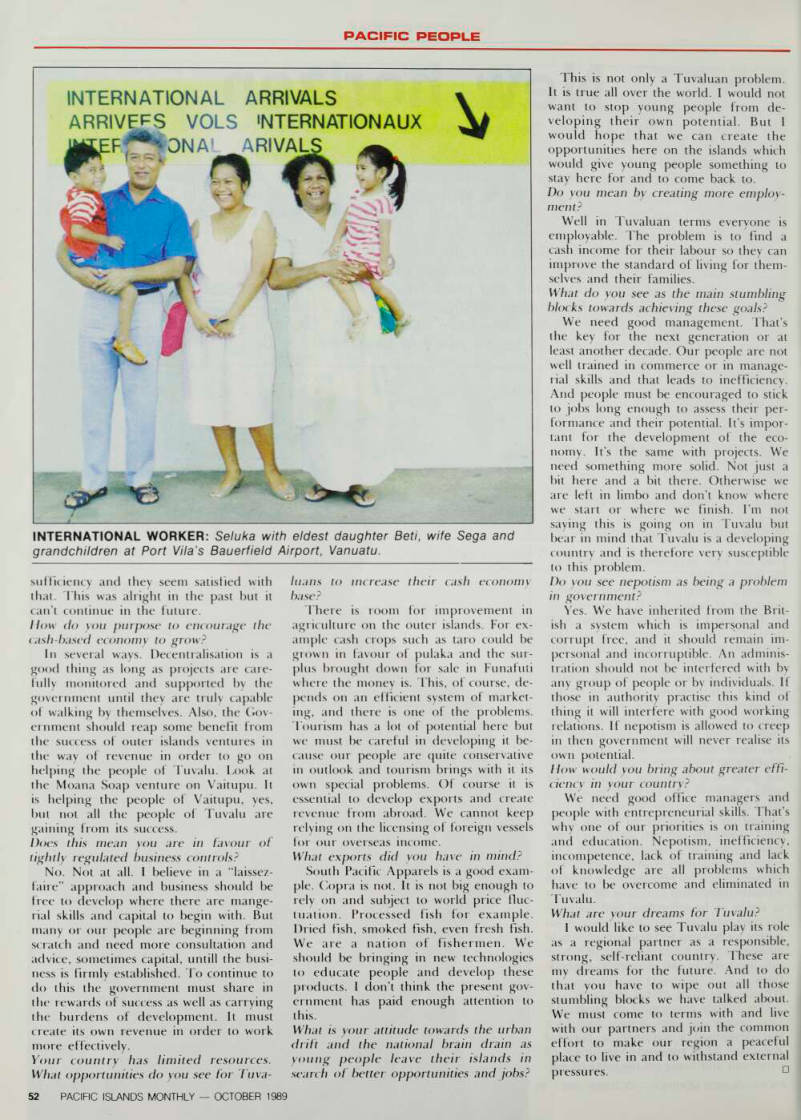
Pacific People
Dr Alesana Seluka, diplomat, social worker, politician
Dr Alesana Seluka has recently returned to Tuvalu after many years working around the region. He was Tuvalu's representative in Suva before Independence. He went on to Western Samoa where he worked in the office of Tokelau Affairs in Apia. Last year he completed a work contract with the Ministry of Health in Port Vila. Dr Seluka was educated in Fiji where he went to school with men like Fiji's deposed Prime Minister Dr Timoci Bavadra.
Amongst his many friends in Vanuatu are former President George Sokomanu.
He was a keen sportsman and played cricket with Fiji Prime Minister Ratu Sir Kamisese Mara. He studied medicine at the Fiji School of Medicine in Suva.
His wife , Sega, is Fijian. They have five children. Dr Seluka is now chasing a political career and seeking a place in parliament. By Diana McManus.
For many years you worked as a doc tor in countries around the Pacific. What has prompted you to turn to politics?
It is nearly 11 years since independ ence and I don’t think Tuvalu is moving quickly enough towards economic self reliance. Also, after speaking with the people on my island of Nui, I see that they are frustrated in making their views heard at the national level. I feel it is my duty to stand for election and serve them as well as my nation and now is the time.
How has your experience equipped you for political life?
Mostly through contact with various ministries of health which I have worked in. This way I have become familiar with politics and politicians and the bureaucratic way of doing things. But my political awareness on the local scene has been sharpened in Tuvalu mostly through conversations with my fellow countrymen on Nui. As a doctor, my contact with people was often limited to their physical condition. The people of Nui have shown me their hopes and aspirations, frustrations, ways of achiev ing goals a dimension of people and politics which I had formerly missed.
What do you want for Tuvalu?
Basically I want us to move more quickly into the modern world and play a proper part as a regional partner. Our main success since Independence has
probably been in establishing a political
infrastructure. But Tuvalu must be seen as trying to be self-reliant and generate its own revenue for governing. This means we have to increase our efforts to establish a cash based economy. We have not lived up to our economic expecta tions.
Why do you think that is the case?
Our islands are remote and scattered.
Our people are very insular and have not developed a national or regional mentality. They are used to helping each other out and living on the edge of self-
Diana Macmanus
sufficiency and they seem satisfied with that. This was alright in the past but it can’t continue in the future.
How do you purpose to encourage the cash-based economy to grow?
In several ways. Decentralisation is a good thing as long as projects are care
fully monitored and supported by the
government until they are truly capable
of walking by themselves. Also, the Gov ernment should reap some benefit from the success of outer islands ventures in the way of revenue in order to go on helping the people of Tuvalu. Look at the Moana Soap venture on Vaitupu. It is helping the people of Vaitupu, yes, hut not all the people of Tuvalu are gaining from its success.
Does this mean you are in favour of
tightly regulated business controls?
No. Not at all. 1 believe in a “laissez faire” approach and business should be free to develop where there are mange rial skills and capital to begin with. But many or our people are beginning from scratch and need more consultation and advice, sometimes capital, untill the busi ness is firmly established. To continue to do this the government must share in the rewards of success as well as carrying the burdens of development. It must create its own revenue in order to work
more effectively.
Your country has limited resources.
What opportunities do you see for Tuva-
I nans to increase their cash economy base?
There is room for improvement in agriculture on the outer islands. For ex ample cash crops such as taro could be grown in favour of pulaka and the sur plus brought down for sale in Funafuti where the money is. This, of course, de pends on an efficient system of market ing, and there is one of the problems.
Tourism has a lot of potential here but we must be careful in developing it be cause our people are quite conservative in outlook and tourism brings with it its own special problems. Of course it is essential to develop exports and create revenue from abroad. We cannot keep relying on the licensing of foreign vessels for our overseas income.
What exports did you have in mind?
South Pacific Apparels is a good exam ple. Copra is not. It is not big enough to rely on and subject to world price fluc tuation. Processed fish for example.
Dried fish, smoked fish, even fresh fish.
We are a nation of fishermen. We should be bringing in new technologies to educate people and develop these products. I don’t think the present gov ernment has paid enough attention to this.
What is your attitude towards the urban drift and the national brain drain as young people leave their islands in search of better opportunities and jobs?
This is not only a Tuvaluan problem.
It is true all over the world. I would not want to stop young people from de veloping their own potential. But I would hope that we can create the opportunities here on the islands which
would give young people something to
stay here for and to come back to.
Do you mean by creating more employ ment?
Well in Tuvaluan terms everyone is employable. The problem is to find a cash income for their labour so they can improve the standard of living for them selves and their families.
What do you see as the main stumbling blocks towards achieving these goals?
We need good management. That’s the key for the next generation or at least another decade. Our people are not well trained in commerce or in manage rial skills and that leads to inefficiency.
And people must be encouraged to stick to jobs long enough to assess their per formance and their potential. It’s impor tant for the development of the eco nomy. Ifs the same with projects. We need something more solid. Not just a bit here and a bit there. Otherwise we are left in limbo and don’t know where we start or where we finish. I’m not saying this is going on in Tuvalu but bear in mind that Tuvalu is a developing country and is therefore very susceptible to this problem.
Do you see nepotism as being a problem
in government?
Yes. We have inherited from the Brit ish a system which is impersonal and corrupt free, and it should remain im personal and incorruptible. An adminis tration should not be interfered with by any group of people or by individuals. It those in authority practise this kind of thing it will interfere with good working relations. If nepotism is allowed to creep in then government will never realise its
own potential.
How would you bring about greater effi
ciency in your country?
We need good office managers and people with entrepreneurial skills. That’s why one of our priorities is on training
and education. Nepotism, inefficiency,
incompetence, lack of training and lack of knowledge are all problems which have to be overcome and eliminated in Tuvalu.
What are your dreams for Tuvalu?
I would like to see Tuvalu play its role as a regional partner as a responsible, strong, self-reliant country. These are my dreams for the future. And to do that you have to wipe out all those stumbling blocks we have talked about.
We must come to terms with and live with our partners and join the common effort to make our region a peaceful place to live in and to withstand external pressures. D
INTERNATIONAL WORKER: Seluka with eldest daughter Beti, wife Sega and grandchildren at Port Vila's Bauerfield Airport, Vanuatu.
Rotarians
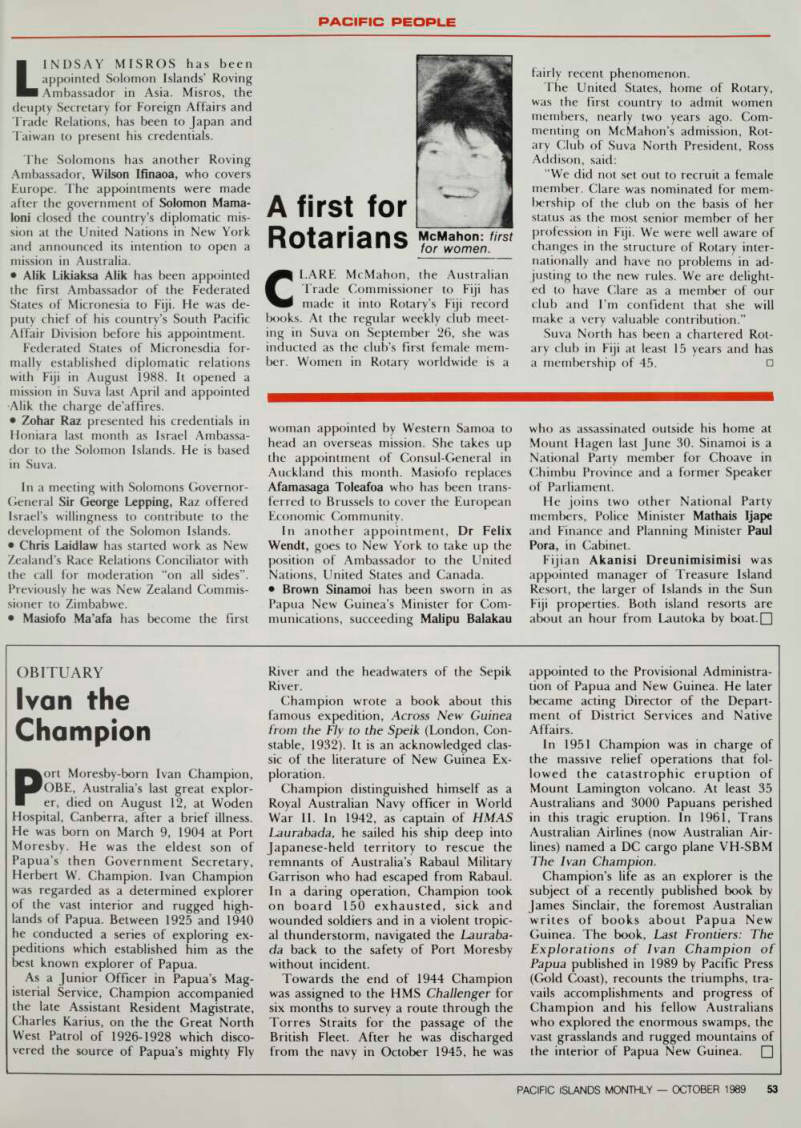
A first for Rotarians
LINDSAY MISROS has been
appointed Solomon Islands’ Roving
Ambassador in Asia. Misros, the deupty Secretary for Foreign Affairs and Trade Relations, has been to Japan and Taiwan to present his credentials.
The Solomons has another Roving Ambassador, Wilson Ifinaoa, who covers Europe. The appointments were made after the government of Solomon Mama loni closed the country’s diplomatic mis sion at the United Nations in New York and announced its intention to open a mission in Australia. • Alik Likiaksa Alik has been appointed the first Ambassador of the Federated States of Micronesia to Fiji. He was de puty chief of his country’s South Pacific Affair Division before his appointment.
Federated States of Micronesdia for
mally established diplomatic relations
with Fiji in August 1988. It opened a mission in Suva last April and appointed Alik the charge de’affires. • Zohar Raz presented his credentials in Honiara last month as Israel Ambassa dor to the Solomon Islands. He is based in Suva.
In a meeting with Solomons Governor- General Sir George Lepping, Raz offered Israel’s willingness to contribute to the development of the Solomon Islands. • Chris Laidlaw has started work as New Zealand’s Race Relations Conciliator with the call for moderation “on all sides”.
Previously he was New Zealand Commis sioner to Zimbabwe. • Masiofo Ma’afa has become the first
, , ... 0 woman appointed by Western Samoa to , , rr ; . . head an overseas mission. She takes up , c „ . the a PP omtment °* Consul-General in Auckland this month. Masiofo replaces Afamasaga Toleafoa who has been transferred to Brussels to cover the European
Economic Community.
In another appointment, Dr Felix Wendt, goes to New York to take up the position of Ambassador to the United Nations, United States and Canada. • Brown Sinamoi has been sworn in as Papua New Guinea’s Minister for Communications, succeeding Malipu Balakau
who as assassinated outside his home at w ¥l , . or . 0 .
Mount Hagen last June 30. Smamoi is a M . J , f National Party member tor Choave in Chimbu Province and a former Speaker of Parliament.
He joins two other National Party members, Police Minister Mathais Ijape and Finance and Planning Minister Paul Pora, in Cabinet.
Fijian Akanisi Dreunimisimisi was appointed manager of Treasure Island Resort, the larger of Islands in the Sun Fiji properties. Both island resorts are about an hour from Lautoka by boat.Q
CLARE McMahon, the Australian Trade Commissioner to Fiji has made it into Rotary’s Fiji record books. At the regular weekly club meet ing in Suva on September 26, she was inducted as the club’s first female mem ber. Women in Rotary worldwide is a
fairly recent phenomenon.
The United States, home of Rotary, was the first country to admit women members, nearly two years ago. Com menting on McMahon’s admission, Rot ary Club of Suva North President, Ross Addison, said: “We did not set out to recruit a female member. Clare was nominated for mem bership of the club on the basis of her status as the most senior member of her profession in Fiji. We were well aware of changes in the structure of Rotary inter nationally and have no problems in ad justing to the new rules. We are delight ed to have Clare as a member of our club and I’m confident that she will make a very valuable contribution.”
Suva North has been a chartered Rot ary club in Fiji at least 15 years and has a membership of 45. □
McMahon: first for women.
Champion
Obituary
Ivan the Champion
Port Moresby-born Ivan Champion,
OBE, Australia’s last great explor er, died on August 12, at Woden Hospital, Canberra, after a brief illness.
He was born on March 9, 1904 at Port Moresby. He was the eldest son of Papua’s then Government Secretary, Herbert W. Champion. Ivan Champion was regarded as a determined explorer of the vast interior and rugged high lands of Papua. Between 1925 and 1940 he conducted a series of exploring ex peditions which established him as the best known explorer of Papua.
As a Junior Officer in Papua’s Mag isterial Service, Champion accompanied the late Assistant Resident Magistrate, Charles Karius, on the the Great North West Patrol of 1926-1928 which disco vered the source of Papua’s mighty Fly
River and the headwaters of the Sepik River.
Champion wrote a book about this famous expedition, Across New Guinea from the Fly to the Speik (London, Con stable, 1932). It is an acknowledged clas sic of the literature of New Guinea Ex ploration.
Champion distinguished himself as a Royal Australian Navy officer in World War 11. In 1942, as captain of HMAS Laurabada, he sailed his ship deep into Japanese-held territory to rescue the remnants of Australia’s Rabaul Military Garrison who had escaped from Rabaul.
In a daring operation, Champion took on board 150 exhausted, sick and wounded soldiers and in a violent tropic al thunderstorm, navigated the Lauraba da back to the safety of Port Moresby without incident.
Towards the end of 1944 Champion was assigned to the HMS Challenger for six months to survey a route through the Torres Straits for the passage of the British Fleet. After he was discharged from the navy in October 1945, he was
appointed to the Provisional Administra tion of Papua and New Guinea. He later became acting Director of the Depart ment of District Services and Native Affairs.
In 1951 Champion was in charge of the massive relief operations that fol lowed the catastrophic eruption of Mount Lamington volcano. At least 35 Australians and 3000 Papuans perished in this tragic eruption. In 1961, Trans Australian Airlines (now Australian Air lines) named a DC cargo plane VH-SBM The Ivan Champion.
Champion’s life as an explorer is the subject of a recently published book by James Sinclair, the foremost Australian writes of books about Papua New Guinea. The book, Last Frontiers: The Explorations of Ivan Champion of Papua published in 1989 by Pacific Press (Gold Coast), recounts the triumphs, tra vails accomplishments and progress of Champion and his fellow Australians who explored the enormous swamps, the vast grasslands and rugged mountains of the interior of Papua New Guinea. □
Reports from the papers. Compiled by John Carter
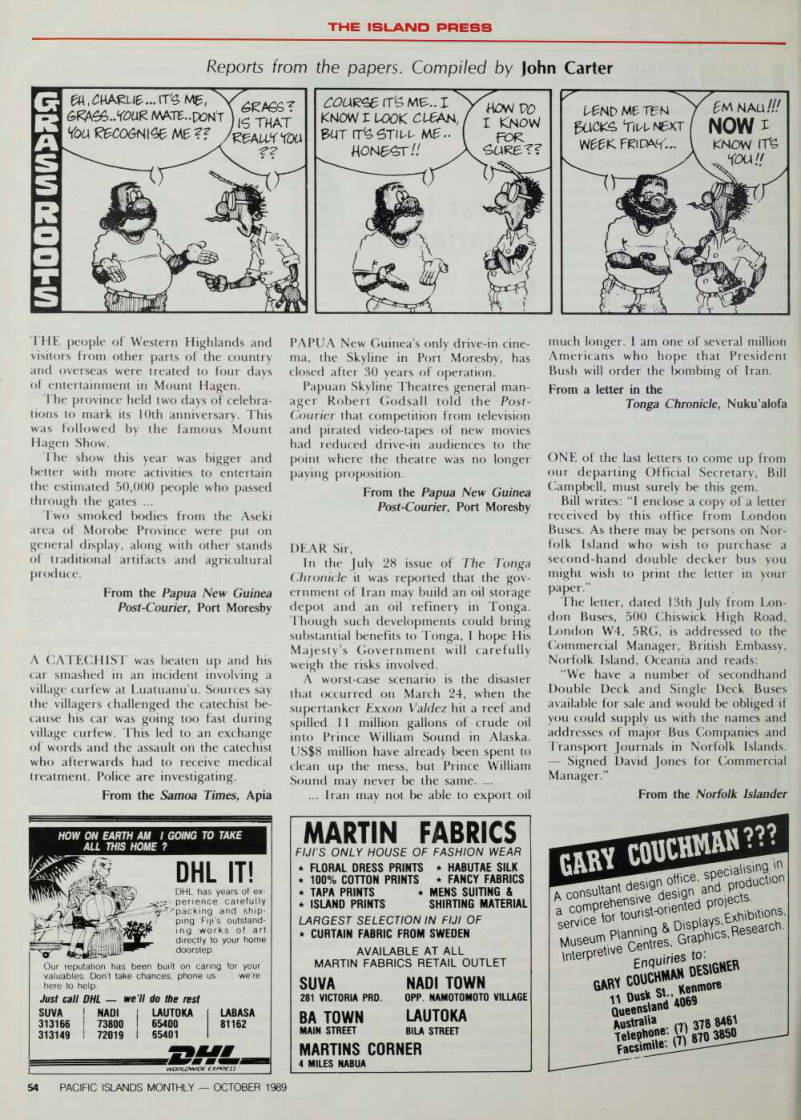
The Island Press
THE people of Western Highlands and visitors from other parts of the country and overseas were treated to four days of entertainment in Mount Hagen.
The province held two days of celebra tions to mark its 10th anniversary. This was followed by the famous Mount
Hagen Show.
The show this year was bigger and better with more activities to entertain the estimated 50,000 people who passed through the gates ...
Two smoked bodies from the Aseki area of Morobe Province were put on
general display, along with other stands
of traditional artifacts and agricultural
produce.
From the Papua New Guinea Post-Courier, Port Moresby A CATECHIST was beaten up and his car smashed in an incident involving a village curfew at Luatuanu’u. Sources say the villagers challenged the catechist be cause his car was going too fast during village curfew. This led to an exchange of words and the assault on the catechist who afterwards had to receive medical treatment. Police are investigating.
From the Samoa Times, Apia
PAPUA New Guinea’s only drive-in cine ma, the Skyline in Port Moresby, has closed after 30 years of operation.
Papuan Skyline Theatres general man
ager Robert Godsall told the Post- Courier that competition from television and pirated video-tapes of new movies had reduced drive-in audiences to the point where the theatre was no longer
paying proposition.
From the Papua New Guinea Post-Courier, Port Moresby
Dear Sir,
In the July 28 issue of The Tonga Chronicle it was reported that the gov ernment of Iran may build an oil storage depot and an oil refinery in Tonga.
Though such developments could bring
substantial benefits to Tonga, I hope His
Majesty’s Government will carefully
weigh the risks involved.
A worst-case scenario is the disaster that occurred on March 24, when the supertanker Exxon Valdez hit a reef and spilled 11 million gallons of crude oil into Prince William Sound in Alaska.
US$B million have already been spent to clean up the mess, but Prince William Sound may never be the same. ... ... Iran may not be able to export oil
much longer. I am one of several million Americans who hope that President Bush will order the bombing of Iran.
From a letter in the Tonga Chronicle, Nukualofa ONE of the last letters to come up from our departing Official Secretary, Bill Campbell, must surely be this gem.
Bill writes: “I enclose a copy of a letter received by this office from London Buses. As there may be persons on Nor folk Island who wish to purchase a second-hand double decker bus you might wish to print the letter in your
paper.”
The letter, dated 13th July from Lon don Buses, 500 Chiswick High Road, London W 4, SRG, is addressed to the
Commercial Manager, British Embassy,
Norfolk Island, Oceania and reads; “We have a number of secondhand Double Deck and Single Deck Buses available for sale and would be obliged if you could supply us with the names and addresses of major Bus Companies and Transport Journals in Norfolk Islands.
Signed David Jones for Commercial
Manager.”
From the Norfolk Islander
Advertisements & other items, pp. 54-56 (1 item)
»— 1 Cd Co — 1?
HOW ON EARTH AM I GOING TO TAKE
ALL THIS HOME ?
DHL IT!
DHL has years of exjr- perience carefully and shipping Fiji’s outstanding works of art directly to your home doorstep Our reputation has been built on caring for your valuables Don't take chances, phone us we re here to help.
Just call DHL — we ll do the rest
SUVA
313166 313149 fz.
WORLDS t OE EXPRESS
MARTIN FABRICS
FIJI'S ONLY HOUSE OF FASHION WEAR
* FLORAL DRESS PRINTS * HABUTAE SILK * 100% COTTON PRINTS * FANCY FABRICS * TAPA PRINTS * MENS SUITING &
* ISLAND PRINTS SHIRTING MATERIAL
LARGEST SELECTION IN FIJI OF
* CURTAIN FABRIC FROM SWEDEN
AVAILABLE AT ALL
MARTIN FABRICS RETAIL OUTLET
SUVA
281 VICTORIA PRO.
BA TOWN
MAIN STREET
NADI TOWN
OPP. NAMOTOMOTO VILLAGE
LAUTOKA
BILA STREET
MARTINS CORNER
4 MILES NABUA
it 1.8 g
■3 C- 3 -3 o» o» G cX (O ■, a 22 5 c 0 60- &r- J r; y) C° 2.® 5-' 2 <o‘ _n 5 sif * “ .*.«■ "f S3 1 «s 3 2 Q ®.§ Oc w ‘® <_ Z3 CD o
»— 1 CD CO — 1?
it m
3.Stj§5
a-" 3.°-^ a5 8-2 5 ® 5. to ry ■ O- co CD bi c =V
3 O' 2-.CO
S-S go
Fuels and lubricants.
Plastics. Chemicals. Bitumen.
Aviation Services. Bunkering.
Shell has penetrated even more of the Pacific to widen its network of offices, terminals and
Network Shell
now servicing
even more
of the Pacific.
distributors as well as service stations.
Now you can re-assess your source of supply, because Shell quality and value is close at hand, with the service to back it up. « REGIONAL OFFICES; GI'AM 6*l -T" -*350. Also servicing Marshall Islands {Majuro). Northern Marianas (Saipan). Palau. 11 6 9 313 933 Also servicing Tonga, Cook Islands. American Samoa. Western Samoa • PAPUA NEW GUINEA 6"5 228 "00. Also servicing Solomon Islands.
NEW CALEDONIA 68" 285 "20. Also servicing Tahiti. Vanuatu.
Looking for a Hard Time.
i\\
fftC
A J > - ~v. ; r~-; 4s? - • ★The Mitsubishi Galant takes overall honours at the Rally of 1,000 Lakes. Finland, 9th round of the WRC f* Finding the ideal conditions in which to put your theories to the test can sometimes take you a little out of your way. As in the case of testing the advanced technology incorporated in the Mitsubishi Galant.
They entered the Galant in some of the most grueling rounds of the World Rally Championship looking for those conditions.
So, from the rocky trails of the Acropolis Rally to the high-speed tracks of the Finnish 1000 Lakes Rally, the Mitsubishi Galant’s organic performance is being put to the test.
Mitsubishi Motors regards all motor sports events as the ultimate proving ground for their automotive technology. And where better to test the embodiment of organic performance, Dynamic-4? Four comprehensive drive systems: 4-wheel drive, 4-wheel steering, 4-wheel independent suspension and 4-wheel anti-lock braking are melded into a single, thinking performance.
An organic performance.
This approach —testing the worth of their technology under the rigors of competition maintains Mitsubishi s finely honed competitive and innovative edge.
And the test results become another part in Mitsubishi’s ever evolving production philosophy —the organic performance. * A
MITSUBI!
MOTOR
MITSUBISHI QHLRNT