Woman of Politics
pp. 51-53 · Read in the full issue
Pacific People
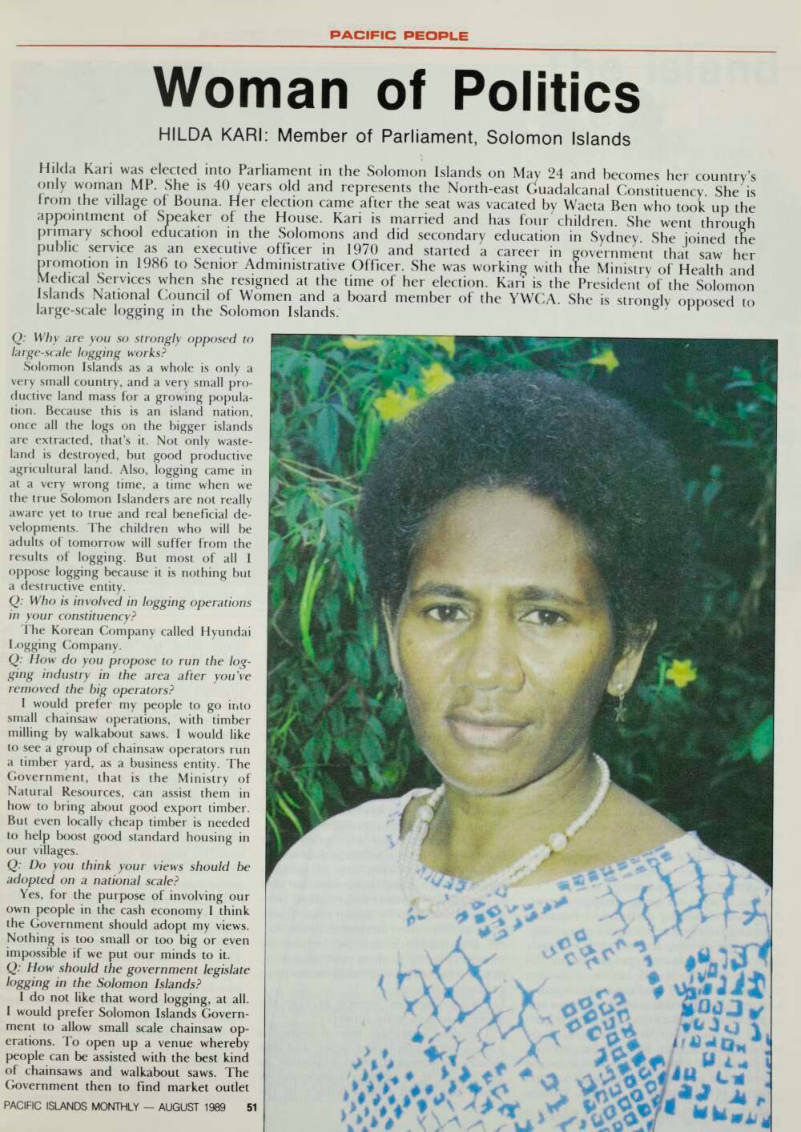
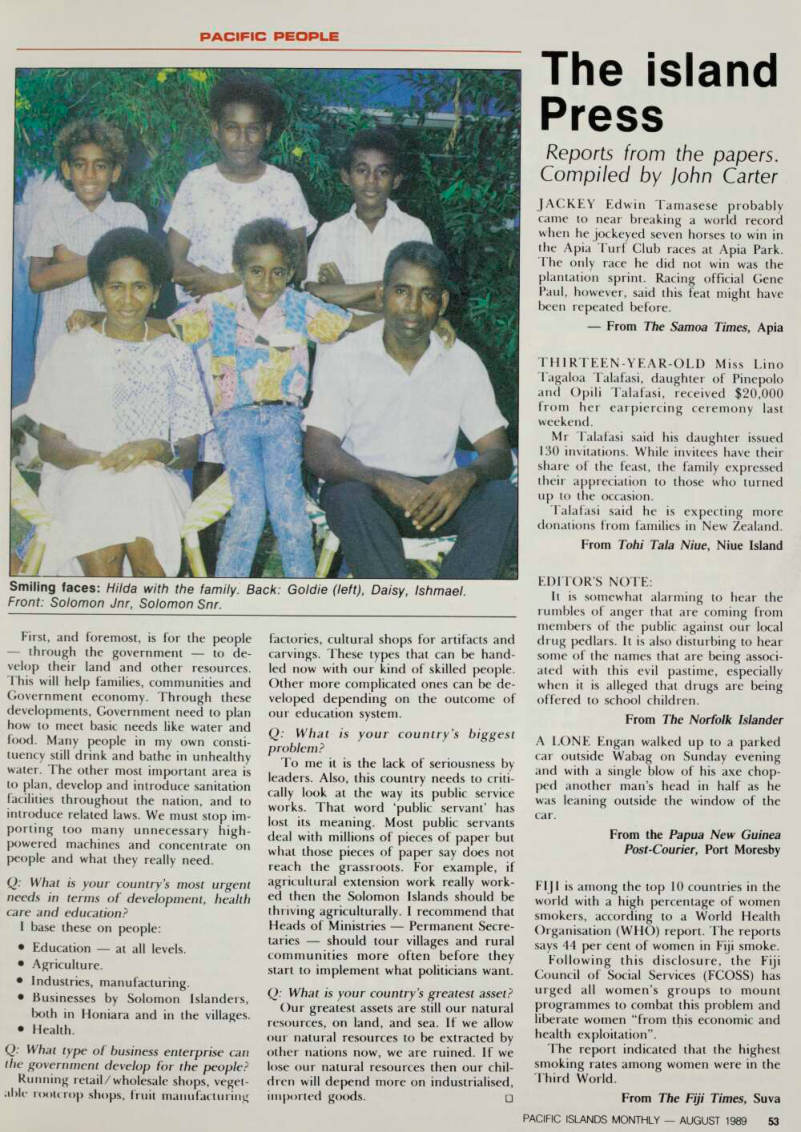
HILDA KARI: Member of Parliament, Solomon Islands Hilda Kari was elected into Parliament in the Solomon Islands on May 24 and becomes her country’s only woman MP. She is 40 years old and represents the North-east Guadalcanal Constituency She is from the village of Bouna. Her election came after the seat was vacated by Waeta Ben who took up the appointment of Speaker of the House. Kari is married and has four children. She went through primary school education in the Solomons and did secondary education in Sydney She joined the public service as an executive officer in 1970 and started a career in government that saw her promotion in 1986 to Senior Administrative Officer. She was working with the Ministry of Health and Serves when she resigned at the time of her election. Kari is the President of the Solomon Islands National Council of Women and a board member of the YWCA. She is strongly opposed to large-scale logging in the Solomon Islands.
Q: Why are you so strongly opposed to
large-scale logging works?
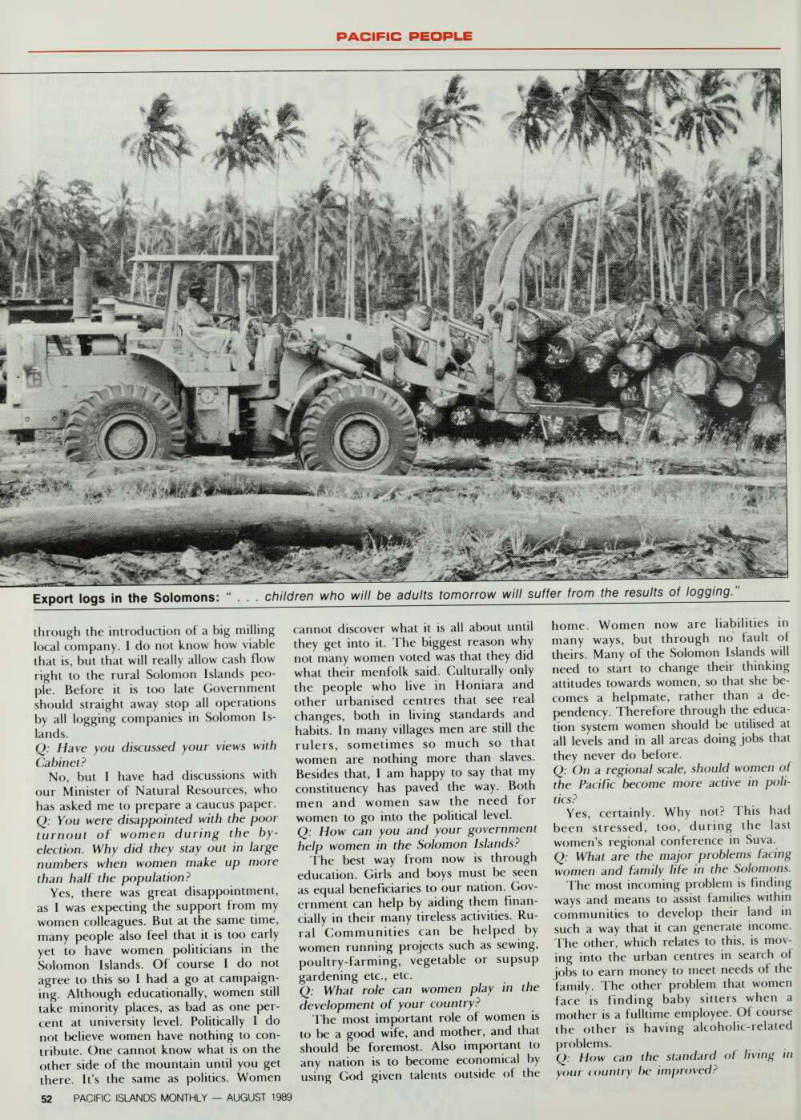
Solomon Islands as a whole is only a very small country, and a very small pro ductive land mass for a growing popula tion. Because this is an island nation, once all the logs on the bigger islands are extracted, that’s it. Not only waste
land is destroyed, but good productive
agricultural land. Also, logging came in at a very wrong time, a time when we the true Solomon Islanders are not really aware yet to true and real beneficial de velopments. The children who will be adults of tomorrow will suffer from the results of logging. But most of all I oppose logging because it is nothing but a destructive entity.
Q: Who is involved in logging operations in your constituency?
The Korean Company called Hyundai
Logging Company.
Q: How do you propose to run the log ging industry in the area after you’ve removed the big operators?
I would prefer my people to go into small chainsaw operations, with timber milling by walkabout saws. I would like to see a group of chainsaw operators run a timber yard, as a business entity. The Government, that is the Ministry of Natural Resources, can assist them in how to bring about good export timber.
But even locally cheap timber is needed to help boost good standard housing in
our villages.
Q: Do you think your views should be adopted on a national scale?
Yes, for the purpose of involving our own people in the cash economy I think the Government should adopt my views.
Nothing is too small or too big or even impossible if we put our minds to it.
Q: How should the government legislate logging in the Solomon Islands?
I do not like that word logging, at all.
I would prefer Solomon Islands Govern ment to allow small scale chainsaw op erations. To open up a venue whereby people can be assisted with the best kind of chainsaws and walkabout saws. The Government then to find market outlet
through the introduction of a big milling local company. I do not know how viable that is, but that will really allow cash flow right to the rural Solomon Islands peopie Before it is too late Government should straight away stop all operations by all logging companies in Solomon Islands Q Have you discussed your views with Cabinet?
No, but I have had discussions with our Minister of Natural Resources, who has asked me to prepare a caucus paper.
Q: You were disappointed with the poor Turnout of women during the byelection Why did they stay out in large
numbers when womL Jake up mofe
than half the population ?
Yes there Ls great disappointment, as Iwa expecfing g the support from my “menrauSues But at the same time,
Z peoK' Mthatkis too early
Tern TZ
not believe women have nothing to contribute. One cannot know what is on the other side of the mountain until you get there. It’s the same as politics. Women
cannot discover what it is all about until they get into it. The biggest reason why not many women voted was that they did what their menfolk said. Culturally only the people who live in Honiara and other urbanised centres that see real changes, both in living standards and habits. In many villages men are still the rulers, sometimes so much so that women are nothing more than slaves.
Besides that, 1 am happy to say that my constituency has paved the way. Both men and women saw the need for women to go into the political level.
Q: How can you and your government help women in the Solomon Islands?
The best way from now is through education. Girls and boys must be seen as equal beneficiaries to our nation. Government can help by aiding them finandally in their many tireless activities. Rural Communities can be helped by nomen in the women is to be a good wife, and mother, and that should be foremost. Also important to any nation is to become economical y using God given talents outside of the
home. Women now are liabilities m many ways, but thr^ theirs. Many of the Solomon Islands wi need to start to change their thin g attitudes towards women so that she be comes a helpmate rather-than a de pendency. Therefore through the ed tion system women should be utilised at all levels and in all areas doing jo s t at they never do before.
Q: On a regional scale, sh ou/d women o the Pacific become more active p ticsr
Yes, certainly. y •
been stressed, too during the last womens regional conference m Suva.
Q: What women and family life m the Solomons.
The most incoming problem is finding ways and means to assist families withm communities to develop their land m such a way that it can generate income.
rZ can family.
teo e g problems. KtAn A- Ar d of livimi in Q. ow ca . , P your coun ry [
Export logs in the Solomons: " ... children who will be adults tomorrow will sutler from the results of logging."
First, and foremost, is for the people through the government to develop their land and other resources.
This will help families, communities and Government economy. Through these developments, Government need to plan how to meet basic needs like water and r i w i ■ tood. Many people m my own constituency still drink and bathe in unhealthy T l • / water. Ihe other most important area is i,, • T to plan, develop and introduce sanitation r ‘-i-,- .. r , t . , facilities throughout the nation, and to i ia t nnriimr 3WS e mus sto P.lo nnwerpH unnecessary ig powered machines and concentrate on
people and what they really need.
7 7 Q: What is your country’s most urgent needs in terms of development, health care and education? 1 base these on people: • r . n i i • Education at all levels. . . gnculture. • Industries, manufacturing. • Businesses by Solomon Islanders, ij , ■ n both in Honiara and m the villages. • Health Q: What type of business enterprise can the government develop for the people?
Running retail/wholesale shops, vegel-
able roolcrop shops, fruit manufacturing
factories, cultural shops for artifacts and carvings. These types that can be hand led now with our kind of skilled people.
Other more complicated ones can be de veloped depending on the outcome of our education system. n. u/u * ■ . > .
Q: What is your country s biggest problem? 7 7 66 P ,, r , lo me it is the lack of seriousness by . ■ A , „ ■■ leaders. Also, this country needs to cnti • 7 , cally look at the way its public service . ** -pi . . / , v v , works. I hat word public servant has st its meaning. Most public servants deal w i t h millions of pieces of paper but ■ . f r Gi «hat those p.eces of paper say does not reach the grassroots. For example, if agricultural extension work really work ec* then the Solomon Islands should be thriving agriculturally. I recommend that Heads of Ministries Permanent Secre taries should tour villages and rural -■ f f , communities more often before they start tQ i m pl emen t w hat politicians want.
What ,s >' our greatest asset?
Our greatest assets are still our natural 5 , , , If n resources, on land, and sea. If we allow our natural resources to be extracted by other nations now, we are ruined. If we lose our natural resources then our chil dren will depend more on industrialised, imported goods. □
Smiling faces: Hilda with the family. Back: Goldie (left), Daisy, Ishmael.
Front: Solomon Jnr, Solomon Snr.