Diana Mcmanus
p. 47 · Read in the full issue
Projects
Charming customs
DON’T worry. Be happy. That is if you live in the Cooks, Fiji, the Kiribati, Niue, the Solomons, Tonga, Tuvalu, Vanuatu, or Western Samoa and you have to deal with a lethargic customs service. CHARM (Cus toms Heads of Administrations Regional Meeting) in association with the Austra lian Customs Service, is bringing radical changes which include the Harmonised Tariff System already implemented in four of those countries. But if you are in Fiji, the Kiribati, Niue, or Vanuatu (where the Harmonised Tariff System has been implemented) and dealing with customs is still laborious and frustrating, then don’t worry. Be happy. CHARM has found a way.
The fourth annual CHARM held in Honiara last June found out that gener ally managers and supervisors were not delegating their responsibilities. Alan Murray, an expert in the international section of the Australian Customs Ser vice, says: “Part of the problem, certainly in some countries, is a cultural differ ence and it’s not something any adminis tration can change overnight.” Fiji’s cus toms deputy comptroller, Eroni Bale Raturaga, agrees that in his country’s case the problem might be racial, but adds that there is no real evidence to support it, except for what is heard on the coconut wireless.
If such a thing like that does exist, or did exist, then it’s something that could affect the morale of the office,” says Murray.
The manner in which CHARM has re solved to tackle the problem suggests where the problem lies. It will imple ment a vigorous training programme for managers and supervisors. Ignorance will naturally be taken care of and there is a fervent hope that the hermits will crawl out of their shells as they gain more confidence and feel more secure with the acquirement of modern man agement skills.
CHARM is four years old. It was cal led together in Canberra in February 1985 by the Australian International De velopment Assistance Bureau to formal ise a South Pacific Customs Development Project, of which CHARM is a think tank. The project’s thrust and emphasis has been training, which (for the bigger part of the past four years) has been at lower levels of the customs hierarchy.
Fiji, Kiribati, Niue and Vanuatu are the first to implement the more efficient Harmonised Tariff System of customs
and excise revenue collection. With the changes has come the delights of the world of high-tech and its appropriate
training.
One of the immediate successes of the South Pacific Customs Development Pro ject has been the forging of an enviable relationship between the nine members of CHARM with their counterparts in New Zealand and Australia. Free of poli tics and the stifling nature of egos they resolve to collectively battle narcotics trafficking through the ports of the re gion. An example of the co-operation forged through the project was the way Australian customs officials contacted Fiji immediately after finding a Fiji-bound shipment of arms in Sydney. Then there was the co-operation between Australia and Vanuatu customs officials which led to the May drug haul in Sydney and Port Vila.
How has CHARM struck such a rap port? “Our get together is just like a family,” says Richard Mariner, the depu ty comptroller who represented Western Samoa to the Honiara CHARM. “We openly reprimand each other and we also openly express our feelings towards each other, we criticise and help each other.” Murray describes CHARM ses sions as cordial, quite open, critical “and there s an honesty about it”. The Austra lian International Development Assist ance Bureau has responded with an additional A 5500,000 for the 1989 a 990 work programme, which will be reviewed in Apia, where CHARM is scheduled for the second of May next year.
What does Australia gain out of this?
Apart from stemming narcotics flow lit tle else. For the island nations an effi cient customs service means substantial increases in annual revenue. In 1985 the assessed collective average annual re venue from customs and excise levies was 42 percent of total governments re venue. In Vanuatu, where there is no income tax, customs and excise earnings represent 70 percent of the govern ment’s total annual revenue. In Western Samoa, it is 60 percent. 1 he impact in the revenue department will not be immediately visible. The South Pacific Customs Development Pro ject’s training thrust is earmarked to be completed by June 1991. When that time comes each member country will have had their own training unit established to ensure continuity and self sufficiency.
By that time CHARM hopes to have harmonised training programmes, tech nical knowhow, standardise procedures and equipment, slow narcotics traffick
ing, improve security measures and pro
vide a charming life for the people it serves. Q
Diana Mcmanus
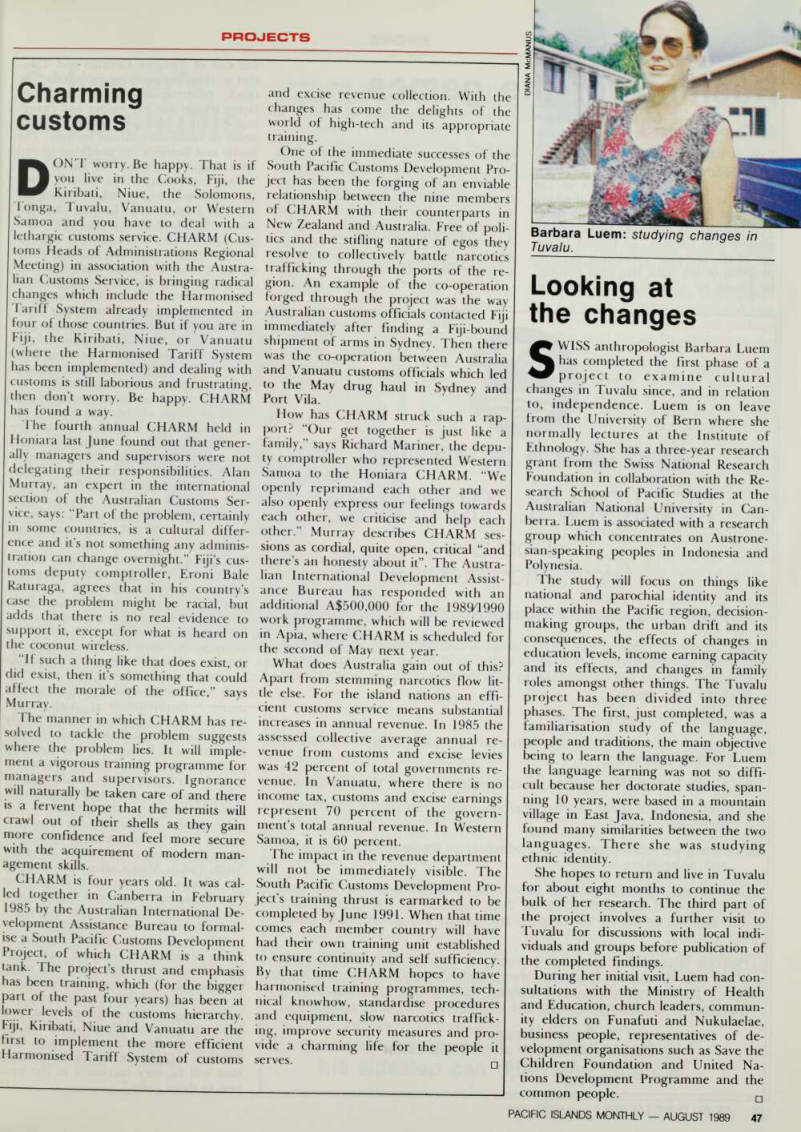
Barbara Luem: studying changes in Tuvalu.