Looking at
p. 47 · Read in the full issue
the changes
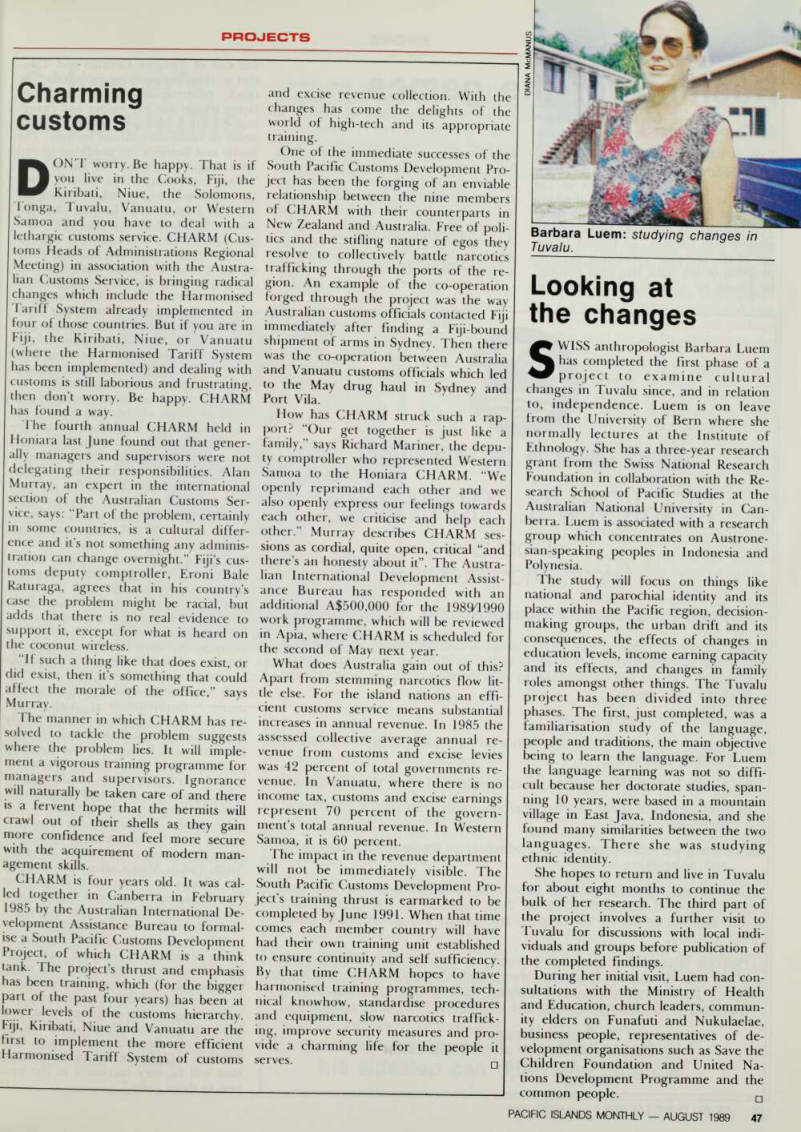
SWISS anthropologist Barbara Luem
has completed the first phase of a project to examine cultural changes in Tuvalu since, and in relation to, independence. Luem is on leave Irom the University of Bern where she normally lectures at the Institute of Ethnology. She has a three-year research grant from the Swiss National Research Foundation in collaboration with the Re search School of Pacific Studies at the Australian National University in Can berra. Luem is associated with a research group which concentrates on Austrone sian-speaking peoples in Indonesia and
Polynesia.
The study will focus on things like national and parochial identity and its place within the Pacific region, decision making groups, the urban drift and its consequences, the effects of changes in education levels, income earning capacity and its effects, and changes in family roles amongst other things. The Tuvalu project has been divided into three phases. The first, just completed, was a familiarisation study of the language, people and traditions, the main objective being to learn the language. For Luem the language learning was not so diffi cult because her doctorate studies, span ning 10 years, were based in a mountain village in East Java, Indonesia, and she found many similarities between the two languages. There she was studying
ethnic identity.
She hopes to return and live in Tuvalu for about eight months to continue the bulk of her research. The third part of the project involves a further visit to Tuvalu for discussions with local indi viduals and groups before publication of the completed findings.
During her initial visit, Luem had con sultations with the Ministry of Health and Education, church leaders, commun ity elders on Funafuti and Nukulaelae, business people, representatives of de velopment organisations such as Save the Children Foundation and United Na tions Development Programme and the common people. n