Tackling a problem in Vanuatu
p. 46 · Read in the full issue
Health
VANUATU, one of the Pacific’s youngest nations, is fast becoming a popular destination for tourists attracted by the country’s largely un
spoilt tropical splendour. What few visi
tors realise, however, is that behind Vanuatu’s scenic beauty is a country where average incomes are around SUSS7O-a-year. Life expectancies at birth for women are around 30 years less than in most industrialised countries. Almost one in 10 children die in their first year, often because of illnesses that could have
been easily prevented and inexpensively
treated. Diseases such as malaria, tuber culosis and diarrhoea are major prob lems.
Not surprisingly, one of the Govern ment’s main concerns since independ ence in 1980 has been to ensure adequ ate health care. But providing health ser vices to Vanuatu’s 80 widely dispersed islands, many of which have no roads or airstrips, is a massive undertaking.
Around one quarter of Vanuatu’s population of 140,000 can only be reached by boat. For many people in rural areas a visit to a health post may require a walk of several hours. What health services there are tend to be underutilised.
In 1984 the Vanuatu Ministry of Health asked the Save the Children Fund Australia (SCFA) to initiate a Prim ary Health Care Project. The Fund approached the Australian International Development Assistance Bureau (AIDAB) to help. AIDAB agreed to pro vide over $1 million under the Bureau’s programme of assistance to Non-
Government Organisations. The project
was to help the Health Department pro vide services in immunisation, maternal and child health (MCH), nutrition and midwifery. The country had four Gov ernment doctors (at the time of writing) and a handful of private practitioners.
Improving access to health care meant
training large numbers of village health
workers, midwives, nutritionists and nurses to administer basic medical treat ment.
According to the Funds’s programme manager in Vanuatu, Euan Lindsay Smith, the project has taken a grass roots approach in order to reach as many peo ple as possible at the lowest possible cost.
A boat, the M.V. Savinfana, is used for transporting medicines, vaccines and dis trict health teams to remote parts of the
archipelago.
The project’s grass-roots approach the health care is clearly evident in the sea of nutrition education. A national nutri-
tion survey conducted in 1983 found that almost one in four children under five years of age were underweight. This was due to a lack of awareness of nutri tion and the importance of giving a vari ety of food to babies and children, rather than to food availability. A belief in food taboos for children and pregnant women is still prevalent in many areas.
Women often work in gardens all day, leaving their children some distance away in the village, even when breast feeding. As a result the children are often given food with a high carbohy drate but low nutritional content.
Because many women in rural areas have had little or no formal education,
the project began designing posters, T
shirts and tea towels in the national lan guage, Bislama, to promote the import ance of good nutrition. Meetings are held with women’s councils, agricultural workers and nurses in towns, villages and schools. Radio programmes are pro duced and courses held for nutrition workers. Even children who go to school are used to educate their parents.
Vanuatu’s birth rate of over 4 per cent, the high level of infant mortality and an average life expectancy for women at birth around five to seven years less than for men, highlight the need for improving access to health ser vices for mothers and their children.
Material and child health adviser Eleanor Sullivan says they do this by providing what she calls a “well-baby cli nic”. “We are looking towards monitor ing the growth and development of chil
dren to ensure they grow up healthy. It’s a pre venta t i v e approach rather than a curative
approach which
tries to ensure that mothers have
healthy pregnan
cies and that chil dren are ade
quately cared
for,” says Sullivan.
With no specialist obstetricians in Vanuatu and a shortage of skilled midwives there is an urgent need to ensure women have access to
adequate antenat
al care and skilled assistance during
and after delivery. The project has established a national midwifery education programme to increase the number of midwives and improve the quality of their training. According to Bernie Mott, the project’s midwife tutor, maternal and child health services are
becoming increasingly accepted.
While a healthy diet, access to. midwif ery services and an adequate health care programme are important in themselves, the project has not overlooked the need for a comprehensive immunisation prog ramme to protect children from poten tially fatal diseases. One of the project’s main concerns, therefore, has been the implementation of the World Health
Organisation’s Expanded Program of
Immunisation (EPI) against tuberculosis,
polio, diptheria, whooping cough and
tetanus. But achieving the project’s target of 80 per cent continuing im munisation coverage for children under five years of age has proved a daunting task. Vaccines require continuous refri geration to ensure their potency.
Vanuatu has a hot tropical climate and the absence of electricity in many centres means that electric fridges and freezers are unusable.
A complex distribution system known as the “cold chain” for vaccines has been established to overcome these problems.
Using a combination of gas and kerosene refrigerators, freezers and insulated car riers, the Health Department has been able to get a much wider coverage for its vaccination programme than ever be fore. D
Bob Peisley/ Aois
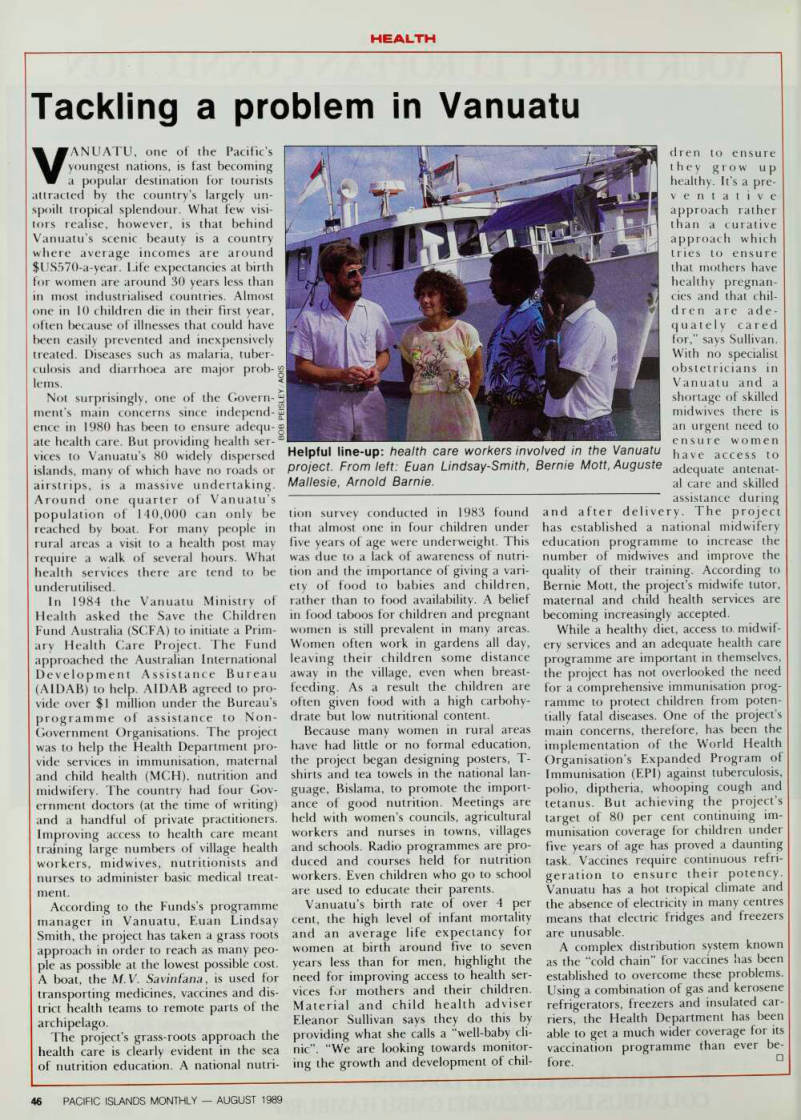
Helpful line-up: health care workers involved In the Vanuatu project. From left: Euan Lindsay-Smith, Bernie Mott, Auguste Mallesie, Arnold Barnie.