Bob Peisley/Aois
p. 20 · Read in the full issue
Solomon Islands
Regrets over logging deal
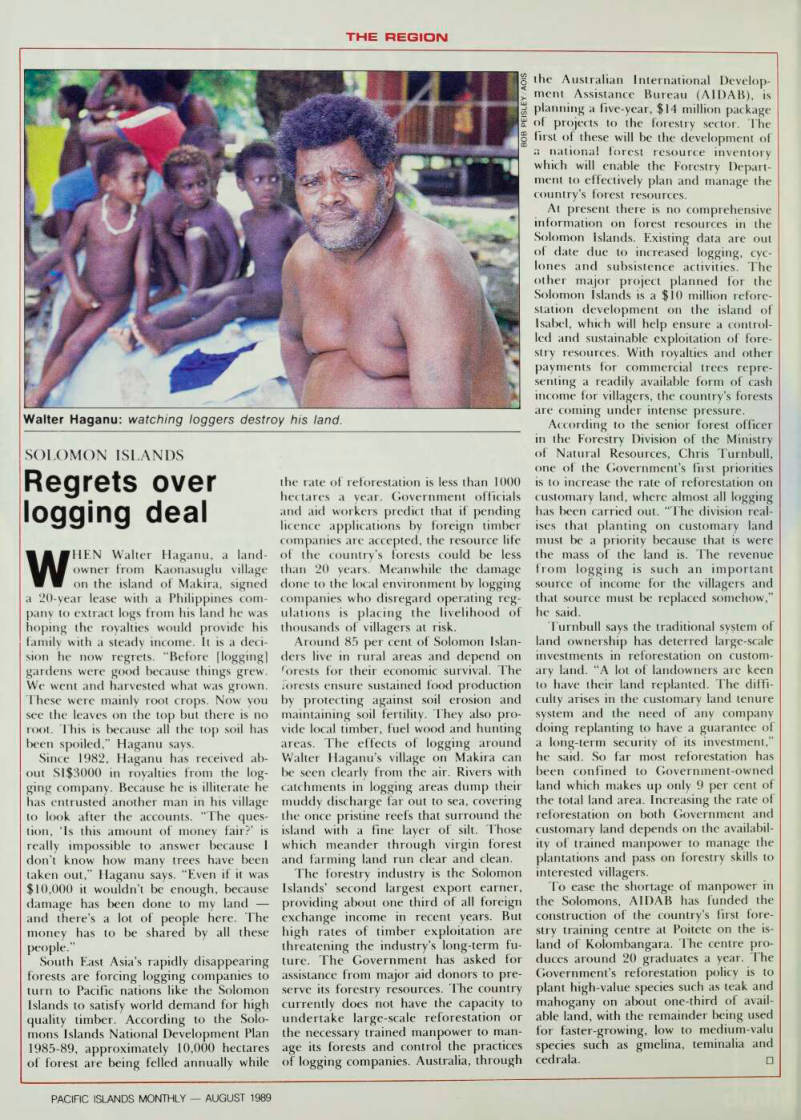
WHEN Walter Haganu, a land
owner from Kaonasuglu village
on the island of Makira, signed a 20-year lease with a Philippines com pany to extract logs from his land he was
hoping the royalties would provide his
family with a steady income. It is a deci sion he now regrets. “Before [logging]
gardens were good because things grew.
We went and harvested what was grown.
These were mainly root crops. Now you see the leaves on the top but there is no root. This is because all the top soil has
been spoiled,” Haganu says.
Since 1982, Haganu has received ab out Sls3ooo in royalties from the log ging company. Because he is illiterate he has entrusted another man in his village to look after the accounts. “The ques tion, Is this amount of money fair?’ is really impossible to answer because I don’t know how many trees have been taken out,” Haganu says. “Even if it was $lO,OOO it wouldn’t be enough, because damage has been done to my land and there’s a lot of people here. The money has to be shared by all these
people.”
South East Asia’s rapidly disappearing
forests are forcing logging companies to
turn to Pacific nations like the Solomon Islands to satisfy world demand for high quality timber. According to the Solo mons Islands National Development Plan 1985-89, approximately 10,000 hectares of forest are being felled annually while
the rate of reforestation is less than 1000 hectares a year. Government officials and aid workers predict that if pending
licence applications by foreign timber
companies are accepted, the resource life of the country’s forests could be less than 20 years. Meanwhile the damage done to the local environment by logging
companies who disregard operating reg
ulations is placing the livelihood of thousands of villagers at risk.
Around 85 per cent of Solomon Islan ders live in rural areas and depend on r orests for their economic survival. The forests ensure sustained food production
by protecting against soil erosion and
maintaining soil fertility. They also pro
vide local timber, fuel wood and hunting areas. The effects of logging around Walter Haganu’s village on Makira can be seen clearly from the air. Rivers with catchments in logging areas dump their muddy discharge far out to sea, covering the once pristine reefs that surround the island with a fine layer of silt. Those which meander through virgin forest and farming land run clear and clean.
The forestry industry is the Solomon Islands’ second largest export earner, providing about one third of all foreign exchange income in recent years. But high rates of timber exploitation are
threatening the industry’s long-term fu
ture. The Government has asked for assistance from major aid donors to pre serve its forestry resources. The country currently does not have the capacity to undertake large-scale reforestation or the necessary trained manpower to man age its forests and control the practices of logging companies. Australia, through
the Australian International Develop ment Assistance Bureau (AIDAB), is
planning a five-year, $l4 million package
of projects to the forestry sector. The first of these will be the development of a national forest resource inventory which will enable the Forestry Depart ment to effectively plan and manage the country’s forest resources.
At present there is no comprehensive information on forest resources in the Solomon Islands. Existing data are out of date due to increased logging, cyc lones and subsistence activities. The other major project planned for the Solomon Islands is a $lO million refore station development on the island of Isabel, which will help ensure a control led and sustainable exploitation of fore stry resources. With royalties and other payments for commercial trees repre senting a readily available form of cash income for villagers, the country’s forests are coming under intense pressure.
According to the senior forest officer in the Forestry Division of the Ministry of Natural Resources, Chris Turnbull, one of the Government’s first priorities is to increase the rate of reforestation on customary land, where almost all logging has been carried out. “The division real ises that planting on customary land must be a priority because that is were the mass of the land is. The revenue from logging is such an important source of income for the villagers and that source must be replaced somehow,” he said.
Turnbull says the traditional system of land ownership has deterred large-scale investments in reforestation on custom ary land. “A lot of landowners are keen to have their land replanted. The diffi culty arises in the customary land tenure system and the need of any company doing replanting to have a guarantee of a long-term security of its investment,” he said. So far most reforestation has been confined to Government-owned land which makes up only 9 per cent of the total land area. Increasing the rate of reforestation on both Government and customary land depends on the availabil ity of trained manpower to manage the plantations and pass on forestry skills to
interested villagers.
To ease the shortage of manpower in the Solomons, AIDAB has funded the construction of the country’s first fore stry training centre at Poitete on the is land of Kolombangara. The centre pro duces around 20 graduates a year. The Government’s reforestation policy is to plant high-value species such as teak and mahogany on about one-third of avail able land, with the remainder being used for faster-growing, low to medium-valu species such as gmelina, teminalia and cedrala. □
Walter Haganu: watching loggers destroy his land.