Nz Embassy
pp. 22-24 · Read in the full issue
New Zealand
Government under fire
By David Robie
PRIME Minister David Lange’s gov ernment has attempted to cope with the growing controversy in New Zealand over the Treaty of Waitan gi by drawing up a set of principles which have been attacked by opponents as “election propaganda” and a “cop out”.
But as race relations with the Maori and Pacific communities loom as a ma jor issue for next year’s general election, one of the strongest defenders of the guidelines last month was Mana Motu hake party leader Matiu Rata. He is a former Maori Affairs Minister and father of the Waitangi Tribunal legisla tion which opened the door to the settle ment of some Maori land claim grie vances. While Rata admitted that most Maori would regard the formula with cynicism, he said the principles showed “common sense” and were a sign that the government was still positive about the treaty. He added: “There has been more progress towards implementing the treaty with this government than with any previous one.”
But advocates of biculturalism were quick to seize on Lange’s downplay of the notion of “partnership” a widespread interpretation of the treaty which ceded government to the British crown in 1840. Maori Council chairman Sir Gra hamLatimer, for example, denounced the guidelines as not being “done in the spirit of partnership”. Instead, it had been done by bureaucrats and presented as a fait accompli “partnership means that in matters of importance to Maori dom there should be consultation”.
The principles announced by the gov ernment to help make decisions such as those involving recommendations from the Waitangi Tribunal are: • the government has the right to govern and make laws; • iwi (tribes) have the right to orga nise as iwi and under the law, to control the resources they own; • all New Zealanders are equal under the law; • the government and the iwi are obliged to accord each other reasonable cooperation on major issues of common concern; and • the government is responsible for providing effective processes for the re solution of grievances in the expectation that reconciliation can occur.
While the principles restated aspects of articles one and three of the treaty, said
Sir Graham, they completely ignored
articles two which guarantees Maori protection of their lands, forests, fisher ies and other taonga (treasures) for as long as they wish to keep them. Opposi tion Maori affairs spokesman Winston Peters accused the government of an “attempt at election propaganda” which was not a serious attempt at addressing the treaty issues.
The Lange government has also been under fire for its appointment of the High Commissioner to Zimbabwe, Christopher Laidlaw, as the new Race Relations Conciliator. Laidlaw, regarded by many New Zealanders as having an exemplary record on race matters, was singled out for a harsh attack by Peters.
Taking up his post last month, Laidlaw faced bitter criticism by opponents while
being defended by many leading Maoris
and race relations personalities. Peters described Laidlaw’s appointment as “sickly white liberalism gone mad”; Laid law retorted it was a “cheap shot”.
Insisting he was interested in the posi tive side of New Zealand race relations, Laidlaw added: “It is a challenge that is arguably going to be the most important area of New Zealand life over the next few years and I want to see if I can make a contribution.” The Race Rela tions Office, which deals with racial slurs and victimisation against Pacific islanders as well as other minority groups, has be come the centre of several controversies in recent years including a row last
year with the news media over the re porting of a “kill a white” statement by a Maori activist.
Some critics have condemned Laid law’s appointment because he is Pakeha and has not lived in New Zealand for several years; others because he is an “unabashed supporter” of the ruling Labour Party. However, although two predecessors were Maori the outgoing Race Relations Conciliator, Wally Hirsh, was also a Pakeha. A leading Maori academic, Dr Ranginui Walker, called on the Maori community to support Laidlaw in his new role. He also defended the appointment of a Pakeha.
“The heat is coming from the Pakeha side as the Maori win a few battles in court on issues such as fisheries,” said Dr Walker, who is also chairman of the Au ckland District Maori Council. “It isn’t a Maori job and it is a thankless task.”
He added that the original legislation was drawn up too hastily and introduced into Parliament so the government could ratify the United Nations international convention on eliminating discrimina tion.
Matiu Rata said he hoped Laidlaw would inspire an improvement in race relations, adding: “New Zealanders are getting a fixation on bigotry.” Laidlaw, a former Rhodes Scholar and diplomat in Suva and Paris before joining the Com monwealth Secretariat in London as an assistant director, toured South Africa with New Zealand’s national All Blacks rugby union team in 1970, later becom
ing an outspoken opponent of apartheid.
His book, Mud in Your Eye, published in 1973, sold 25,000 copies, but caused an uproar in South Africa and within New Zealand rugby circles for its harsh criticisms of racial discrimination in South Africa. Laidlaw and fellow All Black Bob Burgess declared themselves unavailable for the South African tour that year because of their anti-apartheid views.
Under the new legal structure
announced by Justice Minister Geoffrey
Palmer, Laidlaw would be a member of the Human Rights Commission with re sponsibility for race relations. This arrangement is expected to mean better
organisation and improved procedures
for dealing with complaints.
The Race Relations Act’s controversial section 9a, the measure used to investi gate the “kill a white” row involving the country’s mass circulation Sunday Star, is being repealed in the Law reform Mis cellaneous Provisions Bill. Although the statement by Maori activist Hana Te Hemara was made in private at the Au
Nz Embassy
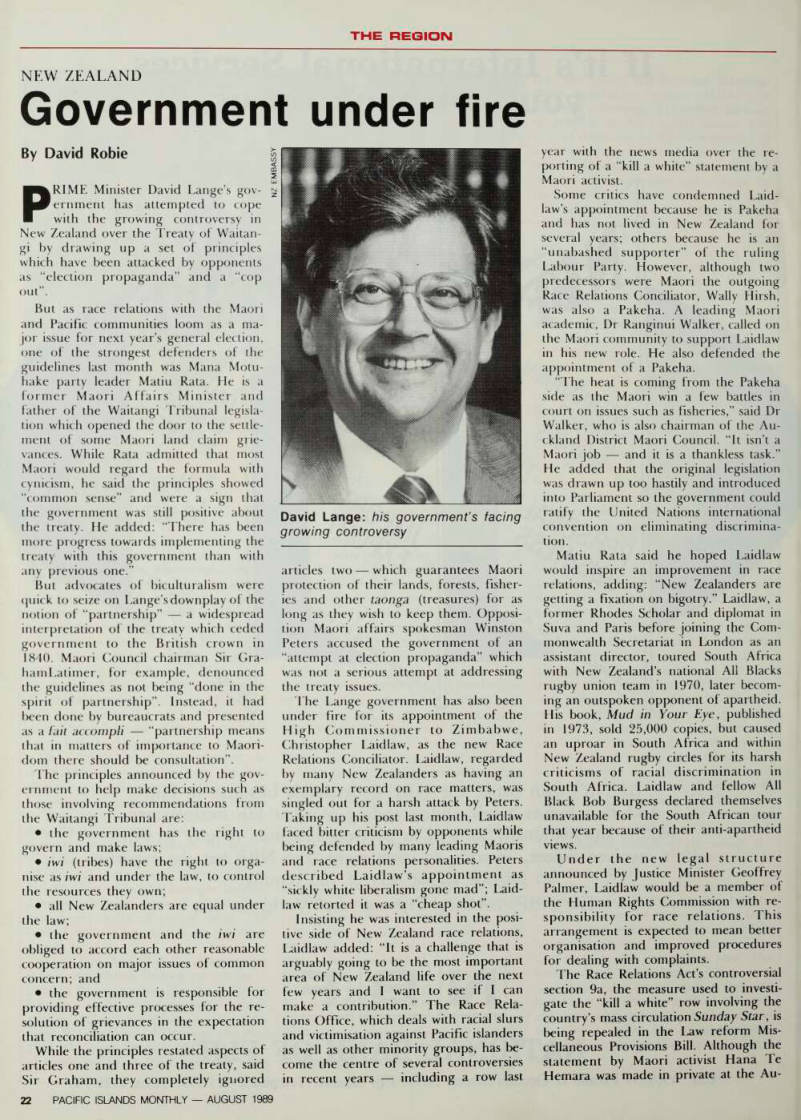
David Lange: his government’s facing growing controversy
ckland University marae (Maori meeting place) to a seminar for law students, it was picked up third-hand by the Sunday Star and published sensationally in viola tion of the act.
Former conciliator Wally Hirsh was unable to act against Te Hemara because the statement was not made in a public place as required under the act in spite of 74 complaints being filed against her. Complaints were also filed with the Race Relations Office against the news media, particularly the Sunday Star for its role in publishing the statement out of context and “fomenting disharmony” throughout the nation.
Eventually Hirsh ruled that the Star had violated Section 9a and asked the newspaper to apologise for the original article (the only action the office was able to take). The Star refused. Instead, the newspaper claimed freedom of the press and freedom of speech as princi ples in conflict with the law. Winston Peters, often tipped as potentially a fu ture prime minister of New Zealand, attacked the office’s ruling, calling it “re
verse apartheid”.
In the row that followed, the influen tial New Zealand Herald called on the government to scrap the Race Relations Office, Justice Minister Palmer declared at the time that the government would consider changing section 9a.
The office has faced other con troversies, too. In 1983, an Auckland City Councillor, Jolyon Firth, made a statement in private referring to “curry munchers” following a council meeting.
A Journalist present reported the com ment. The conciliator at the time, Hiwi Tauroa, failed to obtain an apology from Firth to the Indian community because he had no jurisdiction.
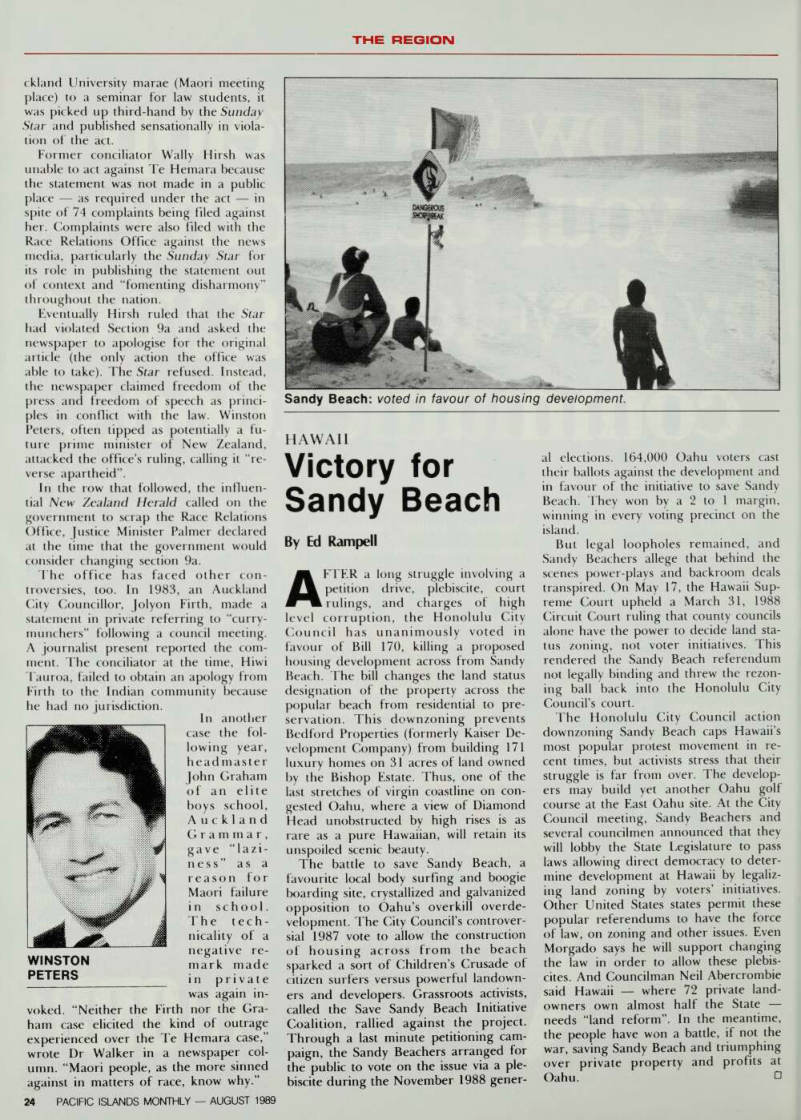
In another case the fol lowing year, headmaster John Graham of an elite boys school, Auckland Grammar, gave “lazi ness” as a reason for Maori failure in school.
The tec h nicality of a
negative re
mark made
in private
was again in
voked. “Neither the Firth nor the Gra ham case elicited the kind of outrage experienced over the Te Hemara case,” wrote Dr Walker in a newspaper col umn. “Maori people, as the more sinned against in matters of race, know why.”