The way
p. 19 · Read in the full issue
New Caledonia
The way ahead
IF July 14 was a day to look back for all French citizens who commemo rated the two hundredth anniversary of their revolution, it had a special sig nificance for Kanaks and Europeans liv ing in New Caledonia; July 14 marked the end of the one-year direct adminis tration by the state and the beginning of the new statute dividing the Territory into three largely autonomous provinces.
On July 17 the Assemblies of the northern province and the islands held their first meetings in Kone, on the west coast, and Lifou, in the Loyalty Islands.
Two days later it was the turn of the southern province after the first official session of the new 54-member Territo rial Congress composed of the three assemblies.
A few days before July 14 French Prime Minister Michel Rocard had writ
written to the three
newly
elected Presidents of the pro vinces and to the Presi dent of the
Congress
and said: “It is now the New Caledonians who have to carry out the econo mical, social and cultural
development” in their country. Referring to National Kanak Socialist Liberation Front (FLNKS) leader Jean-Marie Tjibaou and Rally for Caledonia in the Republic (RPCR) leader Jacques Lafleur, he added that in Paris in June 1988, the two men “had agreed that the state should govern the Territory under direct administration for one year in order to restore civil peace, to prepare new institutions accepted by a large majority of New Caledonians and to lay the foundation of a more balanced de
velopment”.
“The baton has been passed,” said the High Commissioner of the republic, Ber nard Grasset, who attended the three meetings in Kone, Lifou and Noumea.
He will remain the exeuctive chief of the Territory and the head of the Territorial Administration. But the three assemblies
(2 pro-independence, 1 pro-French) will now govern the provinces with extended powers and important financial means.
“We have nine years ahead of us be fore the Territory freely chooses its des tiny. We have nine years to forge the tools necessary to that free choice. Peace has been restored but the germs of divi sion, the germs of clashes still exist. The country is convalescent,” Grasset said. In the north and the islands, where inde
pendentists have a huge majority, the
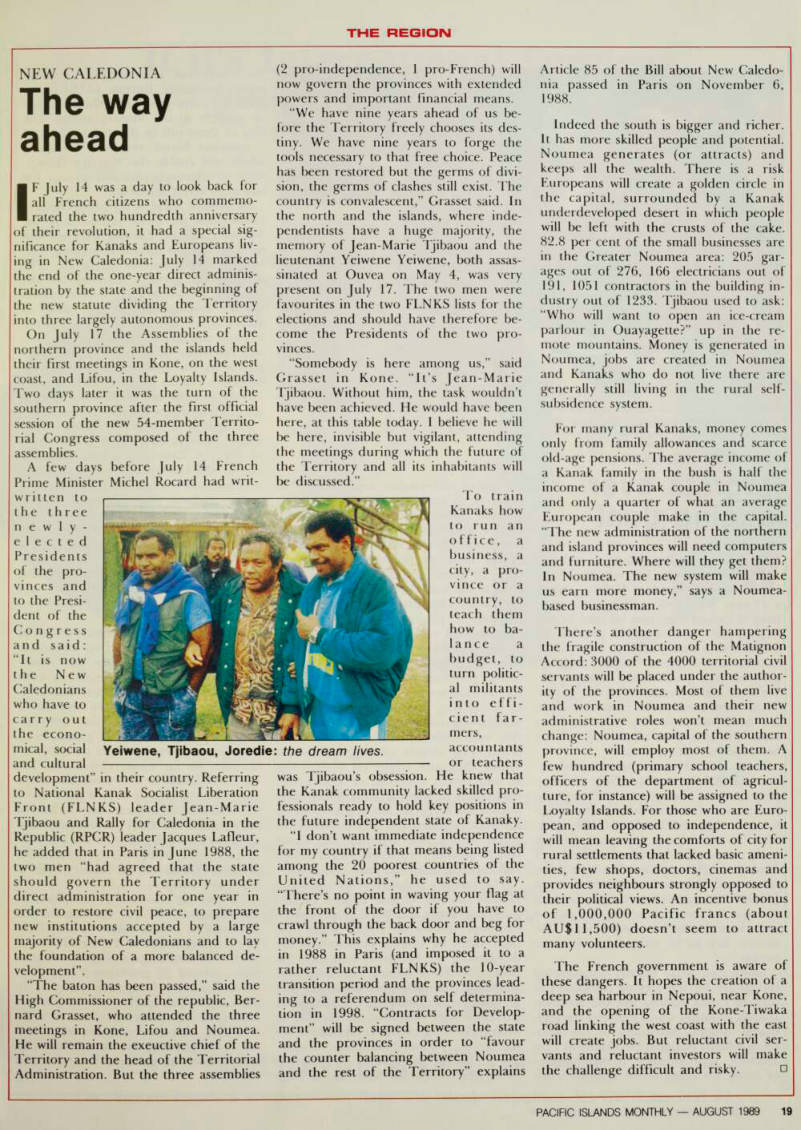
memory of Jean-Marie Tjibaou and the lieutenant Yeiwene Yeiwene, both assas sinated at Ouvea on May 4, was very present on July 17. The two men were favourites in the two FLNKS lists for the elections and should have therefore be come the Presidents of the two pro vinces.
“Somebody is here among us,” said Grasset in Kone. “It’s Jean-Marie Tjibaou. Without him, the task wouldn’t have been achieved. He would have been here, at this table today. I believe he will be here, invisible but vigilant, attending the meetings during which the future of the Territory and all its inhabitants will be discussed.”
To train Kanaks how to run an office, a business, a city, a pro vince or a country, to teach them how to ba lance a
budget, to
turn politic
al militants into effi cient far mers, accountants or teachers
was Tjibaou’s obsession. He knew that the Kanak community lacked skilled pro fessionals ready to hold key positions in the future independent state of Kanaky.
“I don’t want immediate independence for my country if that means being listed among the 20 poorest countries of the United Nations,” he used to say.
“There’s no point in waving your flag at the front of the door if you have to crawl through the back door and beg for
money.” This explains why he accepted
in 1988 in Paris (and imposed it to a rather reluctant FLNKS) the 10-year transition period and the provinces lead ing to a referendum on self determina tion in 1998. “Contracts for Develop ment” will be signed between the state and the provinces in order to “favour the counter balancing between Noumea and the rest of the Territory” explains
Article 85 of the Bill about New Caledo nia passed in Paris on November 6, 1988.
Indeed the south is bigger and richer.
It has more skilled people and potential.
Noumea generates (or attracts) and keeps all the wealth. There is a risk Europeans will create a golden circle in the capital, surrounded by a Kanak underdeveloped desert in which people will be left with the crusts of the cake. 82.8 per cent of the small businesses are in the Greater Noumea area; 205 gar ages out of 276, 166 electricians out of 191, 1051 contractors in the building in dustry out of 1233. Tjibaou used to ask: “Who will want to open an ice-cream parlour in Ouayagette?” up in the re mote mountains. Money is generated in Noumea, jobs are created in Noumea and Kanaks who do not live there are generally still living in the rural self subsidence system.
For many rural Kanaks, money comes only from family allowances and scarce old-age pensions. The average income of a Kanak family in the bush is half the income of a Kanak couple in Noumea and only a quarter of what an average
European couple make in the capital.
“The new administration of the northern and island provinces will need computers and furniture. Where will they get them?
In Noumea. The new system will make us earn more money,” says a Noumea based businessman.
There’s another danger hampering
the fragile construction of the Matignon Accord: 3000 of the 4000 territorial civil servants will be placed under the author ity of the provinces. Most of them live and work in Noumea and their new administrative roles won’t mean much change: Noumea, capital of the southern province, will employ most of them. A few hundred (primary school teachers, officers of the department of agricul ture, for instance) will be assigned to the Loyalty Islands. For those who are Euro pean, and opposed to independence, it will mean leaving the comforts of city for rural settlements that lacked basic ameni ties, few shops, doctors, cinemas and
provides neighbours strongly opposed to
their political views. An incentive bonus of 1,000,000 Pacific francs (about AU$ll,5OO) doesn’t seem to attract many volunteers.
The French government is aware of these dangers. It hopes the creation of a deep sea harbour in Nepoui, near Kone, and the opening of the Kone-Tiwaka road linking the west coast with the east will create jobs. But reluctant civil ser vants and reluctant investors will make the challenge difficult and risky. □
Yeiwene, Tjibaou, Joredie: the dream lives.