Ironing out key issues
pp. 12-15 · Read in the full issue
South Pacific Forum
JAPAN’S refusal to stop driftnet fishing in the South Pacific is likely to force Forum member countries to take the issue up at the United Nations. This possibility sur faced after last month’s Forum meeting in Tarawa when Green
peace campaigner Mike Hagler
urged New Zealand to introduce the subject for discussion at the UN.
Japan continue to refuse to stop the use of the devastating driftnets in the South Pacific, offering in Tara wa to instead reduce the catch if it could be scientifically proven that the highly-priced albacore tuna stocks were being wiped out. But like they did to a similar approach by Japan in the past, the countries of the region refused to except the compromise, saying it was the same delaying tactic Japan used when it faced strong opposition in the North Pacific.
The use of driftnets, also known as gillnets and now dubbed the ‘wall of death’, was a major issue at the 20th Forum meeting on the tiny atoll of Tarawa. “The Forum ex pressed its profound concern at the
damage now being done by pelagic
driftnet fishing to the economy and environment of the South Pacific re gion,” said a Forum communique.
In the face of such a threat to the regional fisheries, the Forum adopted the Tarawa Declaration which, proposed by Australia, de clared the region a driftnet-free zone (see box). But the declaration did not have an easy passage with some countries, like Fiji, having re servations. A convention in New Zealand later in the year will iron out loopholes and try to produce a final detailed policy statement.
Fiji’s Deputy Prime Minister, Jose
vata KamiKamica (who attended in stead of Prime Minister Ratu Sir Kamisese Mara), tried to amend the Australian proposal. He sought a more workable arrangement with Japan and Taiwan on the issue of driftnet fishing rather than “shut ting them our completely. Austra lian Prime Minister Bob Hawke had sought a comprehensive ban which could lead to a global ban. But Fiji, Vanuatu and the Cook Islands maintained there was not enough “expert knowledge” on the issue to justify such a drastic measure. Fiji doubted the viability of policing
such a ban on the high seas. “We simply need more information, in particular expert knowledge on the issue,” said Fiji delegate Ratu Finau Mara, a lawyer at the Crown Law Office in Suva. “Australia wanted to present the convention and declaralion as a package but some leaders thought this was too fast. One thing at a time.’
It was evident that Japan had a strong influence in the Pacific Is-
lands, prompting suggestions that
“cheque book diplomacy” was being
used to gain political clout in the region. “One consequence of this is that the island countries are certain to get more Japanese aid,” an Australian official was reported from Tarawa as saying. “But this is not much good if their future fish resource base is being severely eroded.” Japanese aid to the Pacific Islands is estimated to be SUS7O million a year.
Japan is doing its homework, While the leaders of the Pacific Islands were in Tarawa discussing a
ban on Japanese drifnetters,
Japanese diplomats were making
deals in the capitals of the region.
In Tarawa itself, on July 13, during the Forum, Suva-based Japanese Ambassador Toshio Isogai gave the government of Kiribati |US6.7 mil lion for the construction of a new hospital in Tarawa. At the same time a Japanese company gave SUS 10,000 to Vanuatu to help send a team to the Games of Disabled People in Japan next month. Also on the same day Radio Tonga re ported that a Japanese company, Teisei Maru Marine Products, had
approached the Tongan government
for an agremeent to fish in the king dom’s exclusive 200-mile economic zone. On July 20 Japan gave Tuvalu SUSI million as part of a multi million dollar grant to pay for Tuva
lu’s community fishing project de
velopment. On July 2o Japan gave
Vanuatu SUSB million to pay for the construction of a new terminal building at Bauerfield Airport out side Port Vila. Japan is also funding
a similar project at Tonga’s Fua’amotu Airport. The list goes on as Japan builds friendship in the is lands.
Environmental issues were the key agenda at the Forum which “noted with appreciation” the ratification of the South Pacific Nuclear Free Zone Treaty by the Solomon Islands, making it the 10th party to the trea ty. China has also ratified the trea ty’s Protocols 2 and 3. The Forum called on major powers, particularly the United Mates, France and Bri tain, to ratify the protocols and accept the treaty. The Forum Secre tariat in Suva was also authorised to exchange information and coopera tion with the Organisation for the Prohibition of Nuclear Arms in Latin America (OPANAL). France again came under attack for its con tinued testing of nuclear weapons in French Polynesia, and was urged to stop the tests “immediately”.
In Port Moresby a week later, the government of Rabbie Namaliu, which was represented at the Forum by Deputy PM Akoka Doi, told Par liament it would monitor all de velopments in nuclear-related mat ters in the region. Foreign Affairs Minister Michael Somare said gov
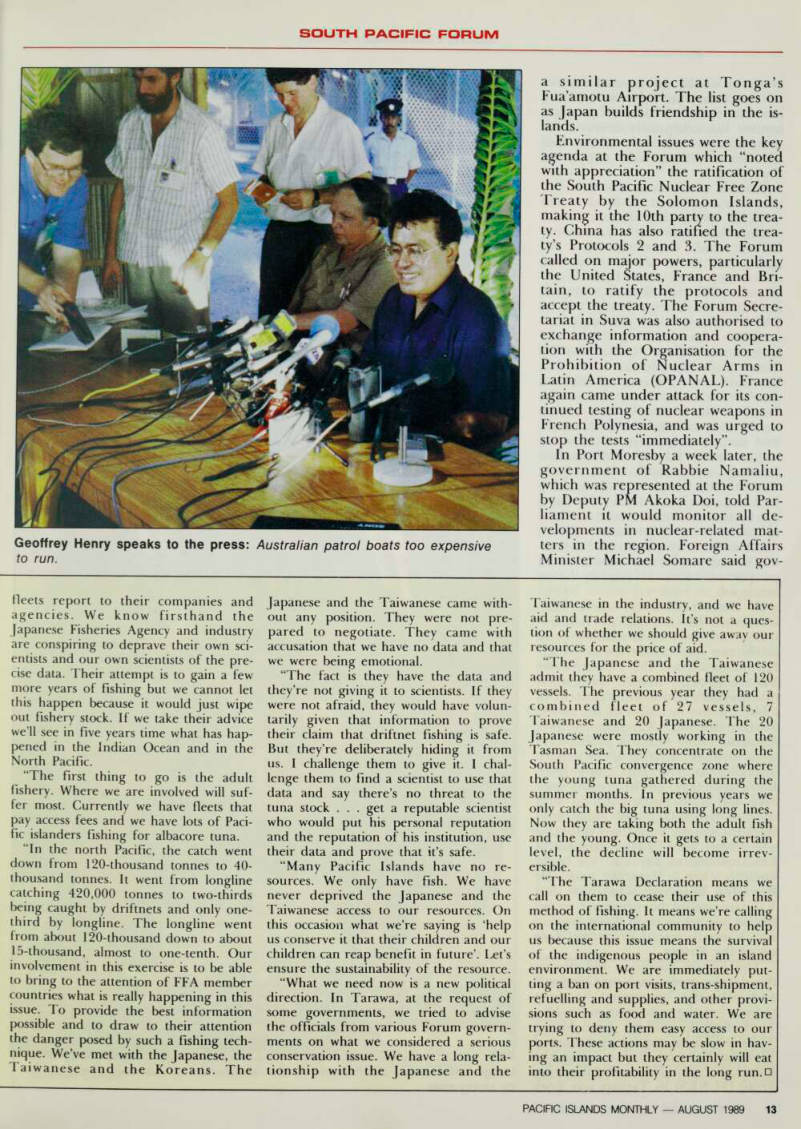
Geoffrey Henry speaks to the press: Australian patrol boats too expensive to run.
ernment would recommend reviews of the treaty to improve existing provisions with a view of covering aspects not adequately covered. Of the superpowers, only China and the Soviet Union have supported the treaty.
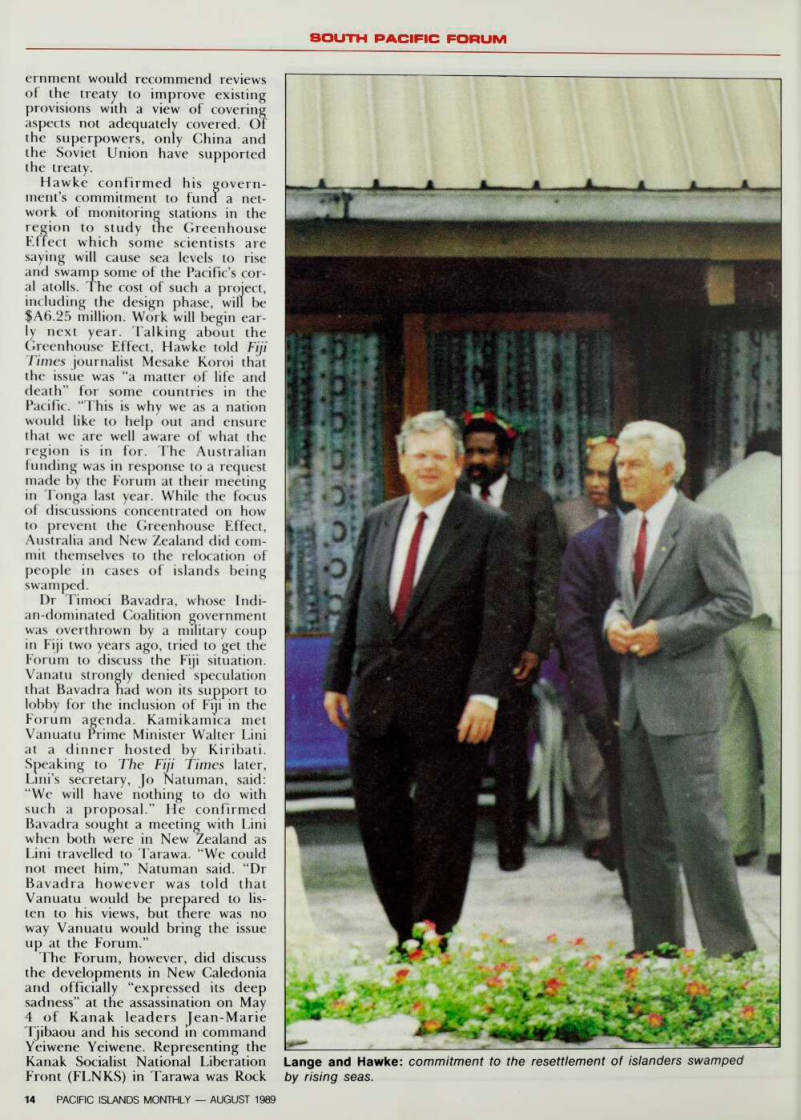
H awke confirmed his govern ment’s commitment to a net work of monitoring stations in the region to study the Greenhouse Effect which some scientists are saying will cause sea levels to rise and swamp some of the Pacific’s cor al atolls. The cost of such a project,
including the design phase, will be
$A6.25 million. Work will begin ear ly next year. Talking about the Greenhouse Effect, Hawke told Fiji Times journalist Mesake Koroi that the issue was “a matter of life and death” for some countries in the Pacific. “This is why we as a nation would like to help out and ensure that we are well aware of what the region is in for. The Australian tunding was in response to a request made by the Forum at their meeting in Tonga last year. While the focus of discussions concentrated on how to prevent the Greenhouse Effect, Australia and New Zealand did com mit themselves to the relocation of people in cases of islands being
swamped.
Dr Timoci Bavadra, whose Indi an-dominated Coalition government was overthrown by a military coup in Fiji two years ago, tried to get the Forum to discuss the Fiji situation.
Vanatu strongly denied speculation
that Bavadra had won its support to lobby for the inclusion of Fiji in the Forum agenda. Kamikamica met Vanuatu Prime Minister Walter Lini at a dinner hosted by Kiribati.
Speaking to The Fiji Times later, Lmi’s secretary, Jo Natuman, said: “We will have nothing to do with such a proposal.” He confirmed Bavadra sought a meeting with Lini when both were in New Zealand as Lini travelled to Tarawa. “We could not meet him,” Natuman said. “Dr Bavadra however was told that Vanuatu would be prepared to lis ten to his views, but tnere was no way Vanuatu would bring the issue up at the Forum.”
The Forum, however, did discuss the developments in New Caledonia
and officially “expressed its deep
sadness” at the assassination on May 4 of Kanak leaders Jean-Marie Tjibaou and his second in command Yeiwene Yeiwene. Representing the Kanak Socialist National Liberation Front (FLNKS) in Tarawa was Rock
Lange and Hawke: commitment to the resettlement of islanders swamped by rising seas.
Wamytan, a member of New Galedonia’s newly-elected Southern Provincial Assembly. He urged the Forum to continue to monitor the progress of the Matignon Accord, through which the French Government lias assured a referendum on independence in 1998. He met with Hawke and discussions were understood to have centred on Kanak training and development. He also had meetings with Lini and New Zealand Prime Minister David Lange. Also in Tarawa was Yann
Celene Uregei whose Kanak faction, FULK, has Teen threatening violent opposition to the Matignon Accord.
Endorsing Australia’s offer to train Kanaks to occupy key positions associated with government, the Forum reiterated its willingness to contribute to the process of recon ciliation and training, On security, Cook Islands Prime Minister, Geoffrey Henry said that although countries have been en
couraged to participate in a joint
programme of surveillance of ter
ritorial waters, the cost of running an Australian-built patrol boat was around |A350,000 a year and still too expensive for the small nations that rely almost entirely on overseas aid grants to keep their economies afloat.
The media came under the target of some rather sharp criticism, mainly Doi. The target of his com ments were Australia and New Zea land. Doi accused Australia of
biased and misinterpreted reporting,
especially on recent events in Bougainville and Port Moresby. He accused the Australian media of not
understanding enough the culture
and traditions of Papua New Guinea to be able to present a better view of events in the country. Because of biased reports, Doi said, PNG lost revenue as potential investors were discouraged. Tourism also suffered.
When asked if he thought Austra lian journalists were anti-Papua New Guinea, Doi replied: “No, it is a case of not understanding the situation, or bothering to make sure the re ports are accurate.” He said Austra lian journalists “beat” up stories and create sensationalism. He said Fiji, Vanuatu and Nauru shared his views. Hawke on the other hand, said the Australian media was com mitted to the freedom of the press.
While he acknowledged that some countries had expressed dissatisfac tion over Australia’s media report ing, he said Australian media re porting was of a high standard.
Even he himself often received un fair treatment from the press at home, he said.
China missed the pre-Forum dia logue. The Chinese delegation was to have travelled from New Zealand with Lange. But Lange said: “There was no room on the plane for them”. Asked if he had given them “the cold shoulder” treatment be cause of the recent trouble in Beij
ing, Lange replied; “I suppose you
could say that, anyway China has a lot more planes than New Zealand has so they still could have got here”.
Next year’s Forum meeting will be in Vanuatu. □