Muller’s challenge to Asia
pp. 12-13 · Read in the full issue
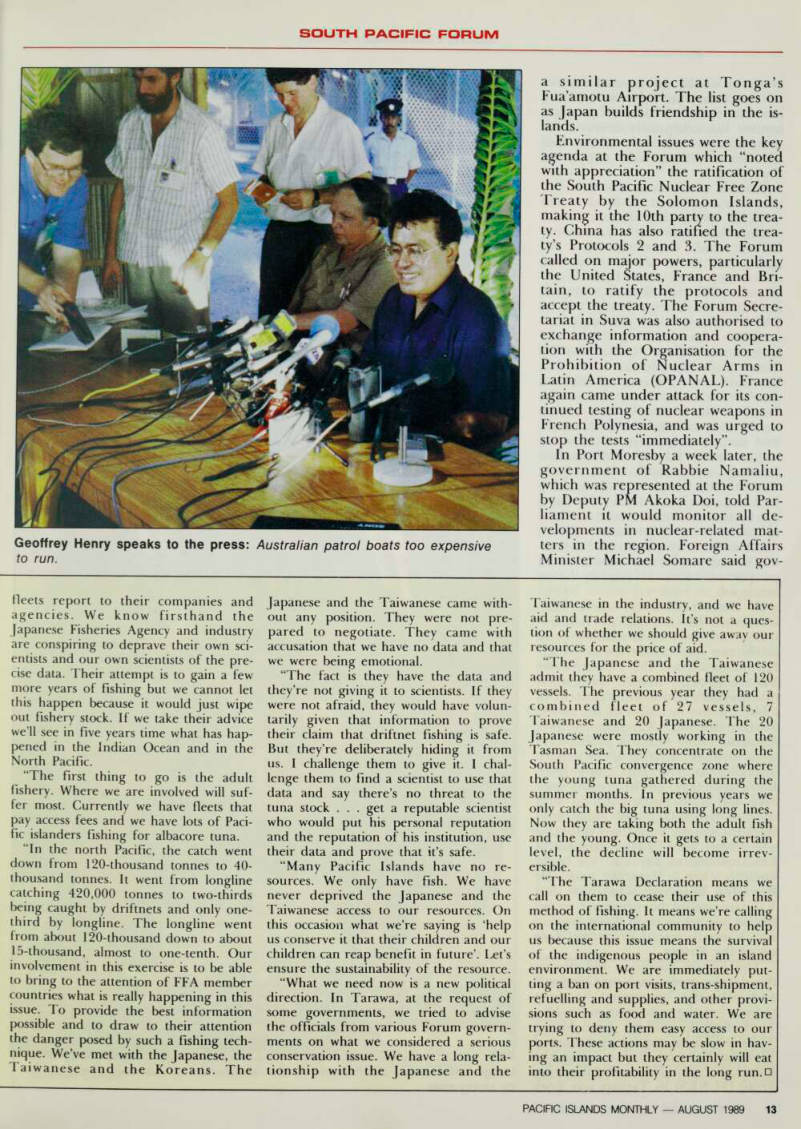
PHILIP Muller has accused the Japanese and Taiwanese fishing fleets of deliberately keeping data from Forum Fishing Agency (FFA) to hamper attempts to prove the dis astrous effect of driftnets in the South Pacific tuna fisheries. Muller, the Forum Fishing Agency Director, said: “If they were not afraid they would have volun tarily given (us) that information. But they’re deliberately hiding it from us. I challenge them find a scientist . . . (who) would say there’s no threat.” Muller spoke to Pacific Islands Monthly’s Hon iara correspondent Dykes Angiki when he returned from the South Pacific Forum meeting in Tarawa. Extracts: “We have monitored the driftnet fleets since October 1988, when we heard it was going to expand by the movement of the Taiwanese fleet to the South Paci fic. We became very concerned. The Taiwanese fleet had been fishing in the Indian Ocean. We knew the catch rate was declining so badly that they would have to move. We collected all the evi dence we could put our fingers on those of other fishermen, mainly Amer icans, the Levuka cannery (in Fiji), the- American Samoan canneries, we got
together and tried to compile a scenerio of what would happen to our tuna re source with the coming in of the drift netters.
“We decided to invite the three Asian driftnet nations (Japan, Taiwan, South Korea) to come to our meeting. During the later half of June (1989) we con vened a legal consultation in Suva. We met on our own before we met with the representatives of the driftnet countries.
Korea with only one driftnet vessel on experimental basis said they would with draw it. The Japanese whom we thought had 30 vessels acknowledged they had 60, the Taiwanese said they had 60 ves sels also. The Japanese said their 60 ves sels catch between 7-10 thousand tonnes a month and the Taiwanese said they catch about 9-thousand tonnes. We know that this information is not true. The catch rate they were admitting are not big enough to sustain the fleet. The fleet operates four to five months in the South Pacific and if you break down the catch by the number of boats it is an uneconomical venture. In essence they are not telling us the truth.
They said they have no data but we know they have data. We know both
fleets report to their companies and agencies. We know firsthand the Japanese Fisheries Agency and industry are conspiring to deprave their own scientists and our own scientists of the precise data. Their attempt is to gain a few more years of fishing but we cannot let this happen because it would just wipe out fishery stock. If we take their advice we 11 see in five years time what has happened in the Indian Ocean and in the North Pacific. ‘The first thing to go is the adult fishery. Where we are involved will suffer most. Currently we have fleets that pay access fees and we have lots of Pacifie islanders fishing for albacore tuna.
In the north Pacific, the catch went down from 120-thousand tonnes to 40thousand tonnes. It went from longline catching 420,000 tonnes to two-thirds being caught by driftnets and only one-
third by longline. The longline went
from about 120-thousand down to about 15-thousand, almost to one-tenth. Our involvement in this exercise is to be able to bring to the attention of FFA member countries what is really happening in this issue. To provide the best information possible and to draw to their attention the danger posed by such a fishing technique. We’ve met with the Japanese, the Taiwanese and the Koreans. The
Japanese and the Taiwanese came with out any position. They were not pre
pared to negotiate. They came with
accusation that we have no data and that we were being emotional, “The fact is they have the data and they’re not giving it to scientists. If they were not afraid, they would have volun tarily given that information to prove their claim that driftnet fishing is safe,
But they’re deliberately hiding it from
us. I challenge them to give it. I chal lenge them to find a scientist to use that data and say there’s no threat to the tuna stock . . . get a reputable scientist who would put his personal reputation and the reputation of his institution, use their data and prove that it’s safe, “Many Pacific Islands have no re sources. We only have fish. We have never deprived the Japanese and the Taiwanese access to our resources. On this occasion what we’re saying is ‘help us conserve it that their children and our children can reap benefit in future’. Let’s ensure the sustainability of the resource, “What we need now is a new political direction. In Tarawa, at the request of some governments, we tried to advise the officials from various Forum govern ments on what we considered a serious conservation issue. We have a long rela tionship with the Japanese and the
Taiwanese in the industry, and we have aid and trade relations. It’s not a ques tion of whether we should give away our resources for the price of aid.
“The Japanese and the Taiwanese admit they have a combined fleet of 120 vessels. The previous year they had a combined fleet of 27 vessels, 7 Taiwanese and 20 Japanese. The 20 Japanese were mostly working in the Tasman Sea. They concentrate on the South Pacific convergence zone where the young tuna gathered during the summer months. In previous years we only catch the big tuna using long lines.
Now they are taking both the adult fish and the young. Once it gets to a certain level, the decline will become irrev ersible.
“The Tarawa Declaration means we call on them to cease their use of this method of fishing. It means we’re calling on the international community to help us because this issue means the survival of the indigenous people in an island environment. We are immediately put ting a ban on port visits, trans-shipment, refuelling and supplies, and other provi sions such as food and water. We are trying to deny them easy access to our ports. These actions may be slow in hav ing an impact but they certainly will eat into their profitability in the long run.D