Back to square one
pp. 10-11 · Read in the full issue
Cover
Paias Wingti wants to return to power. He has lost faith in the government of Rabbie Namaliu and has announced his intention to move a motion of no confidence in the government. The motion, withdrawn in July , is now likely to be tabled in September. It will catch Namaliu in an awkward position: the rebellion on Bougainville continues, the economy is diving, and parliamentary unity now seems lost. Frank Senge looks at the crisis:
PAIAS Wingti threw a sumptuous feast on July 21, and immediate ly declared to some 300 guests that it would be the last party he threw as Papua New Guinea’s Leader of Opposition. The message implied that the next party he hosted would be in his capacity as Prime Minister of the country.
Wingti’s declaration was made on the last day of the July sitting of Parliament.
Two weeks previously, on the first day of Parliament, the Opposition (with Wingti’s full blessing) had withdrawn a motion of no confidence in the 12month-old government of Prime Minis ter Rabbie Namaliu. The motion had named Wingti as alternate Prime Minister.
As the party went on, Wingti told his guests the motion of no confidence was the work of his “lieutenants”. He was
reluctant to en tertain it and said many times he wanted to give the Namaliu Government time and room
to perform
or self destruct. (Wingti’s own second term in office had been short circuited by a Namaliu mo tion of no con
fidence eight
months into office). Namaliu’s 12 months in office have not been enough to allow the work of his government to bear fruit, particularly with the turmoil in Bougainville and recent unrest a big hinderance. But because of those violent problems, Wingti has had a change of mind and concluded Namaliu’s govern ment is not only self-destructing but also taking the Country down with it.
Wingti has had enough. He is now committing his party and the Opposition
to “working 24 hours-a-day” to change
the government. This announcement has jolted his audience back to the reality of Papua New Guinea politics. Nothing has
changed, even though things looked
different in the first two weeks of July.
For a short while then political observers in Papua New Guinea thought the coun
try was achieving political majurity and
acquiring some parliamentary stability.
It is said that crisis mould nations.
There was an indication of this during the July sitting of Parliament when MPs faced with the threat of a national crisis of frightening proportion tried to shake themselves loose of their small party, factional and regional shells to make one giant effort to work together to save the country. From this effort emerged Parliament’s best and most con structive debate on the State of Emergency at Bougainville. For once Members of Parliament put aside the ugly below-the-belt politics which had been the feature of independent Papua New Guinea and collectively sought to solve the violent problems of Bougain-
ville.
The Austra lian colonial administration was blamed for the crisis now
gripping
Bougainville. It is said Papua New Guinea’s colonial mas ters had ignored the landowners, failed to in clude them in roundtable dis cussions and had relocated
them under police supervision. There was no recognition of Bougainville’s strongly matrilineal society where the woman is the landowner. Instead the col onial administration and the House of Assembly representatives drew up a “gentleman’s” agreement. The Bougain ville Copper Agreement contains provi sions for reviews every seven years.
There has been no review since 1974 despite requests by individual parlia mentarians, landowners, provincial au thorities, and the company itself.
Bougainville is a long story. There have been drawbacks in attempts to bring peace since violence erupted with the sabotage of Bougainville Copper Li
mited and government installations after the theft of a large quantity of explosives from BCL last November. In the commit tees formed to deal with the crisis, gov ernment had overlooked the need to
appoint a Bougainville leader to negoti
ate with the landowners. The National Intelligence Organisation has also been accused of not being good enough to warn government of Bougainville before it erupted. One Member of Parliament even blamed the organisation for the deaths of civilians, members of the security forces and militants.
Namaliu told Parliament that the mili tants, led by former BCL worker Francis Ona, were preparing for their military campaign as early as 1987, codifying dis trict names and regional commands. As the security forces battle inch-by-inch into the jungles of Panguna they find expertly dug trenches and tunnels.
Namaliu pointed out the militants have changed their demands from seeking compensation for land to secession for Bougainville. Ona and his guerillas have made secession an unconditional de mand, saying they will fight on until in dependence is achieved, or die trying.
The general population of Bougainvil
le has turned against Ona, now fighting a desperate battle in Panguna’s forested mountains with his lines of supply cut by security forces. But Government forces’ appeals for surrender only attracted de fiance from the rebels. In such a situa tion government has been able to win Opposition support for a two-month ex tension of the State of Emergency on Bougainville. The extension expires on September 5. Parliament is due to meet again in Port Moresby to discuss the Emergency. It is in this meeting that pundits believe Wingti will move his mo tion of no confidence in the government (if he is really serious about it). Bougain ville had occupied Parliament so much that it adjourned without discussing con stitutional reforms that is so crucial to Namaliu’s survival until the next general elections.
The proposed reforms included new constitutional provisions that will restrict motions of no confidence, and provisions
governing the timing of the convening
of Parliament after general elections.
Without having had these constitutional matters cleared in July, Namaliu has ex-
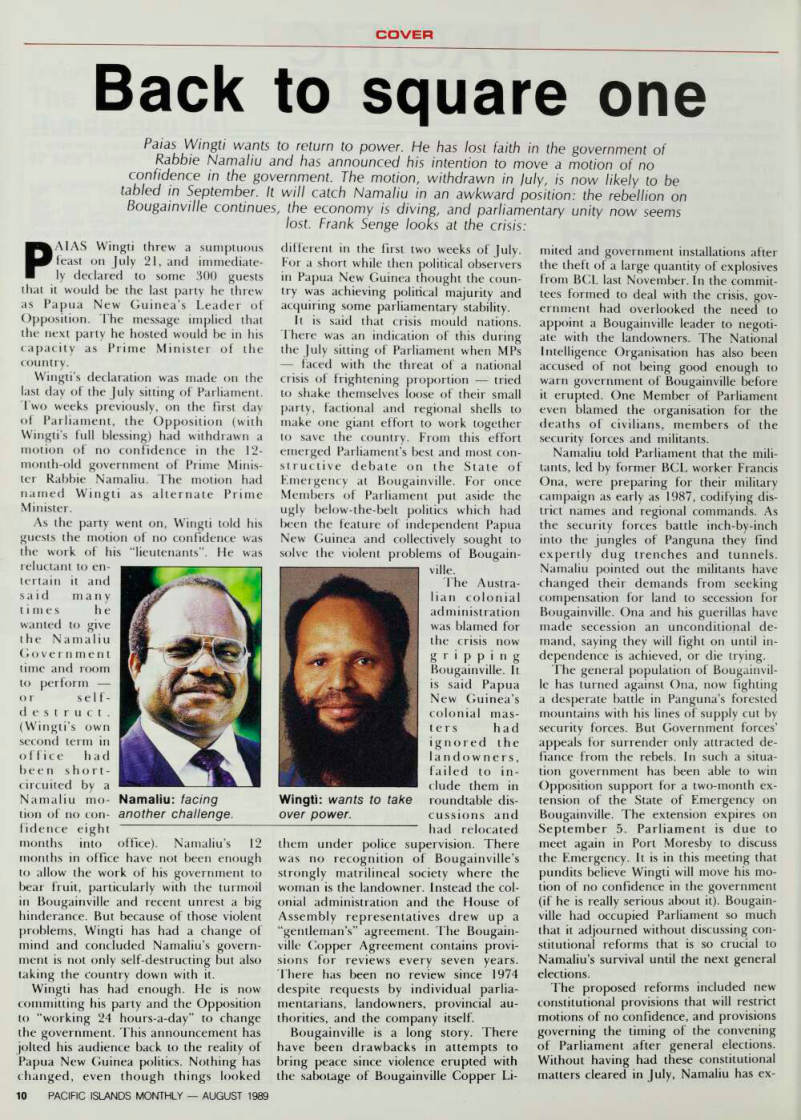
Namaliu: facing another challenge.
Wingti: wants to take over power.
posed his government to renewed attack in the next session which is likely to pro duce a more uncooperative Opposition entertaining a new motion of no confi dence. Should Wingti return to power through such a motion he is likely to also face an uncooperative Namaliu probably
unwilling to help pass any legislation,
particularly the constitutional reforms which Wingti drew up in his previous term of office.
Despite its willing participation in the
constructive debate on Bougainville, the Opposition’s withdrawal in July of its motion of no confidence in the govern ment was not totally a sign of coopera tion. Fate had intervened in the form of the assassination of Communications Minister Malipu Balakau at his home in Mt Hagen. Four members of the Opposition come from Enga Province up in the Highlands where Balakau had strong support. This support, spearheaded by Balakau’s relatives and catalysed by the threat of a vendetta war, pressured the Opposition to withdraw the motion of no confidence at the time of mourning. Even if the Opposition had gone ahead with the motion, it would have certainly lost because it would not have had the Highlands support it needed to provide the 55-vote majority
to win. A count at the time showed the motion would have attracted only 47 votes.
For Wingti, it was wise to withdraw the motion in the face of so much opposition at the time. Had he moved it at the time and lost, it would have encouraged the Opposition to look beyond him the next time for an alternate prime minister.
Now with this latest announcement, Wingti has two months before the next sitting in September to prepare for the new motion. Whether he can drag the Members of Parliament back with him to the instability that marked Parliament in the past is not known. However, many hope that the good signs that emerged in Parliament during the Emergency would remain, encouraging greater unity during the yet unsolved Bougainville crisis.
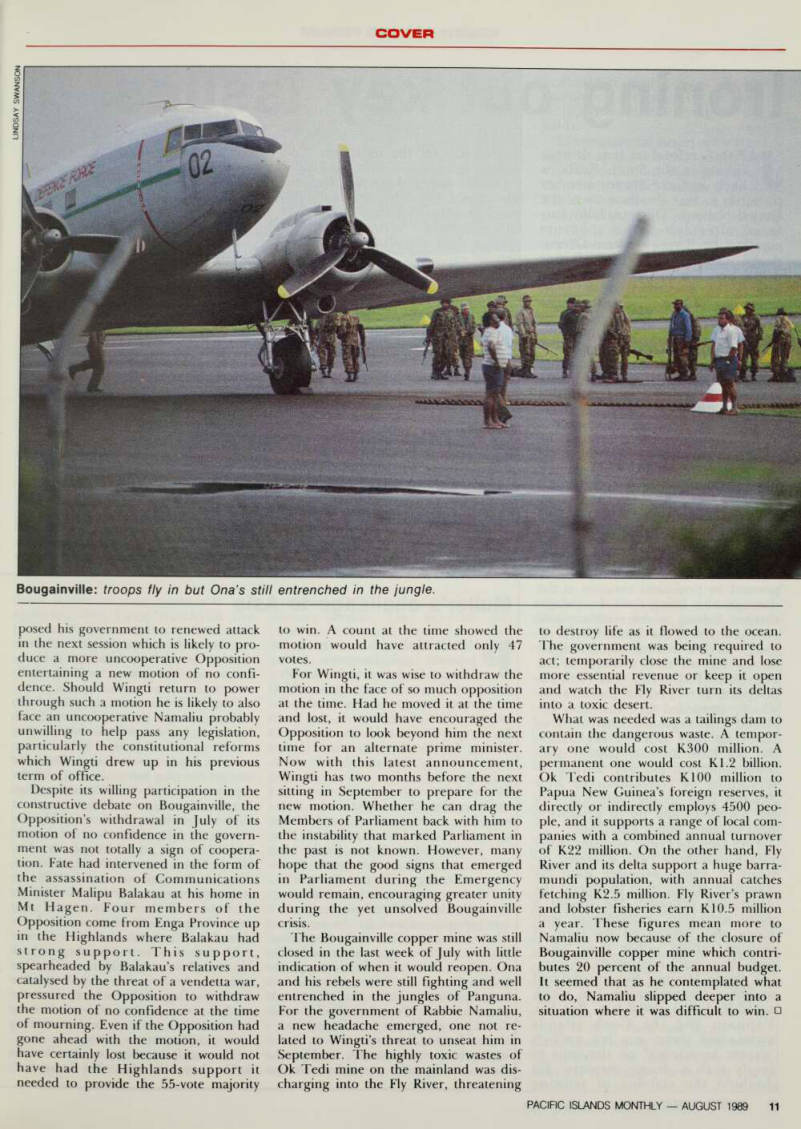
The Bougainville copper mine was still closed in the last week of July with little indication of when it would reopen. Ona and his rebels were still fighting and well entrenched in the jungles of Panguna.
For the government of Rabbie Namaliu, a new headache emerged, one not re lated to Wingti’s threat to unseat him in September. The highly toxic wastes of Ok Tedi mine on the mainland was dis
charging into the Fly River, threatening
to destroy life as it flowed to the ocean.
The government was being required to act; temporarily close the mine and lose more essential revenue or keep it open and watch the Fly River turn its deltas into a toxic desert.
What was needed was a tailings dam to contain the dangerous waste. A tempor ary one would cost K3OO million. A permanent one would cost K 1.2 billion.
Ok Tedi contributes KlOO million to Papua New Guinea’s foreign reserves, it
directly or indirectly employs 4500 peo
ple, and it supports a range of local com panies with a combined annual turnover of K 22 million. On the other hand, Fly River and its delta support a huge barra mundi population, with annual catches fetching K 2.5 million. Fly River’s prawn and lobster fisheries earn K 10.5 million a year. These figures mean more to Namaliu now because of the closure of Bougainville copper mine which contri butes 20 percent of the annual budget.
It seemed that as he contemplated what to do, Namaliu slipped deeper into a situation where it was difficult to win. □
Lindsay Swanson
Bougainville: troops fly in but Ona’s still entrenched in the jungle.