Educating the Pacific
pp. 51-53 · Read in the full issue
Pacific People
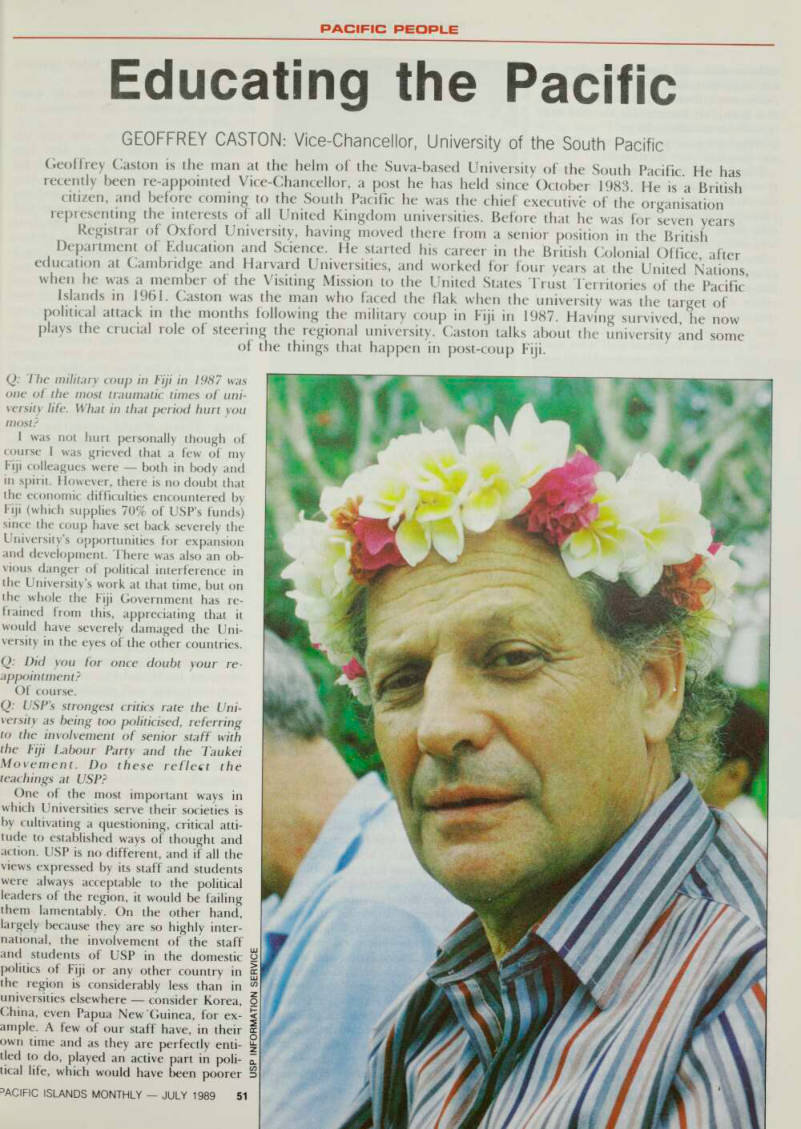
GEOFFREY GASTON; Vice-Chancellor, University of the South Pacific Geoffrey Gaston is the man at the helm of the Suva-based University of the South Pacific He has recently been re-appointed Vice-Chancellor, a post he has held since October 1983 He is a British citizen, and before coming to the South Pacific he was the chief executive of the organisation representing the interests of all United Kingdom universities. Before that he was for seven years Registrar of Oxford University, having moved there from a senior position in the British Department of Education and Science. He started his career in the British Colonial Office after education at Cambridge and Harvard Universities, and worked for four years at the United Nations when he was a member of the Visiting Mission to the United States Trust Territories of the Pacific Islands in 1961. Caston was the man who faced the flak when the university was the target of political attack in the months following the military coup in Fiji in 1987. Having survived he now plays the crucial role of steering the regional university. Caston talks about the university and some of the things that happen in post-coup Fiji.
Q: The military coup in Fiji in 1987 was one of the most traumatic times of uni versity life. What in that period hurt you most?
I was not hurt personally though of course I was grieved that a few of my Fiji colleagues were both in body and in spirit. However, there is no doubt that the economic difficulties encountered by Fiji (which supplies 70% of USP’s funds) since the coup have set back severely the University’s opportunities for expansion and development. There was also an ob vious danger of political interference in the University’s work at that time, but on the whole the Fiji Government has re frained from this, appreciating that it would have severely damaged the Uni versity in the eyes of the other countries.
Q: Did you for once doubt your re appointment?
Of course.
Q: USP’s strongest critics rate the Uni
versity as being too politicised, referring
to the involvement of senior staff with the Fiji Labour Party and the Taukei Movement. Do these reflect the teachings at USP?
One of the most important ways in which Universities serve their societies is by cultivating a questioning, critical atti tude to established ways of thought and action. USP is no different, and if all the views expressed by its staff and students were always acceptable to the political leaders of the region, it would be failing them lamentably. On the other hand, largely because they are so highly inter national, the involvement of the staff and students of USP in the domestic politics of Fiji or any other country in the region is considerably less than in universities elsewhere consider Korea, China, even Papua New Guinea, for ex ample. A few of our staff have, in their own time and as they are perfectly enti tled to do, played an active part in poli tical life, which would have been poorer
Usp Information Service
without them. As long as this does not interfere with their University duties, or excessively colour their teaching, I think that is entirely healthy, for the Universi ty and for society at large.
Q: What are your problems with staffing and how can they be solved?
The first problem is that the Universi ty does not have enough money to pay the number of staff it needs to do the job expected of it. Today we have 40 per cent more students than six years ago, with not a single extra staff member.
Secondly, our salaries and conditions of service are not good enough to recruit many of the best people, and then to retain them. This is as true of regional citizens (now 70 percent of our academic and administrative staff) as it is of those from overseas. Regional staff who teach at USP are perfectly employable in uni versities overseas where they can earn around twice as much: it is not surpris ing that they, like other Pacific profes sionals, are more and more tempted to leave. Moreover, most of our “expatri ate” staff (unlike those who work for governments and in business) are here on local pay and conditions: they are finding their enthusiasm for working in
a very exciting and rewarding university
increasingly in conflict with difficulties, for themselves and their families, in making ends meet. Doubts about future security and stability, for local and over seas staff alike, make matters worse. Aid schemes which pay enhanced salaries to a few overseas staff in specially critical posts are a very valuable palliative, but do not offer a long-term solution.
There is, perhaps, no long-term solu tion. Some academic staff, both regional and from overseas, will continue to come to work at USP, and stay here, because
they find its special character particularly
stimulating and satisfying regardless
of its low rewards. Others will come here because it offers a good place to lay the foundations of a career which will be completed elsewhere. Governments may find that they have to offer higher re
wards to highly qualified people (includ
ing scientists and university teachers) to work in the region as the private sec tor is already beginning to discover. But there will always be a high turnover of staff at USP and the consequences of that are not wholly bad.
Q: What is USP’s future like?
It was set up to do for each of its member countries those of their educa tional tasks which cannot effectively or economically be done nationally and on a small scale. I hope national institutions, like the Solomon Islands College of Higher Education, the National Uni versity of Samoa and the Fiji Institute of Technology, will continue to develop, and free the resources of USP to do the work, at degree and, increasingly, at
post-graduate level which only we can do. At present our development is ham pered by the very pressing need for us to continue to fill the gaps at sub-degree level in national educational provision, with the result that much of the more advanced work continues to be done at overseas universities, often less approp riately. But this cannot be achieved un less more resources can be invested by national Governments in national institu tions, without, of course, reducing their investment in their own regional institu tion. That is the way we should be going, but it will be hard.
Q: Why is USP fragmented, for example Alafua, Tuvalu, Tonga, Vila. Are you
not merely trying to satisfy national
pride?
It is not “merely national pride”, but a perfectly reasonable and healthy wish on the part of each of our member coun tries to have some of the staff and facili ties of their own USP more readily ac cessible to them. The problem is to achieve this without fragmentation, given that it is in the nature of a university that any one student will be taking many different courses in different depart ments, that libraries and laboratories must be used by many different staff members in different fields, and that the academic and administrative staff of what is in any case a very small universi ty must be able to develop a sense of scientific and intellectual community.
Distance education and the development of telecommunications have helped us to strike a balance, but it will always be a contentious issue between our member
countries as it is for other regional organisations.
Q: How widely accepted are the qual ifications acquired at the University of the South Pacific?
Very widely, by those who take the trouble to investigate them. Our best graduates are regularly accepted for post-graduate studies in Australia, New Zealand, the US and the UK and our courses are cross-credited in most uni versities in those countries. We have maintained a system of external advisers
for all our teaching departments, disting
uished scholars from overseas who visit us, talk with our staff and students and examine their work. Their reports, with few exceptions, suggest that we are
maintaining high “international” stan
dards as our member countries wish us to do. Of course, it has been argued that this is a false objective, that more of our graduates would remain in the South Pacific if their qualifications were not accepted overseas. It is the way many other Third World countries have chosen that their universities should go but not those in the South Pacific.
Q: You introduced among others the Certificate in Journalism course and the Degree in Technology. What are the fu ture of these two courses?
The Journalism programme was de veloped and taught by a staff member paid by the Commonwealth Fund for Technical Cooperation. It is not yet clear whether it will be able to replace him, or whether we can find other funding sources for a replacement. The course is a valuable and popular one, and the question mark hanging over its future is an example of the difficulties which arise when we are forced to run programmes with temporary staff positions funded by aid agencies, with our own establishment frozen.
The Technology degree is different.
The staff positions here have been
funded within our regular budget by
gradually redeploying resources from
other departments (notably Education)
in response to the demand from regional governemnts that we move more into ap plied science. It replaces the former B.Ed degree in Industrial Arts, and has the ambitious aim of producing gradu ates who will be capable (among other things) of filling middle-level manage ment positions in the new small indus tries that are developing in Pacific coun tries. USP will probably never have the resources to mount full specialised en gineering degrees, but we, and the Au stralian teams that have advised us, be lieve that the achievement of all-round
general technological skill at degree level
is an important, practical and innovative
objective.
Q: USP has developed good writers, like Epeli Hau’ofa whose Tales of the
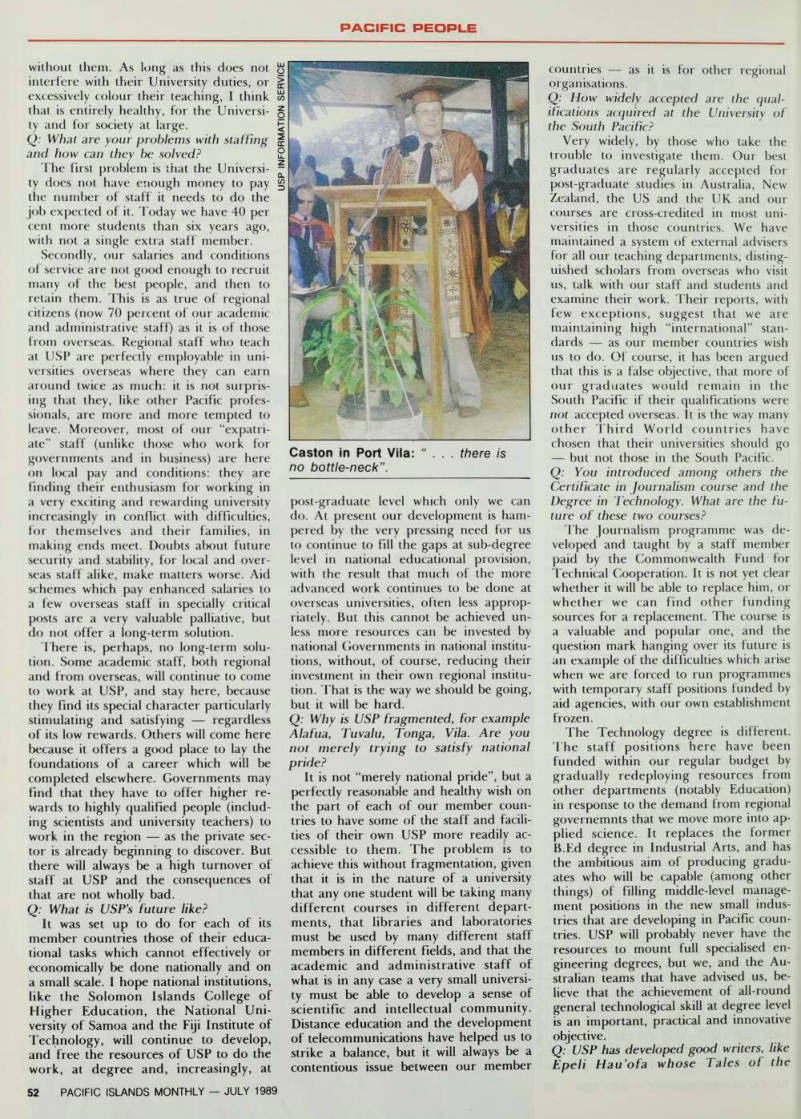
Usp Information Service
Gaston in Port Vila: "... there is no bottle-neck”.
Tikongs, and Kissing the Nederends have been widely acclaimed. Why is writ ing so prominent?
Inspired by the example of writers on the staff of USP, such as Albert Wendt, Subramani, Epeli Hau’ofa, Konai Tha man, Vilsoni Hereniko, Larry Thomas, Pacific Islanders have in the last few years developed the confidence to ex press themselves and the richness of their cultures in writing. A prolific flow of stories, plays, essays and poems is now coming every year from all over the South Pacific, much of it published and encouraged by USP. It is an important function of the University, and helps to establish and reinforce a sense of nation
al and regional identity throughout the
South Pacific.
Q: The university continues to produce graduates at a faster rate than develop ment in many countries in the region.
Will this result in a bottleneck?
There is no bottleneck. In virtually ev ery country there is a shortage of local
qualified professional people, in secon
dary school teaching, in government and, notably, in commerce and in de veloping new industries. Demand from Governments for scholarship places on degree courses has never been higher.
There are two main limitations. Firstly, the shortage of secondary school leavers
with university entrance qualifications,
which compels USP to divert a lot of its resources to sub-degree work, which really ought to be done more economi cally at a national level in schools or col leges. Secondly, Governments have been unable to afford, for the last six years, any increase in the funds they contribute to the University, which has made it im possible for us to venture into new, more
highly specialised areas of higher educa
tion, and makes further expansion of
our existing programmes impossible.
Another big worry is the increasing tendency of graduates in most of the South Pacific countries to emigrate and take their skills to countries where they can offer higher rewards.
Q: How is University of the South Paci
fic helping the growth of regionalism?
Immensely. The young future leaders from different countries in the region spend three or four years of their lives
working together playing together,
learning from and about each other.
Look at the recent USP musical produc tion Sina ma Tinilau , students from different countries and cultures per forming together in a magical play which draws upon shared myths and messages.
I sometimes worry whether when they get home our graduates will find their new Pacific regional understanding can survive collisions with the often narrower nationalistic outlooks of their elders. But then I am reassured at regional meetings when already we can see USP graduates,
often classmates, representing countries around conference tables across which their earlier experience provides short cuts to understanding, and personal friendship quickly breaks down obstacles to international agreement. In this re spect USP is a great asset to the small nations of the South Pacific, not matched by any comparable institution in Europe, Asia, Africa or Latin America.
Q: What roles does USP play in the de velopment of individual countries in the Pacific Islands?
Firstly, it provides qualified people who have been educated in a relevant South Pacific environment: the alterna tive would be University education in metropolitan countries which would be far less appropriate to the development tasks facing island nations.
Secondly, it offers all over the region shorter post-graduate courses to public servants and businessmen in many areas relevant to development such as manage ment, scientific specialisms, agriculture, marine studies, computing, educational administration. In this way it fills one essential role of a university in any de veloping country that of a conduit and filter for international knowledge.
An example (among many) is the recent ly completed Regional Course in Public Expenditure Programming and Manage ment, attended by officials from all over the South Pacific (including Papua New Guinea, the Marshall Islands and Mic ronesia), and also the Republic of the Maldives, which, though many thousands of miles away in the Indian Ocean, is sending us more and more students at all levels, recognising the common de velopmental problems of small island states. The Programme was funded, organised and partly taught by the Eco nomic Development Institute of the World Bank, in collaboration with the Australian Government and USP. The University’s own staff took part in the teaching, and there can be no doubt that this and many other similar events are of direct benefit to the development of the individual countries whose senior offi cials take part.
Thirdly, the University does applied
research in these same developmental areas and of a kind and in a style often more immediately helpful than similar work done in much wealthier universities outside the region. Our regular funding coming as it does from ministries of education does not cover this essential part of our activity, and it is therefore limited by the constant need to scratch around for financial support from aid donors who naturally tend to look first to their own research institutions. Re gional Governments tend to overlook what an important scientific asset of their own they have at USP.
Q: What big plans have you for USP?
Big plans often raise false expectations and lead to demoralising disappoint ment, so I prefer to avoid them. USP must keep on doing really well what it is doing now. That is a sufficient challenge in itself since a university nowadays has to have more and more resources to do the same job, because of the increasing expense of the modern technology with which our students must become famil iar, and which our research workers must use. We cannot expect any really large increase in funds (and therefore staff) from countries whose economies are not themselves growing significantly, if at all. On the other hand, we must not become excessively dependent on exter nal aid, which has a habit of drying up
when you need it most.
So my plans are modest 1 will be happy if, when I leave it, the University has remained as excellent as it has already become. But I have my dreams for example, of a benefactor who could endow at USP a centre for adv anced Pacific studies which would attract to us more scholars and scientists of the excellence of those who now study South Pacific societies and their environment in Australia, New Zealand, the United States. □
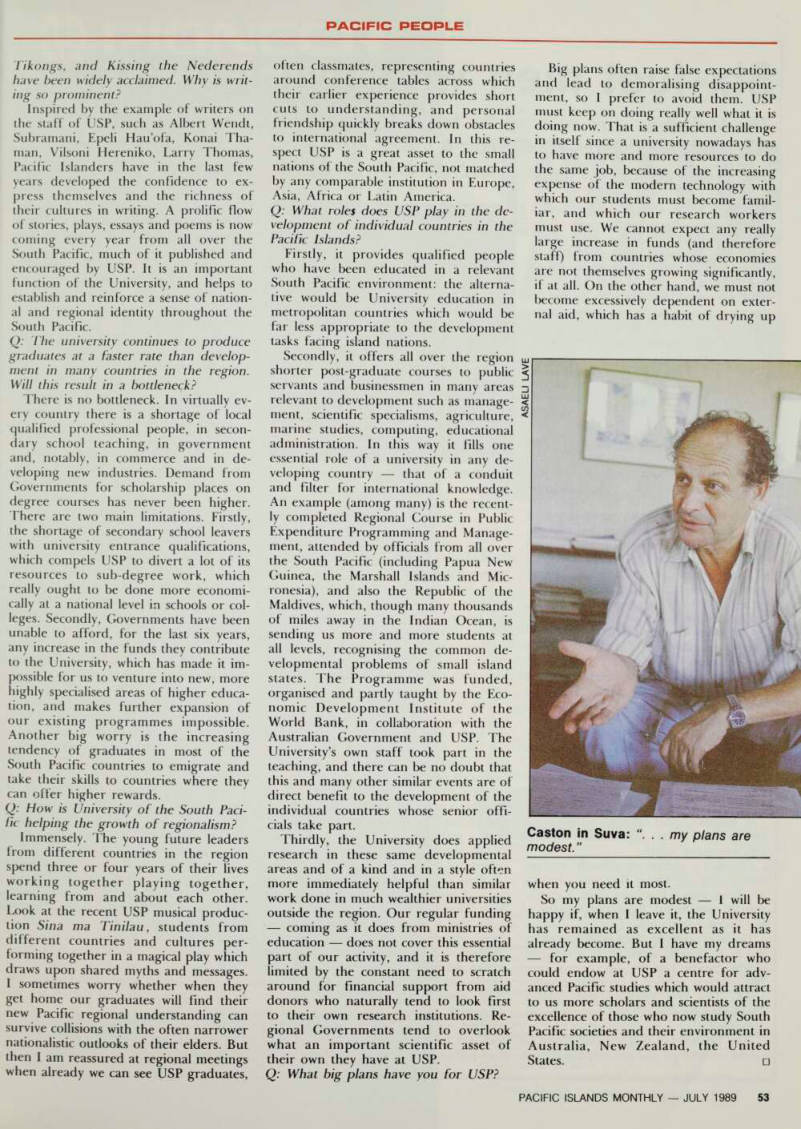
Asaeli Lave
Caston in Suva: "... my plans are modest.”