In search of the best fiction
p. 50 · Read in the full issue
By David Robie
ANEW book series whose pub lishers hope will become a showcase for the finest fiction from New Zealand and the Pacific Is lands has been launched. But there is a vital ingredient in short supply a pool of suitable Pacific writers.
Welcoming the first four titles of Heinemann Reed’s Pacific Writers Series in Samoa House in Auckland in May, Albert Wendt praised the publishers for providing Pacific writing with such an
inspiring boost.
Wendt, professor
of New Zealand literature at Auck
land University
believes that crea tive Pacific writers will emerge.
Inspired by
Heinemann Inter
national’s long
established Afri can and Carib bean writers series which include authors, of the calibre of Chinua Achebe, Doris
Lessing and Wole Soyinka the new Pacific list may herald a new era for is land writers.
Of the inaugural four authors, only one is a Pacific Islander Alistair Te Ariki Campbell of the Cook Islands, with his first novel, The Frigate Bird. Others are leading Maori writer Witi Ihimaera, whose Tangi, a landmark in New Zea land fiction, has been republished under the series imprint; award-winning John Cranna, with an impressive collection of short stories, Visitors; and a powerful first novel by Nick Hyde, Earthly De lights .
Editor Andrew Campbell believes the series will provide a significant new marketing impact in the northern hemis phere for Pacific writers. “These titles have been sold to Australia and Britain so far,” he says. ‘Tfangi, for example, even though it has sold 30,000 copies in this country, has never previously been sold in Australia.”
Campbell is also confident the series will provide a broader regional and in ternational market for Pacific writers.
“The major outlet for Pacific writers has been the University of the South Pacific which has done good publishing,” he says. “But he will be seeking the best Pacific fiction writers and our books will sell in markets where USP books have never been seen.”
Although Campbell is considering
several manuscripts from Pacific writers as possible future titles, he admits he has a big shortage of potential writers. He hopes that the launch of the series will attract them.
Another problem is that the handful of published Pacific fiction writers, like other authors, tend to stay with one im
print. For example, Tonga’s Epeli
Hau’ofa, author of Tales of the Tikongs and Kisses in the Nederends , who is with Penguin, and Longman Paul’s Albert Wendt and Patricia Grace, who are now also part of the Penguin group.
“It is important to catch writers with their first book,” says Campbell. “After publishing their first work, authors tend to stick with that publishing house. It becomes a Catch 22!” However, while many authors welcome the series, some harbour doubts about the parallels with the African writers imprint and criticism over its “almost cultural voyeurism”.
“My feelings are ambivalent,” admits Cranna. “On the one hand I think it is marvellous that a publisher is recognis ing the Pacific in what is still a very pala
gi-dominated publishing world here.
And Andrew must be praised for this achievement. But on the other hand, I also have a sympathy for Salman Rush die’s views on the Africa series. He con siders them a paternalistic showcase of ethnic oddities. Literature is most power ful when it is a cross-fertilisation of cul tures. I would be happier to see a broad er commitment of all publishers to look for Pacific writers and to publish them.”
In Visitors, Cranna demonstrates dis turbing understatement and effortless control over a variety of styles, spiriting the reader from a work gang in the Kamai Range, to the slums of Samoa, and on to a group of hedonistic Ger mans on the beaches of Sicily. The tales of sexuality, madness and death in this collection are narrated by observers who hover on the edge of terrible secrets. As the publishers describe them: “These are stories that go beyond parochial con cerns to universal themes the struggle between powerful and weak, and the darkness that is within us all.”
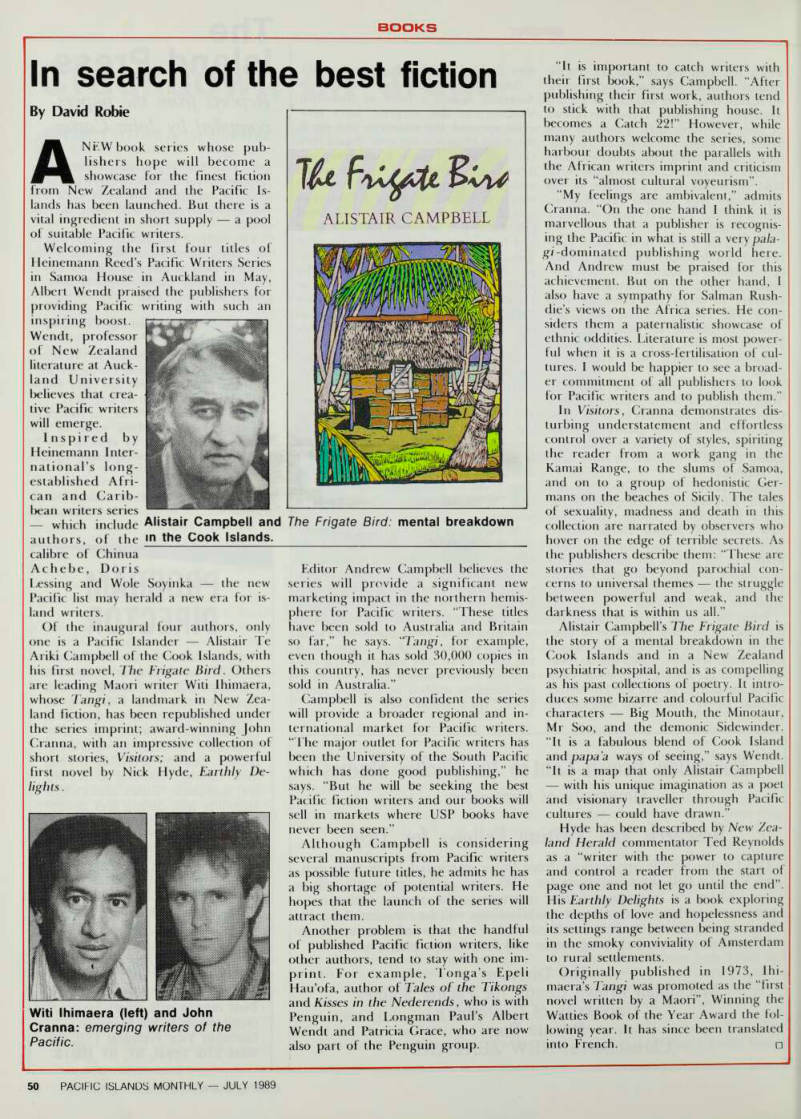
Alistair Campbell’s The Frigate Bird is the story of a mental breakdown in the Cook Islands and in a New Zealand
psychiatric hospital, and is as compelling
as his past collections of poetry. It intro duces some bizarre and colourful Pacific characters Big Mouth, the Minotaur, Mr Soo, and the demonic Sidewinder.
“It is a fabulous blend of Cook Island and papa'a ways of seeing,” says Wendt.
“It is a map that only Alistair Campbell with his unique imagination as a poet and visionary traveller through Pacific cultures could have drawn.”
Hyde has been described by New Zea land Herald commentator Ted Reynolds as a “writer with the power to capture and control a reader from the start of page one and not let go until the end”.
His Earthly Delights is a book exploring the depths of love and hopelessness and its settings range between being stranded in the smoky conviviality of Amsterdam to rural settlements.
Originally published in 1973, Ihi maera’s Tangi was promoted as the “first novel written by a Maori”, Winning the Watties Book of the Year Award the fol lowing year. It has since been translated into French. □
Witi Ihimaera (left) and John Cranna: emerging writers of the Pacific.
Alistair Campbell and The Frigate Bird: mental breakdown in the Cook Islands.