Crackdown on drugs
pp. 48-49 · Read in the full issue
COMPETITORS in the Mini South Pacific Games in Tonga next month will face drug tests in a his torical clean-up move by officials con cerned with the growing use of illegal drugs in international competition. The head of the Oceania National Olympic Committee’s Medical Commission, Dr Robin Mitchell, says the tests have been ordered by the International Olympic Committee. Funds are being sought in Australia and if available fullscale testing would mark the games in the Tongan capital of Nuku’alofa from August 22 to November 3.
The clean-up campaign comes in the wake of a call by Fiji Olympian Joe
Roden for pre-emptitive drug testing in
all South Pacific Games, beginning in Tonga, to ensure that the region’s athletes compete on more equitable terms. Rodan is the South Pacific 400 metres hurdles champion. He has repre sented Fiji in track and field at all South Pcific Games since 1975 in Guam, the Los Angeles and Seoul Olympics and the Commonwealth Games in Edinburgh, Scotland, in 1986. He says South Pacific Games officials must ensure that the
“unique spirit of our regional games
continues to be the envy of the rest of the world”. The 39-year-old veteran Fiji sprinter who has won 9 gold, 8 silver and a bronze from four South Pacific Games and two mini games, says “several incredible performances” in recent meets indicate “cheating in the first degree” by some regional athletes “who must be tak ing illegal drugs to boost their perform
ances unfairly”.
Rodan makes the call and the allega tion as an expected 1600 athletes and officials from regional islands prepare for the biggest mini games in history. “I do not claim to have all the evidence, but several performances in the past few games have been way out of this part of the world considering our standards and progress,” says Rodan, who pointed out that at least one woman who has been competing in the region for a long time looks like a man. “She is strong,” he says.
“She runs like a man. The first time I spoke with her she had a feminine voice, that was quite some time ago. The tone of her voice has changed slightly. We all know about the side effects of drug abuse. We hear about it, we read about it and when we see its visible manifesta tions we naturally get suspicious.” Rodan says drug tests will clear the air of suspi cion which is threatening to fragment the spirit of the South Pacific Games.
Dr Mitchell says some athletes in the
region are using illegal drugs. “We are well informed about drug abuse and their manifestations are obvious in the region,” he adds. Drug testing in the South Pcific Games will be expensive.
The high-tech facilities required for reli able testing are expensive and not readi ly available. Samples will have to be taken to either Los Angeles, Seoul or to Tokyo. The results will not be known until two to three days after the samples are taken. Additionally, a test will cost between SUSISO and SUS2OO. Despite the high hurdles to drug testing in the South Pacific Games, Dr Mitchell says his Medical Commission will go ahead and
take samples for testing.”
Rodan says that if ethical issues like drug abuse and professionalism are not tackled now then athletes from the poor er Pacific Island nations will no longer be able to compete favourably in the South Pacific Games, not being able to afford the time, facilities and drugs of the rich. He says the Olympics of today
has outgrown itself. The same danger threatens the South Pacific Games. He says separate games for drug users, another for professionals and one for the genuine amateurs will be more meaningful. “I could stomach, even stand tall amongst the profes sionals I ran against in Los angeles and Seoul,” says Rodan. “But I cannot sto mach the thought of re turning to the Olympics, or any other games for that matter, with this nagging thought behind my head that I would be humiliated by someone who has che ated himself, cheated his fellow athletes, and cheated the rest of the world look
ing on by unfairly boosting
his ability with drugs.”
Rodan believes his will to win cannot be any less than Ben Johnson’s of Canada, who lost his gold medal in the 100 metres in Seoul when he tested positive for drugs. “But I believe in winning with my own natu ral ability,” he says. “I pre fer to hold a full-time job where I earn a living and share a different kind of fellowship with my co workers, knock off work
and spend time with the family, and spend the rest of my time training on the track and live a normal human life.
“We are the genuine amateurs of sport and we owe it to ourselves that we main tain that stature. We have something very dear and very precious in our South Pacific Games which we need to protect at all costs. Even in intense com petition the atmosphere is carnival, re laxed and friendly. Our security people do not carry guns and are more like ushers and guides rather than imposing marshallmen swamping all over you like in the Olympics.”
He accused the New Caledonians and
French Polynesians of professionalism.
Says he: “I will not be surprised that right now athletes from both Tahiti and New Caledonia are in France preparing for the mini games. They can be in France for as long as three months, I’m told.”
Rodan’s concern reveals a discomfort ing transition in the South Pacific Games
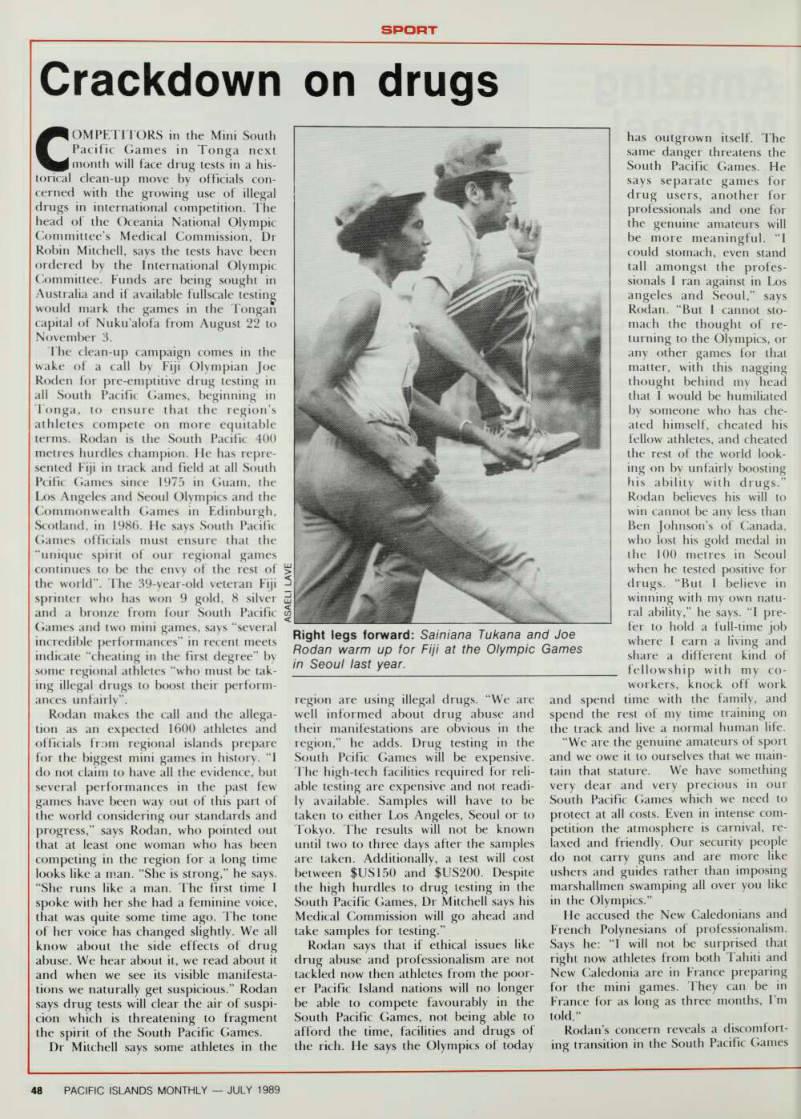
Asaeli Lave
Right legs forward: Sainiana Tukana and Joe Rodan warm up for Fiji at the Olympic Games in Seoul last year.
which has seen the rest of the Pacific
Islands nations unconsciously teaming
up against their more industrious French territories. The three French territories of New Caledonia (24), Tahiti (6) and Wallis 8c Futuna (1) dominate the 18nation South Pacific Games record books in track and field. Collectively, the three hold 31 records out of a possible 38. Fiji (4), Papua New Guinea (1), Western Samoa (1) and Tonga (1) share the other seven records.
Chasing the French in the South Pacific Games is no longer a personal pursuit of excellence. It has now involved governments which see the medal tally as a measure of social and economic well being. Fiji, Tonga, Western Samoa and American Samoa are sending their athletes offshore in pursuit of better technique to match the French territor ies.
According to Rodan the games in Tonga this year might witness another transformation. He predicts the hosts to lead a single-handed assault to wrest dominance away from the French territories. Tonga, as host, will be numerical-
ly superior.
Alain Lazare, New Caledonia’s South Pacific long-distance champion, is the stayer to watch in Tonga. Also from New Caledonia, Brigitte Hardel should have too much power for her fellow women in the sprints, the jumps and the pentathlon. Brothers Paul and Clement Poaniewa, will make jumping a family affair for New Caledonia.
Tahiti has always been strong in the team sports. But their reduction in Tonga will effectively clip their chances of a medal haul. Western Samoa will be seek- ' n § in the boxing ring. Willie Fong will be the man to beat in the 110 metres hurdles. Henry Smith who lives out of
New Zealand, will be strong in the field.
American influence has always made American Samoa a force in basketball.
Vanuatu can also surprise. Jerry Jere maia, sprinted 100 metres in 10.6 sec in the Seoul Olympics last year. Papua New Guinea’s Akali Tuna is a university stu dent with speed and stamina which makes him a strong contender from 100 metres to 800 metres. He is a 400-metres specialist who clocked 47.36 in the Seoul Olymics. “He’ll be strong. He’ll be good and he’ll win for Papua New Guinea in
Tonga,” says Rodan. Fiji’s Seoul Olym
pics experience indicates strength in the middle distances. The youthful trio of Lui Muavesi, Braeman Yee and Henry Rogo will team up to challenge Lazare in the 800 metres and the 1500 metres.
They will also form the core of the 4x400 metres relay team. Sainiana Tuka na provided the surprises of the New Caledonian games in 1987.”
Rodan says whoever wants to win the 400 metres sprint should be running be low 47 seconds or forget the gold. “My only ambition now is to set a new Fiji record for the 400 metres and if I appear in Tonga come the Mini Games then I will be one of the individuals to look out for.” Rodan’s Fiji record is 47.8 seconds.
At the end of it all Rodan is convinced that the Pacific way will come out the ultimate winner. “There is something ab out the Pacific people that just sets them apart. Perhaps it’s their culture, perhaps it’s the way they are brought up. 1 can not really put my thumb on it. But what ever it is, let us keep the South Pacific Games the way it has been.” After all, it has taken more than a quarter of a cen tury for the friendliest games to get to
the kingdom dubbed by Captain James
Cook “The Friendly Isles”.