Six-foot men with five-foot axes
p. 54 · Read in the full issue
Out Of The Past
The Mokolkols were some of the last savages of Papua New Guinea to experience civilisation as we know it today. Here is their story, straight out of the pages of Pacific Islands Monthly, September 1957.
HIGH in the mountains, above Open Bay, slightly north of the volcanic Father Mountain, dwell the Mokolkol tribe, the last of several killer tribes which once inhabited New Britain.
These people, were greatly feared by
the more peaceable and civilised natives, and the name of Mokolkol is still enough to throw a scare into a plantation labour er (and others).
The Mokolkols roamed comparatively near Rabaul, the capital of New Britain within 80 or 90 miles of it; and they persisted in their primitive, savage, nomadic existence until recently.
For many years, during German admi nistration of New Guinea, the Govern ment sent out expeditions in vain en deavours to contact the Mokolkols.
After the 1914-1918 war, when Au stralia took over, many more attempts were made to contact Mokolkol savages.
Such expeditions were entirely fruitless until a couple of years ago when, follow ing a killing raid by the tribe, a Govern ment patrol was at last successful in cap turing a Mokolkol woman and two men.
These were taken to Rabaul, to cala boose. However, the detention was men
tally, medically and physically friendly
and humane.
These guests of the Government were well fed and kept in Rabaul until a fair smattering of local Pidgin talk was assimilated by them. Then a Govern ment patrol took their now happy cap tives back to the solitude of their moun tains. Contact then was easily made.
The chief man of the tribe was made Government Head Man Luluai and ceremoniously crowned with the “Hat” (a red braided, peaked cap). He was an able student of the ceremonial foot slam and sweeping salute.
One day a planter on a lonely, embryo cocoa area on Open Bay was planting seedlings with a few boys when a terrific uproar was heard from the vicinity of the house compound.
Nothing could be seen from the plant
ing area, densely screened by temporary
shade growth, but the din coming from the quarters seemed a veritable donnyb
rook. The few seedling boys yelled,
“Mokolkol he come!” and promptly dis
appeared.
The planter felt that the only thing he could do was go and see “wattineU” was
doing. This is his story: I got up near the house and saw a mob of natives milling around near my house-cook tank.
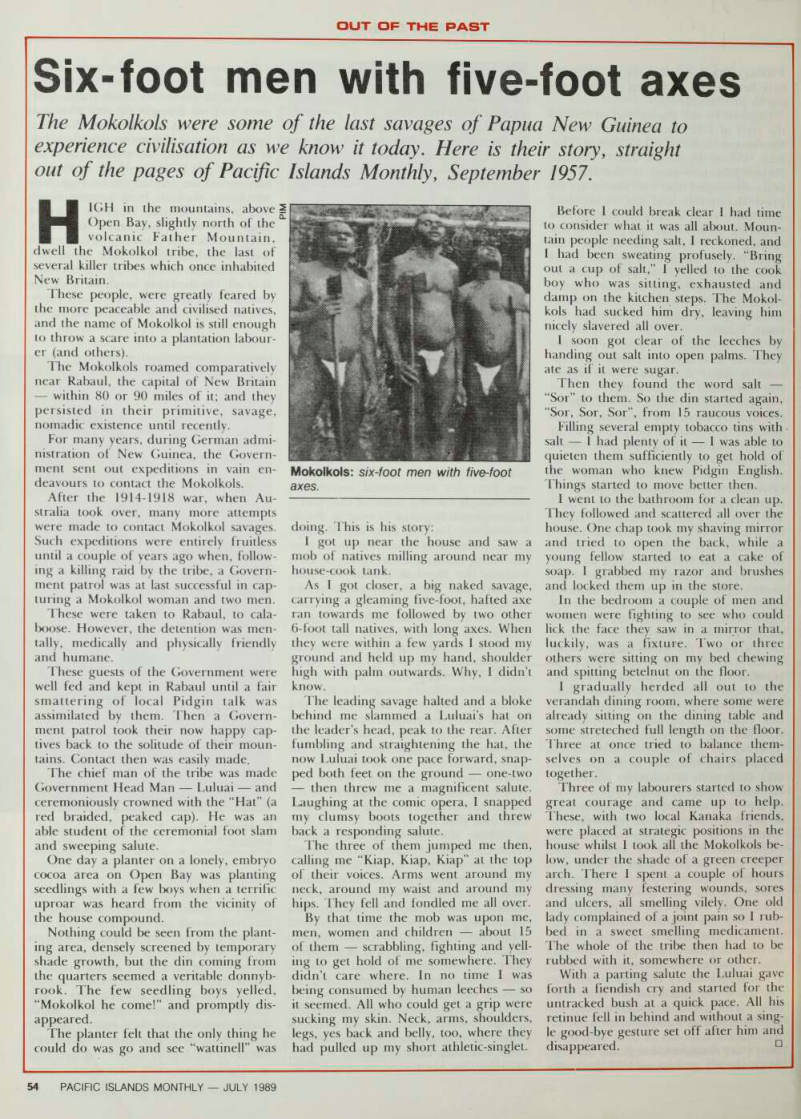
As I got closer, a big naked savage, carrying a gleaming five-foot, hafted axe ran towards me followed by two other 6-foot tall natives, with long axes. When they were within a few yards I stood my ground and held up my hand, shoulder high with palm outwards. Why, I didn’t know.
The leading savage halted and a bloke behind me slammed a Luluai’s hat on the leader’s head, peak to the rear. After fumbling and straightening the hat, the now Luluai took one pace forward, snap ped both feet on the ground one-two then threw me a magnificent salute.
Laughing at the comic opera, I snapped my clumsy boots together and threw back a responding salute.
The three of them jumped me then, calling me “Kiap, Kiap, Kiap” at the top of their voices. Arms went around my neck, around my waist and around my hips. They fell and fondled me all over.
By that time the mob was upon me, men, women and children about 15
of them scrabbling, fighting and yell
ing to get hold of me somewhere. They didn’t care where. In no time I was being consumed by human leeches so it seemed. All who could get a grip were sucking my skin. Neck, arms, shoulders, legs, yes back and belly, too, where they had pulled up my short athletic-singlet.
Before 1 could break clear I had time to consider what it was all about. Moun tain people needing salt, I reckoned, and
I had been sweating profusely. “Bring
out a cup of salt,” I yelled to the cook boy who was sitting, exhausted and damp on the kitchen steps. The Mokol kols had sucked him dry, leaving him nicely slavered all over.
I soon got clear of the leeches by handing out salt into open palms. They ate as if it were sugar.
Then they found the word salt “Sor” to them. So the din started again, “Sor, Sor, Sor”, from 15 raucous voices.
Filling several empty tobacco tins with salt I had plenty of it I was able to quieten them sufficiently to get hold of the woman who knew Pidgin English.
Things started to move better then.
I went to the bathroom for a clean up.
They followed and scattered all over the house. One chap took my shaving mirror and tried to open the back, while a young fellow started to eat a cake of soap. I grabbed my razor and brushes and locked them up in the store.
In the bedroom a couple of men and women were fighting to see who could lick the face they saw in a mirror that, luckily, was a fixture. Two or three others were sitting on my bed chewing and spitting betelnut on the floor.
I gradually herded all out to the verandah dining room, where some were already sitting on the dining table and some streteched full length on the floor.
Three at once tried to balance them selves on a couple of chairs placed
together.
Three of my labourers started to show great courage and came up to help.
These, with two local Kanaka friends, were placed at strategic positions in the house whilst I took all the Mokolkols be low, under the shade of a green creeper arch. There I spent a couple of hours dressing many festering wounds, sores and ulcers, all smelling vilely. One old lady complained of a joint pain so 1 rub bed in a sweet smelling medicament.
The whole of the tribe then had to be rubbed with it, somewhere or other.
With a parting salute the Luluai gave forth a fiendish cry and started for the untracked bush at a quick pace. All his retinue fell in behind and without a sing le good-bye gesture set off after him and
disappeared. D
Pim
Mokolkols: six-foot men with five-foot axes.