Tjibaou?
p. 24 · Read in the full issue
The new Tjibaou?
THE day after he was elected presi dent of the Caledonian Union Francois Burck sought solitude at his 20-acre farm in Moindou, 100 kilometres from New Caledonia’s capital Noumea. But he soon found out his pri vate days were over. As leader of the largest party within the Kanak Socialist National Liberation Front (FLNKS) and successor to Jean-Marie Tjibaou, assas sinated on May 4, Burck has suddenly
become a public figure.
At 50 he was tall, going bald and shy.
He wore spectacles and had curly side burns that were going white. And he was little known, although he played an im portant role behind the scenes within the pro-independence movement. Born in 1939 in Canala, a small mining town on the east coast, he is the eldest of seven children. He attended the local primary school before going to the St Leon Ro man Catholic seminary of Paita, outside Noumea. It was there that he first met Tjibaou, three years his senior. Both be came priests in the sixties after studying at the Catholic University in Lyons, France, and both shared the same desire to achieve social justice in New Cale donia.
Tjibaou quit the priesthood in 1972.
Burck stayed on and got married in Hienghene. Two years later he, too, left the church. They entered politics in 1975 and joined Caledonian Union, a party founded on multi-racial lines and demanding autonomy for New Caledo nia. It became the biggest arm of the FLNKS. In 1977, Tjibaou and Burck, with Yeiwene Yeiwene, Eloi Machoro
and Pierre Declercq confronted France with a petition for independence at the Bourail Convention. All five had been elected into the Territorial Assembly a few months before. Twelve years later, Burck is the only one who has survived more than a decade of killings. Declecq, a Furopean teacher, was assassinated at his home in September 1981. Machoro, who succeeded him, was killed by gen darmerie marksmen in January 1985.
Tjibaou and Yeiwene were gunned down by Djoubelly Wea, a Kanak radical opposed to the Matignon Accord peace pact, on the island of Ouvea on May 4.
Burck was elected president of Caledo nian Union on May 20 to replace Tjibaou. He is a Caldoche. His grand father was an Irish settler. His grand mother was Kanak. Party secretary
general Leopold Joredie was elected
vice-president to replace Yeiwene, and Aymard Bouanaoue became the new
general secretary.
No-one doubts Burck’s ability to rule the party. He is a man known for his strong will and determination. The poli tical events he has been through has har dened his feelings for independence.
“We don’t give up, we continue in mem ory of Jean-Marie and Yeye (Yeiwene),” he said after his election. “The party has asked us to pursue the same struggle and we shall do that. I won’t tell you any more.” He is a hardliner.
Burck sees some difficulties in working with Jacques Lafleur, the loyalist leader of the anti-independence Rally for Cale donia in the Republic (RPCR). “I think Lafleur will have felt more sympathy, more trust towards Tjibaou than towards me,” he said. “He will be more reserved with me and it will be the same from my side.”
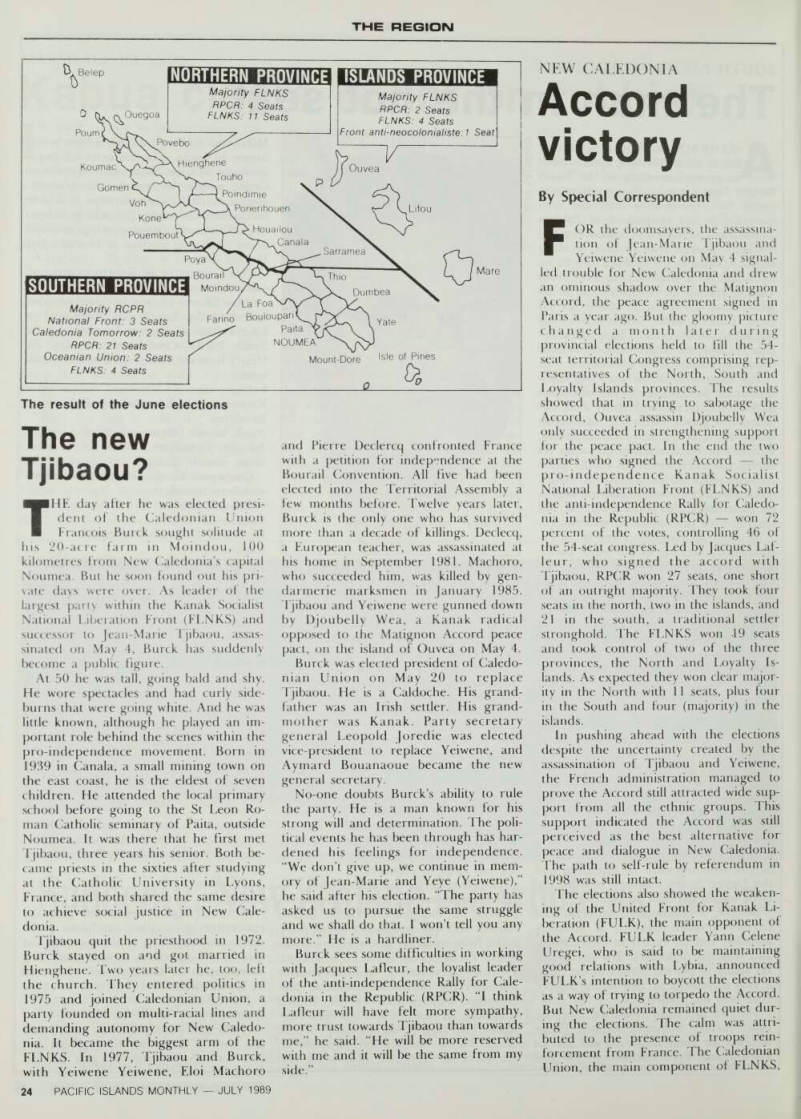
The result of the June elections