Talat Mehmood
p. 23 · Read in the full issue
South Pacific Commission
The man in the hot seat
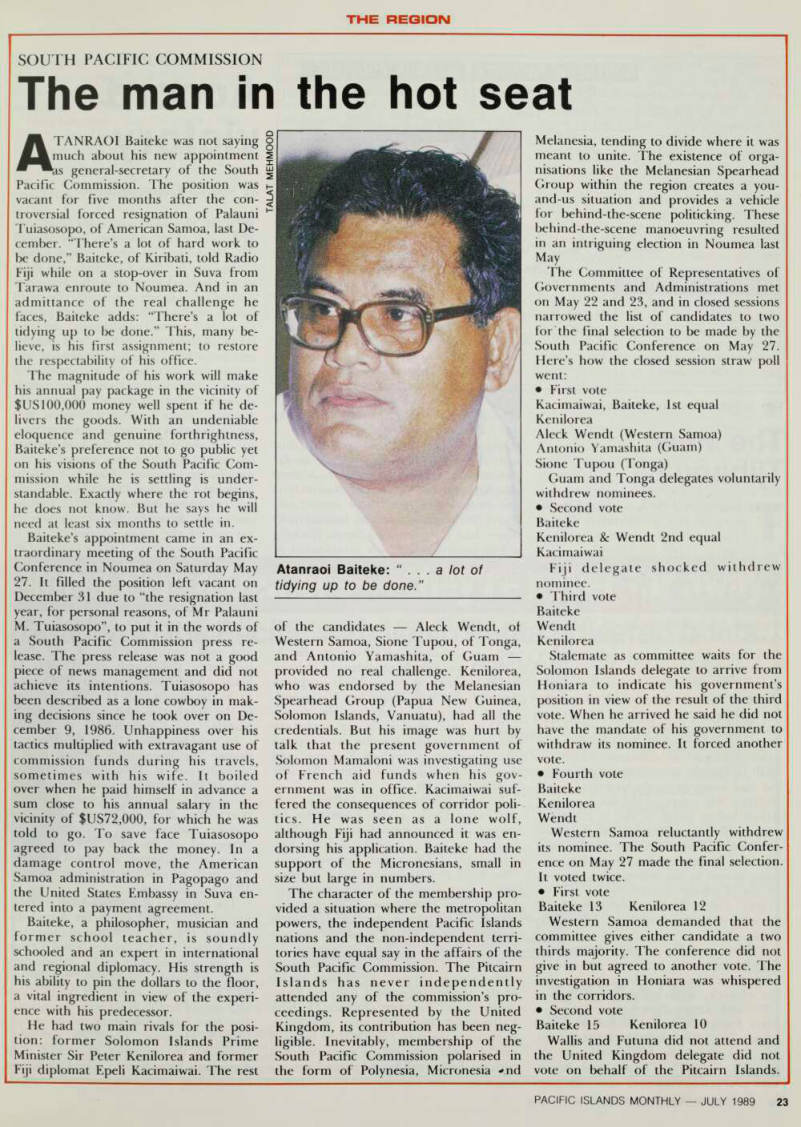
ATANRAOI Baiteke was not saying much about his new appointment as general-secretary of the South Pacific Commission. The position was vacant for five months after the con troversial forced resignation of Palauni Tuiasosopo, of American Samoa, last De cember. “There’s a lot of hard work to be done,” Baiteke, of Kiribati, told Radio Fiji while on a stop-over in Suva from Tarawa enroute to Noumea. And in an admittance of the real challenge he faces, Baiteke adds: “There’s a lot of tidying up to be done.” This, many be lieve, is his first assignment; to restore the respectability of his office.
The magnitude of his work will make his annual pay package in the vicinity of SUS 100,000 money well spent if he de livers the goods. With an undeniable
eloquence and genuine forthrightness,
Baiteke’s preference not to go public yet on his visions of the South Pacific Com mission while he is settling is under standable. Exactly where the rot begins, he does not know. But he says he will need at least six months to settle in.
Baiteke’s appointment came in an ex traordinary meeting of the South Pacific Conference in Noumea on Saturday May 27. It filled the position left vacant on December 31 due to “the resignation last year, for personal reasons, of Mr Palauni M. Tuiasosopo”, to put it in the words of a South Pacific Commission press re lease. The press release was not a good piece of news management and did not achieve its intentions. Tuiasosopo has been described as a lone cowboy in mak ing decisions since he took over on De cember 9, 1986. Unhappiness over his tactics multiplied with extravagant use of commission funds during his travels, sometimes with his wife. It boiled over when he paid himself in advance a sum close to his annual salary in the vicinity of $U572,000, for which he was told to go. To save face Tuiasosopo agreed to pay back the money. In a damage control move, the American Samoa administration in Pagopago and the United States Embassy in Suva en tered into a payment agreement.
Baiteke, a philosopher, musician and former school teacher, is soundly schooled and an expert in international and regional diplomacy. His strength is his ability to pin the dollars to the floor, a vital ingredient in view of the experi ence with his predecessor.
He had two main rivals for the posi tion: former Solomon Islands Prime Minister Sir Peter Kenilorea and former Fiji diplomat Epeli Kacimaiwai. The rest
of the candidates Aleck Wendt, of Western Samoa, Sione Tupou, of Tonga, and Antonio Yamashita, of Guam provided no real challenge. Kenilorea, who was endorsed by the Melanesian Spearhead Group (Papua New Guinea, Solomon Islands, Vanuatu), had all the credentials. But his image was hurt by talk that the present government of Solomon Mamaloni was investigating use of French aid funds when his gov ernment was in office. Kacimaiwai suf fered the consequences of corridor poli tics. He was seen as a lone wolf, although Fiji had announced it was en dorsing his application. Baiteke had the support of the Micronesians, small in size but large in numbers.
The character of the membership pro vided a situation where the metropolitan powers, the independent Pacific Islands nations and the non-independent terri tories have equal say in the affairs of the South Pacific Commission. The Pitcairn Islands has never independently attended any of the commission’s pro
ceedings. Represented by the United
Kingdom, its contribution has been neg
ligible. Inevitably, membership of the
South Pacific Commission polarised in the form of Polynesia, Micronesia *nd
Melanesia, tending to divide where it was meant to unite. The existence of orga nisations like the Melanesian Spearhead Group within the region creates a you and-us situation and provides a vehicle for behind-the-scene politicking. These behind-the-scene manoeuvring resulted in an intriguing election in Noumea last
May
The Committee of Representatives of Governments and Administrations met on May 22 and 23, and in closed sessions narrowed the list of candidates to two for the final selection to be made by the South Pacific Conference on May 27.
Here’s how the closed session straw poll went: • First vote Kacimaiwai, Baiteke, Ist equal Kenilorea Aleck Wendt (Western Samoa) Antonio Yamashita (Guam)
Sione Tupou (Tonga)
Guam and Tonga delegates voluntarily withdrew nominees. • Second vote Baiteke Kenilorea & Wendt 2nd equal Kacimaiwai
Fiji delegate shocked withdrew
nominee. • Third vote Baiteke Wendt Kenilorea Stalemate as committee waits for the Solomon Islands delegate to arrive from Honiara to indicate his government’s position in view of the result of the third vote. When he arrived he said he did not have the mandate of his government to withdraw its nominee. It forced another vote. • Fourth vote Baiteke Kenilorea Wendt Western Samoa reluctantly withdrew its nominee. The South Pacific Confer ence on May 27 made the final selection.
It voted twice. • First vote Baiteke 13 Kenilorea 12 Western Samoa demanded that the committee gives either candidate a two thirds majority. The conference did not give in but agreed to another vote. The investigation in Honiara was whispered in the corridors. • Second vote Baiteke 15 Kenilorea 10 Wallis and Futuna did not attend and the United Kingdom delegate did not vote on behalf of the Pitcairn Islands.
Talat Mehmood
Atanraoi Baiteke: “... a lot of tidying up to be done."