victory
pp. 24-25 · Read in the full issue

New Caledonia
Accord victory
By Special Correspondent
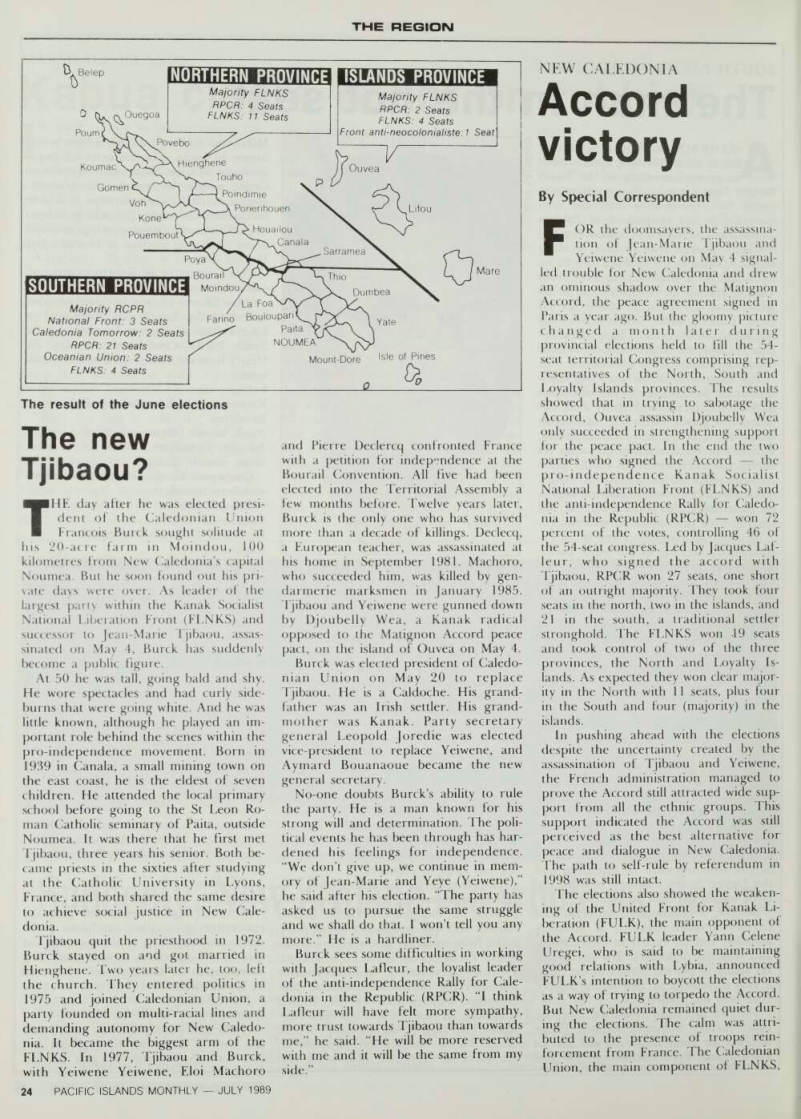
FOR the doomsayers, the assassina tion of Jean-Marie Tjibaou and Yeiwene Yeiwene on May 4 signal led trouble for New Caledonia and drew an ominous shadow over the Matignon Accord, the peace agreement signed in Paris a year ago. But the gloomy picture changed a month later during provincial elections held to fill the 54seat territorial Congress comprising rep resentatives of the North, South and Loyalty Islands provinces. The results showed that in trying to sabotage the Accord, Ouvea assassin Djoubelly Wea only succeeded in strengthening support for the peace pact. In the end the two parties who signed the Accord the pro-independence Kanak Socialist National Liberation Front (FLNKS) and the anti-independence Rally for Caledo nia in the Republic (RPCR) won 72 percent of the votes, controlling 46 of the 54-seat congress. Led by Jacques Laf leur, who signed the accord with Tjibaou, RPCR won 27 seats, one short of an outright majority. They took four seats in the north, two in the islands, and 21 in the south, a traditional settler stronghold. The FLNKS won -19 seats and took control of two of the three provinces, the North and Loyalty Is lands. As expected they won clear major ity in the North with 11 seats, plus four in the South and four (majority) in the islands.
In pushing ahead with the elections despite the uncertainty created by the assassination of Tjibaou and Yeiwene, the French administration managed to prove the Accord still attracted wide sup port from all the ethnic groups. This support indicated the Accord was still perceived as the best alternative for peace and dialogue in New Caledonia.
The path to self-rule by referendum in 1998 was still intact.
The elections also showed the weaken ing of the United Front for Kanak Li beration (FULK), the main opponent of the Accord. FULK leader Yann Celene Uregei, who is said to be maintaining good relations with Lybia, announced FULK’s intention to boycott the elections as a way of trying to torpedo the Accord.
But New Caledonia remained quiet dur ing the elections. The calm was attri buted to the presence of troops rein forcement from France. The Caledonian Union, the main component of FLNKS,
also organised militant groups to help the troops, especially on Lifou, the main island in the Loyalties, where FULK had its greatest support.
Does this mean that the main rivals of Caledonian Union will now disappear
from the political stage? Unlikely. Many
will continue to remain and will not trust the Accord and the lack of absolute guarantee for independence under its terms. The Kanak Liberation Party (PALIKA), the second biggest party in FLNKS, for example, accused Caledo nian Union officials of selfishness be cause the two Kanak provincial presi dents Leopold Joredie (North) and Richard Kaloi (Loyalty Islands), and three of the four vice-presidents be long to Caledonian Union. PALIKA’s attitude is worrying those keen to main tain unity in the wake of Tjibaou’s death.
Tjibaou’s dream was to take advantage of the time allowed in the 10-year interm period leading up to the referendum in 1998 to instill confidence in the ability of the Kanaks to effectively manage an in dependent New Caledonia. He was to embark on an extensive programme of economic development, training and re form to prepare the Kanaks for inde pendence. He knew that only by proving their ability to government their own
affairs were the Kanaks likely to gain confidence, and votes, in those now
opposed to independence. Francois
Burck, who succeeds him as president of Caledonian Union, will undoubtedly fol low the same path. Lafleur, on the other hand, is confident his success in the economically developed South will give him the ground from where he can show by example the benefits of remain ing within the economic umbrella of Prance. But he has missed his biggest clout by losing that absolute majority in the Congress by a vote.
Lafleur knew the significance of the result of the elections. He offered “to continue ... We shall consolidate the peace and continue our policy for ba lance and justice. If they wish to work in this spirit, all the elected members of the Congress will be welcome. The Caledo nian (Union) understood the indepen dentists were sincere when they signed the Matignon Accord and they also understood the RPCR wanted peace”.
Burck was almost overwhelmed with joy and paid tribute to the spirit of Tjibaou.
“Jean-Marie Tjibaou will be happy tonight,” he said as his party celebrated after the elections on Sunday night, June 11. “Voters understood the importance of the stakes of the Matignon Accord.”
One of the surprises of the election was the political shift of the Wallisian and Futunian community settled in New Caledonia as workers during the nickle boom of the sixties. Their population of 15,000 amount to 10 percent of the total population of the territory. Traditionally they supported RPCR which gave them economic and political security in the set tler-dominated South. But because of uncertainty over their residence after in dependence, they formed the Oceanian Union to talk directly to the Kanaks.
I hey have refused to take a precise stand on the independence issue although they feel closer to the Kanaks than to the Europeans. Oceanian Union won two seats in the South, or 40 per cent of the communal votes. This shift is crucial during the 1998 referendum be cause people from Wallis and Futuna are likely to swing in favour of the Kanaks
and independence.
• Simon Loueckhote, a 32-year-old Kanak opposed to independence was elected on June 26 chairman of a new territorial Congress, with the aid of votes from the extreme-right National Front.
Loueckhote, a member of the Rally for Caledonia in the Republic (RPCR) party, won 29 votes out of the 53. □