development
pp. 38-39 · Read in the full issue

The Region
Wilderness destruction threatens development
Rapid population growth
and poorly planned economic
development programmes are leading to the destruction of wilder ness areas and their plants and anim als at an alarming rate, according to a new report from the World Bank’s Office of Environmental Affairs.
If current trends continue, as many as six million species of plants and animals may have become extinct by the end of tnis century and the loss of these species could have a pro found impact on the development efforts of many countries, according to George Ledec and Robert Good land in tneir report, Wildlands: Their Protection and Management in Econo
mic Development.
George Ledec has worked as a con sultant to the World Bank’s Office of Environmental Affairs, and Robert Goodland is chief of the Environmen tal Division in the Bank’s Latin Amer ica and Caribbean Regional Office.
Their study has found that the pre servation of forests, jungles, coastal areas and other wildlands can actually improve prospects for long-term eco nomic development. Wildlands kept in their natural state and properly man aged serve as refuges for plants and animals that may have direct economic uses, and provide important “environ mental services” that help prevent floods and droughts, control soil ero sion and stop the spread of disease.
Wildlands provide a “diverse genetic base” for plant breeding; without this base, the study asserts, “the develop ment of high-yielding crop varieties could probably not be sustained”. Ab out a decade ago, for example, a uni que species of perennial wild maize was discovered in Mexico . . . and may help boost the world’s food produc tion. The maize is being cross-bred with more common varieties to pro duce plants that are resistant to pests and diseases and if the tiny area of land in which the wild maize grows had been cleared, such hybrids could never have been developed.
Protecting wild plants from extinc tion is also important to the produc tion of medicinal drugs. “More than 40 per cent of all prescriptions written in the United States contain one or more drugs that originate from wild species,” the report says.
Wildlands are also home to animals that play a similarly vital role in the lifecycles of many food or medicine producing plants, or that serve as im portant food sources for humans. harvesting of rodents, fish and birds makes a significant con tribution to people’s diets,” the re
port’s authors emphasise.
But wilderness is important not only
Conservation of natural habitats is actually good for business and development projects, according to a World Bank report.
because of the resources it contains: wilderness areas are just as important because they can actually enhance the
long-term productivity of development
projects. They protect and improve the power production of hydroelectric dams, since the clearing of forests and other watersheds leads to increases in erosion, runoff and siltation, limiting the amount of water that can be stored for power generation.
According to the study, “the useful life of the Ambuklao dam in the Phi lippines has been cut from 60 to 32 years because of deforestation, and virtually all of Colombia’s lower Anchicaya Reservoir filled with silt within the first decade of operation . .
Such losses in power-generating capacity translate into impaired in dustrial growth or into massive ex
penditures for flushing or dredging
reservoirs or for constructing replace ment facilities”.
Destroying wildlands can also re verse progress in health conditions in some developing countries. In South America, yellow fever is transmitted
by a mosquito that thrives in sunlit areas. When trees are cut down the mosquitoes infest larger areas and the number of people infected through mosquito bites increases, Over the past 15 years the World Bank and its affiliates have supported more than 40 projects that include measures to protect and manage wilderness. Most have helped establish or have strengthened officially pro tected and managed forests, grass lands and other wildlands, Three of the projects were designed to protect downstream hydroelectric
power-generating capacity by main
taining forested watersheds, and a further six have directly benefited
tourism revenues by conserving
wilderness and wildlife, In Costa Rica, a project aimed at developing the nation’s highways was
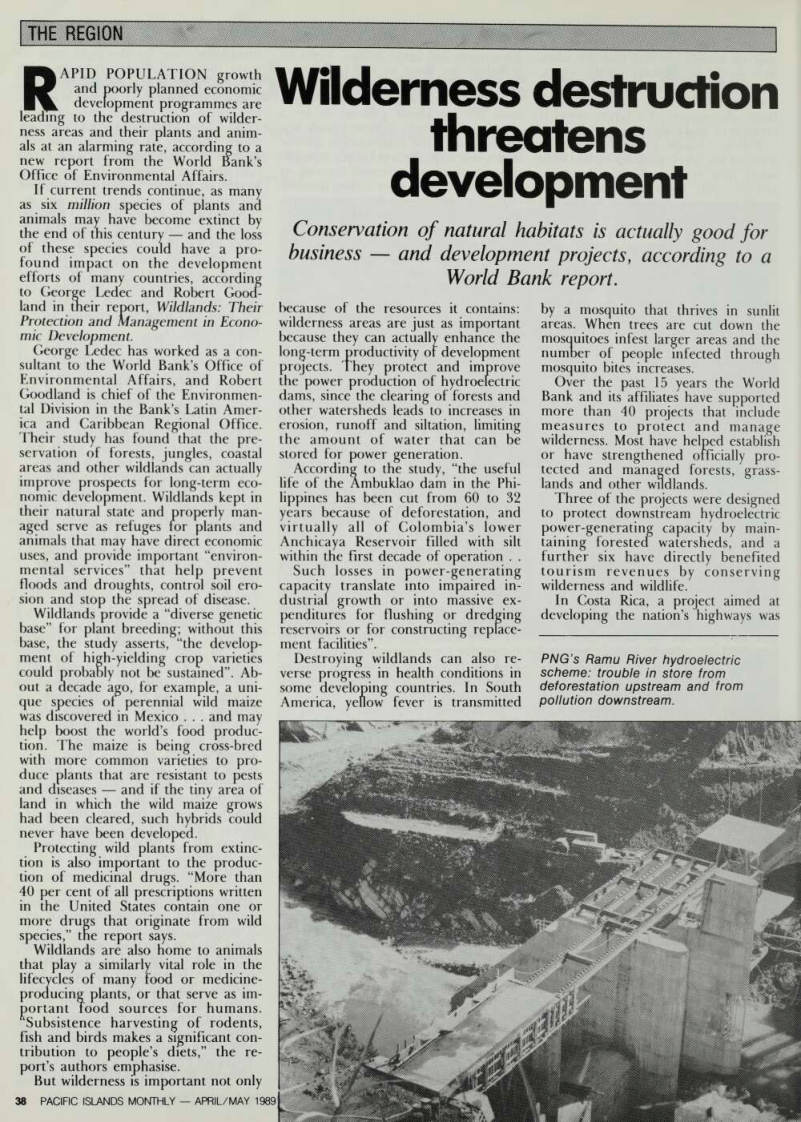
PNG’s Ramu River hydroelectric scheme: trouble in store from deforestation upstream and from pollution downstream.
accompanied by measures to prevent clearing of forests which not only reduce the risk of floods, but help prevent road washouts and landslides.
Including wilderness protection
measures in development projects is relatively inexpensive and can increase the success of projects, the authors found. In Indonesia, an irrigation project on the island of Sulawesi bene fited from efforts to set up the Dumo ga-Bone National Park as the park’s tree cover controls runoff and pre vents sediment building up in irriga tion canals, ensuring a steady year round water supply for farmers.
Because of the variety of roles play ed by wilderness in the development process, governments and develop ment agencies must intensify their efforts to protect these areas, ‘‘ln the design and execution of development projects, wildland management con cerns need to be given their proper
place and weight,” the study argues.
must be part of the planning process from the very beginning and must be put on a par with convention al economic criteria in deciding whether a project is justified.”
Failure to pay adequate attention to environmental concerns “exacts penal ties in the harm done to future generations and in the heavy costs of repairing damage to the environment or of replacing goods and services that were once taken for granted.”
Tellingly, the authors make the con cluding point that the effects of en vironmental damage are felt most by the poor those who are least able to “escape the consequences of a de graded environment, and who often depend directly on natural resources for their livelihoods”. □ Courtesy World Bank News