Inter-island shipping's new face
pp. 36-37 · Read in the full issue
Tuvalu
David Haden sets sail on Nivaga 11, Tuvalu’s brand-new government vessel, and finds that Pacific ships retain their romance but with improved comfort, cleanliness and service.
MANY OF THE Pacific’s island nations still rely heavily on
shipping for regular domestic
ernational communications, transport and trade links for with
out snips, the majority would simply
be completely isolated not only from the rest of their island group but from the world ‘beyond the reer. Aviation may have brought some countries clos er together and cut travelling times dramatically, but land is a precious commodity on small islands . . . and
airstrips are expensive.
One of the highlights of last year’s
tenth anniversary of Independence
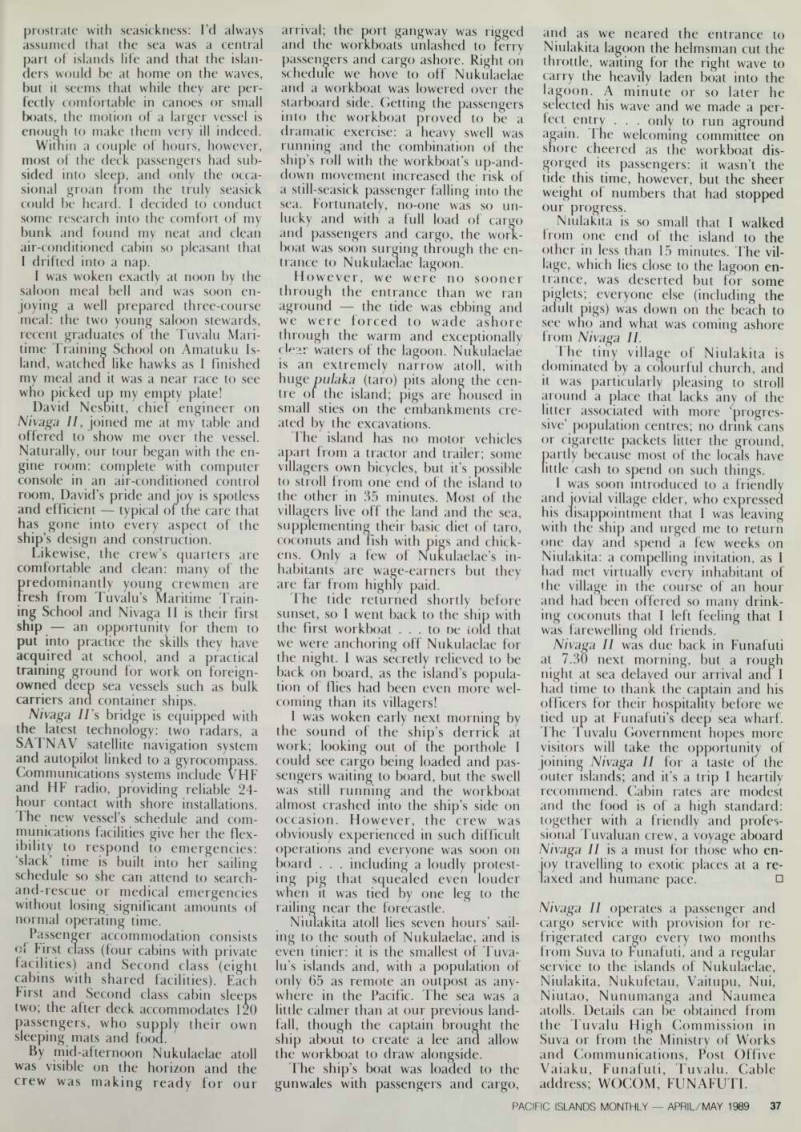
celebrations in Tuvalu was tne arrival of the republic’s new inter-island ferry and cargo vessel, the Nivaga 11. Built by Richards of Lowestoft in the UK with British aid funds, she was de
signed specifically for inter-island
trading and services the eight outer islands of Tuvalu on a regular basis as well as providing a service to Suva ev ery two months. She has a gross ton nage of 1044 tonnes and is o 8 metres in length, with a service speed of 10 knots and a maximum of 12 for emergency sailing. Her single hold can carry 350 tonnes of cargo, plus 20 tonnes of refrigerated cargo in two containers on deck almost double
her predecessor’s capacity.
I joined Nivaga II at the invitation
of Mike Keating, Transport Systems
Manager for Tuvalu’s Ministry of Works and Communications, for a cruise to the islands of Nukulaelae and Niulakita. The vessel was a hive of activity an hour before her sche duled departure from Funafuti’s deep sea wharf, with cargo being loaded, passengers embarking and tne inevit able crowd of onlookers farewelling friends, sending last-minute parcels to the outer islands ... or just there to be a part of the excitement.
Witn the ship’s two workboats se cured to the hatch cover and the last of the cargo and passengers
safely stowed, Nivaga II slipped her
moorings soon after seven o’clock and headed for the open sea. Once past the reef the vessel began to roll in the moderate swell, and 1 was surprised to see how many of the locals were soon
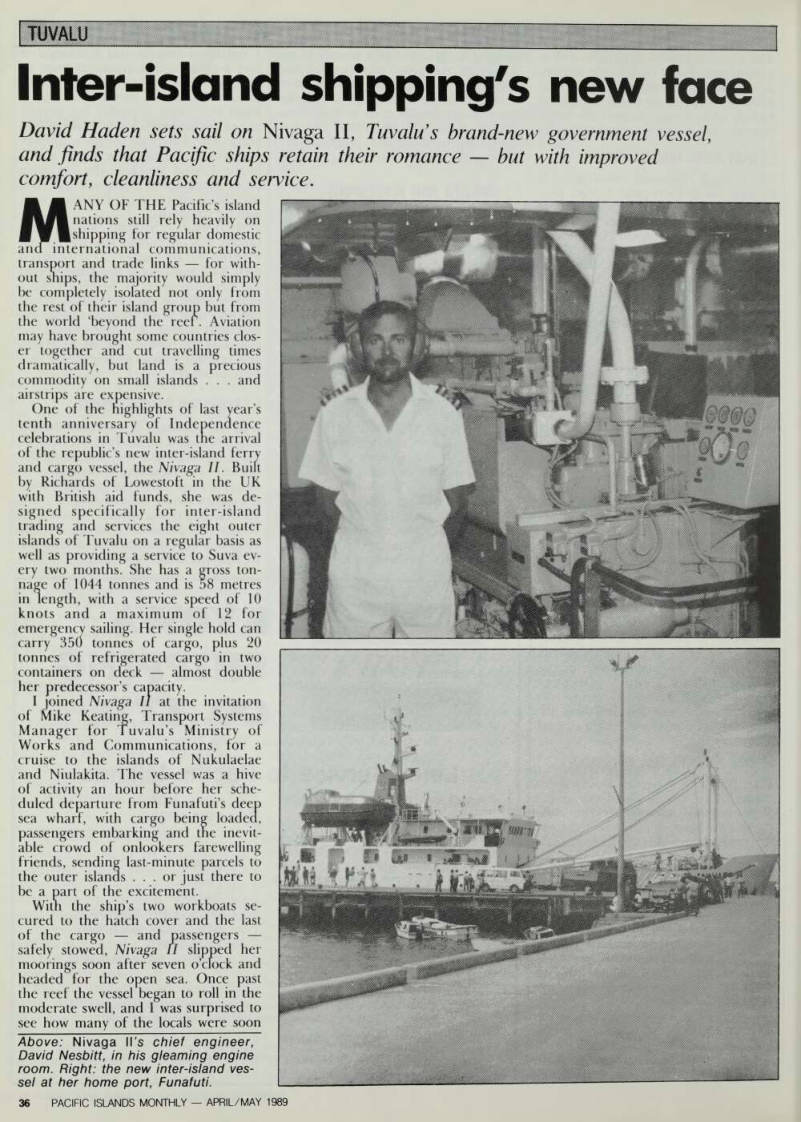
Above: Nivaga Il's chief engineer, David Nesbitt, in his gleaming engine room. Right: the new inter-island ves sel at her home port, Funafuti.
prostrate with seasickness: I’d always assumed that the sea was a central part of islands life and that the islan ders would be at home on the waves, but it seems that while they are per fectly comfortable in canoes or small boats, the motion of a larger vessel is enough to make them very ill indeed.
Witnin a couple of hours, however, most of the deck passengers had sub sided into sleep, and only the occa sional groan from the truly seasick could be heard. I decided to conduct some research into the comfort of my bunk and found my neat and clean air-conditioned cabin so pleasant that I drifted into a nap.
I was woken exactly at noon by the saloon meal bell and was soon en joying a well prepared three-course meal: the two young saloon stewards, recent graduates of the Tuvalu Mari time Training School on Amatuku Is land, watchea like hawks as 1 finished my meal and it was a near race to see who picked up my empty plate!
David Nesbitt, chief engineer on Nivaga //, joined me at my table and offered to show me over the vessel.
Naturally, our tour began with the en gine room: complete with computer console in an air-conditioned control room, David’s pride and jov is spotless and efficient typical of the care that has gone into every aspect of the
ship’s design and construction.
Likewise, the crew’s quarters are comfortable and clean: many of the predominantly young crewmen are fresh from Tuvalu’s Maritime Train ing School and Nivaga II is their first ship an opportunity for them to put into practice the skills they have acquired at school, and a practical
training ground for work on foreign
owned deep sea vessels such as bulk carriers and container ships.
Nivaga lls bridge is equipped with
the latest technology: two radars, a SATNAV satellite navigation system and autopilot linked to a gyrocompass.
Communications systems include VHF and HF radio, providing reliable 24hour contact with shore installations.
The new vessel’s schedule and com munications facilities give her the flex
ibility to respond to emergencies:
‘slack’ time is built into her sailing schedule so she can attend to search and-rescue or medical emergencies without losing significant amounts of normal operating time. accommodation consists of First class (four cabins with private facilities) and Second class (eight cabins with shared facilities). Each First and Second class cabin sleeps two; the after deck accommodates 120 passengers, who supply their own sleeping mats and food.
By mid-afternoon Nukulaelae atoll was visible on the horizon and the crew was making ready for our
arrival; the port gangway was rigged and the worxboats unlashed to ferry passengers and cargo ashore. Right on schedule we hove to off Nukulaelae and a workboat was lowered over the starboard side. Getting the passengers into the workboat provea to be a dramatic exercise: a heavy swell was running and the combination of the ship’s roll with the workboat’s up-and down movement increased the risk of a still-seasick passenger falling into the sea. Fortunately, no-one was so un lucky and with a full load of cargo and passengers and cargo, the work boat was soon surging through the en trance to Nukulaelae lagoon.
However, we were no sooner through the entrance than we ran aground the tide was ebbing and we were forced to wade ashore through the warm and exceptionally clear waters of the lagoon. Nukulaelae is an extremely narrow atoll, with huge pulaka (taro) pits along the cen tre of the island; pigs are housed in small sties on the embankments cre ated by the excavations.
The island has no motor vehicles apart from a tractor and trailer; some
villagers own bicycles, but it’s possible
to stroll from one end of the island to the other in 35 minutes. Most of the villagers live off the land and the sea, supplementing their basic diet of taro, coconuts and fish with pigs and chick ens. Only a few of Nutulaelae’s in habitants are wage-earners but they are far from highly paid.
The tide returned shortly before sunset, so I went back to the ship with the first workboat . . . to oe told that we were anchoring off Nukulaelae for the night. I was secretly relieved to be back on board, as the island’s popula tion of flies had been even more wel
coming than its villagers!
I was woken early next morning by the sound of the ship’s derrick at work; looking out of the porthole 1 could see cargo being loaded and pas sengers waiting to board, but the swell was still running and the workboat almost crashed into the ship’s side on occasion. However, the crew was obviously experienced in such difficult operations and everyone was soon on board . . . including a loudly protest
ing pig that squealed even louder
when it was tied by one leg to the railing near the forecastle.
Niulakita atoll lies seven hours’ sail ing to the south of Nukulaelae, and is even tinier: it is the smallest of Tuva lu’s islands and, with a population of only 65 as remote an outpost as any where in the Pacific. The sea was a little calmer than at our previous land
fall, though the captain brought the
ship about to create a lee and allow the workboat to draw alongside.
The ship’s boat was loaded to the gunwales with passengers and cargo,
and as we neared the entrance to Niulakita lagoon the helmsman cut the throttle, waiting for the right wave to carry the heavily laden boat into the lagoon. A minute or so later he selected his wave and we made a per fect entry . . . only to run aground again. The welcoming committee on shore cheered as the workboat dis gorged its passengers: it wasn’t the tide this time, however, but the sheer weight of numbers that had stopped our progress.
Niulakita is so small that I walked from one end of the island to the other in less than 15 minutes. The vil lage, which lies close to the lagoon en trance, was deserted but for some piglets; everyone else (including the adult pigs) was down on the beach to see who and what was coming ashore from Nivaga 11.
The tiny village of Niulakita is dominated by a colourful church, and it was particularly pleasing to stroll around a place that lacks any of the litter associated with more ‘progres sive’ population centres; no drink cans
or cigarette packets litter the ground,
partly because most of the locals have little cash to spend on such things.
I was soon introduced to a friendly and jovial village elder, who expressed his disappointment that I was leaving with the ship and urged me to return one day and spend a few weeks on Niulakita: a compelling invitation, as I had met virtually every inhabitant of the village in the course of an hour and had been offered so many drink ing coconuts that I left feeling that I was larewelling old friends.
Nivaga II was due back in Funafuti at 7.30 next morning, but a rough night at sea delayed our arrival and I had time to thank the captain and his officers for their hospitality before we tied up at Funafuti’s deep sea wharf.
The Tuvalu Government hopes more visitors will take the opportunity of joining Nivaga II for a taste of the outer islands; and it’s a trip I heartily recommend. Cabin rates are modest and the food is of a high standard:
together with a friendly' and profes
sional Tuvaluan crew, a voyage aboard Nivaga II is a must for those who en joy travelling to exotic places at a re laxed and humane pace. □ Nivaga II operates a passenger and cargo service with provision for re frigerated cargo every two months from Suva to Funafuti, and a regular service to the islands of Nukulaelae, Niulakita, Nukufetau, Vaitupu, Nui, Niutao, Nunumanga and Naumea atolls. Details can be obtained from the Tuvalu High Commission in Suva or from the Ministry of Works and Communications, Post Offive Vaiaku, Funafuti, Tuvalu. Cable address; WOCOM, FUNAFUTI.