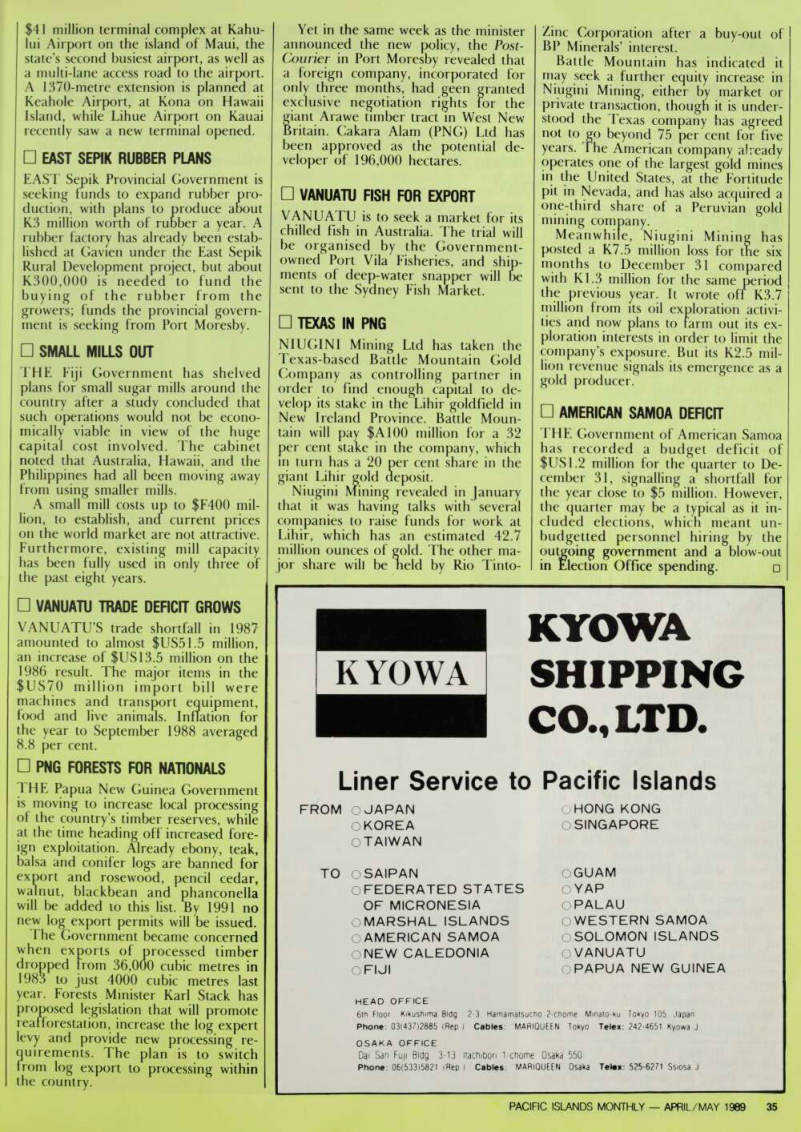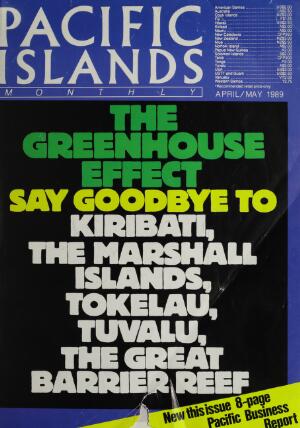
Pacific
Islands
Monthly
American Samoa US$2.OO Australia A 52.50 Cook Islands NZ$3.OO Fiji .\ L.F51.75 Hawaii US$2.5O Kiribati A 52.00 Nauru A 52.00 New Caledonia CFP2SO New Zealand NZ$3.OO Niue NZ$2.5O Norfolk Island A 52.00 Papua New Guinea K 2.00 Solomon Islands 552.00 Tahiti CFP3OO Tonga P 2.00 Tuvalu A 52.00
Usa Us$3.Oo
USTT and Guam US$2.5O Vanuatu VT2.00 Western Samoa T 2.75 ♦Recommended retail price only
April/May 1989
•Jd zl [•2 ILd zflß
F a .V cT •T•] • j : 4 z 4 i• i
A • J *I4 I J
■ I ~~H f 4 l * H Mil fc^,#
Lh W 4 W
i « q *‘| I I I I r / M I I **" ■■ HI ~~8 n•JZf 4 i J <v‘’ ? t *F4I •J •] ”H •II• J ~~M 111 I I j
HHBH^n^^^Srt
Advertisements & other items, pp. 2-4 (1 item)
clarion
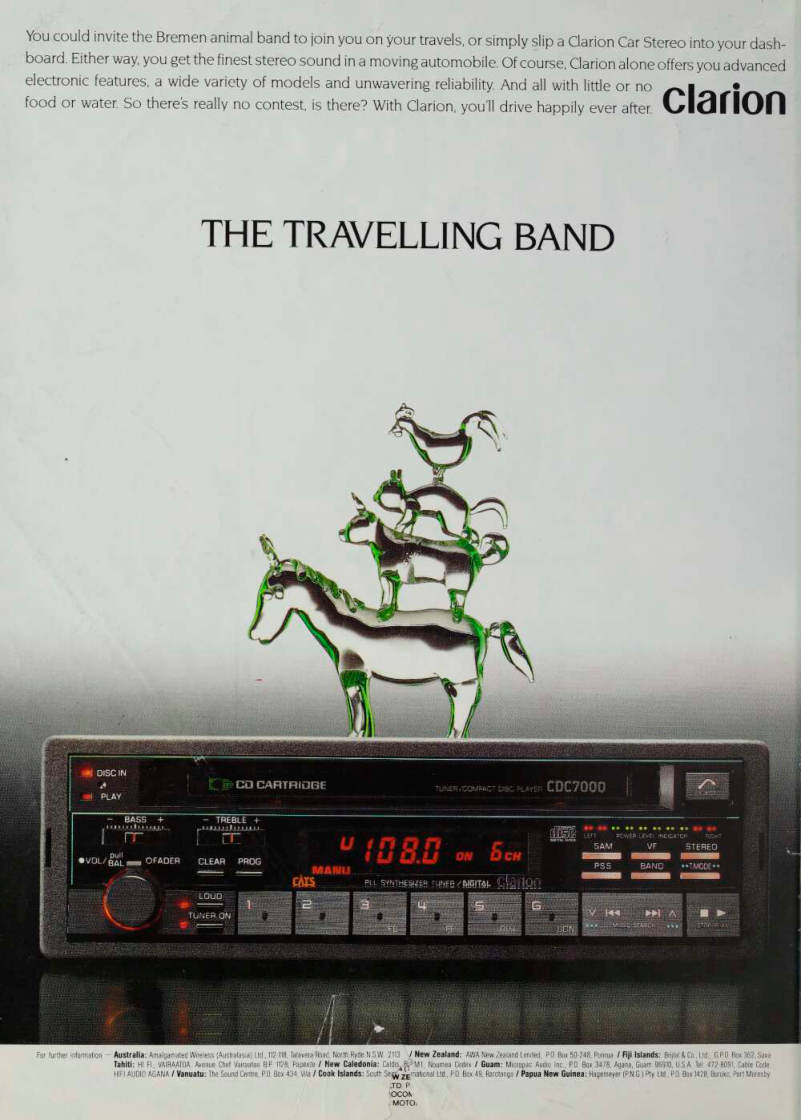
You could invite the Bremen animal band to join you on your travels, or simply slip a Clarion Car Stereo into your dashboard. Either way, you get the finest stereo sound in a moving automobile. Of course, Clarion alone offers you advanced electronic features, a wide variety of models and unwavering reliability. And all with little or no food or water. So there's really no contest, is there? With Clarion, you'll drive happily ever after.
THE TRAVELLING BAND
□□ CARTRIDGE
s'er CDC7QOO
- BASS +
i. M ill 1111 iijji
TREBLE +
nz
► VOL/B ALgBSSW OFAOER CLEAR PROG
LOUD
TUNER ON
u inn n r
i u u.u och
MAAiU
fto PLL SYNTHESIZER JUNER/AjmTAL CfeflOf?
dJDSIS LEFT
SAM VF STEREO
PSS BAND ••T.MCOE*
3 U S G
3 14 S E VFM X ■ » For further information Australia: Amalgamated Wireless (Australasia) Ltd, 112-118, Talavera Road, North Ryde NS W. 2113 / New Zealand: AWA New Zealand Limited, PO. Box 50-248, Ponrua / Fiji Islands; Brijlal & Co,, Ltd., G.PO Box 362, Suva Tahiti: HI FL, VAIRAATOA. Avenue Chef Vairaatoa BP 1128, Papeete / Mew Caledonia: Caldis A &°MI, Noumea Cedex / Guam; Micropac Audio Inc., PO. Box 3478, Agana, Guam 96910, U.S.A Tel: 472-8091, Cable Code: HIFI AUDIO AGANA / Vanuatu: The Sound Centre, PO Box 434, Vila / Cook Islands: South Ltd, PO Box 49, Rarotonga / Papua New Guinea: Hagemeyer (PN G ) Pty Ltd, PO, Box 1428, Boroko, Port Moresby
LTD. P
‘OCON
, MOTO.
BIRD OF PARADISE.
LAP OF LUXURY.
m' r'a
BEAST OF BURDEN.
The Bird of Paradise, the new emblem of Air Niugini, can now be seen adorning the tail of another magnificent bird - the A3lO-300.
Air Niugini’s latest plane has launched a whole new era of comfort and cost-effective flying to and from Papua New Guinea.
Passengers sit In the kind of luxury that can only be enjoyed on a truly wide-bodied jet.
Whilst as a beast of burden the A3lO is incomparable. The underfloor cargo hold handles all current types of containers. And the increase of payload a further source of revenue.
All this goes to show why Air Niugini chose this bird to fly to paradise.
When will you fly one?
S AIRBUS INDUSTRIE
is
ALUMINIUM LEADS THE WAY
R
Maxlane Engineers have developed
their boatbuilding ability to cover a wide range of craft from small dinghies to vessels up to 25 metres in length built from marine grade aluminium.
They are able to build boats to customers individual requirements. Their vessels are accepted in most Pacific Island Nations and have recently exported into Australia. an acceptable Interior workshop showing Aluminium Catamaran under construction All boats are built to international standard.
Call Maxlane Engineers today for a free quote or call in to see their range of designs.
'SiS Flybridge on 10 metre game fishing boat.
Marine & Industrial Engineers P.O. Box 3229, Lami, Fiji Tel: 361988, 361486, 361163. Fax: 300732. iW*- - - 10 Metre Game Fishing Boat
Pacific
Islands
Monthly
Vol. 59 No. 16
Voice Of The Pacific
April/May, ’B9
Cover Story
Developed Western nations may have the luxury of time in which to debate the possible consequences of the Greenhouse Effect. But in the Pacific, where whole islands may disappear in the face of even a slight increase in sea level, time is running out. Peter Roy of the New South Wales Department of Mineral Resources and University of Sydney geography lecturer John Connell examine the horrific consequences of the Greenhouse Effect on the region’s fragile island environments.
MILITARY IMPLICATED IN SPREAD OF MYSTERY DISEASE. 8 Bomb tests and other destructive activity promote ciguatera, new study finds TAHITI TRIES TO FIND ITS ADMINISTRATION 9 The scandal of the disappearing ministers rocks Papeete PALAUAN VOTERS BACK ON THE PLEBISCITE PATH 10 The Republic prepares for yet another Compact vote
Violence Shatters Bougainville's Uneasy Truce 12
No longer a compensation claim, say landowners: now ifs war AUSTRALIAN AID WHERE IT'S MOST EFFECTIVE.. 22 Development assistance goes to those who can profit by it
Feral Nightmare In The Marianas 24
The brown tree snake threatens wildlife, agriculture, human lives and power supplies NEW THIS ISSUE: EIGHT PAGES OF COMPREHENSIVE
Business Reporting 27
Business, Trade Winds and more essential reading!
Not-So-Slow Boat To Nukulaelae 36
A cruise on Tuvalu’s new inter-island ferry
Saving Wilderness Saves Money In Development
Projects 38
World Bank study proves that con servation can be profitable
Png's Capital: A Photo
Profile 40
Behind the sensational headlines is a city very much on the move
Departments
Opinion 7
Transition 43
Island Press 43
Pacific Report 44
Tropicalities 48
Shipping Schedules 50
Out Of The Past 54
Acting Editor Carson Creagh Deputy Editor Richard Dinnen Editorial Adviser John Carter Art Director Adam Brooke Contributors Robin Bromby John Connell David Haden Ed Rampell David Robie Peter Roy Frank Senge Liz Thompson Sven Wahlroos John Zubrzycki
Publisher Geoffrey Hussey
Advertising Sales Sydney & Melbourne Fergus Maclagan (02) 412 3918; Brisbane Robert Walker (07) 371 0533 Adelaide Hastwell Williamson Representations (08) 79 9522
Cover prices are recommended retail only Registered by Australia Post, publication No NBP 1210. Copyright. Fiji Times Limited, Suva, Fiji
Advertisements & other items, pp. 5-6 (2 items)
5
PACIFIC ISLANDS MONTHLY APRIL/MAY 1989
A Fiji Times Limited Production.
Founded 1930 (USPS 952480) 20 Gordon Street, Suva, Fiji; Telex: FJ2124; Fax: (679) 314 111 Pacific Islands Monthly (APPS No. NBP 1210) is published month ly by Fiji Times Limited, a division of Nationwide News, 2 Holt St, Sur ry Hills, NSW 2010. Second class postage paid at Honolulu, Hawaii, POSTMASTER. Send address changes to PACIFIC ISLANDS MONTHLY, PO Box 22250, Honolu lu, Hawaii 96822. Typeset and printed by Fiji Times Limited, 20 Gordon Street, Suva, Fiji.
Good Looks Run In The Eamily
World's No. 1 Family of Multi-valve Automobiles Toyota introduces the all-new Corona. A sweeping beauty that slips through the wind with its powerful 2.0-litre 16-valve engine. Aerodynamic. Luxuriously appointed. And Corolla. The car of preference for more drivers in the world than any other. With sleek, spirited looks and a new 1.6-litre 16-valve engine. Two outstanding members of Toyota’s multi-valve family. With over 5 million multi-valves produced and driven daily on roads throughout the world.
TOYOTA
MULTI-VALVE
ENGINE
tom or
TOYOTA
A double helping of
Opinion
A double helping of PIM . . . and an apology to our readers
THIS ISSUE of Pacific Islands Monthly represents both the first time the magazine has appeared as a double issue, and the first time its pages have been devoted to a vital but often ignored element in the region’s future.
The appearance of this April /May issue is in response to legal matters and production difficulties arising from the March issue which problems resulted m distribution of that issue being delayed. We apologise unreservedly to our readers for the delay but assure them that a disadvantage was put to ultimately good effect and that we will now again be able to provide them with coverage of Pacific affairs on a timely basis. All subscribers will receive an extra month’s issue of the magazine.
In the difficulties that accompanied the production of our March issue, one or two gremlins made their appearance; specifically in that issue’s Opinion page, in which former Islands Business editor John Richardson was mistakenly quoted as saying correspondent David Robie was a journalist “who is either anti-right or pro-left”. Naturally, this was an error: the sentence should have read “David Robie’s articles reflect a journalist who is neither anti-right nor pro-left”. We apologise to David and to John Richardson for the typographical error.
T FIRST glance, the stories contained in this double issue may seem to represent a fairly broad coverage of regional events: violence and sabot age on Bougainville; French Polynesian politics and the mysterious threat of ciguatera; tree snakes; Port Moresby and Tuvalu’s new inter-vessel.
But this issue’s Special Report on the regional consequences of the Green house Effect reveals the overall theme: that of the growing need to address threats to the quality of life throughout Oceania.
That need overwhelms questions of politics, economics and social issues, for it is inherent in all of them: it’s just not possible to devote energy to politics or business if one is (as may literally be true within 50 years) up to one’s knees in effluent, environmental destruction, rising sea levels and otner horrors of na ture. Indeed, environmental Questions can be seen at the heart of the majority of issues affecting the region today not least in the despoliation of Bougainville, and the terrifying spiral of violence that has grown out of an inability to resolve the question of land rights and protection of resources.
Also relevant to Bougainville (and chillingly ironic in the context of the deaths that have occurred there) is the story on Pages 38 and 39. For much of the past century, the Western world has looked on the Pacific in fact, on the globe as a whole as no more than a source of cheap labour, timber, minerals and foodstuffs. It has sought to ‘develop’ natural resources primarily for the benefit of the West, and only recently for tne benefit of those who, having seen so much destruction of their heritage for the benefit of others, are now lobbying for a more equitable share of the world’s wealth.
But as World Bank researchers have found, development and environmental protection are not mutually exclusive concepts. In trutn, they can work hand in hand, for the good of both producer and consumer.
As the World Bank report shows, environmental protection and awareness can actually increase the profitability of development: the forest that is retained upstream of a hydroelectric dam could contain useful drugs, and certainly is home to animals and plants that add to the diets of the local human population.
As global problems of the order of the Greenhouse Effect begin to make themselves felt, the Pacific has to realise that it cannot turn to others for solutions for those others still be battling the same problems on an even greater scale. Oceania has to act on its own behalf, if only to demonstrate that otherwise powerless nations can take the steps necessary to preserve a region of astonishing natural beauty and richness. □
Advertisements & other items, p. 7 (1 item)
Pacific
SLANDS
I MONTH l Y 1
FIJI: Distribution, subscriptions and advertising: Fiji Times Limited, GPO Box 1167, Suva, Fiji Phone 31-4111, telex FJ2124 FRENCH POLYNESIA: Distribution: Hachette Pacifique 10 Ave Bruat, Papeete. Phone 25-610 HAWAII: UNITED STATES: Distribution: PIM Hawaii PO Box 22250, Honolulu, Hawaii, 96822 Advertising Brian C Asqill, Apt 1308,1676 Ala Moana Blvd , Honolulu Hawaii, 96815. Phone (808) 955-9718 JAPAN: Advertising and subscriptions: Universal Media Corporation, GPO Box 46, Tokyo Phone 666-3036 cable UNIMEDIA Tokyo, telex 2524665 MALAYSIA: Advertising and subscriptions: Worldwide Media Services, 57-B Komplex Damai, Jin Dato Haji Eusoft, Kuala Lumpur Phone 63-9340, cables WORLDMEDIA Kuala Lumpur, telex 31533 VANUATU: Distribution: The Vanuatu Stationery and Book Centre, PO Box 557 Port Vila Advertising: Norman Bros Bookshop Port Vila Phone 2232 NEW CALEDONIA: Distribution: Depot Centre de Presse Michel Pentecost CBP2, Noumea Phone 27- 2434, 27-4729 NEW ZEALAND: Distribution: Gordon & Gotch, PO Box 584 , 2 Carr Road, Mt Roskill, Auckland 4 Advertising: McKay International Media Reps Ltd, C/- Albany PO, Auckland 10, New Zealand Phone 413-9119 Telex NZ22701, FAX 413-9110 WELLINGTON: Ross Quaid Media, 1 Scholes Lane Petone (04) 68-7593, PO Box 38699, Petone PAPUA NEW GUINEA: Distribution: Gordon & Gotch, PO Box 3395, Port Moresby Phone 25-4551 25-4855 Advertising: Robert Walker, PO Box 600, Indooroopilly Old Australia 4068 Phone (07) 371-0533 SOLOMON ISLANDS: Distribution and Advertising: The Bookshop, (Norman Bros ) PO Box 503, Honiara PHILIPPINES: Advertising; The GF Group, 12 San Ignacio St., Uroaneta Village, Makati, Metro Manila. Phone 817-7299, telex 45950 and 4233 UNITED KINGDOM; F A Smyth and Associates, 23A Aylmer Parade, London N2OPO, England. Phone (01)340 5088, fax (01)341 9602.
UNITED STATES MAINLAND; Advertising: Joshua B Powers Jr, Powers International Inc , Suite 708, 271 Madison Ave , New York, NY 10016 Phone 867-9580, Subscriptions: PIM, Hawaii, PO Box 22250, Honolulu Hawaii, 96822
SUBSCRIPTIONS
American Samoa...
Australia Canada Cook Islands Fiji French Polynesia Guam Hawaii Japan Kiribati Micronesia Nauru New Caledonia New Zealand Niue Norfolk Island Northern Marianas Papua New Guinea Solomon Islands Tonga Tuvalu United Kingdom US (Mainland) Vanuatu Western Samoa Elsewhere US$45
AUSS3O
US$45
AUSS46
F $24 US$45 US$45 US$45
US$3B
AUSS46
US$35
AUSS42
US$32
AUSS42
AUSS46
AUSS42
US$36
AUSS42
AUSS46
AUSS46
AUSS46
Stg£2B
US$45
AUSS42
AUSS6O
AUSS63
Payments to Pacific Islands Monthly: Subscriptions Dept, GPO Box 1167, Suva, Fiji.
Subscriptions rates includes the cost of airspeeding to all destinations set out above. Direct airmail rates on application.
Ciguatera: blame it on the bomb?
The Region
An Australian researcher has found links between
military activity and a potentially fatal toxin.
By David Robie
DOCTORS AND researchers well know the often deadly
course of ciguatera poisoning
but the causes of outbreaks have re mained unknown. Australian medical researcher Dr Tilman Ruff may have solved the mystery.
Dr Ruff is a researcher at Mel bourne’s Monash Medical School. He says outbreaks of ciguatera poisoning in the Pacific are more serious and freouent than has previously been maae public. “While in Tahiti I learned of outbreaks, probably or possibly related to military activities, that have not been documented or studied, in the past and about which there is no published information,” the doctor says.
The British medical journal The Lancet has published Dr Ruffs find ings, which suggest a link between
ciguatera poisoning and military activi
ties in the region. Tahiti’s Health and Environment Ministry is studying the report, though one official said “there is nothing new, it is really a review of existing data”. The link has long been suspected. “I don’t think it is a big secret,” says Dr Ruff, “it’s just that this is the first time the data has been put together in a credible, scientific way.”
Dr Ruff says recent outbreaks and changes in the incidence of poisoning indicate direct and indirect links be tween ciguatera and nuclear explo sions in the Pacific. While he nas found no direct link between radioac tive fallout and ciguatera, the only re
ported study addressing this question
was conducted in the central Pacific 30 years ago further research is vital.
‘Nuclear explosions directly damage
atolls and coral reefs. Underground blasts may trigger earthquakes,” Dr Ruff says. “The indirect effects are probably larger and related to the eco
logically disruptive impact of human
activities on fragile island and coral reef ecosystems.” The military are often responsible for those activities missile tests, port facilities, airfields, ship and submarine movements, dredging and channel blasting, seabed drilling and the dumping of refuse.
The Pacific has long been an impor tant military theatre, with naval, air and communications bases in the re gion. But only France continues to ex plode nuclear devices in the region and by the end of 1988 had staged 103 underground tests at Moruroa
and Fangataufa atolls in the Tuamoto archipelago.
The incidence of ciguatera in the region is severely under-reported: the South Pacific Commission estimates that official statistics reflect, at best, a mere 20 per cent of actual cases. For the region as a whole, excluding Papua New Guinea, 219 cases per 100,000 population were reported for
1987. Dr Ruffs research for the period 1973-87 shows rates more than three times the regional average were recorded in French Polynesia, some of the isolated island groups in the north-central Pacific (Kiribati, Tokelau and Tuvalu), the Marshall islands in north-east Micronesia and Vanuatu.
Ciguatera is less common in the west ern Melanesian nations of PNG and the Solomon Islands, where the population is less dependent on marine resources and where reporting of cause of death is less complete.
“Between 1960 and 1984 there was
a general flare-up of ciguatera in
French Polynesia, with more than 24,000 cases being recorded among a population that grew from 34,500 in 1960 to 174,000 in 1985,” says Dr Ruff. The number rose sharply through the 19605, peaking in 19/2- 75 at 1200 per 100,000 a ten-fold increase over the 1960 figure.
Ciguatera had not occurred in Hao before January 1965 when the French Atomic Energy Commission began to convert the atoll for a staging base for nuclear testing at Moruroa and Fanga taufa atolls. The building of an army camp for 2000 soldiers, a permanent base for bomb assembly and a 3500 metre runway required the construc tion of piers and dredging of large quantities of coral. The first case of ciguatera reported from Hao involved fish caught at the original French landing site in August 1966. The dis ease then spread to other areas of the atoll over tne next two years.
“Fishing in the Moruroa lagoon has been officially banned ever since the nuclear test explosions began,” says Dr Ruff, “although the ban has not al
ways been respected, particularly by
Polynesians. Moruroa has had a hign incidence of ciguatera over the past 20 years, in which time there has been extensive coral damage caused by the construction of military infrastructure and by the explosions themselves.
Several submarine slides have accom panied nuclear tests and large areas of the atoll continue to subside.”
Dr Ruff says the impact of ciguatera can only be reduced by curbing ecolo gically disruptive human activities on and near coral reefs. “Military activity conducted in the Pacific by nations distant from the affected regions is an assault on a delicate ecosystem and the human population it supports.” □
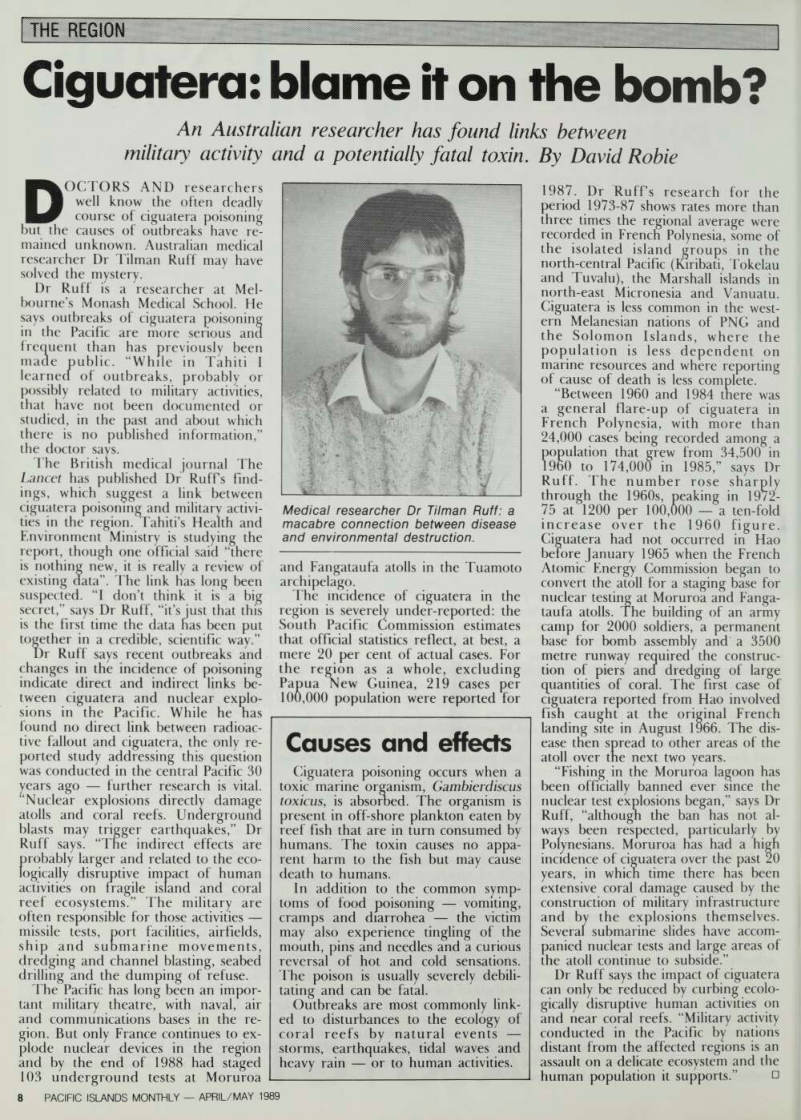
Medical researcher Dr Tilman Ruff: a macabre connection between disease and environmental destruction.
Causes and effects
Ciguatera poisoning occurs when a toxic marine organism, Gambierdiscus toxicus, is absorbed. The organism is present in off-shore plankton eaten by reef fish that are in turn consumed by humans. The toxin causes no appa rent harm to the fish but may cause death to humans.
In addition to the common symp toms of food poisoning vomiting, cramps and diarrohea the victim may also experience tingling of the mouth, pins and needles and a curious reversal of hot and cold sensations.
The poison is usually severely debili
tating and can be fatal.
Outbreaks are most commonly link ed to disturbances to the ecology of coral reefs by natural events storms, earthquakes, tidal waves and heavy rain or to human activities.
Government? What government?
French Polynesia
The administration declared “illegal” by a Papeete court is still facing an uncomfortable and politically
embarrassing crisis.
By David Robie
FTER THE embarrassment of
last year’s “yo-yo ministers”
affair, in which three minis ters who had resigned were hurriedly
reappointed to push through Tahiti’s
budget, President Alexandre Leontieff was caught in a Catch-22 crisis. Was his Government legal or not?
According to the local Government Commission, the press and the Admi nistrative Court, it was not. The three
judge tribunal including Chief Jus
tice Jean Levoignat ruled that the Government had in fact been illegal since last June because of the uncon stitutional appointment of five minis ters. The verdict plunged Tahiti into its biggest political crisis since Leon tieff came to power in October 1987.
“The Government no longer has
any credibility,” declared Opposition
MP and businessman Quito Braun- Ortega, calling on the President (who is in effect a prime minister) to resign.
“What sort of a leader do we have . . . and what does he represent?” he added. La Dcpcche declared in a ban ner headline: THE GOVERNMENT
Is Shattered.
According to Braun-Ortega, the
government’s failures have been eco nomic, political and institutional. He accused Leontieff Government of hav ing a vague economic plan that was in reality “nonexistent”, and one that was driving the territory into “decadence”.
On the political level he launched a scathing attack on the competence of ministers in Leontieffs Tiarama party excluding the President’s brother, Boris Leontieff, who took over the economy portfolio during the crisis.
Concerning the territory’s institutions,
Braun-Ortega claimed that Alexandre Leontieff had arrogantly ignored the laws and the 1984 self-governing sta tute to the point where he was com pletely annihilating” the role of the
Territorial Assembly.
“In these conditions,” added Braun-
Ortega, “we’re demanding the resigna
tion pure and simple of President Leontieff, to put the counter back at zero and so we can resume on a heal thy basis.” A protest letter to High
Commissioner jean Montpezat drew
the response that in the absence of
legal guidelines, he preferred to let
“internal autonomy” run its course.
Irritated, Leontieff declared: “Trying to run a government this way
is unacceptable and impracticable. It is unacceptable that the territory is gov erned with the empty interpretations of the statute by tne Administrative Court.” As well as appealing im mediately to the Council of State, he asked Speaker Jean Juventin to call an extraordinary session of the Assembly by April 3 to endorse his Government and planned to have the “intolerable”
statue changed.
The day after the Administrative Court declared the Leontieff Govern ment illegal, the President called the extraordinary session of the Assembly and assured Tahitians that in the meantime they still had an effective cabinet with the five remaining minis ters taking over the disputed port folios Boris Leontieff (Economy and Finances), Jacqui Drollet (Housing and Social Affairs), Raymond van Bas tolaer (Urban Affairs and General Administration), loane Temauri (Agri culture and Culture), and Alexandre Leontieff himself with the Works, Em
ployment, Professional Training,
Tourism and Sports portfolios.
But the “official” cabinet was one minister short of the minimum of six
required by law. The surprise court
ruling hinged on the definition of how the other five ministers left the
cabinet: did they resign, were they
sacked, or were tney simply replaced?
The judges overturned tne appoint ments on June 30, 1988, of Economy
and Finances Minister Louis Savoie and Urban Affairs and Administration Minister Francois Nanai; and on November 26, 1989, those of three ministers who had resigned nine days earlier but who were recalled for the
crucial budget vote: Georges Kelly,
Government vice-president and Agri
culture Minister; Huguette Hong Kiou, Minister of Housing and Social Affairs; and Napoleon Spitz, Minister of Works, Tourism and Sports.
By annulling the five ministers’
appointments the court effectively
made the entire Government illegal by violating the statute that lays down a minimum of six ministers and a max imum of 10 at any one time: Article 8 of the statute requires the President to present his cabinet list to the Territo rial Assembly for endorsement by sec ret vote within five days of an election.
“The territory hasn’t got a Govern ment. What is going to nappen now?” asked La Depecne. “It must be pointed out that the Government head himself hasn’t been affected by the court verdict: Alexander Leontieff re mains President of the territory.”
Meanwhile, in the recent communal elections Leontieffs Tiamara party fared well and all attempts by Flosse’s Tahoeraa Huiraatira candidates to oust sitting mayors representing the Leontieff coalition were defeated.
One of the surprises was the first round defeat of Jacky Teuira, the for mer Tahitian President and Flosse’s right-hand man, by Boris Leontieff in Arue. But with Boris Leontieff failing to win the 50 per cent vote needed for outright victory, a run-off vote was
needed and, despite a major campaign
by Flosse on behalf of his lieutenant (who is honorary party president of Tahoeraa). Leontieff gained 1850 votes against Teuira’s 1186 to become mayor.
While Flosse suffered setbacks, the
pro-independence parties of Oscar
Tumaru’s Tavini Huiratira and la Mana Te Nunaa gained ground. In Mana leader Jacqui Drollet stood as candidate in Hitia o te Ra on the east coast of Tahiti, and was narrowly de feated by nine votes. However, he has filed allegations of extensive fraud by his opponents with the Administrative Court and the result is expected to be overturned.
A significant feature of the election is that none of the 30,000 French set tlers living in Tahiti were accepted as candidates by local political leaders of Parties. All 970 councillors elected are olynesian or demis . □
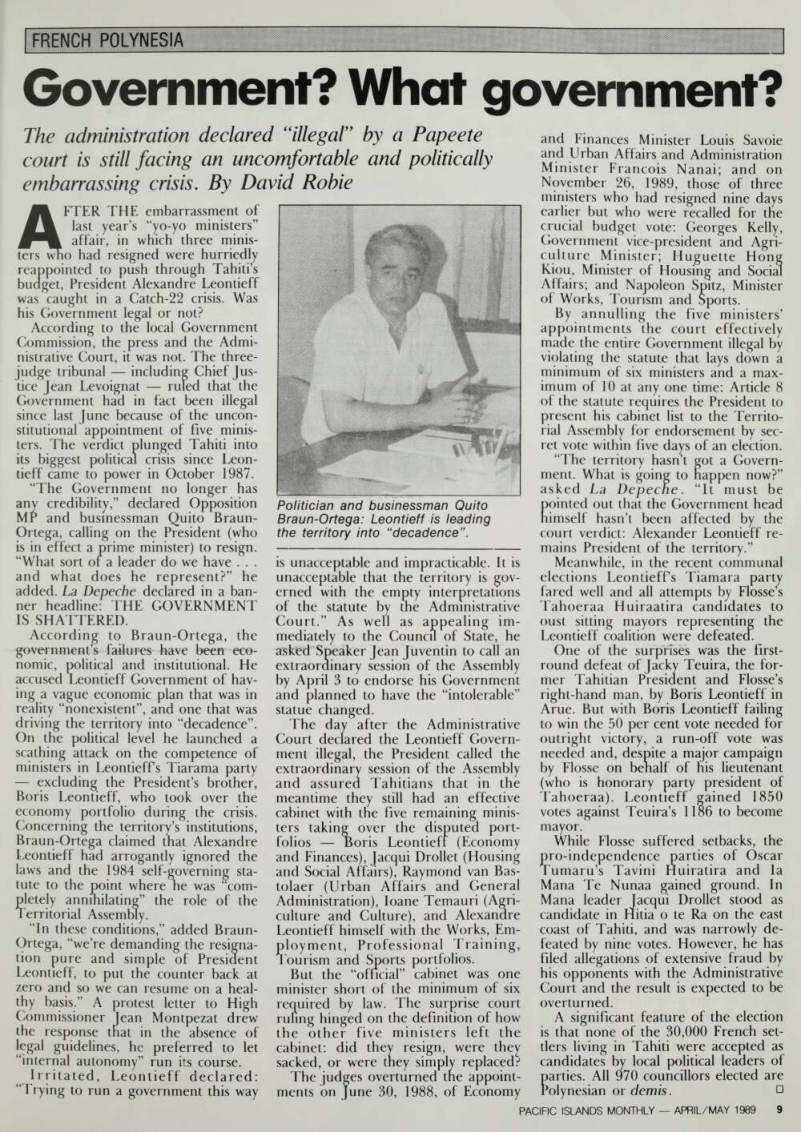
Politician and businessman Quito Braun-Ortega: Leontieff is leading the territory into “decadence”.
Compact vote likely ... again
Palau
The tiny but violence-racked Republic of Palau is set to go to the polls once
more, to determine its future relationship with the United States.
By Ed Rampell
THE HOLY GRAIL’ known as the Compact of Free Association is now being hotly pursued once more, from New'York to Washington to Koror, with talk of yet another poli tical status plebiscite.
The United Nations, the United States and the Republic of Palau (ROP) are taking measures to resolve
Palau’s long deadlocked Compact
approval process with a possible seventh Compact referendum, as the republic’s tiny electorate of only 10,000 prepares for the possibility of casting its ballots on Free Association.
The proposed plebiscite would be Palau’s eleventh national vote since 1980 (not including numerous Pres idential, Senate, House and State elec tions), giving a whole new meaning to the terms universal” suffrage and
“participatory” democracy. Some wits
have even suggested that Palau may become the world’s first nation to have more votes than voters.
In April, the UN Trusteeship Coun cil sent a visiting mission to Palau to observe steps toward bringing into effect the Territory’s proposed pact with the United Mates, which has evaded passage since at least 1983 and has seen the death by gunshot wounds of two presidents, the bankrupting of the nation, and a world recora of ple biscites. The mission was also under instructions to obtain information on political, economic and social condi tions during its two-week visit.
There have been four referenda since 1980 on Palau’s nuclear free constirution (the world’s first) and six
plebiscites on the proposed Compact
between Palau and the United States, which would phase out the UN Trus teeship and replace it with a political status granting Palau home rule and substantial US assistance.
The Pentagon, meanwhile, would have access to the strategically located Western Pacific archipelago but the Compact has repeatedly failed to attain the 75 per cent approval neces sary to override Palau s anti-nuclear
constitutional stipulations.
Meanwhile, President Bush’s Admi nistration has been attempting to gain swift Congressional action on the Compact. On March 8, legislation for
Compact implementation was intro
duced once again in the House of Representatives, in a package that attempts to address Palauan Compact concerns through its subsidiary agree
ments, including: monetary relief for Palau’s IPSECO power project debt (up to SUS 43 million) as well as fund ing for health care, prisons, a public auditor and special prosecutor. The executive branch wants Congress to act as soon as possible, prior to the
proposed plebiscite which, according
to a State Department letter to Con gressional committees, “Since many
elements of Compact implementation .
. . are linked to actions this fiscal year . . . needs to occur by early summer.”
ROP Vice President Kuniwa Naka mura also agrees that a seventh re ferendum on the treaty could be held in June or (uly.
Palau President Ngiratkel Etpison’s
Administration is also active on the Compact front: a 26-member Future Political Status Commission has been established, with representatives from all parts of the Palauan political spec trum. On the left, Palau’s Senate is
represented by staunch anti-nuclear
leader Roman Bedor; the House of
Delegates is represented by attorney
Johnson Tonniong, nephew of
Opposition leader Governor Roman Tmetuchl (who once criticised the Compact as “a masterpiece of cross re ference”), and on the right is zealous Compact supporter and former sena tor Hokkons Baules (in a taped Au
stralian Broadcasting Corporation in
terview aired in February, a man who confessed to firebombing the home of an American attorney opposing the Compact and IPSECO named Baules as the person who hired him to carry out the arson and attempted murder.
The US Congress’s General Account ing Office investigative team has also claimed Baules received a $lOO,OOO pay-off from IPSECO).
The Commission’s position state ment says that “any conflict between the Palau Constitution and the Com pact will ultimately result in the changes to be sought within . . . the
Compact” (emphasis added) and
asserts that any proposal to
accommodate changes by effecting
amendments to the Palau Constitution will not be considered.”
This hard-line position could result in renegotiation, but the United States has flatly refused to reconsider the terms of the Compact.
According to Palauan officials, the Government in Koror is disquietingly similar to the uneasy coalition now ruling Israel: President Etpison beat
Compact critic Governor Tmetuchl (candidate for the Coalition for Open,
Honest, and Just Government) by only
37 votes, while the Coalition’s vice presidential candidate, Kuniwo Naka mura, beat Compact supporter Frank Asanuma by a landslide.
Although Etpison is supported by
the same pro-Compact faction that
previously supported slain Presidents
Salii and Remeliik, the Opposition’s strength has forced him into a posi tion of compromise ... if not into rapprochement. Beneath this mood of coalition and conciliation, however,
political faction-fighting the
Palauan pastime still rages. Four out of five of the President’s ministe rial choices were rejected by an Opposition dominated OEK (National Congress), and the posts for attorney general, special prosecutor and attor ney general are unfilled at time of going to press.
One of President Etpison’s first con ciliatory moves resulted in the resigna tion of Attorney General Philip Isaac, who gave as his reason for resigning the President’s pardon of Johnny Gib bons, younger Brother of Paramount Chief Ibedul (a Compact critic and re
peat presidential aspirant). Gibbons
was convicted of possession of a firearm and ammunition (both illegal in Palau) following a confrontation with the police, while Isaac who
reportedly wore a pistol strapped to
his ankle every day of the Remeliik murder trial had prosecuted the assassination case against Governor Tmetuchl’s son and nephew, though he had no evidence to support his case. The American Civil Liberties Union has charged Isaac with “pro secutorial misconduct” and when the ROP Supreme Court overturned the lower court’s convictions it severely re buked Isaac. Ironically, Isaac’s resigna tion was on the grounds that the Attorney General’s Office “until now has been permitted to function im mune from the vicissitudes of politics.”
The long-awaited investigation by
the Congressional General Accounting
Office into allegations of heroin traf
ficking, widespread government cor
ruption, terrorism and the IPSECO power project should be released to
the public in May, during which
month the UN mission to Palau will also make its report on the Trus teeship Council during its annual deli berations on Micronesia. □
Advertisements & other items, p. 11 (1 item)
by developing your
How to develop
your economy
communications.
In today’s world, no country can develop in isolation.
Id grow it must compete in fast-moving world markets, and to gain access to these a modern telecommunications network is essential.
When you invest in OTC telecommunications you get more than the best telecommunications system available.
You also get the financial expertise that has made OTC Australia’s leading international telecommunications company.
By providing training to your staff in all aspects of financial planning and cost accounting, your system will operate on a sound financial basis. And pay for itself.
Bringing world markets to you.
Australia, like many nations, is a long way from the world’s business
capitals. However, through OTC’s
advanced communications network, the world is now on our doorstep.
OTC is the world’s leading exponent of thin route satellite systems for isolated areas. OTC was one of the founders of Intelsat. And, in the development of optical fibre cable systems, OTC is a pioneer.
This technology which put Australia at the forefront of communications is now available to you through OTC International.
Tailor-made telecommunications.
OTC gives you the choice of the world’s best communications systems which can be specifically designed to meet your needs.
Because we design and operate our own systems, we can offer you experience in integrating the best software and hardware available.
Our experience in the international arena has taught us valuable lessons about the reliability of equipment and supply.
Making the right decision.
For an objective appraisal of your communication needs contact OTC now. Telephone or write to: Mr. Peter Shore, Executive Director, OTC International Limited, GPO Box 7000, Sydney, NSW 2001 Australia. Phone: (612) 2875410, Fax: (612) 2875617.
iiiiOTCii
OTIO4OO PI
Sabotage, killings grow as

Papua New Guinea
Sabotage, killings grow as Bougainville crisis deepens
What began as a compensation claim has erupted into random shootings, ambushes and unexpectedly efficient guerrilla warfare. Frank Senge reports.
THE VIOLENCE on Bougainville
island has become a confused nightmare for all concerned: national and provincial governments; law enforcement agencies; local land owners, business houses and the peo ple of all Papua New Guinea.
What began as a simple, if ludic rous, compensation claim of KlO bil lion in April last year has turned into a spiral of bloodletting that threatens to affect the entire nation. At the time of writing six men have been shot dead and more than 20 wounded in
sporadic exchanges of gunfire be
tween landowners and a combined
police-defence force operation. Four
of the seven dead two plantation labourers and two defence force sol diers were non-Bougainvilleans iro nically chosen by fate to represent the three regions of the country: High lands, Mamose (New Guinea main land) and Papua.
In regionalistic PNG, this twist of fate is significant. Already, tensions are building up in several educational
institutions against the Bougainvillean
student population: a certain baro
meter of public feeling.
Though the perpetrators of violence remain the same elusive militant land owners, the target of their anger has shifted dramatically from one foreign company to the Government and peo ple of PNG. On the face of it the problem appears to have become more complex, but the complexity was there from the beginning. Few people realised the potential (or, if they aid, failed to voice it) that existed starkly in the island’s poignant history of cultu ral clashes, succession movements and long-standing demands for a better deal out of the copper mine.
When the landowners made a com pensation claim for KlO billion last April, it was seen as no more than another in a history of such claims throughout PNG ignoring the fact that this particular claim was already 20 years old and had behind it frus trated, angry people with the full sup port of the provincial government and an important coalition partner, the Melanesian Alliance led by Catholic priest and regional member for
Bougainville Father John Momis.
When landowners lea by University of Technology graduate and former Bougainville Copper Limited surveyor Francis Ona broke into the company armoury, stole huge quantities of ex plosives last November and set about
systematically destroying company in
stallations, it caught the Government of Prime Minister Rabbie Namaliu
completely unaware.
Shocked, the Government tried to establish direct communications be tween the State and the rebels an effort doomed to failure. Negotiations had been the least of the landowners’ requests for those 20 years, and their patience had now run out. They wanted their claims met. Immediately.
With Ona still in the bush and no-one fully appreciating what he wanted, a high-powered ministerial committee was established. Headed by Deputy Prime Minister Akoka Doi, the com mittee was to review the 1974 BCL Agreement that had already been de ferred in 1980 (at the time of writing, there has yet been no communication between BCL and this committee).
The problem was compounded by
simple under-estimation of Mr Ona ana his group of militant landowners.
He was referred to facetiously as a u ßambo- style terrorist” in the Papua New Guinean media, ordered to re turn the explosives he had stolen and to come out of the bush or feel the full weight of the law.
Few took notice of the effectiveness with which his group was blowing up guarded BCL installations, worth mil lions of kina, at will and giving the police the slip each time.
Further, if few observers realised Ona’s capacity to carry on an effective campaign, fewer still studied the frus trations driving him on. In matrilineal Bougainville, he was never in direct line to benefit from the royalties and other benefits derived from the mine: whether he received anything at all was the prerogative of his maternal uncle, Matthew Kove, a titleholder of the mine lease land and direct be neficiary of royalties. The holding of
Only a few months ago, sabotage was the worst of BCL’s problems.
the titles by elders led to conflicts with more highly educated, younger men; and one such resulted m Kove being
kidnapped, allegedly by Ona’s group.
He is now feared dead.
The violence on Bougainville, so far directed at installations and with only isolated exchanges of fire between police and landowners, took on a more direct aura of menace on March 17, when a lone gunman armed with a semi-automatic rifle stole into Arova Plantation and sprayed a labourer’s house with bullets.
Two men from the Western High lands were shot dead; three others
were hospitalised with gunshot
wounds. The shooting was allegedly in retaliation for the brutal killing of a woman a week earlier, and was unre lated to the Ona cause. However, it unleashed a chain of events that dras tically affected Ona and his cause.
Suddenly it was not only BCL, the Government and the police the land owners were dealing, with but non- Bougainvilleans on the island.
On the Sunday after the shooting and in the week following, riots and violent mass demonstrations rocked the townships of Toniva, Kieta and Arawa. Arova International Airport terminal was burnt down, the runway dynamited and two aircraft belonging to local aviation firm Bougair burnt.
The police armoury at Bum govern ment station was raided and burnt, and policemen’s families had to be evacuated. A district office at Toroki na on the West Coast was burnt down.
There were armed clashes between
police and villagers, leading to the
death of a villager and the wounding of scores of others on both sides.
Police recovered a large amount of unexploded World War II bombs in the possession of landowners. The National Government deployed an additional 100 policemen, called out the PNG Defence Force to assist the police and extended a previous curfew for a further two months in the affected areas.
Foreign media and diplomats were banned from Bougainville; Australian Deputy Commissioner Howard Brown ana a Channel 7 news team from Au stralia were ordered out of the pro vince. Mr Namaliu announced later that he had implemented the ban out of consideration for the safety of the
foreigners.
On the morning of Thursday, April
6, 20 PNGDF soldiers on patrol near Irang village, six kilometres south of
Panguna mine, were suddenly
ambushed by about 30 landowners armed with automatic weapons.
Lieutenant James Yandu and Private Lomas Jaruga were shot dead and Warrant Officer Zerry Gari was wounded: soldiers retaliated, killed two militants and wounded two others.
The latest shootings have led to a general feeling of unease and tension
outside Bougainville, particularly at
the University of PNG and University of Technology in Lae where threats have been made to the lives of
Bougainvillean students.
Prime Minister Namaliu, Deputy PM Doi and Foreign Affairs Minister Somare jointly appealed to the nation, and particularly the provinces and the relatives of those who had been shot, to show restraint.
The killings have marred the origin al aims of the landowners’ uprising: to force BCL and the Government to re turn more of the proceeds from the mine to the province. Indeed, BCL management told Pacific Islands Monthly that the focus of the land owners’ attention had been turned away from the company completely until April 15, when the destruction by explosives of a power transmission tower forced the mine to close down for two days.
Sympathisers are slowly withdrawing
their support from Mr Ona. One of the first to publicly withdraw his sup port was North Solomons Premier Joseph Kabui. When Ona failed to meet an ultimatum to come out of hiding on Thursday, March 23, Mr Kabul ceased his attempts at liaison with him, and for him with the National Government. Kabui had gone to the extent of having his cabinet endorse a resolution to request the National Government to guarantee Mr Ona safety and immunity from prosecution, but the Government re jected his request, saying it was “im possible”. With the police now accus ing Kabui of aiding Ona, he told PIM : “I haye done enough communication.
Francis should realise that the longer he stays, the worse it is going to be.
“A lot of things are happening, and people are pointing accusing fingers at
him. Events are now clouding the ori ginal issue and that is striking a better economic deal. We wanted to work out a formula [that] would en able a lot of the money generated in the province to stay here.
One thing in Ona’s favour has been a lack of proper intelligence: in the seven months ne and his group have wreacked havoc on Bougainville, no body had been able to discover how many people are in his group or how well equipped it is. Ona not only knows his Panguna landscape well, but it has become increasingly apparent that he has access to very modern semi- or fully automatic weapons.
That position has now changed, and Mr Namaliu has confirmed that he now has adequate information on the group. In a nationwide address, the Prime Minister said: “There is grow ing evidence that these minority groups have been receiving outside assistance in the form of high
powered weapons.
“This is truly a sad event in our nation’s history. Weapons meant to kill are now being used against other Papua New Guineans . . . Those re sponsible for bringing in and using such weapons can expect no mercy or
sympathy.”
Mr Namaliu did not disclose any of his sources, but admitted the informa tion had come from overseas and that he also had information on the strength of Ona’s group.
It is uncertain how he will use this information: many people includ ing his Cabinet ministers feel the Prime Minister has been dictated to by Father Momis and his Melanesian Alliance for too long.
Momis has been given a free hand to arrange a peaceful solution, but so far nothing has come of it and the PM has formed a second committee, com prising Premiers and headed by veter
an parliamentarian John Kaputin, to
bring the conflicting parties to the
negotiation table.
Mr Kaputin, however, has thrown his assignment back at the Govern ment, calling for clearer terms of re ference and more defined powers.
Perhaps the tragedy of the whole situation is the lack of preparedness for what the immediate future may hold. As in December though the situation has become far more serious in the interim nobody wants to think of the future, and as the nation reels from this latest threat to its eco nomic lifeblood (BCI supplies almost a quarter of the national budget), the Prime Minister continues to plead for peace and harmony. “The alternative is too tragic, too destructive to even consider,” he told the nation.
Perhaps thinking about the alterna
tive might inspire PNG to appreciate
the gravity of the situation. D
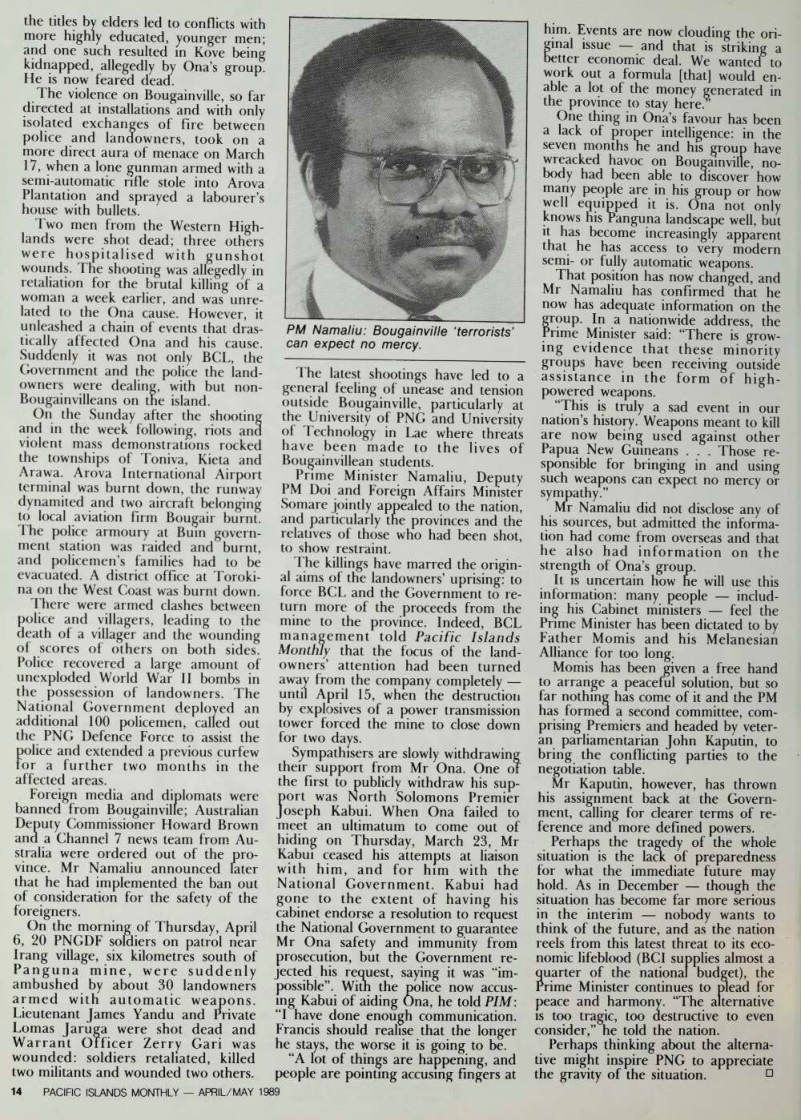
PM Namaliu: Bougainville ‘terrorists’ can expect no mercy.
Advertisements & other items, pp. 13-16 (1 item)
Citizen t
m m m <s> r<\> V s> oh <>> -a U 3
es your times
as seriously as you do.
For some sports time control is a key element.
The Citizen Sports Collection is a winning range of special timepieces
with unique performance features
designed specially for your sport.
The Citizen Sports Collection.
For the serious sportsman... We’ve got your Watch.
©CITIZEN
CITIZEN IS A REGISTERED TRADEMARK OF CITIZEN WATCH CO.. JAPAN FOR FURTHER INFORMATION, PLEASE CONTACT: New Zealand: Citizen Watches (N.Z.) Ltd., P.O. Box 9518, Auckland, New Zealand.
Australia:Citizen Watches Australia Pty. Ltd., Tel: 543 393. Telex: 21429. Fax: 544177. 122 Old Pittwater Road, Brookvale, NSW 2100.
Tel: 939 7077. Cable: Citizen Sydney. Tahiti: Morgan Vernex, Fare Ute B.P. 449, Tahiti.
Telex: AA26633. Fax: 932864. Tel: 2.03.09.
Fiji Islands: Tappoo Limited, P.O. Box, Sigatoka, Fiji. Tel: 50199. Telex: FJ4244.
Papua New Guinea: Kara Pty. Limited, P.O. Box 392, Port Moresby. Tel 25 6044
0,0 pioneer
The future of sound and vision.
1
TRAFFIC
TAMERS
db -rq
r 'sioan,
KEH-7050QR & CDX-3
Pure Sound, Pure Power...
Relax! Let Pioneer’s Traffic Tamers drown out the din.
Our CD Players do it with pure sound, while our Stereo Cassette/Tuners do it with pure power.
Pioneer-original high-tech laser-optics make CD sound even better in the stylish, new CDX-3 at an affordable price.
A great match for it is the new KEH-7050CR with a 7-band graphic equalizer —15 W four or 25W into the standard two channels. That’s high power plus!
If you think this all sounds great in the middle of a traffic jam, wait till you hit the open road and turn up the volume!
KEH-7050QR has switchable Dual Illumination (green or amber).
Anti-theft Quick-Release System.
For further information, please contact: Australia; Pioneer Electronics Australia Pty. Ltd. (Incorporated in Victoria), P.O Box 295, Mordialloc, Victoria, 3195 Tel: 580-9911 Fiji Islands: Brijlal & Company, G.PO Box No. 362, Suva, Fiji Islands Tel: 22258 New Zealand: Monaco Corporation Ltd , 41 Poland Road, Glenfield, Auckland, New Zealand Tel: (09) 444-9144 Norfolk Island: Burnt Pine Traders Ltd., P C. Box 21, Norfolk Island Vanuatu: Burns Philp (Vanuatu) Ltd., Vila, Vanuatu Nauru Island: Jacob Enterprises, P.O. Box N 0.4, Republic of Nauru Tahiti; Tahiti Hi-Fi, P.O. Box 848, Papeete. Tahiti New Caledonia: Menard Pacifique Sari, B.P. 3899, Noumea, New Caledonia Tel: 27*62*23 American Samoa: Transpac Corporation, P.O. Box 1477, Pago Pago, American Samoa 96799 Tel: 633-5224 Rarotonga: South Seas International Ltd., P.O. Box 49, Rarotonga, Cook Islands Tel: 2327
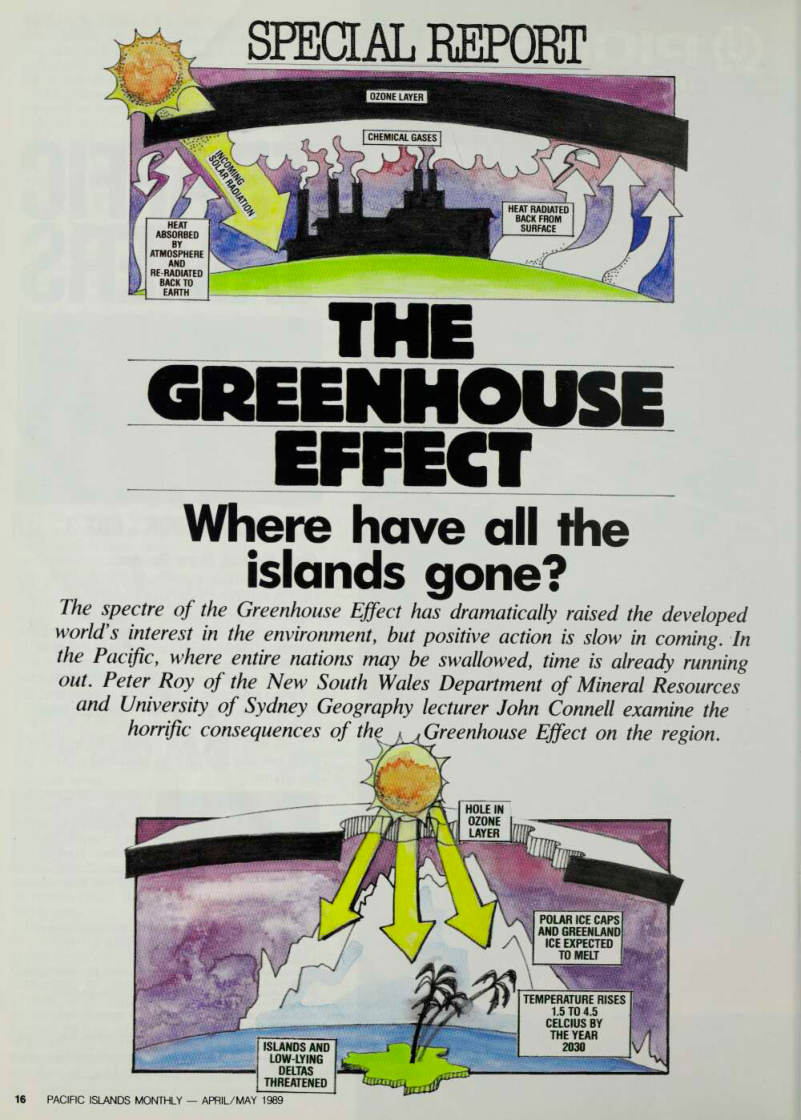
OZONE LAYER
CHEMICAL GASES
Wcl y*
HEAT RADIATED
BACK FROM
SURFACE
HEAT
ABSORBED
BY
ATMOSPHERE
AND
RE-RADIATED
BACK TO
EARTH
GREENHOUSE
Where
islands gone?
The spectre of the Greenhouse Effect has dramatically raised the developed world’s interest in the environment, but positive action is slow in coming. In the Pacific, where entire nations may be swallowed, time is already running out. Peter Roy of the New South Wales Department of Mineral Resources and University of Sydney Geography lecturer John Connell examine the horrific consequences of the , ( Greenhouse Effect on the region.
HOLE IN
OZONE
LAYER
POLAR ICE CAPS
AND GREENLAND
ICE EXPECTED
TO MELT
TEMPERATURE RISES
1.5 TO 4.5
CELCIUS BY
THE YEAR
2030
ISLANDS AND
LOW-LYING
DELTAS
THREATENED
logical problems.
Special Report
fi NVIRONMENTAL issues have ■■ attracted unprecedented media B|| and public attention in the past and everywhere there is a growing awareness of the problems, if not the solutions. The Greenhouse Effect has become the ‘flagship’ of the international environmentalist cause, and the springboard to the front pages for many other man-made eco
No environmental issue has ever stimulated such global interest and spawned such a variety of popular and academic accounts: ironically, howev er, while it is a 20th century dilemma, the term “Greenhouse Effect” was coined almost a century ago. Yet there is still considerable uncertainty over the actual nature of the Greenhouse Effect and future rates of climatic change. In the absence of concrete in formation prophets of doom have gained wide exposure with forecasts of cataclysm, but recent scientific studies have increasingly begun to draw con sistent conclusions about future trends and point to the regions where the Greenhouse Effect win cause the most
severe problems.
Most nations of reasonable wealth and substantial land mass will adapt to the climatic changes some may even find considerable economic advantage in new agricultural possibilities. But m the Pacific, the predicted rise in sea level will mean widespread upheaval and potential disaster. “If the Green house Effect raises sea levels by one metre it will virtually do away with Kiribati,” says that nation’s President, leremia Tabai. “In 50 or 60 years my. country will not be here.”
He is only too aware that the most extreme situations will be faced by small ocean island states occupying low coral islands. Four Pacific nations Kiribati, the Marshall Islands, Tokelau and Tuvalu are composed entirely of low relief atolls and recent studies warn that these states will be devastated if projected sea level rises occur. They may simply cease to con tain any habitable land.
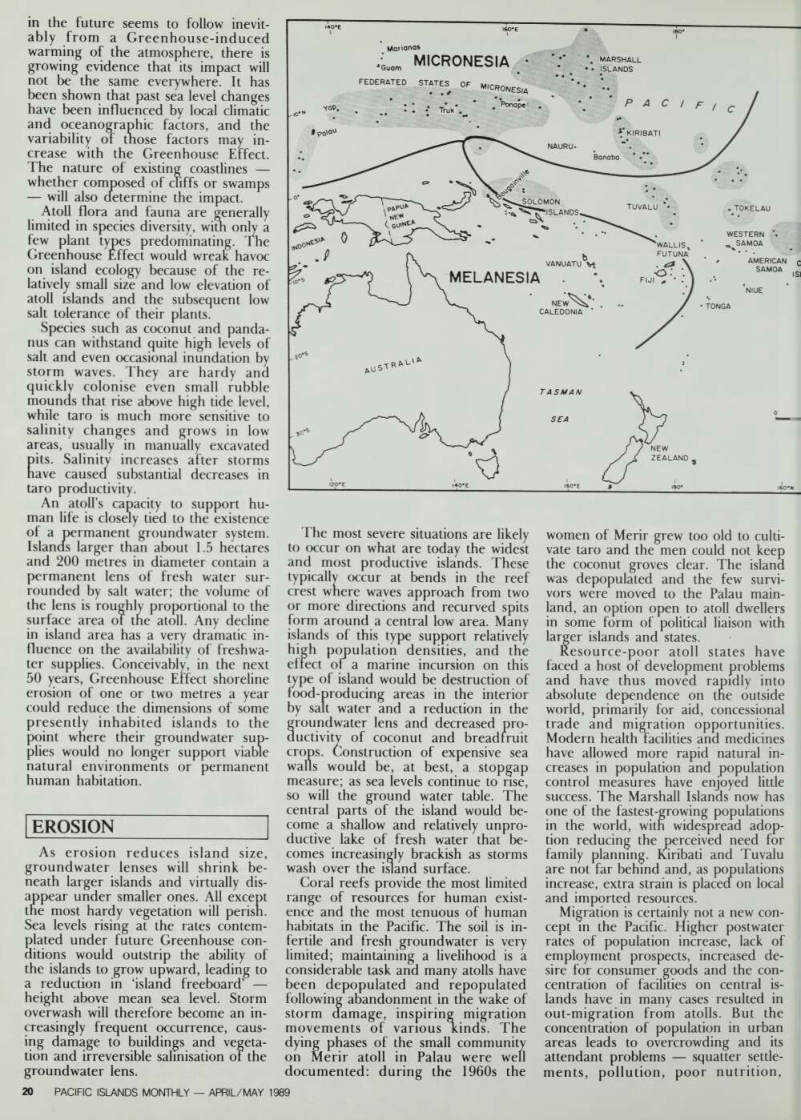
The four atoll states are quite diffe rent in language, culture, history and physical environment. Tuvalu and Tokelau are part of Polynesia; the Marshall Islands and Kiribati are in Micronesia. The state of Tuvalu con sists of nine coral atolls and reef is lands with a total land area of no more than 24 square kilometres, yet spread over 590 kilometres. Kiribati has 20 populated atolls and a land area of 700 square kilometres, but more than half of this (363 square kilometres) is on Kiritimati (Christmas Island), some 3500 kilometres from the national capital, Tarawa. The Mar shall Islands has 24 populated atolls, but the majority of the population lives in the capital, Majuro, or on
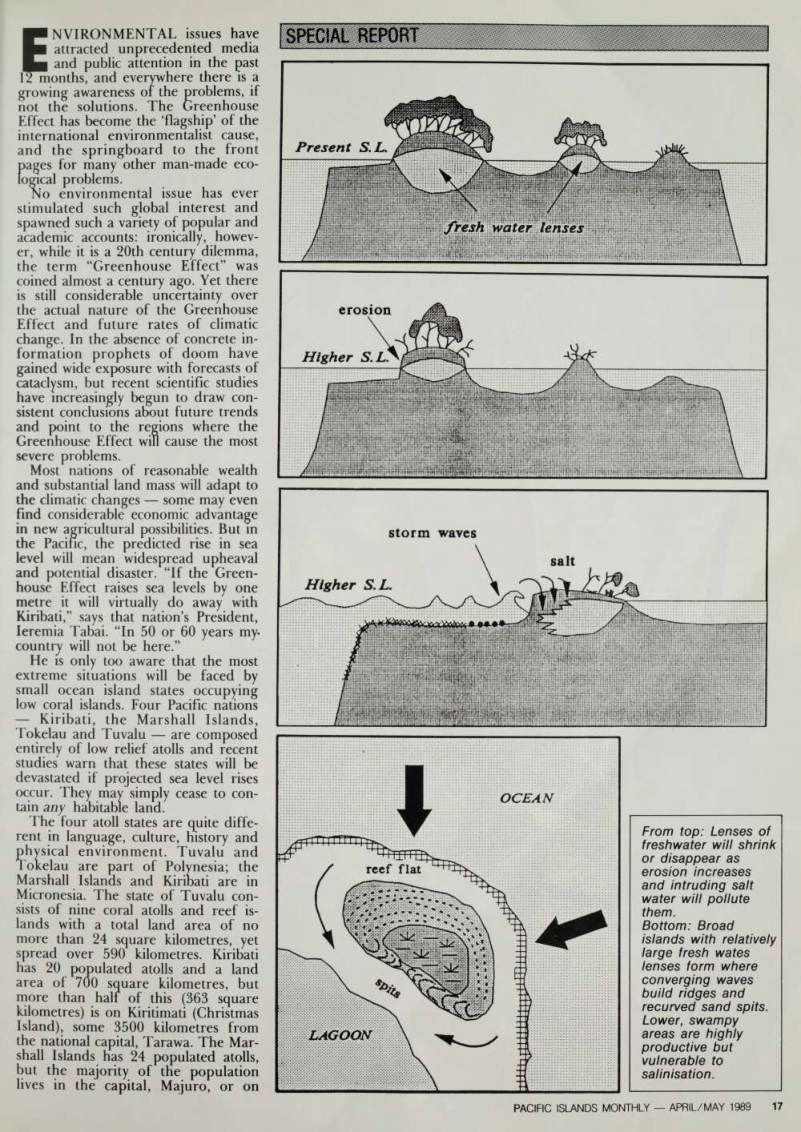
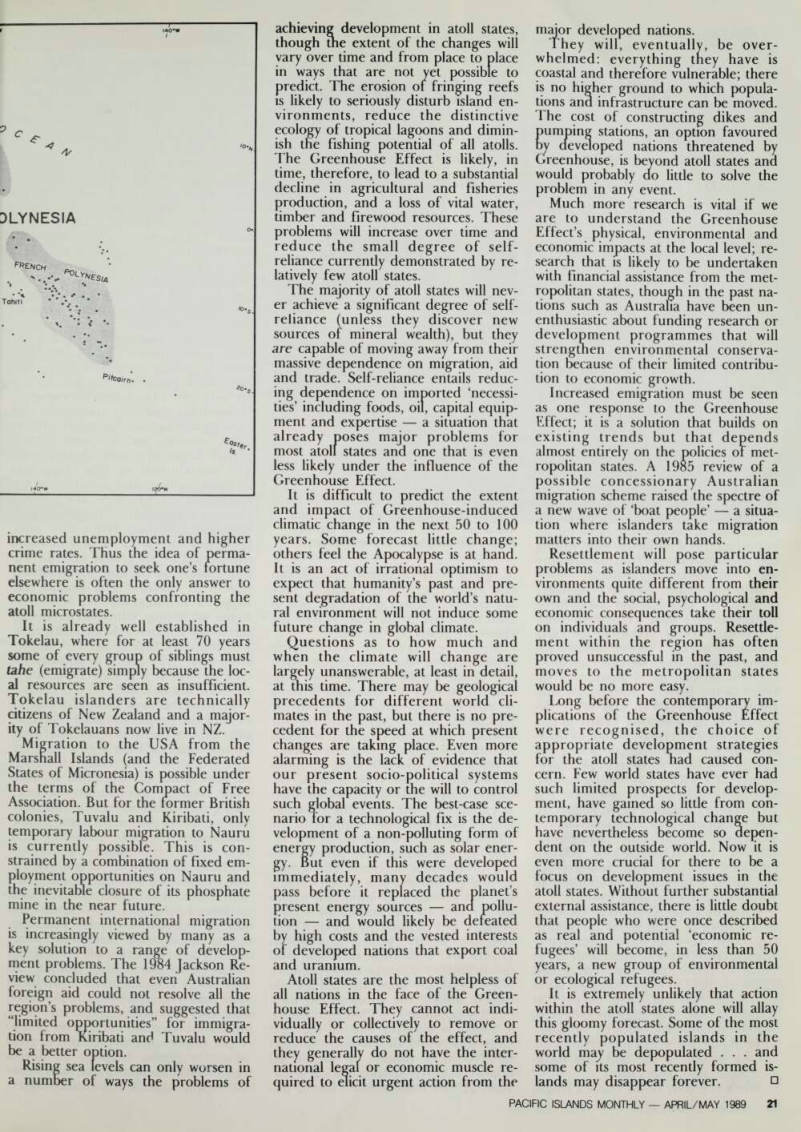
From top: Lenses of freshwater will shrink or disappear as erosion increases and intruding salt water will pollute them.
Bottom: Broad islands with relatively large fresh wates lenses form where converging waves build ridges and recurved sand spits.
Lower, swampy areas are highly productive but vulnerable to salinisation.
Ebeye near the American missile range on Kwajalein Atoll.
Trie buildup of industrial gases in Earth’s atmosphere over the past 30 to 40 years is now well documented. The resulting Greenhouse Effect is expected to raise temperatures over much of the planet’s surface and lead to a rise in ocean levels. The rise will initially come about through an expansion of surface waters and the melting of mountain glaciers; not until much later will melting of the polar ice sheets significantly augment ocean volumes. Coastal erosion will increase as sea-level rises accelerate beyond the upward growth of corals, and will probably be accentuated by a greater frequency of storms.
Analysis of tide gauge records from around the world reveals a small rise
in relative sea level (1.0-1.5 mm per year) over the past few decades. These results have been variously interpreted and it is not clear whether the appa rent sea level changes are caused by a global Greenhouse Effect, local clima tic variability or increased river dis charges into the oceans following the
construction of large irrigation
schemes and dams, Rates of expansion of the oceans cannot be determined with any accuracy because of uncertainty con cerning the pattern and extent of fu ture heating of the earth’s surface, and the rate at which the heat will be absorbed by the oceans, Extreme scenarios for the next 50 years range from virtually no change m mean sea level to an elevation many
metres higher.
The basic effect of a Greenhouse induced rise in sea level is for lowlying lands to be inundated and for coasts to erode. Erosion, as opposed to inun dation, is most severe on shorelines composed of unconsolidated sediment exposed to storm wave attack: a gra dual rise of mean sea level will prog ressively lift the zone of flooding, storm wave and surge effects to new levels, eroding areas previously consi dered safe. Human responses will vary depending on the values of the coastal land under attack and the resources available to provide protective mea sures. In Pacific atoll states, where re sources are very limited, the provision of expensive engineering works will
rarely be an option.
Atolls are accumulations of the re
mains of reef-forming organisms
usually arranged into a rim around a central lagoon and restricted to tropic al ocean waters within 20 degrees of the equator. Drilling results from a number of atolls essentially confirm the early speculations of Charles Dar win that the reef deposits accumulated on the peaks of submerging mid ocean volcanoes. Atoll islands are among the most recent of geological formations and the youngest in terms of human colonisation.
Islands on atoll rims vary enormous ly in size and shape, but rarely rise more than three metres above mean sea level. They may be stable but the occurrence of exposed and eroding outcrops of beachrock/coral con glomerate on one hand and newly formed boulder ridges and sand spits on the other indicate that islands are
constantly changing shape. The build
ing of atoll superstructures, especially islands, results from a combination of processes of small scale erosion and accretion that can be observed on a
day-to-day basis, interspersed by catas
trophic changes caused by rare but ex tremely violent cyclones and hurri canes. Storms have been documented in which waves passed across islands up to eight metres above their land surfaces, hundreds of islanders died and whole island environments were destroyed either washed away or buried in rubble.
These changes have been viewed in terms of dynamic equilibrium rather than stages in an evolutionary prog ression, with periods of island accre tion alternating with (and largely balancing) erosion. A state of dis equilibrium may arise if environmen tal conditions such as relative sea level or storminess change with time. The theoretical effect of slow changes in relative sea level can be predicted: negative movements would tend to promote the accumulation of sediment masses, while positive movements should increase erosion.
While the spectre of rising sea levels ►
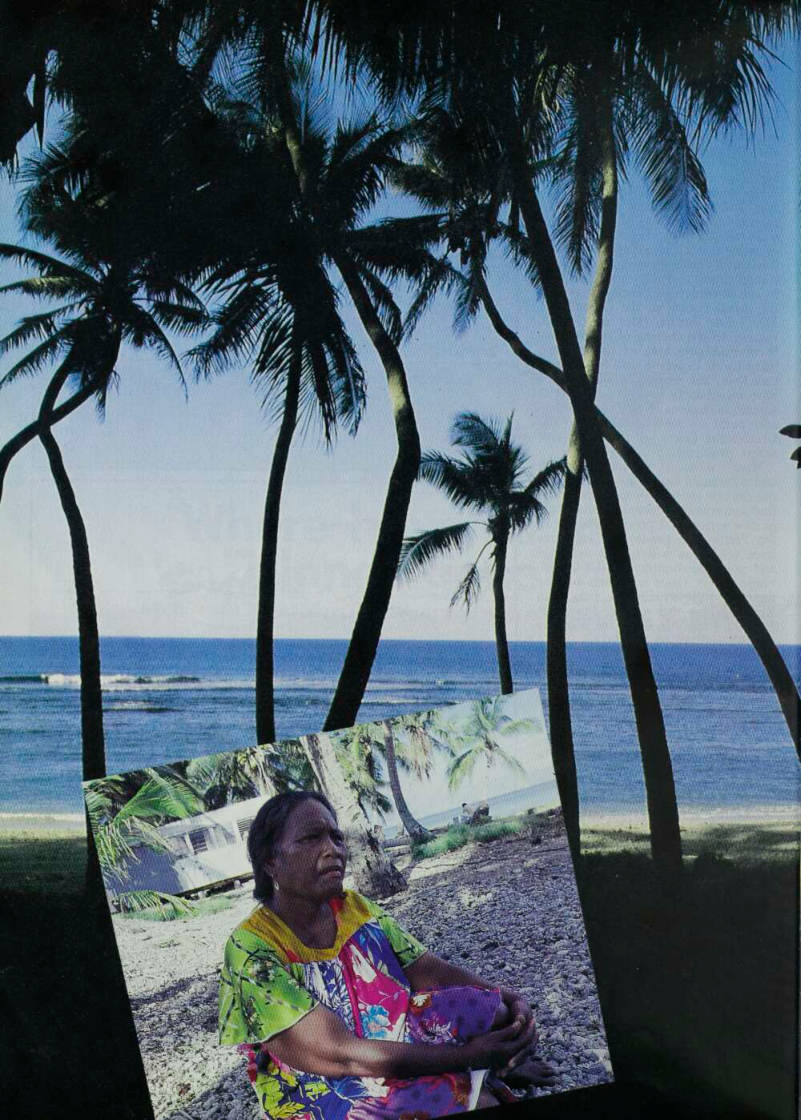
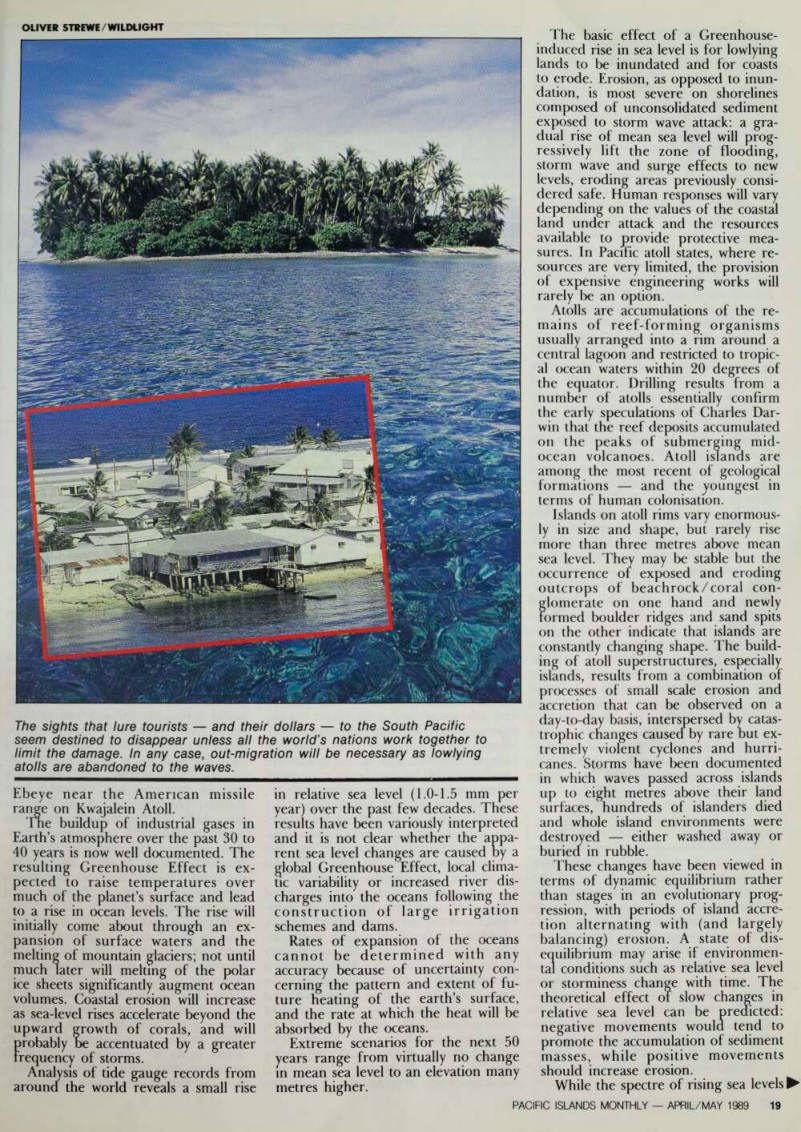
Oliver Strewe / Wildlight
The sights that lure tourists - and their dollars - to the South Pacific seem destined to disappear unless all the world’s nations work together to limit the damage. In any case, out-migration will be necessary as lowlying atolls are abandoned to the waves.
in the future seems to follow inevit ably from a Greenhouse-induced warming of the atmosphere, there is growing evidence that its impact will not be the same everywhere. It has been shown that past sea level changes have been influenced by local climatic and oceanographic factors, and the variability of those factors may in crease with the Greenhouse Effect.
The nature of existing coastlines whether composed of cliffs or swamps will also determine the impact.
Atoll flora and fauna are generally limited in species diversity, with only a
few plant types predominating. The
Greenhouse Effect would wreak havoc on island ecology because of the re latively small size and low elevation of atoll islands and the subsequent low salt tolerance of their plants.
Species such as coconut and panda nus can withstand quite high levels of salt and even occasional inundation by storm waves. They are hardy and quickly colonise even small rubble mounds that rise above high tide level, while taro is much more sensitive to salinity changes and grows in low areas, usually in manually excavated pits. Salinity increases after storms nave caused substantial decreases in
taro productivity.
An atoll’s capacity to support hu man life is closely tied to the existence of a permanent groundwater system.
Islands larger than about 1.5 hectares and 200 metres in diameter contain a permanent lens of fresh water sur rounded by salt water; the volume of the lens is roughly proportional to the surface area of tne atoll. Any decline in island area has a very dramatic in fluence on the availability of freshwa ter supplies. Conceivably, in the next 50 years, Greenhouse Effect shoreline erosion of one or two metres a year could reduce the dimensions of some presently inhabited islands to the point where their groundwater sup plies would no longer support viable natural environments or permanent human habitation.
Erosion
As erosion reduces island size, groundwater lenses will shrink be neath larger islands and virtually dis appear under smaller ones. All except the most hardy vegetation will perish.
Sea levels rising at the rates contem plated under future Greenhouse con ditions would outstrip the ability of the islands to grow upward, leading to a reduction in ‘island freeboard’ height above mean sea level. Storm overwash will therefore become an in
creasingly frequent occurrence, caus
ing damage to buildings and vegeta tion and irreversible sahnisation of the groundwater lens.
The most severe situations are likely to occur on what are today the widest and most productive islands. These typically occur at bends in the reef crest where waves approach from two or more directions and recurved spits form around a central low area. Many islands of this type support relatively high population densities, and the effect of a marine incursion on this type of island would be destruction of food-producing areas in the interior by salt water and a reduction in the froundwater lens and decreased prouctivity of coconut and breadfruit crops. Construction of expensive sea walls would be, at best, a stopgap measure; as sea levels continue to rise, so will the ground water table. The central parts of the island would become a shallow and relatively unproductive lake of fresh water that becomes increasingly brackish as storms wash over the iSand surface.
Coral reefs provide the most limited range of resources for human existence and the most tenuous of human habitats in the Pacific. The soil is infertile and fresh groundwater is very limited; maintaining a livelihood is a considerable task and many atolls have
been depopulated and repopulated
following abandonment in the wake of
storm damage, inspiring migration
movements of various Idnds. The
dying phases of the small community
on Merir atoll in Palau were well
documented: during the 1960 s the
women of Merir grew too old to culti vate taro and the men could not keep the coconut groves clear. The island was depopulated and the few survi vors were moved to the Palau main land, an option open to atoll dwellers in some form of political liaison with larger islands and states.
Resource-poor atoll states have faced a host of development problems and have thus moved rapidly into absolute dependence on the outside world, primarily for aid, concessional
trade and migration opportunities.
Modern health facilities and medicines have allowed more rapid natural in creases in population and population control measures have enjoyed little success. The Marshall Islands now has one of the fastest-growing populations in the world, with widespread adop tion reducing the perceived need for family planning. Kiribati and Tuvalu are not far behind and, as populations increase, extra strain is placed on local and imported resources.
Migration is certainly not a new con cept m the Pacific. Higher postwater rates of population increase, lack of employment prospects, increased de sire for consumer goods and the con centration of facilities on central is lands have in many cases resulted in out-migration from atolls. But the concentration of population in urban areas leads to overcrowding and its attendant problems squatter settle ments, pollution, poor nutrition,
increased unemployment and higher crime rates. Thus the idea of perma nent emigration to seek one’s fortune elsewhere is often the only answer to
economic problems confronting the
atoll microstates.
It is already well established in Tokelau, where for at least 70 years some of every group of siblings must take (emigrate) simply because the loc al resources are seen as insufficient.
Tokelau islanders are technically citizens of New Zealand and a major ity of Tokelauans now live in NZ.
Migration to the USA from the Marshall Islands (and the Federated States of Micronesia) is possible under the terms of the Compact of Free Association. But for the former British colonies, Tuvalu and Kiribati, only temporary labour migration to Nauru is currently possible. This is con strained by a combination of fixed em ployment opportunities on Nauru and the inevitable closure of its phosphate mine in the near future.
Permanent international migration is increasingly viewed by many as a key solution to a range of develop ment problems. The 1984 Jackson Re view concluded that even Australian foreign aid could not resolve all the region’s problems, and suggested that
“limited opportunities” for immigra
tion from Kiribati and Tuvalu would be a better option.
Rising sea levels can only worsen in a number of ways the problems of
achieving development in atoll states, though tne extent of the changes will vary over time and from place to place in ways that are not yet possible to predict. The erosion of fringing reefs is likely to seriously disturb island en vironments, reduce the distinctive
ecology of tropical lagoons and dimin
ish the fishing potential of all atolls.
The Greenhouse Effect is likely, in time, therefore, to lead to a substantial decline in agricultural and fisheries production, and a loss of vital water, timber and firewood resources. These problems will increase over time and reduce the small degree of self reliance currently demonstrated by re latively few atoll states.
The majority of atoll states will nev er achieve a significant degree of self reliance (unless they discover new sources of mineral wealth), but they are capable of moving away from their massive dependence on migration, aid and trade. Self-reliance entails reduc
ing dependence on imported ‘necessi
ties’ including foods, oil, capital equip
ment and expertise a situation that
already poses major problems for
most atoll states and one that is even less likely under the influence of the Greenhouse Effect.
It is difficult to predict the extent and impact of Greenhouse-induced climatic change in the next 50 to 100 years. Some forecast little change; others feel the Apocalypse is at hand.
It is an act of irrational optimism to expect that humanity’s past and pre sent degradation of the world’s natu ral environment will not induce some future change in global climate.
Questions as to how much and when the climate will change are largely unanswerable, at least in detail, at this time. There may be geological precedents for different world cli mates in the past, but there is no pre cedent for the speed at which present
changes are taking place. Even more
alarming is the lack of evidence that our present socio-political systems have the capacity or the will to control such global events. The best-case sce nario for a technological fix is the de velopment of a non-polluting form of energy production, such as solar ener gy. But even if this were developed immediately, many decades would pass before it replaced the planet’s present energy sources and pollu tion and would likely be defeated by high costs and the vested interests of developed nations that export coal and uranium.
Atoll states are the most helpless of all nations in the face of the Green house Effect. They cannot act indi vidually or collectively to remove or reduce the causes of the effect, and they generally do not have the inter national legal or economic muscle re quired to elicit urgent action from the
major developed nations.
They will, eventually, be over whelmed: everything tney have is coastal and therefore vulnerable; there is no higher ground to which popula tions and infrastructure can be moved.
The cost of constructing dikes and pumping stations, an option favoured
by developed nations threatened by
Greenhouse, is beyond atoll states and would probably ao little to solve the problem in any event.
Much more research is vital if we are to understand the Greenhouse Effect’s physical, environmental and economic impacts at the local level; re search that is likely to be undertaken with financial assistance from the met ropolitan states, though in the past na tions such as Australia have been un enthusiastic about funding research or development programmes that will strengthen environmental conserva tion because of their limited contribu tion to economic growth.
Increased emigration must be seen as one response to the Greenhouse Effect; it is a solution that builds on existing trends but that depends almost entirely on the policies of met ropolitan states, A 1985 review of a
possible concessionary Australian
migration scheme raised the spectre of a new wave of ‘boat people’ a situa tion where islanders take migration matters into their own hands.
Resettlement will pose particular problems as islanders move into en vironments quite different from their own and the social, psychological and economic consequences take their toll on individuals and groups. Resetde ment within the region has often proved unsuccessful in the past, and moves to the metropolitan states would be no more easy.
Long before the contemporary im plications of the Greenhouse Effect were recognised, the choice of
appropriate development strategies
for the atoll states had caused con cern. Few world states have ever had such limited prospects for develop ment, have gained so little from con
temporary technological change but
have nevertheless become so depen dent on the outside world. Now it is even more crucial for there to be a focus on development issues in the atoll states. Without further substantial external assistance, there is little doubt that people who were once described as real and potential ‘economic re fugees’ will become, in less than 50 years, a new group of environmental
or ecological refugees.
It is extremely unlikely that action within the atoll states alone will allay this gloomy forecast. Some of the most recently populated islands in the world may be depopulated . . . and some of its most recently formed is lands may disappear forever. □
Aid where it counts
The Region
John Zubrzycki, a journalist with the Australian International Development Assistance Bureau (AIDAB), reports on three Australian self-help aid projects under way in the region.
Weighing More Than 200
kilograms and reaching a
length of more than a metre, the giant clam is one of the largest reef-dwelling animals in the world It is also a delicacy, and with buyers willing to pay up to SA4O a kilogram for the clam’s adductor muscle it is not surprising that the number still to be found ‘in the wild’ is dwindling.
Now, however, a means of satisfying demand for clam meat without en
dangering the species is being de
veloped in the Solomon Islands. Using the latest agricultural techniques, a giant clam hatchery has been set up at the Coastal Aquaculture Centre (GAG) close to the capital of Honiara. It aims to develop economically viable farm ing systems for giant clams and, if suc cessful, could become the basis for an
important rural industry with fishing
communities raising clams on offshore reefs and marketing the meat.
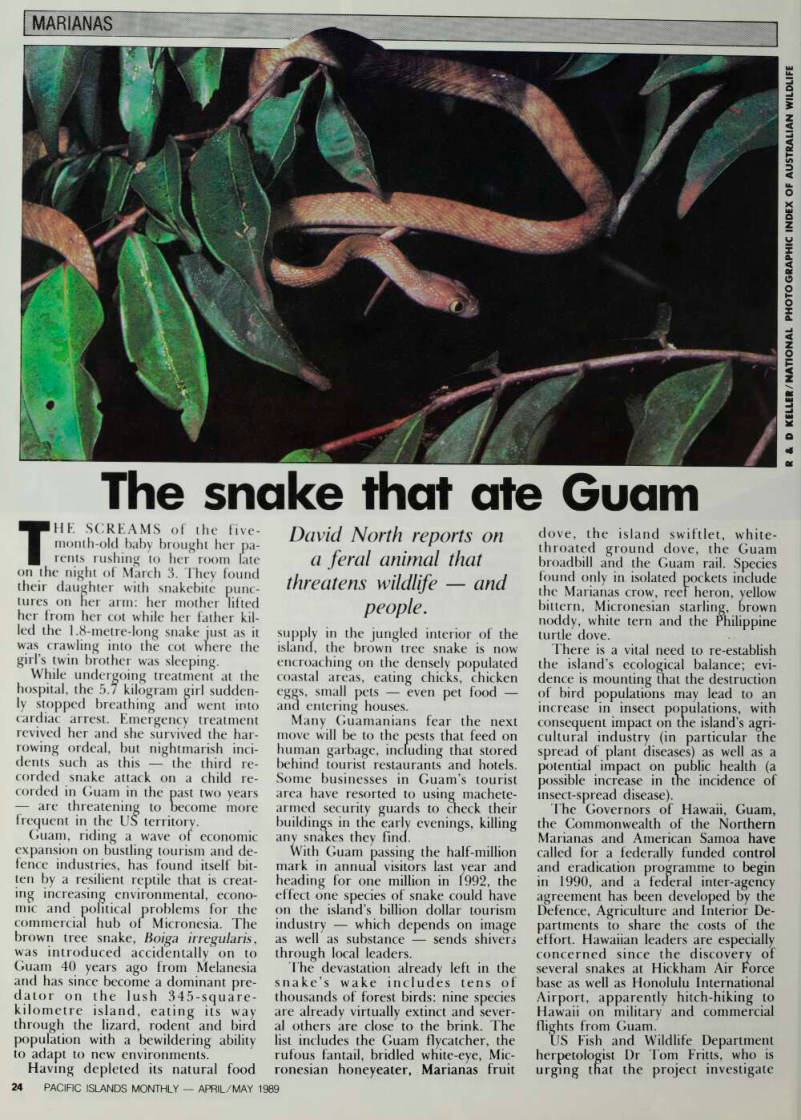
Graham Usher, natchery manager at the GAG, says that the Solomon Is
lands villagers have responded posi
tively to growing clams as an extra source of income: “We’ve already got more requests than we can handle there is an enormous amount of in terest in the project.” Established with funding from AIDAB and other de velopment agencies, the Centre is one of a number of research stations oper ated by the International Centre for
Living Aouatic Resources Manage
ment (ICLARM), an autonomous, non-profit international scientific and technical organisation based in Manila, which supports and conducts research into fisheries and other aquatic re sources. Last financial year AIDAB provided $lOO,OOO ‘core funding’ for ICLARM, a substantial proportion of which supports the clam project.
Scientists at the GAG have about 30 brood stock of giant clams for spawn
ing, and have already successfully
transferred several thousand baby clams to ocean nurseries. The brood clams are held in large fibreglass tanks to enable easy collection of eggs at spawning time. The eggs are collected, placed in tanks and allowed to hatch: after about two weeks the larvae settle on the bottom of the tank and meta
morphose into baby clams.
When the baby clams reach a length
of two or three centimetres (which can take from five to seven months) they are transferred to cages in the sea: it then takes five to six years before the clams are ready for harvest.
Mr Usher says the work being undertaken at the Centre has given the South Pacific a head start over South East Asia in giant clam farming
an important advantage given the
possible commercial spin-offs for
fishing communities in the Solomon Islands and neighbouring countries.
During the first 50 years of Euro pean contact with New Guinea, the Central Highlands, defied all attempts at exploration, but since the construc tion of the Highlands Highway in the 1950 s and the opening up of the re gion, its inhabitants have proved will ing to try new methods and crops.
Coffee production has grown rapidly and has provided an important source of income to thousands of small holders, but despite the region’s rela
tive prosperity, rising population
growth and a shortage of arable land are beginning to make their presence felt. One of tne worst affected areas is Simbu, among the smallest and most
densely populated of PNG’s provinces.
Simbu is also the site of the first
large-scale rural development project
in PNG to be funded by outside aid donors. AIDAB is co-financing a six year, SUSI. 7 million South Simbu Ru
ral Development Project (SSRDP) to increase incomes and improve nutri tion in Gumine and Karamui, the poorest districts in the Simbu valley together with the International Fund
for Agricultural Development (IFAD)
and the PNG Government.
“The crop rotation periods in Gumine and Karamui have declined from about 15 years to two or three years,” says Peter Kamis, the project co-ordinator. Himself a Highlander, Kamis has a clear understanding of the economic and social implications of oyer-population. “Yields are dimi nishing, disputes over land are in creasing, ana more and more people are leaving Simbu to look for work in the cities, ,v he notes. The drift to the cities is particularly worrying for the
PNG government. High unemploy
ment m urban areas is causing law and order problems that are having an adverse effect on investment.
Meanwhile, nutrition standards and incomes throughout Simbu are falling.
By focusing on the food sector, SSRDP hopes to reverse these trends.
The introduction of new crops and farming methods and assistance in the
marketing of produce are already
showing considerable promise. Project
manager Jonathan Hampshire attri butes this success to the way in which the project is integrated into the ex isting management and administrative system in Simbu. “The project also supports an integrated set of compo nents including administrative sup
port, agriculture, health, literacy,
training and capital works,”' Hamp shire says. “The aim is to improve the existing system and leave those things that are sustainable.”
Perhaps the most successful compo nent of the project has been the veget able production and marketing prog ramme. Starting from a zero base, far mer groups are now selling an average of one tonne of vegetames a weex.
“The response from farmers and far mer groups has been very enthusiastic.
Before the project started the oppor tunities for vegetable marketing were very scarce,” Fiampshire says.
PNG’s fast-growing urban popula
tion is creating a strong demand for introduced fruit and vegetables such as lettuce, potatoes and carrots: but lack of continuity in quality and supp ly has meant mat many buyers are turning to overseas suppliers. A recent Asian Development Bank study found that PNG imports more introduced fruit and vegetables than it produces, and that the consumption of intro duced produce will likely grow at 5 to 7 per cent each year. All this is good news for Simbu farmers: “If Simbu can offer consistent quality and regu lar supply, there’s little doubt buyers
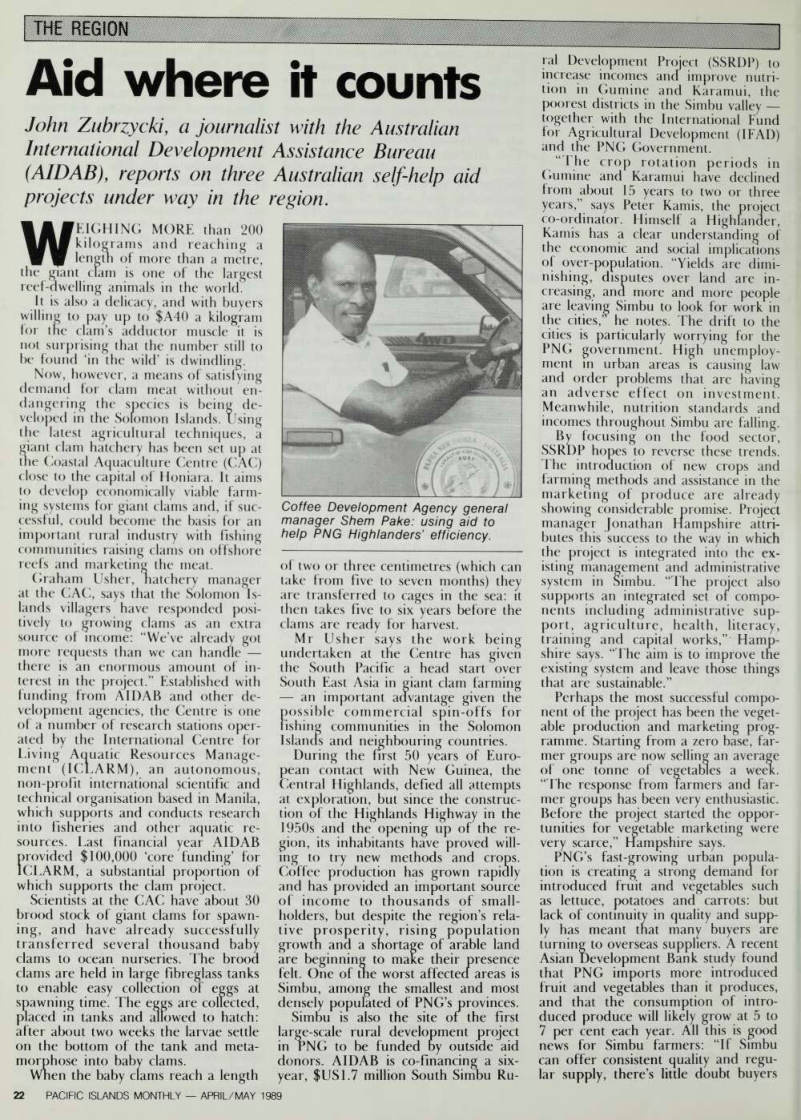
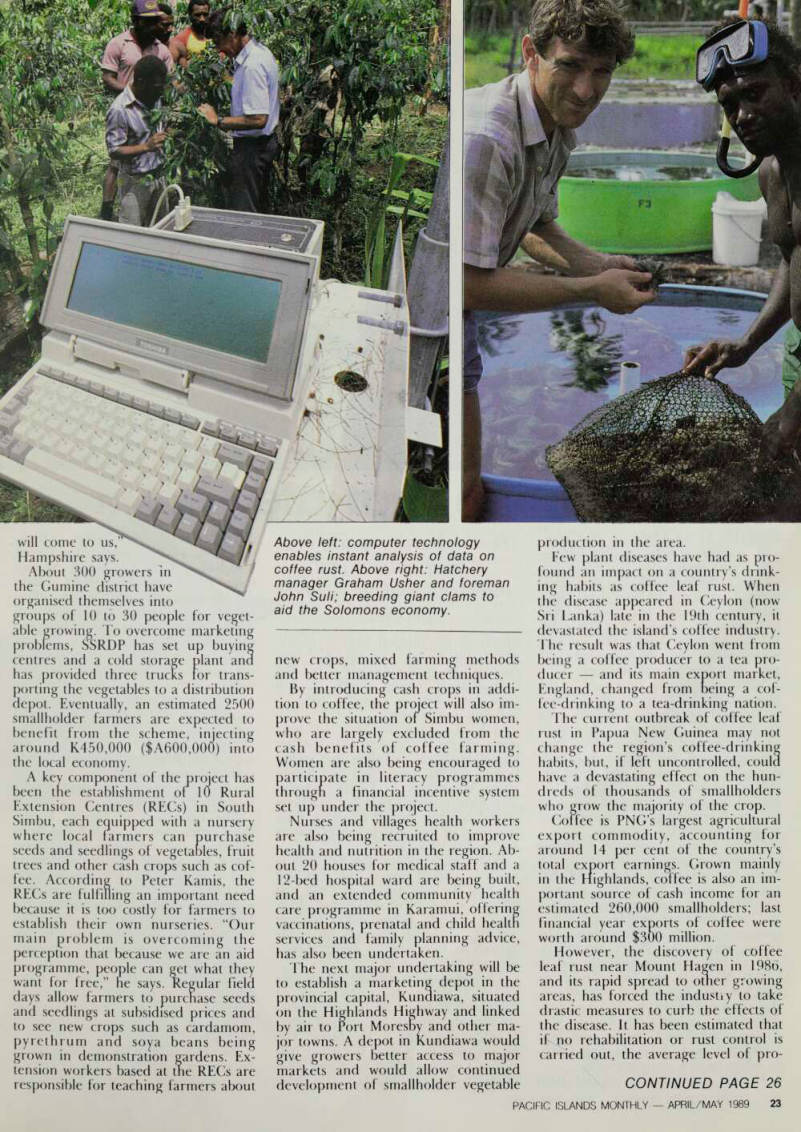
Coffee Development Agency general manager Shem Pake: using aid to help PNG Highlanders’ efficiency.
will come to us/^V*,.
Hampshire says.
About 300 growers m S N the Gumine district have organised themselves into groups of 10 to 30 people for veget able growing. To overcome marketing problems, SSRDP has set up buying centres and a cold storage plant ana has provided three trucks for trans porting the vegetables to a distribution oepot. Eventually, an estimated 2500 smallholder farmers are expected to benefit from the scheme, injecting around K 450,000 ($A600,000) into the local economy.
A key component of the project has been tne establishment of 10 Rural Extension Centres (RECs) in South Simbu, each equipped with a nursery where local farmers can purchase seeds and seedlings of vegetables, fruit trees and other cash crops such as cof fee. According to Peter Kamis, the RECs are fulfilling an important need because it is too costly for farmers to establish their own nurseries. “Our main problem is overcoming the perception that because we are an aid programme, people can get what they want for free,” he says. Regular field days allow farmers to purchase seeds and seedlings at subsidised prices and to see new crops such as cardamom, pyrethrum and soya beans being grovyn in demonstration gardens. Ex tension workers based at the RECs are responsible for teaching farmers about
new crops, mixed farming methods and better management techniques.
By introducing cash crops in addi tion to coffee, the project will also im prove the situation of Simbu women, who are largely excluded from the cash benefits of coffee farming.
Women are also being encouraged to
participate in literacy programmes
through a financial incentive system set up under the project.
Nurses and villages health workers are also being recruited to improve health and nutrition in the region. Ab out 20 houses for medical staff and a 12-bed hospital ward are being built, and an extended community health care programme in Karamui, offering vaccinations, prenatal and child health services and family planning advice, has also been undertaken.
The next major undertaking will be to establish a marketing depot in the
provincial capital, Kundiawa, situated
on the Highlands Highway and linked by air to Port Moresby and other ma jor towns. A depot in Kundiawa would give growers better access to major markets and would allow continued development of smallholder vegetable
production in the area.
Few plant diseases have had as pro found an impact on a country’s drink ing habits as coffee leaf rust. When the disease appeared in Ceylon (now Sri Lanka) late in the 19th century, it devastated the island’s coffee industry.
The result was that Ceylon went from being a coffee producer to a tea pro ducer and its main export market,
England, changed from being a cof
fee-drinking to a tea-drinking nation.
The current outbreak of coffee leaf rust in Papua New Guinea may not
change the region’s coffee-drinking
habits, but, if left uncontrolled, could have a devastating effect on the hun dreds of thousands of smallholders who grow the majority of the crop.
Coffee is PNG’s largest agricultural
export commodity, accounting for
around 14 per cent of the country’s
total export earnings. Grown mainly
in the Highlands, coffee is also an im portant source of cash income for an estimated 260,000 smallholders; last financial year exports of coffee were worth around $3OO million.
However, the discovery of coffee leaf rust near Mount Hagen in 1986, and its rapid spread to other growing areas, has forced the industry to take drastic measures to curb the effects of the disease. It has been estimated that if no rehabilitation or rust control is carried out, the average level of pro-
Continued Page 26
Above left: computer technology enables instant analysis of data on coffee rust. Above right: Hatchery manager Graham Usher and foreman John Suli; breeding giant clams to aid the Solomons economy.
duction for a smallholder family would drop from around 100 kilo grams a year to just 15kg. In 1987 the PNC; Government requested assistance for dealing with the outbreak of cof fee rust and AIDAB responded with SAS million to assist the Coffee De velopment Agency with a crop man agement, rust control and prevention programme and the Coffee Research Institute with research into rust
resistant varieties, spraying techniques
and epidemiology.
Based in Goroka, the Coffee De velopment Agency (CDA), which is
funded primarily by a levy imposed
on coffee growers and an annual con tribution from the National Govern ment, is charged with implementing the Government’s coffee rehabilitation and rust control programme. Shem Pake, CDA general manager, says that if coffee farmers do not learn how to deal with leaf rust the industry could be wiped out in five years. “That’s the effect we have been warned about: if we weren’t here to help, that’s the sort of result coffee growers can expect.”
In November last year the PNG Government announced it was con sidering disbanding the CDA, but was met witn opposition from growers and some provincial governments. Shem Pake says the agency provides an effi cient administrative structure for ex
tension services to increase production and control the spread of coffee rust, “Our objective nere is to train far mers. Once the farmers learn to man age their coffee, there won’t be any necessity to carry on administrative structures,” he says. “It’s my firm opinion that [our] impact has been ex
tremely significant. The village people
have been supporting us all the way.”
I erry Quinlan, the project’s team leader, at the CDA, says the logistics of planning and implementing a re habitation and rust control program me in PNG are enormous: coffee is grown under a variety of conditions; smallholder plantations are scattered, and often located in inaccessible areas, “We base our extension staff in the middle of the coffee growing areas, concentrate on small groups respon sive to new methods and make sure they succeed. Other farmers then fol low their lead and the whole thing snowballs,” Quinlan says,
Although improved management
practices such as pruning, weeding,
shade control and drainage can mim mise the effect of leaf rust on yield, fungicide spraying remains the major
means of control. Determining the most suitable mix of rust control methods for the PNG environment is the task of the Coffee Research Insti tute, which works in close collabora tion with extension workers from the CDA. A collaborative research prog ramme has been established to link the Institute and Australian research bodies in the area of spray technology and the epidemiology of coffee rust.
Project manager Dr Jim Whan re ports that the Institute is applying overseas findings on coffee rust to the PNG environment. “We’ve set up trial sites to find out how the coffee rust is developing under different weather conditions. We’re also trying to de
velop economic thresholds by seeing
how various levels of coffee rust relate to yield. Then we can start advising on whether spraying is economically vi able.”
Better management techniques have already slowed its spread, but Dr Whan warns that if left unchecked, coffee rust could lead to far-reaching social and economic problems. “Seven ty to 80 per cent of the coffee pro duced in PNG is produced by smal lholders. For a lot of these smallhol ders, that is their only source of cash income, so if that yield decreases to 50 per cent their casn income is reduced by 50 per cent . . . which has enor mous social implications.” □
Inset: Simbu smallholder project manager Jonathan Hampshire and designer Koma Kuman. Main picture: Development technician Sorme Kola discusses progress with project co-ordinator Peter Kamis.
The snake that ate Guam
Marianas
David North reports on a feral animal that threatens wildlife and people.
THE SCREAMS of the five month-old baby brought her pa rents rushing to her room late on the night of March 3. They found their daughter with snakebite punc tures on her arm: her mother lifted her from her cot while her father kil led the 1.8-metre-long snake just as it was crawling into the cot where the girl’s twin brother was sleeping.
While undergoing treatment at the
hospital, the 5.7 kilogram girl sudden
ly stopped breathing ana went into
cardiac arrest. Emergency treatment revived her and she survived the har rowing ordeal, but nightmarish inci dents such as this the third re corded snake attack on a child re corded in Guam in the past two years are threatening to become more
frequent in the UJ? territory.
Guam, riding a wave of economic expansion on bustling tourism and de fence industries, has found itself bit ten by a resilient reptile that is creat
ing increasing environmental, econo
mic and political problems for the commercial hub of Micronesia. The brown tree snake, Boiga irregularis, was introduced accidentally on to Guam 40 years ago from Melanesia and has since become a dominant pre dator on the lush 345-square kilometre island, eating its way through the lizard, rodent and bird
population with a bewildering ability
to adapt to new environments.
Having depleted its natural food
supply in the jungled interior of the island, the brown tree snake is now
encroaching on the densely populated
coastal areas, eating chicks, chicken eggs, small pets even pet food and entering houses.
Many Guamanians fear the next move will be to the pests that feed on human garbage, including that stored behind tourist restaurants and hotels.
Some businesses in Guam’s tourist area have resorted to using machete armed security guards to check their
buildings in the early evenings, killing
any snakes they fma.
With Guam passing the half-million mark in annual visitors last year and heading for one million in 1992, the effect one species of snake could have on the island’s billion dollar tourism
industry which depends on image
as well as substance sends shivers through local leaders.
The devastation already left in the snake’s wake includes tens of thousands of forest birds: nine species are already virtually extinct and sever al others are close to the brink. The list includes the Guam flycatcher, the rufous fantail, bridled white-eye, Mic ronesian honeyeater, Marianas fruit
dove, the island swiftlet, white throated ground dove, the Guam broadbill and the Guam rail. Species found only in isolated pockets include the Marianas crow, reef heron, yellow bittern, Micronesian starling, brown noddy, white tern and the Philippine turtle dove.
There is a vital need to re-establish the island’s ecological balance; evi dence is mounting that the destruction of bird populations may lead to an increase in insect populations, with
consequent impact on the island’s agri
cultural industry (in particular the spread of plant diseases) as well as a
potential impact on public health (a
possible increase in tne incidence of
insect-spread disease).
The Governors of Hawaii, Guam, the Commonwealth of the Northern Marianas and American Samoa have called for a federally funded control and eradication programme to begin in 1990, and a federal inter-agency agreement has been developed by the Defence, Agriculture and Interior De partments to share the costs of the effort. Hawaiian leaders are especially concerned since the discovery of several snakes at Hickham Air Force base as well as Honolulu International
Airport, apparently hitch-hiking to
Hawaii on military and commercial flights from Guam.
US Fish and Wildlife Department herpetologist Dr Tom Fritts, who is urging that the project investigate
R & D KELLER/NATIONAL PHOTOGRAPHIC INDEX OF AUSTRALIAN WILDLIFE
natural mortality controls on the snake in its natural range, find out how it flourished on Guam and evaluate a number of control and eradicat. m techniques in the field, including traps, chemical and biological controls ana sterility methods as well as en
couraging professional snake hunters
to reduce the populations and im
proved inspection and detection
efforts at Guam’s military and com mercial air and sea ports.
The reptile also has caused several million dollars worth of damage to the island’s power distribution system (as well as home and commercial ap pliances) in more than 500 ‘snake induced outages’ in the past 10 years.
Climbing power poles after birds nest ing in the cross-arms, the snake (which often grows to more than two metres in length) bridges the line and
grounded wires, blowing transformers
and creating local and island-wide power failures. The only consolation is that the snake which shorts out a pow er line never does so again.
A new and regionally significant aspect to the problem nas surfaced over recent years as snakes have been discovered in Honolulu, Ponape, Kwajalein, Wake, Diego Garcia and
possibly on Saipan.
Both tourism and Guam’s other ma jor industry, defence, have made the island an important air and sea link.
The former drives Guam’s growing importance in the north-south traffic, while the latter ties Guam to the eastflow of the US Pacific base struc ture, increasing the brown tree snake’s opportunities for off-island travel.
A large part of the problem in deal ing with the species is that Boiga irre gularis has been misunderstood, mis identified and its adaptability under estimate for at least 40 years. The
reptile v as probably introduced dur
ing World War II from a US Navy base on Manus Island, off Papua New Guinea. It found a paradise without the predators that had kept it in check in its natural range eastern Indone sia, PNG, the Solomons and northern Australia.
Current estimates of numbers on Guam suggest there are “tens of thousands’, perhaps as many as 8000 per square Kilometre in particularly neavily infested areas of the island.
Snakes were first reported in the early 19505, but their presence was not readily associated witn a decline in
bird population. During the day,
brown tree snakes hide in tree holes, caves, rocks and other cool spots, foraging at night: so there were re latively few opportunities to observe, kmuch less accurately identify, the new m, arrival. Moreover, the first prey the species hunted was the small lizard \J|Land rodent population, whichcaus ed it to be misidentified as the
Philippine rat snake. Until the late 1970 s it was mistakenly viewed as a beneficial species rather than the ecological threat it has revealed itself to be.
By the late 1970 s the drastic decline in the bird population was evident throughout tne island. Pesticides or avian epidemic diseases were initially
suspected, though larger species
especially birds of prey were un affected by the disaster. But by 1982,
Julie Savidge, a University of Illinois
graduate student, had begun to sus pect the snake.
Paying a bounty for dead snakes, she consistently found birds and eggs in their digestive systems, and further studies proved beyond doubt that the snake infestation was the sole cause of the avian extinction.
In response to the disaster captive breeding programmes were initiated to rebuild the forest bird population,
especially of species found only on
Guam. The American association of Zoological Parks and Aquariums and the Guam Division of Aquatic and Wildlife Resources Joined forces, cap turing and moving birds from Guam to breeding programmes in the Un ited States. Many populations, espe cially those of tne Guam rail, show
steady signs of increasing numbers.
So little is known about the snake that scientists are not even certain of its reproductive capacity: some suspect that, once fertilised, the female can store sperm and produce two or three clutches annually, each with up to 12 eggs, over several years. Theoretically, tbat would mean one gravid female snake might be able to introduce an entire and viable population to another island.
Moreover, though it was once thought the brown tree snake’s venom was not deadly to humans, it may only
be the species’ inefficiency in injecting
its toxin that accounts for no loss of human life so far on Guam. The brown tree snake is a member of the
family Colubridae, or rear-fanged
venomous land snakes: it has to im mobilise its prey by wrapping its body around the victim before literally gnawing in o r der to deliver its venom.
If enough Venom is delivered it could be deadly to humans, and the effect of its bite on a five-month-old child’s heart indicates that at the very least infants, the aged and the seriously ill are at significant risk.
While some Guamanians continue to hope naively that the brown tree snake population will die off now that the rodent, lizard and bird popula tions have been depleted, it has be come increasingly clear that this highly adaptable snake has begun a new and
potentially more devastating phase of
its evolution on Guam one that could have devastating political as well as ecological consequences. □
Opposite: the villain - the Brown tree snake. Below: Some of its victims - the Marianas Gallinule, Guam broadbill and bridled white-eye.
Advertisements & other items, p. 27 (1 item)
Business
PACIFIC
ISLANDS
MONTH L
PACIFIC
BUSINESS
REPORT
EIGHT PAGES OF BUSINESS AND
FINANCIAL NEWS FROM
THROUGHOUT THE PACIFIC
EDITED BY ROBIN BROMBY
Business Report
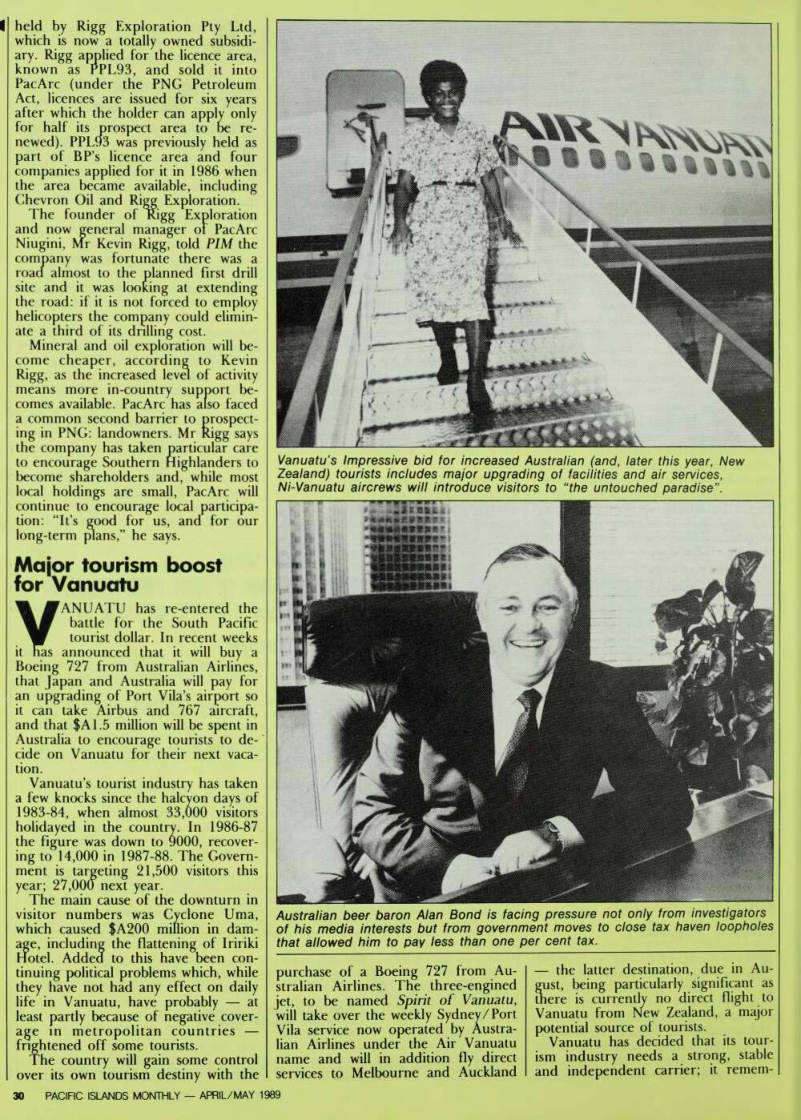
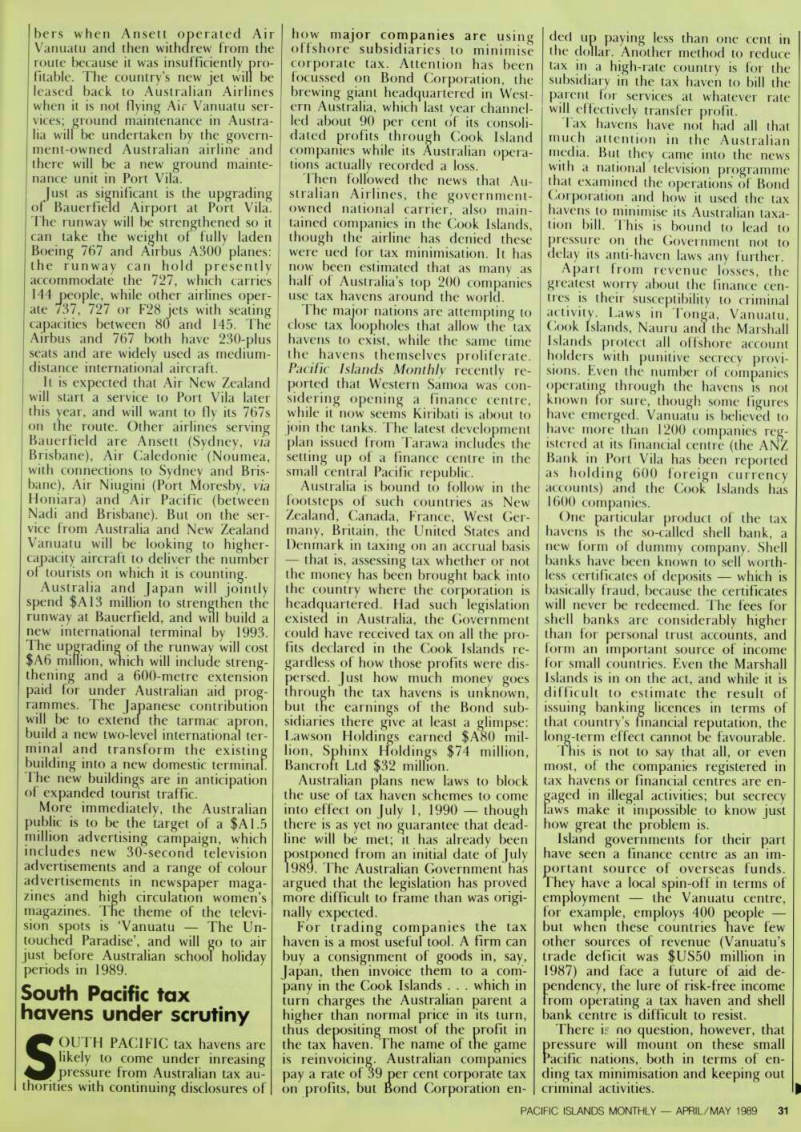
Marshall Islands joins
the South Pacific
THE MARSHALL Islands has sig nailed its intention of reducing its dependence on trade ties with the United States by sending a trade mission to Fiji, Australia and New Zea land. It was also a sign that the gulf between the North and South Pacific that has existed for so long because of colonial history may be on the
way to being bridged.
The mission’s leader, Mr Edinal Jor kan of the recently formed divison of trade and industry in the Marshall Is lands’ Ministry of Resources and De velopment, said the country’s business men have been particularly impressed by the level of industrial development in Fiji, which showed what could be done with tax incentives.
Marshall Islands development is well behind many of the small island states of the Pacific, partly due to its re latively late Independence in 1979.
Also, Pacific experts generally agree that the US did little during its occupation of the Marshall Islands to better the lot of its people (who now number 45,000, with one of the high est birth rates in the world). Copra products account for about 90 per cent of the country’s exports, while ab out SO per cent of imports originate in the US, most of the rest being in the form of cars from Japan.
The Marshalls’ greatest economic opportunity is that it has free access to the Mainland American market, as do other former US territories. The problem for any investor would be to raise a workforce; life in the Marshalls is easy, food and clothing are abun dant and there is little imperative to earn a living. In the Federated States of Micronesia (FSM) there are plans to build a clothing factory that would ex port to the US Mainland, and the gov ernment is talking of importing 700 Sri Lankan workers presumably be cause both skills and interest are lack ing among local people.
The Marshall Islands has made some headway with new economic activities, though copra and the huge US base on Kwajalein atoll are the main sources of revenue. More than one million tonnes of shipping is now
registered under the Marshals flag,
the latest being a 115,000-tonne,
Hong Kong-owned dry bulk carrier
that will be operated with a Marshall Islands crew. The government has also decided to sell Marshall Islands passports for $U5250,000, the idea
being that buyers would enjoy the
same rights to settle in the US as the Marshallese (though the US State De
partment has said naturalised citizens of the Marshalls will have to live in the Islands for five years before they qual
ify lor Mainland residency).
Most recently, the Government hired a company to study the coun try’s economic zone for its mineral potential. President Amata Kabua said the Marshalls was looking to exploit its seabed resources following a recent re port by the East-West Centre, Honolu lu, that identified the area round the Marshalls as likely to contain deposits of manganese, the extraction ana pro cessing of which could be aided by the
country’s comparatively lax environ
mental laws and low taxes.
Most Marshallese who do take jobs find employment in the service sector in supermarkets, shops and hotels.
However, tourism is relatively unde veloped due to a combination of poor air communications and lack of top class hotel accommodation. There are connections with the US, but the cost of travel is high compared with other destinations. This is particularly true if one is trying to reach the Marshalls from the South Pacific, which involves obtaining a seat on the twice-weekly HS74B flight from Fiji via Tuvalu and Kiribati (in fact, the trade commission had to cool its heels in Sydney over Easter because it could not get seats on the flight out of Fiji until later in the week aboard the Airlines of the Marshall Islands aircraft).
The Marshall Islands is now seeking a loan of SUS4O million to upgrade its national airline, including the purch ase of a DCS to operate oetween Ma juro, the capital, and Hawaii and Fiji.
At the same time, the Kiribati airline Air Tungaru is believed to be plan ning the lease of a Boeing 737 to fly Honolulu/Christmas IslandsZfarawa/ Nadi; the nation’s communications have been hit hard by the grounding of Air Nauru, which formeny offered a service from Australia via Nauru. A 737 Kiribati and a DCS to the Mar shalls would be a massive improve ment on the twice-weekly flight, from the Marshalls to Fiji, that also has to service Kiribati ancf Tuvalu.
Continental-Air Micronesia is also now flying a DC 10 direct from Guam to Sydney, which will revolutionise air access to Micronesia from the south.
Sea links are also being improved: Pacific Forum Line has now extended its Kiribati sailings to include Majuro.
The problem for any company wanting to set up in the Marshalls is that the Government has yet to pass a law regulating foreign investment: the desire to enjoy the benefits of de velopment has not been matched by
the drafting of guidelines.
With copra’s future on a seemingly endless downward trend, the country has a genuine need to diversify. It has made few moves toward developing fishing other than setting up a focal company: unlike the FSM, which has ordered three multi-million-dollar tuna boats from Australian shipyards (though three confiscated Japanese ships are tied up in port by political and regional rivalries m the FSM).
What the trade mission’s visit does indicate is that the Marshall Islands is looking to downgrade its economic ties with tne US; a typical post-colonial attitude. The most likely beneficiary is Fiji, whose production methods and
costings impressed the Marshallese
businessmen. They are expected to
buy Fijian-manufactured clothing,
food, small machinery and aluminium boats in the first instance.
The second phase will be to seek out industries that can be developed in the Marshall Islands. Mission leader Jorkan told Pacific Islands Monthly the members had been surprised at what they saw in Fiji and the trip was a useful familiarisation with the econo mies of Australia and New Zealand.
Mr Jorkan said likely industries for the Marshalls could include garment factories and beer brewing.
Bird of Paradise may
gain extra wings
Jl IR NIUGINI could be looking
to further major expansion
within 12 months by adding a secona A3lO Airbus to its fleet. It took delivery of its K 54 million Airbus in mid-March and is considering leas ing the second aircraft.
A second A3lO would imply con siderable route expansion to keep the aircraft fully utilised. The Airbus that went into service last month has a work load designed to produce enough income to cover its costs: twice weekly to Sydney via Brisbane, once
weekly to Sydney direct, weekly from
Port Moresby to Cairns, weekly to Manila and Hong Kong and twice
weekly to Singapore.
A second aircraft would mean new routes, simply because Air Niugini could not expect to be able to double its traffic on existing routes. There has been speculation in aviation circles that the airline is looking at a direct
Port Moresby/Hong Kong flight as
well as services to Tokyo and Auck land. There could be increased ser vices on the Singapore route as traffic has proved better than expected, with not only good business from Asian corporate travellers to Papua New
Guinea but the use by expatriates as the most direct route to Europe.
Air Niugini made its third consecu tive profit in 1987, putting behind it the dismal results of the early 1980 s.
The airline is the only national carrier in the South Pacific that has main tained its independence . . . some part of which can be explained by the fact that it is the only regional carrier that has a substantial domestic network.
The airline made a profit of K 3.54 million after tax last year on revenue of K 83.96 million and carried just over half a million passengers. Air
Niugini general manager Dieter
Seefeld attributed the profit to in creased traffic and better training of the company’s workforce. The airline’s internal traffic has increased as a re sult of its Weekender, Nambawan and Family concession rates, which have reductions of up to 50 per cent on
normal fares. Traditionally, expatriate
residents have gone overseas for vaca tions and have rarely travelled within Papua New Guinea; the new fares maxe that alternative more attractive and make it possible for PNG nation als to better afford air travel.
Since October 1987, Air Niugini has expanded its services rapidly, intro ducing its extension from Honiara to Port Vila; adding services to Sydney
and Singapore to existing flights; re
introducing a service to Daru; adding Misima, Tabubil and Wapenamanda to its internal destinations; Winging in a non-stop flight between Kieta and Cairns and flights between Port Moresby and Townsville, with a Mon day flight to Hong Kong the latest in novation. Air Niugini owns six F2B jets the workhorses of its main domestic routes as well as some short hop international runs such as to Cairns and Honiara and two Dash 7 aircraft. The company also owns 51 per cent of Douglas Airways, a long established third level airline in Papua New Guinea, and is looking at re
equipping Douglas (which currently
uses a variety of aircraft to small aerodromes) and making it more of a feeder service to the national airline’s domestic operations. During 1987, as part of K 3 million staff training scheme, the airline also began a pilot training programme to accelerate the pace of localisation.
Fiji looks to mop up
excess liquidity
Fiji’S Government, Faced
with an excess liquidity situation, is to use its Reserve Bank to mop up money for which the com mercial banks can find no borrowers.
The situation has been brought about by reduced business activity since the two military coups; the subsequent lack of confidence has meant people
are harbouring their savings and few
companies are borrowing to expand,
so commercial banks are left with money (estimated at 10 per cent of
deposits) earning no interest.
The Government has accepted that the Reserve Bank’s earnings will be down this year as a result of the scheme. The first issue of notes offered to the banks was made by the Reserve Bank of Fiji (RBF) in late March, for SFIO million with issues for another $3O million expected be fore the end of May. The notes will be issued in denominations of $F200,000 over three months, one and two years.
The exercise is aimed at enabling the commercial banks and institutions such as the National Provident Fund and insurance companies to earn in come on their funds. The interest to be paid has not been announced.
The RBF’s statement said the exces sive liquidity situation was undesirable because it threatened the stability of the banking system and the future effectiveness of Fiji’s monetary policy.
Banks and insurance companies
have sought permission to expatriate
their funds to countries where they could be invested at good rates, but this was denied: an outrush of funds would seriously affect Fiji’s current account balance, but with such high interest rates prevailing in Australia
and NZ the banks could have solved their problems immediately if offshore investment had been allowed.
Carving a slice of
PNG's oil action
EACARC NIUGINI NL, the first *apua New Guinean company to ist on the Australian stock ex _l since Independence, is looking to farm out a share of its prospect and discussions are under way witn a ma jor oil company.
PacArc, whose home exchange is Brisbane and whose chairman is Peter
Donigi, also currently president of the
PNG Law Society, has raised $A2.6 million from a fully subscribed public float of 10 million one Kina shares issued at $A0.26; since listing on February 23, only small parcels of the company’s shares have been traded within a band of 29c to 32c and, with shares issued to vendors, its total working capital is SA7.B million.
The company has a licence covering 4289 square kilometres within the Pa puan Basin, within 70 km of the oil discovery at lagifu and 15 km north of BP’s discoveries at Hides. The re gion is believed to contain six trillion cubic feet of gas and 600 million bar
rels of liquid nydrocarbons.
The permit to PacArc’s prospect is
held by Rigg Exploration Pty Ltd,
which is now a totally owned subsidi ary. Rigg applied for the licence area, known as PPL93, and sold it into PacArc (under the PNG Petroleum Act, licences are issued for six years after which the holder can apply only for half its prospect area to be re newed). PPL93 was previously held as part of BP’s licence area and four companies applied for it in 1986 when the area became available, including Chevron Oil and Rigg Exploration.
The founder of Rigg Exploration and now general manager of PacArc Niugini, Mr Kevin Rigg, told PIM the company was fortunate there was a roacf almost to the planned first drill site and it was looking at extending the road: if it is not forced to employ helicopters the company could elimin ate a third of its drilling cost.
Mineral and oil exploration will be come cheaper, according to Kevin Rigg, as the increased level of activity means more in-country support be comes available. PacArc has also faced a common second barrier to prospect ing in PNG: landowners. Mr Rigg says the company has taken particular care to encourage Southern Highlanders to become shareholders and, while most local holdings are small, PacArc will continue to encourage local participa tion: “It’s good for us, and for our
long-term plans,” he says.
Major tourism boost
for Vanuatu
has re-entered the battle for the South Pacific tourist dollar. In recent weeks it nas announced that it will buy a Boeing 727 from Australian Airlines, that Japan and Australia will pay for an upgrading of Port Vila’s airport so it can take Airbus and 767 aircraft, and that SAI.S million will be spent in Australia to encourage tourists to de cide on Vanuatu for their next vaca tion.
Vanuatu’s tourist industry has taken a few knocks since the halcyon days of 1983-84, when almost 33,000 visitors holidayed in the country. In 1986-87 the figure was down to 9000, recover ing to 14,000 in 1987-88. The Govern ment is targeting 21,500 visitors this year; 27,000 next year.
The main cause of the downturn in visitor numbers was Cyclone Uma, which caused SA2OO million in dam age, including the flattening of Iririki Hotel. Addea to this have been con
tinuing political problems which, while
they have not had any effect on daily life in Vanuatu, have probably at least partly because of negative cover age in metropolitan countries frightened off some tourists.
The country will gain some control over its own tourism destiny with the
purchase of a Boeing 727 from Au stralian Airlines. The three-engined jet, to be named Spirit of Vanuatu, will take over the weekly Sydney/Port Vila service now operated by Austra lian Airlines under the Air Vanuatu name and will in addition fly direct services to Melbourne and Auckland
the latter destination, due in Au
gust, being particularly significant as
tnere is currently no direct flight to Vanuatu from New Zealand, a major potential source of tourists.
Vanuatu has decided that its tour ism industry needs a strong, stable and independent carrier; it remem
Vanuatu’s Impressive bid for increased Australian (and, later this year, New Zealand) tourists includes major upgrading of facilities and air services, Ni-Vanuatu aircrews will introduce visitors to “the untouched paradise".
Australian beer baron Alan Bond is facing pressure not only from investigators of his media interests but from government moves to close tax haven loopholes that allowed him to pay less than one per cent tax.
bers when Ansett operated Air Vanuatu and then withdrew from the route because it was insufficiently pro fitable. The country’s new jet will be leased back to Australian Airlines when it is not flying Air Vanuatu ser vices; ground maintenance in Austra lia will be undertaken by the govern ment-owned Australian airline and there will be a new ground mainte nance unit in Port Vila.
Just as significant is the upgrading of Bauerfield Airport at Port Vila.
The runway will be strengthened so it can take the weight of fully laden Boeing 767 and Airbus A3OO planes: the runway can hold presently accommodate the 727, which carries 144 people, while other airlines oper ate 737, 727 or F2B jets with seating capacities between 80 and 145. The Airbus and 767 both have 230-plus seats and are widely used as medium distance international aircraft.
It is expected that Air New Zealand will start a service to Port Vila later this year, and will want to fly its 767 s on the route. Other airlines serving Bauerfield are Ansett (Sydney, via Brisbane), Air Caledonie (Noumea, with connections to Sydney and Bris bane), Air Niugini (Port Moresby, via Honiara) and Air Pacific (between Nadi and Brisbane). But on the ser vice from Australia and New Zealand Vanuatu will be looking to higher capacity aircraft to deliver the number of tourists on which it is counting.
Australia and Japan will jointly spend SAI3 million to strengthen the runway at Bauerfield, and wnl build a new international terminal by 1993.
The upgrading of the runway will cost SA6 million, which will include streng thening and a 600-metre extension paid for under Australian aid prog rammes. The Japanese contribution will be to extend the tarmac apron, build a new two-level international ter minal and transform the existing building into a new domestic terminals The new buildings are in anticipation of expanded tourist traffic.
More immediately, the Australian public is to be the target of a SAI.S
million advertising campaign, which
includes new 30-second television advertisements and a range of colour advertisements in newspaper maga zines and high circulation women’s magazines. The theme of the televi sion spots is ‘Vanuatu The Un touched Paradise’, and will go to air just before Australian school holiday periods in 1989.
South Pacific tax
havens under scrutiny
SOUTH PACIFIC tax havens are likely to come under inreasing pressure from Australian tax au thorities with continuing disclosures of
how major companies are using offshore subsidiaries to minimise corporate tax. Attention has been focussed on Bond Corporation, the
brewing giant headquartered in West
ern Australia, which last year channel led about 90 per cent of its consoli dated profits through Cook Island companies while its Australian opera tions actually recorded a loss.
Then followed the news that Au stralian Airlines, the government ovyned national carrier, also main tained companies in the Cook Islands, though the airline has denied these were ued for tax minimisation. It has now been estimated that as many as half of Australia’s top 200 companies use tax havens around the world.
The major nations are attempting to close tax loopholes that allow the tax havens to exist, while the same time the havens themselves proliferate.
Pacific Islands Monthly recently re ported that Western Samoa was con sidering opening a finance centre, while it now seems Kiribati is about to join the tanks. The latest development plan issued from Tarawa includes the setting up of a finance centre in the small central Pacific republic.
Australia is bound to follow in the footsteps of such countries as New Zealand, Canada, France, West Ger many, Britain, the United States and Denmark in taxing on an accrual basis that is, assessing tax whether or not the money has been brought back into the country where the corporation is
headquartered. Had such legislation
existed in Australia, the Government could have received tax on all the pro fits declared in the Cook Islands re gardless of how those profits were dis persed. Just how much money goes through the tax havens is unknown, but the earnings of the Bond sub sidiaries there give at least a glimpse: Lawson Holdings earned SABO mil lion, Sphinx Holdings $74 million, Bancroft Ltd $32 million.
Australian plans new laws to block the use of tax haven schemes to come into effect on July 1, 1990 though there is as yet no guarantee that dead line will be met; it has already been postponed from an initial date of July 1989. The Australian Government has
argued that the legislation has proved
more difficult to frame than was origi
nally expected.
For trading companies the tax haven is a most useful tool. A firm can buy a consignment of goods in, say, Japan, then invoice them to a com pany in the Cook Islands . . . which in turn charges the Australian parent a higher than normal price in its turn, thus depositing most of the profit in the tax haven. The name of the game is reinvoicing. Australian companies pay a rate of 39 per cent corporate tax on profits, but Bond Corporation en
ded up paying less than one cent in the dollar. Another method to reduce tax in a high-rate country is for the subsidiary in the tax haven to bill the parent for services at whatever rate
will effectively transfer profit.
fax havens have not had all that much attention in the Australian media. But they came into the news with a national television programme that examined the operations of Bond Corporation and how it used the tax havens to minimise its Australian taxa tion bill. This is bound to lead to pressure on the Government not to delay its anti-haven laws any further.
Apart from revenue losses, the greatest worry about the finance cen tres is their susceptibility to criminal activity. Laws in Tonga, Vanuatu, Cook Islands, Nauru ana the Marshall Islands protect all offshore account holders with punitive secrecy provi sions. Even the number of companies operating through the havens is not known lor sure, though some figures have emerged. Vanuatu is believed to have more than 1200 companies reg istered at its financial centre (the ANZ Bank in Port Vila has been reported as holding 600 foreign currency accounts) and the Cook Islands has
1600 companies.
One particular product of the tax havens is the so-called shell bank, a new form of dummy company. Shell banks have been known to sell worth less certificates of deposits which is basically fraud, because the certificates will never be redeemed. The fees for shell banks are considerably higher than for personal trust accounts, and form an important source of income for small countries. Even the Marshall Islands is in on the act, and while it is difficult to estimate the result of issuing banking licences in terms of that country’s financial reputation, the long-term effect cannot be favourable.
This is not to say that all, or even most, of the companies registered in tax havens or financial centres are en gaged in illegal activities; but secrecy laws make it impossible to know just how great the problem is.
Island governments for their part have seen a finance centre as an im portant source of overseas funds.
They have a local spin-off in terms of employment the Vanuatu centre,
for example, employs 400 people
but when these countries nave few other sources of revenue (Vanuatu’s trade deficit was |USSO million in 1987) and face a future of aid de pendency, the lure of risk-free income from operating a tax haven and shell bank centre is difficult to resist.
There is no question, however, that Pressure will mount on these small acific nations, both in terms of en ding tax minimisation and keeping out criminal activities.
□ Canadian Fisheries Aid
CANADA is to provide assistance to
projects being undertaken by the
Forum Fisheries Agency, based on Honiara. Canada’s International Cen tre for Ocean Development will pro vide about $A400,000 to help small
scale fishery projects being developed
in member countries, a pilot scheme for placing observers on foreign fishing vessels and for the training of Pacific islanders in specialised fishing methods.
□ Cocoa Assistance Urged
There is growing concern in Papua New Guinea about the plight of the cocoa industry. The K 6 million in the Cocoa Stabilisation Fund is expected to be exhausted by the end of April, and cocoa prices have halved since early 1987, under pressure since the early 1980 s due to the lagged re sponse of world production to the high real prices in the late 19705.
PNG exports were also hit in 1987 as a result of a drought.
A further slump in prices is ex pected in April unless there is a major assistance intervention by the Govern ment. It is reported that many small holders growing cocoa are barely sur viving financially, with both the com mercial banks and the Government
owned Agriculture Bank pressing
many growers for loan repayments.
Growers receive Kl5OO a tonne with the bounty from the stabilisation fund, but would get only K9OO if the fund is exhausted.
Large cocoa-producing companies
in East New Britain, including New Guinea Islands Produce Company, have already threatened mass lay-offs and it has been estimated that the Cocoa Stabilisation Fund would need a possible total of Kl 5 million in 1989 if it were to meet its obligations to growers.
□ Apia Port Development
JAPAN is to provide funds so Western Samoa can upgrade the main wharf at Matautu, as well as work to improve facilities at two other ports and to pro vide a new ferry.
□ Png S Rice Bill Up
PAPUA New Guinea’s rice imports are up, despite continuing efforts to in crease local production. It has been estimated that farms so far established will produce 309 tonnes of rice, but the imports mostly from Australia totalled 17,430 tonnes a year, which cost PNG K 26 million. The worrying trend is for the imported quantity to grow each year.
The Government has announced incentives to farmers growing rice, in
eluding a long-term plan to replace
imports, with provincial governments
being given the task of distributing
rice seeds. Just over 1000 farmers established rice projects in 1988.
□ Tonga-Us Shipping Service
COLUMBUS Line has opened a new direct shipping service between Tonga and the west coast of the United States. The new service will give Ton gans access to the American market and Tongan seamen, trained by a
joint Columbus-Tonga-West German
scheme, will man the vessel Columbus
Canada, registered in Tonga.
□ New Copra Mill Punned
A NEW copra crushing mill is to be built at Madang, PNG, with 50 tons of copra to be crushed each day. Initially
the plant will produce only crude
coconut oil, which has a ready market in India, Pakistan and Bangladesh, and will operate on a diesel engine.
PNG Copra Marketing Board chair man Sir John Guise has called on in
terested companies to lodge applica
tions; overseas companies can apply for the mill project as well as Papua New Guinean enterprises. Sir John
says it is important to ensure that the copra industry is still an important fe ature of the economy.
Plunging world prices hit Papua
New Guinea’s copra exports last year, wiping an estimated million of re ceipts according to the PNG copra Marketing Board. Production last year was down 9 per cent on 1987, the Board’s report says.
□ Craft Body Disbanded
WESTERN Samoa’s Handicraft Cor poration, established in 1965 to im prove the quality of the industry’s pro ducts, is to be closed after losing money for many years.
The corporation has grown in creasingly irrelevant as many hand icraft producers deal direct with hotels and shops rather than through the Government agency.
□ Hawaii’S Visitors Increase
FIGURES show that Hawaii ended 1988 with strong tourist arrival figures and indications of a good start in 1989. The Hawaii Visitors Bureau (HVB) has estimated total tourism spending for 1988 of SUSB.3 billion, up 25.8 per cent on the previous year.
The $1.7 billion increase is greater in size than most other industries’ total contribution to the state’s economy.
Preliminary estimates of Japanese
visitor spending have been increased f rom |4OO to $5OO per person as the earlier estimates are now regarded as too conservative. Even spending by tourists from the US Mainland appears to be higher than expected.
□ Marshalls Waste Deal
A PLAN by a US companv to dump non-toxic waste in the Marshall Is lands now seems set to proceed after die country’s parliament approved the intention of High Chief Amatu Kabua
to begin negotiations with Admiralty
Pacific Inc. The company wants to ship 10 per cent of the household gar bage generated on the West Coast of the US and create landfills in the Mar shall Islands. It will earn the republic about SUSSO million a year.
□ Melbourne-Nadi Service
AIR Pacific has introduced a new weekly direct flight from Melbourne to Nadi, designed to increase passen ger traffic from Victoria.
Air Pacific will thus become the only
airline flying under its own colours in Fiji from Melbourne, Sydney and Bris bane, and will be supporting the ser vice with advertising campaigns in
April and (uly.
□ Vanuatu Forest Agreement
TIEN Bou Enterprises of Taiwan has entered into an agreement with the Government of Vanuatu to log rain forests on the island of Malekida, the second largest in the Vanuatu group at 88km in length and 24km at its
widest point.
□ Fui Woodchip Plan
A LAUTOKA company has signed an agreement to supply SFS6 million worth of woodchips to Japan from its pine plantations over five years. Tro pik Wood Industries Ltd believes the
deal signifies that Japan has accepted
the country as a credible long-term area of investment. The agreement was signed with the Japanese firm of C Itoh 8c Co, though the chips will be shipped to three other Japanese com
panies, including Oji Paper, Japan’s
largest paper manufacturer.
A preliminary schedule shows Tro pik will export 11,000 tonnes by May,
the monthly shipments rising to
20,000 tonnes by November. Under the terms of the contract the Fiji com pany is committed to supplying a minimum 850,000 tonnes of wood chips to the Japanese pulp and paper industry. Earlier this year, Tropik Wood installed a$F 1.5 million sweep saw line to increase the recovery rate in processing swept or curved logs.
□ Taiwan Loans To Fiji
FIJI is about to raise its first-ever loan in Taiwan, with a SUS 2 million adv ance from the Export-Import Bank of China. The money will be used for the purchase of motor vehicles and com munications equipment for govern
ment departments.
□ Png Seeks Fishing Aid
THE Government of Papua New Guinea has asked Japan to fund K 7 million needed for development of the nation’s fishing industry. The cabinet approved the expenditure but learned that there were no funds available, so Fisheries and Marine Resources Minis ter Allan Ebu sought the aid during a recent visit to Tokyo.
Mr Ebu proposed to make the money available through commercial banks under relaxed guidelines to 100 per cent nationally owned companies already involved in fishing or prawn ing, and which have sound and proven management. Japan has
already made available Kl 7 million
through the Agriculture Bank for
agriculture and fisheries development
over the next five years.
□ Kwajalein Worker Layoffs
RADIO Australia has reported that hundreds of American and Marshal lese workers at the US Army testing range ol Kwajalein Atoll have been laid off because of funding cuts. The army base is one of the main sources for the Marshall Islands and the cuts of SUSIS million in funds have cost 250 expatriate and 150 Marshal lese their jobs. The remaining 540 Marshallese still on the payroll have been switched to shorter working
weeks and Job sharing.
□ Hawaii Airport Expansion
MORE than 30.5 million passengers will pass through Hawaii’s airports in
1989; and the number is expected to double within 25 years. The Hawaii
State Department of Transportation
(DOT) has embarked on a programme of renovation and expansion of the
state-run airports.
DOT is bringing back the ‘old Hawaii days’ at Honolulu International Air port, complete with strolling musicians and hula dancers. The department is now in the process of selecting a new site for a SUSI3O million international arrivals building, which will cover 29,750 square metres (320,000 square feet) and will centralise immigrations, customs and public health services on one level. DOT is also planning to in
stall ‘people-movers’ (moving foot
wavs) at Honolulu International to link the various terminals.
The old inter-island terminal has been torn down to make way for a multi-storey structure, to cost $lOO million, witn the airlines operating out of a temporary building.
Work is already underway on a new
While mechanisation has yet to change the way in which sugar cane is harvested in Fiji, economies of scale dictate that the era of small, local crushing mills is past. World prices for sugar have not improved as producers hoped, and the $F400 million establishment cost of even a small mill makes it imperative for Fiji’s largest domestic industry to make the same cost-cutting measures as other sugar-growing nations.
$4l million terminal complex at Kahu lui Airport on the island of Maui, the state’s second busiest airport, as well as a multi-lane access road to the airport.
A 1370-metre extension is planned at Keahole Airport, at Kona on Hawaii Island, while Lihue Airport on Kauai recently saw a new terminal opened.
□ East Sepik Rubber Plans
EAST Sepik Provincial Government is seeking funds to expand rubber pro duction, with plans to produce about K 3 million worth of rubber a year. A rubber factory has already been estab lished at Gavien under the East Sepik Rural Development project, but about K 300,000 is needed to fund the buying of the rubber from the growers; funds the provincial govern ment is seeking from Port Moresby.
□ Small Mills Out
THE Fiji Government has shelved plans for small sugar mills around the country after a study concluded that such operations would not be econo mically viable in view of the huge capital cost involved. The cabinet noted that Australia, Hawaii, and the Philippines had all been moving away from using smaller mills.
A small mill costs up to SF4OO mil lion, to establish, and current prices on the world market are not attractive.
Furthermore, existing mill capacity
has been fully used in only three of the past eight years.
□ Vanuatu Trade Deficit Grows
VANUATU’S trade shortfall in 1987 amounted to almost SUSSI.S million, an increase of SUSI3.S million on the 1986 result. The major items in the SUS7O million import bill were machines and transport equipment, food and live animals. Inflation for the year to September 1988 averaged 8.8 per cent.
□ Png Forests For Nationals
THE Papua New Guinea Government is moving to increase local processing of the country’s timber reserves, while at the time heading off increased fore
ign exploitation. Already ebony, teak,
balsa and conifer logs are banned for export and rosewood, pencil cedar, walnut, blackbean and phanconella will be added to this list. By 1991 no new log export permits will be issued.
The Government became concerned when exports of processed timber dropped from 36,000 cubic metres in 1983 to just 4000 cubic metres last year. Forests Minister Karl Stack has proposed legislation that will promote reafforestation, increase the log expert
levy and provide new processing re
quirements. The plan is to switch from log export to processing within the country.
Yet in the same week as the minister announced the new policy, the Post- Courier in Port Moresby revealed that a foreign company, incorporated for only three months, had geen granted exclusive negotiation rights for the giant Arawe timber tract m West New Britain. Cakara Alam (PNG) Ltd has been approved as the potential de veloper of 196,000 hectares.
□ Vanuatu Fish For Export
VANUATU is to seek a market for its chilled fish in Australia. The trial will be organised by the Government owned Port Vila Fisheries, and ship ments of deep-water snapper will be sent to the Sydney Fish Market.
□ Texas In Png
NIUGINI Mining Ltd has taken the Texas-based Battle Mountain Gold Company as controlling partner in order to find enough capital to de velop its stake in the Lihir goldfield in New Ireland Province. Battle Moun tain will pay SAIOO million for a 32 per cent stake in the company, which m turn has a 20 per cent share in the
giant Lihir gold aeposit.
Niugini Mining revealed in January
that it was having talks with several companies to raise funds for work at Lihir, which has an estimated 42.7 million ounces of gold. The other ma jor share will be neld by Rio Tinto-
Zinc Corporation after a buy-out of BP Minerals’ interest.
Battle Mountain has indicated it may seek a further equity increase in
Niugini Mining, either by market or
private transaction, though it is under stood the Texas company has agreed not to J»° beyond 75 per cent for five years. The American company already operates one of the largest gold mines in the United States, at the Fortitude pit in Nevada, and has also acquired a °qe-third share of a Peruvian gold
mining company.
Meanwhile, Niugini Mining has
posted a K 7.5 million loss for the six months to December 31 compared with K 1.3 million for the same period the previous year. It wrote off K 3.7 million from its oil exploration activi ties and now plans to farm out its ex ploration interests in order to limit the company’s exposure. But its K 2.5 mil lion revenue signals its emergence as a
gold producer.
□ American Samoa Deficit
THE Government of American Samoa has recorded a budget deficit of SUSI. 2 million for the quarter to De cember 31, signalling a shortfall for the year close to $5 million. However, the quarter may be a typical as it in cluded elections, which meant un
budgetted personnel hiring by the
outgoing government and a blow-out in Election Office spending. □
Advertisements & other items, p. 29 (1 item)
Ccop/Sopac
THE COMMITTEE FOR COORDINATION OF JOINT PROSPECTING FOR MINERAL RESOURCES IN THE SOUTH PACIFIC OFFSHORE AREAS
Director
Applications are invited for the position of Director of the Technical Secretariat of CCOP/SOPAC currently located in Suva, Fiji. The permanent location of the Technical Secretariat is under consideration.
CCOP/SOPAC is an inter-governmental organisation composed of twelve countries* of the South Pacific. Its constitution is currently under review. However, the primary objectives of the organisation are to survey the inshore, nearshore, and offshore areas of its member countries, to identify the marine mineral and other non-living resource potential within their Exclusive Economic Zones, and to assist members with their coastal development programmes by carrying out studies of the physical environment in coastal areas. The Technical Secretariat is the executive arm of CCOP/SOPAC.
The Director is responsible to the Committee for the overall management and operation of the Technical Secretariat of CCOP/SOPAC.
The post is restricted to nationals of the member countries of CCOP/SOPAC.
Applicants should have a high degree of ability and extensive experience in public relations and management, and a sound understanding of the Pacific Islands environment. They should be capable of developing effective relations with representatives of governments and scientific bodies.
The Committee will make the appointment during its Annual Session in October of 1989. The appointment will be for a three-year contract with effect from January 1990. Before the end of that term, when the position is readvertised, the appointee will be eligible to apply for a further three-year contract, provided that he or she may not serve for more than six years consecutively.
The remuneration and other terms and conditions of employment will be comparable to that of the chief executive of other South Pacific regional organisations, and as decided by the Committee.
All applications should be fully documented and include details of work experience and qualifications and the names of at least three referees. Applications, to be marked “Director Application”, should be addressed to the Chairman of CCOP/SOPAC and should reach the following address by 31 July 1989: CCOP/SOPAC Technical Secretariat C/- Mineral Resources Department Private Mail Bag
Suva, Fiji
* Member countries of CCOP/SOPAC are AUSTRALIA, COOK ISLANDS. FIJI, KIRIBATI, GUAM, NEW ZEA- LAND. PAPUA NEW GUINEA. SOLOMON ISLANDS, TONGA. TUVALU. VANUATU. WESTERN SAMOA.
NZ to provide Niue air service
■ EW ZEALAND’S Foreign Minister, Russell Marshall, has told the Government of Niue that Wellington wants its aid money spent more productively, following a re cent visit to the island. Mr Marshall flew to Niue to talk with Premier Sir Robert Rex about the almost SNZIO million given in aid last year (close to $5OOO per nead of population) and to discuss pos sibilities for a new airlink following the grounding of Air Nauru.
The New Zealand concern is that Niue’s population remains stable; the is land is still home to 2000 people, but about 10,000 Niueans are living in New Zealand and Niue loses approximately 10 per cent of its population each year through emigration. It is feared that the absence of an air link will encourage more people to live as the shortage of
imported goods grows.
At the moment, Air Samoa is provid ing a temporary service from Pago Pago but the aircraft does not have adequate cargo capacity and the island needs a more direct link with New Zealand, both for passengers and export com modities. A New Zealand aviation con sultant to Wellington flew to the island with Mr Marshall’s party, and is ex pected to report on how tne air link can be re-established.
Air Nauru, even if its passenger certi fication is restored, may not wish to reopen services to Niue; they can hardly have been profitable, and Nauru is fac ing a touch economic future in which it cannot afford the luxury of an interna tional airline flying low-density routes.
The problem for the aviation consul tant is that few other airlines are likely to be interested small aircraft cannot carry the quantity of both imports and exports the islanders need carried by air, while the existing strip is too short to accommodate a fully laden Boeing 737, the smallest feasible aircraft in terms of freight and passenger capacity.
Air New Zealand is now owned by a
Brierley Investment-Qantas-Japan Air
Lines American Airlines consortium and will be assessing its routes on totally commercial grounds, while Ansett has pulled out of services to Vanuatu and between the Cook Islands and Auckland (routes that offer far greater passenger potential) on the grounds that they were uneconomic.
The other essential element in keep ing people on Niue is that sufficient jobs be created for them: the Govern ment’s answer to date has been to swell the public service to the stage where three people are employed for every job. Plumbing, health and dental ser vices are all free of charge and the Gov ernment has been known to lend equip ment to private users for nothing, so
there is neither opportunity nor incen tive for private companies to establish themselves.
New Zealand is donating SNZ33 mil lion to Niue over three years to fund the Niue Concerted Action Plan, and the minister’s visit came soon after the New Zealand Audit Office made public its concern about how aid money is spent on the island, especially in regard
to preferential treatment given by Pre
mier Rex over business loans.
A government review team has re mained on the island to examine how the $lO million given so far has been spent, and officials say the main prob lem on Niue is a “boom-and bust” men tality in which agricultural production is neglected when prices drop. There is no long-term market view: a coconut
creaming factory, for example, has been
closed for several months. There is con siderable scope to increase production
of agricultural goods, particularly taro
and tropical fruit, but trie air service to New Zealand will need to be restored before that can happen.
Mr Marshall found there are indi viduals and groups wanting to set up businesses, but they have not been able to obtain the loans that were part of the New Zealand aid scheme. There are also people who want to develop the island's tourist industry ... but this
again hinges on regular air services.
New Zealand has also urged that Niue speed up its system of land title review: until all ownership is fully identified, plans to free land for freehold title and commercial use cannot go ahead.
While Mr Marshall has been diploma tic about his visit, there is no question that the government is concerned about the aid money’s fate. “When the busi ness community spoke to me . . . they made a bid for some assistance for the
growers’ co-operative, for example, and
I said there was enough money coming from New Zealand as it is,” he says.
“There is a tendency, I think, to do
things very inexpensively. They have 4
per cent [interest on] housing loans and it’s easier to get a loan if you work for the Government than if you work for the private sector.
“There is a tendency to let people have government services and equip ment for nothing . . . Now, I made it very plain that from New Zealand’s point of view, that’s nothing but
freeloading on the system.”
Mr Marshall told Pacific Islands Monthly that one option may be to ex tend the runway on Niue, and to have an aircraft calling there as a stopover on a more major route; perhaps even once a fortnight. “I think they ve given up waiting for Air Nauru to come back to the party that’s a naive belief. □
Advertisements & other items, pp. 33-35 (1 item)
Volvo Penta Dealers —they’re never far away.
Boating in the Pacific with Volvo Penta powered boats.
■ Papua
BNew Guinea
I Guam
1 PENTA
. Solomon Is.
PENTA
NewV-
Caledonia Australia New Zealand I Papua New Guinea Aqua Service Marine PO Box 7, Lae Phone: 42 2587 Solomon Islands Melanesia Holdings Ltd PO Box 173, Honiara Phone: 23749
Fiji
♦ Tahiti
When you cruise through the Pacific,
rest assured that an authorised Volvo Penta service centre is never far away.
Volvo Penta are supported by a truly
international network of dedicated
service dealers, with factory trained
personnel and genuine Volvo
Penta parts to protect your
investment. Dealers are
strategically located in the
Pacific area so you don’t have
to detour from course or back-track.
Fiji Leebrown Ltd PO Box 1081, Suva Phone; 25795 New Caledonia N. Johnston + Cie BP 52, Noumea Ph0ne;272697 Tahiti Comptoir Polynesian BP 628, Papeete Phone: 28027 Guam Pacific Orient Company PO Box 6247, Tamuning Phone: 646 1400 S-405 08 Gothenberg, Sweden Telex 20755 S
KYOWA
KYOWA
SHIPPING
CO., LTD.
Liner Service to Pacific Islands
FROM OJAPAN
OKOREA
OTAIWAN
OHONG KONG
©SINGAPORE
TO OSAIPAN
O FEDERATED STATES
OF MICRONESIA
OMARSHAL ISLANDS
OAMERICAN SAMOA
ONEW CALEDONIA
O FIJI
OGUAM
OYAP
OPALAU
OWESTERN SAMOA
©SOLOMON ISLANDS
©VANUATU
©PAPUA NEW GUINEA
HEAD OFFICE
6th Floor . Kikushima Bldg 2-3, Hamamatsucho 2-chome Mmato-ku Tokyo 105. Japan Phone: 03(437)2885 (Rep ) Cables: MARIQUEEN Tokyo Telex: 242-4651 Kyowa J
OSAKA OFFICE
Dai San Fuji Bldg 3-13 itachibon 1-chome Osaka 550 Phone: 06(533)5821 (Rep ) Cables: MARIQUEEN Osaka Telex: 525-6271 Ssiosa J
Inter-island shipping's new face
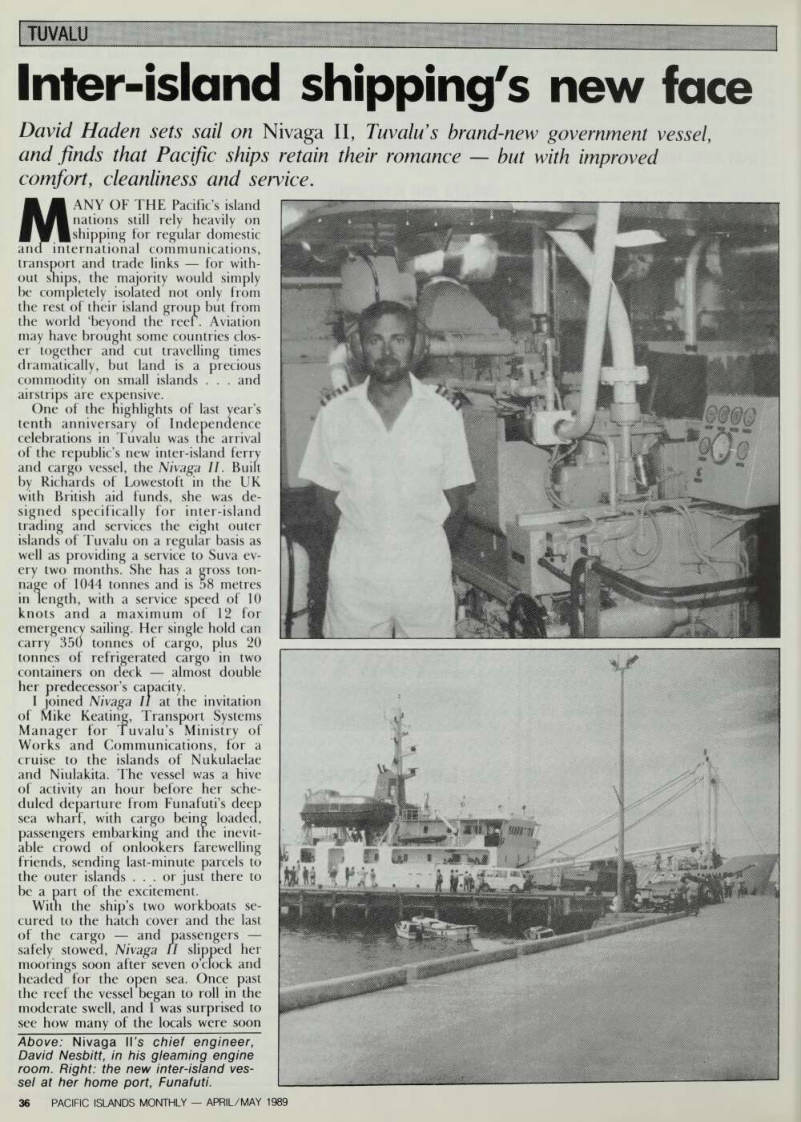
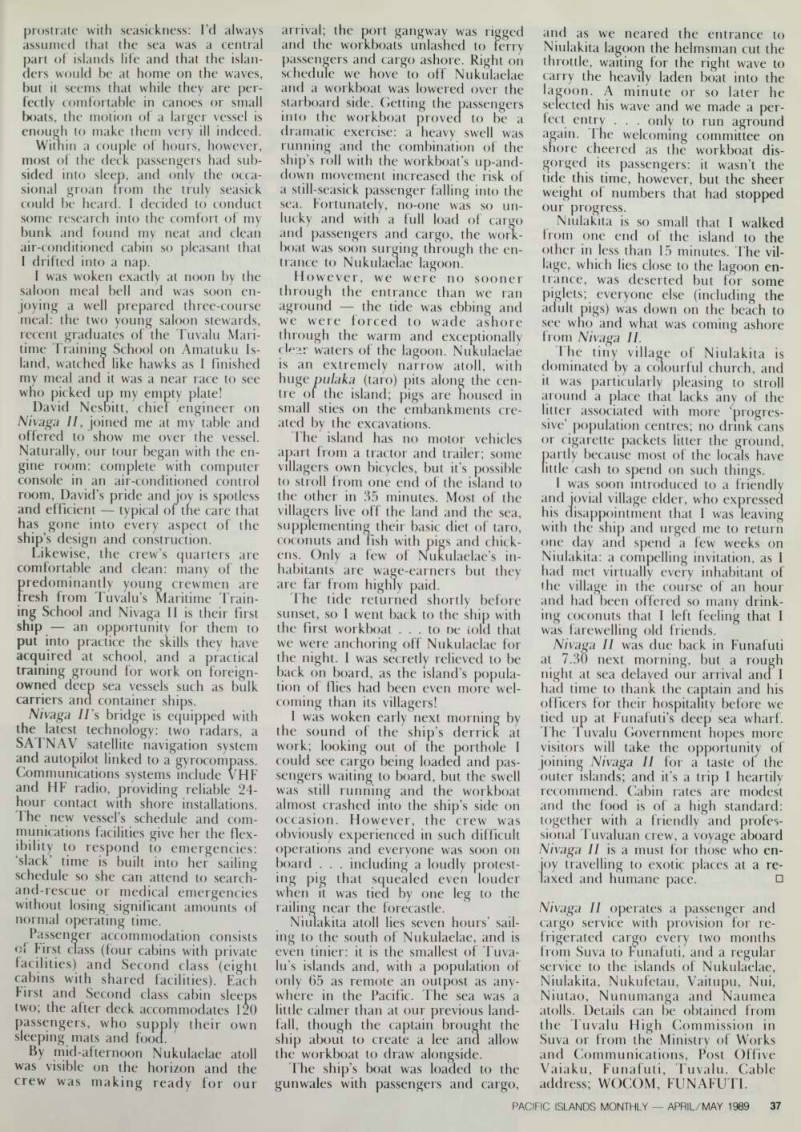
Tuvalu
David Haden sets sail on Nivaga 11, Tuvalu’s brand-new government vessel, and finds that Pacific ships retain their romance but with improved comfort, cleanliness and service.
MANY OF THE Pacific’s island nations still rely heavily on
shipping for regular domestic
ernational communications, transport and trade links for with
out snips, the majority would simply
be completely isolated not only from the rest of their island group but from the world ‘beyond the reer. Aviation may have brought some countries clos er together and cut travelling times dramatically, but land is a precious commodity on small islands . . . and
airstrips are expensive.
One of the highlights of last year’s
tenth anniversary of Independence
celebrations in Tuvalu was tne arrival of the republic’s new inter-island ferry and cargo vessel, the Nivaga 11. Built by Richards of Lowestoft in the UK with British aid funds, she was de
signed specifically for inter-island
trading and services the eight outer islands of Tuvalu on a regular basis as well as providing a service to Suva ev ery two months. She has a gross ton nage of 1044 tonnes and is o 8 metres in length, with a service speed of 10 knots and a maximum of 12 for emergency sailing. Her single hold can carry 350 tonnes of cargo, plus 20 tonnes of refrigerated cargo in two containers on deck almost double
her predecessor’s capacity.
I joined Nivaga II at the invitation
of Mike Keating, Transport Systems
Manager for Tuvalu’s Ministry of Works and Communications, for a cruise to the islands of Nukulaelae and Niulakita. The vessel was a hive of activity an hour before her sche duled departure from Funafuti’s deep sea wharf, with cargo being loaded, passengers embarking and tne inevit able crowd of onlookers farewelling friends, sending last-minute parcels to the outer islands ... or just there to be a part of the excitement.
Witn the ship’s two workboats se cured to the hatch cover and the last of the cargo and passengers
safely stowed, Nivaga II slipped her
moorings soon after seven o’clock and headed for the open sea. Once past the reef the vessel began to roll in the moderate swell, and 1 was surprised to see how many of the locals were soon
Above: Nivaga Il's chief engineer, David Nesbitt, in his gleaming engine room. Right: the new inter-island ves sel at her home port, Funafuti.
prostrate with seasickness: I’d always assumed that the sea was a central part of islands life and that the islan ders would be at home on the waves, but it seems that while they are per fectly comfortable in canoes or small boats, the motion of a larger vessel is enough to make them very ill indeed.
Witnin a couple of hours, however, most of the deck passengers had sub sided into sleep, and only the occa sional groan from the truly seasick could be heard. I decided to conduct some research into the comfort of my bunk and found my neat and clean air-conditioned cabin so pleasant that I drifted into a nap.
I was woken exactly at noon by the saloon meal bell and was soon en joying a well prepared three-course meal: the two young saloon stewards, recent graduates of the Tuvalu Mari time Training School on Amatuku Is land, watchea like hawks as 1 finished my meal and it was a near race to see who picked up my empty plate!
David Nesbitt, chief engineer on Nivaga //, joined me at my table and offered to show me over the vessel.
Naturally, our tour began with the en gine room: complete with computer console in an air-conditioned control room, David’s pride and jov is spotless and efficient typical of the care that has gone into every aspect of the
ship’s design and construction.
Likewise, the crew’s quarters are comfortable and clean: many of the predominantly young crewmen are fresh from Tuvalu’s Maritime Train ing School and Nivaga II is their first ship an opportunity for them to put into practice the skills they have acquired at school, and a practical
training ground for work on foreign
owned deep sea vessels such as bulk carriers and container ships.
Nivaga lls bridge is equipped with
the latest technology: two radars, a SATNAV satellite navigation system and autopilot linked to a gyrocompass.
Communications systems include VHF and HF radio, providing reliable 24hour contact with shore installations.
The new vessel’s schedule and com munications facilities give her the flex
ibility to respond to emergencies:
‘slack’ time is built into her sailing schedule so she can attend to search and-rescue or medical emergencies without losing significant amounts of normal operating time. accommodation consists of First class (four cabins with private facilities) and Second class (eight cabins with shared facilities). Each First and Second class cabin sleeps two; the after deck accommodates 120 passengers, who supply their own sleeping mats and food.
By mid-afternoon Nukulaelae atoll was visible on the horizon and the crew was making ready for our
arrival; the port gangway was rigged and the worxboats unlashed to ferry passengers and cargo ashore. Right on schedule we hove to off Nukulaelae and a workboat was lowered over the starboard side. Getting the passengers into the workboat provea to be a dramatic exercise: a heavy swell was running and the combination of the ship’s roll with the workboat’s up-and down movement increased the risk of a still-seasick passenger falling into the sea. Fortunately, no-one was so un lucky and with a full load of cargo and passengers and cargo, the work boat was soon surging through the en trance to Nukulaelae lagoon.
However, we were no sooner through the entrance than we ran aground the tide was ebbing and we were forced to wade ashore through the warm and exceptionally clear waters of the lagoon. Nukulaelae is an extremely narrow atoll, with huge pulaka (taro) pits along the cen tre of the island; pigs are housed in small sties on the embankments cre ated by the excavations.
The island has no motor vehicles apart from a tractor and trailer; some
villagers own bicycles, but it’s possible
to stroll from one end of the island to the other in 35 minutes. Most of the villagers live off the land and the sea, supplementing their basic diet of taro, coconuts and fish with pigs and chick ens. Only a few of Nutulaelae’s in habitants are wage-earners but they are far from highly paid.
The tide returned shortly before sunset, so I went back to the ship with the first workboat . . . to oe told that we were anchoring off Nukulaelae for the night. I was secretly relieved to be back on board, as the island’s popula tion of flies had been even more wel
coming than its villagers!
I was woken early next morning by the sound of the ship’s derrick at work; looking out of the porthole 1 could see cargo being loaded and pas sengers waiting to board, but the swell was still running and the workboat almost crashed into the ship’s side on occasion. However, the crew was obviously experienced in such difficult operations and everyone was soon on board . . . including a loudly protest
ing pig that squealed even louder
when it was tied by one leg to the railing near the forecastle.
Niulakita atoll lies seven hours’ sail ing to the south of Nukulaelae, and is even tinier: it is the smallest of Tuva lu’s islands and, with a population of only 65 as remote an outpost as any where in the Pacific. The sea was a little calmer than at our previous land
fall, though the captain brought the
ship about to create a lee and allow the workboat to draw alongside.
The ship’s boat was loaded to the gunwales with passengers and cargo,
and as we neared the entrance to Niulakita lagoon the helmsman cut the throttle, waiting for the right wave to carry the heavily laden boat into the lagoon. A minute or so later he selected his wave and we made a per fect entry . . . only to run aground again. The welcoming committee on shore cheered as the workboat dis gorged its passengers: it wasn’t the tide this time, however, but the sheer weight of numbers that had stopped our progress.
Niulakita is so small that I walked from one end of the island to the other in less than 15 minutes. The vil lage, which lies close to the lagoon en trance, was deserted but for some piglets; everyone else (including the adult pigs) was down on the beach to see who and what was coming ashore from Nivaga 11.
The tiny village of Niulakita is dominated by a colourful church, and it was particularly pleasing to stroll around a place that lacks any of the litter associated with more ‘progres sive’ population centres; no drink cans
or cigarette packets litter the ground,
partly because most of the locals have little cash to spend on such things.
I was soon introduced to a friendly and jovial village elder, who expressed his disappointment that I was leaving with the ship and urged me to return one day and spend a few weeks on Niulakita: a compelling invitation, as I had met virtually every inhabitant of the village in the course of an hour and had been offered so many drink ing coconuts that I left feeling that I was larewelling old friends.
Nivaga II was due back in Funafuti at 7.30 next morning, but a rough night at sea delayed our arrival and I had time to thank the captain and his officers for their hospitality before we tied up at Funafuti’s deep sea wharf.
The Tuvalu Government hopes more visitors will take the opportunity of joining Nivaga II for a taste of the outer islands; and it’s a trip I heartily recommend. Cabin rates are modest and the food is of a high standard:
together with a friendly' and profes
sional Tuvaluan crew, a voyage aboard Nivaga II is a must for those who en joy travelling to exotic places at a re laxed and humane pace. □ Nivaga II operates a passenger and cargo service with provision for re frigerated cargo every two months from Suva to Funafuti, and a regular service to the islands of Nukulaelae, Niulakita, Nukufetau, Vaitupu, Nui, Niutao, Nunumanga and Naumea atolls. Details can be obtained from the Tuvalu High Commission in Suva or from the Ministry of Works and Communications, Post Offive Vaiaku, Funafuti, Tuvalu. Cable address; WOCOM, FUNAFUTI.
development
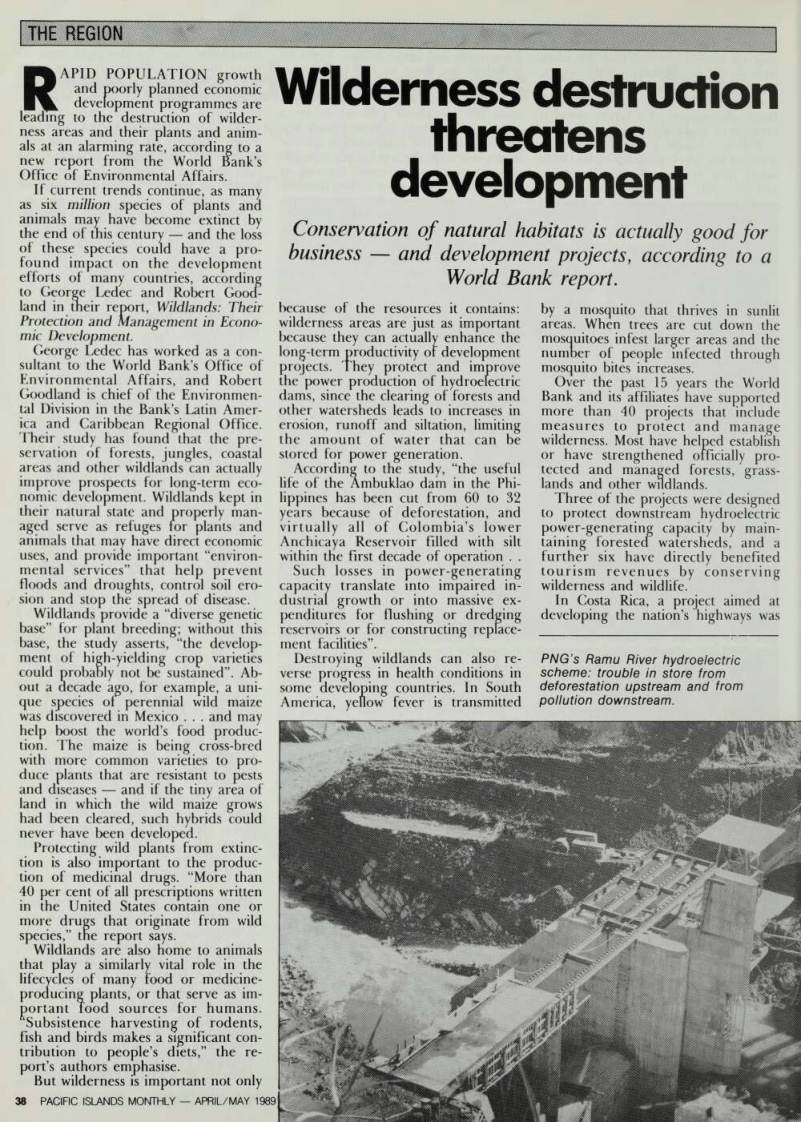

The Region
Wilderness destruction threatens development
Rapid population growth
and poorly planned economic
development programmes are leading to the destruction of wilder ness areas and their plants and anim als at an alarming rate, according to a new report from the World Bank’s Office of Environmental Affairs.
If current trends continue, as many as six million species of plants and animals may have become extinct by the end of tnis century and the loss of these species could have a pro found impact on the development efforts of many countries, according to George Ledec and Robert Good land in tneir report, Wildlands: Their Protection and Management in Econo
mic Development.
George Ledec has worked as a con sultant to the World Bank’s Office of Environmental Affairs, and Robert Goodland is chief of the Environmen tal Division in the Bank’s Latin Amer ica and Caribbean Regional Office.
Their study has found that the pre servation of forests, jungles, coastal areas and other wildlands can actually improve prospects for long-term eco nomic development. Wildlands kept in their natural state and properly man aged serve as refuges for plants and animals that may have direct economic uses, and provide important “environ mental services” that help prevent floods and droughts, control soil ero sion and stop the spread of disease.
Wildlands provide a “diverse genetic base” for plant breeding; without this base, the study asserts, “the develop ment of high-yielding crop varieties could probably not be sustained”. Ab out a decade ago, for example, a uni que species of perennial wild maize was discovered in Mexico . . . and may help boost the world’s food produc tion. The maize is being cross-bred with more common varieties to pro duce plants that are resistant to pests and diseases and if the tiny area of land in which the wild maize grows had been cleared, such hybrids could never have been developed.
Protecting wild plants from extinc tion is also important to the produc tion of medicinal drugs. “More than 40 per cent of all prescriptions written in the United States contain one or more drugs that originate from wild species,” the report says.
Wildlands are also home to animals that play a similarly vital role in the lifecycles of many food or medicine producing plants, or that serve as im portant food sources for humans. harvesting of rodents, fish and birds makes a significant con tribution to people’s diets,” the re
port’s authors emphasise.
But wilderness is important not only
Conservation of natural habitats is actually good for business and development projects, according to a World Bank report.
because of the resources it contains: wilderness areas are just as important because they can actually enhance the
long-term productivity of development
projects. They protect and improve the power production of hydroelectric dams, since the clearing of forests and other watersheds leads to increases in erosion, runoff and siltation, limiting the amount of water that can be stored for power generation.
According to the study, “the useful life of the Ambuklao dam in the Phi lippines has been cut from 60 to 32 years because of deforestation, and virtually all of Colombia’s lower Anchicaya Reservoir filled with silt within the first decade of operation . .
Such losses in power-generating capacity translate into impaired in dustrial growth or into massive ex
penditures for flushing or dredging
reservoirs or for constructing replace ment facilities”.
Destroying wildlands can also re verse progress in health conditions in some developing countries. In South America, yellow fever is transmitted
by a mosquito that thrives in sunlit areas. When trees are cut down the mosquitoes infest larger areas and the number of people infected through mosquito bites increases, Over the past 15 years the World Bank and its affiliates have supported more than 40 projects that include measures to protect and manage wilderness. Most have helped establish or have strengthened officially pro tected and managed forests, grass lands and other wildlands, Three of the projects were designed to protect downstream hydroelectric
power-generating capacity by main
taining forested watersheds, and a further six have directly benefited
tourism revenues by conserving
wilderness and wildlife, In Costa Rica, a project aimed at developing the nation’s highways was
PNG’s Ramu River hydroelectric scheme: trouble in store from deforestation upstream and from pollution downstream.
accompanied by measures to prevent clearing of forests which not only reduce the risk of floods, but help prevent road washouts and landslides.
Including wilderness protection
measures in development projects is relatively inexpensive and can increase the success of projects, the authors found. In Indonesia, an irrigation project on the island of Sulawesi bene fited from efforts to set up the Dumo ga-Bone National Park as the park’s tree cover controls runoff and pre vents sediment building up in irriga tion canals, ensuring a steady year round water supply for farmers.
Because of the variety of roles play ed by wilderness in the development process, governments and develop ment agencies must intensify their efforts to protect these areas, ‘‘ln the design and execution of development projects, wildland management con cerns need to be given their proper
place and weight,” the study argues.
must be part of the planning process from the very beginning and must be put on a par with convention al economic criteria in deciding whether a project is justified.”
Failure to pay adequate attention to environmental concerns “exacts penal ties in the harm done to future generations and in the heavy costs of repairing damage to the environment or of replacing goods and services that were once taken for granted.”
Tellingly, the authors make the con cluding point that the effects of en vironmental damage are felt most by the poor those who are least able to “escape the consequences of a de graded environment, and who often depend directly on natural resources for their livelihoods”. □ Courtesy World Bank News
Advertisements & other items, p. 39 (1 item)
«B Samsung
STAMP COLLECTION!
Beautiful First Day Covers and Postcards of Solomon Islands Stamps are now on sale. 1989 release dates are as follows
* ORCHIDS PTII 20th Jan
* 125TH ANNIVERSARY OF RED CROSS 16TH MAY.
* NUBIBRANCHES JULY
* 20TH ANNIVERSARY OF MOON LANDING AUG/SEPT
* XMAS. OCT.
* CHILDREN’S GAMES NOW
For orders contact:- 0 V Solomon Islands Philatelic Bureau Ltd. A \ C/- General Post Office Honiara, Solomon Islands xfcw Tel. (Honiara) 22108 m
«B SAMSUNG
PRODUCTS FOR PEOPLE WITH MORE
SENSE THAN MONEY
// To own a Samsung TV Screen, Samsung Video Deck and Samsung Remote Control Unit!
That’** Great!
That makes the Samsung Combination the most inexpensive of its kind. Go for the best view. Samsung quality is good enough for the 1988 Olympic Games. Should be ideal for your home!
Available at selected Duty Free Dealers and Burns Philp Home Centres
throughout Fiji.
Cgg SAMSUNG
SOLE DISTRIBUTORS:-
CORRIE & COMPANY
HEAD OFFICE
G.P.O. BOX 45. SUVA
TLX: FJ2166
CABLES; CORRICO’ SUVA
TELEPHONE: 386777
BANKERS: WESTPAC, SUVA
FAX: (679) 300610
BRANCH OFFICE:
161 VITOGO PARADE
G.P.O. BOX 83, LAUTOKA
CABLES: “CORRICO” LAUTOKA
TELEPHONE; 60137
'Moresby' in profile
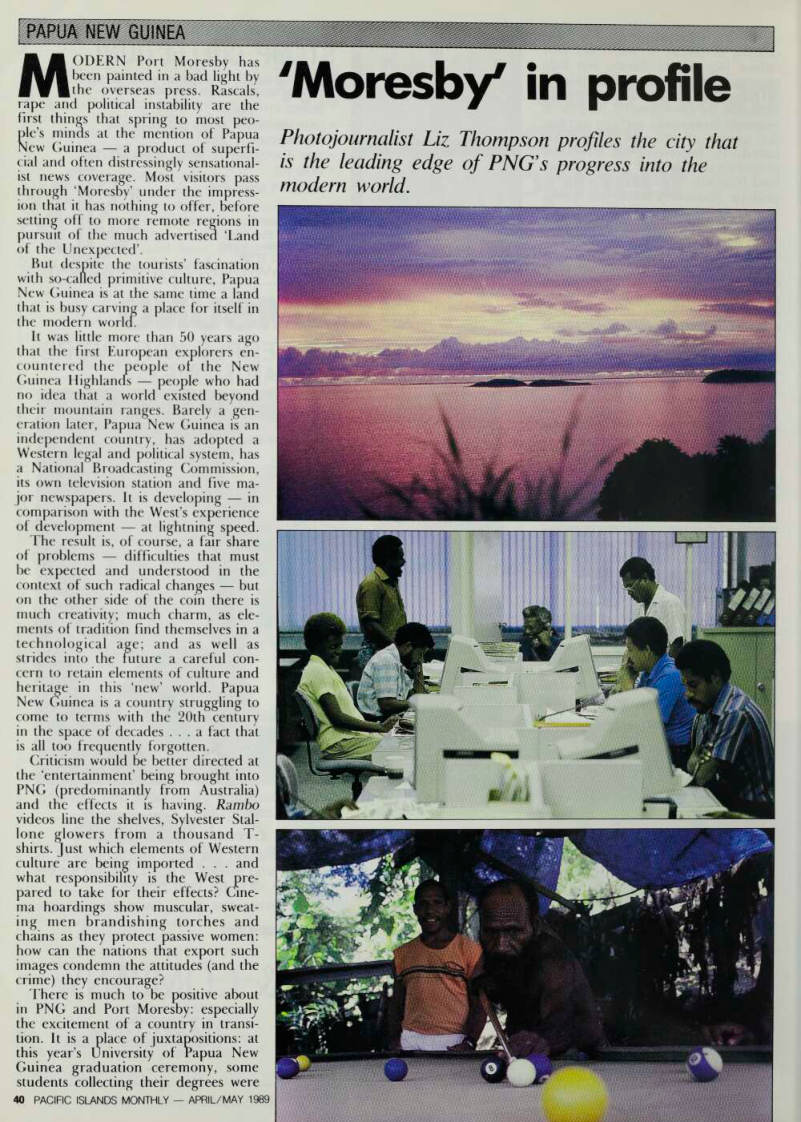
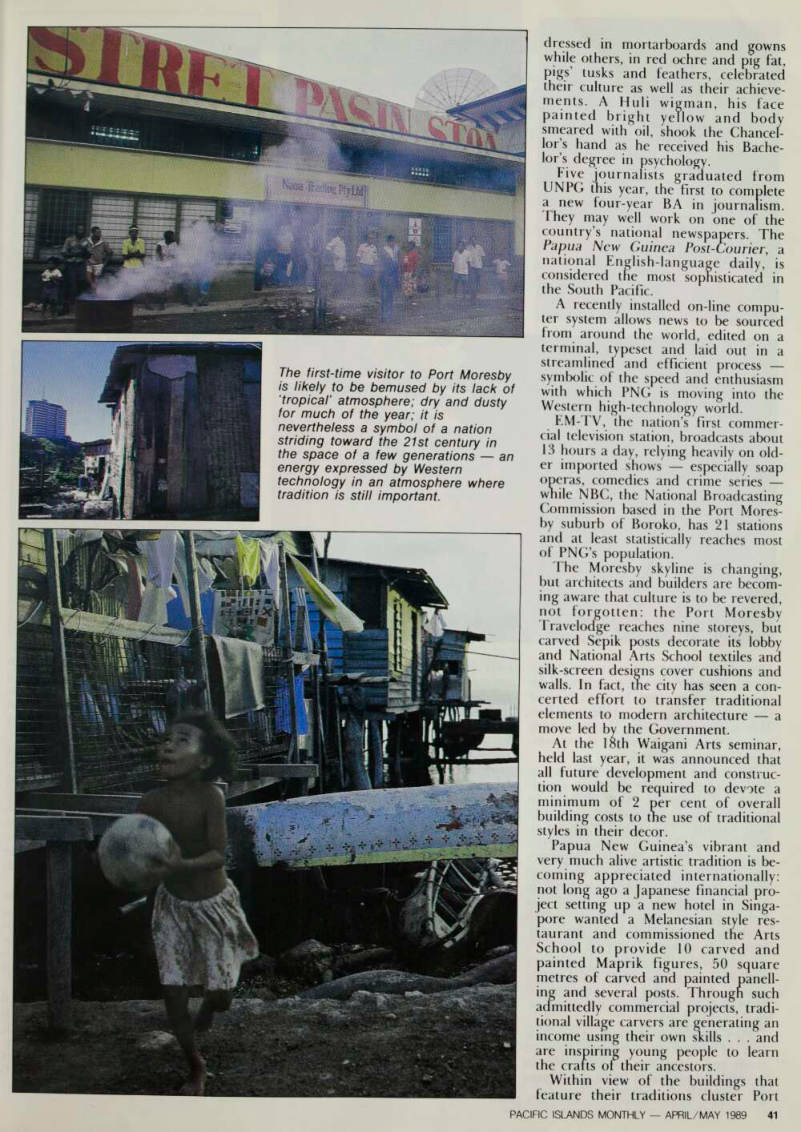
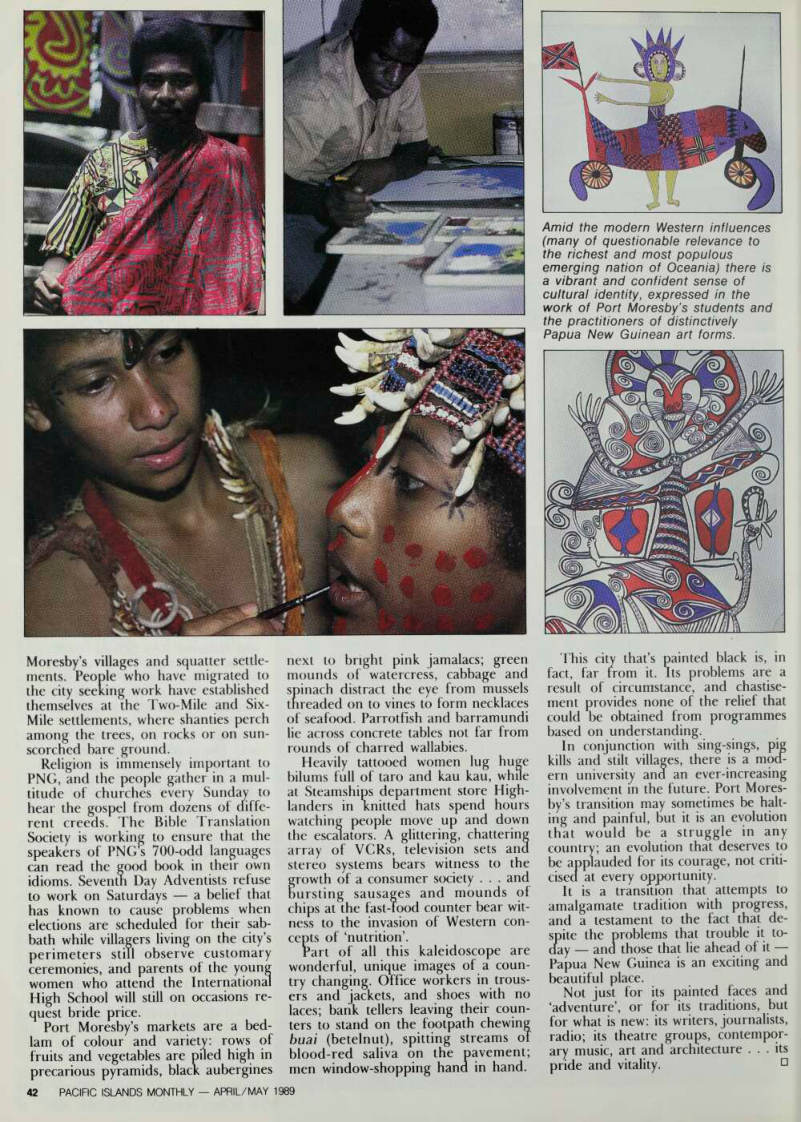
Papua New Guinea
Photojournalist Liz Thompson profiles the city that is the leading edge of PNG’s progress into the modern world.
MODERN Port Moresby has
been painted in a bad light by the overseas press. Rascals, rape and political instability are the first things that spring to most peo ple’s minds at the mention of Papua New Guinea a product of superfi cial and often distressingly sensational ist news coverage. Most visitors pass
through ‘Moresby’ under the impress
ion that it has nothing to offer, before setting off to more remote regions in pursuit of the much advertised ‘Land of the Unexpected’.
But despite the tourists’ fascination with so-called primitive culture, Papua New Guinea is at the same time a land that is busy carving a place for itself in the modern worlcf.
It was little more than 50 years ago that the first European explorers en countered the people of the New Guinea Highlands people who had no idea that a world existed beyond their mountain ranges. Barely a gen eration later, Papua New Guinea is an independent country, has adopted a Western legal and political system, has a National Broadcasting Commission, its own television station and five ma jor newspapers. It is developing in comparison with the West’s experience
of development at lightning speed.
The result is, of course, a fair share of problems difficulties that must be expected and understood in the context of such radical changes but on the other side of the coin there is much creativity; much charm, as ele ments of tradition find themselves in a technological age; and as well as strides into the future a careful con cern to retain elements of culture and heritage in this ‘new’ world. Papua New Guinea is a country struggling to come to terms with the 20th century in the space of decades ... a fact that is all too frequently forgotten.
Criticism would be better directed at the ‘entertainment’ being brought into PNG (predominantly from Australia) and the effects it is having. Rambo videos line the shelves, Sylvester Stal lone glowers from a tnousand T shirts. Just which elements of Western culture are being imported . . . and what responsibility is the West pre pared to take for their effects? Cine ma hoardings show muscular, sweat ing men brandishing torches and chains as they protect passive women: how can the nations that export such images condemn the attitudes (and the
crime) they encourage?
There is much to be positive about in PNG and Port Moresby: especially the excitement of a country in transi tion. It is a place of juxtapositions: at this year’s University of Papua New Guinea graduation ceremony, some students collecting their degrees were
dressed in mortarboards and gowns while others, in red ochre and pig fat, pigs’ tusks and feathers, celebrated their culture as well as their achieve ments. A Huli wigman, his face
painted bright yellow and body
smeared with oil, shook the Chancel lor’s hand as he received his Bache
lor’s degree in psychology.
Five Journalists graduated from UNPG this year, the first to complete a new four-year BA in journalism.
They may well work on one of the country’s national newspapers. The Papua New Guinea Post-Courier, a
national English-language daily, is
considered the most sophisticated in the South Pacific.
A recently installed on-line compu ter system allows news to be sourced from around the world, edited on a terminal, typeset and laid out in a streamlined and efficient process symbolic of the speed and enthusiasm with which PNG is moving into the Western high-technology world.
EM-Ty, the nation’s first commer cial television station, broadcasts about 13 hours a day, relying heavily on old er imported shows especially soap operas, comedies and crime series wnile NBC, the National Broadcasting Commission based in the Port Mores by suburb of Boroko, has 21 stations and at least statistically reaches most of PNG’s population.
The Moresby skyline is changing,
but architects and builders are becom ing aware that culture is to be revered, not forgotten: the Port Moresby Travelodge reaches nine storeys, but carved Sepik posts decorate its lobby and National Arts School textiles and silk-screen designs cover cushions and walls. In fact, tne city has seen a con certed effort to transfer traditional elements to modern architecture a move led by the Government.
At the 18th Waigani Arts seminar, held last year, it was announced that all future development and construc tion would be required to devote a minimum of 2 per cent of overall building costs to tne use of traditional styles in their decor.
Papua New Guinea’s vibrant and very much alive artistic tradition is be
coming appreciated internationally:
not long ago a Japanese financial pro ject setting up a new hotel in Singa pore wanted a Melanesian style res taurant and commissioned the Arts School to provide 10 carved and
painted Maprik figures, 50 square
metres of carved and painted panell ing and several posts. Through such
admittedly commercial projects, tradi
tional village carvers are generating an income using their own skills . . . and are inspiring young people to learn the crafts of their ancestors.
Within view of the buildings that feature their traditions cluster Port
The first-time visitor to Port Moresby is likely to be bemused by its lack of ‘tropical’ atmosphere; dry and dusty for much of the year; it is nevertheless a symbol of a nation striding toward the 21st century in the space of a few generations - an energy expressed by Western technology in an atmosphere where tradition is still important.
Moresby’s villages and squatter settle ments. People who have migrated to the city seeking work have established themselves at the Two-Mile and Six- Mile settlements, where shanties perch among the trees, on rocks or on sun scorched bare ground.
Religion is immensely important to PNG, and the people gather in a mul titude of churches every Sunday to hear the gospel from dozens of diffe rent creeds. The Bible Translation Society is working to ensure that the speakers of PNG’s 700-odd languages can read the good book in their own idioms. Seventh Day Adventists refuse to work on Saturdays a belief that has known to cause problems when elections are scheduled for their sab bath while villagers living on the city’s perimeters still observe customary ceremonies, and parents of the young women who attend the International High School will still on occasions re quest bride price.
Port Moresby’s markets are a bed lam of colour and variety: rows of fruits and vegetables are piled high in
precarious pyramids, black aubergines
next to bright pink jamalacs; green
mounds of watercress, cabbage and spinach distract the eye from mussels threaded on to vines to form necklaces of seafood. Parrotfish and barramundi lie across concrete tables not far from rounds of charred wallabies.
Heavily tattooed women lug huge bilums full of taro and kau kau, while
at Steamships department store High
landers in Knitted hats spend hours watching people move up and down the escalators. A glittering, chattering array of VCRs, television sets and stereo systems bears witness to the growth of a consumer society . . . and bursting sausages and mounds of chips at the fast-food counter bear wit ness to the invasion of Western con cepts of ‘nutrition’.
Part of all this kaleidoscope are wonderful, unique images of a coun try changing. Office workers in trous ers and jackets, and shoes with no laces; bank tellers leaving their coun ters to stand on the footpath chewing buai (betelnut), spitting streams of blood-red saliva on the pavement; men window-shopping hand in hand.
This city that’s painted black is, in fact, far from it. Its problems are a result of circumstance, and chastise ment provides none of the relief that could be obtained from programmes based on understanding.
In conjunction with sing-sings, pig
kills and stilt villages, there is a mod ern university and an ever-increasing involvement in the future. Port Mores by’s transition may sometimes be halt ing and painful, but it is an evolution that would be a struggle in any country; an evolution that deserves to be applauded for its courage, not criti cised at every opportunity.
It is a transition that attempts to amalgamate tradition with progress, and a testament to the fact that de spite the problems that trouble it to day ana those that lie ahead of it Papua New Guinea is an exciting and
beautiful place.
Not just for its painted faces and ‘adventure’, or for its traditions, but for what is new: its writers, journalists, radio; its theatre groups, contempor ary music, art and architecture ... its
pride and vitality. D
Amid the modern Western influences (many of questionable relevance to the richest and most populous emerging nation of Oceania) there is a vibrant and confident sense of cultural identity, expressed in the work of Port Moresby’s students and the practitioners of distinctively Papua New Guinean art forms.
Sir James Henare: 1977-1989
Transition
Davidßobie writes on the passing of one of New Zealand’s great rangatiras.
TRIBUTES flowed from through
out the Pacific when one of. the great rangatiras of New Zealand, Sir James Henare a distinguished soldier, farmer, politician, ana advo cate of Maori causes died on April 2, aged 78. PM David Lange described him as having lived a life that exem
plified the partnership promised in
the Treaty of Waitangi.
“Sir James walked easily in both worlds, Maori and Pakeha, he said, “commanding respect for the ways in which he combined the best of the two cultures.” Maori Affairs Minister Koro Wetere added that Honare was one of the poupou (pillars) of Maoridom and one of its greatest leaders.
“Not many leaders of our time owe
their position to quiet dignity rather
than vociferous opportunism. Sir James did,” remarked the New Zea land Herald in an editorial. “His chief ly mana had its roots in a classic Maori upbringing and grew in battle.”
Several thousand people converged
on the Otiria Marae in Northland to
pay their respects after Sir James had died. Four days later he was buried with full military honours near his pa rents at that tiny Tau Henare Marae at Mototau. The procession, with a gun carriage carrying his casket from Otiria, was delayed for three hours to enable a contingent from the Pacific Islands to pay their respects. Mour ners at the tangi (funeral) included the Moari Queen, Dame Te Atairangi Kaahu; Governor-General Sir Paul Reeves, Prime Minister Lange,
Opposition Leader Jim Bolger, chiefs
and elders of many Maori tribes and members of the 28th Maori Battalion.
The paramount chief of Tai Tokcr au, Sir James was born in a nikau palm whare at Mototau, the son of Northern Maori MP Tau Henare. He spoke Maori at home and English at
school; after studying at Massey Agri
cultural College he worked as a bush man and a farm labourer before mar rying Rose Cherrington, a distant cousin to whom he had been bet rothed at birth, in 1933. Together
they broke in a dairy farm in swamp land at Motatau. Four of their six chil dren had been born when World War II broke out and Henare’s father ordered him to sign up.
Joining the New Zealand Army as a private, Henare rose to the rank of
lieutenant-colonel, becoming comman
der of the Maori Battalion and taking part in major actions in North Africa and Italy. Wounded three times, he was awarded the DSO in 1945.
A source of inspiration and wisdom for his people throughout his life, He nare was also staunch in his conviction that the Treaty of Waitangi be hon oured. He championed many Maori causes and helped found the Lohanga reo (language nest) programme, which he is said to have named. He was knighted in 1978.
“His calm voice could move Maori and Pakeha,” noted the Herald. “He had optimism that reserves of goodwill between the races in this country could overcome passing tension. New Zealand must live up to his memory.”□
The Island Press
Reports from the papers, compiled by John Carter
I AM much concerned about the lands nfglTway traVC a ° ng thC Hlgh On March 4 as I was travelling in a bus from Wabag to Mount Hagen, there was a landslide on the way. Peopie cleared the road and after that, thev put logs across the road and stop- Red the vehicles from going to Mount Hagen and back. They asked passengers and the driver to pay KlO each if they wanted to go quickly. If not, the vehicles would be held up for hours.
From a letter in the Papua New Guinea Post-Courier Port Moresby L ' i' i f t- . . y
EIGHT shopkeepers along Lautoka’s
Vitogo Parade had difficulty in opening their shops yesterday because matcnsticks had been inserted in ey oles and padlocks. al«. W hith,? PS i. 01 ? , Vak , at : ale £ tre . et were called h ‘’aT,r , : aUI ? k ? * ho P k sf e P e J s Most ofTh 11 1 from , Su I va ■ break .heir "' e * ho P kee P ers had to shops. P l ° ° pe " the ' r From the Fiji Times, Suva
A SENIOR government minister has called for the reintroduction of the
death penalty.
Trade and Industry Minister Galeva Kwarara also wants to bring back the Vagrancy Act to give courts the power to remove unemployed people from urban centres.
The minister yesterday issued a strongly worded statement calling for
the tougher penalties following the
death of a Rigo man in Port Moresby earlier this month.
“There is a strong case for the rein troduction of capital punishment,” Mr Kwarara, who is MP for Rigo, said.
From the Papua New Guinea Post-Courier, Port Moresby CAPTAIN Bligh’s epic 3600 mile voyage from Tufua, Tonga, to Timor, Indonesia, will be re-enacted on 28 April. The William Bligh Trust in En gland is sponsoring the event to mark the bicentennial of the voyage, which was forced on Captain Bligh and some
15 other members of his crew follow
ing the mutiny on the Bounty.
From the Samoa Times , Apia A MEMBER of staff in the Depart ment of Agriculture is conducting a research study on the country’s most important staple root crop, sweet pota to or kaukau.
The crop, originally found in South America, was introduced to Papua New Guinea some 400 years ago and has attained a prominent place due to its adaptability both in the Highlands and lowland areas.
It provides between 60 and 90 per cent of energy needs in the Highlands and an average of 50 per cent of the national requirement. It has been esti mated that the annual production of sweet potato in the country is about 1.2 million metric tonnes, with a value of Kl5O million.
From the PNG University of Technology’s The Reporter , Lae
Peter Schroeder
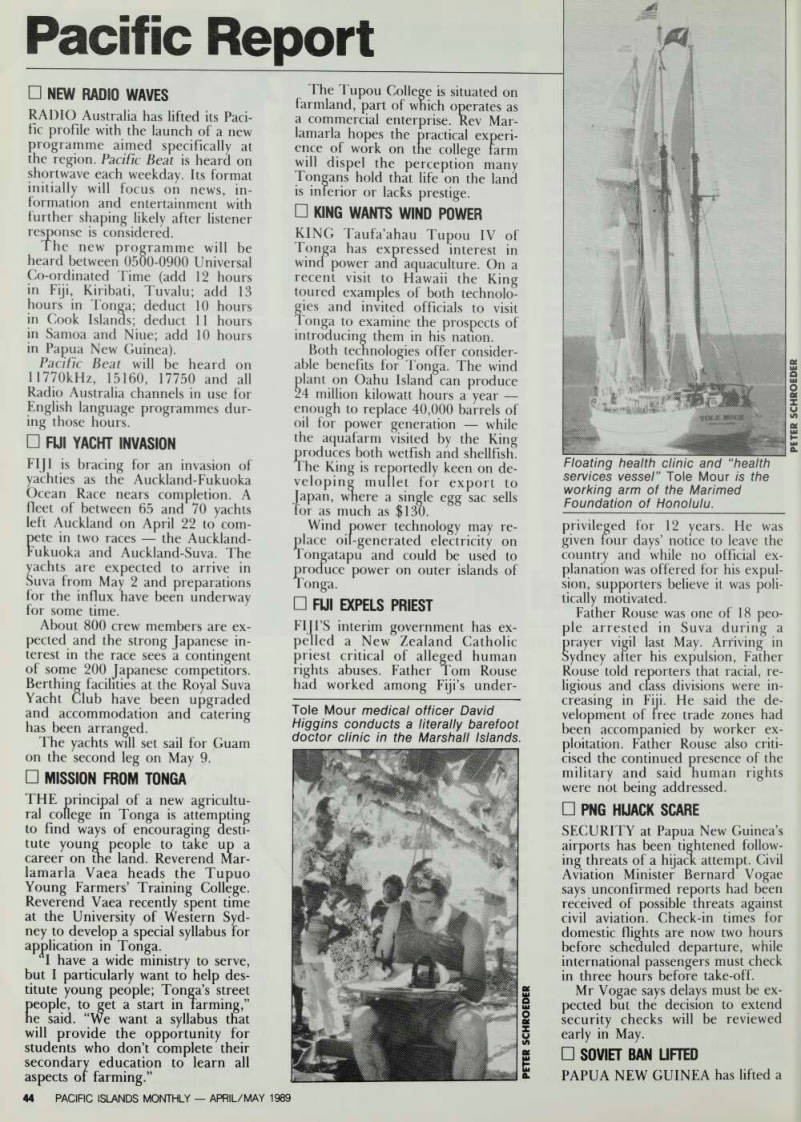


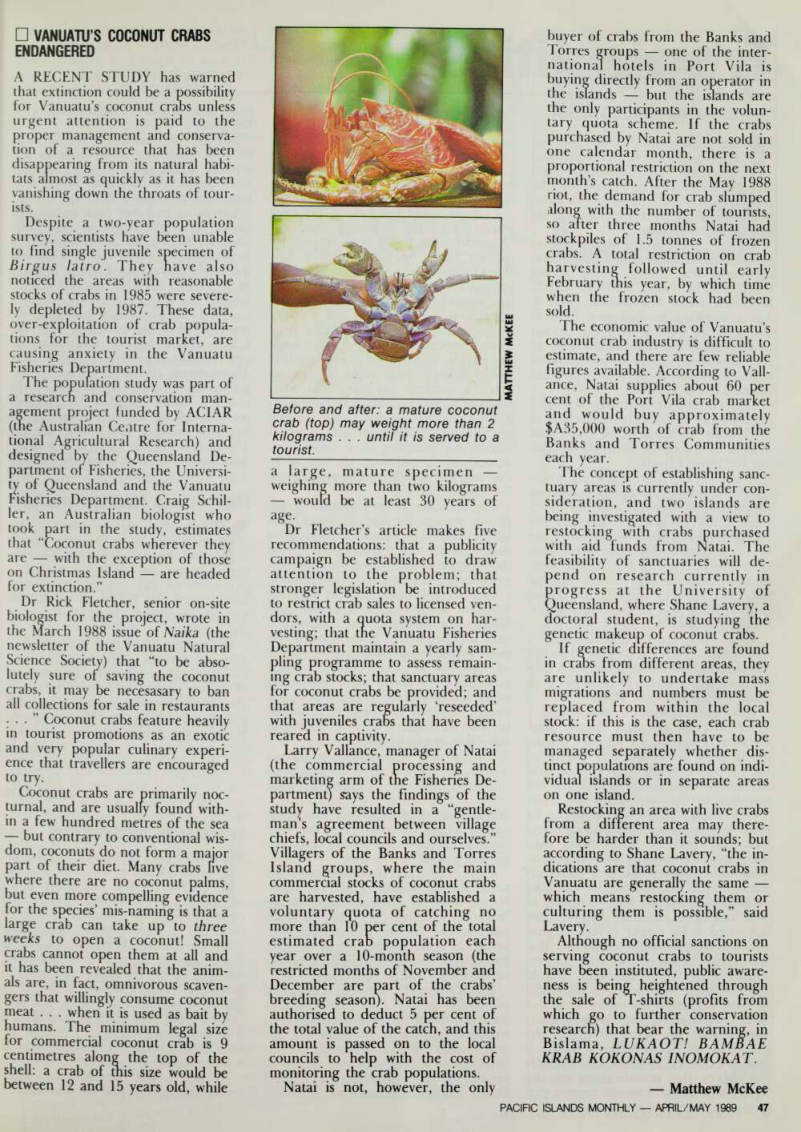
Pacific Report
□ New Radio Waves
RADIO Australia has lifted its Paci fic profile with the launch of a new programme aimed specifically at the region. Pacific Beat is heard on shortwave each weekday. Its format initially will focus on news, in formation and entertainment with further shaping likely after listener response is considered.
The new programme will be heard between 0500-0900 Universal Co-ordinated Time (add 12 hours in Fiji, Kiribati, Tuvalu; add 13 hours in Tonga; deduct 10 hours in Cook Islands; deduct 11 hours in Samoa and Niue; add 10 hours in Papua New Guinea).
Pacific Beat will be heard on 11770 kHz, 15160, 17750 and all Radio Australia channels in use for English language programmes dur ing those hours.
□ Fui Yacht Invasion
FIJI is bracing for an invasion of yachties as the Auckland-Fukuoka Ocean Race nears completion. A fleet of between 65 and 70 yachts left Auckland on April 22 to com pete in two races the Auckland- Fukuoka and Auckland-Suva. The yachts are expected to arrive in Suva from May 2 and preparations for the influx have been underway for some time.
About 800 crew members are ex pected and the strong Japanese in terest in the race sees a contingent of some 200 Japanese competitors.
Berthing facilities at the Royal Suva Yacht Club have been upgraded and accommodation and catering has been arranged.
The yachts will set sail for Guam on the second leg on May 9.
□ Mission From Tonga
THE principal of a new agricultu ral college in Tonga is attempting to find ways of encouraging desti tute young people to take up a career on the land. Reverend Mar lamarla Vaea heads the Tupuo
Young Farmers’ Training College.
Reverend Vaea recently spent time at the University of Western Syd ney to develop a special syllabus for application in Tonga.
A l have a wide ministry to serve, but I particularly want to help des titute young people; Tonga’s street people, to get a start in farming,” ne said. “We want a syllabus that will provide the opportunity for students who don’t complete their secondary education to learn all aspects of farming.”
The Tupou College is situated on farmland, part of which operates as a commercial enterprise. Rev Mar
lamarla hopes the practical experi
ence of work on the college farm will dispel the perception many Tongans hold that life on the land is inferior or lacks prestige.
□ King Wants Wind Power
KING Taufa’ahau Tupou IV of Tonga has expressed interest in wind power and aquaculture. On a recent visit to Hawaii the King toured examples of both technolo fies and invited officials to visit onga to examine the prospects of introducing them in his nation.
Both technologies offer consider able benefits for Tonga. The wind plant on Oahu Island can produce 54 million kilowatt hours a year enough to replace 40,000 barrels of oil for power generation while
the aquafarm visited by the King
produces both wetfish and shellfish.
The King is reportedly keen on de veloping mullet for export to Japan, wnere a single egg sac sells for as much as $l3O.
Wind power technology may re
place oil-generated electricity on
Tongatapu and could be used to produce power on outer islands of Tonga.
□ Fui Expels Priest
FIJI’S interim government has ex pelled a New Zealand Catholic priest critical of alleged human rights abuses. Father Tom Rouse had worked among Fiji’s under-
privileged for 12 years. He was given four days’ notice to leave the country and while no official ex planation was offered for his expul sion, supporters believe it was poli
tically motivated.
Father Rouse was one of 18 peo ple arrested in Suva during a
prayer vigil last May. Arriving in
Sydney after his expulsion, Father Rouse told reporters that racial, re ligious and class divisions were in creasing in Fiji. He said the de velopment of tree trade zones had been accompanied by worker ex ploitation. Father Rouse also criti cised the continued presence of the military and said numan rights were not being addressed.
□ Png Huack Scare
SECURITY at Papua New Guinea’s airports has been tightened follow ing threats of a hijacx attempt. Civil Aviation Minister Bernard Vogae says unconfirmed reports had been received of possible threats against civil aviation. Check-in times for domestic flights are now two hours before scheduled departure, while international passengers must check in three hours before take-off.
Mr Vogae says delays must be ex pected but the decision to extend security checks will be reviewed
early in May.
□ Soviet Ban Lifted
PAPUA NEW GUINEA has lifted a
Tole Mour medical officer David Higgins conducts a literally barefoot doctor clinic in the Marshall Islands.
Floating health clinic and "health services vessel” Tole Mour is the working arm of the Marimed Foundation of Honolulu.
Peter Schroeder
10-year ban on port calls by Soviet cruise ships. The move paves the way for the opening of diplomatic relations between the two countries.
The ban was imposed in 1979 as a protest against Soviet intervention m Afghanistan. Foreign Minister Michael Somare said the easing of certain aspects of the ban was de signed to enable normal relations between PNG and the Soviet Union to be restored.
Soviet cruise ships will be allowed to dock in PNG ports and their sailors will be allowed ashore but the ban will still apply to Soviet fishing vessels. Negotiations with Moscow over a possible fishing agreement were reportedly unlikely before diplomatic ties are formally established.
□ Marshalls Health Cruise
ISOLATED islands often cannot provide adequate medical care and health services. To overcome this problem, a three-masted 50-metre schooner, the Tole Mour, has com menced operation around the Mar shall Islands as a floating health cli nic. The Marimed Foundation of Honolulu funded construction of the traditional tall ship, which has been serving communities in the Marshalls since December 1988.
The ship spent one month at Arno Atoll providing health ser vices and training clinics. A 17member health team of staff and volunteers visited eleven communi ties on the atoll.
Tole Mour is not a hospital ship but rather a “health services vessel .
It is equipped with an exam room, dental and eye clinics, a diagnostic
laboratory, X-ray room and
pharmacy. It is designed to help the Marshall Islands Health Minis try conduct its programme of health care on isolated coral atolls.
□ Iguanas On Increase
IGUANA population has increased on the Fijian island of Yaduatabu since the National Trust of Fiji de clared it a protected area. When the trust took over the island there were only 500 of the rare crested iguana to be found. But since the listing of the area as protected in 1981 the population has increased to almost 8000.
The people of Yaduatambu used the island to raise goats until 1981 when it was found the iguanas were dying out because the goats were destroying the vegetation. An agreement was reached with the re sidents, the goats were removed and a marked increase in iguana numbers was noticed almost im
mediately.
□ Nauru: A Correction
A REPORT on page 36 of the February issue of Pacific Islands Monthly, headed ‘Australia, NZ Si lent on Nauru Compensation Claim’ contained two errors.
The article stated: “The three na tions, Australia, NZ and UK, made
a pre-independence payment of $2l million intended to cover re habilitation costs to that date.” A spokesman for the Republic of Nauru has asked us to point out that it was, in fact, the Republic of Nauru that paid $2l million to the British Phosphate Commission under the requirements of the 1967 Phosphate Agreement be tween the Nauruan Local Govern ment Council and the three partner governments.
In the same article, Nauruan President Hammer Deßoburt is quoted as saying that Nauruans could not be asked to use their own funds to rehabilitate mining that had taken place both before and after independence. His statement said that Nauruans could not be ex pected to use their funds for pre
independence rehabilitation.
□ Sounds Of Music
A SPECIAL exhibition of Pacific musical instruments will be on show at Auckland Museum during May.
“The Sounds of Oceania” display coincides with the publication of a new book, by Auckland University ethnomusicology lecturer Dr Richard Moyle, wnich describes the Museum’s collection for an interna tional audience.
Reverend Malamarla Vaea, of the Tupou Young Farmers’ Training Col lege, Tonga helping Tonga's desti tute young.
□ Vanuatu’S Coconut Crabs
Endangered
A RECENT STUDY has warned that extinction could be a possibility for Vanuatu’s coconut craos unless urgent attention is paid to the proper management and conserva tion of a resource that has been disappearing from its natural habi tats almost as quickly as it has been vanishing down the throats of tour ists.
Despite a two-year population
survey, scientists have been unable
to find single juvenile specimen of
Birgus latro. They nave also
noticed the areas with reasonable stocks of crabs in 1985 were severe
ly depleted by 1987. These data,
over-exploitation of crab popula
tions for the tourist market, are causing anxiety in the Vanuatu
Fisheries Department.
The population study was part of a research and conservation man agement project funded by ACIAR (the Australian Centre for Interna tional Agricultural Research) and
designed by the Queensland De
partment of Fisheries, the Universi ty of Queensland and the Vanuatu
Fisheries Department. Craig Schil
ler, an Australian biologist who took part in the study, estimates that “Coconut crabs wherever they are with the exception of those on Christmas Island are headed for extinction.”
Dr Rick Fletcher, senior on-site biologist for the project, wrote in the March 1988 issue of Naika (the newsletter of the Vanuatu Natural Science Society) that “to be abso lutely sure of saving the coconut crabs, it may be necesasary to ban all collections for sale in restaurants ...” Coconut crabs feature heavily in tourist promotions as an exotic
and very popular culinary experi
ence that travellers are encouraged to try.
Coconut crabs are primarily noc turnal, and are usually founa with in a few hundred metres of the sea but contrary to conventional wis dom, coconuts do not form a major part of their diet. Many crabs five where there are no coconut palms, but even more compelling evidence for the species’ mis-naming is that a large crab can take up to three weeks to open a coconut! Small crabs cannot open them at all and it has been revealed that the anim als are, in fact, omnivorous scaven gers that willingly consume coconut meat . . . when it is used as bait by humans. The minimum legal size for commercial coconut crab is 9 centimetres along the top of the shell: a crab of mis size would be between 12 and 15 years old, while
a large, mature specimen
weighing more than two kilograms would be at least 30 years of age.
Dr Fletcher’s article makes five recommendations: that a publicity campaign be established to draw attention to the problem; that stronger legislation be introduced to restrict crab sales to licensed ven dors, with a quota system on har vesting; that the Vanuatu Fisheries Department maintain a yearly sam pling programme to assess remain ing crab stocks; that sanctuary areas for coconut crabs be provided; and that areas are regularly ‘reseeded’ with juveniles crabs that have been reared in captivity.
Larry Vallance, manager of Natai (the commercial processing and marketing arm of tne Fisheries De partment) says the findings of the study have resulted in a “gentle man’s agreement between village chiefs, local councils and ourselves.”
Villagers of the Banks and Torres Island groups, where the main commercial stocks of coconut crabs are harvested, have established a voluntary quota of catching no more than 10 per cent of the total
estimated crab population each
year over a 10-month season (the restricted months of November and December are part of the crabs’ breeding season). Natai has been authorised to deduct 5 per cent of the total value of the catch, and this amount is passed on to the local councils to help with the cost of
monitoring the crab populations.
Natai is not, however, the only
buyer of crabs from the Banks and Torres groups one of the inter national hotels in Port Vila is buying directly from an operator in the islands but the islands are the only participants in the volun tary quota scheme. If the crabs purchased by Natai are not sold in one calendar month, there is a proportional restriction on the next month’s catch. After the May 1988 riot, the demand for crab slumped along with the number of tourists, so after three months Natai had stockpiles of 1.5 tonnes of frozen crabs. A total restriction on crab
harvesting followed until early
February this year, by which time when the frozen stock had been sold.
The economic value of Vanuatu’s coconut crab industry is difficult to estimate, and there are few reliable figures available. According to Vail ance, Natai supplies about 60 per cent of the Port Vila crab market and would buy approximately $A35,000 worth of crab from the Banks and Torres Communities each year.
The concept of establishing sanc tuary areas is currently under con sideration, and two islands are being investigated with a view to
restocking with crabs purchased
with aid funds from Natai. The feasibility of sanctuaries will de pend on research currently in progress at the University of Queensland, where Shane Lavery, a doctoral student, is studying the genetic makeup of coconut crabs.
If genetic differences are found in crabs from different areas, they are unlikely to undertake mass migrations and numbers must be replaced from within the local stock: if this is the case, each crab resource must then have to be
managed separately whether dis
tinct populations are found on indi vidual islands or in separate areas on one island.
Restocking an area with live crabs from a different area may there fore be harder than it sounds; but according to Shane Lavery, “the in dications are that coconut crabs in Vanuatu are generally the same which means restocking them or culturing them is possible,” said
Lavery.
Although no official sanctions on serving coconut crabs to tourists have been instituted, public aware
ness is being heightened through
the sale of T-shirts (profits from which go to further conservation research) that bear the warning, in Bislama, LUKAOT! BAMBAE
Krab Kokonas Inomokat.
Matthew McKee
Before and after: a mature coconut crab (top) may weight more than 2 kilograms . . . until it is served to a tourist.
Matthew Mckee
Advertisements & other items, pp. 45-46 (1 item)
Johnson's baby oil
Photographed in an executive suite, Suva Travelodge
makes skin feel
as good as it looks.
Whiciii habv (Ml r ' 'if * baby oil is the ideal way to keep skin soft and healthy looking.
JOHNSON'S has the pure, gentle formula that prevents dryness and keeps you smooth, soft and supple all over. And because JOHNSON’S baby oil penetrates deep into your skin, you won’t feel greasy or sticky. JOHNSON'S baby oil. The all-over moisturiser for beautiful bodies. baby oil. The beautiful way to healthy looking skin.
'Trademark © J&J 1989
PHONE: 391155
TELEX; 2293 FJ
FAX: 394728
P.O. BOX 10139, NABUA, SUVA, FIJI ISLANDS.
We’ve been around...
MU & V \w ' Ui <
Tf?,.'’ —t
\ if Xx/ X% m
and arou
nd around,
We’ve delivered apples and pears, grapes, onions and meat. We’ve carried canned and dried fruit, mineral water and wine, wool and hides.
We’ve transported boats, bells, and beer, computer parts and car parts.
We’ve shipped all matter of goods, all over the world.
For over 20 years, ACTA has led the shipping industry in the carriage of both perishable and general cargo to and from Australian shores.
And because ACTA services some of the longest trade routes in the world, we employ only the most advanced shipping methods, and have in fact, pioneered many of them.
We also offer complete land services, including rail transport; and a range of special cargo services from advice on pacldng to information on overseas markets.
When you ship, ship with someone who knows their way around.
Ship with ACTA.
ACTA PTY. LIMITED ACTA HOUSE 447 Kent St Sydney N.S.W. 2000 Phone (02)2660633 Fax (02)2671148 Telex 121369
Tropicalities
"Misleading" Micronesia
THE FEBRUARY 1989'issue of Pacific Islands Monthly includes an article on Micronesia titled
“Kwajalein: Furore in Perspective” by
Ed Rampell. In my opinion, Mr Ram pell’s article contains some misleading statements.
Granted, there was a strong feeling in the United States on the completion of World War II concerning secure borders. The Pearl Harbour attack, launched from Micronesian waters, was a shocking psychological blow to
US security. These feelings persist
among many of our leaders and so they seek to set our front line of naval defence as far away from the con tinental US as possible.
The statement that Mr Rampell quotes from Congressman Herbert in 1945 must be taken in the emotional context of the times. Many died fight ing for those islands.
I also grant that there is great
ignorance among American politicians
concerning Micronesia and tier prob
lems. Little attention is paid to the Pacific islands mainly because they are so . . . pacific. US statesmen, con cerned with crises in the Middle East, Central American and Eastern Europe are (sad to say) unlikely to spend much time worrying about a few thousand islanders.
What Americans need to learn is that a little effort taken now to satisfy the needs of the Micronesians will save a great effort later. It is too late to bund a dam after the flood.
Now that I have shown where I agree with Mr Rampell, let me state my disagreements. Mr Rampell discus ses in great detail the termination of the Trust Territory agreement and denounces the United Nations for not standing up to the US on the issue.
The Compact of Free Association, he says, is something the United States has blackmailea Micronesia into accepting and only the UN can stop it.
This view ignores the fact (carefully omitted from the article) that the Mic ronesians voted for the Compact in free and open elections. In fact, they
approved it by rather hefty margins.
Mr Rampell as much as admits that the Soviet Union would veto the ter mination of the Trusteeship. Should the UN allow the leaders of the USSR to have a greater say in the future of Micronesia than tne Micronesians themselves? Mr Rampell offers the fact that the Trusteeship Council is still in existence as proof that the UN considers the termination of the agreement illegal. I would suggest that
the Trusteeship Council still exists be cause of the unsettled contradictions between the Compact of Free Associa tion and Palau’s nuclear-free constitu tion. The Trusteeship Council cannot be disbanded until all of Micronesia has settled its political status.
I simply could not believe my eyes when I read the following sentence: “Naturally, the USSR is as pleased by military bases on Guam and a Star Wars facility in the Marshalls as Amer ica was at tne prospect of having nuc lear weapons stored in Cuba.” This is what most people would call a faulty analogy. Is Micronesia 90 miles away from Soviet territory? Does Micronesia sit astride any Soviet trade routes?
Could Moscow lie in ruins 10 minutes after a nuclear launch from Mic ronesia? Come on, Mr Rampell! Sug gesting that Micronesia could become an East-West flashpoint sets a world record for jumping to a conclusion.
Apocalyptic predictions do not serve the interests of Micronesia nor any of the Pacific islands.
Micronesians have legitimate com plaints against the United States. But all that have I read and seen suggests that virulent anti-Americanism is not the dogma of Micronesians. My per sonal belief is that Free Association is a temporary status. I wonder how Mr Rampell would react if Guam and Micronesia ultimately chose statehood over independence? If the United Na tions is concerned about the problem of national self-determination, their time would be better spent wondering what happened to those “free ana open” elections the Soviets promised to hold in Eastern Europe. Colonial ism takes many forms.
Michael Antonucci
Carmichael California, USA WHILE we gladly publish Mr Anto nucci’s letter, we must point out that his response contains several “mislead ing statements” of its own.
First, the fact that Micronesians voted for the Compact of Free Asso ciation with the United States was not “carefully omitted” [sic] from Ed Ram pell’s article. In fact, this has been co vered in considerable detail in past issues, and we do not seek to bore our readers with inutile repetition.
Ed RampelTs article referred pointedly to the fact that Palauans nave not voted for Free Association in numbers sufficient to meet the re quirements of that Republic’s Con stitution a snub that has met with responses that demean the United States’ self-professed role as the cham
pion of global democracy and
freedom.
Second, Mr Antonucci is guilty of, at best, ignorance if he believes US nuclear warheads are more distant from Soviet territory than Soviet mis siles may potentially have been from US territory had they been installed in Cuba. While Moscow may not be as close to Micronesia as Washington is to Havana, the major city of Vladivos tok could be vaporised within minutes of a missile launch from US Pacific bases.
Third, Mr Antonucci says that the story carried the assertion that the USSR should have a greater say in determining Micronesia’s future than Micronesians themselves. This is pre posterous and a distortion of the article’s wording. What Mr Rampell was attempting to convey was the be lief that neither the USSR nor the USA has a greater right to determine Micronesia’s future than the inhabi tants of those islands.
First-Hand Friends Sought
MAY be surprised to re ceive mail from Germany, but I read Pacific Islands Monthly regularly and am always interested to get news of the politics, economies and arts of the Pacific we hardly see any news here about your part of the world.
It’s my hobby to deal with the his tory and current problems of the Paci fic Islands, and I believe the best way of getting news is by having friends in the Pacific. I would be very grateful if you could publish my letter so people living in the Pacific could write to me.
Petra Schumann
Str. D. Beffeiung 82-E
Coswig
Ddr 8270
Tuvalu In Perspective
VHE TENTH Anniversary of In- B dependence in Funafuti was not I all flowers and happiness. A lot of tourists — including myself, the only yachtie in Funafuti — were ordered to leave Tuvalu before the start of the celebrations. A young Norwegian in the process of becoming married to a Tuvaluan also had to leave the country temporarily ... a Japanese tourist m Suva, Fiji, was pre vented from sailing to Tuvalu aboard the new ship Nivaga II, though he had already booked accommodation in a guest house at Funafuti.
At first I was confused, but after seeing the secretary to the Governor, I
got the message: he said, “How do I know if you are a terrorist or not?” I guess there had been a terrorist scare . . . and only invited guests were welcome at the celebrations.
Egon Carlsson
Hallabro Sweden
"Bananas" Revisited 1
I READ with interest, but mixed feelings, your article “On not going bananas in the Pacific”. You seem somewhat unfair when you compare the fate of the French ex-colonies, notably in Africa, with other nations’ former colonies such as New Zealand, Canada, the United States and Austra lia where the original population (or what is left of it) could have ex
pressed particular complaints we don’t
near in former French territories. You
also mention Hong Kong and Singa
pore, whose successes owe not a little to Chinese ingenuity.
You imply that France had left be hind only “hatred and humiliation” while referring to Africa. Let me dis agree cordially with you: if you com pare the present situation of fran cophone Africa with a number of other African countries (which I would not mention, so as not to offend them or their former colonis ers), I would dare say that the French record is not bad.
True, some of the francophone countries of Africa are experiencing great economic difficulties but look at what is happening in other African countries; unfortunately, their fate is worse in most cases.
The wars we waged in Indochina and Algeria were more than regrett able. However, our relations with Algeria, where the French presence has been less than futile, are trustful; a great degree of genuine mutual understanding exists between the two peoples and certainly resentment is not felt. As for Laos, Cambodia and Vietnam, I do not know that they har bour feelings of “hatred and humilia tion” at least toward us. They cer tainly are deprived not only of mate rial prosperity, but also of essential
human rights; nevertheless, they are fully aware that France is not to be blamed for this situation.
Concerning New Caledonia, I would agree that for a long time France has been too much looking inward. But a real chance has taken place and we now wish very much that the [terri tory] will expand its relations with all other countries in the Pacific. The new political status will enable [it] to do so. Different circumstances explain the difficulties that exist and that sur faced so violently last year; the French Government is trying to remedy this situation by implementing an alebo rate plan of political, economic and
social development.
The ethnic balance in New Caledo nia being what it is, “giving independ ence” would be a meaningless proposi tion; only a free and democratic deci sion coming after two similar re ferenda in 1958 and 1987 will allow the population in 10 years’ time to de cide its own future.
Roger Duzer
Ambassador of France Canberra, Australia
"Bananas" Revisited 2
Y r OUR ARTICLE certainly brought back memories: I was stationed just below La Foa for several months during 1944, and an occasional jeep ride into Noumea was endured because of anticipation of a pleasant evening at the Hotel du Paci
fique, of pleasant memories.
I’ve been on the island a couple of times since and have to agree that during the journey to Noumea from Tontouta nothing had changed, de spite the wide open spaces. There were, perhaps, a few additional holes in the road, but otherwise nothing was different.
I made a mental observation while there that the French were lousy col onisers, and judging from the consis tent reports in Pacific Islands Monthly [and elsewhere] they still haven’t learned anything about human nature.
Urban D Kapler
Phoenix Arizona, USA
Advertisements & other items, p. 49 (1 item)
6n^ot^ng^« nc,nc,s
gsas.
'C^ CA ' IV --»
FOR SALE
EX-AUSTRALIAN GOVERNMENT
Ex Australian Government Bulldozers Cranes Tractors Post Hole Borers - Forklifts Loaders Loaders backhoes Elevating. Platforms Trenchers Road Graders Road Rollers Garbage Compactors Street Sweepers Excavators 4x4 x 6x6 Heavy Duty Trucks Generators Compressors Prime Movers etc.
Low Kim Low Hr Units
COUSINS TRUCK & MACHINERY SALES
P.O. BOX 191 ARCHERFIELD
BRISBANE OLD 4108
PHONE (07) 277 1822
FAX (07) 274 1389
MARTIN FABRICS
FIJI'S ONLY HOUSE OF
FASHION WEAR
★ FLORAL DRESS PRINTS
★ 100% COTTON PRINTS
★ TAPA PRINTS
★ ISLAND PRINTS
★ HABUTAE SILK
★ FANCY FABRICS
★ MENS SUITING &
SHIRTING MATERIAL
LARGEST SELECTION
IN FIJI OF
★ CURTAIN FABRIC FROM
SWEDEN.
AVAILABLE AT ALL
MARTIN FABRICS RETAIL OUTLET
SUVA NADI TOWN
281 VICTORIA PRO. OPP. RAMOTOMOTO VILLAGE.
LAUTOKA BA TOWN
BILA STREET. MAIN STREET.
MARTINS CORNER
4 MILES HABUA.
Forum
6n^ot^ng^« nc,nc,s
in the Pacm ,—**- <- ' A oro - i- -wil
Shipping Schedules
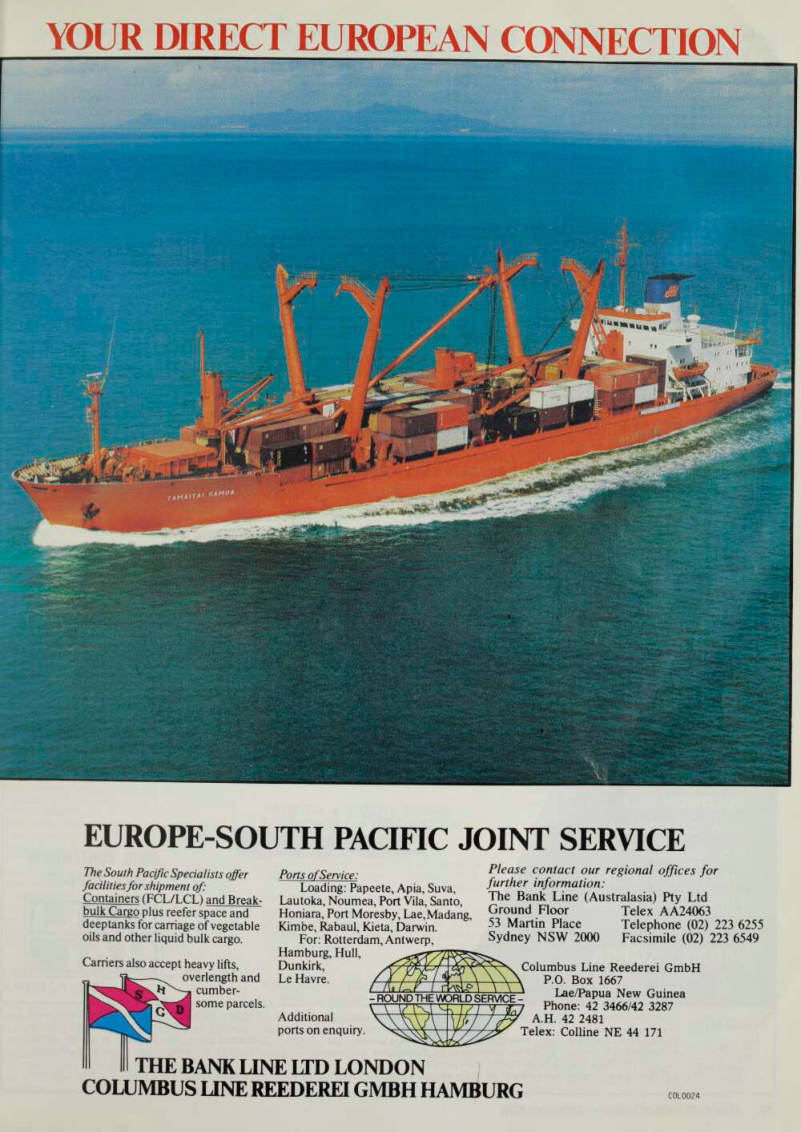
Australia New Caledonia
- Fiji - Hawaii - North
America
PACE Line (ACTA Shipping) operates a fully containerised service every 17 days from Melbourne, Sydney and Brisbane to Noumea, Suva and Lautoka. The vessels continue on to the North coast of America, calling at Hawaii a frequent intervals.
Details from ACTA Pty Ltd, Sydney (266 0633); Tlx AA121369; Fax 267 1148; Burns Philp (SS) Co Ltd, Rodwell Road, Suva (311 777); Tlx FJ2168; Fax 301 127; Burns Philp (SS) Co Ltd, Lautoka (60 777); Sato SA, Avenue James Cook BPC 2, Noumea, Cedex (281 122); Tlx 3163 NN/
Gato. Fax 276 532.
Australia - Samoas -
Tonga
Warner Pacific Lines operates a regular container service from Sydney, Brisbane and Melbourne to Nuku'alofa, Pago Pago, Apia and Vava’u with transhipment to Rarotonga Details from Hetherington Westfarmers Shipping Agency, 37-49 Pitt St, Sydney (223 1600).
Australia - New Caledonia
Fiji Samoas - Tonga
Pacific Forum Line operates a fully containerise service (general, reefer and ro-ro) from Sydney to Noumea, Lautoka, Suva, Apia, Pago Pago, Nuku'alofa, Sydney, Cargo centralised from Adelaide, Melbourne, Brisbane.
Details from Pacific Forum Line, PO Box 796 Auckland; Union Bulkships, 333 George St, Sydney, Brisbane and Melbourne; Union Co, Lautoka; Pacific Forum Line, Suva, Nuku’alofa; Pacific Forum Line, Apia; Polynesia Shipping, Pago Pago.
Australia Kiribati
K. Asia Pacific operates a 5/6 weekly service from Melbourne and Sydney to Kiribati (Tarawa) Details from K. Asia Pacific Pty Ltd, Goldfields House, 1 Alfred St, Circular Quay, Sydney (232 2277), Tlx 122143.
KAP New Guinea Lines calls Tarawa after PNG ports on a 35-day basis from Melbourne and Sydney/Brisbane.
Details from K. Asia Pacific Pty Ltd, Goldfields House, 1 Alfred St, Circular Quay, Sydney (232 2277), Tlx 122143.
Australia Tuvalu
K. Asia Pacific operates a direct service every second voyage to Tuvalu (Funafuti).
Details from K. Asia Pacific Pty Ltd, Goldfields House, 1 Alfred St, Circular Quay, Sydney (232 2277), Tlx 122143.
Australia Norfolk Island
- Lord Howe Island
Norfolk Island Shipping Line operates a direct service every 5/6 weeks ex-Sydney.
Details from K. Asia Pacific Pty Ltd as managing agents for NISL, Goldfields House, 1 Alfred St, Circular Quay, Sydney (232 2277).
Australia New Caledonia
Vanuatu
Norfolk Island Shipping Line operates a direct service every 5/6 weeks ex-Sydney.
Details from K. Asia Pacific Pty Ltd as managing agents for NISL Goldfields House, 1 Alfred St, Circular Quay, Sydney (232 2277), Campagnie Generale Maritime operates a monthly service from Sydney, Melbourne and
Brisbane to Noumea, Port Vila and Santo, for containerised and break-bulk cargo.
Details from Compagnie Generale Maritime 12 Castlereagh St, Sydney (231 3700).
Australia Nauru
Nauru Pacific Line operates a regular cargo service from Melbourne to Nauru, passenger service to Nauru only.
Details from Nauru Pacific Line (Aust) Pty Ltd, Nauru House, 80 Collins St, Melbourne (653 5709), Nedlloyd Swire, 8 Spring St Sydney, (20 522).
Australia - Solomon
Islands Vanuatu
NGAL/PNGL joint service operates a monthly service.
Details from Nedlloyd Swire Pty Ltd, 6 Spring St, Sydney (20 522).
Australia New Zealand
The Australian National Line and the New Zealand Line operate a 10-day container service (TRANZTAS) between Sydney and Melbourne to Auckland, Wellington, Lyttleton and Port Chalmers.
Details from Australian National Shipping Agencies, 131-137 York St. Sydney (225 7333) and Australian National Shipping Agencies, "World Trade Centre", cnr Flinders and Spencer Sts, Melbourne (611 2323) or New Zealand Line, Pastoral House, 96 Lambion Quay, Wellington (72 2245).
Australia - Nz - Fiji
Vanuatu - New Caledonia
Solomons New Guinea
Sitmar Cruises operates a year-round cruise program from* Sydney to include the better-known ports in the above countries plus a number of unspoilt, and largely unknown, island paradises.
Details from Sitmar Cruises, 39 Martin Place, Sydney (239 9000) for NSW; reservations and inquiries (008 42 2277); rest of Australia, reservations and enquiries (088 22 2277).
Australia - Nz Fiji -
Tonga Vanuatu New
Caledonia - Solomons
Samoas Tahiti
P&O Liners call at Auckland, Bay of Islands, Honiara, Lautoka, Noumea, Nukualofa, Pago Pago, Papeete, Port Moresby, Santo, Savusavu, Suva, Vava’u and Vila on cruises from Australia.
Details from P&O Booking Centre, Thomas Cook Pty Ltd, 33 Bligh St, Sydney (237 0333).
Australia Png -
Solomons Vanuatu
A consortium of NGAL/PNG and CONPAC/NEL has four vessels operating a joint service from east coast Australian ports to Port Moresby, Lae, Alotau, Madang, Wewak, Rabaul, Kavieng-Kimbe, Kieta, Honiara, Vila, Santo.
Details from Burns Philp & Co Ltd, PO Box R 124, Royal Exchange, Sydney (20 547); Nedlloyd Swire, 8 Spring St, Sydney (20 522); New Guinea Express Lines, 37 Pitt St, Sydney (241 3991); Vila Agents PO Box 27, Port Vila
(2456), Tlx Nhioii.
New Guinea Express Lines operates a weekly container service from Melbourne, Sydney, Brisbane to Port Moresby, Lae, Alotau, Kimbe, Rabaul, Kieta, Honiara, Kavieng, Madang, Wewak, Santo, Vila.
Details from New Guinea Express Lines, PO Box R 73, Royal Exchange Sydney (241 3991); 127 Creek St, Brisbane (221 9333); 84 William St Melbourne (602 5544); Port Moresby (21 4572); Steamships Trading (agent), Rabaul (92 1400);’
Bougainville Agencies Pty Ltd Kieta, (95 6089); Steamships Trading Co, Madang (82 2446); Graumut Enterprises. Wewak (86 2106); Burns Philp (PNG) Ltd, Kavieng (94 2133); Alotau Stevedoring and Transport, Alotau (61 1318); Ngatia Wholesalers Pty Ltd, Kimbe (93 5102) and Tradco Shipping, Mandana Avenue, Honiara (22 588); Vila Agents Ltd, PO Box 971, Vila, Vanuatu (2490); John Lum & Associates, PO Box 65, Santo, Vanuatu (329).
Europe Tahiti New
Caledonia Vanuatu
The Bank Line and Columbus Line operate a regular joint cargo service from Hamburg, Bramen, Antwerp, Rotterdam and Le Havre to Papeete, Noumea, Port Vila and Santo.
Details from The Bank Line (A’asia) Pty Ltd, 53 Martin Place, Sydney (223 6255), Tlx AA24063; Columbus Line. Lae (423 466), Tlx NE44171; Ets A M. Fare DTE, Papeete; Ets Ballande, Noumea and other local agents.
Europe Png Solomons
The Bank Line & Columbus Line operate a regular joint cargo service from Hamburg, Bramen, Antwerp, Rotterdam and Le Havre to Port Moresby, Lae, Madang, Kimbe, Rabaul, Kieta and Honiara and on inducement to Yandina.
Details from The Bank Line (A’asia) Pty Ltd, 53 Martin Place. Sydney (223 6255), Tlx AA24063; Columbus Line, Lae (423 466), Tlx NE44171; or lines’ local agents.
Europe - Western Samoa -
Tonga - Fiji
The Bank Line & Columbus Line operate a regular joint cargo service from Hamburg, Brennan, Antwerp, Rotterdam and Le Havre to Apia, Nukualofa, Suva and Lautoka.
Details from The Bank Line (A’asia) Pty Ltd, 53 Martin Place, Sydney (223 6255), Tlx AA24063; Columbus Line, Lae (423 466), Tlx NE44171; or lines’ local agents.
Singapore Hong Kong -
Fiji Islands Ports
Kyowa Shipping Co Ltd operates a monthly containerised and break-bulk cargo service from Hong Kong to Lautoka, Suva and then to island ports.
Details from Carpenters Shipping, Private Mail Bag, GPO Suva, Fiji (31 2244); Fax: (679)301 572. Tlx FJ2199.
Far East - Fiji - New
Zealand
New Zealand Unit Express (NZUE) operates a monthly service accepting containerised and break-bulk cargo from Manila, Keelung, Kaohsiung and Hong Kong to Lautoka, Suva and thence to New Zealand ports.
Details from Carpenters Shipping, Private Mail Bag, GPO Suva, Fiji (312 2244), Fax: (679) 311 572; Tlx FJ2199; Burns Philp, Suva (311 777); New Zealand Unit Express, Maritime Building, 2-10 Customhouse Quay, PO Box 890, Wellington (727 865), Cables ENZUEMAN
Wellington, Tlx Nz31340, Nedlnz, Or
Nedlloyd Swire Pty Ltd, Sydney (20 522).
Far East - Mid South Pacific
China Navigation’s New Guinea Pacific Line operates a regular container and Break
Bulk-Heavy Lift service from Hong Kong, Taiwan, Manila, Singapore, Malaysia, Thailand to Port Moresby, Lae, Rabaul, Kieta and Honiara with 18 days frequency. Wewak and Madang will receive four direct calls a year or more on inducement. A T/Service via Lae to these and other PNG ports connecting with monthly sailings is available at cost. Cargo from the same Eastern ports to the South Pacific ports of Noumea, Santo, Vila, Papeete, Pago Pago, Apia, Nukualofa, Rarotonga and Tarawa will be shipped via Japan or Busan on the monthly Bali Hai service.
Details from Steamships Shipping, PO Box 634, Port Moresby (220 283 or 220 289), Kyowa Shipping Ltd operates monthly services from Japan to Guam, Saipan, Solomons, New Caledonia, Fiji, Western and American Samoa, Tahiti, Cook Islands, Tonga and Vanuatu.
Details from Hetherington Wesfarmers Shipping Agency, 37-49 Pitt St, Sydney (223 1600); Carpenters Shipping, Suva (312 244), Tlx FJ2199.
Guam Northern Marianas
Saipan Shipping Co operates a weekly service via barge carrying containers and conventional cargo between Guam and Saipan and Tinian.
Details from Saipan Shipping Co, Inc, PO Box 8, Saipan CM 96950 (322 9706 or 322 9707). Tlx 783619; Fax (670)322 3183; Guam agents Maritime Agencies of the Pacific Ltd.
Hawaii Samoas Tonga
Cook Islands
Hawaii-Pacific Lines operates a monthly container service between Honolulu, Pago Pago, Apia, Nukualofa and Avatiu (Rarotonga).
Details from Hawaii-Pacific Maritime, Inc., PO Box 3264, Honolulu HI (9680)-32641 (808 531 4841).
Details from Morris Hedstrom Samoa Ltd, PO Box 189, Apia, Western Samoa (21 355, 22 722),
Tlx 224 MORISHED SX), Fax 24 279; Union Citcc Travel Ltd, Rarotonga, Cook Islands (682 21 780); Tlx 62024 (UTRAV G); Fax (682) 20 859; Kneubuhl Maritime Services, PO Box 39, Pago Pago, American Samoa 96799, (684 633 5121); Tlx 782505; Fax (684)633 5100; Union Maritime Services Ltd, PO Box 4 Nukualofa, Tonga (21 644 / 5); Tlx 6627, Fax (676) 21 645.
Japan - Fiji Island Ports
Kyowa Shipping Co-operates a monthly containerised service from main ports of Japan to Suva, Lautoka, thence to island ports.
Details from Carpenters Shipping, Neptune House, 3/4 Floor, Tofua St, Walu Bay, Suva (31 2244), Fax (679)301 572 Tlx FJ2199.
Japan - Micronesia
The NYK Shipping Line operates a monthly cargo service from Japan to Micronesia, calling at Yoko, Nagoya, Kobe, Guam, Saipan, Truk, Ponape and Majuro, returning via Yoko, Nagoya and Kobe.
Details from Burns Philp & Co Ltd., 51 Pitt St, Sydney (259 1000).
Saipan Shipping Co operates a monthly service from Japan to Saipan, Guam, Truk, Ponape, Majuro (Kosrae and Ebeye on inducement).
Details from Saipan Shipping Co, PO Box 8, Saipan, CM 96960 (322 9706 or 322 9707), Tlx 783619, Fax (670)322 3183.
Japan agents Kyowa Shipping Company Ltd; Guam Agents Maritime Agencies of the Pacific Ltd.
Japan - Korea - Png
Paradise Service
Mitsui OSK Lines operates a monthly service from main ports in japan, Wewak, Lae, Rabaul, Kieta, Port Moresby.
Details from Robert Laurie Company (PNG) Ltd, PO Box 1032, Lae (42 3642, 42 3811).
Contact; W 0 Hackenberg, Group Shipping Manager.
Japan - Korea - Png -
Paradise Service
Mitsui OSK Lines in joint service with NYK Lines operates a monthly service from main ports in Japan and Busan in Korea to PNG ports of Wewak, Rabaul, Kieta, Lae, Port Moresby, Kavieng, Kimbe, Madang and Oro Bay.
Details from Robert Laurie Company Pty Ltd, PO Box 1032, Lae (direct: 423 642 or a switch; 423 811). Contact W 0 Hackenberg, Group Shipping Manager & Marketing; Tlx NE 42508 Fax 423 801.
Japan - Korea - Fiji -
Island Ports
Bali Hai Service operates a monthly and general cargo and vehicle service from main Japanese ports and Korea to Suva, Lautoka, Apia, Pago Pago, Papeete, Nukualofa, Noumea, Vila, Santo and Honiara.
Details from John Swire and Sons (Japan) Ltd, 14 Ichibancho, Chiyoda-ku, Tokyo (03) 230 9220); Tlx J 22248, Fax (03) 230 9288.
Png - Inter-Mainport
Papua New Guinea Lines offers scheduled 10-20 day coastal liner services linking all PNG major ports with containerisation, reefer, heavy lift and trans-shipment facilities.
Details from PNG Line, Box 543, Port Moresby (211 174), Tlx 22269.
Png - Taiwan - Hong Hong
- Singapore Indonesia
The Bank Line & Columbus Line operates a regular joint cargo service from PNG Ports to Kaohsiung, Hong Kong, Singapore, Jakarta & Surabaya.
Details from The Bank Line (A’asia) Pty Ltd, 51 Pitt St, Sydney (251 6688), Tlx AA24063; Columbus Line, Lae (423 466); Tlx NE44171; or lines’ local agents.
Png - Uk/Continent
The Bank Line and Columbus Line operate a regular joint service from Port Moresby, Oro Bay, Kieta, Rabaul, Kimbe, Madang and Lae to Hull, Hamburg, Rotterdam, Antwerp and Le Havre.
Details from The Bank Line (A’asia) Pty Ltd, 53 Martin Place, Sydney (223 6255), Tlx AA24063; Columbus Line, Lae (423 466), Tlx NE44171; or lines’ local agents.
Solomons Uk/Continent
The Bank Line and Columbus Line operate a regular joint cargo service from Honiara to Hull, Hamburg, Rotterdam, Antwerp and Le Havre.
Details from The Bank Line (A’asia) Pty Ltd, 53 Martin Place, Sydney (223 6255), Tlx AA24063; Columbus Line, Lae (423 466), Tlx NE44171; or lines’ local agents.
Solomons Uk/Continent
The Bank Line and Columbus Line operate a regular joint cargo service from Honiara to Hull, Hamburg, Rotterdam, Antwerp and Le Havre.
Details from The Bank Line (A’asia) Pty Ltd, 53 Martin Place, Sydney (223 6255), Tlx AA24063; Columbus Line, Lae (423 466), Tlx NE44171; Tradco Shipping Ltd., Honiara (22 588); Tlx 66 313.
New Zealand Australia
Png Solomon Islands
Pacific Forum Line operates a containerised and ro-ro service from Lyttleton, Napier and Auckland to Brisbane, Port Moresby, Lae, Honiara, Brisbane then to New Zealand.
Details from Pacific Forum, Auckland, Christchurch; Union Bulkships, Brisbane; Steamships Shipping, Port Moresby and Lae Sullivan Ltd, Honiara; Seabridge, Wellington
New Zealand Cook Islands
Tahiti
New Zealand Line operates cargo services based on pallets and similar units from Auckland to Cook Islands and Tahiti.
Details from NZ Shipping Agencies International Ltd, PO Box 3420, Auckland (392 650), Waterfront Commission, PO Box 61, Rarotonga, Cook Islands; Shipping Office, Govt of Niue, PO Box 107, Niue Island: Compagnie Maritime Polynesienne, PO Box 36, Papeete, Tahiti.
New Zealand - Fiji
Reef operates a regular 18-day service from Auckland to Suva and Lautoka. Also passenger accommodation.
Details from Reef Shipping Agencies, PO Box 3382, Auckland (771 2213), Tlx 60633; MV Fijian Shipping Agencies Ltd, Private Bag, Suva (311 056).
Pacific Line with one ship operates a three-weekly ro-ro cargo service New Zealand, Lautoka, Suva. No passengers.
Details Sofrana Unilines, 18 Customs St Auckland (773 279); PO Box 3614, Tlx NZ2313 Carpenters Shipping, Neptune House, Tofua St’
Walu Bay, Suva (25 141), Tlx FJ2199.
New Zealand Fiji North
America (Wc)
Blue Star Line Ltd Pacific Coast container services: only direct service to and from New Zealand. Blue Star vessels call at Suva and Honolulu on NZ-US West Coast voyages.
Details from Blueport ACT (NZ) Ltd, PO Box 192, Wellington (739 029); Burns Philp (SS) Co Ltd, GPO Box 355, Suva (311 777), Tlx FJ2168
Burnship.
New Zealand - Fiji - Samoas
- Tonga
Pacific Forum Line operates a containerised and ro-ro 21 day service from Auckland to Lautoka, Suva, Apia, Pago Pago and Nukualofa.
Details from Pacific Forum Line, Auckland, Christchurch, Suva and Apia, Union Maritime, Lautoka, and Nukualofa, Polynesian Shipping, Pago Pago.
New Zealand Tonga
Samoas
Warner Pacific Line Services from Auckland to Nuku’alofa, Vava’u, Apia, Pago Pago monthly carrying general and freezer cargoes and FCL Dry Freezer.
Details from McKay Shipping Ltd, 2nd Floor, Ferry Bldg, Quay St., Auckland PO Box 3 (390 229). Cables MACSHIP, Tlx NZ2554f; Warner Pacific Line, Box 93, Nuku’alofa, Tonga; Mealelel (Western Samoa Ltd) Private Bag, Apia, Western Samoa; Burns Phi Ip (SS) Co Ltd, PO Box 129, Pago Pago, American Samoa (633 2709), Burnsouth SB.
Nz Cook Islands
Aitutaki Niue
Cook Islands Line services Auckland, Rarotonga, Aitutaki, Niue monthly carrying general and freezer cargoes.
Details from McKay Shipping Ltd, 2nd Floor, Ferry Bldg, Quay St, Auckiand/PO Box 3, Auckland (390 229). Cables MACSHIP, Tlx NZ2554; Fax 32 931.
Southeast Asia Fiji
Nedlloyd Lines (NZEAS) Service operates regular fast cargo service from Surabaya, Jakarta, Port Kelang, Bangkok and Singapore via New Zealand to Suva and Lautoka. Details from Carpenters Shipping, Neptune House. 3/4 Floor, Tofua St, Walu Bay, Suva (312 244). Fax: (679)301 572. Tlx; FJ2199.
Tahiti - New Caledonia -
Vanuatu - Solomon
Islands New Zealand
Png Singapore Europe
Polish Ocean Lines operates semi-container type vessels to the following ports: from Pappete, Noumea, Santo, Vila, Yandina, Honiara, Auckland, Singapore, Port Kielang, Penang then to Meditearranean ports and Europe via the Suez Canal (other New Zealand ports subject to inducement).
Details from Universal Shipping Agencies Ltd, 7th Floor, 14 Emily PI, Auckland 1 (390 931, 390 727, 32 104), Tlx 21 517.
Taiwan Hong Kong -
Singapore Indonesia
Png
The Bank Line & Columbus Line operate a regular joint cargo service from Kaohsiung, Hong Kong, Singapore, Jakarta, Surabaya to Papua New Guinea Ports.
Details from The Bank Line (A’asia) Pty Ltd, 53 Martin Place, Sydney (223 6255), Tlx AA24063; Columbus Line, Lae (423 466), Tlx NE44171; or lines’ local agents.
Europe Tahiti - W Samoa
Fiji New Caledonia
Compagnie Generale Maritime operates services from Europe and Meditarranean ports to Papeete and Noumea using three ro-ro and multi-purpose vessels thus ensuring a bi-monthly sailing to and from.
Details from Compagnie Generale Maritime, 12 Castlereagh St, Sydney (231 3700).
Europe - Tahiti - New
Caledonia New Zealand
Vanuatu Solomons Png
Europe
Polish Ocean Lines offers regular monthly sailings for containerised and break-bulk cargo, also conventional reefer space and reefer containers from Hamburg, Rotterdam, Dunkirk, Le Havre to Papeete, Noumea, Auckland, Santo, Honiara, Rabaul, Lae, Singapore, returning to Europe via Suez. Other ports in the South Pacific can be served directly with inducement or otherwise via transhipment.
Details from Sotama, BP 9170, Papeete (42 7805), Tlx Sotama 373FP; SATO BP 02 Noumea Cedex (27 2094), Tlx 163 NM; Universal Shipping Agencies, PO Box 2282 Auckland (30 930), Tlx 21517; Vanua Navigation, PO Box 44, Vila (2027), Tlx 1033; Melan Chine Shipping Co, PO Box 71, Honiara (21 678). Tlx 66335 Steamships Trading Co Ltd, PO Box 85, Lae (42 4666), Tlx 4243; Union Steamship Co NZ Ltd, PO Box 50, Apia (21 781); Tlx 226; Warner Pacific Line, PO Box 93, Nukualofa (22 088), Tlx 66219; Fiji Agents TBA.
Europe - Tahiti New
Caledonia
Nedlloyd offers regular cargo services from Continental ports to Papeete, Apia, Fiji and New Caledonia.
Details Nedlloyd (Aust) Pty Ltd, Spring St., Sydney (27 3801); Carpenters Shipping, Ist Floor, Harbour Centre Bldg, 100 Thomson St., Suva (31 2244), Tlx 2199FJ and Vetari St., Lautoka (63 988), Tlx 5215FJ.
Uk - Western Samoa -
Tonga Fiji
The Bank Line and Columbus Line operate a regular joint cargo service from Hull, to Apia, Nukualofa, Suva and Lautoka.
Details from The Bank Line (A’asia) Pty Ltd, 53 Martin Place, Sydney (223 6255), Tlx AA24063; Columbus Line, Lae (423 466), Tlx NE44171; or lines' local agents.
Uk - Png - Solomons
The Bank Line and Columbus Line operate a regular joint cargo service from Hull to Port Moresby, Lae, Madang, Kimbe, Rabaul, Kieta and Honiara and on inducement to Yandina.
Details from The Bank Line (A’asia) Pty Ltd, 53 Martin Place, Sydney (223 6255), Tlx AA24063; Columbus Line, Lae (423 466), Tlx NE44171; or lines' local agents.
Uk - Tahiti - New Caledonia
- Vanuatu
The Bank Line and Columbus Line operate a regular joint cargo service from Hull, to Papeete, Noumea, Port-Vila and Santo.
Details from The Bank Line (A’asia) Pty Ltd, 53 Martin Place, Sydney (223 6255), Tlx AA24063; Columbus Line, Lae (423 466), Tlx NE44171; Ets A M. Fare UTE, Papeete; Ets Ballande, Noumea and other local agents.
Us Hawaii Micronesia
Png
PM&O Lines operate two fully self-contained container vessels on a sailing frquency of every 30 days between the San Francisco Bay Area, Los Angeles, Honolulu and Majuro, Ebeye, Kosrae, Ponape, Truk, Saipan, Yap, Palau, Cebu, Davao, Manila, Lae, Kieta and Rabaul.
Details from PM&O Lines, 353 Sacramento St., San Francisco, California 94111 (415 421 5400); Tlx: 278016 PMO UR; Owner's Representative, PO Box 803, Saipan, NMI 96950 (234 8819); Tlx
783605 Cmcaa.
Advertisements & other items, pp. 51-52 (1 item)
Your Direct European Connection
u« «u
EUROPE-SOUTH PACIFIC JOINT SERVICE
The South Pacific Specialists offer facilities for shipment of: Containers (FCL/LCL) and Breakbulk Cargo plus reefer space and deeptanks for carriage of vegetable oils and other liquid bulk cargo.
Carriers also accept heavy lifts, It: —overlength and cumbersome parcels.
Ports of Service: Loading: Papeete, Apia, Suva, Lautoka, Noumea, Port Vila, Santo, Honiara, Port Moresby, Lae,Madang, Kimbe, Rabaul, Kieta, Darwin.
For: Rotterdam, Antwerp, Hamburg, Hull, Dunkirk, Le Havre. □a
ROUND THE WORLD SERVICE
Additional ports on enquiry.
Please contact our regional offices for further information: The Bank Line (Australasia) Pty Ltd Ground Floor Telex AA24063 53 Martin Place Telephone (02) 223 6255 Sydney NSW 2000 Facsimile (02) 223 6549 Columbus Line Reederei GmbH P.O. Box 1667 Lae/Papua New Guinea Phone: 42 3466/42 3287 A.H. 42 2481 Telex: Colline NE 44 171
THE BANK LINE LTD LONDON
COLUMBUS LINE REEDEREI GMBH HAMBURG
COL0024
YOU’LL FIND IT,
WHERE THE SKY MEETS
THE SEA
TONGA
KIRIBATI
VANUATU
COOK ISLAND
SOLOMON ISLANDS
m
NEW CALEDONIA
U.S. SAMOA
WESTERN SAMOA
FRENCH POLYNESIA
JAPAN . KOREA
RORO. CONTAINER &
B.BULK SHIPPING
BALI
HAI SERVICE
AGENTS
and
PHONE
SUVA:Burns Philp(B P) 311 777 Carpenter Shipping (C.S) 312244 LAUTOKA:B P 60777 C S 63988 APIA:B P 22611 PAGOPAGO :Polynesia Shipping Services Ltd 633-1211 PAPEETE:Compagnie Maritime Polynesienne 42 84 02 NOUMEA:Etablissements Ballande 687-283384 VILA:B P 2456 SANTO;B P 230 HONlARArSullivans (Solomon Islands) Ltd 21645 TARAWAiShipping Corporation of Kiribati 26195 NUKUALOFA;B P 21500 BUSANrfor general cargo Young Chang Shipping Co , Ltd 753-0451 for vehicle Pan Continental Shipping Co., Ltd 778-7680 Soyang Shipping Co , Ltd 752-7755 JAPAN:for general cargo Swire 03-230-9245 for vehicle NYK Lines 03-284-5506 Mitsui O S K 03-587-7123
HMS Bounty: the bloodless mutiny
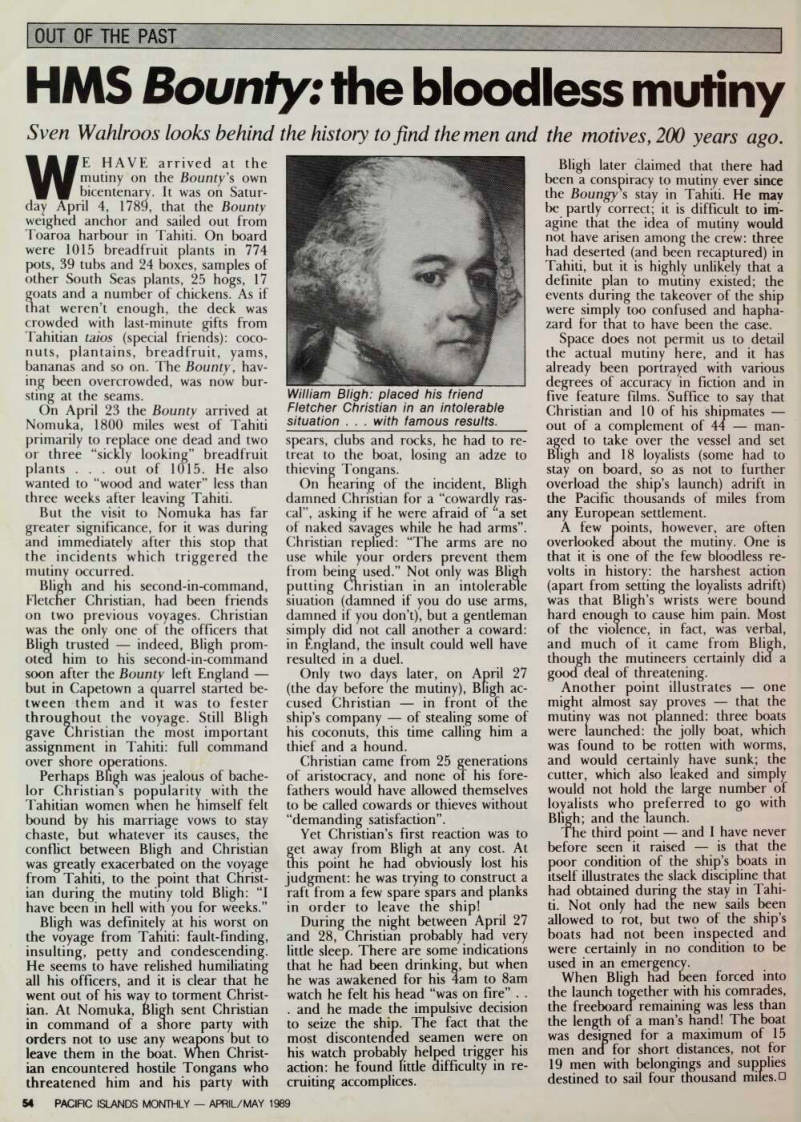
Out Of The Past
Sven Wahlroos looks behind the history to find the men and the motives, 200 years ago
WE HAVE arrived at the mutiny on the Bounty's own bicentenaij. It was on Satur il 4, 1789, that the Bounty weighed anchor and sailed out from Toaroa harbour in Tahiti. On board were 1015 breadfruit plants in 774 pots, 39 tubs and 24 boxes, samples of other South Seas plants, 25 hogs, 17 goats and a number of chickens. As if that weren’t enough, the deck was crowded with last-minute gifts from Tahitian taios (special friends): coco nuts, plantains, breadfruit, yams, bananas and so on. The Bounty, hav ing been overcrowded, was now bur sting at the seams.
On April 23 the Bounty arrived at Nomuka, 1800 miles west of Tahiti primarily to replace one dead and two or three “sickly looking” breadfruit plants . . . out of 1015. He also wanted to “wood and water” less than three weeks after leaving Tahiti.
But the visit to Nomuka has far greater significance, for it was during and immediately after this stop that the incidents which triggered the
mutiny occurred.
Blign and his second-in-command, Fletcher Christian, had been friends on two previous voyages. Christian was the only one of the officers that Bligh trusted indeed, Bligh prom oted him to his second-in-command soon after the Bounty left England but in Capetown a quarrel started be tween them and it was to fester throughout the voyage. Still Bligh gave Christian the most important assignment in Tahiti: full command over shore operations.
Perhaps Bligh was jealous of bache
lor Christians popularity with the Tahitian women when he himself felt bound by his marriage vows to stay chaste, but whatever its causes, the conflict between Bligh and Christian was greatly exacerbated on the voyage from Tahiti, to the point that Christ ian during the mutiny told Bligh: “I have been in hell with you for weeks.”
Bligh was definitely at his worst on the voyage from Tahiti: fault-finding,
insulting, petty and condescending.
He seems to have relished humiliating all his officers, and it is clear that he went out of his way to torment Christ ian. At Nomuka, Bligh sent Christian in command of a snore party with orders not to use any weapons but to leave them in the boat. When Christ ian encountered hostile Tongans who threatened him and his party with
spears, clubs and rocks, he had to re treat to the boat, losing an adze to
thieving Tongans.
On hearing of the incident, Bligh damned Christian for a “cowardly ras cal”, asking if he were afraid of a set of naked savages while he had arms”.
Christian replied: “The arms are no use while your orders prevent them from being used.” Not only was Bligh putting Christian in an intolerable siuation (damned if you do use arms, damned if you don’t), but a gentleman simply did not call another a coward: in England, the insult could well have resulted in a duel.
Only two days later, on April 27 (the day before the mutiny), Bligh ac cused Christian in front of the ship’s company of stealing some of his coconuts, this time calling him a thief and a hound.
Christian came from 25 generations of aristocracy, and none of his fore fathers would have allowed themselves to be called cowards or thieves without
“demanding satisfaction”.
Yet Christian’s first reaction was to get away from Bligh at any cost. At this point he had obviously lost his judgment: he was trying to construct a raft from a few spare spars and planks in order to leave the ship!
During the night between April 27
and 28, Christian probably had yery little sleep. There are some indications that he had been drinking, but when he was awakened for his 4am to Sam watch he felt his head “was on fire” . . . and he made the impulsive decision to seize the ship. The fact that the most discontended seamen were on
his watch probably helped trigger his
action: he found little difficulty in re cruiting accomplices.
Bligfi later claimed that there had been a conspiracy to mutiny ever since the Boungy s s stay in Tahiti. He may be partly correct; it is difficult to im agine that the idea of mutiny would not have arisen among the crew: three had deserted (and been recaptured) in Tahiti, but it is highly unlikely that a definite plan to mutiny existed; the events during the takeover of the ship were simply too confused and hapha zard for that to have been the case.
Space does not permit us to detail the actual mutiny here, and it has already been portrayed with various degrees of accuracy in fiction and in five feature films. Suffice to say that Christian and 10 of his shipmates out of a complement of 44 man aged to take over the vessel and set Bligh and 18 loyalists (some had to stay on board, so as not to further overload the ship’s launch) adrift in the Pacific thousands of miles from any European settlement.
A few points, however, are often overlooked about the mutiny. One is that it is one of the few bloodless re volts in history: the harshest action
(apart from setting the loyalists adrift)
was that Bligh’s wrists were bound hard enough to cause him pain. Most of the violence, in fact, was verbal, and much of it came from Bligh, though the mutineers certainly dicf a
good deal of threatening.
Another point illustrates one might almost say proves that the mutiny was not planned: three boats were launched: the jolly boat, which was found to be rotten with worms, and would certainly have sunk; the cutter, which also leaked and simply would not hold the large number of loyalists who preferred to go with Bligh; and the launch.
The third point and I have never before seen it raised is that the poor condition of the ship’s boats in itself illustrates the slack discipline that had obtained during the stay in Tahi ti. Not only had the new sails been allowed to rot, but two of the ship’s boats had not been inspected and were certainly in no conaition to be used in an emergency.
When Bligh had been forced into the launch together with his comrades, the freeboard remaining was less than the length of a man’s hand! The boat was designed for a maximum of 15 men and for short distances, not for 19 men with belongings and supplies destined to sail four thousand miles. □
William Bligh: placed his friend Fletcher Christian in an intolerable situation . . . with famous results.
Advertisements & other items, pp. 54-56 (2 items)
54
PACinC ISLANDS MONTHLY APRIL/MAY 1989
anyhow
have a
Winfield
Five smokes ahead of the rest 1 haza" 0 health smok |NC
WABN'N 6
WV2 CC494/80
Diamonds Conquer Gold*
The Mitsubishi COLT/LANCER the 1988 Golden Steering Wheel is a Takes The Prestigious ... testament to the excellence of the Mitsubishi Golden Steering Wheel \Colt/Lancer, winner in Class I (under litres).
Both diambrlds and JHI The Colt/Lancer was selected for the are symbofopf qi|ulity,of golden Steering Wheel on three fundarefinement, of mental points: for its unique styling that incorporates the organic principles of nature, for its ease of operation that makes driving more fun, and for its exceptional power and response, the result of the most exciting automotive technology available today.
The Golden Steering Wheel Award is a special highlight to Mitsubishi Motors’ commitment to produce special cars.
And while diamonds have always been very special gems, they look even better of elegance and taste. But on November 10, 1988, one out-shone the other: The Mitsubishi Diamonds won the Golden Steering Wheel Award.
The West German motoring award is one of the most prestigious and soughtafter passenger car trophies in the world.
Bestowed by the Bild am Sonntag magazine on the best new cars released in the particularly competitive German market, A
MITSUBISHI
MOTORS
when supported by gold.
MITSUBISHI COLT/LRNCER
AMERICAN SAMOA: MORRIS SCANLAN SERVICE INC. PO Box 367, Pago Pago, Tel 633-5520/AUSTRALIA: MITSUBISHI MOTORS AUSTRALIA LTD. Box 1284, South Road, Clovelly Park. South Australia 5042. Tel (08) 275-7223/FIJI: NIVIS MOTOR & MACHINERY CO., LTD. G.PO Box 150, Suva, Tel. 38341 1 /FRENCH POLYNESIA (TAHITI): ETS-BREDIN FRERES ET FILS PO Box 21, Papeete, Tahiti, Tel. 4-202-58/NEW CALEDONIA: SOCIETE D'IMPORTATION D AUTO DU PACIFIQUE SUDS.A. B P 438 Rond Point du Pacifique, Noumea, Tel. 274144/NEW ZEALAND: MITSUBISHI MOTORS NEW ZEALAND LTD. Todd Park, Heriot Drive, Private Bag, Ponrua, Tel 370-109/ NORFOLK ISLAND: BORRYS LTD. PO Box 169, Norfolk Island, Tel. 2114/PAPUA NEW GUINEA: TOBA PTY. LTD. PO. Box 503, Port Moresby. Tel. 2 1-7874/SOLOMON ISLANDS: HARVEST PACIFIC LTD. G.PO Box 88, Honiara, Guadalcanal. Tel. 30128/TONGA: SITANI MAPI CO.. LTD. PO. Box 83, Nuku'ALOFA, Tel. 21-044/VANUATU: SOCOMETRA B P. 06 Route de Lagon, Port-Vila, Tel. 2314/WESTERN SAMOA: A M. MACDONALD HOLDINGS LTD.
PO Box 576, Apia, Tel 22022/SAIPAN/POHNPEI/MAJURO/KOSRAE/TRUK/YAP/BELAU: MICRONESIAN MOTORS. INC. 997 South Marine Drive, Tamuning, Guam 96911, Tel. 646-6827