Pacific


Islands
Monthly
American bamoa üb^.uu Australia A 52.50 Cook Islands NZ$3.OO Fiji F 51.75 Hawaii USS2.SO Kiribati A 52.00 Nauru A 52.00 New Caledonia CFP2SO New Zealand NZS3.OO Niue NZS2.SO Norfolk Island A 52.00 Papua New Guinea K 2.00 Solomon Islands 552.00 Tahiti CFP3OO Tonga P 2.00 Tuvalu A 52.00
Usa : Uss3.Oo
USTT and Guam US$2.5O Vanuatu VT2.00 Western Samoa T 2.75 ♦Recommended retail price only
March. 1989
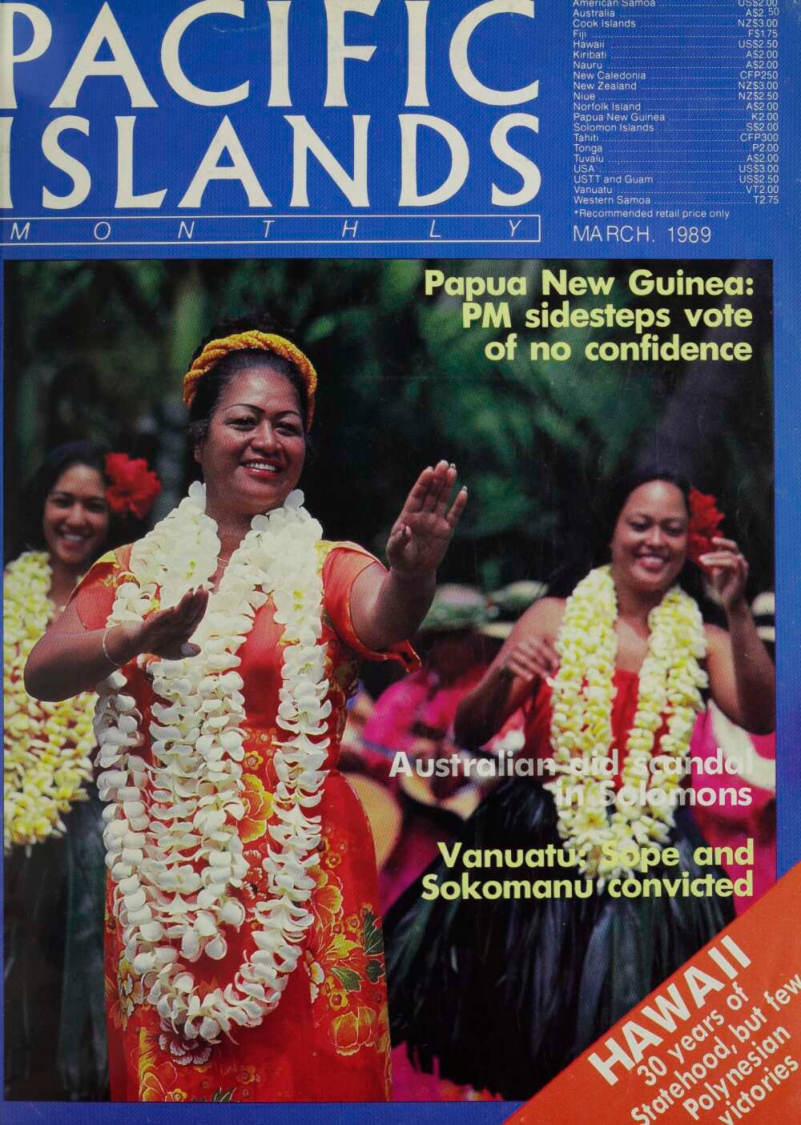
Papua New Guinea: PM sidesteps vote of no confidence
Au sftolia lAfilp'icn
and Sokomand
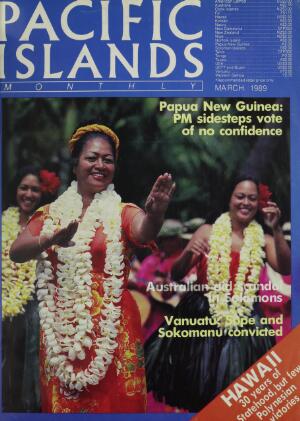
Cover Photograph: Louis H Jawitz/Image Bank
Advertisements & other items, pp. 2-4 (1 item)
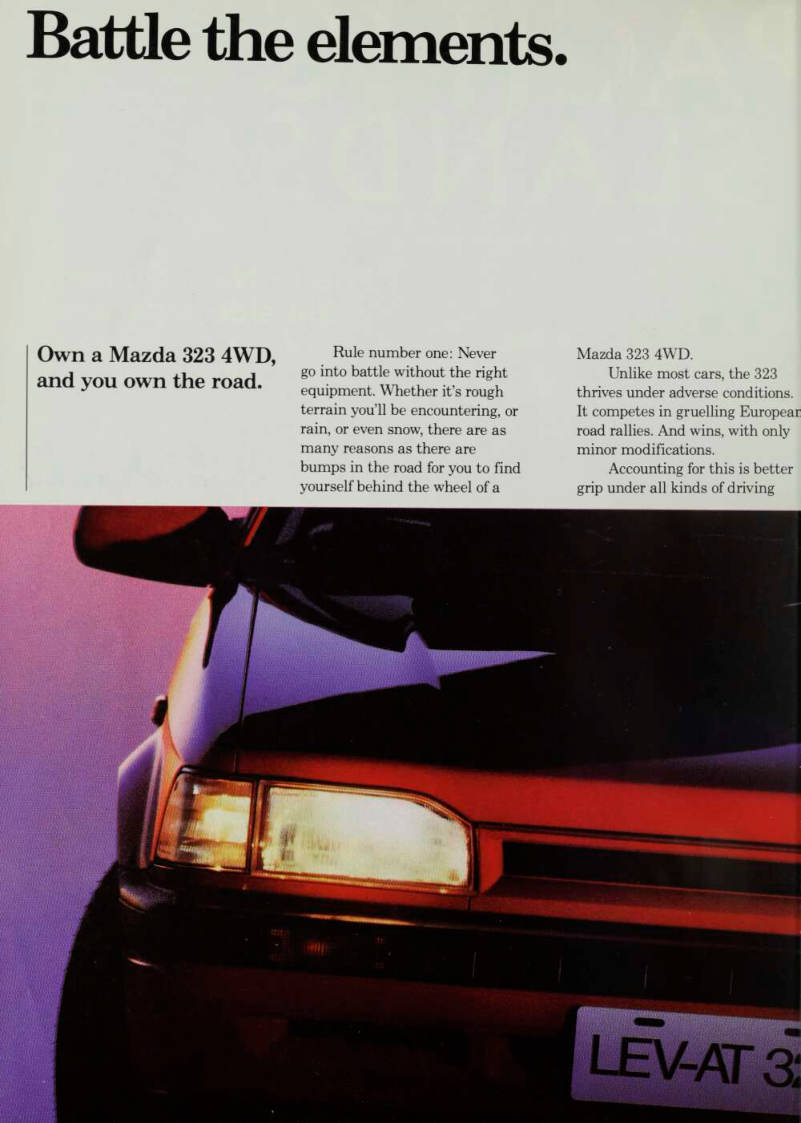
Battle the elements
Own a Mazda 323 4WD,
and you own the road.
Rule number one: Never go into battle without the right equipment. Whether it’s rough terrain you’ll be encountering, or rain, or even snow, there are as many reasons as there are bumps in the road for you to find yourself behind the wheel of a Mazda 323 4WD.
Unlike most cars, the 323 thrives under adverse conditions.
It competes in gruelling Europear road rallies. And wins, with only minor modifications.
Accounting for this is better grip under all kinds of driving
mditions. Greater straight-line stality and cornering characteristics, i short, virtually everything that mtributes to enhanced driver feel.
Driver feel, or handling, has long ?en a priority at Mazda, as evimced by our innovative and highly claimed suspension systems, plus the 323’s sophisticated full-time 4WD. Even more revolutionary is the speed-sensing, 4-wheel steering found on our 626 car.
What conclusions can be drawn from this? Simply that you can battle the elements, and win. Provided you have a Mazda 323 4WD at hand.
Models and features shown may not be available in your area. Please consult your local Mazda dealer.
mazoa
© Mazda Motor Corporation
■a
VIP.
#fiT>
m W ii m mm
Imagine communications without
Cable & Wireless.
As the leading telecommunications company in the South Pacific, Cable & Wireless brings together numerous islands and remote towns every minute of every day At the touch of a button. Cable & Wireless can put you in touch with your neighbours across the street, or across the seas.
It's hard to imagine communications throughout the
South Pacific without Cable & Wireless.
Anything less would be simply...primitive.
£:::!!} Cable ana Wireless pic
Australia Cook Islands Fiji Cable & Wireless Pty, Ltd. Cable & Wireless pic 1 n association with the Level 49, M.LC,Centre PO. Box 47 19 Martin Place Avarua. Rarotonga Sydney Cook Islands
NSW 2000
Solomon Islands In association with the Government of Fiji. Government of the Fiji International Solomon Islands.
Telecommunications Ltd. Solomon Islands RQ Box 59 Mercury House 158 Victoria Parade Suva Fiji International Telecommunications Ltd.
RQ Box 148 Honiara Solomon Islands Tonga Vanuatu Cable and Wireless pic In association with the Private Mail Bag General Post Office NukuAlofa Tongatapu Tonga Government of Vanuatu and France Cables Et Radio Vanuatu International "telecommunications
SAR
RQ Box 164 Port Vila Vanuatu
Pacific
Islands
Monthly
Vol. 59 No. 15
Voice Of The Pacific
March, ’B9
Cover Story i 6
Thirty years after its absorption into the Union, Hawaii is in many ways the most blessed of the United States. Its enviable weather, natural beauty and mid-Pacific location have conferred advantages that are rec ognised around the world . . . not least by increasing numbers of Japanese investors. But as Ed Rampell reports, the aboriginal Sandwich Islanders have paid the price for white success with alienation, de population and the loss of their land.
Namaliu Turns The Opposition's Weapons
Against Wingti . . 8
PNG’s embattled PM dissolves Parliament to stem a vote of no confidence
Four Convicted In Port Vila's Controversial
Sedition Trial 10
Politicians and a President found guilty in a bizarre court case HIGHLANDERS UP THE COST OF MINING IN PNG 14 Free equity a new tactic in efforts to win a share in the minerals boom MORE TAX, LESS REWARD FOR CITIZENS OF THE ALOHA STATE 22 Hawaii’s government wealth comes from iniquitous burdens on the counties
Australian Academic Queried In Solomons
Education "Scam" 24
$10 million misspent, says Commission of Inquiry report ARMY EXERCISE DECLINES INTO A COMEDY OF ERRORS 25 NZ war games degenerate into farce — but who’s laughing?
JOHN FRUM'S FOLLOWERS AWAIT THEIR MILLENIUM.. 26 Under the shadow of a volcano, the region’s last ‘cargo cult’ continues to attract new members LAND RIGHTS AND PSYCHIATRIC CARE UNDER FIRE
In Wellington 31
Whare Paia radicals convicted, Maori sovereignty in conflict with industry THE EFFLUENT OF CIVILISATION . . . AND THE END OF
Pacific Reefs 32
Sewage spells doom for coral reefs throughout the region
COOKS BATTLE TO SAVE FEATHERED AND FINNED
Resources 34
Rare birds and economically vital fisher ies under threat of extinction
A Pacific Arts Treasure
Rediscovered 40
A century-old painting provides a glimp se of traditional life on Tanna
Acting Editor Carson Creagh Deputy Editor Richard Dinnen Editorial Adviser John Carter Art Director Michelle Havenstein Contributors Robin Bromby John Dunn John Hunter Stuart Inder Cheryl Lilly Matthew McKee Diana McManus Ed Rampell David Robie Nicolas Rothwell Frank Senge
Publisher Geoffrey Hussey
Advertising Sales Sydney & Melbourne Fergus Maclagan (02) 412 3918: Brisbane Robert Walker (07) 371 0533 Adelaide Hastwell Williamson Representations (08) 79 9522
Cover prices are recommended retail only Registered by Australia Post, publication No NBP 1210 Copyright Fiji Times Limited, Suva, Fiji
Advertisements & other items, pp. 5-6 (3 items)
Departments
OPINION 7
PACIFIC REPORT 36
STAMPS 39
TRADE WINDS 43
ISLAND PRESS 46
TROPICALITIES 48
SHIPPING SCHEDULES 50
OUT OF THE PAST 54
5
PACIFIC ISLANDS MONTHLY MARCH 1989
A Fiji Times Limited Production.
Founded 1930 (USPS 952480) 20 Gordon Street, Suva, Fiji; Telex; FJ2124; Fax: (679)31 411.
Pacific Islands Monthly (APPS No. NBP 1210) is published month ly by Fiji Times Limited, a division of Nationwide News, 2 Holt St, Sur ry Hills, NSW 2010. Second class postage paid at Honolulu, Hawaii, POSTMASTER. Send address changes to PACIFIC ISLANDS MONTHLY, PO Box 22250, Honolu lu, Hawaii 96822. Typeset and printed by Fiji Times Limited, 20 Gordon Street, Suva, Fiji.
Traffic
GO PIONEER
The future of sound and vision.
TH
TRAFFIC
TAMERS
KEH-7050QR & CDX-3
Pure Sound, Pure Power...
Relax! Let Pioneer’s Traffic Tanners drown out the din.
Our CD Players do it with pure sound, while our Stereo Cassette/Tuners do it with pure power.
Pioneer-original high-tech laser-optics make CD sound even better in the stylish, new CDX-3 at an affordable price.
A great match for it is the new KEH-7050CR with a 7-band graphic equalizer —15 W four or 25W into the standard two channels. That’s high power plus!
If you think this all sounds great in the middle of a traffic jam, wait till you hit the open road and turn up the volume!
KEH-7050QR has switchable Dual Illumination (green or amber).
Anti-theft Quick-Release System.
For further information, please contact: Australia; Pioneer Electronics Australia Pty. Ltd. (Incorporated in Victoria), P.O. Box 295, Mordialloc, Victoria. 3195 Tel: 580-9911 Fiji Islands: Brijlal & Company. G.P.O. Box No. 362, Suva, Fiji Islands Tel: 22258 New Zealand: Monaco Corporation Ltd., 41 Poland Road. Glenfield, Auckland, New Zealand Tel: (09) 444-9144 Norfolk Island: Burnt Pine Traders Ltd, P.O. Box 21, Norfolk Island Vanuatu; Burns Philp (Vanuatu) Ltd., Vila, Vanuatu Nauru Island: Jacob Enterprises, P.O. Box N 0.4, Republic of Nauru Tahiti; Tahiti Hi-Fi, P.O. Box 848, Papeete, Tahiti New Caledonia; Menard Pacifique Sari, B.P. 3899, Noumea, New Caledonia Tel: 27.62*23 American Samoa: Transpac Corporation, P.O. Box 1477, Pago Pago, American Samoa 96799 Tel: 633-5224 Rarotonga: South Seas International Ltd , P.O. Box 49, Rarotonga.
Cook Islands Tel; 2327
The art of balance:
Opinion
The art of balance: a press perspective
THIS MAGAZINE’S New Zealand correspondent, David Robie, has recently been the subject of a curious (and curiously intense) attack in the pages of Islands Business magazine.
The January 1989 issue of that publication devoted no less than five pages to an analysis of the region’s press by Robie for the New Zealand Monthly Review and to a series of ‘responses’ from Islands Business publisher Robert Keith-Reid, editor Peter Lomas and New Caledonia correspondent David Los.
Naturally, David Robie is concerned that readers of Pacific Islands Monthly might believe that the comments printed in the article are accurate, and has made available to us information that puts the matter into a different, and certainly more balanced, perspective.
First, it should be noted that Robie’s analysis includes criticisms of PIM. We accept those criticisms where they are based on accurate in formation, and have informed him of areas where he was in error. We respect his freedom to criticise, and have no intention of marshalling a body of correspondents to divert attention from the substance of his remarks by a personal attack.
That, in essence, is the matter to which both Robie and the editors of PIM take exception: that the pages and editorial resources of an estab lished publication should be used in a personal vendetta which, to be frank, fails to address much less refute his criticisms.
John Richardson, former editor of Islands Business, has written to PIM to present his response to the ‘analysis’. As well as presenting a cogent and unemotional reaction to the article’s tone, Richardson makes the point that: “no one . . . would argue that the Pacific is, for many of its indigenous inhabitants, unjust. Some [islanders] are forced to live in squalor, some in fear of nuclear hazards, some are reduced to being outcasts in their own land and many must look on as their political
leaders indulge in intrigue and corruption.
“Robie, who has a keen sense of what is just and what is not, wrote about these issues objectively and fairly. Many Pacific commentators are unable to do what Robie did for Islands Business report injustices heaped on South Pacific people while remaining dispassionate.
“David Robie’s articles reflect a journalist who is either anti-right or pro-left. He is, however, pro-Pacific. And for the record, he wrote for Islands Business on topics [that] had nothing to do with politics. And we
published them.”
PIM will continue to publish David Robie’s reports to preserve a balanced perspective of regional forces. It is our experience and belief that truth is not a unitary quality; that no one individual, organisation or government can represent truth in its entirety. Therefore we will seek analyses and perspectives from as broad a range of correspondents as is possible. We will not, as Peter Lomas has done, seek to suggest that David Robie must have French documents translated for him . . . when we know, as does Peter Lomas, that Robie worked as a journalist in France for several years ... no mean feat for a man characterised by Lomas as a Francophobe who does not speak the language!
We can assure our readers that we will continue to respect their intelligence by presenting them with a variety of opinions and perspec tives in the firm conviction that they will not suffer deliberate misrepre sentation. □
Advertisements & other items, p. 7 (1 item)
Pacific
ISLANDS
IMP N T H L ~Y~I
FIJI: Distribution, subscriptions and advertising: Fiji Times Limited, GPO Box 1167, Suva, Fiji. Phone 31-4111, telex FJ2124 FRENCH POLYNESIA: Distribution: Hachette Pacifique 10 Ave Bruat, Papeete Phone 25-610 HAWAII: UNITED STATES: Distribution: PIM Hawaii, PO Box 22250, Honolulu, Hawaii, 96822. Advertising; Brian C Asqill, Apt 1308,1676 Ala Moana Blvd., Honolulu Hawaii, 96815. Phone (808) 955-9718.
JAPAN: Advertising and subscriptions: Universal Media Corporation, GPO Box 46, Tokyo Phone 666-3336, cable UNIMEDIA Tokyo, telex 2524665 MALAYSIA: Advertising and subscriptions: Worldwide Media Services, 57-B Komplex Damai, Jin Dato Haji Eusoff, Kuala Lumpur Phone 63-9340, cables WORLDMEDIA Kuala Lumpur, telex 31533, VANUATU: Distribution: The Vanuatu Stationery and Book Centre, PO Box 557 Port Vila Advertising: Norman Bros Bookshop Port Vila Phone 2232 NEW CALEDONIA; Distribution: Depot Centre de Presse Michel Pentecost. CBP2, Noumea Phone 27- 2434, 27-4729 NEW ZEALAND: Distribution: Gordon & Gotch, PO Box 584, 2 Carr Road, Mt Roskill, Auckland 4.
Advertising; McKay International Media Reps Ltd, C/- Albany PO, Auckland 10, New Zealand. Phone 413-9119 Telex NZ22701, FAX 413-9110 WELLINGTON: Ross Quaid Media, 1 Scholes Lane Petone (04) 68-7593, PO Box 38699, Petone PAPUA NEW GUINEA: Distribution: Gordon & Gotch, PO Box 3395, Port Moresby Phone 25-4551,25-4855.
Advertising: Robert Walker, PO Box 600, Indooroopilly, Old Australia 4068 Phone (07) 371-0533.
SOLOMON ISLANDS: Distribution and Advertising: The Bookshop, (Norman Bros.) PO Box 503, Honiara PHILIPPINES: Advertising: The GF Group, 12 San Ignacio St,, Uroaneta Village, Makati, Metro Manila Phone 817-7299, telex 45950 and 4233 UNITED KINGDOM: F A Smyth and Associates, 23A Aylmer Parade, London N2OPO, England Phone (01 )340 5088, fax (01)341 9602.
UNITED STATES MAINLAND: Advertising: Joshua B Powers Jr, Powers International Inc., Suite 708, 271 Madison Ave , New York, NY 10016. Phone 867-9580, Subscriptions PIM, Hawaii, PO Box 22250, Honolulu Hawaii, 96822
SUBSCRIPTIONS
American Samoa US$45 Australia AUSS3O Canada US$45 Cook Islands AUSS46 Fiji F $24 French Polynesia US$45 Guam US$45 Hawaii US$45 Japan US$3B Kiribati AUSS46 Micronesia US$35 Nauru AUSS42 New Caledonia US$32 New Zealand AUSS42 Niue AUSS46 Norfolk Island AUSS42 Northern Marianas US$36 Papua New Guinea AUSS42 Solomon Islands AUSS46 Tonga AUSS46 Tuvalu AUSS46 United Kingdom Stg£2B US (Mainland) US$45 Vanuatu AUSS42 Western Samoa AUSS6O Elsewhere AUSS63 Payments to Pacific Islands Monthly: Subscriptions Dept, GPO Box 1167, Suva, Fiji.
Subscriptions rates includes the cost of airspeeding to all destinations set out above. Direct airmail rates on application.
stop no-confidence vote
Papua New Guinea
Parliament suspended to stop no-confidence vote
Waigani seems condemned to repeat its recent history of rule by defection rather than election, writes Frank Senge
STUDENTS OF Papua New
Guinea’s tangled politics would
be amazed to read a report that began with the words; “Parliament sat the full three-week session without the mention of the now infamous vote of no confidence . .
Those not too familiar with the Byzantine character of life in Waiga m’s corridors of power might ask why: the answer is, quite simply, that the unusual frequent motions of no
confidence and equally frequent
changes of government is absolute
ly ordinary.
The novelty of this provision in the PNG Constitution has died down with its regular invocation, so that people now want to see a return to boring, down-to-earth democratic governing.
For this report, however, the routine sentence must suffice: In the wake of persistent rumours of military coups and continuing industrial dis putes, another motion of no confi dence PNG’s 15th in 11 years was moved on the eight-month-old Government of Prime Minister Rabbie Namaliu on March 2.
Former student leader and Morobe Provincial Premier Utula Samana
sponsored the motion, naming
Opposition Leader Paias Wingti as alternative Prime Minister.
The next day the Government em ployed the very tactic used by Mr Wingti’s government last April wnen it was facing a vote of no confidence.
Leader of Government business John Giheno moved that the house adjourn
to July 4, catching the Opposition
totally unaware and unable to muster enough votes to defeat the motion.
The Government survived the division by 53 votes to the Opposition’s 46.
The only difference between last April’s move and this was that this time Parliament convened for two full weeks: last year, the House adjourned after only two hours and wnen the vote was finally taken, on July 4, the Government was defeated and Mr Namaliu became Papua New Guinea’s fourth Prime Minister since Independ ence in 1975. Not a bad record in
comparison with some parliamentary
democracies, but one that reflects a
nation increasingly dependent on
votes of no confidence rather than elections as a tool of government.
Ironically, on March 1 the Govern ment had tabled a series of proposed amendments to Section 145 of the Constitution ... the very section that provides for no confidence motions.
The Government is proposing to in crease the minimum period between votes of no confidence from six months to between 18 and 30 months; alternatively, after each successful vote the Prime Minister or Governor General will, it is proposed, be given the power to dissolve Parliament and schedule elections.
Constitutional amendments have to be passed by an absolute majority of 73 members (out of 109) in three separate sittings of Parliament.
As has become usual, the motion of no confidence in the Government of Mr Namaliu was tabled after weeks of
speculation, negotiations and defec
tions. But it would appear that Mr Wingti was reluctant to move the vote: his idea was to act in the July sitting, by which time people would judge Mr Namaliu to have been in Government long enough for them to be able to assess his fitness for the position.
The majority of Opposition mem bers, however, were determined to push ahead with the vote. Mr Wingti’s former chief adviser Gabriel Ramoi
said: “I am sorry tor Wingti. He is cautious, but he is a reluctant com
mander leading a willing army.”
At the same time, it appears the Opposition was still trying to decide which commander to follow. The choice was between Mr Wingti, Peo
ple’s Progress Party leader Sir Julius
Chan and Melanesian United Front leader Utula Samana.
The problem was only resolved on the evening before the motion was tabled: Paias Wingti was to be alter nate Prime Minister, Utula Samana was to be his deputy.
The decision to put up Mr Wingti again cost the Opposition the support of Gabriel Ramoi, who claimed he would not support anybody in whom Parliament has already shown it had no confidence.
Five members defected from the Government to the Opposition during the negotiations. The National Party, led by Mount Hagen businessman Michael Mel, pulled out of the coali tion Government and chose the mid dle benches, with Mel declaring that he would offer the support of nis 10 members to whichever side gave them the greatest number of ministries.
Mel had apparently became frus trated by Mr Namaliu’s repeated fai lures to assign a promised ministerial portfolio to the ambitious Highlander or his group.
Michael Mel’s negotiations were thwarted by the presence in Cabinet of Finance and Planning Minister Paul Pora, who leads a faction of five National Party members and who voted with Mr Namaliu in the last mo tion of no confidence while the Mel faction voted with Mr Wingti (Mr Mel later brought his party across to the Government benches).
The present estrangement was Mr Mel’s punishment for not voting for Mr Namaliu when he took Govern ment last year. And when Mel announced the withdrawal of his group this time, Government ministers commented that the National Party had never in any case been considered part of the Government. “[The Mel faction] never voted with us. We don’t need their numbers,” one spokesman
is reported as saying.
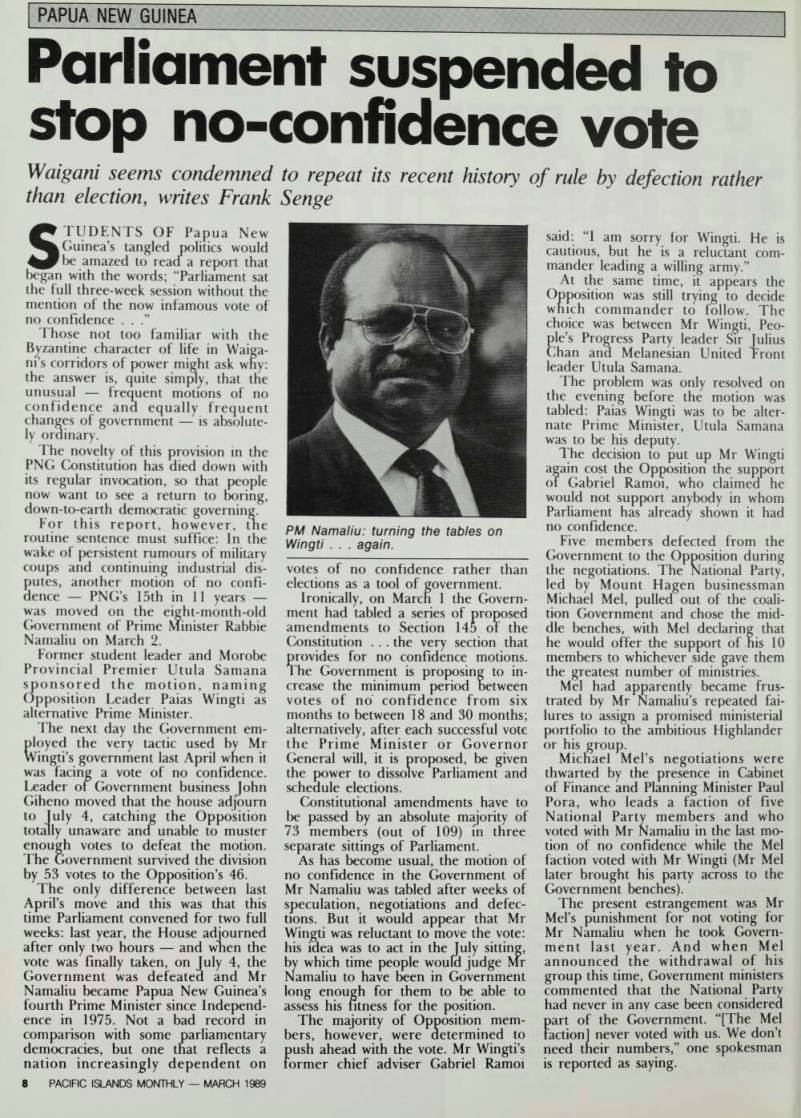
PM Namaliu: turning the tables on Wingti ... again.
Michael Mel has given Paul Pora’s group an ultimatum to follow the majority decision or be sacked from the party. The Government’s fate would be sealed should this group move out, but is highly unlikely: and Mr Pora has told a special meeting of the National Party that he would nev er vote for Mr Wingti the two have bitter grudges that date back to the 1982 elections. er vote for Mr Wingti the two have bitter grudges that date back to the 1982 elections.
The Melanesian Alliance, led by Father John Momis and human rights lawyer and Minister for Justice Ber nard Narakobi, will not leave the Gov ernment benches, if only because the Melanesian Alliance has never before enjoyed the privilege and power it currently holds. With four of its eight members holding ministries, the Melanesian Alliance has the enviable position of having a set of policies that is agreed to readily by the Prime Minister. The mining forum, which for the first time enabled direct nego tiations between landowners and de velopers; the involvement of provin cial governments in decision-making; and heavy emphasis on law and order are Melanesian Alliance ideas.
That leaves Ted Diro’s People’s Ac tion Party as the only other potential power broker with any real capacity.
And again as usual, Diro’s is the un predictable party in any coalition. Diro is as frustrated as Michael Mel at not securing a portfolio for himself (he lays claim to the deputy Prime Minis ter, currently held by fellow PAP par ty member Akoka Doi.) Diro’s problem, however, is that there is no guarantee he will get any better deal with the Opposition.
Though Paias Wingti is snowing in
terest in Mr Diro, it was he who initi ated the Forestry Inquiry and who
thereby started Diro’s problems.
With parties thus entrenched, the
Opposition is working on securing the
Parliamentary support of individual,
unaligned members.
During the two weeks prior to the March 2 motion, Minerals and Energy Minister Patterson Lowa was told by the Opposition that he could keep his ministry if he would cross the floor.
The same message was passed on to Housing Minister Gerald Sigulogo. It is reported that third MP had flown to Rabaul and, when he returned, had already switched sides.
Trade and Industry Minister Galeva Kwarara and Forests Minister Karl Stack were said to be talking to the Opposition, but the tide was stemmed
suddenly by former Communications
Minister Gabriel Ramoi, who announced that he was crossing to the Government with eight fellow Opposi tion members.
He did not, it seems, actually have the eight MPs, but the announcement was enough to cause reflection among Government members who were
thinking of defecting.
Mr Ramoi is adamant that he would not support his former boss again.
“There was a vote of no confidence in the leadership of Wingti. Parliament had no confidence in his leadership.
“How can we put the same man up and ask the same Parliament to change its decision and have confi dence in him again?” Mr Ramoi won dered to reporters.
The vote to which Mr Ramoi refers was taken in July 1988, and was fol lowed by a vote of no confidence in Paias Wmgti’s leadership of the Peo ple’s Democratic Movement . . . by Gabriel Ramoi. When the party reaf firmed Wingti’s leadership, Ramoi left with fellow PDM member Peter Ku man. They now hold independent
positions in the Opposition.
The main reason for the vote of no confidence is what the Opposition re fers to as a “lack of leadership” on the 3art of Rabbie Namaliu. The Opposi-
tion blames recent industrial disputes
in the mining industry and military
demonstrations in Port Moresby on the Government and on the Namaliu style of administration. It is commonly acknowledged that Mr Namaliu is a committee man, one who is uncom fortable with the prospect of tough ac tion. This has been displayed both on Bougainville and in the soldiers’ ‘ram page , when he delegated his deputy, Akoka Doi, to sort out the problems.
But the overriding feeling in the community is that Mr Namaliu must be given time. One Opposition MP who crossed to the Government, Theo Tuya, summed it up thus: “Whether Rabbie is the right Prime Minister or not, I want him to be given sufficient time to prove himself.” Mr Tuva said the continuous votes of no confidence had undermined the credibility of PNG and had effectively made it a “laughing stock” in the eyes of coun tries that practised the same or similar systems of government.
After adjourning Parliament Mr Namaliu admitted that his Govern ment was “spending too much time and resources looking over its shoul der” for votes of no confidence.
“We have to get back to govern ment,” he declared.
But governing with a motion of no confidence on Parliament’s agenda has always been an impossible task. And Opposition leader Paias Wingti has vowed to get rid of the Government, saying it lacks the support of the majority of members.
Government can be changed with a simple majority of 55 members, and Mr Wingti says the adjournment vote of 53-4 o shows the Government still lacks the required majority in the 109member Parliament (one seat is cur rently vacant after a member’s death) and that he has the support of 57 members, some of whom were not present in the house when the ad journment vote was taken.
“We now have a minority govern ment,” he says, “a situation in which in any other country, the Prime Minister
would resign. Knowing PNG politics I
would not expect that, but we will eventually take over Government. The
[present] Government,” Mr Wingti
claims, “is as good as dead.”
Mr Namaliu said his Government was intact, accused the Opposition of
being “frivolous and irresponsible”
and at the same time put part of the blame on the development of the poli tical system in PNG and the public’s lack of familiarity with the Westmins ter system and its workings.
Said Mr Namaliu: “The PNG poli tical situation is volatile. Political party discipline is not really entrenched.
“We are going through a period of experimenting. It takes time for our leaders to get used to it.” □
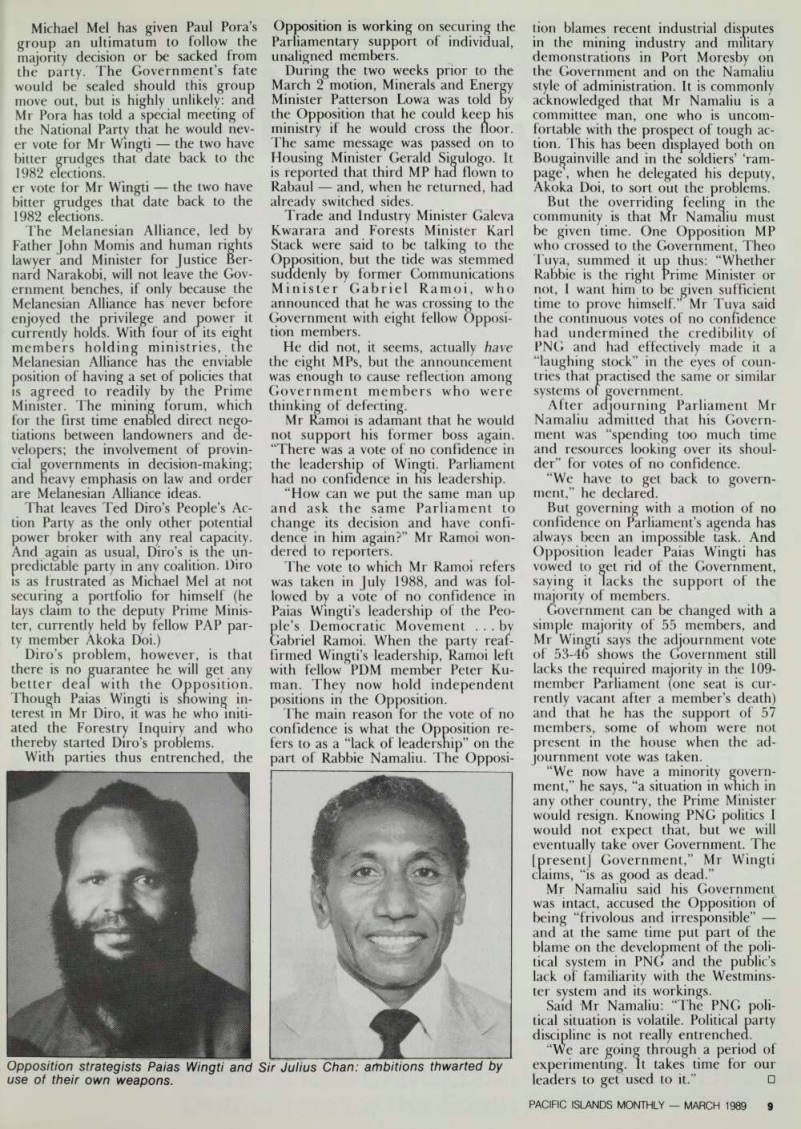
Opposition strategists Paias Wingti and Sir Julius Chan: ambitions thwarted by use of their own weapons.
Sope, Sokomanu guilty

Vanuatu
Sope, Sokomanu guilty of mutiny and sedition
John Dunn reports from Port Vila on the trial that saw a President and a former Ambassador to the United Nations behind bars for treason.
ATI GEORGE Sokomanu, 52, should have been in Japan last month as President of Vanuatu, representing his country at the funeral of Emperor Hirohito.
Instead, he spent his days on a hard wooden courtroom bench and his nights in the near suffocating heat of Port Vila’s steamy, concrete goal.
Sokomanu had been arrested last De cember, following his attempt to dis solve Parliament and to install his nephew and friend, Barak Sope, 38, as nead of an interim Government.
He appeared in the capital’s red roofed colonial Court House charged with incitement to mutiny a crime that carriers a life sentence. With him were Sope and five others, also charged with mutiny and additional
( charges, including sedition, for which
the maximum sentence is three years.
Two blocks away their former friend and colleague, the country’s Prime Minister, Walter Lini tne man they tried to depose worked on in his office. Sokomanu, Sope and Lini had been freedom-fighting com rades under the slogan Sen Hoo (Let’s Pull Together) and leaders of the self government push in the 19705.
Father Lini, a former Anglican priest, became the Re pub fie of Vanuatu’s first Prime Minister, Soko manu became its first President and Sope, a wealthy businessman, was
Secretary-General of the ruling
Vanua’aku Pati, Ambassador to the United Nations and later Minister for Public Works. For seven years the triumvirate ruled peacefully and well over this chain of 83 islands and its population of 146,000. Among the newly emerging nations of the South Pacific, Vanuatu was something of a model. Tourism, based on uncluttered
beaches, reef-protected lagoons and
newly built resort hotels, began attracting travellers from Australia, New Zealand and Japan.
But things began to sour. Sope be gan to flirt with Libya, which upset Lini. Then in January 1987, Lini in Washington to visit President Reagan suffered a severe stroke and there were doubts he would be able to stay on as leader. Sope saw his chance and began to bid for power but Lini reco-
vered (though partial paralysis re
mains) and retained his position.
Sope continued to manoeuvre, and last May staged an anti-Government demonstration after Lini had transfer red land leases around Port Vila from VULCAN, a semi-Government au thority, to a Government Department.
Police and the Government’s 550man paramilitary mobile force res tored order, but not until one man had been killed and damage estimated at close to SAI million was caused to
shops and office buildings.
An angry Lini expelled Sope from the Vanuaaku Pati and declared this
meant he also ceased to be a Member of Parliament: under the constitution an MP expelled from his party must immediately vacate his seat.
Lini pusned this move through the 46-seat Parliament in July, expelling
Sope together with four supporting
MPs plus the 18-member UMP (Union of Moderate Parties) Opposition, which had boycotted Parliament and which was thus deprived of its seats on the technicality that its members had
forfeited Parliamentary membership
by not attending sittings.
By-elections in December to fill the
seats were boycotted by Sope’s newly
formed Melanesian Progressive Party
and the UMP, and when only 40 per cent of voters (compared with a usual average of 80 per cent) participated in the poll, Sope called on Sokomanu to dissolve Parliament on the grounds that Lini had lost popular support.
The result was that Vanuatu now had virtually a one-party legislature, and tensions were beginning to rise.
Then, on December 17, Sokomanu acted. Using his ceremonial address to open Parliament, Sokomanu
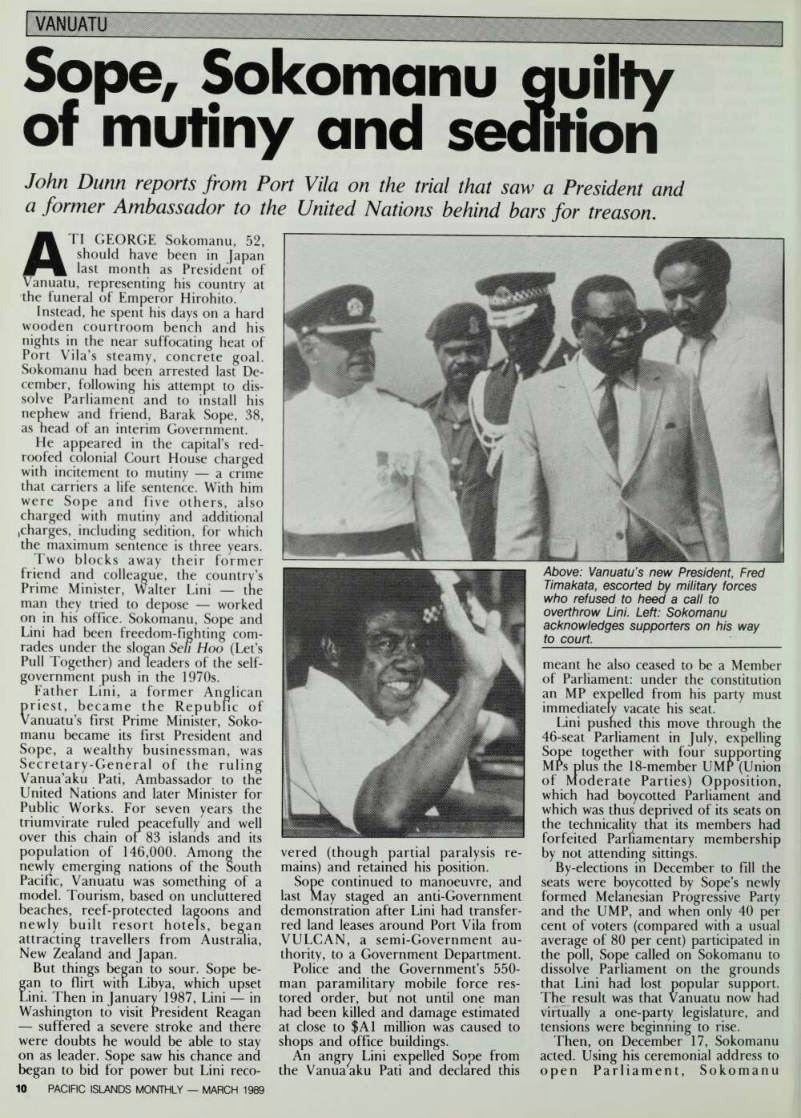
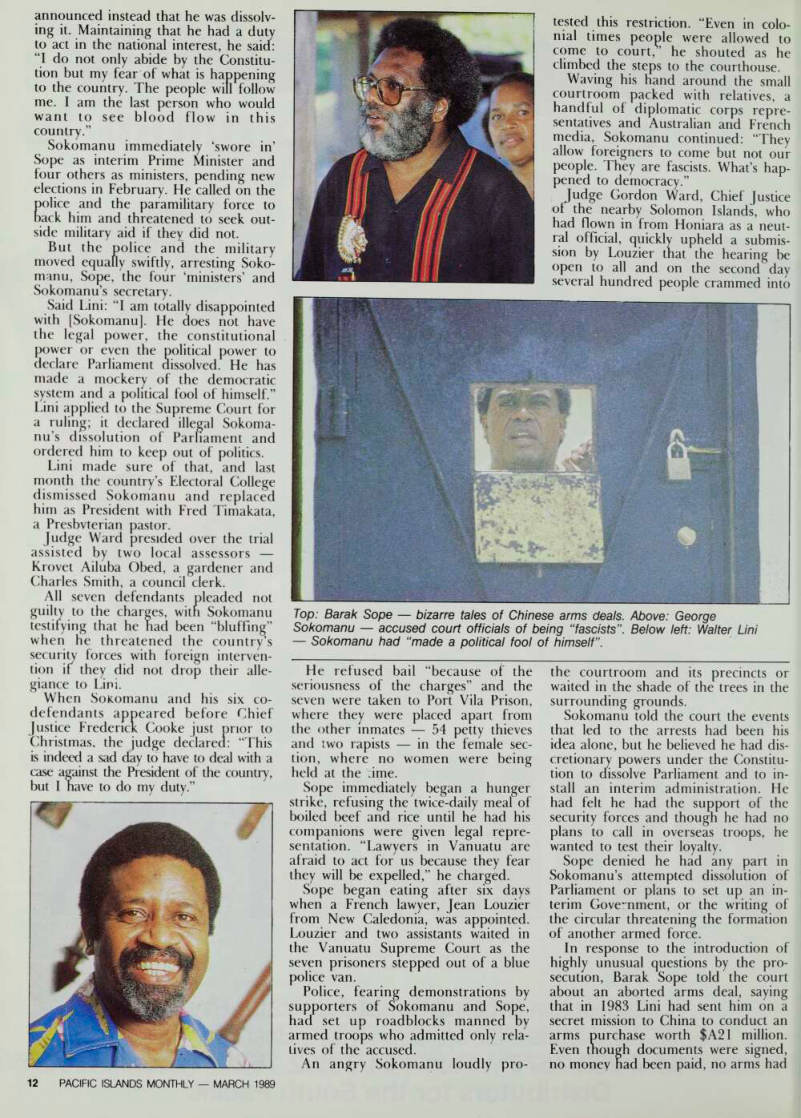
Above: Vanuatu’s new President, Fred Timakata, escorted by military forces who refused to heed a call to overthrow Uni. Left: Sokomanu acknowledges supporters on his way to court.
announced instead that he was dissolv ing it. Maintaining that he had a duty to act in the national interest, he said: “I do not only abide by the Constitu tion but my fear of what is happening to the country. The people will follow me. I am the last person who would want to see blood flow in this
country.”
Sokomanu immediately ‘swore in’
Sope as interim Prime Minister and four others as ministers, pending new elections in February. He called on the police and the paramilitary force to back him and threatened to seek out side military aid if they did not.
But the police and the military
moved equally swiftly, arresting Soko
manu, Sope, the four ‘ministers’ and Sokomanu’s secretary.
Said Lini: “I am totally disappointed with [Sokomanu]. He does not have the legal power, the constitutional power or even the political power to declare Parliament dissolved. He has made a mockery of the democratic system and a political fool of himself.”
Lini applied to the Supreme Court for a ruling; it declared illegal Sokoma nu’s dissolution of Parliament and ordered him to keep out of politics.
Lini made sure of that, and last month the country’s Electoral College dismissed Sokomanu and replaced him as President with Fred Timakata, a Presbvterian pastor.
Judge Ward presided over the trial assisted by two local assessors Krovet Ailuba Obed, a gardener and Charles Smith, a council clerk.
All seven defendants pleaded not guilty to the charges, with Sokomanu testifying that he had been “bluffing” when he threatened the country’s security forces with foreign interven tion if they did not drop their alle giance to Lini.
When Sokomanu and his six co defendants appeared before Chief
Justice Frederick Cooke just prior to
Christmas, the judge declared: “This is indeed a sad day to have to deal with a case against the President of the country, but I have to do my duty.”
He refused bail “because of the seriousness of the charges” and the seven were taken to Port Vila Prison, where they were placed apart from the other inmates 54 petty thieves and two rapists in the female sec tion, where no women were being held at the dme.
Sope immediately began a hunger
strike, refusing the twice-daily meal of boiled beef and rice until he had his
companions were given legal repre
sentation. “Lawyers in Vanuatu are afraid to act for us because they fear
they will be expelled,” he charged.
Sope began eating after six days
when a French lawyer, Jean Louzier from New Caledonia, was appointed.
Louzier and two assistants waited in the Vanuatu Supreme Court as the seven prisoners stepped out of a blue
police van.
Police, fearing demonstrations by
supporters of Sokomanu and Sope, had set up roadblocks manned by armed troops who admitted only rela tives of the accused.
An angry Sokomanu loudly pro
tested this restriction. “Even in colo nial times people were allowed to come to court, he shouted as he climbed the steps to the courthouse.
Waving his hand around the small courtroom packed with relatives, a handful of diplomatic corps repre sentatives and Australian and French media, Sokomanu continued: “They allow foreigners to come but not our
people. They are fascists. What’s hap
pened to democracy.”
Judge Gordon Ward, Chief Justice of the nearby Solomon Islands, who had flown in from Honiara as a neut ral official, quickly upheld a submis sion by Louzier that the hearing be open to all and on the second day several hundred people crammed into
the courtroom and its precincts or waited in the shade of the trees in the
surrounding grounds.
Sokomanu told the court the events that led to the arrests had been his idea alone, but he believed he had dis cretionary powers under the Constitu tion to dissolve Parliament and to in stall an interim administration. He had felt he had the support of the security forces and though he had no plans to call in overseas troops, he wanted to test their loyalty.
Sope denied he had any part in Sokomanu’s attempted dissolution of Parliament or plans to set up an in terim Government, or the writing of the circular threatening the formation of another armed force.
In response to the introduction of
highly unusual questions by the pro
secution, Barak Sope told the court about an aborted arms deal, saying that in 1983 Lini had sent him on a secret mission to China to conduct an arms purchase worth SA2I million.
Even though documents were signed, no money had been paid, no arms had
fop; Barak Sope - bizarre tales of Chinese arms deals. Above: George Sokomanu - accused court officials of being "fascists”. Below left: Walter Lini - Sokomanu had “made a political fool of himself”.
been delivered and the discussions had nothing to do with the events be fore the court Sokomanu’s lawyers argued that he
had been forced by deteriorating poli
tical and economic circumstances to “fall back on the unwritten powers of a traditional Melanesian leader”: said Gustave Tehio, “Mr Sokomanu had worked on the basis that Melanesian customs could override constitutional law. The Head of State acted like a chief and a Christian.”
Another of Sokomanu’s lawyers, Ms Sue Barlow, said: “These are not evil men. These are men of high standing, who went wrong with a good motive.”
Judge Ward, however, accused the
quartet found guilty of “craving poli
tical power” and of being “driven by personal ambition”, fie added: ill-conceived, badly ex ecuted and unsuccessful this attempt turned out to be, for a few days in
December parliamentary democracy in
this country hung by a delicate thread.
“The credit must go to the Govern ment for continuing to follow the con stitutional process despite such an open threat, and to the disciplinary forces who [remained] steadfast in
their duty.
“It is sad to see men who, a mere decade ago, were striving to establish a
parliamentary democracy, flouting the
safeguards they helped to make.”
About 150 people, most of them re latives and friends of the prisoners, crowded into the Port Vila Court House on March 7 to hear Judge Ward conclude the two-and-a-half week trial and announce the verdict.
Judge Ward found Ati George Sokomanu guilty of incitement to
mutiny, seditious conspiracy and
administering an unlawful oatn, and sentenced him to four years’ jail on the first charge: the other two charges brought sentences of two years each, to be served concurrently a total of
six years’ imprisonment.
Barak Sope and Maxim Carlot were also found guilty of incitement to
mutiny (three years’ jail) and seditious
conspiracy, taxing an unlawful oath and making seditious statement (each two years). The last three sentences are to be served concurrently, making a total of five years’ imprisonment.
Willy Jimmy was sentenced to two years’ jail on each of three charges, all to be served concurrently: seditious conspiracy, taking an unlawful oath and making a seditious statement.
All will appeal, especially since the remaining three defendants were ac quitted in a decision Australian obser vers for the International Commission of Jurists condemned as political rather than Judicial (see Page 49).
The verdicts were at least initially received calmly (an explosion on the outskirts of Port Vila on the night of March 7 may have been a protest against the sentences, though at time of going to press no details of the
police investigation were available),
There was no public reaction from Father Lini, but Vanuatu’s new Presi dent, Fred Timataka, called on the people to stay calm and to respect the rule of law. “People should try to work together and consolidate for the betterment of this country,” Mr Tima kata said.
It will be some time before the bit terness and divisions of the past months are healed. And there is the disquieting fact that because of last
year’s Parliamentary expulsions and
boycotted by-elections, there is virtual ly no Opposition in the 46-seat legisla ture. Lim’s Vanua’aku Pad holds 34 seats, a minor group has five and seven are currently unoccupied be cause by-elections are still to be held.
Phis, of course, means that a large part of the population is unrepre sented and likely to remain so because the next general election is not due until the end of 1991.
Meanwhile Father Lini, anxious to restore calm, has called for “harmony and peace”. Achieving that is the real test ahead for Vanuatu. □
Advertisements & other items, pp. 11-13 (1 item)
Simply Better
Ui s< m rC vr# & I I Inquiries to: Masterton International Australia Pty Ltd Suite 16, Argyle Place, Albion 4010 Brisbane Australia >hone: +6l 7 262 7677 Fax: +6l 7 862 1626 Telex: AA140966 Distributors for the South Pacific
SOUTH PACIFIC GAMES (1991) FOUNDATION
Applications are invited for the position of:
“EXECUTIVE DIRECTOR”
GAMES FOUNDATION
The South Pacific Games (1991) Foundation, a body to be established by an Act of the National Parliament of Papua New Guinea requires the services of an Executive Director.
The successful applicant will be a person with vision, drive and strong management experience. A person having sound written and oral communication skills, extensive experience in Papua New Guinea and the ability to liaise effectively with sports people, private enterprise and the government.
The person sought will need to motivate a large number of other people and be able to co-ordinate a host of projects and activities.
This person will report to the Foundation and through it, will be responsible for the organisation and liaison for the staging of the Games in Papua New Guinea. Duties will include:- * Servicing the Foundation and ensuring that the various committees responsible for the organisation of the Games are effective; * Organising financial and other resources necessary for the smooth and successful running of the Games; * Supervising arrangements for provision of adequate facilities for all Games sports; * Ensuring effective communication among and good working relationships with the Department of Home Affairs and Youth, Papua New Guinea Sports Federation, all national sports bodies and the Foundation; and with other Government and private sector organisations. * Producing a full report including an audited account of the finances of the Foundation at the conclusion of the Games; An attractive package equivalent to a Level 7 position in the Public Service of Papua New Guinea will be negotiated. This is a three year position and will cease at the end of the Games in 1991.
Persons applying are requested to submit 4 signed copies of applications together with copies of qualification papers and references; details of Curriculum Vitae; names and addresses of at least 3 referees to-.- The Chairman South Pacific Games (1991) Foundation P 0 Box 3019
BOROKO NCD
Applications close on Friday 31st March, 1989.
Conflict over mining profits
Papua New Guinea
Robin Bromby reports on the financial, legal and political battles that have seen resources firms increasingly unwilling to risk investing in PNG’s minerals boom.
THE Papua New Guinea Govern ment has defused, at least for the moment, simmering land owner discontent over the question of
royalties from mining by foreign com
panies and has managed to convince the Enga provincial government to forgo part of its share of the payment coming from Placer Pacific Ltd’s $A10()0 million Porgera gold mine.
Landowners formerly received just
5 per cent of the royalty, with the pro vincial governments pocketing 95 per cent. Now the split which is ex pected to set a guideline for future mine deals is to be 20 per cent to the landowners and 80 per cent to the provincial government. As compensa tion, provincial governments will re ceive 1 per cent of the total export value of minerals from mines in tneir areas this money to come from general revenue but will be more tnan adequately covered by the central
government’s dividend receipts from
its share of the mines.
PNG Finance Minister Paul Pora says the new ratio will also apply to
the Bougainville Copper Ltd project,
the subject of drawn-out landowner attacks and even sabotage (see Pacific
Islands Monthly, January).
However, it is yet to be seen whether (or rather how long) this new deal will satisfy the people whose land is being used for mining. Indicative of just how great the demands could be come is the recent call from the Wau people for K 4 million and free equity in CRA Ltd’s Hidden Valley gold pro ject. The cash is seen as compensation for environmental damage, while free equity is a new development; not even the central government receives free
equity in a mining project.
While the claim is still modest com pared with the K 10,000 million being asked by traditional landholders from
the Bougainville project. The mining
companies must be hoping that the latest government move to adjust the royalty payments will silence those people making new demands; no min ing company would countenance handing over a percentage of shares free of payment. Even the national government has either to pay for its shares or forgo its proportion of a project’s income until that lost money equates with the value of the shares
being purchased.
But the politicians and landowners
who are arguing for a greater share of the country’s mining wealth have been
given new respectability by the presi
dent of the PNG Law Society, Peter Donigi, who last year wrote a paper arguing that the country’s constitution could be interpreted to the effect that landholders have claim to the own ership of the minerals beneath their land. Mr Donigi wrote at the time that his paper would shock the govern ment and private sector, but “we must not be accused by future generations of being imbeciles, unable to protect what is rightfully theirs.
“We must not be like the Canadian or American Indians or the Australian Aborigines” and allow the people’s re sources to be confiscated for the be nefit of non-citizens.
Mr Donigi’s argument is based on the fact that the Constitution makes no specific provision that all the land belongs to the State of PNG. He cites section 53 (1), which states explicitly that no property could be compulsori ly acquired except by act of Parlia ment, and that grounds exist for chal
lenges to the acquisition through the
courts. That means that no interest or right over property could be compul
sorily acquired by the State.
More recently, Kisakui Posman, a former mining law lecturer now work ing in Mr Donigi’s Port Moresby law firm, has issued a paper that attempts to rebut Donigi. Mr Posman puts tne case that the Mining Act, which gives the state authority to allocate mining rights, is constitutional, and that com pared to ownership by the people or
the provinces, ownership by the state
is more conducive to an orderly de
velopment of the mining industry.
According to Mr Posman,
by the people or provinces, whicn
would invite more cnaos than order, would render control and regulation of the industry less effective.”
Pre-independence mining ordi nances, including that of 1937,
drafted in public ownership of gold,
silver and all other minerals; gold and silver are covered by the 1966 ordi nance, which also makes provision for
acquiring mining leases.
The 1977 Mining (Amalgamated)
Act states that “all gold and minerals in or on any land in the country are the property of the State”. Mr Posman argues that Section 2 (2) of the Con stitution specifically gives the State
sovereignty over natural resources, and that the Constitution clearly leaves the ownership of minerals and other resources to Parliament to resolve.
Mr Posman argues that mining com panies will only invest the millions of kina necessary for exploration if the investment climate is stable and pre dictable, and there is already uncer tainty over many areas of customary land. “This uncertainty has been a source of tribal fights and tensions,” he says. “Instability and unpredictabil ity of ownership of land within PNG’s customary land tenure [do] not make for an investment climate that renders itself attractive to mining investors these problems are greatly minimised by the State’s ownership of minerals.”
Just how great is the commitment
required by mining companies was
illustrated in February, when the Syd ney-based Kundu Petroleum Ltd had its shares suspended in Australia while it restructured. It had spent |AIO mil lion sinking one well three times the cost of equivalent drilling in Au stralia. These high costs are borne be cause of the potential riches to be found, but new demands from land owners could raise questions of viabil
ity for some projects.
There is no Question that the indus try is alarmed by the demands is re
gard to the Hidden Valley prospect
and the Bougainville mine, and that the Donigi argument if it gained wide currency could just encourage more, even more inflated, demands.
There are questions about just how equipped the landowners are, or even the provincial governments, when it comes to negotiating with internation
al mining companies.
The National Government is acutely aware of the dangers, and the loss of confidence such demands could bring.
Many of the landowners would have little idea of the enormous costs in volved in the exploration of Papua New Guinea. As reported previously in PIM, Westpac PNG Ltd has warned
against companies believing they can
move quickly in the country, and that mining companies have to contend with mountainous or swampy terrain, high rainfall, earthquakes and a lack of infrastructure. Helicopter charters cost from SUS6OO a day, consultants SUS3OO a day: a seismic survey costs $A60,000 a kilometre compared with $7OOO a kilometre in Australia. □
Advertisements & other items, p. 15 (1 item)
as seriously as you do.
m <S> <> > . o> x>> s>
-sbk
s L
Citizen takes your times
as seriously as you do.
For some sports time control is a key element.
The Citizen Sports Collection is a winning range of special timepieces
with unique performance features
designed specially for your sport.
The Citizen Sports Collection.
For the serious sportsman... We’ve got your Watch.
•CITIZEN
CITIZEN IS A REGISTERED TRADEMARK OF CITIZEN WATCH CO, JAPAN
FOR FURTHER INFORMATION, PLEASE CONTACT:
AustraliarCitizen Watches Australia Pty. Ltd., 122 Old Pittwater Road. Brookvale, NSW 2100.
Tel: 939 7077. Cable: Citizen Sydney.
Telex: AA26633. Fax: 932864.
Fiji Islands: Tappoo Limited, P.O. Box, Sigatoka, Fiji. Tel; 50199. Telex: FJ4244.
New Zealand: Citizen Watches (N.Z.) Ltd., P.O. Box 9518, Auckland, New Zealand.
Tel: 543 393. Telex: 21429. Fax: 544177.
Tahiti: Morgan Vernex, Fare Ute B.P. 449, Tahiti.
Tel: 2.03.09.
Papua New Guinea: Kara Pty. Limited, P.O. Box 392, Port Moresby. Tel 25 6044
self-determination languishes


Hawaii celebrates 30 years of Statehood - but self-determination languishes
Mainland tourists, Japanese investors even Australian businesses are moving into the Aloha State. But as Ed Rampell reports, the Polynesians who first settled the islands are beginning to agitate for a better deal.
MARCH 12 this year marks the 30th anniversary of Hawaii’s attainment of Statehood. On three decades ago, the United States Congress formally handed to
President Dwight Eisenhower legisla-
tion passed bv the House of Rentesentanves by 323 votes to 89 and by the Senate 76 votes to 15, endorsing the Territory of Hawaii’s admission to the Union. Eisenhower signed the bill, a political status plebiscite was held on June 27 and Hawaii’s electorate approved Statehood by a margin of 17 votes to 1. Out of 240 voting precincts, on repudiated the measure: the only electoral precinct to vote against statehood was Niihau, the ‘forbidden island’ off the coast of Kauai, where a few hundred pure Hawaiians still live, on a privately owned isle, speaking their Polynesian tongue and pursuing
a traditional Pacific way of life.
The vote of this islander enclave was at once a prophecy and a reflec tion of the tortous course of events
leading up to the archipelago’s absorp
tion by empire.
* Tarewell t 0 you> farewell t 0 you , Q fragrance ( n the blue depths, onp £ nf i and I leave Umil we meet again” .. , * „ T , , Aloha Oe, by Queen Liluokalam It is a great irony that the composer of Hawaii’s most famous song of part
ing was the Kingdom’s last ruling
monarch, Queen Liliuokalani. Perhaps
Her Majesty was metaphorically bid
ding adieu to Polynesian sovereignty
in the place mark Twain called ‘the loveliest fleet of islands that lies anchored in any ocean .
It is beyond the scope of this report
to document Hawaiian history in de tail, but within half a century of the first fatal contact with the haole (white man), the archipelago had experi enced a depopulation that brought the indigenous people from an estimated pre-contact population of at least 300,000 to 60,000 within 80 years.
The coming of the West led by force of arms to the transformation of tribal chiefdoms into a European-style, highly centralised monarchy. Many contemporary critics point to King Kamehameha Ifs disastrous 1848 land reform program, the ‘Great Mahele’, as being directly responsible for the Hawaiian landlessness that still plagues this insular society. At that time, only about 1 per cent of the Aina (land) ended up in the hands of the Maka’ainana (commoners).
Throughout the 19th century mis sionaries, merchants, whalers, plan ters, adventurers, indentured labour ers and other (predominantly Amer ican) foreigners entrenched them selves in the Kingdom. Their interests clashed increasingly with the royalty, which died off at an alarming rapid rate. This confrontation came to a
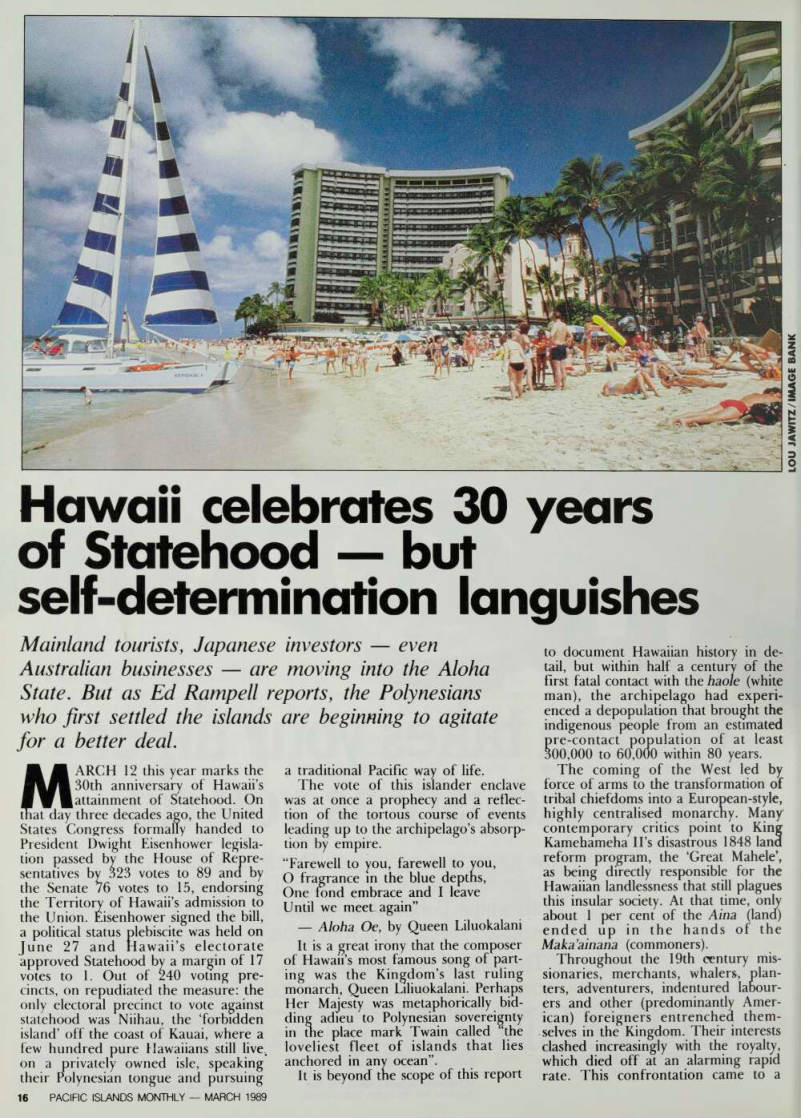
Lou Jawitz/ Image Bank
head in 1893, during the reign of Queen Liliuokalani, and resulted in the colonisation of a sovereign state.
Attorney Hayden Burgess, vice
president of the UN-affiliated World Council of Indigenous Peoples relates the series of events that saw the over throw of the Hawaiian monarchy: “in 1893 the Americans invaded, sending 162 US Marines, armed and ready for war. Basically, what they did was to support a puppet government calling itself a Provisional Government. They told Queen Liliuokalani to either sur render to this government or to go to war with the United States.”
Shortly after the January 1983 coup d’etat, a new US president, Grover Cleveland, took up residence at the White House. Cleveland, an anti
expansionist Democrat, was appalled
at the preceding Republican adminis tration’s gunboat diplomacy and dis
patched special investigator James
Blount to Honolulu for five months to assess the situation. The former Con federate Army officer reported that “a great wrong has been done to the
Hawaiians”, a people “overwhelmingly
opposed to annexation.” Blount went on to say that “their legitimate govern ment should be restored” post haste.
In a supremely cynical move, the Provisional Government went ahead and declare the Republic of Hawaii.
With the so-called pineapple dynasty’s Sanford B Dole as its first President, the Republic haughtily went on to refuse Cleveland’s exhortation to res tore Liluokalani to her throne on the pretext that as an independent nation, the Republic did not have to follow
Washington’s dictates.
A counter-revolution was crushed in 1895, the Queen was placed under house arrest and sentenced to five years’ hard labour and a SUSSOOO fine. In 1986, the Republicans re turned to office and President William
McKinley inaugurated America’s im
perialist age of Manifest Destiny. The ethos that had tamed a contingnet now eyes the world at large once America’s indigenous inhabitants as well as its former British, French and Spanish colonists had been ex punged ‘from sea to shining sea’.
The expansionism that had begun in Honolulu exploded on to the world stage on April 21, 1898, with the Spanish-American War. This brief conflict resulted in Washington seizing control of former Spanish possessions in the Caribbean as well as m the Paci fic, where Guam and the Philippines became US colonies. On July 7, Hawaii was finally annexed by the Un ited States: Pago Pago quickly fol lowed suit as the Panama tanal, link ing the Atlantic and Pacific, was con structed. Thus, the United tates, once a beacon of ati-colonualism, became an imperial power that in the words of
Theodore Roosevelt would “walk softly but carry a big stick”.
During the first half of the 20th
century, the missionary-descended Big
Five Castle & Cooke, Alexander & Baldwin, American Factors, Theo H Davies, C Brewer consolidated its monopoly over land, power and wealth in the archipelago. The rule of this Republican-linked elite was similar to that of a Central American planta tion-based oligarchy; prior to World War II almost half of the Territory’s land mass approximately 1,665,000 hectares was owned by fewer than 80 private owners.
The bombing of Pearl Harbour in 1941 heralded a new era in Hawaii, culminating with Statehood and the ascendancy of a new power structure led by the Democratic Party, unions and various non -haole ethnic groups, But Statehood perpetuated many of the same unresolved problems of the Hawaiian . . . and created new ones, The Hawaiian national liberation movement that has emerged has, in the past decade, centred on two cornerstones: land and culture.
Kekuni Blaisdell describes how col-
“Most Hawaiian dissidents firmly believe the root cause of the present tragedy lies in estrangement from Aina (the land),
turning Hawaii’s aboriginal inhabitants
into aliens in their own homeland”
onisation has impacted on the mental and physical health of the native. Dr Blaisdell, acting interim director of the Centre for Hawaiian Studies at the University of Hawaii, analyses an ‘in-
organic’ situation where “we
Hawaiians in our native land have the poorest health profile of all the ethnic groups in the State. For example, we have the shortest life expectancy and the highest mortality rates for the major causes of death, namely: heart diseases, cancer, stroke, accidents and diabetes. We have the highest rates for chronic illnesses such as hypertension, diabetes and kidney disease.
“Among our young people, we have the highest infant mortality rates; our school children have the highest dental caries rates and among young adult males, we have the highest suicide rates. We have the highest teenage pregnancy rate and for women who become pregnant regardless of age, we have the highest rates for complications . . . and the lowest for those who seek prenatal care.
“So this is a tragic situation and it’s not new. It has been going on since the white man came 200 years ago,” Dr Blaisdell laments. Hawaiians also have the state’s highest rate of
high school dropouts, drug/alcohol
abusers, family/chiid abusers and pris on inmates. A proponent of Hawaiian sovereignty, he contends that this health crisis is the result of an imposed society where colonised peo ple are out of kilter with their natural and social environments a sort of schizophrenia Franz Fanon called “black skins, white masks”.
UA MAU KE EA O KA AINA I KA
Pono (The Life Of The Land
Is Perpetuated In Right
Eousness’)
The motto of the State of Hawaii Kekuni Blaisdell and most Hawaiian dissidents firmly believe the root cause of the firmly present tragedy lies in their estrangement from Aina (the land), turning Hawaii’s aboriginal in habitants into aliens in their own homeland. The alienation of the Aina is a curse, according to barrister Mili lani Trask, who accuses both Federal and State government of what she calls “a massive breach of trust”.
“At the present time,” she says, “there are two Native Hawaiian land
trusts managed by the State. The first was created by act of Congress in 1921 and is called the Hawaiian Homes Commission Trust. It has about [74,000 ha] in it, scattered across the islands with the exception of Lanai.
These lands were set aside by Con gress for the purpose of encouraging
homesteading and pastoral uses.
“The second Native Hawaiian land trust was created in 1959 when we be came a State. Hawaii is the only State in the American Union where the federal government required as part of the compact for its admission into the Union that the State receive approximately [566,800 ha], which it would hold in trust for the public and for Native Hawaiians. In all the other States of the Union the public land of the state in preserved for public pur poses only, but in Hawaii the lands are preserved for the public and the native.” These ceded lands account for almost 580,000 ha.
Though these laws exist on the books, they have not been im plemented: there are two legal cate gories for people of Hawaiian ancestry (see Pacific Islands Monthly, Decem ber 1988) and only one group is legal ly entitled to benefit from the land
trusts the Native Hawaiian benefici ary class, legally defined as being 50 per cent or more Hawaiian blood. Part Hawaiians, who have less than 50 per cent Hawaiian ancestry, have no legal claim to the two land trusts, meaning the overwhelming majority has no land entitlements at all.
Native Hawaiians currently number about 40,000, while part Hawaiians are estimated to be lbo,ooo out of a State population of around one mil lion. This division into two distinctly different classes has recently caused major controversy in the community, with an effort being made to create a
‘single definition’ Hawaiian entitling
all to land trust benefits.
In any case, Mililani Trask charges that these benefits have not been re ceived by the majority of the benefici ary class for which they are ear marked. “In 1982, we had the first federal investigation into how the state had managed those lands and the re sult revealed extensive breach of trust.
At that time there were 8500 families waiting for homes. At the present time there are 18,000 families waiting for entitlements. The report revealed that [much of the land is being used by] State, Federal and country agencies
for various public purposes.” Airports
and military installations, for example, have been established on ceded lands.
Land struggles have characterised Hawaiian nationalism since its reem ergence in the late 1960 s and early
’7os. Japanese speculation, runaway
development ana military occupation
of land the Pentagon occupies 25 per cent of Oahu and 3 per cent of the entire State, and though Hawaii is the third smallest State it is the third largest in terms of actual lands owned by the military and first in terms of land ownership ratio affects the en tire community, but it is the aboriginal people who are hit hardest.
Activists have waged a series of pro tests in an effort to reclaim and pre serve Kalama Valley, Hilo Airport, Waiaole-Waikane, Sand Island, Makua Valley, Waimanalo Beach, Hoae’ae, Sandy Beach and more.
The movement that has come to epitomise the Hawaiian land struggle concerns Kaho’alawe, an island offtne coast of Maui that is regularly used for target practice. The US Navy has invited Japan, Australia, New Zealand, Canada and Britain to participate in manoeuvres that in 1984, for example, involved 80 warships and submarines, 250 aircraft and 50,000 troops. All of the island’s 11,740 ha are part of the ceded land trust and in 19/7, activists George Helm and Kimo Mitchell dis appeared at sea during a protest ac tion. There have been some conces sions, but the Navy continues to bomb Kaho’olawe despite more than a de cade of land occupations and other
demonstrations by the Protect Kaho’olawe Ohana.
If the Hawaiian’s land has been torn from beneath his feet, Western and Eastern acculturation seem to have rent his soul. Missionaries and others sought to banish Hawaiian religion, arts, language and oral tradition ev erything that made Hawaii, Hawaiian.
At times it seemed as if the very act of being Hawaiian was seditious be haviour: as George Helm, the activist to whom the song Hawaiian Soul is dedicates, said: “Far worse than not having land is not having identity, cul ture, pride and dignity.’ 9
“The public
schools that once
banned the
language now
offer Hawaiian as
a subject”
But the exorcism of the inner Hawaiian never fully succeeded, for side by side with the land struggles came Hawaii’s cultural renaissance.
Hawaiian culture has re-emerged in music, dance, fashion, language, reli gion, film, visual arts, theatre and sea
faring. The double-hulled sailing
canoe Hokulea is to this renaissance what Kaho’olawe Island is to the land
rights movement.
Since 19705, Hokulea has traversed the vast stretches of the Pacific with out modern technology, using the stars, the wind, the waves and clouds to navigate from Hawaii to the root of Polynesia. The twin masted canoe proved that the Hawaiians possessed the knowledge necessary for trans oceanic voyaging and that they had not made landfalls at their archipelago perhaps as long ago as 300 AD by accident. Nainoa Thompson, the navigator who guided the canoe dur ing its later voyages, described his Oceanic odyssey as a moment of self perspective, of one person in a vast ocean given an opportunity of looking througn a window into my heritage”.
Indeed, the entire Hawaiian renaiss ance provides a heritage window: musicians such as Gabby Pahinui, the Peter Moon Band, the Makaha Sons of Niihau, the Cazimeros and many others give voice to Kanaloa (Tangar oa), the Polynesian god of creation.
It is in songs, too, that the Hawaiian language literally finds a tongue and the public schools that once ban ned the language now offer Hawaiian as a subject.
Video is playing a key role in cultu
ral preservation and protest politics.
The Make O Ka Aina (the Eyes of the
Land) group creates documentaries about feather weaving as well as prop
aganda vehicles attacking developers,
as in its West Beach Story and Kapu Kau documentaries. Director Puhipau declares that his camera is the “gun” with which he fights the good fight.
The hula has seen a major revival, with festivals such as the Merrie Monarch highlighting traditional choreography; sarongs and other
Polynesian-style garb are worn by
Hawaiians to affirm their Pacific roots.
The realm of the visual arts is also richly diverse. Hawaiian aesthetics stormed the Islands’ art preserves in 1987, with paniolo (cowboy) folk art and a contemporary Hawaiian exhibi tion at the Honolulu Academy of Arts.
In early 1988 Rocky Jensen, the
Hawaiian renaissance’s own Renaiss ance Man, held an exhibition at the Contemporary Arts Centre that may have been the first such display by a Native Hawaiian. Jensen is probably the best Polynesian sculptor outside New Zealand, able to give form to artifacts or carvings that are suffused with a true Pacific sensibility.
Chief Maui Loa, like his cousin
Rocky Jensen a descendant of King
Kalakaua, is also an activist and was instrumental in Hawaiians’ inclusion in the American Indian Religious Free dom Act. Traditional believer and Pele worshipper Dr Emmett Aluli and others oppose the development of geothermal energy and a mooted spaceport on the Big Island out of de ference to the volcano deity. Across the State heiau aboriginal temples are being restored and visited as places of prayer and offerings.
Nineteen eighty-seven was officially
designated Ho’olako, the Year of the Hawaiian, in honour of the descen dants of the State’s first settlers. In early 1988 Ho’olakahi, Hawaiian Unity Day, was held at Aloha Stadium: an estimated 40,000 Hawaiians and their supporters came to the event, billed as the first time since the early 19th cen tury that the Hawaiians nave come together as people. Interviewed at the event, then-thairman of the Office of Hawaiian Affairs Moses Keale re vealed the movement’s master plan and the link between the land rights cause and the cultural rebirth: “First, make people feel good about them selves through ethnic pride. Then, unification. Next comes the major struggle: the return of the land.”
Sovereignty: On Ipa A !
(‘Stand Firm’)
As Hawaiians mark the 30th anniversary of Statehood, a number of matters are reaching a critical stage of development. While Hawaiians remain
an admittedly disadvantaged minority,
the twin land and culture movements
have nevertheless propelled them forward. They now have the Office of Hawaiian Affairs (OHA), the agency charged with serving their interests, and Hawaiian Governor John Waihee, America’s first Polynesian State chief executive. OHA and the Governor’s office are reportedly conducting negotiations regarding the Hawaiian trust lands, which OHA is seeking to place under its jurisdiction.
In January, OHA trustees travelled to Washington and met with Hawaii’s
Congressional delegation to discuss
Federal reparations to Hawaiians for the coup, annexation and the loss of land as the centennial of the monar-
chy’s overthrow approaches. Another
decade will probably see demonstrations similar to those staged by the
Aborigines during Australia’s
bicentennial in 1988, since a number of legal questions in relation to the deposmg of Queen Liliuokalani and the annexation remain unresolved: some activists even speak of trying the United States before the International Court of Justice or the United Nations’ Committee on Decolonisation.
The hottest political issue in Hawaii today is the move for sovereignty (See PIM, January 1989). The word is defined differently by different factions: a small minority favours outright inde-
pendence, including Hayden Burgess
of the WCIP and Peggy Hao Ross, a pretender to the throne claiming to be Hawaii’s rightful oueen, whose group declared independence from the Uo in 1980. But considering the fact that CINCPAC, the Pentagon’s Pacific and Indian Oceans command, is based at Pearl Harbour and that the US has substantial other interests in its Fiftieth State, Hawaii’s withdrawal from the Union is highly improbable.
Ka Lahui Hawaii, or the Sovereign
Hawaiian Nation, is agitating for the next best thing to independence. Ka Lahui Hawaii defines sovereignty as self-determination, and is basically calling for “a nation-within-a-nation ’ based on the Hawaiian Homelands where Hawaiians would have extensive reservations and a government-to government relationship with Washington. At the same time that Hawaiians practised limited home rule over part of the archipelago, they would remain US citizens and Amer ica would exercise control over much of the island chain, Hawaii’s Senator Daniel Inouye, Chairman of the Senate Select Com mittee on Indian Affairs, has been speaking out recently in favour of li mited sovereignty, saying: “Some peo pie may scoff at this whole idea, but parts of it at least are achievable.” For example, there are currently 308 Indi an, Inuit and Aleut ‘nations’ in the continental United States, operating within federal and state confines but with various forms of local control.
Parity for Hawaiians with their Native American brethren seems an attain able goal, but there are many obstacles on tne path to nationhood. The Hawaiian movement has not had a unified leadership, and this lack of solidarity has taken on many forms, Some factions concentrate on special interest issues such as Kaho’olawe, Pele or various court battles; Ka Lahui competes with OHA for political hege mony; the dispute over the blood quantum intended by OHA to uni fy all Hawaiians erupted instead into a bitter feud; and there are per sonality clashes, such as the attack by Ka Lanui’s Kia Aina (governor) Milila ni Trask on Governor Waihee as “a brown puppet held prisoner by busi ness interests”. The backstabbing
among many of Hawaii’s artists
reaches positively Shakespearean prop
ortions, and tneir hatred for one another is poisonous.
Furthermore, what is loosely refer red to as the Hawaiian movement does not by any stretch of the im agination represent all Hawaiians or even a majority of them. Even in the OHA elections, which permit only those of Hawaiian ancestry to cast their ballots, participation is low (60,000 out of a potential 200,000, minus those under the age of 18). Cri tics contend that not only do Hawaiians not vote as a bloc, they don’t vote at all; many Hawaiians identify as patriotic US citizens, such as former state Chief Justice William Richardson, who proclaims: “We’re Americans now. American civilisation is not destroying Hawaiian culture; it’s giving it a chance to revive, progress and grow.” OHA land officer Linda Delaney asserts: “You cannot make Hawaiians choose between the Hawaiian mother and the American father.” Even independence advocate Hayden Burgess estimates that at the most, only 20 per cent of all Hawaiians favour leaving the Union.
The greatest single problem within the Hawaiian movement is lack of mass participation. Though there are 18,000 signatories on the state’s De partment of Hawaiian Home Lands (DHHL) waiting list. Civil Rights for Hawaiians was only able to turn out 200 people for a demonstration at the State Capital . . . one of the largest Hawaiian demonstrations in recent times. Last December’s sovereignty conference likewise drew only 200 participants. A football match attracted more spectators to Aloha Stadium than Hawaiian Unity Day, and a 1987 commemorative service for George Helm and Kimo Mitchell held at the University of Hawaii’s amphitheatre was at least half empty.
Continued inequity has high social costs: crime, welfare, unemployment and the other indicators of anomie, all of which must be borne by society.
Injustice is expensive and impractical:
Hawaiian activist Kawaipuna Prejean
contends that the State’s current SUSSOO million surplus exists because the state refuses to honour its trustee commitments to Hawaiians, such as providing them with the necessary capital for infrastructure on DHHL homesteads and farms. If there is no redress for Hawaiian grievances, Hawaii could sink into a situation where settlers are pitted against na tives. Former OHA Trustee Hayden Burgess points out that “the UN rec ognises armed struggle to be the right of an occupied people,” and refuses to renounce Hawaiians’ right to do to the Americans the same thing the Amer icans did to the British in 1776. □
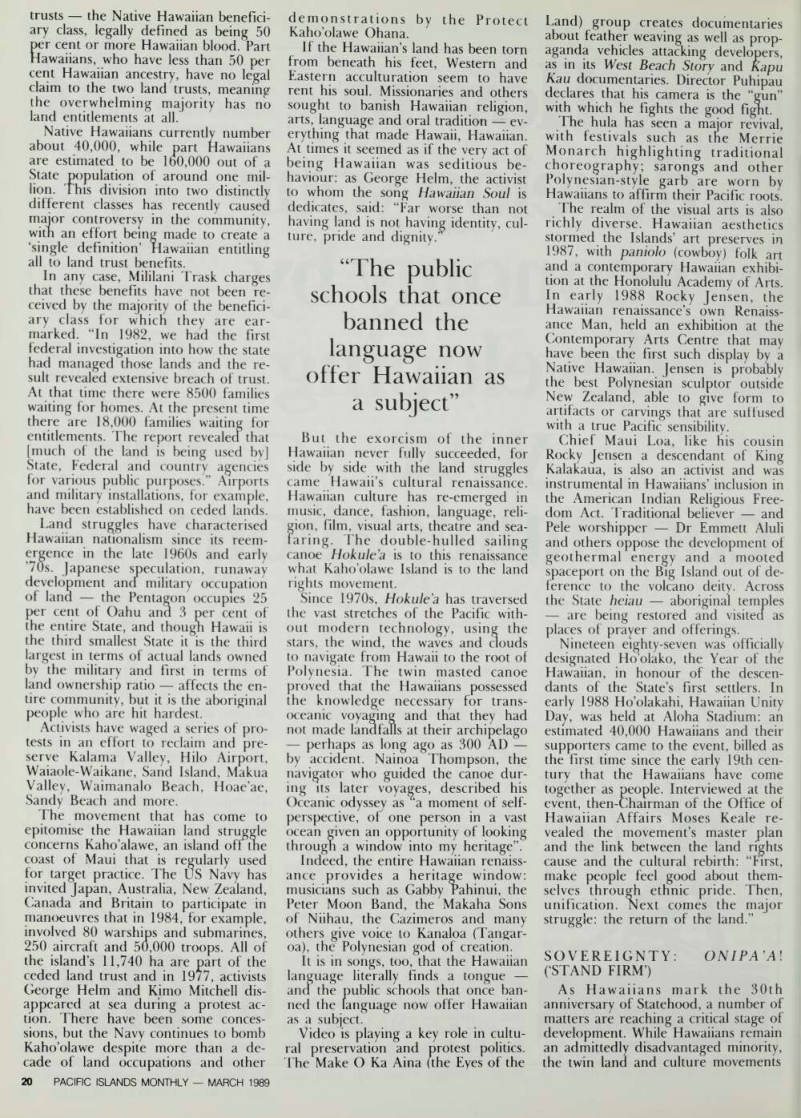
The Hawaiian cultural renaissance is expressed in ‘newly traditional’ forms such as non-tourist dance.
Oliver Strewe/Wildlight
Advertisements & other items, pp. 17-19 (1 item)
Experience
A NEW DRIVING
■ wm u w *■-> ■ * 5B
\^XIIXVSI^.
Ps
MULTI-VALVE
ENGINE
A HIGHER STANDARD:
ALL NEW COROLLAS NOW COME WITH
TOYOTA MULTI-VALVE ENGINES.
Here is a blend of elegance and performance usually found only in big, luxury cars. That’s because Toyota believes everyone should enjoy the newest automotive advancements. And the latest example of this thinking is the all-new Corolla. It has an elegantly rounded shape to be proud of. And the high output and efficient multi-valve engine in all Corollas puts their performance in far better shape.
Expand your driving experience to new horizons with the all-new Corolla. Toyota World’s No. 1 producer of multi-valve engines.
TOYOTA
Howto
develop your
Tail
economy by
developing
your
systems for isolated areas. OTC wasj one of the founders of Intelsat. And/in the development of optical fibre systems, OTC is a pioneer.
This technology, which #it Australia at the f<#front of communications, is available to you through OTQjmternational.
Tailor-made teleconmunications.
OTC gives #)u the choice of the worlds be# communications systems, whicl#can be specifically designed to mee#our needs.
Because \# design, construct and operate ouiJlwn systems, we can offer you expeiJFnce in integrating the best hardware available.
Putting you in control.
An important strategic and economic consideration for anv
communications.
In todays world, no country can develop in isolation. To grow it must compete in fast-moving world markets, and to gain access to these a modern telecommunications network is absolutely essen«ai When cations from /®stralia's ('HiM . you get more than thickest telecommunications system availatac You als«get the sound financial expertise tb# has made OTC Australia’s leadiogfnnternational telecommunicais company.
By providing training to your staff in all aspects of financial planning and cost accounting, your system will operate on a solid financial basis. And pay for itself.
Bringing world markets to you.
Australia, like many nations, is a long way from the worlds business capitals. However, through OTCs advanced communications network, the world is now on our doorstep.
OTC is the worlds leading exponent of thin route satellite communications system is local management.
OTCs advanced training program makes the transfer of knowledge an important part of your system implementation.
Training courses in operations and management, accounting and planning will quickly result in local staffing and administration.
Making the right decision.
For an objective appraisal of your communication needs contact OTC now. Phone or write to Mr. Peter Shore, Executive Director, OTC International Ltd, GPO Box 7000, Sydney NSW 2001 Australia. Telephone (612)2875410, Fax (612)2875617.
OTC
0T1’0264 mojoMDA IMM
Tax burdens anger residents
Hawaii
Hawaiians blame Asian buyers for high property but as Robin Bromby reports, the State’s counties are the culprits.
While Australians Have
been blaming Japanese inves-
ers for meteoric rises in property values, Asian buyers have also been coming under attack in Hawaii for their effect on the state’s nroperty taxes (see Pacific Islands
Monthly, February).
But, as a report from the Bank of
Hawaii points out, the property tax issue on those islands is more directly linked to the problems facing county administration in the State. While the State Government’s coffers are showing a healthy surplus, the counties are starved of money and the only way they have to redress that is by property taxes (or rates, as they known in
countries that follow the British sys tern). As the bank points out, apprais als on which taxes are now based were undertaken before the current prop erty boom, and the effect is especially noticeable in the city of Honolulu, “It appears that Honolulu needs to raise the property taxes aggressively, and the Japanese have come along at
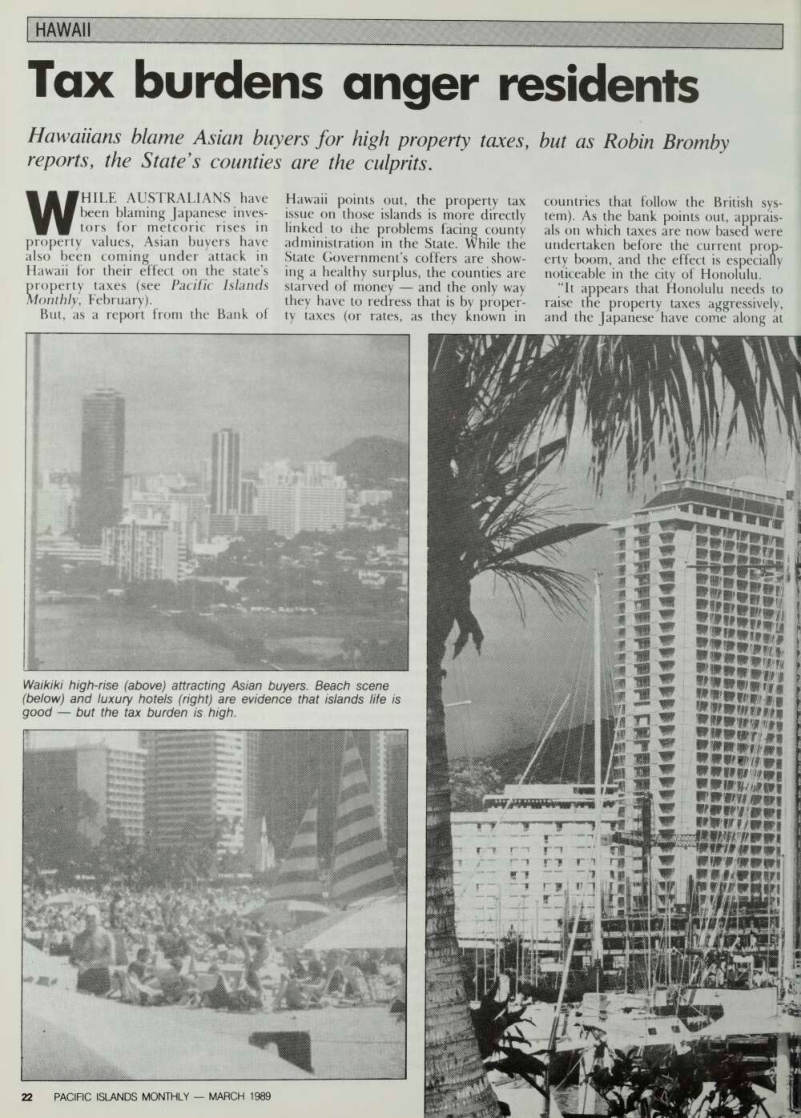
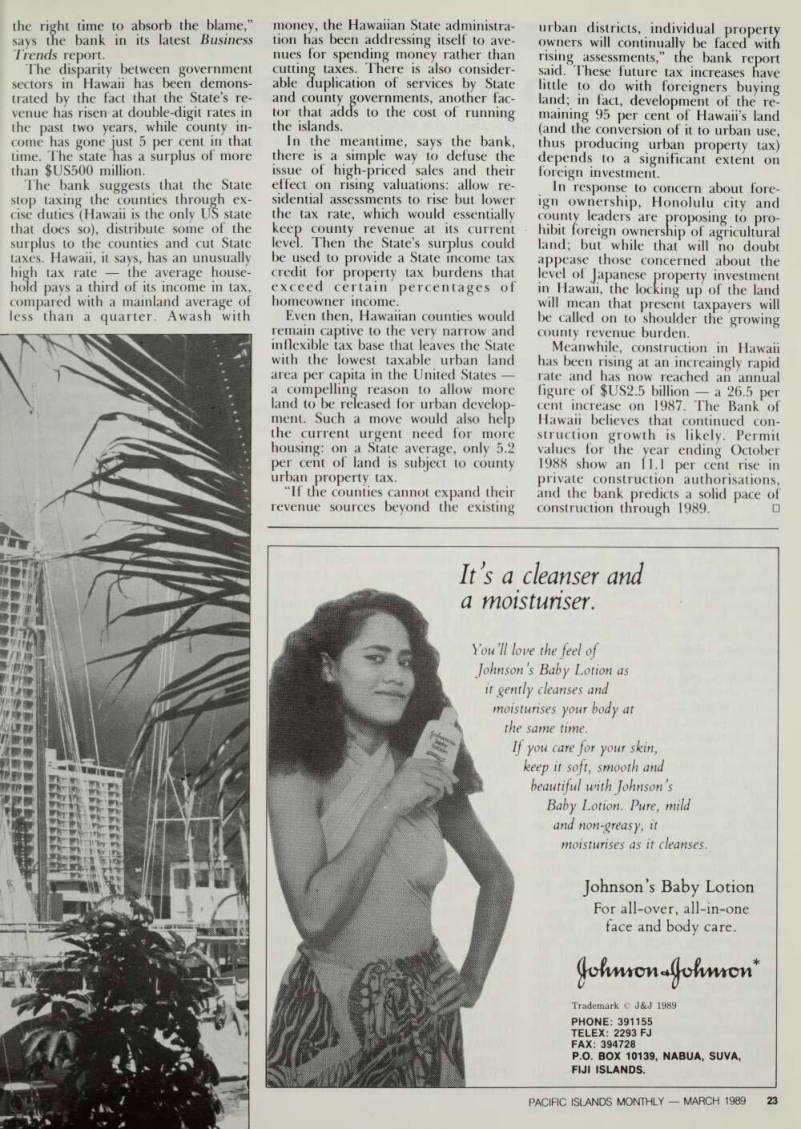
Waikiki high-rise (above) attracting Asian buyers. Beach scene (below) and luxury hotels (right) are evidence that islands life is good - but the tax burden is high.
the right time to absorb the blame,” says the bank in its latest Business Trends report.
The disparity between government sectors in Hawaii has been demons trated by the fact that the State’s re venue has risen at double-digit rates in the past two years, while county in come has gone just 5 per cent in that time. The state has a surplus of more than SUSSOO million.
The bank suggests that the State stop taxing the counties through ex cise duties (Hawaii is the only US state that does so), distribute some of the surplus to the counties and cut State taxes. Hawaii, it says, has an unusually high tax rate the average house hold pays a third of its income in tax, compared with a mainland average of less than a quarter. Awash with
money, the Hawaiian State administration has been addressing itself to avenues for spending money rather than cutting taxes. There is also considerable duplication of services by State and county governments, another factor that adds to the cost of running the islands.
In the meantime, says the bank, there is a simple way to defuse the issue of high-priced sales and their effect on rising valuations; allow residential assessments to rise but lower the tax rate, which would essentially keep county revenue at its current level. Then the State’s surplus could be used to provide a State income tax credit for property tax burdens that exceed certain percentages of homeowner income.
Even then, Hawaiian counties would remain captive to the very narrow and inflexible tax base that leaves the State with the lowest taxable urban land area per capita in the United States a compelling reason to allow more land to be released for urban development. Such a move would also help the current urgent need for more housing: on a State average, only 5.2 per cent of land is subject to county urban property tax.
“If the counties cannot expand their revenue sources beyond the existing
urban districts, individual property owners will continually be faced with rising assessments,” the bank report said. These future tax increases nave little to do with foreigners buying land; in fact, development of the re maining 95 per cent of Hawaii’s land (and the conversion of it to urban use, thus producing urban property tax) depends to a significant extent on
foreign investment.
In response to concern about fore
ign ownership, Honolulu city and
county leaders are proposing to pro
hibit foreign ownership of agricultural
land; but while that will no doubt appease those concerned about the level of Japanese property investment in Hawaii, the locking up of the land will mean that present taxpayers will be called on to shoulder the growing county revenue burden.
Meanwhile, construction in Hawaii has been rising at an increaingly rapid rate and has now reached an annual figure of SUS2.S billion a 26.5 per cent increase on 1987. The Bank of Hawaii believes that continued con struction growth is likely. Permit values for the year ending October 1988 show an 11.1 per cent rise in private construction authorisations, and the bank predicts a solid pace of construction through 1989. □
Advertisements & other items, p. 23 (1 item)
|olmwciM4|olwmcm’
mm m m wt* m ..M m
It 5 cleanser and
a moisturiser.
You'll love the feel of Johnson 's Bd6y Lotion as it gently cleanses and moisturises your body at the same time.
If you care for your skin, keep it soft, smooth and
beautiful with Johnson's
Baby Lotion. Pure, mild and non-greasy, it moisturises as it cleanses.
Johnson’s Baby Lotion
For all-over, all-in-one face and body care.
|olmwciM4|olwmcm’
Trademark © J&J 1989
PHONE: 391155
TELEX: 2293 FJ
FAX: 394728
P.O. BOX 10139, NABUA, SUVA,
FIJI ISLANDS.
$10 million in aid 'misused'
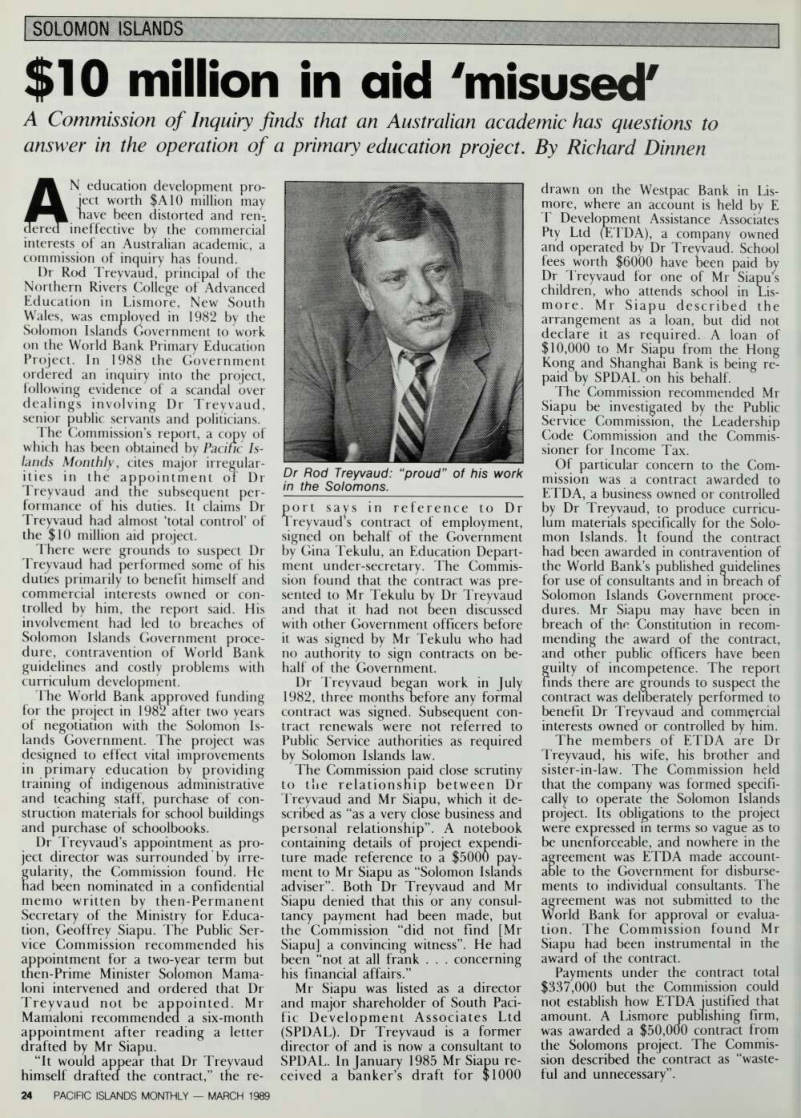
Solomon Islands
A Commission of Inquiry finds that an Australian academic has questions to
answer in the operation of a primary education project.
By Richard Dinnen
N education development pro iect worth SAIO million may nave been distorted and ren-. derea ineffective by the commercial interests of an Australian academic, a commission of inquiry has found.
Dr Rod Treyvaud, principal of the Northern Rivers College of Advanced Education in Lismore, New South Wales, was employed in 1982 by the Solomon Islands Government to work on the World Bank Primary Education Project. In 1988 the Government ordered an inquiry into the project, following evidence of a scandal over
dealings involving Dr Treyvaud,
senior public servants and politicians.
The Commission’s report, a copy of which has been obtained by Pacific Is
lands Monthly, cites major irregular
ities in the appointment of Dr Treyvaud and the subsequent per formance of his duties. It claims Dr Treyvaud had almost ‘total control’ of the $lO million aid project.
There were grounds to suspect Dr Treyvaud had performed some of his duties primarily to benefit himself and commercial interests owned or con trolled by him, the report said. His involvement had led to breaches of Solomon Islands Government proce dure, contravention of World Bank
guidelines and costly problems with
curriculum development.
The World Bank approved funding for the project in 1982 after two years of negotiation with the Solomon Is lands Government. The project was designed to effect vital improvements
in primary education by providing
training of indigenous administrative
and teaching staff, purchase of con struction materials for school buildings and purchase of schoolbooks.
Dr Treyvaud’s appointment as pro ject director was surrounded by irre gularity, the Commission found. He had been nominated in a confidential memo written by then-Permanent Secretary of the Ministry for Educa tion, Geoffrey Siapu. The Public Ser vice Commission recommended his appointment for a two-year term but then-Prime Minister Solomon Mama loni intervened and ordered that Dr Treyvaud not be appointed. Mr Mamaloni recommended a six-month appointment after reading a letter
drafted by Mr Siapu.
“It would appear that Dr Treyvaud himself draftee! the contract,” the re-
port says in reference to Dr Treyvaud s contract of employment, signed on behalf of the Government by Gina Tekulu, an Education Depart ment under-secretary. The Commis sion found that the contract was pre sented to Mr Tekulu by Dr Treyvaud and that it had not been discussed with other Government officers before it was signed by Mr Tekulu who had no authority to sign contracts on be half of the Government.
Dr Treyvaud began work in July
1982, three months oefore any formal contract was signed. Subsequent con tract renewals were not referred to Public Service authorities as required by Solomon Islands law.
The Commission paid close scrutiny to the relationship between Dr Treyvaud and Mr Siapu, which it de scribed as “as a very close business and
personal relationship”. A notebook
containing details of project expendi
ture made reference to a $5OOO pay ment to Mr Siapu as “Solomon Islands adviser”. Both Dr Treyvaud and Mr Siapu denied that this or any consul tancy payment had been made, but the Commission “did not find [Mr Siapu] a convincing witness”. He had been “not at all frank . . . concerning his financial affairs.”
Mr Siapu was listed as a director and major shareholder of South Paci fic Development Associates Ltd (SPDAL). Dr Treyvaud is a former director of and is now a consultant to SPDAL. In January 1985 Mr Siapu re ceived a banker’s draft for $lOOO
drawn on the Westpac Bank in Lis more, where an account is held by E T Development Assistance Associates Pty Ltd (ETDA), a company owned
and operated by Dr Treyvaud. School
fees worth $6OOO have been paid by Dr Treyvaud for one of Mr Siapu’s children, who attends school in Lis more. Mr Siapu described the arrangement as a loan, but did not declare it as required. A loan of $lO,OOO to Mr Siapu from the Hong Kong and Shanghai Bank is being re paid by SPDAL on his behalf.
The Commission recommended Mr
Siapu be investigated by the Public
Service Commission, the Leadership Code Commission and the Commis sioner for Income Tax.
Of particular concern to the Com mission was a contract awarded to ETDA, a business owned or controlled
by Dr Treyvaud, to produce curricu
lum materials specifically for the Solo mon Islands. It found the contract had been awarded in contravention of the World Bank’s published guidelines for use of consultants and in Breach of Solomon Islands Government proce dures. Mr Siapu may have been in breach of the Constitution in recom mending the award of the contract, and other public officers have been guilty of incompetence. The report finds there are grounds to suspect the contract was deliberately performed to benefit Dr Treyvaud and commercial interests owned or controlled by him.
The members of ETDA are Dr Treyvaud, his wife, his brother and sister-in-law. The Commission held that the company was formed specifi cally to operate the Solomon Islands
project. Its obligations to the project
were expressed in terms so vague as to be unenforceable, and nowhere in the agreement was ETDA made account able to the Government for disburse ments to individual consultants. The agreement was not submitted to the World Bank for approval or evalua tion. The Commission found Mr Siapu had been instrumental in the award of the contract.
Payments under the contract total $337,000 but the Commission could not establish how ETDA Justified that amount. A Lismore publishing firm, was awarded a $50,000 contract from the Solomons project. The Commis sion described the contract as “waste ful and unnecessary”.
Dr Rod Treyvaud: “proud” of his work in the Solomons.
Concern over shortcomings in curri culum material provided oy ETDA prompted it to recommend a full reas sessment because of the “profound effect” it was likely to have on future generations. “There is a real danger that the educational objectives of the
curriculum development project have
been distorted . . . with a view to en hancing the image and profits of pri vate commercial interests,” the report said. “It should not have been allowed for the situation to arise whereby one individual played a dual role as educa tion adviser/project director and as a businessman representing a company in a contractual relationship with the project.” The report found this situa tion developed because of the willing ness of Solomon Islands officials, in
particular Mr Siapu, to be manipu
lated by Dr Treyvaud, and because Dr Treyvaud was not directly answerable
to any superior and was allowed almost total control over the project.
The Commission also investigated the affairs of SPDAL and found them to be “shrouded in confusion ... its financial affairs, in particular, are un
satisfactory”. The relationship between
SPDAL and ETDA was at first diffi cult to establish, but funds had been transferred between the two com panies. The Solomon Islands Govern ment entered into an agency agree ment with SPDAL because it was thought to be a locally owned com pany. In reality, SPDAL’s affairs were controlled by Australian business in terests. The Commission found “it would be reasonable to describe SPDAL as a mere sham for ETDA”, and that the bona fides of ETDA are open to “considerable doubt”. The Commission found SPDAL’s accounts were incomplete, contained errors of
omission and commission, referred to apparently fictitious bank overdrafts and had overstated liabilities.
In a prepared statement to his col lege council last month, Dr Treyvaud claimed he was the victim of a cam paign of defamation by opponents of a proposed property development he supports. Dr Treyvaud alleged those opponents had caused the Commis sion of Inquiry to be established.
He maintained that he was proud of the work he had done in the Solomon Islands and that he had gained great “satisfaction” from “contributing to the development of a National Prim ary Education Curriculum”. The Com mission, however, cited shortcomings in financial management, non
completion or non-delivery of projects
and materials, and an apparent net
work of influence-peddling, nepotism
and croneyism. □
for Pacific nations.
New Zealand
Golden Fleece no force for peace
New Zealand military forces put down an imaginary rebellion, but protesters slam the real-life implications
for Pacific nations.
By David Robie
THE TROOPS moved into the re mote town before dawn on a
Sunday and began searching
houses for armed civilian rebels. Villa gers were detained for questioning and some of the insurgents sheltering in the area were shot.
The community based the soldiers as they secured the town. Operation Golden Fleece was under way. After initial difficulties and the loss of seven New Zealand soldiers, the rebels were soon overcome.
This is not a report from a newly created war zone; it is the story of a month-long New Zealand military ex ercise that attracted a barrage of critic ism from peace activists and the trade union movement.
The exercise scenario was that an imaginary Pacific island state, Kolkis, was under the control of a ‘rebel gov
ernment’ supported by ‘Musonan’
forces. The 'official’ Kolkis ‘govern ment’ requested New Zealand assist ance to restore order, NZ troops were mobilised, and the battleground dra ma was played out in the remote cen tral North Island forestry town of Minginui (population 200). The town’s unofficial mayor, George McMillan,
praised the operation, saying “this will
help our troops if they are ever needed in the Pacific Islands.”
While Operation Golden Fleece was
in line with policy laid do,wn in the 1987 White Paper on defence, it be came a pubfic oattleground. The NZ military high command chalked up
the February operation as a victory
but while in military terms it was a success, it was a setback on the politic al front. The unscripted appearance on the scene of two groups attempting to intervene in the imaginary conflict threw a spanner in the works. Obser vers said the sudden obstacle had, however, created a more realistic situation in the context of military and constitutional crisis in the Pacific.
Proclaiming “mediation not militar isation”, one group tried to intervene as mediators between the rebels of Kolkis and the NZ forces during the exercise. The group announced to the media that “a political settlement is possible and necessary rather than a military victory or defeat . . . the de fence forces of many countries are
turning to political solutions for poli
tical problems”.
The other group, styling itself the “People’s Front of Kolkis”, attempted a more direct style of intervention and claimed to have ‘infiltrated’ the milit ary. Publicity of the groups’ activities embarrassed the military and sparked a debate about the nature of New Zea land involvement in the South Pacific at times of political upheaval.
“It is important that people in the Pacific know what is happening,” said Alan Marston, a spokesman for one of the mediation groups. “Our troops are being trained to invade Pacific coun tries we should be preparing for mediation and peacekeeping roles.”
The President of the Council of Trade Unions, Ken Douglas, ‘ambushed’ the military with a press
statement that gained widespread
front page coverage. The army, com
plained Douglas, was preparing to
fight on the “wrong side*’ in countries where armed conflict was likely. “The parallels between the mythical island of Kolkis and our Pacific neighbours are most disturbing,” he said, particu
larly suggesting comparisons with Fiji
ana New Caledonia.
Many unions had protested that the military was practising to suppress a popular movement rather than to Keep the peace or to defend New Zea land. “The army should be practising for a peacekeeping, disaster relief or emergency assistance role in other countries rather than stepping in on behalf of unpopular government trying to settle their problems by milit ary force,” Douglas said. “Foreign in vasions and military campaigns to kill rebels do not solve the problems of
poverty, unemployment and exploita
tion that lead to such unrest.”
Military and government officials fired bach their own salvos. “It’s only an exercise,” said Defence Ministry
spokesman Major Peter Fry. Defence
Minister Bob Tizard complained that the unions had misinterpreted the basis for the exercise. As Mr Tizard explained it, the New Zealand Govern ment had merely responded to a plea from the ‘government’ or a friendly Pacific island state. D
Waiting for the skies
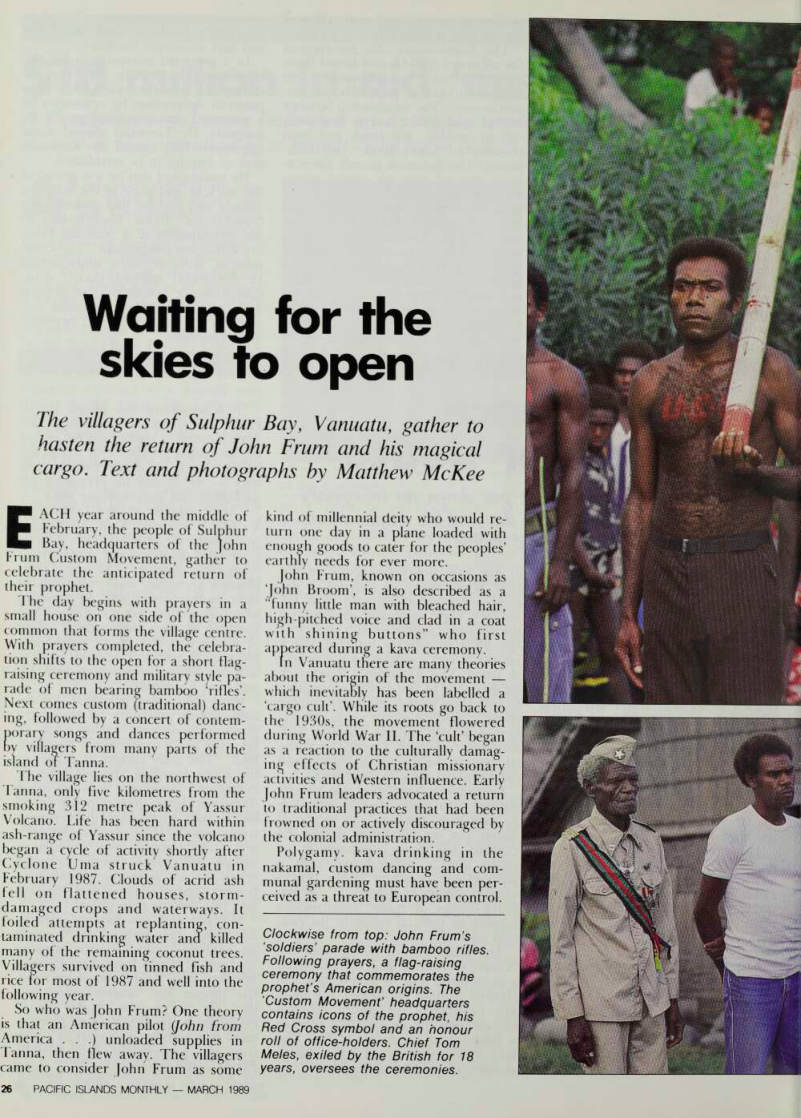
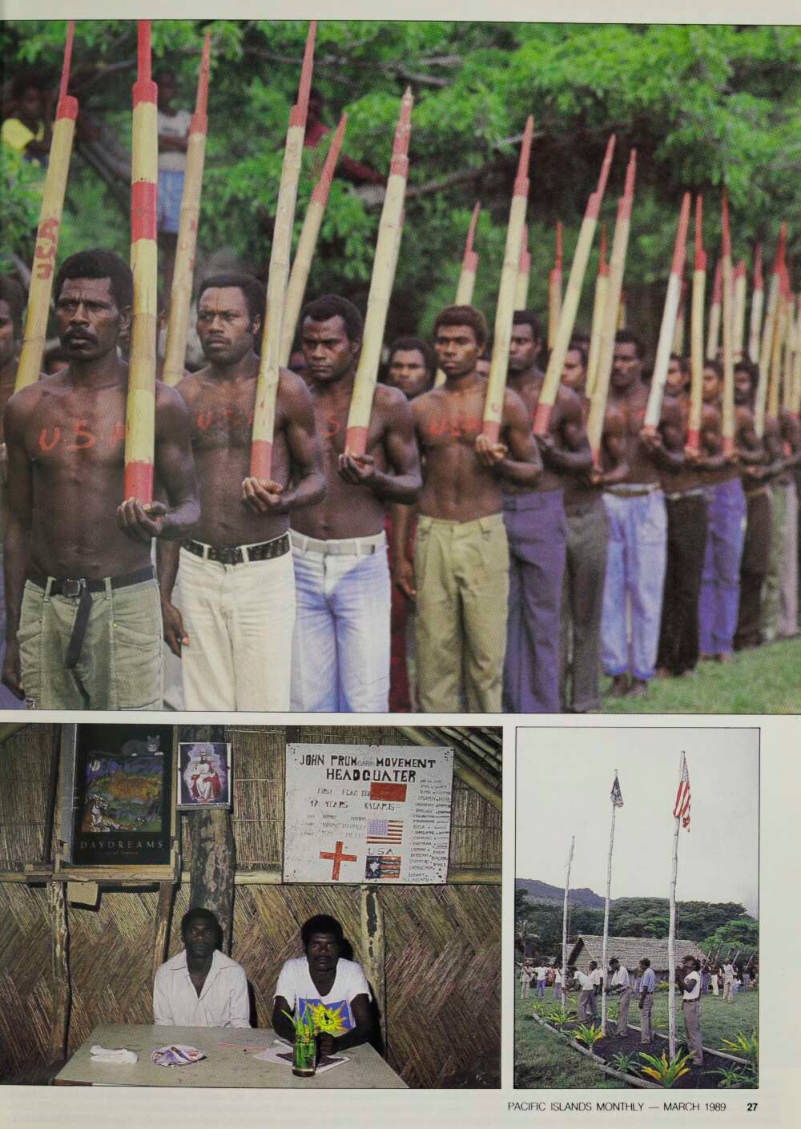


skies to open
The villagers of Sulphur Bay, Vanuatu, gather to hasten the return of John and his magical cargo. Text and photographs by Matthew McKee
EACH year around the middle of
February, the people of Sulphur
Bay, headquarters of the John
frum Custom Movement, gather to celebrate the anticipated return of
their prophet.
I he day begins with prayers in a small house on one side of the open common that forms the village centre, With prayers completed, the celebration shifts to the open for a short flag-
raising ceremony and military style pa-
rade of men bearing bamboo ‘rifles’, Next comes custom (traditional) dancing, followed by a concert of contemporary songs and dances performed by villagers from many parts of the island of Tanna.
I he village lies on the northwest of I anna, only five kilometres from the smoking 312 metre peak of Yassur Volcano. Life has been hard within ash-range of Yassur since the volcano began a cycle of activity shortly after Cyclone Uma struck Vanuatu in February 1987. Clouds of acrid ash lell on flattened houses, stormdamaged crops and waterways. It foiled attempts at replanting, con laminated drinking water and killed many of the remaining coconut trees.
Villagers survived on tinned fish and skszf 1987 an<l "" ,he So who was John Frum? One theory is that an American pilot (John from America . . .) unloaded supplies in Tanna, then flew away. The villagers came to consider John Frum as some
kind of millennial deity who would re turn one day in a plane loaded with enough goods to cater for the peoples’ earthly needs for ever more.
John Frum, known on occasions as John Broom’, is also described as a funny little man with bleached hair, high-pitched voice and clad in a coat with shining buttons” who first appeared during a kava ceremony. in Vanuatu there are many theories about the origin of the movement which inevitably has been labelled a ‘cargo cult’. While its roots go back to the 19305, the movement flowered during World War 11. The ‘cult’ began as a reaction to the culturally damag ing effects of Christian missionary activities and Western influence. Early John Frum leaders advocated a return to traditional practices that had been
frowned on or actively discouraged by
the colonial administration.
Polygamy, kava drinking in the nakamal, custom dancing and com munal gardening must have been per ceived as a threat to European control.
Clockwise from top: John Frum’s ‘soldiers’ parade with bamboo rifles.
Following prayers, a flag-raising ceremony that commemorates the prophet’s American origins. The Custom Movement’ headquarters contains icons of the prophet , his Red Cross symbol and an honour roll of office-holders. Chief Tom Meles, exiled by the British for 18 years, oversees the ceremonies.
because the British administration’s re sponse was to attempt to quash the movement. From 1941 to 1943, adhe rents were arrested, large fines im posed and leaders exiled to outer is lands of the group. Many of these Eeople arrested were put to work on IS Air Force bases at Vila and Santo which meant they were able to ‘spread the good word’ throughout the coun try. Meanwhile, back at the bases, Frum followers were exposed to the sight of black American airmen
apparently in charge of huge quanti
ties of war material and spending large amounts of money. It seemed to them that the missionaries had been lying and that in truth it was black men such as these who were really running the world. The administra tion’s policy was, in reality, greatly to the advantage of the John Frum movement and the opposite of what the British had intended: John Cleese as John Bull versus John Frum.
Arrests and banishments continued even after the Americans departed at the end of the war. The movement was very discreet in its activities, if not
quite underground, during the 1950 s
and ’6os, but reappeared as a political force during the shaky period prior to
independence in July 1980.
John Frum did not return to his followers at Sulphur Bay this year . . . but as one villager explained, “the people had been waiting a long time for Jesus, too”. □
Right: Yassur Volcano still rumbles, reminding the villagers of Sulphur Bay of its destructive power. Below: 'Custom' dancing is an important and serious part of the annual celebrations. Below right: Yassur’s most recent eruption followed hard on the heels of Cyclone Uma, destroying crops and imperilling villagers’ lives.
Advertisements & other items, pp. 28-29 (1 item)
Honda. The expression
irt) HONDA Progress with Distinction.
Prost 11
POWJUHJbU Uy
BOSS
HON]
Marlboro
& - ** m mmm
Honda. The expression
AUSTRALIA; Honda Australia Pty., Ltd. Lot 95 Sharps Road, Tullamarine, Victoria 3043/NEW ZEALAND: Honda New Zealand Ltd. P.O. Box 97-340, South Auckland/PAPUA NEW GUINEA: Toba Pty., Ltd. P.O, Box 503, Port Moresby/TAHITI: Honda Distribution S.A. R.L. B.P 1665, Papeete/KIRIBATI: Atoll Motor & Marino Services P.O. Box 49, Bairiki Tarawa, Republic of Kiribati/U.S. TRUST TERRITORY; United Micronesia Development Association P.O. Box 235, CHRB Saipan CM 96950/COOK ISLANDS: Cook Islands Motor Centre Ltd. P.O. Box 74, Rarotonga/GUAM: Mark’s Motor Co., Inc. P.O. Box DV, Agana/WESTERN SAMOA:
SHOUJR
In the 1988 Formula One Constructors’ Championship, Honda engines powered the HONDA Marlboro McLaren to victory, as they did the Williams HONDA team in 1986 and 1987.
varies, the passion doesn’t
It takes a certain passion to test one’s limits.
Especially in Formula One racing. The intense competition, the ever tougher ground rules make the Formula One circuit a most grueling challenge to Honda’s expertise and innovation.
Yet for us, it’s well worth it. For it helps us refine our motoring technologies. So we can pour that same passion and knowledge into every car we produce.
Triumph in the Formula One today may mean little tomorrow.
But we’ll keep challenging ourselves on the track and on the production line. Our passion demands it.
iHONDA
a Honda supports safe driving. Take care on the road. ; Motor Distributors (Samoa) Ltd. P.O. Box 576. Apia/SOLOMON ISLANDS: Lee Kwok Kuen & Co., Ltd. P.O. Box 537, Honiara/NAURU: Nauru Cooperation Republic of Nauru/FIJI: Coral Island Motors Ltd. P.O. Box 12052 Suva Fiji/AMERICAN SAMOA: Holiday Motors, Parts and Service P.O. Box 968, Pago Pago, American Samoa 96799; Heleck’s Service Center Ltd. P.O. Box 1138. Pago Pago, American Samoa 96799/TONGA: Tonga Industrial Traders P.O. Box 1035, Nukualofa.
Tonga/NORFOLK ISLAND Duncombe Bay Garage P.O. Box 220, Norfolk Island South Pacific 2899/VANUATU: Honda Farm Ltd. P.O. Box 1031, Pori Vila, Vanuatu
Maori activists convicted
New Zealand
An Auckland jury finds five radical Maori health activists guilty of assaulting a patient. David Robie reports.
FIVE RADICAL Maori activists accused of ‘hijacking’ a con
troversial project for psychiatric
care were convicted on Marcn 14 of assaulting a patient in a case likely to
have far-reaching implications for
New Zealand race relations.
Ending a 12-day trial in the Auck land District Court, a jury of nine women and three men took more than six hours to find the five defendants guilty on a total of 10 charges. All were remanded on bail for sentencing on April 11.
“It isn’t any surprise. What do you expect with a political trial like this?”
Titewhai Harawira declared as she left the court building. “This is just one more step to the revolution,” she added before hugging and kissing her family and supporters.
“Don’t cry; we have stayed strong for 12 days,” said the 56-year-old sus pended head of the Carrington Hos pital Maori health unit, Wnare Paia (‘Place of Sanctuary’). “We’ll move for ward for an independent budget for Maori health in Auckland. That in cludes taking back our land in Aotearoa [New Zealand] because health is tied to our land.”
In a statement, she said: “If they were still burning women at the stake, then that would have been done to me as well.” Trial by media had meant that every “crank in the community” had taken it upon themselves to judge her group ‘slashing car tyres, abu sive phone calls, threatening the lives of ourselves and our children”.
Harawira, a key leader of the radic al Maori group Te Ahi Kaa, was found guilty of assaulting Maori
psychiatric patient Charles Matthews
m April 1988. She was also found guilty of threatening to kill him. Hara wira s daughter Hmewhare, 35; her son Arthur, 33; his wife, Tui Pere, 26; and Otere Halkyard, 27, were also convicted on assault and injuring charges. All five had denied the allegations and it was not immediately clear whether they would appeal.
Judge Denis Pain told the jury its decision typified the “true spirit’ of NZ’s justice system: Matthews had alleged in court that he had been pun ched, kicked and grabbed by the genitals at the Whare Paia during two meetings, as punishment for his alleged sexual assault on a staff nurse.
Judge Pain told the jury there were
major conflicts in the evidence of vir-
tually every witness called; “Although
I have ruled [Matthews] was legally competent to give evidence, the credibihty of his testimony is entirely a matter for you to decide ... Is he making it up? Or is he just confused?”
Defence lawyer Dr Rodney Harrison, a renowned civil liberties barrister, told the court that a “seething bed
of politics” lay behind the allegations,
“You may have wondered who was on trial but it was not the Maori health umt,” he added, accusing the New Zealand news media of depicting Harawira as a “bogey”.
After the trial, Television New Zealand’s Eyewitness News programme cited several other allegations of assaults by Harawira, including one with a stiletto heel. It said affidavits had been filed with evidence of the alleged assaults and featured an interview with NZ-born Samoan work trust
organiser Poumau Papali’i, who
alleged an assault at a hui (meeting) of the Corso development and aid agency j n Auckland last September.
“This was an assault on the dignity of my family and ancestors,” he saia, appealing to New Zealanders to speak
out against the violence. “The legal re
medy isn’t enough.”
Last October, the then Auckland Hospital Board ordered the closure of the Whare Paia clinic after a damning report by former race relations con cihator Hiwi Tauroa, following accusa tions of assaults, threats and misuse of public funds. Tauroa’s report detailed what he termed the “mechanics of manipulation” for personal and
ideological gain,
He also warned that in future rec ognised Maori leaders would need to be prepared to stand up and challenge false “Maori views”.
Meanwhile, a controversial Austra lian television documentary about New Zealand race relations has been block ed from being screened in this coun try because of the request of three un identified people featured in Channel 10’s Page One programme. PM David
Lange condemned remarks by Syd
Jackson, a trade unionist and Te Ahi Kaa activist, saying that armed strug gle between the races was inevitable, TVNZ news and current affairs direc tor Paul Norris said such “protection” was usually reserved for extreme cases such as Soviet dissidents. □
Land rights or coalmines?
Confusion lands Government in hot water.
By Robin Bromhy
WELLINGTON IS discovering
that its own Maori land rights
policy is thwarting several
major policy initiatives. The latest such development is the plan by the Tainui Maori Trust Board to seek an injunc tion against the sale of the state-owned coal mines in the Waikato region, south of Auckland.
The Coal Corporation of New Zea land (Coalcorp), which produces 75 per cent of the nation’s coal, is one of several state-owned enterprises up for sale, and the Government is expecting about SNZIOO million from the sale.
Its mines are clustered in three areas, one of which, around Huntly in the Waikato, produces 920,000 tonnes of Coalcorp’s total annual output of 1.5 million tonnes for power stations, firing the NZ Steel plant and for in dustrial users in the north. It is the
key asset of Coalcorp.
The Tainui people have filed in
junction papers with the High Court in Wellington, based on the fact that land they are claiming includes the five mines at Huntly and untapped re serves. The tribe is interested in both
retrospective and future royalties.
Figures suggest that the Tainui peo ple may claim as much as 47,000 nee tares in the Waikato, including the coal mines, Crown land and farmland valued at SNZ74 million.
Both the High Court hearing and the Tainui claim before the Waitangi Tribunal could delay the sale of Coal corp for months, if not years. For its part, the Government is anxious to sell Coalcorp as part of its strategy of rais ing funds to help pay off the country’s massive foreign dent. However, tne Tainui tribe has hinted that it may be
prepared to negotiate directly with the
Government ratner waiting for it to be heard as part of the Waitangi Tribun al claim.
Australia’S Tourism
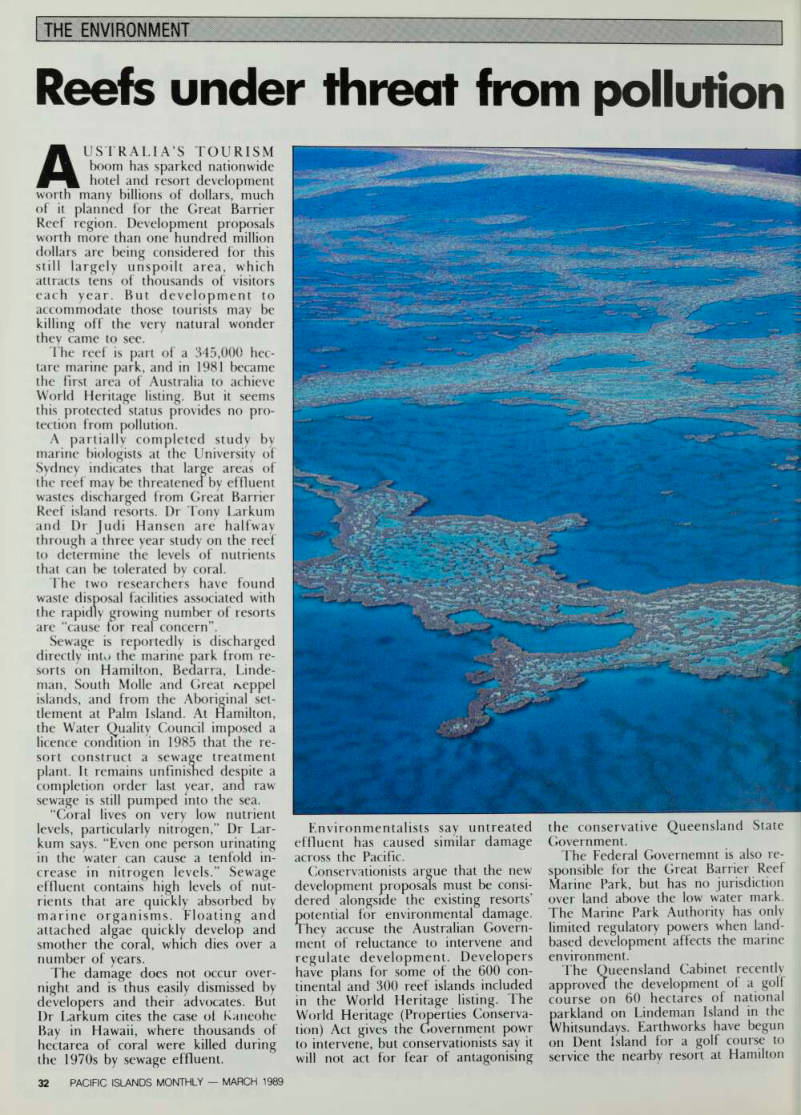
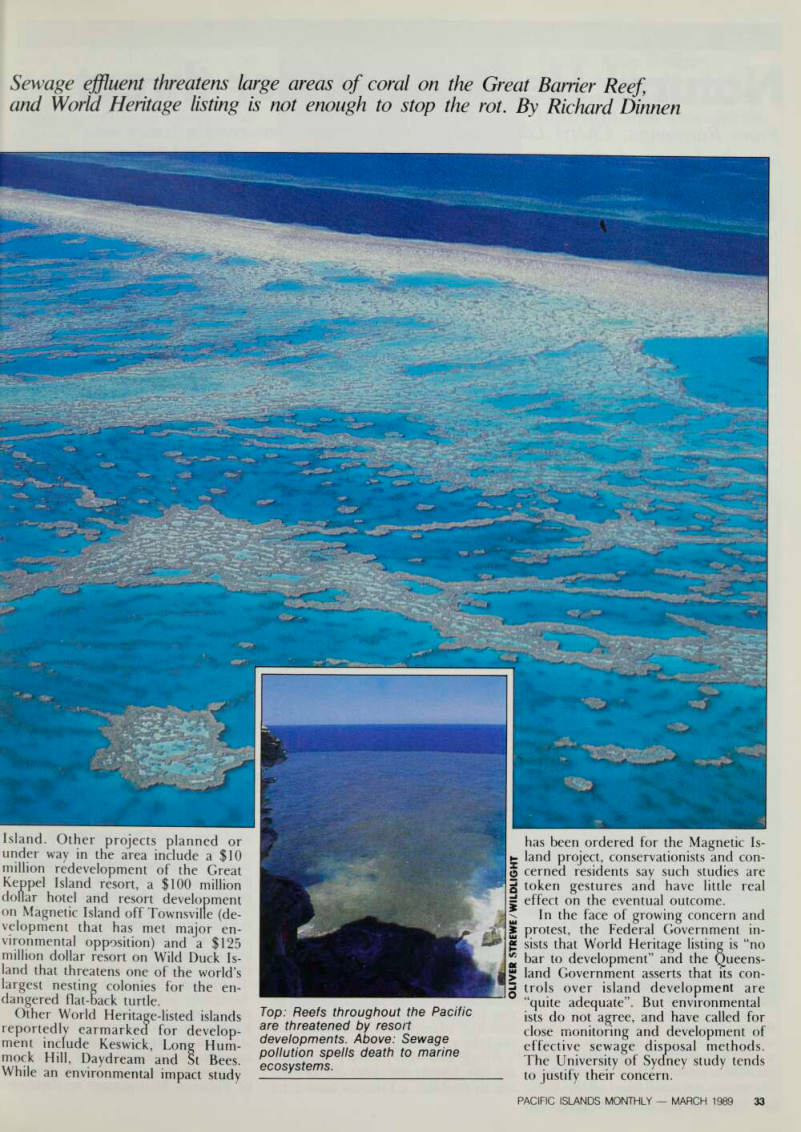
The Environment
Reefs under threat from pollution
boom has sparked nationwide hotel and resort development worth many billions of dollars, much of it planned for the Great Barrier
Reef region. Development proposals
worth more than one hundred million dollars are being considered for this still largely unspoilt area, which attracts tens of thousands of visitors each year. But development to accommodate those tourists may be killing off the very natural wonder they came to see.
The reef is part of a 345,000 hec tare marine park, and in 1981 became the first area of Australia to achieve World Heritage listing. But it seems this protected status provides no pro tection from pollution.
A partially completed study by
marine biologists at the University of Sydney indicates that large areas of the reef may be threatened by effluent wastes discharged from Great Barrier Reef island resorts. Dr Tony Larkum and Dr Judi Hansen are halfway through a three year study on the reef to determine the levels of nutrients that can be tolerated by coral.
The two researchers have found waste disposal facilities associated with the rapidly growing number of resorts are “cause (or real concern”.
Sewage is reportedly is discharged
directly into the marine park from re sorts on Hamilton, Bedarra, Linde man, South Molle and Great irveppel islands, and from the Aboriginal set tlement at Palm Island. At Hamilton, the Water Quality Council imposed a licence condition in 1985 that the re sort construct a sewage treatment plant. It remains unfmisned despite a completion order last year, ana raw sewage is still pumped into the sea.
“Coral lives on very low nutrient levels, particularly nitrogen,” Dr Lar kum says. “Even one person urinating in the water can cause a tenfold in crease in nitrogen levels.” Sewage effluent contains high levels of nut rients that are quickly absorbed by
marine organisms. Floating and
attached algae Quickly develop and
smother the coral, which dies over a number of years.
The damage does not occur over night and is thus easily dismissed by developers and their advocates. But Dr Larkum cites the case of Kaneohe Bay in Hawaii, where thousands of hectarea of coral were killed during
the 1970 s by sewage effluent.
Environmentalists say untreated effluent has caused similar damage across the Pacific.
Conservationists argue that the new development proposals must be consi dered alongside the existing resorts’
potential for environmental damage.
They accuse the Australian Govern ment of reluctance to intervene and
regulate development. Developers
have plans for some of the 600 con tinental and 300 reef islands included in the World Heritage listing. The
World Heritage (Properties Conserva
tion) Act gives the Government powr to intervene, but conservationists say it will not act for fear of antagonising
the conservative Queensland State Government.
The Federal Governemnt is also re sponsible for the Great Barrier Reef Marine Park, but has no jurisdiction over land above the low water mark.
The Marine Park Authority has only limited regulatory powers when land based development affects the marine environment.
The Queensland Cabinet recently
approve? the development of a golf
course on 60 hectares of national parkland on Lindeman Island in the
Whitsundays. Earthworks have begun
on Dent Island for a golf course to service the nearby resort at Hamilton
Sewage effluent threatens large areas of coral on the Great Barrier Reef
and World Heritage listing is not enough to stop the rot.
By Richard Dinnen
Island. Other projects planned or under way in the area include a $lO million redevelopment of the Great Keppel Island resort, a $lOO million dollar hotel and resort development on Magnetic Island off Townsville (de velopment that has met major en vironmental opposition) and a $125 million dollar resort on Wild Duck Is land that threatens one of the world’s largest nesting colonies for the en dangered flat-back turtle.
Other World Heritage-listed islands
reportedly earmarked for develop
ment include Keswick, Long Hum mock Hill, Daydream and St Bees.
While an environmental impact study
has been ordered for the Magnetic Is land project, conservationists and con cerned residents say such studies are token gestures and have little real effect on the eventual outcome.
In the face of growing concern and protest, the Federal Government in sists that World Heritage listing is “no bar to development” and the Queens land Government asserts that its con trols over island development are
“quite adequate”. But environmental
ists do not agree, and have called for close monitoring and development of effective sewage disposal methods.
The University of Sydney study tends
to justify their concern.
Top: Reefs throughout the Pacific are threatened by resort developments. Above: Sewage pollution spells death to marine ecosystems.
Oliver Strewe/Wildlight
Natural Heritage under threat
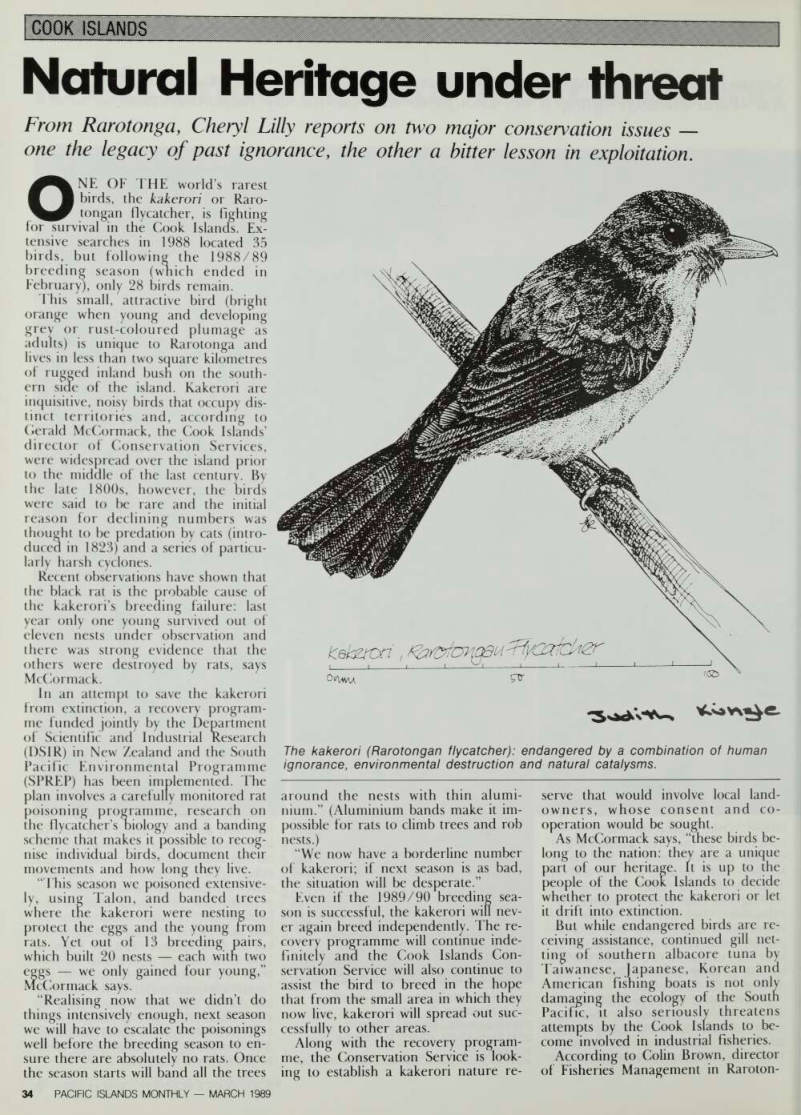
Cook Islands
From Rarotonga, Cheryl Lilly reports on two major conservation issues one the legacy of past ignorance, the other a bitter lesson in exploitation.
ONE OF THE world’s rarest birds, the kakerori or Raro
tongan flycatcher, is fighting
tor survival in the Cook Islands. Ex tensive searches in 1988 located 35 birds, but following the 1988/89 breeding season (wnich ended in February), only 28 birds remain.
This small, attractive bird (bright orange when young and developing grey or rust-coloured plumage as adults) is unique to Rarotonga and lives in less than two square kilometres of rugged inland bush on the south ern siae of the island. Kakerori are inquisitive, noisy birds that occupy dis tinct territories and, according to Gerald McCormack, the Cook Islands’ director of Conservation Services, were widespread over the island prior to the middle of the last century. By the late 1800 s, however, the birds were said to be rare and the initial reason for declining numbers was thought to be predation by cats (intro duced in 1823) and a series of particu
larly harsh cyclones.
Recent observations have shown that the black rat is the probable cause of the kakerori’s breeding failure: last year only one young survived out of eleven nests under observation and there was strong evidence that the others were destroyed by rats, says McCormack.
In an attempt to save the kakerori from extinction, a recovery program
me funded jointly by the Department
of Scientific and Industrial Research (DSIR) in New Zealand and the South Pacific Environmental Programme (SPREP) has been implemented. The plan involves a carefully monitored rat poisoning programme, research on
the flycatcher’s biology and a banding
scheme that makes it possible to recog nise individual birds, document their movements and how long they live.
“This season we poisoned extensive ly, using Talon, and banded trees where the kakerori were nesting to protect the eggs and the young from rats. Yet out of 13 breeding pairs, which built 20 nests each with two
eggs we only gained four young,”
McCormack says.
“Realising now that we didn’t do
things intensively enough, next season
we will have to escalate the poisonings well before the breeding season to en sure there are absolutely no rats. Once the season starts will band all the trees
around the nests with thin aluminium.” (Aluminium bands make it impossible for rats to climb trees and rob nests.) “We now have a borderline number of kakerori; if next season is as bad, the situation will be desperate.”
Even if the 1989/90 breeding season is successful, the kakerori will never again breed independently. The recovery programme will continue indefmitely and the Cook Islands Conservation Service will also continue to assist the bird to breed in the hope that from the small area in which they now live, kakerori will spread out suecessfully to other areas.
Along with the recovery programme, the Conservation Service is looking to establish a kakerori nature re-
serve that would involve local land owners, whose consent and co
operation would be sought,
As McCormack says, “these birds be long to the nation: they are a unique part of our heritage. It is up to the people of the Cook Islands to decide whether to protect the kakerori or let it drift into extinction, But while endangered birds are re ceiving assistance, continued gill net ting of southern albacore tuna by Taiwanese, Japanese, Korean and American fishing boats is not onlv damaging the ecology of the South Pacific, it also senouslv threatens attempts by the Cook Islands to be come involved in industrial fisheries, According to Colin Brown, director of Fisheries Management in Raroton
The kakerori (Rarotongan flycatcher): endangered by a combination of human ignorance, environmental destruction and natural catalysms.
ga, the Cook Islands has always wanted to participate in such an in dustry. “The Cook Islands are in fact the most practicable location for boats fishing this albacore stock,” he says, “Ideally we would like to see a trans hipping base set up on Rarotonga, but our most realistic option is a joint ven ture with United States boats fishing this albacore ground.”
However, any hope of establishing industrial fisheries are likely to be overshadowed by the activities of the S’ll netters. “There are currently more an 150 boats, all with 15 to 20 nets, fishing this area,” says Brown. “At this level tne southern albacore stocks will be wiped out in two years.”
Cohn Brown’s concern for the fu ture of southern albacore stocks is shared by many South Pacific nations.
Late last year reprsentatives from the South Pacific Commission, Forum Fisheries Agency and regional orga nisations from the Cook Islands, Ton ga, Fiji, Tahiti, American Samoa and New Zealand, met in Suva to discuss
the implications and problems posed
by the gill netters.
It was recognised that the region faced a major threat from the num bers of gill netters entering this fisher y; and because the fishing is mainly in International waters, national fisheries laws cannot be applied to prevent the
anticipated over-exploitation or ban
the gill netters.
The consultative committee at the Suva meeting recommended that the use of gill nets for catching pelagic fish be condemned at all levels. Colin Brown explains: “Gill nets sweep the ocean floor, taking everything includ ing marine mammals and sea turtles.
They also represent a navigational hazard to other boats, and when they break or are lost, the nets drift ancl continue to catch fish, small whales and other marine animals.”
The consultative group called for regional governments to ban albacore gill net boats from using port facilities, for regional canneries not to purchase gill netted albacore and for the imple mentation of a ban on the tranship ment of gill netted albacore within the region. It was requested that the Au stralian and New Zealand Govern ments be approached to raise the gill net issue during southern bluefin tuna trilateral talks with Japan.
It was also recommended that those governments having bilateral access arrangements with Japan, Taiwan and Korea stress their countries’ concern
regarding gill netting activities in the
South Pacific.
For its part, the Cook Islands gives high priority to the conservation of albacore stocks and hopes regional co operation will achieve sound manage ment measures to protect this econo
mically vital fishery. □
Advertisements & other items, p. 35 (1 item)
Timber
Exotic Kiln Dried
Tropical Hardwoods.
Government graded to international standards.
Burns Philp specialise in export orders, and offer the largest selection of timber to be found in Fiji at highly competitive prices.
Professionally treated, and graded to meet the stringest standards of Fiji’s Forest Department, Burns Philp timber provides the quality and choice to satisfy the most demanding job.
Contact Burns Philp Timber today and buy with confidence. \ iX ■ \ V
Timber
A Division Of Burns Philp (South Sea) Company Ltd SUVA BRANCH Golflink Rd, Nabua Telephone 384060, 384999 G.P.O. Box 355, Suva, Fiji Is. Fax (679) 301809. Telex FJ2493
Pacific Report
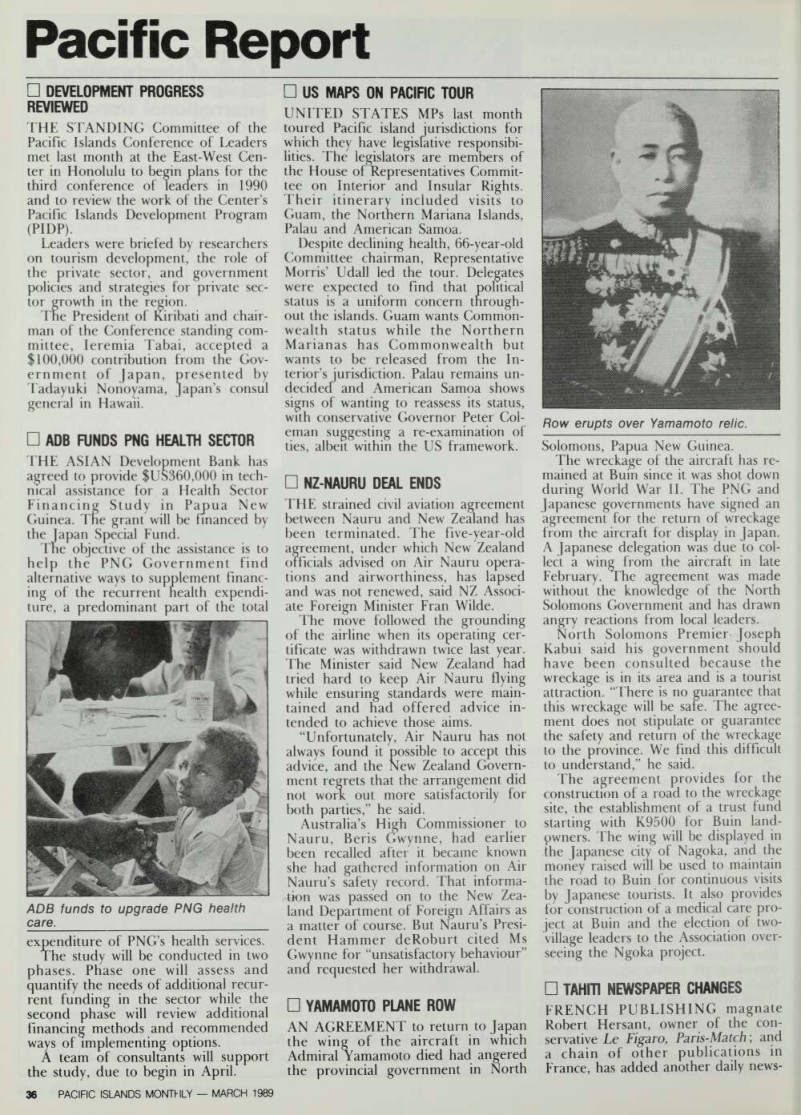
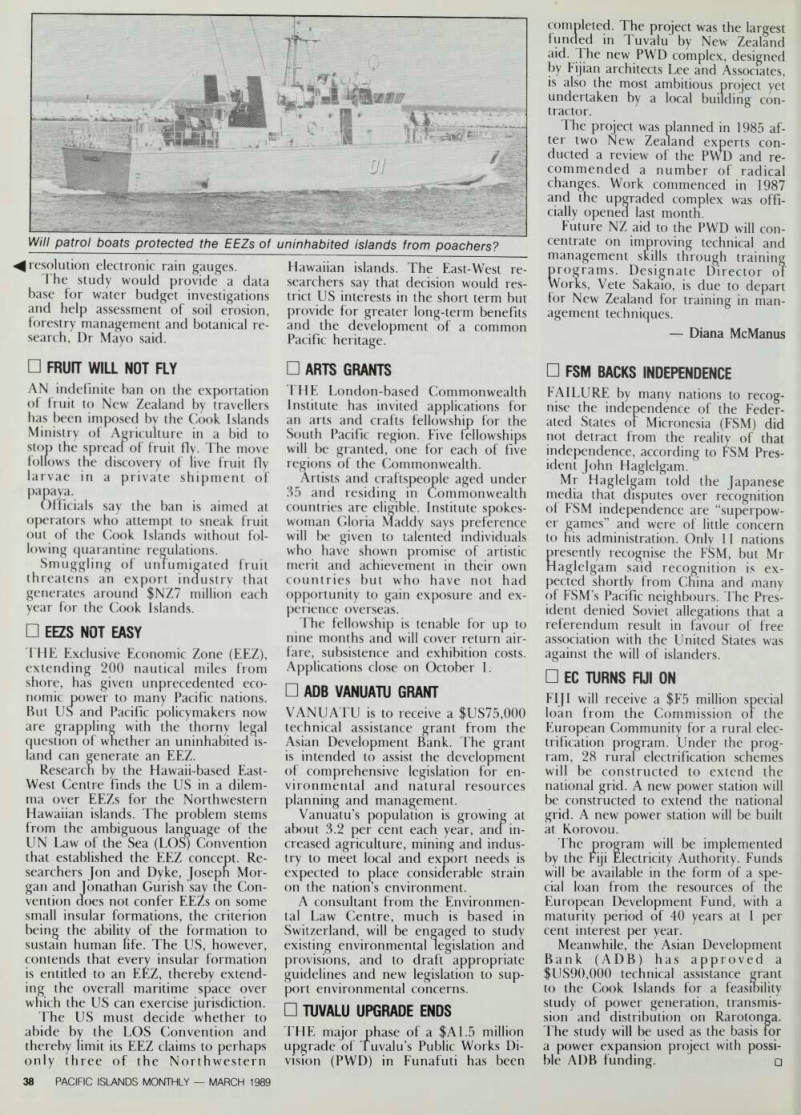
□ Development Progress
Reviewed
THE STANDING Committee of the Pacific Islands Conference of Leaders met last month at the East-West Cen ter in Honolulu to begin plans for the third conference of leaders in 1990 and to review the work of the Center’s
Pacific Islands Development Program
(Pidp).
Leaders were briefed by researchers on tourism development, the role of the private sector, and government
policies and strategies for private sec
tor growth in the region.
Tne President of Kiribati and chair man of the Conference standing com mittee, leremia Tabai, accepted a $lOO,OOO contribution from the Gov
ernment of Japan, presented by
Tadayuki Nonoyama, Japan’s consul
general in Hawaii.
□ Adb Funds Png Health Sector
THE ASIAN Development Bank has agreed to provide $Ub360,000 in tech nical assistance for a Health Sector
Financing Study in Papua New
Guinea. The grant will be financed by
the Japan Special Fund.
Tne objective of the assistance is to help the PNG Government find alternative ways to supplement financ ing of the recurrent health expendi ture, a predominant part of the total
expenditure of PNG’s health services.
The study will be conducted in two phases. Phase one will assess and quantify the needs of additional recur rent funding in the sector while the second phase will review additional financing methods and recommended
ways of implementing options.
A team of consultants will support the study, due to begin in April.
□ Us Maps On Pacific Tour
UNITED STATES MPs last month toured Pacific island jurisdictions for
which they have legislative responsibi
lities. The legislators are members of the House of Representatives Commit tee on Interior and Insular Rights.
Their itinerary included visits to Guam, the Northern Mariana Islands, Palau and American Samoa.
Despite declining health, 66-year-old
Committee chairman, Representative Morris’ Udall led the tour. Delegates were expected to find that political status is a uniform concern through out the islands. Guam wants Common wealth status while the Northern Marianas has Commonwealth but wants to be released from the In terior’s jurisdiction. Palau remains un decided and American Samoa shows signs of wanting to reassess its status, with conservative Governor Peter Col eman suggesting a re-examination of ties, albeit within the US framework.
□ Nz-Nauru Deal Ends
THE strained civil aviation agreement between Nauru and New Zealand has been terminated. The five-year-old agreement, under which New Zealand officials advised on Air Nauru opera tions and airworthiness, has lapsed and was not renewed, said NZ Associ ate Foreign Minister Fran Wilde.
The move followed the grounding of the airline when its operating cer tificate was withdrawn twice last year.
The Minister said New Zealand had tried hard to keep Air Nauru flying while ensuring standards were main tained and had offered advice in tended to achieve those aims.
“Unfortunately, Air Nauru has not always found it possible to accept this advice, and the New Zealand Govern ment regrets that the arrangement did not worT out more satisfactorily for both parties,” he said.
Australia’s High Commissioner to Nauru, Beris Gwynne, had earlier been recalled after it became known she had gathered information on Air Nauru’s safety record. That informa tion was passed on to the New Zea land Department of Foreign Affairs as a matter of course. But Nauru’s Presi dent Hammer deßoburt cited Ms
Gwynne for “unsatisfactory behaviour”
and requested her withdrawal.
□ Yamamoto Plane Row
AN AGREEMENT to return to Japan the wing of the aircraft in which Admiral Yamamoto died had angered the provincial government in North
Solomons, Papua New Guinea.
The wreckage of the aircraft has re mained at Buin since it was shot down during World War 11. The PNG and Japanese governments have signed an agreement for the return of wreckage from the aircraft for display in Japan.
A Japanese delegation was due to col lect a wing from the aircraft in late February. The agreement was made without the knowledge of the North Solomons Government and has drawn angry reactions from local leaders.
North Solomons Premier Joseph Kabui said his government should have been consulted because the wreckage is in its area and is a tourist attraction. “There is no guarantee that this wreckage will be safe. The agree ment does not stipulate or guarantee the safety and return of the wreckage to the province. We find this difficult to understand,” he said.
The agreement provides for the construction of a road to the wreckage site, the establishment of a trust fund starting with K 9500 for Buin land pwners. The wing will be displayed in the Japanese city of Nagoka, and the money raised will be used to maintain the road to Buin for continuous visits
by Japanese tourists. It also provides
for construction of a medical care pro ject at Buin and the election of two village leaders to the Association over
seeing the Ngoka project.
□ Tahiti Newspaper Changes
FRENCH PUBLISHING magnate Robert Hersant, owner of the con servative Le Figaro, Paris-Match ; and a chain of other publications in France, has added another daily news
ADB funds to upgrade PNG health care.
Row erupts over Yamamoto relic.
paper to his growing Pacific interests.
The Hersant group, Pacific-Presse Communication, last month took over control of Les Nouvelles de Tahiti, one of Tahiti’s two biggest newspap ers. Announcing the takeover m a front page statement, former pub lisher Julien Siu, a Tahitian-Chmese businessman, and Pacific-Presse group
publisher Henri Morny promised
readers the paper would be given an editorial facelift and a more commer cial structure.
Media commentators suggested the paper would be given a more profes sional, more lively presentation with the use of four-colour pictures like its sister-paper in Noumea, Les Nouvelles Caledomennes. Once regarded as a reasonably liberal paper and frequent ly criticised for giving too much space to pro-independence parties, it is now expected to move further to the right than its rival, La Depeche.
Louis Bresson was named as new editor-in-chief and it was announced he would head a “solid and dynamic” team of journalists. “His mission is clear,” said the publishers in their joint statement. “He must offer every morning to our readers a modern
newspaper, complete, independent,
objective, attuned to the preoccupa tions of the territory’s leaders and its population, while at the same time being open to the aspirations of youth ... on whom our future depends.”
Ironically, just two days after the
takeover of Les Nouvelles, one of the
region’s previously independent and
locally owned newspapers, commenta tor Daniel Tardieu criticised the curbs in news media and the proposed licensing of newspapers in Fiji.
“In all countries respecting civil liberties,” he wrote in La Depeche, “those of the press are the foundation stones of democracy. One crucial fac tor is the right of citizens to free ex pression. But the press embarrasses governments and those who do not like freedom of expression”.
□ Landowners In Sydney Talks
LANDOWNERS IN the Special Min ing Lease (SML) area of Forgers in Papua New Guinea are dissatisfied witn the handling of their affairs by the local representatives of the
Porgera Joint Venture (PJV) company.
So the landowners decided to go straight to the top, last month sending a 10-member delegation to Sydney for talks with the overseas managers of the company. A chief of the SML area, Pakitu Pundi, led the delegation to discuss problems with the people landowners feel are the “real” mana gers of the venture.
The delegation reportedly sought
an assurance of 10 per cent free share participation in the mine, construction
of a permanent township before min
ing begins, upgrading of the local
health centre, trie awarding of con tracts to Porgerans, and training and
employment.
□ Cooks Aid To Increase
US aid to the Cook Islands is likely to increase by $lOO,OOO to around SUSSOO,OOO a year, according to out going US Ambassador to New Zea land, Paul Cleveland. After a recent visit to Rarotonga, Mr Cleveland gave assurances aid would be continued to the newly elected government of
Prime Minister Geoffrey Henry.
Mr Cleveland said bis country is paying more attention to the Pacific in response to demands from the region and increased awareness in the US.
Talks between Mr Cleveland and Mr Henry centred on future US aid prog rams, in particular possible assistance to develop the black pearl industry in the northern Cook Islands.
Meanwhile, a New Zealand Audit Office team has examined the man agement of NZ’s Official Development Assistance (ODA) to the Cook Islands.
An Audit Office team spent a week in the Islands and observers say their re sponse to ODA projects was generally favourable. It is not known if the
team’s report will be made public: the decision to publish rests with a select committee of the NZ Parliament.
Cheryl Lilly
□ Centre For Norfolk
THE American Society for Environ mental Education (ASEE) has prop osed the development of an environ mental research centre on Norfolk Is land. A site for the proposed South Pacific Centre for the Environment has yet to be found, but preliminary meetings indicate considerable enthu siasm for the project.
ASEE president Dr William Mayo says the centre will provide a focus for scientific research of relevance to the region and establish a centre to host regional South Pacific conferences on environmental and scientific topics.
The project, Dr Mayo hopes, will be funded by donations from individuals, corporations and governments. The ASEE has so far sought the involve ment of the Norfolk Island Govern ment, the University of Auckland (NZ)
and the Macquarie University, Sydney.
If approved, the centre would open in 1991, with its first research project already listed as a study of monitoring of Norfolk Island rainfall using high ►
resolution electronic rain gauges.
The study would provide a data base for water budget investigations and help assessment of soil erosion, forestry management and botanical re search, Dr Mayo said.
□ Fruit Will Not Fly
AN indefinite ban on the exportation of fruit to New Zealand by travellers has been imposed by the Cook Islands Ministry of Agriculture in a bid to stop the spreacf of fruit fly. The move follows the discovery of live fruit fly larvae in a private shipment of papaya.
Officials say the ban is aimed at operators who attempt to sneak fruit out of the Cook Islands without fol
lowing quarantine regulations.
Smuggling of unfumigated fruit
threatens an export industry that generates around SNZ7 million each year for the Cook Islands.
□ Eezs Not Easy
THE Exclusive Economic Zone (EEZ), extending 200 nautical miles from shore, has given unprecedented eco nomic power to many Pacific nations.
But US and Pacific policymakers now
are grappling with the thorny legal
question of whether an uninhabited is land can generate an EEZ.
Researcn by the Hawaii-based East- West Centre finds the US in a dilem ma over EEZs for the Northwestern Hawaiian islands. The problem stems from the ambiguous language of the UN Law of the Sea (LOS) Convention that established the EEZ concept. Re
searchers Jon and Dyke, Josepn Mor
gan and Jonathan Gurish say the Con vention aoes not confer EEzs on some small insular formations, the criterion being the ability of the formation to sustain human life. The US, however, contends that every insular formation is entitled to an EEZ, thereby extend ing the overall maritime space over which the US can exercise jurisdiction.
The US must decide whether to abide by the LOS Convention and thereby limit its EEZ claims to perhaps only three of the Northwestern
Hawaiian islands. The East-West re searchers say that decision would res trict US interests in the short term but provide for greater long-term benefits and the development of a common
Pacific heritage.
□ Arts Grants
THE London-based Commonwealth Institute has invited applications for an arts and crafts fellowship for the South Pacific region. Five fellowships will be granted, one for each of five regions of the Commonwealth.
Artists and craftspeople aged under 35 and residing in Commonwealth countries are eligible. Institute spokes woman Gloria Maddy says preference will be given to talented individuals who have shown promise of artistic merit and achievement in their own countries but who have not had opportunity to gain exposure and ex
perience overseas.
The fellowship is tenable for up to nine months and will cover return air fare, subsistence and exhibition costs.
Applications close on October 1.
□ Adb Vanuatu Grant
VANUATU is to receive a $U575,000 technical assistance grant from the Asian Development Bank. The grant is intended to assist the development of comprehensive legislation for en vironmental and natural resources planning and management.
Vanuatu’s population is growing at about 3.2 per cent each year, ana in creased agriculture, mining and indus try to meet local and export needs is expected to place considerable strain on the nation’s environment.
A consultant from the Environmen tal Law Centre, much is based in Switzerland, will be engaged to study
existing environmental legislation ana
provisions, and to draft appropriate guidelines and new legislation to sup port environmental concerns.
□ Tuvalu Upgrade Ends
THE major phase of a SAI.S million upgrade of Tuvalu’s Public Works Di vision (PWD) in Funafuti has been
completed. The project was the largest
funded in Tuvalu by New Zealand aid. The new PWD complex, designed by Fijian architects Lee and Associates, is also the most ambitious project yet undertaken by a local building con tractor.
The project was planned in 1985 af ter two New Zealand experts con ducted a review of the PWD and re commended a number of radical changes. Work commenced in 1987 and the upgraded complex was offi cially opened last month.
Future NZ aid to the PWD will con centrate on improving technical and
management skills through training
programs. Designate Director of
Works, Vete Sakaio, is due to depart for New Zealand for training in man
agement techniques.
Diana McManus
□ Fsm Backs Independence
FAILURE by many nations to recog nise the independence of the Feder ated States of Micronesia (FSM) did not detract from the reality of that independence, according to FSM Pres
ident John Haglelgam.
Mr Haglelgam told the Japanese media that disputes over recognition of FSM independence are “superpow er games” and were of little concern to his administration. Only 11 nations presently recognise the FSM, but Mr Haglelgam said recognition is ex pected shortly from China and many of FSM’s Pacific neighbours. The Pres ident denied Soviet allegations that a referendum result in favour of free association with the United States was against the will of islanders.
□ Ec Turns Fiji On
FIJI will receive a SFS million special loan from the Commission of the European Community for a rural elec trification program. Under the prog ram, 28 rural electrification schemes will be constructed to extend the national grid. A new power station will be constructed to extend the national grid. A new power station will be built at Korovou.
The program will be implemented
by the Fiji Electricity Authority. Funds
will be available in the form of a spe cial loan from the resources of the European Development Fund, with a maturity period of 40 years at 1 per cent interest per year.
Meanwhile, the Asian Development Bank (ADB) has approved a SUS9O,OOO technical assistance grant to the Cook Islands for a feasibility study of power generation, transmis sion and distribution on Rarotonga.
The study will be used as the basis for
a power expansion project with possi
ble ADB funding. □
Will patrol boats protected the EEZs of uninhabited islands from poachers?
Advertisements & other items, p. 37 (1 item)
S€R Mfinfigcmcnt Corporation Ptv. Ltd.
P O BOX 1171 TEL: (075) 46 2260 SOUTHPORT, OLD., 4215 FAX: (075) 46 1318
AUSTRALIA.
SEA MANAGEMENT CORPORATION ARE NOW BUILDING THE NEW CON-
CEPT IN LANDING VESSELS WITH
* BETTER HEAD SEA CAPABILITY
* BETTER VISIBILITY AHEAD
* BETTER SPRAY PROTECTION
* HIGHER ON-DECK DEADWEIGHT
* BETTER SPEED THROUGH LOWER BLOCK CO-EFFICIENTS * EASIER TO DEBEACH WITH PROPELLERS WORKING AHEAD THE VESSEL DESIGN IS GEARED FOR REPEAT CONSTRUCTION IN BOTH STEEL AND ALUMINIUM. WE ALSO MANUFACTURE IN KIT FORM, EASY TO ASSEMBLE WITH BASIC SHIPBUILDING SKILLS AND EQUIPMENT.
STANDARD SIZES FROM 15 METRES TO 50 METRES STERN LANDING VESSELS THE WAY TO GO.
OFFSHORE CLASS -35 M
i 0 Q 0 GOG
Q 0 □ □ 0 ; o □ □ Inter Island Cargo/Passenger Vessel
Pacific Stamp Box
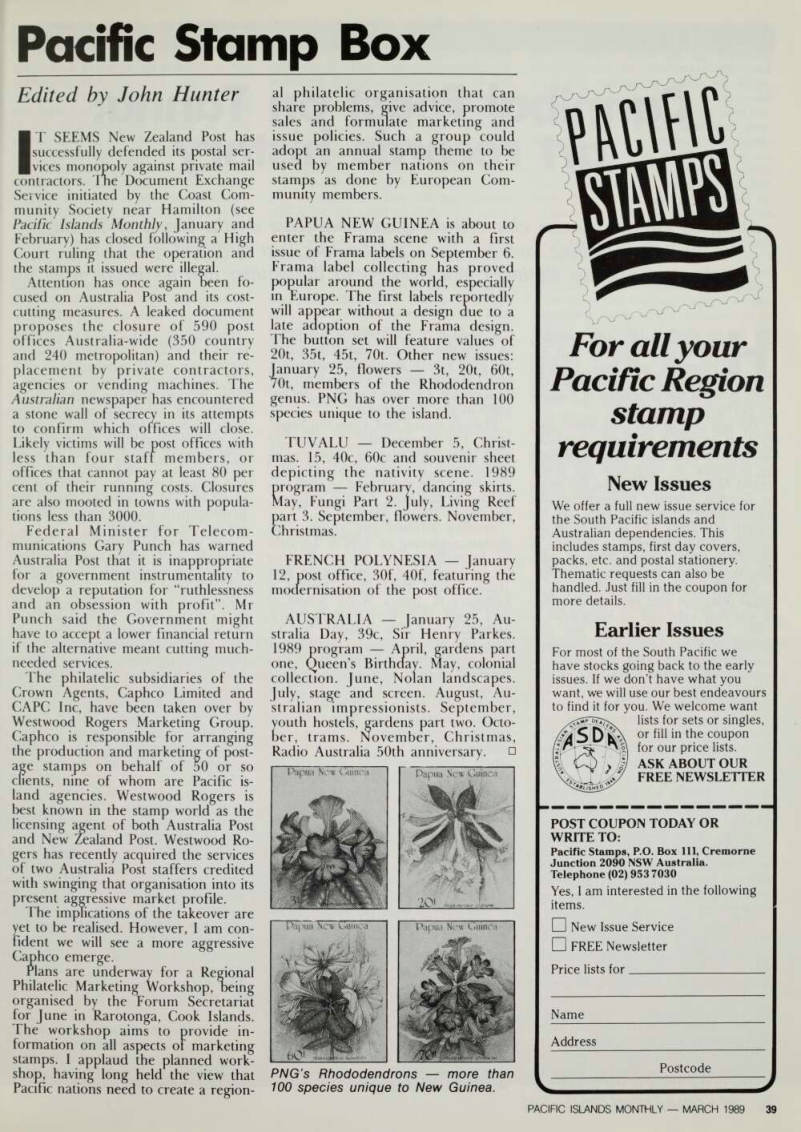
Edited by John Hunter
IT SEEMS New Zealand Post has successfully defended its postal ser
vices monopoly against private mail
contractors. The Document Exchange Service initiated by the Coast Com munity Society near Hamilton (see Pacific Islands Monthly , January and
February) has closed following a High
Court ruling that the operation and the stamps it issued were illegal.
Attention has once again oeen fo cused on Australia Post and its cost cutting measures. A leaked document proposes the closure of 590 post offices Australia-wide (350 country and 240 metropolitan) and their re
placement by private contractors,
agencies or vending machines. The Australian newspaper has encountered a stone wall of secrecy in its attempts to confirm which offices will close.
Likely victims will be post offices with less than four staff members, or offices that cannot pay at least 80 per cent of their running costs. Closures are also mooted in towns with popula tions less than 3000.
Federal Minister for Telecom munications Gary Punch has warned Australia Post that it is inappropriate for a government instrumentality to develop a reputation for “ruthlessness and an obsession with profit”. Mr Punch said the Government might have to accept a lower financial return if the alternative meant cutting much needed services.
The philatelic subsidiaries of the Crown Agents, Caphco Limited and CAPC Inc, have been taken over by
Westwood Rogers Marketing Group.
Caphco is responsible for arranging
the production and marketing of post age stamps on behalf of 50 or so clients, nine of whom are Pacific is land agencies. Westwood Rogers is best known in the stamp world as the licensing agent of both Australia Post and New Zealand Post. Westwood Ro gers has recently acquired the services of two Australia Post staffers credited with swinging that organisation into its
present aggressive market profile.
The implications of the takeover are yet to be realised. However, I am con fident we will see a more aggressive
Caphco emerge.
Plans are underway for a Regional
Philatelic Marketing Workshop, being
organised by the Forum Secretariat for June in Rarotonga, Cook Islands.
The workshop aims to provide in formation on all aspects of marketing stamps. I applaud the planned work shop, having long held the view that Pacific nations need to create a region
al philatelic organisation that can share problems, give advice, promote sales and formulate marketing and issue policies. Such a group could adopt an annual stamp theme to be used by member nations on their stamps as done by European Com munity members.
PAPUA NEW GUINEA is about to enter the Frama scene with a first issue of Frama labels on September 6.
Frama label collecting has proved popular around the world, especially m Europe. The first labels reportedly will appear without a design aue to a late adoption of the Frama design.
The button set will feature values of 20t, 35t, 45t, 70t. Other new issues: January 25, flowers 3t, 20t, 60t, /Ot, members of the Rhododendron genus. PNG has over more than 100 species unique to the island.
TUVALU December 5, Christ mas. 15, 40c, 60c and souvenir sheet depicting the nativity scene. 1989
program February, dancing skirts.
May, Fungi Part 2. July, Living Reef part 3. September, flowers. November, Christmas.
French Polynesia January
12, post office, 30f, 40f, featuring the modernisation of the post office.
AUSTRALIA January 25, Au stralia Day, 39c, Sir Henry Parkes. 1989 program April, gardens part one, Queen’s Birthday. May, colonial collection. June, Nolan landscapes.
July, stage and screen. August, Au stralian impressionists. September, youth hostels, gardens part two. Octo ber, trams. November, Christmas, Radio Australia 50th anniversary. □
PNG’s Rhododendrons - more than 100 species unique to New Guinea.
Advertisements & other items, p. 39 (1 item)
requirements
For all your
Pacific Region
stamp
requirements
New Issues
We offer a full new issue service for the South Pacific islands and Australian dependencies. This includes stamps, first day covers, packs, etc. and postal stationery.
Thematic requests can also be handled. Just fill in the coupon for more details.
Earlier Issues
For most of the South Pacific we have stocks going back to the early issues. If we don’t have what you want, we will use our best endeavours to find it for you. We welcome want lists for sets or singles, or fill in the coupon for our price lists.
ASK ABOUT OUR
FREE NEWSLETTER
POST COUPON TODAY OR
WRITE TO:
Pacific Stamps, P.O. Box 111, Cremorne Junction 2090 NSW Australia.
Telephone (02) 953 7030 Yes, 1 am interested in the following items. d New Issue Service □ FREE Newsletter Price lists for Name Address Postcode
Cannibal Feast on Tanna:
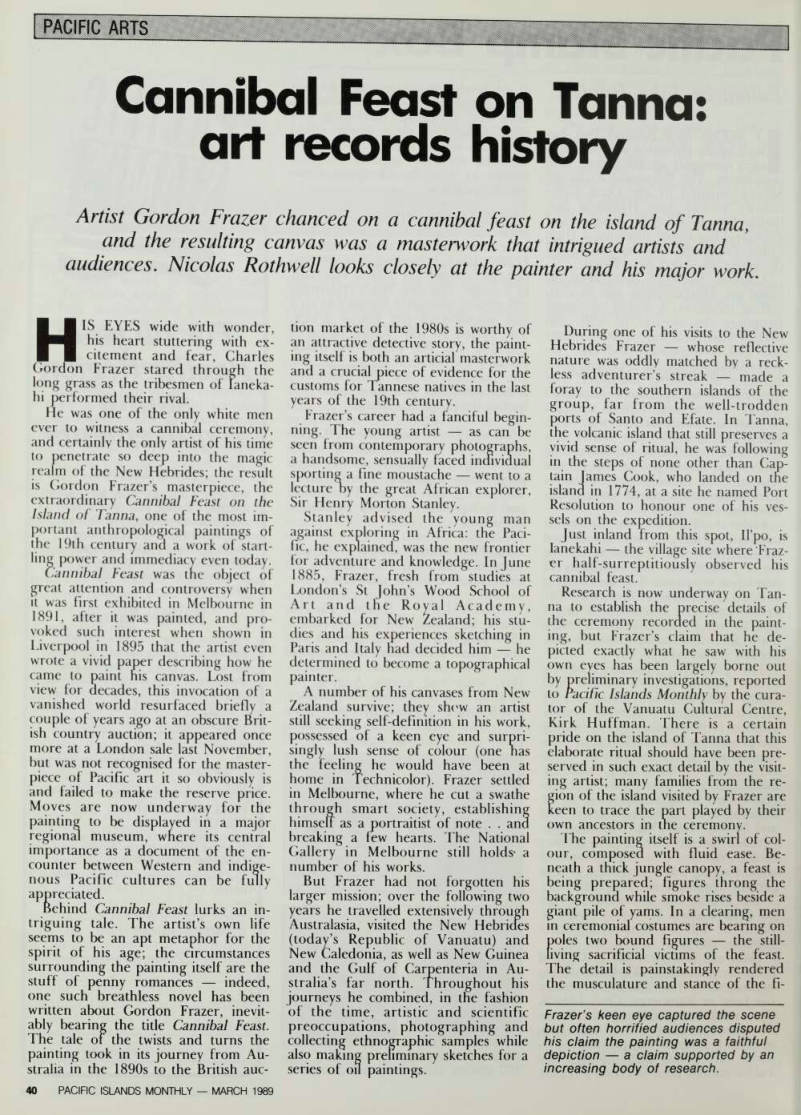
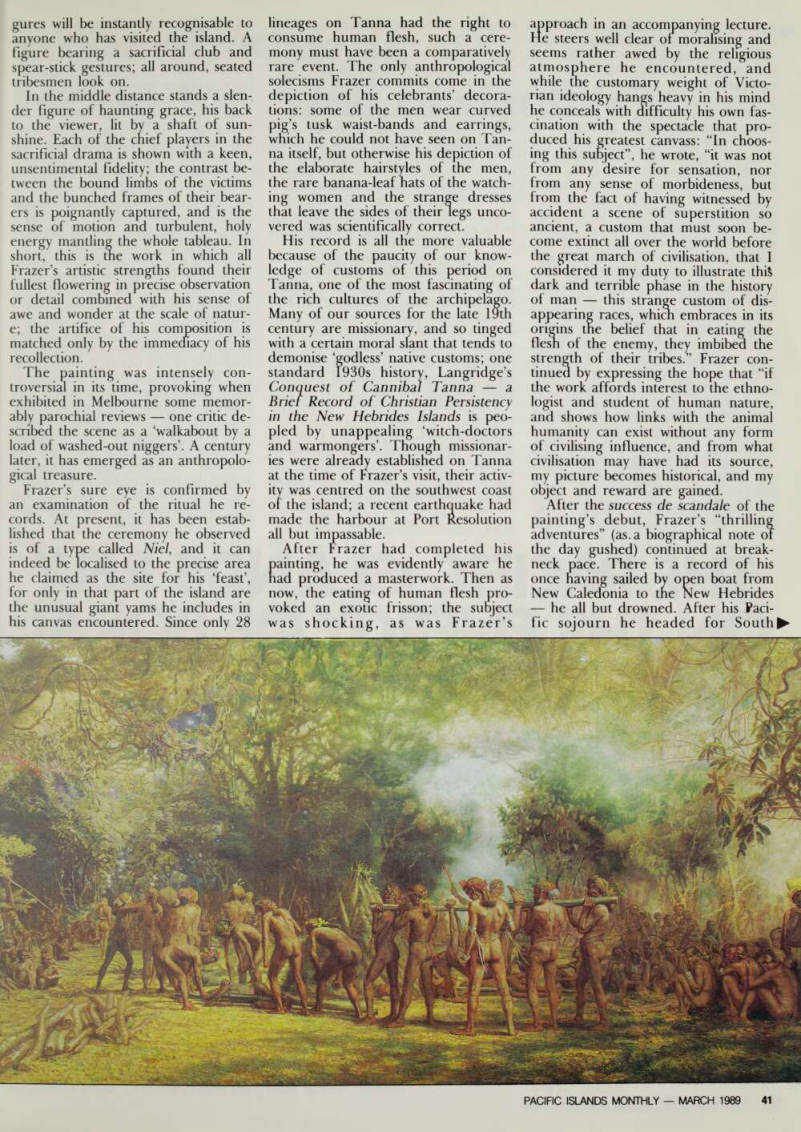
Pacific Arts
Cannibal Feast on Tanna: art records history
Artist Gordon Frazer chanced on a cannibal feast on the island of Tanna, and the resulting canvas was a masterwork that intrigued artists and audiences. Nicolas Rothwell looks closely at the painter and his major work.
HIS EYES wide with wonder, his heart stuttering with ex citement and fear, Charles Cordon Frazer stared through the long grass as the tribesmen of faneka hi performed their rival.
He was one of the only white men ever to witness a cannibal ceremony, and certainly the only artist of his time to penetrate so deep into the magic realm of the New Hebrides; the result is Gordon Frazer’s masterpiece, the extraordinary Cannibal Feast on the Island of Tanna, one of the most im
portant anthropological paintings of
the 19th century and a work of start
ling power and immediacy even today.
Cannibal Feast was tne object of great attention and controversy when it was first exhibited in Melbourne in 1891, after it was painted, and pro voked such interest when shown in Liverpool in 1895 that the artist even wrote a vivid paper describing how he came to paint his canvas. Lost from view for decades, this invocation of a vanished world resurfaced briefly a couple of years ago at an obscure Brit ish country auction; it appeared once more at a London sale last November, but was not recognised for the master piece of Pacific art it so obviously is and failed to make the reserve price.
Moves are now underway for the painting to be displayed in a major regional museum, wnere its central importance as a document of the en counter between Western and indige nous Pacific cultures can be fully
appreciated.
Behind Cannibal Feast lurks an in triguing tale. The artist’s own life seems to be an apt metaphor for the spirit of his age; the circumstances surrounding the painting itself are the stuff of penny romances indeed, one such breathless novel has been written about Gordon Frazer, inevit ably bearing the title Cannibal Feast.
The tale of the twists and turns the painting took in its journey from Au stralia in the 1890 s to the British auc
tion market of the 1980 s is worthy of an attractive detective story, the paint ing itself is both an articial masterwork and a crucialpiece of evidence for the customs for Tannese natives in the last years of the 19th century.
Frazer’s career had a fanciful begin ning. The young artist as can be seen from contemporary photographs, a handsome, sensually faced inaividual sporting a fine moustache went to a lecture oy the great African explorer,
Sir Henry Morton Stanley.
Stanley advised the young man against exploring in Africa: the Paci fic, he explained, was the new frontier for adventure and knowledge. In June 1885, Frazer, fresh from studies at London’s St John’s Wood School of Art and the Royal Academy, embarked for New Zealand; his stu dies and his experiences sketching in Paris and Italy had decided him he determined to become a topographical
painter.
A number of his canvases from New Zealand survive; they show an artist still seeking self-definition in his work, possessed of a keen eye and surpri singly lush sense of colour (one has the feeling he would have been at home in Technicolor). Frazer settled in Melbourne, where he cut a swathe
through smart society, establishing
himsetf as a portraitist of note . . and breaking a few hearts. The National Gallery in Melbourne still holds* a number of his works.
But Frazer had not forgotten his larger mission; over the following two years he travelled extensively through Australasia, visited the New Hebrides (today’s Republic of Vanuatu) and New Caledonia, as well as New Guinea and the Gulf of Carpenteria in Au stralia’s far north. Throughout his journeys he combined, in the fashion of the time, artistic and scientific
preoccupations, photographing and
collecting ethnographic samples while
also making preliminary sketches for a series of oil paintings.
During one of his visits to the New Hebrides Frazer whose reflective nature was oddly matched by a reck less adventurer’s streak made a foray to the southern islands of the group, far from the well-trodden ports of Santo and Efate. In Tanna, the volcanic island that still preserves a vivid sense of ritual, he was following in the steps of none other than Cap tain James Cook, who landed on the island in 1774, at a site he named Port Resolution to honour one of his ves sels on the expedition.
Just inland from this spot, Il’po, is lanekahi the village site where Fraz er half-surreptitiously observed his cannibal feast.
Research is now underway on Tan na to establish the precise details of the ceremony recorded in the paint ing, but Frazer’s claim that he de picted exactly what he saw with his own eyes has been largely borne out
by preliminary investigations, reported
to Pacific Islands Monthly by the cura tor of the Vanuatu Cultural Centre, Kirk Huffman. There is a certain pride on the island of Tanna that this elaborate ritual should have been pre served in such exact detail by the visit ing artist; many families from the re gion of the island visited by Frazer are keen to trace the part played by their own ancestors in the ceremony.
The painting itself is a swirl of col our, composed with fluid ease. Be neath a thick jungle canopy, a feast is
being prepared; figures throng the
background while smoke rises beside a giant pile of yams. In a clearing, men in ceremonial costumes are bearing on poles two bound figures the still living sacrificial victims of the feast.
The detail is painstakingly rendered the musculature and stance of the fi-
Frazer’s keen eye captured the scene but often horrified audiences disputed his claim the painting was a faithful depiction a claim supported by an increasing body of research.
gures will be instantly recognisable to anyone who has visited the island. A figure bearing a sacrificial club and spear-stick gestures; all around, seated tribesmen look on.
In the middle distance stands a slender figure of haunting grace, his back to the viewer, lit by a shaft of sunshine. Each of the cnief players in the sacrificial drama is shown with a keen, unsentimental fidelity; the contrast between the bound limbs of the victims and the bunched frames of their bearers is poignantly captured, and is the sense of motion and turbulent, holy energy mantling the whole tableau. In short, this is the work in which all Frazer’s artistic strengths found their fullest flowering in precise observation or detail combined with his sense of awe and wonder at the scale of nature; the artifice of his composition is matched only by the immediacy of his recollection.
The painting was intensely controversial in its time, provoking when exhibited in Melbourne some memorably parochial reviews one critic described the scene as a ‘walkabout by a load of washed-out niggers’. A century later, it has emerged as an anthropolo-
gical treasure.
Frazer’s sure eye is confirmed by an examination of the ritual he records. At present, it has been established that the ceremony he observed is of a type called Me/, and it can indeed be localised to the precise area he claimed as the site for his ‘feast’, for only in that part of the island are the unusual giant yams he includes in his canvas encountered. Since only 28
lineages on Tanna had the right to consume human flesh, such a ceremony must have been a comparatively rare event. The only anthropological solecisms Frazer commits come in the depiction of his celebrants’ decorations: some of the men wear curved pig’s tusk waist-bands and earrings, which he could not have seen on Tanna itself, but otherwise his depiction of the elaborate hairstyles of the men, the rare banana-leaf hats of the watching women and the strange dresses that leave the sides of their legs uncovered was scientifically correct.
His record is all the more valuable because of the paucity of our knowledge of customs of this period on Tanna, one of the most fascinating of the rich cultures of the archipelago, Many of our sources for the late 19th century are missionary, and so tinged with a certain moral slant that tends to demonise ‘godless’ native customs; one
standard 1930 s history, Langridge’s
Conquest of Cannibal Tanna a Brief Record of Christian Persistency in the New Hebrides Islands is peo-
pled by unappealing ‘witch-doctors
and warmongers’. Though missionar-
ies were already established on Tanna at the time of Frazer’s visit, their activity was centred on the southwest coast of the island; a recent earthquake had made the harbour at Port Resolution all but impassable.
After Frazer had completed his painting, he was evidently aware he had produced a masterwork. Then as now, the eating of human flesh provoked an exotic frisson; the subject was shocking, as was Frazer’s
approach in an accompanying lecture, He steers well clear of moralising and seems rather awed by the religious atmosphere he encountered, and while the customary weight of Victo rian ideology hangs heavy in his mind he conceals with difficulty his own fas cination with the spectacle that pro duced his greatest canvass: “In choos ing this subject”, he wrote, “it was not from any desire for sensation, nor from any sense of morbideness, but from the fact of having witnessed by accident a scene of superstition so ancient, a custom that must soon be come extinct all over the world before the great march of civilisation, that I considered it my duty to illustrate this dark and terrible phase in the history of man this strange custom of dis appearing races, which embraces in its origins the belief that in eating the flesh of the enemy, they imbibed the strength of their tribes.” Frazer con tinued by expressing the hope that “if the work affords interest to the ethno logist and student of human nature, and shows how links with the animal humanity can exist without any form of civilising influence, and from what civilisation may have had its source, my picture becomes historical, and my object and reward are gained, After the success de scandale of the
painting’s debut, Frazer’s “thrilling
adventures” (as. a biographical note of the day gushed) continued at break neck pace. There is a record of his once having sailed by open boat from New Caledonia to the New Hebrides —he all but drowned. After his Faci fic sojourn he headed for Souths
<4 America and was on hand in Rio dur ing the city’s bombardment in the 1890 s. His final journey took him to the kingdom of Siam, where he was commissioned to prepare a series of portraits of the royal family . . . and it was there that he died, still in his early 30s, of blackwater fever in 1899.
The new century was not kind to
Frazer’s reputation. The pale-faced
dandy who stares out of surviving por traits wearing a polka-dotted waist coast was out of kilter with his own
time, though he adopted its ideology
of progress with obligatory enthu siasm. His sudden distant death was forgotten in the swirl of historic up heavals; war and social change had drowned out the European taste for Pacific visions.
Then, in 1937, a lightly fictionalised account of his experiences on Tanna appeared in London. Cannibal Feast
by Joy Langton (apparently a relative
of the artist) gives a lurid rendition of the events Frazer’s own public lectures in Liverpool described. Chapter 29 of the tale which traces the career of one “Charles Gordon”, even offers a
mythological interpretation of the
‘feast’ and its significance. Experts feel the author must have had access to Frazer’s private papers or some close personal connection to the New Heb rides, for the transportation of local
language is of ten mysteriously accurate.
The Frazer family appears to have kept the painting with an archive of the artist’s other Pacific works. Can nibal Feast never fetched the 500 pounds asked for it in London while Frazer was still alive, so the assump tion was made that the painting was of purely private value. All the canvases were handed down the generations within the family; their movements were sometimes eventful, as when they were consigned to the last boat that evacuated the Channel island of Jersey before the advancing Germans in World War 11.
Eventually, in the mid-80s, the Fraz er paintings were taken to a promin ent British auction house. “It was as if there was a taboo upon them; no-one would handle them, recalls one deal er who became involved in the trans action. A small regional house put them up for sale ana they were purch ased on behalf of a pair of venture some London collectors.
The untimely death of these two purchasers resulted in the re emergence of Cannibal Feast from the murk of the art-dealing world, and its presence in last year’s Christies sale.
Here, despite the failure of the paint ing to mate its reserve, Cannibal Feast attracted press attention though once again British eyes were quite un
sure what to make of this vivid, high
ly-worked image from a distant world.
The fate of a masterpiece of sym pathetic vision now hangs in the ba lance as a new home is sought for the canvas that became Frazer’s testament.
Let us leave the last word to the young artist himself, one of the rare men of his time drawn to the islands of the New Hebrides not by profit or
proselytisation, but by an open spirit
of inquiry. Cannibal Feast is a painting that could only have been painted at such a time and by such a man; sub
ject and artist seem clasped together
in a single, complicit gaze.
“If it were not for their superstitious rites, these black people are no more cruel than white men. If a boat lands and treats the natives brutally it is not unnatural the next white man who lands will be revenged upon,” wrote Frazer with sad knowledge of the harsh life of the islands in tnose days.
“There is much that is beautiful in these black savages. Never had I fully realised the suotle charm of move ment and grace of the human figure, till I lived amongst these dark-skinned children of the forest ... for the heathen are very happy they come under the power of the white man.”
The time has surely come to rescue this man’s record of New Hebridean custom from oblivion. □
Advertisements & other items, p. 42 (1 item)
The Pacific Islands Rely
ON THE ENERGY OF BORAL
"S' SS
* f*v*-Vw|R
Norfolk Island Norfolk Island 2419 Papua New Guinea Port Moresby 214248 Lae 422574 Rabaul 921225 Wewak 862125 Tonga Nukualofa 21388 Cook Islands Rarotonga 24460 American Samoa Pago Pago 633 2170 Fiji Suva 24035 Lautoka 60088 Sigatoka 50578 Labasa 82973 All through the Pacific Islands, people rely on Boral Speed-E-Gas LP Gas for their energy needs.
Boral has terminals throughout the area, and is proud to be a leading supplier.
Speed-E-Gas is clean, efficient and low in cost.
It’s the ideal energy source for cooking and water heating in homes, motels and hotels, and for a wide range of industrial uses.
So call Boral. We have the energy you're looking for. %
BORAL GAS
Vanuatu Santo 455 Port Vila 2046 Solomon Islands Honiara 21833 Boral Gas Limited, Bth Floor, IBM House, 168 Kent St., Sydney, NSW 2000. Tel: (02) 278512.
Facing the Vail of death'

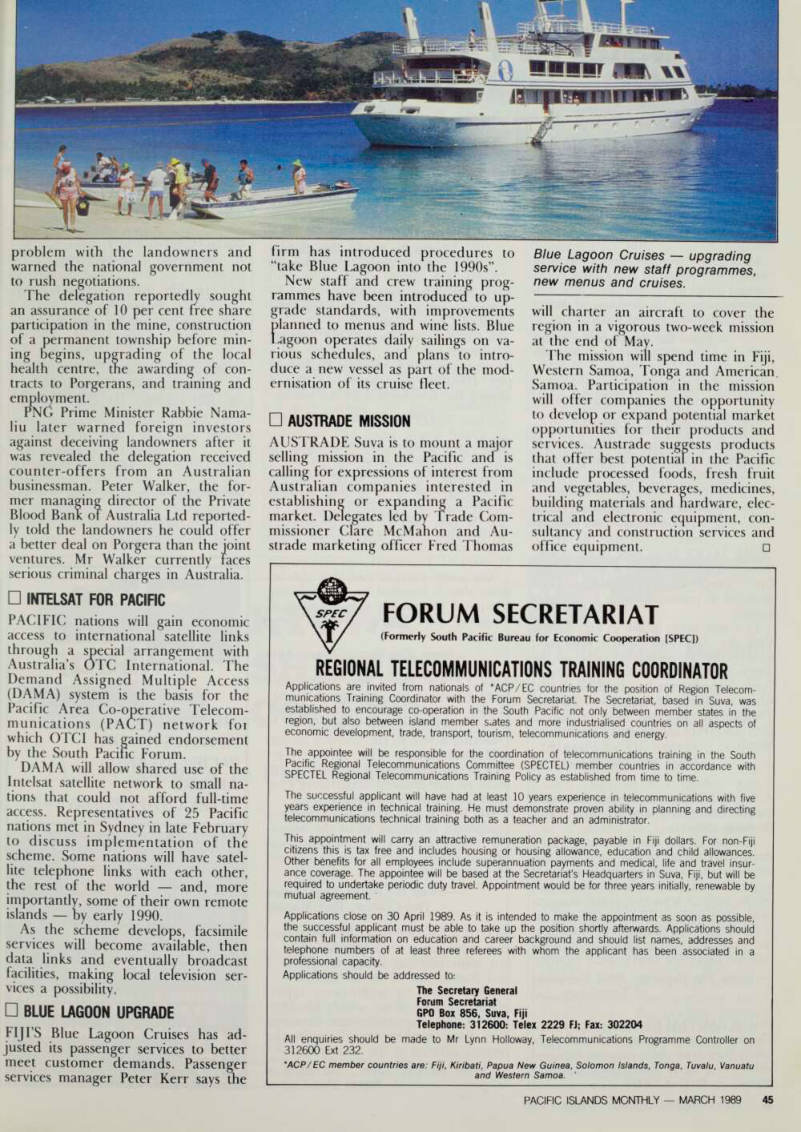
Trade Winds
Robin Bromby reports on the latest and most horrifying threat to the viability of the region’s fisheries.
mmHE FORUM Fisheries Agency (FFA) is hopeful it will get Japan to the negotiating table witnin the next few months, but is less opti mistic about the outcome of such talks.
Two main issues will be discussed: the
gill net fishing Japanese boats under
take both in the Tasman and in the Pacific east of New Zealand, and a multilateral treaty with FFA countries for the right to fish in their exclusive economic zones.
Along with the Taiwanese and South Koreans, Japanese fishing fleets are using gill nets dubbed the ‘Wall of Deatn to catch large numbers of mostly juvenile albacore tuna, a prac tice that has serious implications for the Pacific albacore fishery.
But, in the matter of reaching a fishing agreement with Forum coun tries, the Japanese have been a good deal more intransigent than their Asian counterparts. They broke off their deal with Papua New Guinea when the Government in Port Mores by wanted an increase in the fee (an increase to which the Taiwanese and South Koreans had agreed, but one the Japanese would not countenance).
Similarly, boats from Japan withdrew from the Tuvalu economic zone; they had agreed to pay the price required by Funafuti, but the Tuvalu Govern ment, in order to balance its budget for the year, asked for payment in advance. For Japan, one of the richest nations in the world, the request from a micro-state of fewer than 9000 peo ple could hardly have been a major issue . . . but refuse they did.
Tuna caught legally in the Pacific either by approved methods in inter national waters or under a fee arrangement in economic zones amounts to 600,000 tonnes a year: 375,000 by purse seine, 75,000 by pole and line and 150,000 by longhne.
Then there is gill netting.
Between the latitudes of 38 and 41 degrees in the South Pacific, juvenile albacore tuna come to the surface as part of their annual migration to the warmer tropical waters. They are on their way north to spawn. But vast
numbers are being caught by Asian
boats before they have a chance to re produce and as a consequence the portents for the future are grim.
The culprit is the gill net, which is suspended about 15 metres below the
“The gill nets are up
to 55 kilometres long
... and for the fish
there is simply no way
around.”
surface and has holes just large enough to catch tuna by their gills.
The nets are up to 55 kilometres long and for the fish there is simply no way around.
Gill nets catch not only tuna, but dolphins, small whales, sea birds and turtles as well and represent an ecological disaster that threatens not just Tonga and the Solomon Islands out, ironically, the Asian fishing indus tries themselves.
For while one group of boast clears the oceans with its gill nets, they will
deprive Japanese and Taiwanese long
line boats (which catch the adults after spawning) of a future. The longliners generally operate in territorial econo mic zones and pay the island govern ments for the right: gill-netters, in contrast, operate m international wa ters and pay nothing.
The Honiara-based Forum Fishing Agency estimates that within five years the numbers of albacore tuna could be down to 10 per cent of present levels.
It has been estimated that Asian fishermen are catching about 40,000 tonnes a year with gill nets, of which 30.000 tonnes are juvenile fish. The sustainable yield is reckoned at about 10.000 tonnes, with a maximum 5000 tonnes of juveniles. About 162 boats are now involved in gill netting; 130 Taiwanese, 30 Japanese and two South Koreans.
The FFA’s researchers have evi dence that the length and width of the gill nets, which are made of nylon, appear to have increased in the past year. Most of the catch is being sent to Taiwan, with some going to canneries in Thailand.
Canneries in Fiji and American Samoa have refused to buy fish caught with gill nets: French Polynesia and Vanuatu have refused gill net boats servicing or refuelling in their ports; and the Cook Islands turned down a Taiwanese proposal to build a cold store in that country.
Only New Caledonia and New Zea land nave allowed Japanese boats to
trans-ship tuna caught by gill netting,
but now the New Zealand Govern ment is lobbying the three Asian coun tries to phase out the method.
However, the first to feel the effect of such huge numbers of fish being caught will be the longline vessels, which seek adult fish in the deeper reaches of the tropical oceans.
Fiji has 17 longline vessels, which provide jobs both on the ships and at the cannery at Levuka. Vanuatu has a considerable investment in longlining, with a cold store and trans-shipment base and licences to 40 Taiwanese boats crewed partly by local men.
The Cook Islands earns licence fees from 53 South Korean longline boats, while American Samoa has two can neries and about 100 Taiwanese boats landing their catches there. French Polynesia has licensed Japanese and
Korean longliners.
Other countries also count fishing as part of their future: the Solomon Is lands is investing in its own fishing fleet, while Papua New Guinea has estimated that the present harvest of 2000 tonnes could be expanded to 180.000 tonnes of tuna a year without depleting the stock.
While the South Koreans and the Taiwanese have the gill net issue aside been prepared to strike deals by which they can fish in the econo mid zones of the small Pacific island states, the Japanese have been reluc tant to sign agreements unless they get all the conditions they seek. Both Tuvalu and PNG have cancelled agreements and the Marshall Islands has now given notice that it wants the Japanese out of its waters.
The annual catch of all types of tuna in the central and western Pacific has been estimated to be more than 600.000 tonnes a year, with a value of about SUS6OO million. The island states cannot afford fleets of boats; just one boat the size of the average US tuna vessel would cost SUSII mil lion to build and $3 million a year to operate, so these countries are reliant on what the big fishing nations do. If
they persist in over-fishing the re
source, and resisting reasonable pay ments, the hopes the small Pacific States have for economic development will be dashed. □
□ Spares Not Short
UK aircraft manufacturer Short Brothers has expanded its spare parts inventory in Australia following suc cessful sales campaigns there and in Southeast Asia. Spares for Shorts air craft operating in Australia and the Pacific will now be supplied from their Sydney office.
Short’s general manager in Australia John Burleigh says tne expansion, Lacked by the company’s major avionics suppliers, is worth SA2 mil lion over the past three months.
□ Columbus Discovers Tonga
COLUMBUS Line will commence a direct shipping service between Tonga in the US west coast. The container vessel Columbus Canada, which flies the Tongan flag and is crewed by Tongan rating seamen and cadets, will operate the service. A second vessel may operate the route at a later stage.
Loading on the west coast for tne first service was due in early March and the vessel is due in Nukualofa by April 10.
□ Pac-Dunlop Contract
PACIFIC Dunlop will share in SA6O
million contract to produce super sized batteries for the Australian Sub marine Corporation (ASC).
The contract was awarded to a joint venture company owned by Pacific Dunlop and German manufacturer, Varta Batteries AC.
The joint venture will invest $A6.5 million in a new manufacturing plant in Adelaide, South Australia, where the ASC has its submarine building facility. ASC received the contract to build six submarines from the Austra lian Navy. Each battery has a mass of 230 tonnes and consists of 448 cells.
Pacific Dunlop managing director
Philip Brass says the technology trans fer involved in the project could open up export opportunities and new de velopments in the supply of electrical power to remote areas.
□ Landowners In Sydney Talks
LANDOWNERS IN the Special Min ing Lease (SML) area of Porgera in the Highlands of Papua New Guinea are dissatisfied with the handling of their affairs by the local representa tives of the Porgera Joint Venture
(PJV) company.
So the landowners decided to go straight to the top, last month sending
a 10-member delegation to Sydney for talks with the overseas managers of the company. A chief of the SML area, Pakitu Pundi, led the delegation to discuss problems with the people landowners feel are the “real” mana gers of the venture.
The delegation dismissed claims by mine developers that there was no
Peter Walker - entrepreneur now facing criminal charges.
problem with the landowners and warned the national government not to rush negotiations.
The delegation reportedly sought
an assurance of 10 per cent free share participation in the mine, construction of a permanent township before min
ing begins, upgrading of the local
health centre, the awarding of con tracts to Porgerans, and training and
employment.
PNG Prime Minister Rabbie Nama liu later warned foreign investors against deceiving landowners after it was revealed the delegation received counter-offers from an Australian businessman. Peter Walker, the for mer managing director of the Private Blood Bank of Australia Ltd reported ly told the landowners he could offer a better deal on Porgera than the joint ventures. Mr Walker currently faces serious criminal charges in Australia.
□ Intelsat For Pacific
PACIFIC nations will gain economic access to international satellite links through a special arrangement with Australia’s OTC International. The
Demand Assigned Multiple Access
(DAMA) system is the basis for the Pacific Area Co-operative Telecom munications (PACT) network foi which OTCI has gained endorsement by the South Pacific Forum.
DAMA will allow shared use of the Intelsat satellite network to small na tions that could not afford full-time access. Representatives of 25 Pacific nations met in Sydney in late February to discuss implementation of the scheme. Some nations will have satel lite telephone links with each other, the rest of the world and, more importantly, some of their own remote
islands by early 1990.
As the scheme develops, facsimile services will become available, then data links and eventually broadcast facilities, making local television ser vices a possibility.
□ Blue Lagoon Upgrade
FIJI’S Blue Lagoon Cruises has ad justed its passenger services to better meet customer demands. Passenger services manager Peter Kerr says the
firm has introduced procedures to “take Blue Lagoon into the 1990s”.
New staff and crew training prog rammes have been introduced to up
grade standards, with improvements
planned to menus and wine lists. Blue Lagoon operates daily sailings on va rious schedules, and plans to intro duce a new vessel as part of the mod ernisation of its cruise fleet.
□ Austrade Mission
AUSTRADE Suva is to mount a major selling mission in the Pacific and is calling for expressions of interest from Australian companies interested in establishing or expanding a Pacific market. Delegates led by Trade Com missioner Clare McMahon and Au strade marketing officer Fred Thomas
will charter an aircraft to cover the region in a vigorous two-week mission at the end of May.
The mission will spend time in Fiji, Western Samoa, Tonga and American Samoa. Participation in the mission will offer companies the opportunity
to develop or expand potential market
opportunities for their products and services. Austrade suggests products that offer best potential in the Pacific include processed foods, fresh fruit
and vegetables, beverages, medicines,
building materials and hardware, elec trical and electronic equipment, con sultancy and construction services and office equipment. □
Blue Lagoon Cruises - upgrading
service with new staff programmes, new menus and cruises.
Advertisements & other items, pp. 44-45 (2 items)
Trade Winds
Solarex
electricity from sunlight - the simplest most reliable G am power supply under the sun Papua New Guinea Solomon Is Vanuatu Australia Fiji New Caledonia Tonga
SOLAR ELECTRIC MODULES
Samoa * Tahiti New Zealand / > If you’ve been considering solar electric power contact us for the
most comprehensive quote and
name of your local dealer.
Duncan Maclean
SOLAREX PACIFIC DISTRIBUTOR
BMK Bob McKnight(Trading) pty. Ltd.
I#IVII% p Q BQX 92 FORTITUDE VALLEY, BRISBANE 4006, QLD. AUSTRALIA TELEPHONE (671) 252 7600 FAX (617) 252 5505 TELEX AA41846
SPEC
f
FORUM SECRETARIAT
(Formerly South Pacific Bureau for Economic Cooperation [SPEC])
REGIONAL TELECOMMUNICATIONS TRAINING COORDINATOR
Applications are invited from nationals of *ACP/EC countries for the position of Region Telecommunications Training Coordinator with the Forum Secretariat. The Secretariat, based in Suva, was established to encourage co-operation in the South Pacific not only between member states in the region, but also between island member spates and more industrialised countries on all aspects of economic development, trade, transport, tourism, telecommunications and energy.
The appointee will be responsible for the coordination of telecommunications training in the South Pacific Regional Telecommunications Committee (SPECTEL) member countries in accordance with SPECTEL Regional Telecommunications Training Policy as established from time to time.
The successful applicant will have had at least 10 years experience in telecommunications with five years experience in technical training. He must demonstrate proven ability in planning and directing telecommunications technical training both as a teacher and an administrator.
This appointment will carry an attractive remuneration package, payable in Fiji dollars. For non-Fiji citizens this is tax free and includes housing or housing allowance, education and child allowances.
Other benefits for all employees include superannuation payments and medical, life and travel insurance coverage. The appointee will be based at the Secretariat’s Headquarters in Suva, Fiji, but will be required to undertake periodic duty travel. Appointment would be for three years initially, renewable by mutual agreement.
Applications close on 30 April 1989. As it is intended to make the appointment as soon as possible, the successful applicant must be able to take up the position shortly afterwards. Applications should contain full information on education and career background and should list names, addresses and telephone numbers of at least three referees with whom the applicant has been associated in a professional capacity.
Applications should be addressed to: The Secretary General Forum Secretariat GPO Box 856, Suva, Fiji Telephone; 312600: Telex 2229 FJ; Fax: 302204 All enquiries should be made to Mr Lynn Holloway, Telecommunications Programme Controller on 312600 Ext 232. * ACP/EC member countries are: Fiji, Kiribati, Papua New Guinea, Solomon Islands, Tonga, Tuvalu, Vanuatu and Western Samoa.
The Island Press
Reports from the papers, compiled by John Carter
THE FAMILY of Huon Gulf MP Ben
Garry yesterday strongly demanded
he return to the Government benches
immediately.
They also want him to fly home to his Gabsongkeg village near Nadzab airport this weekend for an urgent
meeting.
Mr Garry’s younger brother Ankog and cousins Solomon and Giling Ferea warned that he would face the full consequences of his decision to defect to the Paias Wingti-led Opposition.
From the Papua New Guinea Post-Courier, Port Moresby HUON GULF MP Ben Garry is back in the Government less than a week after defecting to the Opposition.
His decision to return follows strong objections from his family and close supporters who did not want him to associate with an Opposition that in cluded Morobe MP, Utula Samana.
From the Papua New Guinea Post-Courier, Port Moresby “WHY MAKE Jesus look like a sandy haired Englishman or a weepy Ita lian?” People ask the question about
pictures in publications or hanging in
homes.
In a new book, made in Fiji, Robert Park, an American church volunteer, with Father Winston Halapua of the
Anglican St John’s Training Centre in
Suva, has portrayed in bola black and white a Christ who belongs in Fiji and
Tonga. The full-page pictures face a
text in five languages, including Hindi.
From The Fiji Times, Suva A SURVEY was conducted last year on the lime (kambang) preferences of betelnut chewers . . .
The aim of the survey based on a statistically sound sample was to de termine the kambang preference of experienced chewers (ie kids and adults with at least two years’ mastica tion experience). The results will be used to establish the priority ratings of the kambangs in the subsequent inves tigation into their heavy metal content.
From The Reporter, PNG University of Technology, Lae FOUR PARTIALLY blind Papua New
Guineans yesterday regained full sight
when they had their corneas replaced with ones from dead Americans thanks to Project Orbis.
This is history for PNG as it is the first time that such an operation has been done in the country, and moreover, done on board a DCS jet, converted into a state-of-the-art eye
hospital at Port Moresby’s Jackson’s
International Airport.
From the Papua New Guinea Post-Courier, Port Moresby FIJI NOW has one of the highest drowning ratios in the world, says the
Fiji Red Cross Society.
A record number of 36 people drowned last year, resulting in a drowning ratio of 5.0 (five drownings per 100,000 population) rated among the five highest in the world.
From The Fiji Times, Suva SOME 40 tons of copra are on the wharf reportedly because the Bank Line vessel that was supposed to take it was required to leave early to allow a cement ship to come in.
Informed sources told the Samoa Times the copra vessel left three hours early on instructions from the
Ministry of Transport and Shipping.
The same sources said that the ce ment ship is handled by a stevedoring company for which the Minister of Shipping, Jack Netzler, worked some years back.
From The Samoa Times, Apia THE CHANCES of very ill patients
leaving Lae’s Angau Memorial Hospit
al alive are “minimal”, Health Minister
Robert Suckling heard yesterday.
During a visit to the hospital he was told that people who suffer heart attacks cannot he saved because equip ment in the casualty department’s re suscitation unit is outdated.
He heard also that basic medical equipment in almost all of the hospit al s major clinical departments was broken down, posing a serious threat to patients’ lives.
From the Papua New Guinea Post-Courier, Port Moresby STUDENTS ARE now allowed to bor row video tapes from the library . . . but some popular titles, like Rocky I and Rambo, are to be withdrawn.
There are 38 withdrawn tapes, mainly feature films, which Ms Mar garet Gault, the audiovisual librarian, says have nothing to do with the courses offered at the University.
From the Uni Tavur, University of Papua New Guinea
Advertisements & other items, p. 46 (1 item)
Digest
FOCAL
COMMUNICATIONS
EDUCATIONAL AND
HEALTH TRAINING
VIDEOS
science * maths * history * health and guidance
Suitable for primary, secondary
schools, hospitals, etc.
FOR FURTHER INFORMATION, PLEASE
COMPLETE
THE COUPON BELOW AND RETURN
TO: Focal Communications, PO Box 383, St Leonards NSW 2065 Australia tel: (02) 437 6855 fax: (02) 436 0175 PM 1
NAME: TITLE:
ORGANISATION:
ADDRESS:
COUNTRY:
The
South
Digest
THE PRIVATE
NEWSLETTER ON
PACIFIC ISLANDS
AFFAIRS
EVERY OTHER FRIDAY
* STEELAGE SAFES
* FIREPROOF FILING CABINETS
* COMPUTER DATA CABINETS
* STRONGROOM DOORS
* DEPOSIT LOCKERS
* SAFE WITH DEPOSIT LOCKERS
* FIRE PROOF CABINETS
* BANKERS TREASURY SAFES
FOR MORE DETAIL. CATALOGUES
& PRICES CONTACT:-
CD Maheth Syndicate 31 Raojibhai Patel St.
P.O. Box 1187. Suva. Fiji Islands Telex: 2399 FJ Mahesh. Fax; 302485
Media under the microscope
Communications
A Pacific seminar will look at the alienating affect of ‘media imperialism’
on Pacific communities.
By Eileen Tugum
THE IMPACT of modern communication technologies on Pacific cultures is causing grave concern among church leaders and communicators in the region.
At a seminar titled “Faith, Culture
and Communication”, sponsored by
the World Association for Christian Communication Pacific (WACC-PAC) in Goroka last month, 18 participants from Papua New Guinea, Fiji, Vanuatu, Tonga, New Zealand and Australia expressed concern that rapid growth in satellite communication and increasing commercial communication monopolies have made it increasingly difficult for small (or large) island states to control the flow of information, much of which has been found
to be culturally alienating.
Graham Tnomas, an Australian broadcaster with many years of experience in Pacific communiations, told the seminar that one of the major
challenges facing the region is “find-
ing ways to use communication tech-
nologies without letting them destroy
cultural integrity and identity.”
The video and television revolution, participants agreed, has had a drama tic impact on the pattern of daily life, rivalled only by the impact of educa tion and the removal of young people
from agriculture, fishing and house
work to the classroom. Video and tele vision place the entire village in front of the screen for up to eight hours (in American Samoa, research shows up to 14) out of every 24, replacing activi ties vital to cultural continuity, However, Mr Thomas warned that it must be recognised that cultures are
not static; white they are continually
evolving, very rapid change can be
destructive. As Sister Maria Burke of the Melanesian Institute of PNG said of television at the 1986 Waigani Seminar, “education for awareness
building and general entertainment
the media can provide, but only if the material fits the people and if the means are available to the majority of
people. However, if the content of
programming is totally foreign we will
nave cultural alienation.”
The impact of satellite-delivered television, for example over which recipients have little or no control has oeen cause for concern in a num ber of traditional societies. But island nations are researching ways of allow ing communities local control over in coming satellite services and the estab lishment of a direct input and produc tion facility in both video and audio.
As a step in this direction, the Paci fic region has opted to look at the
WACC-sponsored Manila Congress
from a cultural perspective.
The seminar, to be held from Octo ber 15-19 this year, involves discussion highlighting the impact of modern communications technology on Pacific cultures, addressing the question of how those technologies could be used to the advantage of the community, and how the island nations could con trol the flow of information. □
Advertisements & other items, p. 47 (1 item)
Co., Ltd.
s c\> v TO
Pacific Islands Monthly
READERS
Pacific Press announces the publication of LAST FRONTIERS:
THE EXPLORATIONS OF IVAN
CHAMPION OF PAPUA
by james Sinclair Each copy of this limited and numbered edition of 1000 copies includes a commemorative bookplate signed by Ivan Champion, OBE, and James Sinclair. Published by Pacific Press, 17 Park Avenue, Broadbeach Waters, Queensland Australia 4128.
LAST FRONTIERS is available to P/M readers at a special reduced price until 31 January 1989. Instead of the regular price of SABS (SUS 72), P/M readers who enclose the review on Page 48 with their payment can purchase Last Frontiers for the pre-publication price of SA69 (SUSSB) plus postage and handling (Australia SAS; Asia/Oceania SAB or SUS 7; other countries SAIO or SUS 9).
KYOWA
KYOWA
SHIPPING
CO., LTD.
Liner Service to Pacific Islands
FROM OJAPAN OHONG KONG
OKOREA OSINGAPORE
OTAIWAN
TO OSAIPAN
OFEDERATED STATES
OF MICRONESIA
OMARSHAL ISLANDS
©AMERICAN SAMOA
ONEW CALEDONIA
OFIJI
©GUAM
©YAP
©PALAU
©WESTERN SAMOA
©SOLOMON ISLANDS
©VANUATU
©PAPUA NEW GUINEA
HEAD OFFICE
6th Floor Kikushima Bldg 2-3. Hamamatsucho 2-chome Mmato-ku Tokyo 105 Japan Phone: 03(437)2885 (Rep ) Cables: MARIQUEEN Tokyo Telex: 242-4651 Kyowa J
OSAKA OFFICE
Dai San Fuji Bldg 3-13 llachidon 1-chome Osaka 550 Phone: 06(533)5821 (Rep ) Cables: MARIQUEEN Osaka Telex: 525-6271 Ssiosa J
Tropicalities
"Miscarriage" In Vila?
■ WRITE to put on record the fol lowing responses in respect to com ments made by Mr Stuart Little more concerning the recent trials of the former President of Vanuatu, Mr Ati George Sokomanu and members of his illegal interim Government.
Mr Littlemore’s comments were broadcast by Radio Australia on March 8, 1989.
The Government of Vanuatu chal lenges the statement that the trial har boured a “miscarriage of justice” and that the trial result is not a fair result”.
As an appeal was considered almost certain to be lodged a process which has since been confirmea the Judges consider it is unfortunate that Mr Littlemore chose to comment on the law itself.
The Judges are surprised that Mr Littlemore saw fit to comment on the actual result of the trial when he was only in Port Vila for five out of 10 davs of the trial.
Mr Littlemore was not in court to hear the evidence of the three accused who were acquitted. The assessors who made that decision were entitled to do so on the basis of their inter pretation of the evidence as it related to the mens res of the defendants.
Our courts in Vanuatu are open and public. Mr Littlemore’s report should have been limited to the way in which the trial was conducted rather than [containing] an expression of his personal views on the evidence.
Mr Littlemore has chosen to speak to the press giving his own personal interpretation of the evidence he was not in as good as a position as the assessors to do that, as they had heard the entire evidence.
Donald Kalpokas
Minister for Foreign Affairs and Judicial Services Port Vila, Vanuatu MR Kalapoka’s letter, which refers to radio comments by Sydney barrister and International Commission of Jur ists (Australian Section) sedition trial observer Mr Stuart Littlemore, de mands a response.
Pacific Islands Monthly has obtained a copy of the media release prepared by the ICJ, which sets out in skeletal terms the objections it has made to the conduct of the trial. However, there are further objections not referred to in the media release which must be given proper attention by the Govern ment and judiciary of the Republic of Vanuatu among them that the issue
of the aborted Chinese arms deal (see our report on Page 10 of this issue) was utterly irrelevant to the charges on which Mr Sope was being cross examined (and that the deal had been in fact instigated by Mr Sope under instructions from Father Lini); that the defendants’ counsel failed to draw the court’s attention to such irrelevant questioning; and that the direction of the trial did not adhere to established guidelines. It is expected these aspects will form part of the grounds on which the defendants will appeal against their convictions.
Reproduced below is the media re lease distributed by the ICJ: THE Executive Committee of the In ternational Commission of Jurists, Au stralian Section, has adopted the re port of its observer at the Vanuatu sedition trial, in which the trial is de scribed as a miscarriage of justice.
The former President of the Repub lic of Vanuatu, Ati George Sokomanu,
and three leading politicial figures
Barak Sope, Maxim Carlot and Willie Jimmy were convicted ... on counts of conspiracy to overthrow the Lini Government, incitement to
mutiny and unlawful oath-taking.
They were sentenced to prison terms from six to two years.
The report, made by member of the Council of the Australian Section of the ICJ [and] Sydney barrister Stuart Littlemore, says in attacking the out come of [the] Port Vila trial that: “Whatever convicted the four men, it certainly not was the evidence ten dered against them.”
Three men, two of whom were not politicians and the third of whom was a minor figure in Vanuatu politics, were acquitted on the same charges.
The ICJ report says that the convic tions, where the evidence was the same as that against the acquitted men, “defy logical analvsis” and that the evidence against all [the] accused was “identical and identically in
adequate. ”
The report calls the convictions “perverse’* and adds that there was, at the close of the case brought by Vanuatu’s Public Prosecutor, no case for any of the accused to answer.
“Irrespective of the final outcome of the trial,” the report says, “the judge was in error (when he declined to stop the trial and direct verdicts of not guilty on all counts) and the result was
a miscarriage of justice.”
An appeal against [the] convictions has been set down for the first week in April, at which the four men will be
represented by Sydney QC Mr Barry
Toomey. The Australian Section of the ICJ expects to make a further re port once the [outcome of the] appeal nas been determined.
Us Visas In Solomons
I WOULD like to point out an error in your December 1988 issue.
David North wrote in his article “US Islanders overcome passport tri bulations” that “the US Department of State issues visas in the former Trust Territories and in Suva and Port Moresby, but nowhere else in the Pacific”.
I would like to point out that the American Embassy in Honiara, Solo mon Islands, has been issuing visas for over a year to citizens and residents of Solomon Islands. In addition, citizens and residents of Vanuatu are able to apply by mail to the Embassy in Hon iara, with most receiving their visas by return mail (or pouched to their travel agent) in little over a week. Applicants from Vanuatu who require an in person interview are able to meet the consular officer on one of his regular consular visits to Port Vila.
This is perhaps not an earth shaking change, but Mr North should be aware that another or what he calls “barriers” to travel to the United States has been lowered.
Bill Warren
Charge d’Affaires, US Embassy Honiara
Treue Freunde Aus
Samoa?
I AM a 27-year-old female student from Germany in search of an En
glish-speaking penfriend from
Western Samoa. Would you please publish my name and address so that someone interested may write to me.
Alexandra Dittmar
Treburer Str 24 6000 Frankfurt 71 West Germany
Vanuatu Pioneer Sought
WOULD ANY of your readers have any information on a captain Ronald McLeod, an ancestor of mine who settled in the Vanuatu group during the 1860 s, ori finally as a planter on the island of anna.
Capt McLeod was born in Nova Sco tia and came to New Zealand with his
family about 1844. They settled as far mers but he was later ostracised by his relatives for supposedly dabbling in the slave-trade. Other information suggests that though he did recruit labour for his own use, he was well respected and liked by the natives whose “side he often took in matters of ill usage by the whites”.
It seems likely Capt McLeod settled on Tanna and grew maize, cotton and copra with mostly imported labour. As he is reported to have sailed to these islands aboard the vessel Woodstock, it is possible that he shipped his produce in the same vessel to Auckland and Noumea.
It was reported that he later set up a trading post on Efate and built a large home. He was bought out by the New Hebrides Company and later died of fever at Noumea. Available dates indicate this would have been in 1894 when the Captain was aged 50.
Any further information would be
much appreciated.
R Jenkins
Kanuka Rd Sandspit Warkworth North Auckland, NZ
Pacific Stickers Sought
THE WESTERN Australian Stick er Collectors’ Association is a non-profit group that exists to serve sticker collectors everywhere. We currently have more than 100 mem bers in Australia, New Zealand and the US. We are all keen sticker collec tors trying to collect as many stickers (also known as self-adhesive labels) as possible to add to our collections.
As we are a non-profit association we don’t buy stickers; our funds are used to pay our running costs. But as well as writing to companies and orga nisations all over the world requesting stickers, I also write back ana thank everyone that does send stickers to us, and I send one of our stickers to them, too.
If readers of Pacific Islands Monthly use stickers to advertise, have stickers for public relations purposes or just to label things, that’s what we’re after.
Naturally the more stickers the better, but even if they could only send us one sticker, this would be greatly appreciated. Of course, when we re ceive more stickers than we have members, spares are stockpiled for fu ture members.
I look forward to hearing from PIM reades and hope 1989 is shaping up to be a good year for all of them.
John Cohen, WASCA
PO Box 77 Brunswick Junction WA 6224
Fijians Or Not Fijians ...
AN OPINION page in your January issue included a sum mary of recent political events m Fiji.
This said: “ . . . the Melanesian population sought to throw off wjiat is perceived as the shackles of a colonial imbalance in opportunity.”
In view of the fact that Fiji became wholly independent some 17 years previously, I am puzzled by the use of the worn ‘colonial’ in describing the situation at the time of the 1987 coup.
But what particularly grieves me is to find Pacific Islands Monthly , with nearly 60 years of experience of the Pacific behind it, using ‘Melanesian’ instead of ‘Fijian’ to describe the in
digenous people of Fiji.
1 know that this has recently become common practice along a number of
overseas journalists.
There may be an excuse for some of them on the grounds of ignorance, but surely PIM should be well aware of the strong Polynesian admixture among the Fijian people, and that Melanesians’ is neitner a comprehen sive nor adequate synonym for Fi jians’.
Why should there be this sudden and unnecessary change? The word
Fijian’ is straightforwardly descriptive,
is enshrined in law and has the au thority of more than a century of reg ular use.
One group of people in Fiji who can certainly be classified properly as Melanesians are the members of the not inconsiderable Solomon Islands community. An illuminating feature of the draft Constitution now being dis cussed in Fiji is that people of Solo mon Islands descent have been re moved from the category of Fijians for voting purposes and are classified among the ‘others’ who are described as being neither Fijians nor Indians or Rotumans.
Sir Leonard Usher
Suva, Fiji
Making Contact ...
Ti HANK YOU very much for pub my address, which I sent in
seeking penpals. With your help I
have received letters from throughout the Pacific islands countries and I pas sed some of them on to my friends.
We are now receiving letters from our penpals and we are pleased to know all about their countries and to tell them about Papua New Guinea.
On behalf of my mates I’d like to take this opportunity to thank you for
your help.
Herman Huafe
Lae, PNG
Advertisements & other items, p. 49 (1 item)
Martin Fabrics
rh hĥ
FOR SALE
EX-AUSTRALIAN GOVERNMENT
Ex Australian Government Bulldozers Cranes Tractors Post Hole Borers Forklifts Loaders Loaders backhoes Elevating Platforms Trenchers Road Graders Road Rollers Garbage Compactors Street Sweepers Excavators 4x4 x 6x6 Heavy Duty Trucks Generators Compressors Prime Movers etc.
'Low Kim Low Hr Units
COUSINS TRUCK & MACHINERY SALES
P.O. BOX 191 ARCHERFIELD
BRISBANE OLD 4108
PHONE (07) 277 1822
FAX (07) 274 1389
MARTIN FABRICS
FIJI’S ONLY HOUSE OF
FASHION WEAR
★ FLORAL DRESS PRINTS
★ 100% COTTON PRINTS
★ TAPA PRINTS
★ ISLAND PRINTS
★ HABUTAE SILK
★ FANCY FABRICS
★ MENS SUITING &
SHIRTING MATERIAL
LARGEST SELECTION
IN FIJI OF
★ CURTAIN FABRIC FROM
SWEDEN.
AVAILABLE AT ALL
MARTIN FABRICS RETAIL OUTLET
SUVA NADI TOWN
281 VICTORIA PRO. OPP. NAMOTOMOTO VILLAGE.
LAUTOKA BA TOWN
BILA STREET. MAIN STREET.
MARTINS CORNER
4 MILES NABUA.
A
Shipping Schedules
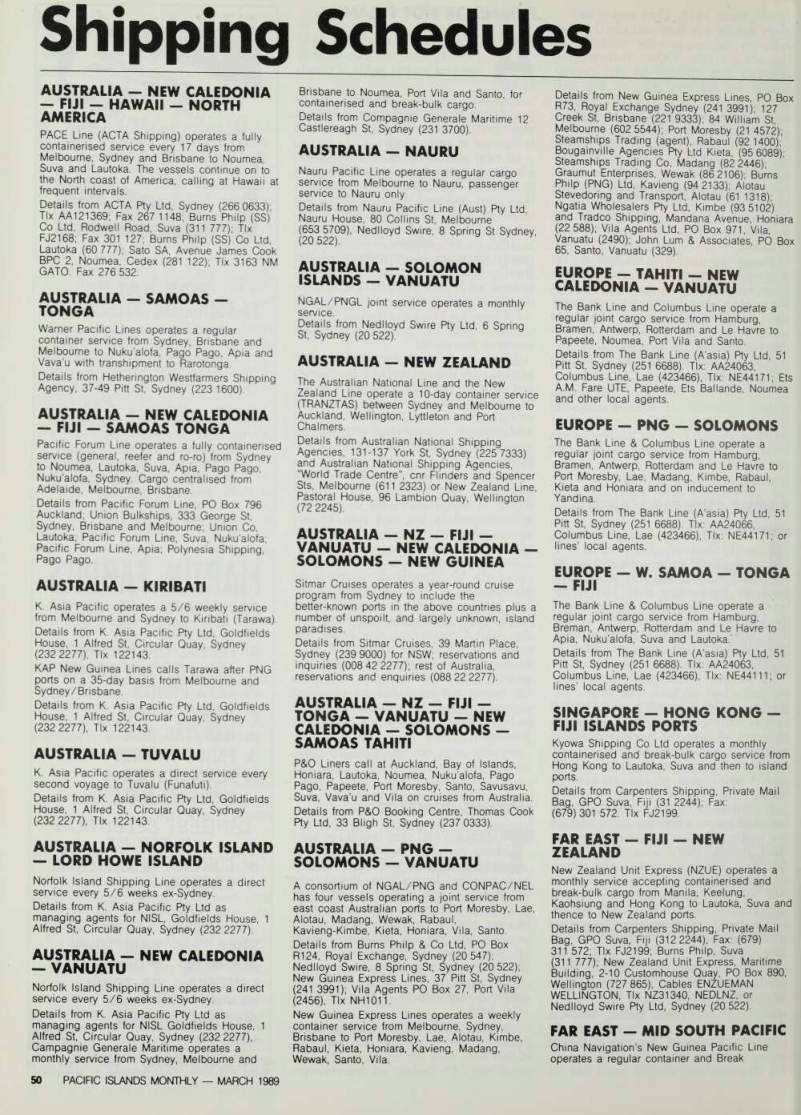

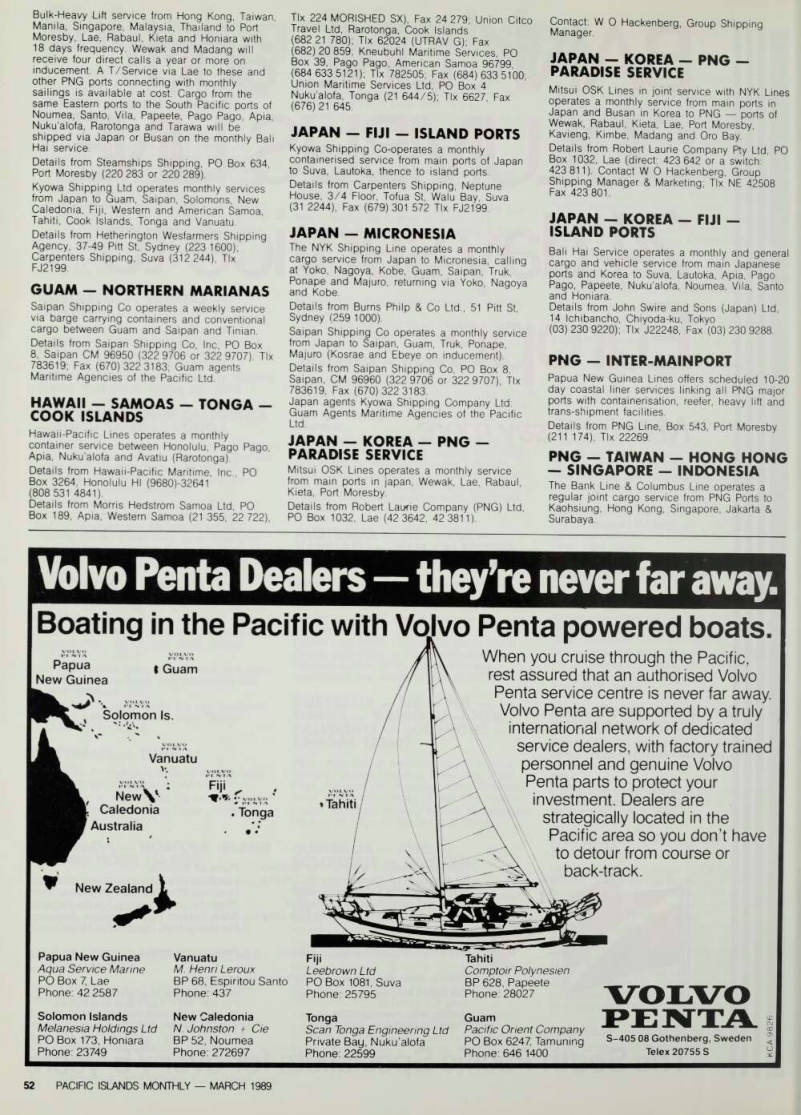
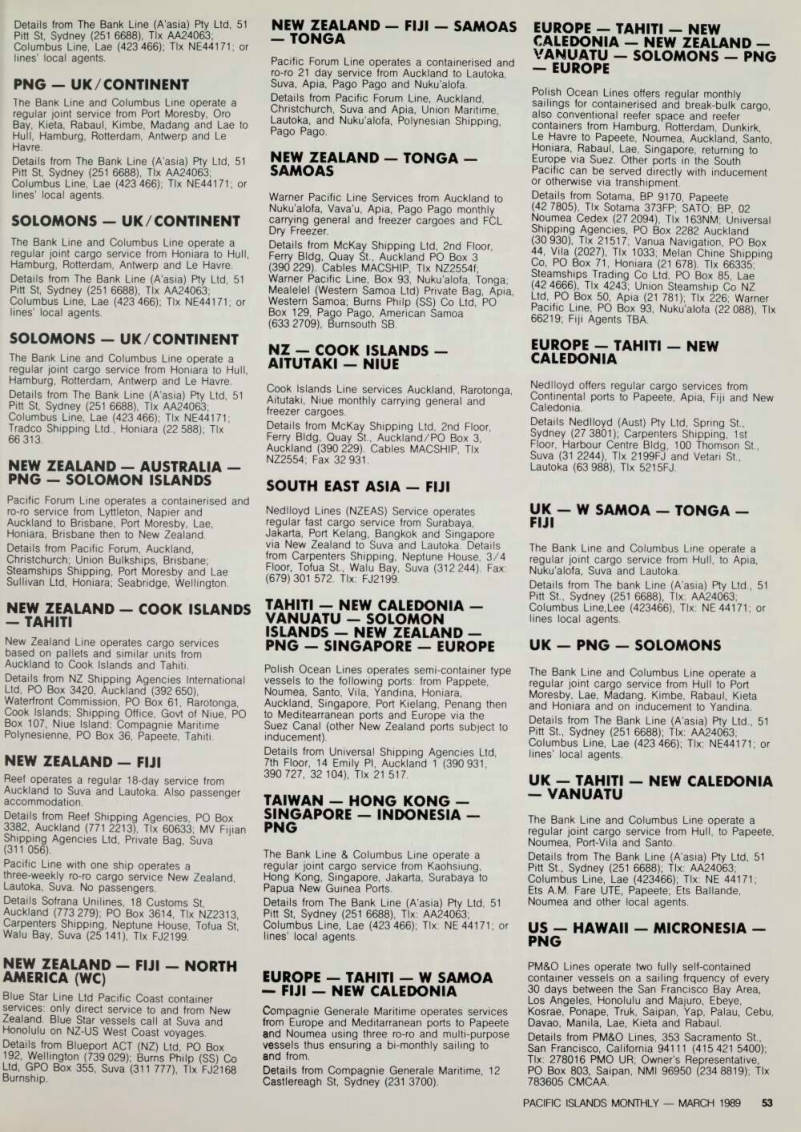
Australia New Caledonia
- Fiji - Hawaii - North
America
PACE Line (ACTA Shipping) operates a fully containerised service every 17 days from Melbourne, Sydney and Brisbane to Noumea, Suva and Lautoka, The vessels continue on to the North coast of America, calling at Hawaii at frequent intervals.
Details from ACTA Pty Ltd, Sydney (266 0633); Tlx AA121369; Fax 267 1148; Burns Philp (SS) Co Ltd. Rodwell Road, Suva (311 777); Tlx FJ2168; Fax 301 127; Burns Philp (SS) Co Ltd, Lautoka (60 777); Sato SA, Avenue James Cook BPC 2, Noumea, Cedex (281 122); Tlx 3163 NM
Gato. Fax 276 532.
Australia Samoas
Tonga
Warner Pacific Lines operates a regular container service from Sydney, Brisbane and Melbourne to Nukualofa, Pago Pago, Apia and Vava’u with transhipment to Rarotonga.
Details from Hetherington Westfarmers Shipping Agency, 37-49 Pitt St, Sydney (223 1600).
Australia New Caledonia
Fiji Samoas Tonga
Pacific Forum Line operates a fully containerised service (general, reefer and ro-ro) from Sydney to Noumea, Lautoka, Suva, Apia, Pago Pago, Nuku’alofa, Sydney. Cargo centralised from Adelaide, Melbourne, Brisbane.
Details from Pacific Forum Line, PO Box 796 Auckland; Union Bulkships, 333 George St, Sydney, Brisbane and Melbourne; Union Co, Lautoka; Pacific Forum Line, Suva, Nukualofa; Pacific Forum Line, Apia; Polynesia Shipping, Pago Pago.
Australia Kiribati
K. Asia Pacific operates a 5/6 weekly service from Melbourne and Sydney to Kiribati (Tarawa).
Details from K. Asia Pacific Pty Ltd, Goldfields House, 1 Alfred St, Circular Quay, Sydney (232 2277), Tlx 122143.
KAP New Guinea Lines calls Tarawa after PNG ports on a 35-day basis from Melbourne and Sydney/Brisbane.
Details from K. Asia Pacific Pty Ltd, Goldfields House, 1 Alfred St, Circular Quay, Sydney (232 2277), Tlx 122143.
Australia Tuvalu
K. Asia Pacific operates a direct service every second voyage to Tuvalu (Funafuti).
Details from K. Asia Pacific Pty Ltd, Goldfields House, 1 Alfred St, Circular Quay, Sydney (232 2277), Tlx 122143.
Australia Norfolk Island
Lord Howe Island
Norfolk Island Shipping Line operates a direct service every 5/6 weeks ex-Sydney.
Details from K. Asia Pacific Pty Ltd as managing agents for NISL, Goldfields House, 1 Alfred St, Circular Quay, Sydney (232 2277).
Australia - New Caledonia
- Vanuatu
Norfolk Island Shipping Line operates a direct service every 5/6 weeks ex-Sydney.
Details from K. Asia Pacific Pty Ltd as managing agents for NISL Goldfields House, 1 Alfred St, Circular Quay, Sydney (232 2277), Campagnie Generale Maritime operates a monthly service from Sydney, Melbourne and
Brisbane to Noumea, Port Vila and Santo, for containerised and break-bulk cargo.
Details from Compagnie Generale Maritime 12 Castlereagh St. Sydney (231 3700).
Australia Nauru
Nauru Pacific Line operates a regular cargo service from Melbourne to Nauru, passenger service to Nauru only.
Details from Nauru Pacific Line (Aust) Pty Ltd, Nauru House, 80 Collins St, Melbourne (653 5709), Nedlloyd Swire, 8 Spring St Sydney, (20 522).
Australia - Solomon
Islands - Vanuatu
NGAL/PNGL joint service operates a monthly service.
Details from Nedlloyd Swire Pty Ltd, 6 Spring St, Sydney (20 522).
Australia - New Zealand
The Australian National Line and the New Zealand Line operate a 10-day container service (TRANZTAS) between Sydney and Melbourne to Auckland, Wellington, Lyttleton and Port Chalmers.
Details from Australian National Shipping Agencies, 131-137 York St, Sydney (225 7333) and Australian National Shipping Agencies, "World Trade Centre", cnr Flinders and Spencer Sts, Melbourne (611 2323) or New Zealand Line, Pastoral House, 96 Lambion Quay, Wellington (72 2245).
Australia Nz Fiji
Vanuatu - New Caledonia
Solomons - New Guinea
Sitmar Cruises operates a year-round cruise program from Sydney to include the better-known ports in the above countries plus a number of unspoilt, and largely unknown, island paradises.
Details from Sitmar Cruises, 39 Martin Place, Sydney (239 9000) for NSW; reservations and inquiries (008 42 2277); rest of Australia, reservations and enquiries (088 22 2277).
Australia Nz - Fiji -
Tonga - Vanuatu - New
Caledonia Solomons -
Samoas Tahiti
P&O Liners call at Auckland, Bay of Islands, Honiara, Lautoka, Noumea, Nukualofa, Pago Pago, Papeete, Port Moresby, Santo, Savusavu, Suva, Vava’u and Vila on cruises from Australia.
Details from P&O Booking Centre, Thomas Cook Pty Ltd. 33 Bligh St, Sydney (237 0333).
Australia - Png -
Solomons - Vanuatu
A consortium of NGAL/PNG and CONPAC/NEL has four vessels operating a joint service from east coast Australian ports to Port Moresby, Lae, Alotau, Madang, Wewak, Rabaul, Kavieng-Kimbe, Kieta, Honiara, Vila, Santo.
Details from Burns Philp & Co Ltd, PO Box R 124, Royal Exchange, Sydney (20 547); Nedlloyd Swire, 8 Spring St, Sydney (20 522); New Guinea Express Lines, 37 Pitt St, Sydney (241 3991); Vila Agents PO Box 27, Port Vila
(2456), Tlx Nhioii.
New Guinea Express Lines operates a weekly container service from Melbourne, Sydney, Brisbane to Port Moresby, Lae, Alotau, Kimbe, Rabaul, Kieta, Honiara, Kavieng, Madang, Wewak, Santo, Vila.
Details from New Guinea Express Lines, PO Box R 73, Royal Exchange Sydney (241 3991) 127 Creek St, Brisbane (221 9333); 84 William St Melbourne (602 5544); Port Moresby (21 4572)- Steamships Trading (agent), Rabaul (92 1400);’
Bougainville Agencies Pty Ltd Kieta, (95 6089); Steamships Trading Co, Madang (82 2446); Graumut Enterprises, Wewak (86 2106); Burns Philp (PNG) Ltd, Kavieng (94 2133); Alotau Stevedoring and Transport, Alotau (61 1318); Ngatia Wholesalers Pty Ltd, Kimbe (93 5102) and Tradco Shipping, Mandana Avenue, Honiara (22 588); Vila Agents Ltd, PO Box 971, Vila, Vanuatu (2490); John Lum & Associates, PO Box 65, Santo, Vanuatu (329).
Europe Tahiti New
Caledonia Vanuatu
The Bank Line and Columbus Line operate a regular joint cargo service from Hamburg, Bramen, Antwerp, Rotterdam and Le Havre to Papeete, Noumea, Port Vila and Santo.
Details from The Bank Line (A’asia) Pty Ltd, 51 Pitt St, Sydney (251 6688). Tlx; AA24063, Columbus Line, Lae (423466), Tlx: NE44171; Ets A.M. Fare UTE, Papeete, Ets Ballande, Noumea and other local agents.
Europe - Png - Solomons
The Bank Line & Columbus Line operate a regular joint cargo service from Hamburg, Bramen, Antwerp, Rotterdam and Le Havre to Port Moresby, Lae, Madang, Kimbe, Rabaul, Kieta and Honiara and on inducement to Yandina.
Details from The Bank Line (A’asia) Pty Ltd, 51 Pitt St. Sydney (251 6688). Tlx: AA24066, Columbus Line, Lae (423466), Tlx: NE44171; or lines’ local agents.
Europe W. Samoa Tonga
- Fiji
The Bank Line & Columbus Line operate a regular joint cargo service from Hamburg, Breman, Antwerp, Rotterdam and Le Havre to Apia, Nukualofa, Suva and Lautoka."
Details from The Bank Line (A'asia) Pty Ltd, 51 Pitt St, Sydney (251 6688). Tlx: AA24063, Columbus Line, Lae (423466), Tlx; NE44111; or lines’ local agents.
Singapore - Hong Kong -
Fiji Islands Ports
Kyowa Shipping Co Ltd operates a monthly containerised and break-bulk cargo service from Hong Kong to Lautoka, Suva and then to island ports.
Details from Carpenters Shipping, Private Mail Bag, GPO Suva, Fiji (31 2244); Fax: (679)301 572. Tlx FJ2199.
Far East - Fiji - New
Zealand
New Zealand Unit Express (NZUE) operates a monthly service accepting containerised and break-bulk cargo from Manila, Keelung, Kaohsiung and Hong Kong to Lautoka, Suva and thence to New Zealand ports.
Details from Carpenters Shipping, Private Mail Bag, GPO Suva, Fiji (312 2244), Fax: (679) 311 572; Tlx FJ2199; Burns Philp. Suva (311 777); New Zealand Unit Express, Maritime Building, 2-10 Customhouse Quay, PO Box 890, Wellington (727 865), Cables ENZUEMAN
Wellington. Tlx Nz31340, Nedlnz, Or
Nedlloyd Swire Pty Ltd, Sydney (20 522).
Far East Mid South Pacific
China Navigation’s New Guinea Pacific Line operates a regular container and Break
Bulk-Heavy Lift service from Hong Kong, Taiwan, Manila, Singapore, Malaysia, Thailand to Port Moresby, Lae, Rabaul, Kieta and Honiara with 18 days frequency. Wewak and Madang will receive four direct calls a year or more on inducement. A T/Service via Lae to these and other PNG ports connecting with monthly sailings is available at cost. Cargo from the same Eastern ports to the South Pacific ports of Noumea, Santo, Vila, Papeete, Pago Pago, Apia, Nukualofa, Rarotonga and Tarawa will be shipped via Japan or Busan on the monthly Bali Hai service.
Details from Steamships Shipping, PO Box 634 Port Moresby (220 283 or 220 289).
Kyowa Shipping Ltd operates monthly services from Japan to Guam, Saipan, Solomons, New Caledonia, Fiji, Western and American Samoa, Tahiti, Cook Islands, Tonga and Vanuatu.
Details from Hetherington Wesfarmers Shipping Agency, 37-49 Pitt St, Sydney (223 1600); Carpenters Shipping. Suva (312 244), Tlx FJ2199.
Guam Northern Marianas
Saipan Shipping Co operates a weekly service via barge carrying containers and conventional cargo between Guam and Saipan and Tinian Details from Saipan Shipping Co, Inc, PO Box 8, Saipan CM 96950 (322 9706 or 322 9707) Tlx 783619; Fax (670)322 3183; Guam agents Maritime Agencies of the Pacific Ltd.
Hawaii - Samoas - Tonga -
Cook Islands
Hawaii-Pacific Lines operates a monthly container service between Honolulu, Pago Pago, Apia, Nukualofa and Avatiu (Rarotonga).
Details from Hawaii-Pacific Maritime, Inc., PO Box 3264, Honolulu HI (9680)-32641 (808 531 4841).
Details from Morris Hedstrom Samoa Ltd, PO Box 189, Apia, Western Samoa (21 355, 22 722),
tlx 224 MORISHED SX), Fax 24 279; Union Citco Travel Ltd, Rarotonga. Cook Islands (682 21 780); Tlx 62024 (UTRAV G); Fax (682) 20 859; Kneubuhl Maritime Services, PC Box 39, Pago Pago, American Samoa 96799 (684 633 5121); Tlx 782505; Fax (684)633 5100; Union Maritime Services Ltd, PC Box 4 Nukualofa, Tonga (21 644/5); Tlx 6627, Fax (676) 21 645.
Japan Fiji Island Ports
Kyowa Shipping Co-operates a monthly containerised service from main ports of Japan to Suva, Lautoka, thence to island ports.
Details from Carpenters Shipping, Neptune House, 3/4 Floor, Tofua St, Walu Bay, Suva (31 2244), Fax (679)301 572 Tlx FJ2199.
Japan Micronesia
The NYK Shipping Line operates a monthly cargo service from Japan to Micronesia, calling at Yoko, Nagoya, Kobe, Guam, Saipan, Truk, Ponape and Majuro, returning via Yoko, Nagoya and Kobe.
Details from Burns Philp & Co Ltd., 51 Pitt St Sydney (259 1000), Saipan Shipping Co operates a monthly service from Japan to Saipan, Guam, Truk, Ponape, Majuro (Kosrae and Ebeye on inducement).
Details from Saipan Shipping Co, PC Box 8, Saipan, CM 96960 (322 9706 or 322 9707), Tlx 783619, Fax (670)322 3183.
Japan agents Kyowa Shipping Company Ltd: Guam Agents Maritime Agencies of the Pacific Ltd.
Japan Korea Png
Paradise Service
Mitsui OSK Lines operates a monthly service from main ports in japan, Wewak, Lae, Rabaul, Kieta, Port Moresby.
Details from Robert Laurie Company (PNG) Ltd, PO Box 1032, Lae (42 3642, 42 3811).
Contact: W 0 Hackenberg, Group Shipping Manager.
Japan Korea Png
Paradise Service
Mitsui OSK Lines in joint service with NYK Lines operates a monthly service from main ports in Japan and Busan in Korea to PNG ports of Wewak, Rabaul, Kieta, Lae, Port Moresby, Kavieng, Kimbe, Madang and Oro Bay.
Details from Robert Laurie Company Pty Ltd, PC Box 1032, Lae (direct: 423 642 or a switch: 423 811). Contact W 0 Hackenberg, Group Shipping Manager & Marketing; Tlx NE 42508 Fax 423 801.
Japan Korea Fiji -
Island Ports
Bah Hai Service operates a monthly and general cargo and vehicle service from main Japanese ports and Korea to Suva, Lautoka, Apia, Pago Pago, Papeete, Nukualofa, Noumea, Vila, Santo and Honiara.
Details from John Swire and Sons (Japan) Ltd, 14 Ichibancho, Chiyoda-ku, Tokyo (03) 230 9220); Tlx J 22248, Fax (03) 230 9288.
Png Inter-Mainport
Papua New Guinea Lines offers scheduled 10-20 day coastal liner services linking all PNG major ports with containerisation, reefer, heavy lift and trans-shipment facilities.
Details from PNG Line, Box 543, Port Moresby (211 174), Tlx 22269.
Png Taiwan Hong Hong
Singapore Indonesia
The Bank Line & Columbus Line operates a regular joint cargo service from PNG Ports to Kaohsiung, Hong Kong, Singapore, Jakarta & Surabaya.
Details from The Bank Line (A’asia) Pty Ltd, 51 Pitt St, Sydney (251 6688), Tlx AA24063; Columbus Line, Lae (423 466); Tlx NE44171; or lines’ local agents.
Png - Uk/Continent
The Bank Line and Columbus Line operate a regular joint service from Port Moresby, Oro Bay, Kieta, Rabaul, Kimbe, Madang and Lae to Hull, Hamburg, Rotterdam, Antwerp and Le Havre.
Details from The Bank Line (A’asia) Pty Ltd, 51 Pitt St, Sydney (251 6688), Tlx AA24063; Columbus Line, Lae (423 466); Tlx NE44171; or lines’ local agents.
Solomons - Uk/Continent
The Bank Line and Columbus Line operate a regular joint cargo service from Honiara to Hull, Hamburg, Rotterdam, Antwerp and Le Havre.
Details from The Bank Line (A’asia) Pty Ltd, 51 Pitt St, Sydney (251 6688), Tlx AA24063; Columbus Line. Lae (423 466); Tlx NE44171; or lines’ local agents.
Solomons Uk/Continent
The Bank Line and Columbus Line operate a regular joint cargo service from Honiara to Hull, Hamburg, Rotterdam, Antwerp and Le Havre.
Details from The Bank Line (A’asia) Pty Ltd, 51 Pitt St, Sydney (251 6688), Tlx AA24063; Columbus Line, Lae (423 466); Tlx NE44171; Tradco Shipping Ltd., Honiara (22 588); Tlx 66 313.
New Zealand Australia
Png Solomon Islands
Pacific Forum Line operates a containerised and ro-ro service from Lyttleton, Napier and Auckland to Brisbane, Port Moresby, Lae, Honiara, Brisbane then to New Zealand.
Details from Pacific Forum, Auckland, Christchurch; Union Bulkships, Brisbane; Steamships Shipping, Port Moresby and Lae Sullivan Ltd, Honiara; Seabridge, Wellington.
New Zealand - Cook Islands
- Tahiti
New Zealand Line operates cargo services based on pallets and similar units from Auckland to Cook Islands and Tahiti.
Details from NZ Shipping Agencies International Ltd, PO Box 3420, Auckland (392 650), Waterfront Commission, PO Box 61, Rarotonga, Cook Islands; Shipping Office, Govt of Niue, PO Box 107, Niue Island; Compagnie Maritime Polynesienne, PO Box 36, Papeete, Tahiti.
New Zealand - Fiji
Reef operates a regular 18-day service from Auckland to Suva and Lautoka. Also passenger accommodation.
Details from Reef Shipping Agencies, PO Box 3382, Auckland (771 2213), Tlx 60633; MV Fijian Shipping Agencies Ltd, Private Bag, Suva (311 056).
Pacific Line with one ship operates a three-weekly ro-ro cargo service New Zealand, Lautoka, Suva. No passengers.
Details Sofrana Unilines, 18 Customs St Auckland (773279); PO Box 3614, Tlx NZ2313, Carpenters Shipping, Neptune House, Tofua St Walu Bay, Suva (25 141), Tlx FJ2199.
New Zealand Fiji North
America (Wc)
Blue Star Line Ltd Pacific Coast container services: only direct service to and from New Zealand. Blue Star vessels call at Suva and Honolulu on NZ-US West Coast voyages.
Details from Blueport ACT (NZ) Ltd, PO Box 192, Wellington (739 029); Burns Philp (SS) Co Ltd, GPO Box 355, Suva (311 777), Tlx FJ2168 Burnship.
New Zealand - Fiji - Samoas
Tonga
Pacific Forum Line operates a containerised and ro-ro 21 day service from Auckland to Lautoka, Suva, Apia, Pago Pago and Nukualofa.
Details from Pacific Forum Line, Auckland, Christchurch, Suva and Apia, Union Maritime, Lautoka, and Nukualofa, Polynesian Shipping, Pago Pago.
New Zealand Tonga
Samoas
Warner Pacific Line Services from Auckland to Nuku’alofa, Vava'u, Apia, Pago Pago monthly carrying general and freezer cargoes and FCL Dry Freezer.
Details from McKay Shipping Ltd, 2nd Floor, Ferry Bldg, Quay St., Auckland PO Box 3 (390 229). Cables MACSHIP, Tlx NZ2554f; Warner Pacific Line, Box 93, Nuku’alofa, Tonga; Mealelel (Western Samoa Ltd) Private Bag, Apia, Western Samoa; Burns Phi Ip (SS) Co Ltd, PO Box 129, Pago Pago, American Samoa (633 2709), Burnsouth SB.
Nz Cook Islands
Aitutaki - Niue
Cook Islands Line services Auckland, Rarotonga, Aitutaki, Niue monthly carrying general and freezer cargoes.
Details from McKay Shipping Ltd, 2nd Floor, Ferry Bldg, Quay St., Auckland/PO Box 3, Auckland (390 229). Cables MACSHIP, Tlx NZ2554; Fax 32 931.
South East Asia - Fiji
Nedlloyd Lines (NZEAS) Service operates regular fast cargo service from Surabaya, Jakarta, Port Kelang, Bangkok and Singapore via New Zealand to Suva and Lautoka. Details from Carpenters Shipping, Neptune House, 3/4 Floor, Tofua St., Walu Bay, Suva (312 244). Fax: (679)301 572. Tlx: FJ2199.
Tahiti - New Caledonia -
Vanuatu Solomon
Islands - New Zealand -
Png Singapore Europe
Polish Ocean Lines operates semi-container type vessels to the following ports: from Pappete, Noumea, Santo, Vila, Yandina, Honiara, Auckland, Singapore, Port Kielang, Penang then to Meditearranean ports and Europe via the Suez Canal (other New Zealand ports subject to inducement).
Details from Universal Shipping Agencies Ltd, 7th Floor, 14 Emily PI, Auckland 1 (390 931, 390 727, 32 104), Tlx 21 517.
Taiwan Hong Kong
Singapore Indonesia
Png
The Bank Line & Columbus Line operate a regular joint cargo service from Kaohsiung, Hong Kong, Singapore, Jakarta, Surabaya to Papua New Guinea Ports.
Details from The Bank Line (A’asia) Pty Ltd, 51 Pitt St, Sydney (251 6688), Tlx: AA24063; Columbus Line, Lae (423 466); Tlx: NE44171; or lines’ local agents.
Europe Tahiti - W Samoa
Fiji New Caledonia
Compagnie Generale Maritime operates services from Europe and Mediterranean ports to Papeete and Noumea using three ro-ro and multi-purpose vessels thus ensuring a bi-monthly sailing to and from.
Details from Compagnie Generale Maritime, 12 Castlereagh St, Sydney (231 3700).
Europe Tahiti New
Caledonia New Zealand
Vanuatu Solomons Png
Europe
Polish Ocean Lines offers regular monthly sailings for containerised and break-bulk cargo, also conventional reefer space and reefer containers from Hamburg, Rotterdam, Dunkirk, Le Havre to Papeete, Noumea, Auckland, Santo, Honiara, Rabaul, Lae, Singapore, returning to Europe via Suez. Other ports in the South Pacific can be served directly with inducement or otherwise via transhipment.
Details from Sotama, BP 9170, Papeete (42 7805), Tlx Sotama 373FP; SATO; BP, 02 Noumea Cedex (27 2094), Tlx 163 NM; Universal Shipping Agencies, PO Box 2282 Auckland (30 930), Tlx 21517; Vanua Navigation, PO Box 44, Vila (2027), Tlx 1033; Melan Chine Shipping Co, PO Box 71, Honiara (21 678). Tlx 66335; Steamships Trading Co Ltd, PO Box 85, Lae (42 4666), Tlx 4243; Union Steamship Co NZ Ltd, PO Box 50, Apia (21 781); Tlx 226; Warner Pacific Line, PO Box 93, Nukualofa (22 088), Tlx 66219; Fiji Agents TBA.
Europe Tahiti New
Caledonia
Nedlloyd offers regular cargo services from Continental ports to Papeete, Apia, Fiji and New Caledonia.
Details Nedlloyd (Aust) Pty Ltd, Spring St., Sydney (27 3801); Carpenters Shipping, Ist Floor, Harbour Centre Bldg, 100 Thomson St., Suva (31 2244), Tlx 2199FJ and Vetari St., Lautoka (63 988), Tlx 5215FJ.
Uk W Samoa Tonga
Fiji
The Bank Line and Columbus Line operate a regular joint cargo service from Hull, to Apia, Nukualofa, Suva and Lautoka.
Details from The bank Line (A’asia) Pty Ltd., 51 Pitt St., Sydney (251 6688), Tlx; AA24063; Columbus Line,Lee (423466), Tlx: NE 44171; or lines local agents.
Uk Png Solomons
The Bank Line and Columbus Line operate a regular joint cargo service from Hull to Port Moresby, Lae, Madang. Kimbe, Rabaul, Kieta and Honiara and on inducement to Yandina.
Details from The Bank Line (A'asia) Pty Ltd., 51 Pitt St., Sydney (251 6688); Tlx: AA24063; Columbus Line, Lae (423 466); Tlx: NE44171; or lines’ local agents.
Uk Tahiti New Caledonia
Vanuatu
The Bank Line and Columbus Line operate a regular joint cargo service from Hull, to Papeete, Noumea, Port-Vila and Santo.
Details from The Bank Line (A’asia) Pty Ltd, 51 Pitt St., Sydney (251 6688); Tlx: AA24063; Columbus Line, Lae (423466); Tlx: NE 44171; Ets A.M. Fare UTE, Papeete; Ets Ballande, Noumea and other local agents.
Us Hawaii Micronesia
Png
PM&O Lines operate two fully self-contained container vessels on a sailing frquency of every 30 days between the San Francisco Bay Area, Los Angeles, Honolulu and Majuro, Ebeye, Kosrae, Ponape, Truk, Saipan, Yap, Palau, Cebu, Davao, Manila, Lae, Kieta and Rabaul.
Details from PM&O Lines, 353 Sacramento St., San Francisco, California 94111 (415 421 5400); Tlx: 278016 PMC UR; Owner’s Representative, PO Box 803, Saipan, NMI 96950 (234 8819); Tlx
783605 Cmcaa.
Advertisements & other items, pp. 51-52 (1 item)
Europe.
BANK LINE and
COLUMBUS LINE
24 day service to
Europe.
Need we say more...
G The Joint Service Partners offer facilities for shipment of: Containers (PCL/LCL) and Break-bulk Cargo plus reefer space and deeptanks for carriage of vegetable oils and other liquid bulk cargo.
Carriers also accept heavy lifts, overlength and cumbersome parcels.
Ports of Service: Loading; Papeete, Apia, Suva, Lautoka, Noumea, Port Vila, Santo, Honiara, Port Moresby, Lae, Madang, Kimbe, Rabaul, Kieta, Darwin. For: Rotterdam, Antwerp, Hamburg, Hull, Dunkirk, Le Havre.
Additional ports on enquiry.
Please contact our regional offices for further information: The Bank Line (Australasia) Pty Ltd Suite 701, 51 Pitt St, Sydney, NSW, Australia 2000 Phone 251 6688 Telex 24063 Columbus Line Reederei GmbH P.O. Box 1 667, Lae/Papua New Guinea.
Phone: 423466/423487/A.H. 422481 Telex; Colline NE 441 71 The South Pacific Specialists for over 75 years
Volvo Renta Dealers —they’re never far away.
Boating in the Pacific with Volvo Renta powered boats. u Papua
HNew Guinea
I Guam Solomon Is.
Vanuatu
New\ v
Caledonia Australia
Fiji'
Tonga New Zealand Papua New Guinea Aqua Service Marine PO Box 7, Lae Phone: 42 2587 Solomon Islands Melanesia Holdings Ltd PO Box 173, Honiara Phone: 23749 - ♦ Tahiti
When you cruise through the Pacific,
rest assured that an authorised Volvo Renta service centre is never far away.
Volvo Renta are supported by a truly international network of dedicated service dealers, with factory trained
personnel and genuine Volvo
Renta parts to protect your
investment. Dealers are strategically located in the Pacific area so you don’t have to detour from course or back-track.
Vanuatu M. Henri Leroux BP 68, Espiritou Santo Phone: 437 New Caledonia N. Johnston + Cie BP 52, Noumea Phone: 272697 Fiji Leebrown Ltd PO Box 1081, Suva Ph0ne:25795 Tonga Scan Tonga Engineering Ltd Private Bay, Nuku’alofa Phone: 22599 Tahiti Comptoir Polyneslen BP 628, Papeete Phone: 28027 Guam Pacific Orient Company PO Box 6247, Tamuning Phone: 646 1400
VOLVO
S-405 08 Gothenberg, Sweden < Telex 20755 S
Tonga's message in a bottle
Out Of The Past
Stuart Inder digs into Tonga’s little-known Spanish past
PACIFIC EXPLORER Alejandro
Malaspina didn’t approve of the European practice of his f claiming land merely because one of their navigators happened to be the first white man to see it, but he was under instructions to claim Vavau for Spain; so in May 1793, Tonga’s green and attractive northern group became a Spanish possession.
The basis for Malaspina’s little known annexation was that 12 years earlier, Spain’s Francisco Antonio Mourelle had made the first recorded sighting of the group. Mourelle named Vavau the Martin de Mayorga Islands, after the viceroy of Mexico, to whom he happened to be carrying official dispatcnes from the Philip pines. During two weeks spent in Vavau in February 1781, Mourelle got on well with the Tongans and was im pressed with the excellent state of their roads and plantations.
It was one of tnose curious fortunes of history that James Cook, who vi sited Tonga no less than three times between 1773 and 1777, had not beaten Mourelle to Vavau. On his last voyage, Cook spent almost a fortnight in northern Ha’apai, little more than 100 kilometres south of Vavau, where he heard of the group and expressed interest in visiting it. But the Vavau high chief Finau, who was in Ha’apai at the time, put him off with a cock n bull story oi there being neither har bour nor anchorage there and Cook never did see Vavau. The group’s fjord-like harbours are in fact the best
in Tonga.
Malaspina, an Italian in the service of Spain, spent much of his time in a harbour Mourelle had named Port of Refuge. His instructions were to make a thorough examination of the group and to claim it in a public ceremony.
His two ships, Descubierta and Atrevi da, had already been on a long voyage of exploration and with scientists, sur veyors and even artists on board, were well equipped for the task.
The clay before the expedition finished its work, Malaspina prepared a document of possession and buried it in a bottle beneath a tent the scien tists were using as an observatory.
Translated from the Spanish, the document read: ‘The corvettes Descubertia and
Atrevida of His Catholic Majesty, under the orders of Captains Don
Alejandro Malaspina and Don Jose
Bustamente y Guerra, were in this port in the month of May of the year 1793, and having reconnoitered the whole archipelago around Vavao, they took possession of it in the name of
His Catholic Majesty, raising the flag
at the site of the observatory and accompanying this solemn act with seven cries of Long Live the King”, as did the natives presided over by their chief B una. The natives repeated Vavao foxa Espana the same number of times. This means “Vavao, son of
Spain”.
Malaspina’s men were the last Euro pean visitors to Tonga prior to the arrival of the first European settlers but the newcomers were ships’ deser ters and missionaries and none were Spanish. Nor was anything more heard of Spain’s annexation. Malaspi na fell out of Court favour not long after he returned to Spain, and was imprisoned for more than seven years and the voluminous papers of his expedition were ordered to be with held from publication.
Malaspina died in Italy in 1809, a few years after being released. Incred ibly, it was 1885 before an edited ver
sion of Malaspina’s journal together
with accounts of some of his officers was published in Madrid. This volume, and an officer’s account, pub lished in Uruguay in 1849, have never been translated into English.
The Tonga Government itself was unaware that the Vavauans had, almost two centuries ago, declared themselves to be “sons of Spain” until 1962, when Robert Langdon (a Pacific Islands Monthly contributor and later assistant editor) passed on the details to Queen Salote Tupou HI while she
was visiting Sydney. Langdon, a Span
ish history scholar who went on to spend 18 years as executive officer of the Pacific Manuscripts Bureau of the Australian National University, Can berra, had uncovered this unusual
piece of Tongan history while re
seraching in Sydney’s Mitchel Library.
Queen Salote, who died in 1965 af ter 47 years on the throne, was re
portedly intrigued by the news but
showed no interest in having anybody search for Malaspina’s buried historic
al treasure. In 1978 her elder son, King Taufa’ahau Tupou IV, was him self inspired to organise a search for the bottle.
By that time, inspection of a draw ing by an expedition artist, in the possesion of the National Library in Canberra, had unexpectedly revealed the probable site of the observatory tent. It had been erected on a small coral islet close to the foreshore of the Port of Refuge, after the top of the island had been levelled to provide sufficient working place for the scien tific party.
Access was by steps cut into the cor al, and the site had been selected to give the party privacy from the Ton gans who, as Mourelle had re ported, were inclined to be light
fingered.
first, however, the islet had to be firmly identified. This task was accom plished in early 1973 by a small group of enthusiasts led by long-time Vavau citizen and writer Patrick Matheson (whose books include a short history of Tonga, The Tongan Past), in Ross and Mmine Norgrove’s schooner, White Squall. It took some detective work before likely sites were narrowed down to one islet, on which the party found evidence of steps. But the top was overgrown with heavy vegetation, including some substantial trees.
That September, King Taufa’ahau
personally directed a large working
party in clearing the site. They unco vered holes in the coral, which the King judged to have held the tent pegs, and a central hole filled with rubble like the others that may have held the centre pole. Malaspina was believed to have used this to also hold the flagpole.
When the holes were cleared, however, there was no historic bottle to be found.
King Taufa’ahau was satisfied that the site on which Malaspina claimed Vavau for Spain had been identified.
But he suspected the unfortunate
navigator’s document of ‘annexation’
had not long survived the curiosity of his friendly nosts.
“If I know anything of my ances tors, they probably had the bottle up and were inspecting its contents be fore Malaspina’s sails disappeared over the horizon,” he chuckled. n
Advertisements & other items, pp. 55-56 (1 item)
anyhow
have a Winfield M ealth h a H
Diamonds
Conquer Gold.
. -.'i . .. - ...
OF
SSW
j 1 v >v A a m * The Mitsubishi Colt/Lancer Takes The Prestigious Golden Steering Wheel Award.
The Diamonds have done it! The world-famous symbols of quality and innovation are also the recipients of the prestigious Golden Steering Wheel Award.
On November 10, 1988 the respected German weekend magazine, Bild am Sonntag awarded the Mitsubishi Colt/ Lancer the coveted prize for Class I (under 1.5 litres).
In considering all newly released passenger cars in Germany for the preceding year, the 21 judges Ipoked carefully at nine aspects of each car. When selecting the Colt/Lancer, the panel commended particularly the Colt/Lancer’s distinctive styling, interior comfort and ease of operation, and the crisp, responsive power.
In conquering the gold, the Three Mitsubishi Diamonds have highlighted an exciting new approach to automotive engineering prevalent at Mitsubishi Motors. And confirmed once again their symbolism of quality and innovation the world over.
A
MITSUBISHI
MOTORS
MITSUBISHI COLT
MITSUBISHI COLT/LHNCER
AMERICAN SAMOA: MORRIS SCAN LAN SERVICE INC. PO Box 367, Pago Pago, Tel 633-5520/AUSTRALIA: MITSUBISHI MOTORS AUSTRALIA LTD Box 1284, South Road, Clovelly Park, South Australia 5042, Tel (083 275-7223/FIJI; NIVIS MOTOR & MACHINERY CO.. LTD. G.P.O. Box 150, Suva, Tel. 38341 1 /FRENCH POLYNESIA (TAHITI): ETS-BREDIN FRERESETFILS PO Box 21. Papeete,-Tahiti, Tel. 4-202-58/NEW CALEDONIA; SOCIETE D IMPORTATION D AUTO DU PACIFIQUE SUD S.A BP 438 Rond Point du Pacifique, Noumea, Tel. 274144/NEW ZEALAND: MITSUBISHI MOTORS NEW ZEALAND LTD. Todd Park, Heriot Drive, Private Bag, Porirua, Tel. 370-109/ NORFOLK ISLAND: BORRYS LTD. P O Box 169, Norfolk Island, Tel 2114/PAPUA NEW GUINEA: TOBA PTY LTD. PO Box 503, Port Moresby, Tel. 21-7874/SOLOMON ISLANDS: HARVEST PACIFIC LTD G.P.O. Box 88, Honiara.
Guadalcanal, Tel 30128/TONGA: SITANI MAFI CO., LTD. PO Box 83, Nuku ALOFA, Tel. 21-044/VANUATU: SOCOMETRA B P. 06 Route de Lagoa Port-Vila, Tel 2314/WESTERN SAMOA: A M MACDONALD HOLDINGS LTD P.O Box 576. Apia, Tel. 22022/SAIPAN/POHNPEI/MAJURO/KOSRAE/TRUK/YAP/BELAU; MICRONESIAN MOTORS, INC. 997 South Manne Drive, Tamumng, Guam 9691 1, Tel 646-6827