Pacific
Islands
Monthly
Mmencan aamoa USS 2 00
Australia AS2^5O
Cook Islands NZ$3,OO Fiji cci 7c Hawaii !.’"!!! USS2.SO Kiribati A 52.00 Nauru A 52.00 New Caledonia CFP2SO New Zealand NZ$3 00 Niue NZ$2.5O Norfolk Island A 52.00 Papua New Guinea K 2.00 Solomon Islands 552.00 Tahiti CFP3OO Tonga P 2.00 Tuvalu A 52.00
Usa Uss3.Oo
USTT and Guam USS2.SO Vanuatu VT2.00 Western Samoa T 2.75 ♦Recommended retail price only
February 1989
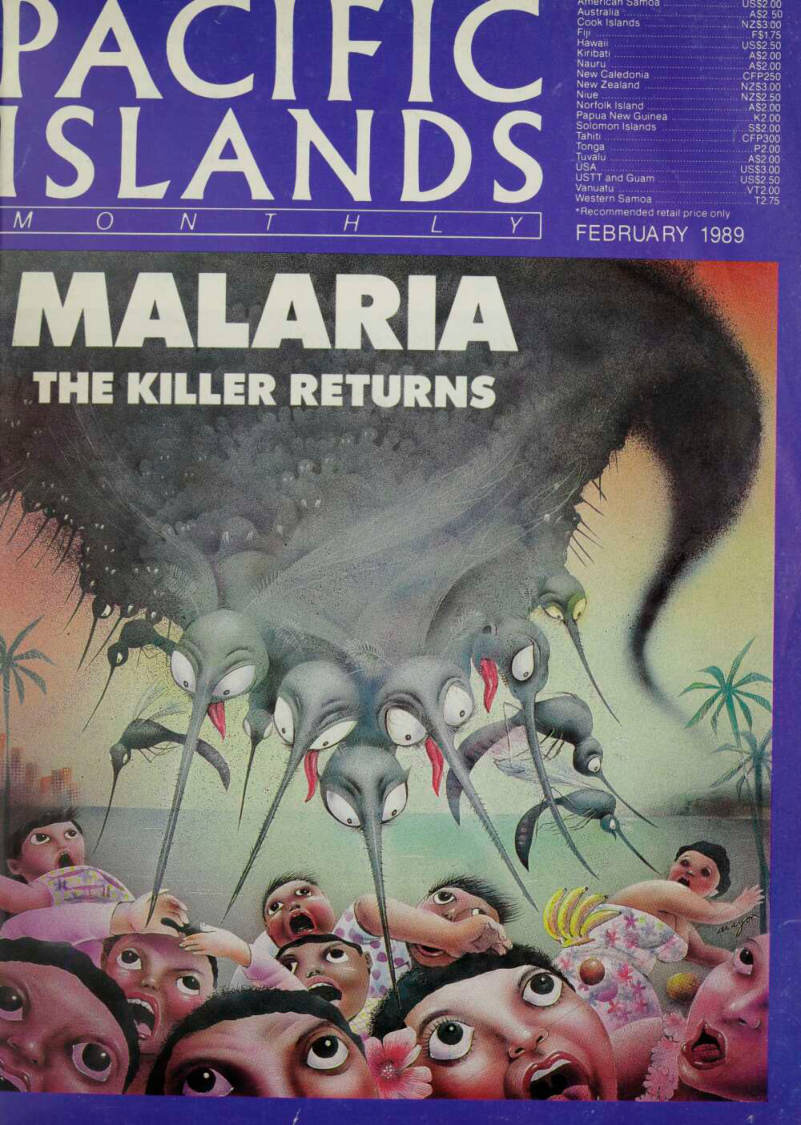
Malaria
The Killer Returns
Advertisements & other items, pp. 2-4 (1 item)
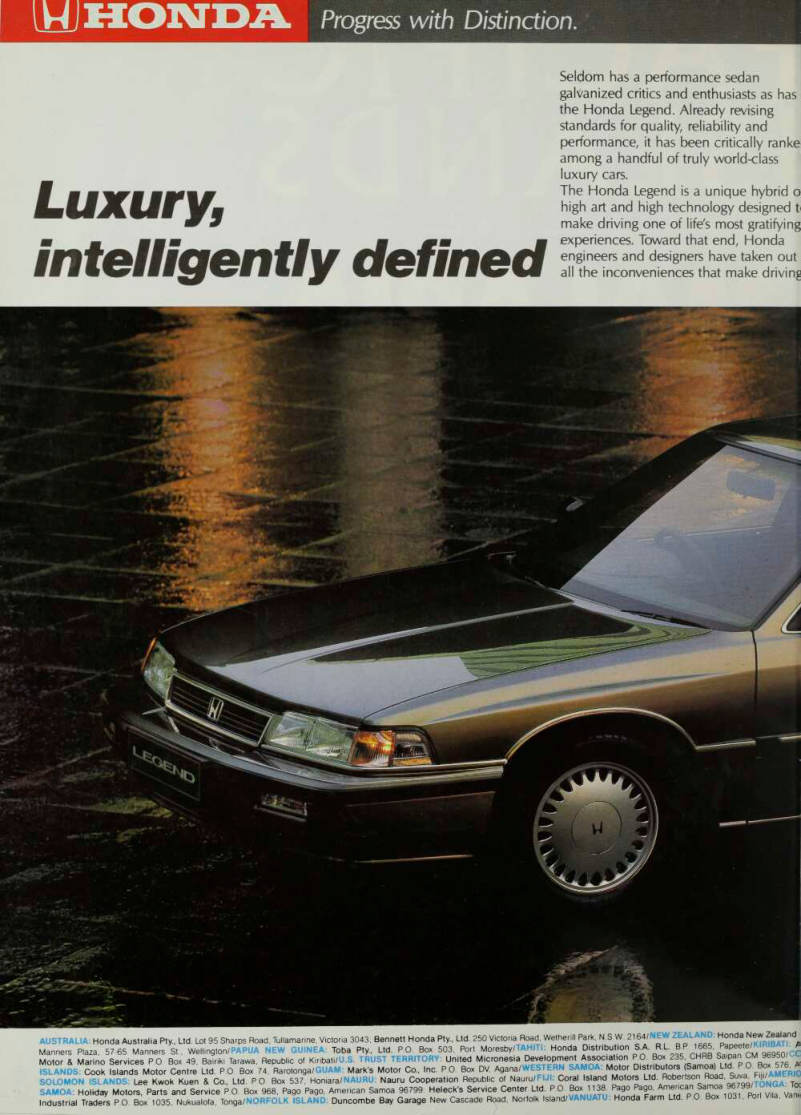
Luxury,
intelligently defined
Seldom has a performance sedan galvanized critics and enthusiasts as has the Honda Legend. Already revising standards for quality, reliability and performance, it has been critically ranke among a handful of truly world-class luxury cars.
The Honda Legend is a unique hybrid o high art and high technology designed t make driving one of life's most gratifying experiences. Toward that end, Honda engineers and designers have taken out all the inconveniences that make driving r A m AUSTRALIA: Honda Australia Pty., Ltd. Lot 95 Sharps Road, Tullamarine. Victoria 3043, Bennett Honda Pty., Ltd. 250 Victoria Road, Wetherill Park, N S W. 21 64/NEW ZEALAND. Honda New Zealand Manners Plaza, 57-65 Manners St , Wellington/PAPUA NEW GUINEA: Toba Pty., Ltd. P.O. Box 503, Port Moresby/ Honda Distribution SA R.L BP 1665. Papeete/ * A Motor & Marino Services PO Box 49, Bairiki Tarawa, Republic of Kiribati/U.S. TRUST TERRITORY: United Micronesia Development Association P_o. ISLANDS Cook Islands Motor Centre Ltd. P.O. Box 74, Rarotonga/GUAM Mark’s Motor Co., Inc. P.O. Box DV, Agana/WESTERN SAMOA. Motor Distributors (Samoa) Piii/AMERIO SOLOMON ISLANDS: Lee Kwok Kuen & Co., Ltd. PC Box 537, Honiara/NAURU: Nauru Cooperation Republic of Nauru/FIJI Coral Island Motors Ltd 9/TONGA To' Holiday Motors, Parts and Service PO Box 968, Pago Pago, American Samoa 96799 Heleck’s Service Center Ltd. P.O Box 1138 Pago Pago, America Industrial Trades P.O. Box 1035, Nukualofa, Tonga/NORFOLK ISLAND: Duncombe Bay Garage New Cascade Road, Norfolk Island/VANUATU: Honda Farm Ltd. PO Box 1031, Pori Vila,
[ chore. And they have added a emarkable array of amenities that make Iriving a joy. beneath the Legend's low aerodynamic icod beats the heart of a high >erformance V 6 24-valve engine with ace-bred PGM-FI programmed fuel ajection. Sophisticated 4-wheel double fishbone suspensions are teamed with dvanced braking and steering systems Dr an exceptional balance of performance nd comfort. aside, you will discover quality appointments and luxurious optional leather seating, surrounded by a panoramic view an environment that accentuates your pleasure and inspires a mood of quiet relaxation.
The Legend Sedan, in short, is an executive-class automobile that combines luxury performance with unrivaled comfort, distinctive styling with timeless elegance. Imagine the satisfaction as you savor the ultimate driving experience. (0
SEDAN
) the 1988 Formula One Constructors' Championships, ionda engines powered the HONDA Marlboro IcLaren to victory, as they did the /i I Hams HONDA team in 1986 and 1987.
anyhow
haw a
Winfield
t|MESS
BBDUO
> A u Itn SM
Pacific
Islands
Monthly
Vol. 59 No. 14
Voice Of The Pacific
February, ’B9
Cover Story i 6
Malaria was once thought to be going the way of measles and smallpox: eradication of mosquito breeding environments, spraying and new drugs had, it was believed, put paid the tropical world’s greatest killer. But nature is flexible, and as Robert Simms learned, malaria is back with a vengeance. Researchers warn, too, that the much-heralded vaccine is at least a decade away from practical application and may not be the cure-all the people of the Pacific hope.
Cover Illustration: Edd Aragon
NEW PRESIDENT'S GOOD TIDINGS FOR THE REGION 8 Reagan hardly knew the Pacific existed: George Bush seems to be aware of its economic ana strategic importance RUSSELL MARSHALL EMERGES AS A CHEMICAL WEAPONS
Hardliner . 9
NZ’s Foreign Minister was conspicuously vocal at a Paris conference TONGA TAKES THE OLD-FASHIONED APPROACH TO AIDS 10 Virtue is expected to save the Kingdom from the ‘sin virus’
AUSTRALIA'S MAN IN PORT MORESBY TO DEPART 12 And Waigani blunders, misrepresenting his reasons for leaving
A New Broom In Rarotonga 13
Geoffrey Henry returns to power, promising to salvage the Cooks’ economy
Foreign Investment Raises Hawaiian Hackles 14
Japanese property buyers worry locals 'GRAVE ROBBERS' CAUSE OUTRAGE ON MAUI 15 Resort project disturbs ancient burial sites and native feelings
Peaceniks And Paedophiles In Manila 21
Philippines authorities overreact to a regional peace conference THE OLD FIRM FLEXES NEW MUSCLES 22 Burns Philp, the quintessential islands trader, looks to the future GATHERING THE FORESTS OF THE FUTURE 26 Australian scientists work to provide fuel for a wood-starved world
America's Island Membarassment 31
A Soviet ‘theft 9 draws unwelcome atten tion to US treatment of the Marshalls
Forum: Building A New
Pacific 33
Noumea observer C S Hopman tells how to avoid a region of banana republics
Acting Editor Carson Creagh Deputy Editor Richard Dinnen Editorial Adviser John Carter Art Director Michelle Havenstein Contributors Robin Bromby C S Hopman Stuart Inder Michael Monaity David S North Frank Senge Robert Simms Ingrid Strewe
Publisher Geoffrey Hussey
Advertising Sales Sydney & Melbourne Warren Grey (02) 288 3521 Fergus Maclagan (02) 412 3918: Brisbane Robert Walker (07) 3710533 Adelaide Hastwell Williamson Representations (08) 79 9522
Cover prices are recommended retail only Registered by Australia Post, publication No NBPI2K). Copyright Fiji Times Limited, Suva, Fiji.
Advertisements & other items, pp. 5-6 (3 items)
Departments
OPINION 7
STAMPS. 29
TRADE WINDS 36
PACIFIC REPORT 40
ISLAND PRESS 42
TRANSITION 43
BOOK REVIEWS 44
OUT OF THE PAST 50
5
PACIFIC ISLANDS MONTHLY FEBFIUARY 1989
A Fiji Times Limited Production.
Founded 1930 (USPS 952480) 20 Gordon Street, Suva, Fiji; Telex: FJ2124; Fax: (679)31 411.
Pacific Islands Monthly (APPS No. NBP 1210) is published month ly by Fiji Times Limited, a division of Nationwide News, 2 Holt St, Sur ry Hills, NSW 2010. Second class postage paid at Honolulu, Hawaii, POSTMASTER. Send address changes to PACIFIC ISLANDS MONTHLY. PO Box 22250, Honolu lu, Hawaii 96822. Typeset and printed by Fiji Times Limited, 20 Gordon Street, Suva, Fiji.
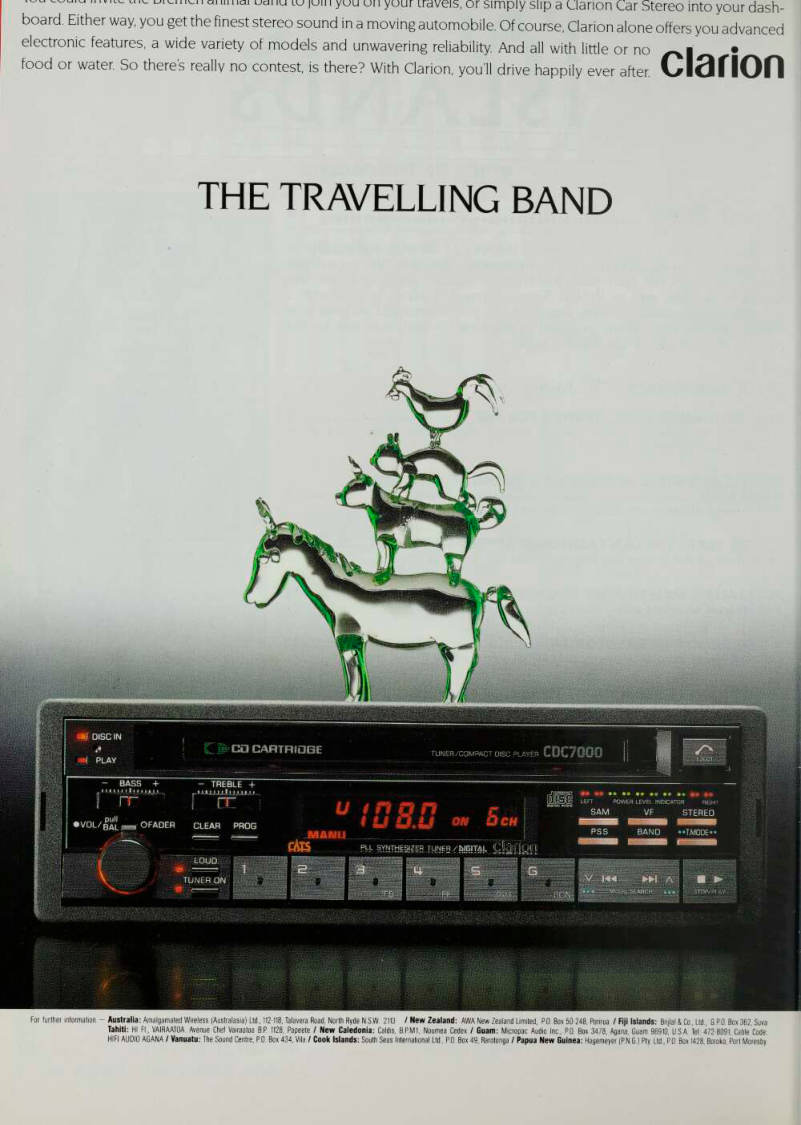
The Travelling Band
aiulliai uclllu LU J UIU Y uu travels, or simply sup a Clarion Car Stereo into your dashboard. Either way, you get the finest stereo sound in a moving automobile. Of course, Clarion alone offers you advanced electronic features, a wide variety of models and unwavering reliability. And all with little or no • food or water. So there's really no contest, is there? With Clarion, you'll drive happily ever after. OlOflOfl
% ■ !j / hi i
CO CARTRIDGE
ER/COMPACT DISC PLAYER CDC7OOO
- TREBLE +
r-WJUJUaJOJJJJJ,!-.
U ma
LEFT POWER LEVEL INDICATOR RIGHT
► VOL/g AL3RBSI OFADER CLEAR PROG
ILStS.U a.
SAM VF STEREO
PSS BAND ••T.MODE**
. *■, 1 «• PLL SYNTHESIZER TUNER /NCjTAL r J ■'!' f. l' 2 3 S B
» P W SCN -
Oi ’ ' V !«◄ A ■ ►
ARCH • ■ 1 STOP/Pi AY
For further information - Australia: Amalgamated Wireless (Australasia) Ltd., 112-118, Talavera Road, North Ryde NS W. 2113 / New Zealand: AWA New Zealand Limited, PO. Box 50-248, Porirua / Fiji Islands; Brijlal & Co,, Ltd., G.P.O. Box 362, Suva Tahiti: HI FI , VAIRAATOA. Avenue Chef Vairaatoa B P 1128, Papeete / New Caledonia: Caldis, B.PMI, Noumea Cedex / Guam: Micropac Audio Inc , PO. Box 3478, Agana, Guam 96910, US A. Tel: 472-8091, Cable Code: HIFI AUDIO AGANA / Vanuatu: The Sound Centre, PO, Box 434, Vila / Cook Islands: South Seas International Ltd., PO. Box 49, Rarotonga / Papua New Guinea; Hagemeyer (PN G.) Pty Ltd., PO Box 1428, Boroko, Port Moresby
The discovery -
Opinion
The discovery and salvation - of a new Pacific animal
VER SINCE the exploration of the island of New Guinea got under way last century, biologists have looked on that jungled, mountainous land as a I* scientific El Dorado: literally the last place on Earth where any significant number of new plant and animal species might await discovery and description.
That scientific faith has been amply rewarded, especially m the post-World War II era of scientific exploration. Hitherto unknown (at least in zoological and botanical terms) areas have been found to contain marvels: and the trend continues, with new and unusual organisms coming under professional scrutiny each year.
Prominent in one important area of research is Dr Tim Flannery, head of the mammal section at the Australian Museum in Sydney. In the past few years Dr Flannery has described new marsupials, bats and rodents including a bizarre mountain-dwelling giant rat up to a metre in length from Papua New Guinea and Irian Jaya.
In 1985, Dr Flannery almost paid the ultimate price for his interest in New Guinea’s rare and endangered mammals: while on an expedition in the Tor ricelli Mountains in northern PNG, he contracted scrub typhus and was only saved by an arduous journey to a mission station. One of the men carrying Dr Flannery’s stretcher through the rugged Torricellis wore a large black animal claw on a pendant; still fascinated by the natural world despite his illness, the young scientist bought the pendant and wondered for three years about the animal from which the claw had come.
Last year, he had his answer: a new and totally unsuspected species of tree kangaroo, or kapul in Tok Pisin. Part of the amazement with which the discov ery of the new tree kangaroo has been greeted stems from its size up to 20 kilograms in weight, and significantly larger than its cousins (indeed, it is the largest mammal endemic to Melanesia), ft is black overall but for a patch of orange fur at the base of its long, robust tail another feature that has had scientists wondering why it took so long to be discovered.
There is, however, a note of urgency about the new find: with a severely restricted (and dwindling) range, and a population estimated at no more than 200 individuals, the new species is critically endangered.
The story could end there another rare and beautiful creature consigned to extinction through habitat destruction, hunting pressure and look of interest but for an innovative lifesaving scheme.
In an era of privatisation and self-reliance (and in recognition of higher priorities on the part of national and provincial governments), Dr Flannery has decided to seek the assistance this animal so desperately needs through what can only be called sponsorship. The benefits to a sponsor are immediate: not only the pleasure of doing something concrete for conservation, but the unusual gratification of having the new species named after an individual or corporate sponsor (or, indeed, after an individual nominated by that sponsor). Dr Flannery needs finance to conduct research into the tree kangaroo’s ecology, reproduction and social life, and in partnership with the PNG Division of Wildlife to establish a wildlife management area and captive breeding program.
The cost of sponsorship is not cheap. Dr Flannery estimates that half a million dollars (Australian) will be needed to fund a five-year research programme and to establish a captive breeding programme but it is money that will be more than well spent, for how many opportunities can there be to save a beautiful and rare animal from extinction?
Dr Flannery is to be congratulated for his imaginative approach. It is, no doubt, one that will be imitated elsewhere but again, it is one worthy of imitation. Readers of Pacific Islands Monthly who may be interested in contri buting to the preservation of a unique Pacific mammal can contact Dr Flannery at: The Australian Museum, PO Box A 285, Sydney South NSW, Australia 2000 or by telephone on (61 02) 339 8114. Give, so this animal may live. □
Advertisements & other items, p. 7 (1 item)
Pacific
SLANDS
IMONT H L Y
FIJI: Distribution, subscriptions and advertising: Fiji Times Limited, GPO Box 1167, Suva, Fiji. Phone 31-4111, telex FJ2124.
FRENCH POLYNESIA: Distribution: Hachette Pacifique 10 Ave Bruat, Papeete, Phone 25-610 HAWAII: UNITED STATES: Distribution: PIM Hawaii, PO Box 22250, Honolulu, Hawaii, 96822, Advertising: Brian C Asgill. Apt 1308,1676 Ala Moana Blvd., Honolulu Hawaii, 96815. Phone (808) 955-9718 JAPAN: Advertising and subscriptions: Universal Media Corporation, GPO Box 46, Tokyo Phone 666-3036, cable UNIMEDIA Tokyo, telex 2524665 MALAYSIA: Advertising and subscriptions; Worldwide Media Services, 57-B Komplex Damai, Jin Dato Haji Eusoff, Kuala Lumpur Phone 63-9340, cables WORLDMEDIA Kuala Lumpur, telex 31533.
VANUATU: Distribution: The Vanuatu Stationery and Book Centre, PO Box 557 Port Vila Advertising; Norman Bros Bookshop Port Vila Phone 2232 NEW CALEDONIA: Distribution: Depot Centre de Presse Michel Pentecost CBP2, Noumea Phone 27- 2434, 27-4729 NEW ZEALAND: Distribution; Gordon & Gotch, PO Box 584 , 2 Carr Road, Mt Roskill, Auckland 4 Advertising: McKay International Media Reps Ltd, C/- Albany PO, Auckland 10, New Zealand. Phone 413-9119 Telex NZ22701, FAX 413-9110 WELLINGTON: Ross Quaid Media, 1 Scholes Lane Petone (04) 68-7593, PO Box 38699. Petone PAPUA NEW GUINEA: Distribution: Gordon & Gotch, PO Box 3395, Port Moresby Phone 25-4551.25-4855 Advertising; Robert Walker, PO Box 600, Indooroopilly, Old Australia 4068 Phone (07) 371-0533 SOLOMON ISLANDS; Distribution and Advertising: The Bookshop, (Norman Bros) PO Box 503, Honiara.
PHILIPPINES: Advertising; The GF Group, 12 San Ignacio St., Uroaneta Village, Makati, Metro Manila Phone 817-7299, telex 45950 and 4233.
UNITED KINGDOM; F A Smyth and Associates, 23A Aylmer Parade, London N2OPO, England. Phone (01 )340 5088, fax (01)341 9602 UNITED STATES MAINLAND: Advertising: Joshua B Powers Jr, Powers International Inc., Suite 708 , 271 Madison Ave , New York, NY 10016. Phone 867-9580, Subscriptions PIM, Hawaii, PO Box 22250, Honolulu Hawaii, 96822
SUBSCRIPTIONS
American Samoa Australia Canada Cook Islands Fiji- French Polynesia Guam Hawaii Japan Kiribati Micronesia Nauru New Caledonia New Zealand Niue Norfolk Island Northern Marianas Papua New Guinea Solomon Islands ...
Tonga Tuvalu United Kingdom ...
US (Mainland) Vanuatu Western Samoa Elsewhere US$45
AUSS3O
US$45
AUSS46
F $24 US$45 US$45 US$45
US$3B
AUSS46
US$35
AUSS42
US$32
,AUSS42
AUSS46
AUSS42
US$36
AUSS42
AUSS46
AUSS46
AUSS46
Stg£2B
US$45
AUSS42
AUSS6O
AUSS63
Payments to Pacific Islands Monthly: Subscriptions Dept, GPO Box 1167, Suva, Fiji.
Subscriptions rates includes the cost of airspeeding to all destinations set out above Direct airmail rates on application
Bush's 'Good News'
United States
Bush's 'Good News' for the Pacific
David North examines likely US Pacific policy under George Bush.
EARLY SIGNS are that the new Republican administration will benefit the Pacific region. While the two key sub-Cabinet Pacific posi tions had not been filled at time of writing, the new Pacific team is gener
ally brighter, more knowledgeable and
more united than former president
Reagan’s team.
The key players are: President Bush, who clearly knows more and cares more about public policy in general and the Pacific in particular than Ronald Reagan; Secretary of the Interior Manuel Lujan, a former member of the Interior and Insular Affairs Committee of the House of Representatives, comes to the office knowing more about the territories than most of his predecessors; the Governors of Guam, Joe Ada, Amer ican Samoa, Peter Tali Coleman, and the Marianas, Pedro Tenoria. For the first time in American history there is
a Republican president in the White
House and three Republican gov ernors in the Pacific territories.
Finally, for totally different reasons, the powers of the two Congressmen (delegates) from Guam and American Samoa will be greater this vear than last. While neither delegate has a vote on the floor of the House, both can vote in party caucuses and in commit tees and can serve as de facto ambas sadors for their territories.
Ben Blaz, the Guam Republican, is much closer to the two of Bush’s Cabinet members than he was to thJr predecessors. Blaz and Interior Secret ary Lujan have a great deal in com mon; both are members of somewhat similar ethnic minorities, and both have made good within the establish ment. Blaz was the first Chamorro to secure a general’s star in the American military; Lujan, the first Mexican- American Republican to be elected to Congress, served as a member of the House for the State of New Mexico from 1968 until he declined to run for re-election last year.
More pertinently, over the past four years Blaz and Lujan have shared two
other minority memberships: both
have been Republican members of the Democratic-dominated House of Rep resentatives Committee on Interior and Insular Affairs; and both have been Republican members within the
House Hispanic Caucus, another
mostly Democrat group (minority
members, both blacks and Hispanics, are much more likely to be Democrats
than Republicans).
Further, Blaz was heavily involved
in Republican Jack Kemp’s ill-fated
right-wing campaign for the Presiden cy. Now that Kemp is the new secret ary for Housing and Urban Affairs, Blaz is expected to seek some grants for Guam for housing and other pub lic works from Kemp’s department, which has never been a major player on Guam.
The delegate from American Samoa, newly-elected Eni Hunkin
Faleomavaega the only Democratic
office-holder among this group will be stronger than the last incumbent for the simple reason that Fofo Sunia was crippled in his last year of office by the payroll scandal that led to his resignation and jail sentence. The new
delegate has ample Capitol Hill expe
rience; as Eni Hunkin he served as a staff attorney to Congressman Phil Burton at the height of nis power over territorial affairs (the delegate has
since begun using his chiefly name).
Faleomaveaga, like Blaz, spent most of his life away from the islands in public service. A child of a US Navy petty officer, he went to school in Hawaii and on the mainland, then served in Vietnam before going to law school and on to Washington. He then practised law in Pago Pago and was the island’s Lieutenant Governor be fore being elected to the House arriving there already wise in the ways of the House.
Faleomaveaga’s priorities will be to seek to improve the island’s infrastruc ture; to modernise its electricity gen eration system, the water supply and road system.
Underlying the basic note of optim ism as the nushies’ take office is a sense that this Administration will have a better record (and certainly a better rhetoric on race relations) an often unspoken underlying theme in
Mainland-territory relations.
The Government in Washington is
usually dominated by white Anglo-
Saxon males, while the territories are: Puerto Rico Hispanic; Virgin Is lands English-speaking olack; Guam and the Marianas Chamorro;
and American Samoa Samoan.
Ronald Reagan may not have been a racist but he adopted racist positions, fighting every civil rights bill passed in the last three decades, sought to res tore tax-free status to anti-black schools and made snide remarks about the late Martin Luther King. Bush, on the other hand, had a good voting re cord in the House on civil rights issues and recently attended a memorial ceremony for King.
The Bush position on civil rights, while admirable, may lead in the fu ture to some problems with the is lands. What does a pro-civil rights President do when faced with Amer ican Samoa’s ethnocentric land ownership laws? Or with Guam’s efforts to give the future decision making power about its status not to all citizens, but solely to Guam’s Cha morro population? He may, however, never have to face those issues even though Blaz reintroduced the Guam Commonwealth Bill on the first day of the new Congress.
If Bush does face the Guam status issue, it will be through a knowledge able Secretary of Interior. Lujan has visited Guam several times and on one trip he had a meeting-cum-celebration with the Lujans of the island: all at that session could trace their ancestry back to a time when their forefathers were living in a portion of the Spanish
Empire not yet conquered by the
United States.
Lujan has conducted hearings on the proposed Guam Commonwealth Bill, ana will be participating in the work of an administrative task force (which is having some trouble with the
Chamorro-only provision) studying
the proposal. He will also play a key role in the selection of one of the two key sub-Cabinet posts, that of Assis tant Secretary of Interior for Territo rial and International Affairs. Insiders are expecting a member of an ethnic minority ancvor a woman to again get the job; the job has changed hands frequently in recent years, often with one acting assistant secretary replacing another, and the incumbents have usually been women or Hispanics.
Janet McCoy, once the US High Com missioner for the Trust Territories, held the job on an acting basis until Bush was inaugurated. □
Pacific Voice in Paris
The Region
While New Zealand’s Russell Marshall was a strong voice for the Pacific, some island nations were strangely silent at the Paris conference on chemical weapons.
By Nicolas Rothwell
THE voice of the Pacific was well to the fore at the Paris interna tional conference on chemical weapons control with key presenta tions from Australia and New Zea land. While many Pacific island na tions did not send delegations or pre sent speeches, Papua New Guinea and the Cook Islands were prominently
represented.
The conference was convened as an urgent meeting following initiatives by then US President Ronald Reagan and French President Francois Mitterand at the United Nations last year. Fore ign ministers from some 80 states and representatives of 140 nations gathered to re-affirm the existing 1925 Geneva Protocol against the use of chemical weapons, but the four day event turned into an agonised consid eration of infringements of that pro tocol. The spotlight of media and di plomatic attention was turned on the
recent use of chemical weapons in the Iran-Iraq war, and on American
allegations that Libya, supplied by
West European chemical companies,
was in the process of constructing a chemical munitions factory.
Chief exponent of Pacific concerns was New Zealand Foreign Minister Russell Marshall who announced his country’s decision to withdraw the re servation it had initially made more than 50 years ago when it acceded to the Geneva Protocol. New Zealand has now given up the right to use chemic al weapons even if it is attacked by another nation using such weapons.
Mr Marshall stressed the special concerns of the Pacific region m the main explanation the Paris conference was to hear of this distant geographic
al perspective.
J New Zealand is a South Pacific na tion and though our ties and bonds of friendship have kept us close to coun tries in many other parts of the world, our immediate concern is, not un naturally, for our own neighbour hood. We value our quality oflife and our clean and still largely unspoilt environment.
“The very thought of any chemical warfare in our region fills us, as it would all of our South Pacific neigh bours, with great repugnance.”
But Mr Marshall also spoke of New Zealand’s much wider concern: more important than the remote possibility
of chemical warfare in the Pacific is the very real fear of chemical pollu tion in the region.
“As we now know, the damage being done to the global environment by the careless use of chemicals needs underscoring. The pollution of the atmosphere could, in a matter of de cades, have a devastating impact on the South Pacific.
“New Zealand had also expressed sympathy at the United Nations, the
International Atomic Energy Agency
and elsewhere, for those developing countries confronted with attempts to dump toxic waste in their territories.
The fragile economies of our own area of the South Pacific depend on an environmentally respons ole atti tude being taken towards preserving the delicate equilibrium of nature.”
Mr Marshall stressed an urgent
need to more closely couple together
arms control and environmental poli cies. He suggested as a model the South Pacific Nuclear Free Zone (SPNFZ) treaty, especially its provi sions against radioactive waste dump ing and nuclear weapons.
Less “Pacific” in his outlook but nevertheless one of the major di plomatic influences at the conference was the Australian representative David Reese, his country’s new ambas sador to UN disarmament negotiations underway in Geneva.
Mr Reese outlined Australian moves to control chemical weapons prolifera tion, through the activities of the in formal “Australian group” of adv anced Western nations, wnich moni
tors exports of potential “precursor”
chemicals, and through an important
regional initiative.
This Asia-Pacific initiative, launched at the UN last year by Australian Prime Minister Bob Hawke, is aimed at keeping the region chemical weapons-free and has been highly
praised by international experts for its
value in building contacts between re gional states on this sensitive issue. is fortunate to inhabit a chemical weapons-free environment we want it to stay that way we want our region to be free of chemical weapons in a world that is free of che mical weapons,” Mr Reese told the conference. □
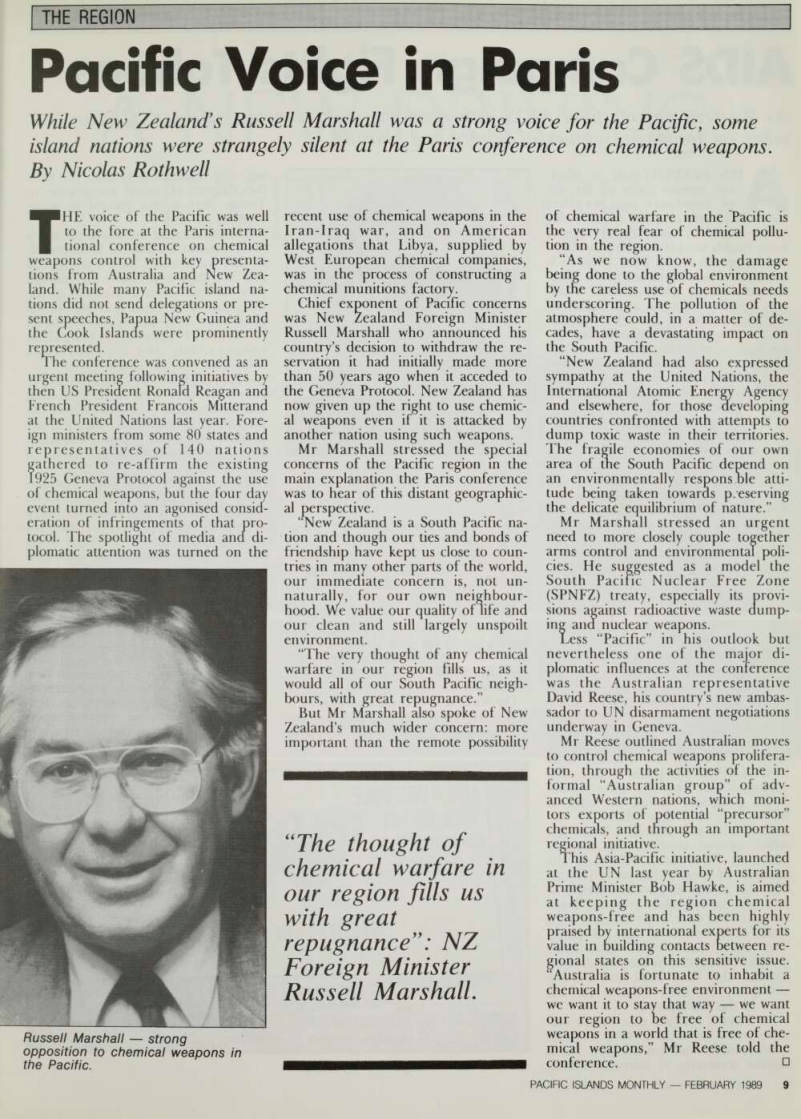
“The thought of chemical warfare in our region fills us with great repugnance”: NZ Foreign Minister Russell Marshall.
Russell Marshall - strong
opposition to chemical weapons in the Pacific.
AIDS Campaign Fights Taboos
Tonga
As Western nations fight AIDS with condoms and promotes ‘safe sex’ Tone a relies on traditional virtues of fidelity and chastity.
Mk Ids Prevention In West
ern nations focus on the use of condoms and explicit methods of safe sex, but the attitudes to sex found in many Pacific nations force health workers to adopt a diffe rent approach to the killer virus. It is not easy to talk about sex in the king dom of Tonga, where a strict Victo rian morality remains as a legacy of the missionaries of the 19th century.
In this context, fidelity and chastity are seen as mightier than the condom
in Tonga’s fight against AIDS and
policy-makers believe that laws pre scribing a life sentence for sodomy will deter hjgh-risk behaviour.
The Tongan Government has laun ched what must be, per capita, one of the most comprehensive anti-AIDS campaigns in the world. A massive education program is under way, with posters, stickers and leaflets, work shops for MPs, church leaders and Health Department staff. There are
village meetings, billboards and hourly
radio announcements. When overseas visitors arrive at Nukualofa airport, the first Tongan they are likely to see is a young man seated at a desk hand ing out AIDS education pamphlets.
He also carefully observes new arrivals for obvious signs of the virus.
Tonga has had only one AIDS vic tim. In June 1987, a Tongan man ar rived back in the Kingdom from Texas. Health officials observing his
arrival on a Friday evening, suspected
he IVas a likely carrier of the Human Immunodeficiency Virus (HIV) which causes AIDS. Dr Tili Puloka, chief medical officer for public health, with responsibility for the government AIDS program, visited the man at home the next day where he ex amined him and offered a blood test
which proved positive. On Monday
morning Dr Puloka informed the Minister of Health that an AIDS car rier was in the kingdom. Though he had told no-one else, everyone knew of the carrier’s presence and Nukualofa was in a state of panic.
The report was on the radio news, people discussed it in shops and clubs, around the kava bowl and on the streets. It was even debated for two days in the Parliament.
Dr Puloka realised that future car riers must be treated with absolute confidentially and compassion. He is against screening of overseas arrivals
and insists that blood tests must re-
mam voluntary.
As longas one-man AIDS program, 62-year-old Dr Puloka pounds the streets and bars of Nukualofa counselling and educating the town’s relatively few members of groups at high-risk of contracting the virus.
I hey accept and welcome his attention he recalls one night when he was applauded as he walked into the upstair: bar at Joe’s, a Nukualofa nightspot favoured by transvestites and prostitutes.
Dr Puloka attributes a dramatic drop in sexually transmitted diseases to a heightened awareness of AIDS.
Promiscuity, he says, is on the way
out, and homosexuality does not have the degree of social acceptance in Tonga that it has gained in some Western nations.
As in the rest of Polynesia, there is a fairly relaxed attitude to homosexual ity and transvestites have a recognised role in village and family life, though they have not been as accepted as the fa afafine of Samoa. But the moral panic over AIDS has reinforced belief in biblical injunctions against homosexuality and driven Tonga’s fakafefine into the closet.
Tapu, such as the faka’apa’apa (be tween brother and sister) prohibit frank discussion of sexual matters but Dr Puloka is determined they will not prevent education. “Tapu is important but not as important as prevention of AIDS,” he says.
Tapu are likely to be further under mined by the sort of activities held on World AIDS day last December when the town’s schoolchildren amassed for
singing competitions. Original songs
on the AIDS theme were composed for the occasion.
Condoms don’t feature in Tonga’s armoury against AIDS. “We teach our people to refrain from sexual prom iscuity. It would be contradictory to then give them the means to practice it,” says Dr Puloka. Condoms are available on request, but Tongan men don’t like to use them. While resear ching in Sydney’s Kings Cross red light district, he met brothelkeepers wno had chased out Tongan men who refused to use condoms. □
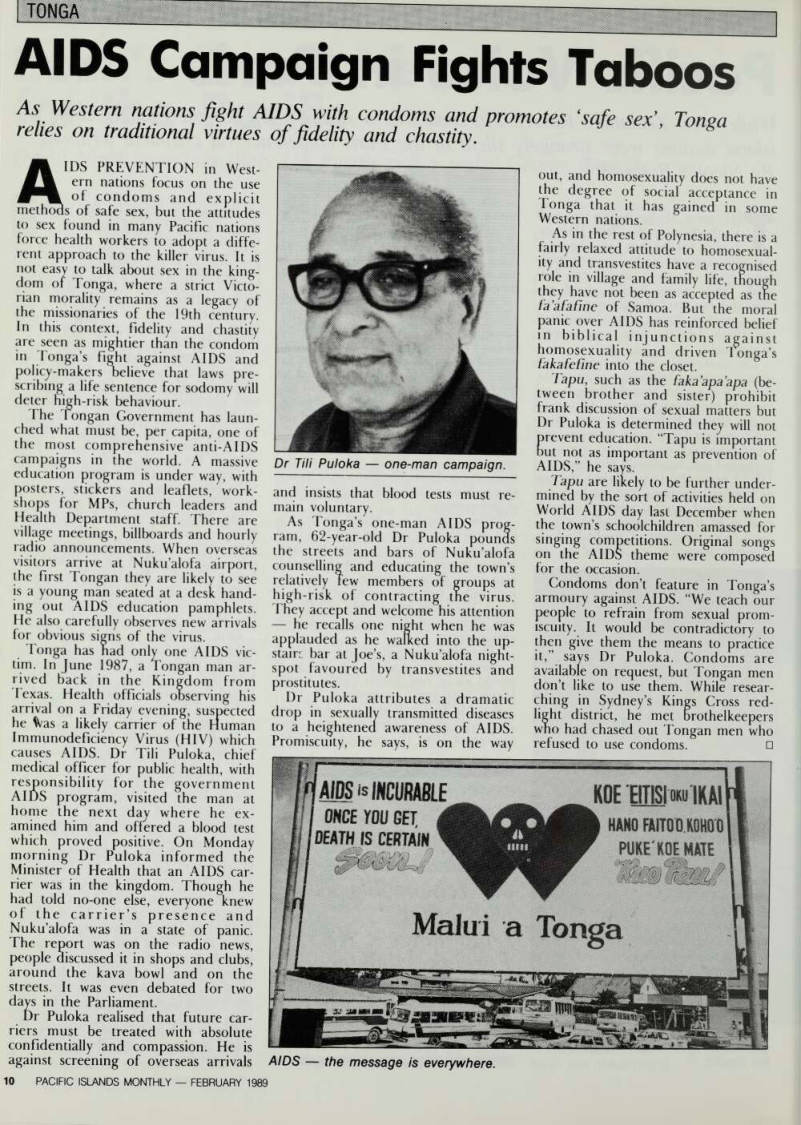
AIDS - the message is everywhere.
Dr Tili Puloka - one-man campaign.
Advertisements & other items, p. 11 (1 item)
Experience
A NEW DRIVING
" _-5 - 4-Gf^ - . - -•
sfil
SB-
and here.
TOYOTA
MULTI-VALVE
J ENGINE
< %ltti
A HIGHER STANDARD:
ALL NEW COROLLAS NOW COME WITH
TOYOTA MULTI-VALVE ENGINES.
Here is a blend of elegance and performance usually found only in big, luxury cars. That’s because Toyota believes everyone should enjoy the newest automotive advancements. And the latest example of this thinking is the all-new Corolla. It has an elegantly rounded shape to be proud of. And the high output and efficient multi-valve engine in all Corollas puts their performance in far better shape.
Expand your driving experience to new horizons with the all-new Corolla. Toyota World’s No. 1 producer oj multi-valve engines.
TOYOTA
Australia Recalls Envoy
Papua New Guinea
Controversial High Commissioner Lance Joseph returns to Canberra.
But the early recall is a promotion, writes Frank Senge.
FTER ONLY 18 months in Port Moresby, Australian High Commissioner Lance Josepn leaves for Canberra in April.
In his brief period of service, Mr Joseph created an image unlike any High Commissioner before him an image some observers claim may have caused a degree of estrangement in relationships betwen Australia and Papua New Guinea. Indeed, some observers have gone so far as to say Canberra made a mistake in sending Mr Joseph to Port Moresby.
Well Known in Canberra for his
forthright, upright approach, Mr
Joseph’s appointment to one of Au stralia’s four biggest missions seems to have indicated that Canberra judged the relationship between the two na tions firm enough to tolerate a High Commissioner of his character.
The past has fostered in the minds of Papua New Guineans a dreamy, almost hallowed image of benevolent
Australia, the un-mterfering big
brother, aid giver and protector. Pre vious High Commisioners have allowed that perception to stand, con ducting their missions out of the pub lic eye and the result has been that PNG’s only knowledge of Australia’s presence in the country consisted of annual talks, the odd trade seminar and the sponsorship of an occasional rural project.
Mr Joseph, however, by his direct and public approach, has dissipated Australia’s benign image, making it not only more numan ‘big brother’ and aid giver but also a trade partner and investor ... and one with its own socioeconomic problems.
In matters wnere the Government’s decisions or, as in the case of recent strikes, industrial unrest affected Australia and Australians, Mr Joseph made his views known publicly, often inviting severe criticism from both the Government and the public.
This bold new approach naturally made a lot of people unhappy: and it happens that some were so unhappy that in January, PNG foreign affairs officials caused a serious breach of di plomatic protocol.
On January 15, Mr Joseph released a press statement to voice his concerns about the safety of Australians in PNG as a result of widespread violent in dustrial unrest in the country.
The media led their bulletins the next day with slightly exaggerated versions of Mr Joseph’s concerns, which co vered Australian investment as well as
personal safety.
Predictably there were immediate reprisals from the Government and unions, accusing Mr Joseph of in terfering in domestic unions and Gov ernment affairs.
On the same day the High Commis sioner secured an appointment with
the Acting Foreign Affairs Secretary,
John Balagetuna, to personally deliver a letter dated January 11 to let PNG know he was returning to Canberra on a promotion. But almost as soon as it had been lodged, the letter was leaked. Six Foreign Affairs officers called a newspaper journalist into their confidence and revealed the con tents of the letter.
When the first journalist did not treat the subject with prominence, the officers found another, presumbaly less squeamish, journalist.
The next day, banner headlines in
one Port Moresby newspaper told of Mr Joseph being recalled” to Canber ra because of his public statements on
January 15.
Mr Joseph was not surprisingly livid at what Australian High Commission sources claim was “scurrilous rumour
mongering”. Foreign Affairs Minister
Michael Somare was equally angry, and made a public apology to the
High Commisioner.
One question remains in the minds of observers on both sides of the Tor res Straits: did Canberra err in judg ing the relationship between the two countries ready ana mature enough to receive a Lance Joseph? The Austra lian newspaper has already reported that the new High Commissioner to PNG, Allan Taylor, had been in structed to take a ‘softly softly’ approach. Which leads to a further query: when will the relationship be mature enough to allow the appoint ment of another Lance Josepn a High Commissioner able to speak the hard and unpalatable truth? □
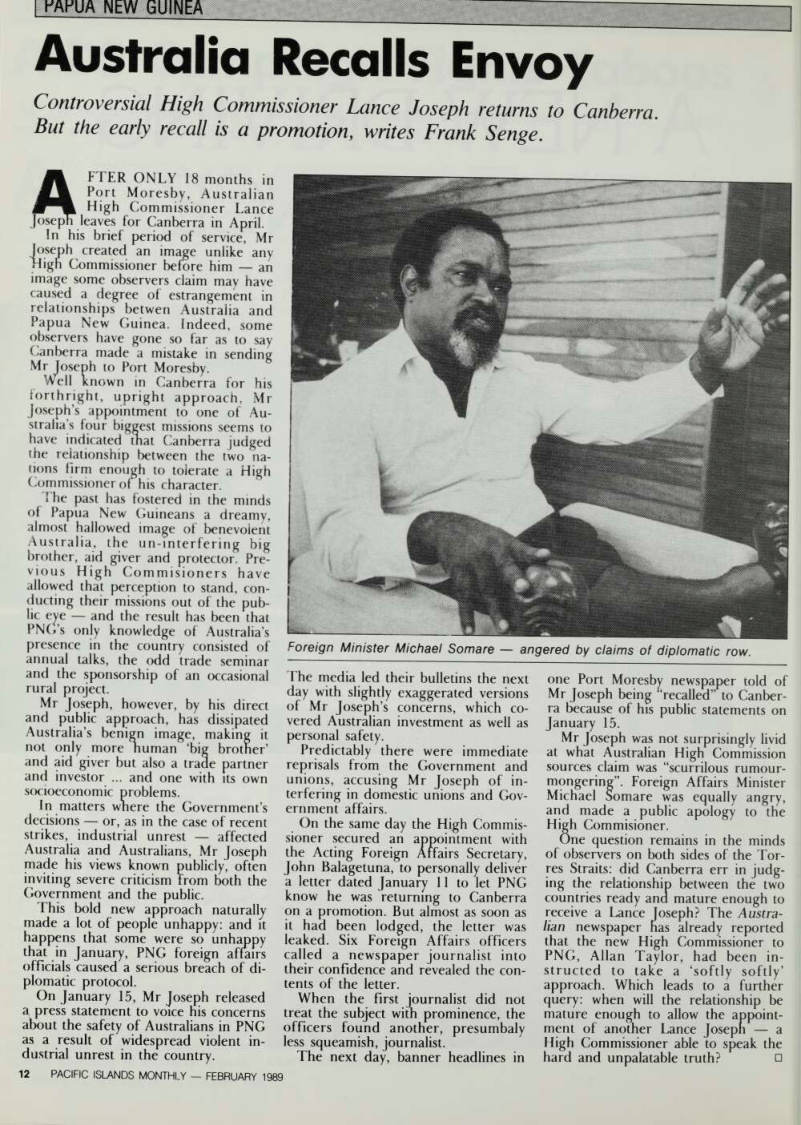
Foreign Minister Michael Somare angered by claims of diplomatic row.
Henry Re-elected
Cook Islands
Henry Re-elected After Five Years
Geoffrey Henry returns from opposition but fails to
secure an outright majority.
By Cheryl Lilly
LAST MONTH’S general election
saw the Cook Islands Party (CIP) led by Geoffrey Henry returned to power after five years in opposition.
But, while looking for a clean sweep of seats from the ruling Coalition Gov ernment and thus a clear, workable majority, the CIP managed to secure only 12 seats out of the 24 contested.
The Coalition led by Dr Pupuke Robati secured nine seats, one seat went to a non-aligned candidate and the remaining two seats and thus the balance of power went to the Democratic Tumu (Demo Tumu) Par ty led by Mr Vincent Ingram.
There has been much speculation on whether the CIP would have the support of the Demo Tumu and be assured of even forming a gov ernment; however, in an open letter published in the Cook Islands News on January 25, party leader Ingram dismissed these rumours and declared his party’s unconditional support to ensure stability in the country for the coming five years.
The swing against the ruling Coali tion on Rarotonga (where tne CIP won seven of the nine seats contested) was not reflected in the outer islands, where most seats remain unchanged.
The absence of any swing in voting has been attributed in part to the re moteness of these islands, in part to elector concern with parochial rather than national issues to which Raro tongans were mo e attuned.
Speaking to Pacific Islands Monthly shortly before his investiture as Prime Minister, Mr Henry expressed his un happiness at not having a clear major
ity. “Obviously we were disappointed
not to secure a two-thirds majority,” he said. “It will make it difficult to implement the law reforms that will ensure a clean government for today and tomorrow. We will need to negoti ate with the Opposition to see where their support is likely to come from.”
According to Mr Henry the Cook Islands, under the newly elected CIP Government, aims to be a leading na tion in the Pacific by the mid 19905.
“In the 19705, the Cook Islands had one of the best health and education systems in the Pacific and we were in fact the envy of many of our territo
rial neighbours. This we achieved on smaller budgets than most of the other countries,” he said. “We intend for the Cook Islands to have an education system of which we can all be proud; one that is more relevant to our needs as well as preparing our children for the demands of the out side world.”
Under the previous government the past few years have seen the health system reach an all-time low, with peo
ple fearing to be hospitalised and
those who could afford the airfare flying to New Zealand for treatment rather than risking admission to the hospital on Rarotonga. Education has also suffered badly, with little govern
ment input.
In what many people saw as an
attempt to shield itself from further public criticism, the Coalition Govern ment placed a ban on the state-owned newspaper and radio station. The ban, which prevented any political issues whether in the form of songs, adver tisements, recordings, letters to the editor or news being broadcast on the radio or publisher! in the news paper, came into force almost two months prior to the January 19 elec tions and was only lifted on January 4.
Sadly for the Cooks, what nad emerged over the months leading up to the election was that even though the standard of all essential services had seriously declined, Government ministers had continued to abuse the system. Of major concern to electors was the abuse of ministerial travel allo wances known in the Islands as the ‘Geat Travel Allowance Rip-Off. One minister was permitted to draw a daily travel allowance of up to three times the rate of the most expensive hotel while overseas; it has been estimated that more than SNZBOO,OOO was spent in the 1986/87 period alone by a handful of ministers who were not re quired to account for the money was spent. “We propose to establish a lead ership code that will present this situa tion recurring,” says Mr Henry. □
Advertisements & other items, p. 13 (1 item)
Forum Secretariat
(formerly South Pacific Bureau for Economic Co-operation [SPEC] Applications are invited for the position of ECONOMIC OFFICER within the Forum Secretariat. The Secretariat, based in Suva, was established to encourage cooperation between Island member states and between those states and the more industrialised countries on all aspects of economic development, trade, transport, telecommunications, tourism and energy.
The appointee will work principally on development coordination and liaison activities and on the preparation of project dossiers. Applicants should be well qualified in economics or a related field and should have a sound knowledge of the economies of South Pacific Island countries. Familiarity with donor government and agency procedures in the region would be an advantage. We are also looking for a capacity to set clear priorities, to work under pressure, and to present work in a clear and concise manner.
This appointment will carry an attractive remuneration package, payable in Fiji dollars. For non-Fiji citizens this is tax free and includes housing or housing allowance, education and child allowances. Other benefits for all employees include superannuation payments and medical, life and travel insurance coverage. The appointee will be based at the Secretariat’s Headquarters in Suva, Fiji but will be required to undertake periodic duty travel. Appointments would be for three years initially, renewable by mutual agreement.
Applications close on 31 March, 1989. As it is intended to make the appointment as soon as possible, the successful applicant must be able to take up the position shortly afterwards. Applications should contain full information on education and career background and should list names, addresses and telephone numbers of at least three referees with whom the applicant has been associated in a professional capacity.
Applications should be addressed to: The Secretary General Forum Secretariat GRO Box 856, Suva, Fiji.
Telephone: 312600; Telex: 2229 FJ; Fax 302204 All enquiries should be made to Mr Rene Wilson, Director of Services, on 312600 extension 202.
SPEC
T
Japanese Investment
Hawaii
Alarms Residents
By Michael Moriarty
ftOTH MAINLAND and Hawaiian Americans have
been growing apprehensive
and suspicious about Japanese invest ment in the US for several years. In certain automobile producing areas of the US it is not advisable to drive an ‘un-American’ vehicle, and in some cities parking lots have special stalls designated ‘foreign car’: one cannot help but wonder if these are for the purpose of identifying targets. Even though the have invested slightly less than a third as much as British corporate investors in US in dustries a little under SUS 3 billion the Japanese have been the prime targets of America’s growing national ist sentiment.
Some observers catch the glint of racism in this whole scenario; for ex ample, there was relatively little outcry over the sale of Hawaii’s gas supplier (Pacific Resources Incorporated) to an Australian firm. It seems there are those who cannot forget their experi ences during World War 11.
The issue is particularly acute in Hawaii, where Japanese investors have purchased significant chunks of the State's real estate and hotel industry.
One of the more spectacular examples surfaced in mid-January, and it con tains elements many Hawaiians find
particularly unpalatable disregard
for local inhabitants, and large tracts of land changing hands repeatedly without any of the parties doing any vyork on the land itself; ‘pure’ specula tion at its worst.
The area concerned is the North Kohala area of the Big Island, where around 7700 hectares owned by Castle and Cook (which had closed clown its sugar plantation during the 1970 s and had been seeking a buyer for some time) was sold last April to Statesman Mortgage Company of lowa and Hart ford Realty Corporation. These two
companies then assigned purchase
rights to Southmark Corporation of Georgia in July: Southmark then made a deal with SoPac Kohala (a
California-based corporation).
In September, officers of the Cha lon Corporation, a Japanese firm, were reported to have visited the Big Island to investigate purchase of the land based on information provided
by Royal Coast Realty. In October,
Hartfort and SoPac agreed to sell the property to Royal Coast Development.
Allegedly, the Chalon Corporation,
on becoming aware of the deal, then indicated its interest in buying the property. An article in the January 19 issue of the West Hawaii Today news paper reported that Royal Coast had claimed it would not sell unless Royal Coast Development and Realty were
appointed by Chalon as developer and
exclusive broker for the land.
A 53-page complaint in Federal
Court by Royal Coast Realty and
Royal Coast Development details some
hair-raising events Tiat allegedly
occurred shortly after the sale to Cha lon: allegations of racketeering, fraud, conspiracy, breach of contract and other criminal violations.
The complaint states that Chalon re fused to honour a marketing and de velopment agreement in which the
firm agreed to provide monthly pay
ments of $U522,500, to give a 20 per cent share of profits from the de velopment (the plaintiff estimates a total of $U531.54 million) and com missions from exclusive brokerage sales (estimated to be $5.8 million).
The complaint states that the “ . . . defendants threatened, directly or in directly, various individuals associated with tne plaintiffs with murder and/ or other serious bodily injury, for the purpose of forcing them to consent to
the restructured purchase agreement”.
It goes on to say that George Matsuo, born and raised in Japan and a Royal Coast stockholder, according to Attor ney General Darryl Johnston, was in formed by a Mr Snoichi Kamon Presi dent of Chalon Corporation that he should be concerned for the welfare of his family still living in Japan.
Kamon allegedly stated that he nad in the past relied on the Yamaguchigumi faction of the Yakuza (the so-called Japanese Mafia’) to arrange the terms he wanted in business deals.
The complaint also alleges that on November 10 last year, “ ... at the Halekulani hotel, in front of five wit nesses, Kamon told Louis Rees [who was negotiating the restructured agreement] that if he created prob lems for Chalon, Kamon would see to it that Rees would be a ‘dead
roundeye’.”
The suit alleges further that on January 12 this year, in a phone call to Matsuo, Kamon reportedly said that “if Royal Coast Development con tinued to demand that Cnalon Japan observe the terms of the development and marketing agreement, Kamon would use all means, including illegal means, to get what he wanted’ v . Roval Coast attorney Johnson asserted that in racketeering cases damages can be tripled, and in this instance damages
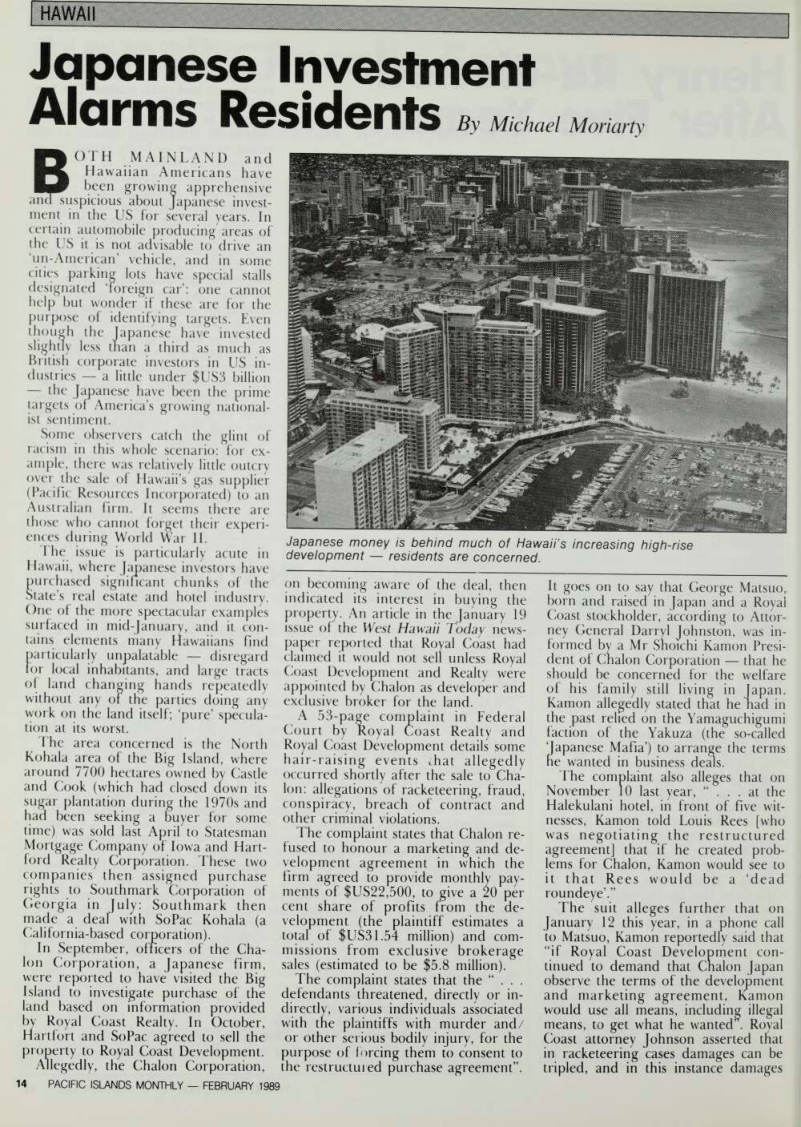
Japanese money is behind much of Hawaii’s increasing high-rise development - residents are concerned.
could amount to SUS 112 million.
David Nakashima, Counsellor for Chalon Corporation (the parent com pany of Chalon International of Hawaii) in a statement to the press said, “ . . . the case is without merit and is based, in my opinion, on mis
representation, manipulation and de
ceit”. He is apparently preparing a countersuit for fraud, misrepresenta tion and slander.
Nakashima went on to say that the case “ . . . does not change Chalon’s commitment to North Kohala and the County of Hawaii. The company’s plans to balance the preservation of historic sites [in] the area with re creational and agricultural activities
have drawn widespread community
support.” I live in North Kohala, and it was only a few weeks ago that the sale was first announced to a wave of apprehension among concerned local residents.
All sources of public information state that Chalon’s plans for the area were unknown and nobody, to the best of my knowledge, in this com munity of 3000 people could or would reveal anything about the develop ment proposal. With no public meet ings and no real information, area re sidents are befuddled by Nakashima’s statement confusion that can only serve to increase mistrust in an
already suspicious population.
There have been other examples of
behaviour considered unacceptable by
most Hawaiian residents. In one case a Japanese citizen bought ‘Coconut Is land’ in Kaneohe Bay, only to be de ported for falsifying documentation in order to enter the United States. In the exclusive Waialae-Kahala suburb of Honolulu, Japanese investors have purchased a number of homes one buyer reportedly rode around in a
limousine, choosing properties without
leaving his car.
Honolulu Mayor Frank Fasi has made it publicly dear that he would like to stem the wave of foreign invest ment, at least in the private home market, and will be seeking ways to do Just that. Senator Rick Reed has intro duced a bill in the Hawaiian legisla ture that would prohibit non-residents of Hawaii owning residential land: the bill is likely to ne found unconstitu tional, but it highlights the strong undercurrent of feeling among Hawaiians about the apparent loss of their homeland to foreigners.
On the other hand, it must be noted that some of the Japanese-owned hotels on the Big Island have been among the county’s best citizens. The Maunalani Bay Hotel and Resort pre
served existing Hawaiian fishponds,
led the drive for a fire station in the area and voluntarily provided more housing than was -initially demanded by the county. This last move actually
forced other hotels to follow suit and effectively forced the raising of official levels of acceptable ‘afforaable hous ing’ a developer is now required by law to provide.
Even if the courts decide that Cha lon is completely innocent, this cannot
help but make it harder for legitimate Japanese businesses to function in Hawaii. If the allegations prove true,
they will provide Hawaii’s politicians
with a good excuse to implement laws that will curb Japanese business activ ity in the Hawaiian Islands. □
Putting Down
The Ritz
Hawaiian activists vow to stop the construction of a luxury hotel over an ancient burial ground on the
island of Maui.
By Michael Moriarty
IN Hawaii has « ■ been opposed in many diffe wJf rent ways but never more swiftly and effectively as in the recent case at Honokahua, on the northwest shore of the island of Maui, where Ritz-Carlton had planned to build a SUSBO million hotel complex on oceanside land owned by the Kapalua
Land Company.
Work began quietly on the sand dunes but in mid-December the local press informed the public that several hundred bodies had been exhumed from the site. Hawaiian activists gained television coverage when they began picketing the site and protests spread to the island of Oahu where Hawaiians set up a 24-hour Christmas eve vigil as a sign of protest, disgust
and indignation. Key local politicians
such as Maui mayor Hannibal Tavares and Governor John Waihee lent their support to the protest. Although Wainee had to admit that as governor he had no legal standing in the mat ter, he called it a “moral issue” and
flatly opposed the development.
I ne site is listed in the Hawaii Reg ister of Historic Sites as a burial ground. Since September 1987, more than 900 sets of remains have been carefully removed for re-burial under an agreement signed before work be gan. The number of burials has been a surprise to both Hawaiians and State officials.
Colin Cameron of the Kapalua Land Company agreed to halt all ex cavation until early January, while the
concerned parties conducted negotia
tions. “It’s just not practical to move the hotel site we have no other hotel site,” he said. Cameron earned the activists’ praise for the costly stop work order and kept negotiations at
an amicable level. But there appears to be little common ground between
the parties.
Activists demand a permanent end to digging, the return of the bones to their original resting places and that the site be preservea and honoured.
Negotiations are continuing but
practical moves are being made by
opponents of the development. The Oil ice of Hawaiian Affairs and Hui Alanui () Makena, a Maui-based com munity group, are asking for the re consideration of a county-issued
Shoreline Management permit which
authorises construction of the hotel.
The permit requires groundbreaking
by February 27, 1989. Kapalua Land
Company had previously acknow
ledged that an extension of the permit would be sought.
This issue highlights the basic con flict between the value system of Hawaiians and the business world’s in terpretation of value only in a monet ary sense. Observers say Mr Cameron appears to be trying harder than some developers to step lightly in Hawaii but critics attribute his approach only to an awareness of the volatility of the issue. Removal of the bodies was be gun quietly and without the formation of an advisory committee of Hawaiians at the start of the venture. The activ ists say that if the removal had been completed quietly, that would have
suited Kapalua “just fine”.
Activists have vowed to fight the de velopment and say they will mount the sort of protest that could be expected if Hawaiians decided to build a hotel complex and resort in Arlington Memorial Cemetery, in Washington DC, and began removing bodies with out consultation or ceremony to make way for the development. D
Malaria
The Killer Returns
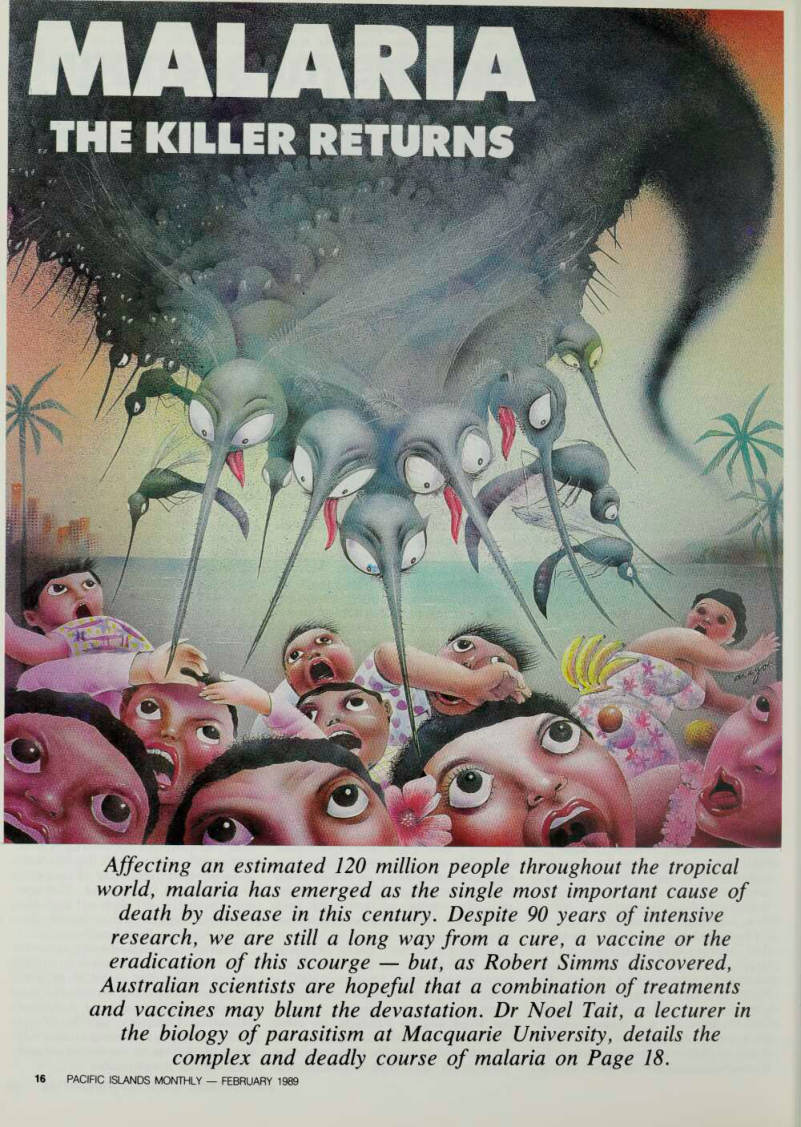
Affecting an estimated 120 million people throughout the tropical world, malaria has emerged as the single most important cause of death by disease in this century. Despite 90 years of intensive research, we are still a long way from a cure, a vaccine or the eradication of this scourge - but, as Robert Simms discovered, Australian scientists are hopeful that a combination of treatments and vaccines may blunt the devastation. Dr Noel Tait, a lecturer in the biology of parasitism at Macquarie University, details the complex and deadly course of malaria on Page 18.
M M ALARIA is an ancient disease first documented by Hippo- Berates in the sth century BC.
It was thought originally to be caused by evil emanations of bad air near swamps hence the name ‘mal-aria’.
Explorers, travellers and natives feared its burning fevers and dreadful chills, and by the time Sir Ronald Ross discovered tne malaria parasite in the stomach of the Anopheles mosquito in 1897, the disease was a leading cause of death in many regions.
Modern advances m medicine have led to the development of treatments and vaccines but malaria is by no means conquered yet. A late i97os study estimated that 120 million peo ple worldwide were affected by malar ia and the disease develops resist ance to new drugs almost as quickly as researchers can develop them.
The four types of malaria, vivax, falciparum, ovale and malariae are
carried mainly by the Anopheles mos
quito. Parasites enter the Body in the saliva of the mosquito and travel in the blood to the liver (see Page 18).
In falciparum malaria the parasites multiply in red blood cells between 12 and 24 times each 48 hours. The cells are destroyed, liberating toxins that cause chills and fever; the level of pa rasitaemia increases rapidly, and leads to anaemia. Parasited cells can accumulate in the brain and cause cerebral malaria, or in the kidneys, with renal failure a likely consequence.
The organs became enlarged as the reticulo-endothelial system begins to absorb the parasites: which is why fal ciparum malaria can often be fatal.
Vivax malaria is more prevalent but less likely to prove fatal because it attacks only young blood cells. This limits its reproduction and prevents cell infection reaching critical level.
Malaria should always be considered a possibility in anyone who becomes ill after an overseas trip, and the danger of misdiagnosis cannot be overstated.
“The symptoms are very similar to flu and are easily mistaken,” says Profes sor Karl Rieckman, director of medic al research at the Sydney-based Army Malaria Research Unit (AMRU). “The diagnosis can only be made by ex amining blood films.” Professor Rieck man cites a recent case of a man who showed no improvement after symp tomatic treatment for influenza. A second opinion was sought and subse quent blood tests revealed para sitaemia had reached a critical point, with more than 10 per cent of red blood cells infected. “The patient would probably have died within days had the correct diagnosis not been made. Misdiagnosis often occurs be cause the first blood film shows no trace of the parasite; a second test 24 hours later is imperative,” he says.
Of all the virulent diseases encoun-
tered in human history, Plasmodium falciparum, one of the four types of malaria, has proved the most defiant, In the latitudes roughly bounded by the Tropics of Capricorn and Cancer, it has resisted all attempts at eradication or even significant control.
The forerunner of AMRU was established at Cairns, North Queensland during World War 11, and pioneered research into the treatment and prevention of the disease using paludrine. This was successful at the time but the parasite had developed a resistance to the drug by the late 19505. The problem of drug resistance has continued with falciparum malaria becoming resistant to successive treat-
ments with terrifying efficiency.
AMRU’s Professor Rieckman has been fighting the disease for more than 30 years. “Falciparum malaria has proved difficult to treat,” he says,
“During the 50s and 60s chloroquine was usually the most effective drug available, but by the late 70s the para site had become resistant in many Carts of the world.” Fansidar, a com ination of pyrimethamine and a sul phonamide, was tried next, but resist ance to this became evident in some areas within five or six years.
The degree of parasite resistance can vary widely in some patients the clinical response is very good, but usually some parasites will be un affected by the treatment and the symptoms return three or four weeks later. “There is some improvement on the intermediate level but the parasite still exists in large numbers. There are patients who don’t respond at all be cause it is totally resistant. Even with
the latest drug, mefloquine, the prob
lems remains with cases in Thailand
already showing resistance.”
Lieutenant Colonel Tony Sweeney,
an entomologist and commanding officer at AMRU, advocates a com bination of drug treatment and mos quito control as the most effective solution. “It takes 10 to 14 days from the time the mosquito becomes in fected with the parasite to the time it can infect another person,” he says. It is in this period that control must be attempted. In Papua New Guinea and other Pacific countries, mass spraying with DDT and the painting of interior walls or houses with the chemical have resulted in a reduction of mosquito numbers. However, this is expensive and difficult to achieve in the remote areas of some affected countries and is in its own way almost as fatal as un controlled malaria.
Robert Simms
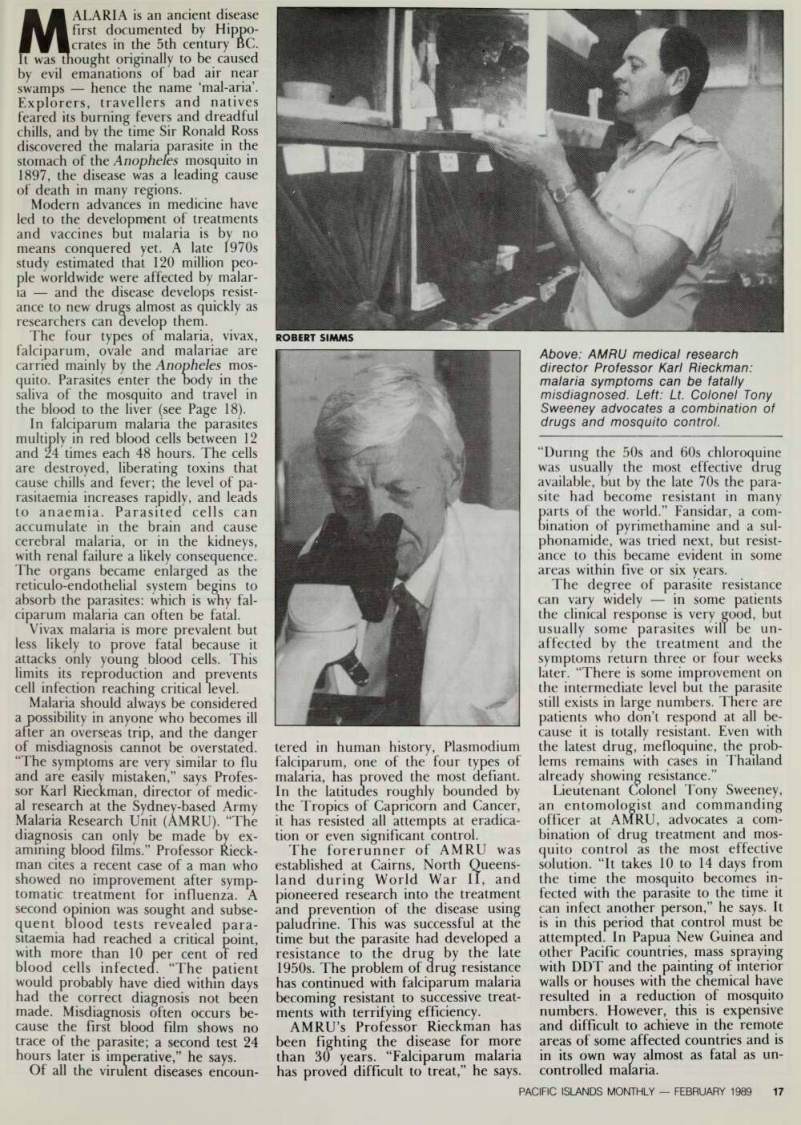
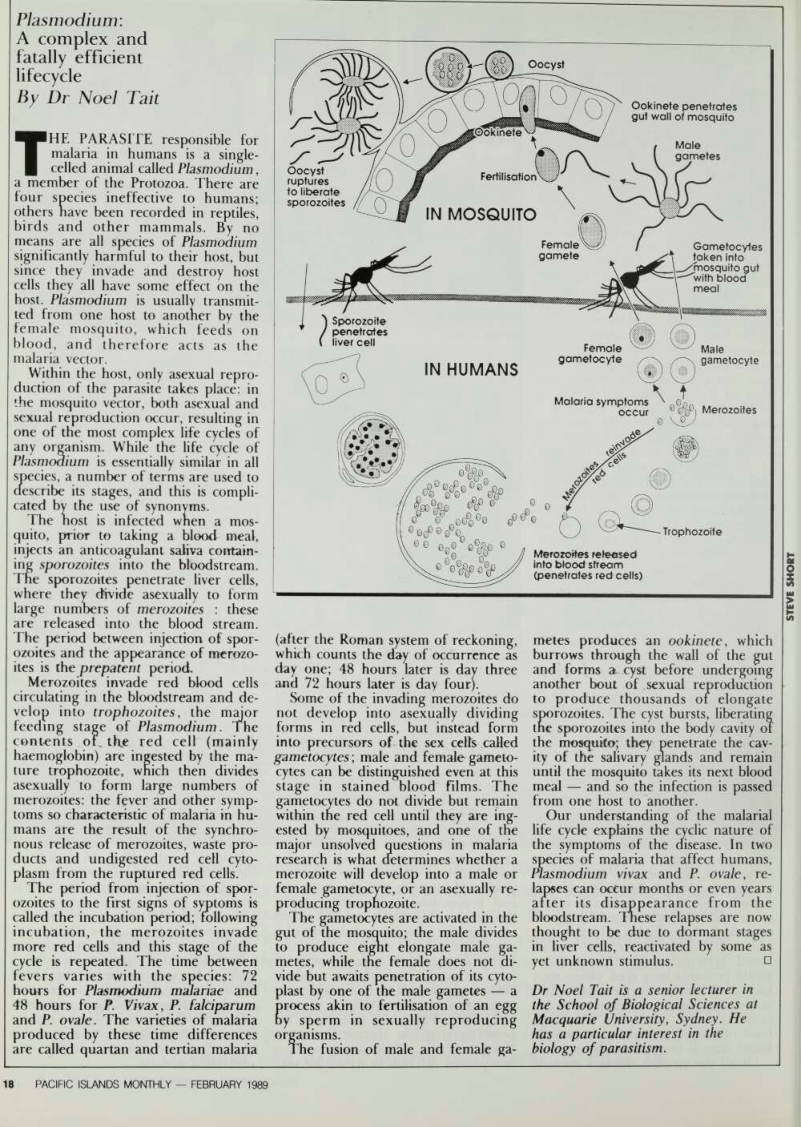
Above: AMRU medical research director Professor Karl Rieckman: malaria symptoms can be fatally misdiagnosed. Left: Lt. Colonel Tony Sweeney advocates a combination of drugs and mosquito control.
fatally efficient

Plasmodium : A complex and fatally efficient lifecycle
By Dr Noel Tait
THE PARASITE responsible for
malaria in humans is a single celled animal called Plasmodium, a member of the Protozoa. There are four species ineffective to humans; others nave been recorded in reptiles, birds and other mammals. By no means are all species of Plasmodium significantly harmful to their host, but since they invade and destroy host cells they all have some effect on the host. Plasmodium is usually transmit ted from one host to another by the female mosquito, which feeds on blood, and therefore acts as the malaria vector.
Within the host, only asexual repro duction of the parasite takes place: in the mosquito vector, both asexual and sexual reproduction occur, resulting in one of the most complex life cycles of any organism. While the life cycle of Plasmodium is essentially similar in all species, a number of terms are used to describe its stages, and this is compli cated by the use of synonyms.
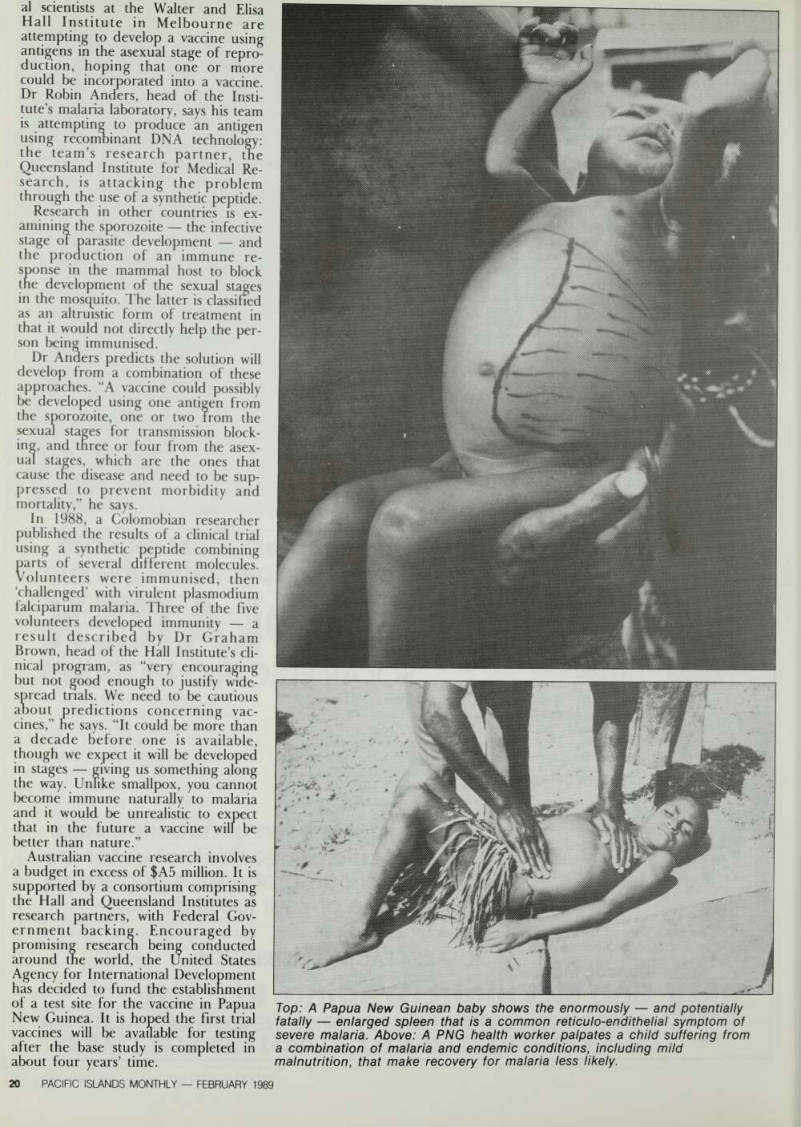
The host is infected wnen a mos quito, prior to taking a blood meal, injects an anticoagulant saliva contain ing sporozoites into the bloodstream.
The sporozoites penetrate liver cells, where they divide asexually to form large numbers of merozoites : these are released into the blood stream.
The period between injection of spor ozoites and the appearance of mcrozo ites is (he prepatent period Merozoites invade red blood cells circulating in the bloodstream and de
velop into trophozoites, the major
feeding stage of Plasmodium. The contents of th.e red cell (mainly haemoglobin) are ingested by the ma ture trophozoite, which then divides asexually to form large numbers of merozoites: the fever and other symp toms so characteristic of malaria in hu mans are the result of the synchro nous release of merozoites, waste pro ducts and undigested red cell cyto plasm from the ruptured red cells.
The period from injection of spor ozoites to the first signs of syptoms is called the incubation period; following incubation, the merozoites invade more red cells and this stage of the cycle is repeated. The time between fevers vanes with the species: 72 hours for Plasmodium malariae and 48 hours for P. Vivax, P. falciparum and P. ovale. The varieties of malaria produced by these time differences are called quartan and tertian malaria
(after the Roman system of reckoning, which counts the day of occurrence as day one; 48 hours later is day three and 72 hours later is day four).
Some of the invading merozoites do
not develop into asexually dividing
forms in red cells, but instead form into precursors of the sex cells caHed gametocytes ; male and female gametocytes can be distinguished even at this stage in stained blood films. The gametocytes do not divide but remain within tne red cell until they are ingested by mosquitoes, and one of the major unsolved questions in malaria research is what determines whether a merozoite will develop into a male or female gametocyte, or an asexually re-
producing tropnozoite.
The gametocytes are activated in the gut of the mosquito; the male divides
to produce eight elongate male ga-
metes, while the female does not divide but awaits penetration of its cyto plast by one of the male gametes a process akin to fertilisation of an egg oy sperm in sexually reproducing
organisms.
The fusion of male and female ga-
metes produces an ookinete, which burrows through the wall of the gut and forms a cyst before undergoing another bout of sexual reproduction to produce thousands of elongate sporozoites. The cyst bursts, liberating the sporozoites into the body cavity of the mosquito; they penetrate the cav ity of the salivary glands and remain until the mosquito takes its next blood meal and so the infection is passed from one host to another.
Our understanding of the malarial life cycle explains the cyclic nature of the symptoms of the disease. In two species of malaria that affect humans, Plasmodium vivax and P. ovale, re lapses can occur months or even years after its disappearance from the bloodstream. Tnese relapses are now thought to be due to dormant stages in liver cells, reactivated by some as yet unknown stimulus. □ Dr Noel Tait is a senior lecturer in the School of Biological Sciences at Macquarie University, Sydney. He has a particular interest in the biology of parasitism.
A bacillus called BTI a specific toxin that kills mosquito larvae with out affecting other aquatic animals has been used with some success, but its short-term effect limits its applica tion. AMRU is investigating possible methods of biological control that aug ment and turn back on the host the pathogens and parasites that occur naturally in the mosquito, but preven tion of mosquito attack remains, for the moment, the most effective method of avoiding the disease. “The Anopheles mosquito, the main carrier of the parasite, is a nocturnal species,” says Lt Col Sweeney. “By remaining inside screened houses at night and using repellents, a good deal of con trol can oe achieved.”
The AMRU is currently researching long-term control methods for mos quitos and the development of effec tive prophylactic and treatment regim es. Older drugs to which falciparum malaria proved resistant are also being examined to see if their efficacy can
be improved by combining them with
other drugs.
Vaccine researchers are also finding the parasite difficult to control. Medic-
Robert Simms
So eager is the female Anopheles mosquito to gorge on blood that she excretes fluid even as she is ingesting a blood meal: eventually even fresh blood is excreted.
al scientists at the Walter and Elisa Hall Institute in Melbourne are
attempting to develop a vaccine using
antigens in the asexual stage of repro duction, hoping that one or more could be incorporated into a vaccine.
Dr Robin Anders, head of the Insti tute’s malaria laboratory, says his team
is attempting to produce an antigen
using recombinant DNA technology:
the team’s research partner, tne Queensland Institute for Medical Re search, is attacking the problem through the use of a synthetic peptide.
Research in other countries is ex amining the sporozoite the infective stage of parasite development and the production of an immune re sponse in the mammal host to block the development of the sexual stages in the mosquito. The latter is classified as an altruistic form of treatment in that it would not directly help the per son being immunised.
Dr Anders predicts the solution will develop from a combination of these approaches. “A vaccine could possibly
be developed using one antigen from
the sporozoite, one or two from the sexual stages for transmission block ing, and three or four from the asex ual stages, which are the ones that cause the disease and need to be sup pressed to prevent morbidity and mortality,” he says.
In 1988, a Colomobian researcher published the results of a clinical trial
using a synthetic peptide combining
parts of several different molecules.
Volunteers were immunised, then
‘challenged’ with virulent plasmodium
falciparum malaria. Three of the five
volunteers developed immunity a
result described by Dr Graham Brown, head of the Hall Institute’s cli nical program, as “very encouraging but not good enough to justify wide spread trials. We need to be cautious
aoout predictions concerning vac
cines,” he says. “It could be more than a decade before one is available, though we expect it will be developed
in stages giving us something along
the way. Unlike smallpox, you cannot become immune naturally to malaria and it would be unrealistic to expect that in the future a vaccine will be better than nature.”
Australian vaccine research involves a budget in excess of SAS million. It is
supported by a consortium comprising
the Hall and Queensland Institutes as research partners, with Federal Gov
ernment backing. Encouraged by
promising research being conducted
around tne world, the United States
Agency for International Development
has decided to fund the establishment of a test site for the vaccine in Papua New Guinea. It is hoped the first trial vaccines will be available for testing after the base study is completed in about four years’ time.
Top: A Papua New Guinean baby shows the enormously - and potentially fatally - enlarged spleen that is a common reticulo-endithelial symptom of severe malaria. Above: A PNG health worker palpates a child suffering from a combination of malaria and endemic conditions, including mild malnutrition, that make recovery for malaria less likely.
Advertisements & other items, p. 19 (1 item)
' 8 Solarex
electricity from sunlight - the simplest most reliable power supply under the sun
Papua New Guinea Australia
SOLAR ELECTRIC MODULES
Vanuatu Fiji Samoa New Caledonia Tonga Tahiti New Zealand ✓ > If you’ve been considering solar electric power contact us for the most comprehensive quote and name of your local dealer.
Duncan Maclean
SOLAREX PACIFIC DISTRIBUTOR
BMK Bob McKnight(Trading) Pty. Ltd.
P.O. BQX 92 FORTITUDE VALLEY, BRISBANE 4006, QLD. AUSTRALIA TELEPHONE (671) 252 7600 FAX (617) 252 5505 TELEX AA41846
Rank in Manila
The Region
Delegates at a Manila conference on regional peace and development ran the
gauntlet of military harassment.
By David Robie
THE MANILA Declaration seemed harmless enough. “Out going US President Ronald Reagan has prophesied that the 21st century will be the Asia-Pacific cen tury,” it said. “His vision is one where
transnational corporations exploit
Asia-Pacific peoples and natural re sources.
“Let us collectively reshape that vi sion. Let us together turn the world’s
largest region into its largest nuclear
free and foreign military bases-free zone.”
Several anti-nuclear senators addres sed the 200 delegates from Asian and Pacific countries including Fiji, New Caledonia and Papua New Guinea at the four-day conference in January,
sponsored by a coalition of Filipino
trade unions, social justice movements, church groups and the Partido ng Bayan (National Party). Their declara tion, to resist a growing nuclear and military presence in the region, focus sed on the United State’s Clark Air Base and Subic Bay Naval Station in
the Philippines.
Delegates accused France and the US of increasing the nuclear threat in the region, and the Soviet Union was also criticised. The meeting also pro tested against the role of Australia and New Zealand and the ‘policemen of the Pacific’, noting “with alarm” the growing posture of Japan, Australia and New Zealand as junior partners of the US in the region.
Among demands cited in the dec laration for the Pacific were; the with drawal of US, French and other forces; reparation payments from France and the US to the people of the region for destruction caused by nuclear testing in the Marshall Islands and Polynesia; independence in New Caledonia, restoration of democracy in Fiji and the demilitarisation of Guam.
Almost the only nation to win the con ference’s approval was Vanuatu, for its anti-nuclear stance; the
“courageous struggle of the people of
Belau against US attempts to subvert their nuclear-free constitution” was also hailed.
Pastor Djoubelly Wea of the FLNKS appealed to delegates to lobby the Un ited Nations and to pressure France to comply with the lyB6 resolution on decolonisation. He insisted last year’s Matignon accord was no guarantee of independence. “The results of the re
ferendum in Kanaky show that more than 11,000 Caldoches in Noumea voted against the Matignon accord,
against [Jacques] Lafleur and against
Kanak independence,” he said. “For us this raises the question of whether the accord has already been broken.
“These Caldoches are already com ing up strongly racism and fascism are growing and will continue to grow.
On Christmas Eve, a girl from Ouvea was shot by a Caldocne in Noumea.”
Wea declared that pro-independence barricades would remain in force on Ouvea until May 4.
The presence of the delegates in the Philippines was regarded as a threat
by tne military authorities, and trig
gered a wave of what delegates claimed was paranoia, disinformation and harassment by the armed forces.
“Who’s afraid of a bunch of peace lovers?” asked one.
A few days after the arrival of 80 Australians, 18 Japanese, 17 New Zealanders and scores of other dele gates from Asia and Pacific countries, Manila’s national newspapers splashed
front-page reports attacking the so
called peace brigade. Major-General
Ramon Montano, chief of the Philip pine Constabulary, accused the bri gade of interfering in the country’s in ternal affairs. He said that intelligence reports alleged the brigade was sup porting the local communist movement; one report even claimed collaboration with Phillippine author
ities by foreign intelligence networks.
Montano warned that if any dele gates committed “acts inimical to national security” they would be tre ated as “common criminals just like
paedophiles”.
Montano pledged to arrest anybody found actively participating in '‘rebel teach-ins”; contacting leaders of the outlawed Communist Party of the Phi lippines/New People’s Army and visit
ing guerilla zones; joining peace cara
vans or solidarity marches; carrying or distributing “rebellious or seditious” leaflets or making utterances that might incite rebellion.
Montano also claimed that armed forces could “lick” the 20-year-old communist insurgency if they could join forces with “the civilian lead
ership” clearly attempting to tar the
peace brigade with the insurgency
brush.
The response may seem bizarre, but
since President Corazon Aquino took office three years ago with a pledge to protect human rights, her government has failed to shaxe off the legacy of repression left by ousted dictator Fer dinand Marcos. The church-backed Task Force Detainees reports that in 1987 alone, 7444 people were arrested without warrants. A further 602 peo ple were tortured and 284 were killed or wounded in 29 massacres of civi
lians by right-wing vigilantes, the milit
ary or private security forces.
The day after Montano’s statement, the extremist right-wing group Sandi gan and a newly formed umbrella
D of vigilantes responsible for
eds of ‘salvagings’ murders of activists, suspected rebel suppor ters and human rights lawyers, took up the cue. Sandigan alerted the country against the entry of “foreign communist propagandists” whose pre sence could only “undermine efforts to attain national stability”.
Opening the peace and develop ment conference, Senator Wigberto Tanada lashed out at the “ironic” harassment of the peace brigade.
“Under the Marcos dictatorship, hu man rights and people’s security were
trampled upon,” Tanada added.
“Under this present democratic gov ernment, we cannot allow the security of the people to be sacrificed once again on the altar of ‘national secur ity’.” □
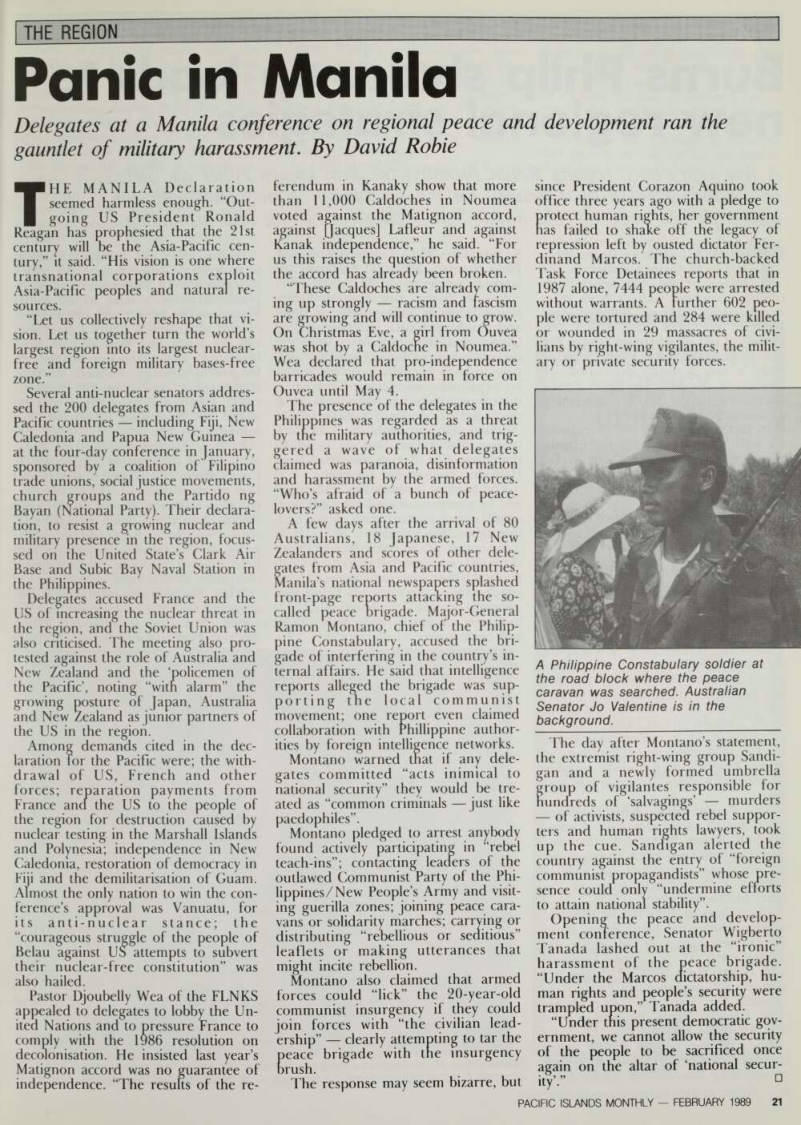
A Philippine Constabulary soldier at the road block where the peace caravan was searched. Australian Senator Jo Valentine is in the background.
new regional strategies
Australia
Bums Philp shake-up leads to new regional strategies
A few years ago, reports Robin Bromby, the firm known either as “BP’s” or “Bloody Pirates” was headed for the scrapheap. A new lean, efficient approach has seen the old South Seas trader recovering and expanding.
HEAD office of Burns Philp "I & Co in Sydney preserves the image of the old South Seas trading company, with its brass plate at the street entrance, polished door
handles, engraved glass panels and
models of ola island trading ships. But the image belies the reality: Burns Philp is now a widely diversified, in ternational company, its South Pacific
operations having become something
of a commercial backwater.
In fact it is running out of expatri ate staff who can serve in the islands, as its management needs are so far removed from those of an island trad er there is little synergy between its new and old business.
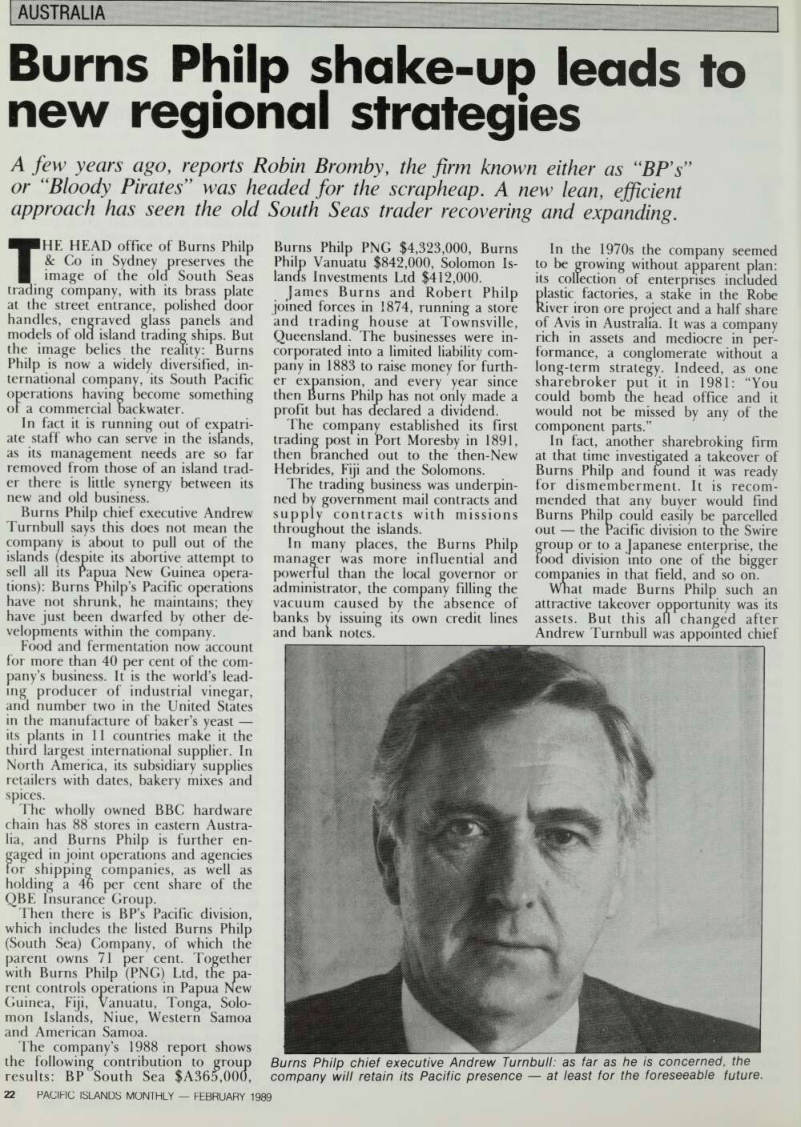
Burns Philp chief executive Andrew Turnbull says this does not mean the company is about to pull out of the islands (despite its abortive attempt to sell all its Papua New Guinea opera tions): Burns Philp’s Pacific operations have not shrunk, he maintains; they have just been dwarfed by other de velopments within the company.
Food and fermentation now account for more than 40 per cent of the com pany’s business. It is the world’s lead ing producer of industrial vinegar, and number two in the United States in the manufacture of baker’s yeast its plants in 11 countries make it the third largest international supplier. In North America, its subsidiary supplies retailers with dates, bakery mixes and
spices.
The wholly owned BBC hardware chain has 88 stores in eastern Austra lia, and Burns Philp is further en
gaged in joint operations and agencies
for shipping companies, as well as holding a 46 per cent share of the QBE Insurance Group.
Then there is BP’s Pacific division, which includes the listed Burns Philp (South Sea) Company, of which the parent owns 71 per cent. Together with Burns Philp (PNG) Ltd, the pa rent controls operations in Papua New Guinea, Fiji, Vanuatu, Tonga, Solo mon Islands, Niue, Western Samoa and American Samoa.
The company’s 1988 report shows the following contribution to group results: BP South Sea $A365,000,
Burns Philp PNG $4,323,000, Burns Philp Vanuatu $842,000, Solomon Islands Investments Ltd $412,000.
James Burns and Robert Philp joined forces in 1874, running a store and trading house at Townsville, Queensland. The businesses were incorporated into a limited liability company in 1883 to raise money for further expansion, and every year since then Burns Philp has not only made a profit but has declared a dividend.
The company established its first trading post in Port Moresby in 1891, then branched out to the then-New Hebrides, Fiji and the Solomons.
The trading business was underpinned by government mail contracts and supply contracts with missions throughout the islands.
In many places, the Burns Philp manager was more influential and powerful than the local governor or administrator, the company filling the vacuum caused by the absence of banks by issuing its own credit lines and bank notes.
In the 1970 s the company seemed to be growing without apparent plan: its collection of enterprises included plastic factories, a stake in the Robe River iron ore project and a half share of Avis in Australia. It was a company rich in assets and mediocre in per formance, a conglomerate without a long-term strategy. Indeed, as one sharebroker put it in 1981: “You could bomb the head office and it would not be missed by any of the
component parts.”
In fact, another sharebroking firm at that time investigated a takeover of Burns Philp and found it was ready for dismemberment. It is recom mended that any buyer would find
Burns Philp could easily be parcelled
out the Pacific division to the Swire group or to a Japanese enterprise, the food division into one of the bigger companies in that field, and so on.
What made Burns Philp such an attractive takeover opportunity was its assets. But this all changed after Andrew Turnbull was appointed chief
Burns Philp chief executive Andrew Turnbull: as far as he is concerned, the company will retain its Pacific presence - at least for the foreseeable future.
executive in 1984 the firm set clear goals and began to show real profit
growth: its operating profit after tax
m 1988 was $62.9/ million, against $50.5 million the previous year. While moving into new areas, particularly fermentation, Burns Philp has been shedding activities that do not fit the new corporate plan 23 divisions or businesses have gone since 1983.
So far as the Pacific is concerned, Andrew Turnbull has been keen to move out of what Australians call ‘mum and dad’ operations small shops or businesses that are better handled by local owners. “The view I developed after a few years at Burns Philp was that we don’t want to do anything in the Pacific a small business could aspire to do,” says Turnbull.
Particularly in remote areas, small traders can compete effectively with a giant such as Burns Philp. “I am in terested in the strengths of larger financial activities coming back to the main centres where we can oper ate showrooms, supermarkets. The time has arrived for us to sell down our equity,” he says. “We want to in crease the pace of localisation, to get a return on our investment to give us the money to expand internationally.”
A major step in that strategy was the planned sale, in two parcels, of its 68 per cent shareholding in Burns Philp (PNG) Ltd. The balance was already held by the Investment Cor poration of PNG and the Public Offic ers Superannuation Board and the sale would have brought the parent about SA4O million over five years.
The agreement required an inde- Pendent valuation but the buyer, the
NG National Equities Corporation,
refused to accept that valuation and pulled out the deal. At the time of
writing Burns Philp is planning to
offer about 18 per cent ofits shares in the PNG subsidiary to financial institu tions and individual investors in the country an arrangement expected to reap about KlO million. According to Andrew Turnbull it is company policy to have at least 50 per cent local ownership in Burns Philp Pacific op erations, and PNG Prime Minister Rabbie Namaliu has agreed with this formula as an interim objective.
As discussions continued over the sale of the firm’s PNG operations, Burns Philp argued that it was unwise for the National Equities Corporation to buy all the shares, even though the Australian parent would provide man agement for the five-year handover period. Turnbull feels there are not enough trained managers in Papua New Guinea. “It was too sudden they don’t have the talent to run it at this time,” he says.
However, Burns Philp is training staff in all its Pacific branches, partly because it cannot find Australians to
fill what had been traditionally ex
patriate management positions.
Burns Philp’s activities are now directed toward food production, fer mentation, high tech and chemical dis tribution; you just can’t take managers trained for these fields and, for exam ple, drop them into a vehicle distribu tor or retailer in Tonga or Western Samoa,” Turnbull says.
In 1980 about 75 per cent of Burns Philp’s profits had come from the Pacific; now the figure is 10 per cent a reflection of the firm’s move away from its traditional activities.
Throughout the islands Burns Philp distributes motor vehicles including the popular Toyota, Yamaha and Hino brands. Its shops are well known and the company is now moving into home furnishings, and its latest annual report revealed that merchandising business in Vanuatu remains steady
despite falling returns for shipping
ana automotive sales.
In the Solomon Islands the com pany has invested in a new ready mixed concrete plant, branches m Tonga, Niue, Western Samoa and American Samoa have traded strongly, and though its merchandising opera tion in Western Samoa has been sold, the firm’s automotive and shipping businesses have been retained.
In Papua New Guinea, Burns Philp (PNG) Ltd entered a joint venture with P&O to charter bulk carriers for copper concentrates from the Ok Tedi project; a new coaster is being built in China and the company has oeen in volved in establishing a new shipping service in Western Australia.
Fiji continues to be a problem. The first coup “knocked the company bad ly”, Turnbull admits: trading went down to about 38 per cent of normal; then it climbed back to about 75 per cent only to be knocked back to 40 per cent by the second coup. The company has also lost much of its In dian middle management due to
emigration.
Turnbull says Fiji business has shrunk to compensate for managerial losses a motor showroom in Ba has been closed as has the timber yard in Lautoka, while an accidental fire des
troyed the Burns Philp building at
Sigatoka and now the Fiji company
is once again trading profitably. After
the second coup it was estimated that Burns Philp (South Sea) Ltd had lost about sAll million in the book value of its Fijian ventures, and staff levels fell from 842 to about 500. The com pany has been especially affected be cause most of its activities are service oriented it thus felt the slump in business activity more quickly than
most foreign enterprises.
Andrew Turnbull says Burns Philp will continue to operate in the islands so long as governments want it to, but
the company’s attitude is: “If you want shareholding, it’ll be there.” The money can be used profitably else where in the world (unless, like Fiji, Burns Philp cannot get its cash re serves out; the lack of demand for fi nance also means depressed interest rates while it sits in a Fijian bank).
However, Mr Turnbull is adamant that profits in the Pacific are higher than they have ever been.
So far as he is concerned Burns Philp will remain a South Pacific trad er at least for the foreseeable fu ture. He points to the fact that the company is currently upgrading many of its stores as evidence that funds are constantly being returned to the busi ness to improve them. □
Advertisements & other items, pp. 23-25 (1 item)
Development
AGENCY
DIRECTOR
New Zealand Volunteer Service Abroad (Inc), which has a volunteer programme spanning 16 countries of the Pacific, Asia and Africa, wishes to appoint a Director (Development) who will have specific responsibility for identifying, planning and implementing new projects in these and other areas.
Applicants should have a tertiary qualification, be well versed in the issues faced by developing countries and preferably have first hand experience of living and working in such an environment.
Maturity, judgement, the ability to relate with credibility to senior management and government officials plus the capacity to work effectively with the Director (Operations) in a small team are also essential attributes. Travel within New Zealand and overseas will be required.
The successful applicant will be expected to take up the appointment by mid 1989.
Applications close on 13th March 1989.
For further information and an application form write to: The Chairperson Volunteer Service Abroad PO Box 12-246 Wellington, NZ Ph. 04-725759 Telex NZ31648
Battle the elements
Own a Mazda 323 4WD,
and you own the road.
Rule number one: Never go into battle without the right equipment. Whether it’s rough terrain you’ll be encountering, or rain, or even snow, there are as many reasons as there are bumps in the road for you to find yourself behind the wheel of a Mazda 323 4WD.
Unlike most cars, the 323 thrives under adverse conditions.
It competes in gruelling European road rallies. And wins, with only minor modifications.
Accounting for this is better grip under all kinds of driving
:onditions. Greater straight-line sta- )ility and cornering characteristics, n short, virtually everything that ontributes to enhanced driver feel.
Driver feel, or handling, has long >een a priority at Mazda, as evilenced by our innovative and highly icclaimed suspension systems, plus the 323 , s sophisticated full-time 4WD. Even more revolutionary is the speed-sensing, 4-wheel steering found on our 626 car.
What conclusions can be drawn from this? Simply that you can battle the elements, and win. Provided you have a Mazda 323 4WD at hand.
Models and features shown may not be available in your area. Please consult your local Mazda dealer.
I \-rA
© Mazda Motor Corporation
CSIRO begins PNG
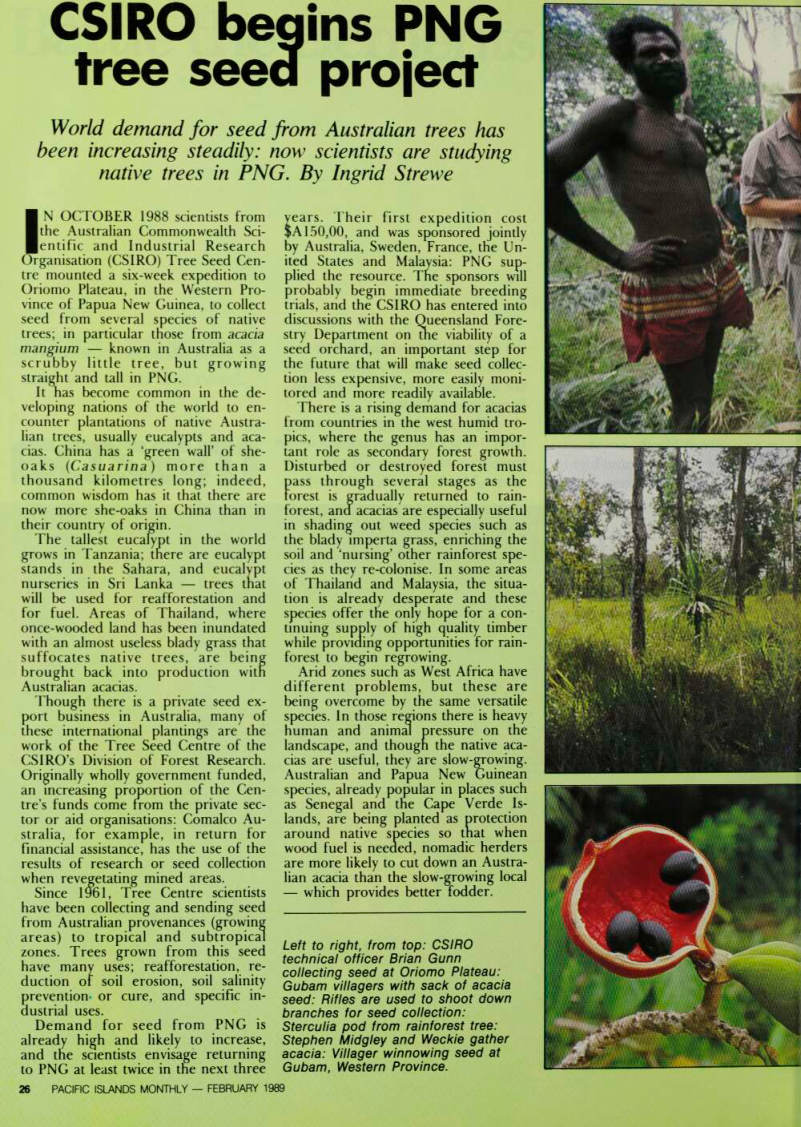
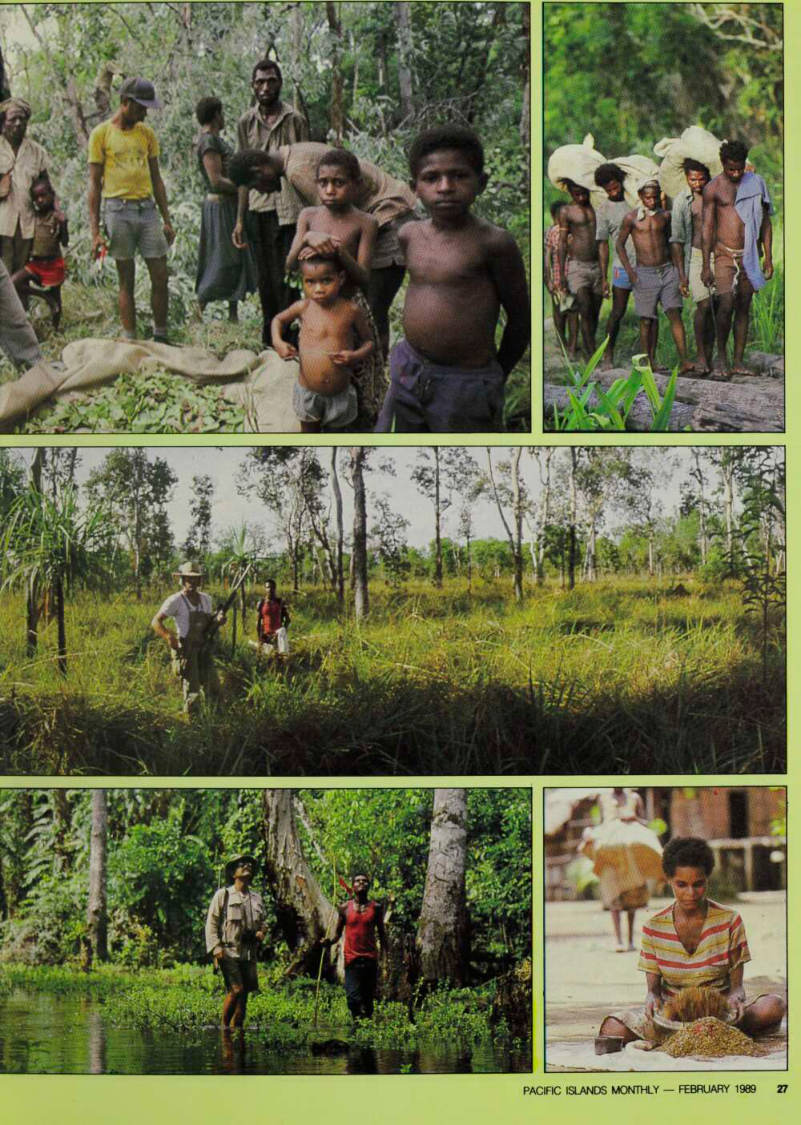
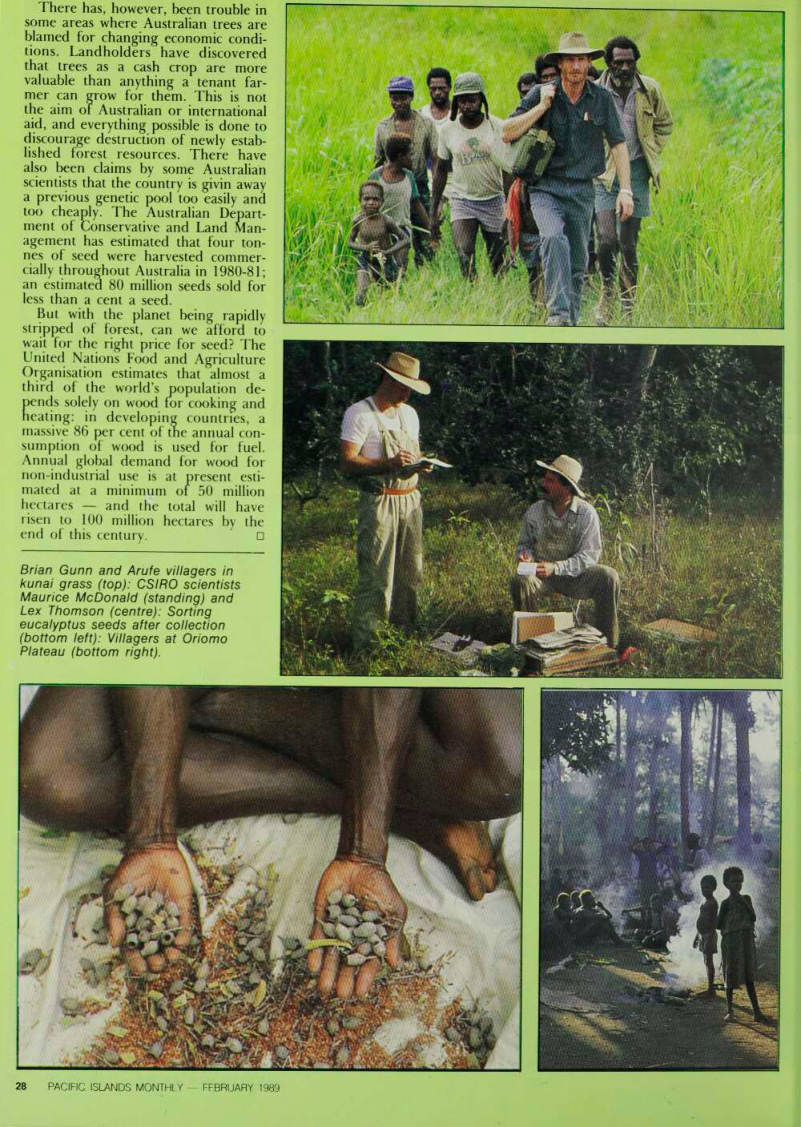
tree seed project
World demand for seed from Australian trees has been increasing steadily: now scientists are studying
native trees in PNG.
By Ingrid Strewe
IN OCTOBER 1988 scientists from the Australian Commonwealth Sci entific and Industrial Research Organisation (CSIRO) Tree Seed Cen tre mounted a six-week expedition to Oriomo Plateau, in the Western Pro vince of Papua New Guinea, to collect seed from several species of native trees; in particular those from acacia mangium known in Australia as a scrubby little tree, but growing straight and tall in PNG.
It has become common in the de veloping nations of the world to en counter plantations of native Austra lian trees, usually eucalypts and aca cias. China has a ‘green wall’ of she oaks ( Casuarina ) more than a thousand kilometres long; indeed, common wisdom has it that there are now more she-oaks in China than in their country of origin.
The tallest eucalypt in the world grows in Tanzania; there are eucalypt stands in the Sahara, and eucalypt nurseries in Sri Lanka trees tnat will be used for reafforestation and for fuel. Areas of Thailand, where once-wooded land has been inundated with an almost useless blady grass that suffocates native trees, are being brought back into production with Australian acacias.
Though there is a private seed ex port business in Australia, many of these international plantings are the work of the Tree Seed Centre of the CSIRO’s Division of Forest Research.
Originally wholly government funded, an increasing proportion of the Cen tre’s funds come from the private sec tor or aid organisations: Comalco Au stralia, for example, in return for financial assistance, has the use of the results of research or seed collection when revegetating mined areas.
Since 1961, Tree Centre scientists have been collecting and sending seed from Australian provenances (growing areas) to tropical and subtropical zones. Trees grown from this seed have many uses; reafforestation, re duction of soil erosion, soil salinity prevention* or cure, and specific in dustrial uses.
Demand for seed from PNG is
already high and likely to increase,
and the scientists envisage returning to PNG at least twice in the next three
years. Their first expedition cost $A 150,00, and was sponsored jointly by Australia, Sweden, France, the Un ited States and Malavsia: PNG sup plied the resource. The sponsors will
probably begin immediate breeding
trials, and the CSIRO has entered into discussions with the Queensland Fore stry Department on the viability of a seed orchard, an important step for the future that will make seed collec tion less expensive, more easily moni tored and more readily available.
There is a rising demand for acacias from countries in the west humid tro pics, where the genus has an impor tant role as secondary forest growth.
Disturbed or destroyed forest must fiass through several stages as the orest is gradually returned to rain forest, and acacias are especially useful in shading out weed species such as the blady imperta grass, enriching the soil and ‘nursing’ other rainforest spe cies as they re-colonise. In some areas of Thailand and Malaysia, the situa tion is already desperate and these species offer the only hope for a con
tinuing supply of high quality timber
while providing opportunities for rain
forest to begin regrowing.
Arid zones such as West Africa have different problems, but these are being overcome by the same versatile species. In those regions there is heavy human and animal pressure on the landscape, and thougn the native aca cias are useful, they are slow-growing.
Australian and Papua New Guinean
species, already popular in places such
as Senegal and the Cape Verde Is lands, are being planted as protection around native species so that when wood fuel is neeaed, nomadic herders are more likely to cut down an Austra lian acacia than the slow-growing local which provides better fodder.
Left to right, from top: CSIRO technical officer Brian Gunn collecting seed at Oriomo Plateau: Gubam villagers with sack of acacia seed: Rifles are used to shoot down branches for seed collection: Sterculia pod from rainforest tree: Stephen Midgley and Weckie gather acacia: Villager winnowing seed at Gubam, Western Province.
There has, however, been trouble in some areas where Australian trees are blamed for changing economic condi tions. Landholders have discovered that trees as a cash crop are more valuable than anything a tenant far mer can grow for them. This is not the aim of Australian or international aid, and everything possible is done to discourage destruction of newly estab lished forest resources. There have also been claims by some Australian scientists that the country is givin away a previous genetic pool too easily and too cheaply. The Australian Depart ment of Conservative and Land Man agement has estimated that four ton nes of seed were harvested commer cially throughout Australia in 1980-81; an estimated 80 million seeds sold for less than a cent a seed.
But with the planet being rapidly
stripped of forest, can we afford to wait for the right price for seed? The United Nations Food and Agriculture Organisation estimates that almost a third of the world’s population de pends solely on wood for cooking and heating: in developing countries, a massive 86 per cent of trie annual con sumption of wood is used for fuel.
Annual global demand for wood for non-industrial use is at present esti mated at a minimum of 50 million hectares and the total will have risen to 100 million hectares by the end of this century. □
Brian Gunn and Arufe villagers in kunai grass (top): CSIRO scientists Maurice McDonald (standing) and Lex Thomson (centre): Sorting eucalyptus seeds after collection (bottom left): Villagers at Oriomo Plateau (bottom right).
Pacific Stamp Box
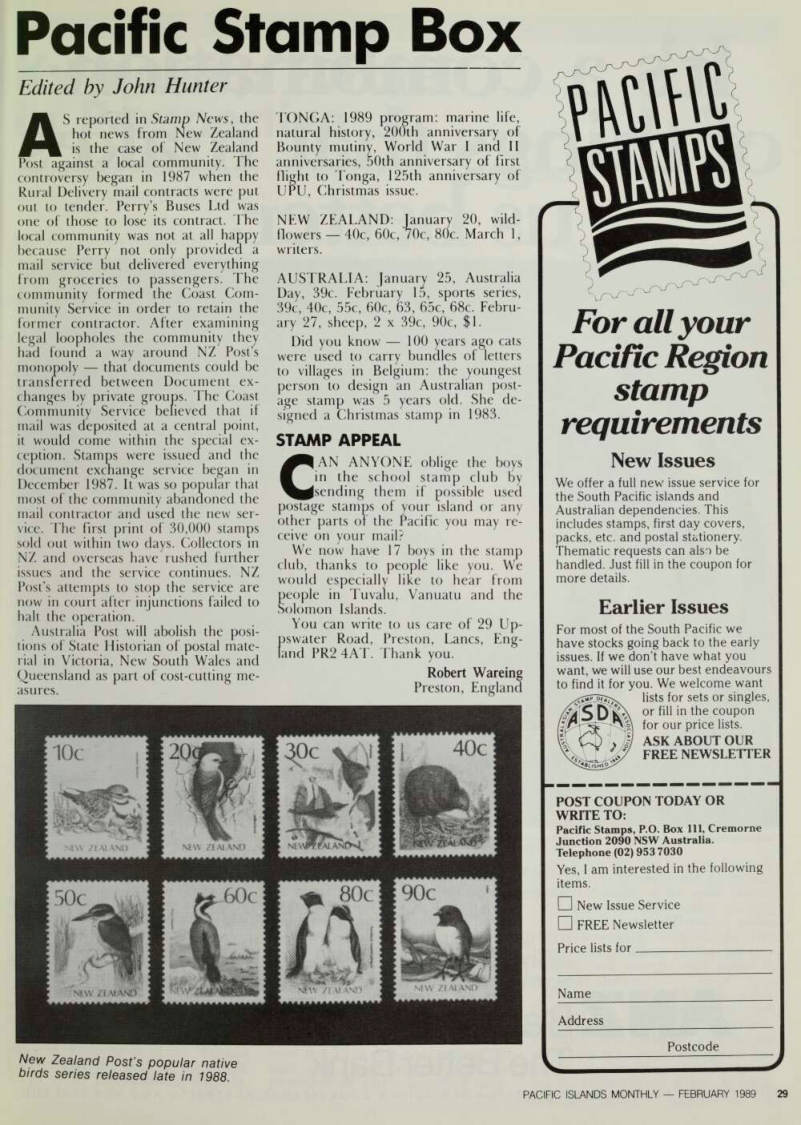
Edited by John Hunter
AS reported in Stamp News , the hot news from New Zealand is the case of New Zealand Post against a local community. The controversy began in 1987 when the Rural Delivery mail contracts were put out to tender. Perry’s Buses Ltd was one of those to lose its contract. The local community was not at all happy
because Perry not only provided a
mail service but delivered everything from groceries to passengers. The community formed the Coast Com munity Service in order to retain the former contractor. After examining
legal loopholes the community they
had found a way around NZ Post’s monopoly that documents could be transferred between Document ex
changes by private groups. The Coast
Community Service believed that if mail was deposited at a central point, it would come within the special ex ception. Stamps were issued and the document exchange service began in December 1987. It was so popular that most of the community abandoned the mail contractor and used the new ser vice. The first print of 30,000 stamps sold out within two days. Collectors in NZ and overseas have rushed further issues and the service continues. NZ Post’s attempts to stop the service are now in court after injunctions failed to halt the operation.
Australia Post will abolish the posi tions of State Historian of postal mate rial in Victoria, New South Wales and Queensland as part of cost-cutting me asures.
TONGA: 1989 program: marine life, natural history, 200th anniversary of Bounty mutiny, World War I and II anniversaries, 50th anniversary of first
flight to Tonga, 125th anniversary of
UPU, Christmas issue.
NEW ZEALAND: January 20, wild flowers —40 c, 60c, /oc, 80c. March 1, writers.
AUSTRALIA: January 25, Australia Day, 39c. February 15, sports series, 39c, 40c, 55c, 60c, 63, 65c, 68c. Febru ary 27, sheep, 2 x 39c, 90c, $l.
Did you know 100 years ago cats were used to carry bundles of letters to villages in Belgium: the youngest person to design an Australian post age stamp was 5 years old. She de signed a Christmas stamp in 1983.
Stamp Appeal
CAN ANYONE oblige the boys
in the school stamp club by sending them if possible used postage stamps of your island or any other parts of the Pacific you may re ceive on your mail?
We now have 17 boys in the stamp club, thanks to people like you. We would especially like to hear from people in Tuvalu, Vanuatu and the Solomon Islands.
You can write to us care of 29 Up pswater Road, Preston, Lancs, Eng land PR2 4AT. Thank you.
Robert Wareing
Preston, England
New Zealand Post’s popular native birds series released late in 1988.
Advertisements & other items, pp. 29-30 (1 item)
Pacific Region
%\m
For all your
stamp
requirements
New Issues
We offer a full new issue service for the South Pacific islands and Australian dependencies. This includes stamps, first day covers, packs, etc. and postal stationery.
Thematic requests can also be handled. Just fill in the coupon for more details.
Earlier Issues
For most of the South Pacific we have stocks going back to the early issues. If we don’t have what you want, we will use our best endeavours to find it for you. We welcome want lists for sets or singles, or fill in the coupon for our price lists.
ASK ABOUT OUR
FREE NEWSLETTER
POST COUPON TODAY OR
WRITE TO:
Pacific Stamps, P.O. Box 111, Cremorne Junction 2090 NSW Australia.
Telephone (02)953 7030 Yes, I am interested in the following items.
CH New Issue Service
I I FREE Newsletter
Price lists for Name Address Postcode
It’s a combination
of things that makes
us better.
In business everyone needs all the help they can get that’s why we offer you a combination of services to help make life a lot easier.
We’re the bank you can turn to for travellers cheques, foreign exchange, telegraphic transfers, letters of credit, safety deposit boxes, investment advice and of course finance.
So when it comes to doing business in the Pacific talk to ANZ.
Bank
The Better Bank
FIJI SOLOMON ISLANDS VANUATU PA PU A NE W GUI N E A COOK ISLANDS AUSTRALIA AND NEW ZEALAND
Kwajalein: Furore
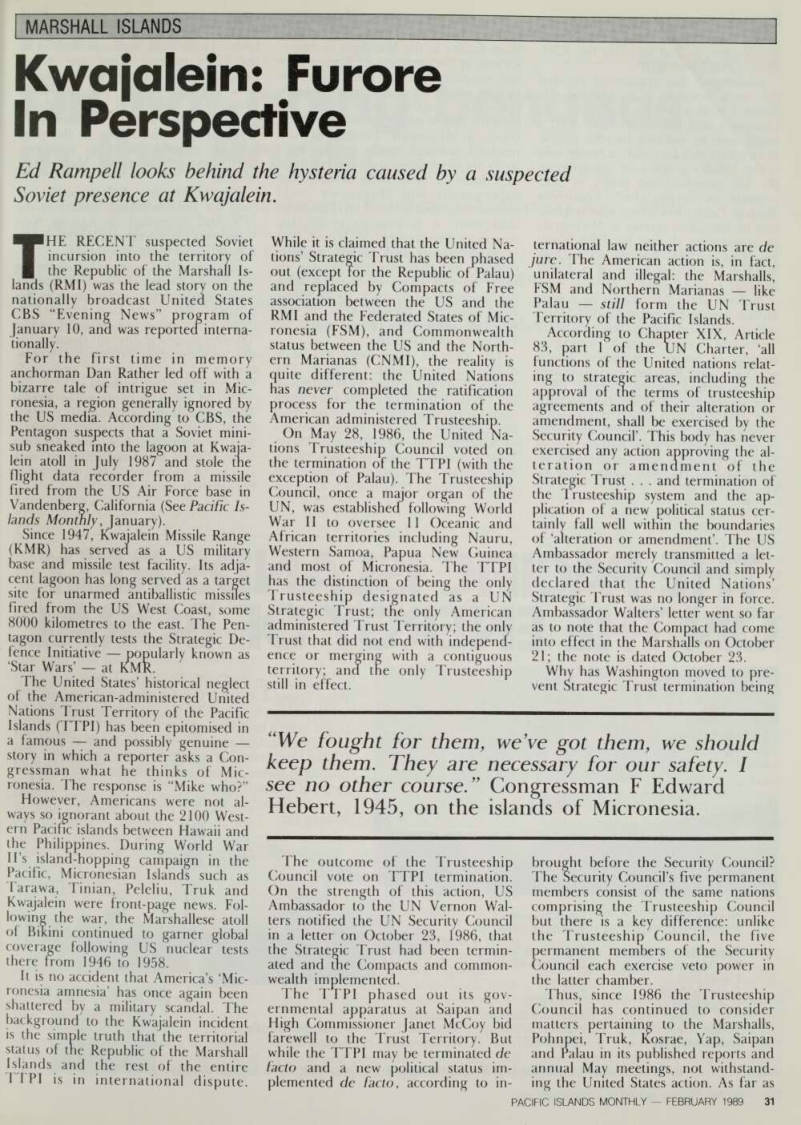
Marshall Islands
Kwajalein: Furore In Perspective
Ed Rampell looks behind the hysteria caused by a suspected Soviet presence at Kwajalein.
THE RECENT suspected Soviet
incursion into the territory of the Republic of the Marshall Is lands (RMI) was the lead story on the nationally broadcast United States CBS “Evening News” program of January 10, and was reported interna
tionally.
For the first time in memory anchorman Dan Rather led off with a bizarre tale of intrigue set in Mic
ronesia, a region generally ignored by
the US media. According to CBS, the Pentagon suspects that a Soviet mini sub sneaked into the lagoon at Kwaja lein atoll in July 1987 and stole tne flight data recorder from a missile fired from the US Air Force base in Vandenberg, California (See Pacific Is
lands Monthly, January).
Since 1947, Kwajalein Missile Range (KMR) has served as a US military base and missile test facility. Its adja cent lagoon has long served as a target site for unarmed antiballistic missiles fired from the US West Coast, some 8000 kilometres to the east. The Pen tagon currently tests the Strategic De fence Initiative popularly known as ‘Star Wars’ at KMR.
The United States’ historical neglect of the American-administered United Nations Trust Territory of the Pacific Islands (TTPI) has been epitomised in a famous and possibly genuine story in which a reporter asks a Con gressman what he thinks of Mic ronesia. The response is “Mike who?”
However, Americans were not al ways so ignorant about the 2100 West ern Pacific islands between Hawaii and the Philippines. During World War H’s island-hopping campaign in the Pacific, Micronesian Islands such as Tarawa, Tinian, Peleliu, Truk and Kwajalein were front-page news. Fol lowing the war, the Marshallese atoll of Bikini continued to garner global coverage following US nuclear tests there from 1946 to 1958.
It is no accident that America’s ‘Mic ronesia amnesia’ has once again been shattered by a military scandal. The background to the Kwajalein incident is the simple truth that the territorial status of the Republic of the Marshall Islands and the rest of the entire TTPI is in international dispute.
While it is claimed that the United Nalions’ Strategic Trust has been phased out (except Tor the Republic of Palau)
and replaced by Compacts of Free
association between the US and the RMI and the Federated States of Micronesia (FSM), and Commonwealth status between the US and the Northern Marianas (CNMI), the reality is quite different: the United Nations has never completed the ratification process for the termination of the American administered Trusteeship.
On May 28, 1986, the United Nations Trusteeship Council voted on the termination of the TTPI (with the exception of Palau). The Trusteeship Council, once a major organ of the UN, was established following World War II to oversee 11 Oceanic and African territories including Nauru, Western Samoa, Papua New Guinea and most of Micronesia. The TTPI has the distinction of being the only Trusteeship designated as a UN Strategic Trust; the only American administered Trust Territory; the only Trust that did not end with independence or merging with a contiguous
territory; and the only Trusteeship
still in effect.
“We fought for them, we’ve got them, we should keep them. They are necessary for our safety. I see no other course.” Congressman F Edward Hebert, 1945, on the islands of Micronesia.
The outcome of the Trusteeship Council vote on TTPI termination.
On the strength of this action, US Ambassador to the UN Vernon Wal ters notified the UN Security Council in a letter on October 23, 1986, that the Strategic Trust had been termin ated and tne Compacts and common
wealth implemented.
The TTPI phased out its gov ernmental apparatus at Saipan and High Commissioner Janet McCoy bid farewell to the Trust Territory. But while the TTPI may be terminated de facto and a new political status im plemented de facto , according to in
ternational law neither actions are de jure. The American action is, in fact, unilateral and illegal: the Marshalls, FSM and Northern Marianas like Palau still form the UN Trust Territory of the Pacific Islands, According to Chapter XIX, Article 83, part 1 of the UN Charter, ‘all functions of the United nations relat ing to strategic areas, including the approval of the terms of trusteeship agreements and of their alteration or amendment, shall be exercised by the Security Council’. This body has never exercised any action approving the al teration or amendment of the Strategic Trust . . . and termination of the Trusteeship system and the ap plication of a new political status cer tainly fall well within the boundaries of ‘alteration or amendment’. The US Ambassador merely transmitted a let ter to the Security Council and simply declared that tne United Nations’
Strategic Trust was no longer in force.
Ambassador Walters’letter went so far as to note that the Compact had come into effect in the Marshalls on October 21; the note is dated October 23.
Why has Washington moved to pre vent Strategic Trust termination being
brought before the Security Council?
The Security Council’s five permanent members consist of the same nations
comprising the Trusteeship Council
but there is a key difference: unlike the Trusteeship Council, the five permanent members of the Security Council each exercise veto power in the latter chamber.
Thus, since 1986 the Trusteeship Council has continued to consider matters pertaining to the Marshalls,
Pohnpei, Truk, Kosrae, Yap, Saipan
and Palau in its published reports and annual May meetings, not withstand ing the United States action. As far as
the United Nations is concerned, the Trust Territory of the Pacific Islands is still alive and includes the RMI,
Fsm, Cnmi And Rop.
Washmgton has apparently avoided
the issue because it is worried the Soviet Union will quite legally kill the Compacts and Commonwealth with a single vote by utilising its veto power, Buttressing this fear over a Soviet veto is the USSR’s practice of condemning the US presence and policy in Micronesia as ‘imperialist’. President Mikhail Gorbachev’s own characterisation of American actions in Micronesia as ‘annexation’ during his 1986 Soviet Far East address has added fuel to hawkish American fears of a USSR Security Council veto.
Moscow views Micronesia as a fivemillion-square-kilometre United States militarised and nuclearised zone, a ‘forward base’ in the Pentagon strategy of ‘Soviet containment’ aimed
at thwarting Russian expansionism
and protecting the continental USA.
The Washington Post has documented that the Pentagon has a contingency plan whereby Tinian, Guam and Palau form a Western Pacific defence arc of fallback bases should US military installations in the Philippines ever be closed.
Naturally, the USSR is as pleased by military bases on Guam and a Star Wars facility in the Marshalls as Amer ica was at the prospect of having nuc lear weapons stored in Cuba. The hor
rifying possibility is that such military
toe-to-toe confrontation could put Moscow and Washington on a collision course in Micronesia. The region’s un resolved political status, as the Mar shalls incident illustrates, will continue as a bone of contention between the superpowers and Micronesia could conceivably evolve into an East-West flashpoint: it is wise to recall that America’s involvement in World War II both began and ended in Mic ronesia and that obscure, remote is lands have a knack of moving from the recesses of history to headline
news once they become militarily sig
nificant: witness in recent times the Falklands and Grenada.
The case of Micronesia has been dubbed ‘a sham within a scandal’: The United Nations’ refusal to stand up to the US over the TTPI issue is an igno miny, especially since no fewer tnan eight directly involved Pacific entities Australia, Fiji, New Zealand, Papua New Guinea, Western Samoa, Solo mon Islands, Vanuatu, and East Timor’s Fretilin (which has a UN pre
sence somewhat similar to that of the PLO) are represented at the world body. The Pacific nations can lead in the UN’s peace-broking and decol onisation process if they work together in a regional voting bloc, as Other geopolitical regions m the world do.
In fact, these island countries have acted as a de facto bloc in the past,
holding monthly meetings on perti
nent matters at their Manhattan offices.
They have also diplomatically lob bied for the embattled Kanaks at the UN and suceeded in having New Caledonia inscribed on the UN’s list of
non-self-governing territories.
If for no other reason than defusing the North Pacific, the United Nations the world forum presiding over the postwar decolonisation process must take an active interest in its Trustee responsibility to ensure that
the long overdue Trusteeship Agree
ments of development and self determination are realised.
Should the UN continue to ignore Micronesia and its disputed political status, there will eventually be a price to pay. Someday, UN peace-keeping troops may be dispatched to tiny specks of sand that have once more become front-page news. □
Advertisements & other items, p. 32 (1 item)
The Pacific Islands Rely
ON THE ENERGY OF BORAL
■l— •■■■ %■ ■Hi is* All through the Pacific Islands, people rely on Boral Speed-E-Gas LP Gas for their energy needs.
Boral has terminals throughout the area, and is proud to be a leading supplier.
Speed-E-Gas is clean, efficient and low in cost.
It’s the ideal energy source for cooking and water heating in homes, motels and hotels, and for a wide range of industrial uses.
So call Boral. We have the energy you’re
looking for.
1 ■ <■ieSi I Ml Norfolk Island Norfolk Island 2419 Papua New Guinea Port Moresby 214248 Lae 42 2574 Rabaul 921225 Wewak 862125 Tonga Nukualofa 21388 Cook Islands Rarotonga 24460 American Samoa Pago Pago 633 2170 Fiji Suva 24035 Lautoka 60088 Sigatoka 50578 Labasa 82973 Vanuatu Santo 455 Port Vila 2046
BORAL GAS
Solomon Islands Honiara 21833 Boral Gas Limited. Bth Floor, IBM House, 168 Kent St., Sydney, NSW 2000. Tel: (02) 278512.
in the Pacific
Forum
On not going bananas in the Pacific
Ever since the days of Jean-Jacques Rousseau, philosophers have turned to Oceania in search of an ideal society.
C S Hopman, a longtime resident in New Caledonia, offers his thoughts on what could be done to create a society that could profit from its very distance from less happy lands. Readers are invited to respond to Mr Hopman’sideas: write to him % Pacific Islands Monthly, GPO Box 4245, Sydney Australia 2001.
)| N VIETNAM it was a broken raw legg: pass it from hand to hand, |and yolk remains while the white ribbles away. Here it’s done with coconuts: eat the white meat and keep the coarse brown husk. In both cases
something precious is lost.
The British used to say that next to Providence, their Empire was the greatest force for good on earth.
Perhaps not; but New Zealand, Cana da, the USA, Australia are the sort of places to which people want to emi
grate. Singapore and Hong Kong are
bustling, prosperous cities. But think of the misery the French left in Afri ca, Indonesia and elsewhere.
Why the difference? It is important to find out, because it’s clear to some one who has lived in New Caledonia for more than 17 years that they are doing it again here. If they follow
their present trajectory, they will again
leave hated and humiliated, blaming foreigners or fate, perhaps and
not understanding how carefully they
built themselves a trap and fell into it.
This trap is not uniquely French: human beings are all lousy colonisers of this earth. We could oe creating
extraordinary beauty, abundance,
wellbeing; instead there is unemploy ment, crime, war, environmental des truction. We waste and destroy what is most previous. I hope to show here that there is a way out of the trap.
The New Caledonian Case The writer O Henry coined the term ‘banana republic’ for those Latin American nations that in his day were dominated by the United Fruit Com pany. The term is now used to con note any country in which foreign governments or companies use local governments or companies to plunder or pollute. The practice can be traced back at least as far as Rome, which
mined Britain for its armaments in dustry and sent it administration and finished goods in return.
Drive with me from Tontouta air port to Noumea. One of the first things you will notice is that the coun try is quite empty. It has a population of some 160,000 Belgium, about the same size, has 10 million. Much of the land you see particularly furth er north belongs to a few people or to companies and is tenant farmed.
This was not always so: before the de pression of the 19305, most farmers owned their land and the villages in the interior were developing healthily.
But then prices of farm goods fell while those of fuel, fertiliser and tools
were kept high.
Many farms put up as collateral fell to the importers and the banks.
Look again at that empty land.
While the Americans were here dur ing World War 11, this island fed some 400,000 people: now seven tenths of our food is imported. Drive through any village in the interior.
What do you see? Town hall, gendar merie, scnool, church, post office, a
bar, a few shops selling imported
goods . . . and tnafs it. Tnere’s none of the infrastructure of little factories producing toys, ceramics, furniture, nor the wayside stands you find in other places. The soil is full of metal, but not a single spoon or can-opener is made here. The island is sur rounded by millions of square kilometres of ocean, but fishing rights are leased to foreigners. Except for a few prawns, no fish are exported.
There might have been good occa sions for bringing people here. In March 1918 the (Germans broke through the Allied lines and spilled into France, thinking they had won.
Drunk and debauched, their bags full of loot, they were captured or Killed,
and realised they had lost. But the charms of ‘military jujitsu’ were lost on the signatories of the Treaty of Ver sailles. Woodrow Wilson notwithstand ing, the British and the French in sisted on enormous reparations and in 1920 more than 100,000 Germans died of cold and hunger. There was an extraordinary feeling of bitterness and frustration which, as Hitler him self wrote, gave rise to Nazism. Had the French (and the British) had the generosity to invite some of these peo ple to their colonies, a second world war and the atrocities of the gas cham bers and A-bomb might have been avoided. France might have kept her colonies and this country might have developed an economy capable of paying its own wav.
About half of tne white population of just under 40,000 (the same as Haiti before the slave rebellion) are employed as state or territorial fonc tionnaires. Another 30 per cent or so have bureaucratic jobs in banks, insur ance companies, airlines and the like.
Living standards here are quite high:
medical and school facilities, roads, water, communications even to re mote areas are better than in many Pacific Islands. France sends some $3OO to $5OO million per year to keep
this place going. When imported
goods came maimy from Frace, most of the money sent here went back there. Now it tends to go elsewhere, and adds to France’s balance of pay ment deficit.
To the left, as we drive to town, there are mountains. They are beauti ful but cut by great gashes in the dark red earth where miners searched for (and perhaps found) nickel ore.
Some very large fortunes were made but not much of that money came back. Payments are usually made abroad, and who is to check whether
prices quoted here are the same as those paid elsewhere? In any case it is evident that not much was invested in
replanting strip-mined slopes, so when
the heavy rains come, red slit flows down over farmland and into the la goon, where it kills the reef. Nickel mining and smelting do provide a few jobs but, with automation, even less.
It s a matter of most value removed and least added: how can the value of a stripped mountain or polluted la goon be compared with that of cash stashed away in foreign accounts?
As we drive into town, you see the nickel smelting works on the right. It had about 15 per cent of the world market some 20 years ago now it processes 6 per cent. Strange that this factory should be here on the west coast, even though most of the ore is on the east only a few hundred kilometres away. Strange, too, that ab out half the island’s population lives in Noumea and its suburbs. Why not spread out a bit? Have the capital in the centre say in Bourail. Put a university on the east coast, where it rains more, send industry to the south so the dust can blow out to sea.
Noumea, with its numerous hills and bays, could have been one of the most beautiful towns in the world. It isn’t. Many of the bays have been fil led in. Ugly apartment buildings block what should have been beautiful views. This place was obviously more concerned with money than beauty, and impoverished itself in consequ ence. Here, as in any banana town, you can see elegant ladies stepping out of fine cars over piles of trash or across open sewers into luxurious shops. As everywhere where there is
injustice there is ugliness graffiti,
shanty huts and garish villas.
The overall impression of Noumea is that of a little colony of consump
tion; the bureaucracy regularly
appears on TV asking for more, but never suggests it is vastly overstaffed.
The miners doubtless do well most of the time, but it is hard to know just how well they complain about hard times, but manage to stay in business.
The importers do quite well, sending
out the money brought in by the pub lic sector and mines. But the whole thing is very ingrown. Unlike Amer icans, Australians, Canadians and New Zealanders, who invited people to come and help build their countries, the local government refused to accept even the pieds noirs when they had to leave Algeria. Un pays merveilleux a wonderful country say the local French when visiting relatives back in the metropolc . . . but when the latter, who pay the taxes that keep this place going, try to come here they find they cannot do so without return tickets.
Let us consider why this island is likely to go bananas.
There is wealth. There is more than nickel, chromium and cobalt in the ground here: other metals as well as coal, oil and gas have been found, too.
The island is beautiful, has a pleasant climate and is uniquely situated. In a few decades fluid fossil fuels will run out. Then humanity will get its energy from the ocean, and the Pacific is tne best place in the world to do this.
There is dependence. The whole is land suffers from a mentalite d assistc.
Even the independentists do not real ise just how great the potential of this island is, and expect France to go on looking after them after independ ence. As things stand this country could not survive without French aid: its internal market is too small and prices are too high for it to develop viable industries. Its bureaucracy is too concerned with self-preservation.
The mining-importing oligarchy de
pends on this bureaucracy to defend
its privileges.
There is hatred. Such wealth as has been made here has not been shared
fairly. Many Melanesians feel they
have been treated like second-class citizens in their own country. This is also increasingly true for the petits blancs the poor whites. Since the Matignon Agreement the old indepen
dentist/loyalist split has given away to
a more fluid, possibly explosive situa tion as each of the old blocs split into those for and against these agree ments. People are confused, fright ened, frustrated.
There is instability. After recent riots, the mayor of Noumea com
plained that the police did practically
nothing but this is understandable in the light of Ouvea. France cannot afford a colonial war here. Scenes of gendarmes shooting Melanesian chil dren could do nasty things to France’s reputation and balance of payments.
North Africans might stop buying Peugeots; South Africans might be come sarcastic.
France already pays heavily to keep
this place. Why snould she pay more or spill more blood? But how can wealth, especially if unfairly distri buted, be protected without force? If there is more trouble, there will be fewer investments, more unemploy ment and more trouble. France, hav ing trouble at home and suspecting it may not be here for long, may be in clined to cut its losses. Others, seeing the fragility of the Matignon agree ments, may want to wait and see be fore putting money here.
Wealth, dependency, hatred, insta bility mix these any way you want, but the results are predictable.
Whether this place remains French or not, or adopts some sort of independ ence-in-association, it will be hard to avoid the bananas. As in the 20 or so other countries to which she gave
or was forced to give independ ence, France will hurt herself and others. This island will become another of those dumps that festers under a subtropical sun, incapable of taking care of itself.
Curing the Latin Disease Some harsh things have been said ab out Latins in general, and the French in particular. This was not done with any intent to arouse hatred or wound Gallic pride: a doctor who diagnoses a disease does not hate the sufferer. On the contrary; he seeks to understand and eliminate the cause of the suffer ing. To heal is to make whole again, to re-member what had been dis membered.
Some of my Melanesian friends may feel my suggestion that the French could have done well to bring several million Germans or other Frenchmen to New Caledonia may sound like the far right National Front. But let them consider whether they, too, have been infected by the Latin disease. When humanity starts colonising the stars, will they be out in the forefront? Or will their society be sucked too dry, split too deep to join in the fun?
The Melanesians have largely pre served the tribal organisation nasea on direct exchange and customary law all peoples had before money was in vented. They ‘fell’ in the sense that they are one with their land; their land claims them as much as they claim it. Melanesian consciousness was originally much less egocentric than the European’s. A person was his rela tionship to others; before the Euro peans came, New Caledonia/Kanaky nad a busy trade and communications network with its neighbours; economic and social exchanges went on between coastal and mountain regions or the outer islands and the mainland. Socie ty was based on exchanges of women, jade, food, artworks.
Traditional Melanesian property is neither private nor common. The clan head manages the clan’s lands, but does not own them. He is empowered to decide how clan lands are allocated to different families and under what conditions they may be attri buted to foreigners. Homage (in the form of yams) is given to him and through him to the clan’s founders.
The tribal chiefs power, in contrast, was above all a political power, quite different from subordinate powers to decide on resource allocation. He had no particular prerogatives to decide over tribal lands, but protected the tribe’s heritage, formed alliances and, with clan notables, resolved disputes.
Not surprisingly, the Melanesians hit it off better with the English than they did with the French, who not only came later but had less under standing of tribal psychology. Initially
the Melanesians hoped the English would rid them of the French Gon dou, chief of rebel mountain tribes, expressed his feelings in Pidgin: “Frenchmen all same pouacas. Sup pose me look one, I vomit.” The French killed him.
Like most peoples who still live according to largely oral traditions, the Melanesians are often able com
municators and negotiators. Magic
boucan and ceremony have an impor tant place in their culture.
Melanesians can negotiate with other Oceanians in ways that French men cannot. The French are not only outsiders, there are some important things about making agreements they
“In an Oceanic market, abilities would merge
in healthy competition rather than suffocating
this economy with mini-monopolies”
do not understand. Their symbolism of the Matignon agreements was wrong. As one of my Melanesian friends observed, an agreement concerning a country should be signed there. Signatories should be able to contact their countrymen, the vibrations of the land and spirits of their ancestors. He also notea the symbolism of the French prime ministers coming here all the way from Paris to make a speech under a Kanaky flag.
France, however, deserves tne
world’s gratitude for having preserved
the Melanesian way of life as well as it did throughout a century of European imperialism. French Governors, in-
spired by Rousseau’s ‘noble savage’
and by real compassion, helped pro-
tect the Melanesians from the sort of land-grabbing that more or less annihilated the American Indians but France has not realised that an understanding of the Melanesian way of life and Melanesian economics could help her solve many of her problems. Since she insists on keeping her sovereignty over Kanaky all to herself, she is playing a losing game, Her support of the local oligarchy is all too reminiscent of Algeria and Vietnam or the US backing of various Trujillos, Battistas and Somosas.
Maintaining the peace is problematical, maintaining civil services is costly . . . and no-one seems very grateful. She can’t do much with the place and is not sure if she wants to let it go.
But think of what might have happened if, after World War 11, France had proposed to her Indochinese possessions that she would help organise them into a common market with a single currency, system of laws, government with powers balanced between centre and periphery, and then leave asking only for reasonable
guarantees for anv people and invest ments she leaves oenina.
There is immense wealth in the Pacific: energy, minerals, food, fresh water, living space can be obtained from it. But doing so will require
large, long term investments quite
beyond the resources of any island by
itself. Large, long-term investments
cannot be made without the expecta tion of political stability over a wide region. Expensive research must be written off with large economies of scale. Devices developed and pro duced in one place may have to be used widely in others to be profitable.
France, with her advanced ocean ex ploration and satellite launching facili
ties, could play an important role in the development of this region.
Perhaps more than most countries she could also contribute culture: her love of good and gracious living, her artists ana architects could all acfd greatly to the quality of life here. It is time the white community here stopped look ing abroad for the solutions to its problems. It is right here in the Paci fic: instead of begging from Paris or selling baubles into this minute mar ket, they could be managing exports, imports and investments Detween, and in, the European Community and a potential Oceania Federation. The Caldoches and New Caledonian whites are more enterprising than the Frenchmen who stayed at home.
Their technical, commercial and admi nistrative competence, their ties with Europe, their knowledge of local con ditions and their money could all be put to use more rewardingly here than elsewhere.
In an Oceanic market their abilities would merge in healthy competition and co-operation with entrepreneurs from other states, rather than suffo cating this little economy with mini monopolies. But if they hold the answer to others’ problems, the con verse is also true. They must learn to be friends with the people they have looked down on for so long.
One of the advantages of a Federa tion would be that internal games would tend to become less intense as representatives of different parties de fended the interests of their islands around a table. So, if it seemed desir able to form a regional airline by com bining the resources of many local lines, Melanesians and whites could combine effectively to make sure that each island state received a fair share of the revenues of the joint airline.
Greater stability within and between nations then makes large, long term investment more likely, reduces unem ployment and so attracts more invest ment. Another advantage might be that international waters would, by en closure, become a de facto part of the Federation’s economic zone.
It would be advantageous if mem ber states were roughly of the same size and shared similar interests: in particular the development of island and ocean resources. Small island na tions might feel their voices would not be heard if larger Pacific rim nations were to join, but this could lead to a neo-colonial ‘spheres of influence” situation. Best use would not be made of the ocean’s resources if it were to cut up so that larger powers con fronted each other more or less direct ly. Rather, it would seem that if the ocean is to be worked and cared for efficiently, various powers should in vest in tne whole region together.
As things stand now, however, va rious influences are spreading across the Pacific; opposing military forces manoeuvre in close proximity. France is in a unique position to play an ex
tremely beneficial role: relinquishing
sovereignty to her Pacific territories on condition they immediately form a part of a larger federation and that the rights of her erstwhile citizens and interests would be properly guaran teed in that f ederation, she could help build that Federation and act as an arbiter in the organisation of its admi nistrative structures.
Instead of spreading much and earning little to Keep these places, she could help herself and others.
This would certainly not be easy.
Melanesians, Asians and Europeans differ more than do Germans, French and Britons. Patience and tact would
be required to explain the advantages
of relinquishing some sovereignty
or the necessity of letting islanders manage their affairs.
But the rewards could be immense for all concerned. We do not have to go bananas. With foresight and wis dom, we can merge seemingly conflict
ing interests. The particular genius of
each community is required for suc cess, just as Latin organisation and German initiative produced in Britons a uniquely successful blend. After several centuries of intermixing, Celts, Romans, Jutes, Danes, Normans and others fused into what Englishmen proudly called their race.
Who knows but that something simi lar could happen here: an Oceanic race whose members are second to none in grace, bravery and intelli gence. Perhaps if we combine Oceanic abilities to agree and to explore with European science and Asian pragmat ism, Oceania could become a model for a more integrated humanity. □
Compensation Claim
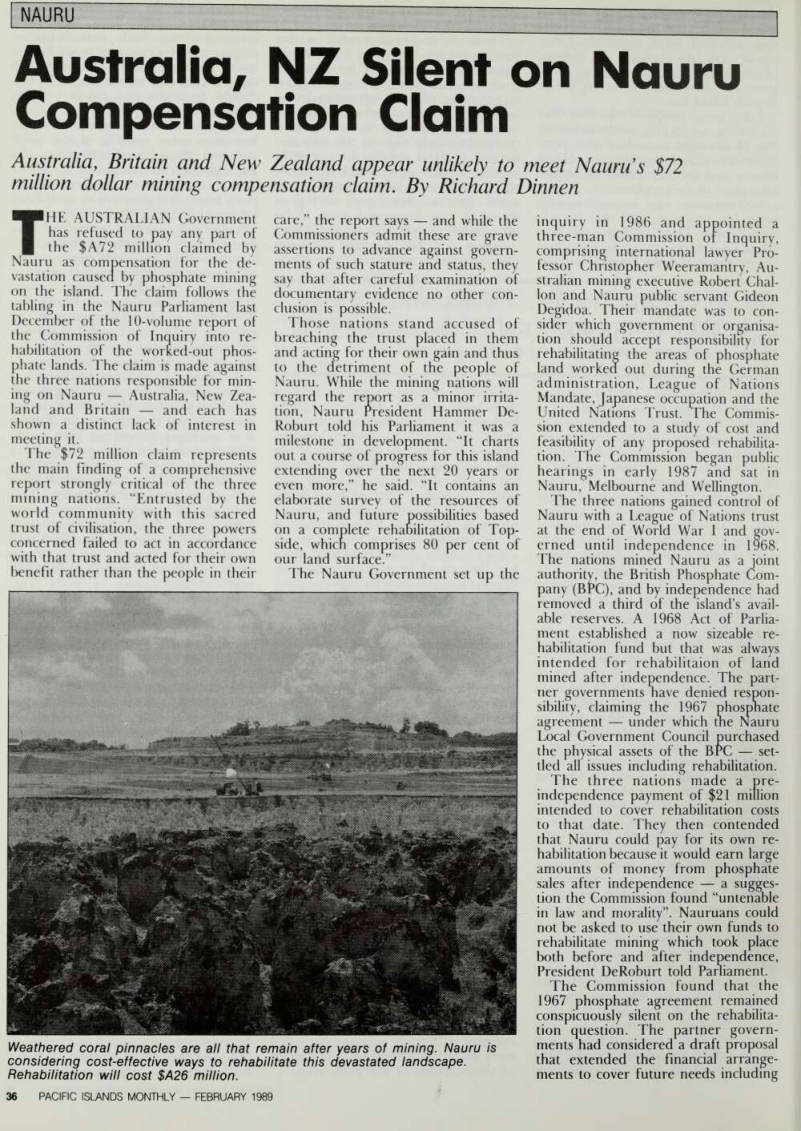
Nauru
Australia, NZ Silent on Nauru Compensation Claim
Australia, Britain and New Zealand appear unlikely to meet Nauru’s $72
million dollar mining compensation claim.
By Richard Dinnen
THE AUSTRALIAN Government has refused to pay any part of the SA72 million claimed by Nauru as compensation for the de
vastation caused by phosphate mining
on the island. The claim follows the tabling in the Nauru Parliament last December of the 10-volume report of the Commission of Inquiry into re habilitation of the worked-out phos phate lands. The claim is made against the three nations responsible for min ing on Nauru Australia, New Zea land and Britain and each has shown a distinct lack of interest in
meeting it.
The $72 million claim represents the main finding of a comprehensive report strongly critical of the three mining nations. “Entrusted by the world community with this sacred trust of civilisation, the three powers concerned failed to act in accordance with that trust and acted for their own benefit rather than the people in their
care,” the report says and while the Commissioners admit these are grave assertions to advance against govern ments of such stature and status, they say that after careful examination of documentary evidence no other con clusion is possible.
Those nations stand accused of breaching the trust placed in them and acting for their own gain and thus to the detriment of the people of Nauru. While the mining nations will regard the report as a minor irrita tion, Nauru President Hammer De- Roburt told his Parliament it was a milestone in development. “It charts out a course of progress for this island extending over the next 20 years or even more,” he said. “It contains an elaborate survey of the resources of Nauru, and future possibilities based on a complete rehabilitation of Top side, which comprises 80 per cent of our land surface.”
The Nauru Government set up the
inquiry in 1986 and appointed a three-man Commission of Inquiry,
comprising international lawyer Pro
fessor Christopher Weeramantry, Au
stralian mining executive Robert Chal lon and Nauru public servant Gideon Degidoa. Their mandate was to con sider which government or organisa tion should accept responsibility for rehabilitating the areas of phosphate land worked out during the German administration, League of Nations Mandate, Japanese occupation and the United Nations Trust. The Commis sion extended to a study of cost and feasibility of any proposed rehabilita tion. The Commission began public hearings in early 1987 and sat in Nauru, Melbourne and Wellington.
The three nations gained control of Nauru with a League of Nations trust at the end of World War I and gov erned until independence in 1968.
The nations mined Nauru as a joint authority, the British Phosphate Com pany (BPC), and by independence had removed a third of the island’s avail able reserves. A 1968 Act of Parlia ment established a now sizeable re habilitation fund but that was always intended for rehabilitaion of land mined after independence. The part ner governments nave denied respon
sibility, claiming the 1967 phosphate
agreement under which tne Nauru Local Government Council purchased the physical assets of the BPC set tled all issues including rehabilitation.
The three nations made a pre independence payment of $2l million intended to cover rehabilitation costs to that date. They then contended that Nauru could pay for its own re habilitation because it would earn large amounts of money from phosphate sales after independence a sugges tion the Commission found “untenable in law and morality”. Nauruans could not be asked to use their own funds to rehabilitate mining which took place both before and after independence, President Deßoburt told Parliament.
The Commission found that the 1967 phosphate agreement remained conspicuously silent on the rehabilita tion question. The partner govern ments had considered a draft proposal that extended the financial arrange ments to cover future needs including
Weathered coral pinnacles are all that remain after years of mining. Nauru is considering cost-effective ways to rehabilitate this devastated landscape.
Rehabilitation will cost $A26 million.
resettlement or rehabilitation. That this clause was not included in the fin al agreement, the Commission said, clearly shows there was no under standing that the agreement released the partner governments from the obligation to rehabilitate.
They have committed a violation of the obligations on Mandatory and Trustee powers in failing to restore mined out land to useful condition, the report said.
The question of responsibility for rehabilitation of land or relocation of the island’s 8000 residents has long been a hot issue. The Commission says
the former administering authority
was aware more than 20 years before the termination of the Trust that an alternative land area would have to be provided for Nauruans if rehabilita tion did not take place. “Despite its awareness of this fact, it continued to pursue a policy that progressively, and at an accelerated pace, rendered the island unfit for habitation,” said the
President. “The only possible justifica
tion for pursuing such a course of conduct despite its awareness of its re sults was a resolve to make good the damage done in one way or another.”
In distinguishing two stages re habilitation and development the Commissioners were careful to balance their stinging criticism of the partner
governments with what President De- Roburt described as a “heartening and yet realistic view of the opportunities for rehabilitation”. It had long been held that rehabilitation would be ridi culously expensive a view the Com mission finally lays to rest. It suggests modern machinery can be used to re move and crush limestone pinnacles,
allowing residual mining to take place.
The land can then be contourea and prepared for subsequent use. Some phosphate, crushed limestone, humus and nutrients can be used to produce
a topsoil eventually comparable with
that presently stockpiled on Topside.
Newly discovered groundwater could
be treated for irrigation use. The Commission injects an optimistic note with the assertion that rehabilitation will pave the way for a range of land uses. But the task ahead is a formid able one 80 per cent of Nauru’s land surface will have been rendered useless by 1990 and the total cost of rehabilitation is estimated at a mini mum of SA2I6 million.
“We are no longer visualising the
arrival of giant ships disgorging vast
amounts of soil culled from wherever in the world to fill the holes,” says President De Roburt. “Rather we see a
carefully designed program extending
over 20 years where natural soil ana
plant regeneration takes place at the
same time as secondary resource min ing and re-contouring. It should draw an enthusiastic response in what should be a truly national endeavour.”
No doubt Nauruans will be keen to share this vision and bring it to life.
Faced with a $72 million price tag, the partner governments are unlikely to share the enthusiasm.
Australian Foreign Affairs Minister Gareth Evans visited Nauru last
September and stated emphatically
that his country would make no furth er compensation payments. Australia has not altered its stance, and has told Nauru it will not be bound by the findings of the Commission.
Senator Evans reportedly believes the 1968 payment was a fair one, tak ing full account of Nauru’s future eco nomic needs including rehabilitation, and was fairly negotiated. Nauru also ‘benefited’ from the transfer by BPC of the then existing mining equipment and other assets at a ‘favourable price’.
Australia has argued that phosphate income brought to Nauru a standard of living far m excess of other island states. It is an assertion that illustrates the Australian Government’s myopic view of the region and tendency to ignore the environmental, social and health problems that may be con cealed in a ‘wide brown land’ but can not be ignored in the vast Pacific. □
Advertisements & other items, p. 37 (1 item)
Bali
TONGA
KIRIBATI
VANUATU
COOK ISLAND
SOLOMON ISLANDS
NEW CALEDONIA
U.S. SAMOA
WESTERN SAMOA
FRENCH POLYNESIA
JAPAN . KOREA
YOU’LL FIND IT,
WHERE THE SKY MEETS
THE SEA
m
RORO. CONTAINER &
B.BULK SHIPPING
BALI
HAL
AGENTS
and
PHONE
SUVA:Burns Philp(B P) 311 777 Carpenter Shipping (C S) 31 2244 LAUTOKA:B P 60777 C S 63988 APIA:B P 22611 PAGOPAGO Polynesia Shipping Services Ltd 633-1211 PAPEETE:Compagnie Maritime Polynesienne 42 84 02 NOUMEA:Etablissements Ballande 687-283384 VILA:B P 2456 SANTO:B P 230 HONlARA:Sullivans (Solomon Islands) Ltd 21645 TARAWA:Shipping Corporation of Kiribati 26195 NUKUALOFA:B P 21500 BUSAN:for general cargo Young Chang Shipping Co., Ltd 753-0451 for vehicle Pan Continental Shipping Co., Ltd 778-7680 Soyang Shipping Co., Ltd 752-7755 JAPAN:for general cargo Swire 03-230-9245 for vehicle NYK Lines 03-284-5506 Mitsui O S K 03-587-7123
Trade Winds
□ Nz Line Re-Flags Ships
NEW ZEALAND Line last month hi jacked its own ships in order to get rid of its own crews in a re-flagging op eration designed to make the Line attractive to buyers.
The crew of the huge container ves sel New Zealand Pacific was told to divert to Moorea where they were met by British officers and Spanish seamen who immediately took control of the ship after the crew refused to sign an employment agreements that would have maintained their wages but cut leave allowances. The ship was re named Tui and the Hong Kong flag was hoisted as it set off for Auckland where it was immobilised by union picket lines. The New Zealand Forum II met a similar fate in Port Moresby and was renamed Weka.
Both ships are now owned by sub
sidiary companies in Hong Kong
established by the government-owned
NZ Line. Directors say the reflagging which may serve the Line sNzll.6 million this year was the only way they could preserve buyer interest in the line. But the Australian National
Line (ANL), which had tendered to bu y NZ Line with existing manning practices, is now fighting to reverse td e rejection of its bid by the NZ Treasury. The bid reportedly was re jected after ANL refused to provide unconditional indemnity to pay NZ Lmes back-tax liabilities which could total more than SNZ2S million, n • ■ DAIJI , DDnciT
Tuvalu Bank Profit
THE NATIONAL Bank of Tuvalu has announced a pre-tax profit to De cember 31, 1987 of $500,107 down $16,205 on the record profit of 1986.
It was taken as a gooa result in the face of falling Australian dollar in terest rates.
The National Bank, 60 per cent owned by the Government and 40 per
cent by Westpac Banking Corporation,
relies for much of its funding on in vesting its surplus funds and sees the profit as a healthy per annum return of 42.3 per cent on average sharehol ders’ funds.
Steady expansion marked 1987,
with growth in savings account de posits of $528,000 and increased adv
ances of $433,000. Demand for fi nance was strong, home loans pre dominating with 43 per cent of all new loans Being for house building or renovation throughout Tuvalu.
Overseas investments were up $440,000 on the previous year.
□ Hawaii Bank Worth $6 Billion
BANKCORP Hawaii Inc, the parent company of Bank of Hawaii and the Hawaiian Trust Company Ltd, has re ported record earnings for the third quarter of 1988. Its total assets in creased 14.6 per cent in the twelve month period to SUS6.I4 billion, mak ing it the first financial institution in Hawaii to exceed $6 billion in assets.
The bank’s loans grew 20 per cent in the year to SUS3.7O billion, while deposits increased 13.6 per cent to a total of SUSS.6 billion.
□ Blue Lagoon Posts Profit
FIJI’S Blue Lagoon Cruises Ltd has
reported a trading profit of $F851,394
for the financial year ending in May 1988 despite last year’s dramatic tour ism slump. But chairman David Wil son told directors the biggest drop had been in passengers from the Us and Canada nad been caused by the lack of airline capacity from North America.
“The past financial year was certain ly the most difficult and commercially uncertain period any company in Fiji
is likely to experience, particularly for
those dependent on tourism,” said Mr Wilson. The sale of the MV Taleanda to an Australian company and its re placement by the $2.5 million MV Nanuya Princess had boosted pre-tax profit and accounted for a significant part of Blue Lagoon’s operations. The company operates six vessels from Lautoka providing a number of cruise options each week.
□ A3Lo For Air Niugini
AIR NIUGINI has taken delivery of its first Airbus A3lO-300 aircraft. The new jet carries 30 first class and 179 economy class passengers and is due to begin flights in March on routes from Port Moresby to Manila, Singa pore, Brisbane and Sydney. It replaces an A3OO B 4 aircraft leased from Au stralian Airlines.
“Our leased A3OO played a crucial role in establishing us as a profitable airline in a competitive market during the past few years,” says Mr Seefeld.
“We look forward to serving our pas sengers even better with the new Airous.” □
□ Hawaiian Airlines On Move
HAWAIIAN Airlines is planning major expansion with the sale of stock to a Japan Air Lines subsidiary, Pan Padr - ] f, . , cl u m w i 1k Hotels. Shareho ders have agreed . . i r on 8 to a stock increase of 20 per cent, „i• . • ’ making a huge capital injection. * 8 . . .P .tc K /- j * Approval by the US Government is txpec e o e or coming.
In 1987 the airline was to be so d to u j i r i market crash intervened and the deal collapsed: before the crash Hawaiian Airlines shares had been trading at ,, cat V , , Hawaiian sees two immediate benelits m the ink with J AL, apart from the new capita availability - the possib.litv of extending its routes to
secondary Japanese destinations such
as Okinawa, and the Japanese carrier s influence with Boeing ,f Hawaiian wants early delivery of new aircraft.
Meanwhile Hawaiian takes delivery January of another DCS from Scandmavian Airlines Systems (SAS). This may be used to increase frequency on Rights m the South Pacific. The DCS used on the long-haul runs between Honoltilu, Auckland and Sydney now also services the Auckland/Rarotonga route. Since Ansett ceased operating the Caook Island International Airways service on that run, the two destina-
tions have been linked by a Hawaiian
Jet (flying under air Rarotonga’s
name) mating a round trip to the Cook Islands every Wednesday.
Hawaiian Airlines uses LIOOI Tris tars for its US West Coast-Honolulu services, and Hies refurbished DCS jets to the South Pacific in a configuration of 16 first class and 194 economy seats. Apart from Sydney and Auck land, Hawaiian has landing rights at
Rarotonga, Apia, Pago Pago, Papeete
and Nutu’alofa.
However, aircraft shortages have meant that earlier plans to nave two llights a week out of Sydney have had to be shelved; by the end of October seats on the Friday flights to and from Sydney had been almost completely booked through to the end of January 1989, says Hawaiian’s Australian sales director, Gillian Harman.
Airline workers were surprised with their success in that after only nine
months up against highly competitive
airlines flying wide-bodiea jets,
Hawaiian’s old DCS has done very well. Hawaiian has built a successful business in small-lot air freight: it flies fresh food, cigarettes and other cargo into Pago Pago and Apia from Austra lia and New Zealand, and according to Ms Harman this traffic will be prom oted further in 1989.
Robin Bromby
□ Waste Conference
THE 1989 Pacific Basin Conference for Hazardous Waste Research will convene in Singapore from April 2-7.
The meeting follows the inaugural
conference field in February 1988, which identified common problems in managament of hazardous waste in the Pacific Basin. Organisers say the second meeting will review progress in waste disposal research and continue development of collaborative prog rams between member nations.
Training courses, technical papers, workshops and research planning ses sions are scheduled for the conference which is open to anyone involved in hazardous waste research and man agement. The training courses will be conducted by David Barnes of Sinclair Knight Partners, Australia, and Louis Theodore of Manhattan College in the United States.
Accommodation and social functions
are being arranged by the organisers,
the Pacific Basin Consortium for Hazardous Waste Research. Financial assistance is available to people wishing to attend from developing na tions.
□ Cooks Halt Fishing
THE Cook Islands Prime Minister Geoffrey Henry has asked the Japanese Government to cease all
fishing activity in Cook Islands waters, including trans-shipping, until a for mal fishing agreement has been negotiated. The Director of Fisheries Management, Colin Brown, says the move follows an estimated US$lOO,OOO loss last year from opera tions carried out in the Cook Islands by Japanese tuna boats.
Meanwhile Taiwan has sought per mission to establish a trans-shipping base in Rarotonga. But Department of Marine Resources officials have ex
pressed concern over possible
approaches to the private sector from the Taiwanese regarding storage and other facilities required for a trans shipping base. Taiwanese fishing boats have been observed using gill nets, a
practice strongly opposed by the Cook
Islands Government.
□ Fiji Tourism Up
FIJI could earn up to SF2OO million in foreign exchange from tourism this year, according to the outgoing chair man of the Fiji Visitors Bureau David Williams. Mr Williams says projections show at least 260,000 people will visit Fiji this year, a further increase on last yeaijs record 211,000. But Mr Wil liams said achieving the projected visi tor total and revenue will depend on
active participation and co-operation
by airlines and Fiji’s tourist industry
operators.
□ Anz Buys Bank
THE ANZ Bank has been given the go-ahead to buy the New Zealand Government-owned Post Office Bank.
ANZ announced its intention to buy Postbank last December for almost SNZSOO million. The NZ Commerce Commission has approved the sale and ownership will change hands late this month.
□ Qantas Changes
THE Australian international airline QANTAS has announced changes to its Trans-Pacific schedules whicn will see flights pass through Tahiti rather
than Fiji. Six QANTAS flights from
Australia to North America which formerly made transit stops in Fiji have been re-routed through Tahiti.
But QANTAS international relations manager David Callaghan says the changes will not adversely affect tour ism m Fiji. Mr Callaghan says the route changes were made to attract more American tourists to the West ern Pacific and traffic through Fiji’s Nadi Airport will not be affected. But resort operators in Fiji are concerned the new schedules will cut the number of Americans travelling to Fiji.
□ More Charges In Vanuatu
AS SACKED Vanuatu president Ati George Sokomanu and rebel MP Barak Sope await trial following last year’s failed coup, two of their sup porters have been sentenced to prison terms lor sabotage. McKenzie Kaloititi, son of the private secretarv to the for mer president, and Karie Kora, Sope’s bodvguard, have each been sentenced to 15 months jail for damaging and setting fire to rural radio stations on the island of Efate.
The two men failed to appear for sentencing and had to be brought to
the courtnouse by police. They were
released pending an appeal. Mr
Kaloititi also faces a further seven
months prison over damages to a
Burns Philp supermarket in Port Vila
last December.
Sokomanu and Sope are both in jail, ilong with four other men, awaiting trial on charges of sedition and incit ing mutiny. Sope staged a brief hun ger strike during January, but is eat-
again and reportedly in good
□ Panguna Unrest Continues
UNREST continues at the giant
Bougainville Copper Mine at Panguna
n Papua New Guinea’s North Solo
mons Province, prompting authorities
o impose a dusk-to-dawn curfew at he mmesite and in surrounding towns md villages. The curfew is enforced )y a force of 400 heavily-armed police.
The militant followers of Francis
Ona have been blamed for the unrest which began in December with a num ber of explosions which twice forced the mine to cease operations (see January Pacific Islands Monthly). Mr Ona’s followers are all local landown ers dissatisfied with the conservative leadership of their elders and intent on strongly pursuing increased com pensation from mine operators BCL for the use of their land and the dam
age caused by mining activity.
The landowners have waged a con tinuing campaign of harassment and sabotage in support of their com pensation demands. PNG Justice Minister Bernard Narakobi has ruled out the possibility of an amnesty for Ona in exchange for an end to the campaign. But the Minister did leave open tne option that Cabinet could direct police not to proceed with a prosecution if charges are laid.
□ Earhart Out Of Fuel
BRITISH air historian Rov Nesbit claims to have discovered evidence which suggests famed US aviator Amelia Earnart ran out of fuel and crashed about 50 kilometres short of Howland Island in the western Pacific on her round-the-world flight 50 vears ago.
Nesbit, a former RAF navigator, says he discovered a letter from Earhart to the British aviation author ities in which she wrote of her inten tion to carry 1000 US gallons of fuel on board her Lockheed Electra air craft for her 4100 km flight from Lae in Papua New Guinea to Howland Is lands. The Sydnev Daily Telegraph reported her navigator Fred Noonan as saying they would carry 950 gal lons.
According to fuel consumption fi gures supfdied by Lockheed, Nesbit says the twin-engined plane could have flown for 20 hours and 13 mi nutes on 950 gallons of fuel. Earharfs last radio message was received 20 hours and 20 minutes after takeoff, making it likely that she ran out of fuel soon afterward. She never arrived at Howland and no trace of her or the aircraft has ever been found.
□ Air Nz New Service
AIR NEW ZEALAND will begin direct flights between Sydney and Los Angeles on March 27 under new air rights granted after bilateral talks last year. Air NZ currently runs eight flights a week from Sydney to LA via Auckland. The new service will oper ate twice weekly via Honolulu using Boeing 747-200 aircraft. With the in troduction later this year of the 747- 400, Air NZ will operate non-stop Sydney-LA flights.
The changes are part of a shift of emphasis to the more lucrative busi ness market. □
Advertisements & other items, p. 39 (1 item)
Fbim Of The Fleet!
m PRI bunkers fishing vessels at Pago Pago Harbor.
When it comes to supplying top-quality marine products to boats and ships throughout the South Pacific, PRI is a “Friend of the Fleet”.
Whether it’s diesel fuel that keeps the ships at sea, or oil lubricants that keep the engines running smooth, PRI has it all.
When the fleet docks in American Samoa, PRI supplies the diesel fuel that keeps canneries like Starkist and Samoa Packing running too!
From Hawaii to Guam to American Samoa, Tonga and beyond, PRI systems bunkering means you always get the same consistent PRI service, value and quality wherever you purchase our products.
PRI-Pacific Resources, Inc. vW Powering the Pacific PRI SOUTH PACIFIC • GAS EXPRESS • HAWAIIAN INDEPENDENT REFINERY ©pr.sp.9B*
Pacific Report
Fisheries War Escalates
Japan is unlikely to pay higher prices for Pacific rights.
By Robin Bromby
fisheries war between the is f land states of the South Pacific
and Japan looks like intensify
ing. Tuvalu has followed Papua New Guinea’s lead in breaking an agree ment on the basis that the prices offered by the Japanese for using the waters of its 200-nautical-mile exclu sive economic zone are far too low.
There are now suggestions that in the coming tuna season some Japanese boats may attempt to fish illegally and will be arrested if caught.
Members of the Forum Fisheries Agency (FFA) are demanding better prices after having wrung an agree ment out of the United States, but the Japanese, who take about 235,000 ton nes of tuna out of Pacific waters, are showing no sign that they will accede to these demands. The dispute will almost certainly prove far more in tractable than that with the US tuna fleet. The Japanese have shown few signs in the past 25 years of conceding on financial and economic arrange ments, while Pacific leaders are show
ing signs of becoming increasingly
angry at Japanese intransigence and arrogance. FFA director Phillip Muller has gone on record as saying that South Pacific countries are expecting to have to seize Japanese vessels
fishing illegally this season.
Earlier this year the Americans signed an agreement that provides royalty payments to the Forum na tions. It followed years of illegal fishing by US boats and several arrests and heavy fines when island nations could catch the boats. The agreement was possible only because the Amer ican Government overruled the de mands of its own fishermen. But with the Japanese it is much harder to drive a wedge between business and government, to find the dividing line if, indeed, there is one. White the
Japanese have been adept at wringing
concessions for their products around
the world, they have proved equally
adroit at protecting their own indus tries from competition or what they
regard as heavy imposts.
Even if the Pacific countries get the Japanese to sign on the dotted line, that by itself may mean little. “They
probably won’t fish illegally, but they’ll
go into a treaty and then reinterpret it to their own needs just as they did in the coal agreement with Australia,”
says Dr Geoffrey Waugh, formerly a
senior economist with the FFA in Homara and now lecturing at the University of New South Wales. “It’s hard
to break through Japanese industry
and get to the government.” He says another problem is that many fishing boats operate on marginal return and that Japan cannot afford to pay a similar royalty to the Americans without drastically rationalising its fleet (now between 800 and 1000 boats), There is also the possibility Japanese fishermen would underreport their catch after the agreement was signed.
What the Japanese do and what they say can cause confusion: in 1986, then-foreign minister Tadashi Kuranari said his country was eager to promote stability and development in the South Pacific region but both Tuvalu and Papua New Guinea have withdrawn fishing rights after the Japanese refused to pay what those
countries considered a fair source ren tal. The Japanese company, C Itoh, also pulled out of the troubled Levuka cannery when its initial agreement with the Fiji government lapsed.
Tokyo has already refused to open negotiations with the FFA countries; the Pacific states, many of which see fish as their main economic resource and greatest opportunity for impro ving their people s lot, want a regional fishing deal. Both sides seem to be digging in for the long haul.
The one wild card is whether as happened at the height of the dispute with the American tuna men the Soviet Union approaches any of the island states with an attractive offer
for fishing rights. Though not popu
lar in the region, the USSR at least has a reputation for honouring com mercial arrangements and not fishing
illegally. □
Advertisements & other items, p. 41 (1 item)
Aggie Grey’s
Hotel
Stay at Aggie Grey’s
the South Pacific’s
legendary hotel.
Situated right in the heart of Western Samoa. Enjoy Polynesian style friendliness and service.in'cool surroundings, superb entertainment and food Magnificent white sand beaches only a short drive away.
Air-conditioned rooms, swimming pool and full bar facilities.
Bookings through Union Steamship Company of NZ Pan Am. Air New Zealand or direct to Aggie Grev’s. Apia Western Samoa Cables: AGGIES’ Apia
FOR SALE
EX-AUSTRALIAN GOVERNMENT
Ex Australian Government Bulldozers Cranes Tractors Post Hole Borers - Forklifts Loaders Loaders backhoes Elevating Platforms Trenchers Road Graders Road Rollers Garbage Compactors Street Sweepers Excavators 4x4 x 6x6 Heavy Duty Trucks Generators Compressors Prime Movers etc.
'Low Kim Low Hr Units
COUSINS TRUCK & MACHINERY SALES
P.O. BOX 191 ARCHERFIELD
BRISBANE OLD 4108
PHONE (07) 277 1822
FAX (07) 274 1389
TO
Pacific Islands Monthly
READERS
Pacific Press announces the publication of LAST FRONTIERS:
THE EXPLORATIONS OF IVAN
CHAMPION OF PAPUA
by james Sinclair Each copy of this limited and numbered edition of 1000 copies includes a commemorative bookplate signed by Ivan Champion, OBE, and james Sinclair. Published by Pacific Press, 17 Park Avenue, Broadbeach Waters, Queensland Australia 4128.
LAST FRONTIERS is available to P/M readers at a special reduced price until 31 January 1989. Instead of the regular price of SABS (SUS 72), P/M readers who enclose the review on Page 48 with their payment can purchase Last Frontiers for the pre-publication price of SA69 (SUSSB) plus postage and handling (Australia SAS; Asia/Oceania SAB or SUS 7; other countries SAIO or SUS 9).
The Island Press
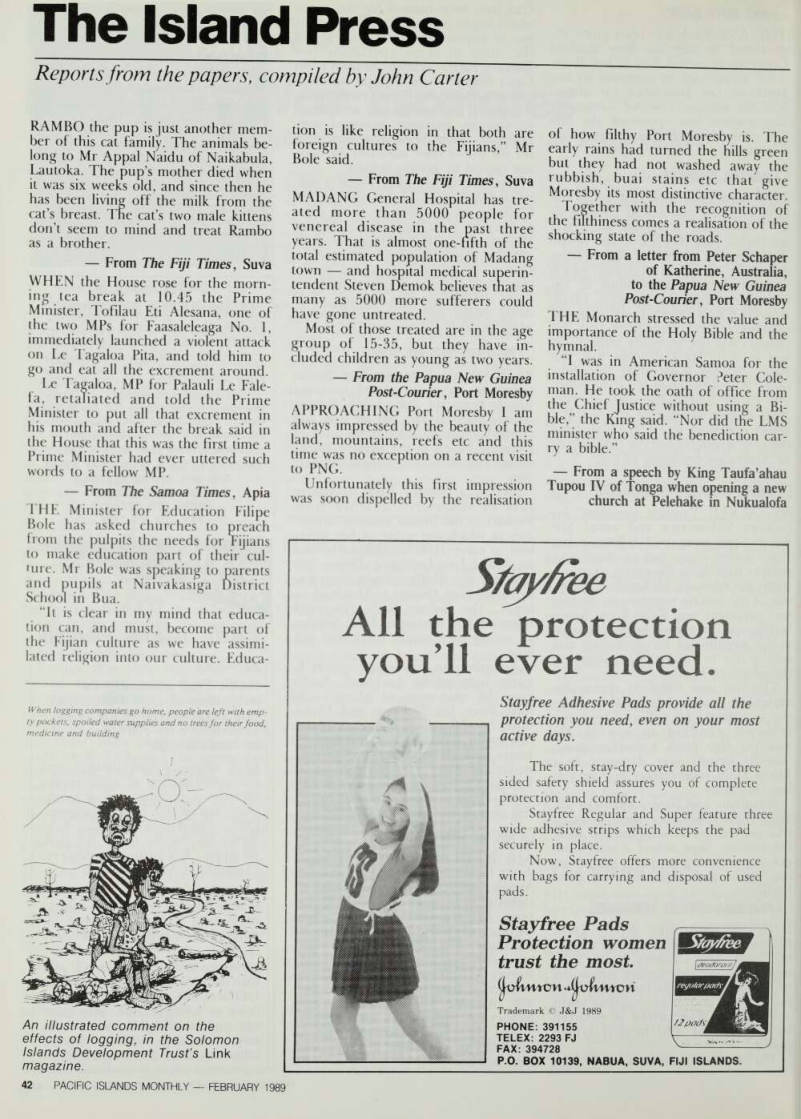
Reports from the papers, compiled by John Carter
RAM BO the pup is just another mem ber of this cat family. The animals be long to Mr Appal Naidu of Naikabula, Lautoka. The pup’s mother died when it was six weeks old, and since then he has been living off the milk from the cat’s breast. The cat’s two male kittens don’t seem to mind and treat Rambo as a brother.
From The Fiji Times , Suva WHEN the House rose for the morn ing tea break at 10.45 the Prime Minister, Tofilau Eti Alesana, one of the two MPs for Faasaleleaga No. 1, immediately launched a violent attack on Le Tagaloa Pita, and told him to go and eat all the excrement around.
Le Tagaloa, MP for Palauli Le Fale fa, retaliated and told the Prime Minister to put all that excrement in his mouth and after the break said in the House that this was the first time a Prime Minister had ever uttered such words to a fellow MP.
From The Samoa Times , Apia THE Minister for Education Filipe Bole has asked churches to preach from the pulpits the needs for Fijians to make education part of their cul ture. Mr Bole was speaking to parents and pupils at Naivakasiga District School in Bua.
“It is clear in my mind that educa tion can, and must, become part of the Fijian culture as we have assimi lated religion into our culture. Educa
tion is like religion in that both are foreign cnltnres to the Fijians,” Mr Bole said.
From The Fiji Times, Suva MADANG General Hospital has treated more than 5000 people for venereal disease in the past three years. That is almost one-fifth of the total estimated population of Madang town and hospital medical superintendent Steven Demok believes tnat as many as 5000 more sufferers could have gone untreated.
Most of those treated are m the age group of 15-35, but they have ineluded children as young as two years.
From the Papua New Guinea Post-Courier, Port Moresby APPROACHING Port Moresby I am always impressed by the beauty of the land, mountains, reefs etc and this time was no exception on a recent visit to PNG.
Unfortunately this first impression
was soon dispelled by the realisation
of how filthy Port Moresby is The early rains had turned the hills green but they had not washed away the rubbish, buai stains etc that give M ° resb y, its most distinctive character, .. r?5 ther Wlth the recognition of u V ' lness c °mes a realisation of the shockm S state of tbe roads, From a letter from Peter Schaper of Katherine, Australia, to the Papua New Guinea Post-Courier, Port Moresby THE Monarch stressed the value and importance of the Holy Bible and the
hymnal.
“I was in American Samoa for the installation of Governor Peter Cole man - He took the oath of office from w®- C ,usd USti “/«M° Ua , wc •’ • e K / n 8 sal . c . N . or cb , tbe mm'stM w fi o sald the benedlctlon car .
From a speech by King Taufa’ahau Tupou IV of Tonga when opening a new church at Pelehake in Nukualofa
Advertisements & other items, p. 42 (1 item)
Stay/ree
All the protection
you’ll ever need.
Stayfree Adhesive Pads provide all the protection you need , even on your most active days.
The soft, stay-dry cover and the three sided safety shield assures you of complete protection and comfort.
Stayfree Regular and Super feature three wide adhesive strips which keeps the pad securely in place.
Now, Stayfree offers more convenience with bags for carrying and disposal of used pads.
Stayfree Pads
Protection women trust the most Trademark © J&J 1989
PHONE: 391155
TELEX; 2293 FJ
FAX: 394728 x
P.O. BOX 10139, NABUA, SUVA, FIJI ISLANDS.
When logging companies go home, people are left with empty pockets, spoiled water supplies and no trees for their food, medicine and building & An illustrated comment on the effects of logging, in the Solomon Islands Development Trust’s Link magazine.
Transition
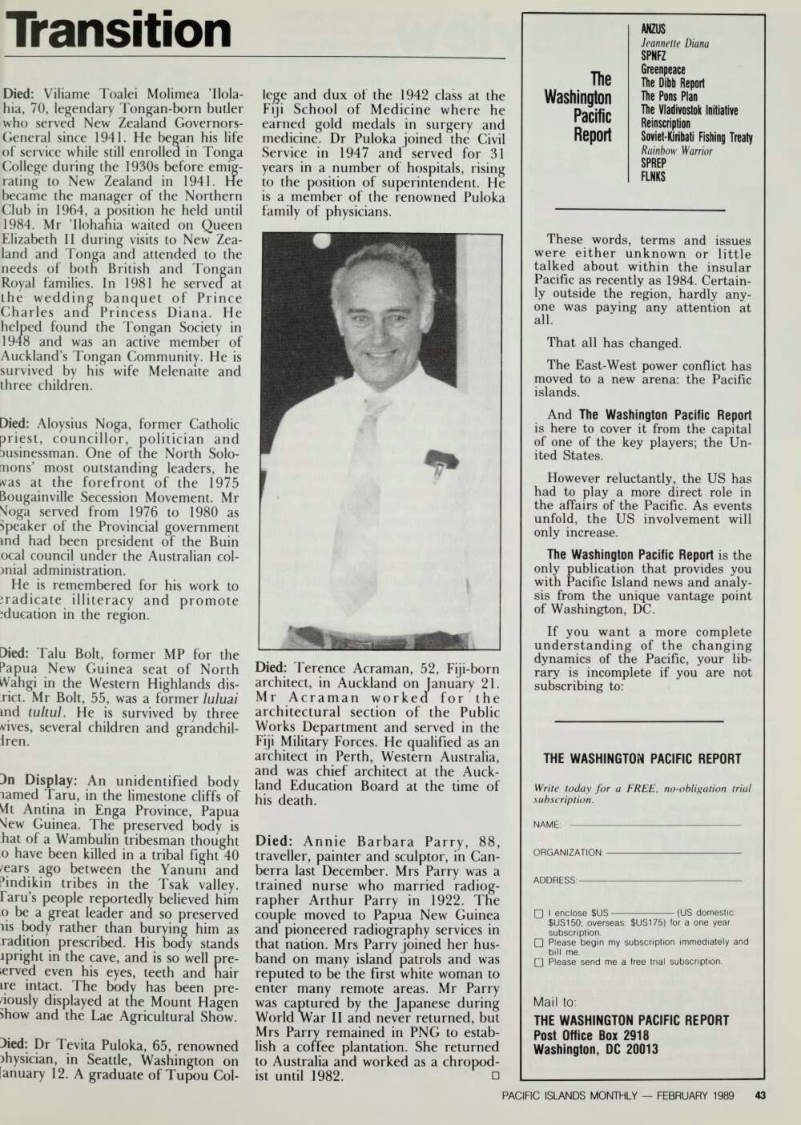
Died: Viliame Toalei Molimea ’llola hia, 70, legendary Tongan-born butler who served New Zealand Governors- General since 1941. He began his life of service while still enrolled in Tonga College during the 1930 s before emig rating to New Zealand in 1941. He became the manager of the Northern Club in 1964, a position he held until 1984. Mr ’llohahia waited on Queen Elizabeth II during visits to New Zea land and Tonga and attended to the needs of both British and Tongan Royal families. In 1981 he served at the wedding banquet of Prince Charles ana Princess Diana. He helped found the Tongan Society in 1948 and was an active member of Auckland’s Tongan Community. He is survived by his wife Melenaite and three children.
Died: Aloysius Noga, former Catholic priest, councillor, politician and businessman. One of the North Solo mons’ most outstanding leaders, he was at the forefront of the 1975 Bougainville Secession Movement. Mr Voga served from 1976 to 1980 as Speaker of the Provincial government md had been president of the Buin ocal council under the Australian col onial administration.
He is remembered for his work to
eradicate illiteracy and promote
education in the region.
Died: Talu Bolt, former MP for the Papua New Guinea seat of North Wahgi in the Western Highlands dis net. Mr Bolt, 55, was a former luluai md tultul. He is survived by three wives, several children and grandchil dren.
Dn Display: An unidentified body lamed Taru, in the limestone cliffs of Vlt Antina in Enga Province, Papua Guinea. The preserved body is hat of a Wambulin tribesman thought o have been killed in a tribal fight 40 /ears ago between the Yanum and 3 indikin tribes in the Tsak valley.
Faru’s people reportedly believed him
q be a great leader and so preserved lis body rather than burying him as radition prescribed. His body stands ipright in the cave, and is so well pre served even his eyes, teeth and hair ire intact. The body has been pre viously displayed at the Mount Hagen >how and the Lae Agricultural Show.
Died: Dr Tevita Puloka, 65, renowned ihysician, in Seattle, Washington on fanuary 12. A graduate of Tupou Col
lege and dux of the 1942 class at the Fiji School of Medicine where he earned gold medals in surgery and medicine. Dr Puloka joined the Civil Service in 1947 and served for 31 years in a number of hospitals, rising to the position of superintendent. He is a member of the renowned Puloka
family of physicians.
Died: Terence Acraman, 52, Fiji-born architect, in Auckland on January 21.
Mr Acraman workedf for the architectural section of the Public Works Department and served in the Fiji Military Forces. He qualified as an architect in Perth, Western Australia, and was chief architect at the Auck land Education Board at the time of his death.
Died: Annie Barbara Parry, 88, traveller, painter and sculptor, in Can berra last December. Mrs Parry was a trained nurse who married radiog rapher Arthur Parry in 1922. The couple moved to Papua New Guinea and pioneered radiography services in that nation. Mrs Parry joined her hus band on many island patrols and was reputed to be the first white woman to enter many remote areas. Mr Parry
was captured by the Japanese during
World War II and never returned, but Mrs Parry remained in PNG to estab lish a coffee plantation. She returned to Australia and worked as a chiropod ist until 1982. □
Advertisements & other items, p. 43 (1 item)
Washington
ANZUS
Jeannette Diana
SPNFZ
Greenpeace The Dibb Report The Pons Plan The Vladivostok Initiative Reinscription Soviet-Kinbati Fishing Treaty Rainbow Warrior
SPREP
FINKS
These words, terms and issues were either unknown or little talked about within the insular Pacific as recently as 1984. Certainly outside the region, hardly anyone was paying any attention at all.
That all has changed.
The East-West power conflict has moved to a new arena; the Pacific islands.
And The Washington Pacific Report is here to cover it from the capital of one of the key players; the United States.
However reluctantly, the US has had to play a more direct role in the affairs of the Pacific. As events unfold, the US involvement will only increase.
The Washington Pacific Report is the only publication that provides you with Pacific Island news and analysis from the unique vantage point of Washington, DC.
If you want a more complete understanding of the changing dynamics of the Pacific, your library is incomplete if you are not subscribing to:
THE WASHINGTON PACIFIC REPORT
Write today for a FREE, no-obligation trial subscription.
NAME;
ORGANIZATION:
ADDRESS:
□ I enclose SUS (US domestic: SUSISO; overseas: SUSI7S) for a one year subscription. □ Please begin my subscription immediately and bill me. □ Please send me a free trial subscription.
Mail to;
THE WASHINGTON PACIFIC REPORT
Post Office Box 2918 Washington, DC 20013
The
Washington
Pacific
Report
Book Review
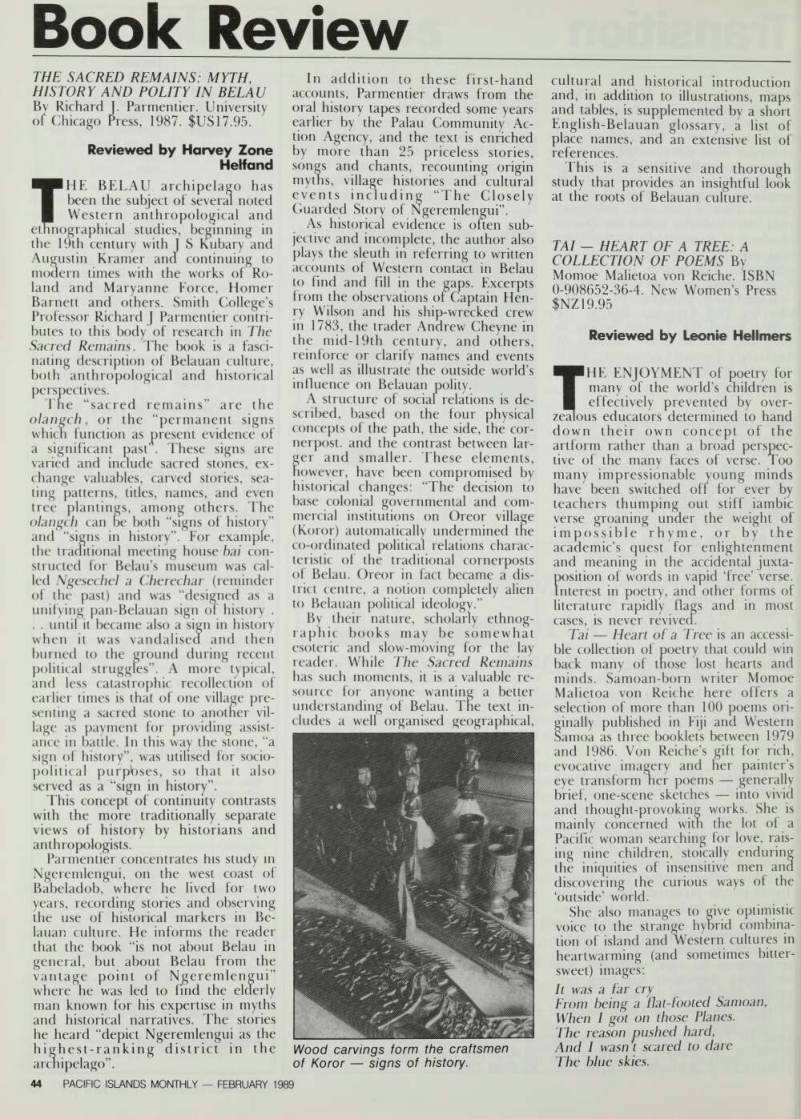
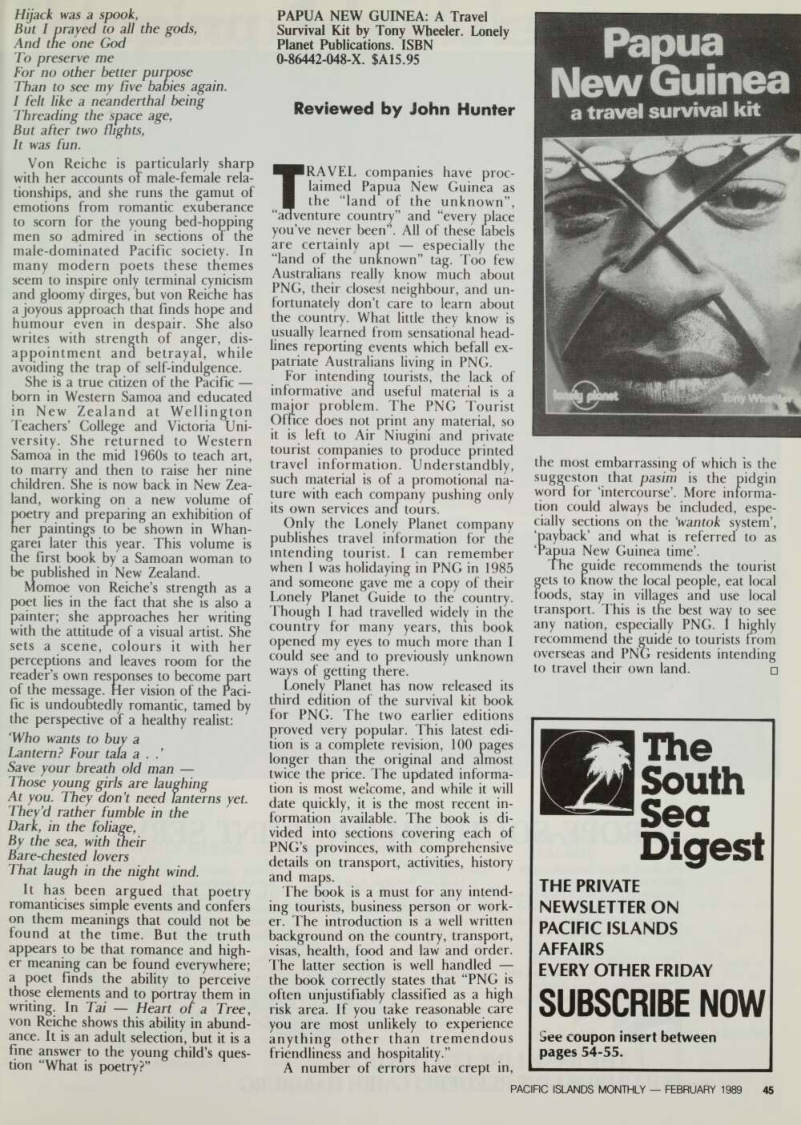
The Sacred Remains: Myth,
History And Polity In Belau
By Richard J. Parmentier. University of Chicago Press, 1987. $US 17.95.
Reviewed by Harvey Zone Helfand «HE BELAU archipelago has been the subject of several noted
Western anthropological and
ethnographical studies, beginning in
the 19th century with J S Kubary and Augustin Kramer ana continuing to modern times with the works of Ro land and Maryanne Force, Homer Barnett and others. Smith College’s Professor Richard J Parmentier contri butes to this body of research in The Sacred Remains. The book is a fasci nating description of Belauan culture, both anthropological and historical
perspectives.
The “sacred remains” are the
olangch, or the “permanent signs
whicn function as present evidence of a significant past . These signs are varied and include sacred stones, ex change valuables, carved stories, sea ting patterns, titles, names, and even tree plantings, among others. The olangch can be both “signs of history” and “signs in history”. For example, the traditional meeting house bai con structed for Belau’s museum was cal led Ngesechel a Cherechar (reminder of the past) and was “designed as a
unifying pan-Belauan sign of history .
. . until it became also a sign in history when it was vandalised and then burned to the ground during recent
political struggles”. A more typical,
and less catastrophic recollection of earlier times is that of one village pre senting a sacred stone to another vil lage as payment for providing assist ance in battle. In this way the stone, “a sign of history”, was utilised for socio political purpbses, so that it also served as a “sign in history”.
This concept of continuity contrasts with the more traditionally separate views of history by historians and
anthropologists.
Parmentier concentrates his study in Ngeremlengui, on the west coast of Babeladob, where he lived for two years, recording stories and observing the use of historical markers in Be lauan culture. He informs the reader that the book “is not about Belau in general, but about Belau from the
vantage point of Ngeremlengui”
where he was led to find the elderly man known for his expertise in myths and historical narratives. The stories he heard “depict Ngeremlengui as the highest-ranking district in the
arcnipelago”.
In addition to these first-hand accounts, Parmentier draws from the oral history tapes recorded some years earlier by the Palau Community Ac tion Agency, and the text is enriched by more than 25 priceless stories, songs and chants, recounting origin mytns, village histories and cultural
events including “The Closely
Guarded Story of Ngeremlengui”.
As historical evidence is often sub jective and incomplete, the author also plays the sleuth in referring to written accounts of Western contact in Belau to find and fill in the gaps. Excerpts from the observations of Captain Hen ry Wilson and his ship-wrecked crew in 1783, the trader Andrew Cheyne in the mid-19th century, and others, reinforce or clarify names and events as well as illustrate the outside world’s influence on Belauan polity.
A structure of social relations is de scribed, based on the four physical concepts of the path, the side, the cor nerpost. and the contrast between lar ger and smaller. These elements,
however, have been compromised by
historical changes: “The decision to base colonial governmental and com mercial institutions on Oreor village (Koror) automatically undermined the co-ordinated political relations charac teristic of the traditional cornerposts of Belau. Oreor in fact became a dis trict centre, a notion completely alien
to Belauan political ideology.”
By their nature, scholarly ethnog
raphic books may be somewhat esoteric and slow-moving for the lay reader. While The Sacred Remains has such moments, it is a valuable re source for anyone wanting a better understanding of Belau. The text in cludes a well organised geographical,
cultural and historical introduction and, in addition to illustrations, maps and tables, is supplemented by a short English-Belauan glossary, a list of place names, and an extensive list of references.
This is a sensitive and thorough
study that provides an insightful look
at the roots of Belauan culture.
TAI - HEART OF A TREE: A
Collection Of Poems By
Momoe Malietoa von Reiche. ISBN 0-908652-36-4. New Women’s Press $NZ19.95 Reviewed by Leonie Hellmers VHE ENJOYMENT of poetry for S many of the world’s children is
I effectively prevented by over
zealous educators determined to hand down their own concept of the artform rather than a broad perspec tive of the many faces of verse. Too many impressionable young minds have been switched off for ever by teachers thumping out stiff iambic verse groaning under the weight of
impossible rhyme, or by the
academic’s quest for enlightenment and meaning in the accidental juxta position of words in vapid ‘free’ verse.
Interest in poetry, and other forms of literature rapidly flags and in most cases, is never revived.
Tai Heart of a Tree is an accessi ble collection of poetry that could win back many of those lost hearts and minds. Samoan-born writer Momoe Malietoa von Reiche here offers a selection of more than 100 poems ori
ginally published in Fiji and Western
§amoa as three booklets between 1979 and 1986. Von Reiche’s gift for rich, evocative imagery and her painter’s eye transform ner poems generally brief, one-scene sketches into vivid and thought-provoking works. She is mainly concerned with the lot of a Pacific woman searching for love, rais ing nine children, stoically enduring the iniquities of insensitive men and discovering the curious ways of the ‘outside’ world.
She also manages to give optimistic voice to the strange hybrid combina tion of island and Western cultures in heartwarming (and sometimes bitter
sweet) images;
It was a far cry From being a flat-footed Samoan, When I got on those Planes.
The reason pushed hard, And I wasnt scared to dare The blue skies.
Wood carvings form the craftsmen of Koror - signs of history.
Hijack was a spook,
But I prayed to all the gods, And the one God To preserve me For no other better purpose Than to see my Five babies again.
I felt like a neanderthal being Threading the space age, But after two flights, It was fun.
Von Reiche is particularly sharp with her accounts of male-female rela tionships, and she runs the gamut of emotions from romantic exuberance to scorn for the young bed-hopping men so admired in sections of the male-dominated Pacific society. In many modern poets these themes
seem to inspire only terminal cynicism
and gloomy dirges, but von Reiche has a joyous approach that finds hope and humour even in despair. She also writes with strength of anger, dis
appointment and betrayal, while
avoiding the trap of self-indulgence.
She is a true citizen of the Pacific born in Western Samoa and educated in New Zealand at Wellington Teachers’ College and Victoria Uni versity. She returned to Western Samoa in the mid 1960 s to teach art, to marry and then to raise her nine children. She is now back in New Zea land, working on a new volume of poetry and preparing an exhibition of her paintings to be shown in Whan garei later this year. This volume is the first book by a Samoan woman to be published in New Zealand.
Momoe von Reiche’s strength as a poet lies in the fact that she is also a
painter; she approaches her writing
with the attitude of a visual artist. She sets a scene, colours it with her perceptions and leaves room for the reader’s own responses to become part of the message. Her vision of the Paci fic is undoubtedly romantic, tamed by the perspective of a healthy realist: ‘Who wants to buy a Lantern? Four tala a .
Save your breath old man Those young girls are laughing At you. They don’t need lanterns yet.
Thev’d rather fumble in the Dark, in the foliage, By the sea, with their Bare-chested lovers That laugh in the night wind.
It has been argued that poetry romanticises simple events and confers on them meanings that could not be found at the time. But the truth appears to be that romance and high er meaning can be found everywhere; a poet finds the ability to perceive those elements and to portray them in writing. In Tai Heart of a Tree, von Reiche shows this ability in abund ance. It is an adult selection, but it is a fine answer to the young child’s ques tion “What is poetry?”
Papua New Guinea: A Travel
Survival Kit by Tony Wheeler. Lonely Planet Publications. ISBN 0-86442-048-X. $A15.95 Reviewed by John Hunter companies have proc |i laimed Papua New Guinea as H| the “land of the unknown”,
“aoventure country” and “every place
you’ve never been. All of these labels
are certainly apt especially the
“land of the unknown” tag. Too few Australians really know much about PNG, their closest neighbour, and un fortunately don’t care to learn about the country. What little they know is usually learned from sensational head lines reporting events which befall ex patriate Australians living in PNG.
For intending tourists, the lack of informative and useful material is a major problem. The PNG Tourist Office does not print any material, so it is left to Air Niugim and private
tourist companies to produce printed
travel information. Understandbly, such material is of a promotional na ture with each company pushing only its own services and tours.
Only the Lonely Planet company publishes travel information for the intending tourist. I can remember when I was holidaying in PNG in 1985 and someone gave me a copy of their Lonely Planet Guide to the country.
Though I had travelled widely in the country for many years, this book opened my eyes to much more than I could see and to previously unknown ways of getting there.
Lonely Planet has now released its third edition of the survival kit book for PNG. The two earlier editions proved very popular. This latest edi tion is a complete revision, 100 pages longer than the original and almost twice the price. The updated informa tion is most welcome, and while it will date quickly, it is the most recent in formation available. The book is di vided into sections covering each of
PNG’s provinces, with comprehensive
details on transport, activities, history and maps.
The book is a must for any intend ing tourists, business person or work er. The introduction is a well written background on the country, transport, visas, health, food and law and order.
The latter section is well handled the book correctly states that “PNG is often unjustifiably classified as a high risk area. If you take reasonable care you are most unlikely to experience anything other than tremendous friendliness and hospitality.”
A number of errors have crept in,
the most embarrassing of which is the suggeston that pasim is the pidgin word for ‘intercourse’. More informa tion could always be included, espe cially sections on the wantok system’, ‘payback’ and what is referred to as ‘Papua New Guinea time’.
The guide recommends the tourist gets to know the local people, eat local foods, stay in villages and use local transport. This is the best way to see any nation, especially PNG. I highly recommend the guide to tourists from overseas and PNG residents intending to travel their own land. □
Advertisements & other items, pp. 45-46 (1 item)
Papua
New Guinea a travel survival kit
Hie
South
Sea
Digest
THE PRIVATE
NEWSLETTER ON
PACIFIC ISLANDS
AFFAIRS
EVERY OTHER FRIDAY
SUBSCRIBE NOW
See coupon insert between pages 54-55.
YOUR DIRECT EUROPEAN CONNECTION
If
EUROPE-SOUTH PACIFIC JOINT SERVICE
The South Pacific Specialists offer facilities for shipment of: Containers (FCL/LCL) and Breakbulk Cargo plus reefer space and deeptanks for carriage of vegetable oils and other liquid bulk cargo.
Carriers also accept heavy lifts, overlength and cumbersome parcels.
Ports of Service: Please contact our regional offices for Loading: Papeete, Apia, Suva, further information: Lautoka, Noumea, Port Vila, Santo, The Bank Line (Australasia) Pty. Ltd.
Honiara, Port Moresby, Lae,Madang, Suite 701, 51 Pitt Street Kimbe, Rabaul, Kieta, Darwin. Sydney N.S.W. 2000 For: Rotterdam, Antwerp, Phone: 251 6688 Telex; 24063 Hamburg, Hull, Dunkirk, Le Havre.
Additional ports on enquiry.
Columbus Line Reederei GmbH P.O. Box 1667
ROUND THE WORLD SERVl^k^
A H. 42 2481 Telex: Colline NE 44 171
THE BANK LINE LTD LONDON
COLUMBUS LINE REEDEREI GMBH HAMBURG
C0L0024
Shipping Schedules
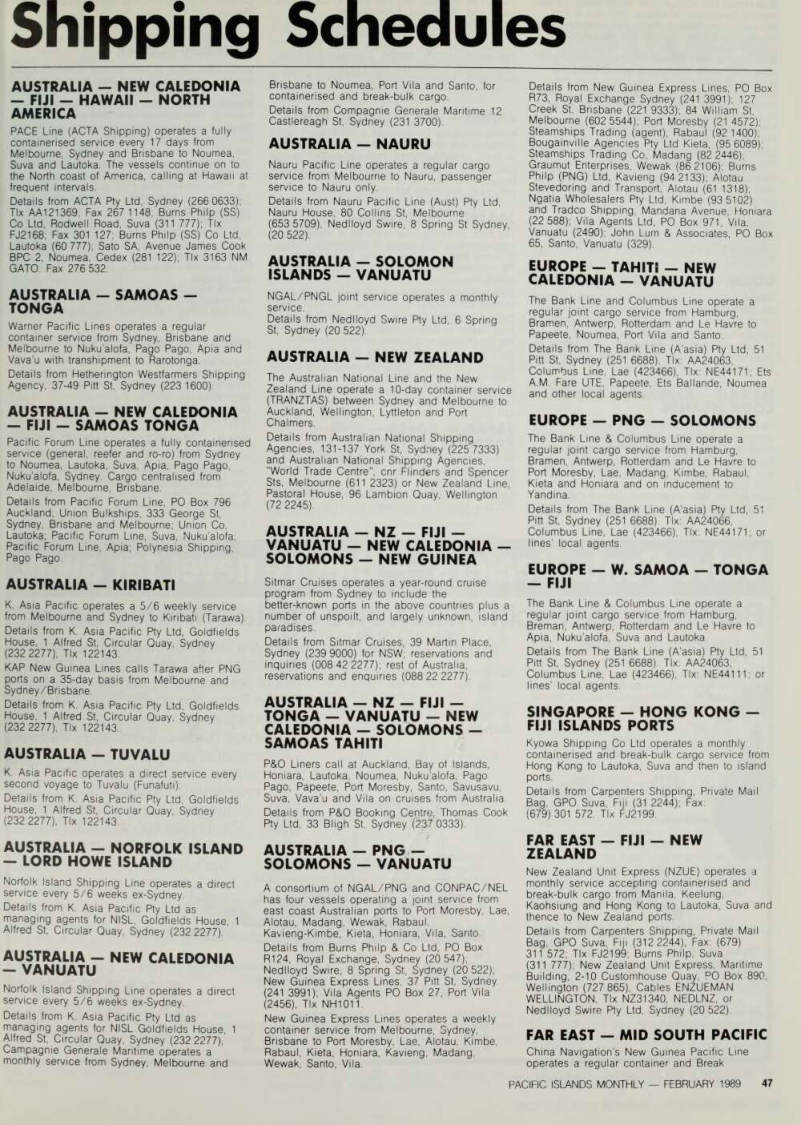
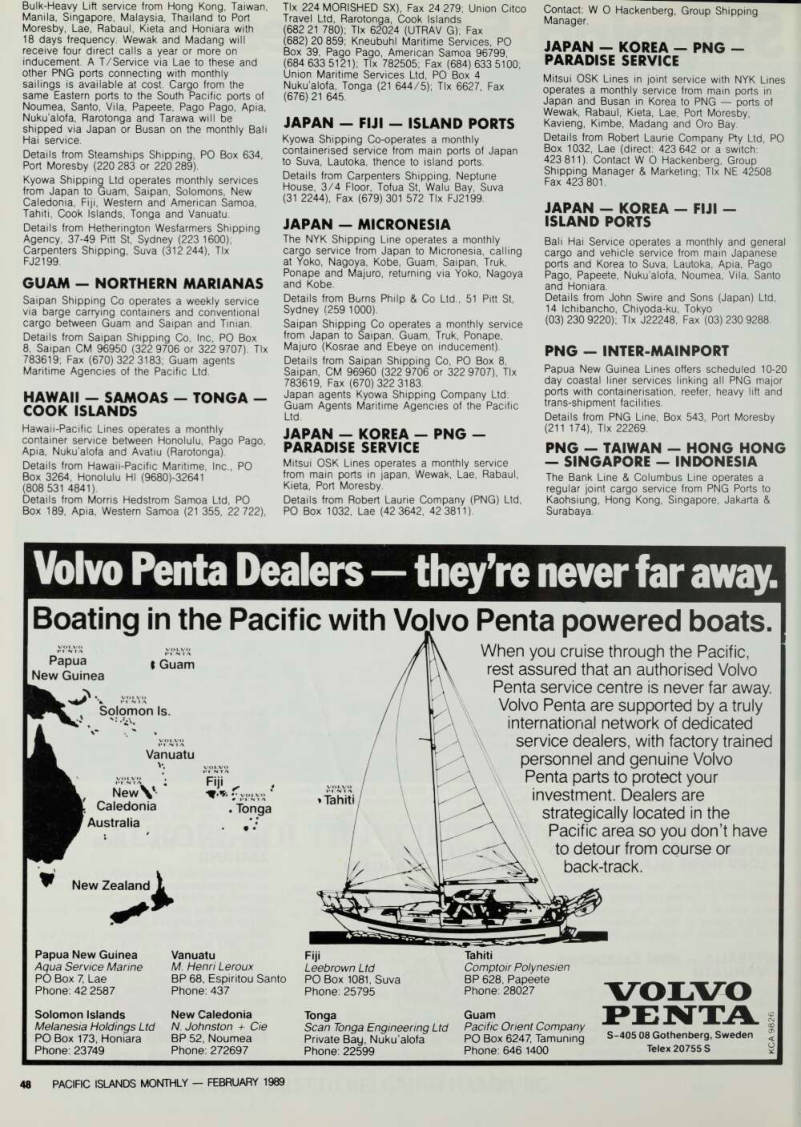
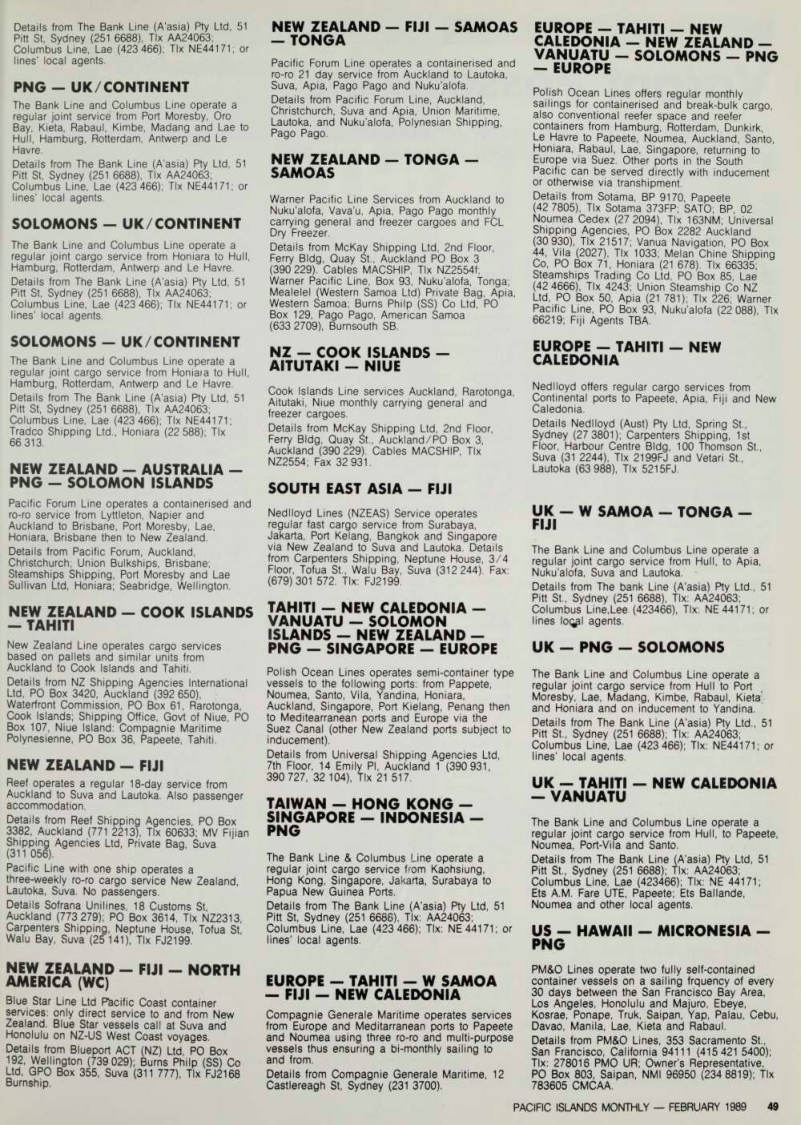
Australia - New Caledonia
- Fiji - Hawaii - North
America
PACE Line (ACTA Shipping) operates a fully containerised service every 17 days from Melbourne, Sydney and Brisbane to Noumea, Suva and Lautoka. The vessels continue on to the North coast of America, calling at Hawaii at frequent intervals.
Details from ACTA Pty Ltd, Sydney (266 0633); Tlx AA121369; Fax 267 1148; Burns Philp (SS) Co Ltd, Rodwell Road, Suva (311 777); Tlx FJ2168; Fax 301 127; Burns Philp (SS) Co Ltd, Lautoka (60 777); Sato SA, Avenue James Cook BPC 2, Noumea, Cedex (281 122); Tlx 3163 NM
Gato, Fax 276 532.
Australia - Samoas -
Tonga
Warner Pacific Lines operates a regular container service from Sydney, Brisbane and Melbourne to Nukualofa, Pago Pago, Apia and Vava’u with transhipment to Rarotonga.
Details from Hetherington Westfarmers Shipping Agency, 37-49 Pitt St, Sydney (223 1600).
Australia - New Caledonia
- Fiji - Samoas Tonga
Pacific Forum Line operates a fully containerised service (general, reefer and ro-ro) from Sydney to Noumea, Lautoka, Suva, Apia, Pago Pago, Nukualofa, Sydney. Cargo centralised from Adelaide, Melbourne, Brisbane, Details from Pacific Forum Line, PO Box 796 Auckland; Union Bulkships, 333 George St, Sydney, Brisbane and Melbourne; Union Co, Lautoka; Pacific Forum Line, Suva, Nuku'alofa; Pacific Forum Line, Apia; Polynesia Shipping, Pago Pago.
Australia Kiribati
K. Asia Pacific operates a 5/6 weekly service from Melbourne and Sydney to Kiribati (Tarawa).
Details from K. Asia Pacific Pty Ltd, Goldfields House, 1 Alfred St, Circular Quay, Sydney (232 2277), Tlx 122143.
KAP New Guinea Lines calls Tarawa after PNG ports on a 35-day basis from Melbourne and Sydney/Brisbane.
Details from K. Asia Pacific Pty Ltd, Goldfields House, 1 Alfred St, Circular Quay, Sydney (232 2277), Tlx 122143.
Australia Tuvalu
K. Asia Pacific operates a direct service every second voyage to Tuvalu (Funafuti).
Details from K. Asia Pacific Pty Ltd, Goldfields House, 1 Alfred St, Circular Quay, Sydney (232 2277), Tlx 122143.
Australia Norfolk Island
- Lord Howe Island
Norfolk Island Shipping Line operates a direct service every 5/6 weeks ex-Sydney.
Details from K. Asia Pacific Pty Ltd as managing agents for NISL, Goldfields House 1 Alfred St, Circular Quay, Sydney (232 2277).
Australia New Caledonia
- Vanuatu
Norfolk Island Shipping Line operates a direct service every 5/6 weeks ex-Sydney.
Details from K. Asia Pacific Pty Ltd as managing agents for NISL Goldfields House, 1 Alfred St, Circular Quay, Sydney (232 2277), Campagnie Generale Maritime operates a monthly service from Sydney, Melbourne and
Brisbane to Noumea, Port Vila and Santo, for containerised and break-bulk cargo.
Details from Compagnie Generale Maritime 12 Castlereagh St, Sydney (231 3700).
Australia Nauru
Nauru Pacific Line operates a regular cargo service from Melbourne to Nauru, passenger service to Nauru only Details from Nauru Pacific Line (Aust) Pty Ltd, Nauru House, 80 Collins St, Melbourne (653 5709), Nedlloyd Swire, 8 Spring St Sydney, (20 522).
Australia - Solomon
Islands - Vanuatu
NGAL/PNGL joint service operates a monthly service.
Details from Nedlloyd Swire Pty Ltd, 6 Spring St, Sydney (20 522).
Australia New Zealand
The Australian National Line and the New Zealand Line operate a 10-day container service (TRANZTAS) between Sydney and Melbourne to Auckland, Wellington, Lyttleton and Port Chalmers.
Details from Australian National Shipping Agencies, 131-137 York St, Sydney (225 7333) and Australian National Shipping Agencies, "World Trade Centre”, cnr Flinders and Spencer Sts, Melbourne (611 2323) or New Zealand Line, Pastoral House, 96 Lambion Quay, Wellington (72 2245).
Australia Nz Fiji
Vanuatu New Caledonia -
Solomons - New Guinea
Sitmar Cruises operates a year-round cruise program from Sydney to include the better-known ports in the above countries plus a number of unspoilt, and largely unknown, island paradises.
Details from Sitmar Cruises, 39 Martin Place, Sydney (239 9000) for NSW; reservations and inquiries (008 42 2277); rest of Australia, reservations and enquiries (088 22 2277).
Australia - Nz Fiji -
Tonga Vanuatu - New
Caledonia Solomons
Samoas Tahiti
P&O Liners call at Auckland, Bay of Islands, Honiara, Lautoka, Noumea, Nukualofa, Pago Pago, Papeete, Port Moresby, Santo, Savusavu, Suva, Vava’u and Vila on cruises from Australia.
Details from P&O Booking Cejitre, Thomas Cook Pty Ltd, 33 Bligh St, Sydney (237 0333). 7
Australia - Png -
Solomons Vanuatu
A consortium of NGAL/PNG and CONPAC/NEL has four vessels operating a joint service from east coast Australian ports to Port Moresby, Lae, Alotau, Madang, Wewak, Rabaul, Kavieng-Kimbe, Kieta, Honiara, Vila, Santo.
Details from Burns Philp & Co Ltd, PO Box R 124, Royal Exchange, Sydney (20 547); Nedlloyd Swire, 8 Spring St, Sydney (20 522); New Guinea Express Lines, 37 Pitt St, Sydney (241 3991); Vila Agents PO Box 27, Port Vila
(2456), Tlx Nhioii.
New Guinea Express Lines operates a weekly container service from Melbourne, Sydney, Brisbane to Port Moresby, Lae, Alotau, Kimbe, Rabaul, Kieta, Honiara, Kavieng, Madang, Wewak, Santo, Vila.
Details from New Guinea Express Lines, PO Box R 73, Royal Exchange Sydney (241 3991); 127 Creek St, Brisbane (221 9333); 84 William St, Melbourne (602 5544); Port Moresby (21 4572); Steamships Trading (agent), Rabaul (92 1400); Bougainville Agencies Pty Ltd Kieta, (95 6089); Steamships Trading Co, Madang (82 2446); Graumut Enterprises, Wewak (86 2106); Burns Philp (PNG) Ltd, Kavieng (94 2133); Alotau Stevedoring and Transport, Alotau (61 1318); Ngatia Wholesalers Pty Ltd, Kimbe (93 5102) and Tradco Shipping, Mandana Avenue, Honiara (22 588); Vila Agents Ltd, PO Box 971, Vila, Vanuatu (2490); John Lum & Associates, PO Box 65, Santo, Vanuatu (329).
Europe Tahiti New
Caledonia Vanuatu
The Bank Line and Columbus Line operate a regular joint cargo service from Hamburg, Bramen, Antwerp, Rotterdam and Le Havre to Papeete, Noumea, Port Vila and Santo Details from The Bank Line (A'asia) Pty Ltd, 51 Pitt St, Sydney (251 6688). Tlx: AA24063, Columbus Line, Lae (423466), Tlx: NE44171; Ets A.M. Fare UTE, Papeete, Ets Ballande, Noumea and other local agents.
Europe - Png - Solomons
The Bank Line & Columbus Line operate a regular joint cargo service from Hamburg, Bramen, Antwerp, Rotterdam and Le Havre to Port Moresby, Lae, Madang, Kimbe, Rabaul, Kieta and Honiara and on inducement to Yandina.
Details from The Bank Line (A'asia) Pty Ltd, 51 Pitt St, Sydney (251 6688). Tlx: AA24066, Columbus Line, Lae (423466), Tlx: NE44171; or lines' local agents.
Europe - W. Samoa Tonga
- Fiji
The Bank Line & Columbus Line operate a regular joint cargo service from Hamburg, Breman, Antwerp, Rotterdam and Le Havre to Apia, Nukualofa, Suva and Lautoka.
Details from The Bank Line (A’asia) Pty Ltd, 51 Pitt St, Sydney (251 6688). Tlx: AA24063, Columbus Line, Lae (423466), Tlx: NE44111; or lines’ local agents.
Singapore - Hong Kong -
Fiji Islands Ports
Kyowa Shipping Co Ltd operates a monthly containerised and break-bulk cargo service from Hong Kong to Lautoka, Suva and then to island ports.
Details from Carpenters Shipping, Private Mail Bag, GPO Suva, Fiji (31 2244); Fax: (679)301 572. Tlx FJ2199.
Far East - Fiji New
Zealand
New Zealand Unit Express (NZUE) operates a monthly service accepting containerised and break-bulk cargo from Manila, Keelung, Kaohsiung and Hong Kong to Lautoka, Suva and thence to New Zealand ports.
Details from Carpenters Shipping, Private Mail Bag, GPO Suva, Fiji (312 2244), Fax: (679) 311 572; Tlx FJ2199; Burns Philp, Suva (311 777); New Zealand Unit Express, Maritime Building, 2-10 Customhouse Quay, PO Box 890, Wellington (727 865), Cables ENZUEMAN
Wellington, Tlx Nz31340, Nedlnz, Or
Nedlloyd Swire Pty Ltd, Sydney (20 522).
Far East Mid South Pacific
China Navigation’s New Guinea Pacific Line operates a regular container and Break
Bulk-Heavy Lift service from Hong Kong, Taiwan, Manila, Singapore, Malaysia, Thailand to Port Moresby, Lae, Rabaul, Kieta and Honiara with 18 days frequency. Wewak and Madang will receive four direct calls a year or more on inducement. A T/Service via Lae to these and other PNG ports connecting with monthly sailings is available at cost. Cargo from the same Eastern ports to the South Pacific ports of Noumea, Santo, Vila, Papeete, Pago Pago, Apia, Nukualofa, Rarotonga and Tarawa will be shipped via Japan or Busan on the monthly Bali Hai service.
Details from Steamships Shipping, PO Box 634, Port Moresby (220 283 or 220 289).
Kyowa Shipping Ltd operates monthly services from Japan to Guam, Saipan, Solomons, New Caledonia, Fiji, Western and American Samoa, Tahiti, Cook Islands, Tonga and Vanuatu.
Details from Hetherington Wesfarmers Shipping Agency, 37-49 Pitt St, Sydney (223 1600); Carpenters Shipping, Suva (312 244), Tlx FJ2199.
Guam Northern Marianas
Saipan Shipping Co operates a weekly service via barge carrying containers and conventional cargo between Guam and Saipan and Tinian.
Details from Saipan Shipping Co, Inc, PO Box 8, Saipan CM 96950 (322 9706 or 322 9707). Tlx 783619; Fax (670)322 3183; Guam agents Maritime Agencies of the Pacific Ltd.
Hawaii Samoas Tonga
Cook Islands
Hawaii-Pacific Lines operates a monthly container service between Honolulu, Pago Pago, Apia, Nukualofa and Avatiu (Rarotonga).
Details from Hawaii-Pacific Maritime, Inc., PO Box 3264, Honolulu HI (9680)-32641 (808 531 4841).
Details from Morris Hedstrom Samoa Ltd, PO Box 189, Apia, Western Samoa (21 355, 22 722),
Tlx 224 MORISHED SX). Fax 24 279; Union Citco Travel Ltd, Rarotonga, Cook Islands (682 21 780); Tlx 62024 (UTRAV G); Fax (682) 20 859; Kneubuhl Maritime Services, PC Box 39, Pago Pago, American Samoa 96799, (684 633 5121); Tlx 782505; Fax (684)633 5100; Union Maritime Services Ltd, PC Box 4 Nukualofa. Tonga (21 644 / 5); Tlx 6627, Fax (676) 21 645.
Japan Fiji Island Ports
Kyowa Shipping Co-operates a monthly containerised service from main ports of Japan to Suva, Lautoka, thence to island ports.
Details from Carpenters Shipping, Neptune House, 3/4 Floor, Tofua St, Walu Bay, Suva (31 2244), Fax (679) 301 572 Tlx FJ2199,
Japan - Micronesia
The NYK Shipping Line operates a monthly cargo service from Japan to Micronesia, calling at Yoko, Nagoya, Kobe, Guam, Saipan, Truk, Ponape and Majuro, returning via Yoko, Nagoya and Kobe.
Details from Burns Philp & Co Ltd., 51 Pitt St, Sydney (259 1000).
Saipan Shipping Co operates a monthly service from Japan to Saipan, Guam, Truk, Ponape, Majuro (Kosrae and Ebeye on inducement).
Details from Saipan Shipping Co, PC Box 8, Saipan, CM 96960 (322 9706 or 322 9707), Tlx 783619, Fax (670)322 3183.
Japan agents Kyowa Shipping Company Ltd.
Guam Agents Maritime Agencies of the Pacific Ltd.
Japan Korea - Png
Paradise Service
Mitsui OSK Lines operates a monthly service from main ports in japan, Wewak, Lae, Rabaul, Kieta, Port Moresby.
Details from Robert Laurie Company (PNG) Ltd, PO Box 1032, Lae (42 3642, 42 3811),
Contact: W 0 Hackenberg, Group Shipping Manager.
Japan Korea - Png -
Paradise Service
Mitsui OSK Lines in joint service with NYK Lines operates a monthly service from main ports in Japan and Busan in Korea to PNG ports of Wewak, Rabaul, Kieta, Lae, Port Moresby, Kavieng, Kimbe, Madang and Oro Bay.
Details from Robert Laurie Company Pty Ltd, PC Box 1032, Lae (direct: 423 642 or a switch. 423 811). Contact W 0 Hackenberg, Group Shipping Manager & Marketing; Tlx NE 42508 Fax 423 801.
Japan - Korea - Fiji
Island Ports
Bali Hai Service operates a monthly and general cargo and vehicle service from main Japanese ports and Korea to Suva, Lautoka, Apia, Pago Pago, Papeete, Nukualofa, Noumea, Vila, Santo and Honiara.
Details from John Swire and Sons (Japan) Ltd, 14 Ichibancho, Chiyoda-ku, Tokyo (03) 230 9220); Tlx J 22248, Fax (03) 230 9288.
Png - Inter-Mainport
Papua New Guinea Lines offers scheduled 10-20 day coastal liner services linking all PNG major ports with containerisation, reefer, heavy lift and trans-shipment facilities.
Details from PNG Line, Box 543, Port Moresby (211 174), Tlx 22269.
Png - Taiwan - Hong Hong
Singapore - Indonesia
The Bank Line & Columbus Line operates a regular joint cargo service from PNG Ports to Kaohsiung, Hong Kong, Singapore, Jakarta & Surabaya.
Details from The Bank Line (A’asia) Pty Ltd, 51 Pitt St, Sydney (251 6688), Tlx AA24063; Columbus Line, Lae (423 466); Tlx NE44171; or lines' local agents.
Png - Uk/Continent
The Bank Line and Columbus Line operate a regular joint service from Port Moresby, Oro Bay, Kieta, Rabaul, Kimbe, Madang and Lae to Hull, Hamburg, Rotterdam, Antwerp and Le Havre.
Details from The Bank Line (A’asia) Pty Ltd, 51 Pitt St, Sydney (251 6688), Tlx AA24063; Columbus Line, Lae (423 466); Tlx NE44171; or lines' local agents.
Solomons - Uk/Continent
The Bank Line and Columbus Line operate a regular joint cargo service from Honiara to Hull, Hamburg, Rotterdam, Antwerp and Le Havre.
Details from The Bank Line (A’asia) Pty Ltd, 51 Pitt St, Sydney (251 6688), Tlx AA24063; Columbus Line, Lae (423 466); Tlx NE44171; or lines’ local agents.
Solomons - Uk/Continent
The Bank Line and Columbus Line operate a regular joint cargo service from Honiaia to Hull, Hamburg, Rotterdam, Antwerp and Le Havre.
Details from The Bank Line (A’asia) Pty Ltd, 51 Pitt St, Sydney (251 6688), Tlx AA24063; Columbus Line, Lae (423 466); Tlx NE44171; Tradco Shipping Ltd., Honiara (22 588); Tlx 66 313.
New Zealand - Australia -
Png Solomon Islands
Pacific Forum Line operates a containerised and ro-ro service from Lyttleton, Napier and Auckland to Brisbane, Port Moresby, Lae, Honiara, Brisbane then to New Zealand.
Details from Pacific Forum, Auckland, Christchurch; Union Bulkships, Brisbane; Steamships Shipping, Port Moresby and Lae Sullivan Ltd, Honiara; Seabridge, Wellington.
New Zealand - Cook Islands
- Tahiti
New Zealand Line operates cargo services based on pallets and similar units from Auckland to Cook Islands and Tahiti.
Details from NZ Shipping Agencies International Ltd, PO Box 3420, Auckland (392 650), Waterfront Commission, PO Box 61, Rarotonga, Cook Islands; Shipping Office, Govt of Niue, PO Box 107, Niue Island: Compagnie Maritime Polynesienne, PO Box 36, Papeete, Tahiti.
New Zealand - Fiji
Reef operates a regular 18-day service from Auckland to Suva and Lautoka. Also passenger accommodation, Details from Reef Shipping Agencies, PO Box 3382, Auckland (771 22131, Tlx 60633; MV Fijian Shipping Agencies Ltd, Private Bag, Suva (311 056).
Pacific Line with one ship operates a three-weekly ro-ro cargo service New Zealand, Lautoka, Suva. No passengers.
Details Sofrana Unilines, 18 Customs St, Auckland (773 279); PO Box 3614, Tlx NZ2313, Carpenters Shipping, Neptune House, Tofua St, Walu Bay, Suva (25 141), Tlx FJ2199,
New Zealand - Fiji - North
America (Wc)
Blue Star Line Ltd Pacific Coast container services: only direct service to and from New Zealand. Blue Star vessels call at Suva and Honolulu on NZ-US West Coast voyages.
Details from Blueport ACT (NZ) Ltd, PO Box 192, Wellington (739 029); Burns Philp (SS) Co Ltd, GPO Box 355, Suva (311 777), Tlx FJ2168 Burnship.
New Zealand - Fiji - Samoas
- Tonga
Pacific Forum Line operates a containerised and ro-ro 21 day service from Auckland to Lautoka, Suva, Apia, Pago Pago and Nuku’alofa.
Details from Pacific Forum Line, Auckland, Christchurch, Suva and Apia, Union Maritime, Lautoka, and Nuku’alofa, Polynesian Shipping, Pago Pago.
New Zealand Tonga
Samoas
Warner Pacific Line Services from Auckland to Nukualofa, Vava’u, Apia, Pago Pago monthly carrying general and freezer cargoes and FCL Dry Freezer.
Details from McKay Shipping Ltd, 2nd Floor, Ferry Bldg, Quay St., Auckland PO Box 3 (390 229). Cables MACSHIP, Tlx NZ2554f; Warner Pacific Line, Box 93, Nukualofa, Tonga; Mealelel (Western Samoa Ltd) Private Bag, Apia, Western Samoa; Burns Philp (SS) Co Ltd, PO Box 129, Pago Pago, American Samoa (633 2709), Burnsouth SB.
Nz - Cook Islands -
Aitutaki - Niue
Cook Islands Line services Auckland, Rarotonga, Aitutaki, Niue monthly carrying general and freezer cargoes.
Details from McKay Shipping Ltd, 2nd Floor, Ferry Bldg, Quay St., Auckland/PO Box 3, Auckland (390 229). Cables MACSHIP, Tlx NZ2554; Fax 32 931.
South East Asia - Fiji
Nedlloyd Lines (NZEAS) Service operates regular fast cargo service from Surabaya, Jakarta, Port Kelang, Bangkok and Singapore via New Zealand to Suva and Lautoka, Details from Carpenters Shipping, Neptune House, 3/4 Floor, Tofua St., Walu Bay, Suva (312 244), Fax: (679)301 572. Tlx; FJ2199.
Tahiti New Caledonia
Vanuatu - Solomon
Islands New Zealand
Png Singapore Europe
Polish Ocean Lines operates semi-container type vessels to the following ports: from Pappete, Noumea, Santo, Vila, Yandina, Honiara, Auckland, Singapore, Port Kielang, Penang then to Meditearranean ports and Europe via the Suez Canal (other New Zealand ports subject to inducement).
Details from Universal Shipping Agencies Ltd, 7th Floor, 14 Emily PI, Auckland 1 (390 931, 390 727, 32 104), Tlx 21 517.
Taiwan - Hong Kong -
Singapore - Indonesia
Png
The Bank Line & Columbus Line operate a regular joint cargo service from Kaohsiung, Hong Kong, Singapore, Jakarta, Surabaya to Papua New Guinea Ports.
Details from The Bank Line (A’asia) Pty Ltd, 51 Pitt St, Sydney (251 6688), Tlx: AA24063; Columbus Line, Lae (423 466); Tlx: NE 44171; or lines’ local agents.
Europe - Tahiti - W Samoa
- Fiji - New Caledonia
Compagnie Generale Maritime operates services from Europe and Meditarranean ports to Papeete and Noumea using three ro-ro and multi-purpose vessels thus ensuring a bi-monthly sailing to and from.
Details from Compagnie Generale Maritime, 12 Castlereagh St, Sydney (231 3700).
Europe Tahiti New
Caledonia - New Zealand -
Vanuatu - Solomons - Png
Europe
Polish Ocean Lines offers regular monthly sailings for containerised and break-bulk cargo, also conventional reefer space and reefer containers from Hamburg, Rotterdam, Dunkirk, Le Havre to Papeete, Noumea, Auckland, Santo, Honiara, Rabaul, Lae, Singapore, returning to Europe via Suez. Other ports in the South Pacific can be served directly with inducement or otherwise via transhipment.
Details from Sotama, BP 9170, Papeete (42 7805), Tlx Sotama 373FP; SATO; BP, 02 Noumea Cedex (27 2094), Tlx 163 NM; Universal Shipping Agencies, PO Box 2282 Auckland (30 930), Tlx 21517; Vanua Navigation, PO Box 44, Vila (2027), Tlx 1033; Melan Chine Shipping Co, PO Box 71, Honiara (21 678). Tlx 66335; Steamships Trading Co Ltd, PO Box 85, Lae (42 4666), Tlx 4243; Union Steamship Co NZ Ltd, PO Box 50, Apia (21 781); Tlx 226; Warner Pacific Line, PO Box 93, Nukualofa (22 088), Tlx 66219; Fiji Agents TBA.
Europe - Tahiti - New
Caledonia
Nedlloyd offers regular cargo services from Continental ports to Papeete, Apia, Fiji and New Caledonia.
Details Nedlloyd (Aust) Pty Ltd, Spring St., Sydney (27 3801); Carpenters Shipping, Ist Floor, Harbour Centre Bldg, 100 Thomson St., Suva (31 2244), Tlx 2199FJ and Vetari St., Lautoka (63 988), Tlx 5215FJ.
Uk W Samoa Tonga
Fiji
The Bank Line and Columbus Line operate a regular joint cargo service from Hull, to Apia, Nukualofa, Suva and Lautoka.
Details from The bank Line (A'asia) Pty Ltd., 51 Pitt St., Sydney (251 6688), Tlx: AA24063; Columbus Line,Lee (423466), Tlx; NE 44171; or lines loqpl agents.
Uk - Png - Solomons
The Bank Line and Columbus Line operate a regular joint cargo service from Hull to Port Moresby, Lae, Madang, Kimbe, Rabaul, Kieta and Honiara and on inducement to Yandina.
Details from The Bank Line (A’asia) Pty Ltd., 51 Pitt St., Sydney (251 6688); Tlx: AA24063; Columbus Line, Lae (423 466); Tlx: NE44171; or lines’ local agents.
Uk - Tahiti - New Caledonia
- Vanuatu
The Bank Line and Columbus Line operate a regular joint cargo service from Hull, to Papeete, Noumea, Port-Vila and Santo.
Details from The Bank Line (A'asia) Pty Ltd, 51 Pitt St., Sydney (251 6688); Tlx: AA24063; Columbus Line, Lae (423466); Tlx: NE 44171; Ets A.M. Fare UTE, Papeete; Ets Ballande, Noumea and other local agents.
Us - Hawaii - Micronesia -
Png
PM&O Lines operate two fully self-contained container vessels on a sailing frquency of every 30 days between the San Francisco Bay Area, Los Angeles, Honolulu and Majuro, Ebeye, Kosrae, Ponape, Truk, Saipan, Yap, Palau, Cebu, Davao, Manila, Lae, Kieta and Rabaul.
Details from PM&O Lines, 353 Sacramento St,, San Francisco, California 94111 (415 421 5400); Tlx: 278016 PMC UR; Owner’s Representative, PO Box 803, Saipan, NMI 96950 (234 8819); Tlx
783605 Cmcaa.
Advertisements & other items, p. 48 (1 item)
Volvo Renta Dealers —they’re never far away.
Boating in the Pacific with Volvo Renta powered boats.
Papua
New Guinea t Solomon Is i I Guam Vanuatu v.
New\ v
Caledonia Australia
Fiji
Tonga
New Zealand I , ♦ Tahiti
When you cruise through the Pacific,
rest assured that an authorised Volvo
Renta service centre is never far away.
Volvo Renta are supported by a truly
international network of dedicated
service dealers, with factory trained
personnel and genuine Volvo
Renta parts to protect your
investment. Dealers are
strategically located in the
Pacific area so you don’t have
\\ to detour from course or
back-track.
Papua New Guinea Aqua Service Marine PO Box 7, Lae Phone: 42 2587 Solomon Islands Melanesia Holdings Ltd PO Box 173, Honiara Phone: 23749 Vanuatu M. Henri Leroux BP 68, Espiritou Santo Phone; 437 New Caledonia N. Johnston + Cie BP 52, Noumea Phone: 272697 Fiji Leebrown Ltd PO Box 1081, Suva Phone: 25795 Tonga Scan Tonga Engineering Ltd Private Bay, Nuku’alofa Phone: 22599 Tahiti Comptoir Polynesien BP 628, Papeete Phone: 28027 Guam Pacific Orient Company PO Box 6247, Tamuning Phone: 646 1400
VOLVO
PENTA
S-405 08 Gothenberg, Sweden Telex 20755 S CD
CNJ
co O) < o *
Vacant Possessions
Out Of The Past
Stuart Inder recalls the scramble for possession of two islands contending governments admitted were unfit for human habitation.
A two-line notice stating that the British Government had agreed that Matthew and Hunter Islands should be attached to New Caledonia, under France’s con trol, appeared in the French Residen cy information bulletin in Vila, New Flebrides, in November 1965.
The notice seemed to resolve own ership of the two useless, volcanic chunks of South Seas real estate two centuries after Europeans first saw them islands that were among the last places on earth not claimed by any government.
But 23 years later, their ownership is still far from settled. Both New Caledonia and Vanuatu adminis tered Jointly by Britain and France as the New Hebrides until independence in 1980 now claim them.
It is interesting to note that territo rial disputes in the South Pacific are surprisingly rare and those few to arise in recent times have been re solved painlessly. The fierce disputes took place last century, when the great
powers of the day disputed possession
of a number of important groups, in cluding the islands of Samoa, the Solo mon Islands, New Guinea and the New Hebrides. It was the bitter Anglo-French struggle for supremacy in the New Hebriaes that resulted in
the compromise joint administration
of those islands.
In 1965 Britain was able to annex the unclaimed Conway Reef, west of Fiji, and incorporate it in Fiji’s bound aries without any dispute. In 1972, af ter a group of commercial adventures planned to set up a private republic west of Tonga on unclaimed Minerva Reef, Tonga promptly erected a cou ple of tiny artificial islets there and annexed them warning off the claimants without further trouble.
In 1979 the United States cleverly walked away from some old claims that might have led to squabbles with the Cook Islands, Tokelau, Tuvalu and Kiribati if they had been allowed to remain on the record. The century old claims were for the three islands that now constitute Tokelau, for four islands in the Cooks, four in Tuvalu and 14 in Kiribati. Political reality, in the form of possession, had long since
overtaken the claims, so the US clever ly drew up treaties that made the is lands over to the possessors as good will gifts. The islanders accepted the “gifts in the spirit in which they were offered, and honour was satisfied.
A similar approach could resolve the competing claims for Matthew and Hunter but this outcome is unlikely until the constitutional future of New Caledonia is settled, which promises to be a slow and painful process.
Vanuatu’s post-colonial sensitivities are, naturally, understood by the lead ers of New Caledonia’s Independence front, who indicated to Vanuatu a few years ago that an independent New Caledonia would resolve the dispute in Vanuatu’s favour.
Vanuatu stakes a traditional claim to ownership of the islands. Matthew is known to the Vanuatu people as Umaenupne and Hunter as Umaenaeg. According to Vanuatu, the islands were officially unclaimed but appeared on the map of the New fteorides for most of the long con dominium period and the Frencn nev er disputed it. Only towards the end did France pressure Britain to agree to their attachment to New Caledonia.
However, Vanuatu argues, Britain had no authority to give tne islands away.
Matthew Island is about 480 kilometres east of New Caledonia’s southern tip and 240 kilometres southeast of Vanuatu’s most southerly
populated island, Anatom (formerly
Aneityum). Hunter is about 50km southeast of Matthew; both are little more than rocky havens for sea birds, actively volcanic, and incapable of sup porting human life.
Matthew was first recorded and named in 1788, by Captain Thomas Gilbert, commander of the Charlotte, one of the fleet of convict transports that colonised Australia. He named it Matthews’ Rock after the Charlotte’s owner. Hunter was sighted and named in 1798 by Captain Fearn of the British merchant snip Hunter.
Volcanic activity has considerably
changed Matthew, the larger of the two, since Captain Gilbert first sighted it. As pure real estate, the two islands are worthless: their new significance lies in the fact that with the creation
of the 200-nautical-mile exclusive eco nomic zone, the country that owns them can extend its resource rights.
Few people even knew of the islands until 1962, when they won some local notoriety and not a little amusement when a claim for Matthew was made in the Condominium Joint Court in Vila by two island businessmen of in
dependent and entrepreneurial spirit
Bob Paul, an Australian and long time Vanuatu resident, and the late Henri Martinet, a Frenchman living in New Caledonia.
Their joint application cost them 15 shillings each, but it caused a more
expensive flurry of activity among
British and French officials of the day.
The two men weren’t too serious, but became more determined when they saw the official reaction: France sent a warship to Matthew, probably to claim it, but couldn’t put a party ashore be cause of the sea conditions. Later the weather prevented Paul himself from getting ashore with a bag of cement to erect a cairn, but he dia swim ashore and plant a coconut as a gesture.
The daredevil Martinet tnen tried to land a light aircraft on the island, but crash-landed and was rescued by a French naval helicopter. He returned in a second plane to repair his first, but came down in the sea and had to be rescued again.
The aircraft wreckage on Matthew
began attracting the curiosity of pas
sing yachts, ana in 1973 the Austra lian Navy was asked to blow it up.
Martinet went ashore with the team from HMAS Melbourne so that he could salvage the engine. The official RAN photograph of this exercise was captioned “the desolation of the is land, a volcanic formation composed mainly of basalt and slag. The cliffs were nearly 600 feet high. All around the Navy men as they worked were signs of a possible active volcano the smell of sulphur was everywhere”.
In 1975 a French warship officially took possession of the islands for France, erecting plaques. But follow ing its independence, Vanuatu sent a party of its own to raise the flag.
In the end, however, neither Bob Paul nor Henri Martinet ever received a satisfactory answer to their claim. □
Advertisements & other items, pp. 51-52 (1 item)
Traffic
TAMERS
KEH-7050QR & CDX-3
Pure Sound, Pure Power...
Relax! Let Pioneer’s Traffic Tamers drown out the din.
Our CD Players do it with pure sound, while our Stereo Cassette/Tuners do it with pure power.
Pioneer-original high-tech laser-optics make CD
sound even better in the stylish, new CDX-3 at an
affordable price.
A great match for it is the new KEH-7050CR with a 7-band graphic equalizer —15 W four or 25W into the standard two channels. That’s high power
plus!
If you think this all sounds great in the middle of a traffic jam, wait till you hit the open road and turn up
the volume!
KEH-7050QR has switchable Dual Illumination (green or amber).
Anti-theft Quick-Release System.
For further information, please contact; Australia: Pioneer Electronics Australia Pty. Ltd. (Incorporated in Victoria), P.O Box 295, Mordialloc, Victoria, 3195 Tel: 580-9911 Fiji Islands: Brijlal & Company, G.P.O Box No. 362, Suva, Fiji Islands Tel: 22258 New Zealand: Monaco Corporation Ltd., 41 Poland Road, Glenfield, Auckland, New Zealand Tel: (09) 444-9144 Norfolk Island; Burnt Pine Traders Ltd., P C. Box 21, Norfolk Island Vanuatu: Burns Philp (Vanuatu) Ltd.. Vila, Vanuatu Nauru Island: Jacob Enterprises, P.O. Box N 0.4, Republic of Nauru Tahiti: Tahiti Hi-Fi, P.O. Box 848, Papeete, Tahiti New Caledonia; Menard Pacifique Sari, B.P. 3899, Noumea, New Caledonia Tel: 27.62*23 American Samoa: Transpac Corporation, P.O. Box 1477, Pago Pago, American Samoa 96799 Tel: 633-5224 Rarotonga: South Seas International Ltd., P.O. Box 49, Rarotonga, Cook Islands Tel: 2327
The Mitsubishi Colt/Lancer Takes The Prestigious Golden Steering Wheel Award* The Diamonds have done it! The world-famous symbols of quality and innovation are also the recipients of the prestigious Golden Steering Wheel Award.
On November 10, 1988 the respected German weekend magazine, Bild am Sonntag awarded the Mitsubishi Colt/ Lancer the coveted prize for Class I (under 1.5 litres).
In considering all newly released passenger cars in Germany for the preceding year, the 21 judges looked carefully at nine aspects of each car. When selecting the Colt/Lancer, the panel commended particularly the Colt/Lancer’s distinctive styling, interior comfort and ease of operation, and the crisp, responsive power.
In conquering the gold, the Three Mitsubishi Diamonds have highlighted an exciting new approach to automotive engineering prevalent at Mitsubishi Motors. And confirmed once again their symbolism of quality and innovation the world over. o 3* . i
MITSUBISHI LANCER
MITSUBISHI COLT
MITSUBISHI COLT/LINGER
A
MITSUBISHI
MOTORS
\MERICAN SAMOA: MORRIS SCANLAN SERVICE INC. PO Box 367, Pago Pago, Tel 633-5520/AUSTRALIA MITSUBISHI MOTORS AUSTRALIA LTD. Box 1284, South Rqad, Clovelly Park. South Australia 5042. Tel (08) ■75-7223/FUI: NIVIS MOTOR & MACHINERY CO.. LTD. G.P.O Box 150, Suva, Tel 383411 /FRENCH POLYNESIA (TAHITI); ETS-BREDIN FRERES ETFILS P O Box 21, Papeete, Tahiti, Tel 4-202 58/NEW CALEDONIA SOCIETE D AUTO DU PACIFIQUE SUD S A B P 438 Rond Point du Pacifique, Noumea, Tel 274144/NEW ZEALAND; MITSUBISHI MOTORS NEW ZEALAND LTD. Todd Park, Heriot Drive, Private Bag. Porirua, Tel 370-109/ NORFOLK ISLAND; BORRYS LTD. P O Box 169, Norfolk Island, Tel 21 14/RAPUA NEW GUINEA TOBA PTY. LTD. P O Box 503, Port Moresby, Tel 21-7874/SOLOMON ISLANDS: HARVEST PACIFIC LTD G.P.O. Box 88, Honiara, Guadalcanal, Tel 30128/TONGA SITANI MAFI CO.. LTD. PO Box 83, Nuku'ALOFA, Tel 21-044/VANUATU; SOCOMETRA B P 06 Route de Lagon, Port-Vila, Tel. 2314/WESTERN SAMOA AM. MACDONALD HOLDINGS LTD >O. Box 576, Apia, Tel 22022/SAIPAN/POHNPEI/MAJURO/KOSRAE/TRUK/YAP/BELAU: MICRONESIAN MOTORS, INC. 997 South Marine Dnve, Tamuning, Guam 9691 1. Tel. 646-6827