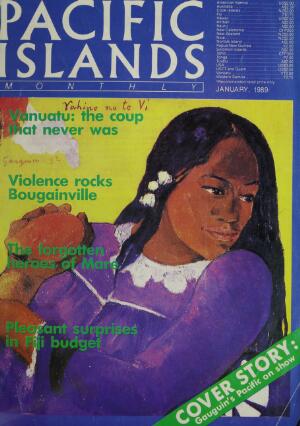
Pacific
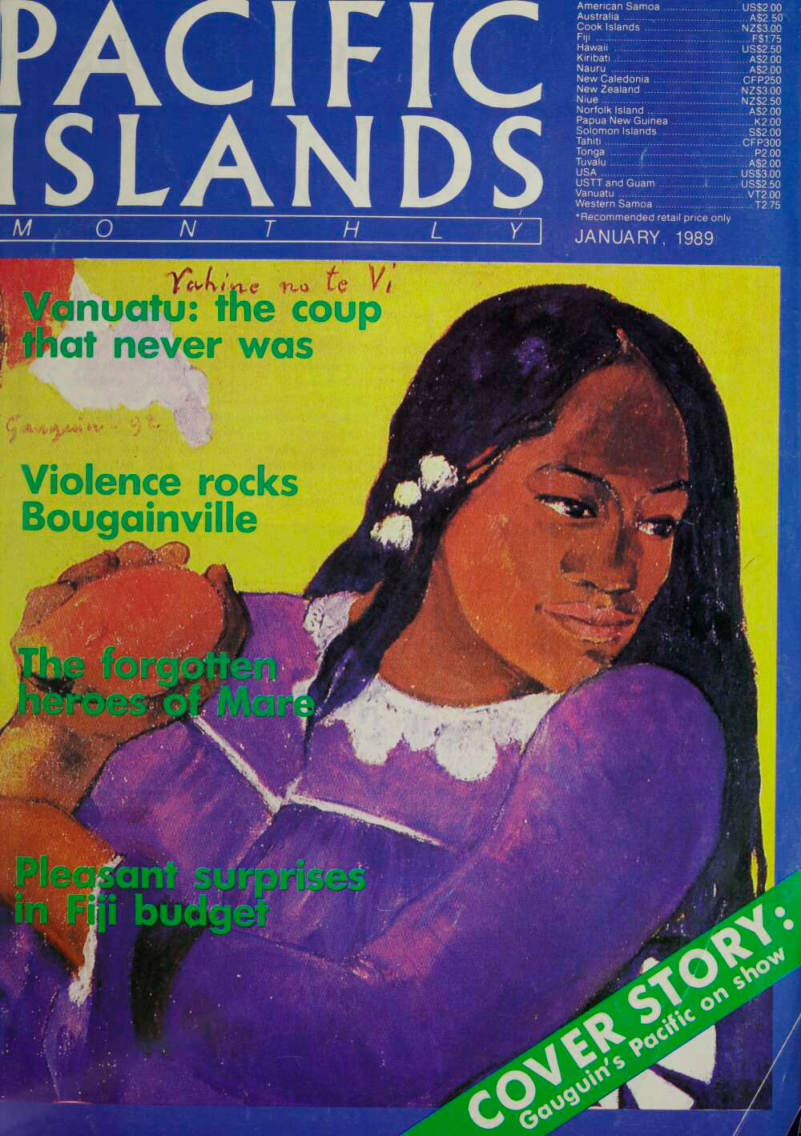


Islands
Monthy
American Samoa US$2.OO Australia A 52.50 Cook Islands NZ$3.OO Fiji F 51.75 Hawaii US$2.5O Kiribati A 52.00 Nauru A 52.00 New Caledonia CFP2SO New Zealand NZ$3.OO Niue NZ$2.5O Norfolk Island A 52.00 Papua New Guinea K 2.00 Solomon Islands 552.00 Tahiti CFP3OO Tonga P 2.00 Tuvalu A 52.00
Usa Us$3.Oo
USTT and Guam US$2.5O Vanuatu VT2.00 Western Samoa T 2.75 ♦Recommended retail price only
January, 1989
#• vv'rvr wg r
Hanuatu: the coup
inat never was
Violence rocks Bougainville
* rj p % n g 4* /k j *J§ J p I
ij- I r : .!• 1 1IJr tjgLr?*XH[ < mMbk%. irdbr - riiPv^m|fi|i
my, IB•TiJt» j
COVER ILLUSTRATION: COURTESY OF REUNION DES MUSEES
Nationaux, Paris
Advertisements & other items, pp. 2-4 (1 item)
outstanding performance,
They share good looks,
and footwork by
Mazda.
For some people, racing is in their dloocL At Mazda, racing is in our cars.
Of course, we enter European road ’allies to show what we can do. Against :he best competition in the world. And inder the most grueling conditions.
But we’re also interested in discovering how to make our cars hold the 'oad even better. How to give them greater straight-line stability, and make them follow a driver’s wishes exactly when making high-speed turns.
In short, we’re using rallies as a means to perfect our “footwork.”
That’s why the Mazdas you find in the showroom, like the 323 4WD on the right, are so similar to our race cars. We’ve become very adept at putting what we learn into practice.
How else to explain the presence of so many unmodified Mazdas in local rallies the world over. In good weather and in bad, Mazdas claim more than their share of victories. What’s especially significant is that rally drivers claim their Mazdas perform best when conditions are at their worst.
Of course, better footwork pays off under regular driving conditions, too. It lets you seek out a quicker line through uadiiai - 069 HflP
S-curves. Diminishes the effects of strong crosswinds. Best of all, it helps your car do what you want it to, almost before you even think it.
For years Mazda has been succeeding at giving drivers a better feel for the road. Whether with innovative and highly acclaimed suspension systems.
Full-time 4WD. Or more recently with the dramatic Speed-Sensing 4-Wheel Steering System now available on Mazda 626 cars.
And through racing, we’ll continue to fine-tune our footwork.
Because we know that here lie the greatest rewards. Both for Mazda, with our growing reputation for build ing world-class automobiles. And for you, when you drive the car that results from what we learn.
New Mazda 323 Models and features shown may not be available in your area. Please consult your local Mazda dealer This warranty is valid only in Australia.
Your kind of car.
Mazda Motor Corporation A m
LEV-AT 323
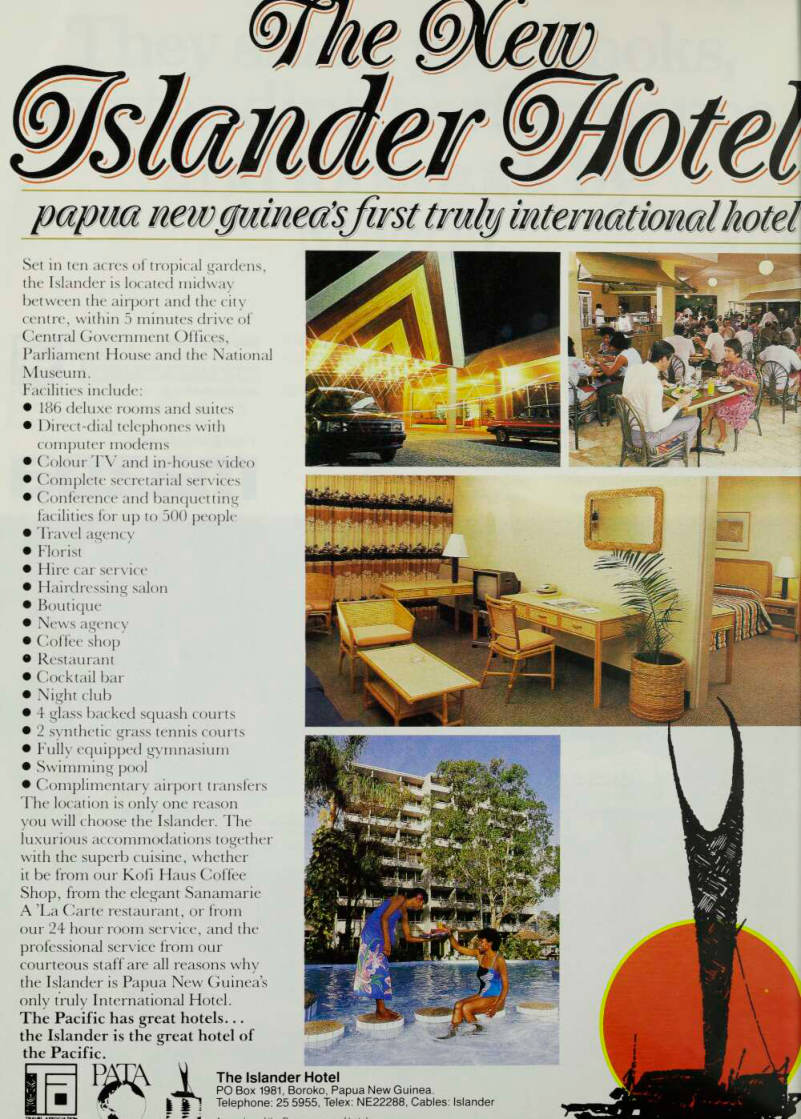
r Set in ten acres of tropical gardens, the Islander is located midway between the airport and the city centre, within 5 minutes drive of Central Government Offices, Parliament House and the National Museum.
Facilities include: • 186 deluxe rooms and suites • Direct-dial telephones with computer modems • Colour TV and in-house video • Complete secretarial services • Conference and banquetting facilities for up to 500 people • Travel agency • Florist • Hire car service • Hairdressing salon
• Boutique
• News agency • Coffee shop • Restaurant • Cocktail bar • Night club • 4 glass backed squash courts • 2 synthetic grass tennis courts
• Fully equipped gymnasium
• Swimming pool
• Complimentary airport transfers
The location is only one reason you will choose the Islander. The luxurious accommodations together with the superb cuisine, whether it be from our Kofi Haus Coffee Shop, from the elegant Sanamarie A ’La Carte restaurant, or from our 24 hour room service, and the professional service from our courteous staff are all reasons why the Islander is Papua New Guineas only truly International Hotel.
The Pacific has great hotels... the Islander is the great hotel of the Pacific. fU t “I The Islander Hotel PO Box 1981, Boroko, Papua New Guinea.
Telephone: 25 5955, Telex: NE22288, Cables: Islander
Pacific
Islands
Monthly
Vol. 59 No. 13
Voice Of The Pacific
January, 89
Cover Story
As Nicolas Rothwell Reports, painter Paul Gauguin was very much a self-invented (if not self-made) man: he set out to create around himself his own mythology of the South Pacific, and succeeded in a way that has only been seen in this century in the likes of James Michener. Now, for the first time, international collectors and museums have put together a major exhibition of Gauguin’s masterpieces, lesser-known works and the astonishingly fruitful results of his South Seas voyage of self-discovery.
Pleasant Surprises In Fiji Budget... 9
But there’s a sting in Finance Minister Kamikaniica’s generosity PARIS SEEKS A NEW DIPLOMATIC ROLE 10 Rocard’s Government plays down the flamboyant era Gaston BANK GIVES QUALIFIED SUPPORT FOR PNG ECONOMY 14 Westpac PNG looks to the future — with some warnings CONTROVERSIAL PSYCHIATRIC UNITS SURVIVE IN NZ 14 Auckland’s radical Whare Paia has a stay of execution
Hawaiians Dream Of Independence 15
A Honolulu conference seeks a unified approach
Landowners Locked In Compensation
Struggle With Miners 16
Bougainvilleans versus Bougainville Chopper: violence is the result FIJI SAYS THANKS FOR 100 YEARS OF MEDICAL SERVICE 20 Suva’s medical school celebrates its First century SOPE, SOKOMANU TOPPLED IN TREASONABLE' ACTIONS 24 Lini survives a bungled and criminal coup attempt
Educators Battle Ignorance, Prejudice 27
Old attitudes die hard — and sex education fights to be heard SCHOOL STUDENTS LEARN ABOUT LIFE IN PNG... 28 Talent and imagination to the fore in a competition for children THE PACIFIC'S VOICE GROWS IN STRENGTH AND REACH 34 Radio Australia boosts its presence in the region FROM COCONUTS TO OIL PALMS FOR LOCAL PROFIT 35 New Ireland rehabilitates old plantations for a new crop
New Caledonia's Forgotten
Patriots 36
Soldiers from Mare battle for recognition
The Making Of The Nuclear
Free Pacific 43
A new documentary reveals the arguments behind the Treaty of Rarotonga
Acting Editor Carson Creagh Deputy Editor Richard Dinnen Editorial Adviser John Cater Art Director Michelle Havenstein Contributors Robin Bromby Stephen Henningham Wally Hiambohn Stuart Inder Vijendra Kumar Harry Lander Ed Rampell David Robie Nicolas Rothwell
Publisher and Managing Editor Geoffrey Hussey
Advertising Sales Sydney & Melbourne Warren Grey (02) 288 3521 Fergus Maclagan (02) 412 3918: Brisbane Robert Walker (07) 371 0533 Adelaide Hastwell Williamson Representations (08) 79 9522
Cover prices are recommended retail only Registered by Australia Post, publication No NBP 1210 Copyright, Fiji Times Limited, Suva, Fiji
Advertisements & other items, pp. 5-6 (3 items)
Departments
OPINION 7
PACIFIC REPORT 43
TRADE WINDS 43
TROPICALI TIES 38
STAMPS 46
ISLAND PRESS 42
TRANSITION 45
BOOK REVIEWS 48
OUT OF THE PAST 54
5
PACIFIC ISLANDS MONTHLY JANUARY 1989
A Fiji Times Limited Production.
Founded 1930 (USPS 952480) 20 Gordon Street, Suva, Fiji; Telex: FJ2124, Fax: (679) 31 411.
Pacific Islands Monthly (APPS No. NBP 1210) is published month ly by Fiji Times Limited, a division of Nationwide News, 2 Holt St, Sur ry Hills, NSW 2010. Second class postage paid at Honolulu, Hawaii, POSTMASTER. Send address changes to PACIFIC ISLANDS MONTHLY, PO Box 22250, Honolu lu, Hawaii 96822. Typeset and printed by Fiji Times Limited, 20 Gordon Street, Suva, Fiji.
Cj) Pioneer
elf Component Systems ■ 500 watts (pmpo) B 5 + 5 UR graphic mmlizen I DAT in/out ■ Multiprogram timer MSurrmmi Sow BCD Fade Edit Synchro system 9fdesUpr digital s m vith spectrum analyzer ■ Remote controllable, motor-driven volume UCD M circuitry UFull-function remote control ■ Full-logic control ■ Dolby* B 23cm cone woofer with elastic composite diaphragm developed I choose my music with care. Sometimes it’s the oldies. Sometimes it’s the totally new. But there’s one kind I can’t stand —the kind that’s weak or distorted. That’s why my choice in a personal hi-fi is PERSON NA PLUS —the powerful system that hates distortion and noise as much as I do. My PERSONNA Z-90R has a huge 500 watts of peak music power output, and three-way speaker systems that sound bigger than all outdoors. The graphic equalizer with spectrum analyzer lets me tailor the sound to my tastes. And there’s the double, auto-reverse cassette deck, quartz-PLL synthesizer FM/AM tuner, full-auto turntable and the optional six-disc Multi-play CD player. But best of all—l can operate the whole system, including the volume, by remote control. At first, it looked too hard to use. Wrong! Pioneer made it easy. They made my choice easy, too. PERSON NA PLUS—also available in the Z-70R and Z-50R systems —is the choice I recommend to you.
The future of sound and vision.
For further information, please contact: Australia: Pioneer Electronics Australia Pty. Ltd. (Incorporated in Victoria), P.O. Box 295, Mordialloc, Victoria, 3195 Tel: 580-9911 Fiji Islands: Brijlal & Company, G.P.O. Box No. 362, Suva, Fiji Islands Tel: 22258 New Zealand: Monaco Corporation Ltd., 41 Poland Road, Glenfield, Auckland, New Zealand Tel: (09) 444-9144 Norfolk Island: Burnt Pine Traders Ltd,, P.O. Box 21, Norfolk Island Vanuatu: Burns Philp (Vanuatu) Ltd., Vila, Vanuatu Nauru Island: Jacob Enterprises, P.O. Box N 0.4, Republic of Nauru Tahiti: Tahiti Hi-Fi, P.O. Box 848, Papeete, Tahiti New Caledonia: Menard Pacifique Sari, B.P. 3899, Noumea, New Caledonia Tel: 27*62.23 American Samoa; Transpac Corporation, P.O. Box 1477, Pago Pago, American Samoa 96799 Tel: 633-5224 Rarotonga: South Seas International Ltd., P.O. Box 49, Rarotonga. Cook Islands Tel: 2327
Aid's real meaning
Opinion
Major metropolitan powers are beginning to jind Pacific nations less willing to accept the ‘ that go
economic assistance.
RECENT news stories about the purported ‘theft’ of a United States guided missile warhead in the waters of Kwajalein Atoll highlight an intriguing change in the balance of power in the Pacific. The news stories spoke of a missile test that attempted to hide military secrets from the Soviet Union by recording navigational data on board the missile rather than broadcasting such information.
Apparently, the experiment went wrong when the US Navy vessel detailed to recover tne missile’s nose-cone failed to retrieve the all important flight recorder. Sabre-rattlers in Washington immediately sus pected foul play. A Russian mini-sub, they said, must have stolen the
flight recorder.
Leaving aside such obvious conclusions as a Pentagon attempt to sway public opinion in favour of increased spending on defence, what emerges from the incident is the United States’ decreasing ability to bestride the world with military and economic might. No less experi enced a columnist than the Times' Bernard Levin (a commentator hard ly noted for his pink views) is meeting little argument over his claims that both the US§R and the USA are beginning to lose their ‘empires’.
Domestic financial, agricultural, social and ethnic problems, Levin argues, are turning the Kremlin’s interest inward in what amounts to a repetition of an isolationism that has been seen many times already in Russian history. But Washington faces different problems: increasing indifference to its Cold War philosophies, dissatisfaction with its role as guardian of liberty; and concern over its approach to Third World debts in apparent defiance of other financial centres’ misgivings.
These factors and others are beginning to make their effects felt . in the Pacific. It would be premature and inaccurate to detect any great movement away from alignment with the United States and towara the Eastern bloc: rather, more and more Pacific nations are refusing to ally themselves with any of the so-called Great Powers except when they can derive some direct advantage from the relationship.
The trend can be seen throughout Oceania: in coups in Fiji, where the Melanesian population sought to throw off what it perceived as the shackles of a colonial imbalance in opportunity; in New Zealand, where the Labour Government’s refusal to countenance a nuclear-armed US presence resulted first in the threats of economic isolation and then in the realisation that the country could survive without American assis tance; in New Caledonia, of course, where France has by all appearances realised that its proud possessions may become liabilities after all.
However, such developments must also be examined in the light of reality for many of the smaller, resource-poor Pacific nations. It is no insult to the people of Tuvalu, Tokelau or Kiribati to say that they will always be recipients of aid. They can argue with vigour those more fortunate who spend so much on ‘necessities’ of the most' vapid nature imaginable have a duty to their fellow human beings to help them build the best life possible.
This is perhaps the nut of the matter: that becoming an aid recipient does not, morally should not, render one a client of the person or nation providing that aid. The time is coming fast when the world will be too crowded, its environment too degraded and its resources too valuable, for notions of empire to persist. Just as the smaller nations of Eastern Europe are hurling defiance at their Soviet ‘masters’, so are the thank fully independent nations of the Pacific learning that power is transitory . . . and that even the tiniest atoll is sovereign territory, not to be abused as a plaything or bargaining chip for others. D
DESPITE advances in television and publishing (technology, radio remains the most effective medium tor speedy and widespread transmission of news and information. Radio requires none of tele vision’s costly and unwieldy apparatus, can provide entertainment or a portable, life-saving link in times of emergencv. It has been a unitwing medium throughout the 20th century, bringing to listeners the ’first draft’ of history as it happens: and in times of war and disaster it has been used to send messages of encouragement to survivors and coded instructions to resistance fighters behind enemy lines.
Radio is a medium that bridges great distances eco nomicallv, and with the introduction of satellites its scope is now unlimited. In the Pacific, vast stretches of ocean separate small islands served bv often irregular mail and transport operations barriers that can defeat timely newspaper coverage and make television an expensive, impractical service. But it is for such a place that radio was invented.
One person acutely aware of this is New Zealand's Russell Marshall, the Foreign Affairs Minister (and head of that country’s new External Relations and Trade Ministry) who took responsibility for the for mer Island Affairs portfolio in the wake of the sacking ot Richard Prebble. Last December, Mr Marshall listed as one of his first priorities the upgrading of Radio New Zealand’s shortwave service. He hopes the 1989 budget will allow spending on the service, a hope shared by many thousands of radio listeners throughout the South Pacific.
Most international broadcasters use transmitters generating 100,000 watts or more but Radio New Zealand relies on two 7500 watts transmitters that have been in service since the 19405. Their signals are almost inaudible in the vast Pacific, and program stan dards are generally poor; the shortwave service has no budget ot its own and generally relays one of the domestic radio networks.
This neglect of responsibility cannot continue. As one of the region’s most articulate nations, New Zea land has a duty to provide a quality shortwave service with news, information and entertainment programs.
Small island states cannot afford the cost of equip ment and international coverage and look to their more developed neighbours who can and should foot the bill for such a vital service. The cost to New Zealand will be comparatively small and the benefits substantial. “1 am under no illusion of its importance in foreign affairs,” Marshall said recently.
Radio Australia recognises the importance of the region and improvements to its Pacific service are im minent. A new Pacific service begins on March 6, based on the results of a recent listener survey. Radio Australia already has the biggest audience in the re gion, and its new service will further consolidate that lead and extend Australia’s sphere of influence.
Radio New Zealand must move urgently to redress the imbalance and to ensure a diversity of voices and opinions. The nations of the Pacific have the right to hear the voice of New Zealand on a quality shortwave radio service. □
Advertisements & other items, pp. 7-8 (1 item)
Pacific
ISLANDS
|MQNT H L Y I
FIJI: Distribution, subscriptions and advertising: Fiji Times Limited, GPO Box 1167, Suva, Fiji Phone 31-4111, telex FJ2124 FRENCH POLYNESIA Distribution: Hachette Pacifique 10 Ave Bruat, Papeete Phone 25-610 HAWAII: UNITED STATES Distribution: PIM Hawaii PO Box 22250, Honolulu, Hawaii, 96822 Advertising: Brian C Asgill, Apt 1308,1676 Ala Moana Blvd , Honolulu, Hawaii, 96815. Phone (808) 955-9718 JAPAN: Advertising and subscriptions: Universal Media Corporation, GPO Box 46, Tokyo Phone 666-3036, cable UNIMEDIA Tokyo, telex 2524665 MALAYSIA: Advertising and subscriptions; Worldwide Media Services. 57-B Komplex Damai, Jin Dato Haji Eusoft, Kuala Lumpur Phone 63-9340, cables WORLDMEDIA Kuala Lumpur, telex 31533 VANUATU: Distribution: The Vanuatu Stationery and Book Centre, PO Box 557 Port Vila Advertising: Nor man Bros Bookshop Port Vila Phone 2232 NEW CALEDONIA: Distribution: Depot Centre de Presse Michel Pentecost CBP2, Noumea Phone 27- 2434, 27-4729 NEW ZEALAND Distribution: Gordon & Gotch, PO Box 584 , 2 Carr Road, Mt Roskill, Auckland 4 Advertising: McKay International Media Reps Ltd, C/ Albany PO, Auckland 10, New Zealand Phone 413-9119 Telex NZ22701, FAX 413-9110 WELLINGTON: Ross Quaid Media, 1 Scholes Lane, Petone (04) 68 7593, PO Box 38699, Petone PAPUA NEW GUINEA: Distribution: Gordon & Gotch, PO Box 3395, Port Moresby Phone 25-4551 25-4855 Advertising: Robert Walker, PO Box 600, Indooroopilly, Old Australia 4068 Phone (07) 371-0533 SOLOMON ISLANDS: Distribution and Advertising; The Bookshop, (Norman Bros ) PO Box 503, Honiara PHILIPPINES; Advertising; The GF Group, 12 San Ignacio St, Uroaneta Village, Makati, Metro Manila Phone 817-7299, telex 45950 and 4233 UNITED KINGDOM: F A Smyth and Associates, 23A Aylmer Parade, London N2OPO, England Phone (01 )340 5088, fax (01)341 9602 UNITED STATES MAINLAND: Advertising: Joshua B Powers Jr., Powers International Inc , Suite 708, 271 Madison Ave , New York, NY 10016 Phone 867-9580, Subscriptions PIM, Hawaii, PO Box 22250, Honolulu Hawaii, 96822
SUBSCRIPTIONS
American Samoa US$45 Australia AUSS3O Canada US$45 Cook Islands AUSS46 Fiji F $24 French Polynesia US$45 Guam US$45 Hawaii US$45 Japan US$3B Kiribati AUSS46 Micronesia US$35 Nauru AUSS42 New Caledonia US$32 New Zealand AUSS42 Niue AUSS46 Norfolk Island AUSS42 Northern Marianas US$36 Papua New Guinea AUSS42 Solomon Islands AUSS46 Tonga AUSS46 Tuvalu AUSS46 United Kingdom Stq£2B US (Mainland) US$45 Vanuatu AUSS42 Western Samoa AUSS6O Elsewhere AUSS63 Payments to Pacific Islands Monthly: Subscriptions Dept, GPO Box 1167, Suva, Fiji.
Subscriptions rates includes the cost of airspeeding to all destinations set out above. Direct airmail rates on application
m The South
Sea Digest
THE PRIVATE NEWSLETTER
ON PACIFIC ISLANDS AFFAIRS
EVERY OTHER FRIDAY
SUBSCRIBE NOW
See coupon insert between pages 54-55.
FORUM SECRETARIAT
(formerly South Pacific Bureau for
Economic Cooperation [SPEC]
Applications are invited from citizens of member countries for the following positions within the FORUM SECRETARIAT (formerly the South Pacific Bureau for
Economic Co-operation):
CHIEF ECONOMIST
The Nineteenth South Pacific Forum held recently in Tonga gave priority to the continued development of a strong and effective Economic Services Division within the Secretariat to assist Pacific island member countries of the Forum to improve their capabilities in economic analysis and planning. A crucial step in this initiative will be the establishment of a new position of Chief Economist to assume responsibility for directing the activities of the expanded Division which, it is envisaged, will eventually comprise a team of five economists.
This is an exciting opportunity for an experienced, senior economist to make a substantial contribution to the economic development of the Pacific region.
Applicants should possess a sound, working knowledge of the economies of Pacific Island countries, including an appreciation of the problems of both the subsistence and monetised sectors. They should also possess advanced academic qualifications in economics or a related field, as well as proven abilities to work under pressure, to set priorities among a wide range of options and to manage staff effectively. Familiarity with donor government and agency procedures would be an advantage
MANAGER REGIONAL PETROLEUM UNIT
The Regional Petroleum Unit [RPU] is being created under the auspices of the Secretariat to provide specialist assistance to its member governments to improve existing petroleum supply and pricing arrangements on and on-going basis The RPU will assist in ensuring that the costs of supply and marketing operations, in and between number countries, are minimised. It also aims at harmonizing the relationship between Governments and the oil companies represented in the South Pacific region, and at reducing the dependence of governments on short-term consultancies.
The RPU Manager will be required to direct and supervise the work of the unit and keep the Director of the Secretariat briefed on regional petroleum issues and the activities of the RPU. The manager will plan, direct and participate in studies concerning the supply of petroleum in the South Pacific; advise Member Governments as requested on issues relating to petroleum, particularly in relation to price control and contract negotiations He/she will also represent the RPU on committees and meetings and maintain liaison with other groups working on petroleum issues in the Pacific The successful applicant will have tertiary qualifications in engineering, economics, or other suitable qualifications associated with the oil industry He/she must have at least 10 years experience in the oil industry and/or government positions associated with the oil industry, with particular experience in dealing with issues relating to both government and the oil industry He/she must also have the ability to manage and relate to people from a wide range of backgrounds, have good written and oral communication, and be willing to travel frequently throughout the region
GENERAL INFORMATION
These senior level appointments will attract substantial remuneration packages, tax-free for non-Fiji citizens and payable in Fiji dollars, including housing or housing allowances, education and child allowances, superannuation payments and medical, life and travel insurance benefits. The appointees will be based at the Secretariats Headquarters in Suva, Fiji, but will be required to undertake extensive duty travel Appointments would be for two years initially, renewable by mutual agreement.
Applications close on 10 December 1988. As it is intended to make the appointments as soon as possible, the successful applicants must be able to take up the positions shortly afterwards. Applications should contain full information on education and career backgrounds and should list names, addresses and telephone numbers of at least three referees with whom the applicants have been associated in professional capacities.
Applications should be addressed to: The Director Forum Secretariat GPO Box 856 Suva, Fiji Telephone: 312600; Telex: 2229 FJ; Fax: 302204 All enquiries should be made to Mr Rene Wilson, Deputy Director, on 312600 extension 202.
Gentle Budget for Fiji
Fiji
The interim Government cuts duties and seeks to encourage the private sector, but a mini-budget later this year could bring new taxes. By Vijendra Kumar
FEW FIJIANS expected any sur
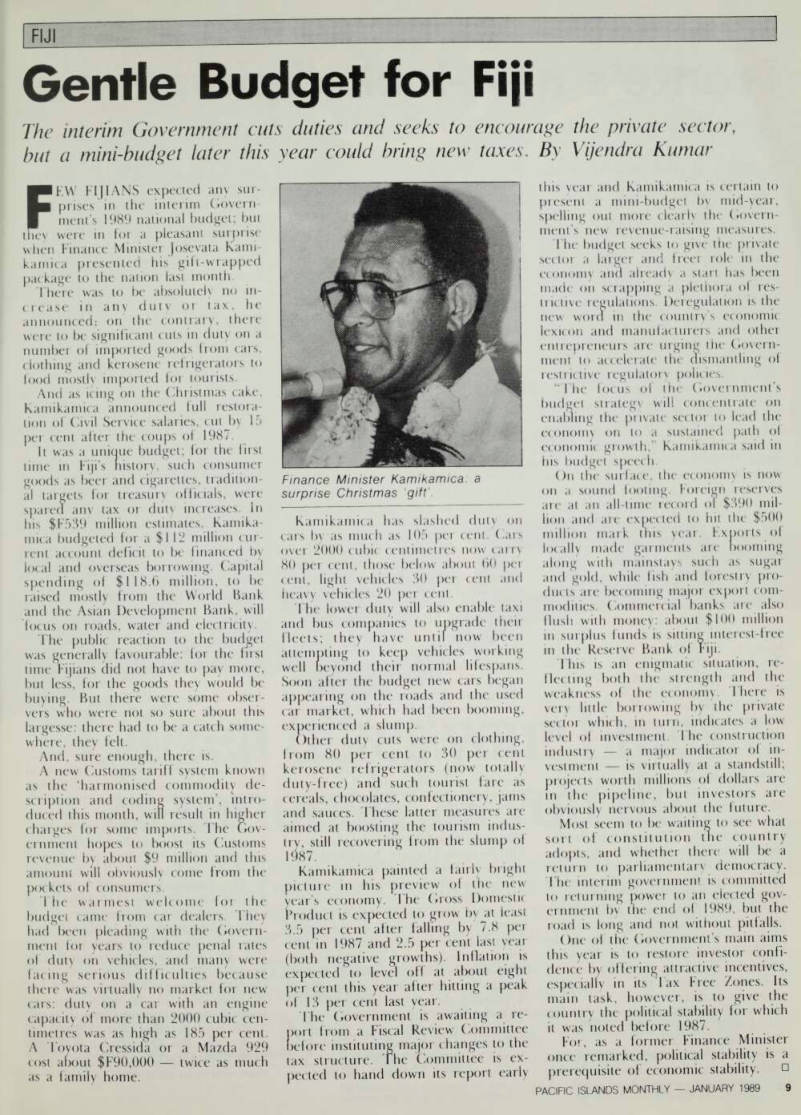
prises in the interim Govern ment’s 1989 national budget; but they were in foi a pleasant surprise when Finance Minister Josevata Kami
kamica presented his gift-wrapped
package to the nation last month There was to be absolutely no in crease in any duty or tax. he announced: on the contrary, there were to be significant cuts in duty on a number of imported goods from cars, clothing and kerosene refrigerators to food mostly imported for tourists.
And as icing on the Christmas cake, Kamikamica announced lull restora tion of Civil Service salaries, cut by 15 per cent after the coups of 1987.
It was a unioue budget; tor the first time in Fiji’s bistory, such consumer goods as beer and cigarettes, tradition al targets for treasurv officials, were spared any tax or duty increases. In his $F539 million estimates, Kamika mica budgeted for a $ll2 million cur rent account deficit to be financed by local and overseas borrowing. Capital spending of $1 18.6 million, to be raised mostly from the World Bank and the Asian Development Bank, will focus on roads, water and electricity .
The public reaction to the budget was generally favourable: for the first time Fijians did not have to pay more, but less, for the goods they would be buying. But there were some obser vers who were not so sure about this largesse: there had to be a catch some where, they fell.
And, sure enough, there is.
A new Customs tariff system known as the ‘harmonised commodity de
scription and coding system’, intro
duced this month, will result in higher charges for some imports. The Gov ernment hopes to boost its Customs revenue by about $9 million and this amount will obviously come from the pockets of consumers.
The warmest welcome for the budget came from car dealers. They had been pleading with the Govern ment for years to reduce penal rates of duty on vehicles, and many were facing serious difficulties because there was virtually no market for new cars; duty on a car with an engine capacity of more than 2000 cubic cen timetres was as high as 185 per cent.
A Toyota Cressida or a Mazda 929 cost about $F'9O,OOO twice as much as a family home.
Kamikamica has slashed duty on cars by as much as 105 per cent. Cars over 2000 cubic centimetres now carry 80 per cent, those below about 60 per cent, light vehicles 30 per cent and heavy vehicles 20 per cent.
The lower duty will also enable taxi and bus companies to upgrade their fleets; they have until now been
attempting to keep vehicles working
well beyond their normal lifespans.
Soon after the budget new cars began appearing on the roads and the used car market, which had been booming,
experienced a slump.
Other duty cuts were on clothing, from 80 per cent to 30 per cent
kerosene refrigerators (now totally
duty-free) and such tourist fare as cereals, chocolates, confectionery, jams and sauces. These latter measures are aimed at boosting the tourism indus try, still recovering from the slump of I^B7.
Kamikamica painted a tairh bright picture in his preview of the new' year’s economy. The Gross Domestic Product is expected to grow by at least 3.5 per cent after falling by 7.8 per cent in 1987 and 2.5 per cent last year (both negative growths). Inflation is expected to level off at about eight per cent this year after hitting a peak of 13 per cent last year.
The Government is awaiting a re port from a Fiscal Review Committee bef ore instituting major changes to the lax structure. The Committee is ex pected to hand down its report earlv
this vear and Kamikamica is certain to present a mini-budget by mid-year, spelling out more clearly the Govern ment’s new revenue-raising measures.
The budget seeks to give the private sector a larger and freer role in the economy and already a start has been made on scrapping a plethora of res trictive regulations. Deregulation is the new word in the country's economic lexicon and manufacturers and other entrepreneurs are urging the Govern ment to accelerate the dismantling of
restrictive regulatory policies.
“The focus of the Government’s budget strategy will concentrate on enabling the private sector to lead the economy on to a sustained path of economic growth. Kamikamica said in
his budget speech.
On the surface, the economy is now on a sound footing. Foreign reserves are at an all-time record of $390 mil lion and are expected to hit the $5OO million mark this yeai. Exports of locally made garments are booming along with mainstays such as sugar and gold, while fish and forestry pro ducts are becoming major export com modities. Commercial banks are also flush with money: about $lOO million in surplus funds is sitting interest-free in the Reserve Bank of Fiji.
This is an enigmatic situation, re flecting both the strength and the weakness of the economy There is
very little borrowing by the private
sector which, in turn, indicates a low level of investment. The construction industry a major indicator of in vestment is virtually at a standstill; projects worth millions of dollars are in the pipeline, but investors are obviously nervous about the future.
Most seem to be waiting to see what sort of constitution tne country adopts, and whether there will be a return to parliamentary democracy.
The interim government is committed to returning power to an elected gov ernment by the end of 1989, but the road is long and not without pitfalls.
One of the Government’s main aims this year is to restore investor confi dence by offering attractive incentives, especially in its lax Free Zones. Its main task, however, is to give the country the political stability for which it was noted before 1987.
For, as a former Finance Minister once remarked, political stability is a prerequisite of economic stability. □
Finance Minister Kamikamica: a surprise Christmas ‘gift’.
France's new-look diplomacy
The Region
David Rohie reports on changes in Paris's policies in the post-Flosse era.
GASTON Flosse era in the I South Pacific was a paradox.
H Faced with mounting allegations
of corruption and deepening resent ment at home in Papeete, the former French Secretary for Pacific Affairs was eventually forced to resign from
the French Polynesian presidency.
Then the government of his conserva tive ruling party, Tahoeraa Huiraatira, collapsed after rioting in October 1987
exposed growing unemployment and
social problems m Tahiti.
But things were different for Flosse in the wider South Pacific arena. For mer French Prime Minister Jacques Chirac’s reward for his lieutenant, through the creation ol a well-funded secretariat of Pacific Affairs, was a
gamble that had paid oil handsomely:
many Polynesian politicians were im pressed with the fact that a Pacific islander (Flosse is part-Tahitian) was now speaking on behalf of France; they lilced his charming style of di plomacy and the ‘gifts’ dished out by Ins office.
They seemed not to care that Can berra and Wellington thought Flosse arrogant and his methods question
able. They appeared unconcerned by
his alleged role in the controversial re patriation to Paris of Rainbow Warrior bombers Alain Mafart and Dominique Prieur from Hao Atoll. Nor did those politicians seem concerned that one of Flosse’s key priorities was to blunt South Pacific support for the Kanak independence movement in New Cale donia and opposition to nuclear test ing in the Tuamotus.
Flosse managed to remain popular
with Polynesian governments despite
the suspicion with which other Melanesian states regarded his activi ties and his involvement in a con troversy in the Solomon Islands that led eventually to an embarrassing gov ernment crisis. Cook Islands, in par
ticular, piqued at perceived neglect by
New Zealand, was happy to encourage the French connection while Flosse was still, in effect, roving ambassador.
“Flosse is regarded very highly in the Cook Islands,” wrote Le Monde's Oceania correspondent Patrice de Beer after a recent visit,” ... a totally different perception from how he is seen in Papeete and France. He has established many positive links with
Polynesian leaders.’’
Now, however, there is a problem: while socialist Prime Minister Michel
Rocard is keen to foster better rela tions with Australia, New Zealand and other Pacific nations, the Secretariat of Pacific Affairs is defunct and Flosse is out of a job. Instead the South Pacific Council, set up under the previous socialist administration with one-time
revolutionary ideologue Regis Debray
at its head, has been dusted off and revived. Philippe Baude, French dele gate to the South Pacific Commission, has been named secretary of what will probably be a low-profile agency.
Rocard has written to Alexandre Leontieff, president of French Polynesia’s territorial government and Flosse’s former right-hand man, asking him to organise a study of the evolution of protection for fisheries resources in the South Pacific. The assignment, observers say, makes Leontieff France’s roving ambassador for economic, scientific and cultural exchanges in the region. The Tahiti Sun Press reports Leontieff will be ex pected to monitor fisheries decisons made in the region including French territories and the decisions of international organisations. He will be assisted by French diplomats and officials in the region and in Paris.
Rocard has also asked Leontieff to
organise co-operation between nation
al and • territorial research organisa tions in the South Pacific.
It is an irony that while the so-called Matignon peace accord appears to offer some hope for New Caledonia, politics in Tahiti are becoming in creasingly fragile with Leontieff strug gling to hold together his coalition government. Three of his cabinet ministers recently resigned to ensure he would have a majority in the
budget debate. Deputy President
(icorges Kelly, Social Affairs Minister Huguette Hong Kiou and Labour and
Fniployment Minister Napoleon Spitz
stepped down from the 10-strong cabinet so they could resume their places in the 41-seat Territorial Assembly before the debate began.
Leontieff is threatened by the recent formation of a centre group of six dis sident politicians led by businessman
Quito Braun-Ortega. Though Braun-
Ortega was once Flosse’s bitter foe, it is possible the group will join forces with the Flosse Opposition.
One week before the November 1988 referendum on French policy on
New Caledonia, a public opinion poll
produced some interesting statistics on
attitudes to modern French colonial ism. The IPSOS Institute asked a rep resentative sample of the French population “do you accept or reject the idea that the French overseas ter ritories and departments should be granted independence within the next decade?” The results, published in the news magazine Le Point , showed a
majority supporting independence for
all territories French Polynesia
Guadeloupe, Guyana, Martinique,
Mayotte, New Caledonia, Reunion, St Pierre and Miouelon, and Wallis and Futuna. Guadeloupe drew the largest vote for independence (48 per cent for, 35 per cent against), and the fi gures were similar For New Caledonia and French Polynesia. In the wake of this majority popular response Pacific based observers now ask why France does not give independence without delay to her last Pacific colonies.
In Tahiti, which to some extent shares similar colonial problems to New Caledonia, local political leaders were even more concerned than those in France over the ambiguity of the Matignon accord ballot, voters were not being asked to approve a direct question such as “are you for or
against independence for the
Kanaks?” Instead they were being asked to endorse Rocaro’s vague peace plan that would eventually lead to still another referendum on self determination in 1998 a ballot the 3osition Gaullist Rally for the Re lic has already pledged to scuttle if and when it returns to power.
But most of Tahiti’s nine major political parties and the influential Evangelical and Catholic churches eventually endorsed a Yes vote. They argued tnat Rocard had at least tem porarily introduced peace to New Caledonia following the bloodbath on Ouvea during the May presidential elections. At least 6000 Tahitians live in the territory, most supporting French rule because they fear being
repatriated after independence.
Pro-independence leader Oscar Temaru’s Tavini Huiraatira party was the only group to support the Kanak Socialist National Liberation Front (FLNKS). Flosse’s Tahoeraa called for an abstention in the vote, claiming Rocard also had secret plans to make
Tahiti independent. But Polynesian
voters gave the Rocard plan a slightly higher endorsement (82 per cent) than voters in metropolitan France. □
Advertisements & other items, pp. 11-13 (1 item)
Citizen takes your times
m m <s> <>> <V> » <s> -a ■ ■ LO
as seriously as you do.
For some sports time control is a key element.
The Citizen Sports Collection is a winning range of special timepieces
with unique performance features
designed specially for your sport.
The Citizen Sports Collection.
For the serious sportsman...WeVe got your Watch.
CITIZEN
CITIZEN IS A REGISTERED TRADEMARK OF CITIZEN WATCH CO., JAPAN
FOR FURTHER INFORMATION, PLEASE CONTACT:
Australia:Citizen Watches Australia Pty. Ltd., 122 Old Pittwater Road, Brookvale, NSW 2100.
Tel: 939 7077. Cable: Citizen Sydney.
Telex: AA26633. Fax: 932864.
Fiji Islands: Tappoo Limited, P.O. Box, Sigatoka, Fiji. Tel: 50199. Telex; FJ4244.
New Zealand: Citizen Watches (N.Z.) Ltd., P.O. Box 9518, Auckland, New Zealand.
Tel: 543 393. Telex: 21429. Fax: 544177.
Tahiti: Morgan Vernex, Fare Ute B.P. 449, Tahiti.
Tel: 2.03.09.
Papua New Guinea: Kara Pty. Limited, P.O. Box 392, Port Moresby. Tel 25 6044
Luxury t
intelligently defined
Seldom has a performance sedan galvanized critics and enthusiasts as has the Honda Legend. Already revising standards for quality, reliability and performance, it has been critically ranked among a handful of truly world-class luxury cars.
The Honda Legend is a unique hybrid of high art and high technology designed to make driving one of life's most gratifying experiences. Toward that end, Honda engineers and designers have taken out all the inconveniences that make driving %
3S3ZT’
B rnmmm — * Sli Si .'it c r ,v ■: AUSTRALIA:Honda Australia Pty., Ltd. Lot sJS Sharps Road, Tullamarine, Victoria 3043, Bennett Honda Pty., Ltd. 250 Victoria Road, Wetherill Park, N S W. 2164/ NEW ZEALAND: Honda New Zealand Ltd.
Manners Plaza, 57-65 Manners St , Wellington/ PAPUA NEW GUINEA: Toba Pty., Ltd. PO Box 503, Port Moresby/TAHITI: Honda Distribution S.A. R.L. B P 1665, Papeete/KIRIBATI Atoll Motor & Marino Services P O Box 49, Bairiki Tarawa. Republic of Kiribati/U.S. TRUST TERRITORY: United Micronesia Development Association P O Box 235, CHRB Saipan CM 96950/ K ISLANDS; Cook Islands Motor Centre Ltd. P O Box 74, Rarotonga/GUAM: Mark’s Motor Co., Inc. P O Box DV, Agana/WESTERN SAMOA: Motor Distributors (Samoa) Ltd. P.O. Box 576, Apia/ SOLOMON ISLANDS: Lee Kwok Kuen & Co., Ltd. PO Box 537, Honiara/NAURb Nauru Cooperation Republic of Nauru/FIJ Coral Island Motors Ltd. Robertson Road, Suva, Fiji/AMERICAN SAMOA: Holiday Motors, Parts and ServicerP O Box 968, Pago Pago, American Samoa 96799: Heleck’s Service Center Ltd. P.O Box 1138. Pago Pago, American Samoa 96799/TONGA Tonga Industrial Traders P O Box 1035, Nukualofa, Tonga/ NORFOLK ISLAND: Duncombe Bay Garage New Cascade Road, Norfolk Island/VANUATU; ’fonda Farm Ltd. P O Box 1031, Port Vila, Vanuatu
m HR a chore. And they have added a remarkable array of amenities that make driving a joy.
Beneath the Legend's low aerodynamic hood beats the heart of a high
performance V 6 24-valve engine with
race-bred PGM-FI programmed fuel
injection. Sophisticated 4-wheel double
wishbone suspensions are teamed with advanced braking and steering systems for an exceptional balance of performance and comfort.
Inside, you will discover quality appointments and luxurious optional leather seating, surrounded by a panoramic view an environment that accentuates your pleasure and inspires a mood of quiet relaxation.
The Legend Sedan, in short, is an executive-class automobile that combines luxury performance with unrivaled comfort, distinctive styling with timeless elegance. Imagine the satisfaction as you savor the ultimate driving experience.
In the 1988 Formula One Constructors' Championships , Honda engines powered the HONDA Marlboro McLaren to victory; as they did the Williams HONDA team in 1986 and 1987.
Cautious approval for PNG
economy
Westpac finds abundant promise but advises careful management of the PNG economy. By Robin Bromby
RECENT MINERAL discoveries in Papua New Guinea show the pountry has abundant economic potential but that national and provincial Governments must take great care m their management of the economy, This was the cautious prognosis from Westpac Bank PNG Ltd, published in its 1988 annual report. But the re-
sponsibility for realising this potential
does not fall only on governments, the report said. The private sector also must make significant contributions.
Westpac PNG recorded an after tax profit ol K 4.400 million, up 14 per cent in the previous year. Lne return on shareholders’ funds was 21.3 per cent, compared with 16.8 per cent in
the previous year.
The bank found PNG’s more favourable trade figures were due largely to a significant increase in gold and copper receipts. A trade surplus of Kl 3 / million was recorded in the first half of 1988, compared with a K 3 million deficit for the same period in 1987. Cocoa prices sank to their lowest point in six years, and coffee receipts also droppea. It was mainly increased mining activity, the report says, that pushed imports to record levels.
But Westpac found fault with re
vised lending guidelines, announced
by the Government early in 1988, which required commercial banks to focus on wholly or predominantly
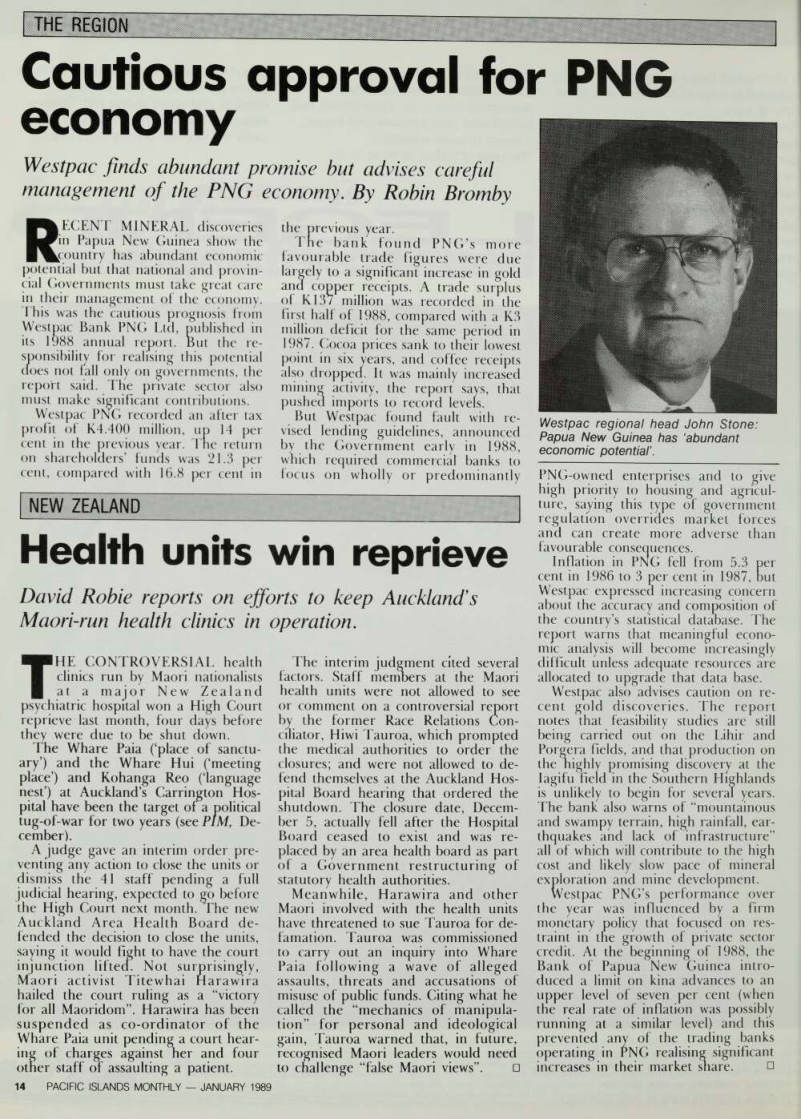
Westpac regional head John Stone: Papua New Guinea has ‘abundant economic potential’.
Health units win reprieve
New Zealand
David Robie reports on efforts to keep Auckland’s Maori-run health clinics in operation.
The Controversial Health
clinics run by Maori nationalists at a major New Zealand
psychiatric hospital won a High Court
reprieve last month, four days before they were due to be shut down.
The Whare Paia (‘place of sanctu ary’) and the Whare Hui (‘meeting
place’) and Kohanga Reo (‘language
nesf) at Auckland’s Carrington Hos pital have been the target of a political tug-of-war for two years (see PIM, De cember).
A judge gave an interim order pre venting any action to close the units or dismiss the 41 staff pending a full
judicial hearing, expected to go before
the High Court next month. The new Auckland Area Health Board de fended the decision to close the units, saying it would fight to have the court
injunction liftecf Not surprisingly,
Maori activist Titewhai Harawira hailed the court ruling as a “victory for all Maoridom”. Harawira has been suspended as co-ordinator of the Whare Paia unit pending a court hear ing of charges against her and four other staff of assaulting a patient.
The interim judgment cited several factors. Staff members at the Maori health units were not allowed to see or comment on a controversial report by the former Race Relations Con ciliator, Hiwi Tauroa, which prompted the medical authorities to order the closures; and were not allowed to de fend themselves at the Auckland Hos pital Board hearing that ordered the shutdown. The closure date, Decem ber 5, actually fell after the Hospital Board ceased to exist and was re placed by an area health board as part of a Government restructuring of statutory health authorities.
Meanwhile, Harawira and other Maori involved with the health units have threatened to sue Tauroa for de famation. Tauroa was commissioned to carry out an inquiry into Whare Paia following a wave of alleged assaults, threats and accusations of misuse of public funds. Citing what he called the “mechanics of manipula tion” for personal and ideological gain, Tauroa warned that, in future, recognised Maori leaders would need to challenge “false Maori views”. □
PNG-owned enterprises and to give
high priority to housing and agricul
ture, saying this type of government regulation overrides market forces and can create more adverse than favourable consequences.
Inflation in PNG fell from 5.3 per cent in 1986 to 3 per cent in 1987, out
Westpac expressed increasing concern
about the accuracy and composition of the country’s statistical database. The report warns that meaningful econo mic analysis will become increasingly difficult unless adequate resources are allocated to upgrade that data base.
Westpac also advises caution on re cent gold discoveries. The report notes that feasibility studies are still being carried out on the Lihir and Porgera fields, and that production on
the nighly promising discovery at the
lagifu field in the Southern Highlands is unlikely to begin for several years.
The bank also warns of “mountainous and swampy terrain, high rainfall, ear thquakes and lack of infrastructure” all of which will contribute to the high cost and likely slow pace of mineral
exploration and mine development.
Westpac PNG’s performance over
the year was influenced by a firm monetary policy that focused on res traint in the growth of private sector credit. At the beginning of 1988, the Bank of Papua New Guinea intro duced a limit on kina advances to an upper level of seven per cent (when the real rate of inflation was possibly running at a similar level) and this prevented any of the trading banks operating in PNG realising significant increases in their market snare. □
'United front ' on ethnic rights
Hawaii
Native Hawaiians gather to formulate civil rights policy. By Ed Rampell
The Decolonisation Pro
cess that began with Western Samoa’s independence in 1962 has spread throughout the Pacific, and has now reached even Hawaii. Hawaii today the United States’ 50th state
was an independent Polynesian
kingdom until 1893; five years later it was ‘officially’ annexed by the USA and in the years since then, Hawaiians have become a disadvantaged minority in their own land. Ninety years later,
however, they are again speaking out
on the issue of self-determination.
On December 4 and 5 last year, six Hawaiian groups participated in a Hawaiian Sovereignty Conference held at the State Legislature building, Hawaii’s seat of political power. More than 200 indigenous panelists and participants discussed programs for Hawaiian self-determination in an
event sponsored by the University of
Hawaii’s centre for Hawaiian Studies.
A group calling itself Ka Lahui Hawaii the Sovereign Hawaiian Nation proposed the creation of a ‘nation within a nation’. According to Ka Lahui Kia Aina (governor) Mililani Trask (see Pacific Islands Monthly, November and December 1988), this would give Hawaiians the same rights and legal status as American Indians, who live on reservation lands under tribal systems. Many Indian tribes are exempt from numerous US federal laws and can make rules of their own native American lands, enjoying a uni que ‘government to government’ rela
tionship with Washington.
While Ka Lahui advocates a demo cratic representative form of govern ment to guarantee self-determination,
other conference participants disagree.
Two islander groups, Onana O Hawaii and the Council of Hawaiian Orga nisations, call for the restoration of deposed royalty and the establishment of a constitutional monarchy (under which Hawaii was ruled throughout most of the 19th century).
The United Nations-linked Institute for the Advancement of Hawaiian
Affairs advocates outright independ
ence, while a fourth separatist group, Na O Iwi O Hawaii, favours setting aside two or three of the archipelago’s islands for the exclusive use of Hawaiians. But most conference parti
cipants point out that independence
from the United States is unrealistic that the US would do anything to pre vent secession.
Fifteen groups in all were invited to
take part in the conference, based on expressions of their stand on the sovereignty issue within the past year.
Most such as the Office of Hawaiian Affairs, a state agency declined to send a representative. Others, such as the Hou Hawaiians an
ancestral indigenous extended family
were not invited on the grounds that organisers were not aware if the Hou had a position on sovereignty.
However, according to Hou elder counsel Kamuela Price, the tribal group does have a stand on sovereignty that is strongly reflected in the Hou’s legal and legislative work on behalf of the native Hawaiians. “We’ve always believed that we already have sovereignty,” asserts Price. “It is implicit in Washington’s inclusion of Hawaiians in the Native American Religious Freedom Act.”
Price believes that full Hawaiian sovereignty can be realised through
the legislative and legal framework'of
the American democratic process: the
Hou is currently in federal court seek ing access to up to 486,000 hectares of land set aside to benefit Hawaiians in the Statehood Admissions Act.
The various Hawaiian groups dis agree on what form sovereignty should take; some believe sell determination should be only for those with 50 per cent or more Hawaiian blood, while others feel anv body with any Hawaiian blood should be entitled to play a role in the pro cess. However, all stress the import ance of the return of land to the mainly landless Hawaiians as essential, and concur that islanders need greater political empowerment and that self determination is the way to achieve it.
Until now the Hawaiian movement has been divided and without a uni
fying leadership. Ihe Hawaiian
Sovereignty Conference may have provided a significant step forward in creating the united front needed to
continue Hawaii’s indigenous political
and land rights struggles.
Advertisements & other items, p. 15 (1 item)
Vacancy: Political Officer
(formely South Pacific Bureau for Ecomomic Co-operation)
FORUM SECRETARIAT
Applications are invited from citizens of member countries for the position of Political Officer with the Forum Secretariat (formely the South Pacific Bureau for Economic Cooperation).
The Forum Secretariat is currently upgrading its political and legal capability and a new position has been created for an able and experienced political officer. Applicants should have a good degree in international law and or arts (particularly in political science, history or Pacific Studies) and be reasonably familiar with, and capable of analysing and preparing reports on, regional and international political developments. Forum Government or foreign affairs experience would be an advantage.
The successful applicant will also be required to assist Secretariat staff in organising and servicing the Forum Dialogue to be held annually between Forum countries and non-Forum Governments and agencies. He/She would also be expected to work in support of other Forum and regional co-ordinating committees.
GENERAL INFORMATION
The position carries an attractive remuneration package, tax-free for non Fiji citizens, and payable in Fiji dollars, including housing or housing allowances, education and child allowances superannuation payments and medical, life and travel insurance benefits. The appointee will be based at the Secretariat Headquarters in Suva, Fiji, but may be required to undertake periodic duty travel. Appointments would be for three years initially, renewable by mutual agreement.
Applications close on 3 March, 1989. As it is intended to make the appointment as soon as possible, the successful applicant must be able to take up the position shortly afterwards.
Applications should contain full information on education and career backgrounds and should list names, addresses and telephone numbers of at least three referees with whom the applicants have been associated in professional capacities.
Applications should be addressed to: All enquiries should be made to Mr Rene Wilson, Director of Services on 312600 extension 202.
The Secretary General Forum Secretariat PO Box 856 Suva, Fiji Telephone 312600; Telex: 2229 FJ; Fax: 302204
sabotage in Panguna
Papua New Guinea
Landowners resort to sabotage in Panguna
Bougainville landowners force the shutdown of PNG’s largest revenue earner as they turn to violence in their quest for compensation, by Wally Hiambohn
II N APRIL last year, when landown-
|ers of Papua New Guinea’s giant
|copper mine on Bougainville Island lodged a KlO billion compensation claim for their land (or what was left of it), no-one took them seriously.
Understandably so; it was thought the claim was ludicrously far-fetched and that no-one in the world much less in PNG had that kind of money. So the matter was left to die a natural death. No-one expected the landowners, generally known as quiet and easygoing, to press on with their claim to the extent of violence.
Almost all negotiating parties were therefore unprepared when the threatened violence did erupt at the end of November. Bougainville Copper Limited (BCL) and the National Government were left stunned as a handful of landowners, led by former BCL surveyor Francis Ona, set about
burning buildings and destroying vital
communications and electricity supply
installations.
Equipped with a massive quantity of
explosives and walkie-talkies thought
to have been stolen from BCL, the
landowners became guerilla fighters and, operating from thick forests, set about crippling PNG’s largest revenue earner. For a fortnight they continued sporadic attacks on mine property, leaving no clue to their whereabouts.
A police squad of 200 men specifically trained to quell trouble and led by Police Commissioner Paul Tohian left to chase without success the saboteurs, who were described as “terrorists” and “Rambo-style rebels”. And up to the end of December last year, the police were still searching in vain for the saboteurs.
The troubles began on November 22 when a group of armed men held
up security guards at BCL’s explosives
magazine and stole 228 items of ex
plosives, including detonators and
fuses. Before the company or the Gov ernment could act they struck on November 24, burning an administra live block, a helicopter and its hangar, and a guest house, The attacks continued on November 26 when an electric shovel used for digging ore was damaged and attempts were also made to destroy
other installations at the Panguna mine site. The total cost of the saboteurs’ actions was estimated at K 700,000.
While police reinforcements were called in from Rabaul, BCL chairman Don Carruthers flew to Port Moresby to assess the situation and to hold ur gent talks with Prime Minister Rabbie Namaliu. Mr Carruthers later issued a statement that promised CRA, the majority shareholder in BCL, would “seriously reconsider” its future invest ments in the country: CRA is the ma jor developer of an alluvial gold de posit at Mt Rare in the Highlands and Hidden Valley in Morobe Province.
Carruthers said the weekend “acts of terrorism” at Panguna were the result of “unrealistic expectations”.
“There could not be anything more damaging to PNG’s reputation as a place to invest than an attack on Bougainville Copper, which has been operating here for many years and al ways tried to do the right thing,” Mr Carruthers’ statement read. “Raising money for future investments in any sector would be almost impossible if
international backers thought explo
sives might be used on equipment or
innocent people.”
The impact of a CRA withdrawal
from exploration and gold mining
would be felt severely in PNG. The company spends KlO million a year in exploration, had planned to invest K2OO million this year to develop Hid den Valley and was reinvesting K 250 million a year from 1988 to 1990 to extend the Panguna mine’s lifetime.
Mr Namaliu reacted to the state ment with resentment, describing it as a “regrettable over-reaction”, pfe cal led for a “mature and considered re
sponse”, saying “problems at the mine
site are hardly confined to PNG, as CRA would well know.
“I seem to recall numerous Austra
lian mining companies having difficul
ties with local tribal landowners, en vironmental groups and even state and national governments. We want to maintain harmony with the mining in dustry, but we must do so on a basis of mutual co-operation and an under
standing of important local problems
such as land tenure,” the Prime Minis ter said.
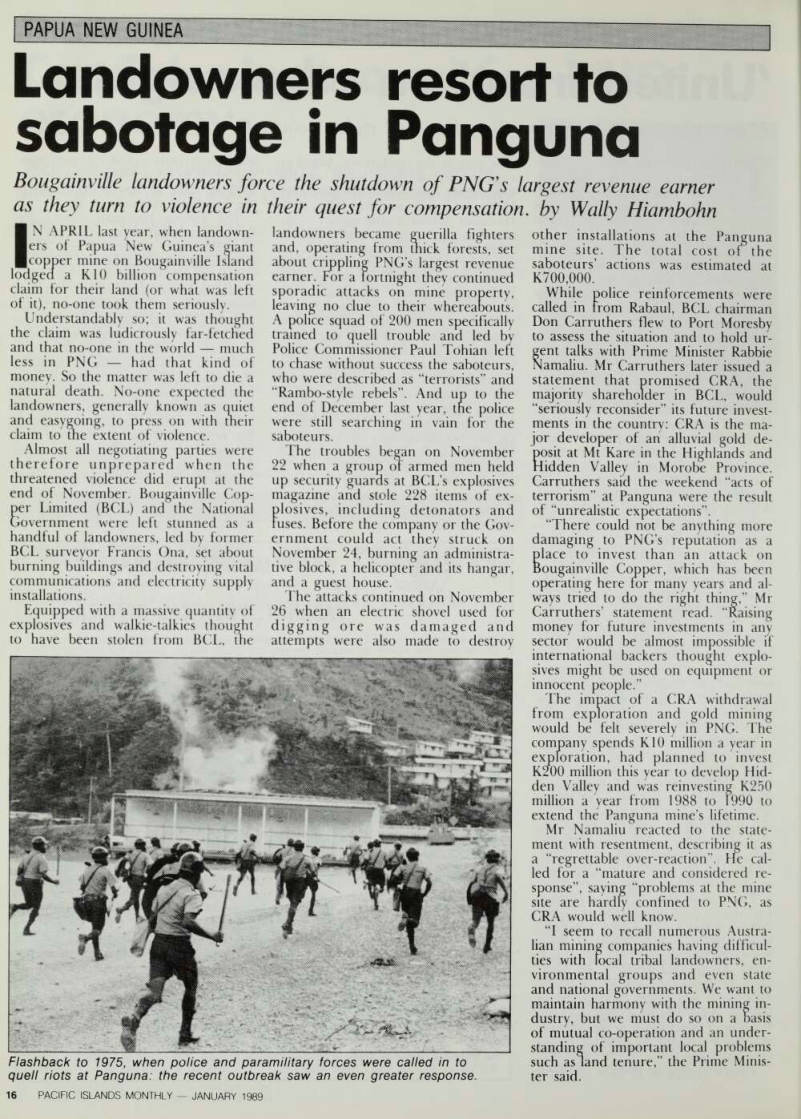
Flashback to 1975, when police and paramilitary forces were called in to quell riots at Panguna: the recent outbreak saw an even greater response.
The same day Father John Momis, a
leading figure in the renegotiation of
the BCL agreement, urged that it was time landowners who had been ignored for too long were taken seriously. He called for a tripartite agreement in which the Government, the company and the landowners all played an active role in the venture.
The troubles were far from over.
On December 1 another magazine store belonging to the Bougainville
Development Corporation’s Arawa
limestone quarry was broken into and
a large quantity of explosives stolen
the tne ft raised fears that parts needed to complete a major act of sabotage had now been taken and, the following night, a power transmission tower was blown completely off its base and sent crashing down a cliff.
The blast plunged the Panguna mine into total darkness and its huge machines, including the ore crushers, conveyor and concentrator, all ground to a halt.
Mine workers laboured around the clock to set up a temporary pole to restore power on Saturday; but the mine by then was virtually under siege. A repeater station linking the mine to the outside world was burned to the ground, and on Sunday a second power transmission tower was blown up, causing a second blackout at the mine and forcing a complete shutdown of operations for six days.
Opposition leader Paias Wingti
reacted predictably, putting the blame
on Mr Namaliu and his Government for “complacency” in handling the cris j s anc j sa ying the Government's disregard ()r Carruthers’ concern about the situation and its failure to deal firmly with the landowners had led to the escalation of the violence. Mr Wingti also claimed Father Momis has “implanted false expectations” in the minds of the Panguna landowners.
Mr Namaliu appointed a ministerial committee, led by his deputy Akoka Doi, and ordered it to Bougainville to meet landowners, the company and the provincial government and settle the matter. Police Commissioner Tohian, on arrival at Panguna, ordered his men to shoot and kill saboteurs if necessary, while PNG Defence Force soldiers were mobilised to be deployed if the crisis deepened.
The Doi delegation, though meeting
with company officials and provincial government representatives, failed for a week to bring Ona and his men to the negotiating table: he refused point-blank to come out of hiding unless police were withdrawn.
In the meantime, on December 7 saboteurs bombed a BCL maintenance building in Arawa, causing an estimated K 350,000 damage.
Patience was running out and the deployment of soldiers seemed inevitable: in Port Moresby PM Namaliu warned the saboteurs ‘our patience is not unlimited” and the company, despite restoring power to the mine, refused to continue production, fearing for the safety of its workers. The Goveminent delegation finally met Ona and his men on December 8 and received a guarantee of peace from the
landowners. The delegation left for Port Moresby with high hopes of a settlement, but BCL continued to re fuse to open the mine with a large
quantity of explosives still at large,
In Port Moresby the Government considered declaring a curfew in the mine area and its immediate locality, but gave the saboteurs until spm on December 12 to hand over the missing explosives or come under severe res trictions on freedom of movement, The saboteurs responded and sur rendered a quantity of explosives be fore the deadline, A personal assurance from Mr Namaliu saw Panguna return to pro duction on December 11. Five days la ter, the Government appointed a second team, again headed by Mr Doi, to take part in the renegotiation of the
Bougainville Copper Agreement. Car
ruthers and the Prime Minister also met again in Port Moresby to make peace a meeting Carruthers called ‘amicable and constructive”, At that meeting Mr Carruthers gave his assurances that the company would work out the problems affecting mine operations and would co-operate in reviewing the agreement. He also said that despite its problems, BCL was looking forward to an “excellent year .
In 1964, an Australian colonial administrator went to Panguna, on Bougainville Island, to negotiate ac quisition of the copper-rich land. In one sentence he told the landowners, “You get nothing”, climbed back into his helicopter and left, Now, 24 years later, the legacy of that attitude is at last being felt, both in Australia and PNG. Deprived of
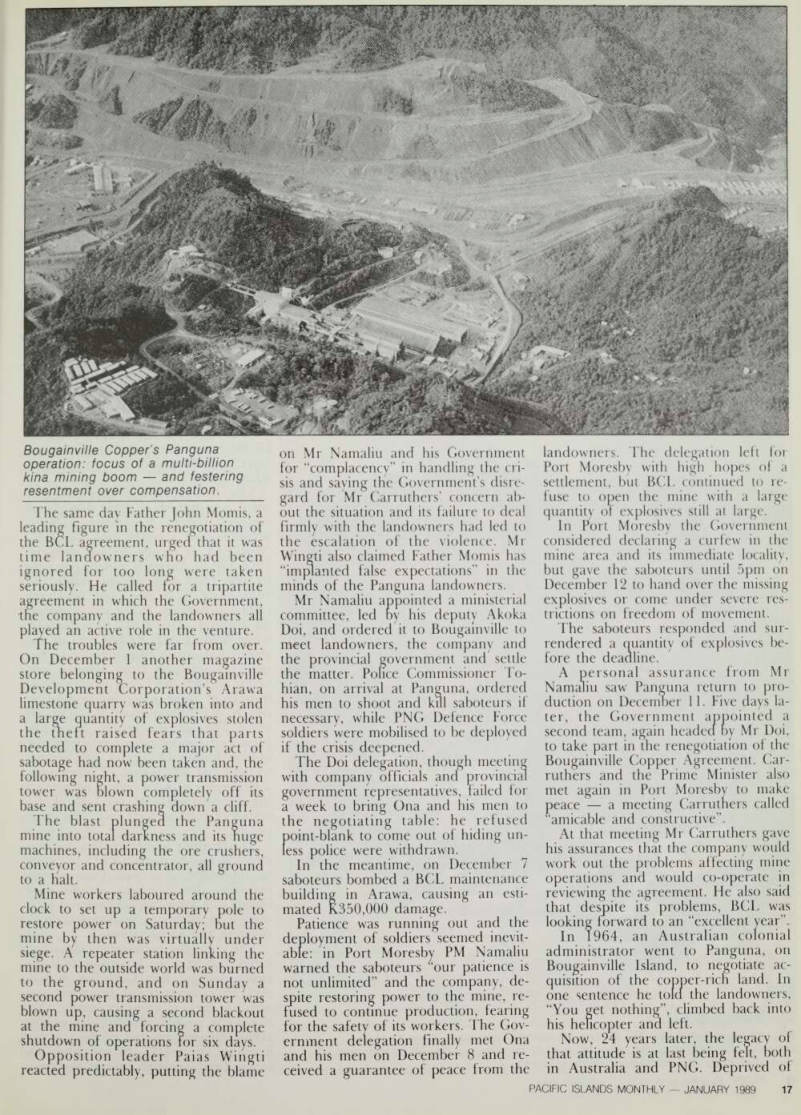
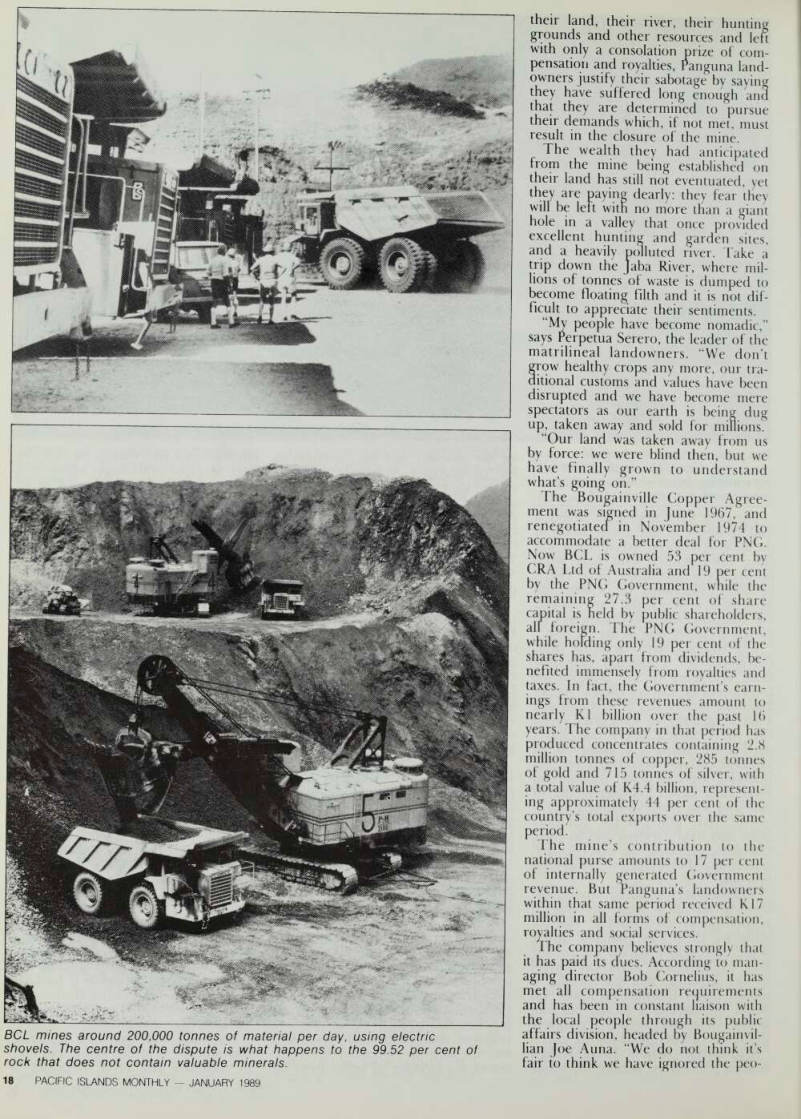
Bougainville Copper’s Panguna operation: focus of a multi-billion kina mining boom - and festering resentment over compensation.
their land, their river, their hunting grounds and other resources and leu with only a consolation prize of com pensation and royalties, Panguna land owners justify their sabotage by saying they have suffered long enough and that they are determined to pursue their demands which, if not met, must result in the closure of the mine.
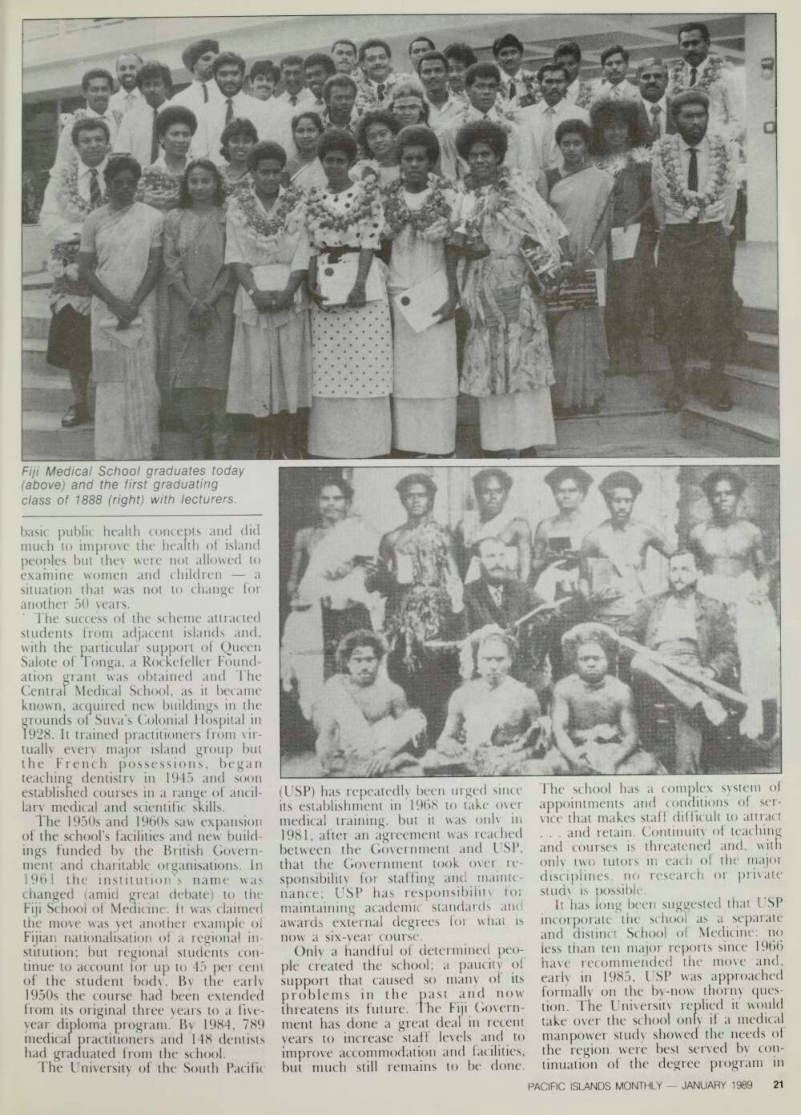
The wealth they had anticipated from the mine being established on their land has still not eventuated, yet they are paying dearly: they fear they will be left with no more than a giant hole in a valley that once provided excellent hunting and garden sites, and a heavily polluted river. Take a trip down the Jaba River, where mil lions of tonnes of waste is dumped to become floating filth and it is not dif ficult to appreciate their sentiments.
“My people have become nomadic,” says Perpetua Serero, the leader of the matrilineal landowners. “We don’t grow healthy crops any more, our tra ditional customs and values have been disrupted and we have become mere spectators as our earth is being dug up, taken away and sold for minions'; “Our land was taken away from us by force: we were blind then, but we have finally grown to understand whafs going on.”
The Bougainville Copper Agree ment was signed in June 1967," and renegotiated in November 1974 to accommodate a better deal for PNG.
Now BCL is owned 53 per cent by CRA Ltd of Australia and 19 per cent by the PNG Government, wnile the remaining 27.3 per cent of share capital is held by public shareholders, all foreign. The PNG Government, while holding only 19 per cent of the shares has, apart from dividends, be nefited immensely from royalties and taxes. In fact, the Government’s earn ings from these revenues amount to nearly K 1 billion over the past 16 years. The company in that period has produced concentrates containing 2.8 million tonnes of copper, 285 tonnes of gold and 715 tonnes of silver, with a total value of K 4.4 billion, represent ing approximately 44 per cent of the country’s total exports over the same period.
The mine’s contribution to the national purse amounts to 17 per cent of internally generated Government revenue. But Panguna’s landowners within that same period received Kl 7 million in all forms of compensation, royalties and social services.
The company believes strongly that it has paid its dues. According to man aging director Bob Cornelius, it has met all compensation requirements and has been in constant liaison with the local people through its public affairs division, headed by Bougainvil lian Joe Auna. “We do not think it’s fair to think we have ignored the peo
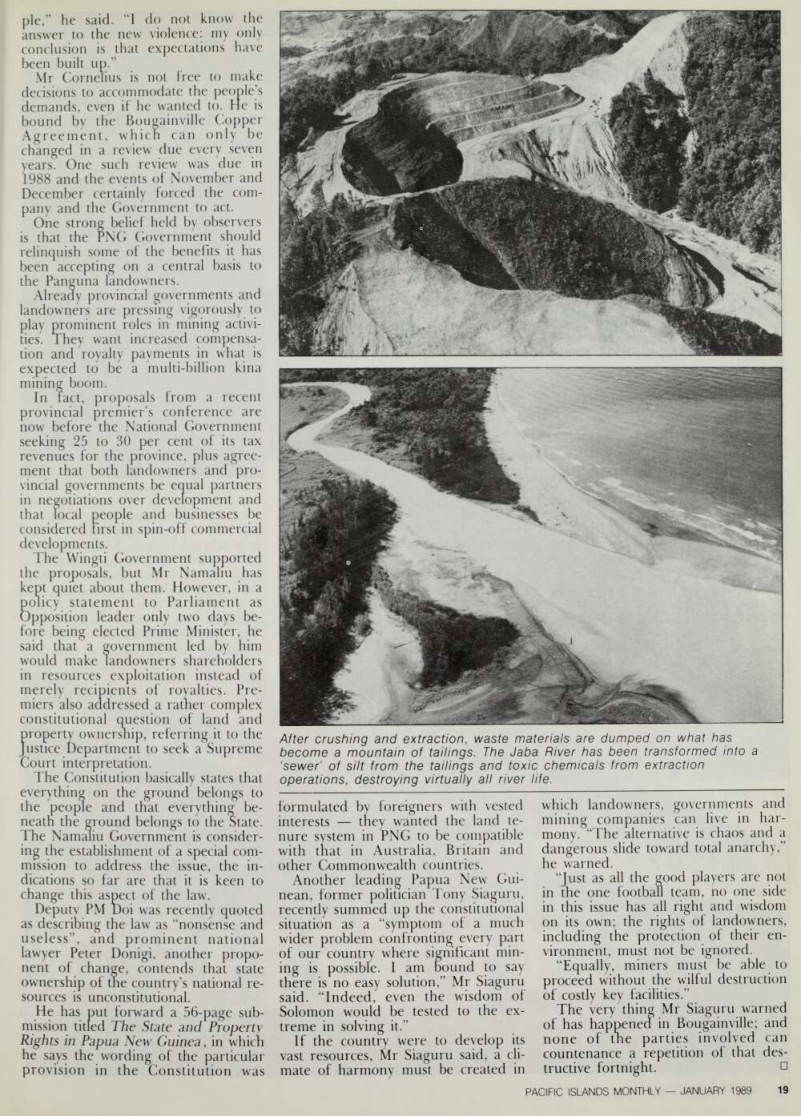
BCL mines around 200,000 tonnes of material per day, using electric shovels. The centre of the dispute is what happens to the 99.52 per cent of rock that does not contain valuable minerals.
pie,” he said. “I do not know the answer to the new violence: my only conclusion is that expectations have been built up.”
Mr Cornelius is not free to make decisions to accommodate the people’s demands, even if he wanted to. He is
bound by the Bougainville Copper
Agreement, which can only be changed in a review due every seven years. One such review was due in 1988 and the events of November and December certainly forced the com pany and the Government to act.
One strong belief held by observers is that the PNG Government should relinquish some of the benefits it has been accepting on a central basis to the Panguna landowners.
Already provincial governments and
landowners are pressing vigorously to
play prominent roles in mining activi
ties. They want increased compensa tion and royalty payments in what is expected to be a multi-billion kina
mining boom.
In fact, proposals from a recent
provincial premier’s conference are
now before the National Government seeking 25 to 30 per cent of its tax revenues for the province, plus agree ment that both landowners and pro vincial governments be equal partners in negotiations over development and that local people and businesses be considered first in spin-off commercial
developments.
The Wingti Government supported
the proposals, but Mr Namahu has kept quiet about them. However, in a Solicy statement to Parliament as
•pposition leader only two days be
fore being elected Prime Minister, he said that a government led by him would make landowners shareholders in resources exploitation instead of
merely recipients of royalties. Pre
miers also addressed a rather complex constitutional question of land and
property ownership, referring it to the
Justice Department to seek a Supreme
Court interpretation.
The Constitution basically states that
everything on the ground belongs to
the people and that everything be neath the ground belongs to the State.
The Namahu Government is consider ing the establishment of a special com mission to address the issue, the in dications so far are that it is keen to change this aspect of the law.
Deputy PM Doi was recently quoted
as describing the law as “nonsense and useless”, and prominent national lawyer Peter Donigi, another propo nent of change, contends that state ownership of tne country’s national re sources is unconstitutional.
He has put forward a 56-page sub mission titled The State and Property Rights in Papua New Guinea , in whicn he says the wording of the particular provision in the Constitution was
formulated by foreigners with vested interests tney wanted the land te nure system in PNG to be compatible with tnat in Australia, Britain and other Commonwealth countries.
Another leading Papua New Gui
nean, former politician Tony Siaguru,
recently summed up the constitutional situation as a “symptom of a much wider problem confronting every part of our country where significant min ing is possible. I am hound to say there is no easy solution,” Mr Siaguru said. “Indeed, even the wisdom of Solomon would be tested to the ex treme in solving it.”
If the country were to develop its vast resources, Mr Siaguru said, a cli mate of harmony must be created in
which landowners, governments and mining companies can live in har mony. “The alternative is chaos and a dangerous slide toward total anarchy, he warned. ‘‘Just as all the good players are not in the one football team, no one side in this issue has all right and wisdom on its own; the rights of landowners, including the protection of their en vironment, must not be ignored, “Equally, miners must be able to proceed without the wilful destruction
of costly key facilities.”
The very thing Mr Siaguru warned of has happened in Bougainville; and none of tne parties involved can countenance a repetition of that des- Inactive fortnight. D
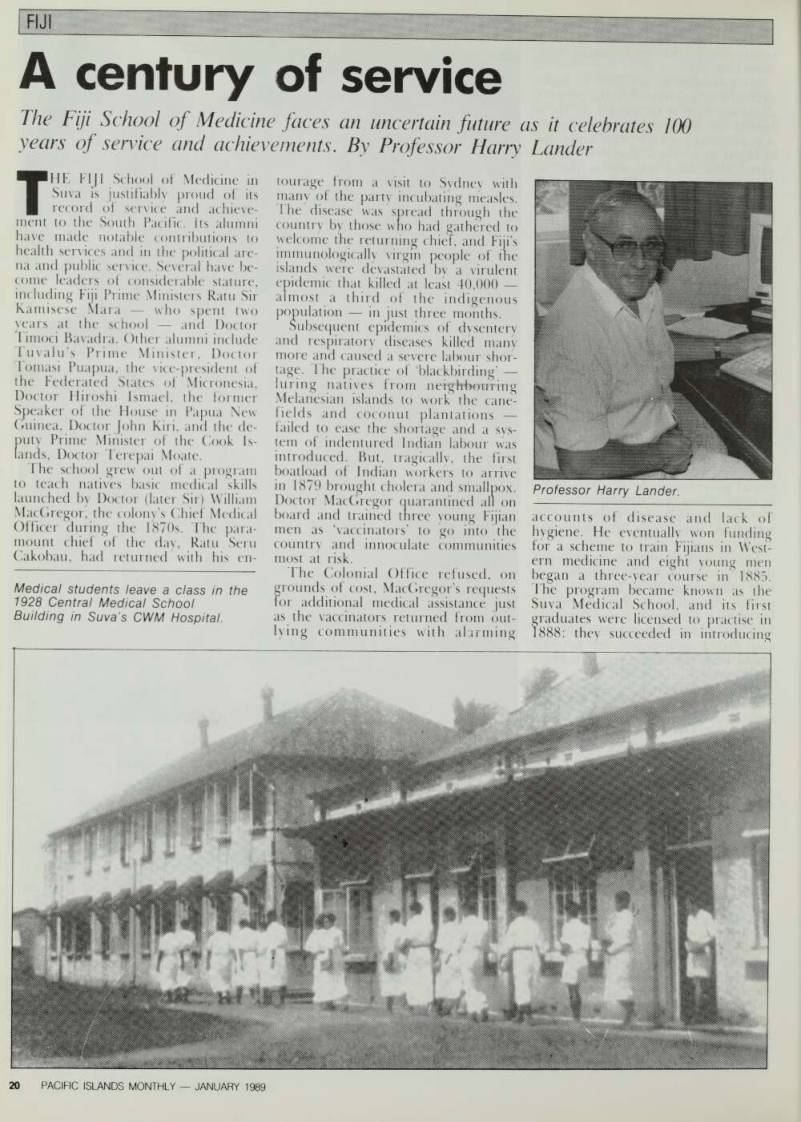
After crushing and extraction, waste materials are dumped on what has become a mountain of tailings. The Jaba River has been transformed into a ‘sewer’ of silt from the tailings and toxic chemicals from extraction operations, destroying virtually all river life.
A century of service
Fiji
The Fiji School oj Medicine faces an uncertain future as it celebrates 100 years of service and achievements. By Professor Harry Lander
THE Fiji School of Medicine in Suva is justifiably proud of its record of service and achieve ment to the South Pacific. Its alumni have made notable contributions to health services and in the political are na and public service. Several have be come leaders of considerable stature, including Fiji Prime Ministers Ratu Sir Kamisese Mara who spent two years at the school and Doctor I imoci Bavadra. Other alumni include Tuvalu’s Prime Minister, Doctor I omasi Puapua, the vice-president of the Federated States of Micronesia, Doctor Hiroshi Ismael, the former Speaker of the House in Papua New Guinea, Doctor John Kiri, and the de- D Prime Minister of the Cook Is s, Doctor Terepai Moate.
The school grew out of a program to teach natives basic medical skills launched by Doctor (later Sir) William MacGregor, the colony’s Chief Medical Officer during the 1870 s. The para mount chief of the day, Ratu Scru Cakobau, had returned with his en
tourage from a visit to Sydney with many of the party incubating measles.
The disease was spread through the country by those wno had gathered to welcome the returning chief, and Fiji’s immunologically virgin people of the islands were devastated bv a virulent epidemic that killed at least 40,000 almost a third of the indigenous population in just three months.
Subsequent epidemics of dysentery and respiratory diseases killed many more and caused a severe labour shor tage. The practice of ‘blackbirding’
luring natives from neighbouring
Melanesian islands to work the cane fields and coconut plantations failed to ease the shortage and a sys tem of indentured Indian labour was introduced. But. tragically, the first boatload of Indian workers to arrive in 1879 brought cholera and smallpox.
Doctor MacGregor quarantined all on board and trained three young Fijian men as ‘vaccinators’ to go into the country and innoculate communities most at risk.
The Colonial Office refused, on grounds of cost, MacGregor’s requests for additional medical assistance Just as the vaccinators returned from out lying communities with alarming
accounts of disease and lack of
hygiene. He eventually won funding
for a scheme to train Fijians in West ern medicine and eight voting men began a three-year course in 1885.
The program became known as the Suva Medical School, and its first graduates were licensed to practise in 1888: they succeeded in introducing
Medical students leave a class in the 1928 Central Medical School Building in Suva's CWM Hospital.
Professor Harry Lander.
basic public health concepts and did much to improve the health of island peonies but they were not allowed to examine women and children a situation that not to change for another 50 years.
The success of the scheme attracted students from adjacent islands and, with the particular support of Queen Salote of Tonga, a Rockefeller Found ation grant was obtained and The Central Medical School, as it became known, acquired new buildings in the grounds of Suva’s Colonial Hospital in 1928. It trained practitioners from vir tually every major island group but
the French possessions, began
teaching dentistry in 1945 and soon established courses in a range of ancil lary medical and scientific skills.
The 1950 s and 1960 s saw' expansion of the school’s facilities and new build ings funded by the British Govern ment and charitable organisations. In 1961 the institutions name was changed (amid great debate) to the Fiji School of Medicine. It w r as claimed the move was yet another example of Fijian nationalisation of a regional in stitution; but regional students con tinue to account for up to 45 per cent of the student bodv. By the early 1950 s the course had been extended from its original three years to a five year diploma program. By 1984, 789 medical practitioners and 148 dentists had graduated from the school.
The University of the South Pacific
(USP) has repeatedly been urged since its establishment in 1968 to take over medical training, but it was only in 1981, after an agreement was reached between the Government and USP, that the Government took over re sponsibility for staffing and mainte nance; USP has responsibility for maintaining academic standards and awards external degrees lor what is now a six-year course.
Only a handful ol determined peo ple created the school; a paucity ol support that caused so many ol its problems in the past and now threatens its future. The Fiji Govern ment has done a great deal in recent years to increase stall levels and to Improve accommodation and facilities, but much still remains to be done.
The school has a complex system of appointments and conditions of ser vice that makes stall difficult to attract . . . and retain. Continuity of teaching and courses is threatened and. with only two tutors in each of the major disciplines, no research or private stud\ is possible.
It has long been suggested that USP incorporate the school as a separate and distinct School of Medicine: no less than ten major reports since 1966 have recommended the move and, early in 1985, USP was approached formally on the by-now thorny ques tion. The University replied it would take over the school only il a medical manpower study showed the needs of the region were best served by con tinuation of the degree program in
Fiji Medical School graduates today (above) and the first graduating class of 1888 (right) with lecturers.
Fiji. The survey is oUlimited value for projecting future needs (who would nave predicted, for example, the ex odus of 40 per cent of Fiji’s doctors since March 1987?) and its results could be manipulated to support pre conceived plans of action. Tnere can be no doubt Pacific nations will con tinue to require doctors trained in the region, but to suggest these doctors’
study in neighbouring metropolitan
nations is absurd.
The Fiji Government has empha sised it will maintain its present finan cial support for medical training if USP taxes over the school. A 1986 au dit showed an operating cost of $F1.12 million for its medical course, of which the Government provided $0.78 million. USP has said it will re quire $2.75 million to operate a suit aolv upgraded program each year.
The $2 million shortfall is peanuts in
today’s Pacific.
The failure to merge is a result of
complex political considerations. The
Government is committed to continue training doctors and ancillary person nel in Fiji and the school is by defini tion one that serves the needs of Fiji and the region. As the Government foots most of the bill, it has behaved in the past as if the school owes little to its regional neighbours, so it is
hardly surprising that the Govern
ment’s request for USP to incorporate the school is viewed with suspicion by those neighbouring nations who view the move as an additional financial burden to be imposed on them.
A co-ordinated move by interested donors could raise the additional funds if all the nations involved made a combined request.
The South Pacific’s various ministers and directors of health and education must forget past differences and begin to co-operate, perhaps under the au spices of the World Health Organisa tion, which has already taken a lead in
this matter. They must work toward a sensible long-term solution to the problems of medical education in the region, recognising that such a step win be of benefit to all. □
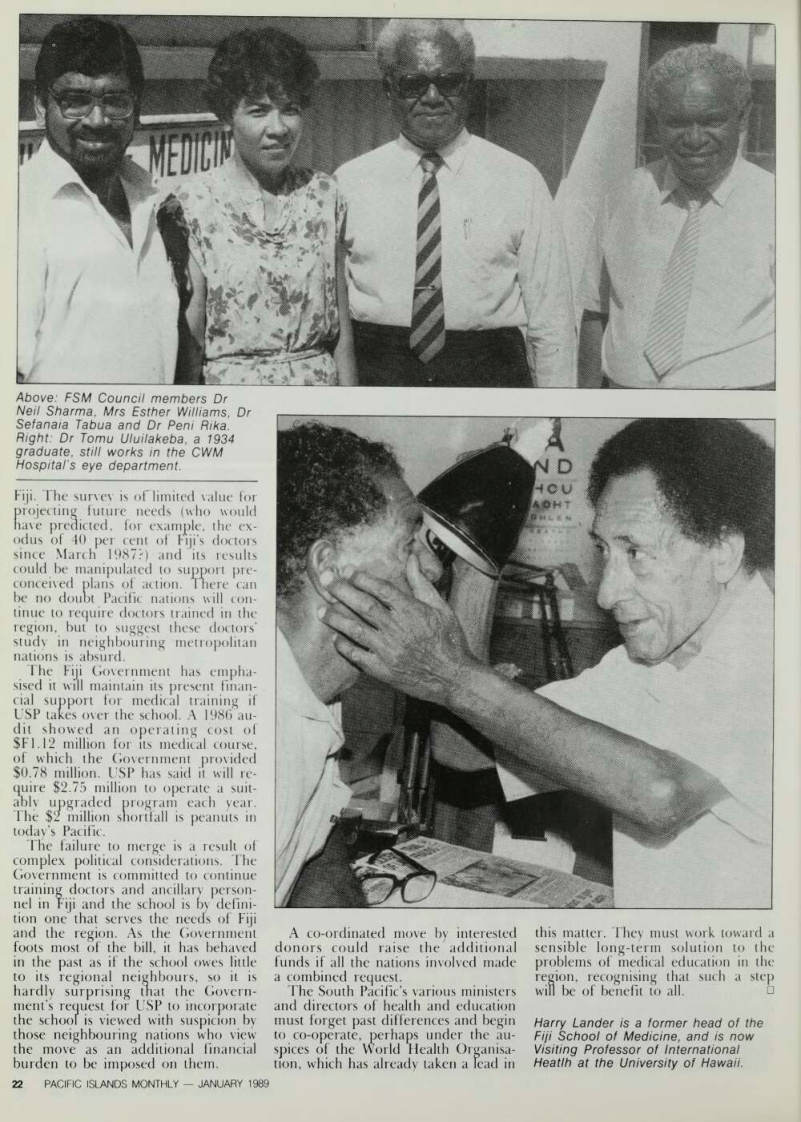
Above: FSM Council members Dr Neil Sharma, Mrs Esther Williams, Dr Sefanaia Tabua and Dr Peni Rika.
Right: Dr Tomu Uluilakeba, a 1934 graduate, still works in the CWM Hospital's eye department.
Harry Lander is a former head of the Fiji School of Medicine, and is now Visiting Professor of International Heatlh at the University of Hawaii.
Advertisements & other items, p. 23 (1 item)
Experience
A NEW DRIVING
SS’S
V- Skfe *'
A HIGHER STANDARD:
ALL NEW COROLLAS NOW COME WITH
TOYOTA MULTI-VALVE ENGINES.
Here is a blend of elegance and performance usually found only in big, luxury cars. That’s because Toyota believes everyone should enjoy the newest automotive advancements. And the latest example of this thinking is the all-new Corolla. It has an elegantly rounded shape to be proud of. And the high output and efficient multi-valve engine in all Corollas puts their performance in far better shape.
Expand your driving experience to new horizons with the all-new Corolla. Toyota - World’s No. 1 producer of multi-valve engines.
TOYOTA
Lini quashes coup attempt
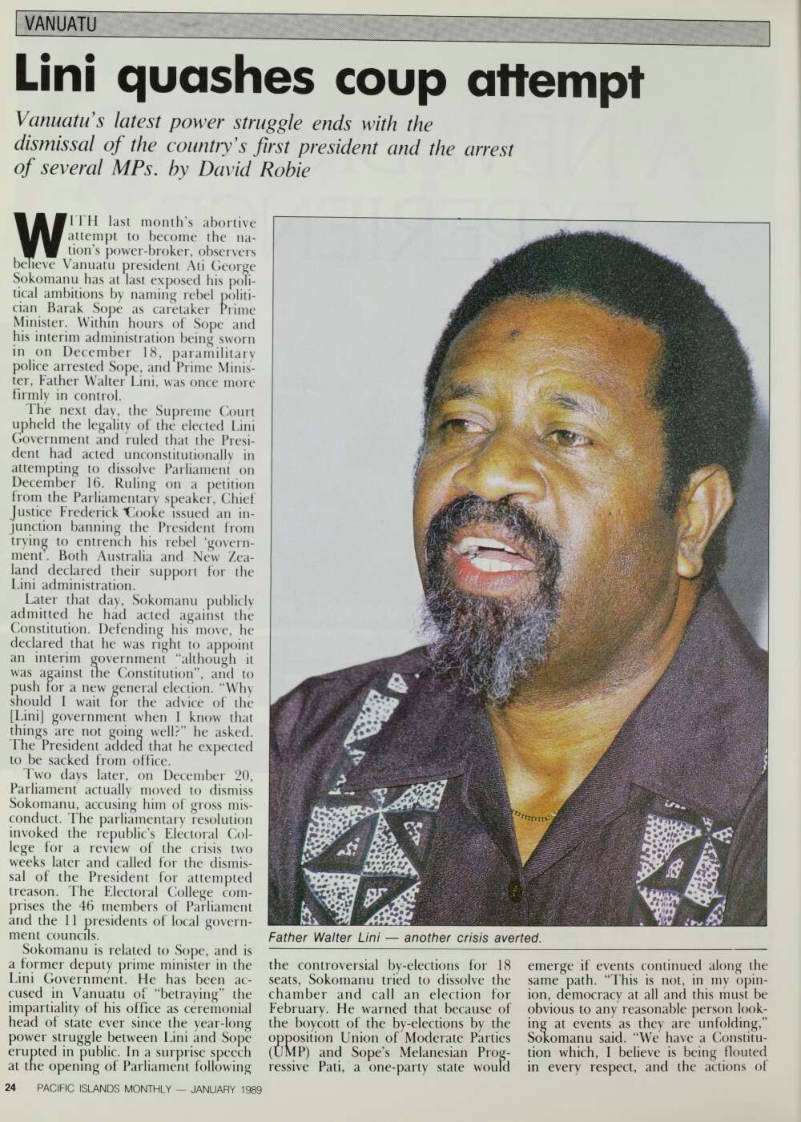
Vanuatu
Vanuatu’s latest power struggle ends with the dismissal of the country’s first president and the arrest of several MPs. by David Robie
1 A MITH last month’s abortive wflff attempt to become the na- W W tion’s power-broker, observers believe Vanuatu president Ati George Sokomanu has at last exposed his poli
tical ambitions by naming rebel politi
cian Barak Sope as caretaker Prime Minister. Within hours of Sope and his interim administration being sworn in on December 18, paramilitary police arrested Sope, and Prime Minis ter, Father Walter Lini, was once more firmly in control.
The next day, the Supreme Court upheld the legality of the elected Lini Government and ruled that the Presi dent had acted unconstitutionally in attempting to dissolve Parliament on December 16. Ruling on a petition from the Parliamentary speaker, Chief Justice Frederick "Cooke issued an in junction banning the President from trying to entrench his rebel ‘govern ment . Both Australia and New Zea land declared their support for the Lini administration.
Later that day, Sokomanu publicly admitted he had acted against the Constitution. Defending his move, he declared that he was right to appoint an interim government “although it was against the Constitution”, and to push for a new general election. “Why should I wait tor the advice of the [Lini] government when I know that things are not going well?” he asked.
The President added that he expected to be sacked from office.
Two days later, on December 20, Parliament actually moved to dismiss Sokomanu, accusing him of gross mis conduct. The parliamentary resolution invoked the republic’s Electoral Col lege for a review of the crisis two weeks later and called for the dismis sal of the President for attempted treason. The Electoral College com prises the 46 members of Parliament and the 11 presidents of local govern ment councils.
Sokomanu is related to Sope, and is a former deputy prime minister in the Lini Government. He has been ac cused in Vanuatu of “betraying” the impartiality of his office as ceremonial head of state ever since the year-long power struggle between Lini and Sope erupted in public. In a surprise speech at the opening of Parliament following
the controversial by-elections for 18 seats, Sokomanu tried to dissolve the chamber and call an election for February. He warned that because of the boycott of the by-elections by the opposition Union of Moderate Parties (UMP) and Sope’s Melanesian Progressive Pati, a one-party state would
emerge if events continued along the same path. “This is not, in my opin ion, democracy at all and this must be obvious to any reasonable person look ing at events as they are unfolding,”
SoKomanu said. “We have a Constitu tion which, I believe is being flouted in every respect, and the actions of
Father Walter Lini - another crisis averted.
everybody involved in the politically turbulent past six months or so, irrespective of the technicalities in volved, are a sad legacy to our inten tions when we founded our republic.”
Though his words sounded noble, critics cited as evidence of political bias the speed with which he appointed his protege, Barak Sope, as “Prime Minis ter”. Sope had been sacked from Cabinet and ousted by the ruling Vanuaaku Pati. The Lini Cabinet re sided him as the instigator of anti ciovernment rioting last May which caused the death of one man and SA2 million dollars damage in the capital.
After making his address, Sokoma nu picked up his papers and stormed out of Parliament. But less than half an hour later Parliament was recon vened for a speech by the Prime Minister. Lini condemned the Presi dent, described him as a “disgrace and a political fraud” and called on him to
resign. Branding the move a “political
coup”, Lini added that the attempted dissolution had no effect.
Guarded by armed paramilitary
Vanuatu Mobile Force troopers, MPs gathered in the chamber next day in defiance of the President for the start of the Budget session. Under the Con stitution, Parliament can only be dis solved by the President after a resolu tion by a two-thirds majority of MPs
or on the advice of the Prime Minister and the Council of Ministers.
As tension mounted, the President was barred at gunpoint from making a broadcast on government-controlled Radio Vanuatu and the security forces set up roadblocks around the capital.
A 22-year-old Australian tourist wounaed after the car in which he was travelling failed to stop at a roadblock outside Port Vila.
A “hit-list” was reportedly circulated
by close supporters of Sope naming
leading members of the Lmi Cabinet and senior civil servants as revenge targets. Written in Bislama and signed ‘Mr Black Dog’, the list warned that a man had already been ‘martyred’ for land rights and that if anybody else died ‘one of you will either die or will disappear without trace’.
Politicians and civil servants named on the list were Home Affairs and Police Minister lolu Abil, Lands Minis ter William Mahit, Finance Minister Sela Molisa and Lini’s private secretary and spokesman Joe Natuman. Also in cluded were Prime Minister’s Office deputy secretary Grace Molisa, deputy
Foreign Affairs secretary Raymond
Malapa and Police Special Branch Chief Superintendent Waimini Perei.
Vietnamese businessmen named in cluded the owner of Dovair, Dinh Van Than, a major financial supporter ot the Vanua’aKii Pati and one of Lini’s closest associates, and Rene Ah Pow, owner of the Au Bon Marche super market. Luan Van Dinh was said to have “already been dealt with” as an example to the other 16 people named on the list. Dinh’s photo-
Sope - power bid ends in court.
M graphic shop was wrecked by protes tors during the anti-government riot ing last May and, in November, he was beaten up by a gang of Sope’s supporters. He was flown to Noumea for surgery with a badly smashed jaw.
At least two of Sope’s colleagues, David Trene and Albert Sanday, were reportedly arrested in connection with the list, along with 16 people arrested
in the purge. Sope, putative deputy
Prime Minister Maxime Carlot and three other ministers of the short-lived interim government were charged with sedition which carries a three year Jail term and taking unlawful oaths. They were remanded until January 4 when a Port Vila court, packed with their supporters, commit ted them to stand trial. Sokomanu also appeared on January 4 to answer a
charge of inciting mutiny; if convicted
he could face a maximum life sent ence. All six were due to stand trial on January 13 in Port Vila.
Even as Sokomanu faced the court, the Electoral College met to decide whether he should be dismissed from the presidency. But with several coun cil heads stranded by Cyclone Delilah the College failed to attain a quorum and resolved to reconvene on January 10 when Sokomanu was dismissed.
When Sokomanu called in late November for the by-elections to be scrapped and a fresh poll held, Prime
Minister Lini prevented the plea being
broadcast on Radio Vanuatu and ac cused the President of meddling in political affairs; then he went further, claiming Sokomanu was trying to use his office to back Sope’s bid to over throw the Lini Government.
Supporters of Sope have in turn ac cused the PM of trying to create a dictatorship or a one-party state. In response, Lini and his supporters counter that Sope has been trying to subvert Vanuatu’s democratic process
through coercion, opportunism and
increasing corruption.
Sope was once one of the most powerful ideologues of the Vanua’aku rati and its secretary-general for 14 years. He is an ardent admirer of Fiji’s Major General Sitiveni Rabuka, and, on a visit to Suva in October, Joined Rabuka in a bitter attack on Australian (and, by implication, New Zealand) di plomacy in the Pacific, Folowing a series of constitutional law challenges to the Lini administra tion, Sope’s New Zealand-born laywer, Peter Coombe, was given one month to leave the country. Though he peti tioned Lini to revoke the order, the Prime Minister refused to reconsider and Coombe was forced to leave the country three days after the attempted dissolution of Parliament.
Lini did not reveal the reason for the expulsion, but Government sources claimed Coombe along with
an American and a West Papuan both declared pesona non grata had been interferring in the internal poli tics of Vanuatu. Coombe denied the
allegation, claiming an interest “purely
in offering legal advice and service”.
Coombe had given legal representa tion to about 40 of the 120 people arrested during the post-riot purge in Port Vila including two brothers of Barak Sope who were last month jailed with sentences ranging from 11 to 14 months. Three others also charged were given suspended sent ences, and all had been arrested for
rioting and causing malicious damage.
Six years ago, Coombe’s former wife Christine was expelled from Vanuatu after publishing an anti-government newspaper, The Voice of Vanuatu.
The republic’s only other paper is the government organ Vanuatu Weekly.
Coombe failed in July to win three constitutional challenges on behalf of Sope and his renegade MPs, the so called Gang of Five, and the 18 opposition UMP members who had been expelled from Parliament. But he later won a Court of Appeal judg ment. Shortly after Sope and his four Melanesian Progressive Pati MPs William Edgell, Charles Godden, Ana tole Lingtamat and Jimmy Simon were reinstated in Parliament they res igned, declaring they had no confi dence in Speaker Onneyn Tahi. Sope claimed in a statement that Tahi had “disgraced” the office of Speaker, while Tahi had repeatedly warned the
five they would have problems retain ing their Parliamentary seats for the Budget session because they had mis sed three consecutive sitting days in late July 1988.
The resignations coincided with the closure of nominations for the by elections for the 18 vacant UMP seats.
The move meant Sope’s Melanesian Progressives who would have formed a token Opposition had they remained in the chamber joined Opposition leader Maxime Carlofs boycott of the elections to honour their deal. The Vanua’aku Pati, however, was not the only contender.
The Tan Union and Nagriamel, the Santo-based party which attempted secession at independence in 1980, as well as a handful of independents also contested the by-elections.
Nine of the vacant seats were filled unopposed six to the Vanua’aku Pati and three to the Tan Union. This meant the VP already had a 29 seat majority [one seat for Santo Rural re mained vacant because there were only three nominations for the electo rate’s four seats]. The VP now has 35 seats, Tan Union five, while the Santo seat and five Melanesian Progressive seats remained vacant.
In last year’s general election, Sope
won his seat by just three votes. At the time, he challenged Lini for the Prime Ministership, attacking the leader’s ill health after he had become partially paralysed as a result of a stroke 10 months earlier. D
George Sokomanu - Vanuatu’s first president, sacked after the failed ‘coup’.
Advertisements & other items, p. 25 (1 item)
14L/4IR --- Papua New Guinea's
nationwide airline connection to and
from the World.
it
DOMESTIC
Talair serves all provinces in P.M.G., many on a daily basis. No other airline comes close to serving the 130 ports a week that Talair does. Charter services also are available.
INTERNATIONAL
Using our computerised system
in any of our 12 International Travel Centres, we can book you anywhere in the world 0n...
planes, trains, luxury liners
arrange rental cars, hostefs, motels or hotels.
jii
* * r Panguna - 95 8020 • Arawa - 95 2113 • Mt. Hagen - 52 2465 Boroko - 25 7655 • Tabubil - 58 9228 • Goroka - 72 1355 • Lae - 42 2316 Madang - 82 2757 • Rabaul - 82 2882 • Wewak - 86 2012 Vanimo - 87 1180 • Port Moresby - 21 4766 • Waigani - 25 7877 Brisbane Metropolitan Area - 229 1177 Outside Brisbane - 008 777879 Ink V*l .w.
I ATA
QUALITY IN AIR TRANSPORT
Teachers Fight Sex Taboos
Population explosion, a jump in teenage pregnancies and rising sex-related crimes are troubling South Pacific societies. By David Robie
SOCIAL restraints once essential to survival on small South Pacific islands, including customs that
curbed population growth, have
eroded rapidly over recent decades, and the consequences are beginning to alarm many of the region s leaders and educators.
The collapse of traditional customs, alienation between generations and a desire to sample the modern ‘good life’ as portrayed on television and in videos nave in several countries fos tered a youth culture with disturbing sexual trends.
Both the Marshall Islands and the Solomon Islands, at least, are headed for population explosions that will sorely tax their limited economic and social resources. Elsewhere in the re gion, particularly in Tahiti and on Ebeye Island in tne Marshalls, the sha dow of AIDS (acquired immune de
ficiency syndrome) is looming.
Sex is a touchy or taboo subject in many Pacific cultures; though some countries have programs in sexuality education, they are frequently too for mal and ineffective.
Pacific educators focused on these
problems and examined possible
strategies at a seminar on family life education organised by the Suva-based UNESCO Pacific Office, in collabora tion with the NZ Family Planning Association, in Auckland last month.
Twenty officials and educators partici pated, representing the Cook Islands, Palau, Federated States of Micronesia, Fiji, Kiribati, Marshall Islands, Papua New Guinea, Solomon Islands, Tonga, Vanuatu and Western Samoa.
“Seminar isn’t really the right word for it,” said Family Planning Associa tion education director Barbara Lusk.
“We really got to the nub of the
issues, approached them practically
through workshops and experienced
some of the methods at several Auck land secondary schools with many Pacific islanders.
“Teaching styles need to change in
the Pacific. Rather than a formal
teacher-up-front situation, learning is
done with discussions, activities, games, role playing, videos and case studies. Rather than concentrating on the abstract ideas parents might be thinking of, the issues are approached more from where the kids are coming from the sort of questions they are asking, such as, ‘Am 1 normal? What
is happening to me? How will I know when I’ve reached puberty?’ ”
Seminar participants studied ways to improve sexuality programs in Pacific schools and other community venues, to share ideas and resources such as special Pacific videos in sex education. to talk to Pacific students at Auckland’s Seddon High School about their
experiences in sexuality education,
and the planning of national programs and strategies.
“Many Pacific nations are faced with growing problems of teenage pre-
gnancies, illegitimacy, sexually trans-
mitted diseases and sex-related crimes,” said Dr Allan Rondo, Suvabased regional adviser for population education in the Pacific. “It is vital that sexuality education is expanded
more effectively among teenagers.”
But that is easier said than done, when the subject is so sensitive even a New Zealand Sunday Times headline on a report about the seminar saying Pacific people had gathered to “talk sex” caused concern.
"Sex education is part of a cultural taboo, a subject that cannot be talked about openly"
“Sex education is part of a cultural taboo a fearsome subject that can not be talked about openly,” said Mar garet Ratu, a senior curriculum officer of Papua New Guinea’s Education De partment. “Urban children miss out on cultural values that have dis appeared with the modern lifestyle.”
While most educators agreed on the need for more widespread and more useful sexuality education among teenagers, they got a negative re sponse from Tonga’s director of education, Paulo Bloomfield.
“Sex education in our view should never, never include being taught how to practise it,” he said. “It is sacred, it is Godly a matter between male and female. It should not be learned from books.
“It should be from the right teacher, not the wrong teacher,”
Bloomfield added, condemning an American educator who had taught sex education in the Tongan language and who had “fortunately” now left.
“There should be a father figure and a mother figure. Never mix the
sexes. If you mix them . . . no, no!”
Later, he was heard to defend rape as being the “natural sexual urge” of young men; several other men re jected the notion of rape within mar
riage.
Among countries that have well advanced family life education prog rams is Fiji, which has been stirred into action by reports on alarming sex ual behaviour among the young, Under the headline Teen Mothers
Baby Shock’, The Fiji limes reported
that of 8093 births in Suva during 1984, 13 per cent of mothers were under the age of 19. Of the total births, 1617 babies were illegitimate, Also, 65 per cent of the mothers suffering from S fl)s bore illegitimate children. “Recent disclosures about the problems of teenage pregnancies, ille
gitimacy, sexually transmitted diseases,
juvenile delinquency and psychological
problems have caused alarm in Fiji,” says Kaminieli Tagica, the Education
Ministry’s family life education project
co-ordinator. “ I his has stimulated the
introduction of family life education
including sexuality education
into the schools.”
Fiji authorities have produced a documentary video called Better Safe: A South Pacific Drama , which tells the story of Jone, a fun-loving young man popular with teenage girls, and how
ne spreads STDs. Sponsored by the
Family Planning Federation of Austra lia, the video also gives up-to-date in formation on AIDS.
Another video, a 45-minute prog ram called Talanoa (‘Telling Stories), shows students talking about family planning, teenage sex, abortion and STDS. The videos are now being widely used in the Pacific. A pilot program expanding sex education in schools has now been adopted in all 141 schools in Fiji, and steps have been taken to introduce community counselling. “This word sex education sets bells ringing,” says Bogden. “But the issues are deadly serious for the Pacific and it is important to reaffirm positive values where culture is break ing down.” D
Students
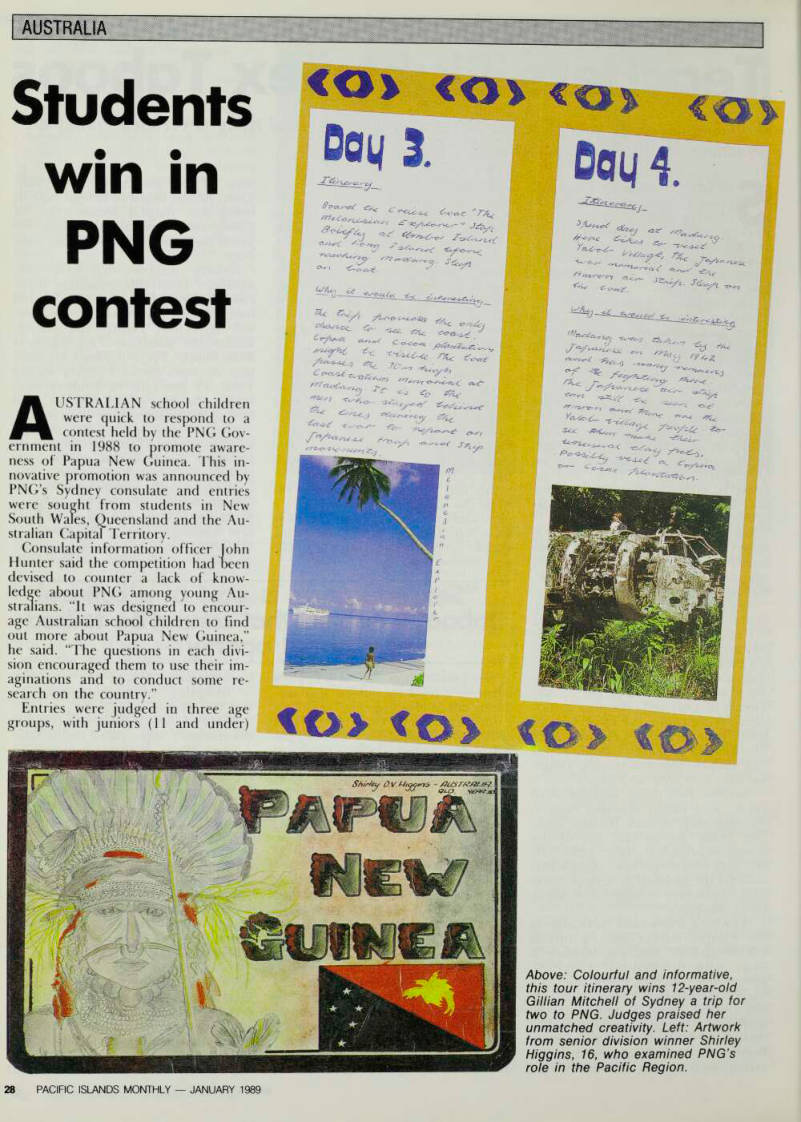
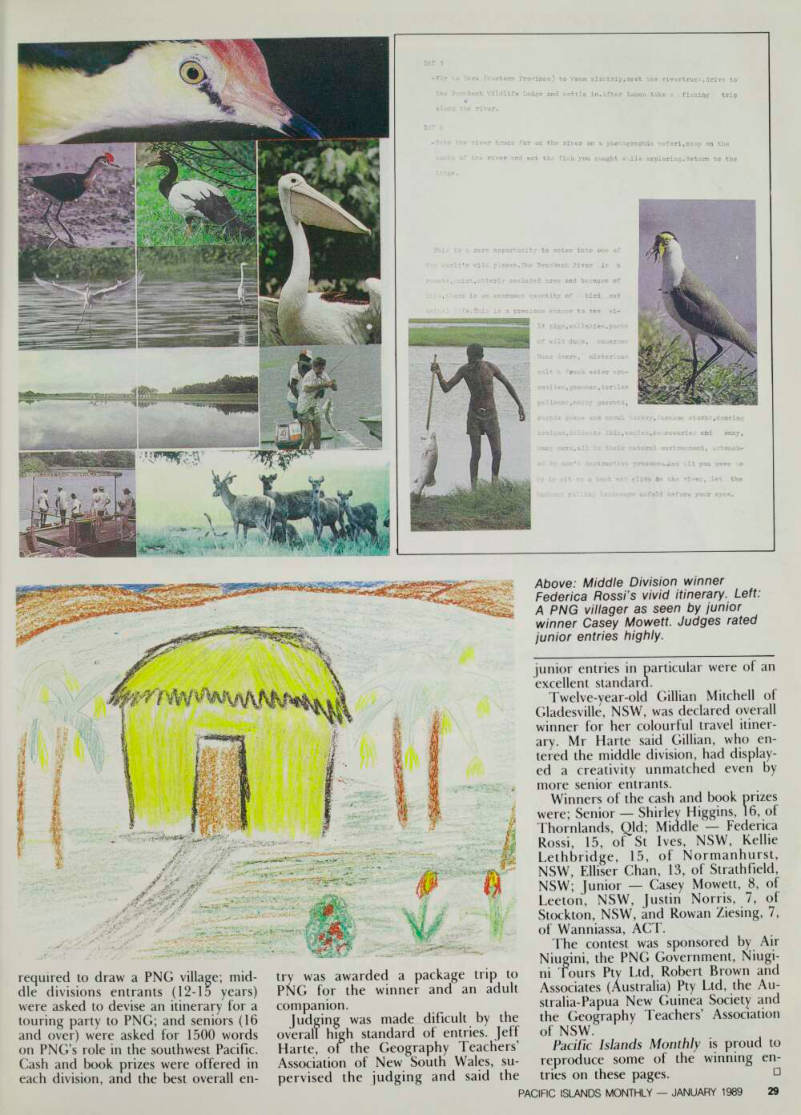
Australia
Students win in
Png
contest
Australian school children were quick to respond to a contest held by the PNG Gov ernment in 1988 to promote aware ness of Papua New Guinea. This in novative promotion was announced by PNG’s Sydney consulate and entries were sought from students in New South Wales, Queensland and the Au
stralian Capital Territory.
Consulate information officer John Hunter said the competition had oeen devised to counter a lack of know ledge about PNG among young Au stralians. “It was designed to encour age Australian school children to find out more about Papua New Guinea,” he said. “The questions in each divi sion encouraged them to use their im aginations and to conduct some re search on the country.”
Entries were judged in three age groups, with juniors (11 and under)
Above: Colourful and informative, this tour itinerary wins 12-year-old Gillian Mitchell of Sydney a trip for two to PNG. Judges praised her unmatched creativity. Left: Artwork from senior division winner Shirley Higgins, 16, who examined PNG’s role in the Pacific Region.
required to draw a PNG village; mid dle divisions entrants (12-15 years) were asked to devise an itinerary for a touring party to PNG; and seniors (16 and over) were asked for 1500 words on PNG’s role in the southwest Pacific.
Cash and book prizes were offered in each division, and the best overall en
try was awarded a package trip to PNG for the winner and an adult companion.
Judging was made dificult by the overall high standard of entries. Jeff Harte, of the Geography Teachers’
Association of New South Wales, su pervised the judging and said the
junior entries in particular were of an excellent standard.
Twelve-year-old Gillian Mitchell of Gladesville, NSW, was declared overall winner for her colourful travel itiner ary. Mr Harte said Gillian, who en tered the middle division, had display ed a creativity unmatched even by more senior entrants.
Winners of the cash and book prizes were; Senior — Shirley Higgins, 16, of Thornlands, Old; Middle — Federica Rossi, 15, of St Ives, NSW, Kellie Lethbridge, 15, of Normanhurst, NSW, Elliser Chan, 13, of Strathfield, NSW; Junior — Casey Mowett, 8, of Leeton, NSW, Justin Norris, 7, of Stockton, NSW, and Rowan Ziesing, 7, of Wanniassa, ACT.
The contest was sponsored by Air Niugini, the PNG Government, Niugi ni Tours Pty Ltd, Robert Brown and Associates (Australia) Pty Ltd, the Au stralia-Papua New Guinea Society and the Geography Teachers’ Association of NSW.
Pacific Islands Monthly is proud to reproduce some of the winning en tries on these pages. D
Above: Middle Division winner Federica Rossi’s vivid itinerary. Left: A PNG villager as seen by junior winner Casey Mowett. Judges rated junior entries highly.
Paul Gauguin: The
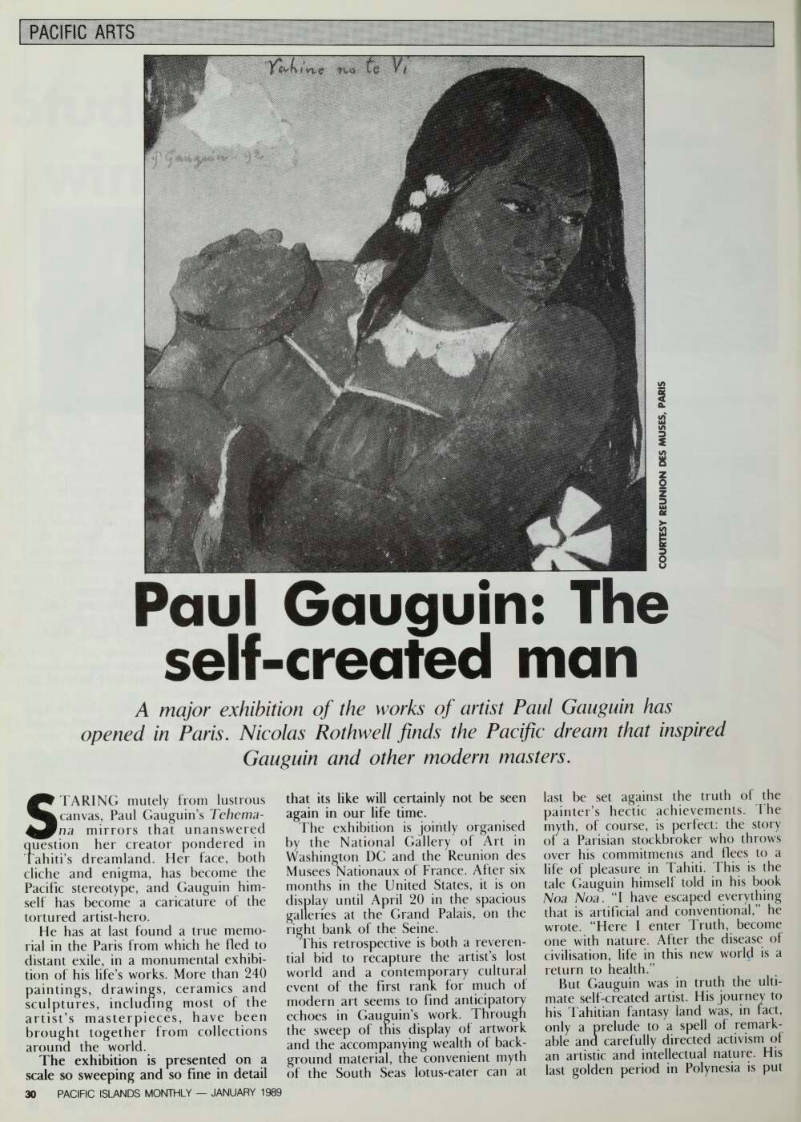

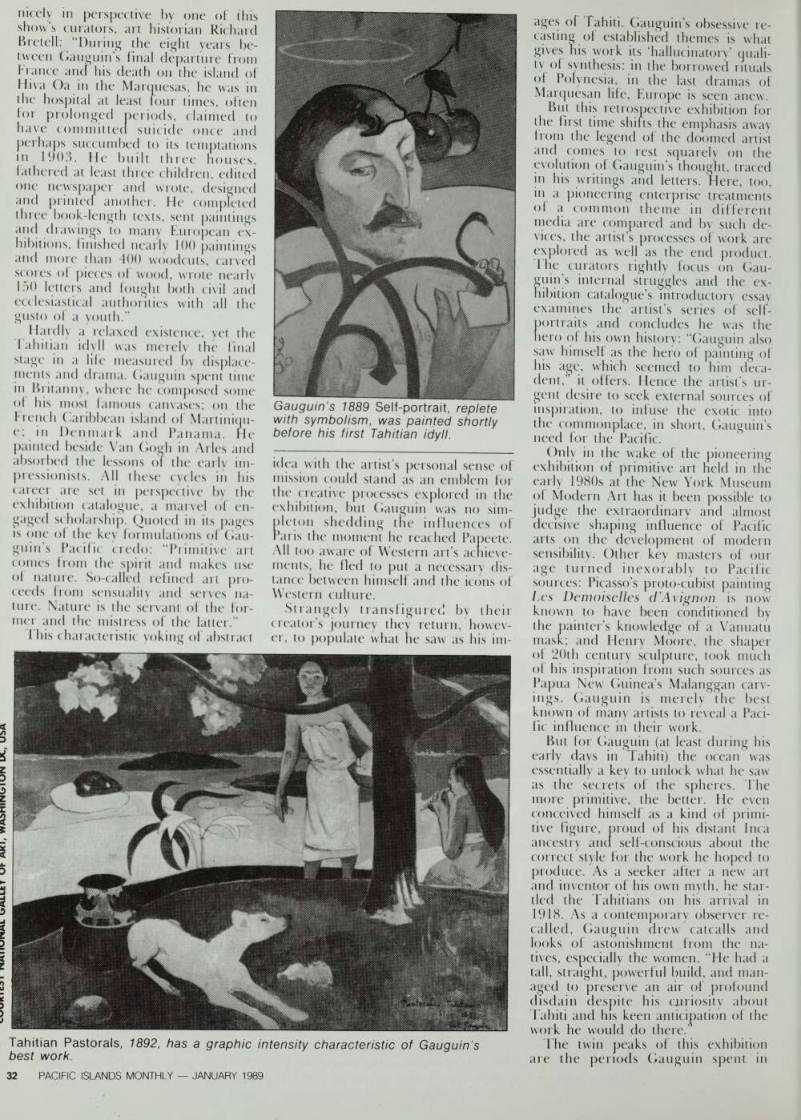
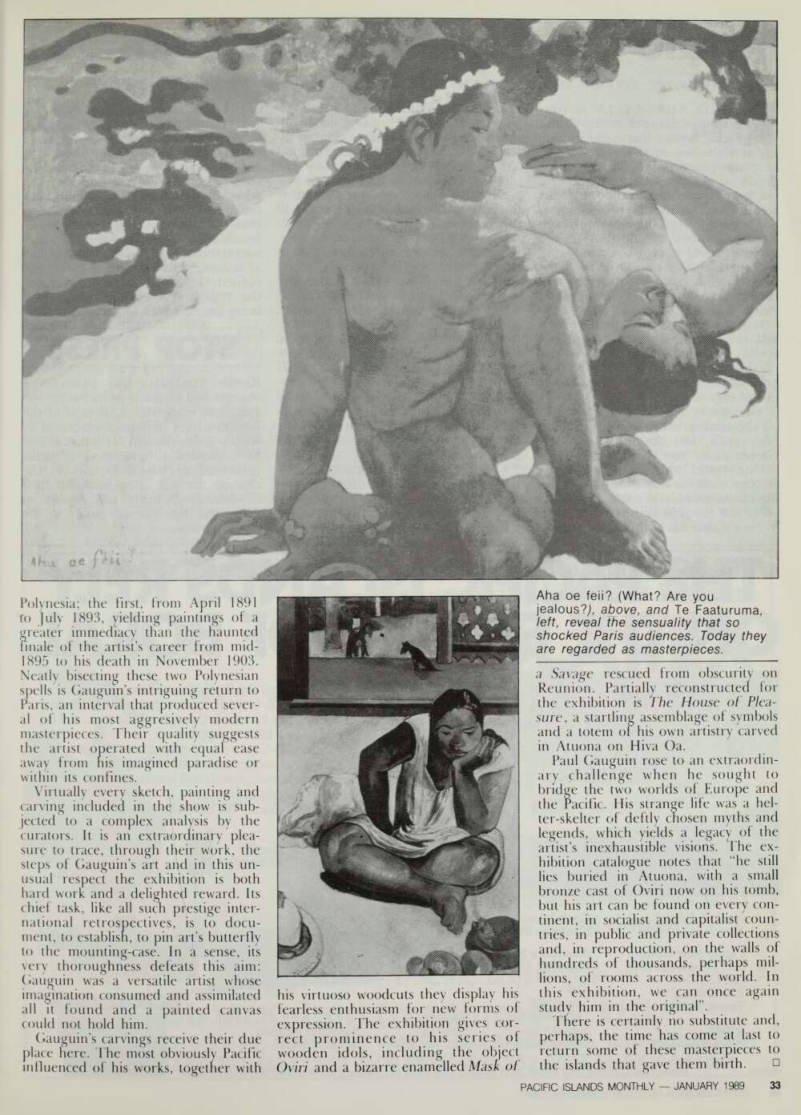
Pacific Arts
Paul Gauguin: The self-created man
A major exhibition of the works of artist Paul Gauguin has opened in Paris. Nicolas Rothwell finds the Pacific dream that inspired Gauguin and other modern masters.
STARING mutely from lustrous
canvas, Paul Gauguin’s Tehemana mirrors that unanswered question her creator pondered in Tahiti’s dreamland. Her face, both cliche and enigma, has become the Pacific stereotype, and Gauguin himself has become a caricature of the tortured artist-hero.
He has at last found a true memorial in the Paris from which he fled to distant exile, in a monumental exhibition of his life’s works. More than 240 paintings, drawings, ceramics and sculptures, including most of the artist’s masterpieces, have been brought together from collections around the world.
The exhibition is presented on a scale so sweeping and so fine in detail
that its like will certainly not be seen again in our life time.
The exhibition is jointly organised by the National Gallery of Art in Washington DC and the Reunion des Musees Nationaux of France. After six months in the United States, it is on display until April 20 in the spacious galleries at the Grand Palais, on the right bank of the Seine.
This retrospective is both a reverential bid to recapture the artist’s lost world and a contemporary cultural event of the first rank for much of modern art seems to find anticipatory echoes in Gauguin’s work Through the sweep of this display of artwork and the accompanying wealth of background material, the convenient myth of the South Seas lotus-eater can at
last be set against the truth of the painter’s hectic achievements. The myth, of course, is perfect: the story of a Parisian stockbroker who throws over his commitments and flees to a life of pleasure m Tahiti. This is the tale Gauguin himselt told in his book Noa Noa. I have escaped everything that is artificial and conventional, he wrote. Here I enter Truth, become one with nature. After the disease ot civilisation life m this new world is a return to health.
But Gauguin was m truth the ulti mate self created artist. His journey o his Tahitian fantasy land was in to only a prelude to a spell ot rema able ana carefully directed activism o an artistic and intellectual nature, is last golden period m Polynesia is put
Courtesy Reunion Des Muses, Paris
nicely in perspective by one of this show’s curators, art historian Richard Bretell: “During the eight years be tween Gauguin’s final departure from France and his death on the island of Hiva Oa in the Marquesas, he was in the hospital at least four times, often for prolonged periods, claimed to have committed suicide once and perhaps succumbed to its temptations in 1903. He built three houses, fathered at least three children, edited one newspaper and wrote, designed and printeef another. He completed three book-length texts, sent paintings and drawings to many European ex hibitions, finished nearly 100 paintings and more than 400 woodcuts, carved scores of pieces of wood, wrote nearly 150 letters and fought both civil and ecclesiastical authorities with all the gusto of a youth.”
Hardly a relaxed existence, yet the Tahitian idyll was merely the final stage in a life measured oy displace ments and drama. Gauguin spent time in Britanny, where he composed some of his most famous canvases; on the French Caribbean island of Martiniqu e; in Denmark and Panama. He painted beside Van Gogh in Arles and absorbed the lessons of the early im pressionists. All these cycles in his career are set in perspective by the exhibition catalogue, a marvel of en
gaged scholarship. Quoted in its pages
is one of the key formulations of Gau guin’s Pacific credo: “Primitive art comes from the spirit and makes use of nature. So-called refined art pro ceeds from sensuality and serves na ture. Nature is the servant of the for mer and the mistress of the latter.”
I his characteristic yoking of abstract
idea with the artist’s personal sense of mission could stand as an emblem for the creative processes explored in the exhibition, but Gauguin was no sim pleton shedding the influences of Paris the moment he reached Papeete.
All too aware of Western art’s achieve ments, he fled to put a necessary dis tance between himself and the icons of Western culture.
Strangely transfigured by their
creator’s Journey they return, howev er, to populate what he saw as his im-
ages of Tahiti. Gauguin’s obsessive re casting of established themes is what gives his work its ‘hallucinatory’ quali ty of synthesis: in the borrowed rituals of Polynesia, in the last dramas of Marquesan life, Europe is seen anew.
But this retrospective exhibition for the first time shifts the emphasis away from the legend of the doomed artist and comes to rest squarely on the evolution of Gauguin’s thought, traced in his writings and letters. Here, too, in a pioneering enterprise treatments of a common theme in different media are compared and by such de vices, the artist’s processes of work are explored as well as the end product.
The curators rightly focus on Gau guin’s internal struggles and the ex
hibition catalogue’s introductory essay
examines the artist’s series of self portraits and concludes he was the hero of his own history: “Gauguin also saw himself as the hero of painting of his age, which seemed to him deca dent,’ it offers. Hence the artist’s ur gent desire to seek external sources of inspiration, to infuse the exotic into the commonplace, in short, Gauguin’s need for the Pacific.
Only in the wake of the pioneering exhibition of primitive art held in the early 1980 s at the New York Museum of Modern Art has it been possible to judge the extraordinary and almost decisive shaping influence of Pacific arts on the development of modern sensibility. Other key masters of our age turned inexorably to Pacific
sources: Picasso’s proto-cubist painting
Les Demoiselles d’Avignon is now known to have been conditioned by the painter’s knowledge of a Vanuatu mask; and Henry Moore, the shaper ol 20th century sculpture, took much ol his inspiration from such sources as Papua New Guinea’s Malanggan carv
ings. Gauguin is merely the best
known of many artists to reveal a Paci fic influence in their work.
But for Gauguin (at least during his early days in Tahiti) the ocean was essentially a key to unlock what he saw as the secrets of the spheres. The more primitive, the better. He even conceived himself as a kind of primi tive figure, proud of his distant Inca ancestry and self-conscious about the correct style for the work he hoped to produce. As a seeker after a new art and inventor of his own myth, he star tled the Tahitians on his arrival in 1918. As a contemporary observer re called, Gauguin drew catcalls and looks of astonishment from the na tives, especially the women. “He had a tall, straight, powerful build, and man aged to preserve an air of profound disdain despite his curiosity about Tahiti and his keen anticipation of the work he would do there.
The twin peaks of this exhibition are the periods Gauguin spent in
[?] NA[?]NAL GALLEY OF ARI, WASHINGION DO, USA
Tahitian Pastorals, 1892, has a graphic intensity characteristic of Gauguin’s best work.
Gauguin's 1889 Self-portrait, replete with symbolism, was painted shortly before his first Tahitian idyll.
Polynesia; the first, from April 1891 to July 1893, yielding paintings of a greater immediacy than the haunted finale of the artist’s career from mid -1895 to his death in November 1903.
Neatly bisecting these two Polynesian
spells is Gauguin’s intriguing return to
Paris, an interval that produced sever al of his most aggresively modern
masterpieces. Then quality suggests
the artist operated with equal ease away from his imagined paradise or within its confines.
Virtually every sketch, painting and carving included in the show is sub jected to a complex analysis by the curators. It is an extraordinary plea sure to trace, through their work, the steps of Gauguin’s art and in this un usual respect the exhibition is both hard work and a delighted reward. Its chief task, like all such prestige inter national retrospectives, is to docu ment, to establish, to pin art’s butterfly to the mounting-case. In a sense, its very thoroughness defeats this aim: Gauguin was a versatile artist whose imagination consumed and assimilated all it found and a painted canvas could not hold him.
Gauguin’s carvings receive their due place here. The most obviously Pacific influenced of his works, together with
his virtuoso woodcuts they display his fearless enthusiasm for new forms of expression. The exhibition gives cor rect prominence to his series of wooden idols, including the object Oviri and a bizarre enamelled MasK of
a Savage rescued from obscurity on Reunion. Partially reconstructed tor the exhibition is The House of Plea
sure, a startling assemblage of symbols
and a totem of his own artistry carved in Atuona on Hiva Oa.
Paul Gauguin rose to an extraordin ary challenge when he sought to bridge the two worlds of Europe and the Pacific. His strange life was a hel ter-skelter of deftly chosen myths and legends, which yields a legacy of the artist’s inexhaustible visions. The ex hibition catalogue notes that “he still lies buried in Atuona, with a small bronze cast of Oviri now on his tomb, but his art can be found on every con tinent, in socialist and capitalist coun tries, in public and private collections and, in reproduction, on the walls of hundreds of thousands, perhaps mil lions, of rooms across the world. In this exhibition, we can once again study him in the original”.
There is certainly no substitute and, perhaps, the time has come at last to return some of these masterpieces to the islands that gave them birth. □
Aha oe feii? (What? Are you Jealous?), above, and Te Faaturuma, left, reveal the sensuality that so shocked Paris audiences. Today they are regarded as masterpieces.
Advertisements & other items, p. 31 (1 item)
now servicing
Fuels and lubricants.
Plastics. Chemicals. Bitumen.
Aviation Services. Bunkering.
Shell has penetrated even more of the Pacific to widen its network of offices, terminals and
Network Shell
now servicing
even more
of the Pacific.
distributors as well as service stations.
Now you can re-assess your source of supply, because Shell quality and value is close at hand, with the service to back it up. REGIONAL OFFICES: GUAM 671 4"" 4350. Also servicing Marshall Islands (Majuro), Northern Marianas (Saipan), Palau.
FIJI 679 313 933- Also servicing Tonga. Cook.lslands, American Samoa. Western Samoa • PAPUA NEW GUINEA 675 2281)0. Also servicing Solomon Islam * NEW CALEDONIA 68~ 285 ‘'2o. Also servicing Tahiti, Vanuatu.
‘Radio Oz’ Plans Pacific Changes
The shortwave service moves to increase its audience,
by Robin Bromby
AUSTRALIA is conchanges to its South service that could include the introduction of a special English language program for the region. No details of the proposed changes have yet been made public, but it seems some Radio Australia programmers feel a need for transmissions with high Pacific content in addition to the general world service on shortwave (Pacific islanders currently hear the same English language program that is also beamed to Asia, Europe and North America).
It is understood that the proposal will not be taken any further until Radio Australia, the external service of the Australian Broadcasting Cor poration, completes a listener survey m the region.
The survey has been completed in all the smaller island states, including Micronesia, but not in Papua New Guinea or in New Caledonia.
One trend to emerge from the listener survey is that shortwave listen ing climbs steadily in times of political crisis: the coups in Fiji, Kanak troubles in New Caledonia and political tension
in Vanuatu have each led to a rush on shortwave-capable radios in local shops as the public tries to tune in to Radio Australia and other internation al broadcasters for news and informa tion not available on local stations.
At other times, however, shortwave listening in the islands does not reach the proportions it has in Asia. Most island stations broadcast on the medium wave (except in Papua New Guinea and the Solomon Islands).
Listeners just do not turn to shortwave as they do in Indonesia and China, where Radio Australia’s phenomenal
audience figures are explained by the
fact that much local broadcasting is on the shortwave bands because of the great distances the signals must travel.
In the Pacific, most radio stations car ry local announcements such as boat arrivals, cyclone warnings and deaths and the majority of islanders rely on this form of communication for all their news.
One problem for the Radio Austra lia survey is that most English speaking South Pacific broadcasters relay programs from Melbourne; some respondents were unable to dis
tinguish between listening to direct broadcasts from Radio Australia and
hearing a relayed transmission
through their local station.
The Pacnews system has allowed is land broadcasters access to news from other Pacific states, thus diminishing the need to tune to Radio Australia to hear regional news. But the Australian broadcaster does offer a level of inter national coverage not available on loc al stations. Advocates of a more spe cialised English-language program for the region feel such a service will bring listeners back to Radio Australia.
Stop Press
Radio Australia has confirmed changes will be made to its Pacific ser vice from early March. Results of the listener survey have been examined by Radio Australia in Melbourne and have enabled programmers to make informed decisions. Details of the changes are still being finalised: Paci fic Islands Monthly will report on them and the listener survey in the
February issue.
Advertisements & other items, p. 34 (1 item)
The Pacific Islands Rely
ON THE ENERGY OF BORAL
« . © - 1 • : , All through the Pacific Islands, people rely on Boral Speed-E-Gas LP Gas for their energy needs.
Boral has terminals throughout the area, and is proud to be a leading supplier.
Speed-E-Gas is clean, efficient and low in cost.
It's the ideal energy source for cooking and water heating in homes, motels and hotels, and for a wide range of industrial uses.
So call Boral. We have the energy you're looking for.
Norfolk Island Norfolk Island 2419 Papua New Guinea Port Moresby 214248 Lae 422574 Rabaul 921225 Wewak 862125 Tonga Nukualofa 21388 Cook Islands Rarotonga 24460 American Samoa Pago Pago 633 2170 Fiji Suva 24035 Lautoka 60088 Sigatoka 50578 Labasa 82973 Vanuatu Santo 455 Port Vila 2046
BORAL GAS
Solomon Islands Honiara 21833 Boral Gas Limited, Bth Floor, IBM House, 168 Kent St., Sydney, NSW 2000. Tel: (02) 278512.
Plantations to re-open

Robin Bromby reports on the resurrection of the derelict plantations of PNG’s New Ireland province.
ABANDONED and derelict
plantations in Papua New
Guinea’s New Ireland pro vince will be brought back to life by a major new palm oil and cocoa project.
Venture company Poliamba Ptv Ltd has secured a K 14.5 million loan from the European Investment Bank (a financial arm of the EEC) to fund the scheme which will be a major boost to the local economy and pro vide much-needed employment.
The region has been in decline for about ten years, due largely to a downturn of international copra prices. Planning for the new project nas been underway since 1986 and Poliamba has been buying up derelict plantations along the old (German-built Buluminski Highway 75 kilometres from the port of Kavieng, the capital of New Ireland. Some 4300 hectares of palms, an oil mill and about 1000 hectares of cocoa will be established on the plantations and surrounding bush ana scrub.
Most of the land has traditionally been used for growing coconuts and a small amount of cocoa. Total budget for the project is K 44 million, includ
ing a new wharf at Kavieng.
Poliamba’s general manager Martin Collins said tne Papua New Guinea government will have a share in the venture, as will the New Ireland De velopment Corporation and the Lon don-based Commonwealth Develop
ment Corporation.
The first palm oil is expected to be available in 1991 and tne mill will have the capacity to process 30 tonnes of fresh fruit bunches every hour.
When the plantation and mill reach full capacity in the year 2000, an annual output of 22,500 tonnes of oil, 5000 tonnes of palm kernels and ab out 750 tonnes of cocoa is expected.
But Mr Collins said these projections are too conservative and will be ex ceeded. Most of the produce will be exported to the US and Europe.
The rehabilitation of the old planta tions has boosted local employment opportunities, with about 1000 people
currently employed on the project. Mr
Collins expects most of the workers, including the manual labourers, will work on contract. “The New Irelan ders don’t mind wording, but they don’t like having to work,” he said.
Fish and fruit are plentiful so a daily wage is not a major or sufficiently ex citing incentive. Most workers have inbeen employed as contractors, giving them the feeling they are inde pendent entrepreneurs rather than wage earners.
Rather than live in a company com pound, local workers live in their own villages which are close to the planta tion area. Mr Collins said the company had been well pleased with the num ber of young New Irelanders who had signed work contracts with Poliamba.
Unlike copra, palm oil has been bringing good prices, with the Bank of Papua New Guinea’s first quarterly re port for 1988 indicating a steady rise in palm oil export prices fuelled by continuing strong demand from India, the worlds largest palm oil consumer, and fears of a coconut oil shortage. In the March 1988 quarter the f.o.b. price of palm oil averaged K 358 a ton ne (against K 226 for copra) and 28,000 tonnes was exported at a value of KlO million. It is anticipated that the New Ireland project will markedly increase PNG’s palm oil exports. □
Advertisements & other items, p. 35 (1 item)
Solarex
electricity from sunlight - the simplest most reliable power supply under the sun Guam Papua New Guinea i* i** v v Solomon Is Vanuatu Australia Fiji New Caledonia Tonga
SOLAR ELECTRIC MODULES
Samoa Tahiti New Zealand > If you’ve been considering solar electric power contact us for the
most comprehensive quote and
name of your local dealer.
„ M , SOLAREX PACIFIC DISTRIBUTOR
Duncan Maclean
BMK Bob McKnight(Trading) Pty. Ltd.
P.O. BQX 92 FORTITUDE VALLEY, BRISBANE 4006, QLD. AUSTRALIA TELEPHONE (671) 252 7600 FAX (617) 252 5505 TELEX AA41846
How the men of Mare
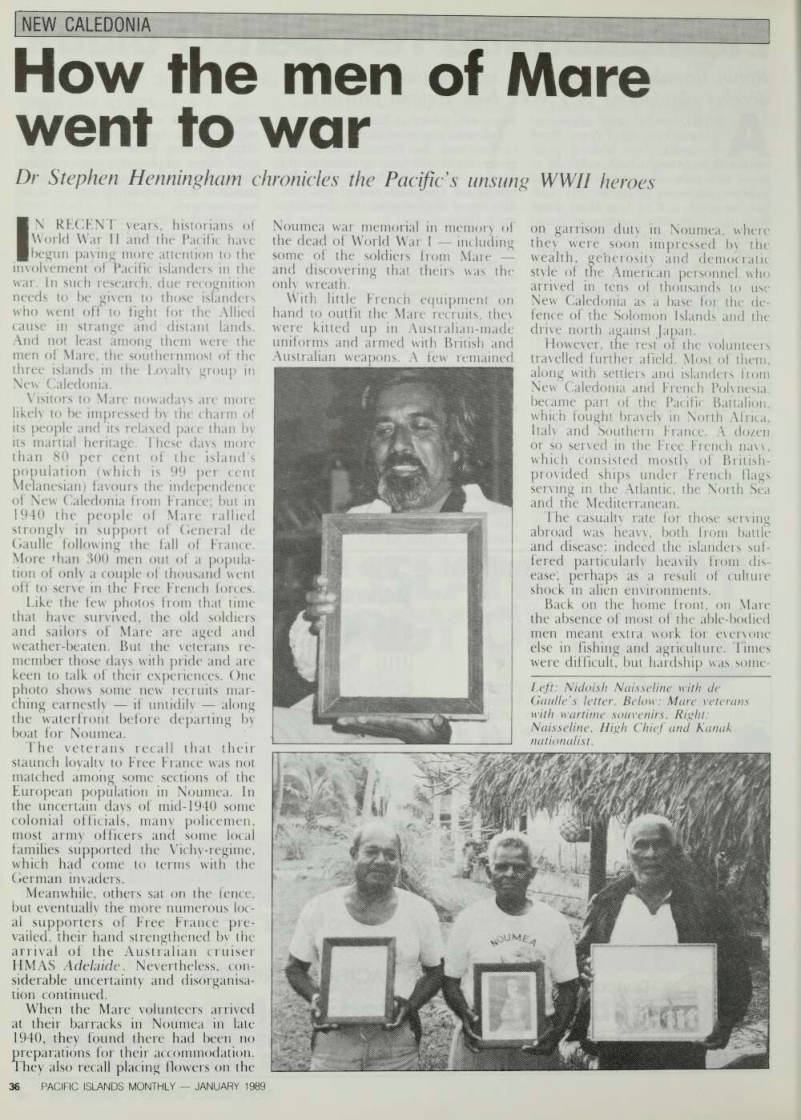
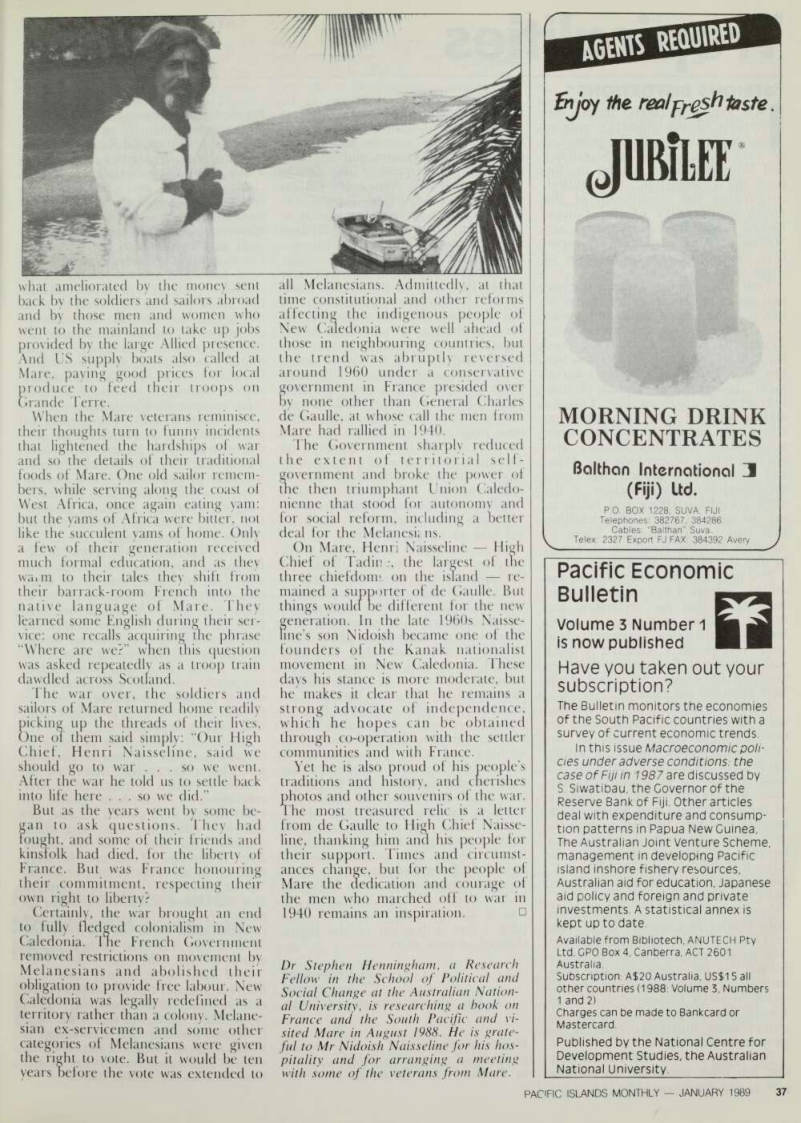
New Caledonia
How the men of Mare went to war
Dr Stephen Henningham chronicles the Pacific’s unsung WWII heroes
IN RECENT years, historians of World War II and the Pacific have begun paying more attention to the involvement of Pacific islanders in the war. In such research, due recognition needs to be given to those islanders who went off to fight for the Allied cause in strange and distant lands.
And not least among them were the men of Mare, the southernmost of the three islands in the Loyalty group in New Caledonia.
V isitors to Mare nowadays are more likely to be impressed bv the charm of its people and its relaxed pace than by its martial heritage. These days more than 80 per cent of the island’s population (which is 99 per cent Melanesian) favours the independence of New Caledonia from France; but in 1940 the people of Mare rallied strongly in support of General de Gaulle following the fall of France.
More than 300 men out of a popula tion of only a couple of thousand went off to serve in the Free French forces.
Like the few photos from that time that have survived, the old soldiers and sailors of Mare are aged and weather-beaten. But the veterans re member those days with pride and are keen to talk of their experiences. One photo shows some new recruits mar
ching earnestly if untidily along
the waterfront before departing by boat for Noumea.
The veterans recall that their staunch loyalty to Free France was not matched among some sections of the European population in Noumea. In the uncertain days of mid-1940 some colonial officials, many policemen, most army officers and some local
families supported the Vichy-regime,
which had come to terms with the German invaders.
Meanwhile, others sat on the fence, but eventually the more numerous loc al supporters of Free France pre vailed, their hand strengthened by the arrival of the Australian cruiser HMAS Adelaide. Nevertheless, con
siderable uncertainty and disorganisa
tion continued.
When the Mare volunteers arrived at their barracks in Noumea in late 1940, they found there had been no preparations for their accommodation.
They also recall placing flowers on the
Noumea war memorial in memory of the dead of World War I including some of the soldiers from Mare and discovering that theirs was the only wreath.
With little French equipment on hand to outfit the Mare recruits, thev were kitted up in Australian-made uniforms and armed with British and Australian weapons. A few remained
on garrison duty in Noumea, where
they were soon impressed by the
wealth, generosity and democratic style of the American personnel who arrived in tens of thousands to use New Caledonia as a base for the de fence of the Solomon Islands and the
drive north against Japan.
However, the rest of the volunteers travelled further afield. Most of them, along with settlers and islanders from New Caledonia and French Polynesia, became part of the Pacific Battalion, which fought bravely in North Africa, Italy and Southern France. A dozen or so served in the Free French navy, which consisted mostly of British
provided ships under French flags
serving in the Atlantic, the North Sea and the Mediterranean.
The casualty rate for those serving abroad was Heavy, both from battle and disease: indeed the islanders suf fered particularly heavily from dis ease, perhaps as a result of culture shock in alien environments.
Back on the home front, on Mare the absence of most of the able-bodied men meant extra work for everyone else in fishing and agriculture. Times were difficult, but hardship was some-
Left: Nidoish Naisseline with de Gaulle’s letter. Below: Mare veterans with wartime souvenirs. Right: Naisseline, High Chief and Kanak nationalist.
what ameliorated by the money sent back by the soldiers and sailors abroad and by those men and women who went to the mainland to take up Jobs
provided by the large Allied presence.
And US supply boats also called at
Mare, paying good prices for local
produce to feed their troops on Grande Terre.
When the Mare veterans reminisce, their thoughts turn to funny incidents that lightened the hardships of war and so" the details of their traditional foods of Mare. One old sailor remem bers, while serving along the coast of West Africa, once again eating yam: but the yams of Africa were bitter, not like the succulent yams of home. Only a few of their generation received much formal education, and as they waitn to their tales they shift from their barrack-room French into the native language of Mare. They learned some English during their ser vice: one recalls acquiring the phrase “Where are we?” when this question was asked repeatedly as a troop train dawdled across Scotland.
The war over, the soldiers and sailors of Mare returned home readily picking up the threads of their lives, One of them said simply: “Our High Chief, Henri Naisseline, said we should go to war ... so we went.
After the war he told us to settle back into life here ... so we did.”
But as the years went by some be gan to ask questions. They had fought, and some of their friends and kinsfolk had died, for the liberty of France. But was France honouring their commitment, respecting their
own right to liberty?
Certainly, the war brought an end to fully fledged colonialism in New Caledonia. Ine French Government removed restrictions on movement by Melanesians and abolished their obligation to provide free labour. New Caledonia was legally redefined as a territory rather than a colony. Melane sian ex-servicemen and some other categories of Melanesians were given the right to vote. But it would be ten years before the vote was extended to
all Melanesians. Admittedly, at that time constitutional and other reforms
affecting the indigenous people of
New Caledonia were well ahead of those in neighbouring countries, but the trend was abruptly reversed around 1960 under a conservative government in France presided over by none other than General Charles de Gaulle, at whose call the men from Mare had rallied in 1940.
The Government sharply reduced the extent of territorial self government and broke the power of tne then triumphant Union Caledo nienne that stood for autonomy and for social reform, including a better deal for the Melanesia ns.
On Mare, Henri Naisseline High Chief of Fadin', the largest of ibe three chiefdorm on the island re mained a supporter of de Gaulle. But things woulcl be different for the new generation. In the late 1960 s Naisse hne’s son Nidoish became one of the founders of the Kanak nationalist movement in New Caledonia. These days his stance is more moderate, but he makes it clear that he remains a strong advocate of independence, which he hopes can be obtained through co-operation with the settler communities and with France.
Yet he is also proud of his people’s traditions and history, and cherishes photos and other souvenirs of the war.
The most treasured relic is a letter from de Gaulle to High Chief Naisse line, thanking him and his people for their support. Times and circumst ances change, but for the people of Mare the dedication and courage of the men who marched off to war in 1940 remains an inspiration. □ Dr Stephen Henningham . a Research Fellow in the School oj Political and Social Change at the Australian Nation al University, is researching a hook on France and the South Pacific and vi sited Mare in August 1988. He is grate ful to Mr Nidoish Naisseline for his hos pitality and for arranging a meeting with some of the veterans from Mare.
Advertisements & other items, p. 37 (1 item)
JIIRiLtt"
in joy the realf r
MORNING DRINK
CONCENTRATES
Bokhan International 3 (Fiji) ltd.
P O. BOX 1228, SUVA, FIJI
Telephones: 382767, 384286.
Cables: "Balthan" Suva.
Telex: 2327 Export FJ FAX: 384392 Avery J
Pacific Economic
Bulletin
Volume 3 Number! is now published la
Have you taken out your
subscription?
The Bulletin monitors the economies of the South Pacific countries with a survey of current economic trends.
In this issue Macroeconomic policies under adverse conditions: the case of Fiji In 1987 are discussed by S. Siwatibau, the Governor of the Reserve Bank of Fiji. Other articles deal with expenditure and consumption patterns in Papua New Guinea, The Australian Joint Venture Scheme, management in developing Pacific island inshore fishery resources, Australian aid for education, Japanese aid policy and foreign and private investments. A statistical annex is kept up to date.
Available from Bibliotech, ANUTECH Pty Ltd, CPO Box 4, Canberra, ACT 2601 Australia.
Subscription: As2o Australia, US$l5 all other countries (1988: Volume 5, Numbers 1 and 2) Charges can be made to Bankcard or Mastercard.
Published by the National Centre for Development Studies, the Australian National University.
Tropicalities
"Serious Distortions"
I AM writing to correct serious dis tortions of my country’s policies and actions in the Pacific published by your magazine in its September and November issues. I refer to “Be hind the Celebrations” (September), concerning the celebration of the 100th anniversary of the Tonga- United States friendship treaty, and “Invasion, American Style” (Novem ber), concerning the construction of water tanks in Tuvalu.
Your story on the Tongan celebra tion makes the assertion that in July of this year the United States and Tonga
. . sign(ed) a United States-Tonga
Treaty of Amity, Commerce, and Navigation”, and goes on to claim that this alleged treaty is a “military agree ment” guaranteeing “transit of nuc lear-armed craft in the Tongan archipelago”. To put it plainly, no treaty was signed at the July com memorative ceremony, dealing with warship transit or anything else. What was signed was a mutual declaration commemorating the centenary of the 1888 friendship treaty and reaffirm ing the spirit of peace and friendship that had led the United States of America and the Kingdom of Tonga to sign the original agreement.
Not only was no treaty signed, but on the contrary it was mutually agreed beforehand that the declaration was not to be taken as a treaty or other binding international agreement. Had your correspondent bothered to check with either this Embassy or the Gov ernment of Tonga, he could easily have obtained the facts.
As to the question of US warship visits to Tonga, the United States has never sought from Tonga or any other South Pacific country a written agreement permitting visits by US naval vessels. In arranging for these visits, we rely entirely on the goodwill of the government and people of the country involved. In keeping with the very close and friendly relationship between the United States and the Kingdom of Tonga, His Majesty’s Government has always welcomed visits by our naval vessels.
Your story on the US Army’s assist ance project to construct water tanks in Tuvalu was also seriously distorted.
The project in question was a success ful test run for a new assistance prog ram being implemented by the IJS Army Western Command in Hawaii.
Under this program, US Army En gineer units undertake construction projects in the region.
As a pilot project, the Tuvalu exer cise was quite successful. In addition
to finishing the water tanks ahead of schedule, the Engineers built a new road along the runway and carried out other road repairs and improve ments, at the request of the Tuvalu Ministry of Works. Also, at the request of the Government of Tuvalu, the US AY Clinger delayed its return to Hawaii in order to deliver medical supplies to the island of Niu, where a flu epidemic was in progress.
Your correspondent seems to have missed the point of the speech made
by Mr Benzinger (not Benzinga) of
this Embassy. Mr Benzinger cud in deed emphasise the importance of the logistical achievement in getting the people and material to Tuvalu across the long distance involved. The main point, however, is that the experience gained from the water tank project makes it feasible to plan more ambi tious projects for the future. We have already invited the Government of Tuvalu to consider what projects they might wish our Army Engineers to undertake now that we all are more familiar with the capabilities involved.
We have every expectation that they will take us up on the offer.
As to the water tank project itself, your reporter’s estimate of the life of the tanks would appear to be based on the life of ordinary sheet iron tanks.
The tanks installed were coated with an epoxy-based rust preventive and lined with corrosion-proof plastic. Our engineers anticipate that the tank should last several times your corres pondent’s estimate. As to the alleged rubber-eating “knicker beetles”, we have verified with engineers that no insect found in the region should rep resent a threat to the synthetic rubber washers used in the Tuvalu tanks.
Your story grossly exaggerates the scale of the exercise. The Engineers set up a small camp on about 100 yards of the unpopulated side of the runway. This was a simple necessity, since Funafuti lacks accommodation for 25 people. The exercise was de signed to be self-contained, so as to minimise the disruption to everyday life on Funafuti. Your estimate or the cost is also absurdly overstated. The project cost a fraction of the figure claimed in your story.
Leonard Rochwarger
US Ambassador to Fiji, Tuvalu, Kiribati and Tonga Mr Rochwarger is, of course, entitled to respond to any story that appears in Pacific Islands Monthly. However,
his own letter contains ‘ distortions' of our coverage that are as ‘serious’ as those he identifies. Ed Rampelfs story on the celebrations for King Taufa’ahau’s 70th birthday made no claim that a ‘new’ treaty was signed; in fact, it stated specifically that die occa sion commemorated and renewed an agreement originally signed in 1888.
As well as a mutual declaration of peace, amity and friendship, both the 1888 and 1988 versions of the treaty contain references to a relationship that could only be construed as of a military nature: indeed, Mr Rochwar ger is himself quoted in the story as
referring to the training of Tongan
military officers in the US and Congresswoman Patricia Saiki refers to die “strategic” nature of Tonga’s
relationship with Washington.
Mr Rampelfs story was a piece of journalism; not an expression of gov ernment policy or an attempt to nave a government s policy perceived in the way that government any govern ment would prefer. Thus Mr Roch warger’s comments about the Novem ber story, ‘lnvasion American Style’ cannot pass unchallenged.
That PIM “missed die point” of Mr
Benziger’s speech is, frankly, an eva
sion. Our correspondent, as an islan der, interpreted Mr Benziger’s words in his own way. That might not have been the way Mr Benziger hoped his speech would be received, but it was nevertheless a legitimate response. In other places the United States’ activi ties would have been interpreted as a display of military might or, if the cor
respondent were of a particular poli
tical hue, as imperialism.
Lastly, Mr Rochwarger is guilty of
obfuscation over the cost of the pro ject. Our story carefully states that the “whole operation is estimated to have cost about . . (emphasis added). No exact figures were quoted because, de spite our enquiries, none were made available. But that is not the point.
Even if the cost of the exercise were reduced by an order of magnitude, to “about” $A500,000, the fact remains that the United States succeeded in in stalling fewer water tanks having less capacity than those installed by the Seventh-Day Adventist Church . . . at almost 20 times the cost!
And that, surely, should have been the real point of the operation: not to demonstrate militarv capability, or to repair some roads, out to provide bad ly needed assistance for a small nation whose fisheries resources are exploited without reasonable recompense by na tions such as the United States. □
The Truth About Joyita?
IN NOVEMBER 1955 I was a 23year-old ship’s writer aboard the Royal Fleet Auxiliary RFA Der wentdale on a passage from Colombo to Suva. At around about the Thurs day Island passage we received a sig nal to keep a lookout for anything un usual on tne remainder of the voyage to Suva. Submarine activity was men tioned but we were not tola the reason and it was not a high priority lookout or that was my impression.
On arrival at Suva we were told the facts of the Joyita as they were known at the time by L/Cdr Peter Trent, the Royal New Zealand Navy Liaison Officer at Suva our cargo of oil was for the Admiralty fuelling station there. Peter Trent took me down to the Customs shed to the roped-off area where the collection of material, personal effects and so on taken off the Joyita was put, simply in a pile.
Nobody was allowed to go near the stuff; I was lucky just to be shown it at all. Among the conglomeration of the material there were some bunk mat tresses all sodden with salt water, but with distinct evidence of charring or burning. Peter Trent told me tnese had been found on the engine, soaked in kerosene or some similar accelerant.
He said it appeared they had been put down in the engine room by some
body and set alignt.
Surely, then, this is evidence of fire.
Of course it isn’t what one normally means by accident caused by fire, but did not the encjuiry come to some con clusion of foul play? 1 still have my diary of that voyage, but unfortunate ly must have been too interested in tne sights of Suva to write it all up we had been at sea for 25 days.
I wo years later 1 went to Fiji again, this time employed by CSR on their sugar estates where I stayed until 19/1. I am still a citizen of Fiji and will always be stirred by any resurrec tion of this mystery. I feel that some one, somewhere, knows the answer.
John Barnes
Auckland New Zealand
Fiji adds 'flesh and
blood' to a turbulent
history
RARYL TARTE, the author of Fiji (Pascoe Publishing), is a member of an old Fiji colo mily and thus has the creden tials to properly flesh out his story which, as he says, “blends facts with
fiction, real life characters with im aginary people”. All this is accom plished with skill to “add dramatic emphasis to the fascinating events . . . and to put flesh and blood on the colourful characters to have contri buted to the evolution of Fiji”.
In his nothing short of epic novel, Tarte covers the history of Fiji from the time of its first European sighting by Abel Tasman in 1643, to 1987’s military coups. Here are all the great names of Fiji history: Ratu Sent Cako bau, the Tui Viti, Maafu, the Tongan who conquered the eastern Fan islands; the ill-fated British Consul, Pritchard; Williams, the American Consul whose greed led to the ceding of Fiji to Queen Victoria; the rip roaring days of the old capital, Levu ka, and the era of the blackbirders.
We are witness to momentous changes, from the inter-tribal feuding and its accompanying orgies of canni balism to the acceptance of law and order under Ratu Beru Cakobau and
on to today’s emphasis on Christianity
among the Fijian people. The strength
and nobility of Cakobau is clearly shown at the Ceremony of Cession on October 10, 1874. As Daryl Tarte paints the scene: “Before finally ced ing this country to Her Majesty the Queen of Great Britain and Ireland, the King desires through Your Excel lency to give Her Majesty the only thing he posse* >es that mav interest her. The King gives Her Majesty his old and favourite war club which, un til lately, was the only known law in Fiji. In abandoning club law and adopting the form and principles of civilised societies he laid by his old weapon and covered it with the emblems of peace . . .”
From such beginnings Tarte follows, always faithfully, the broad outlines of
Fiji’s often turbulent, always interest
ing history including the impact of
the British decision to bring in Indian labour for the sugar fields and the growth and power of the sugar com panies. Through it all we feel the con cern of the Fijians for their land, their customs and way of life.
Also threaded through the book is the equally fascinating story of the
pioneering Chamberlain family and
the development of the family estate on the lovely garden island’ of Taveuni. Tarte admits that he used his own family as a model: “'They did settle on Taveuni,” he says. “However, the Chamberlains are intended to rep resent a composite of the pioneer families who settled in Fiji, and who remained involved for generations in the development of the islands.”
The fortunes, both waxing and wan ing, of these pioneers followed the pattern of the crops grown in Fiji, first
cotton, then copra and finally sugar.
But these early settlers were not only attracted by the chance of fortune, nor is the story that of their trading success alone.
They were a lusty lot, and the local maidens were willing. Even the re
spectably married Henry Chamberlain
succumbs to the beauty of Salote, daughter of the powerful Maafu. 1 here are fascinating pen pictures
of outstanding figures in Fiji’s de
velopment, such as the legendary statesman Ratu Sir Lala Sukuna, and of prominent present-day leaders. In fact, all the major figures on all sides of the recent conflicts are there, thinly
disguised by fictitious names.
It is difficult to write recent history as fiction, and much of the dramatic events in Fiji are still ‘news’. As yet they have not had the advantage of time to be put into perspective, but this well-crafted novel adheres to his tory so faithfully that it must be of absorbing interest to all who aspire to some knowledge of the growth of Fiji as a nation and of particular interest to those who have already delved into the country’s turbulent history. It’s re curring theme is one of concern over land: tne needs of the Indian farmers, and the passionate attachment of the Fijian people to their land. The con flict of course, is decades old, and cen tres on the conundrum of land being owned by the Fijians yet cultivated bv others, the Australian sugar giant CS& and the Indian farmers. Earle’s prob ing into the many facets of Fijian life and history is manifested by clever de velopment of the forces responsible for shaping the events that have over
taken Fiji. He provides compelling in
sights into the way of life, the feelings, the history and tne different customs that make up multiracial Fiji, and gives a clear picture of the inevitability of the events of the past two years.
In reference to recent events, Tarte offers his opinion in a publicity release
accompanying Fiji : “Brigadier Rabuka
gave the Fijians the opportunity to voice their feelings, reassert them selves and pursue a course of action
that deposed Western-style democracy.
“The Western world expected, in deed demanded, that Fiji conform with the Western brand of democracy.
But is this suitable for Fiji?”
Fiji is a big book; an absorbing book. Its conclusions and the promin ence, it has given to living people and to recent events will inevitably make it a controversial book, but it is enjoy able reading and to be heartily recom mended. It is sad, however, to see a book of such scope and quality printed on such poor paper!
Victor Carell
Pacific Report
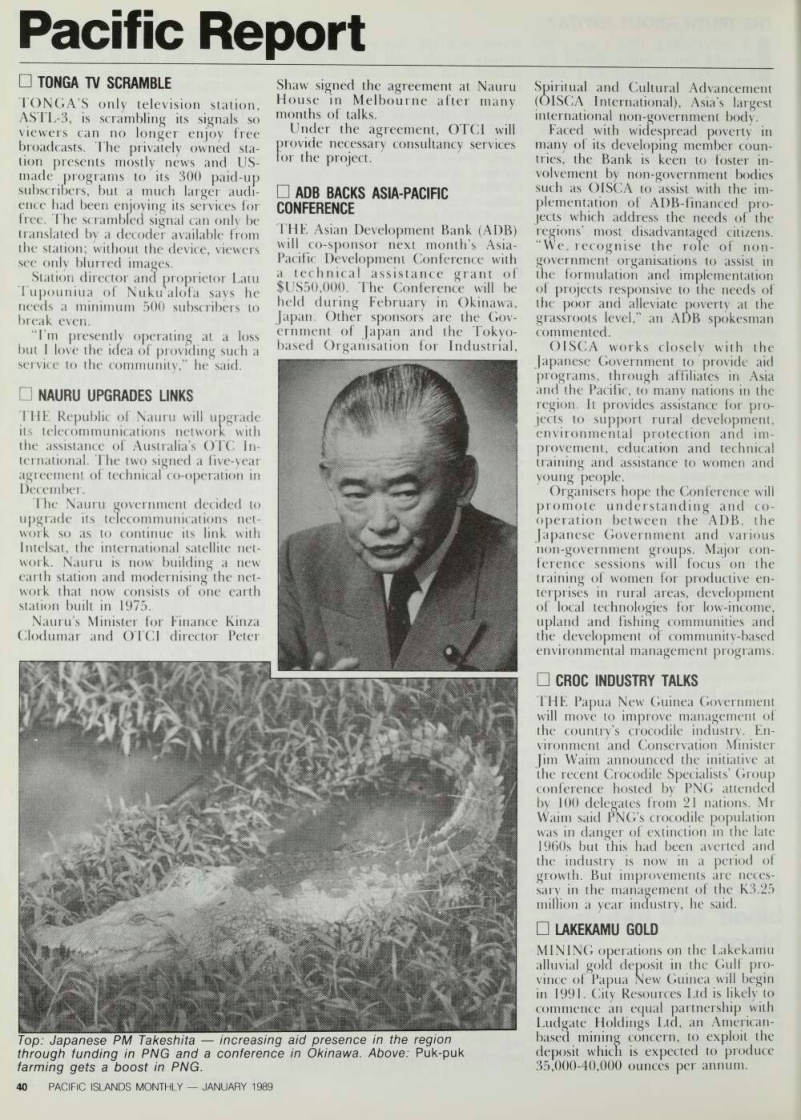
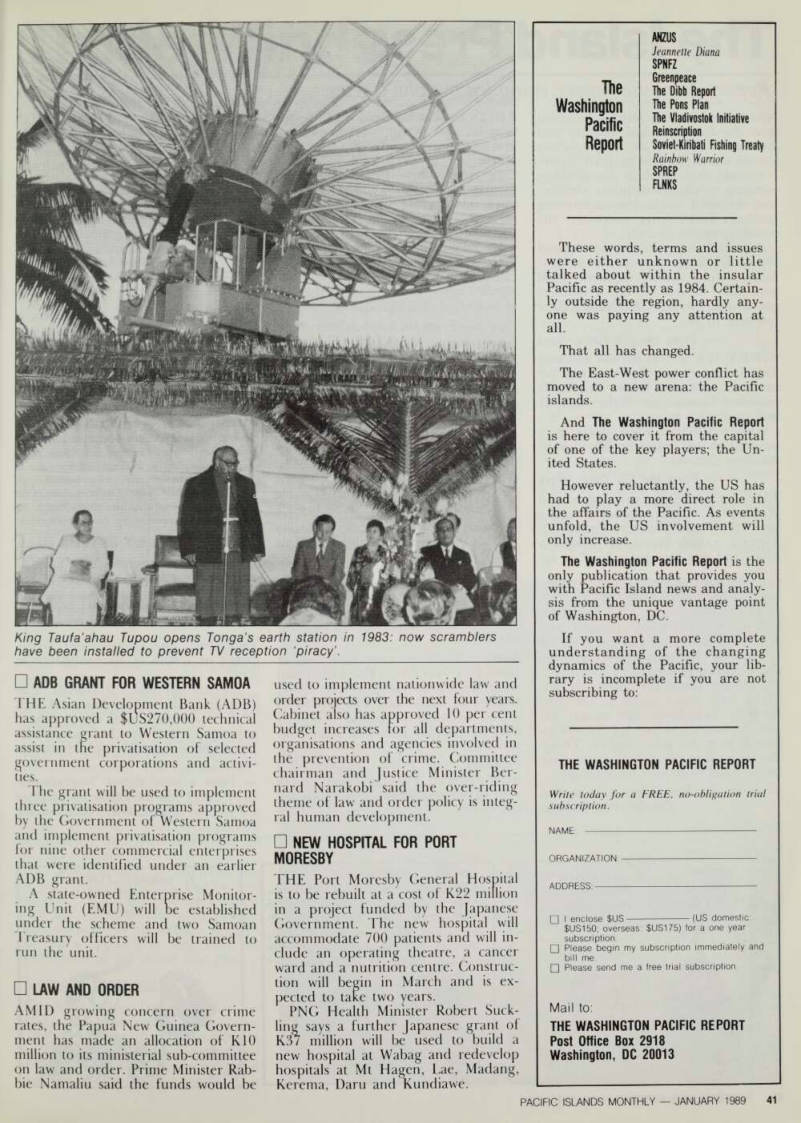
□ Tonga Tv Scramble
TONGA’S only television station, ASTL-3, is scrambling its signals so viewers can no longer enjoy free broadcasts. The privately owned sta tion presents mostly news and US made programs to its 300 paid-up subscribers, but a much larger audi ence had been enjoying its services for free. The scrambled signal can only be translated by a decoder available from the station; without the device, viewers
see only blurred images.
Station director ana proprietor Latu Tupouniua of Nukualofa says he needs a minimum 500 subscribers to break even.
“I’m presently operating at a loss but I love the idea of providing such a service to the community,” he said.
□ Nauru Upgrades Links
THE Republic of Nauru will upgrade its telecommunications network with the assistance of Australia’s OTC In ternational. T he two signed a five-year agreement of technical co-operation in December.
The Nauru government decided to upgrade its telecommunications net work so as to continue its link with Intelsat, the international satellite net work. Nauru is now building a new earth station and modernising the net work that now consists of one earth station built in 1975.
Nauru’s Minister for finance Kinza Clodumar and OTCI director Peter
Shaw signed the agreement at Nauru House in Melbourne after many months of talks.
Under the agreement, OTCI will
provide necessary consultancy services
for the project.
□ Adb Backs Asia-Pacific
Conference
THE Asian Development Bank (ADB) will co-sponsor next month’s Asia- Pacific Development Conference with a technical assistance grant of SUSSO,OOO. The Conference will be held during February in Okinawa, Japan. Other sponsors are the Gov ernment of Japan and the Tokyo based Organisation for Industrial,
Spiritual and Cultural Advancement (OISCA International), Asia’s largest international non-government body.
Faced with widespread poverty in many of its developing member coun tries, the Bank is keen to foster in volvement by non-government bodies such as OISCA to assist with the im plementation of ADB-financed pro jects which address the needs of the
regions’ most disadvantaged citizens.
“We, recognise the role of non government organisations to assist in the formulation and implementation ol projects responsive to the needs of the poor and alleviate poverty at the grassroots level,” an ADB spokesman commented.
OISCA works closely with the Japanese Government to provide aid programs, through affiliates in Asia and the Pacific, to many nations in the region It provides assistance for pro jects to support rural development, environmental protection and im provement, education and technical training and assistance to women and
young people.
Organisers hope the Conference will promote understanding and co operation between the ADB, the Japanese Government and various non-government groups. Major con ference sessions will focus on the training of women for productive en terprises in rural areas, development of local technologies for low-income, upland and fishing communities and
the development of community-based
environmental management programs.
□ Croc Industry Talks
THE Papua New Guinea Government will move to improve management of the country’s crocodile industry. En vironment and Conservation Minister Jim Waim announced the initiative at the recent Crocodile Specialists’ Group conference hosted by PNG attended by 100 delegates from 21 nations. Mr Waim said PNG’s crocodile population was in danger of extinction in the late 1960 s but this had been averted and the industry is now in a period of growth. But improvements are neces sary in the management of the K 3.25 million a year industry, he said.
□ Lakekamu Gold
MINING operations on the Lakekamu alluvial gold deposit in the Gulf pro vince of Papua New Guinea will begin in 1991. City Resources Ltd is likely to commence an equal partnership with Ludgate Holdings Ltd, an American based mining concern, to exploit the
deposit which is expected to produce
35,000-40,000 ounces per annum.
Top: Japanese PM Takeshita - increasing aid presence in the region through funding in PNG and a conference in Okinawa. Above: Puk-puk farming gets a boost in PNG.
□ Adb Grant For Western Samoa
THE Asian Development Bank (ADB) has approved a $U5270,000 technical assistance grant to Western Samoa to assist in the privatisation of selected government corporations and activi ties.
The grant will be used to implement
three privatisation programs approved
by the Government of Western Samoa
and implement privatisation programs
for nine other commercial enterprises that were identified under an earlier ADB grant.
A state-owned Enterprise Monitor ing Unit (EMU) will oe established under the scheme and two Samoan Treasury officers will be trained to run the unit.
□ Law And Order
AMID growing concern over crime rates, the Papua New Guinea Govern ment has made an allocation of KlO million to its ministerial sub-committee on law and order. Prime Minister Rab bie Namaliu said the funds would be
used to implement nationwide law and order projects over the next four years.
Cabinet also has approved 10 per cent budget increases for all departments, organisations and agencies involved in the prevention of crime. Committee chairman and Justice Minister Ber nard Narakobi said the over-riding theme of law and order policy is integ ral human development.
□ New Hospital For Port
Moresby
THE Port Moresby General Hospital is to be rebuilt at a cost of K 22 million in a project funded by the Japanese Government. The new hospital will accommodate 700 patients and will in clude an operating theatre, a cancer ward and a nutrition centre. Construc tion will begin in March and is ex pected to take two years.
PNG Health Minister Robert Suck ling says a further Japanese grant of K 37 million will be used to build a
new hospital at Wabag and redevelop
hospitals at Mt Hagen, Lae, Madang, Kerema, Daru and Kundiawe.
King Taufa’ahau Tupou opens Tonga's earth station in 1983: now scramblers have been installed to prevent TV reception ‘piracy’.
Advertisements & other items, p. 41 (1 item)
Washington
ANZUS
Jeannette Diana
SPNFZ
Greenpeace Tire Dibb Report The Pons Plan Die Vladivostok Initiative
Reinsertion
Soviet-Kiribati Fishing Treaty Rainbow Warrior
SPREP
FINKS
These words, terms and issues were either unknown or little talked about within the insular Pacific as recently as 1984. Certainly outside the region, hardly anyone was paying any attention at all.
That all has changed.
The East-West power conflict has moved to a new arena; the Pacific islands.
And The Washington Pacific Report is here to cover it from the capital of one of the key players; the United States.
However reluctantly, the US has had to play a more direct role in the affairs of the Pacific. As events unfold, the US involvement will only increase.
The Washington Pacific Report is the only publication that provides you with Pacific Island news and analysis from the unique vantage point of Washington, DC.
If you want a more complete understanding of the changing dynamics of the Pacific, your library is incomplete if you are not subscribing to;
THE WASHINGTON PACIFIC REPORT
Write today for a FREE, no-obligation trial subscription.
NAME:
ORGANIZATION:
ADDRESS:
□ I enclose SUS (US domestic: SUSISO; overseas: SUSI7S) for a one year subscription. □ Please begin my subscription immediately and bill me. □ Please send me a free trial subscription.
Mail to:
THE WASHINGTON PACIFIC REPORT
Post Office Box 2918 Washington, DC 20013
Tlie
Washington
Pacific
Report
The Island Press
Reports from the papers, compiled by John Carter
NAUSORI farmer Meli Baleilakeba told the Constitutional Inquiry and Advisory Committee that women should not be allowed to drink liquor.
He told the committee that drunken mothers produced drunken children and blamed nightclub-wandering mothers for having produced the
drunken youths of today.
Asked if males should be stopped from drinking liquor, he said if fathers were drunk, mothers could look after the family, but if mothers got drunk, the children would have nowhere to go.
From the Fiji Times, Suva
AIR PACIFIC’S early Sunday morning
Tokyo service was first delayed be cause of mechanical failure and finally cancelled because the flight engineer had consumed liquor.
About 100 stranded passengers were flown to Tokyo on Monday by Air New Zealand.
From the Fiji Times, Suva I HE DEBATE in the House on
Wednesday flared into name-calling
when the Prime Minister, Tofilau Eti Alesana, called Fuima-ono Mimio a “dog” and was branded a “pig” in re turn.
From the Samoa Times, Apia A LITTLE boy with a big heart for the needy, 10-year-old musical pro digy Christian Gante has given to the PNG Rehabilitation Centre and the Cheshire Homes.
Christian raised the money by giv ing a solo piano recital at the Port Moresby Travelodge last month. He said he wanted to use his natural ta lent to help the poor, and on Thurs day he went to the Rehabilitation Cen tre to hand over his Christmas gift.
From the Papua New Guinea Post Courier, Port Moresby
AIR IN the Cook Islands is among the best in the world, says American atmospheric researcher, Dr Dale Hurst.
Dr Hurst, of the University of Cali fornia, Irvine County, has been in volved in atmospheric research throughout the Pacific for the past five years.
He says the air samples taken from here show better, clearer results be cause of Rarotonga’s isolation in the Pacific Ocean, and because of the lack of industrial development.
From the Cook Islands News, Rarotonga THE MAJORITY of wheelchairs used in the Pacific have been designed for and donated by ‘developed’ countries.
Chairs fall to pieces at an alarming rate; arrive with no spare parts and no instruction or training provided for upkeep; become a ‘barrier to mobility’ because they cannot cope with Pacific environmental factors, and suitable design adaptations need to be made.
From the South Pacific Disability Council magazine Lali, Apia WITH everyone asking what the fu ture holds for this troubled nation, I decided to drag out the old crystal ball and have a quick preview of the year ahead . . .
January: Torrential rains wash most of Irian Jaya into PNG. The Indonesian army follows on the principle of de fending its sacred soil. The PNGDF is unable to respond because it is busy
burning people’s homes in Milne Bay
province.
February: The Prime Minister of a much-reduced PNG is toppled in a vote of no confidence. Somebody re
places him.
March: Ihe new Prime Minister res igns in the wake of allegations about an improper relationship with a women s soccer team. He is replaced.
April: The new Prime Minister resigns because he has lost confidence in the Parliament. The women’s soccer team forms a coalition government.
May: The Government is pack-raped during an inspection tour of rural
sporting facilities.
June: PNG’s first rape crisis centre is established in Waigani. LoMet troops burn it down.
July: New liquor restrictions are intro duced in the NCD in response to the alarming rise in rape and arson.
August: The new liquor laws are re voked. Black marketeers march on Parliament and, finding it vacant, take over.
September: The Government succeeds
in selling Bougainville and Enga to
CRA, thus preventing total economic
collapse.
October: The Government awards it self massive salary increases.
November: There is a total economic
collapse.
December: The Government is de posed in a vote of no confidence in itself.
It’s not all bad, of course. The Kumuls finally win a game and Miss PNG is crowned Miss World (but is subsequently defrocked when she turns out to be a 42-year-old mother of ten).
From a letter signed ‘Nostradamus’ in the Papua New Guinea Post-Courier , Port Moresby
Trade Winds
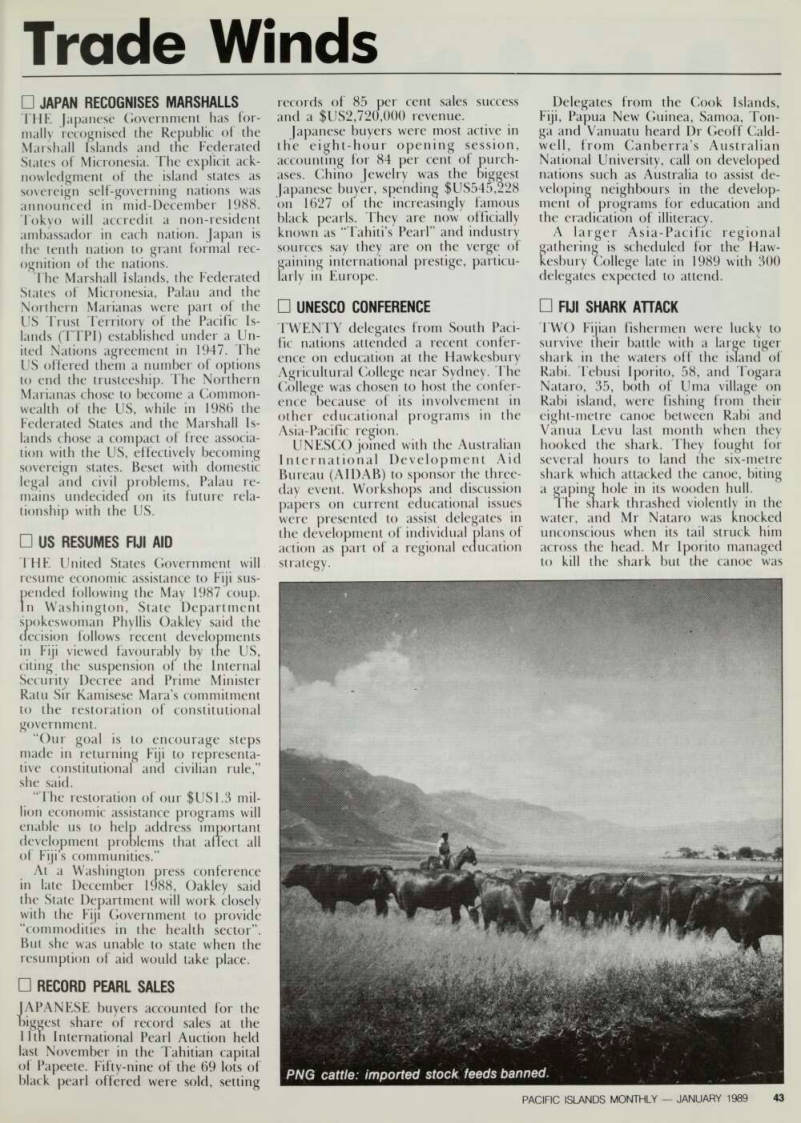
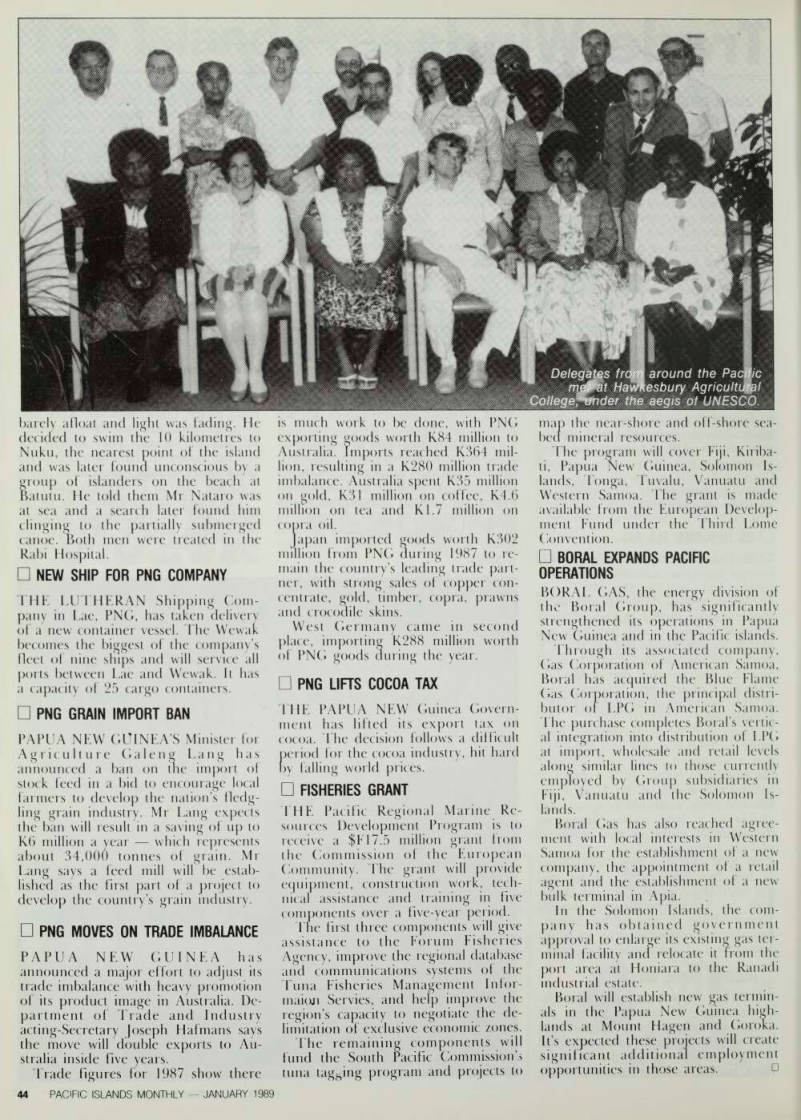
□ Japan Recognises Marshalls
IHE Japanese Government has for
mally recognised the Republic of the
Marshall Islands and the Federated States of Micronesia. The explicit ack nowledgment of the island states as
sovereign self-governing nations was
announced in mid-December 1988.
Tokyo will accredit a non-resident ambassador in each nation. Japan is the tenth nation to grant formal rec ognition of the nations.
T he Marshall Islands, the Federated States of Micronesia, Palau and the Northern Marianas were part of the US Trust Territory of the Pacific Is lands (TTPI) established under a Un ited Nations agreement in 1947. The US offered them a number of options to end the trusteeship. The Northern Marianas chose to become a Common wealth of the US, while in 1986 the Federated States and the Marshall Is lands chose a compact of free associa tion with the US, effectively becoming sovereign states. Beset with domestic legal and civil problems, Palau re mains undecided on its future rela tionship with the US.
□ Us Resumes Fiji Aid
THE United States Government will resume economic assistance to Fiji sus pended following the May 1987 coup.
In Washington, State Department
spokeswoman Phyllis Oakley said the
decision follows recent developments in Fiji viewed favourably by tne US, citing the suspension of the Internal Security Decree and Prime Minister Ratu Sir Kamisese Mara’s commitment to the restoration of constitutional government.
“Our goal is to encourage steps made in returning Fiji to representa tive constitutional and civilian rule,” she said.
“The restoration of our SUSI. 3 mil lion economic assistance programs will enable us to help address important development problems that affect all of Fiji’s communities.”
At a Washington press conference in late December 1988, Oakley said the State Department will work closely with the Fiji Government to provide “commodities in the health sector”.
But she was unable to state when the resumption of aid would take place.
□ Record Pearl Sales
JAPANESE buyers accounted for the niggest share of record sales at the II tli International Pearl Auction held last November in the Tahitian capital of Papeete. Fifty-nine of the 69 lots of black pearl offered were sold, setting
records of 85 per cent sales success and a $U52,720,000 revenue.
Japanese buyers were most active in
the eight-hour opening session,
accounting for 84 per cent of purch ases. Chino Jewelry was the biggest
Japanese buyer, spending $U5545,228
on 1627 of the increasingly famous
black pearls. They are now officially
known as “Tahiti’s Pearl” and industry sources say they are on the verge of
gaining international prestige, particu
larly in Europe.
□ Unesco Conference
TWENTY delegates from South Paci fic nations attended a recent confer ence on education at the Hawkesbury
Agricultural College near Sydney. The
College was chosen to host the confer ence because of its involvement in other educational programs in the
Asia-Pacific region.
UNESCO joined with the Australian International Development Aid Bureau (AIDAB) to sponsor the three day event. Workshops and discussion papers on current educational issues were presented to assist delegates in the development of individual plans of action as part of a regional education strategy.
Delegates from the Cook Islands, Fiji, Papua New Guinea, Samoa, Ton ga and Vanuatu heard Dr Geoff Cald well, from Canberra’s Australian National University, call on developed nations such as Australia to assist de
veloping neighbours in the develop
ment of programs for education and the eradication of illiteracy.
A larger Asia-Pacific regional
gathering is scheduled for the Haw kesbury College late in 1989 with 300
delegates expected to attend.
□ Fui Shark Attack
TWO Fijian fishermen were lucky to survive their battle with a large tiger shark in the waters off the island of Rabi. Tebusi Iporito, 58, and Togara Nataro, 35, both of Uma village on Rabi island, were fishing from their eight-metre canoe between Rabi and Vanua Levu last month when they hooked the shark. They fought for several hours to land the six-metre shark which attacked the canoe, biting a gaping hole in its wooden hull.
The snark thrashed violently in the water, and Mr Nataro was knocked unconscious when its tail struck him across the head. Mr Iporito managed to kill the shark but the canoe was
PNG cattle: imported stock feeds banned.
barely afloat and light was fading. He decided to swim the 10 kilometres to Nuku, the nearest point of the island and was later found unconscious by a group of islanders on the beach at Batutu. He told them Mr Nataro was at sea and a search later found him
clinging to the partially submerged
canoe. Both men were treated in the
Rabi Hospital.
□ New Ship For Png Company
THE LUTHERAN Shipping Com pany in Lae, PNG, has taken delivery of a new container vessel. The Wewak becomes the biggest of the company’s fleet of nine ships and will service all ports between Lae and Wewak. It has a capacity of 25 cargo containers.
□ Png Grain Import Ban
PAPUA NEW GUINEA’S Minister for
Agriculture Galeng Lang has
announced a ban on the import of stock feed in a bid to encourage local farmers to develop the nation’s fledg
ling grain industry. Mr Lang expects
the ban will result in a saving of up to K 6 million a year which represents about 34,000 tonnes of grain. Mr Lang says a feed mill will be estab lished as the first part of a project to
develop the country’s grain industry.
□ Png Moves On Trade Imbalance
Papua New Guinea Has
announced a major effort to adjust its trade imbalance with heavy promotion of its product image in Australia. De partment of Trade and Industry
acting-Secretarv Joseph Hafmans says
the move will double exports to Au stralia inside five years.
Trade figures for 1987 show there
is much work to be done, with PNG exporting goods worth KB4 million to Australia. Imports reached K 364 mil lion, resulting in a K2BO million trade imbalance. Australia spent K 35 million on gold, K3I million on coffee, K 4.6 million on tea and K 1.7 million on copra oil.
Japan imported goods worth K 302
million from PNG during 1987 to re main the country’s leading trade part ner, with strong sales of copper con centrate, gold, timber, copra, prawns and crocodile skins.
West Germany came in second place, importing K2BB million worth of PNG goods during the year.
□ Png Lifts Cocoa Tax
THE PAPUA NEW Guinea Govern ment has lifted its export tax on cocoa. The decision follows a difficult period lor the cocoa industry, hit hard
oy falling world prices.
□ Fisheries Grant
THE Pacific Regional Marine Re sources Development Program is to receive a $F17.5 million grant from the Commission of the European Community. The grant will provide equipment, construction work, tech nical assistance and training in five components over a five-year period.
The first three components will give assistance to the Forum Fisheries
Agency, improve the regional database
and communications systems of the Tuna Fisheries Management Infor maioji Servies, and help improve the
region’s capacity to negotiate the de
limitation of exclusive economic zones.
The remaining components will fund the South Pacific Commission’s tuna tagging program and projects to
map the near-shore and off-shore sea ben mineral resources.
The program will cover Fiji, Kiriba ti, Papua New Guinea, Solomon Is lands, Tonga, Tuvalu, Vanuatu and Western Samoa. The grant is made available from the European Develop ment Fund under the Third Lome Convention.
□ Boral Expands Pacific
Operations
BORAL GAS, the energy division of the Boral Group, has significantly
strengthened its operations in Papua
New Guinea and in the Pacific islands.
Through its associated company, Gas Corporation of American Samoa, Boral has acquired the Blue Flame Gas Corporation, the principal distri butor of LPG in American Samoa.
The purchase completes Boral’s vertic al integration into distribution of LPG at import, wholesale and retail levels along similar lines to those currently
employed by Group subsidiaries in
Fiji, Vanuatu and the Solomon Is lands.
Boral Gas has also reached agree ment with local interests in Western Samoa for the establishment of a new company, the appointment of a retail agent and the establishment of a new bulk terminal in Apia.
In the Solomon Islands, the com pany has obtained government approval to enlarge its existing gas ter minal facility and relocate it from the port area at Honiara to the Ranadi industrial estate.
Boral will establish new gas termin als in the Papua New Guinea high lands at Mount Hagen and Goroka.
It’s expected these projects will create
significant additional employment
opportunities in those areas. □
Delegates from around the Pacific
met at Hawkesbury Agricultural
College, under the asgis of UNESCO.
Transition
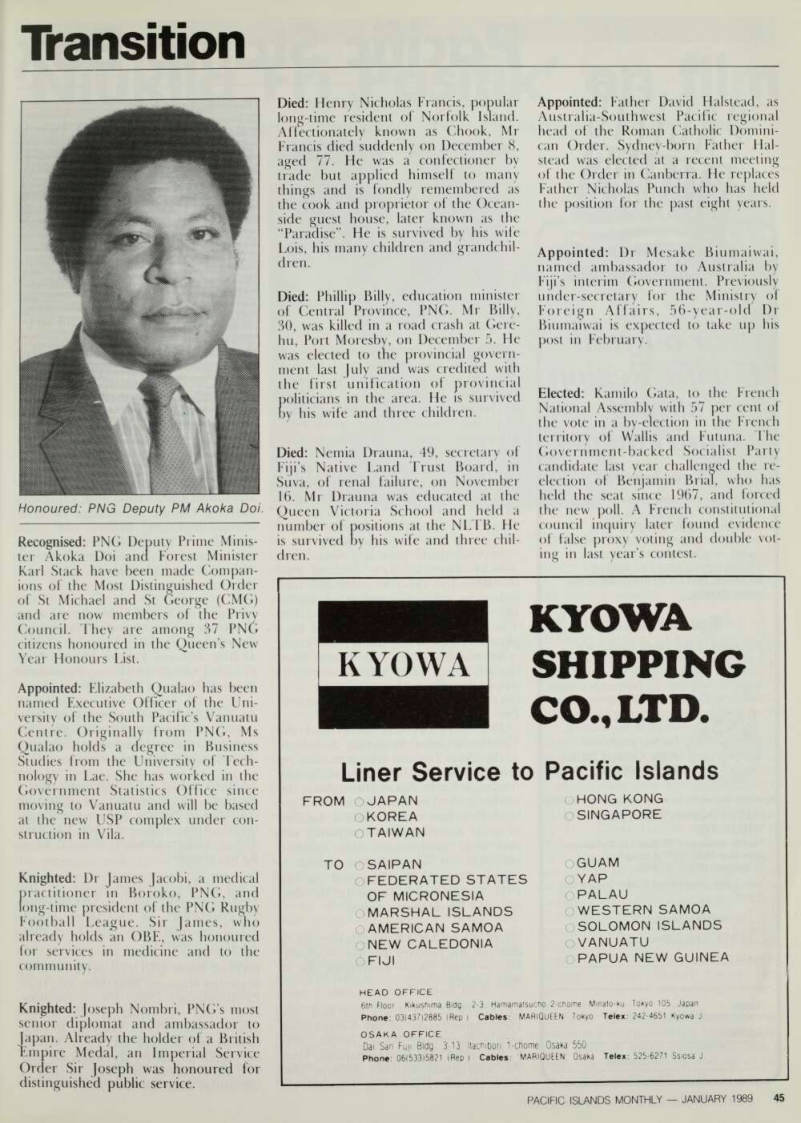
Recognised: PNG Deputy Prime Minis ter Akoka Doi and Forest Minister Karl Stack have been made Compan ions of the Most Distinguished Order of St Michael and St George (CMG) and are now members of the Privy Council. They are among 37 PNG citizens honoured in the Queen’s New Year Honours List.
Appointed: Elizabeth Qualao has been named Executive Officer of the Uni versity of the South Pacific’s Vanuatu Centre. Originally from PNG, Ms Qualao holds a degree in Business Studies from the University of Tech nology in Lae. She has worked in the Government Statistics Office since moving to Vanuatu and will be based at the new USP complex under con struction in Vila.
Knighted: Dr James Jacobi, a medical practitioner in Boroko, PNG, and
long-time president of the PNG Rugby
Football League. Sir James, who already holds an OBE, was honoured for services in medicine and to the
community.
Knighted; Joseph Nombri, PNG’s most senior diplomat and ambassador to Japan. Already the holder of a British Empire Medal, an Imperial Service Order Sir Joseph was honoured for
distinguished public service.
Died: Henry Nicholas Francis, popular long-time resident of Norfolk Island.
Affectionately known as Chook, Mr Francis died suddenly on December 8, aged 77. He was a confectioner by trade but applied himself to many things and is fondly remembered as the cook and proprietor of the Oceanside guest house, later known as the “Paradise”. He is survived by his wife Lois, his many children and grandchild ren - Died: Phillip Billy, education minister of Central Province, PNG. Mr Billy, 30, was killed in a road crash at Gerehu, Port Moresby, on December 5. He was elected to tne provincial govern ment last July and was credited with the first unification of provincial politicians in the area. He is survived fry his wife and three children. 1 Died: Nemia Drauna, 49, secretary of Fiji’s Native Land Trust Board, in Suva, of renal failure, on November 16. Mr Drauna was educated at the Queen Victoria School and held a number of positions at the NLTB. He is survived oy his wife and three children.
Appointed: Father David Halstead, as Australia-Southwest Pacific regional head of the Roman Catholic Domini can Order. Sydney-born Father Hal stead was elected at a recent meeting of the Order in Canberra. He replaces Father Nicholas Punch who has held the position for the past eight years, Appointed: Dr Mesake Biumaiwai, named ambassador to Australia by
Fiji’s interim Government. Previously
under-secretary for the Ministry of
Foreign Affairs, 56-year-old Dr
Biumaiwai is expected to take up his post in February, . „ , Elected; Kamtlo Gala to the French National Assembly with 57 per cent of the vote m a by-election m the french territory of Wallis and Futuna. The Government-backed Socialist Party candidate last year challenged the re election of Benjamin Brial, who has held the seat since 1967, and forced the new poll. A french constitutional council inquiry later found evidence of false proxy voting and double vot ing in last year’s contest.
Honoured: PNG Deputy PM Akoka Doi.
Advertisements & other items, pp. 45-46 (1 item)
Co., Ltd.
KYOWA
KYOWA
SHIPPING
CO., LTD.
Liner Service to Pacific Islands
FROM O JAPAN HONG KONG
OKOREA OSINGAPORE
OTAIWAN
TO OSAIPAN
O FEDERATED STATES
OF MICRONESIA
MARSHAL ISLANDS
AMERICAN SAMOA
NEW CALEDONIA
O FIJI
OGUAM
O YAP
OPALAU
WESTERN SAMOA
SOLOMON ISLANDS
VANUATU
PAPUA NEW GUINEA
HEAD OFFICE
6th Floor . Kikushima Bldg 2-3 Hamamatsucho 2-chome Mmato-ku. Tokyo 105 Japan Phone: 03(437)2885 (Rep I Cables: MARIQUEEN Tokyo Telex: 242-4651 Kyowa J
OSAKA OFFICE
Dai San Fuji Bldg 3-13 Itachibon 1-chome Osaka 550 Phone: 06(533)5821 (Rep ) Cables MARIQUEEN Osaka Telex: 525-6271 Ssiosa J
For all your
Pacific Region
stamp
requirements
New Issues
We offer a full new issue service for the South Pacific islands and Australian dependencies. This includes stamps, first day covers, packs, etc. and postal stationery.
Thematic requests can also be handled. Just fill in the coupon for more details.
Earlier Issues
For most of the South Pacific we have stocks going back to the early issues. If we don’t have what you want, we will use our best endeavours to find it for you. We welcome want lists for sets or singles, or fill in the coupon for our price lists.
ASK ABOUT OUR
FREE NEWSLETTER
POST COUPON TODAY OR
WRITE TO:
Pacific Stamps, P.O. Box 111, Cremorne Junction 2090 NSW Australia.
Telephone (02) 953 7030 Yes, I am interested in the following items. □ New Issue Service [U FREE Newsletter Price lists for Name Address Postcode J
Pacific Stamp Box
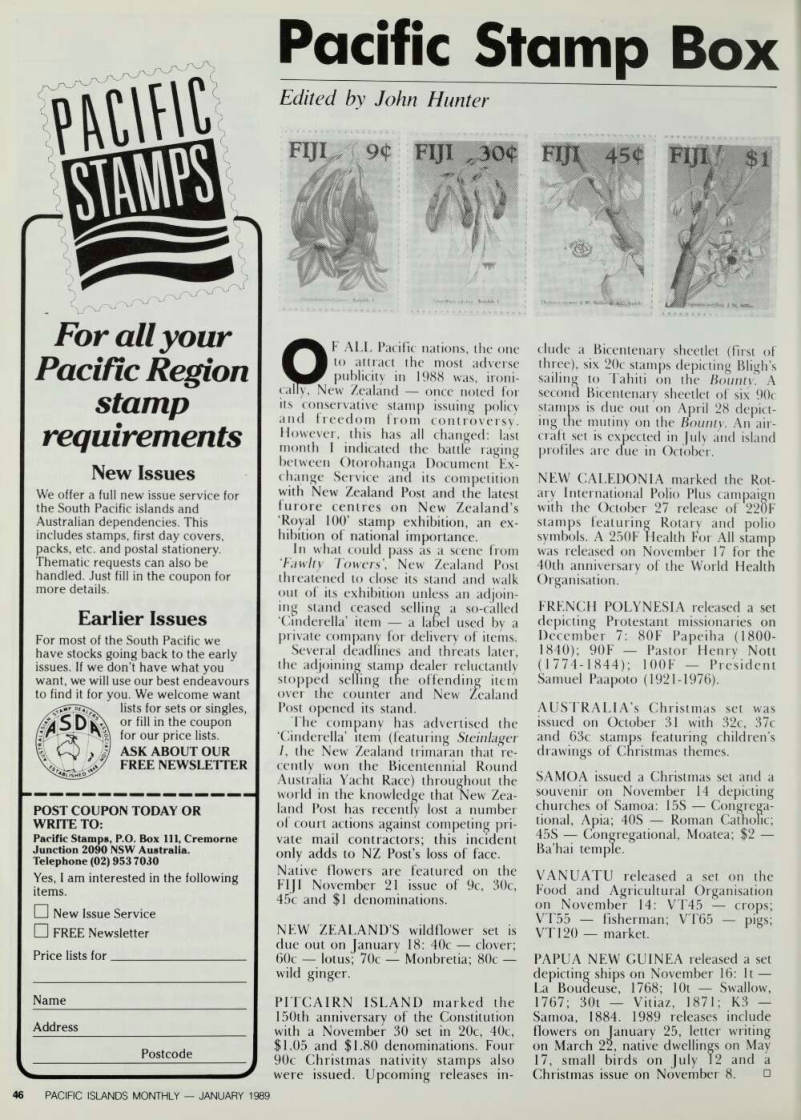
Edited by John Hunter
F ALL Pacific nations, the one ■ Wto attract the most adverse publicity in 1988 was, ironi- New Zealand once noted for its conservative stamp issuing policy and freedom from controversy.
However, this has all changed: last month I indicated the battle raging between Otorohanga Document Ex change Service and its competition with New Zealand Post and the latest furore centres on New Zealand’s Royal 100’ stamp exhibition, an ex hibition of national importance.
In what could pass as a scene from Fawlty Towers' , New Zealand Post threatened to close its stand and walk out of its exhibition unless an adjoin ing stand ceased selling a so-called ‘Cinderella’ item a label used by a private company for delivery of items.
Several deadlines and threats later, the adjoining stamp dealer reluctantly
stopped selling the offending item
over the counter and New Zealand Post opened its stand.
The company has advertised the
‘Cinderella’ item (featuring Steinlager
I , the New Zealand trimaran that re cently won the Bicentennial Round Australia Yacht Race) throughout the world in the knowledge that New Zea land Post has recently lost a number
of court actions against competing pri
vate mail contractors; this incident only adds to NZ Post’s loss of face.
Native flowers are featured on the FIJI November 21 issue of 9c, 30c, 45c and $1 denominations.
NEW ZEALAND’S wildflower set is due out on January 18: 40c clover; 60c lotus; 70c Monbretia; 80c
wild ginger.
PITCAIRN ISLAND marked the 150th anniversary of the Constitution with a November 30 set in 20c, 40c, $1.05 and $l.BO denominations. Four 90c Christmas nativity stamps also were issued. Upcoming releases in
dude a Bicentenary sheetlet (first of three), six 20c stamps depicting Bligh’s sailing to Tahiti on the Bounty. A second Bicentenary sheetlet of six 90c stamps is due out on April 28 depict ing the mutiny on the Bounty. An air craft set is expected in July and island profiles are due in October.
NEW CALEDONIA marked the Rot ary International Polio Plus campaign with the October 27 release of 220 F stamps featuring Rotary and polio symbols. A 250 F Health For All stamp was released on November 17 for the 40th anniversary of the World Health
Organisation.
FRENCH POLYNESIA released a set depicting Protestant missionaries on December 7: 80F Papeiha (1800- 1840); 90F Pastor Henry Nott (1774-1844); 100 F President Samuel Paapoto (1921-1976).
AUSTRALIA’S Christmas set was issued on October 31 with 32c, 37c and 63c stamps featuring children’s drawings of Christmas themes.
SAMOA issued a Christmas set and a souvenir on November 14 depicting churches of Samoa: 15S Congrega tional, Apia; 40S Roman Catholic; 45S Congregational, Moatea; $2
Ba’hai temple.
VANUATU released a set on the
Food and Agricultural Organisation
on November 14: VT4S crops; VTSS fisherman; VT6S pigs; VTI2O market.
PAPUA NEW GUINEA released a set depicting ships on November 16: It La Boudeuse, 1768; lOt Swallow, 1767; 30t Vitiaz, 1871; K 3 Samoa, 1884. 1989 releases include flowers on January 25, letter writing on March 22, native dwellings on May 17, small birds on July 12 and a Christmas issue on November 8. □
'Niukila Fri Pasifik' on film
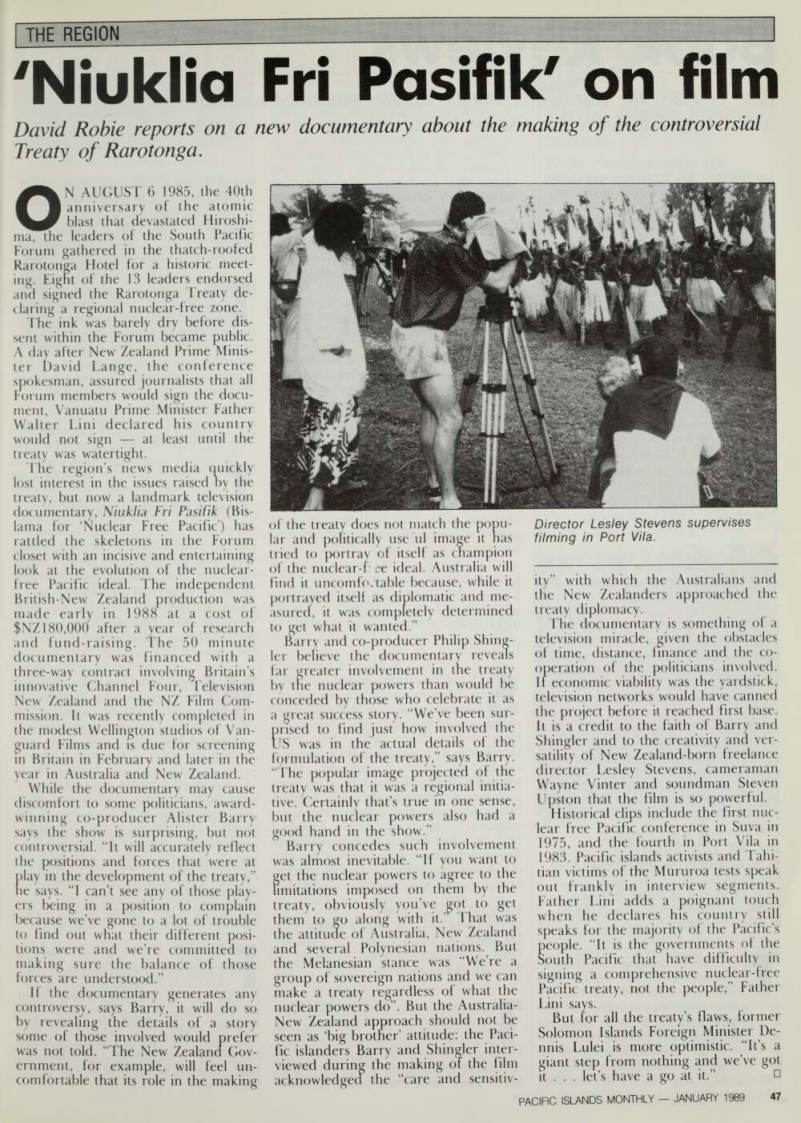
David Robie reports on a new documentary about the making of the controversial Treaty of Rarotonga.
ON AUGUST 6 1985, the 40th anniversary of the atomic blast that devastated Hiroshi ma, the leaders of the South Pacific Forum gathered in the thatch-roofed Rarotonga Hotel for a historic meet ing. Eight of the 13 leaders endorsed and signed the Rarotonga Treaty de claring a regional nuclear-free zone.
The ink was barely dry before dis sent within the Forum became public.
A day after New Zealand Prime Minis ter David Lange, the conference spokesman, assured journalists that all Forum members would sign the docu ment, Vanuatu Prime Minister Father Walter Lini declared his country would not sign at least until the treaty was watertight.
The region’s news media quickly lost interest in the issues raised by the treaty, but now a landmark television documentary, Niuklia Fri PasiFik (Bis lama for ‘Nuclear Free Pacific’) has rattled the skeletons in the Forum closet with an incisive and entertaining look at the evolution of the nuclear free Pacific ideal. The independent British-New Zealand production was made early in 1988 at a cost of SNZ 180,000 after a year of research and fund-raising. The 50 minute documentary was financed with a
three-way contract involving, Britain’s
innovative Channel Four, Television New Zealand and the NZ Film Com mission. It was recently completed in the modest Wellington studios of Van guard Films and is due for screening m Britain in February and later in the year in Australia ana New Zealand.
While the documentary may cause discomfort to some politicians, award
winning co-producer Alister Barry
says the show is surprising, but not controversial. “It will accurately reflect the positions and forces that were at play in the development of the treaty,” ne says. “I can’t see any of those play ers being in a position to complain because we’ve gone to a lot of trouble to find out what their different posi tions were and we’re committed to making sure the balance of those forces are understood.”
If the documentary generates any controversy, says Barry, it will do so by revealing the details of a story some of those involved would prefer was not told. “The New Zealancl Gov ernment, for example, will feel un comfortable that its role in the making
of the treaty does not match the popu lar and politically use ul image it nas tried to portray of itself as cnampion of the nuclear-f ee ideal. Australia will find it uncomfortable because, while it portrayed itself as diplomatic and me asured, it was completely determined to get what it wanted.”
Barry and co-producer Philip Shing ler believe the documentary reveals far greater involvement in the treaty by the nuclear powers than would be conceded by those who celebrate it as a great success story. “We’ve been sur prised to find just how involved the US was in the actual details of the formulation of the treaty,” says Barry.
“The popular image projected of the
treaty was that it was a regional initia tive. Certainly that’s true in one sense, but the nuclear powers also had a good hand in the show.”
Barry concedes such involvement was almost inevitable. “If you want to get the nuclear powers to agree to the limitations imposed on them by the
treaty, obviously you’ve got to get
them to go along with it.’ That was the attitude of Australia, New Zealand and several Polynesian nations. But the Melanesian stance was “Were a group of sovereign nations and we can make a treaty regardless of what the nuclear powers do”. But the Australia- New Zealand approach should not be seen as ‘big brother’ attitude: the Paci fic islanders Barry and Shingler inter viewed during the making of the film acknowledged the “care and sensitiv
ity” with which the Australians and the New Zealanders approached the
treaty diplomacy.
The documentary is something of a television miracle, given the obstacles of time, distance, finance and the co operation of the politicians involved. 1 1 economic viability was the yardstick, television networks would have canned the project before it reached first base.
It is a credit to the faith of Barry and Shingler and to the creativity and ver satility of New Zealand-born freelance director Lesley Stevens, cameraman Wayne Vinter and soundman Steven Upston that the film is so powerful.
Historical clips include the first nuc lear free Pacific conference in Suva in 1975, and the fourth in Port Vila in 1983. Pacific islands activists and Tahi tian victims of the Mururoa tests speak out frankly in interview segments.
Father Lini adds a poignant touch when he declares his country still speaks for the majority of the Pacific’s people. “It is the governments of the South Pacific that have difficulty in
signing a comprehensive nuclear-free
Pacific treaty, not the people,” Father Lini says.
But for all the treaty’s flaws, former Solomon Islands Foreign Minister De nnis Lulei is more optimistic. “It’s a giant step from nothing and we’ve got it . . . let’s have a go at it.” □
Director Lesley Stevens supervises filming in Port Vila.
Book Reviews
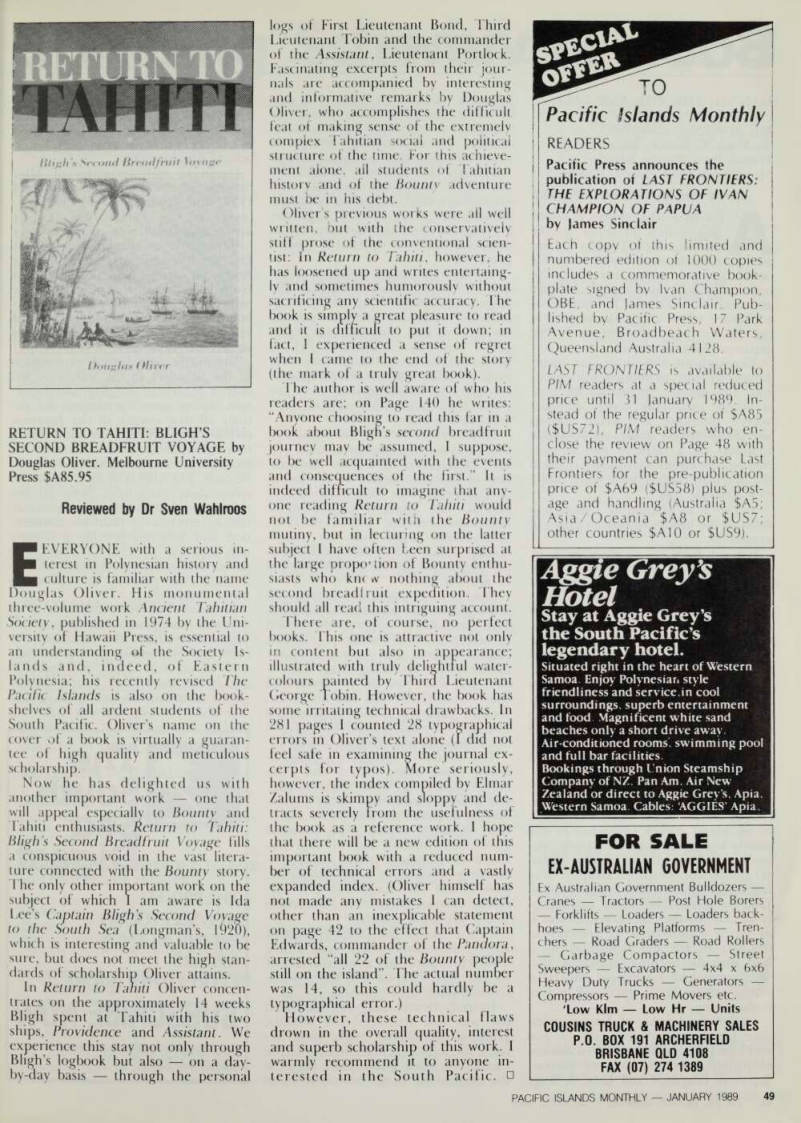
Late in 1988, the Institute of Pacific Studies published a number books by islanders about the region. A number of titles are reviewed here.
From The Mangrove Swamps
By Tomasi R. Vakatora. SFS in the
islands, SUS 7 elsewhere
THE author has observed Fiji's political and social evolution at close quarters, and tells that story through an account of his em ergence from a humble family in a village on the Rewa Delta to mem bership of Fiji's Cabinet. V akatora was administrator of many government projects and head of ministries before he entered politics, eventually holding a number ol portfolios and becoming Speaker. He is well qualified to giye an inside account of the events of 1987, and in this volume considers the future of Fiji at length.
Pacific Courts And Legal
SYSTEMS Edited by Guv Powles and Mere Pulea. ISBN 982-02-0046-6 Islands SFB, SUSI 4 elsewhere.
MORE than 50 people engaged
in courts and the law in the Pacific discuss their work, ex perience and areas of concern, provid ing insights into the 28 countries and territories of the region. Judges, magistrates, court administrators,
policymakers, prosecutors, lawyers and
academics have contributed valuable information to this book, which offers a country-by-country analysis of court systems, sources of law, government systems and the legal profession, with emphasis on critical areas such as legal aid and representation and training of practitioners. It is published in associa tion with the University of the South Pacific’s Law Unit in Vanuatu and the Faculty of Law at Monash University, Melbourne.
Pacific Universities
Achievements, Problems,
PROSPECTS Edited bv Ron Crocombe and Malama Meleisca ISBN 982-02-0039-3. Islands SFIO, SUSIS elsewhere.
TER TIARY education was virtual ly unknown in the Pacific until 1945 but bv 1987 there were nine universities offering degrees and the prospect of three more opening within a fev\ years. Staff at these uni versities have contributed chapters on the complex educational realities of the region. Chapters on the number
of islanders studying overseas are in cluded, and national perspectives on higher education and its future are closelv examined.
Traditional Architecture In
VANUATU Bv Christian Coiffiei translated bv V Anun and P Hereniko. ISBN 982-02-0047-4.
Islands SFS, SUSB elsewhere.
THE diversity of technological
forms chosen by generations of m-Vanuatu is depicted in a clear text supported bv many photographs,
site plans and drawings Village
architecture in Vanuatu has changed greatlv over the past century; mis book examines the evolution of spatial organisation of buildings and the de sign, construction techniques and use of materials. Its scope is comprehen sive, but it does not include the urban areas of Luganville on Espiritu Santo or Port Vila on Elate.
Micronesian Politics
Volume Three in the series Politics in the Pacific Islands. ISBN 982-02-0038-5. Islands SF7, SUSI 2 elsewhere.
SIX million Pacific islanders make up the most politically frag mented community on earth: di into 22 political units, they often have to struggle to define their rela tionship with the metropolitan powers closest to them. Present-day Mic ronesia is here examined by a political scientist, a former politician, a pub lisher, a historian, a journalist and an educator. The book covers Kiribati, Nauru, the Marshall Islands, the Federated States of Micronesia, Guam, the Commonwealth of the Northern Marianas and the Republic of Palau.
Law, Politics And
Government In The Pacific
ISLANDS STATES Edited by Vash H Ghai. ISBN 982-02-0049-0. Islands SFB, SUSIS elsewhere.
THE book concentrates on the constitutional and governmental systems of the independent Paci fic island states, including the con siderable developments that have taken place since their independence.
Pacific Isi Ands
Communication Journal Voi
15 No 2 Freedom And
Training For The Pacific
MEDIA Edited by Ron Crocombe and Marjorie Crocombe. SF3.
THE authors examine the effect on Pacific media and com munications of crises such as the two Fiji coups. The training of Pacific people in all aspects of media work is given considerable space, with academics stressing the need for co
operation throughout the region.
FIJIANS AT WAR bv Asesela Ravuvu. ISBN 982-02-0025-3. Islands SF4, SUS 6 elsewhere. study was first published in I 1974 and is now in its second I printing. It studies Fijian atti tudes to war, based on oral and writ ten evidence, examines the reasons for Fijian participation in the two World Wars and the impact of these experi ences on the relationships between
Europeans, Indians and Fijians.
Land Rights Of Pacific
WOMEN 1986 (reprint). ISBN 982-02-0012-1. Islands |F4, SUS 6 elsewhere.
WOMEN’S rights to land
throughout the Pacific re
main generally secondary to
those of men, even in matrilineal societies. Christianity, commerce and centralised government have, howev er. brought important changes, and adjustments to law and adaptation of behaviour continue. This increasingly important topic is considered in case studies of Fiji, Vanuatu, 1 onga, West ern Samoa and the Cook Islands.
French Polynesia A Book
Of Selected Readings, Edited
by Nancy Pollock and Ron Crocombe. ISBN 982-02-0032-6.
Island Price SFB, SUST2 elsewhere. fRFNCH Polynesia has made a significant contribution to the Pacific’s heritage, but little ill ation is available in English about its past and the issues faced by France’s Polynesian territories today.
This book attempts to fill the gap with an overview of history, customs, the land, current issues and concerns for the future.
Return To Tahiti: Bligh’S
Second Breadfruit Voyage By
Douglas Oliver. Melbourne University Press SA85.95 Reviewed by Dr Sven Wahlroos E EVERYONE with a serious in terest in Polynesian history and culture is familiar with the name Douglas Oliver. His monumental three-volume work Ancient Tahitian Society , published in 1974 by the Uni versity of Hawaii Press, is essential to an understanding of the Society Is lands and, indeed, of Eastern Polynesia; his recently revised The Facitic Islands is also on the book shelves of all ardent students of the South Pacific. Oliver’s name on the cover of a book is virtually a guaran tee of high quality and meticulous
scholarship.
Now he has delighted us with another important work — one that will appeal especially to Bounty and Tahiti enthusiasts. Return to Tahiti: Bligh's Second Breadfruit Voyage fills a conspicuous void in the vast litera ture connected with the Bounty story.
The only other important work on the subject of which I am aware is Ida
Lee’s Captain BUgh's Second Voyage
to the South Sea (Longman’s, 1920), which is interesting and valuable to be sure, but does not meet the high stan dards of scholarship Oliver attains.
In Return to Tahiti Oliver concen trates on the approximately 14 weeks Bligh spent at Tahiti with his two ships, Providence and Assistant. We
experience this stay not only through
Bhgh’s logbook but also — on a day by-day basis — through the personal
logs of First Lieutenant Bond, Third Lieutenant Tobin and the commander of the Assistant , Lieutenant Portlock.
Fascinating excerpts from their jour nals are accompanied by interesting and informative remarks by Douglas Oliver, who accomplishes the difficult feat of making sense of the extremelv complex Tahitian social and political structure of the time For this achieve ment alone, all students of Tahitian historv and of the Bounty adventure must be in his debt.
Oliver s previous works were all well written, but with the conservatively stiff prose of the conventional scien tist; in Return to Tahiti , however, he has loosened up and writes entertaing ly and sometimes humorously without sacrificing any scientific accuracy. The book is simply a great pleasure to read and it is difficult to put it down; in fact, 1 experienced a sense of regret when I came to the end of the story (the mark of a truly great book).
The author is well aware of who his readers are; on Page 140 he writes: “Anyone choosing to read this far in a book about Bligh’s second breadfruit journey mav be assumed, I suppose, to be well acquainted with the events and consequences of the first.” It is indeed difficult to imagine that anv one reading Return to Tahiti would not be familiar with the Bounty mutiny, but in lecturing on the latter subject I have often Teen surprised at the large proportion of Bounty enthu siasts who km w nothing about the second bread! ruit expedition. They should all read this intriguing account.
There are, of course, no perfect books. This one is attractive not only in content but also in appearance; illustrated with truly delightful water colours painted by Thiro Lieutenant George Tobin. However, the book has some irritating technical drawbacks. In 281 pages I counted 28 typographical errors in Oliver’s text alone (I did not feel safe in examining the journal ex cerpts for typos). More seriously, however, the index compiled by Elmar Zalums is skimpy and sloppy and de tracts severely from the usefulness of the book as a reference work. I hope that there will be a new edition of this important book with a reduced num ber of technical errors and a vastly expanded index. (Oliver himself has not made any mistakes I can detect, other than an inexplicable statement on page 42 to the effect that Captain Edwards, commander of the Pandora , arrested “all 22 of the Bounty people still on the island”. The actual number was 14, so this could hardly be a
typographical error.)
However, these technical flaws drown in the overall quality, interest and superb scholarship of this work. I warmly recommend it to anyone in terested in the South Pacific. □
Advertisements & other items, p. 49 (1 item)
Aggie Grey's
ST*
ciM-
T««S r 0
Pacific Islands Monthly
READERS
Pacific Press announces the publication of LAST FRONTIERS:
THE EXPLORATIONS OF IVAN
CHAMPION OF PAPUA
by James Sinclair Each copy of this limited and numbered edition of 1000 copies includes a commemorative bookplate signed by Ivan Champion, OBE, and James Sinclair. Published by Pacific Press, 17 Park Avenue, Broad beach Waters, Queensland Australia 4128.
LAST FRONTIERS is available to RIM readers at a special reduced price until 31 January 1989. Instead of the regular price of SABS (SUS 72), P/M readers who enclose the review on Page 48 with their payment can purchase Last Frontiers for the pre-publication price of SA69 (SUSSB) plus postage and handling (Australia SAS; Asia/Oceania SAB or SUS 7; other countries SAIO or SUS 9).
Aggie Grey's
Hotel
Stay at Aggie Grey’s
the South Pacific’s
legendary hotel.
Situated right in the heart of Western Samoa Enjoy Polynesian style friendliness and service.in cool surroundings, superb entertainment and food Magnificent white sand beaches only a short drive away.
Air-conditioned rooms' swimming pool and full bar facilities.
Bookings through Union Steamship Company of NZ. Pan Am. Air New Zealand or direct to Aggie Grey’s. Apia.
Western Samoa Cables: AGGIES’ Apia
FOR SALE
EX-AUSTRALIAN GOVERNMENT
Ex Australian Government Bulldozers Cranes Tractors Post Hole Borers Forklifts Loaders Loaders backhoes Elevating Platforms Trenchers Road Graders Road Rollers Garbage Compactors Street Sweepers Excavators 4x4 x 6x6 Heavy Duty Trucks Generators Compressors Prime Movers etc.
"Low Kim Low Hr Units
COUSINS TRUCK & MACHINERY SALES
P.O. BOX 191 ARCHERFIELD
BRISBANE OLD 4108
FAX (07) 274 1389
Book Review
Nan’Yo: The Rise And Fall
Of The Japanese In
Micronesia 1855-1945
By Mark R. Peattie, University of Hawaii Press. Pacific Islands Monograph Series No. 4, US$3O.
Reviewed by JOHN CONNELL 7 JR T a time when Japan is asserting a new presence in the Pacific; when Toyotas dominate island roads, tuna vessels scour the oceans and aid reaches new levels, this important book provides a valuable and detailed account of the quarter of a century when a significant part of the Pacific was an element in the
Japanese colonial empire.
Throughout the inter-war years Japan set out to absorb Micronesia
into the empire, primarily by con-
structing profitable settler colonies
where Japanese and other Asians would eventually come to dominate islanders by a ratio of two to one.
Nan Vo, the South Seas from Saipan to the Marshall Islands, were taken into a new strategic role.
Nan’yo is an account of a small segment of the history of Japan’s imperial
expansion.
ft is not a history of Micronesia, or of Micronesians under Japanese rule but it is nevertheless a significant contribution to both areas. Mark Peattie, a specialist in modern Japanese history, himself states that “I have simply tried to tell the story of the rise and fall of a vigorous, aggressive and enterprising people on distant and far-scattered fragments of land ... a setting that was both exotic and geographically fast”. He tells the story well, and more than 40 photographs (and a rather odd assembly of maps) make this a most elegant production in a fine series.
Japanese interest in Micronesia began toward the end of the 19th century as the navy and merchant marine of an island nation expanded to still poorly known and remote islands: virtually the last phase in the global
scramble for empire. Despite tiny
trading companies and limited capital,
Japan acquired Micronesia surprising-
ly quickly. By the end of World War I, as Japan consolidated its presence in the face of US and British alarm, it had already become apparent that Micronesia had a strategic value that would remain far in excess of its economic value.
Under the League of Nations mandate Japan applied characteristic zeal and energy to public works, education, shipping services and, of course, Japanese language and laws. A huge
Japanese bureaucracy grew a sign of worse things to come under the American trusteeship that was “intensive and dominating” compared with everything that had gone before,
Though the Japanese bureaucracy
was competent, and met with
surprisingly little indigenous resistance
(other than in Palau and Yap), the grafting of this bureaucracy on to small-scale societies necessarily created problems.
There was limited religious freedom, labour was exploited in the Angaur phosphate mine, health programmes could not stimulate population growth and education was segre-
gated and discriminatory. Peattie
points out, however, though they were
prejudiced and perjorative, Japanese
attitudes to Micronesians were no worse than most other colonial outlooks at the time.
Micronesians became subordinate in every way to the Japanese colonial systern, emphasised by a mass immigration of Japanese similar to the influx of Europeans into New Caledonia or Hawaii. The Japanese population of Micronesia reached 62,000 in 1937,
substantially larger than the indige-
nous population, and only recently has the population of Micronesia reached its pre-war level.
Neither encouraged nor actively discourased by the Japanese administration, the flood of migrants threatened to swamp the Micronesian population; Peattie records one American visitor in the 1930 s recording that “the nalives will soon pass on to silence and dust”. Fortunately this was not to be,
though Japanese policy represented
that nation’s most important breach of the League of Nations mandate.
The economic prosperity that followed copra sales, fishing and com merce has long been Micronesians’ one positive recollection of the period.
Having acquired the islands for essen daily strategic reasons, the Japanese government initially had no real eco nomic development policy; yet a combination of vigorous private initiative, government encouragement and subsidies eventually turned Micronesia
into a profitable colony.
At the end of the 1930 s exports of sugar, phosphate, fish and copra dwarfed exports, but it was the end of an era. When Japan left, the produclive economy never revived.
Indeed, Peattie suggests that had the war not scourged the islands, Japanese Micronesia might have become the agricultural showplace of the Pacific” albeit a showplace only for the colonialists. In the economic boom
Micronesians were still largely bystan ders, watching aghast as the islands’ ecological structures were devastated by deforestation, erosion and omni vorous African snails.
Japanese militarisation of Mic ronesia did not begin in earnest until 1939, and Japan’s “invulnerable for tress” in the Pacific was largely mythical; a result both of the mystery with which Japan shrouded the islands and the fevered imagination of the American press. Nonetheless it was from Micronesia that the Japanese launched their attack on Pearl Har hour an attack that four years later brought the end of Japan’s colonial empire in Micronesia.
Insensitive and brutal exploitation of the islanders in the war years left only a legacy of tragedy and bitter ness. A few stone foundations are vir tualy all that remain of the Japanese civilian era. Military debris is much more prominent: a clear mark of the strategic arena Micronesia had already become. The effects of direct Japanese colonialism may have been all but obliterated, but modern Japanese eco nomic interests in tourism, construc tion and fisheries provide a massive neo-colonial presence, “exercising power and influence in the Pacific on a scale that pre-war entrepreneurs never dreamed”.
In place of the tidal wave of Japanese immigrants has come one of
Japanese products: the Japanese have
colonised Micronesia more effectively than direct rule could ever achieve, and in this book Mark Peattie has ele gantly recorded the history of what is now almost a forgotten era. □
Advertisements & other items, p. 50 (1 item)
Digest
Hie
South
Sea
Digest
THE PRIVATE
NEWSLETTER ON
PACIFIC ISLANDS
AFFAIRS
EVERY OTHER FRIDAY
SUBSCRIBE NOW
See coupon insert between pages 54-55.
Shipping Schedules
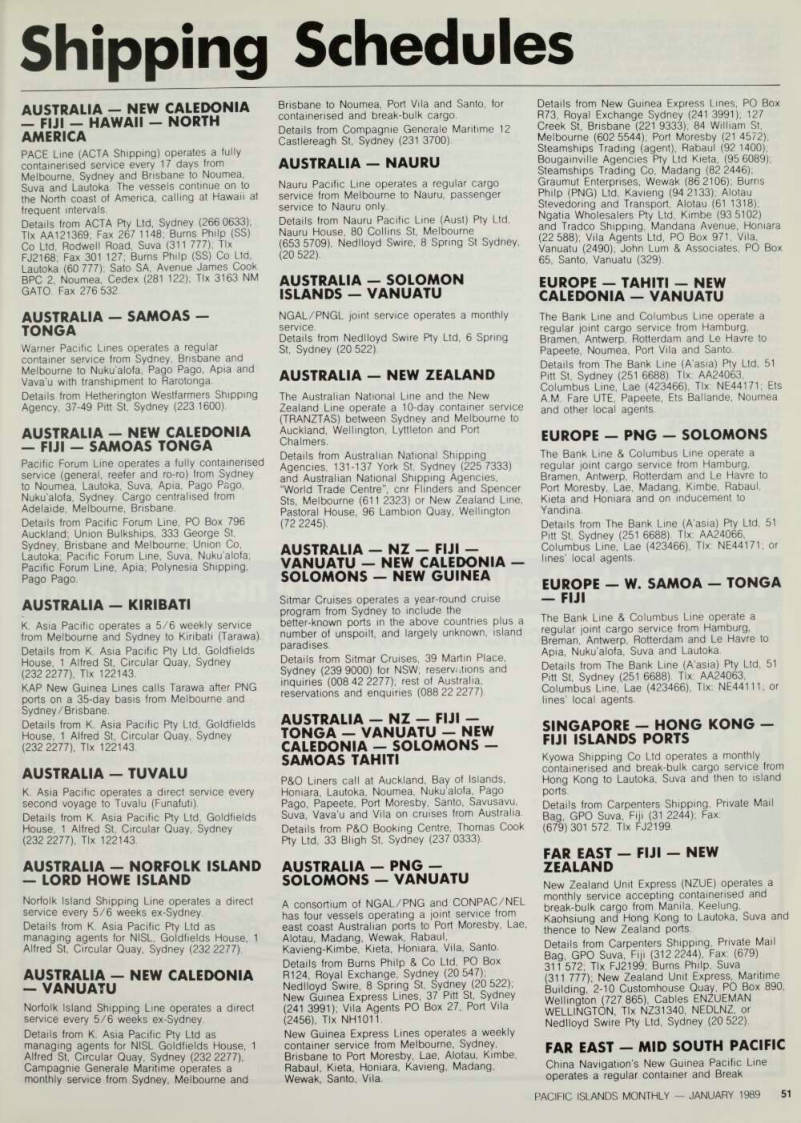
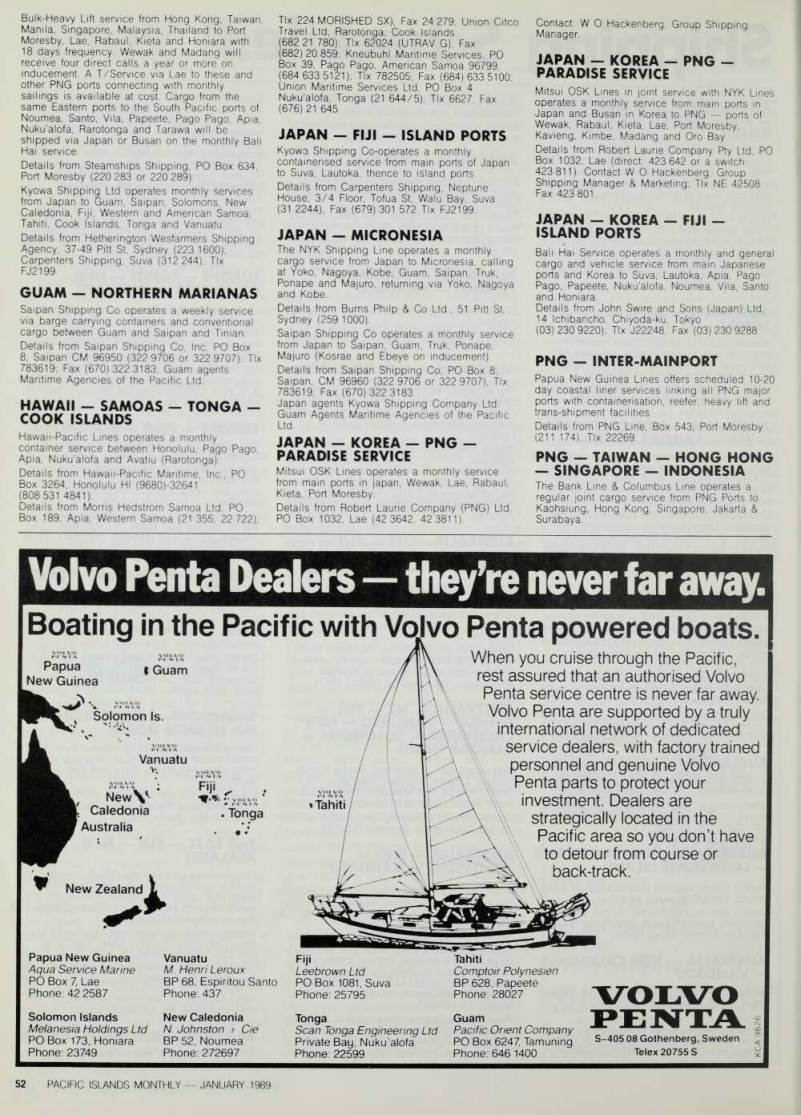
Australia New Caledonia
Fiji Hawaii North
America
PACE Line (ACTA Shipping) operates a fully containerised service every 17 days from Melbourne, Sydney and Brisbane to Noumea, Suva and Lautoka. The vessels continue on to the North coast of America, calling at Hawaii at frequent intervals.
Details from ACTA Pty Ltd, Sydney (266 0633); Tlx AA121369; Fax 267 1148; Burns Philp (SS) Cos Ltd. Rodwell Road, Suva (311 777); Tlx FJ2168; Fax 301 127; Burns Philp (SS) Cos Ltd, Lautoka (60 777); Sato SA, Avenue James Cook BPC 2, Noumea, Cedex (281 122); Tlx 3163 NM
Gato, Fax 276 532.
Australia - Samoas -
Tonga
Warner Pacific Lines operates a regular container service from Sydney, Brisbane and Melbourne to Nukualofa, Pago Pago, Apia and Vava’u with transhipment to Rarotonga.
Details from Hetherington Westfarmers Shipping Agency, 37-49 Pitt St, Sydney (223 1600).
Australia New Caledonia
Fiji Samoas Tonga
Pacific Forum Line operates a fully containerised service (general, reefer and ro-ro) from Sydney to Noumea, Lautoka, Suva, Apia, Pago Pago, Nuku'alofa, Sydney. Cargo centralised from Adelaide, Melbourne, Brisbane.
Details from Pacific Forum Line, PO Box 796 Auckland; Union Bulkships, 333 George St, Sydney, Brisbane and Melbourne; Union Cos, Lautoka; Pacific Forum Line, Suva, Nuku'alofa; Pacific Forum Line, Apia; Polynesia Shipping, Pago Pago.
Australia - Kiribati
K. Asia Pacific operates a 5/6 weekly service from Melbourne and Sydney to Kiribati (Tarawa).
Details from K. Asia Pacific Pty Ltd, Goldfields House, 1 Alfred St, Circular Quay, Sydney (232 2277). Tlx 122143.
KAP New Guinea Lines calls Tarawa after PNG ports on a 35-day basis from Melbourne and Sydney/Brisbane.
Details from K. Asia Pacific Pty Ltd, Goldfields House, 1 Alfred St, Circular Quay, Sydney (232 2277), Tlx 122143.
Australia - Tuvalu
K. Asia Pacific operates a direct service every second voyage to Tuvalu (Funafuti).
Details from K. Asia Pacific Pty Ltd, Goldfields House, 1 Alfred St, Circular Quay, Sydney (232 2277), Tlx 122143.
Australia - Norfolk Island
- Lord Howe Island
Norfolk Island Shipping Line operates a direct service every 5/6 weeks ex-Sydney.
Details from K. Asia Pacific Pty Ltd as managing agents for NISL, Goldfields House, 1 Alfred St, Circular Quay, Sydney (232 2277).
Australia New Caledonia
- Vanuatu
Norfolk Island Shipping Line operates a direct service every 5/6 weeks ex-Sydney.
Details from K. Asia Pacific Pty Ltd as managing agents for NISL Goldfields House, 1 Alfred St, Circular Quay, Sydney (232 2277), Campagnie Generale Maritime operates a monthly service from Sydney, Melbourne and
Brisbane to Noumea, Port Vila and Santo, for containerised and break-bulk cargo.
Details from Compagnie Generale Maritime 12 Castlereagh St, Sydney (231 3700).
Australia Nauru
Nauru Pacific Line operates a regular cargo service from Melbourne to Nauru, passenger service to Nauru only.
Details from Nauru Pacific Line (Aust) Pty Ltd, Nauru House, 80 Collins St, Melbourne (653 5709), Nedlloyd Swire, 8 Spring St Sydney, (20 522).
Australia Solomon
Islands Vanuatu
NGAL/PNGL joint service operates a monthly service.
Details from Nedlloyd Swire Pty Ltd, 6 Spring St, Sydney (20 522).
Australia New Zealand
The Australian National Line and the New Zealand Line operate a 10-day container service (TRANZTAS) between Sydney and Melbourne to Auckland, Wellington, Lyttleton and Port Chalmers.
Details from Australian National Shipping Agencies, 131-137 York St, Sydney (225 7333) and Australian National Shipping Agencies, “World Trade Centre", cnr Flinders and Spencer Sts, Melbourne (611 2323) or New Zealand Line, Pastoral House, 96 Lambion Quay, Wellington (72 2245).
Australia - Nz Fiji
Vanuatu - New Caledonia -
Solomons New Guinea
Sitmar Cruises operates a year-round cruise program from Sydney to include the better-known ports in the above countries plus a number of unspoilt, and largely unknown, island paradises.
Details from Sitmar Cruises, 39 Martin Place, Sydney (239 9000) for NSW; reservations and inquiries (008 42 2277); rest of Australia, reservations and enquiries (088 22 2277).
Australia - Nz Fiji
Tonga Vanuatu - New
Caledonia Solomons
Samoas Tahiti
P&O Liners call at Auckland, Bay of Islands, Honiara, Lautoka, Noumea, Nukualofa, Pago Pago, Papeete, Port Moresby, Santo, Savusavu, Suva, Vava'u and Vila on cruises from Australia.
Details from P&O Booking Centre, Thomas Cook Pty Ltd, 33 Bligh St, Sydney (237 0333).
Australia Png
Solomons Vanuatu
A consortium of NGAL/PNG and CONPAC/NEL has four vessels operating a joint service from east coast Australian ports to Port Moresby, Lae, Alotau, Madang, Wewak, Rabaul, Kavieng-Kimbe, Kieta, Honiara, Vila, Santo.
Details from Burns Philp & Cos Ltd, PO Box R 124, Royal Exchange, Sydney (20 547); Nedlloyd Swire, 8 Spring St, Sydney (20 522); New Guinea Express Lines, 37 Pitt St, Sydney (241 3991); Vila Agents PO Box 27, Port Vila
(2456), Tlx Nhioii.
New Guinea Express Lines operates a weekly container service from Melbourne, Sydney, Brisbane to Port Moresby, Lae, Alotau, Kimbe, Rabaul, Kieta, Honiara, Kavieng, Madang, Wewak, Santo, Vila.
Details from New Guinea Express Lines, PO Box R 73, Royal Exchange Sydney (241 3991); 127 Creek St, Brisbane (221 9333); 84 William St, Melbourne (602 5544); Port Moresby (21 4572); Steamships Trading (agent), Rabaul (92 1400); Bougainville Agencies Pty Ltd Kieta, (95 6089); Steamships Trading Cos, Madang (82 2446); Graumut Enterprises, Wewak (86 2106); Burns Philp (PNG) Ltd, Kavieng (94 2133); Alotau Stevedoring and Transport, Alotau (61 1318); Ngatia Wholesalers Pty Ltd, Kimbe (93 5102) and Tradco Shipping, Mandana Avenue, Honiara (22 588); Vila Agents Ltd, PO Box 971, Vila, Vanuatu (2490); John Lum & Associates, PO Box 65, Santo, Vanuatu (329).
Europe Tahiti - New
Caledonia Vanuatu
The Bank Line and Columbus Line operate a regular joint cargo service from Hamburg, Bramen, Antwerp, Rotterdam and Le Havre to Papeete, Noumea, Port Vila and Santo Details from The Bank Line (A’asia) Pty Ltd, 51 Pitt St, Sydney (251 6688). Tlx; AA24063, Columbus Line, Lae (423466), Tlx; NE44171; Ets A.M. Fare DTE, Papeete, Ets Ballande, Noumea and other local agents.
Europe Png Solomons
The Bank Line & Columbus Line operate a regular joint cargo service from Hamburg, Bramen, Antwerp, Rotterdam and Le Havre to Port Moresby, Lae, Madang, Kimbe, Rabaul, Kieta and Honiara and on inducement to Yandina.
Details from The Bank Line (A’asia) Pty Ltd, 51 Pitt St, Sydney (251 6688). Tlx; AA24066, Columbus Line, Lae (423466), Tlx: NE44171; or lines’ local agents.
Europe W. Samoa Tonga
Fiji
The Bank Line & Columbus Line operate a regular joint cargo service from Hamburg, Breman, Antwerp, Rotterdam and Le Havre to Apia, Nukualofa, Suva and Lautoka.
Details from The Bank Line (A’asia) Pty Ltd, 51 Pitt St, Sydney (251 6688). Tlx; AA24063, Columbus Line, Lae (423466), Tlx; NE44111; or lines’ local agents.
Singapore Hong Kong
Fiji Islands Ports
Kyowa Shipping Cos Ltd operates a monthly containerised and break-bulk cargo service from Hong Kong to Lautoka, Suva and then to island ports.
Details from Carpenters Shipping, Private Mail Bag, GPO Suva, Fiji (31 2244); Fax; (679)301 572. Tlx FJ2199.
Far East - Fiji - New
Zealand
New Zealand Unit Express (NZUE) operates a monthly service accepting containerised and break-bulk cargo from Manila, Keelung, Kaohsiung and Hong Kong to Lautoka, Suva and thence to New Zealand ports.
Details from Carpenters Shipping, Private Mail Bag, GPO Suva, Fiji (312 2244). Fax; (679) 311 572; Tlx FJ2199; Burns Philp, Suva (311 777); New Zealand Unit Express, Maritime Building, 2-10 Customhouse Quay, PO Box 890, Wellington (727 865), Cables ENZUEMAN
Wellington, Tlx Nz31340, Nedlnz, Or
Nedlloyd Swire Pty Ltd, Sydney (20 522).
Far East - Mid South Pacific
China Navigation’s New Guinea Pacific Line operates a regular container and Break
Bulk-Heavy Lift service from Hong Kong, Taiwan, Manila, Singapore, Malaysia, Thailand to Port Moresby, Lae, Rabaul, Kieta and Honiara with 18 days frequency. Wewak and Madang will receive four direct calls a year or more on inducement. A T/Service via Lae to these and other PNG ports connecting with monthly sailings is available at cost. Cargo from the same Eastern ports to the South Pacific ports of Noumea, Santo, Vila, Papeete, Pago Pago, Apia, Nukualofa, Rarotonga and Tarawa will be shipped via Japan or Busan on the monthly Bali Hai service.
Details from Steamships Shipping, PO Box 634, Port Moresby (220 283 or 220 289).
Kyowa Shipping Ltd operates monthly services from Japan to Guam, Saipan, Solomons, New Caledonia, Fiji, Western and American Samoa, Tahiti, Cook Islands, Tonga and Vanuatu.
Details from Hetherington Wesfarmers Shipping Agency, 37-49 Pitt St, Sydney (223 1600); Carpenters Shipping, Suva (312 244), Tlx FJ2199
Guam Northern Marianas
Saipan Shipping Cos operates a weekly service via barge carrying containers and conventional cargo between Guam and Saipan and Tinian.
Details from Saipan Shipping Cos, Inc, PO Box 8, Saipan CM 96950 (322 9706 or 322 9707) Tlx 783619; Fax (670)322 3183; Guam agents Maritime Agencies of the Pacific Ltd.
Hawaii Samoas Tonga
Cook Islands
Hawaii-Pacific Lines operates a monthly container service between Honolulu, Pago Pago, Apia, Nukualofa and Avatiu (Rarotonga).
Details from Hawaii-Pacific Maritime, Inc., PO Box 3264. Honolulu HI (9680)-32641 (808 531 4841).
Details from Morris Hedstrom Samoa Ltd, PO Box 189, Apia, Western Samoa (21 355, 22 722),
Tlx 224 MORISHED SX), Fax 24 279; Union Citco Travel Ltd, Rarotonga, Cook Islands (682 21 780); Tlx 62024 (UTRAV G), Fax (682) 20 859; Kneubuhl Maritime Services, PC Box 39, Pago Pago, American Samoa 96799, (684 633 5121); Tlx 782505; Fax (684)633 5100; Union Maritime Services Ltd, PC Box 4 Nukualofa, Tonga (21 644/5); Tlx 6627, Fax (676) 21 645.
Japan Fiji Island Ports
Kyowa Shipping Co-operates a monthly containerised service from main ports of Japan to Suva, Lautoka, thence to island ports.
Details from Carpenters Shipping, Neptune House, 3/4 Floor, Tofua St, Walu Bay, Suva (31 2244), Fax (679)301 572 Tlx FJ2199.
Japan - Micronesia
The NYK Shipping Line operates a monthly cargo service from Japan to Micronesia, calling at Yoko, Nagoya, Kobe, Guam, Saipan, Truk, Ponape and Majuro, returning via Yoko, Nagoya and Kobe.
Details from Burns Philp & Cos Ltd., 51 Pitt St, Sydney (259 1000).
Saipan Shipping Cos operates a monthly service from Japan to Saipan, Guam, Truk, Ponape, Majuro (Kosrae and Ebeye on inducement).
Details from Saipan Shipping Cos, PC Box 8, Saipan, CM 96960 (322 9706 or 322 9707), Tlx 783619, Fax (670)322 3183 Japan agents Kyowa Shipping Company Ltd: Guam Agents Maritime Agencies of the Pacific Ltd.
Japan - Korea - Png -
Paradise Service
Mitsui OSK Lines operates a monthly service from main ports in japan, Wewak, Lae, Rabaul, Kieta, Port Moresby Details from Robert Laurie Company (PNG) Ltd, PO Box 1032, Lae (42 3642, 42 3811).
Contact: W 0 Hackenberg, Group Shipping Manager.
Japan Korea Png
Paradise Service
Mitsui OSK Lines in joint service with NYK Lines operates a monthly service from mam ports in Japan and Busan in Korea to PNG ports of Wewak, Rabaul, Kieta, Lae, Port Moresby, Kavieng, Kimbe, Madang and Oro Bay Details from Robert Laurie Company Pty Ltd, PC Box 1032, Lae (direct: 423 642 or a switch; 423 811). Contact W 0 Hackenberg, Group Shipping Manager & Marketing; Tlx NE 42508 Fax 423 801.
Japan Korea Fiji
Island Ports
Bali Hai Service operates a monthly and general cargo and vehicle service from main Japanese ports and Korea to Suva, Lautoka, Apia, Pago Pago, Papeete, Nukualofa, Noumea, Vila, Santo and Honiara.
Details from John Swire and Sons (Japan) Ltd, 14 Ichibancho, Chiyoda-ku, Tokyo (03) 230 9220); Tlx J 22248, Fax (03) 230 9288.
Png - Inter-Mainport
Papua New Guinea Lines offers scheduled 10-20 day coastal liner services linking all PNG major ports with containerisation, reefer, heavy lift and trans-shipment facilities.
Details from PNG Line, Box 543, Port Moresby (211 174), Tlx 22269.
Png Taiwan Hong Hong
Singapore Indonesia
The Bank Line & Columbus Line operates a regular joint cargo service from PNG Ports to Kaohsiung, Hong Kong, Singapore, Jakarta & Surabaya.
Details from The Bank Line (A’asia) Pty Ltd, 51 Pitt St, Sydney (251 6688), Tlx AA24063; Columbus Line, Lae (423 466); Tlx NE44171; or lines’ local agents.
Png - Uk/Continent
The Bank Line and Columbus Line operate a regular joint service from Port Moresby, Oro Bay, Kieta, Rabaul. Kimbe, Madang and Lae to Hull, Hamburg, Rotterdam, Antwerp and Le Havre.
Details from The Bank Line (A’asia) Pty Ltd, 51 Pitt St. Sydney (251 6688), Tlx AA24063; Columbus Line, Lae (423 466); Tlx NE44171; or lines’ local agents.
Solomons - Uk/Continent
The Bank Line and Columbus Line operate a regular joint cargo service from Honiara to Hull, Hamburg. Rotterdam, Antwerp and Le Havre.
Details from The Bank Line (A’asia) Pty Ltd, 51 Pitt St, Sydney (251 6688), Tlx AA24063; Columbus Line, Lae (423 466); Tlx NE44171; or lines’ local agents.
Solomons - Uk/Continent
The Bank Line and Columbus Line operate a regular joint cargo service from Honiara to Hull, Hamburg, Rotterdam, Antwerp and Le Havre.
Details from The Bank Line (A’asia) Pty Ltd, 51 Pitt St, Sydney (251 6688), Tlx AA24063; Columbus Line, Lae (423 466); Tlx NE44171; Tradco Shipping Ltd., Honiara (22 588); Tlx 66 313.
New Zealand - Australia -
Png - Solomon Islands
Pacific Forum Line operates a containerised and ro-ro service from Lyttleton, Napier and Auckland to Brisbane, Port Moresby, Lae, Honiara, Brisbane then to New Zealand.
Details from Pacific Forum, Auckland, Christchurch; Union Bulkships, Brisbane; Steamships Shipping, Port Moresby and Lae Sullivan Ltd, Honiara; Seabridge, Wellington,
New Zealand — Cook Islands
— Tahiti
New Zealand Line operates cargo services based on pallets and similar units from Auckland to Cook Islands and Tahiti.
Details from NZ Shipping Agencies International Ltd, PC Box 3420, Auckland (392 650), Waterfront Commission, PC Box 61, Rarotonga, Cook Islands; Shipping Office, Govt of Niue, PO Box 107, Niue Island: Compagnie Maritime Polynesienne, PO Box 36, Papeete, Tahiti.
New Zealand — Fiji
Reef operates a regular 18-day service from Auckland to Suva and Lautoka. Also passenger accommodation.
Details from Reef Shipping Agencies, PO Box 3382, Auckland (771 2213), Tlx 60633, MV Fijian Shipping Agencies Ltd, Private Bag, Suva (311 056).
Pacific Line with one ship operates a three-weekly ro-ro cargo service New Zealand, Lautoka, Suva. No passengers.
Details Sofrana Unilines, 18 Customs St, Auckland (773 279); PO Box 3614, Tlx NZ2313, Carpenters Shipping, Neptune House, Tofua St, Walu Bay, Suva (25 141), Tlx FJ2199
New Zealand — Fiji — North
America (Wc)
Blue Star Line Ltd Pacific Coast container services: only direct service to and from New Zealand. Blue Star vessels call at Suva and Honolulu on NZ-US West Coast voyages.
Details from Blueport ACT (NZ) Ltd, PO Box 192, Wellington (739 029), Burns Philp (SS) Co Ltd, GPO Box 355, Suva (311 777), Tlx FJ2168 Burnship.
New Zealand - Fiji - Samoas
Tonga
Pacific Forum Line operates a containerised and ro-ro 21 day service from Auckland to Lautoka, Suva, Apia, Pago Pago and Nukualofa.
Details from Pacific Forum Line, Auckland, Christchurch, Suva and Apia, Union Maritime, Lautoka, and Nukualofa, Polynesian Shipping, Pago Pago.
New Zealand Tonga
Samoas
Warner Pacific Line Services from Auckland to Nukualofa, Vava’u, Apia, Pago Pago monthly carrying general and freezer cargoes and FCL Dry Freezer.
Details from McKay Shipping Ltd, 2nd Floor, Ferry Bldg, Quay St., Auckland PO Box 3 (390 229). Cables MACSHIP, Tlx NZ2554f; Warner Pacific Line, Box 93, Nukualofa, Tonga: Mealelel (Western Samoa Ltd) Private Bag, Apia, Western Samoa; Burns Phi Ip (SS) Cos Ltd, PO Box 129, Pago Pago, American Samoa (633 2709), Burnsouth SB.
Nz - Cook Islands
Aitutaki - Niue
Cook Islands Line services Auckland, Rarotonga, Aitutaki, Niue monthly carrying general and freezer cargoes.
Details from McKay Shipping Ltd, 2nd Floor, Ferry Bldg, Quay St., Auckland/PO Box 3, Auckland (390 229). Cables MACSHIP, Tlx NZ2554; Fax 32 931.
South East Asia - Fiji
Nedlloyd Lines (NZEAS) Service operates regular fast cargo service from Surabaya, Jakarta, Port Kelang, Bangkok and Singapore via New Zealand to Suva and Lautoka. Details from Carpenters Shipping, Neptune House, 3/4 Floor, Tofua St., Walu Bay, Suva (312 244) Fax; (679)301 572. Tlx: FJ2199
Tahiti New Caledonia
Vanuatu - Solomon
Islands - New Zealand -
Png Singapore Europe
Polish Ocean Lines operates semi-container type vessels to the following ports; from Pappete, Noumea, Santo, Vila, Yandina, Honiara, Auckland, Singapore, Port Kielang, Penang then to Meditearranean ports and Europe via the Suez Canal (other New Zealand ports subject to inducement).
Details from Universal Shipping Agencies Ltd, 7th Floor, 14 Emily PI, Auckland 1 (390 931, 390 727, 32 104), Tlx 21 517.
Taiwan Hong Kong
Singapore - Indonesia -
Png
The Bank Line & Columbus Line operate a regular joint cargo service from Kaohsiung, Hong Kong, Singapore, Jakarta, Surabaya to Papua New Guinea Ports.
Details from The Bank Line (A’asia) Pty Ltd, 51 Pitt St, Sydney (251 6688), Tlx: AA24063; Columbus Line, Lae (423 466); Tlx. NE44171; or lines' local agents.
Europe Tahiti W Samoa
- Fiji - New Caledonia
Compagnie Generale Maritime operates services from Europe and Meditarranean ports to Papeete and Noumea using three ro-ro and multi-purpose vessels thus ensuring a bi-monthly sailing to and from.
Details from Compagnie Generale Maritime, 12 Castlereagh St, Sydney (231 3700)
Europe - Tahiti - New
Caledonia New Zealand
Vanuatu - Solomons - Png
- Europe
Polish Ocean Lines offers regular monthly sailings for containerised and break-bulk cargo, also conventional reefer space and reefer containers from Hamburg, Rotterdam, Dunkirk, Le Havre to Papeete, Noumea, Auckland, Santo, Honiara, Rabaul, Lae, Singapore, returning to Europe via Suez. Other ports in the South Pacific can be served directly with inducement or otherwise via transhipment.
Details from Sotama, BP 9170, Papeete (42 7805), Tlx Sotama 373FP; SATO; BP, 02 Noumea Cedex (27 2094), Tlx 163 NM; Universal Shipping Agencies, PO Box 2282 Auckland (30 930), Tlx 21517; Vanua Navigation, PO Box 44, Vila (2027), Tlx 1033: Melan Chine Shipping Cos, PO Box 71, Honiara (21 678). Tlx 66335; Steamships Trading Cos Ltd, PO Box 85, Lae (42 4666), Tlx 4243; Union Steamship Cos NZ Ltd, PO Box 50, Apia (21 781); Tlx 226; Warner Pacific Line, PO Box 93, Nukualofa (22 088), Tlx 66219; Fiji Agents TBA.
Europe - Tahiti - New
Caledonia
Nedlloyd offers regular cargo services from Continental ports to Papeete, Apia, Fiji and New Caledonia.
Details Nedlloyd (Aust) Pty Ltd, Spring St., Sydney (27 3801); Carpenters Shipping, Ist Floor, Harbour Centre Bldg, 100 Thomson St., Suva (31 2244), Tlx 2199FJ and Vetari St., Lautoka (63 988), Tlx 5215FJ.
Uk - W Samoa Tonga
Fiji
The Bank Line and Columbus Line operate a regular joint cargo service from Hull, to Apia, Nukualofa, Suva and Lautoka.
Details from The bank Line (A’asia) Pty Ltd., 51 Pitt St., Sydney (251 6688), Tlx: AA24063; Columbus Line,Lee (423466), Tlx; NE 44171; or lines local agents.
Uk - Png - Solomons
The Bank Line and Columbus Line operate a regular joint cargo service from Hull to Port Moresby, Lae, Madang, Kimbe, Rabaul, Kieta and Honiara and on inducement to Yandina.
Details from The Bank Line (A’asia) Pty Ltd., 51 Pitt St., Sydney (251 6688); Tlx: AA24063; Columbus Line, Lae (423 466); Tlx: NE44171; or lines' local agents.
Uk Tahiti New Caledonia
Vanuatu
The Bank Line and Columbus Line operate a regular joint cargo service from Hull, to Papeete, Noumea, Port-Vila and Santo Details from The Bank Line (A’asia) Pty Ltd, 51 Pitt St.. Sydney (251 6688); Tlx; AA24063; Columbus Line, Lae (423466); Tlx: NE 44171; Ets A M Fare UTE, Papeete; Ets Ballande, Noumea and other local agents
Us Hawaii Micronesia
Png
PM&O Lines operate two fully self-contained container vessels on a sailing frquency of every 30 days between the San Francisco Bay Area, Los Angeles, Honolulu and Majuro, Ebeye, Kosrae, Ponape, Truk, Saipan, Yap, Palau, Cebu, Davao, Manila, Lae, Kieta and Rabaul.
Details from PM&O Lines, 353 Sacramento St., San Francisco, California 94111 (415 421 5400), Tlx 278016 PMO UR; Owner’s Representative, PO Box 803, Saipan, NMI 96950 (234 8819); Tlx
783605 Cmcaa
Advertisements & other items, p. 52 (1 item)
Volvo Renta Dealers —they’re never far away.
Boating in the Pacific with Volvo Renta powered boats.
I Papua
HNew Guinea
I Guam Solomon Is.
Vanuatu
New\ v
Caledonia Australia
VO I. VO
PI NTA
Fiji , Tonga New Zealand I Papua New Guinea Aqua Service Marine PO Box 7, Lae Phone: 42 2587 Solomon Islands Melanesia Holdings Ltd PO Box 173, Honiara Phone: 23749 ‘ ♦ Tahiti
When you cruise through the Pacific,
rest assured that an authorised Volvo Renta service centre is never far away.
Volvo Renta are supported by a truly international network of dedicated
service dealers, with factory trained
personnel and genuine Volvo
Renta parts to protect your
investment. Dealers are
strategically located in the
Pacific area so you don’t have to detour from course or
back-track.
Vanuatu M. Henri Leroux BP 68, Espiritou Santo Phone: 437 New Caledonia N. Johnston + Cie BP 52, Noumea Phone; 272697 Fiji Leebrown Ltd PO Box 1081, Suva Phone: 25795 Tonga Scan Tonga Engineering Ltd Private Bay, Nukualofa Phone: 22599 Tahiti Comptoir Polynesien BP 628, Papeete Phone: 28027 Guam Pacific Orient Company PO Box 6247, Tamuning Phone: 646 1400
VOLVO
S-405 08 Gothenberg, Sweden < Telex 20755 S
Tragedy on the Sepik
Out Of The Past
The villagers of Timbunke in Papua New Guinea paid a terrible price for their support of Australian troops during World War 11. Stuart Inder examines a story that, 45 years on, has still not been fully told.
“Investigations into the Timbunke mas sacres have now been finalised, and it is hoped that in the very near future that matter may be regarded as com pletely closed ...”
TIIME has shown that the opening paragraph of the five-page re port sent by the Assistant Dis trict Officer at Angoram to his District Officer at Wewak on February 25, 1947, was optimistic. The matter was, in fact, closed not long afterwards if you look at it from a purely admi nistrative standpoint. But more than 40 years on, many of the people of Timbunke (then known as Timbunki), on the Sepik River in Papua New Guinea’s East Sepik province, would not agree it was completely closed”.
And perhaps it never can be closed.
Today, Timbunke is a depressed
place compared with many villages on
the river. And it may be that its de pressed state is at least in part a legacy of its ‘crime’ that in 1944, when it
was occupied by Japanese forces fight
ing Australians, it took the Austra lians’ side. The extent of the anguish this caused its people was not known until after the war. It was then that ADC Ralph Ormsby and two other Native Affairs officers, ADO A R Haviland and Patrol Officer Peter Maloney, made their investigations on behalf of the re-established Australian administration. But even they, as close as they were to events and with eyewitnesses at hand, could recon struct only the probable course of events from the evidence available to them. Those who took active part in the massacre were unwilling to supply details, and the victims hadn’t survived to bear witness. We may never know the full horror of the Timbunke mas sacres and their aftermath.
There were Japanese garrisons up and down the Sepik in 1944 as Au stralian forces continued their push up New Guinea’s north coast. One day, an Australian Catalina landed in the Timbunke lagoon and, after some body on board waved an Australian flag, the plane was quickly surrounded by friendly canoes. This contact led to the arrival by air of an armed Austra lian party wnich, on information sup plied by the people of the village,
attacked and virtually wiped out an entire Japanese garrison. The Austra lians were taken out again by air.
The Japanese first reacted to the attack by sending a party of troops accompanied by local warriors friendly to them to attack Timbunke. The assault was a failure and they decided to be more circumspect. They orga nised intermediaries from surround ing villages to contact the Timbunke people with the message that the Japanese were prepared to settle the matter by arranging a satisfactory pay ment in pigs. The Timbunkes, most of them now living away from the village, agreed to return for talks.
Meanwhile, Japanese troops secretly occupied the almost deserted village.
When the Timbunkes arrived the next
day, Japanese troops organised the
segregation of men from women and children while the main body of troops remained hidden. The Japanese invited a party of warriors they had brought from ‘friendly’ vil lages to bind the men’s arms.
The men were then lined up and, while the Japanese stood by, were attacked by their neighbours with sticks and knives. The Timbunke luluai was stabbed with a fish spear by one of the ringleaders of the attack.
The Japanese now instructed the war riors to stand back while a double line of Japanese troops was ordered for ward with bayonets fixed. The
Japanese captain ceremoniously be
headed one of the Timbunke men with his sword and all the others were bayoneted, except two men who were ordered to stand aside. The dead and the dying were then machine-gunned, their bodies thrown into a nearby shell crater. According to Ormsby’s infor mants, some were still squirming.
The two men who had been pulled out of the line were ordered to take a Japanese party to the spot where the
Previous Japanese garrison was
uried. After doing this they made a bold attempt to jump into the river and escape, but were chased by their neighbours in a canoe and shot. Sub sequently, the warriors brought by the
Japanese were apparently given a free
hand to plunder and rape. Any valu ables they could not carry away, such as carvings from the Timbunke haus tambaran, were destroyed.
Ninety-six Timbunke men and one woman were missing after these events. Some of them, including the woman, may have been killed when
the Japanese occupied the village. But
the agony was just beginning for the surviving women of Timbunke. Eigh ty-two of the younger ones were di vided up by the men from the 10 vil lages that took part in the attack and forcibly taken back to the men’s vil lages. More than 40 of these women were not returned to Timbunke until after the war.
The villages held sing-sings to cele brate their part in the attack on Tim bunke, many of them displaying new homicidal emblems. They continued to boast publicly of their exploits until well after the war, when the Austra lian administration threatened punish ment of those who wanted to keep the matter alive. During Ormsby’s inves tigations the Timbunke people were so bitter in their condemnation of their attackers that a number said the
only compensation they wanted was to
see the ringleaders hanged. The hos tility was so strong that the investiga tors decided to temporarily suspend their inquiries and nonetheless pay war damage compensation to the vil lage. A total of 3150 pounds was paid, “the money disbursed in silver,”
Ormby reported, “so that the whole village might have a good chance of appreciating its value. But subsequent ly every penny of it was paid into five savings bank accounts opened for the purpose. The accounts were opened m the names of the five principal clans and the present intention is that as far as possible the money will re main untouched until the children of the men killed start to come of age.”
At the end of the investigation the raiding villages were ordered to pay compensation of 20 pigs. In the Court for Native Affairs, 4/ men who had taken Timbunke women by force and compelled them to live with them for more than a year were each sentenced to three months’ imprisonment.
“To finalise this report,” Orsmby wrote, “let it be said that the prime cause of the whole affair was the loyal ty of the Timbunke and natives and
their willingness to help the Allied
cause without considering the possible risk to themselves.” D
Advertisements & other items, pp. 55-56 (1 item)
MvV v
A V' •i" m £3 r w i i3f^> m V
I 5WVk^ :
*V* % ■ S* »W:i V V V M M V
BWI
SiK
> >-• * V' ‘•is 3^ % v> * V I ■-■'
MvV v
&& 'w \ > * /X ->r W'iJ^r&*r.r ««L*. o^<l <s» s® (2 s>? $2 \S ’
Cp' 3 !# a - <# A -■ A nu mt % ; *’
A M ft 4 |#fM^ $ ie *e * * m «SB v|p ■ 4k *# % 1 #* „* ■ i* * *& Tt fr !■■ y* m mm
•»"%» kjk v%« ,pt%
r* l .*w* * • *•* 1 ! * %t -% %■/ A *fe« £4s* **:■%*
AP S
72 years old, ?
PfK
19 years young
OF *0 V gP 1989
FEB
A O ❖ {hr * H w% LJ
and yet, 0 years old now.
Mitsubishi Motors Corporation starts a new life as a public company. 72 years ago, Mitsubishi Shipbuilding Co., Ltd. created Japan’s first productionseries passenger car, the Model A. This was the start of an illustrious history of developing many of the country’s firsts in the transport field and earning a reputation as one of the pioneers of industrial Japan.
Mitsubishi technology forged inroads to help advance all modes of transport. 19 years ago, Mitsubishi Motors Corporation came into being by taking over the automotive manufacturing side of operations. Concentrating on producing quality motor vehicles allowed them to make tremendous advances in rapid succession.
Access to vast resources through their close relationship with the Mitsubishi family has been an invaluable source of technological innovation and enables them to manufacture such a wide variety of vehicles; from 548 cc minicars to 17,737 cc truck tractors.
And today, this tradition of quality and innovation continues in vehicles like the Mitsubishi Galant.
And now 0 years old, Mitsubishi Motors Corporation starts a new life as a public company, having been listed in the first section of the Tokyo Stock Exchange in December, 1988. And celebrates one more birthday in years to come.
A
MITSUBISHI
MOTORS
'^° RR ' S SCANLAN SERVICE INC PO Box 367, Pago Pago, Tel 633-5520/AUSTRALIA: MITSUBISHI MOTORS AUSTRALIA LTD. Box 1284, South Road, Clovelly Park. South Australia 5042, Tel (08) X S MOTOR & machin EßY CO.. LTD G.PO Box 150, Suva, Tel 383411 /FRENCH POLYNESIA (TAHITI): ETS-BREDIN FRERESETFILS PO Box 21, Papeete, Tahiti, Tel 4-202-58/NEW CALEDONIA: SOCIETE 1.1. .» DAUTODU PACIFIQUESUDS AB p 4 38 Rond Point du Pacifique, Noumea, Tel 274144/NEW ZEALAND: MITSUBISHI MOTORS NEW ZEALAND LTD. Todd Park, Herlot Drive Private Bag Porirua Tel 370-109/ NORFOLK SLAND: BORRYS LTD. PO Box 169, Norfolk Island, Tel. 2114/PAPUA NEW GUINEA. TOBA PTY. LTD. PO Box 503, Port Moresby, Tel 21-7874/SOLOMON ISLANDS: HARVEST PACIFIC LTD. G PO Box 88, Honiara, Guadalcanal Tel 30128/TONGA; SITANI MAPI CO., LTD. PO Box 83, Nuku'ALOFA, Tel 21-044/VANUATU: SOCOMETRA B P. 06 Route de Lagon, Port-Vila, Tel 2314/WESTERN SAMOA: A M MACDONALD HOLDINGS LTD, PO Box 576, Apia, Tel. 22022/SAIPAN/POHNPEI/MAJURO/KOSRAE/TRUK/YAP/BELAU; MICRONESIAN MOTORS, INC. 997 South Manne Drive, Tamumng, Guam 96911, Tel 646-6827