Pacific
Islands
Monthly
Australia A&^bu Cook Islands NZ$3.OO Fiji F 51.75 Hawaii Kiribati A 52.00 Nauru A 52,00 New Caledonia CFP2SO New Zealand NZ$3.OO Niue NZ$2.5O Norfolk Island A 52.00 Papua New Guinea K 2.00 Solomon Islands 552.00 Tahiti CFP3OO Tonga P 2.00 Tuvalu A 52.00
Usa Us$3.Oo
USTT and Guam US$2.5O Vanuatu VT2.00 Western Samoa T 2.75 ♦Recommended retail price only
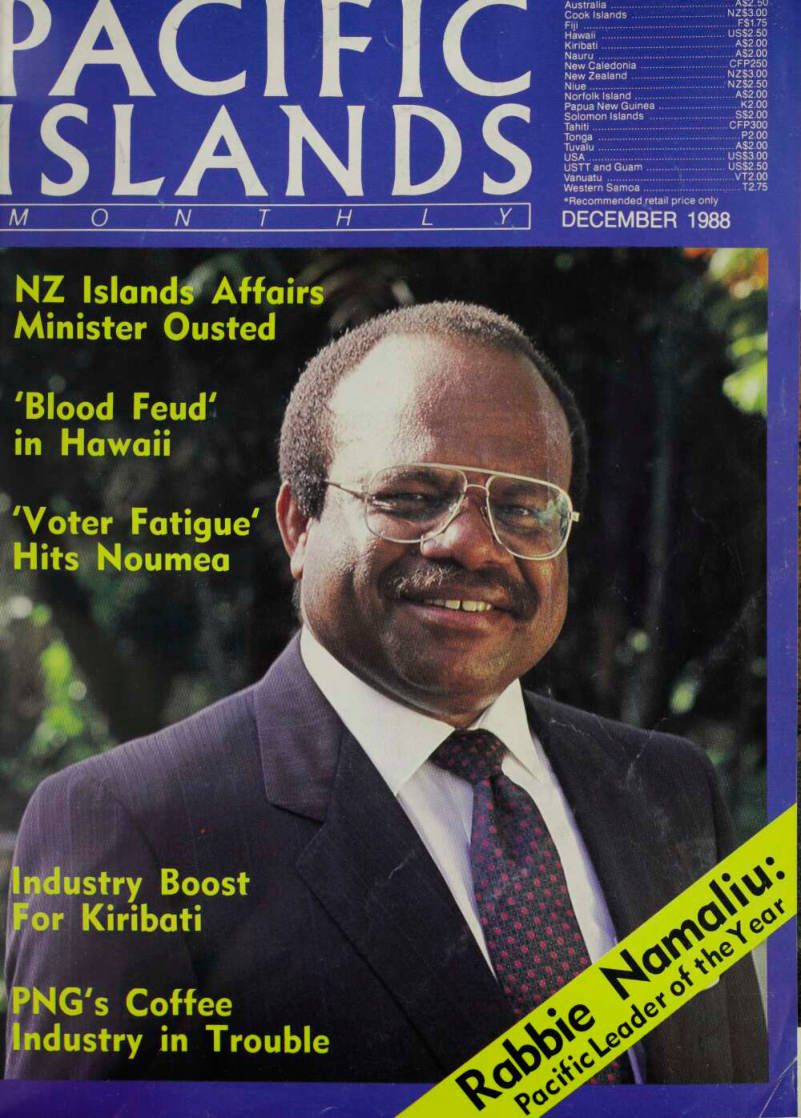
December 1988
NZ Islands Affairs Minister Ousted 'Blood Feud' M in Hawaii Ml 'Voter Fatigue' ujj Hits Noumea M
Industry Boost For Kiribati PNG's Coffee Industry in Trouble
Advertisements & other items, pp. 2-4 (1 item)
intelligently defined
Luxury,,
Seldom has a performance sedan galvanized critics and enthusiasts as has the Honda Legend. Already revising standards for quality, reliability and performance, it has been critically ranker among a handful of truly world-class luxury cars.
The Honda Legend is a unique hybrid ok high art and high technology designed t«: make driving one of life's most experiences. Toward that end, Honda engineers and designers have taken out all the inconveniences that make driving *
ftjggr*
■ »• . .'At E AX Ml \ ,1a Cl r AUSTRALIA: Honda Australia Pty., Ltd. Lot 95 Sharps Road, Tullamarine, Victoria 3043, Bennett Honda Pty., Ltd. 250 Victoria Road, Wetherill Park, N.S.W. 2164/NEW ZEALAND. Honda New Zealand LJ Manners Plaza, 57-65 Manners St . Wellington/PAPUA NEW GUINEA: Toba Pty., Ltd. P.O. Box 503, Port Moresby/TAHITI: Honda Distribution S.A. R.L B.R 1665, Papeete/KIRIBATI: AM/ Motor & Marino Services PO Box 49, Bairiki Tarawa, Republic of Kiribati/U.S. TRUST TERRITORY: United Micronesia Development Association P.O. Box 235, CHRB Saipan CM 96950/ ISLANDS: Cook Islands Motor Centre Ltd. P.O. Box 74, Rarotonga/GUAM: Mark’s Motor Co., Inc. P.O. Box DV, Agana/WESTERN SAMOA: Motor Distributors (Samoa) Ltd. P.O. Box 576 >. App/ SOLOMON ISLANDS: Lee Kwok Kuen & Co., Ltd. PO Box 537, Honiara/NAURU: Nauru Cooperation Republic of Nauru/FIJI: Coral Island Motors Ltd. Robertson Road, Suva, Fiji/AMtHiOM SAMOA; Holiday Motors, Parts and Service P.O. Box 968, Pago Pago, American Samoa 96799; Heleck’s Service Center Ltd. P.O. Box 1138 Pago Pago, American Samoa 96799/TONGA: Tbnjni Industrial Traders P O Box 1035, Nukualofa, Tonga/NORFOLK ISLAND: Duncombe Bay Garage New Cascade Road, Norfolk island/VANUATU: Honda Farm Ltd. P.O. Box 1031, Pori Vila, Vanusu
a chore. And they have added a remarkable array of amenities that make driving a joy.
Beneath the Legend's low aerodynamic nood beats the heart of a high aerformance V 6 24-valve engine with 'ace-bred PGM-FI programmed fuel njection. Sophisticated 4-wheel double wishbone suspensions are teamed with idvanced braking and steering systems or an exceptional balance of performance md comfort. nside, you will discover quality appointments and luxurious optional leather seating, surrounded by a panoramic view an environment that accentuates your pleasure and inspires a mood of quiet relaxation.
The Legend Sedan, in short, is an executive-class automobile that combines luxury performance with unrivaled comfort, distinctive styling with timeless elegance. Imagine the satisfaction as you savor the ultimate driving experience. n the 1988 Formula One Constructors' Championships , -londa engines powered the HONDA Marlboro McLaren to victory; as they did the Villiams HONDA team in 1986 and 1987.
m m <s> o> <S> <-> vS> » o> -s L LO • *
Citizen takes your times
as seriously as you do.
For some sports time control is a key element.
The Citizen Sports Collection is a winning range of special timepieces
with unique performance features
designed specially for your sport.
The Citizen Sports Collection.
For the serious sportsman... We’ve got your Watch.
CITIZEN
CITIZEN IS A REGISTERED TRADEMARK OF CITIZEN WATCH CO, JAPAN
FOR FURTHER INFORMATION. PLEASE CONTACT:
Australia:Citizen Watches Australia Pty. Ltd., 122 Old Pittwater Road, Brookvale, NSW 2100.
Tel: 939 7077. Cable; Citizen Sydney.
Telex: AA26633. Fax: 932864.
Fiji Islands: Tappoo Limited, P.O. Box, Sigatoka, Fiji. Tel; 50199. Telex: FJ4244.
New Zealand: Citizen Watches (N.Z.) Ltd., P.O. Box 9518, Auckland, New Zealand.
Tel: 543 393. Telex; 21429. Fax: 544177.
Tahiti: Morgan Vernex, Fare Lite B.P. 449, Tahiti.
Tel: 2.03.09.
Papua New Guinea: Kara Pty. Limited, P.O. Box 392, Port Moresby. Tel 25 6044
Pacific
Islands
Monthly
Vol. 59 No. 12
Voice Of The Pacific
December, ’BB
Cover Story 16
For the first time, the readers of Pacific Islands Monthly have been given the opportunity of choosing their Pacific Leader of the Year. They have responded by ‘electing’ Papua New Guinea’s Prime Minister, Rabbie Nama liu, citing his devotion to his country, his intellectual strengths . . . and, we suspect, the very contrast to PNG’s previous leaders, who appear to have judged policy as less electorally attractive than politicking. Frank Senge profiles the man and his political biography.
Cover Photograph: Oliver Strewe/Wildlight
ISLANDERS "ACCIDENTAL VICTIMS" IN NZ MINISTER'S FALL 9 Richard Prebble’s dismissal from Cabinet angers his Polynesian supporters
Palau Chooses A New Leader 10
Few surprises as the troubled territory elects a successor to Lazarus Salii FLNKS GAINS, NATIONAL FRONT LOOMS IN NEW CALEDONIA 12 The big loser in last month’s French referendum is RPCR leader Lafleur A DEADLY LEGACY FOR AMERICA'S PACIFIC PARADISE 14 Pesticides threaten Hawaii’s green and lovely environment HUMAN RIGHTS ABUSE SPOTLIGHT TURNS ON THE PACIFIC 18 Amnesty International reports torture, execution and more MORE OF THE SAME FOR US ISLAND TERRITORIES 20 Democrates and Republicans tie in Hawaii, Guam and American Samoa GREED AND GENETICS STIR OPPOSITION IN HAWAII 22 Developers vs democracy and a new ‘Native Hawaiian’
FRINGE POLITICS AND MENTAL HEALTH: WHO LOSES? 24 Radical Maori activists blasted in New Zealand BRINGING THE WORK ETHIC TO THE ISLANDS 26 Fiji employers seek to develop the West’s economic model KEEPING THE FAITH FAR FROM HOME 28 A photo-essay report on Sydney’s thriving Tongan community
People Of Ihl 31
Plastic surgery brings new hope to isolated communities DEVELOPMENT OR DISEASE FOR PNG COFFEE? 34 Market fluctuations, politics and rust threaten a boom industry AMERICA OPENS DOORS TO ISLAND MIGRANTS 36 But as US loopholes opens, Canada restricts entry
Pacific People: The Region
Finds Its Own Voice 42
Tongan author Epeli Hau’ofa amuses md scandalises
Arts Festival On Film 45
Townsville’s arts celebration now avail ihle on video
Deputy Editor Carson Creagh Art Director Samantha Foster Editorial Adviser John Carter Contributors Robin Bromby Leonie von Hellmers John Hunter Stuart Inder Matthew McKee Rex Matthews Michael Moriarty David S North Ed Rampell David Robie Nicolas Rothwell Frank Senge Rovert Simms Rosalind Temariti
Publisher and Managing Editor Geoffrey Hussey
Advertising Sales Sydney & Melbourne Warren Grey (02) 288 3521 Fergus Maclagan (02) 412 3918; Brisbane Robert Walker (07) 3710533 Adelaide Hastwell Williamson Representations (08) 79 9522
Cover prices are recommended retail only Registered by Australia Post, publication No NBPI2IO Copyright Fiji Times Limited, Suva, Fiji
Advertisements & other items, pp. 5-6 (3 items)
Departments
OPINION 7
PACIFIC REPORT 27
TRADE WINDS 38
TROPICALITIES 40
STAMPS 46
ISLAND PRESS 46
TRANSITION 47
BOOK REVIEWS 48
SHIPPING SCHEDULES 50
OUT OF THE PAST 54
5
PACIFIC ISLANDS MONTHLY DECEMBER 1988
A Fiji Times Limited Production.
Founded 1930 (USPS 952480) 20 Gor don Street, Suva, Fiji; Telex: FJ2124; Fax; (679)301521; GPO Box 1167, Suva, Fiji; Telephone: (679) 31 4111.
Pacific Islands Monthly (APPS No.
NBP 1210) is published monthly by Fiji Times Limited, a division of Nationwide News. 2 Holt St, Surry Hills, NSW 2010.
Second classpostage paid at Honolulu, Hawaii, POSTMASTER. Send address changes to PACIFIC ISLANDS MONTHLY, PO Box 22250, Honolulu, Hawaii 96822. Typeset by David Graph ics, Sydney, and printed by Fiji Times Limited, 20 Gordon Street, Suva. Fiji.
Cd Pioneer
V i* rtn IB spectrum analyzer ■ Remote controllable, motor-driven volume ■ CD 1 circuitry ■ Full-function remote control ■ Full-logic control UDolby* B ' nd ■23 cm cone woofer with elastic composite diaphragm developet I choose my music with care. Sometimes it’s the oldies. Sometimes it’s the totally new. But there’s one kind I can’t stand —the kind that’s weak or distorted. That’s why my choice in a personal hi-fi is PERSONNA PLUS —the powerful system that hates distortion and noise as much as I do. My PERSONNA Z-90R has a huge 500 watts of peak music power output, and three-way speaker systems that sound bigger than all outdoors. The graphic equalizer with spectrum analyzer lets me tailor the sound to my tastes. And there’s the double, auto-reverse cassette deck, quartz-PLL synthesizer FM/AM tuner, full-auto turntable and the optional six-disc Multi-play CD player. But best of all —I can operate the whole system, including the volume, by remote control. At first, it looked too hard to use. Wrong! Pioneer made it easy. They made my choice easy, too. PERSON NA PLUS —also available in the Z-70R and Z-50R systems —is the choice I recommend to you.
The future of sound and vision.
For further information, please contact: Australia: Pioneer Electronics Australia Pty. Ltd. (Incorporated in Victoria), P.O. Box 295, Mordialloc, Victoria, 3195 Tel: 580-9911 Fiji Islands: Brijlal & Company, G.P.O. Box No. 362, Suva, Fiji Islands Tel: 22258 New Zealand: Monaco Corporation Ltd., 41 Poland Road, Glenfield, Auckland, New Zealand Tel: (09) 444-9144 Norfolk Island: Burnt Pine Traders Ltd., P.O. Box 21, Norfolk Island Vanuatu! Rums Philn I trl Vila Vanuatu Nauru Island: Jacob Enterprises. P.O. Box N 0.4, Republic of Nauru Tahiti: Tahiti Hi-Fi, P.O. Box 848, Papeete, Tahiti New Caledonia; Menard Pacifique Sari, B.P. 3899, Noumea, New Caledonia Tel: 27.62*23 American Samoa: Transpac Corporation, P.O. Box 1477, Pago Pago, American Samoa 96799 Tel: 633-5224 Rarotonga: South Seas International Ltd., P.O. Box 49, Rarotonga, Cook Islands Tel: 2327
Leader Of The Year
Opinion
Readers chose a young and dynamic leader whose country stands on the threshold of immense
regional power.
FOR THE FIRST time in the 58-year history of Pacific Islands Monthly, the magazine’s many thousands of readers have been asked to select the man or woman they feel has best guided the destiny of a nation or an organisation. They have responded by ‘electing’ as 1988 Pacific Leader of the Year Papua New Guinea’s energetic and formidably intelligent young Prime Minister, Rabbie Namaliu.
Nominations for Rabbie Namaliu outnumbered those for other Pacific leaders by a comfortable margin; and they came not only from Papua New Guinea itself but from Australia, New Zealand, other island nations . . . even from the United States, Canada and Europe. In fact, there were more from PlM’s far-flung readers than there were from PNG a reflection, certainly, of that country’s understandable caution about a Prime Minister who came to power through a vote of no confidence, and one who manifestly lacks the charisma of his predecessor.
Instead, ‘voters’ from PNG as well as from other parts spoke of Mr Namaliu’s devotion to the task that lies ahead of him; of his intellect and powers of formulating policy; of his persistence; and, indeed, of his absence of political showmanship: his, they felt, is a talent that manifests itself in accomplishment rather than demagoguery.
Nevertheless, Rabbie Namaliu has yet to demonstrate that his accom plishments so far will last, and that they will be given the chance to bear fruit. He appears to have the co-operation of the Opposition in his plans to amend tne Constitution, to remove the potentially disastrous possibil ity of a no-confidence motion bringing down a Government before it has had time to find its feet. The Opposition, of course, has its own interests well in mind in this case: for wnat is good for today’s Government will stand tomorrow’s of whatever political stripe in equally good stead.
He has seen more of the world in which politicians and businessmen operate than many of his fellow parliamentarians. He knows there is no simple solution, but he recognises that even the most humble solution will not work unless and until the people of PNG are better educated.
No matter where the circle is entered, the course remains the same: better education means greater awareness of social responsibility; better education means awareness of social responsibility and identity on a national rather than village, regional or tribal scale; national awareness means a better appreciation of national opportunities rather than self aggrandising policies. Realistic policies in turn mean an appreciation of wnat can be attained, over the longest possible time and for the benefit of the greatest number of people . . . and the realisation that such myopic policies will not be accepted by a better-educated electorate.
Despite his inexperience in the cut and thrust of contemporary PNG politics, it would appear Rabbie Namaliu has the vision to work for the good of his country by creating that circle. He has eschewed ‘develop ment’ as a panacea; he has contracted the previous Government’s plans to flood the nation with schemes for income generation. Instead, he has grasped the difficult policy of providing a better standard of education not to hold out a promise of wealth and opportunity (a promise that cannot be met, and that will not be met for some time), but to make his countrymen aware of what they can achieve for themselves.
Fewer than 15 years after Independence, Papua New Guinea has discovered it possesses resource wealth that could make it the most powerful nation in Oceania. If the readers of Pacific Islands Monthly are proved right in their judgment, Papua New Guinea also possesses a resource of a richer kind: a leader who can use his country’s wealth in the service of enhancing its human potential. □
Advertisements & other items, p. 7 (1 item)
Pacific
ISLANDS
|MQNT H L Y I
FIJI; Distribution, subscriptions and advertising: Fiji Times Limited, GPO Box 1167, Suva, Fiji. Phone 31-4111, telex FJ2124 FRENCH POLYNESIA: Distribution: Hachette Pacifique 10 Ave Bruat, Papeete. Phone 25-610 HAWAII; UNITED STATES: Distribution: PIM Hawaii, PO Box 22250, Honolulu, Hawaii, 96822. Advertising: Brian C Asgill, Apt 1308,1676 Ala Moana Blvd., Honolulu, Hawaii, 96815. Phone (808) 955-9718.
JAPAN: Advertising and subscriptions: Universal Media Corporation, GPO Box 46, Tokyo. Phone 666-3036, cable UNIMEDIA Tokyo, telex 2524665 MALAYSIA: Advertising and subscriptions: Worldwide Media Services, 57-B Komplex Damai, Jin Dato Haji Eusoff, Kuala Lumpur. Phone 63-9340, cables WORLDMEDIA Kuala Lumpur, telex 31533 VANUATU: Distribution: The Vanuatu Stationery and Book Centre, PO Box 557 Port Vila Advertising; Norman Bros Bookshop Port Vila Phone 2232 NEW CALEDONIA: Distribution: Depot Centre de Presse Michel Pentecost CBP2, Noumea Phone 27- 2434, 27-4729 NEW ZEALAND; Distribution: Gordon & Gotch, PO Box 584 , 2 Carr Road, Mt Roskill, Auckland 4 Advertising: McKay International Media Reps Ltd, C/- Albany PO, Auckland 10, New Zealand. Phone 413-9119.
Telex NZ22701, FAX 413-9110 WELLINGTON: Ross Quaid Media, 1 Scholes Lane, Petone (04) 68-7593, PO Box 38699, Petone PAPUA NEW GUINEA: Distribution: Gordon & Gotch, PO Box 3395, Port Moresby. Phone 25-4551.25-4855.
Advertising: Robert Walker, PO Box 600, Indooroopilly, Old Australia 4068 Phone (07) 371-0533.
SOLOMON ISLANDS: Distribution and Advertising: The Bookshop, (Norman Bros.) PO Box 503, Honiara PHILIPPINES: Advertising; The GF Group, 12 San Ignacio St., Uroaneta Village, Makati, Metro Manila Phone 817-7299, telex 45950 and 4233 UNITED KINGDOM: F A Smyth and Associates, 23A Aylmer Parade, London N2OPO, England. Phone (01 )340 5088, fax (01)341 9602.
UNITED STATES MAINLAND: Advertising: Joshua B Powers Jr, Powers International Inc , Suite 708, 271 Madison Ave , New York, NY 10016. Phone 867-9580, Subscriptions PIM, Hawaii, PO Box 22250, Honolulu Hawaii, 96822
SUBSCRIPTIONS
American Samoa USS4S Australia AUSS24 Canada US$45 Cook Islands AUSS46 Fiji F $24 French Polynesia US$45 Guam US$45 Hawaii US$45 Japan US$3B Kiribati AUSS46 Micronesia US$35 Nauru AUSS42 New Caledonia US$32 New Zealand AUSS42 Niue AUSS46 Norfolk Island AUSS42 Northern Marianas US$36 Papua New Guinea AUSS42 Solomon Islands AUSS46 Tonga AUSS46 Tuvalu AUSS46 United Kingdom Stg£2B US (Mainland) US$45 Vanuatu AUSS42 Western Samoa AUSS6O Elsewhere AUSS63 Payments to Pacific Islands Monthly: Subscriptions Dept, GPO Box 1167, Suva, Fiji.
Subscriptions rates includes the cost of airspeeding to all destinations set out above. Direct airmail rates on application.
A new Pacific profit
motive?
Self-sufficiency can be gained through
effort . . . but at what price?
THE PRINCIPAL employers of Fiji got together last month and in a review of where the Repub lic’s business community stands and where it may be going suggested that if the Government’s aim of lifting Fijian participation in business until a significant proportion of the national economy was in Fijian hands is to succeed, then Fijians would have to become much more selfish and individualistic.
Fiji is not alone in facing the choice between the islands idyll and a place in the world where only hard-heaaed business decisions, unclouded by past social principles and free of family fetters, can give the freedom to move an economy.
But Fiji has leapt into the spotlight, as it were, with the coups and the constitution drama, so that the choice is more starkly present for Fiji than for smal ler Pacific countries. Let them not be smug about it, however: “be tough and be businesslike, or be no thing” is the way the world runs.
Major-General Rabuka wants to perpetuate not only Fijian hegemony but also some very admirable social Qualities: and one does not have to share the General’s personal religious outlook to appreciate the value of tne sabbath ne hopes to uphold. A day a week of thorough rest is a very healthy contribution to a life of balanced content.
That, however, is not the way to make millions.
Such values have to be left to the also-rans, who can indulge in ease and excuse themselves for not suc ceeding because the price was too high. And you can’t have too much common or community own ership of services or resources: Australia and New Zealand are discovering that if the government owns the railways or the port facilities they only lose money, so those nations are joining the world move ment to put as much as possible into private hands.
The motive is to make every service pay (though quantifying the profitability of health, for example, or education, has so far eluded philosophers).
So, Fiji is being told, it is necessary to individualise land ownership so that, if not buying and selling land you can at least use it as collateral for a loan for your business. Nauru has already found that land can be portioned out in precise shares to all the traditional owners ... an adaptation of historical relationships the ancestors never envisaged.
Sadly, there’s no going back. Nostalgia is a luxury that can still be enjoyed, but the substance is gone and even if you aeplore the materialistic culture of these who arrive with plans for tourist development or resource exploitation, you have to meet them on terms of equal toughness if you’re going to retain your heritage and reed your people.
It is, as tne Pacific is discovering to its chagrin, a tough world. □
Advertisements & other items, p. 8 (1 item)
Financial Controller
(Formerly South Pacific Bureau for Eco-
nomic Cooperation [SPEC])
FORUM SECRETARIAT
FINANCIAL CONTROLLER
Applications are invited from citizens of member countries for the position of Financial Controller within the Forum Secretariat. The Secretariat, based in Suva, was established to encourage co-operation in the South Pacific not only between member states in the region, but also between island member states and more industrialised countries on all aspects of economic development, trade, transport, tourism, telecommunications and energy.
The appointee will be responsible for the efficient management of the Secretariat’s Finance & Accounting Division, including the development and maintenance of efficient accounting & financial management systems, financial reporting procedures and the preparation of the Secretariat’s annual Estimated Work Programme and Budget Applicants should possess an appropriate degree with a major in accounting from a recognised tertiary institution. The applicant must be a member of a recognised professional body with at least 8 years experience in accounting and financial activities, and exposure to general management and administration. Experience with computerised financial accounting systems is necessary and previous experience in a regional organisation would be advantageous.
This appointment will carry an attractive remuneration package, tax-free for non Fiji citizens and payable in Fiji dollars, including housing or housing allowance, education and chijd allowance, superannuation payments and medical, life and travel insurance benefits. The appointee will be based at the Secretariat’s Headquarters in Suva, Fiji, but may be required to undertake periodic duty travel.
Appointment would be for two years initially, renewable by mutual agreement.
Applications close on 31 January 1989. As it is intended to make the appointment as soon as possible, the successful applicant must be able to take up the position shortly afterwards. Applications should contain full information on education and career background and should list names, addresses and telephone numbers of at least three referees with whom the applicant has been associated in a professional capacity.
Applications should be addressed to: The Director Forum Secretariat GPO Box 856, Suva, Fiji.
Telephone: 312600; Telex 2229 FJ; Fax: 302204 All enquiries should be made to Mr Rene Wilson, Deputy Director, on 312600 extension 202.
Island Affairs minister ousted
New Zealand
Richard Prebble’sdismissal outrages islanders.
By Robin Bromby
THE New Zealand Government has achieved political synergy in its approach to the South Pacific . . . by making the same minister re sponsible for both foreign and Pacific Island affairs. Given that New Zealand claims the Pacific has top priority in its overseas relations, the decision to give the Minister of Foreign Affairs, Rus sell Marshall, the Pacific Islands port folio does make sense (associate minis ter Fran Wilde will also be involved in both: she will probably bear the brunt of the Pacific Islands work).
Marshall has taken on the job after former minister Richard Preoble said that Prime Minister David Lange was not making rational decisions, and was dismissed from Cabinet. The Pacific Island Affairs portfolio was an accidental victim; Prebble clashed with the PM over his administration of his
major responsibility, the State-Owned
Enterprises portfolio, because he had wanted to speed up the sale of gov ernment-owned assets. He ended up being NZ’s first Minister to be dismis sed from office this century even Native Affairs Minister Sir Apirana Ngata was allowed to resign after financial irregularities were discovered in his department back in 1934.
The Prebble dismissal has upset many Pacific islanders resident in New Zealand, for whom the Pacific Island Affairs portfolio was established. And Richard Prebble was the ideal choice for the job: he is MP for Auckland central, where 64 per cent of the islan ders resident in New Zealand live.
Russell Marshall, on the other hand, represents the provincial city of Wan ganui, which has a large Maori population but few Pacific migrants.
Prebble supporters are reported to have circulated a petition seeking his reinstatement, their argument being that it was the State-owned Enterprises role and not the Pacific portfolio at the centre of the dispute with Prime Minister Lange. Just a few days after the dismissal, Mr Lange had been due to open the new Auckland office of the Ministry of Pacific Island Affairs.
The opening was cancelled, apparent ly because it was feared island com munity leaders would have used the occasion to present their petition to him. The cancellation of the opening also angered island people in Au ckland; the news came after a food had been ordered, cultural displays readied and singing groups had prac
tised. About 1000 invitations had already been mailed.
Mr Marshall told Pacific Islands Monthly his initial reaction had been reluctance to take on more work. But he said he realised the sense of com
bining the two portfolios.
New Zealand’s most recent census shows 127,000 resident Pacific islan ders, and it is expected the 1991 fi gure will be about 170,000 slightly more than the entire population of Western Samoa. About naif the islan ders living in New Zealand are Sa moan and roughly a quarter are of Cook Island origin, with large Niuean and Tongan communities. There are few Melanesians or Micronesians, re flecting New Zealand’s long connec tion with Polynesia.
The community has substantial problems, hence the setting up of a separate ministry to deal with their concerns: islanders populate the poor er inner city suburbs of Auckland (or the even more bleak suburban state housing estates), fill the more menial
jobs and have problems adjusting to
the language and cultural life in New Zealand. But island people can earn good money if employed, and their remittances are crucial to their home lands’ economies.
Russell Marshall admittd that he has a lot of work ahead to him before he can come to grips with the new port folio; when Minister of Education he
was familiar with the gigantic task of helping island children make their way in the New Zealand school system, but otherwise his contact with migrant communities has not been all that great. The Government is still placing great emphasis on Pacific pre schooling to give these children a good start in the education system.
He also revealed that New Zealand will be making its relations with the
Pacific states its “major foreign policy
commitment”. Since Decoming Foreign
Minister after the 1987 general elec tion, Mr Marshall has made three trips
through Polynesia as well as attending
the recent Forum meeting in Tonga.
His immediate priorities are: a new diplomatic post in Kiribati; upgrading Radio New Zealand’s shortwave ser vice to make the country heard once again in the region; and establishing a consulate in French Polynesia.
He has been “impressed” by the dominance of Radio Australia in the region, and is hoping the 1989 budget will allow spending on New Zealand’s shortwave service. While most interna tional broadcasters use transmitters ranging in power from 100,000 to 500,000 watts, Radio New Zealand has two 7500 W transmitters that have been in service since the late 19405.
They can scarcely be heard in the South Pacific and even if reception is adequate, the programs rarely are; the shortwave service, having no budget of its own, mainly relays one of the domestic radio networks.
Radio Australia is now the most lis tened-to station in the region and its news and other programs are fre quently relayed on island stations. The Foreign Minister said there is an ob vious need to redress the communica tions rivalry more in New Zealand’s favour: “I am under no illusion of its importance in foreign affairs,” he said.
The importance the government in Wellington now attaches to the Pacific is markedly different from the policies of 20 years ago. In the late 19605, Fijian Prime Minister Ratu (later Sir) Kamisese Mara complained while on a visit to Wellington that his country felt rather neglected, adding: “I think New Zealand may get a pain in the neck looking always at Southeast Asia it should exercise it by turning its neck toward the Pacific.”
At the end of 1988, no one can now accuse New Zealand of overlooking its nearest neighbours. □
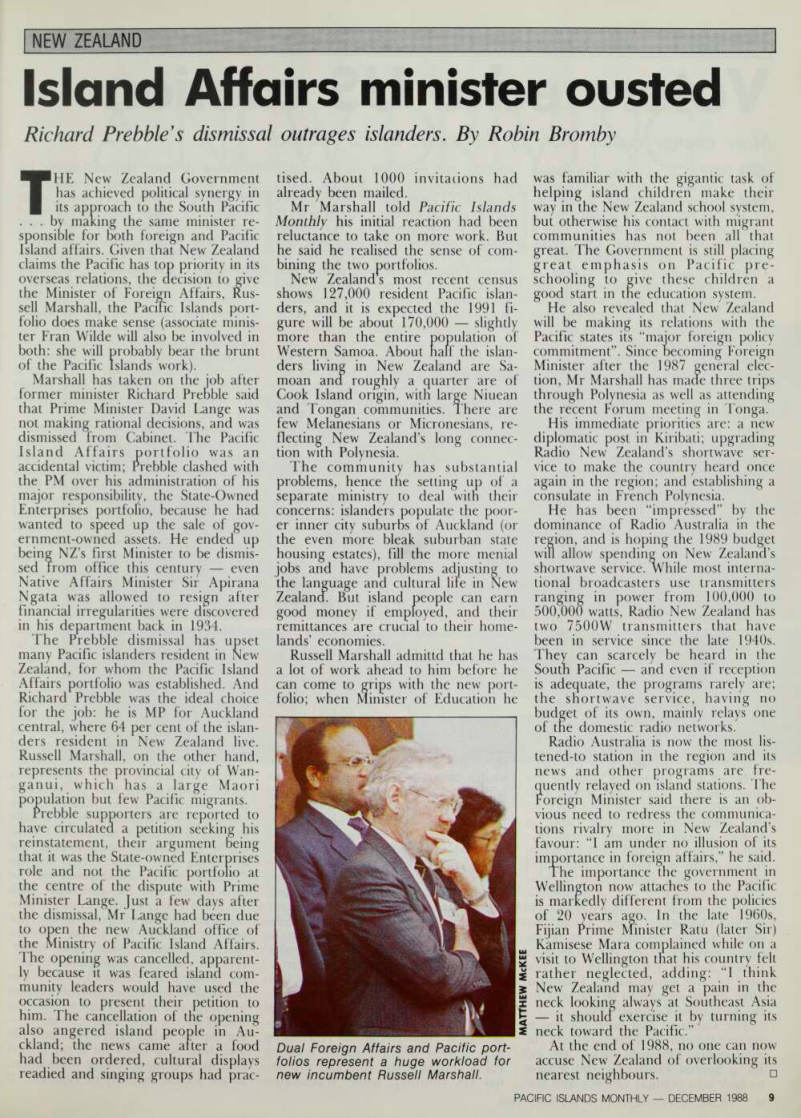
Dual Foreign Affairs and Pacific port folios represent a huge workload for new incumbent Russell Marshall.
Matthew Mck Ee
Voters echo US caution
Palau
More change equals more of the same.
By Ed Rampell
COMPACT of Free Association advocate Governor Ngiratkel Etpison has emerged as the vic tor m tne Republic of Palau’s seven candidate presidential race . . . with a mere 39-vote win. With 2383 votes, Etpison edged past Governor Roman Tmetuchl’s tally of 2344 ballots to snatch victory from the reform ele ment in Palauan politics, with the re sult of the Republic’s general elections a mirror of election results in the US.
With Etpison’s victory, the pro-
Compact Ta Belau Party formerly led
by late President Lazarus Salii retains control of the presidency, just as the Republicans retained their domination of the White House with George Bush. However, like President-elect Bush, President-elect Etpison is facing a national Congress with both Houses
dominated by tne Opposition.
Furthermore, the Coalition for Open, Honest, and just Government succeeded in electing its candidate.
Senator Kuniwo Nakamura, to the Vice-Presidency (the President and Vice President do not run as an offi cial team). Senator Nakamura is the brother of Supreme Court Chief jus tice Mamoru Nakamura, who has ruled against the Compact in favour of Palau’s nuclear-free constitution in historic court cases, and Tosiwo Naka mura, who introduced the framed rules’ anti-nuclear provisions at the 1979 Constitutional Convention.
Hence, with a split ticket and a Coali tion-dominatea OEK (Senate and House of Delegates), Governor Etpi son faces a deeply divided Palau.
It is this divisiveness that has char acterised the Republic’s political life since ancient times, and which cost Governor Tmetuchl the 1988 election: the Airai State Governor came in second to late President Haruo Re meliik in the 1980 and 1984 presiden tial races. In the special election held after Remeliik’s assassination in june 1985, Tmeluchl’s son and nephew were framed for the murder, knock ing the Opposition leader out of con tention (the co-defendants were even
tually exonerated by the ROP Sup
reme Court in 1987). With the crea tion of the broad-based Coalition, 1988 finally seemed to be the year for
the long-term Compact critic.
The Coalition had been formed to protect Palauan civil libertires and hu man rights; Tmetuchl backed the call for a Special Prosecutor and auditor to look into political violence and cor
ruption, and endorsed the continuing investigation by the United States
Congress’s watchdog agency, the
General Accounting Office, into Palau’s myriad problems. The former political status negotiator is also sup ported a renegotiation of the ties be tween Palau and its superpower ‘pro tector’, and Governor Tmetuchl and his Coalition enjoyed wide popularity.
Many Palauan politicians as well as the grass-roots anti-nuclear movement led In Roman Bedor also supported both the Coalition’s cause ana its candi dates, but a Tmetuchl /Coalition vic tory was not to be largely thanks to the blunderings of three other candi dates linked to Palau’s loosely aligned Opposition. The trio of spoilers evcn tuallv finished fifth, sixth, and seventh in trie presidential sweepstakes, suc ceeding in defeating the Coalition’s
campaign.
High Chief Ibedul Yutaka Gibbons, apparently not content with holding Palau’s highest traditional rank, came in a distant fifth place with 729 votes: Ibedul was hampered with allegations by the GAO that he took a $200,000 bribe from the IPS ECO power project that has effectively bankrupted Palau, and former Speaker of the House Santos Olikong, the last to toss his hat into the ring, polled out 475 voles.
The first candidate to enter the race, Governor Moses Uludong, finished next to last with 588 votes.
Uludong has been blasted by oppo nents as a ‘sold-out socialist’, a former anti-nuclear and pro-independence activist who, sensing that me winds have changed, now endorses common wealth status which would territor ially bind Palau to America forever. In addition to a rape-related course case
brought against Uludong by an Amer
ican attorney, the media has charged hin with misappropriation of public funds and has even Questioned his sanity. Like his brother Cisco Uludong who publicly advertises himself as ‘a Marxist tunica moneymaker' Moses Uludong epitomises what has bede viled Palauan politics for decades by
virtually guaranteeing a ‘progressive’
candidate cannot become president.
The pro-Compact bloc was also split, however, between three candi dates all supporting the treaty that would phase out American administra tion of a United Nations Trusteeship with a new political status granting Palau limited nome rule and substan tial US funding, while Washington
assumed defence responsibilities. In terim President Thomas Remengesau finished third with 1761 votes, while Minister of State John O Ngiraked came in fourth with 764 votes: 4908 voters cast their ballots for Compact advocates while 4136 members of the electorate chose candidates who have been critical of the accord for years.
Nevertheless, the two-man Vice Presidential race illustrates the power of unity in Palauan politics. Un
opposed by any other Opposition con
tenders and backed by the Coalition, Senator Nakamura was elected in a landslide over Delegate Frank Kazuo Asanuma (one of the central figures in the GAO investigations).
In a nation where two elected presi dents have died violently, the pres idential race was oddly crowded: one would think the Palau presidency would be least popular job m the Paci fic. President-elect Etpison seems to have the dynamism and political
strength for the job, Ngiratkel Etpi
son, 63, was born during the Japanese occupation of Micronesia, ana tnough he speaks fluent Palauan and apancsc
he speaks no English. Etpison is,
however, one of Palau’s most success ful businessmen.
The President-elect is the Governor of Ngatpang State, which is located on the island of Babeldaob’s West Coast: he also holds Ngatpang’s highest
chiefly title, Rekemesit. Like his rival
Roman Tmetuchl, Etpison is a mem ber of the Seventh Day Adventist church and has also served as head of the Council of Governors, composed of the executive of Palau’s 16 stales.
Many regard Governor Etpison as a clean’ businessman and politician in
the corruption-racked Republic: he
has not, for example, been personally implicated in either the PEsCO scan dal or presidential assassinations. But questions have been raised by the President-elect’s assumption of the Salii mantle and his association with Ta Belau Party, which includes a pro- Compact faction allegedly linked not only to IPSECO but to the violence that has plagued Palau. Some obser vers fear that the supposed secret soci ety (known as ‘Panama’), which was responsible for crime and corruption in Palau, will also attempt to pull the strings of the new chief executive but tne Ta Belau Party’s rank and file and those who voted for it are honest citizens who support Free Association, as are a clear majority of Palauans. □
Advertisements & other items, p. 11 (1 item)
Experience
A NEW DRIVING
- W
■ik^£-Sa;
m&m EC
and here
PkVSJ^-
TOYOTA
MULTI-VALVE
ENGINE
A HIGHER STANDARD:
ALL NEW COROLLAS NOW COME WITH
TOYOTA MULTI-VALVE ENGINES.
Here is a blend of elegance and performance usually found only in big, luxury cars. That’s because Toyota believes everyone should enjoy the newest automotive advancements. And the latest example of this thinking is the all-new Corolla. It has an elegantly rounded shape to be proud of. And the high output and efficient multi-valve engine in all Corollas puts their performance in far better shape.
Expand your driving experience to new horizons with the all-new Corolla. Toyota World’s No. 1 producer of multi-valve engines.
TOYOTA
France reluctant to vote
New Caledonia
Prime Minister Rocard struggles to inspire his countrymen.
By Nicolas Rothwell
M EW CALEDONIAN politics in
the 1980 s seem ineluctably
marked by the rhythms of
Frencn tragedy: disaster breeds hope, resolution gives way to enmity and re venge. So it was with the November b referendum held by France to provide a national imprimatur for the Malig non Accord for this August, brokered by Prime Minister Michel Rocard be tween the leaders of the two Caledo nian communities for the Kanaks, Jean-Marie Tjibaou, for the Cal doches, Jacques Lafleur.
The script developed in mid-year by
Mr Rocard, a tireless and imaginative politician, was breathtaking in its sim plicity: agree to peace, consult the French people, bind the entire nation to the deal then let the plan mature for 10 years.
Unfortunately, the French people
demonstrated their sublime indiffer ence to this vision; barely one in three bothered to turn out for the referen dum which was, unbelievably, the seventh major vote of the year. Parti cipatory democracy is all very well, it seems, but sometimes you can have too much of a good thing.
Most mainland French citizens showed little interest in the referen
dum campaign, despite an advertising
blitz encouraging them to vote. Polls uncovered an almost hallucinatory ignorance on the part of the homme moyen as to the issues behind the re ferendum, the options of the ballot papers ... or even the geographical location of New Caledonia itself.
By the end of polling day fewer than 14 million of Frances 38 million electors had turned out. More than 12 million of them actually expressed a preference, and exactly four in five of these backed the Rocard proposals.
But in the territory itself the result was a disturbing mirror image of the national verdict.
Turnout was heavy throughout New Caledonia: two in three electors voted
there and, ominously, they split down
racial lines. The Kanaks solidly sup
ported the referendum proposals,
which pave the way for a further 1998 self-determination vote. But the Euro pean population of the territory spurned tne lead offered by Mr Laf
leur. They voted heavily against the
French Government plans, which have now automatically passed into law de
spite their opposition.
New Caledonia, then, faces a future rather different from the harmonious
progress glimpsed by Prime Minister Rocard: Tne Caldoche community has been consigned by an uninterested mainland French population to a de cade of development toward an inde
pendence vote they fiercely oppose.
Their preferred political representa
tives (if the raw judgment of the November poll can be read in such terms) are no longer the leaders of the Gaullist offshoot on the territory, the RPCR. If the European community feels sympathy for any political group ing it would be the sole party that called for a ‘no’ vole, the right-wing National Front.
This referendum result marks a punctuation point in New Caledonia’s political evolution. For Kanak leader Tjibaou of the FLNKS, it represents the triumph of a strategy of restraint; the fruit of long years of political alliance with French President Fran cois Mitterrand, whose Socialist Party is now firmly in control of the French Government. Only in a few communes
where breakaway Kanak parties
(FULK and Palika) are strong did the blanket ‘yes’ vote across the northern and eastern regions waver.
For the RPCR’s Lafleur the Malig non Accord, signed in the wake of this year’s disastrous political violence, had sealed a startling political conversion.
A ‘loyalist’ and long-term public oppo
nent of the FLNKS, Lafleur sought to deliver his European backers to the camp of peace and development even though independence lurked as
the likely outcome in 1988. They felt betrayed . . . and voted with their feet.
Lafleur is in poor health; his res ignation is widely canvassed in the French press, though he says he will stay on as RPCR leader to underline his “profound intimate conviction that these accords will bring peace to New Caledonia” and also keep the terri tory inside the French Republic. behind these referendum results lies a story of intense political man oeuvres, alliances forged and gain said, and the unfurling of emotive
French political symbols. The long
term effect on France’s Pacific profile is uncertain, but PM Rocard and his advisers now face an urgent struggle to win the trust of the European population of New Caledonia: for the
Caldoches have just given solid proof
of their hostility to the Prime Minis ter’s own plans for the territory.
Lafleur today appears in new' guise that of a prophet without honour in his own land. His advisers confirm that he will probably remain at the helm of his party until next year’s
municipal (March) and provincial
(June) elections, but if his traditional electorate fails to support him then he will find it hard not to stand aside, though there is no-one of similar sta ture within the RPCR. Confusion and an intense struggle for political control in the European community of New Caledonia would be likely.
If the referendum served to streng then Tjibaou and destabilise Lafleur
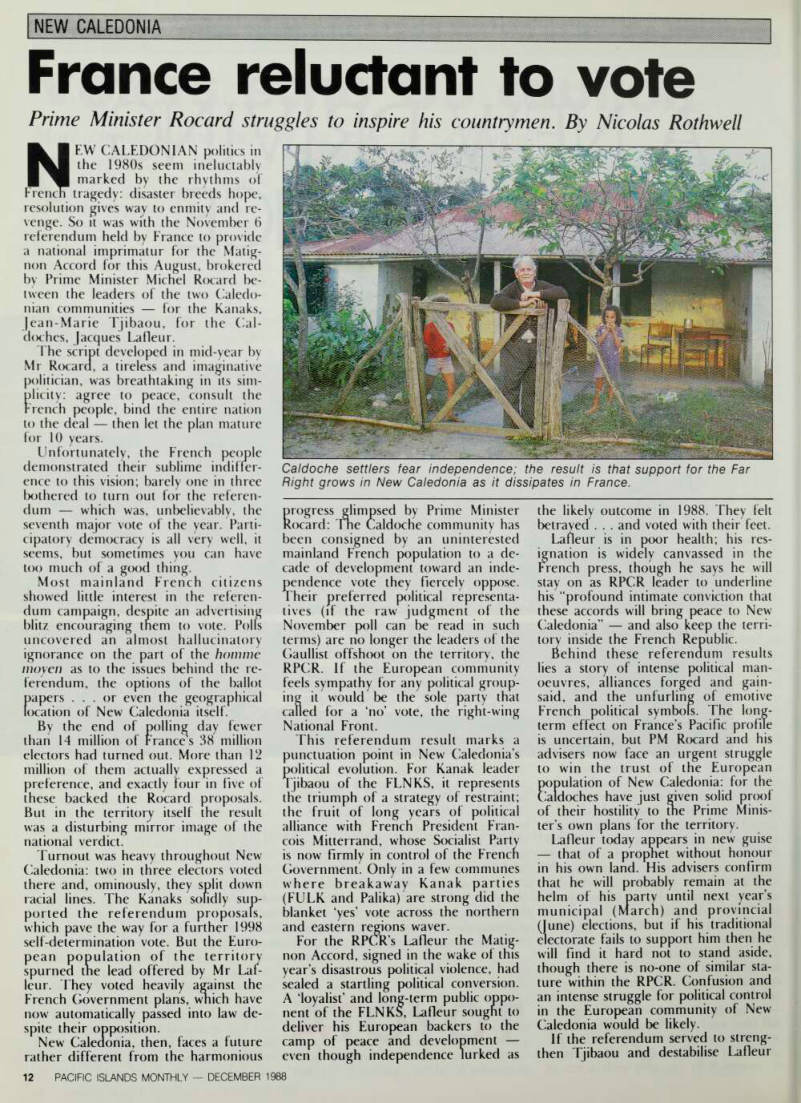
Caldoche settlers fear independence; the result is that support for the Far Right grows in New Caledonia as it dissipates in France.
in the territory itself, its effects in France were equally disconcerting for the political establishment. The social ist Government of Michel Rocard, supported in a last-minute televised appeal to the nation by President Mit terrand, threw its weight behind the referendum proposals. The record ab stention rate undoubtedly reflected the electorate’s disenchantment with
French politics, its ‘voting fatigue’ and
indifference to far-off New Caledo nia’s fate. But the effect was also to damage Rocard’s prestige and even to cheapen the referendum procedure it self, once a keystone of tne Fifth Re
public’s multi-layered democracy.
Though Rocard and Mitterrand had made plain this was a new style of referendum rather than the tradition al ‘vote of confidence’ of the type de Gaulle used to great effect, Opposition politicians were swift to capitalise on the result, hinting broadly that both men should resign.
For the conservative Opposition, the
referendum campaign posed equally
serious problems. The two main strands in the centre-right coalition were split in their stands on the plebis cite: tne Gaullists of the Rassemble ment pour la Republique (RPR), still led by Jacques Chirac, called for ab stention on the grounds that they could not in all conscience either sup port or oppose the referendum prop osals. Their political campaign was im
pressively marshalled by the party’s
rising star, Alain Juppe.
Meanwhile the centrists of the Un ion for French Democracy (UDF) under Raymond Barre had called for a ‘yes’ vote, and general disarray was the order of the campaign among smaller centrist formations.
Thus the vote increased strains in the conservative camp; at the same
lime, it effectively frayed the ties be tween the RPR and Lafleur’s local RPCR. Undoubtedly, Caldoche voters were confused by the spectacle of the
RPR opposing Lafleur’s position.
On the hard right the National Front of Jean-Marie Le Pen waged an unremitting fight against the referen dum proposals, calling for a flat ‘no’ vote. The Front’s efficient number two, Jean-Pierre Stibois, was killed in a car crash on the eve of the vote a development that may yet prove signi ficant m mainland politics. But in New Caledonia itself the Front, led by Guy
George and forcefully supported by a
big gun from the mainland party, Ro ger Holleindre, enhanced its power.
Over the past year this party’s standing has sea-sawed, largely as a result of changes in the voting system.
It has gone from marginal status in New Caledonia and great strength in France itself to weakness on the main land and startling potency among the European community of the territory.
The Rocard Government assiduous ly portrayed the referendum vote as a final mandate for its New Caledonia policy, despite the low turnout. Gov ernment spokesmen discounted sug gestions from the RPR camp that the record level of abstentions would jus-
tify a future Gaullist Prime Minister revising crucial elements of the Matig non Accord package.
Imminent visits to the territory by both Prime Minister Rocard and Minister for Overseas Territories Louis Le Pensec will underline the Government’s determination to ensure the new laws are smoothly introduced.
The nuts and bolts are as follows: the territory is to be divided into three regions and a wide range of economic projects launched; a controversial poli tical amnesty comes into force, cover ing all political offences committed in New Caledonia before the 20 August signing date of the Accords (murder alone excepted); and next June sees the elections for the three Caledonian provincial assemblies the North, with 15 members, the Loyalty Islands, with 7 members, and the South, with 32 members. The first two are certain to be controlled by the FLNKS while the southern region (centred on Noumea) will reflect a strong Euro pean majority. The regionalisation en ters into force on July 14, 1989.
These three assemblies, whose mem bers will serve six-year terms, are to act as local parliaments with indepen dent budgets and administrations. Sit ting together, they will make up the Congress of the territory under the direction of a president. Executive power will remain in the hands of the
High Commissioner.
Mr Le Pensec, who will oversee the implementation of the New Caledonia statute, has a ticklish task ahead of him. Faced by the unavoidable facts of the vote ana the choice of six large European communities in the south of New Caledonia (Noumea, Dumbea, Mont-Dore, Bourail, La Foa, Parino) for the ‘no’ ballot in the referendum, the Minister admitted that “clearly the Caldoches did not want” the regiona lisation called for by the Accords. “But insofar as violence is born from injus tice,” he said, “it is up to us to ensure that equality of opportunity is a fact of life in New Caledonia.”
Jean-Marie Tjibaou of the FLNKS, with his customary 20-20 vision in matters political, summed up the re ferendum result: “Three parlies signed the Matignon Accord, and that Accord will be fulfilled by three par ties. If any one party fails to fulfil the Accord, men that will be the end of the accord. With 57 per cent of New Caledonian voters voting ‘yes’, we can put the Accord into force. But the 42 per cent who voted ‘no’ are a signal for a great, great deal of vigilance the decade ahead will tell us whether a rejectionist front can ruin things; I
hope not.”
For the Government in Paris, the task of establishing a harmonious poli tical culture is also linked to a broader
regional diplomacy. □
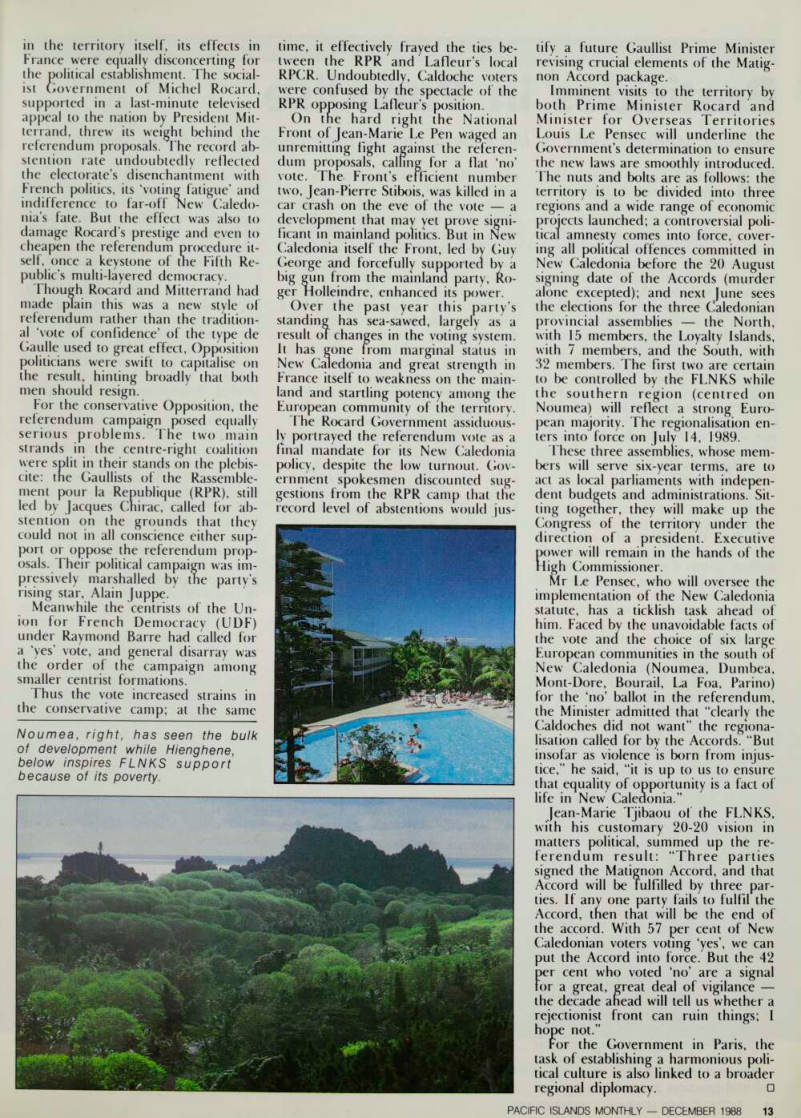
Noumea, right, has seen the bulk of development while Hienghene, below inspires FLNKS support because of its poverty.
Pesticides in Paradise
Hawaii
Michael Moriarty looks at the toxic legacy of agriculture in the Aloha State.
M AWAITS fine weather and be nign climate are famous the world over: however, year warmth and the crowd it attracts produce some problems. A 1968 report by the Slate of Hawaii Department of Agriculture tilled Eva luation of Pesticide Problems in Hawaii concluded that Hawaii used pesticides at a rate fully 10 times high er than the national average.
Hawaii’s pesticide consumption is
three and a half limes the per capita national average and six times than of its nearest neighbour, California a
major agricultural state. Meanwhile,
dry stream beds on Oahu are kept clear of weeds with herbicides and, as one visitor to the islands said recently, “I’ve never before seen a road gang spraying herbicide from a tanker . . . with a firehose!”
The almost unchanging climate in Hawaii means that there is no cleans ing frost; pests are not killed or con trolled by the rigours of winter, and breed happily all year around. Add six million visitors a year and an economy
completely dependent on imports and
you nave a situation where between 14 and 21 new species of insect pests are identified in Hawaii every year.
Seventy-two major landowners con
trol approximately 95 per cent of Hawaii s land. The largest landowner.
Bishop Estate, owns nearly a fifth of Hawaii’s private land, and such a con
centration of ownership together
with a natural scarcity of land and Hawaii’s tourist and residential popu
larity makes land prices skyrocket.
The market for land in Hawaii is
not primarily agricultural: develop
ment of subdivisions, resorts and re tirement communities has long been competing with agricultural uses. The small group of major landowners naturally looks to its property for maximum return, so farmers arc
paying premium prices, mortgage
rates are high and the average young farmer cannot afford a large property.
Maintaining a market share is also a major consideration and if the small farmer fails to supply the ripe tomato or banana, Hawaiian merchants will look elsewhere. North American sup
pliers can readily satisfy the Hawaiian
market through airfreight, with the result that Hawaii’s small farmers have to plant the same crop year after year to maintain their share of the market.
The net result is that many agri
cultural practices generally recognised
as beneficial are being ignored as im
practical: pushed by mortgage pay
ments, it is economically impossible to let land lie fallow and the small far nier simply cannot rotate crops. There is no ‘back forty’ to rotate the crop to, and all available agricultural land must be used to produce crops.
With literally nowhere else to go, the pests and diseases attracted by a given crop can build up over succes sive plantings until they represent a truly serious threat and the Hawaiian farmers only desperate re sponse is heavy spraying (once a week being the norm) which in turn drives up production expenses as both labour and pesticide costs increase.
With Hawaii’s population including
people from a broad range of cul tures, it is no surprise to find a simi
larly wide variety of vegetables culti
vated . . . and the State’s farmers been quick to adapt modern chemical methods to weed, disease and insect control problems. But there is a furth er problem in many cases with the legality of their pest-control programs.
The United States has some tough laws relating to the use of the various chemicals unleashed on the world by modern technology. To be approved for use on any given crop, eadi che mical must be tested on that crop and then evaluated for residues. The pre scribed tests are extensive and expen sive, running into millions of dollars, and in some cases the total value of many of the crops in question is less than the cost of having a chemical cleared for legal use.
Add to this laws that make high dol lar value per hectare crops more a liability than lower yield crops, and chemical companies shy away from clearing crops that otherwise might be worth their trouble. In this situation, it is unlikely many of Hawaii’s variety of special ethnic vegetables will ever be tested to determine which chemicals are really safe to use on them.
Hawaii’s large agricultural
businesses also contribute to the pesti
cides problem. Sugarcane undergoes
‘close in’, when its leaves effectively shade the entire land area below the
plants, preventing weed growth. But
before this can happen, cane fields are sprayed with a variety of herbicides.
Of relatively recent introduction are cane varieties that require spraying with the herbicides Roundup or Mon 8000 to ripen’ them (‘ripening’ con sists of arresting the plant’s actual
growth while leaving it to continue
photosynthesising, thus increasing
sugar content. Without spraying, the sugar content of the new varieties is inadequate). However, the precision of application is frequently not all that could be desired. A colleague told me in horror of how a 300-gallon 350 litre planeload of Roundup had dis appeared en route to the intended spray location. He knew the plane had been loaded, but when the pilot went to spray the cane fields . . . there was no herbicide in the tank. Where it all ended up between loading and its in tended destination was a complete mystery.
On another occasion he learned a
pilot had mistakenly spread rodenti
cide in a forest reserve. He did not like to speculate about the effects or retention of rodenticide in local pigs, which frequented cultivated fielcls as well as the adjacent reserve.
Perhaps more dangerous though
dwindling in its extent is Hawaii’s famous pineapple industry. In the past, exemptions have been granted to pineapple growers regarding the use of pest control substances banned else where in the US. At various times in recent years it has been discovered that drinking water sources have been tainted witn enough pesticides to cause restrictions on water use from wells in the area. One of the subst ances noted was used in pineapple fields to combat ants: interestingly, it had been out of use for a number of years when discovered . . . and today, purified bottled water is finding an in
creasing market throughout Hawaii.
Meanwhile, the closest office to Honolulu of the US Environmental Protection Agency is in San Francisco, and in the absence of the EPA the US Coast Guard is supposed to be deputised as the EPA s agent.
President Reagan has been under criticism by environmentalists who say he has essentially gutted the EPA and in Hawaii the Coast Guard garri son has also been whittled down.
There are no rescue facilities located on the islands of Kauai and Hawaii and volunteer auxiliaries are all that is left in their place. Undermanned for rescue and at the same time called upon to escalate the ‘war on drugs’ that the President has declared, the Coast Guard has perforce been absent from the enforcement of many of the environmental laws it is supposed to oversee in Hawaii. D
Advertisements & other items, p. 15 (1 item)
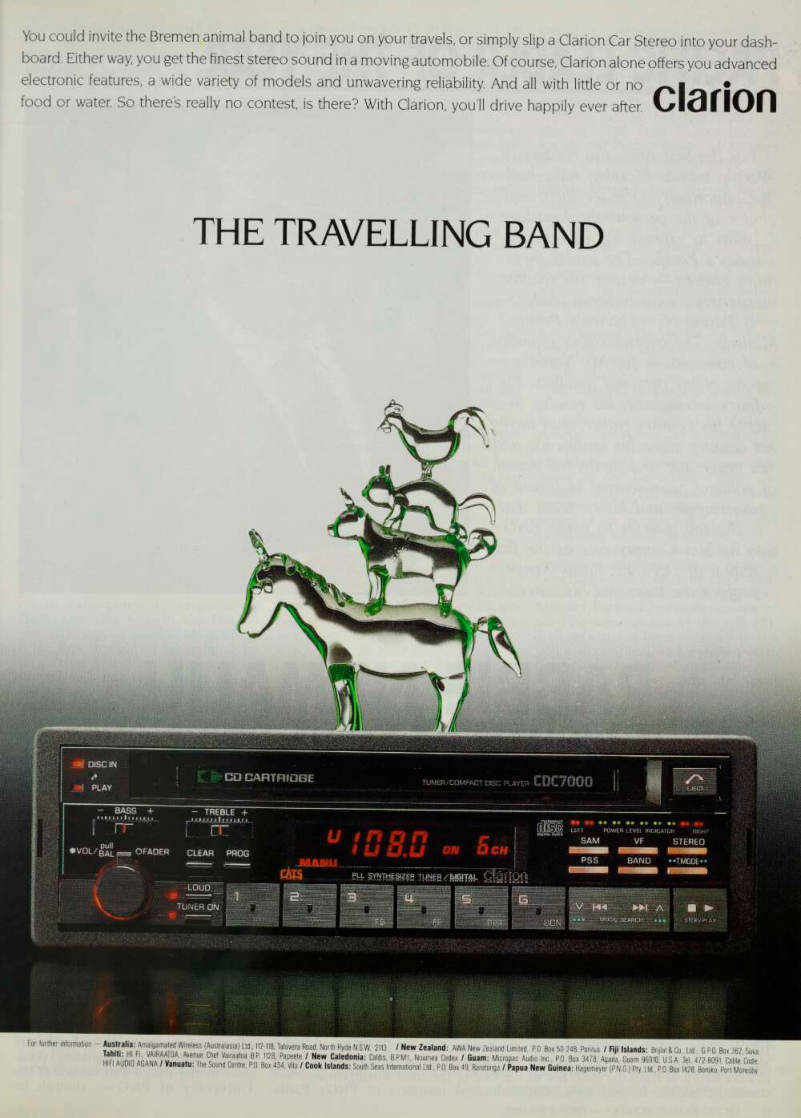
clarion
You could invite the Bremen animal band to join you on your travels, or simply slip a Clarion Car Stereo into your dashboard. Either way, you get the finest stereo sound in a moving automobile. Of course, Clarion alone offers you advanced electronic features, a wide variety of models and unwavering reliability. And all with little or no food or water. So there's really no contest, is there? With Clarion, you'll drive happily ever after.
THE TRAVELLING BAND
ns 'am. m
CD CARTRIDGE
TUNER/COMPACT DISC PLAYER
CDC7OOO
- BASS +
tin 1.14x1
- TREBLE +
--ijjxjjj.Ujjjxu. rr
>VOL/bal yarn OFADER CLEAR PROG
u in on r
I U U.U ON OCH
m pLL synthesizer tuner/NGITAL * ■
JUD LEFT POWER LEVEL INDICATOR RIGHT
VF STEREO
PSS BAND ••T.MODE"
- mm hh a FF HPT , SCN ; M us;l
SEARCH ■ STOP/PI AY
For further information (Australasia) Ltd 112-118, Talavera Road, North Ryde NSW 2113 / New Zealand: AWA New Zealand Limited, P.O. Box 50-248, Ponrua / Fiji Islands: Bnjlal & Co, Ltd, GPO Box 362 Suva Ai’imnArANA/ Wan. 9 3 }03 B . p ,128 - Pa P eete 1 New Caledonia: Caldis, B.PMI, Noumea Cedex / Guam: Micropac Audio Inc ,P 0 Box 3478, Agana, Guam 96910, US A Tel: 472-8091 Cable Code AUDIO AGANA / Vanuatu: The Sound Centre, P 0 Box 434, Vila / Cook Islands: South Seas International Ltd, P 0 Box 49, Rarotonga / Papua New Guinea; Hagemeyer (PNG) Pty Ltd, P 0 Box 1428, Boroko, Port Moresby
Pacific Leader Of The Year
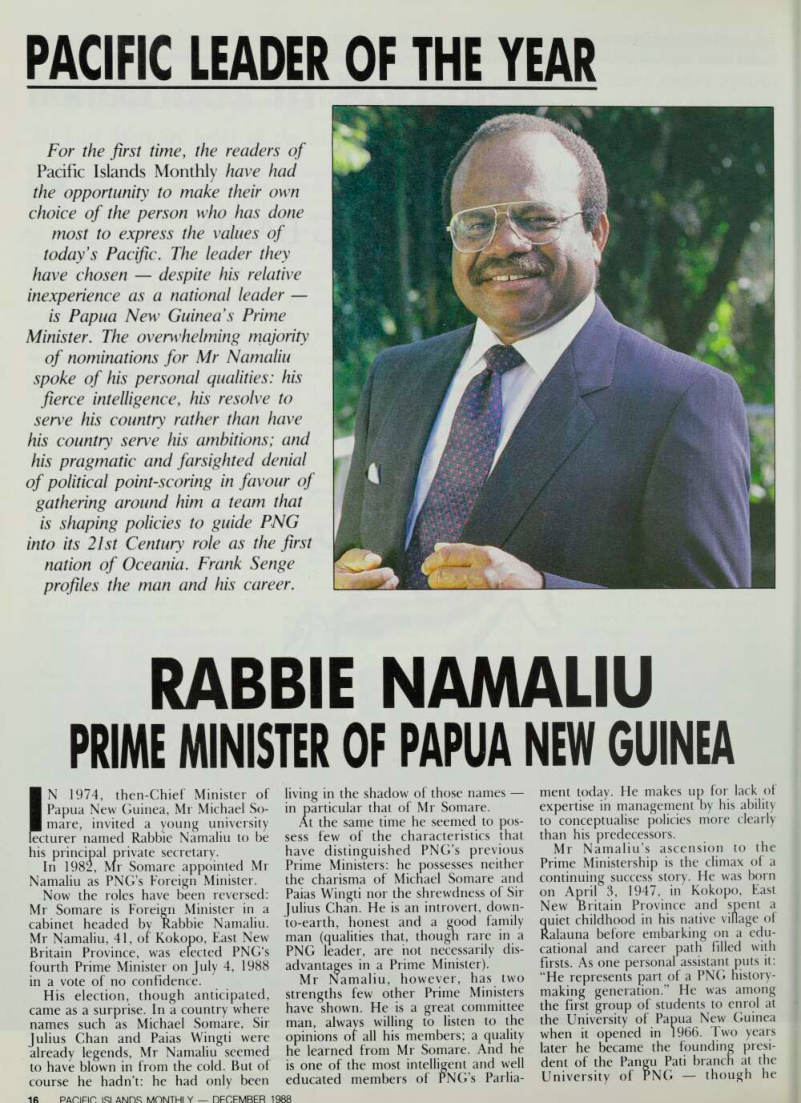
For the first time, the readers of Pacific Islands Monthly have had the opportunity to make their own choice of the person who has done most to express the values of today's Pacific. The leader they have chosen despite his relative inexperience as a national leader is Papua New Guinea s Prime Minister. The overwhelming majority of nominations for Mr Namaliu spoke of his personal qualities: his fierce intelligence, his resolve to serve his country rather than have his country serve his ambitions; and his pragmatic and farsighted denial of political point-scoring in favour of gathering around him a team that is shaping policies to guide PNG into its 21st Century role as the first nation of Oceania. Frank Senge profiles the man and his career.
Rabbie Namaliu
Prime Minister Of Papua New Guinea
I N 1974, then-Chief Minister of 9 Papua New Guinea, Mr Michael So mare, invited a young university lecturer named Rabbie Namaliu to be
his principal private secretary.
In 1982, Mr Somare appointed Mr Namaliu as PNG’s Foreign Minister.
Now the roles have been reversed: Mr Somare is Foreign Minister in a cabinet headed by Rabbie Namaliu.
Mr Namaliu, 41, of Kokopo, East New Britain Province, was elected PNG‘s fourth Prime Minister on July 4, 1988 in a vote of no confidence.
His election, though anticipated,
came as a surprise. In a country where names such as Michael Somare, Sir Julius Chan and Paias Wingti were already legends, Mr Namaliu seemed to have blown in from the cold. But of course he hadn’t: he had only been
living in the shadow of those names in particular that of Mr Somare.
At the same time he seemed to pos sess few of the characteristics that
have distinguished PNG’s previous
Prime Ministers: he possesses neither the charisma of Michael Somare and Paias Wingti nor the shrewdness of Sir Julius Chan. He is an introvert, down to-earth, honest and a good family man (qualities that, though rare in a PNG leader, are hot necessarily dis advantages in a Prime Minister).
Mr Namaliu, however, has two strengths few other Prime Ministers have shown. He is a great committee man, always willing to listen to the opinions of all his members; a quality he learned from Mr Somare. And he is one of the most intelligent and well educated members of PNG’s Parlia
ment today. He makes up for lack of expertise in management oy his ability
to conceptualise policies more clearly
than his predecessors.
Mr Namaliu’s ascension to the Prime Ministership is the climax of a continuing success story. He was born on April 3, 1947, in Kokopo, East New Britain Province and spent a quiet childhood in his native village of Ralauna before embarking on a edu cational and career path filled with firsts. As one personal assistant puts it: “He represents part of a PNG history making generation.” He was among the first group of students to enrol at the University of Papua New Guinea when it opened in 1966. Two years later he became the founding presi dent of the Pangu Pad branch at the University of PNG though he
admits he hadn’t very much choice at that time. “It was the only party going that had clear, definite views on inde pendence,” he recalls. “It was also in students at that time to be involved with a nationalist political movement.”
Stories are still told of how Rabbie Namaliu, Mekere Morauta (now Man aging Director of the PNG Banking Corporation) and Tony Siaguru (for mer MP), walked into the ‘whites-only’ bars at both the Boroko Hotel and the Port Moresby Golf Club and deman ded to be served. Nobody wanted to gainsay three very thirsty rugby union players . . . and a significant racial barrier was broken down.
A less savoury tale told about the three friends is when they took on the UPNG cooks. Arriving late from a rugby union game, they were refused service: Mr Namaliu pushed his friends back and dived at the cooks,
fists swinging.
Later and somewhat mellowed he graduated from UPNG with a Bachelor of Arts in 1970, majoring in History and English, and was offered a Canadian Commonwealth scho larship to the University of Victoria, British Columbia.
He graduated from Columbia with a Master’s degree in History and Politic al Science m 1972, took up tutoring and lecturing at UPNG in 1973 but before the year was out, Michael So mare asked him to become his private secretary and the pressures to which the young academic was sub jected (at a time when the drive was
on to gain political independence
from Australia) brought the first se rious stirrings of political ambition.
He first thought of becoming a fu ture Prime Minister in this period be tween 1973 and 1975. But it was no more than a dream. “With charismatic leaders such as Michael Somare, Sir Julius Chan and lambakey Okuk, it was hard to think of becoming Prime Minister over their heads. You looked up to them,” Mr Namaliu remembers.
“It wasn’t until I became a member that I became interested in the lead
ership question.”
After Independence in 1975, Mr Namaliu was appointed a District Commissioner to nis home province.
East New Britain. He played a leading role in establishing up the provincial government system there and took part in quelling the North Solomons secession uprising. He remains today a firm believer in the provincial govern ment system, and as long as he is in any position of influence provincial governments will thrive.
At the end of 1976 he changed jobs again, being appointed chairman of the Public Service, and in 1978 mar ried his wife, Margaret.
In 1979 he resigned from the Public Service. A year later Michael Somare
was toppled in PNG’s first vote of no confidence, and Mr Namaliu went back to work for him. In 1981, howev er, he moved back to the academic world, accepting a lectureship in the Department of Political and Adminis trative Studies at UPNG.
But politics continued to beckon; in July 1982 he was a Pangu candidate for Kokopo electorate in the general election, defeating a long time person al friend, Oscar Tamur. At that elec tion Michael Somare regained govern ment and appointed Mr Namaliu Foreign Affairs Minister: a post in which he distinguished himself, gain ing a reputation as one of the best Foreign Ministers Papua New Guinea has ever seen.
Mr Namaliu saw his first chance at gaining the leadership of Pangu Pati m 1982, when succession and the de puty leadership of the party were dis cussed rather heatedly within party ranks. It was a testing time, with a variety of strong personalities and fac tions pulling the party in different directions. Paias Wingti. John Nilkare, Tony Siaguru, Rabbie Namaliu and Gabriel Ramoi were all beginning to talk about succession. In his usual way, Mr Somare managed them by letting the younger men fight among them selves without involving himself. When the fight became too personal, he stepped in as the peacemaker.
Regional interests began to exert themselves on considerations for lead ership, too. Mr Siaguru, from the Sepik like Mr Somare, and Rabbie Namaliu from the New Guinea Islands region the smallest in terms of rep resentation in Pangu could only to watch and wait their time.
The choice for the deputy lead ership was between two Highlanders, Paias Wingti and John Nilkaro. Mr Namaliu threw his support behind Mr Wingti to help him secure the deputy leadership, but in March 1985 Paias Wingti pulled out of Pangu with 16 members and moved a vote of no con fidence in Mr Somare. The motion failed, and the splinter group moved to the Opposition benches.
Later, four people led by Tony Siaguru and John Nilkare broke away from Pangu, rejoined and broke away again: thus weakened, Pangu lost gov ernment in a second vote of no confi dence in November to Paias Wingti.
But the defeat actually worked to Mr Namaliu’s advantage, since Paias
Wingti, Tony Siaguru, John Nilkare
and Gabriel Ramoi his rivals for the leadership were gone.
Michael Somare did not offer the leadership to his protege on a plate, however, and on September 29 last year Rabbie Namaliu confronted The Chief in his office and asked his lead er to step down.
Mr Namaliu was in time to lead
Pangu in a second unsuccessful bid to form a grand coalition with
PDM. Though he personally opposed
the move, the party again voted in its favour and he was forced to go along with the majority.
Pangu Pati elected him leader on May 20, 1988. Only 45 days later he was elected Prime Minister by 58 votes to 51, dethroning Paias Wingti.
This month, the readers of Pacific Islands Monthly have elected Rabbie Namaliu as the magazine’s first Pacific Leader of the Year.
In the months since he became PM, Mr Namaliu has shifted the Wingti government’s emphasis on economic development back to the social sector,
arguing that economic development
will only come about when the popula tion is able to live in peace and when it is educated. He has set up a four point policy for his government: head ing it are proposals for constitutional and legislative reforms.
Mr Namaliu proposes to amend sec tions of the Constitution that he be lieves have contributed to PNG’s fluid
political atmosphere. In particular, he
is seeking to amend Section 145, which allows for motions of no confi dence in the Government every six months. Draft proposals now being circulated indicate that the grace period of six months will be extended to between 12 and 30 months.
Law and order is the second most important emphasis of the Namaliu Government. An eight-member min isterial committee headed by Justice Minister Bernard Narakobi was one of the first actions taken by the new PM.
KlO million has been allocated to the
police department and a joint police
defence force special operation was launched to combat crime and tribal fighting in the Highlands, Morobe
and Madang regions.
Education is Mr Namaliu’s third area of emphasis.
Initially, he has promised that sub stantial cuts to tertiary education and a national scholarship scheme adopted by the Wingti Government wilt be reinstated. The current Grade Six school-leaver system is being phased out and the Government plans to have universal education in the country within 10 years.
Though the economy forms the last part of Namaliu’s policy structure, it is nis greatest concern. The greatest problem for any government is the move toward economic independence and the management of the country’s rich resources, Mr Namaliu told PIM: “How any government initiates poli cies to distribute the benefits from the mineral wealth to benefit the majority of people will become a major task.
“I believe that if you are to become self-sufficient, you nave to have local expertise. We nave to have our own ►
trained, and trained quickly.
Otherwise we will continue to employ outsiders.”
In this regard, Mr Namaliu is look ing to the Pacific nations for expertise.
The traditional recruiting grounds
have been Australia, New Zealand and England, but the PM wants a man power bureau to be set up with the South Pacific Forum where member countries can place their excess exper tise at the disposal of fellow members.
On PNG’s role in the Pacific, Mr Namaliu would like to see the country have a say in regional matters. ‘PNG nas to respond to how the people of the Pacific see its role as the biggest of island nations,” he says. “Fiji was seen as a leader because it had been independent longer, had a stable leadership and had regional institu tions ana more expertise.
“After the coups all that has changed. Fiji has to sort its own affairs, but in the meantime we can’t shy away from our responsibilities: we must help develop the Forum.” Mr Namaliu sees a Pacific of the future where citizens are able to travel throughout the region without the need for visas or passports. This idea has already been discussed within the Melanesian Spearhead Group of PNG, Solomon Islands and Vanuatu.
Mr Namaliu also proposes to main tain the Spearhead, though Mr So mare was initially opposed to it. As a pressure group, the Spearhead has achieved its desired result in New Caledonia, Mr Namaliu says.
PNG will also maintain its observer status with ASEAN, and take a more active role in the United Nations by offering its soldiers to be employed in UN peacekeeping missions.
The people of Papua New Guinea are still cautious about their new lead er and he is cautious about the imple mentation of his programs and ideas.
His most immediate problem is to emerge from the shadow of Mr So mare and establish his own identity with the people. “It is difficult to de
velop your own identity, especially
when he [Somare], is still in Cabinet, he says. “But in other ways it’s impor tant to have him around. In the initial stages; when you’re trying to find your own feet, you need a stabilising factor, and he has provided that.”
Hovering over political life in PNG is the constant threat of a vote of no confidence, but for the time being the spotlight is firmly on Rabbie Namaliu.
And he seems purposeful, if cautious, in the early, crucial months of his Prime Ministership. While he may lack the charismatic appeal of Paias Wingti, Rabbie Namaliu nas taken the deliber ate step of not promising the people of ?NC the moon, but of moving with
forethought through the nation’s
second decade of self-determination. □
Advertisements & other items, p. 16 (1 item)
16
PAr.lFin I.QI AND.B MDMTHI Y DFCFMRER 1988
Human rights
The Region
Human rights abuses grow
Palau, Fiji, New Caledonia and Tahiti cited in an
Amnesty International report.
By David Robie
UNTIL last year the South Paci fic was so peaceful it never rated a mention in the Amnesty International annual report on human rights abuses. But now, af ter a debut by New Caledonia, the world human rights organisation’s re port this year has introduced an Asia- Pacific section that cites several Pacific countries for the first time: even Au stralia gets a notoriety listing.
The change began with a fact finding mission by a senior executive to island states last year, but the major concerns still remain on the fringe of the region in particular, the In donesian-ruled territories of East Timor and Irian Jaya.
Incidents cited by the 1988 Amnesty International Report include: EAST TIMOR: Aleixo Gutteres and Vincent des Sousa were reportedly tortured in late 1986 and early 198/
during interrogation in the capital of
Dili, in a house occupied by Indone
sian military intelligence (KOTIS).
Gutteres was reportedly suspected
of co-operating with Fretilin, which continued throughout the year to wage a guerilla war against the In donesian government and in support of independence for East Timor. He was tried and sentenced to seven
years’ imprisonment early in the year.
NEW CALEDONIA: Seventeen pro independence activists were sentenced to prison terms of between six months ana two years in April, after convic tion for stone-throwing. Their trial may have been politically motivated, arising from a violent clash in the east ern mining town of Thio in November 1986 between independence activists and supporters of French rule.
Stones were thrown, there were out breaks of arson and one person died from gunshot wounds. Thirty three independence activists were arrested while none of the supporters of French rule was charged.
The trial of seven self-confessed kil lers who took part in the so-called Hienghene massacre of 10 unarmed Kanaxs in December 1984 ended in October with their acquittal on grounds of ‘self-defence’.
PALAU: Voters passed an amend ment to the constitution in August that paved the way for a second vote in which the Compact of Free Associa tion with the United States was
approved. The amendment illegally
removed a provision requiring a 75 per cent majority to overturn an anti nuclear clause in the constitution, and was later rejected as unconstitutional by the Palau Supreme Court.
Roman Bedor, a lawyer who led moves to retain anti-nuclear provisions in the Constitution, was among several opponents of the constitutional changes who faced death threats. On September 7, his elderly father Bins Bedor was shot dead.
FIJI: Two military coups on May 14 and September 25 resulted in hun dreds of arrests among them trade
unionists, politicians ana journalists.
All were released after periods rang ing from a few hours to a week.
Arrests continued after the second coup, and some of those held were reportedly beaten, immersed in sew age and subjected to other cruel or
humiliating treatment.
IRIAN JAVA: In late January two young men, Paskalais Kawurim and
Anakletus Bitip, were reportedly
arrested and tortured by Indonesian soldiers in the village of Awayanka, Mindiptanah. They had failed to re port to local authorities after return ing from a refugee camp in Papua New Guinea and may have been sus pected of being supporters of OPM, the Free Papua Movement, which has been waging an armed struggle for an independent state in Irian Jaya since the mid-19605. Both men were held in military detention for two months without charge, then released.
TAHITI: After the rioting in Octo ber of unemployed Tahitians in the
capital of Papeete, a French judge
ordered the arrest of Felix “Rara ’ Col ombel, president of the Dockwqrkers Union, on charges of ‘complicity in violence and destruction of property’.
The riot was triggered off by the break-up of a dockers strike.
Other trade unionists were arrested; Colombel was released after two weeks in detention. D
Advertisements & other items, p. 19 (1 item)
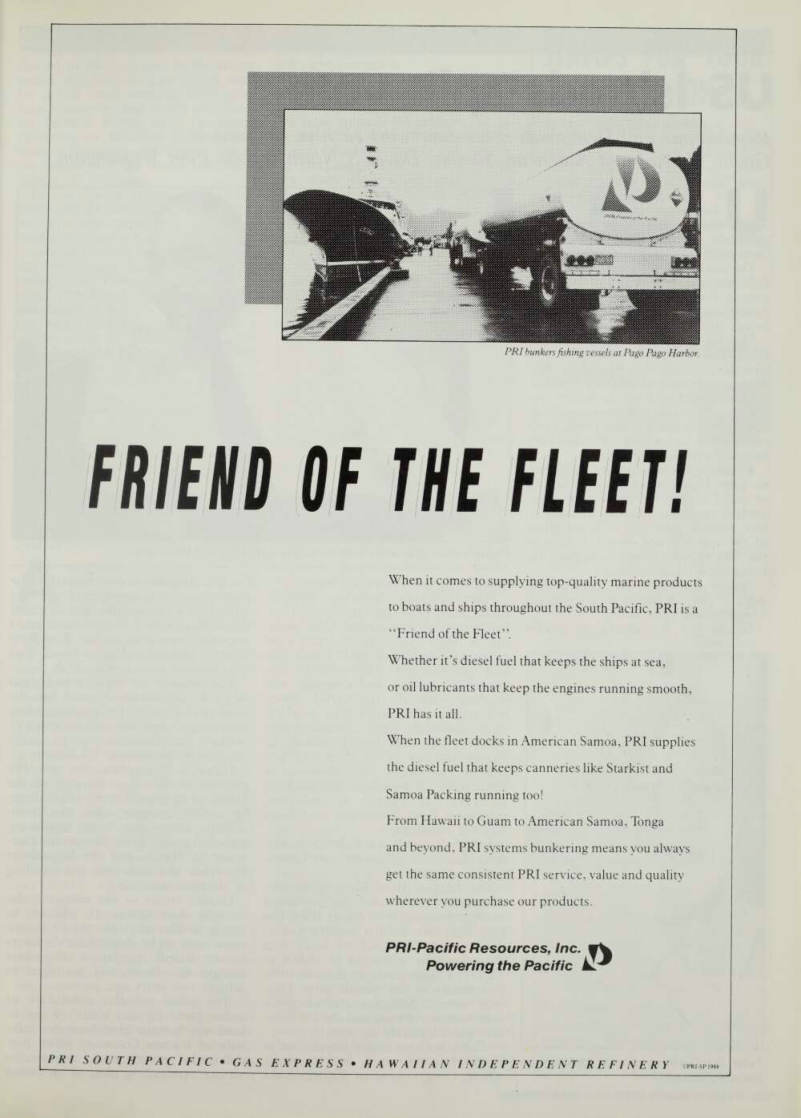
Of The Fleet!
<» PR I bunkers fishing vessels at Pago Pago Harbor.
When it comes to supplying top-quality marine products to boats and ships throughout the South Pacific, PRI is a “Friend of the Fleet”.
Whether it’s diesel fuel that keeps the ships at sea, or oil lubricants that keep the engines running smooth, PRI has it all.
When the fleet docks in American Samoa, PRI supplies the diesel fuel that keeps canneries like Starkist and Samoa Packing running too!
From Hawaii to Guam to American Samoa, Tonga and beyond, PRI systems bunkering means you always get the same consistent PRI service, value and quality wherever you purchase our products.
PRI-Pacific Resources, Inc.
Powering the Pacific PRI SOUTH PACIFIC • GAS EXPRESS • HAWAIIAN INDEPENDENT REFINERY prisp^
US islands split vote
United States
Republicans and Democrats score four wins each in elections in Guam, Hawaii and American Samoa. David S North reports from Washington.
US ISLAND voters like
Americans generally split
their ballots in the November
elections, giving Republicans and
Democrats four major victories each.
The main battle, the race to succeed Fofo Sunia as American Samoa’s dele gate in Congress, was so close that a runoff was required before Eni Hunk in was confirmed (see opposite page).
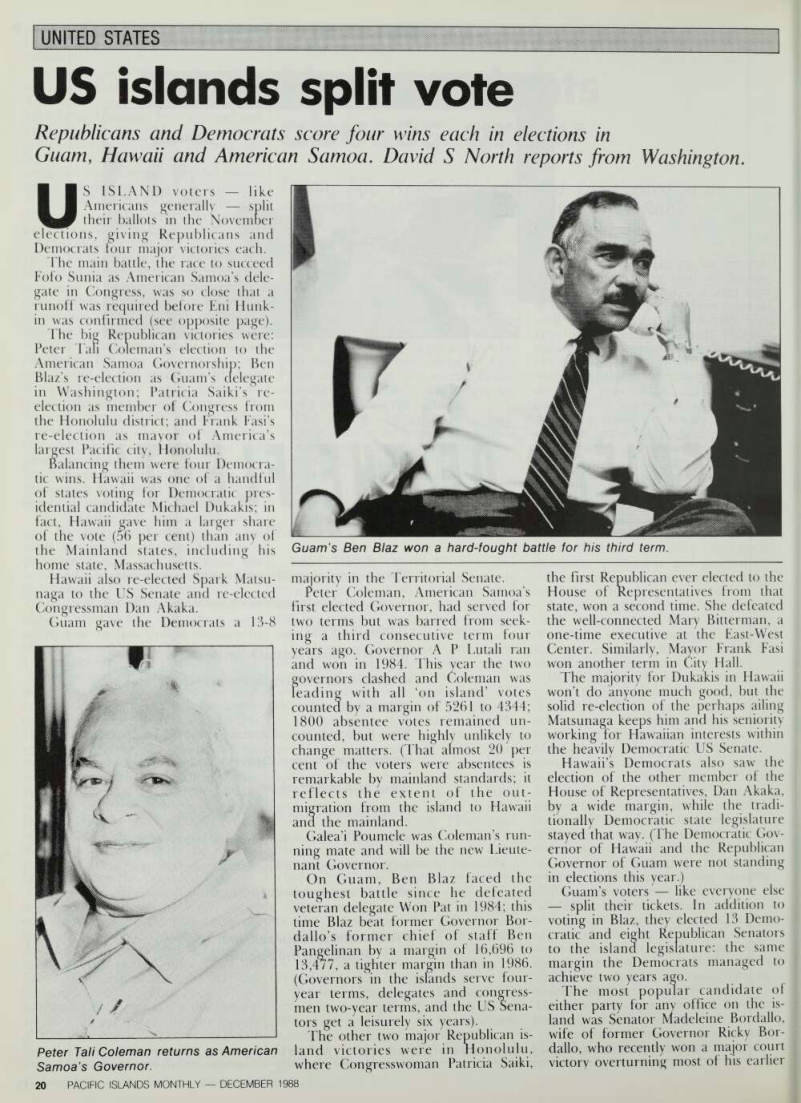
The big Republican victories were: Peter Tab Coleman’s election to the American Samoa Governorship; Ben Blaz’s re-election as Guam’s delegate in Washington; Patricia Saiki’s re election as member of Congress from the Honolulu district; and Frank Fasi’s re-election as mayor of America’s
largest Pacific city, Honolulu.
Balancing them were four Democra tic wins. Hawaii was one of a handful of states voting for Democratic pres idential candidate Michael Dukakis; in fact, Hawaii gave him a larger share of the vote (5o per cent) than any of the Mainland states, including his home state, Massachusetts.
Hawaii also re-elected Spark Matsu naga to the US Senate and re-elected Congressman Dan Akaka.
Guam gave the Democrats a 13-8
majority in the Territorial Senate.
Peter Coleman, American Samoa’s first elected Governor, had served for two terms but was barred from seek ing a third consecutive term four years ago. Governor A P Lutali ran and won in 1984. This year the two governors clashed and Coleman was leading with all ‘on island’ votes counted by a margin of 5261 to 4344; 1800 absentee votes remained un counted, but were highly unlikely to change matters. (That almost 20 per cent of the voters were absentees is remarkable by mainland standards; it reflects the extent of the out migration from the island to Hawaii and the mainland.
Galea’i Poumele was Coleman’s run ning mate and will be the new Lieute nant Governor.
On Guam, Ben Blaz faced the toughest battle since he defeated veteran delegate Won Pat in 1984; this time Blaz beat former Governor Bor dallo’s former chief of staff Ben Pangelinan by a margin of 16,696 to 13,4/7, a tighter margin than in 1986. (Governors in the islands serve four year terms, delegates and congress men two-year terms, and the US Sena tors get a leisurely six years).
The other two major Republican is land victories were in Honolulu, where Congresswoman Patricia Saiki,
the first Republican ever elected to the House of Representatives from that state, won a second time. She defeated the well-connected Mary Bitterman, a one-time executive at the East-West Center. Similarly, Mayor Frank Fasi won another term in City Hall.
The majority for Dukakis in Hawaii won’t do anyone much good, but the solid re-election of the perhaps ailing
Matsunaga keeps him and his seniority
working for Hawaiian interests within the heavily Democratic US Senate.
Hawaii’s Democrats also saw the election of the other member of the House of Representatives, Dan Akaka, by a wide margin, while the tradi
tionally Democratic state legislature
stayed that way. (The Democratic Gov ernor of Hawaii and the Republican Governor of Guam were not standing in elections this year.) Guam’s voters like everyone else split their tickets. In addition to voting in Blaz, they elected 13 Demo cratic and eight Republican Senators to the island legislature: the same margin the Democrats managed to achieve two years ago.
The most popular candidate of either party for any office on the is land was Senator Madeleine Bordallo, wife of former Governor Ricky Bor dallo, who recently won a major court victory overturning most of his earlier
Peter Tali Coleman returns as American Samoa's Governor.
Guam's Ben Blaz won a hard-fought battle for his third term.
convictions for alleged corruption.
Senator Bordallo, a Democrat elected to fill a vacancy in the senate earlier this year, secured 20,262 votes for a full term, running 2500 more than runner-up (and family ally) Senator Edward Reyes, once Lieutenant Governor to Bordallo. Gordon Mailioux, a Democrat and a newcomer to the Senate, had the lowest total for a winner, 12,700 votes.
In the Guam system, each party nominates 21 candidates for the Senate. The most popular 21 of the 42 candidates then serve for two years.
Speculation was rife in Guam as to the forthcoming battle for the speakership of the Twentieth Guam Legislature. The Speaker following US mainland tradition is the leader of the body not the neutral presiding officer as in the Westminster system, The Bordallo faction will probably push Ms Bordallo for the job.
Another possibility is that this time, as in the past, an alliance will be formed between the Sunshine Democrats (anti-Bordallo) and the Republicans, with former speaker Carl Gutierrez as the coalition candidate. A possible compromise candidate would be
the well-respected Reyes, who stayed
clean during the scanaal-wracked Bor dallo administration, Guam’s tradition of having a large percentage of women in the legista ture continued, seven being elected this time around. (In addition to Ms Bordallo they were Democratic Pillar Lugan, Elizabeth Arriola and Hermi nia Dierking, and Republicans Martha Cruz Ruth, Doris Brooks and Marilyn Manibusan.) The tradition has been growing stronger lately; in mid-1986 there were four women in the legisla ture, by mid-1987 there were two more and Ms Bordallo made it seven earlier this year, American Samoa elected its Fono (legislature) in November as well, but this is not a partisan election. Seven sitting members were defeated for re election, but the all-male composition of the House of Representatives was not changed. The Senate, to be elected later this year, is unlikely to have any women members either; it is the only US flag legislature in which for all practical purposes women are barred from voting. Matai do the vot ing for this body (see Pacific Islands
Monthly, September 1986.) □
Hunkin wins 'runoff'
Narrow victory for Samoan ‘patriot’.
By Ed Rampell
JVk MAN who has been described as “the most adventurous congressional candidate since Davy Crockett” has been confirmed as American Samoa’s Delegate to the House of Representatives.
Faleomaveaga Eni F Hunkin, Jr in tends to navigate a new course for the unincorporated US territory over his second two-year term. Close to the top of his agenda is the upgrading of
Pago Pago’s political status with
Washington, in an effort to end 88 years of what he calls “colonial abuse”.
Hunkin is seeking a status of free association between American Samoa and the United States, patterned on the Cook Islands-New Zealand part nership. He is also seeking an im proved economic package from the US to provide Pago Pago with the in frastructure necessary for making the
territory less dependent on
Washington.
At 40, Hunkin (who is a strong family man with five children) is a part of the postwar generation of islanders conscious of their role as Pacific entities in a community of micro-nations.
In addition to his sailing exploits aboard Hokule’a the popular politician has excellent congressional credentials: in 1984 he was elected Lieutenant Governor of American Samoa after
having served as Deputy Attorney
General and, from 1973 to 1981, working for the US House of Repre sentatives first as an administrative assistant to the then-Delegate from Pago Pago and later as staff council to the influential Interior and Insular Affairs Committee. A Vietnam veteran and Captain in the US Army Reserve, Hunkin has a law degree from Ber
keley, a bachelor’s degree in political
science from Brigham Young Uni versity, Utah, qualifications from the Church College of Hawaii . . . and the Samoan chiefly title of Faleomaveaga.
In addition, tne Hokule’a stalwart is, appropriately, a founder of the Tutila canoe club.
Democrat Hunkin faced stiff opposition in the November election.
Public Defender Aumoeualago Soli and local Senator Multiauaopele Ivi also tossed their hats into the ring, as did Senator Tufele Lia. Hunkin beat Tufele in the November 8 election but did not receive a majority, hence the November 22 runoff (which Hunkin won by a narrow margin). In addition to the congressional seat, the gov ernorship and local legislature were also contested: former Governor Peter Tali Coleman beat Eni’s teammate, Governor Lutali, for that seat. A staunch patriot, Hunkin has asserted that: “1 am a Samoan first, an Amer ican second. You cannot serve two masters.” □
Advertisements & other items, p. 21 (1 item)
Collection
STAMPS FOR YOUR
WORLD, INCLUDING AUSTRALIA, N.Z.,
PACIFIC ISLANDS, P.N.G., ASCENSION,
SINGAPORE, TRISTAN, BAHAMAS,
HONG KONG, FALKLAND IS., AND
SOUTH GEORGIA, IN MUH, MINT AND
USED CONDITION.
If you wish to receive my free price list, please write to Serendib, P.O. Box 207, Mt. Ommaney, Queensland 4074, Australia.
Pacific Economic
Bulletin
T Volume 3 Number 1 is now published
Have you taken our
your subscription?
The Bulletin monitors the economies of the South Pacific countries with a survey of current economic trends.
In this issue Macroeconomic policies under adverse conditions; the case of Fiji in 1987 are discussed by S. Siwatibau, the Governor of the Reserve Bank of Fiji.
Other articles deal with expenditure and consumption patterns in Papua New Guinea, The Australian Joint Venture Scheme, management in developing Pacific Island inshore fishery resources, Australian aid for education, Japanese aid policy and foreign and private investments. A statistical annex is kept up to date.
Available from Bibliotech, ANUTECH Pty Ltd. GPO Box 4, Canberra, ACT 2601 Australia.
Subscription. As2o Australia, US$l5 all other countries (1988. Volume 3, Numbers 1 and 2).
Charges can be made to Bankcard or Mastercard Published by the National Centre for Development Studies, the Australian National University.
developers in beach battle
Hawaii
Democracy wins out over developers in beach battle
Community action saves Oahu’s Sandy Beach.
By Ed Rampell
JA CARTOON in 1970 s ‘new
wave’ journalist Hunter S Thompson’s book on Hawaii
depicts a pack of vultures sweeping
down on an island, with the caption Real estate development in Oahu . On November 8 this year the ‘vultures’ re ceived a clear anti-development mes sage from the electorate with the triumph of the Save Sandy Beach in itiative. When the Kaiser Development Company proposed a new residential development near Sandy Beach a popular surfing spot on one of Oahu’s last stretches of unspoiled coastline the people arose. Despite City Council approval, a media campaign and un clear ballot language, community activists defeated developers by 164,007 votes to 85,210.
Land near Sandy Beach has been zoned residential since the 19705, but in 1987 the Honolulu City Council
approved a shoreline development
permit by a slim margin; Kaiser plan ned to construct 171 nomes (each re portedly in the half-million dollar price range) at a proposed subdivision 000 metres away from the beach on land owned by the Bishop Estate, a private Hawaiian land trust.
From the moment the matter came before the City Council local residents and supporters from all over Hawaii were planning their opposition. The Save Sandy Beach Initiative Coalition emerged to do battle with the de velopers; to tilt against corporate windmills. Petitions attracted more than 39,000 signatories in only 10 weeks, enabling the issue to be placed on the State elections ballot. The San dy Beachers sought to protect the property by ‘downzoning’ it, from re sidential to preservation.
The cause touched a responsive chord in Oahu people weary of de velopers, the Pentagon and others who have been alienating land since Statehood, transforming Hawaii into a paradise almost irretrievably lost. The Sandy Beachers found support in a community sick of high-rise eyesores, spiralling real estate prices Hawaii’s homes cost more tnan double the American national average
Japanese speculation, increasing pollu
tion and growing congestion . . . not to mention artillery practice. Hawaii’s Aloha Aina “love the land” senti ment and environmental awareness
immediately came to the fore.
The movement, led by long-time environmentalist and community organiser Phil Estermann, became a populist revolt. Labour unions and artists’ associations spoke out and bipartisan endorsement was given by both
mayoral contenders, Republican in-
cumbent Frank Fasi (re-elected for his fifth term) and Democratic challenger Marilyn Bornhorst, US Congressional candidates, Republican incumbent Patricia Saiki (who was returned to office) and Democrat Mary Bitterman. Fortyfour members of the bicameral State Legislature and four City Council members, together with candidates for
the Office of Hawaiian Affairs, also endorsed the initiative.
The pro-development forces quickly
launched a counter-offensive with the formation of People Who Vote Know on The Sandy Beach Initiative. The well-financed campaign concentrated on a media barrage on TV, radio and in the newspapers claiming that the housing would not affect Sandy Beach’s pristine splendour.
Some other Hawaiian groups, most notably the Bishop Estate, came out against the initiative, claiming that downzoning would lower the value of its lands, hence reducing revenues for its indigenous programs such as the
all-Hawaiian Kamehameha School.
The Estate further claimed that the downzoning was the first step in turn ing the trust’s private lands into public property, thereby taking the lands out of its control. (Estermann, however, insists that “according to polls, the ethnic groups most strongly opposed to developments such as Sandy Beach are the Hawaiians.”) Public suspicions were also aroused by what some claimed was “confusing” language on ballot papers: voters opposed to the development were asked to vote ‘Yes’, while those who favoured the construction were re quired to ‘No’. Estermann and others charged that Kaiser took advantage of this confusion “and deliberately ran an outrageous, deceptive, dishonest
media campaign”.
Nevertheless, the initiative surged easily to victory on what local media characterised as a ‘tidal wave’ of opposition. Estermann estimates that “Kaiser and the Bishop Estate outs pent us at least $3O to one. They spent between $300,000 and $400,000; we spent only $lO,OOO on
the campaign. This makes our two-to one victory all the sweeter.”
However, despite the jubilation the outcome of the Sandy Beach vote is
still subject to judicial rulings. An
Oahu circuit court has already found the voter initiatives cannot change land-use ordinances, but the matters must be reviewed by the Hawaii Sup reme Court. Furthermore, the City Council is considering two related bills, irrespective on tne high court ruling, that would condemn the land so it could be turned into a public park and that would rezone the land.
The Sandy Beach supporters, howev er, are only guaranteed four out of the nine votes on the Council.
More disappointing was the result of a second initiative: in a 23,455 to 18,186 vote, Japanese developers and their supporters beat environmental ists opposed to the construction of a 350-room luxury hotel near Hapuna Beach (see Pacific Islands Monthly, September). The hotel is the founda tion for a $329 million resort, which would also include a golf course and 800 homes on 198 hectares. A coali
tion of business and labour groups stressing property rights and economic needs defeated the Save Hapuna In itiative Petitioners unlike Oahu, the Big Island was more concerned with jobs than with the environment.
The plebiscite process has a stormy history in Hawaii. In the early 1980 s a community movement Defeated Japanese real estate developers at Nukolii on Kauai through the ballot box. However, following the devasta tion of Hurricane Iwa and the ensuing depressed economy, a second initiative was passed overturning the result of the first and opening up the beach for a Hilton Hotel and condominiums.
The success of the first Sandy Beach initiative has nevertheless caught the
State off guard. During the anti-Sandy
Beach initiative drive, pro-business
elements emphasised the importance
of private land ownership, attempting
to play on patriotism with the asser tion that “there are no property rights in communist countries”. Estermann agrees he was “definitely being red baited”, but points out that despite these tactics, ‘the initiative won in ev ery voting district on Oahu”. □
'Blood Feud'
in Honolulu
By Ed Rampell
A HAWAII State agency has succeeded in its controversial quest to alter the legal defini tion of the ‘Native Hawaiian’. The Office of Hawaiian Affairs (OHA) last month sponsored a controversial poll that advocated a ‘referendum on self determination’ which opponents claimed was no more than an attempt to break a Hawaiian land trust.
In essence, all people of any amount of Hawaiian blood were asked to ex press their view on what constitutes a Native Hawaiian. Since 1920 the de scendants of the Aloha State’s abor iginal inhabitants have been separated by the US Congress into two distinct categories: those of 50 per cent or more Hawaiian blood quantum, known as Native Hawaiians (the Hawaiian Homestead Act and the Statehood Admissions Act established a major land trust earmarked to be nefit this class) and those of less than 50 per cent indigenous ancestry re ferred to as Hawaiians or part- Hawaiians. According to OHA in formation there are about 40,000 Na tives and 160,000 part-Hawaiians liv
ing in the archipelago today.
OHA, a State agency created in 1978 ‘to better the living conditions of the Hawaiian people’, conducted a direct mail campaign on the lawful de
signation of Hawaiians, seeking a sing le definition of Hawaiian which it claims would enable all people of Hawaiian blood to partake of the trust fund presently set aside for the exclu sive use of tnose with half or more Hawaiian ancestry. OHA contended that replacement of the two blood quantum categories with a single de finition entitling all to benefit from the land trust would help unify and empower the Hawaiian people, and that the only way it could fulfill its agenda of taking control of Hawaiian lands and gaining political power was through the unification of the 50th State’s 200,000 people (out of a mil lion) of Hawaiian background.
However, a number of the benefi ciaries of this endowment are vigor ously protesting in the form of Feder al and State lawsuits and through other forms of dissent. Lieutenant Governor Ben Cayetano, the State’s election commissioner, ruled that it would be unconstitutional for OHA to place the issue on the ballot during last month’s US presidential and general elections. As a result, the deci sion-making process was through a direct mail campain: the Hawaiians registered to vote in OHA elections for Trustees received a ‘ballot’, which they had to mark and return in pre
pared envelopes by November 8.
(Non-Hawaiians were not eligible to participate, while anyone with any in digenous blood could: out of a poten tial 100,000 Hawaiian voters, only ab out 60,000 are registered with OHA).
The outcome of the referendum represents a resounding victory for OHA. Of 63,452 ballots mailed there were 19,747 responses: 16,482 voters answered ‘Yes’ to a new definition of Native Hawaiian, 2981 ‘No’ and there were only 284 invalid responses.
OHA has thus been given what one trustee calls a mandate to change the definition, as 84 per cent of those w ho bothered to return ballots (55 per cent of respondents said they were of 50 per cent or more Hawaiian ancestry) supported the proposal. However, the outcome of the so-called ballot does not have the force of law', and merely expresses the will of the majority of those participating in the process.
OHA says it does plan to use the re sult to influence the appropriate law makers to alter the definition of Hawaiians, though critics claim the procedure is not a legitimate act of self-determination as expressed through a plebiscite, but merely a self serving survey on the part of OHA.
The ‘ballot’ language which some
contend was deliberately misleading
reads; “Should every Native Hawaiian have the right to enjoy the benefits of the assets of the Office of Hawaiian
Affairs, as provided by policies
adopted by the OHA Board of Trus tees? The term ‘Native Hawaiian’ means all of the descendants of the
indigenous people inhabiting the
Hawaiian Islands prior to 1778”.
An optional identification was in cluded on the ‘ballot’: “Are you 50 per cent or more Hawaiian blood?” Both questions required ‘Yes’ or ‘No’.
Many so-called beneficiaries were
confused and angered by what they
perceive to be the breaking of their trust by its administrators: m fact, an OHA referendum’ forum at the Polynesian preserve of Nanakuli on Oahu had a low turnout, and frequent comments critical of OHA were met with rounds of applause. Trustee Frenchy De Soto stated that “it took a lot of guts” for the Board members to confront their constituency on the Waianae Coast, many of whom have 50 per cent Hawaiian heritage and live on Homestead land.
A number of related lawsuits against the State agency were threatened, and
some were actually lodged. Hereditary
Chief Maui Loa, spiritual leader of the Hou Hawaiians, filed a breach of trust suit in Federal court; four Native Hawaiians Jointly sued OHA’s Board of Trustees in State court, also for breach of trust, and even the Adminis trator and former Chairman of OHA announced their intention of suing the agency’s trustees. The traditionalist organisation Ka Lahui Hawaii (See
PIM, November) actively urged
Hawaiians to vote ‘No’ and to main tain the dual categories. Ka Lahui leader Mililani Trask a former OHA legal counsel also requested a f ederal probe of the agency.
Chief Loa, Ka Lahui and the four Native plaintiffs contended that the nine Trustees violated “their duty and
loyalty to Native Hawaiian benefi ciaries by using Native assets to dis solve their . . . land trust”. The Board
purportedly breached its fiduciary
duty and misapplied funds: Ka Lahui even alleges that by altering the blood quantum, OHA “is paving the way to break the Hawaiian Trust.
Critics also point out that Native Hawaiians are greatly outnumbered by
part-Hawaiians even though Na
tives may be those with the most to lose in the ‘plebiscite’. Hence, non beneficiaries who outnumber benefi ciaries were being asked whether they wanted to benefit from a trust fund set aside for others.
Ex-Chairman Moses Keale lost his position on August 30 as a result of this dispute. Trustee Keale claims to be a pure Hawaiian from the ‘forbid den island’ of Niihau, and though he said he favoured the ‘single definition Hawaiian’, he opposed the way OHA financed its referendum process.
While chairman, he secretly sought the legal opinion of the State Attorney General regarding OHA expenses for its referendum campaign and related matters: the AG concluded that OHA had improperly used funds derived from a trust set aside for the benefit of Natives for a campaign to dissolve their trust. This included paying for pro-referendum forums at a Honolulu restaurant as well as the balloting pro cess itself.
The office of Hawaiian Affair’s movement for what supporters proc laim as solidarity has, it seems, actually unleashed dissent and division in the Hawaiian community. □
Maoris split over Whare Paia
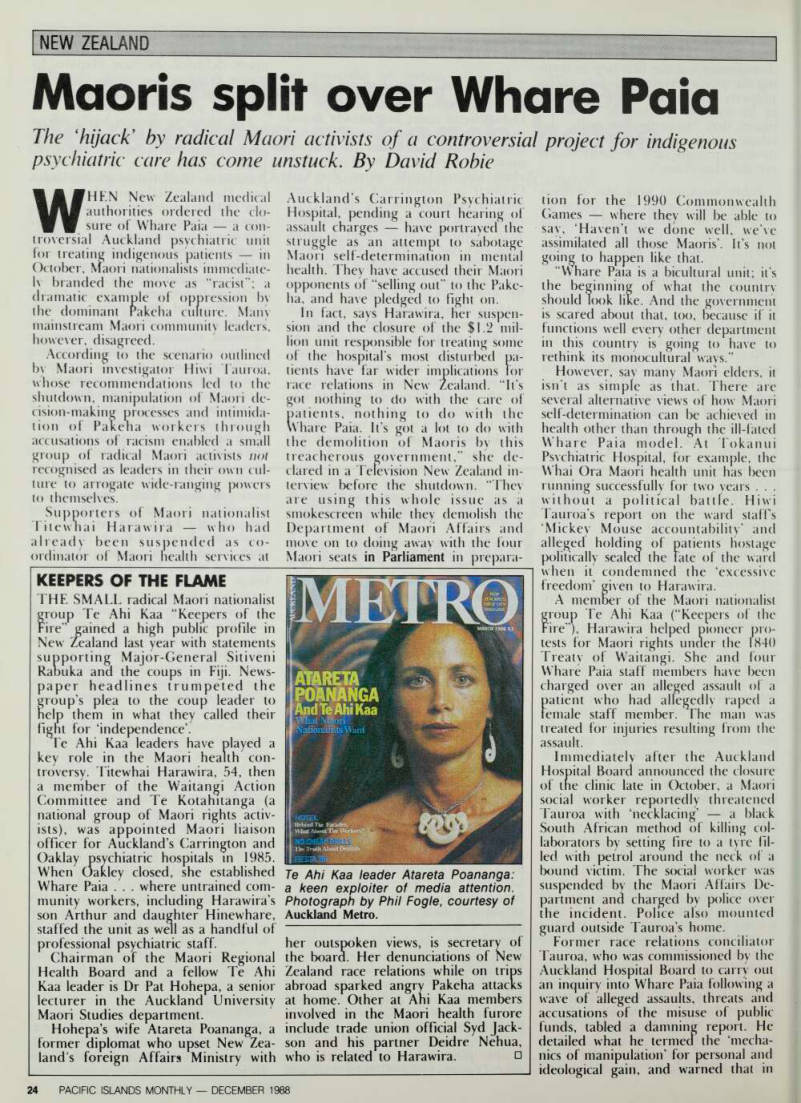
New Zealand
The ‘hijack’ by radical Maori activists of a controversial project for indigenous
psychiatric care has come unstuck.
By David Robie
WHEN New Zealand medical authorities ordered the clo sure of Whare Paia a con troversial Auckland psychiatric unit for treating indigenous patients in October, Maori nationalists immediate ly branded the move as “racist”; a
dramatic example of oppression by
the dominant Pakeha culture. Main mainstream Maori community leaders,
however, disagreed.
According to the scenario outlined by Maori investigator Hiwi Tauroa, whose recommendations led to the shutdown, manipulation of Maori de cision-making processes and intimida tion of Pakcna workers through accusations of racism enabled a small group of radical Maori activists not recognised as leaders in their own cul ture to arrogate wide-ranging powers to themselves.
Supporters of Maori nationalist Titewnai Harawira who had already been suspended as co ordinator of Maori health services at
Auckland’s Carrington Psychiatric
Hospital, pending a court hearing of
assault charges have portrayed the struggle as an attempt to sabotage Maori self-determination in mental health. They have accused their Maori opponents of “selling out” to the Pake ha, and have pledged to fight on.
In fact, says Harayvira, her suspen sion and the closure of the $1.2 mil lion unit responsible for treating some of the hospital’s most disturbed pa tients have far yvider implications for race relations in New Zealand. “It’s got nothing to do with the care of patients, nothing to do with the Whare Paia. It’s got a lot to do with the demolition of Maoris by this treacherous government,” she de clared in a Television New Zealand in lervieyv before the shutdown. “They are using this whole issue as a smokescreen while they demolish the Department of Maori Affairs and move on to doing away with the four Maori seats in Parliament in prepara
lion for the 1990 Commonwealth Games where they will be able to say, 'Haven’t we done well, we’ve assimilated all those Maoris’. It’s not going to happen like that.
“VVhare Paia is a bicultural unit; it’s the beginning of what the country should look like. And the government is scared about that, too, because if it functions well every other department in this country is going to have to rethink its monocultural wavs.”
However, say many Maori elders, it isn’t as simple as that. There are several alternative views of how Maori self-determination can be achieved in health other than through the ill-fated Whare Paia model. At Tokanui Psychiatric Hospital, for example, the Whai Ora Maori health unit has been running successfully’ for two years . . . yvithout a political battle. Hiwi Tauroa’s report on the ward staffs
'Mickey Mouse accountability’ and
alleged holding of patients hostage
politically sealed the fate of the ward when it condemned the ‘excessive freedom’ given to Harawira.
A member of the Maori nationalist group Te Ahi Kaa (“Keepers of the Fire”), Harayvira helped pioneer pro tests for Maori rights under the 1840 Treaty of Waitangi. She and four VVhare Paia staff members have been charged over an alleged assault of a
patient yvho had allegedly raped a
female staff member. The man was treated for injuries resulting from the assault.
Immediately after the Auckland Hospital Board announced the closure of tne clinic late in October, a Maori social yvorker reportedly threatened Tauroa with ‘necklacing’ a black South African method of killing col laborators by setting fire to a tyre fil led with petrol around the neck of a bound victim. The social worker yvas suspended by the Maori Affairs De partment and charged by police over the incident. Police also mounted guard outside Tauroa’s home.
Former race relations conciliator Tauroa, who was commissioned by the Auckland Hospital Board to carry out an inquiry into Whare Paia following a wave of alleged assaults, threats and accusations of the misuse of public funds, tabled a damning report. He detailed yvhat he termed the mecha nics of manipulation’ for personal and ideological gain, and warned that in
future recognised Maori leaders would need to be prepared to stand up and challenge false 'Maori views’.
After visits to many marae in the Auckland region, Tauroa became con vinced most of the Maori leadership did not support Whare Paia in its pre sent form. A fhey were most unhappy about the things that had been said and recorded about Maoridom in general,” he said, “much of which arose inevitably from the behaviour of those being promoted by the media as
Maori leaders.”
Tauroa added that when meeting some of the Whare Paia staff, “1 found that when it suited them they would uphold Maori customs. When, however, it served them belter to trample on Maori tikanga , there was never any hesitation to do this. I have been present on numerous marae when tney have insulted tangata whe nua (people of the land) usually under the banner of seeking a Waitan gi Treaty solution, a take (subject for discussion) concerning which there
will always be degrees of support.”
Tauroa also accused the New Zea land media of creating so-called spokespeople for Maoridom who “would not exist” without newspapers and television. Many of those mis takenly seen as leaders are sought out by the media because they are “de
liberately controversial or offensive, and are prepared to sacrifice their
people for personal motives”.
“instead tne ward had been hijacked
bv racially preoccupied political radic
als as a noisy and splotlit stage on which to promote Maori nationalism,” said the New Zealand Herald. “That public funds and the mentally ill have been so used required reproach for those involved, not least tne medical board that allowed the situation to de velop and took so long to correct it”.
The Auckland Star agreed; “Far from being a racist act, the closure is neces sary to protect the interests of the whole community, Maori included, and the welfare of patients, Maori in
particular”.
However, the Star also noted that it hoped that Whare Paia might emerge
again following a suitable cooling-off
period, this time applying normal standards of accountability and profes sional care into an appropriate cultu ral context.
District Court Judge Kenneth Mason was called in to head an in quiry into psychiatric care in the coun try’s largest city last July, following a double murder by a patient on tem porary release from Carrington Hos
pital. The inquiry’s report, recently
made public, condemned medical au
thorities as having ‘disgraced psychial
ry’ and warned lack of security could cause a catastrophe. An injunction was filed to prevent blamed medical offi cials being named publicly but both Prime Minister David Lange and the Opposition called for their resigna tions. Mason also condemned Whare Paia staff who refused to meet him.
According to Tauroa’s report, Whare Paia patients were being drilled in support action for Maori national ists employed on the staff and medical
procedures for patients moving out of
the hospital to public functions had
been ignored. That practice suggested
a danger to patients and public.
Threats and violence from ward staff had also raised concern. “That among persons threatening violence are the people in charge of a psychiat ric unit makes a mocxery of patient care,” Tauroa’s report said.
Attempts to resolve the crisis peace fully at Whare Paia failed: stall re fused to co-operate with the Maori health project manager for Carrington Hospital, Te Pere Curtis.
Tne row was not a Maori failure, he stressed: “Maoridom at large had fell the images arising out of the Carring ton issues were destructive of the Maori people”. Tauroa appealed to the hospital board to press on with boosting Maori involvement in all levels of health care. □
Keepers Of The Flame
THE SMALL radical Maori nationalist froup Te Ahi Kaa “Keepers of the ire” gained a high public profile in New Zealand last year with statements
supporting Major-General Sitiveni
Raouka and the coups in Fiji. News paper headlines trumpeted the group’s plea to the coup leader to help them in what they called their
fight for ‘independence’.
Te Ahi Kaa leaders have played a key role in the Maori health con troversy. Titewhai Harawira, 54, then a member of the Waitangi Action Committee and Te Kotahitanga (a national group of Maori rights activ ists), was appointed Maori liaison officer for Auckland’s Carrington and
Oaklay psychiatric hospitals m 1985.
When Oakley closed, she established Whare Paia . . . where untrained com
munity workers, including Harawira’s
son Arthur and daughter Hinewhare, staffed the unit as well as a handful of
professional psychiatric staff.
Chairman of the Maori Regional Health Board and a fellow Te Ahi Kaa leader is Dr Pal Hohepa, a senior lecturer in the Auckland University Maori Studies department.
Hohepa’s wife Atareta Poananga, a former diplomat who upset New Zea land’s foreign Affairs Ministry with
her outspoken views, is secretary of the board. Her denunciations of New Zealand race relations while on trips abroad sparked angry Pakeha attacks at home. Other at Ahi Kaa members involved in the Maori health furore include trade union official Syd Jack son and his partner Deidre Nehua, who is related to Harawira. □
Te Ahi Kaa leader Atareta Poananga: a keen exploiter of media attention.
Photograph by Phil Fogle, courtesy of Auckland Metro.
Advertisements & other items, p. 25 (1 item)
Taia\R
JAIA\R --- Papua New Guinea's
nationwide airline connection to and
from the World.
DOMESTIC
Talair serves all provinces in P.N.G., many on a daily basis. IMo other airline comes close to serving the 130 ports a week that Talair does. Charter services also are available.
INTERNATIONAL
Using our computerised system
in any of our 12 International Travel Centres, we can book you anywhere in the world 0n...
planes, trains, luxury liners,
arrange rental cars, hostefs, motels or hotels. •• n Panguna - 95 8020 • Arawa - 95 2113 • Mt. Hagen - 52 2465 Boroko - 25 7655 • Tabubil - 58 9228 • Goroka - 72 1355 • Lae - 42 2316 Madang - 82 2757 • Rabaul - 82 2882 • Wewak - 86 2012 Vanimo - 87 1180 • Port Moresby - 21 4766 • Waigani - 25 7877 Brisbane Metropolitan Area - 229 1177 Outside Brisbane - 008 777879
TAIA\R
4
QUALITY IN AIR TRANSPORT
'Profit is not a dirty word'
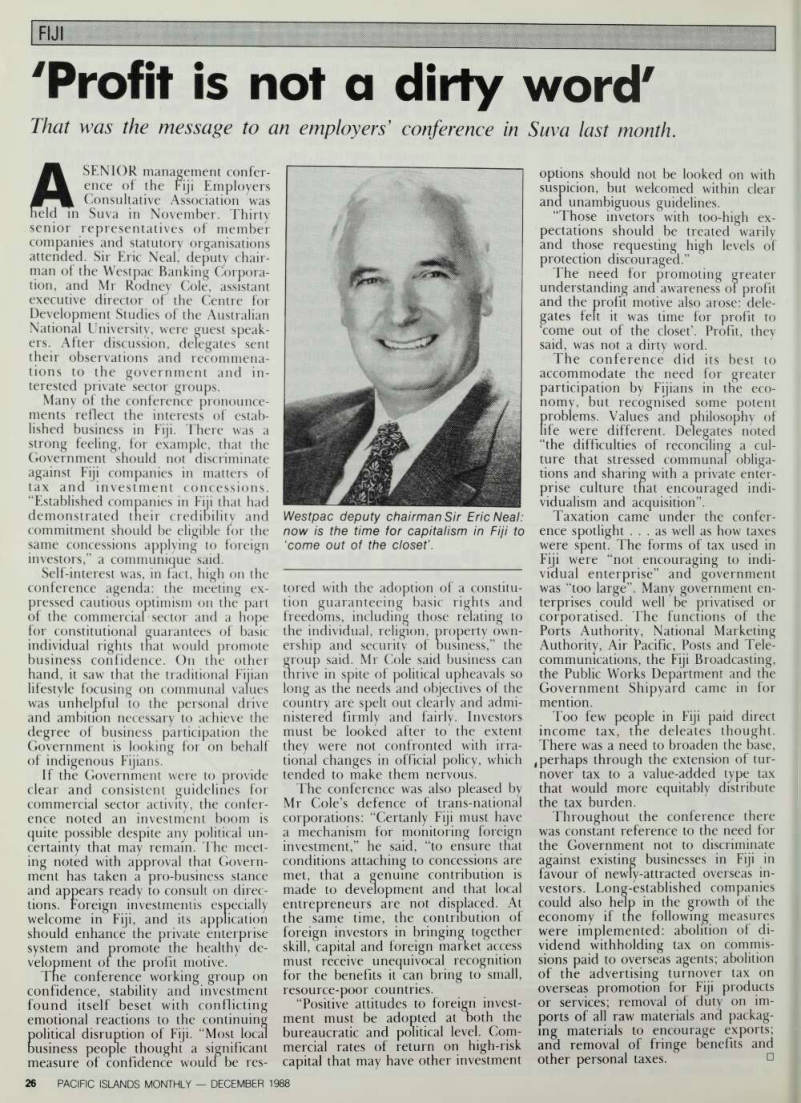
Fiji
That was the message to an employers' conference in Suva last month.
SENIOR management confer ence of the Fiji Employers i Consultative Association was held in Suva in November. Thirty senior representatives of member companies and statutory organisations attended. Sir Eric Neal, deputy chair man of the Westpac Banking Corpora tion, and Mr Rodney Cole, assistant executive director of the Centre for Development Studies of the Australian National University, were guest speak ers. After discussion, delegates sent their observations and recommena tions to the government and in terested private sector groups.
Many of the conference pronounce ments reflect the interests of estab lished business in Fiji. There was a strong feeling, for example, that the Government should not discriminate against Fiji companies in matters of tax and investment concessions.
“Established companies in Fiji that had demonstrated tneir credibility and commitment should be eligible for the same concessions applying to foreign investors,” a communique said.
Self-interest was, in fact, high on the conference agenda: the meeting ex pressed cautious optimism on the part of the commercial sector and a hope for constitutional guarantees of basic individual rights that would promote business confidence. On the other hand, it saw that the traditional Fijian lifestyle focusing on communal values was unhelpful to the personal drive and ambition necessary to achieve the degree of business participation the Government is looking for on behalf
of indigenous Fijians.
If the Government were to provide clear and consistent guidelines for commercial sector activity, the confer ence noted an investment boom is
quite possible despite any political un
certainty that may remain. The meet ing noted with approval that Govern ment has taken a pro-business stance and appears ready to consult on direc
tions. Foreign investmentis especially
welcome in Fiji, and its application should enhance the private enterprise system and promote the healthy de velopment or the profit motive.
The conference working group on confidence, stability and investment found itself beset with conflicting emotional reactions to the continuing political disruption of Fiji. “Most local business people thought a significant measure of confidence would be res-
tored with the adoption of a constitu tion guaranteeing basic rights and freedoms, including those relating to the individual, religion, property own ership and security of business,” the group said. Mr Cole said business can thrive in spite of political upheavals so long as the needs and objectives of the country are spelt out clearly and admi nistered firmly and fairly. Investors must be looked after to the extent they were not confronted with irra tional changes in official policy, which tended to make them nervous.
The conference was also pleased by Mr Cole’s defence of trans-national
corporations: “Certanly Fiji must have
a mechanism for monitoring foreign investment,” he said, “to ensure that conditions attaching to concessions are met, that a genuine contribution is made to development and that local entrepreneurs are not displaced. At the same time, the contribution of
foreign investors in bringing together
skill, capital and foreign market access
must receive unequivocal recognition
for the benefits it can bring to small, resource-poor countries.
“Positive attitudes to foreign invest ment must be adopted at Doth the bureaucratic and political level. Com mercial rates of return on high-risk capital that may have other investment
options should not be looked on with suspicion, but welcomed within clear
and unambiguous guidelines.
“Those invetors with too-high ex pectations should be treated warily and those requesting high levels of
protection discouraged.”
The need for promoting greater understanding and awareness of profit and the profit motive also arose: dele gates felt it was time for profit to come out of the closet’. Profit, they said, was not a dirty word.
The conference did its best to accommodate the need for greater
participation by Fijians in the eco
nomy, but recognised some potent problems. Values and philosophy of life were different. Delegates noted “the difficulties of reconciling a cul ture that stressed communal obliga tions and sharing with a private enter prise culture that encouraged indi vidualism and acquisition”.
Taxation came under the confer ence spotlight ... as well as how taxes were spent. The forms of tax used in Fiji were “not encouraging to indi vidual enterprise” and government was “too large”. Many government en terprises could well be privatised or corporatised. The functions of the
Ports Authority, National Marketing
Authority, Air Pacific, Posts and Tele
communications, the Fiji Broadcasting,
the Public Works Department and the Government Shipyard came in for mention.
Too few people in Fiji paid direct income tax, the deleates thought.
There was a need to broaden the base, , perhaps through the extension of tur nover tax to a value-added type tax that would more equitably distribute the tax burden.
Throughout the conference there was constant reference to the need for the Government not to discriminate
against existing businesses in Fiji in
favour of newly-attracted overseas in
vestors. Long-established companies
could also help in the growth of the economy if trie following measures were implemented: abolition of di vidend withholding tax on commis sions paid to overseas agents; abolition of the advertising turnover tax on
overseas promotion for Fiji products
or services; removal of duty on im ports of all raw materials and packag ing materials to encourage exports; and removal of fringe benefits and other personal taxes. D
Westpac deputy chairman Sir Eric Neal: now is the time for capitalism in Fiji to ‘come out of the closet'.
Pacific Report
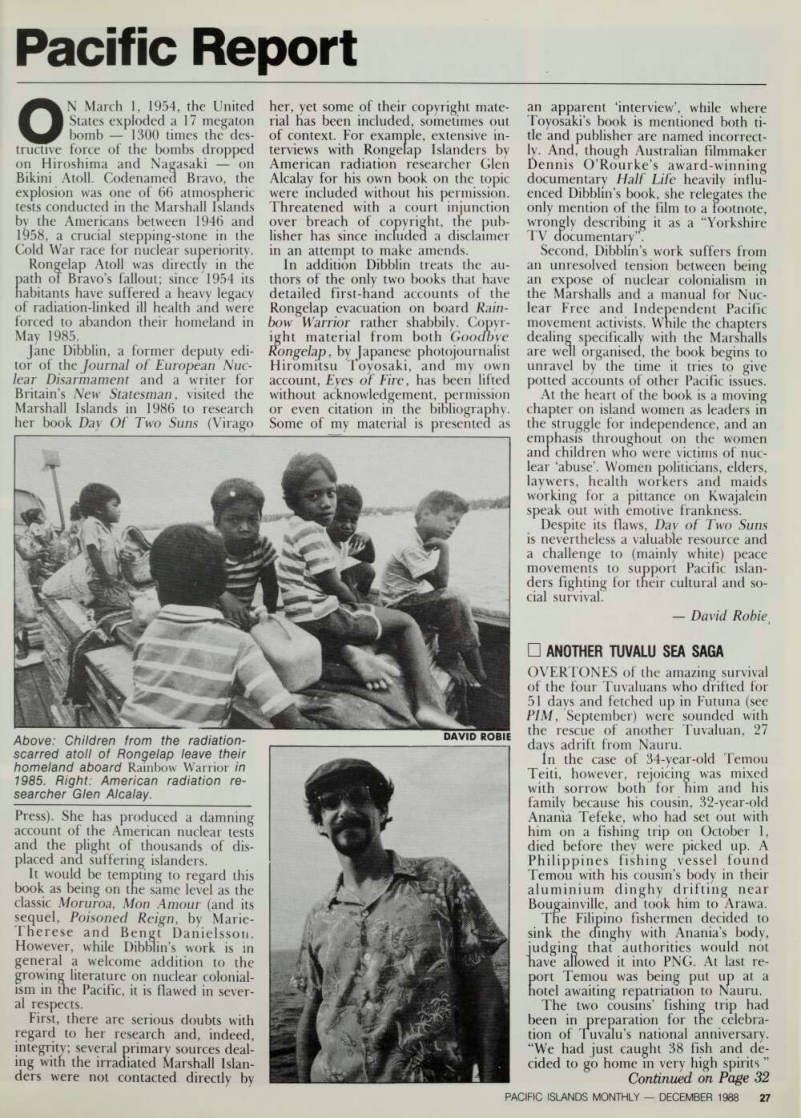
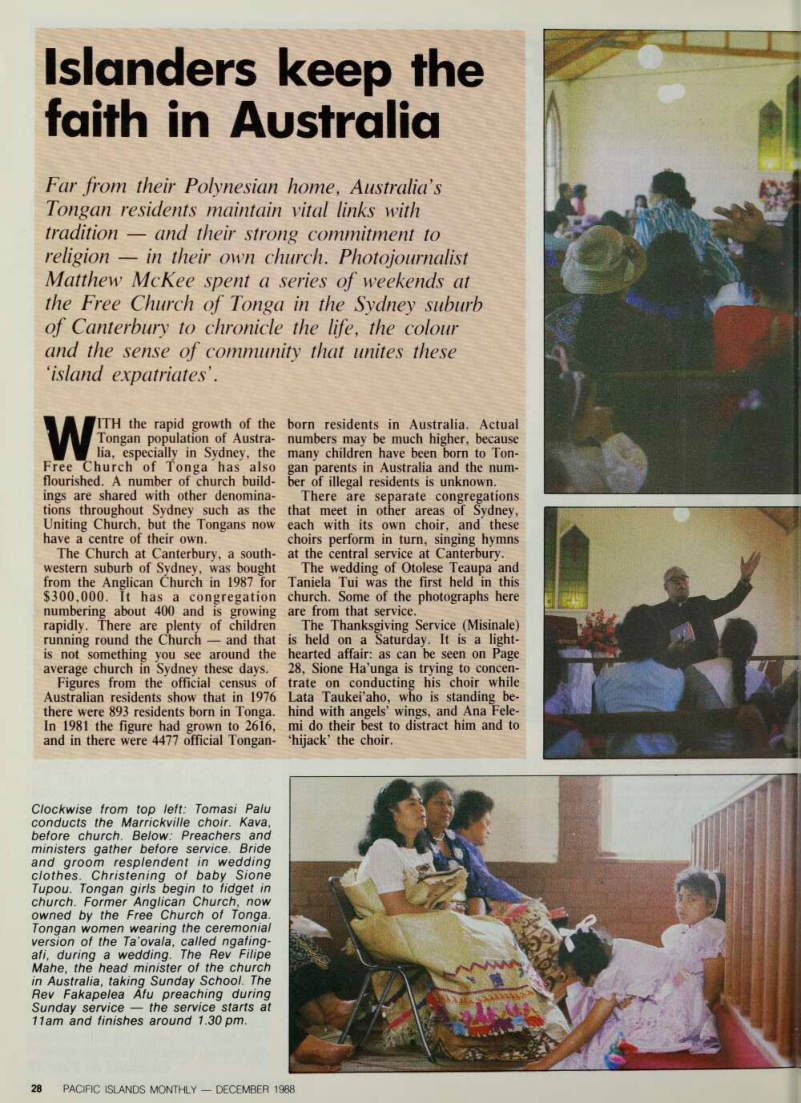
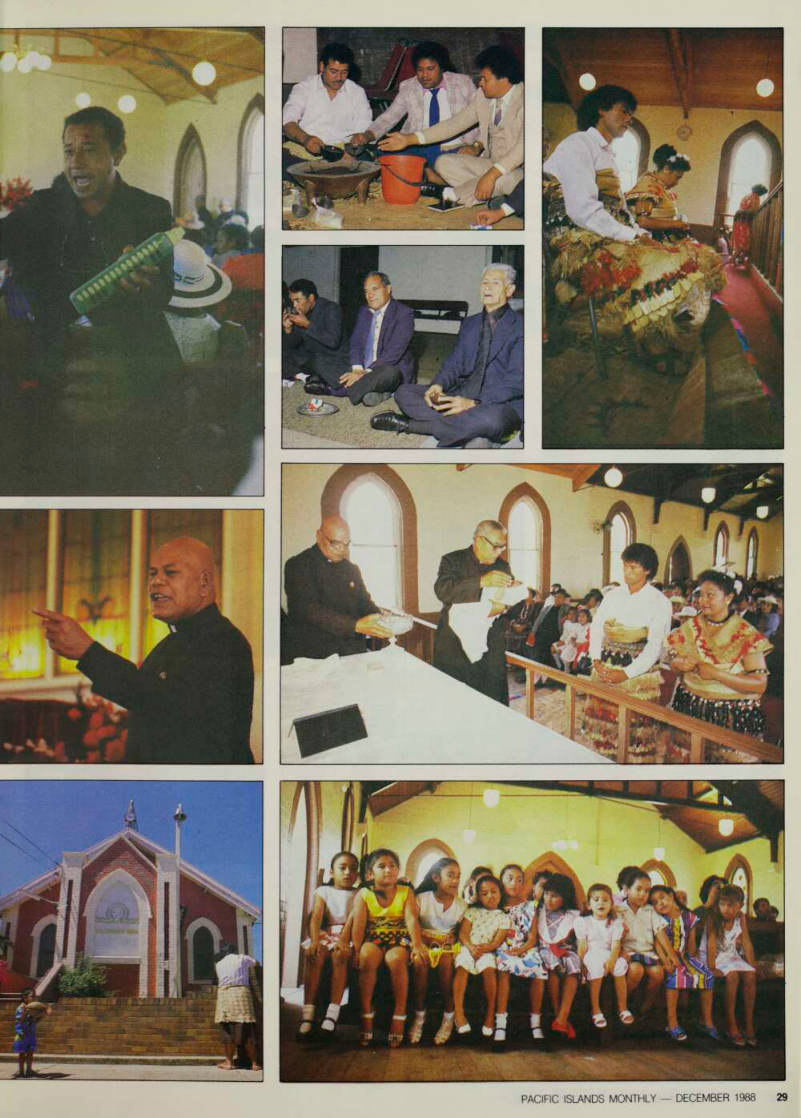

ON March 1, 1954, the United States exploded a 17 megaton bomb 1300 times the destructive force of the bombs dropped on Hiroshima and Nagasaki on Bikini Atoll. Codenamed Bravo, the explosion was one of 66 atmospheric tests conducted in the Marshall Islands by the Americans between 1946 and 1958, a crucial stepping-stone in the Cold War race for nuclear superiority, Rongelap Atoll was directly in the path of Bravo’s fallout; since 1954 its habitants have suffered a heavy legacy of radiation-linked ill health and were forced to abandon their homeland in
May 1985.
Jane Dibblin, a former deputy editor of the Journal of European Nuclear Disarmament and a writer for Britain’s New Statesman, visited the Marshall Islands in 1986 to research her book Day Of Two Suns (Virago
Press). She has produced a damning account of the American nuclear tests and the plight of thousands of dis
placed and suffering islanders.
It would be tempting to regard this book as being on the same level as the classic Moruroa, Mon Amour (and its
sequel, Poisoned Reign, by Marie-
Therese and Bengt Danielsson.
However, while Dibblin’s work is in general a welcome addition to the growing literature on nuclear colonial ism in the Pacific, it is flawed in sever al respects.
First, there are serious doubts with regard to her research and, indeed, integrity; several primary sources deal ing with the irradiated Marshall Islan ders were not contacted directly by
her, yet some of their copyright mate rial has been included, sometimes out of context. For example, extensive in terviews with Rongelap Islanders by American radiation researcher Glen Alcalay for his own book on the topic were included without his permission, Threatened with a court injunction over breach of copyright, the pub lisher has since includea a disclaimer in an attempt to make amends.
In addition Dibblin treats the au thors of the only two books that have detailed first-hand accounts of the Rongelap evacuation on board Ram bow Warrior rather shabbily. Copyr ight material from both Goodbye
Rongelap, byjapanese photojournalist
Hiromitsu Toyosaki, and my own account, Eyes of Fire, has been lifted
without acknowledgement, permission
or even citation in the bibliography, Some of my material is presented as
an apparent interview’, while where Toyosaki’s book is mentioned both ti tle and publisher are named incorrect ly. And, though Australian filmmaker Dennis O’Rourke’s award-winning documentary Half Life heavily influ enced Dibblm’s book, she relegates the only mention of the film to a footnote, wrongly describing it as a “Yorkshire
TV documentary”.
Second, Dibblm’s work suffers from an unresolved tension between being an expose of nuclear colonialism in the Marshalls and a manual for Nuc lear Free and Independent Pacific movement activists. While the chapters dealing specifically with the Marsnalls are well organised, the book begins to unravel by the time it tries to give potted accounts of other Pacific issues.
At the heart of the book is a moving chapter on island women as leaders in the struggle for independence, and an emphasis throughout on the women and children who were victims of nuc lear ‘abuse’. Women politicians, elders, laywers, health workers and maids
working for a pittance on Kwajalein
speak out with emotive frankness.
Despite its flaws, Day of Two Suns is nevertheless a valuable resource and a challenge to (mainly white) peace movements to support Pacific islan ders fighting for their cultural and so cial survival.
David Robie
□ Another Tuvalu Sea Saga
OVERTONES of the amazing survival of the four Tuvaluans who drifted for 51 days and fetched up in Futuna (see PIM, September) were sounded with the rescue of another Tuvaluan, 27 days adrift from Nauru.
In the case of 34-year-old Temou Teiti, however, rejoicing was mixed with sorrow both for him and his family because his cousin, 32-year-old Anania Tefeke, who had set out with him on a fishing trip on October 1, died before they were picked up. A
Philippines fishing vessel found
Temou with his cousin’s body in their aluminium dinghy drifting near Bougainville, and took him to Arawa.
The Filipino fishermen decided to sink the dinghy with Anania’s body, judging that authorities would not nave allowed it into PNG. At last re port Temou was being put up at a notel awaiting repatriation to Nauru.
The two cousins’ fishing trip had been in preparation for the celebra tion of Tuvalu’s national anniversary.
“We had just caught 38 fish and de cided to go home m very high spirits ”
Continued on Page 32
Above: Children from the radiation scarred atoll of Rongelap leave their homeland aboard Rainbow Warrior in 1985. Right: American radiation re searcher Glen Alcalay.
David Robie
he said. But their outboard motor died and they were soon swept away by strong winds and currents. They tried to make a sea anchor with their water-filled petrol tank, but it did not have any effect.
The fishermen did not worry undu ly at first, thinking they would be res cued. “We ate the raw fish we had caught and drank urine mixed with seawater,” Temou said. “We saw three ships during the time we were adrift but they were too far away to notice us. Anania died on October 14.
“I felt lonely and very sorry for him, but I was very weak and could not do much for him. I could not throw him overboard because he was too heavy,” he said.
“It rained once and I could only collect water in a bottle. When that ran out, I went back to drinking sea water mixed with urine. I was weak and did not have very much hope of survival until I saw the fishing boat and started waving.”
□ Kiribati Constitution Decision
A DECISION of major constitutional
significance was delivered by Mr Jus
tice Topping at the High Court in Be tio on November 18. An application
by Opposition member Dr Harry
Tong, seeking an order to restrain the Attorney General, Michael Tekab webwe, from taking part in the pro ceedings of the Maneaba in Maungata bu (House of Parliament) was struck out for want of jurisdiction by the
High Court.
The court held that the Maneaba in Maungatabu had the right to conduct its own proceedings without interfer ence from the courts, and that this was an important part of political free dom. In his judgment, Mr Justice Topping said: “The basis of this Con stitution is the separation of powers.
The Judiciary ought not to interfere in the running of the Legislature and vice versa: the Speaker and Parliament cannot be challenged in their legisla tive capacities. The Kiribati Constitu tion does not limit the power of Par liament as to privilege.”
The decision clarifies the question of parliamentary supremacy and reaf firms the principles of sovereignty of parliament upheld in most other countries.
□ New Role For France
FRANCE is poised to step into a breach between Australia and the small Pacific nations, according to the Paris newspaper Le Monde.
It said France’s reputation in the re gion was benefiting from the resent ment many smaller nations felt to wards Australia’s “police” role. “In the wake of the referendum on the future of New Caledonia, the influence of
France in the South Pacific is being seen in anew light,” a correspondent wrote. “Pilloried not long ago by those Melanesian countries most susceptible to the independence and nationalist movements, Paris is polishing up its
international image.
“The setbacks of Australia whose
role of regional police is challenged
more and more openly play no small part in this change.”
The newspaper said this redistribu tion as power came as South Pacific nations were falling prey to unpre
cedented political tension, particularly
in Melanesian states. With all the coups d’etat, riots and constitutional crises of 1987 and 1988, Melanesia had never before known so much turbulence, Lc Monde said. “Those events have revealed the fragility of these island states, which are economi cally dependent on the outside world and whose stability inherited from the colonial era is starting to crack,”
Citing opposition to Australia’s dis patch of anti-riot gear to Father Wal ter Lini’s Vanuatu Government earlier this year, the newspaper said political troubles in that country could lead to anew balance of power in the region.
Le Monde had also dismissed Father Lini’s criticism at the last South Pacific Forum of France’s peace plan for New Caledonia as “mere rhetoric designed for local consumption”.
□ Us Bans Vanuatu Tuna
THE UNITED States Government has banned the importation of yellowfm tuna caught in the eastern tropical Pacific Ocean from countries that violate US laws protecting marine mammals. The ban is primarily to protect dolphins, which associate with schools of tuna and are often caught in the nets of large tuna vessels.
Strict regulations oblige the Amer ican tuna fleet to use special nets de
signed to prevent dolphins being trap
ped, to undertake rescue operations for dolphins that are caught in nets and not to fish after sunset, when res cue operations would be difficult. It is claimed this has reduced the number of dolphins killed by the US fishing fleet from a very conservative estimate of more than 100,000 in 1976 to around 20,000 in 1987.
Vanuatu is named as a non complier with the US rules, along with Panama, Ecuador and Venezuela. El Salvador and the Soviet Union are already under embargo for failure to meet US requirements.
Voice of America radio said that to sell their tuna catch in the United States, other nations do not have to meet the same strict requirements the US imposes on its own tuna fleet, but they do have to make a comparable effort to reduce marine mammal deaths associated with tuna fishing.
Islanders keep the faith
faith in Australia
Far from their Polynesian home, Australia’s Tongan residents maintain links tradition and their strong commitment to religion in their own church. Photojournalist Matthew McKee spent a series of weekends at the Free Church of Tonga the Sydney suburb of Canterbury to chronicle the life, the colour and the sense of community that unites these ‘island expatriates’.
WITH the rapid growth of the Tongan population of Austra lia, especially in Sydney, the Free Church of Tonga has also flourished. A number of church build ings are shared with other denomina tions throughout Sydney such as the Uniting Church, but the Tongans now have a centre of their own.
The Church at Canterbury, a south western suburb of Sydney, was bought from the Anglican Church in 1987 for $300,000. It has a congregation numbering about 400 and is growing rapidly. There are plenty of children running round the Church and that is not something you see around the average church in Sydney these days.
Figures from the official census of Australian residents show that in 1976 there were 893 residents bom in Tonga.
In 1981 the figure had grown to 2616, and in there were 4477 official Tongan
born residents in Australia. Actual numbers may be much higher, because many children have been born to Ton gan parents in Australia and the num ber of illegal residents is unknown.
There are separate congregations that meet in other areas of Sydney, each with its own choir, and these choirs perform in turn, singing hymns at the central service at Canterbury.
The wedding of Otolese Teaupa and Taniela Tui was the first held in this church. Some of the photographs here are from that service.
The Thanksgiving Service (Misinale) is held on a Saturday. It is a light hearted affair: as can be seen on Page 28, Sione Ha’unga is trying to concen trate on conducting his choir while Lata Taukei’aho, who is standing be hind with angels’ wings, and Ana Fele mi do their best to distract him and to ‘hijack’ the choir.
Clockwise from top left: Tomasi Palu conducts the Marrickville choir. Kava, before church. Below: Preachers and ministers gather before service. Bride and groom resplendent in wedding clothes. Christening of baby Sione Tupou. Tongan girls begin to fidget in church. Former Anglican Church, now owned by the Free Church of Tonga.
Tongan women wearing the ceremonial version of the Ta’ovala, called ngafing afi, during a wedding. The Rev Filipe Mahe, the head minister of the church in Australia, taking Sunday School. The Rev Fakapelea Afu preaching during Sunday service the service starts at 11am and finishes around 1.30 pm.
Clockwise from top left: Sasaia Kaloni Kaivelata and sons relax in the hall be fore Thanksgiving. Thanksgiving service is marked by hijinks. Women preparing the wedding feast. George Sigg, ‘papa lagi’ 11-year-old plays with Siupeli Kaivelata, age 2 at Thanksgiving. Chil dren helping to cover the Thanksgiving feast tables to keep the flies away it was a 37 degree October heatwave in Sydney that day. Eseta Palu and her doll. Younger children socialise outside under supervision of older children while the adults are still in church or preparing the feast.
Medical aid on the move
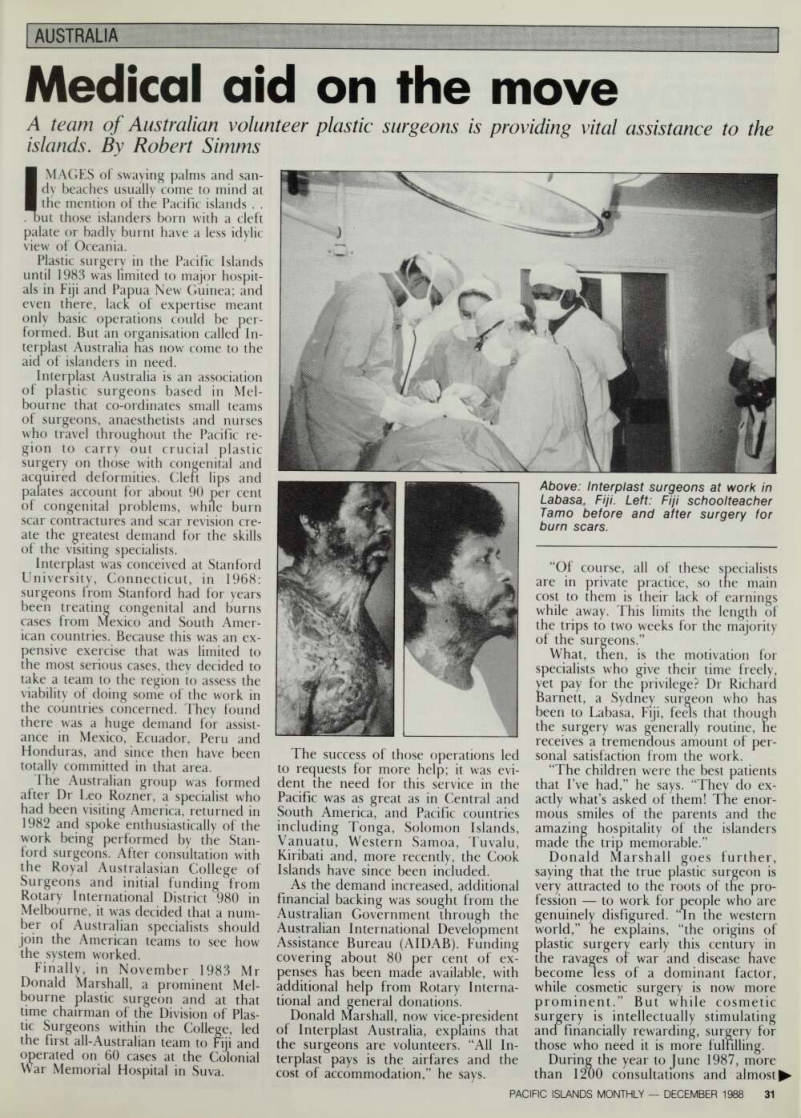
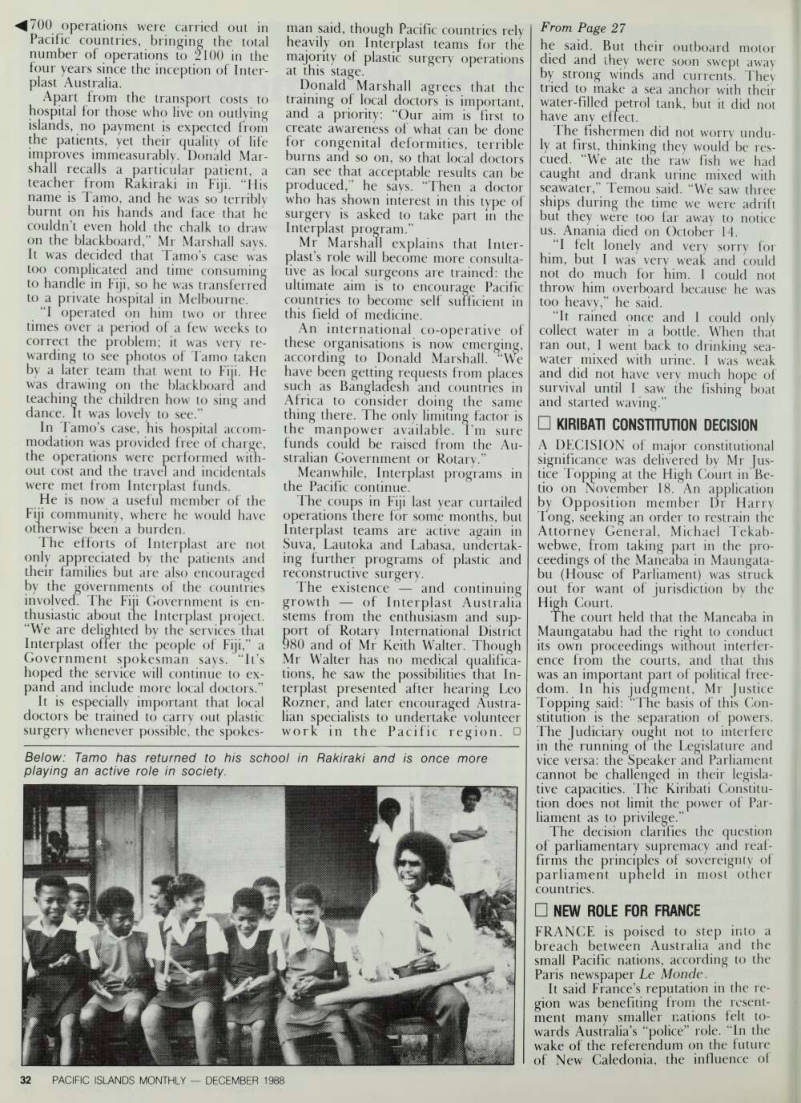
Australia
A team of Australian volunteer plastic surgeons is providing vital assistance to the
islands.
By Robert Simms
IMAGES of swaying palms and san dy beaches usually come to mind at tHe mention of the Pacific islands . . ut those islanders born with a cleft palate or badly burnt have a less idylic view of Oceania.
Plastic surgery in the Pacific Islands until 1983 was limited to major hospit als in Fiji and Papua New Guinea; and even there, lack of expertise meant only basic operations could be per formed. But an organisation called In terplast Australia has now come to the aid of islanders in need.
Interplast Australia is an association of plastic surgeons based in Mel bourne that co-ordinates small teams of surgeons, anaesthetists and nurses who travel throughout the Pacific re gion to carry out crucial plastic surgery on those with congenital and acquired deformities. Cleft lips and palates account for about 90 per cent of congenital problems, while burn scar contractures and scar revision cre ate the greatest demand for the skills
of the visiting specialists.
Interplast was conceived at Stanford University, Connecticut, in 1968: surgeons from Stanford had for years been treating congenital and burns cases from Mexico and South Amer ican countries. Because this was an ex pensive exercise that was limited to the most serious cases, they decided to take a team to the region to assess the viability of doing some of the work in the countries concerned. They found there was a huge demand for assist ance in Mexico, Ecuador, Peru and Honduras, and since then have been totally committed in that area.
The Australian group was formed after Dr Leo Rozner, a specialist who had been visiting America, returned in 1982 and spoke enthusiastically of the work being performed by the Stan ford surgeons. After consultation with the Royal Australasian College of Surgeons and initial funding from Rotary International District 980 in Melbourne, it was decided that a num ber of Australian specialists should join the American teams to see how the system worked.
Finally, in November 1983 Mr Donald Marshall, a prominent Mel bourne plastic surgeon and at that time chairman of the Division of Plas tic Surgeons within the College, led the first all-Australian team to Fiji and operated on 60 cases at the Colonial War Memorial Hospital in Suva.
The success of those operations led to requests for more help; it was evident the need for this service in the pacific was as great as in Central and South America, and Pacific countries
including Tonga, Solomon Islands,
Vanuatu, Western Samoa, Tuvalu, Kiribati and, more recently, the Cook Islands have since been included, As the demand increased, additional financial backing was sought from the Australian Government through the Australian International Development Assistance Bureau (AIDAB). Funding covering about 80 per cent of expenses has been made available, with additional help from Rotary International and general donations.
Donald Marshall, now vice-president of Interplast Australia, explains that the surgeons are volunteers. “All Interplast pays is the airfares and the cost of accommodation,” he says.
“Of course, all of these specialists are in private practice, so the main cost to them is their lack of earnings while away. This limits the length of the trips to two weeks for the majority of the surgeons.”
What, tnen, is the motivation for
specialists who give their time freely,
yet pay for the privilege? Dr Richard Barnett, a Sydney surgeon who has been to Labasa, Fiji, feels that though the surgery was generally routine, he receives a tremendous amount of per sonal satisfaction from the work.
“The children were the best patients that I’ve had,” he says. “They do ex actly what’s asked of them! Tne enor mous smiles of the parents and the amazing hospitality of the islanders made the trip memorable.”
Donald Marshall goes further, saying that the true plastic surgeon is very attracted to the roots of the pro fession to work for people who are genuinely disfigured. “In the western world,” he explains, “the origins of
plastic surgery early this century in
the ravages of war and disease nave become less of a dominant factor, while cosmetic surgery is now more prominent.” But while cosmetic
surgery is intellectually stimulating
and financially rewarding, surgery for those who need it is more fulfilling.
During the year to June 1987, more than 1200 consultations and almost ►
Above: Interplast surgeons at work in Labasa, Fiji. Left: Fiji schoolteacher Tamo before and after surgery for burn scars.
operations were carried out in Pacific countries, bringing the total number of operations to 2100 in the four years since the inception of Inter plast Australia.
Apart from the transport costs to hospital for those who live on outlying islands, no payment is expected from the patients, yet their quality of life
improves immeasurably. Donald Mar
shall recalls a particular patient, a teacher from Rakiraki in Fiji. “His name is Tamo, and he was so terribly burnt on his hands and face that he couldn’t even hold the chalk to draw on the blackboard,” Mr Marshall says.
It was decided that Tamo’s case was too complicated and time consuming to handle in Fiji, so he was transferred to a private hospital in Melbourne.
“I operated on him two or three times over a period of a few weeks to correct the problem; it was very re warding to see photos of Tamo taken by a later team that went to Fiji. He was drawing on the blackboard and teaching the children how to sing and dance. It was lovely to see.”
In Tamo’s case, his hospital accom modation was provided free of charge, the operations were performed with out cost and the travel and incidentals were met from Interplast funds.
He is now a useful member of the Fiji community, where he would have otherwise been a burden.
The efforts of Interplast are not
only appreciated by the patients and
their families but are also encouraged by the governments of the countries involved. The Fiji Government is en thusiastic about the Interplast project.
“We are delighted by the services that Interplast offer the people of Fiji,” a Government spokesman says. “It’s hoped the service will continue to ex pand and include more local doctors.”
It is especially important that local doctors be trained to carry out plastic surgery whenever possible, the spokes
man said, though Pacific countries rely heavily on Interplast teams for the majority of plastic surgery operations at this stage.
Donald Marshall agrees that the training of local doctors is important, and a priority: “Our aim is first to create awareness of what can be done for congenital deformities, terrible burns and so on, so that local doctors can see that acceptable results can be produced,” he says. “Then a doctor who has shown interest in this type of surgery is asked to take part m the Interplast program.”
Mr Marshall explains that Inter plast’s role will become more consulta tive as local surgeons are trained: the ultimate aim is to encourage Pacific countries to become self sufficient in this field of medicine.
An international co-operative of these organisations is now emerging, according to Donald Marshall. “We have been getting requests from places such as Bangladesh and countries in Africa to consider doing the same thing there. The only limiting factor is the manpower available. I’m sure funds could be raised from the Au stralian Government or Rotary.”
Meanwhile, Interplast programs in the Pacific continue.
The coups in Fiji last year curtailed operations there for some months, but Interplast teams are active again in Suva, Lautoka and Labasa, undertak ing further programs of plastic and reconstructive surgery.
The existence and continuing growth of Interplast Australia stems from the enthusiasm and sup port of Rotary International District 980 and of Mr Keith Walter. Though Mr Walter has no medical qualifica tions, he saw the possibilities that In terplast presented after hearing Leo Rozner, and later encouraged Austra lian specialists to undertake volunteer work in the Pacific region. □
Below: Tamo has returned to his school in Rakiraki and is once more playing an active role in society.
Raun Isi long Sydney
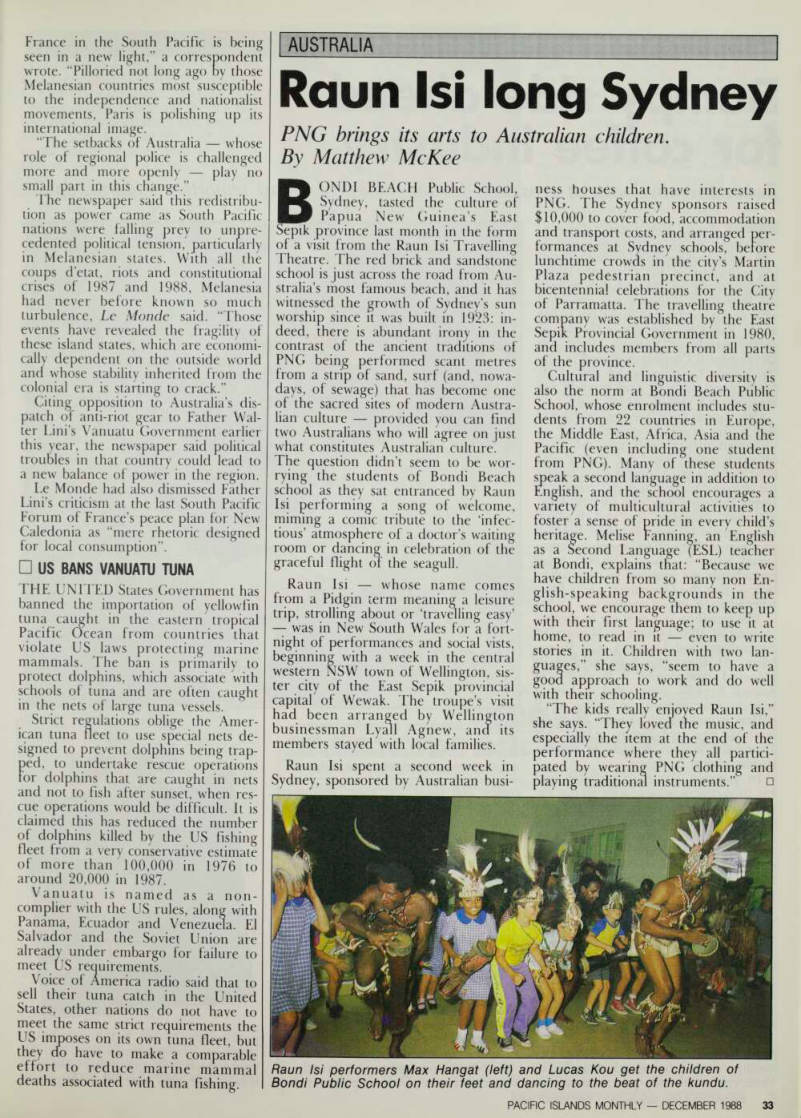
Australia
PNG brings its arts to Australian children.
By Matthew McKee
ONDI BEACH Public School, Sydney, tasted the culture of Papua New Guinea’s East Sepik province last month in the form of a visit from the Raun Isi Travelling Theatre. The red brick and sandstone school is just across the road from Australia’s most famous beach, and it has witnessed the growth of Sydney’s sun worship since it was built in 1923: indeed, there is abundant irony in the contrast of the ancient traditions of PNG being performed scant metres from a strip of sand, surf (and, nowadays, of sewage) that has become one of the sacred sites of modern Australian culture provided you can find two Australians who will agree on just what constitutes Australian culture.
The question didn’t seem to be worrying the students of Bondi Beach school as they sat entranced by Raun Isi performing a song of welcome, miming a comic tribute to the ‘infectious’ atmosphere of a doctor’s waiting room or dancing in celebration of the
graceful flight of the seagull.
Raun Isi - whose name comes from a Pidgin term meaning a leisure
trip, strolling about or ‘travelling easy’
- was in New South Wales for a fortnight of performances and social vists, beginning with a week in the central western NSW town of Wellington, sister city of the East Sepik provincial capital of Wewak. The troupe's visit
had been arranged by Wellington
businessman Lyall Agnew, and its members stayed with local families. 1 Raun Isi spent a second week in
Sydney, sponsored by Australian busi-
ness houses that have interests in PNG. The Sydney sponsors raised $lO,OOO to cover food, accommodation and transport costs, and arranged per formances at Sydney schools, before lunchtime crowds in the city’s Martin Plaza pedestrian precinct, and at bicentennial celebrations for the City of Parramatta. The travelling theatre company was established by the East Sepik Provincial Government in 1980, and includes members from all parts of the province.
Cultural and linguistic diversity is also the norm at Bondi Beach Public School, whose enrolment includes stu dents from 22 countries in Europe, the Middle East, Africa, Asia and the Pacific (even including one student from PNG). Many of these students speak a second language in addition to English, and the school encourages a variety of multicultural activities to foster a sense of pride in every child’s
heritage. Melise Fanning, an English
as a Second Language (ESL) teacher at Bondi, explains that: “Because we have children from so many non En
glish-speaking backgrounds in the
school, we encourage them to keep up with their first language; to use it at home, to read in it even to write stories in it. Children with two lan guages,” she says, “seem to have a good approach to work and do well with their schooling.
“The kids really enjoyed Raun Isi,” she says. “They loved the music, and especially the item at the end of the
performance where they all partici
pated by wearing PNG clothing and
playing traditional instruments.” □
Raun Isi performers Max Hangat (left) and Lucas Kou get the children of Bondi Public School on their feet and dancing to the beat of the kundu.
for coffee industry
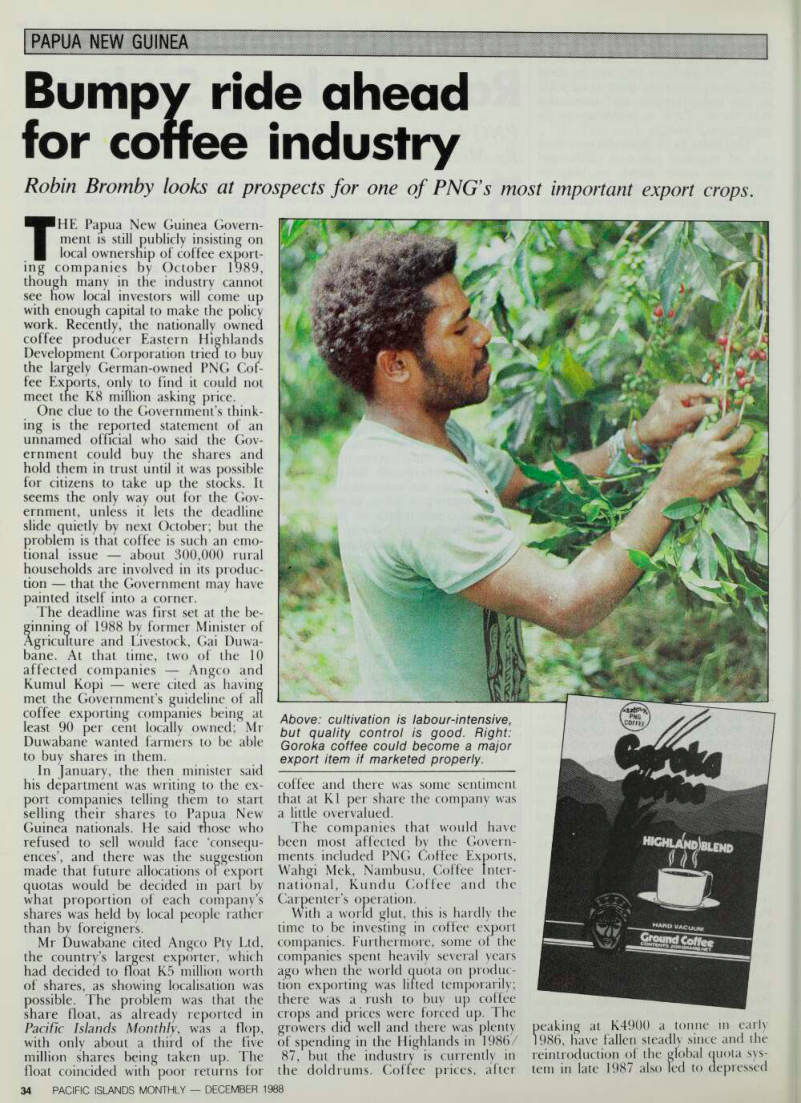
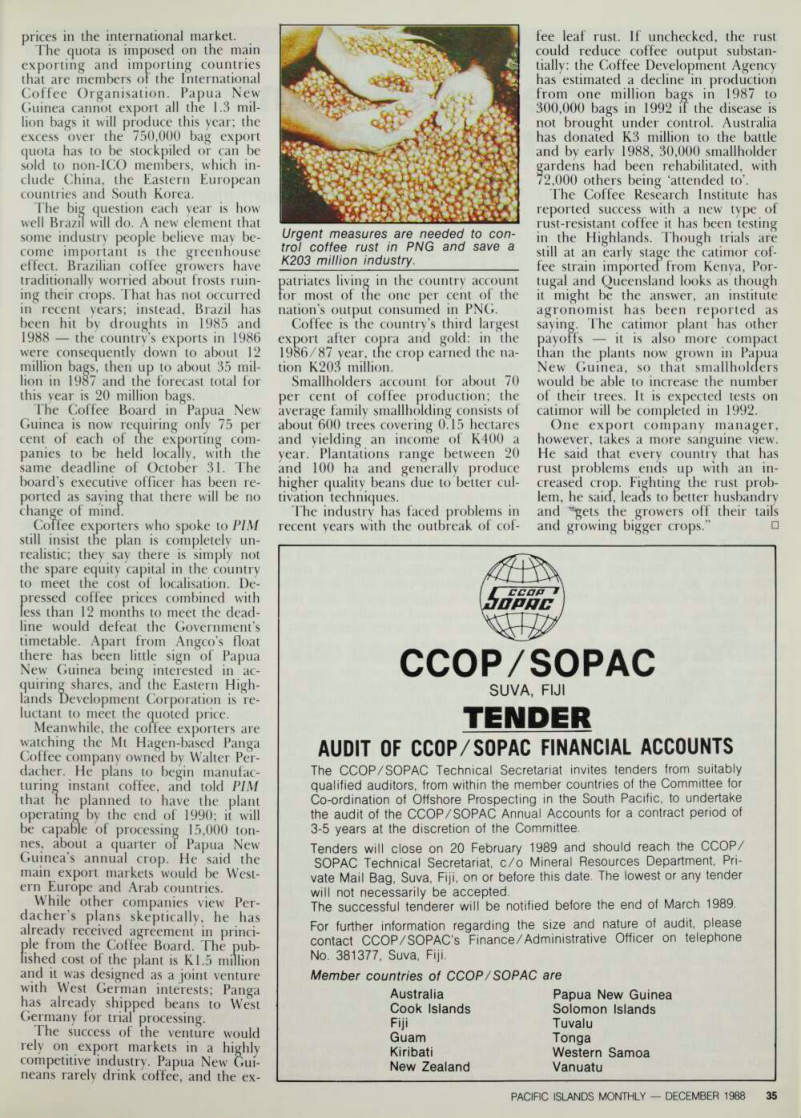
Papua New Guinea
Bumpy ride ahead for coffee industry
Robin Bromby looks at prospects for one of PNG’s most important export crops.
THE Papua New Guinea Govern ment is still publicly insisting on local ownership of coffee export ing companies by October 1989, though many in the industry cannot see now local investors will come up with enough capital to make the policy work. Recently, the nationally owned coffee producer Eastern Highlands
Development Corporation tried to buy
the largely German-owned PNG Cof fee Exports, only to find it could not meet trie K 8 million asking price.
One clue to the Government’s think ing is the reported statement of an unnamed official who said the Gov ernment could buy the shares and hold them in trust until it was possible for citizens to take up the stocks. It seems the only way out for the Gov ernment, unless it lets the deadline slide quietly by next October; but the problem is that coffee is such an emo tional issue about 300,000 rural households are involved in its produc tion that the Government may have painted itself into a corner.
The deadline was first set at the be ginning of 1988 by former Minister of Agriculture and Livestock, Gai Duwa bane. At that time, two of the 10 affected companies Angco and Kumul Kopi were cited as having met the Government’s guideline of all coffee exporting companies being at least 90 per cent locally owned; Mr Duwabane wanted farmers to be able to buy shares in them.
In January, the then minister said his department was writing to the ex port companies telling them to start selling their shares to Papua New Guinea nationals. He said those who refused to sell would face ‘consequ ences’, and there was the suggestion made that future allocations of export quotas would be decided in part by what proportion of each company’s shares was held by local people rather
than by foreigners.
Mr Duwabane cited Angco Pty Ltd, the country’s largest exporter, which had decided to float K 5 million worth of shares, as showing localisation was possible. The problem was that the share float, as already reported in Pacific Islands Monthly, was a flop, with only about a third of the five million shares being taken up. The float coincided with poor returns for
coffee and there was some sentiment that at K 1 per share the company was a little overvalued.
The companies that would have been most affected by the Govern ments included PNG Coffee Exports, Wahgi Mek, Nambusu, Coffee inter national, Kundu Coffee and the
Carpenter’s operation.
With a world glut, this is hardly the time to be investing in coffee export companies. Furthermore, some of the companies spent heavily several years ago when the world quota on produc tion exporting was lifted temporarily; there was a rush to buy up coffee crops and prices were forced up. The growers did well and there was plenty of spending in the Highlands in 1986/ 87, but the industry is currently in the doldrums. Coffee prices, after
peaking at K 4900 a tonne in early 1986, have fallen steadly since and the reintroduction of the global Quota sys tem in late 1987 also Fed to depressed
Above: cultivation is labour-intensive, but quality control is good. Right: Goroka coffee could become a major export item if marketed properly.
prices in the international market.
The quota is imposed on the main
exporting and importing countries
that are members of the International
Coffee Organisation. Papua New
Guinea cannot export all the 1.3 mil lion bags it will produce this year; the excess over the 750,000 bag export quota has to be stockpiled or can be sold to non-ICO members, which in clude China, the Eastern European countries and South Korea.
The big question each year is how well Brazil will do. A new element that some industry people believe may be come important is the greenhouse effect. Brazilian coffee growers have traditionally worried about frosts ruin ing their crops. That has not occurred in recent years; instead, Brazil has been hit by droughts in 1985 and 1988 the country’s exports in 1986 were consequently down to about 12 million bags, then up to about 35 mil lion in 1987 and the forecast total for this year is 20 million bags.
The Coffee Board in Papua New Guinea is now requiring only 75 per cent of each of tne exporting com panies to be held locally, with the same deadline of October 31. The board’s executive officer has been re ported as saying that there will be no change of mind.
Coffee exporters who spoke to PIM still insist tne plan is completely un realistic; they say there is simply not the spare equity capital in the country to meet the cost of localisation. De pressed coffee prices combined with less than 12 months to meet the dead line would defeat the Government’s timetable. Apart from Angco’s float there has been little sign of Papua New Guinea being interested in ac quiring shares, and the Eastern High lands Development Corporation is re luctant to meet the quoted price.
Meanwhile, the coffee exporters are
watching the Mt Hagen-based Panga
Coffee company owned by Walter Per dacher. He plans to begin manufac turing instant coffee, and told PIM that ne planned to have the plant operating by the end of 1990; it will be capable of processing 15,000 ton nes, about a quarter of Papua New Guinea’s annual crop. He said the main export markets would be West ern Europe and Arab countries.
While other companies view Per dacher’s plans skeptically, he has already received agreement in princi ple from the Coffee Board. The pub lished cost of the plant is K 1.5 million and it was designed as a joint venture with West German interests; Panga has already shipped beans to West
Germany for trial processing.
The success of the venture would rely on export markets in a highly
competitive industry. Papua New Gui
neans rarely drink coffee, and the ex-
patriates living in the country account for most of tne one per cent of the nation’s output consumed in PNG.
Coffee is the country’s third largest export after copra and gold: in the 1986/87 year, the crop earned the na tion K 203 million.
Smallholders account for about 70 per cent of coffee production; the average family smallholding consists of about 600 trees covering 0.15 hectares and yielding an income of K4OO a year. Plantations range between 20 and 100 ha and generally produce higher quality beans due to better cul
tivation techniques.
The industry has faced problems in recent years with the outbreak of cof
fee leaf rust. If unchecked, the rust could reduce coffee output substan
tially: the Coffee Development Agency
has estimated a decline in production from one million bags in 1987 to 300.000 bags in 1992 if the disease is not brought under control. Australia has donated K 3 million to the battle and by early 1988, 30,000 smallholder gardens had been rehabilitated, with 72.000 others being ‘attended to’.
The Coffee Research Institute has reported success with a new type of rust-resistant coffee it has been testing in the Highlands. Though trials are still at an early stage the catimor cof fee strain imported from Kenya, Por
tugal and Queensland looks as though
it might be the answer, an institute agronomist has been reported as saying. The catimor plant has other payoffs it is also more compact than the plants now grown in Papua New Guinea, so that smallholders would be able to increase the number of their trees. It is expected tests on catimor will be completed in 1992.
One export company manager, however, takes a more sanguine view.
He said that every country that has rust problems ends up with an in creased crop. Fighting the rust prob lem, he said, leads to better husbandry and **gets the growers off their tails
and growing bigger crops.” □
Urgent measures are needed to con trol coffee rust in PNG and save a K 203 million industry.
Advertisements & other items, p. 35 (1 item)
Ccop/Sopac
SUVA, FIJI
TEMPER
AUDIT OF CCOP/SOPAC FINANCIAL ACCOUNTS
The CCOP/SOPAC Technical Secretariat invites tenders from suitably qualified auditors, from within the member countries of the Committee for Co-ordination of Offshore Prospecting in the South Pacific, to undertake the audit of the CCOP/SOPAC Annual Accounts for a contract period of 3-5 years at the discretion of the Committee.
Tenders will close on 20 February 1989 and should reach the CCOP/ SOPAC Technical Secretariat, c/o Mineral Resources Department, Private Mail Bag, Suva, Fiji, on or before this date. The lowest or any tender will not necessarily be accepted.
The successful tenderer will be notified before the end of March 1989.
For further information regarding the size and nature of audit, please contact CCOP/SOPAC’s Finance/Administrative Officer on telephone No. 381377, Suva, Fiji.
Member countries of CCOP/SOPAC are Australia Cook Islands Fiji Guam Kiribati New Zealand Western Samoa Vanuatu Tuvalu Tonga Papua New Guinea Solomon Islands
passport tribulations
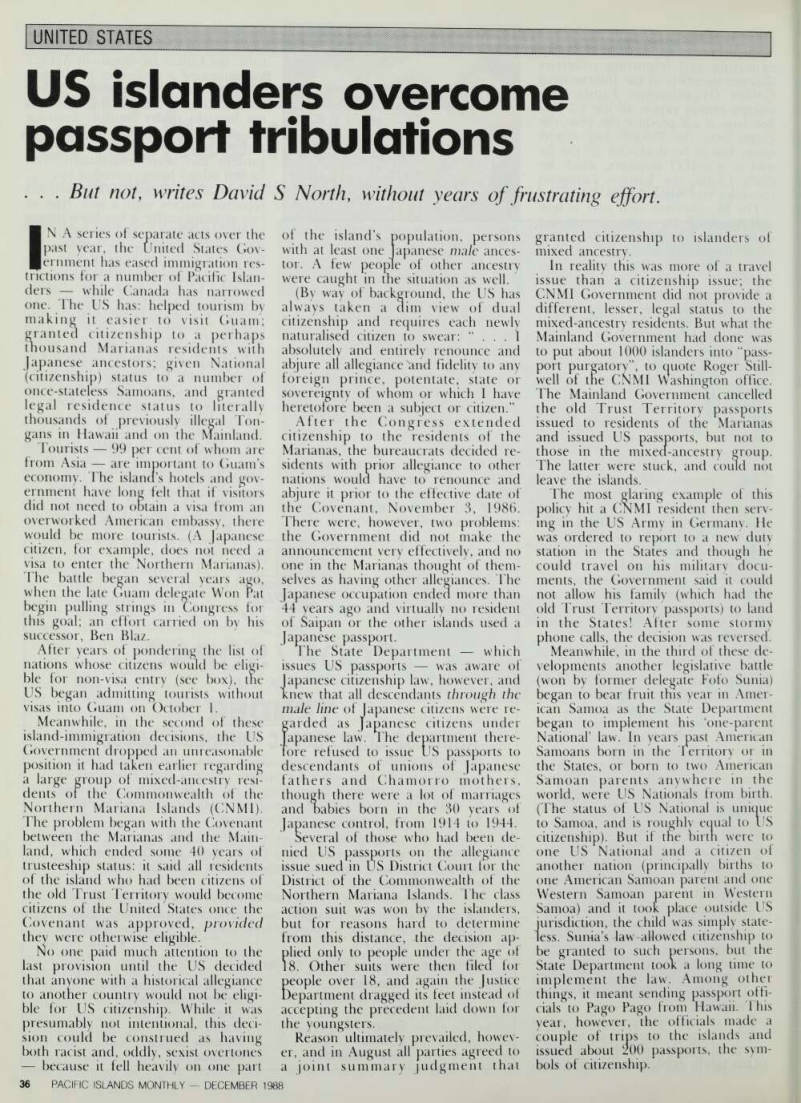
United States
US islanders overcome passport tribulations
. . . But not, writes David S North, years of frustrating effort.
IN A series of separate acts over the past year, the United States Gov ernment has eased immigration res trictions for a number of Pacific Islan ders while Canada has narrowed one. The US has: helped tourism by making it easier to visit Guam; granted citizenship to a perhaps thousand Marianas residents with
Japanese ancestors; given National
(citizenship) status to a number of once-stateless Samoans, and granted legal residence status to literally thousands of previously illegal Ton gans in Hawaii and on the Mainland.
Tourists 99 per cent of whom are from Asia are important to Guam’s economy. The island’s hotels and gov ernment have long felt that if visitors did not need to obtain a visa from an overworked American embassy, there would be more tourists. (A Japanese citizen, for example, does not need a visa to enter the Northern Marianas).
The battle began several years ago, when the late Guam delegate Won Pat
begin pulling strings in Congress for
this goal; an effort carried on by his successor, Ben Blaz.
After years of pondering the list of nations whose citizens would be eligi ble for non-visa entry (see box), the US began admitting tourists without visas into Guam on October 1.
Meanwhile, in the second of these island-immigration decisions, the US Government dropped an unreasonable position it had taken earlier regarding a large group of mixed-ancestry resi dents of the Commonwealth of the Northern Mariana Islands (CNMI).
The problem began with the Covenant between the Marianas and the Main land, which ended some 40 years of trusteeship status; it said all residents of the island who had been citizens of the old Trust Territory would become citizens of the United States once the
Covenant was approved, provided
they were otherwise eligible.
No one paid much attention to the last provision until the US decided that anyone with a historical allegiance to another country would not be eligi ble for US citizenship. While it was presumably not intentional, this deci sion could be construed as having both racist and, oddly, sexist overtones because it fell heavily on one part
of the island’s population, persons with at least one Japanese male ances tor. A few people of other ancestry were caught in the situation as well. (By way of background, the US has always taken a dim view of dual
citizenship and requires each newly
naturalised citizen to swear: “ . . . 1 absolutely and entirely renounce and abjure all allegiance "and fidelity to any foreign prince, potentate, state or sovereignty of whom or which I have heretofore been a subject or citizen.”
After the Congress extended citizenship to the residents of the Marianas, the bureaucrats decided re sidents with prior allegiance to other nations would have to renounce and abjure it prior to the effective date of the Covenant, November 3, 1986.
There were, however, two problems; the Government did not make the announcement very effectively, and no one in the Marianas thought of them selves as having other allegiances. The Japanese occupation ended more than 44 years ago and virtually no resident of Saipan or the other islands used a
Japanese passport.
The State Department which issues US passports was aware of Japanese citizenship law, however, and Knew that all descendants through the male line of Japanese citizens were re garded as Japanese citizens under Japanese law. The department there fore refused to issue US passports to descendants of unions of Japanese fathers and Chamorro mothers, though there were a lot of marriages and Babies born in the 30 years of Japanese control, from 1914 to 1944.
Several of those who had been de nied US passports on the allegiance issue sued in US District Court lor the District of the Commonwealth of the Northern Mariana Islands. The class action suit was won by the islanders, but for reasons hara to determine from this distance, the decision ap plied only to people under the age of 18. Other suits were then filed for Eeople over 18, and again the Justice ►epartment dragged its feet instead of accepting the precedent laid down for the youngsters.
Reason ultimately prevailed, howev
er, and in August all parties agreed to a joint summary judgment that
granted citizenship to islanders of mixed ancestry.
In reality this was more of a travel issue than a citizenship issue; the CNMI Government did not provide a different, lesser, legal status to the mixed-ancestry residents. But what the Mainland Government had done was to put about 1000 islanders into “pass port purgatory”, to Quote Roger Still well of the CNMI Washington office.
The Mainland Government cancelled the old Trust Territory passports issued to residents of the Marianas and issued US passports, but not to those in the mixea-ancestry group.
The latter were stuck, and could not leave the islands.
The most glaring example of this policy hit a CNMI resident then serv ing in the US Army in Germany. He was ordered to report to a new duty station in the States and though he could travel on his military docu ments, the Government said it could not allow his family (which had the old Trust Territory passports) to land in the States! After some stormy phone calls, the decision was reversed.
Meanwhile, in the third of these de
velopments another legislative battle
(won by former delegate Fofo Sunia) began to bear fruit this year in Amer ican Samoa as the State Department
began to implement his ‘one-parent
National’ law. In years past American Samoans born in the Territory or in the States, or born to two American Samoan parents anywhere in the world, were US Nationals from birth. (The status of US National is unioue to Samoa, and is roughly eaual to US citizenship). But if the birth were to one US National and a citizen of another nation (principally births to one American Samoan parent and one Western Samoan parent in Western Samoa) and it took place outside US jurisdiction, the child was simply state less. Sunia’s law allowed citizenship to be granted to such persons, but the State Department took a long time to implement the law. Among other things, it meant sending passport offi cials to Pago Pago from Hawaii. This year, however, the officials made a couple of trips to the islands and issued about 200 passports, the sym bols of citizenship.
The fourth major change in im
migration practices took place on the
Mainland, in Hawaii and in Guam, and that it was helpful to thousands of islanders came as a total surprise to
immigration specialists. The long
debated Immigration Reform and Control Act (IRCA) of 1986 created, among other things, an alien legalisa tion program for two classes of aliens: those who had been in the US illegally since 1982, and those who had been illegally in the states for a shorter period who had done some farm work. These amnesty provisions were designed primarily for former resi dents of Mexico, particularly Mexican farmworkers who are important to California’s powerful farm interests.
No one expected that close to 3000
Tongans would apply for legislation,
but they did (bear in mind that Tonga is a long way from the United States, that there are only about 100,000 Tongans living in the homeland, that there are no direct flights to the States, and that a Tongan wanting a visa to the US must apply for it in Suva). Even more surprising to Main land immigration officials was the fact that more than half of the Tongans applied as farmworkers. The agri cultural program was an easier route to legal status that the other one, and
was generally regarded as dogged by
large numbers of fraudulent applica tions though there was no specific discussion of Tongan fraud as there had been by applicants from Pakistan, Bangladesh, Haiti and Mexico.
The number of applicants for lega lisation from South Pacific jurisaic tions were as follows:
Tonga 2921
Western Samoa 962 Australia 340 New Zealand 294
Fiji 246
Palau 117 Nauru 8 Papua New Guinea 7 French Polynesia 5 Solomon Islands 3
Fsm 1
Kiribati 1 New Caledonia 1 Tuvalu 1 Vanuatu 1 Total 5913 Most of the applications from Ton ga and from other islands were filed m California (particularly South Los Angeles) and in Hawaii.
While the US, sometimes unwitting ly . . . and sometimes gracelessly, was opening various doors to islanders, Canada narrowed one. Unlike the Un ited States, Canada allows citizens of many nations to enter without visas but has a list for which visas are re quired. Following the coups in Fiji, for example, that nation was added to the visa fist though Fiji continues to
turn the other cheek, and Canadians do not need a visa to visit Fiji.
One other barrier continues to slow travel from the independent islands of the South Pacific to the United States: the number of the places where one can secure an American visa. The US Department of State issues visas in the former Trust Territories (FSM, Marshalls, Palau and CNMI) and in Suva and Port Moresby, but nowhere else in the Pacific not in any of the French territories, the Solomons, Vanuatu, Western Samoa or even in American Samoa (where they were formerly available).
When asked if visa issue would be restored in Pago Pago, one senior
State Department official exploded
“over my dead body”: it seems the Governors of American Samoa and the Panama Canal Zone and their designees could in the past issue tourist visas, but the American Immigration Service was soon complaining to the State Department about the strange
parade of Iranians, Hong Kong
Chinese and other non-Pacific and non-Latin American people who were showing up with unlikely tales . . . and Governor’s visas.
First, the Department tried to
change the Pago Pago issue practices
to no avail. Then it sought to encourage some agency to investigate the pattern, but found that no one was willing to take jurisdiction in such an odd arrangement: not the State De-
partment’s internal investigations unit,
not the Department of the Interior
and not the FBI. State officials and
Congressional staff finally used just
about the most obscure legislative vehicle available to kill the practice they attached language to a private bill dealing with an individual immigrant, which allowed the immigrant into the State while taking the visa power away from the Governors, Though the US quietly took care of its P a go ? a go visa problem, one really outrageous immigration scam con tinues in the South Pacific: the sale of ‘Tonga Protected Persons’ passports.
These documents formerly cost about |USBOOO each, but now they are avail able for “a fee prescribed by His Majesty in Council in other words, a fee set by regulation . . . or, perhaps, by what the traffic will bear.
These passports’ are virtually
worthless as travel documents among the many nations that do not accept them are Australia, Canada, New Zealand, Papua New Guinea and the United States and they do not guarantee the holder entrance into Tonga, either. However, it is said some Latin American nations have been known to accept them.
On the other hand, the documents are hardly worthless to the Kingdom of Tonga. According to a government publication quoted m The South Sea Digest (July 8, 1988) Tonga sold $U56,500,000 worth of ‘Tonga Pro tected Person’ passports between Janu ary 1986 and April 1988. No wonder Tonga, with minimal exports, enjoys a balance of payments surplus! □
Visa freedom... and regional ignorance
PEOPLE from the following nations no longer require a visa to visit Guam: Brunei, Burma, Indonesia, Japan, Malaysia, Nauru, New Zealand, Papua New Guinea, Singapore, Solomons, Un
ited Kingdom (including Hong Kong),
Vanuatu and Western Samoa.
The US Government made up the list by calculating the rate of visa denials by country of origin. Countries where visa denials are high such as the Philip pines and Korea were eliminated no matter how much Guam pressed for their inclusion on the visa-waiver list.
Japanese, for example, only rarely over
stay US visas, hence they were good candidates for the no-visa arrangement.
SOMETIMES Governments in North America need geography lessons, to wit: • For months the Uo Immigration and Naturalisation Service (INS) showed St Kitts, the former British Caribbean col ony as a South Pacific Island in its statistical reports. • Canada’s instructions to its consular officers say the citizens of the Solomon
Islands do not need a visa to enter Cana da, but people from the ‘British Solomon Islands’ do need such a visa. • Similarly, Canada tells its consuls that citizens of American Samoa need a visa if they want to visit Canada, but that Nationals of the United States do not need visas; however, the only Nationals (as opposed to citizens) of the United States are American Samoans and US National status is the norm for residents of that territory. • Finally, the INS General Counsel felt it necessary to write ‘Western Samoa was and still is an independent country’ when he defined what was and what was not part of the United States for the pur poses of its alien amnesty program. In that program aliens who had been illegal ly on US territory since January 1, 1982, could seek legal status. The General Counsel ruled that the program applied to Guam, but not to American Samoa, the Commonwealth of the Northern Mariana Islands, the Federated States of Micronesia, the Republic of the Marshalls or the Republic of Palau. □
Small-scale industry
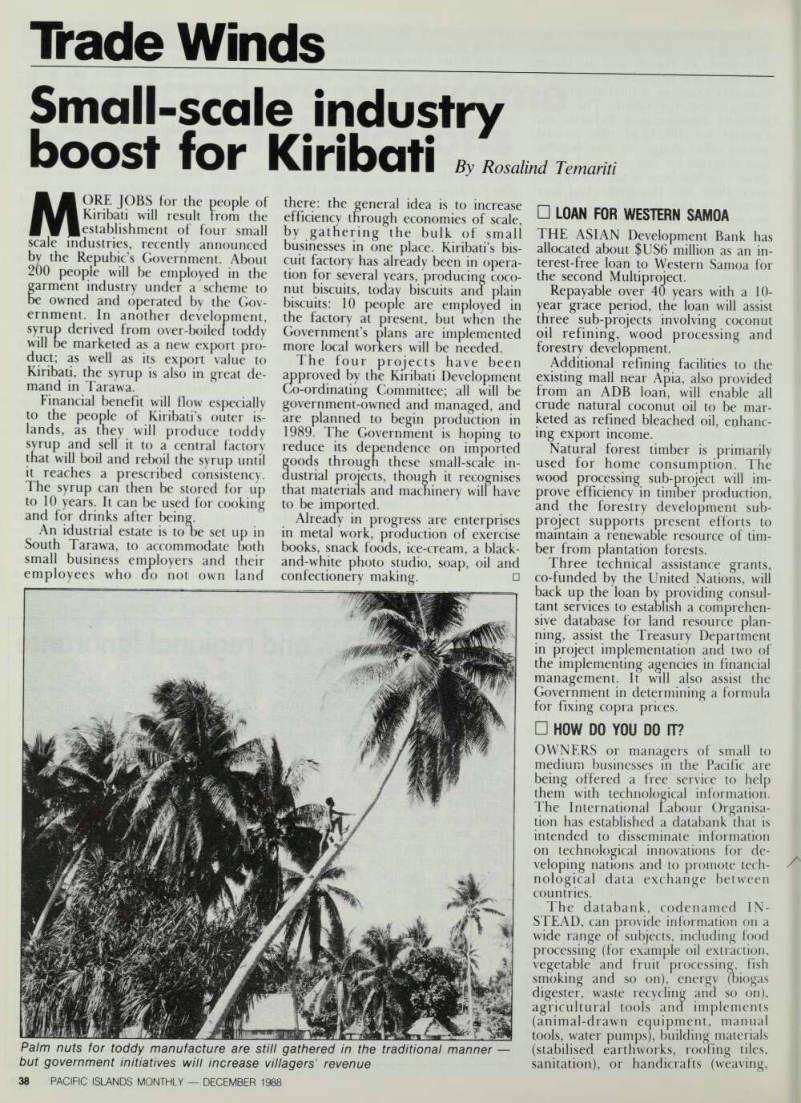
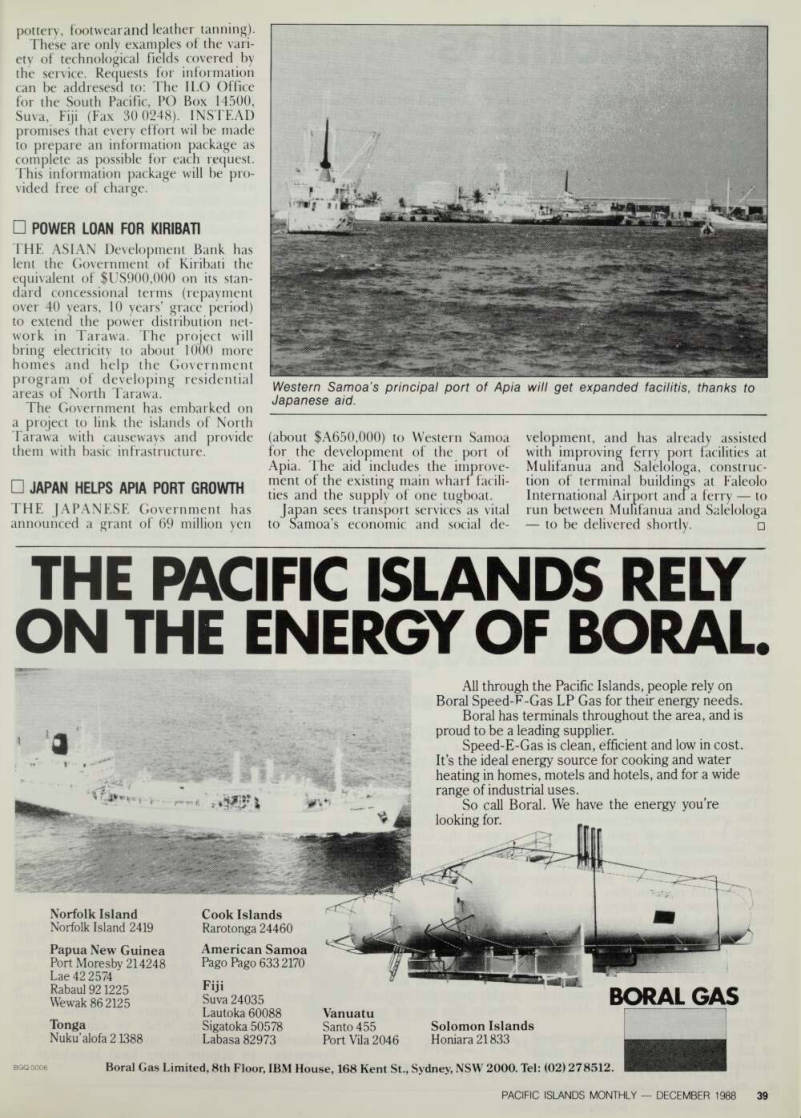
Trade Winds
Small-scale industry boost for Kiribati
By Rosalind Temariti
MO RE JOBS for the people of Kiribati will result from the establishment of four small scale industries, recently announced oL the Re P ubl . c s Government. About 200 people will be employed in the garment industry under a scheme to be owned and operated by the Government. In another development, syrup derived from over-boiled toddy will be marketed as anew export product; as well as its export value to Kiribati, the syrup is also in great demand in Tarawa.
Financial benefit will flow especially to the people of Kiribati’s outer islands, as they will produce toddy syrup and sell it to a central factory that will boil and reboil the syrup until it reaches a prescribed consistency, The syrup can then be stored for up to 10 years. It can be used for cooking and for drinks after being.
An idustrial estate is to oe set up in South Tarawa, to accommodate both small business employers and their employees who do not own land
there: the general idea is to increase efficiency through economies of scale, by gathering the bulk of small businesses in one place. Kiribati’s bis cuit factory has already been in opera tion for several years, producing coco nut biscuits, today biscuits and plain biscuits: 10 people are employed in the factory at present, but when the Government’s plans are implemented more local workers will be needed.
The four projects have been approved by the Kiribati Development Co-ordinating Committee; all will be government-owned and managed, and
are planned to begin production in
1989. The Government is hoping to reduce its dependence on imported goods through these small-scale in dustrial projects, though it recognises that materials and machinery will have to be imported.
Already in progress are enterprises in metal work, production of exercise books, snack foods, ice-cream, a black and-white photo studio, soap, oil and
confectionery making. □
□ Loan For Western Samoa
THE ASIAN Development Bank has allocated about SUS 6 million as an in terest-free loan to Western Samoa for the second Multiproject.
Repayable over 40 years with a 10year grace period, the loan will assist
three sub-projects involving coconut
oil refining, wood processing and
forestry development.
Additional refining facilities to the existing mall near Apia, also provided from an ADB loan, will enable all crude natural coconut oil to be mar keted as refined bleached oil, enhanc ing export income.
Natural forest timber is primarily used for home consumption. The wood processing sub-project will im prove efficiency in timber production, and the forestry development sub project supports present efforts to maintain a renewable resource of tim ber from plantation forests.
Three technical assistance grants, co-funded by the United Nations, will back up the loan by providing consul tant services to estaohsh a comprehen sive database for land resource plan ning, assist the Treasury Department in project implementation and two of the implementing agencies in financial management. It will also assist the Government in determining a formula
for fixing copra prices.
□ How Do You Do It?
OWNERS or managers of small to medium businesses in the Pacific are being offered a free service to help them with technological information.
The International Labour Organisa tion has established a databank that is intended to disseminate information on technological innovations for de veloping nations and to promote tech
nological data exchange between
countries.
The databank, codenamed IN STEAD, can provide information on a wide range of subjects, including food processing (for example oil extraction, vegetable and fruit processing, fish smoking and so on), energy i[biogas digester, waste recycling and so on), agricultural tools ana implements (animal-drawn equipment, manual tools, water pumps), building materials (stabilised earthworks, roofing tiles, sanitation), or handicrafts (weaving,
Palm nuts for toddy manufacture are still gathered in the traditional manner but government initiatives will increase villagers’ revenue
pottery, footwearand leather tanning).
These are only examples of the vari ety of technological fields covered by the service. Requests for information can be addresesd to: The ILO Office for the South Pacific, PO Box 14500, Suva, Fiji (Fax 30 0248). INSTEAD promises that every effort wil be made to prepare an information package as complete as possible for each request.
This information package will be pro vided free of charge.
□ Power Loan For Kiribati
TFIE ASIAN Development Bank has lent the Government of Kiribati the equivalent of |US9OO,OOO on its stan dard concessional terms (repayment over 40 years, 10 years’ grace period) to extend the power distribution net work in Tarawa. The project will bring electricity to about 1000 more homes and help the Government program of developing residential areas of North Tarawa.
The Government has embarked on a project to link the islands of North Tarawa with causeways and provide them with basic infrastructure.
□ Japan Helps Apia Port Growth
THE JAPANESE Government has announced a grant of 69 million yen
(about $A650,000) to Western Samoa for the development of the port of Apia. The aid includes the improve ment of the existing main wharf facili ties and the supply of one tugboat.
Japan sees transport services as vital to Samoa’s economic and social de
velopment, and has already assisted with improving ferry port facilities at Mulifanua and Salelologa, construc tion of terminal buildings at Faleolo International Airport ana a ferry to run between Mulifanua and Salelologa to be delivered shortly. □
Western Samoa’s principal port of Apia will get expanded fad litis, thanks to Japanese aid.
Advertisements & other items, p. 39 (1 item)
The Racific Islands Rely
ON THE ENERGY OF BORAL
All through the Pacific Islands, people rely on Boral Speed-P-Gas LP Gas for their energy needs.
Boral has terminals throughout the area, and is proud to be a leading supplier.
Speed-E-Gas is clean, efficient and low in cost.
It’s the ideal energy source for cooking and water heating in homes, motels and hotels, and for a wide range of industrial uses.
So call Boral. We have the energy you’re looking for. a V ■hi
SsSSi
■ Norfolk Island Norfolk Island 2419 Papua New Guinea Port Moresby 214248 Lae 42 2574 Rabaul 921225 Wewak 86 2125 Tonga Nukualofa 21388 Cook Islands Rarotonga 24460 American Samoa Pago Pago 6332170 Fiji Suva 24035 Lautoka 60088 Sigatoka 50578 Labasa 82973
BORAL GAS
Vanuatu Santo 455 Port Vila 2046 Solomon Islands Honiara 21833 Boral Gas Limited, Bth Floor, IBM House, 168 Kent St., Sydney, NSW 2000. Tel: (02) 278512.
Tropicalities

Institute “Not Critical”
I WRITE in relation to the article ■ ‘Nauruans dying of wealth’, pub lished in the Dominion Sunday Times and reprinted in Pacific Islands Monthly, October 1988.
The article contains a number of in accurate statement attributed to this Institute. None of these represents an accurate view of the Institute and I would like to provide your readers with a more balanced position regard ing health problems not only in Nauru but in the whole Pacific region.
The Nauru Government has been concerned about the nation’s health problems, and the Government of President Hammer de Roburt has been working with this Institute for almost a decade to define the problem and to implement preventive mea sures. The Institute is not, as claimed by the writer, critical of the Nauru Government and its position has been
seriously misrepresented.
The intrusion of Western people and their lifestyles into Pacific Island cultures, whether initiated by mission ary zeal, commercial interests, political opportunism or even humanitarianism has inevitably led to considerable changes in the spectrum of disease. In a number of Pacific nations, so-called ‘Western’ diseases (heart disease, hypertension, strokes and diabetes) have now reached levels similar to or exceeding those seen in the European populations of Australia and New Zea land. Fragile island economies and health systems are ill-prepared to meet the cost of these chronic diseases.
Nauru appears to have suffered the greatest toll, but many other Microne sian and Polynesian nations are rapid ly catching up. A health problem of similar magnitude exists within the New Zealand Maori and Australian
Aboriginal communities.
The medical facts cited about Nauru in the article are correct and were pre sented by me at an open hearing of the Commission of Inquiry into the rehabilitation of the worTea-out phos phate lands in Nauru. My evidence was reported in a number of Austra lian newspapers, and there was no cri ticism of the Nauru Government.
In fact, criticism was directed at the major powers in the Pacific region for ignoring the social, cultural and health effects of their political and economic contact with both the islands and their own indigenous (Maori and Aborigin al) communities.
The Nauru Government has moved to take action in a number of areas including the establishment of a di
abetes prevention and control clinic, the appointment of a dietitian, fre quent visits to the island by consul tants in diabetes and eye disorders, and the importation of certain dietary foods. Nauruans with complications from these diseases are provided with medical care in Australia if they can not be managed in Nauru.
Nauruan patients are no different from those in Australia and New Zea land where compliance with recom mended dietary and medical treat ment is far from optimal.
The article in question has not pro vided a balanced picture of the prob lem one that now faces nearly every Pacific nation. I would therefore be grateful if you would give my reply
equal prominence.
Professor Paul Zimmet Lios-Intemational Diabetes Institute Melbourne, Australia
Pacific Islands Monthly is always glad
to have balance. However, it appears Professor Zimmet has to educate not only us but his own staff: he disowns the assessment made by Dr Dowse, and we accept that the professor’s is the official view of the institute.
On the other hand, he does not go far to deny or disprove Dr Dowse’s assessment. That “the Government has moved to act” after 10 years is not exactly a lightning response to a prob lem that has surely been quite visible for most of that time.
Horrified By Png Attack
I WAS shocked to read in the October edition of the senseless, brutal attack on Mr Justice Barnett in Port Moresby on September 10. As with most news from PNG, no mention was made of this in the Australian press.
What is Papua New Guinea coming to when this sort of thing is becoming commonplace? Do they want such notoriety as is witnessed m South Afri ca? If so, they are fast heading in the
right direction.
Tos Barnett is well known to me both professionally and as a friend.
Our association goes back to school days in Melbourne. He has devoted many years of his life to service to the people of PNG, and is generally very highly regarded. He certainly doesn’t deserve this sort of treatment.
H F Nankervis Prosperine Queensland, Australia
Festival Disappointment
AFTER eagerly travelling to Australia from Israel I was bitterly disappointed in the Festival of Pacific Arts held in Townsville. I agree wholeheartedly with Sina Powell s letter in Pacific Is lands Monthly, October.
I had attended the truly magnificent original festival held in Suva m 1972, and it was with memories of that wonderful experience that I came to Australia this year.
At Townsville the groups that came from the island countries were all de lightful, and the audiences were re ceptive. The disaster of this year’s fes tival was caused by the ineptitude and the indifference of the organisers and their selfish and callous concen tration on their own political activities.
This was an unforgivable intrusion in an arts festival.
A Golberg Tel Aviv Israel
Pacific Journalism Defended
I WOULD like to respond to some of David Robie’s observations in his arti cle, ‘Sope’s Desperate Gamble Falters’
Pacific Islands Monthly, September)
especially since I was named.
It seems we now suffer the same cliches the South Pacific Islands have complained about for such a long time that is, we are all lumped together without distinction.
Nevertheless, David Robie’s criticism (and that of the Vanuatu Govern ment) of sensationalist “war hungry” journalists cannot be dismissed. In fact it is a growing chorus in the region.
One observation is that Australian news organisations, especially televi sion networks, are only beginning to see the significance of the region.
It is also true that the “deadline driven” approach to stories taken in Australia is not suited to a region vyhere national economies are so sensi tive to the ebb and flow of tourists. At the same time, it is unreasonable to expect journalists not to report, for example, coups in Fiji or a constitu tional crisis in Vanuatu.
But just as there are many different cultures and priorities in South Pacific countries, so too are there different types of journalism. I, and the vast majority of my colleagues, work long and hard to present as accurate and balanced a picture of regional events as possible. While we cannot change our deadlines, many of us are trying to acquire more local knowledge to help that process.
Sometimes we also must work within restrictions imposed on us by South Pacific governments. “Beating up” a story with mythical references to impending doom is not doing the job properly. It embarrasses us all.
The other point is: did David Robie see any of the stories on Vanuatu go to air on ABC TV? We pride ourselves on treating stories objectively: in fact, I have just been appointed
a full-time diplomatic correspondent,
It reflects our belief that the South Pacific is of prime importance and should not be seen as a hit-and-miss story only if there is trouble.
We are not “war hungry”. We are information hungry and if we do that well enough, Australian audiences will be better educated about the region’s
emerging political and economic
geography.
Finally, the contempt of court case against me followed a regrettable incident with over-zealous camera crews from the ABC and another TV network who were outside the courtroom while the rest of us were inside, Nevertheless, I took responsibility for the actions of the ABC crew for which I apologised sincerely to the court.
The only reason we were called back to court later in the week was because the judge was under the misapprehension that the ABC had
broken an undertaking to the court, We hadn’t. It goes to show there can be misunderstanding on all sides.
Margot O’Neill Diplomatic Correspondent, ABC TV Parliament House Canberra, Australia
Vanuatu Bank Update
YOUR article on finance, banking and insurance (Pacific Islands Monthly, November) was of great interest; however, certain facts concerning the
Vanuatu Co-operative Savings Bank
(VCSB) are no longer accurate.
The VCSB was a division of the Vanuatu Co-operative Federation until December 1986, when a new company was formed and obtained a banldng licence. "
Prior to this the VCSB’s branch structure was rationalised, with the number of branches being reduced to 20 prior to the transfer of the business to the new company. The VCSB has since opened two new branches and we are examining potential sites as resources allow. We have also diversified our invetments away from other banks and towards government bonds and offshore investments. Our offshore investments, however, did not perform as well as those of the Bank of Kiribati or the National Bank of Tuvalu, being
responsible for VT0.17 million of the VT0.23 million loss in 1987/88.
The problems we currently face are similar to quite a few banks in this region, and include an insufficient
capital base, earning capacity reduced
by imposition of Central Bank reserve requirements, lack of experienced staff, communications, and restricted internal investment opportunities. In the face of these difficulties the VCSB continues to operate and work toward being able to offer services requuired to customers and potential customers, David C. Whiskert Vanuatu Co-operative Savings Bank Port Vila
Pacific Ships Update
PRINTER’S ink is supposed to flc ,v in our veins but all too often it’s prim ter’s imps that cause problems for Pacific islands Monthly, as for all other publications. Due to a technical error, the address was accidentally left off Ms Vera Hatton’s letter in the November issue Pim .
All those Pacific history buffs who would like to help her in her quest for information should write to: Vera Hatton PO Box 634 Nowra, NSW Australia 2541
Advertisements & other items, p. 41 (1 item)
into your life...
Put dome colour
□ Full Colour and Multi-Colour Printing □ Books and Publication specialists □ Photo Typesetting □ Annual Reports Magazines Year Books our speciality! □ Free Quotation Service □ Posters and Programmes
Fiji Times Ltd
PUBLISHERS AND COMMERCIAL PRINTERS
PHONE SUVA 314 111 TELEX 2124 TIMES SV FJ
FAX SUVA 301521
FOR ALL YOUR QUALITY
COLOUR PRINTING REQUIREMENT
Matthew Mckee
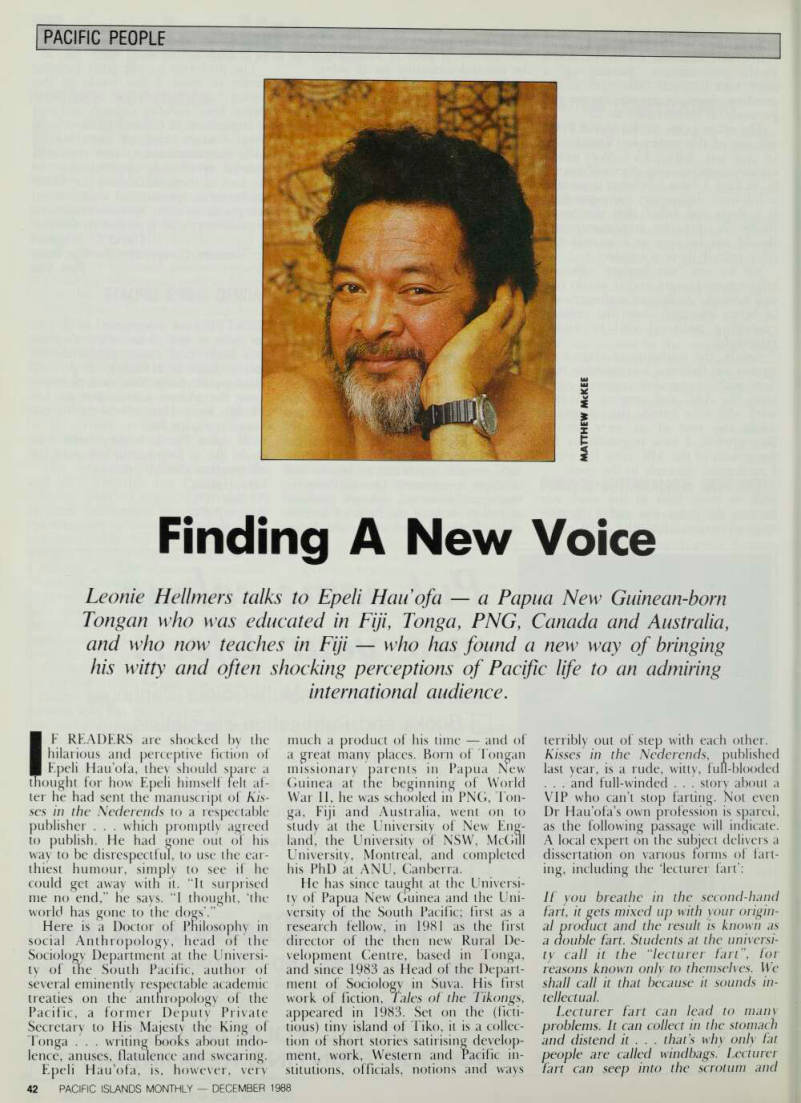
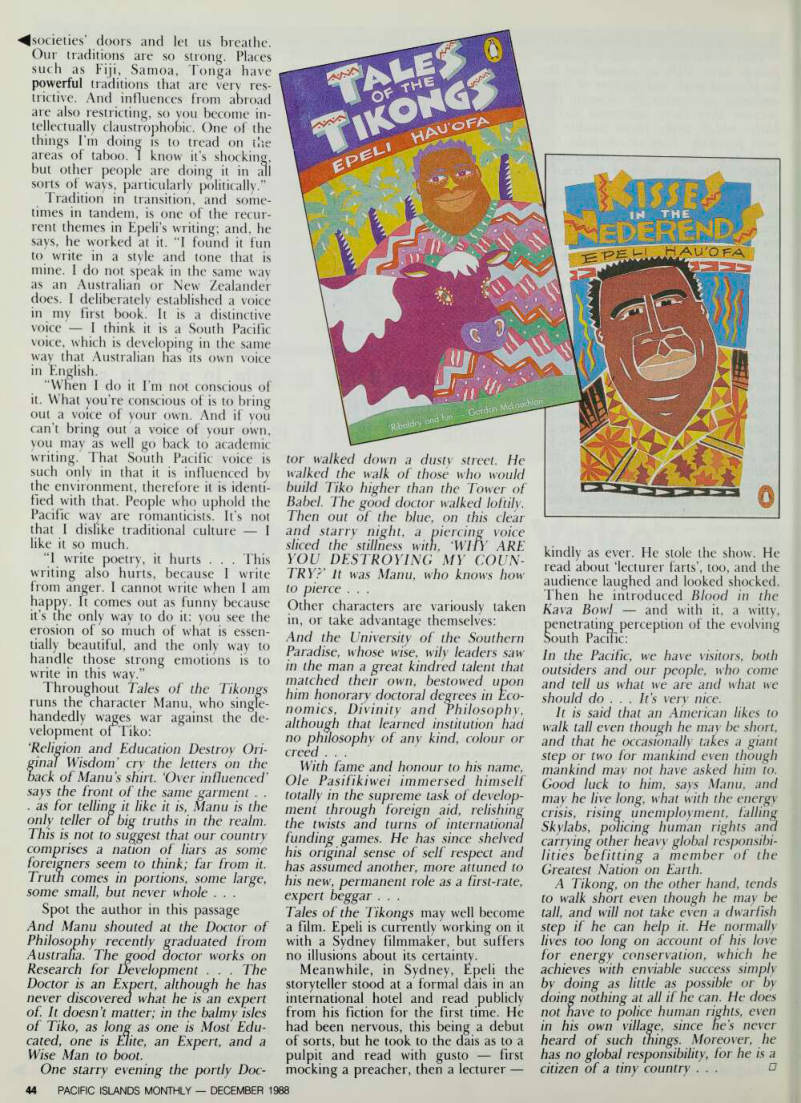
Pacific People
Finding A New Voice
Leonie Hdimers talks to Epeli Hau’ofa a Papua New Guinean-born Tongan who was educated in Fiji ,Tonga, PNG, Canada and Australia, and who now teaches in Fiji who has found a new way of bringing his witty and often shocking perceptions of Pacific life to an admiring international audience.
IF READERS are shocked by the hilarious and perceptive fiction of Epeli Hau’ofa, they should spare a ought for how Epeli himself felt af ter he had sent the manuscript of Kis ses in the Nederends to a respectable publisher . . . which promptly agreed to publish. He had gone out of his way to be disrespectful, to use the ear thiest humour, simply to see if he could get away with it. “It surprised me no end,” he says. “I thought, ‘the world has gone to the dogs’.”
Here is a Doctor of Philosophy in social Anthropology, head of the Sociology Department at the Universi ty of the South Pacific, author of
several eminently respectable academic
treaties on the anthropology of the Pacific, a former Deputy Private Secretary to His Majesty the King of Tonga . . . writing doors about indo lence, anuses, flatulence and swearing.
Epeli Hau’ofa, is, however, very
much a product of his time and of a great many places. Born of Tongan
missionary parents in Papua New
Guinea at the beginning of World War 11, he was schooled in PNG, Ton ga, Fiji and Australia, went on to study at the University of New Eng land, the University of NSW, McGul
University, Montreal, and completed
his PhD at ANU, Canberra.
He has since taught at the Universi ty of Papua New Guinea and the Uni versity of the South Pacific; first as a research fellow, in 1981 as the first director of the then new Rural De velopment Centre, based in Tonga, and since 1983 as Head of the Depart ment of Sociology in Suva. His first work of fiction, Tales of the Tikongs, appeared in 1983. Set on the (ficti tious) tiny island of Tiko, it is a collec tion of snort stories satirising develop ment, work, Western and Pacific in stitutions, officials, notions and ways
terribly out of step with each other.
Kisses in the Nederends, published last year, is a rude, witty, full-blooded . . . and full-winded . . . story about a VIP who can’t stop farting. Not even Dr Hau’ofa’s own profession is spared, as the following passage will indicate.
A local expert on the subject delivers a dissertation on various forms of fart ing, including the ‘lecturer fart’: If you breathe in the second-hand fart, it gets mixed up with your origin al proouct and the result is known as a double fart. Students at the universi ty call it the “lecturer fart'\ for reasons known only to themselves. We shall call it that because it sounds in tellectual.
Lecturer fart can lead to many problems. It can collect in the stomach and distend it .. . thafs why only fat people are called windbags. Lecturer fart can seep into the scrotum and
Matthew Mckee
blow it up to the size of a soccer ball.
That’s what most of our important people have. VIPs sit around and do no physical work, not because of their eminence as is generally assumed, but because they carry enormous soccer balls, which make them unable to work properly. They sit on chairs be hind huge desks to hide their bal
loons. Tnafs why they’re so cranky
and bossy . . .
While Epeli Hau’ofa can regard the human condition at this fundamental level, such an analysis is nevertheless no great insight into his own charac ter. A big and gentle man, Epeli is somehow both commanding and shy at the same time, combining grace, charm and extreme politeness. ITiotos rarely do him justice it’s the quick changes in facial expressions that are so interesting. He makes outrageous
statements straight-faced, waiting to
see if his audience gets the joke: If he succeeds, he breaks into a sudden
smoky, musical laugh.
Storytelling is important to Epeli as
a person, as a writer and as a lecturer.
His gift obviously comes from deep in his past. “You gradually develop this ability to tell stories,” he explains, “de pending on which kind of society you come from in the Pacific. In my time, story telling was very important before radio came still is. Radio didn’t break it down, it broadened all sorts of things. But video has got into the Pacific very very strongly, especially in the east; Fiji, Tonga, Samoa. Tradi tional culture was breaking down any way, but what video is likely to affect is the way people talk.
“Instead of spending your evening with each other you’re glued, just like television elsewhere. I can foresee (but one cannot be categorical about this) the breakdown of that tradition of self-entertainment. Sitting down, tell ing stories to each other now fami lies are just like families are anywhere there is television.
“You see, while we were growing up we were separated from girls at about the age of nine or 10, and we started telling stories to each other at night; everyone took turn telling stories and frightening each other. Then boys would drift off and you’d find your self telling a story to yourself, then you’d drift off to sleep . . .
“In a place such as Tonga now, with video (which is very widespread) that sort of setting has been removed. The thing is with oral storytelling that you start from a very early age and prog ress. If you’re cut off there, the desire to tell stories will go. Maybe people will talk about video . . . and Amer
ican things.
“Things change. As you grow older, say 16, 17, you hover on the periphery of the world of adult men telling stories, so you develop your
skill there; you imitate them. By the time you’re 20 or 21 you get married, then you are in the kava circles with all the very skilled storytellers.
“Myths are a different thing; the storytelling I’m talking about is anec dotal, you must be on your mettle all the time. You have to compose on the spot there’s a competition. One of
the most fascinating things is sitting
around the kava bowl with me telling these stories; one bounces off another.
Tall stories, you see, and everyone en joys it. It can go on all night.
“People of my generation, because they were raised in this, they still tell stories and enjoy it tremendously. It’s a hierarchial society, so what you have are groups of people of different ages telling stories to each other.
“In villages in many parts of the
“I found it fun to write in a style and tone that is mine ... It is a distinctive voice I think it is very much a South Pacific voice”
South Pacific in Papua New Guinea and the Solomons grandmothers still tell children very frightful stories, horror stories. They tell them to en tertain, but also to frighten kids. It keeps them under control; you tell them nasty things that happen around the bush so you don’t have to chase little kids: they just sit there and be have. Grandmothers tell stories about the nasty spirits that live in the big trees and the cliffs; so children just
keep away because they are fright
ened, and in that way they are safe.
“As people grow up, their stories alter; close to puberty there are romantic stories, very clean ones. Af ter puberty 13, 14, 15 that’s when dirty stories come in, told by older boys to younger ones really to test them and titillate them.
“Kisses in the Nederends is an ex ample of a combination of those dirty stories and bad habits I acquired in Australia, being disrespectful of every thing. I was here in the 1960 s and early 70s, when Australia went into a very interesting stage the biggest knockers around, some of the most
gifted people emerging, people such
as David Williamson (whose early plays knocked everyone left, right and centre), Michael Leunig had started [publishing] some of the best cartoons Eve ever read in my life. Australians everywhere were breaking out from the constraints of the 1950 s and early 60s. So that had an influence on this book; that plus the earthy sense of humour of Pacific islands people.
“Of course it’s one thing having it published: it’s a different thing
altogether people buying it. It’s not
very well liked in the islands.”
Academic writing is an area from which Epeli finds himself increasingly distanced. “Maybe when I retire and I’m useless for anything else, I’ll write more,” he muses. “My interest has shifted toward fiction; there’s a great deal more freedom in it. In academic writing you have to pay homage to your theoretical betters, your intellec tul ancestors. With this you just go straight in. It’s more fun . . . especially if you have a twisted mind. You laugh and laugh as you write (which you don’t do with academic writing you never laugh, you get serious, you damn everyone). But with fiction you get an idea and you fall off your bed.”
IThe university’s main contribution to excellence was in the Held of creative gossip. Her academic sources also told her that the most heated cold war
campaign in the university was waged
within the School of Social and Econo mic Disintegration between the De partments of Sociology and History.
Sociologists had a guerrilla training
camp, funded by the KGB and Col onel Gaddafi, located at one end of the university sewage pond. At the other extremity of the same mess historians, backed by the rest of the university and funded by the CIA and MOSSAD, supported a camp where budding assassins were trained in the science of the slow strangulation of their arch enemies, the sociologists.
The Department of Administrative Studies . . . provided recruits for the guerrilla and assassin camps, while Geography detailed charts of the pond and its environs and Economics laid
down the campaign plans. Accounting
procured funds ana arms for every one, making themselves filthy rich.
The other schools tongue-fought themselves into a stupor and, not knowing what else to do, changed their names, believing that this would make them sound less awful. . .
When it comes to the roles that writ ing such as the above from Kisses in the Nederends can fulfil, there are as many different meanings as there are readers. Epeli says he writes to satisfy certain urges, “But when I rationalise this (which I don’t usually do), one of the aims is to open our ►
doors and let us breathe.
Our traditions are so strong. Places such as Fiji, Samoa, Tonga have powerful traditions that are very res trictive. And influences from abroad are also restricting, so you become in tellectually claustrophobic. One of the things I’m doing is to tread on the areas of taboo. I know it’s shocking, but other people are doing it in all sorts of ways, particularly politically.”
Tradition in transition, and some times in tandem, is one of the recur rent themes in Epeli’s writing; and, he says, he worked at it. “I found it fun to write in a style and tone that is mine. I do not speak in the same way as an Australian or New Zealander does. I deliberately established a voice in my first book. It is a distinctive voice 1 think it is a South Pacific voice, which is developing in the same way that Australian has its own voice
in English.
“When I do it I’m not conscious of it. What you’re conscious of is to bring out a voice of your own. And if you can’t bring out a voice of your own, you may as well go back to academic writing. That South Pacific voice is such only in that it is influenced by the environment, therefore it is identi fied with that. People who uphold the Pacific way are romanticists. It’s not that I dislike traditional culture I like it so much.
“I write poetry, it hurts . . . This writing also hurts, because I write from anger. I cannot write when I am happy. It comes out as funny because it’s the only way to do it: you see the erosion of so much of what is essen tially beautiful, and the only way to handle those strong emotions is to write in this way.”
Throughout Tales of the Tikongs runs the character Manu, who single handedly wages war against the de velopment of Tiko: ‘Religion and Education Destroy Ori ginal Wisdom ’ cry the letters on the oack of Manu’s shirt. ‘Over influenced’ says the front of the same garment . . . as for telling it like it is, Manu is the only teller of big truths in the realm.
This is not to suggest that our country comprises a nation of liars as some foreigners seem to think; far from it.
Truth comes in portions, some large, some small, but never whole ...
Spot the author in this passage And Manu shouted at the Doctor of
Philosophy recently graduated from
Australia. The good doctor works on Research for Development . . . The Doctor is an Expert, although he has never discovered what he is an expert of It doesn’t matter; in the balmy isles of Tiko, as long as one is Most Edu cated, one is Elite, an Expert, and a Wise Man to boot.
One starry evening the portly Doc-
tor walked down a dusty street. He walked the walk of those who would build Tiko higher than the Tower of Babel. The good doctor walked loftily.
Then out of the blue, on this clear and starry night, a piercing voice sliced the stillness with, ‘WIiY ARE
You Destroying My Coun
TRY?’ It was Manu, who knows how
to pierce . . .
Other characters are variously taken in, or take advantage themselves: And the University of the Southern Paradise, whose wise, wily leaders saw in the man a great kindred talent that matched their own, bestowed upon him honorary doctoral degrees in Eco nomics, Divinity and Philosophy, although that learned institution had no philosophy of any kind, colour or creed . . .
With fame and honour to his name, Ole Pasifikiwei immersed himself totally in the supreme task of develop
ment through foreign aid, relishing
the twists and turns of international funding games. He has since shelved his original sense of self respect and has assumed another, more attuned to his new, permanent role as a first-rate,
expert beggar . . .
Tales of the Tikongs may well become a film. Epeli is currently working on it with a Sydney filmmaker, but suffers no illusions about its certainty.
Meanwhile, in Sydney, Epeli the storyteller stood at a formal dais in an international hotel and read publicly from his fiction for the first time. He had been nervous, this being a debut of sorts, but he took to the dais as to a pulpit and read with gusto first mocking a preacher, then a lecturer
kindly as ever. He stole the show. He read about ‘lecturer farts’, too, and the audience laughed and looked shocked.
Then he introduced Blood in the Kava Bowl and with it, a witty,
penetrating perception of the evolving
South Pacific: In the Pacific, we have visitors, both outsiders and our people, who come and tell us what we are and what we should do . . . It’s very nice.
It is said that an American likes to walk tall even though he may he short, and that he occasionally tares a giant step or two for mankind even though mankind may not have asked him to.
Good luck to him, says Manu, and may he live long, what with the energy
crisis, rising unemployment, falling
Sky labs, policing human rights and
carrying other heavy global responsibi
lities Defitting a member of the Greatest Nation on Earth.
A Tikong, on the other hand, tends to walk short even though he may be tall, and will not take even a dwarfish step if he can help it. He normally lives too long on account of his love for energy conservation, which he achieves with enviable success simply by doing as little as possible or by aoing nothing at all if he can. He does not nave to police human rights, even in his own village, since he’s never heard of such things. Moreover, he has no global responsibility, for he is a citizen of a tiny country ... o
Festival on film
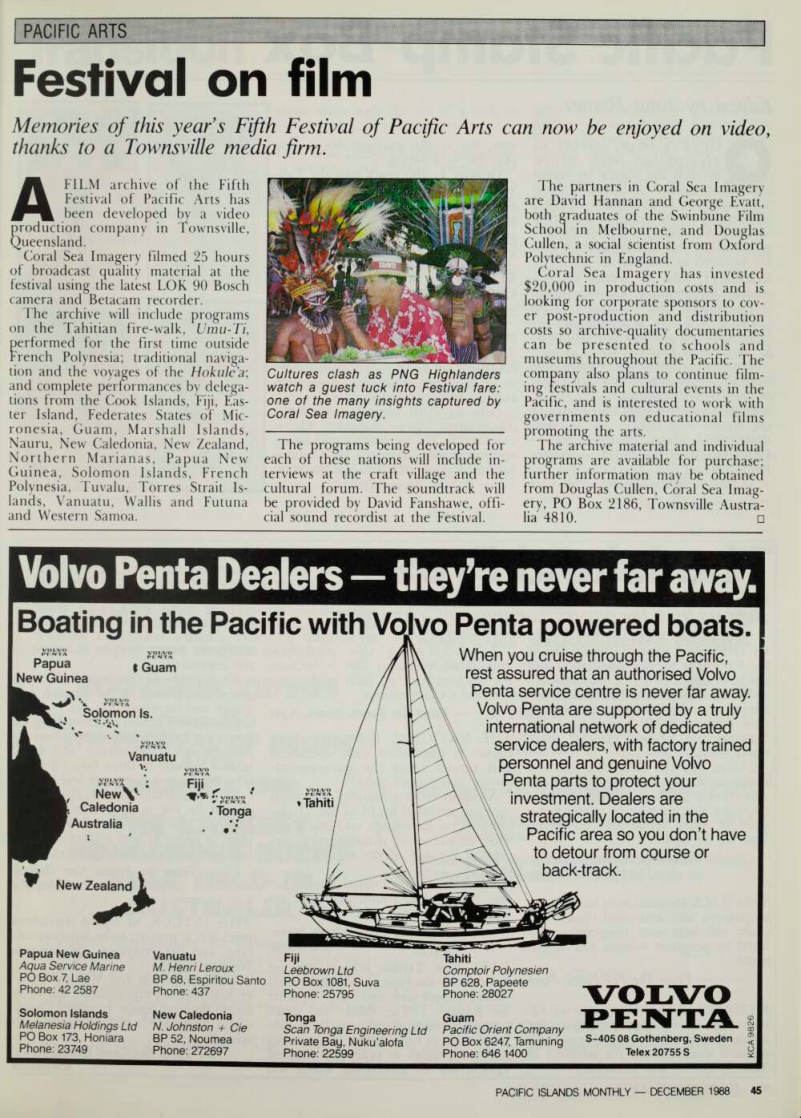
Pacific Arts
Memories of this year’s Fifth Festival of Pacific Arts can now be enjoyed on video, thanks to a Townsville media firm.
JR FILM archive of the Fifth Festival of Pacific Arts has been developed by a video
production company in Townsville,
Queensland.
Coral Sea Imagery filmed 25 hours of broadcast quality material at the festival using the latest LOK 90 Bosch camera and Betacam recorder.
The archive will include programs on the Tahitian fire-walk, Umu-Ti, performed for the first time outside
French Polynesia; traditional naviga
tion and the voyages of the Hokulea;
and complete performances by delega
tions from the Cook Islands, Fiji, Eas ter Island, Federates States of Mic ronesia, Guam, Marshall Islands, Nauru, New Caledonia, New Zealand, Northern Marianas, Papua New Guinea, Solomon Islands, French Polynesia, Tuvalu, Torres Strait Is lands, Vanuatu, Wallis and Futuna and Western Samoa.
The programs being developed for each of these nations will include in terviews at the craft village and the cultural forum. The soundtrack will be provided by David Fanshawe, offi cial sound recordist at the Festival.
The partners in Coral Sea Imagery are David Hannan and George Evatt, both graduates of the Swinbune Film School in Melbourne, and Douglas Cullen, a social scientist from Oxford
Polytechnic in England.
Coral Sea Imagery has invested $20,000 in production costs and is looking for corporate sponsors to cov er post-production and distribution costs so archive-quality documentaries can be presented to schools and museums throughout the Pacific. The company also plans to continue film ing festivals and cultural events in the Pacific, and is interested to work with governments on educational films promoting the arts.
The archive material and individual programs are available for purchase; further information may be obtained from Douglas Cullen, Coral Sea Imag ery, PO Box 2186, Townsville Austra lia 4810. □
Cultures clash as PNG Highlanders watch a guest tuck into Festival fare: one of the many insights captured by Coral Sea Imagery.
Advertisements & other items, p. 45 (1 item)
Volvo Renta Dealers —they’re never far away.
Boating in the Pacific with Volvo Renta powered boats.
Pa P ua »Guam New Guinea
1 PFNTA
Solomon Is.
VOLVO
PL (VTA
Vanuatu
PtNTA J
New\ v
Caledonia Australia Fi i' Tonga New Zealand Papua New Guinea Aqua Service Marine PO Box 7, Lae Phone: 42 2587 Solomon Islands Melanesia Holdings Ltd PO Box 173, Honiara Phone: 23749 Vanuatu M. Henri Leroux BP 68, Espiritou Santo Phone: 437 New Caledonia N. Johnston + Cie BP 52, Noumea Phone: 272697 ♦ Tahiti
When you cruise through the Pacific,
rest assured that an authorised Volvo
Penta service centre is never far away.
Volvo Penta are supported by a truly
international network of dedicated
service dealers, with factory trained
personnel and genuine Volvo
Penta parts to protect your
investment. Dealers are
strategically located in the
Pacific area so you don’t have
to detour from course or
back-track.
Fiji Leebrown Ltd PO Box 1081, Suva Phone: 25795 Tonga Scan Tonga Engineering Ltd Private Bay, Nuku’alofa Phone: 22599 Tahiti Comptoir Polynesien BP 628, Papeete Phone:2Bo27 Guam Pacific Orient Company PO Box 6247, Tamuning Phone: 646 1400 S-405 08 Gothenberg, Sweden Telex 20755 S
Pacific Stamp Box
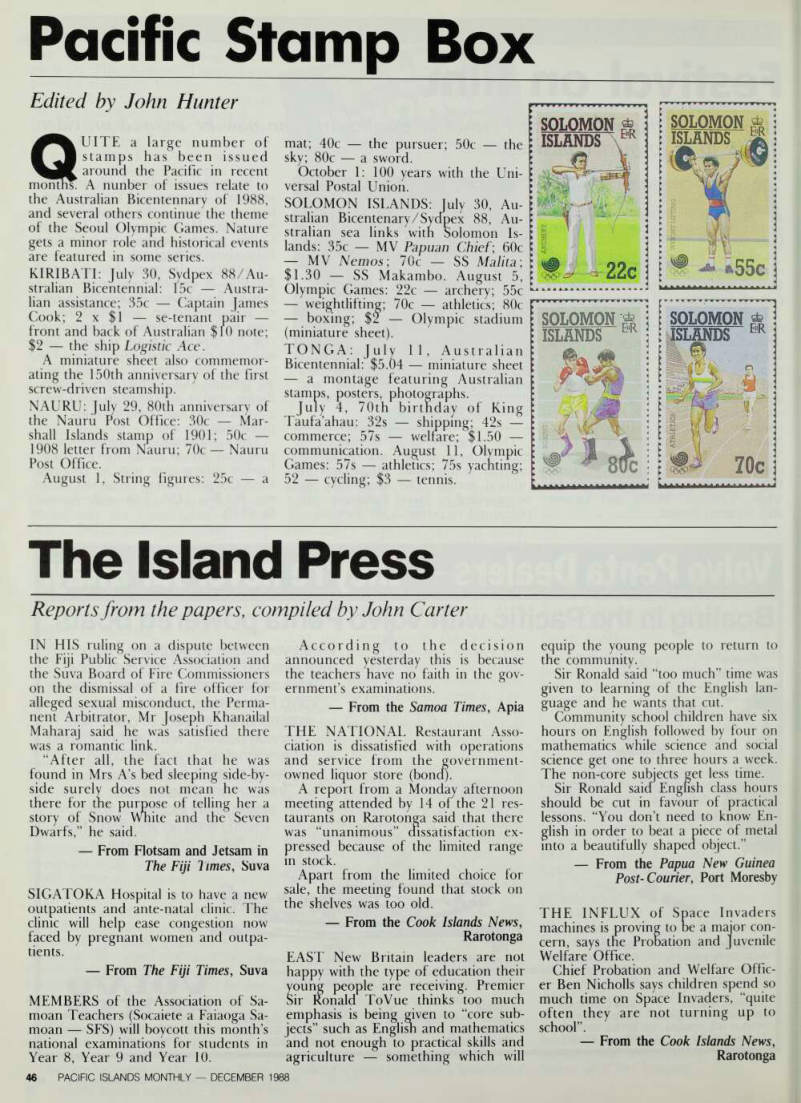
Edited by John Hunter
a large number of B stamps has been issued around the Pacific in recent month's. A nunber of issues relate to the Australian Bicentennary of 1988, and several others continue the theme of the Seoul Olympic Games. Nature gets a minor role and historical events are featured in some series.
KIRIBATI: July 30, Sydpex 88/Au stralian Bicentennial: 15c Austra lian assistance; 35c Captain James Cook; 2 x $1 se-tenant pair front and back of Australian $lO note; $2 the ship Logistic Ace.
A miniature sheet also commemor ating the 150th anniversary of the first
screw-driven steamship.
NAURU: July 29, 80th anniversary of the Nauru Post Office: 30c Mar shall Islands stamp of 1901; 50c 1908 letter from Nauru; 70c Nauru Post Office.
August 1, String figures: 25c a
mat; 40c the pursuer; 50c the sky; 80c a sword.
October 1: 100 years with the Uni versal Postal Union.
Solomon Islands: July 30, Au
stralian Bicentenary/Svdpex 88, Au stralian sea links with Solomon Is lands: 35c MV Papuan Chief; 60c MV Nemos; 70c SS Malita; $1.30 SS Makambo. August 5, Olympic Games: 22c archery; 55c weightlifting; 70c athletics; 80c boxing; $2 Olympic stadium (miniature sheet).
TONGA: July 11, Australian Bicentennial: $5.04 miniature sheet a montage featuring Australian stamps, posters, photographs.
July 4, 70th birthday of King Taufa’ahau: 32s shipping; 42s commerce; 57s welfare; $1.50 communication. August 11, Olympic Games: 57s athletics; 75s yachting; 52 cycling; $3 tennis.
The Island Press
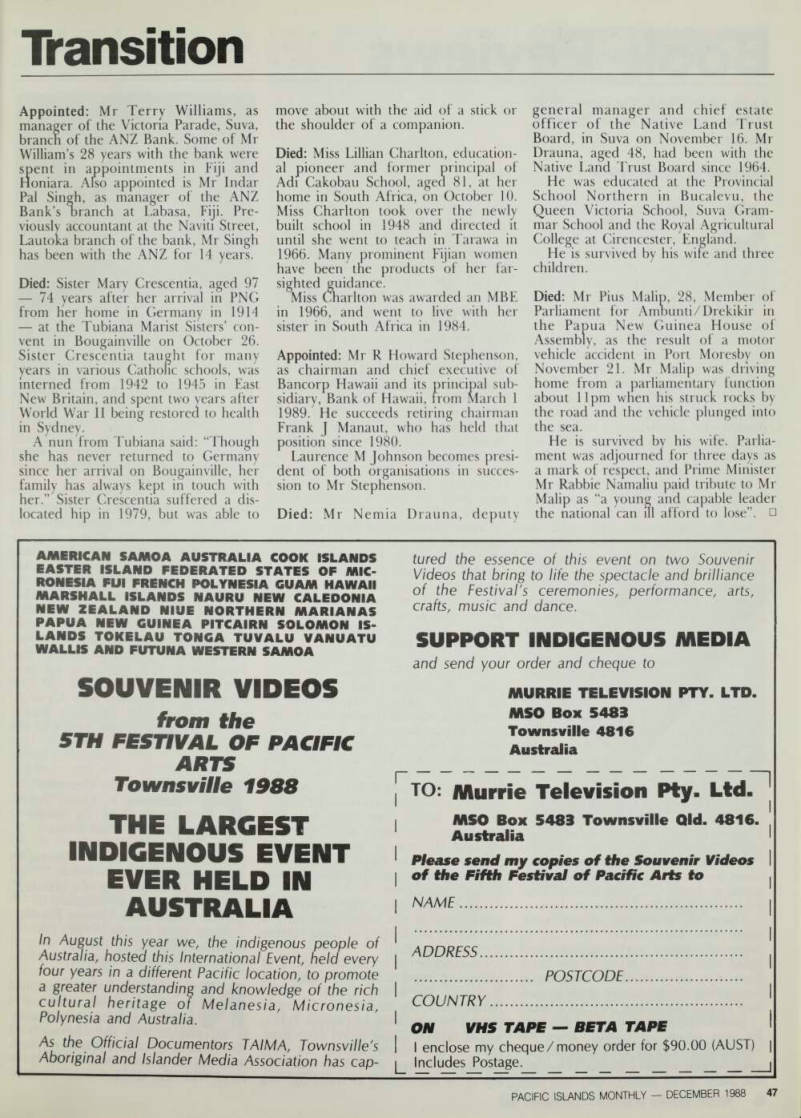
Reports from the papers, compiled by John Carter
IN HIS ruling on a dispute between the Fiji Public Service Association and the Suva Board of Fire Commissioners on the dismissal of a fire officer for alleged sexual misconduct, the Permanent Arbitrator, Mr Joseph Khanailal Maharaj said he was satisfied there was a romantic link.
“After all, the fact that he was found in Mrs A’s bed sleeping side-byside surely does not mean he was there for the purpose of telling her a story of Snow White and the Seven Dwarfs,” he said.
From Flotsam and Jetsam in The Fiji Times, Suva SIGATOKA Hospital is to have a new outpmients a nd ante-natal clinic. The dime will help ease congestion now faced by pregnant women and outpatients ‘ From The Fiji Times, Suva MEMBERS of the Association of Samoan Teachers (Socaiete a Faiaoga Samoan SFS) will boycott this month’s national examinations for students in Year 8, Year 9 and Year 10.
According to the decision announced yesterday this is because the teachers have no faith in the gov ernment’s examinations.
From the Samoa Times, Apia THE NATIONAL Restaurant Asso ciation is dissatisfied with operations and service from the government
owned liquor store (bond).
A report from a Monday afternoon meeting attended by 14 of the 21 res taurants on Rarotonga said that there was “unanimous” dissatisfaction ex pressed because of the limited range m stock.
Apart from the limited choice for sale, the meeting found that stock on the shelves was too old.
From the Cook Islands News, Rarotonga EAST New Britain leaders are not happy with the type of education their young people are receiving. Premier Sir Ronald To Vue thinks too much emphasis is being given to “core sub jects” such as English and mathematics and not enough to practical skills and
agriculture something which will
equip the young people to return to
the community.
Sir Ronald said “too much” time was given to learning of the English lan guage and he wants that cut.
Community school children have six hours on English followed by four on mathematics while science and social science get one to three hours a week.
The non-core subjects get less time.
Sir Ronald said English class hours should be cut in favour of practical lessons. “You don’t need to know En glish in order to beat a piece of metal
into a beautifully shaped object.”
From the Papua New Guinea Post-Courier, Port Moresby THE INFLUX of Space Invaders machines is proving to be a major con cern, says the Probation and Juvenile Welfare Office.
Chief Probation and Welfare Offic er Ben Nicholls says children spend so much time on Space Invaders, “quite often they are not turning up to school”.
From the Cook Islands News, Rarotonga
Appointed: Mr Terry Williams, as manager of the Victoria Parade, Suva, branch of the ANZ Bank. Some of Mr William’s 28 years with the bank were
spent in appointments in Fiji and
Honiara. Also appointed is Mr Indar Pal Singh, as manager of the ANZ Bank’s Branch at Labasa, Fiji. Pre viously accountant at the Naviti Street, Lautoka branch of the bank, Mr Singh has been with the ANZ for 14 years.
Died: Sister Mary Crescentia, aged 97 74 years after her arrival in PNG from her home in Germany in 1914 at the Tubiana Marist Sisters’ con vent in Bougainville on October 26.
Sister Crescentia taught for many years in various Catholic schools, was interned from 1942 to 1945 in East New Britain, and spent two years after World War II being restored to health
in Sydney.
A nun from Tubiana said: “Though she has never returned to Germany since her arrival on Bougainville, her family has always kept in touch with her.” Sister Crescentia suffered a dis located hip in 1979, but was able to
move about with the aid of a stick or the shoulder of a companion.
Died: Miss Lillian Charlton, education al pioneer and former principal of Adi Cakobau School, aged 81, at her home in South Africa, on October 10.
Miss Charlton took over the newly built school in 1948 and directed it until she went to teach in Tarawa in
1966. Many prominent Fijian women
have been the products of her far
sighted guidance.
Miss Charlton was awarded an MBE in 1966, and went to live with her sister in South Africa in 1984.
Appointed: Mr R Howard Stephenson, as chairman and chief executive of Bancorp Hawaii and its principal sub sidiary, Bank of Hawaii, from March 1 1989. He succeeds retiring chairman Frank J Manaut, who has held that position since 1980.
Laurence M Johnson becomes presi dent of both organisations in succes sion to Mr Stephenson.
Died: Mr Nemia Drauna, deputy
general manager and chief estate officer of the Native Land Trust Board, in Suva on November 16. Mr Drauna, aged 48, had been with the Native Land Trust Board since 1964.
He was educated at the Provincial School Northern in Bucalevu, the Queen Victoria School, Suva Gram mar School and the Royal Agricultural
College at Cirencester, England.
He is survived by his wife and three children.
Died: Mr Pius Malip, 28, Member of Parliament for Amounti/Drekikir in the Papua New Guinea House of Assembly, as the result of a motor vehicle accident in Port Moresby on November 21. Mr Malip was driving home from a parliamentary function about 11pm when his struck rocks by the road and the vehicle plunged into the sea.
He is survived by his wife. Parlia ment was adjourned for three days as a mark of respect, and Prime Minister Mr Rabbie Namaliu paid tribute to Mr Malip as “a young and capable leader the national can ill afford to lose”. □
Advertisements & other items, p. 47 (2 items)
Transition
Indigenous Event
AMERICAN SAMOA AUSTRALIA COOK ISLANDS
EASTER ISLAND FEDERATED STATES OF MIC-
RONESIA FUI FRENCH POLYNESIA GUAM HAWAII
MARSHALL ISLANDS NAURU NEW CALEDONIA
NEW ZEALAND NIUE NORTHERN MARIANAS
PAPUA NEW GUINEA PITCAIRN SOLOMON IS-
LANDS TOKELAU TONGA TUVALU VANUATU
WALLIS AND FUTUNA WESTERN SAMOA
SOUVENIR VIDEOS
from the
STH FESTIVAL OF PACIFIC
ARTS
Townsville 1988
THE LARGEST
INDIGENOUS EVENT
EVER HELD IN
AUSTRALIA
In August this year we, the indigenous people of Australia , hosted this International Event , held every four years in a different Pacific location , to promote a greater understanding and knowledge of the rich cultural heritage of Melanesia , Micronesia , Polynesia and Australia.
As the Official Documentors TAIMA, Townsville's Aboriginal and Islander Media Association has captured the essence of this event on two Souvenir Videos that bring to life the spectacle and brilliance of the Festival's ceremonies , performance , arts , crafts , music and dance.
SUPPORT INDIGENOUS MEDIA
and send your order and cheque to
MURRIE TELEVISION PTY. LTD.
MSO Box 5483 Townsville 4816 Australia TO: Murrie Television Pty. Ltd. - * IWISO Box 5483 Townsville Old. 4816.
Australia I
Please send my copies of the Souvenir Videos of the Fifth Festival of Pacific Arts to .
NAME
ADDRESS
POSTCODE
COUNTRY
ON VMS TAPE BETA TAPE
I enclose my cheque/money order for $90.00 (AUST) Includes Postage.
Book Reviews
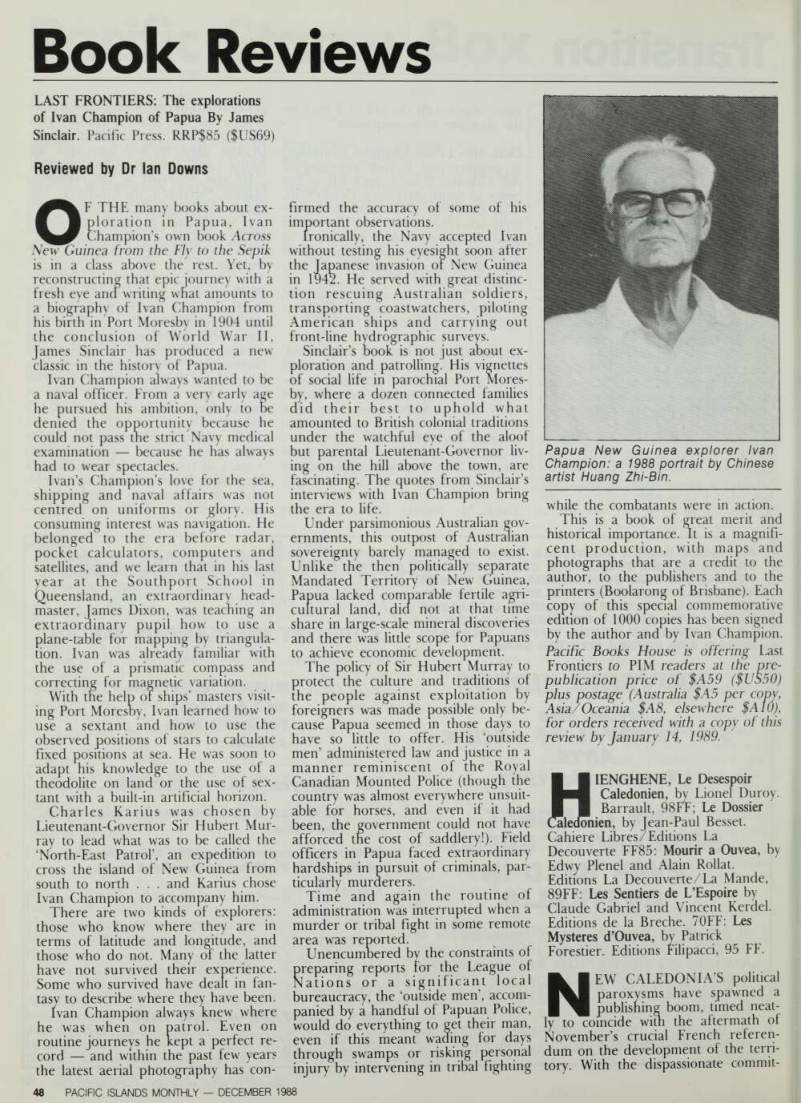
LAST FRONTIERS: The explorations of Ivan Champion of Papua By James Sinclair. Pacific Press. RRPSBS (SUS 69) Reviewed by Dr lan Downs
OF THE many books about ex ploration in Papua, Ivan Champion’s own book Across New Guinea from the Fly to the Sepik is in a class above the rest. Yet, by reconstructing that epic journey with a fresh eye and writing what amounts to a biography of Ivan Champion from his birth in Port Moresby in 1904 until the conclusion of World War 11, James Sinclair has produced a new classic in the historv of Papua.
Ivan Champion always wanted to be a naval officer. From a very early age he pursued his ambition, only to be denied the opportunity because he could not pass the strict Navy medical examination because he has always had to wear spectacles.
Ivan’s Champion’s love for the sea, shipping and naval affairs was not centred on uniforms or glory. His consuming interest was navigation. He belonged to the era before radar, pocket calculators, computers and satellites, and we learn that in his last year at the Southport School in Queensland, an extraordinary head master, James Dixon, was teaching an extraordinary pupil how to use a
plane-table for mapping by triangula
tion. Ivan was already familiar with the use of a prismatic compass and correcting for magnetic variation.
With the help of ships’ masters visit ing Port Moresby, Ivan learned how to use a sextant and how to use the observed positions of stars to calculate fixed positions at sea. He was soon to adapt his knowledge to the use of a theodolite on land or the use of sex tant with a built-in artificial horizon.
Charles Karius was chosen by Lieutenant-Governor Sir Hubert Mur ray to lead what was to be called the ‘North-East Patrol’, an expedition to cross the island of New Guinea from south to north . . . and Karius chose Ivan Champion to accompany him.
There are two kinds of explorers: those who know where they are in terms of latitude and longitude, and those who do not. Many of the latter have not survived their experience.
Some who survived have dealt in fan tasy to describe where they have been.
Ivan Champion always knew where he was when on patrol. Even on routine journeys he kept a perfect re cord and within the past few years the latest aerial photography has con
firmed the accuracy of some of his
important observations.
Ironically, the Navy accepted Ivan without testing his eyesight soon after the Japanese invasion of New Guinea in 1942. He served with great distinc tion rescuing Australian soldiers,
transporting coastwatchers, piloting
American ships and carrying out front-line hydrographic surveys.
Sinclair’s book is not just about ex ploration and patrolling. His vignettes of social life in parochial Port Mores by, where a dozen connected families did their best to uphold what amounted to British colonial traditions under the watchful eye of the aloof but parental Lieutenant-Governor liv ing on the hill above the town, are fascinating. The quotes from Sinclair’s interviews with Ivan Champion bring the era to life.
Under parsimonious Australian gov ernments, this outpost of Australian sovereignty barely managed to exist.
Unlike the then politically separate Mandated Territory of New yuinea,
Papua lacked comparable fertile agri
cultural land, did not at that time share in large-scale mineral discoveries and there was little scope for Papuans to achieve economic development.
The policy of Sir Hubert Murray to protect the culture and traditions of
the people against exploitation by
foreigners was made possible only be cause Papua seemed in those days to have so little to offer. His ‘outside men’ administered law and justice in a manner reminiscent of the Royal Canadian Mounted Police (though the country was almost everywhere unsuit able for horses, and even if it had been, the government could not have afforced the cost of saddlery!). Field officers in Papua faced extraordinary hardships in pursuit of criminals, par
ticularly murderers.
Time and again the routine of administration was interrupted when a murder or tribal fight in some remote area was reported.
Unencumbered by the constraints of preparing reports for the League of Nations or a significant local bureaucracy, the ‘outside men’, accom panied by a handful of Papuan Police, would do everything to get their man, even if this meant wading for days through swamps or risking personal
injury by intervening in tribal fighting
while the combatants were in action.
This is a book of great merit and historical importance. It is a magnifi cent production, with maps and photographs that are a credit to the author, to the publishers and to the printers (Boolarong of Brisbane). Each copy of this special commemorative edition of 1000 copies has been signed by the author and by Ivan Champion.
Pacific Books House is offering Last Frontiers to PIM readers at the pre publication price of SAS9 (SUSSO) plus postage (Australia SAS per copy, Asia/Oceania SAB, elsewhere $A10), for orders received with a copy of this review by January 14, 1989.
HIENGHENE, Le Desespoir Caledonien, by Lionel Duroy.
Barrault, 98FF; Le Dossier lien, by Jean-Paul Besset.
Cahiere Libres/Editions La Decouverte FFBS: Mourir a Ouvea, by Edwy Plenel and Alain Rollat.
Editions La Decouverte/La Mande, 89FF: Les Senders de L’Espoire by Claude Gabriel and Vincent Kernel.
Editions de la Breche. 70FF: Les Mysteres d’Ouvea, by Patrick Forestier. Editions filipacci, 95 FF.
NEW CALEDONIA’S political
paroxysms have spawned a publishing boom, timed neat ly to coincide with the aftermath of November’s crucial French referen dum on the development of the terri tory. With the dispassionate commit
Papua New Guinea explorer Ivan Champion: a 1988 portrait by Chinese artist Huang Zhi-Bin.
ment of medical researchers tracing the origins of some virulent tropical disease. French journalists have fo cused on New Caledonia’s agonies over the past decade, subjecting this sliver of Pacific territory to an intense political and social analysis.
Lionel Duroy went to Kanak inde pendence leader Jean-Marie Tjibaou’s rock-girt redoubt of Hienghene, sup ported by the flower of French news
magazines, LEvenement du Joudi :
casting a cold eye on a hundred years of history, he produces a vivid, emblematic tale that reaches a climax with the ‘Hienghene massacre’ of 5 December 198 A, an attack in which two of Tjibaou’s brothers died.
The massacre has been seen in scores of reports as the nadir of New Caledonian violence, and in Lionel Durov’s account the tensions between the different communities of Grande Terre that formed the prologue to the killings, and set in motion an inexor able tragic progress, are well traced.
Le Dossier Caledonien, a thorough background briefing on France’s role in the Pacific territory, is explicitly de signed as a handbook to the political fallout from the November referen dum. The author, a journalist on the Paris radical journal Polids, is well qualified for his task; he was previous ly one of the key figures benind the Journal de Nouvelle-Caledonie, an im
pressive but short-lived independent
Noumea newspaper known by its en thusiasts simply as the Journal Bleu’.
Jean-Paul Besset adopts an austere style, similar to that relayed by Jean- Marie Kohler in his recent overview of New Caledonian history.
He seeks to answer various ques tions a reasonable Martian might pose, on being acquainted with the realities of New Caledonia today: Is continued French status the only way to resolve
the problems peacefully? Is independ
ence a realistic option? What do the
independentists want?
The actual result of the November referendum would clearly have star tled Besset, who places Tjibaou and the leader of the European commun ity on the territory, Jacques Lafleur, on his front cover, their hands amic
ably clasped. On voting day Tjibaou
delivered his tribe in the name of the Matignon Accord brokered by Prime Minister Rocard: Lafleur did not.
In the wake of the result, New Cale donia’s political future seems as prob lematic as ever. Right-wing political
formations are reportedly gaining
force in Noumea; the glow of concord that suffused the territory as Besset was writing his book may yet evapo rate, giving its helpful presentation of New Caledonian history and econo mics a poignant, ironic tone. Besset considers the lessons of the past cen tury plain: one people has done vio
lence to another, and the time has come for France to make reparations by preparing the way for independ ence. He even contends that only this future will allow France to maintain its high Pacific presence, for it would be clear “this presence was oriented to ward peace and development”.
Edwy Plenel and Alain Rollat have previously collaborated on a politial biography of France’s ultra-right lead er, Jean-Marie Le Pen of the National Front. Le Pen’s political formation seems destined to play a significant role in New Caledonia's future, since its opposition to the legislation de veloped after the Matignon Accord was shared by a majority of the Euro pean community of the territory.
In Mourir a Ouvea, Plenel and Rol lat provide far more than a “quickie” account of the extraordinary events on the northernmost of the Loyalty Is lands this April. They offer a detailed reconstruction of the political response to the crisis posed, on the eve of the presidential elections, by the Kanak se izure of police hostages. By this chro nology they aim to indict the Govern ment of Gaullist Prime Minister Jac ques Chirac and his Overseas Terri tories Minister, Bernard Pons.
The Ouvea crisis is presented as the turning-point that made possible the Matignon Accord and the authors highlight the parallels beween the con duct of the French State during this nightmare and during the 1985 Ram bow Warrior affair, when there was a similar reluctance to investigate the behaviour of the military.
In the pages of Le Monde earlier this year, the authors broke the story that members of the Kanak comman do of Ouvea died ater being taken alive by the military. Here they offer
further testimony, suggesting these
men were summarily executed. For French readers with long memories there are disturbing echoes of the worst excesses of the war in Algeria.
The key documents surroundings
the Ouvea operation are printed as an appendix: the handwritten on the grotto of Gossanah, where the hos tages were held; the “Legonus report” by the head of the French elite bri
gade involved; the military inquiry
into the deaths of the Kanaks in capti vity; and, as a coda, the full text of the Matignon Accord reached under the guidance of Michel Rocard the re solution of the tragedy of Ouvea.
Les Senders de L’Espoir is a newly
published potted history by Claude
Gabriel ana Vincent Kermel, journal ists on the Trotskyist paper Rouge. At the other end of the spectrum is Pat rick Forestier’s Les Mysteres d’Ouvea this Paris-Match journalist enthuses over the conduct of the police, those
“soldiers-of-the-law”, during April’s
tormented days on Ouvea. □
Advertisements & other items, p. 49 (1 item)
Digest
TO
Pacific Islands Monthly
READERS
Pacific Press announces the publication of LAST FRONTIERS:
THE EXPLORATIONS OF IVAN
CHAMPION OF PAPUA
by james Sinclair Each copy of this limited and numbered edition of 1000 copies includes a commemorative bookplate signed by Ivan Champion, OBE, and james Sinclair. Published by Pacific Press, 17 Park Avenue, Broadbeach Waters, Queensland Australia 4128.
LAST FRONTIERS is available to P/M readers at a special reduced price until 31 January 1989. Instead of the regular price of SABS (SUS 72), P/M readers who enclose the review on Page 48 with their payment can purchase Last Frontiers for the pre-publication price of SA69 (SUSSB) plus postage and handling (Australia SAS; Asia/Oceania SAB or SUS 7; other countries SAIO or SUS 9).
Aggie Grey's
Hotel
Stay at Aggie Grey’s
the South Pacific’s
legendary hotel.
Situated right in the heart of Western Samoa. Enjoy Polynesian style friendliness and service,in cool surroundings, superb entertainment and food. Magnificent white sand beaches only a short drive away.
Air-conditioned rooms', swimming pool and full bar facilities.
Bookings through Union Steamship Company of NZ, Pan Am, Air New Zealand or direct to Aggie Grey’s, Apia, Western Samoa. Cables; AGGIES’ Apia .
The South
Sea
Digest
THE PRIVATE NEWSLETTER
ON
PACIFIC ISLANDS AFFAIRS
EVERY OTHER FRIDAY
SUBSCRIBE NOW
Shipping Schedules
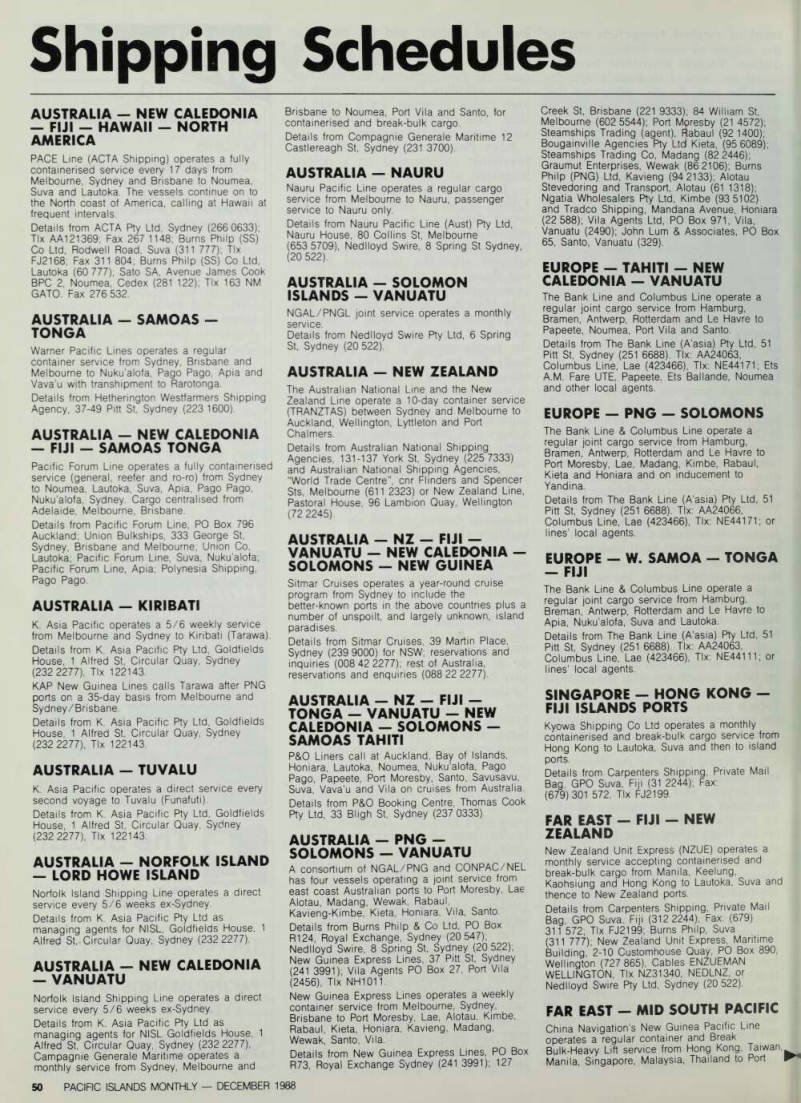
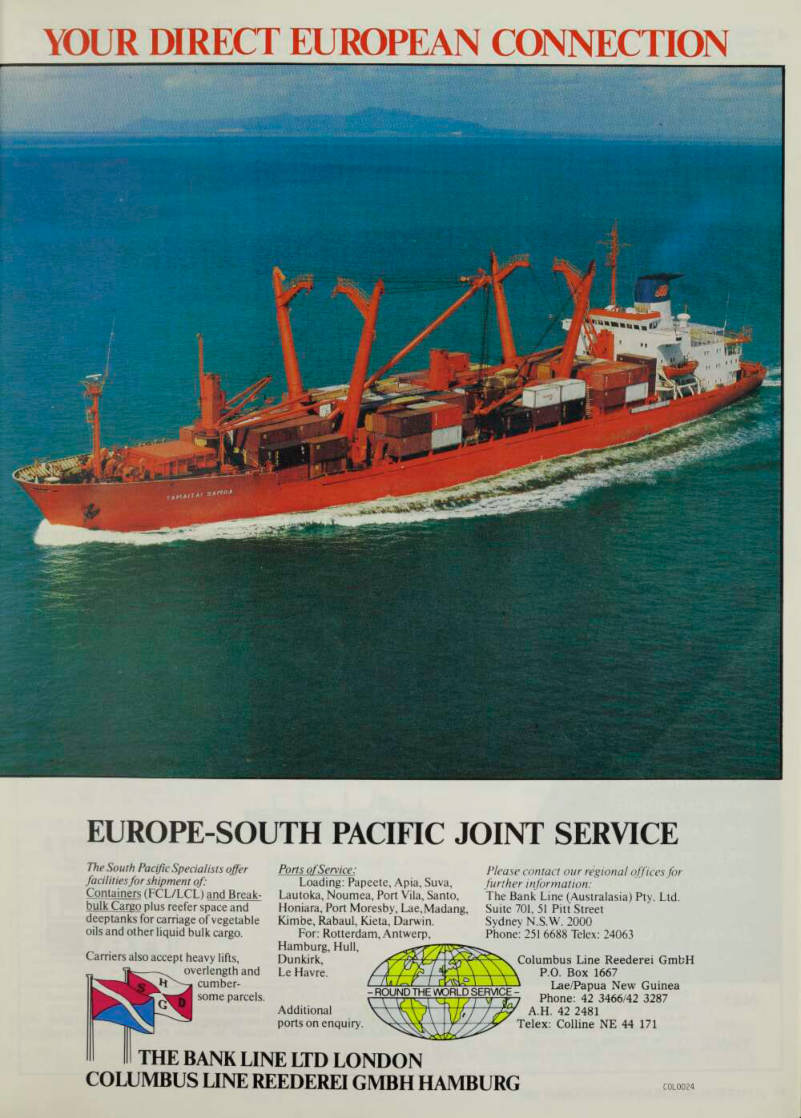
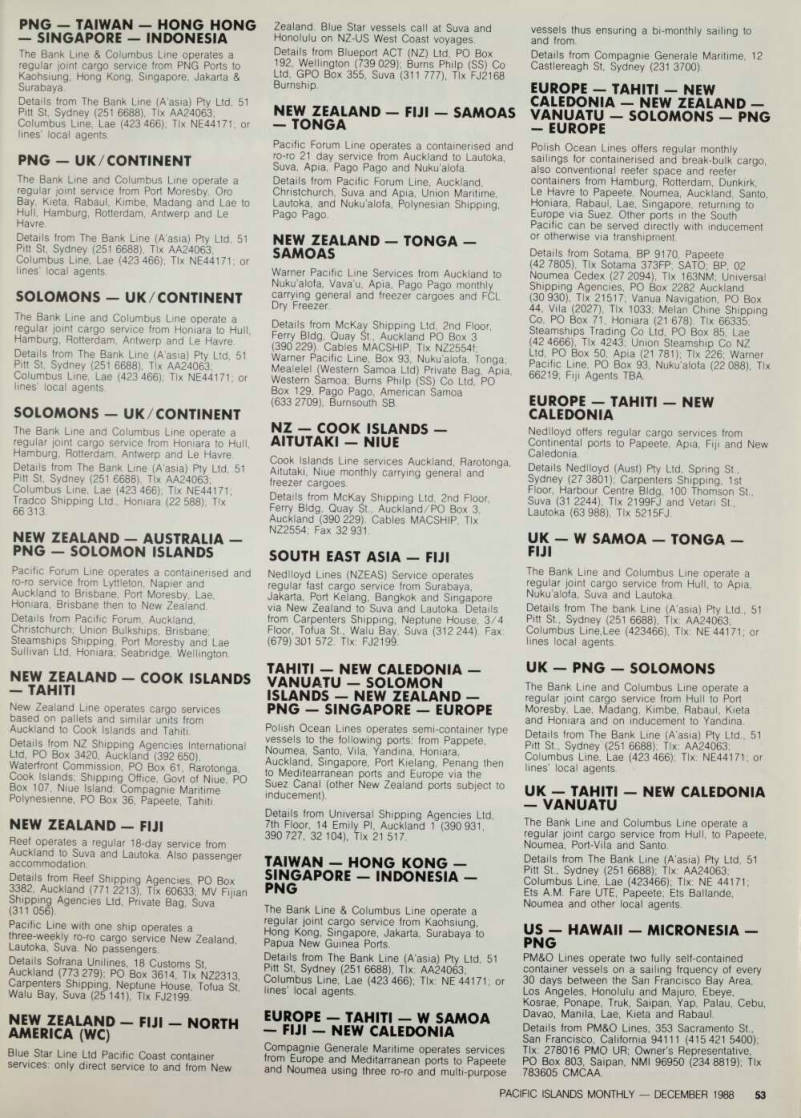
Australia - New Caledonia
Fiji - Hawaii - North
America
PACE Line (ACTA Shipping) operates a fully containerised service every 17 days from Melbourne, Sydney and Brisbane to Noumea, Suva and Lautoka. The vessels continue on to the North coast of America, calling at Hawaii at frequent intervals.
Details from ACTA Pty Ltd, Sydney (266 0633); Tlx AA121369; Fax 267 1148; Burns Philp (SS) Co Ltd, Rodwell Road, Suva (311 777); Tlx FJ2168; Fax 311 804; Burns Philp (SS) Co Ltd, Lautoka (60 777); Sato SA, Avenue James Cook BPC 2, Noumea, Cedex (281 122); Tlx 163 NM
Gato. Fax 276 532.
Australia - Samoas -
Tonga
Warner Pacific Lines operates a regular container service from Sydney, Brisbane and Melbourne to Nukualofa, Pago Pago. Apia and Vava'u with transhipment to Rarotonga.
Details from Hetherington Westfarmers Shipping Agency, 37-49 Pitt St, Sydney (223 1600).
Australia New Caledonia
Fiji Samoas Tonga
Pacific Forum Line operates a fully containerised service (general, reefer and ro-ro) from Sydney to Noumea, Lautoka, Suva, Apia, Pago Pago, Nuku’alofa, Sydney. Cargo centralised from Adelaide, Melbourne, Brisbane.
Details from Pacific Forum Line, PO Box 796 Auckland; Union Bulkships, 333 George St, Sydney, Brisbane and Melbourne; Union Co, Lautoka; Pacific Forum Line, Suva, Nuku’alofa; Pacific Forum Line, Apia; Polynesia Shipping, Pago Pago,
Australia - Kiribati
K. Asia Pacific operates a 5/6 weekly service from Melbourne and Sydney to Kiribati (Tarawa).
Details from K. Asia Pacific Pty Ltd, Goldfields House, 1 Alfred St, Circular Quay, Sydney (232 2277), Tlx 122143.
KAP New Guinea Lines calls Tarawa after PNG ports on a 35-day basis from Melbourne and Sydney/Brisbane.
Details from K. Asia Pacific Pty Ltd, Goldfields House, 1 Alfred St, Circular Quay, Sydney (232 2277), Tlx 122143.
Australia Tuvalu
K. Asia Pacific operates a direct service every second voyage to Tuvalu (Funafuti).
Details from K. Asia Pacific Pty Ltd, Goldfields House, 1 Alfred St, Circular Quay, Sydney (232 2277). Tlx 122143.
Australia Norfolk Island
Lord Howe Island
Norfolk Island Shipping Line operates a direct service every 5/6 weeks ex-Sydney.
Details from K. Asia Pacific Pty Ltd as managing agents for NISL, Goldfields House, 1 Alfred St, Circular Quay, Sydney (232 2277).
Australia - New Caledonia
Vanuatu
Norfolk Island Shipping Line operates a direct service every 5/6 weeks ex-Sydney.
Details from K. Asia Pacific Pty Ltd as managing agents for NISL Goldfields House, 1 Alfred St, Circular Quay, Sydney (232 2277), Campagnie Generale Maritime operates a monthly service from Sydney, Melbourne and
Brisbane to Noumea, Port Vila and Santo, for containerised and break-bulk cargo.
Details from Compagnie Generale Maritime 12 Castlereagh St, Sydney (231 3700).
Australia - Nauru
Nauru Pacific Line operates a regular cargo service from Melbourne to Nauru, passenger service to Nauru only.
Details from Nauru Pacific Line (Aust) Pty Ltd, Nauru House, 80 Collins St, Melbourne (653 5709), Nedlloyd Swire, 8 Spring St Sydney, (20 522).
Australia - Solomon
Islands - Vanuatu
NGAL/PNGL joint service operates a monthly service.
Details from Nedlloyd Swire Pty Ltd, 6 Spring St, Sydney (20 522).
Australia - New Zealand
The Australian National Line and the New Zealand Line operate a 10-day container service (TRANZTAS) between Sydney and Melbourne to Auckland, Wellington, Lyttleton and Port Chalmers.
Details from Australian National Shipping Agencies, 131-137 York St, Sydney (225 7333) and Australian National Shipping Agencies, "World Trade Centre", cnr Flinders and Spencer Sts, Melbourne (611 2323) or New Zealand Line, Pastoral House, 96 Lambion Quay, Wellington (72 2245).
Australia - Nz - Fiji -
Vanuatu - New Caledonia -
Solomons - New Guinea
Sitmar Cruises operates a year-round cruise program from Sydney to include the better-known ports in the above countries plus a number of unspoilt, and largely unknown, island paradises.
Details from Sitmar Cruises, 39 Martin Place, Sydney (239 9000) for NSW; reservations and inquiries (008 42 2277); rest of Australia, reservations and enquiries (088 22 2277).
Australia - Nz Fiji
Tonga Vanuatu - New
Caledonia Solomons -
Samoas Tahiti
P&O Liners call at Auckland, Bay of Islands, Honiara, Lautoka, Noumea, Nukualofa, Pago Pago, Papeete, Port Moresby, Santo, Savusavu, Suva, Vava’u and Vila on cruises from Australia.
Details from P&O Booking Centre, Thomas Cook Pty Ltd, 33 Bligh St, Sydney (237 0333).
Australia - Png -
Solomons Vanuatu
A consortium of NGAL/PNG and CONPAC/NEL has four vessels operating a joint service from east coast Australian ports to Port Moresby, Lae Alotau, Madang, Wewak, Rabaul, Kavieng-Kimbe, Kieta, Honiara, Vila, Santo.
Details from Burns Philp & Co Ltd, PO Box R 124, Royal Exchange, Sydney (20 547); Nedlloyd Swire, 8 Spring St, Sydney (20 522); New Guinea Express Lines, 37 Pitt St, Sydney (241 3991); Vila Agents PO Box 27, Port Vila
(2456), Tlx Nhioii.
New Guinea Express Lines operates a weekly container service from Melbourne, Sydney, Brisbane to Port Moresby, Lae, Alotau, Kimbe, Rabaul, Kieta, Honiara, Kavieng, Madang, Wewak, Santo, Vila.
Details from New Guinea Express Lines, PO Box R 73, Royal Exchange Sydney (241 3991); 127
Creek St, Brisbane (221 9333); 84 William St, Melbourne (602 5544); Port Moresby (21 4572); Steamships Trading (agent), flabaul (92 1400); Bougainville Agencies Pty Ltd Kieta, (95 6089); Steamships Trading Co, Madang (82 2446); Graumut Enterprises, Wewak (86 2106); Burns Philp (PNG) Ltd, Kavieng (94 2133); Alotau Stevedoring and Transport, Alotau (61 1318); Ngatia Wholesalers Pty Ltd, Kimbe (93 5102) and Tradco Shipping, Mandana Avenue, Honiara (22 588); Vila Agents Ltd, PC Box 971, Vila, Vanuatu (2490); John Lum & Associates, PC Box 65, Santo, Vanuatu (329).
Europe - Tahiti - New
Caledonia - Vanuatu
The Bank Line and Columbus Line operate a regular joint cargo service from Hamburg, Bramen, Antwerp, Rotterdam and Le Havre to Papeete, Noumea, Port Vila and Santo.
Details from The Bank Line (A'asia) Pty Ltd, 51 Pitt St, Sydney (251 6688). Tlx; AA24063, Columbus Line, Lae (423466), Tlx; NE44171; Ets A.M. Fare DTE, Papeete, Ets Ballande, Noumea and other local agents.
Europe - Png - Solomons
The Bank Line & Columbus Line operate a regular joint cargo service from Hamburg, Bramen, Antwerp, Rotterdam and Le Havre to Port Moresby, Lae, Madang, Kimbe, Rabaul, Kieta and Honiara and on inducement to Yandina.
Details from The Bank Line (A’asia) Pty Ltd, 51 Pitt St. Sydney (251 6688). Tlx; AA24066.
Columbus Line, Lae (423466), Tlx: NE44171; or lines' local agents.
Europe W. Samoa - Tonga
- Fiji
The Bank Line & Columbus Line operate a regular joint cargo service from Hamburg, Breman, Antwerp, Rotterdam and Le Havre to Apia, Nukualofa, Suva and Lautoka.
Details from The Bank Line (A’asia) Pty Ltd, 51 Pitt St, Sydney (251 6688). Tlx: AA24063, Columbus Line, Lae (423466), Tlx; NE44111; or lines' local agents.
Singapore Hong Kong
Fiji Islands Ports
Kyowa Shipping Co Ltd operates a monthly containerised and break-bulk cargo service from Hong Kong to Lautoka, Suva and then to island ports.
Details from Carpenters Shipping, Private Mail Bag, GPO Suva, Fiji (31 2244); Fax: (679)301 572. Tlx FJ2199.
Far East - Fiji - New
Zealand
New Zealand Unit Express (NZUE) operates a monthly service accepting containerised and break-bulk cargo from Manila, Keelung, Kaohsiung and Hong Kong to Lautoka, Suva and thence to New Zealand ports.
Details from Carpenters Shipping, Private Mail Bag, GPO Suva, Fiji (312 2244), Fax: (679) 311 572; Tlx FJ2199; Burns Philp, Suva (311 777); New Zealand Unit Express, Maritime Building, 2-10 Customhouse Quay, PC Box 890, Wellington (727 865), Cables ENZUEMAN
Wellington, Tlx Nz31340, Nedlnz, Or
Nedlloyd Swire Pty Ltd. Sydney (20 522).
Far East - Mid South Pacific
China Navigation’s New Guinea Pacific Line operates a regular container and Break Bulk-Heavy Lift service from Hong Kong, Taiwan Manila, Singapore, Malaysia, Thailand to Port W*
Moresby, Lae, Rabaul, Kieta and Honiara with 18 days frequency. Wewak and Madang will receive four direct calls a year or more on inducement. A T/Service via Lae to these and other PNG ports connecting with monthly sailings is available at cost. Cargo from the same Eastern ports to the South Pacific ports of Noumea, Santo, Vila, Papeete, Pago Pago, Apia, Nukualofa, Rarotonga and Tarawa will be shipped via Japan or Busan on the monthly Bali Hai service.
Details from Steamships Shipping, PO Box 634 Port Moresby (220 283 or 220 289).
Kyowa Shipping Ltd operates monthly services from Japan to Guam, Saipan, Solomons, New Caledonia, Fiji, Western and American Samoa, Tahiti, Cook Islands, Tonga and Vanuatu.
Details from Hetherington Wesfarmers Shipping Agency, 37-49 Pitt St, Sydney (223 1600); Carpenters Shipping, Suva (312 244) Tlx FJ2199
Guam Northern Marianas
Saipan Shipping Co operates a weekly service via barge carrying containers and conventional cargo between Guam and Saipan and Tinian.
Details from Saipan Shipping Co, Inc. PO Box 8. Saipan CM 96950 (322 9706 or 322 9707). Tlx 783619; Fax (670)322 3183; Guam agents Maritime Agencies of the Pacific Ltd
Hawaii Samoas Tonga
Cook Islands
Hawaii-Pacific Lines operates a monthly container service between Honolulu, Pago Pago, Apia, Nukualofa and Avatiu (Rarotonga).
Details from Hawaii-Pacific Maritime, Inc., PO Box 3264, Honolulu HI (9680)-32641 (808 531 4841) Details from Morris Hedstrom Samoa Ltd, PO Box 189, Apia, Western Samoa (21 355, 22 722).
Tlx 224 MORISHED SX), Fax 24 279; Union Citco Travel Ltd, Rarotonga, Cook Islands (682 21 780); Tlx 62024 (UTRAV G); Fax (682) 20 859; Kneubuhl Maritime Services, PO Box 39, Pago Pago, American Samoa 96799 (684 633 5121); Tlx 782505; Fax (684)633 5100; Union Maritime Services Ltd, PO Box 4 Nukualofa, Tonga (21 644/5); Tlx 6627, Fax (676) 21 645.
Japan Fiji Island Ports
Kyowa Shipping Co-operates a monthly containerised service from main ports of Japan to Suva, Lautoka, thence to island ports.
Details from Carpenters Shipping, Neptune House, 3/4 Floor, Tofua St, Walu Bay, Suva (31 2244), Fax (679) 301 572 Tlx FJ2199.
Japan Micronesia
The NYK Shipping Line operates a monthly cargo service from Japan to Micronesia, calling at Yoko, Nagoya, Kobe, Guam, Saipan, Truk, Ponape and Majuro, returning via Yoko, Naq’ova and Kobe.
Details from Burns Philp & Co Ltd. 51 Pitt St Sydney (259 1000).
Saipan Shipping Co operates a monthly service from Japan to Saipan, Guam, Truk, Ponape, Majuro (Kosrae and Ebeye on inducement).
Details from Saipan Shipping Co, PO Box 8 Saipan, CM 96960 (322 9706 or 322 9707), Tlx 783619, Fax (670)322 3183.
Japan agents Kyowa Shipping Company Ltd: Guam Agents Maritime Agencies of the Pacific Ltd.
Japan Korea Png
Paradise Service
Mitsui OSK Lines operates a monthly service from main ports in japan, Wewak, Lae, Rabaul,
Kieta, Port Moresby.
Details from Robert Laurie Company (PNG) Ltd PO Box 1032, Lae (42 3642, 42 3811) Contact: W 0 Hackenberg, Group Shippino Manager.
Japan Korea Png
Paradise Service
Mitsui OSK Lines in joint service with NYK Lines operates a monthly service from main ports in Japan and Busan in Korea to PNG ports of Wewak, Rabaul, Kieta, Lae, Port Moresby, Kavieng, Kimbe, Madang and Oro Bay.
Details from Robert Laurie Company Pty Ltd, PO Box 1032, Lae (direct: 423 642 or a switch: 423 811). Contact W 0 Hackenberg, Group Shipping Manager & Marketing; Tlx NE 42508 Fax 423 801.
Japan - Korea - Fiji -
Island Ports
Bali Hai Service operates a monthly and general cargo and vehicle service from main Japanese ports and Korea to Suva, Lautoka, Apia, Pago Pago, Papeete, Nukualofa, Noumea, Vila, Santo and Honiara.
Details from John Swire and Sons (Japan) Ltd, 14 Ichibancho, Chiyoda-ku, Tokyo (03) 230 9220); Tlx J 22248, Fax (03) 230 9288.
Png - Inter-Mainport
Papua New Guinea Lines offers scheduled 10-20 day coastal liner services linking all PNG major ports with containerisation, reefer, heavy lift and trans-shipment facilities.
Details from PNG Line, Box 543, Port Moresby (211 174), Tlx 22269.
Png - Taiwan - Hong Hong
- Singapore - Indonesia
The Bank Line & Columbus Line operates a regular joint cargo service from PNG Ports to Kaohsiung, Hong Kong, Singapore, Jakarta & Surabaya.
Details from The Bank Line (A’asia) Pty Ltd, 51 Pitt St, Sydney (251 6688), Tlx AA24063; Columbus Line, Lae (423 466); Tlx NE44171; or lines’ local agents.
Png - Uk/Continent
The Bank Line and Columbus Line operate a regular joint service from Port Moresby, Oro Bay, Kieta, Rabaul, Kimbe, Madang and Lae to Hull, Hamburg, Rotterdam, Antwerp and Le Havre.
Details from The Bank Line (A’asia) Pty Ltd, 51 Pitt St, Sydney (251 6688), Tlx AA24063; Columbus Line, Lae (423 466); Tlx NE44171; or lines’ local agents.
Solomons Uk/Continent
The Bank Line and Columbus Line operate a regular joint cargo service from Honiara to Hull, Hamburg, Rotterdam, Antwerp and Le Havre.
Details from The Bank Line (A’asia) Pty Ltd, 51 Pitt St, Sydney (251 6688), Tlx AA24063; Columbus Line, Lae (423 466); Tlx NE44171; or lines' local agents.
Solomons Uk/Continent
The Bank Line and Columbus Line operate a regular joint cargo service from Honiara to Hull, Hamburg, Rotterdam, Antwerp and Le Havre.
Details from The Bank Line (A’asia) Pty Ltd, 51 Pitt St, Sydney (251 6688), Tlx AA24063; Columbus Line, Lae (423 466); Tlx NE44171; Tradco Shipping Ltd., Honiara (22 588); Tlx 66 313.
New Zealand Australia -
Png Solomon Islands
Pacific Forum Line operates a containerised and ro-ro service from Lyttleton, Napier and Auckland to Brisbane, Port Moresby, Lae, Honiara, Brisbane then to New Zealand.
Details from Pacific Forum, Auckland, Christchurch; Union Bulkships, Brisbane; Steamships Shipping, Port Moresby and Lae Sullivan Ltd, Honiara; Seabridge, Wellington.
New Zealand Cook Islands
Tahiti
New Zealand Line operates cargo services based on pallets and similar units from Auckland to Cook Islands and Tahiti.
Details from NZ Shipping Agencies International Ltd, PO Box 3420, Auckland (392 650), Waterfront Commission, PO Box 61, Rarotonga, Cook Islands; Shipping Office, Govt of Niue, PC Box 107, Niue Island: Compagnie Maritime Polynesienne, PO Box 36, Papeete, Tahiti.
New Zealand - Fiji
Reef operates a regular 18-day service from Auckland to Suva and Lautoka. Also passenger accommodation.
Details from Reef Shipping Agencies PO Box 3382, Auckland (771 2213), Tlx 60633; MV Fijian (31? 056) A9encioS Ltd ’ Private Ba 9. Suva Pacific Line with one ship operates a three-weekly ro-ro cargo service New Zealand, Lautoka, Suva. No passengers.
Details Sofrana Unilines, 18 Customs St Auckland (773 279); PO Box 3614, Tlx NZ2313 Carpenters Shipping, Neptune House Tofua St’
Walu Bay, Suva (25 141), Tlx FJ2199.
New Zealand Fiji North
America (Wc)
Blue Star Line Ltd Pacific Coast container services: only direct service to and from New
Zealand. Blue Star vessels call at Suva and Honolulu on NZ-US West Coast voyages.
Details from Blueport ACT (NZ) Ltd, PO Box 192, Wellington (739 029); Burns Philp (SS) Co Ltd, GPO Box 355, Suva (311 777), Tlx FJ2168 Burnship.
New Zealand Fiji Samoas
- Tonga
Pacific Forum Line operates a containerised and ro-ro 21 day service from Auckland to Lautoka, Suva, Apia, Pago Pago and Nukualofa.
Details from Pacific Forum Line, Auckland, Christchurch, Suva and Apia, Union Maritime, Lautoka, and Nukualofa, Polynesian Shipping Pago Pago.
New Zealand Tonga
Samoas
Warner Pacific Line Services from Auckland to Nukualofa, Vava’u, Apia, Pago Pago monthly carrying general and freezer cargoes and FCL Dry Freezer.
Details from McKay Shipping Ltd, 2nd Floor, Ferry Bldg, Ouay St., Auckland PO Box 3 (390 229). Cables MACSHIP, Tlx NZ2554f; Warner Pacific Line, Box 93, Nuku'alofa, Tonga; Mealelel (Western Samoa Ltd) Private Bag, Apia, Western Samoa; Burns Philp (SS) Co Ltd, PO Box 129, Pago Pago, American Samoa (633 2709), Burnsouth SB.
Nz Cook Islands -
Aitutaki - Niue
Cook Islands Line services Auckland, Rarotonga, Aitutaki, Niue monthly carrying general and freezer cargoes.
Details from McKay Shipping Ltd, 2nd Floor, Ferry Bldg, Guay St., Auckland/PO Box 3, Auckland (390 229). Cables MACSHIP, Tlx NZ2554; Fax 32 931.
South East Asia Fiji
Nedlloyd Lines (NZEAS) Service operates regular fast cargo service from Surabaya, Jakarta, Port Kelang, Bangkok and Singapore via New Zealand to Suva and Lautoka. Details from Carpenters Shipping, Neptune House, 3/4 Floor, Tofua St., Walu Bay, Suva (312 244). Fax: (679)301 572. Tlx: FJ2199,
Tahiti New Caledonia
Vanuatu - Solomon
Islands New Zealand
Png Singapore - Europe
Polish Ocean Lines operates semi-container type vessels to the following ports: from Pappete, Noumea, Santo, Vila, Yandina, Honiara, Auckland, Singapore, Port Kielang, Penang then to Meditearranean ports and Europe via the Suez Canal (other New Zealand ports subject to inducement), Details from Universal Shipping Agencies Ltd, 7th Floor, 14 Emily PI, Auckland 1 (390 931, 390 727, 32 104), Tlx 21 517.
Taiwan Hong Kong
Singapore Indonesia
Png
The Bank Line & Columbus Line operate a regular joint cargo service from Kaohsiung, Hong Kong, Singapore, Jakarta, Surabaya to Papua New Guinea Ports.
Details from The Bank Line (A’asia) Pty Ltd, 51 Pitt St, Sydney (251 6688), Tlx: AA24063; Columbus Line, Lae (423 466); Tlx: NE 44171; or lines’ local agents.
Europe - Tahiti - W Samoa
Fiji New Caledonia
Compagnie Generale Maritime operates services from Europe and Meditarranean ports to Papeete and Noumea using three ro-ro and multi-purpose
vessels thus ensuring a bi-monthly sailing to and from.
Details from Compagnie Generale Maritime, 12 Castlereagh St, Sydney (231 3700).
Europe Tahiti New
Caledonia New Zealand
Vanuatu - Solomons Png
- Europe
Polish Ocean Lines offers regular monthly sailings for containerised and break-bulk cargo, also conventional reefer space and reefer containers from Hamburg, Rotterdam, Dunkirk, Le Havre to Papeete, Noumea, Auckland, Santo, Honiara, Rabaul, Lae, Singapore, returning to Europe via Suez. Other ports in the South Pacific can be served directly with inducement or otherwise via transhipment.
Details from Sotama, BP 9170, Papeete (42 7805), Tlx Sotama 373FP; SATO; BP, 02 Noumea Cedex (27 2094), Tlx 163 NM; Universal Shipping Agencies, PO Box 2282 Auckland (30 930), Tlx 21517; Vanua Navigation, PO Box 44, Vila (2027), Tlx 1033; Melan Chine Shipping Co, PO Box 71, Honiara (21 678). Tlx 66335; Steamships Trading Co Ltd, PO Box 85, Lae (42 4666), Tlx 4243; Union Steamship Co NZ Ltd, PO Box 50, Apia (21 781); Tlx 226; Warner Pacific Line, PO Box 93, Nukualofa (22 088), Tlx 66219; Fiji Agents TBA.
Europe Tahiti New
Caledonia
Nedlloyd offers regular cargo services from Continental ports to Papeete, Apia, Fiji and New Caledonia.
Details Nedlloyd (Aust) Pty Ltd, Spring St., Sydney (27 3801); Carpenters Shipping, Ist Floor, Harbour Centre Bldg, 100 Thomson St., Suva (31 2244), Tlx 2199FJ and Vetari St., Lautoka (63 988), Tlx 5215FJ.
Uk W Samoa Tonga -
Fiji
The Bank Line and Columbus Line operate a regular joint cargo service from Hull, to Apia, Nukualofa, Suva and Lautoka.
Details from The bank Line (A’asia) Pty Ltd., 51 Pitt St., Sydney (251 6688), Tlx: AA24063; Columbus Line,Lee (423466), Tlx: NE 44171; or lines local agents.
Uk Png Solomons
The Bank Line and Columbus Line operate a regular joint cargo service from Hull to Port Moresby, Lae, Madang, Kimbe, Rabaul, Kieta and Honiara and on inducement to Yandina.
Details from The Bank Line (A’asia) Pty Ltd., 51 Pitt St., Sydney (251 6688); Tlx: AA24063; Columbus Line, Lae (423 466); Tlx: NE44171; or lines' local agents.
Uk Tahiti New Caledonia
Vanuatu
The Bank Line and Columbus Line operate a regular joint cargo service from Hull, to Papeete, Noumea, Port-Vila and Santo.
Details from The Bank Line (A’asia) Pty Ltd, 51 Pitt St., Sydney (251 6688); Tlx: AA24063; Columbus Line, Lae (423466); Tlx: NE 44171; Ets A.M. Fare UTE, Papeete; Ets Ballande, Noumea and other local agents.
Us Hawaii Micronesia
Png
PM&O Lines operate two fully self-contained container vessels on a sailing frquency of every 30 days between the San Francisco Bay Area, Los Angeles, Honolulu and Majuro, Ebeye, Kosrae, Ponape, Truk, Saipan, Yap, Palau, Cebu, Davao, Manila, Lae, Kieta and Rabaul.
Details from PM&O Lines, 353 Sacramento St., San Francisco, California 94111 (415 421 5400); Tlx: 278016 PMC UR; Owner’s Representative, PO Box 803, Saipan, NMI 96950 (234 8819); Tlx
783605 Cmcaa,
Advertisements & other items, pp. 51-52 (1 item)
Your Direct European Connection
ur s ■ ■
EUROPE-SOUTH PACIFIC JOINT SERVICE
The South Pacific Specialists offer facilities for shipment of: Containers (FCL/LCL) and Breakbulk Cargo plus reefer space and deeptanks for carriage of vegetable oils and other liquid bulk cargo.
Carriers also accept heavy lifts, overlength and cumbersome parcels.
Ports of Service: Loading; Papeete, Apia, Suva, Lautoka, Noumea, Port Vila, Santo, Honiara, Port Moresby, Lae,Madang, Kimbe, Rabaul, Kieta, Darwin.
For: Rotterdam, Antwerp, Hamburg, Hull, Dunkirk, Le Havre.
Additional ports on enquiry.
- ROUND THE WORLD SERVICE
Please contact our regional offices for further information: The Bank Line (Australasia) Pty. Ltd.
Suite 701, 51 Pitt Street Sydney N.S.W. 2000 Phone: 251 6688 Telex: 24063 Columbus Line Reederei GmbH P.O. Box 1667 Lae/Papua New Guinea Phone: 42 3466/42 3287 A.H. 42 2481 Telex: Colline NE 44 171
THE BANK LINE LTD LONDON
COLUMBUS LINE REEDEREI GMBH HAMBURG
C0L0024
TONGA
KIRIBATI
VANUATU
COOK ISLAND
SOLOMON ISLANDS
NEW CALEDONIA
U.S. SAMOA
WESTERN SAMOA
FRENCH POLYNESIA
JAPAN . KOREA
YOU’LL FIND IT,
WHERE THE SKY MEETS
THE SEA
RORO. CONTAINER &
B.BULK SHIPPING
BALI
HAI SERVICE
AGENTS
and
PHONE
SUVA:Burns Philp(B P) 311 777 Carpenter Shipping (C.S) 31 2244 LAUTOKA:B P 60777 C S 63988 APIA:B P 22611 PAGOPAGO :Polynesia Shipping Services Ltd 633-1211 PAPEETE.Compagnie Maritime Polynesienne 42 84 02 NOUMEA:Etablissements Ballande 687-283384 VILA:B P 2456 SANTO:B P 230 HONlARArSullivans (Solomon Islands) Ltd 21645 TARAWA:Shipping Corporation of Kiribati 26195 NUKUALOFA:B P 21500 BUSANitor general cargo Young Chang Shipping Co., Ltd 753-0451 for vehicle Pan Continental Shipping Co , Ltd 778-7680 Soyang Shipping Co , Ltd 752-7755 JAPANdor general cargo Swire 03-230-9245 for vehicle NYK Lines 03-284-5506 Mitsui O S K 03-587-7123
A Christmas ghost story
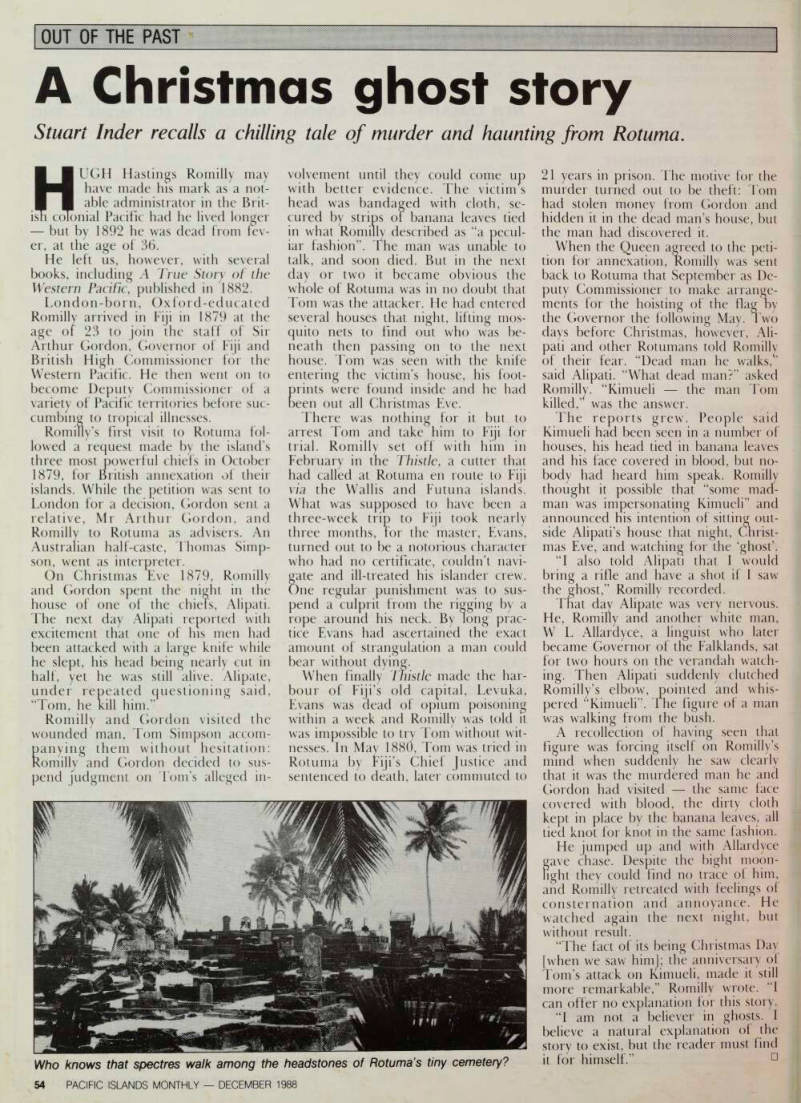
Out Of The Past
Stuart Inder recalls a chilling tale of murder and haunting from Rotuma.
HUGH Hastings Romilly may
have made his mark as a not able administrator in the Brit mial Pacific had he lived longer but by 1892 he was dead from fev er, at the age of 36.
He left us, however, with several books, including A True Story of the Western PaciTic, published in 1882.
Fondon-born, Oxford-educated Romilly arrived in Fiji in 1879 at the age of 23 to join the staff of Sir Arthur Gordon, Governor of Fiji and British High Commissioner for the Western Pacific. He then went on to become Deputy Commissioner of a variety of Pacific territories before suc
cumbing to tropical illnesses.
Romilly’s first visit to Rotuma fol lowed a request made by the island’s three most powerful chiefs in October 1879, for British annexation of their islands. While the petition was sent to London for a decision, Gordon sent a relative, Mr Arthur Gordon, and Romilly to Rotuma as advisers. An Australian half-caste, Thomas Simp son, went as interpreter.
On Christmas Eve 1879, Romilly and Gordon spent the night in the house of one of the chiefs, Alipati.
The next day Alipati reported with
excitement that one of his men had been attacked with a large knife while he slept, his head being nearly cut in half, yet he was still alive. Alipate,
under repeated questioning said,
“Tom, he Kill him.”
Romilly and Gordon visited the wounded man, Tom Simpson accom panying them without hesitation: Romilly and Gordon decided to sus
pend judgment on Tom’s alleged in
volvement until they could come up with better evidence. The victim s head was bandaged with cloth, se cured by strips of banana leaves tied in what Romilly described as “a pecul iar fashion”. The man was unable to talk, and soon died. But in the next day or two it became obvious the whole of Rotuma was in no doubt that Tom was the attacker. He had entered several houses that night, lifting mos quito nets to find out who was be neath then passing on to the next house. Tom was seen with the knife entering the victim’s house, his foot prints were found inside and he had been out all Christmas Eve.
There was nothing for it but to arrest Tom and take him to Fiji for trial. Romilly set off with him in February in the Thistle , a cutter that had called at Rotuma en route to Fiji via the Wallis and Futuna islands.
What was supposed to have been a
three-week trip to Fiji took nearly
three months, for the master, Evans, turned out to be a notorious character who had no certificate, couldn’t navi gate and ill-treated his islander crew.
One regular punishment was to sus pend a culprit from the rigging by a rope around his neck. By long prac tice Evans had ascertained the exact amount of strangulation a man could bear without dying.
When finally Thistle made the har bour of Fiji’s old capital, Levuka, Evans was dead of opium poisoning within a week and Romilly was told it was impossible to try Tom without wit nesses. In May 1880, Tom was tried in
Rotuma by Fiji’s Chief justice and
sentenced to death, later commuted to
21 years in prison. The motive for the murder turned out to be theft: Tom had stolen money from Gordon and hidden it in the dead man’s house, but the man had discovered it.
When the Queen agreed to the peti tion for annexation, Romilly was sent back to Rotuma that September as De puty Commissioner to make arrange ments for the hoisting of the flag ny the Governor the following May. Two days before Christmas, however, Ali pati and other Rotumans told Romilly of their fear. “Dead man he walks,’ said Alipati. “What dead man?” asked Romilly. “Kimueli the man Tom killed,’’ was the answer.
The reports grew. People said Kimueli had been seen in a number of houses, his head tied in banana leaves and his face covered in blood, but no
body had heard him speak. Romilly
thought it possible that “some mad man was impersonating Kimueli” and announced his intention of sitting out side Alipati’s house that night, Qirist mas Eve, and watching for the ‘ghost’.
“I also told Alipati that I would bring a rifle and have a shot if I saw
the ghost,” Romilly recorded.
That day Alipate was very nervous.
He, Romilly and another white man, W L Allardyce, a linguist who later became Governor of the Falklands, sat for two hours on the verandah watch
ing. Then Alipati suddenly clutched
Romilly’s elbow, pointed and whis pered “Kimueli”. The figure of a man was walking from the bush.
A recollection of having seen that
figure was forcing itself on Romilly’s
mind when suddenly he saw clearly that it was the murdered man he and Gordon had visited the same face covered with blood, the dirty cloth kept in place by the banana leaves, all tied knot for knot in the same fashion.
He jumped up and with Allardyce gave chase. Despite the bight moon fight they could find no trace of him, and Romilly retreated with feelings of consternation and annoyance. He watched again the next night, but without result.
“The fact of its being Christmas Day [when we saw him]; the anniversary of Tom’s attack on Kimueli, made it still more remarkable,” Romilly wrote. “I can offer no explanation for this story.
“I am not a believer in ghosts. I believe a natural explanation of the story to exist, but the reader must find it for himself.” n
Who knows that spectres walk among the headstones of Rotuma’s tiny cemetery?
Advertisements & other items, pp. 55-56 (1 item)
anyhow
have a
Winfield
the rest -f|\|£SS yOliß \
EOUSS
i 09 VV/arn making tn° itn S
Challenges Rewarded
Developing a new trend-setting car is a constant set of challenges faced on the drawing board, in the laboratory and, finally, on the test course.
For Mitsubishi Motors these challenges were embodied in a high-speed research vehicle, the Galant HSR. This prototype recorded cruising speeds in excess of 320km/h with exceptional stability and response. By incorporating state-of-the-art technologies in what was essentially an r ordinary four-cylinder coupe, the HSR made everyday high-speed driving a reality.
But the HSR was designed to test these advanced technologies as they may be applied in a distinctive passenger vehicle.
Meeting this challenge resulted in the new Mitsubishi Galant-the reward of precise engineering and a gently organic design of warmth and emotion. An individualistic sedan that was voted Japanese Car of the Year only two months after its release.
Ultimately however, the final reward belongs to you.
Introducing the new
MITSUBISHI GRLRNT
Precision in Action Mitsubishi Motors is now offering a free 36-page PR magazine featuring interesting articles and exciting photos. If interested, write to: P.l. Advertising, International Business Planning Department, Office of International Business, Mitsubishi Motors Corporation, 33-8, Shiba 5-chome, Minato-ku, Tokyo 108, Japan.
AMERICAN SAMOA: MORRIS SCANLAN SERVICE INC PO Box 367, Pago Pago Tel 633-5520/AUSTRALIA; MITSUBISHI MOTORS AUSTRALIA LTD B °* South Road, Clovelly Park, South Australia 5042, Tel (08) 275-7223/FUI: NIVIS MOTOR & MACHINERY CO., LTD. G P O Box 150, Suva, Tel 383411 /FRENCH POLYNESIA (TAHITI): ETS-BREDIN FRERES ET FILS PO Box 21, Papeete, Tahiti, Tel 4-202-58/NEW CALEDONIA; SOCIETE D IMPORTATION D AUTO DU PACIFIQUE SUD SA.
B P 438 Rond Point du Pacitique, Noumea, Tel 274144/NEW ZEALAND: MITSUBISHI MOTORS NEW ZEALAND LTD Todd Park. Heriot Drive, Private Bag, Porirua, Tel 370-109/NORFOLK ISLAND: BORRYS LTD. PO. Box 169, Norfolk Island. Tel. 2114/PAPUA NEW GUINEA: TOBA PTY LTD. PO Box 503, Port Moresby, Tel 21-7874/ SOLOMON ISLANDS: HARVEST PACIFIC LTD. G PO Box 88. Honiara, Guadalcanal, Tel. 30128/TONGA; SITANI MAPI CO.. LTD PO. Box 83, Nuku ALOFA, TeL 21044/ VANUATU; SOCOMETRA B P 06 Route de Lagon. Port-Vila, Tel 2314/WESTERN SAMOA: A M MACDONALD HOLDINGS LTD. P.O Box 576, Apia, Tel. 22022 SAIPAN/ POHNPEI/MAJURO/KOSRAE/TRUK/YAP/BELAU: MICRONESIAN MOTORS, INC. 997 South Marine Drive, Tamuning, Guam 96911, Tel 646-6827 V (2 13 JA ‘>B9 & A
MITSUBISHI
MOTORS