'Moresby' in profile
pp. 40-42 · Read in the full issue
Papua New Guinea
Photojournalist Liz Thompson profiles the city that is the leading edge of PNG’s progress into the modern world.
MODERN Port Moresby has
been painted in a bad light by the overseas press. Rascals, rape and political instability are the first things that spring to most peo ple’s minds at the mention of Papua New Guinea a product of superfi cial and often distressingly sensational ist news coverage. Most visitors pass
through ‘Moresby’ under the impress
ion that it has nothing to offer, before setting off to more remote regions in pursuit of the much advertised ‘Land of the Unexpected’.
But despite the tourists’ fascination with so-called primitive culture, Papua New Guinea is at the same time a land that is busy carving a place for itself in the modern worlcf.
It was little more than 50 years ago that the first European explorers en countered the people of the New Guinea Highlands people who had no idea that a world existed beyond their mountain ranges. Barely a gen eration later, Papua New Guinea is an independent country, has adopted a Western legal and political system, has a National Broadcasting Commission, its own television station and five ma jor newspapers. It is developing in comparison with the West’s experience
of development at lightning speed.
The result is, of course, a fair share of problems difficulties that must be expected and understood in the context of such radical changes but on the other side of the coin there is much creativity; much charm, as ele ments of tradition find themselves in a technological age; and as well as strides into the future a careful con cern to retain elements of culture and heritage in this ‘new’ world. Papua New Guinea is a country struggling to come to terms with the 20th century in the space of decades ... a fact that is all too frequently forgotten.
Criticism would be better directed at the ‘entertainment’ being brought into PNG (predominantly from Australia) and the effects it is having. Rambo videos line the shelves, Sylvester Stal lone glowers from a tnousand T shirts. Just which elements of Western culture are being imported . . . and what responsibility is the West pre pared to take for their effects? Cine ma hoardings show muscular, sweat ing men brandishing torches and chains as they protect passive women: how can the nations that export such images condemn the attitudes (and the
crime) they encourage?
There is much to be positive about in PNG and Port Moresby: especially the excitement of a country in transi tion. It is a place of juxtapositions: at this year’s University of Papua New Guinea graduation ceremony, some students collecting their degrees were
dressed in mortarboards and gowns while others, in red ochre and pig fat, pigs’ tusks and feathers, celebrated their culture as well as their achieve ments. A Huli wigman, his face
painted bright yellow and body
smeared with oil, shook the Chancel lor’s hand as he received his Bache
lor’s degree in psychology.
Five Journalists graduated from UNPG this year, the first to complete a new four-year BA in journalism.
They may well work on one of the country’s national newspapers. The Papua New Guinea Post-Courier, a
national English-language daily, is
considered the most sophisticated in the South Pacific.
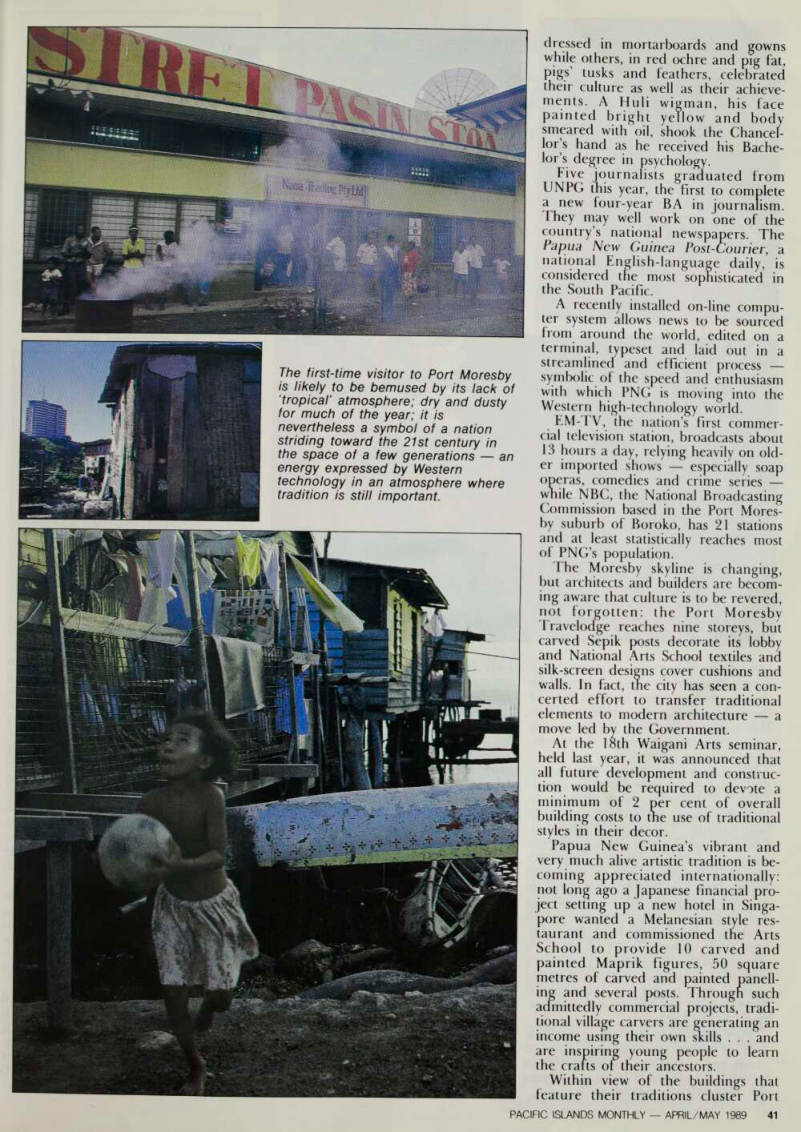
A recently installed on-line compu ter system allows news to be sourced from around the world, edited on a terminal, typeset and laid out in a streamlined and efficient process symbolic of the speed and enthusiasm with which PNG is moving into the Western high-technology world.
EM-Ty, the nation’s first commer cial television station, broadcasts about 13 hours a day, relying heavily on old er imported shows especially soap operas, comedies and crime series wnile NBC, the National Broadcasting Commission based in the Port Mores by suburb of Boroko, has 21 stations and at least statistically reaches most of PNG’s population.
The Moresby skyline is changing,
but architects and builders are becom ing aware that culture is to be revered, not forgotten: the Port Moresby Travelodge reaches nine storeys, but carved Sepik posts decorate its lobby and National Arts School textiles and silk-screen designs cover cushions and walls. In fact, tne city has seen a con certed effort to transfer traditional elements to modern architecture a move led by the Government.
At the 18th Waigani Arts seminar, held last year, it was announced that all future development and construc tion would be required to devote a minimum of 2 per cent of overall building costs to tne use of traditional styles in their decor.
Papua New Guinea’s vibrant and very much alive artistic tradition is be
coming appreciated internationally:
not long ago a Japanese financial pro ject setting up a new hotel in Singa pore wanted a Melanesian style res taurant and commissioned the Arts School to provide 10 carved and
painted Maprik figures, 50 square
metres of carved and painted panell ing and several posts. Through such
admittedly commercial projects, tradi
tional village carvers are generating an income using their own skills . . . and are inspiring young people to learn the crafts of their ancestors.
Within view of the buildings that feature their traditions cluster Port
The first-time visitor to Port Moresby is likely to be bemused by its lack of ‘tropical’ atmosphere; dry and dusty for much of the year; it is nevertheless a symbol of a nation striding toward the 21st century in the space of a few generations - an energy expressed by Western technology in an atmosphere where tradition is still important.
Moresby’s villages and squatter settle ments. People who have migrated to the city seeking work have established themselves at the Two-Mile and Six- Mile settlements, where shanties perch among the trees, on rocks or on sun scorched bare ground.
Religion is immensely important to PNG, and the people gather in a mul titude of churches every Sunday to hear the gospel from dozens of diffe rent creeds. The Bible Translation Society is working to ensure that the speakers of PNG’s 700-odd languages can read the good book in their own idioms. Seventh Day Adventists refuse to work on Saturdays a belief that has known to cause problems when elections are scheduled for their sab bath while villagers living on the city’s perimeters still observe customary ceremonies, and parents of the young women who attend the International High School will still on occasions re quest bride price.
Port Moresby’s markets are a bed lam of colour and variety: rows of fruits and vegetables are piled high in
precarious pyramids, black aubergines
next to bright pink jamalacs; green
mounds of watercress, cabbage and spinach distract the eye from mussels threaded on to vines to form necklaces of seafood. Parrotfish and barramundi lie across concrete tables not far from rounds of charred wallabies.
Heavily tattooed women lug huge bilums full of taro and kau kau, while
at Steamships department store High
landers in Knitted hats spend hours watching people move up and down the escalators. A glittering, chattering array of VCRs, television sets and stereo systems bears witness to the growth of a consumer society . . . and bursting sausages and mounds of chips at the fast-food counter bear wit ness to the invasion of Western con cepts of ‘nutrition’.
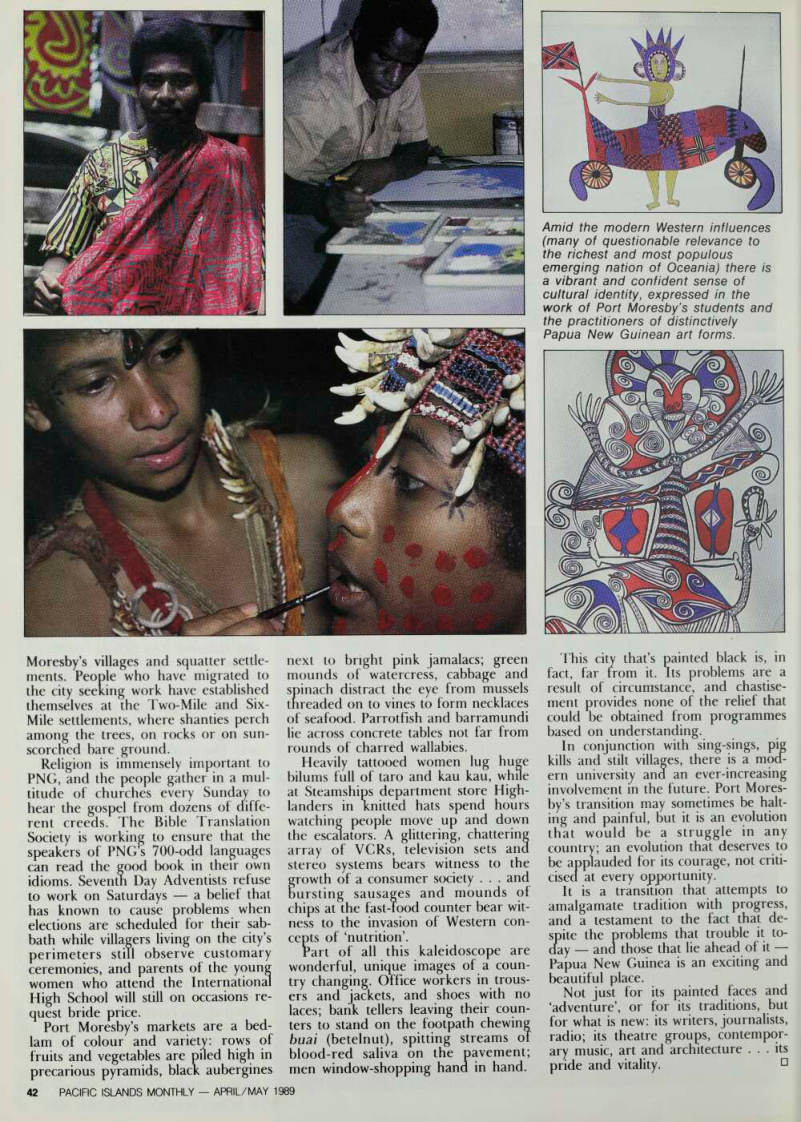
Part of all this kaleidoscope are wonderful, unique images of a coun try changing. Office workers in trous ers and jackets, and shoes with no laces; bank tellers leaving their coun ters to stand on the footpath chewing buai (betelnut), spitting streams of blood-red saliva on the pavement; men window-shopping hand in hand.
This city that’s painted black is, in fact, far from it. Its problems are a result of circumstance, and chastise ment provides none of the relief that could be obtained from programmes based on understanding.
In conjunction with sing-sings, pig
kills and stilt villages, there is a mod ern university and an ever-increasing involvement in the future. Port Mores by’s transition may sometimes be halt ing and painful, but it is an evolution that would be a struggle in any country; an evolution that deserves to be applauded for its courage, not criti cised at every opportunity.
It is a transition that attempts to amalgamate tradition with progress, and a testament to the fact that de spite the problems that trouble it to day ana those that lie ahead of it Papua New Guinea is an exciting and
beautiful place.
Not just for its painted faces and ‘adventure’, or for its traditions, but for what is new: its writers, journalists, radio; its theatre groups, contempor ary music, art and architecture ... its
pride and vitality. D
Amid the modern Western influences (many of questionable relevance to the richest and most populous emerging nation of Oceania) there is a vibrant and confident sense of cultural identity, expressed in the work of Port Moresby’s students and the practitioners of distinctively Papua New Guinean art forms.