The snake that ate Guam
pp. 24-25 · Read in the full issue
Marianas
David North reports on a feral animal that threatens wildlife and people.
THE SCREAMS of the five month-old baby brought her pa rents rushing to her room late on the night of March 3. They found their daughter with snakebite punc tures on her arm: her mother lifted her from her cot while her father kil led the 1.8-metre-long snake just as it was crawling into the cot where the girl’s twin brother was sleeping.
While undergoing treatment at the
hospital, the 5.7 kilogram girl sudden
ly stopped breathing ana went into
cardiac arrest. Emergency treatment revived her and she survived the har rowing ordeal, but nightmarish inci dents such as this the third re corded snake attack on a child re corded in Guam in the past two years are threatening to become more
frequent in the UJ? territory.
Guam, riding a wave of economic expansion on bustling tourism and de fence industries, has found itself bit ten by a resilient reptile that is creat
ing increasing environmental, econo
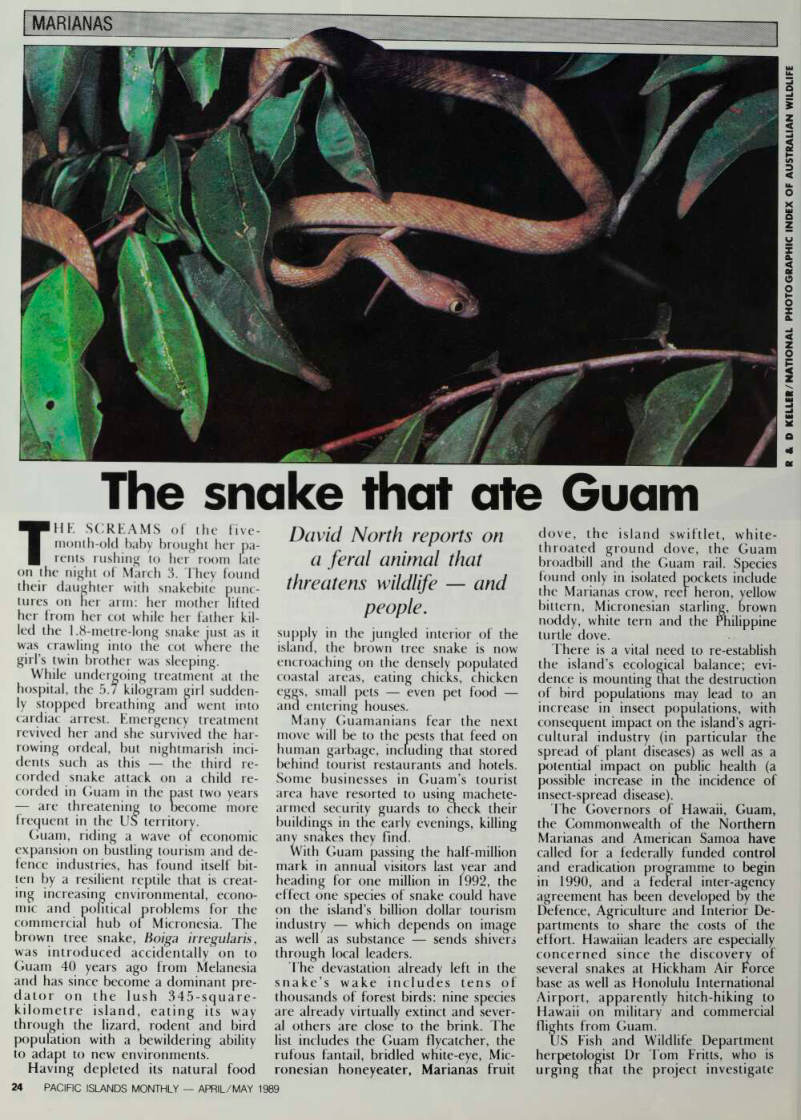
mic and political problems for the commercial hub of Micronesia. The brown tree snake, Boiga irregularis, was introduced accidentally on to Guam 40 years ago from Melanesia and has since become a dominant pre dator on the lush 345-square kilometre island, eating its way through the lizard, rodent and bird
population with a bewildering ability
to adapt to new environments.
Having depleted its natural food
supply in the jungled interior of the island, the brown tree snake is now
encroaching on the densely populated
coastal areas, eating chicks, chicken eggs, small pets even pet food and entering houses.
Many Guamanians fear the next move will be to the pests that feed on human garbage, including that stored behind tourist restaurants and hotels.
Some businesses in Guam’s tourist area have resorted to using machete armed security guards to check their
buildings in the early evenings, killing
any snakes they fma.
With Guam passing the half-million mark in annual visitors last year and heading for one million in 1992, the effect one species of snake could have on the island’s billion dollar tourism
industry which depends on image
as well as substance sends shivers through local leaders.
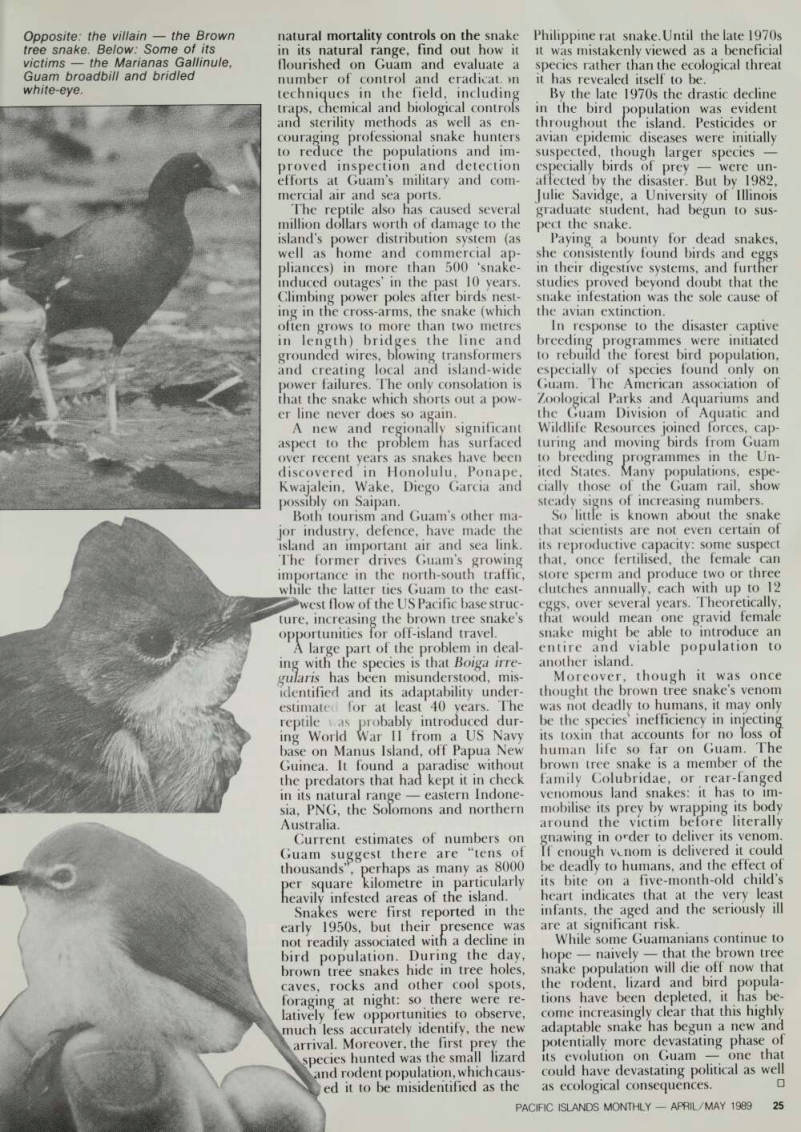
The devastation already left in the snake’s wake includes tens of thousands of forest birds: nine species are already virtually extinct and sever al others are close to the brink. The list includes the Guam flycatcher, the rufous fantail, bridled white-eye, Mic ronesian honeyeater, Marianas fruit
dove, the island swiftlet, white throated ground dove, the Guam broadbill and the Guam rail. Species found only in isolated pockets include the Marianas crow, reef heron, yellow bittern, Micronesian starling, brown noddy, white tern and the Philippine turtle dove.
There is a vital need to re-establish the island’s ecological balance; evi dence is mounting that the destruction of bird populations may lead to an increase in insect populations, with
consequent impact on the island’s agri
cultural industry (in particular the spread of plant diseases) as well as a
potential impact on public health (a
possible increase in tne incidence of
insect-spread disease).
The Governors of Hawaii, Guam, the Commonwealth of the Northern Marianas and American Samoa have called for a federally funded control and eradication programme to begin in 1990, and a federal inter-agency agreement has been developed by the Defence, Agriculture and Interior De partments to share the costs of the effort. Hawaiian leaders are especially concerned since the discovery of several snakes at Hickham Air Force base as well as Honolulu International
Airport, apparently hitch-hiking to
Hawaii on military and commercial flights from Guam.
US Fish and Wildlife Department herpetologist Dr Tom Fritts, who is urging that the project investigate
R & D KELLER/NATIONAL PHOTOGRAPHIC INDEX OF AUSTRALIAN WILDLIFE
natural mortality controls on the snake in its natural range, find out how it flourished on Guam and evaluate a number of control and eradicat. m techniques in the field, including traps, chemical and biological controls ana sterility methods as well as en
couraging professional snake hunters
to reduce the populations and im
proved inspection and detection
efforts at Guam’s military and com mercial air and sea ports.
The reptile also has caused several million dollars worth of damage to the island’s power distribution system (as well as home and commercial ap pliances) in more than 500 ‘snake induced outages’ in the past 10 years.
Climbing power poles after birds nest ing in the cross-arms, the snake (which often grows to more than two metres in length) bridges the line and
grounded wires, blowing transformers
and creating local and island-wide power failures. The only consolation is that the snake which shorts out a pow er line never does so again.
A new and regionally significant aspect to the problem nas surfaced over recent years as snakes have been discovered in Honolulu, Ponape, Kwajalein, Wake, Diego Garcia and
possibly on Saipan.
Both tourism and Guam’s other ma jor industry, defence, have made the island an important air and sea link.
The former drives Guam’s growing importance in the north-south traffic, while the latter ties Guam to the eastflow of the US Pacific base struc ture, increasing the brown tree snake’s opportunities for off-island travel.
A large part of the problem in deal ing with the species is that Boiga irre gularis has been misunderstood, mis identified and its adaptability under estimate for at least 40 years. The
reptile v as probably introduced dur
ing World War II from a US Navy base on Manus Island, off Papua New Guinea. It found a paradise without the predators that had kept it in check in its natural range eastern Indone sia, PNG, the Solomons and northern Australia.
Current estimates of numbers on Guam suggest there are “tens of thousands’, perhaps as many as 8000 per square Kilometre in particularly neavily infested areas of the island.
Snakes were first reported in the early 19505, but their presence was not readily associated witn a decline in
bird population. During the day,
brown tree snakes hide in tree holes, caves, rocks and other cool spots, foraging at night: so there were re latively few opportunities to observe, kmuch less accurately identify, the new m, arrival. Moreover, the first prey the species hunted was the small lizard \J|Land rodent population, whichcaus ed it to be misidentified as the
Philippine rat snake. Until the late 1970 s it was mistakenly viewed as a beneficial species rather than the ecological threat it has revealed itself to be.
By the late 1970 s the drastic decline in the bird population was evident throughout tne island. Pesticides or avian epidemic diseases were initially
suspected, though larger species
especially birds of prey were un affected by the disaster. But by 1982,
Julie Savidge, a University of Illinois
graduate student, had begun to sus pect the snake.
Paying a bounty for dead snakes, she consistently found birds and eggs in their digestive systems, and further studies proved beyond doubt that the snake infestation was the sole cause of the avian extinction.
In response to the disaster captive breeding programmes were initiated to rebuild the forest bird population,
especially of species found only on
Guam. The American association of Zoological Parks and Aquariums and the Guam Division of Aquatic and Wildlife Resources Joined forces, cap turing and moving birds from Guam to breeding programmes in the Un ited States. Many populations, espe cially those of tne Guam rail, show
steady signs of increasing numbers.
So little is known about the snake that scientists are not even certain of its reproductive capacity: some suspect that, once fertilised, the female can store sperm and produce two or three clutches annually, each with up to 12 eggs, over several years. Theoretically, tbat would mean one gravid female snake might be able to introduce an entire and viable population to another island.
Moreover, though it was once thought the brown tree snake’s venom was not deadly to humans, it may only
be the species’ inefficiency in injecting
its toxin that accounts for no loss of human life so far on Guam. The brown tree snake is a member of the
family Colubridae, or rear-fanged
venomous land snakes: it has to im mobilise its prey by wrapping its body around the victim before literally gnawing in o r der to deliver its venom.
If enough Venom is delivered it could be deadly to humans, and the effect of its bite on a five-month-old child’s heart indicates that at the very least infants, the aged and the seriously ill are at significant risk.
While some Guamanians continue to hope naively that the brown tree snake population will die off now that the rodent, lizard and bird popula tions have been depleted, it has be come increasingly clear that this highly adaptable snake has begun a new and
potentially more devastating phase of
its evolution on Guam one that could have devastating political as well as ecological consequences. □
Opposite: the villain - the Brown tree snake. Below: Some of its victims - the Marianas Gallinule, Guam broadbill and bridled white-eye.